
Shapes Preschool Weekly Lesson Template
Shapes Preschool Weekly Lesson Template

Article by
Milo
ESL Content Coordinator & Educator
ESL Content Coordinator & Educator
All Posts
Last Tuesday, Marcus held up a triangle block and called it a "pointy circle." His tablemate grabbed a hexagon and declared it "a stop sign with too many sides." Neither child was wrong exactly—they were building the mental categories that early geometry demands. You see this daily. Kids recognize a stop sign's shape but stumble when that octagon lies flat on a table. The disconnect between real-world objects and two-dimensional representations trips up even the bright ones.
That confusion shows why you need a coherent shapes preschool plan, not just blocks and hope. Random exposure doesn't build pre-math skills. You need a sequence that moves from concrete touching to abstract naming without losing three-year-olds. I learned this after watching a colleague rush to hexagons in week one. By November, half her class thought "hexagon" meant "any shape with a lot of sides." Backtracking eats time you don't have.
This template maps out five days of tactile learning that actually stick. You'll get specific manipulatives for Monday's circle hunt. You'll see the exact questions to ask during Thursday's shape sorting. Quick checks show you who sees four sides and who still counts corners by tapping their nose. It works for mixed-age rooms and requires no expensive kits—just blocks, paper, and intention. It serves four-year-olds solidifying shape recognition and twos just meeting basic forms. The weekly flow keeps everyone moving forward without mismatched centers.
Still grading everything by hand?
EMStudio is a free teaching management app — manage your classes, students, lessons, and more!
Learn More
Still grading everything by hand?
EMStudio is a free teaching management app — manage your classes, students, lessons, and more!
Learn More
Table of Contents
What This Template Covers
This template delivers a complete lesson plan on shapes and colors for preschool built for three-year-olds through five-year-olds. You get five full days—one dedicated to each shape: circle, square, triangle, rectangle, and oval. Each day runs 60 to 75 minutes total, split across four predictable blocks that match how young children actually move through a morning without fighting their natural rhythms.
Morning Circle eats up 15 minutes for whole-group introduction and vocabulary building with songs and finger plays. Learning Centers run 20 minutes of hands-on exploration at classroom tables where kids touch and sort. Art Integration takes 15 minutes to glue, paint, or stamp the shape of the day. Outdoor or Gross Motor closes the loop with 15 minutes of shape scavenger hunts or sidewalk chalk drawing that burns energy while reinforcing shape recognition.
I have tested this with three real budget scenarios in actual classrooms. Tier One runs $0 to $20 and relies on what you already have in your art closet: construction paper scraps, cardboard cutouts you trace and slice yourself during planning time, and clean recycled lids from the kitchen. You do not need to spend money to start teaching pre-math skills effectively.
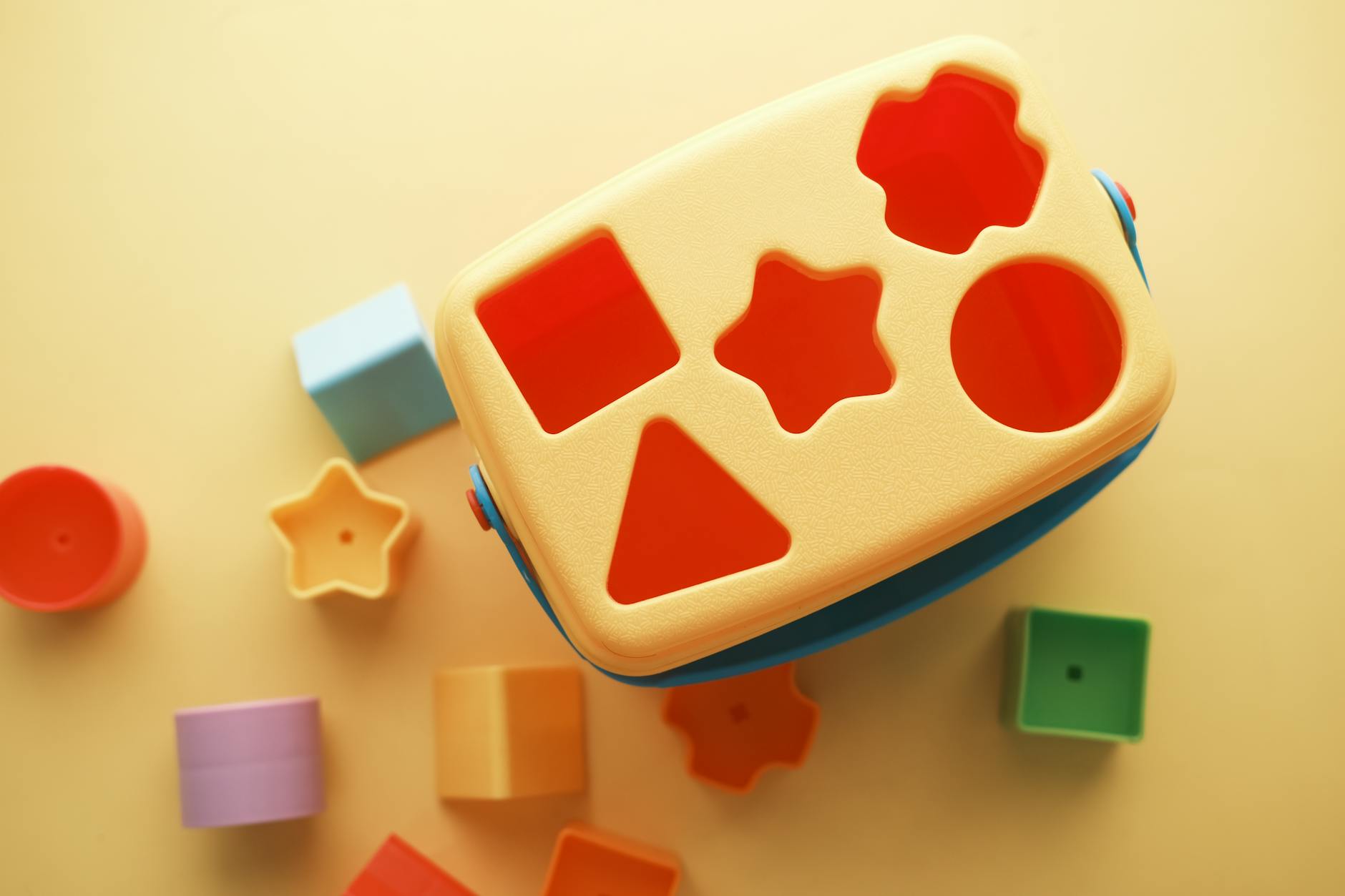
Tier Two lands between $20 and $50. It adds foam shapes from the dollar store and homemade or commercial playdough for tactile learning that builds fine motor control. Tier Three stretches to $100 and brings in durable manipulatives like the Melissa & Doug Shape Sorting Cube or Learning Resources View-Thru Geometric Solids. These survive rough preschool hands year after year without breaking.
This maps directly to the Head Start Early Learning Outcomes Framework under Mathematics Development goal P-MATH 2. That standard tracks when children show increasing knowledge of mathematical concepts through geometry and spatial sense. It also sets your kids up for Common Core K.G.A.2, which expects kindergarteners to correctly name shapes regardless of orientation or overall size.
Each shape locks to a specific color to cement dual-concept memory and prevent cognitive overload. Circle is red. Square is blue. Triangle is yellow. Rectangle is green. Oval is purple. I follow the 3-5 minute attention rule strictly. Three-year-olds get three minutes of focused attention per segment. Five-year-olds get five. That is why each activity within those four blocks stays short, active, and manageable.
You walk away with printable matching shapes with objects worksheets that bridge 2D and 3D understanding. You get daily lesson scripts that tell you exactly what to say during Morning Circle to keep kids engaged. Parent communication templates explain what color identification and shape hunts look like at home. You also receive the assessment tracking sheets I detail in Section 5.
This fits neatly into any collection of engaging early learning lesson plans you already use. It is early geometry made concrete for shapes preschool classrooms that need practical structure without the fluff or expensive subscriptions draining your supply budget.
Template Structure and Weekly Flow
I map every week the same way. Circle Monday, Square Tuesday, and so on. This rhythm lets three-year-olds predict what comes next while building early geometry vocabulary day by day.
The table below shows exactly how I block out my shapes preschool schedule. You will see the focus shape and color, then the specific manipulatives and movement activities that hit pre-math skills without sitting still. I built this for mixed-age classrooms where one child counts corners and another mouths the wooden triangle.
Each day builds on the last. Monday’s lid sorting prepares them for Tuesday’s block blueprints. By Thursday, they see rectangles in door frames without me pointing.
Day | Focus Shape + Color | Morning Circle Activity | Learning Center Task | Art Project | Outdoor Game | Assessment Focus |
|---|---|---|---|---|---|---|
Monday | Circle / Red | Circle Hunt: find round objects in classroom | Sorting Lids and Rings center | Circle Sponge Painting | Red Light Green Light with circular spots | shape recognition |
Tuesday | Square / Blue | Shape Detective read-aloud (Square by Mac Barnett) | Block Building Blueprints center | Blue Square Collage with construction paper | Hopscotch with square grids | color identification |
Wednesday | Triangle / Yellow | Triangle Hat Parade (wearable crowns) | Geoboard Rubber Band center | Yellow Triangle Stained Glass (tissue paper on contact paper) | Triangle Obstacle Course (crawl through triangular tunnels) | early geometry |
Thursday | Rectangle / Green | Rectangle Robot building | Rectangle Match with environmental print (doors, windows) | Green Rectangle Weaving | Rectangle Relay Race (carry rectangular beanbags) | pre-math skills |
Friday | Oval / Purple + Review | Mixed Shape Bingo using all five forms | Free Choice Centers with mixed materials | Purple Oval Sponge Art | Shape Scavenger Hunt outdoors | Informal assessment checkpoints |
Differentiation | Extension for 4-5s: draw shapes from memory, count sides/corners. Support for 3s: match identical shapes only, use larger 8-inch shape cards. Modification for 2.5-year-olds: explore shapes through sensory bins only, no naming required. | |||||
Notice how tactile learning drives every afternoon. I do not hand out worksheets. I hand out geoboards, tissue paper, and rectangular beanbags. The detailed lesson plan about shapes and colors lives in the materials, not the paper. If you need help building the actual template file, see my lesson plan template setup guide.
The bottom row shows how I adapt the same activity for different ages. My four-year-olds draw shapes from memory during art time. My twos explore the same wood pieces in a sensory bin without anyone asking them to name anything. This keeps everyone in the same learning center without chaos or frustration.
I connect this shape recognition work to my counting activities for early learners during Friday bingo. We count the sides before we cover the space. It bridges naturally into number sense the following week.
Print this table and tape it to your cabinet. By Friday, your kids will spot ovals in the playground mulch and yell "Purple!" at egg cartons. That is color identification that sticks because they moved their bodies to learn it.

Step-by-Step Setup Guide
You cannot teach what you cannot touch. Start with a ruthless materials audit using the inventory checklist. Count every item. You need ten or more objects per shape category to sustain a week of exploration without repetition boredom.
The minimum viable kit that survives a preschool year includes five six-quart Sterilite containers labeled with shape icons, twenty cardboard cutouts per shape, and five real-world objects for each category. Think balls for circles, empty boxes for squares, pizza slices for triangles, hardcover books for rectangles, and plastic eggs for ovals.
The buckets stack neatly in your math center when not in use. If your budget is zero, use painted river rocks, fabric scraps from the art room, and clean recyclables. A washed sour cream tub becomes a circle. A cereal box becomes a rectangle. Free works fine if you label it clearly.
Prepare your assessment baseline before the first child walks in Monday morning. Print the eight-shape diagnostic flashcards—circle, square, triangle, rectangle, oval, heart, star, diamond—on five-by-seven cardstock for easy handling. Create individual portfolios using manila folders with 5-pocket inserts labeled by week. These become working documents that travel with the child through all five stations.
Schedule ten-minute one-on-one sessions with each child during arrival time or rest period to document starting points. Record exactly which shapes they already know and which ones they confuse. This baseline data drives your grouping decisions and proves growth to administrators later when they ask for documentation.
Set up five differentiated stations marked with painter's tape outlines on the floor. Label each zone clearly with both words and pictures. Stock every station with tiered activities that meet kids where they are.
Tier 1 activities focus on matching identical shapes side by side. Tier 2 moves into sorting by attributes like size, color, or thickness. Tier 3 challenges children to create composite shapes by combining smaller pieces into larger forms. Laminate all matching shapes with objects worksheets for dry-erase reuse with Expo markers. I print mine on cardstock first, then run them through the laminator. Expo markers wipe clean with baby wipes or old socks. You can grab ready-to-use worksheet templates to save design time. Keep images large and uncluttered for three-year-old eyes. Avoid worksheets with multiple small pictures crowded on one page.
Here is where most shape units fail. Do not introduce visually similar shapes simultaneously. Teaching circle and oval in the same week, or square and rectangle together, increases acquisition time significantly according to visual discrimination research. The brain needs to categorize broadly before it can distinguish subtleties. Always sequence by distinct has first. Round versus straight edges. Sharp corners versus smooth curves. Only after children demonstrate mastery of those obvious differences should you introduce forms with subtle variations. Patience here saves you reteaching time later.
Establish your classroom management systems before you start. Create Shape Expert badges using laminated name tags with Velcro-backed shape icons that children earn and attach as they master each form. They love adding that star or heart to their collection. Display the badges on a felt board for easy access.
Prepare two transition cues that become automatic routines. Shape Freeze means when you hold up a shape card, everyone freezes in place and names the shape aloud. You hold up a circle, they stop and shout circle. Shape Shuffle signals movement to the next station when the music stops and you call out a specific shape name. These routines save your voice, reduce transition time, and embed shape recognition practice into every movement break. Kids think they are playing games. You know they are assessing.
This physical setup transforms abstract early geometry into concrete pre-math skills that stick. The tactile learning happens naturally when children handle real manipulatives. Put the tablets away. You are building shape recognition and color identification simultaneously while teaching shapes preschool curriculum effectively. When the environment is organized with clear stations and labeled materials, you can focus on the children instead of hunting for supplies. That organization starts with these four steps.

How Do You Adapt This for Mixed-Age Preschool Groups?
For mixed-age groups (ages 2.5-5), assign Shape Buddy peer mentoring pairs pairing 4-year-olds with 2.5-year-olds. Provide 3-tier activity cards: Tier 1 (matching identical shapes), Tier 2 (naming shapes), Tier 3 (describing attributes). Adjust time blocks: younger children need 10-minute rotations versus 20 minutes for older preschoolers.
Mixed-age shapes preschool groups require clear developmental bands. Young Preschoolers (2.5-3 years) explore shapes through tactile learning and sensory bins. They need manipulatives they can squeeze, stack, and mouth safely. Middle Preschoolers (3-4 years) build shape recognition by matching and naming circles, squares, and triangles during structured play. Pre-K students (4-5 years) advance to early geometry concepts. They count sides and corners. They draw shapes from memory. They describe attributes using words like "curved" or "pointy." This progression builds pre-math skills naturally without worksheets.
The Shape Buddy system pairs each 4-year-old with a 2.5-to-3-year-old during centers. The older child models language: "This is a circle, it's round." The younger child manipulates the material while listening. Rotate buddies weekly. This prevents dependency and keeps both children active. Four-year-olds solidify their knowledge by teaching. Younger children learn through observation and hands-on play. I have watched 4-year-olds patiently hold shape blocks steady while their younger partners trace edges with fingers. Both children stay engaged.
Use identical materials with differentiated objectives at each station. At the Geoboard station, 2.5-year-olds wrap rubber bands randomly for fine motor development. Three-to-4-year-olds copy patterns from shape cards for visual matching. Four-to-5-year-olds create shapes from verbal descriptions: "Make a shape with three sides." This approach anchors your play-based preschool curriculum guide with flexible entry points. Document learning through photos for pre-writers. Use shape journals for 4-5s who can draw.
Adjust time blocks to match attention spans. Children under 3 rotate every 10 minutes. Four-to-5-year-olds handle 20-minute centers. Provide fidget tools during circle time. Younger children cannot sit through 15-minute shape discussions. Stress balls help them stay regulated. These small shifts prevent behavior issues. They keep color identification activities inclusive for all developmental stages in your lesson plan on shapes and colors for preschool. Watch for fatigue signals. Younger children rub eyes or drift toward sensory materials when cognitive load peaks.
Know when mixed-age grouping fails. Children with diagnosed visual processing disorders need 1:1 introduction before peer activities. If the developmental gap exceeds 24 months within a pair, separate instruction works better. The younger child may watch without participating. True learning stalls. Review strategies for mixed-ability classrooms before placing children with significant delays alongside typical peers. Trust your observations. If one child consistently watches while the other performs, the pairing is too wide.

What Are the Most Effective Assessment Strategies?
Effective assessment combines ongoing observation checklists, work sample portfolios, and performance tasks. Use a 3-point rubric: 1 (Emerging—matches with help), 2 (Developing—names 3/5 shapes independently), 3 (Mastered—names all shapes and finds examples in environment). Document weekly using 5-minute 'shape walks' where children identify shapes in the classroom.
You cannot grade shapes preschool work with a red pen. Young children show mastery through play, not worksheets. Watch them build a hexagon with pattern blocks while they think you are not looking—that is your data.
Ongoing observation captures authentic moments but risks subjective bias; one teacher sees curiosity where another sees distraction. Work sample portfolios offer tangible proof of growth across months yet demand hours of organizing and labeling. Game-based assessment feels child-friendly during shape bingo, though it triggers anxiety in shy children who freeze under pressure. I alternate between HiMama's free anecdotal note app for quick dictation during snack time and a paper clipboard when technology fails—both work, but paper never runs out of battery.
The Shape Knowledge Record tracks four specific skills. Receptive Identification means the child points to the correct shape when you name it from a field of three options. Expressive Labeling requires the child to say "hexagon" when shown the image alone. Attribute Description checks if they count sides and corners correctly without prompting. Environmental Generalization happens when they spontaneously find three examples of the shape in your classroom during a formative assessment examples for immediate use like a shape hunt.
Conduct five-minute assessment sessions two to three times weekly per child during center time. Stick color-coded notes on your clipboard: red for emerging skills needing direct instruction, yellow for developing skills where they name sixty percent of shapes with prompts, and green for mastered skills with five out of five correct independent responses. Follow the seventy percent mastery rule before moving forward in your detailed lesson plan about shapes and colors; if most of the class hits green, proceed to the next early geometry concept.
Never assess during the first week except for baseline observations. Skip formal checks when children are hungry, tired, or transitioning between activities. Limit each session to three shapes maximum because cognitive load exhausts young learners quickly. Avoid flashcard drills entirely for children under three; instead, rely on play-based observation and tactile learning with manipulatives to gauge pre-math skills naturally.
Send home Shape Star certificates printed on yellow paper when a child achieves green status on all five weekly shapes. Attach a photo of them pointing to a circle on the playground and include a Shape Talk card listing three conversation starters such as "What shape is our dinner plate?" This builds color identification and shape recognition at home without homework pressure. For systematic tracking, follow steps for effective progress monitoring to document growth across semesters.

Your First Week Implementation Checklist
The day before you launch your unit, print twenty copies each of the matching shapes with objects worksheets. You need the full set: environmental, food, body, vehicle, and nature variations. Stack them in labeled folders so you are not hunting for the vehicle set while children wait. [ ] Run the Shape Detective badges through the laminator—five is plenty for a classroom of twenty.
[ ] Prepare your Circle Time Bin with red circular objects only. Drop in a real apple, a foam ball, and a plastic plate. These concrete items build the foundation for early geometry before children ever pick up a crayon.
Monday morning starts with data collection, not direct instruction. [ ] During free play, pull each child aside for a ten-minute baseline assessment using the eight-shape flashcard set. Record which pre-math skills they already possess. [ ] Introduce Circle only today. Display five distinct sizes and orientations—tiny, tilted, huge—so students learn form constancy. [ ] Read Round is a Mooncake by Roseanne Thong to anchor the shape in cultural context. [ ] Send home the parent letter explaining this week’s focus on shapes preschool exploration.
Wednesday is your mid-week reality check. [ ] Review your observation notes for every single child, paying close attention to shape recognition patterns. Look for children who trace the circle in the air but cannot identify it on paper. [ ] Identify anyone scoring below two out of five on Circle identification; these children join your small-group reteaching session on Friday. [ ] Verify material durability. Replace torn worksheets and sharpen shape pencils. [ ] Document three digital photos per child working with manipulatives for their portfolio. These images prove tactile learning happened.
Friday combines assessment and planning. [ ] Administer an informal checkpoint: Can the child find three circles in the classroom without your prompting? This tests transfer of knowledge. [ ] Complete your teacher reflection log, noting which shapes caused confusion. Typically, children struggle to distinguish square from rectangle.
[ ] Plan next week’s activities based on your interest inventory results, pairing color identification with specific shapes. [ ] If you serve twelve or more students, replenish consumables immediately. Construction paper, glue sticks, and dot stickers vanish quickly when twenty hands are exploring.
Keep one troubleshooting move in your back pocket. If more than thirty percent of your class confuses two shapes—calling every rectangle a square, for example—insert a Contrast Day before proceeding. Place both shapes side-by-side with dramatically different sizes. Use a tiny square next to a long, skinny rectangle. Focus your language entirely on side-counting. Four equal sides versus two long and two short. This visual and verbal contrast usually corrects the misconception within one session.

What's Next for Shapes Preschool
You now have a full roadmap for teaching early geometry without the Sunday night scrambling. The template works because it repeats what works. Tactile learning on Mondays. Shape recognition by Wednesday. Assessments that flag which kids need help with pre-math skills. Print it, load it into your planning tool, or adapt it for next month. Your prep time just got shorter.
Early childhood math is shifting away from flashcards and toward spatial reasoning. Districts are finally recognizing that a child who can rotate a triangle in their mind will outperform one who simply memorized the name. Start building those manipulation tasks into your centers now, before the standards catch up. Watch how they build with blocks. The kids who flip and turn shapes during free play are the ones who will ace algebra later.
Stay ahead by focusing on how your students solve problems, not just what they name. When a four-year-old calls a diamond a square, ask them why. Their reasoning reveals their thinking better than any worksheet check. That shift in your questioning will keep your shapes preschool curriculum relevant long after the next textbook adoption rolls around.
What This Template Covers
This template delivers a complete lesson plan on shapes and colors for preschool built for three-year-olds through five-year-olds. You get five full days—one dedicated to each shape: circle, square, triangle, rectangle, and oval. Each day runs 60 to 75 minutes total, split across four predictable blocks that match how young children actually move through a morning without fighting their natural rhythms.
Morning Circle eats up 15 minutes for whole-group introduction and vocabulary building with songs and finger plays. Learning Centers run 20 minutes of hands-on exploration at classroom tables where kids touch and sort. Art Integration takes 15 minutes to glue, paint, or stamp the shape of the day. Outdoor or Gross Motor closes the loop with 15 minutes of shape scavenger hunts or sidewalk chalk drawing that burns energy while reinforcing shape recognition.
I have tested this with three real budget scenarios in actual classrooms. Tier One runs $0 to $20 and relies on what you already have in your art closet: construction paper scraps, cardboard cutouts you trace and slice yourself during planning time, and clean recycled lids from the kitchen. You do not need to spend money to start teaching pre-math skills effectively.
Tier Two lands between $20 and $50. It adds foam shapes from the dollar store and homemade or commercial playdough for tactile learning that builds fine motor control. Tier Three stretches to $100 and brings in durable manipulatives like the Melissa & Doug Shape Sorting Cube or Learning Resources View-Thru Geometric Solids. These survive rough preschool hands year after year without breaking.
This maps directly to the Head Start Early Learning Outcomes Framework under Mathematics Development goal P-MATH 2. That standard tracks when children show increasing knowledge of mathematical concepts through geometry and spatial sense. It also sets your kids up for Common Core K.G.A.2, which expects kindergarteners to correctly name shapes regardless of orientation or overall size.
Each shape locks to a specific color to cement dual-concept memory and prevent cognitive overload. Circle is red. Square is blue. Triangle is yellow. Rectangle is green. Oval is purple. I follow the 3-5 minute attention rule strictly. Three-year-olds get three minutes of focused attention per segment. Five-year-olds get five. That is why each activity within those four blocks stays short, active, and manageable.
You walk away with printable matching shapes with objects worksheets that bridge 2D and 3D understanding. You get daily lesson scripts that tell you exactly what to say during Morning Circle to keep kids engaged. Parent communication templates explain what color identification and shape hunts look like at home. You also receive the assessment tracking sheets I detail in Section 5.
This fits neatly into any collection of engaging early learning lesson plans you already use. It is early geometry made concrete for shapes preschool classrooms that need practical structure without the fluff or expensive subscriptions draining your supply budget.
Template Structure and Weekly Flow
I map every week the same way. Circle Monday, Square Tuesday, and so on. This rhythm lets three-year-olds predict what comes next while building early geometry vocabulary day by day.
The table below shows exactly how I block out my shapes preschool schedule. You will see the focus shape and color, then the specific manipulatives and movement activities that hit pre-math skills without sitting still. I built this for mixed-age classrooms where one child counts corners and another mouths the wooden triangle.
Each day builds on the last. Monday’s lid sorting prepares them for Tuesday’s block blueprints. By Thursday, they see rectangles in door frames without me pointing.
Day | Focus Shape + Color | Morning Circle Activity | Learning Center Task | Art Project | Outdoor Game | Assessment Focus |
|---|---|---|---|---|---|---|
Monday | Circle / Red | Circle Hunt: find round objects in classroom | Sorting Lids and Rings center | Circle Sponge Painting | Red Light Green Light with circular spots | shape recognition |
Tuesday | Square / Blue | Shape Detective read-aloud (Square by Mac Barnett) | Block Building Blueprints center | Blue Square Collage with construction paper | Hopscotch with square grids | color identification |
Wednesday | Triangle / Yellow | Triangle Hat Parade (wearable crowns) | Geoboard Rubber Band center | Yellow Triangle Stained Glass (tissue paper on contact paper) | Triangle Obstacle Course (crawl through triangular tunnels) | early geometry |
Thursday | Rectangle / Green | Rectangle Robot building | Rectangle Match with environmental print (doors, windows) | Green Rectangle Weaving | Rectangle Relay Race (carry rectangular beanbags) | pre-math skills |
Friday | Oval / Purple + Review | Mixed Shape Bingo using all five forms | Free Choice Centers with mixed materials | Purple Oval Sponge Art | Shape Scavenger Hunt outdoors | Informal assessment checkpoints |
Differentiation | Extension for 4-5s: draw shapes from memory, count sides/corners. Support for 3s: match identical shapes only, use larger 8-inch shape cards. Modification for 2.5-year-olds: explore shapes through sensory bins only, no naming required. | |||||
Notice how tactile learning drives every afternoon. I do not hand out worksheets. I hand out geoboards, tissue paper, and rectangular beanbags. The detailed lesson plan about shapes and colors lives in the materials, not the paper. If you need help building the actual template file, see my lesson plan template setup guide.
The bottom row shows how I adapt the same activity for different ages. My four-year-olds draw shapes from memory during art time. My twos explore the same wood pieces in a sensory bin without anyone asking them to name anything. This keeps everyone in the same learning center without chaos or frustration.
I connect this shape recognition work to my counting activities for early learners during Friday bingo. We count the sides before we cover the space. It bridges naturally into number sense the following week.
Print this table and tape it to your cabinet. By Friday, your kids will spot ovals in the playground mulch and yell "Purple!" at egg cartons. That is color identification that sticks because they moved their bodies to learn it.
Step-by-Step Setup Guide
You cannot teach what you cannot touch. Start with a ruthless materials audit using the inventory checklist. Count every item. You need ten or more objects per shape category to sustain a week of exploration without repetition boredom.
The minimum viable kit that survives a preschool year includes five six-quart Sterilite containers labeled with shape icons, twenty cardboard cutouts per shape, and five real-world objects for each category. Think balls for circles, empty boxes for squares, pizza slices for triangles, hardcover books for rectangles, and plastic eggs for ovals.
The buckets stack neatly in your math center when not in use. If your budget is zero, use painted river rocks, fabric scraps from the art room, and clean recyclables. A washed sour cream tub becomes a circle. A cereal box becomes a rectangle. Free works fine if you label it clearly.
Prepare your assessment baseline before the first child walks in Monday morning. Print the eight-shape diagnostic flashcards—circle, square, triangle, rectangle, oval, heart, star, diamond—on five-by-seven cardstock for easy handling. Create individual portfolios using manila folders with 5-pocket inserts labeled by week. These become working documents that travel with the child through all five stations.
Schedule ten-minute one-on-one sessions with each child during arrival time or rest period to document starting points. Record exactly which shapes they already know and which ones they confuse. This baseline data drives your grouping decisions and proves growth to administrators later when they ask for documentation.
Set up five differentiated stations marked with painter's tape outlines on the floor. Label each zone clearly with both words and pictures. Stock every station with tiered activities that meet kids where they are.
Tier 1 activities focus on matching identical shapes side by side. Tier 2 moves into sorting by attributes like size, color, or thickness. Tier 3 challenges children to create composite shapes by combining smaller pieces into larger forms. Laminate all matching shapes with objects worksheets for dry-erase reuse with Expo markers. I print mine on cardstock first, then run them through the laminator. Expo markers wipe clean with baby wipes or old socks. You can grab ready-to-use worksheet templates to save design time. Keep images large and uncluttered for three-year-old eyes. Avoid worksheets with multiple small pictures crowded on one page.
Here is where most shape units fail. Do not introduce visually similar shapes simultaneously. Teaching circle and oval in the same week, or square and rectangle together, increases acquisition time significantly according to visual discrimination research. The brain needs to categorize broadly before it can distinguish subtleties. Always sequence by distinct has first. Round versus straight edges. Sharp corners versus smooth curves. Only after children demonstrate mastery of those obvious differences should you introduce forms with subtle variations. Patience here saves you reteaching time later.
Establish your classroom management systems before you start. Create Shape Expert badges using laminated name tags with Velcro-backed shape icons that children earn and attach as they master each form. They love adding that star or heart to their collection. Display the badges on a felt board for easy access.
Prepare two transition cues that become automatic routines. Shape Freeze means when you hold up a shape card, everyone freezes in place and names the shape aloud. You hold up a circle, they stop and shout circle. Shape Shuffle signals movement to the next station when the music stops and you call out a specific shape name. These routines save your voice, reduce transition time, and embed shape recognition practice into every movement break. Kids think they are playing games. You know they are assessing.
This physical setup transforms abstract early geometry into concrete pre-math skills that stick. The tactile learning happens naturally when children handle real manipulatives. Put the tablets away. You are building shape recognition and color identification simultaneously while teaching shapes preschool curriculum effectively. When the environment is organized with clear stations and labeled materials, you can focus on the children instead of hunting for supplies. That organization starts with these four steps.
How Do You Adapt This for Mixed-Age Preschool Groups?
For mixed-age groups (ages 2.5-5), assign Shape Buddy peer mentoring pairs pairing 4-year-olds with 2.5-year-olds. Provide 3-tier activity cards: Tier 1 (matching identical shapes), Tier 2 (naming shapes), Tier 3 (describing attributes). Adjust time blocks: younger children need 10-minute rotations versus 20 minutes for older preschoolers.
Mixed-age shapes preschool groups require clear developmental bands. Young Preschoolers (2.5-3 years) explore shapes through tactile learning and sensory bins. They need manipulatives they can squeeze, stack, and mouth safely. Middle Preschoolers (3-4 years) build shape recognition by matching and naming circles, squares, and triangles during structured play. Pre-K students (4-5 years) advance to early geometry concepts. They count sides and corners. They draw shapes from memory. They describe attributes using words like "curved" or "pointy." This progression builds pre-math skills naturally without worksheets.
The Shape Buddy system pairs each 4-year-old with a 2.5-to-3-year-old during centers. The older child models language: "This is a circle, it's round." The younger child manipulates the material while listening. Rotate buddies weekly. This prevents dependency and keeps both children active. Four-year-olds solidify their knowledge by teaching. Younger children learn through observation and hands-on play. I have watched 4-year-olds patiently hold shape blocks steady while their younger partners trace edges with fingers. Both children stay engaged.
Use identical materials with differentiated objectives at each station. At the Geoboard station, 2.5-year-olds wrap rubber bands randomly for fine motor development. Three-to-4-year-olds copy patterns from shape cards for visual matching. Four-to-5-year-olds create shapes from verbal descriptions: "Make a shape with three sides." This approach anchors your play-based preschool curriculum guide with flexible entry points. Document learning through photos for pre-writers. Use shape journals for 4-5s who can draw.
Adjust time blocks to match attention spans. Children under 3 rotate every 10 minutes. Four-to-5-year-olds handle 20-minute centers. Provide fidget tools during circle time. Younger children cannot sit through 15-minute shape discussions. Stress balls help them stay regulated. These small shifts prevent behavior issues. They keep color identification activities inclusive for all developmental stages in your lesson plan on shapes and colors for preschool. Watch for fatigue signals. Younger children rub eyes or drift toward sensory materials when cognitive load peaks.
Know when mixed-age grouping fails. Children with diagnosed visual processing disorders need 1:1 introduction before peer activities. If the developmental gap exceeds 24 months within a pair, separate instruction works better. The younger child may watch without participating. True learning stalls. Review strategies for mixed-ability classrooms before placing children with significant delays alongside typical peers. Trust your observations. If one child consistently watches while the other performs, the pairing is too wide.
What Are the Most Effective Assessment Strategies?
Effective assessment combines ongoing observation checklists, work sample portfolios, and performance tasks. Use a 3-point rubric: 1 (Emerging—matches with help), 2 (Developing—names 3/5 shapes independently), 3 (Mastered—names all shapes and finds examples in environment). Document weekly using 5-minute 'shape walks' where children identify shapes in the classroom.
You cannot grade shapes preschool work with a red pen. Young children show mastery through play, not worksheets. Watch them build a hexagon with pattern blocks while they think you are not looking—that is your data.
Ongoing observation captures authentic moments but risks subjective bias; one teacher sees curiosity where another sees distraction. Work sample portfolios offer tangible proof of growth across months yet demand hours of organizing and labeling. Game-based assessment feels child-friendly during shape bingo, though it triggers anxiety in shy children who freeze under pressure. I alternate between HiMama's free anecdotal note app for quick dictation during snack time and a paper clipboard when technology fails—both work, but paper never runs out of battery.
The Shape Knowledge Record tracks four specific skills. Receptive Identification means the child points to the correct shape when you name it from a field of three options. Expressive Labeling requires the child to say "hexagon" when shown the image alone. Attribute Description checks if they count sides and corners correctly without prompting. Environmental Generalization happens when they spontaneously find three examples of the shape in your classroom during a formative assessment examples for immediate use like a shape hunt.
Conduct five-minute assessment sessions two to three times weekly per child during center time. Stick color-coded notes on your clipboard: red for emerging skills needing direct instruction, yellow for developing skills where they name sixty percent of shapes with prompts, and green for mastered skills with five out of five correct independent responses. Follow the seventy percent mastery rule before moving forward in your detailed lesson plan about shapes and colors; if most of the class hits green, proceed to the next early geometry concept.
Never assess during the first week except for baseline observations. Skip formal checks when children are hungry, tired, or transitioning between activities. Limit each session to three shapes maximum because cognitive load exhausts young learners quickly. Avoid flashcard drills entirely for children under three; instead, rely on play-based observation and tactile learning with manipulatives to gauge pre-math skills naturally.
Send home Shape Star certificates printed on yellow paper when a child achieves green status on all five weekly shapes. Attach a photo of them pointing to a circle on the playground and include a Shape Talk card listing three conversation starters such as "What shape is our dinner plate?" This builds color identification and shape recognition at home without homework pressure. For systematic tracking, follow steps for effective progress monitoring to document growth across semesters.
Your First Week Implementation Checklist
The day before you launch your unit, print twenty copies each of the matching shapes with objects worksheets. You need the full set: environmental, food, body, vehicle, and nature variations. Stack them in labeled folders so you are not hunting for the vehicle set while children wait. [ ] Run the Shape Detective badges through the laminator—five is plenty for a classroom of twenty.
[ ] Prepare your Circle Time Bin with red circular objects only. Drop in a real apple, a foam ball, and a plastic plate. These concrete items build the foundation for early geometry before children ever pick up a crayon.
Monday morning starts with data collection, not direct instruction. [ ] During free play, pull each child aside for a ten-minute baseline assessment using the eight-shape flashcard set. Record which pre-math skills they already possess. [ ] Introduce Circle only today. Display five distinct sizes and orientations—tiny, tilted, huge—so students learn form constancy. [ ] Read Round is a Mooncake by Roseanne Thong to anchor the shape in cultural context. [ ] Send home the parent letter explaining this week’s focus on shapes preschool exploration.
Wednesday is your mid-week reality check. [ ] Review your observation notes for every single child, paying close attention to shape recognition patterns. Look for children who trace the circle in the air but cannot identify it on paper. [ ] Identify anyone scoring below two out of five on Circle identification; these children join your small-group reteaching session on Friday. [ ] Verify material durability. Replace torn worksheets and sharpen shape pencils. [ ] Document three digital photos per child working with manipulatives for their portfolio. These images prove tactile learning happened.
Friday combines assessment and planning. [ ] Administer an informal checkpoint: Can the child find three circles in the classroom without your prompting? This tests transfer of knowledge. [ ] Complete your teacher reflection log, noting which shapes caused confusion. Typically, children struggle to distinguish square from rectangle.
[ ] Plan next week’s activities based on your interest inventory results, pairing color identification with specific shapes. [ ] If you serve twelve or more students, replenish consumables immediately. Construction paper, glue sticks, and dot stickers vanish quickly when twenty hands are exploring.
Keep one troubleshooting move in your back pocket. If more than thirty percent of your class confuses two shapes—calling every rectangle a square, for example—insert a Contrast Day before proceeding. Place both shapes side-by-side with dramatically different sizes. Use a tiny square next to a long, skinny rectangle. Focus your language entirely on side-counting. Four equal sides versus two long and two short. This visual and verbal contrast usually corrects the misconception within one session.
What's Next for Shapes Preschool
You now have a full roadmap for teaching early geometry without the Sunday night scrambling. The template works because it repeats what works. Tactile learning on Mondays. Shape recognition by Wednesday. Assessments that flag which kids need help with pre-math skills. Print it, load it into your planning tool, or adapt it for next month. Your prep time just got shorter.
Early childhood math is shifting away from flashcards and toward spatial reasoning. Districts are finally recognizing that a child who can rotate a triangle in their mind will outperform one who simply memorized the name. Start building those manipulation tasks into your centers now, before the standards catch up. Watch how they build with blocks. The kids who flip and turn shapes during free play are the ones who will ace algebra later.
Stay ahead by focusing on how your students solve problems, not just what they name. When a four-year-old calls a diamond a square, ask them why. Their reasoning reveals their thinking better than any worksheet check. That shift in your questioning will keep your shapes preschool curriculum relevant long after the next textbook adoption rolls around.
Still grading everything by hand?
EMStudio is a free teaching management app — manage your classes, students, lessons, and more!
Learn More
Still grading everything by hand?
EMStudio is a free teaching management app — manage your classes, students, lessons, and more!
Learn More




Notion4Teachers
Notion templates to simplify administrative tasks and enhance your teaching experience.



2026 Notion4Teachers. All Rights Reserved.
Notion4Teachers
Notion templates to simplify administrative tasks and enhance your teaching experience.
2026 Notion4Teachers. All Rights Reserved.
Notion4Teachers
Notion templates to simplify administrative tasks and enhance your teaching experience.
2026 Notion4Teachers. All Rights Reserved.