
12 Differential Teaching Strategies for Mixed-Ability Classrooms
12 Differential Teaching Strategies for Mixed-Ability Classrooms

Article by
Milo
ESL Content Coordinator & Educator
ESL Content Coordinator & Educator
All Posts
You’ve got the roster. Three kids who finished the novel last week, five who are still decoding chapter two, and a handful somewhere in between wondering if they’re supposed to be bored or lost. You’ve tried making three different worksheets, but that lasted exactly one afternoon before you ran out of copies and patience. This is the mixed-ability classroom reality: same standard, wildly different readiness levels, and only 50 minutes to make it work.
Here’s what nobody tells you in PD: differential teaching strategies don’t mean creating 30 unique lessons. They mean smart shifts in how you deliver content, structure the work, and let kids show what they know. Whether you’re using scaffolded instruction for your struggling readers or interest-based learning to hook your advanced kids, the goal is one manageable lesson that flexes without breaking you.
This post walks through 12 specific moves—organized by content, process, and product—that you can plug in tomorrow. No theory-heavy frameworks. Just the strategies that kept me sane during six years of teaching 7th grade ELA with reading spans from second grade to tenth and every learning profile in between.
Still grading everything by hand?
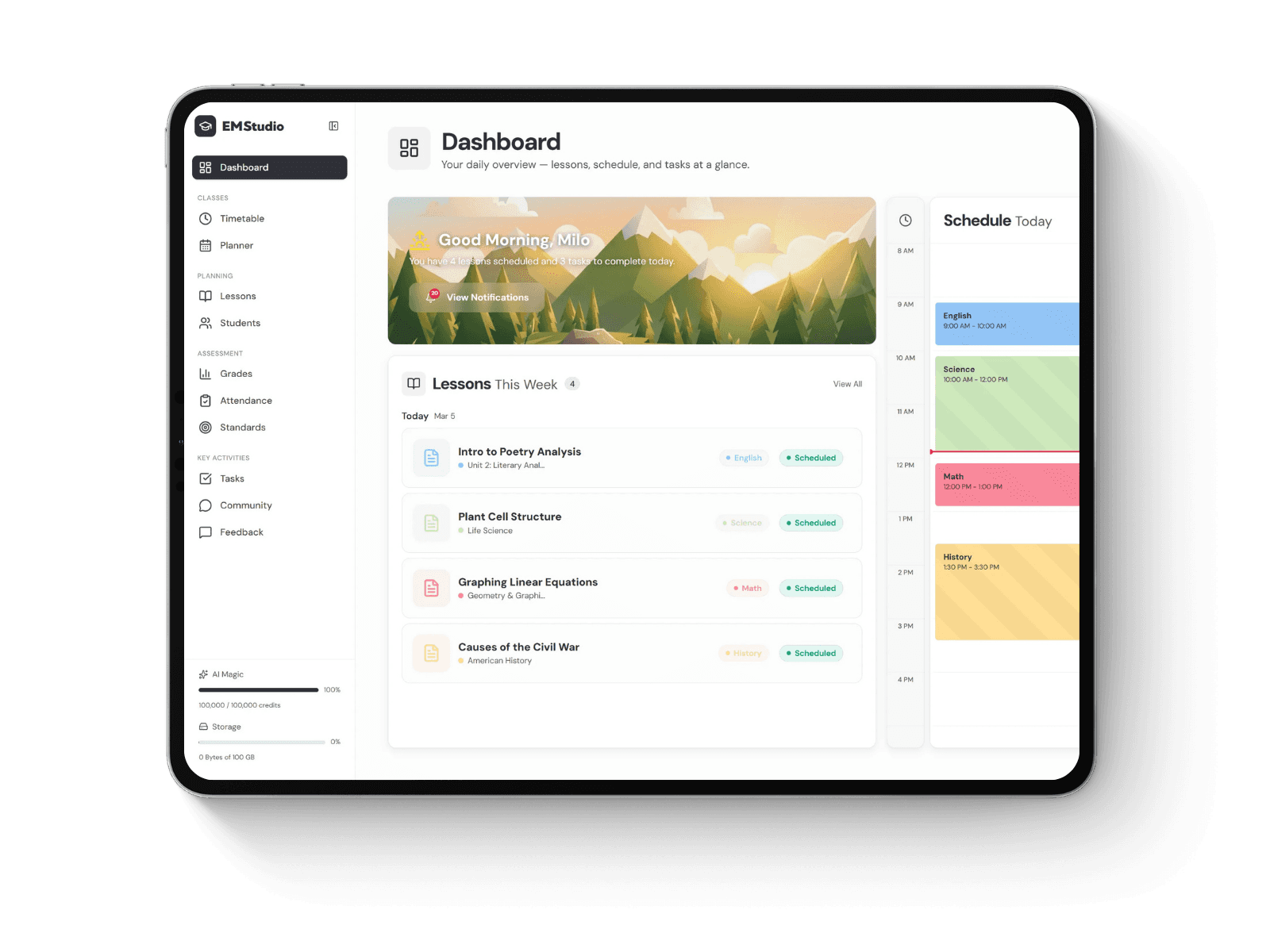
EMStudio is a free teaching management app — manage your classes, students, lessons, and more!
Learn More
Still grading everything by hand?
EMStudio is a free teaching management app — manage your classes, students, lessons, and more!
Learn More
Table of Contents
What Are the Most Effective Differential Teaching Strategies for Content Delivery?
The most effective differential teaching strategies for content delivery include tiered assignments adjusting complexity by readiness level, curriculum compacting to eliminate redundant instruction for advanced learners who pre-test above 80%, learning menus offering structured student choice via Tic-Tac-Toe formats, and station rotation models grouping learners by skill needs while ensuring all students access grade-level standards. Content differentiation means adjusting what students learn based on where they are, not building four different lesson plans for the same class period. You modify the complexity of the material while keeping everyone anchored to the same grade-level standards.
John Hattie's Visible Learning research shows that the right level of challenge drives achievement. Too easy and students check out; too hard and they shut down. Tiering hits that sweet spot—what some call the Goldilocks principle—where the work stretches each learner without breaking them.
Don't fall into the differentiation trap. Creating entirely separate lessons for each group doubles your workload and burns you out by October. Instead, tier the same core concept three ways.
Strategy | Prep Time | Best Class Size | Grade Level Fit | Technology Needs |
|---|---|---|---|---|
Tiered Assignments | 45 mins | 15-35 | K-12 | None |
Curriculum Compacting | 2 hours | 15-30 | 6-12 | Low |
Learning Menus | 30 mins | 20-35 | K-12 | Low |
Station Rotation | 1-2 hours | 24-32 | K-12 | Medium to High |
Tiered Assignments by Readiness Level
Design a three-tier system that provides scaffolded instruction on the same standard. In a 9th-grade biology unit on cell structure, you might offer these options:
Tier 1 (Below): Identify three cell parts using a word bank and diagram.
Tier 2 (At): Explain the function of each part in complete sentences.
Tier 3 (Above): Compare prokaryotic and eukaryotic cells using primary source journal articles.
Building these takes about 45 minutes per lesson once you have a template. I use a simple three-column table in Google Docs—same reading passage on the left, three question sets across the top. You aren't writing three lessons; you're adjusting the depth of the same concept. That's the heart of sustainable differential teaching strategies: one prep, multiple entry points.
Here's where tiering fails: when it becomes tracking. If the same five kids always get the word bank while others do analysis, you've created a low-skill ghetto that never moves. Rotate tiers based on unit-by-unit formative assessment. A student who struggles with cells might ace genetics next month. Movement between tiers signals to kids that their current level is temporary, not a life sentence.
Curriculum Compacting for Advanced Learners
When students score 80% or higher on a unit pre-test, they don't need the baseline instruction. Curriculum compacting eliminates those redundant lessons, saving three to four days per unit for those learners. You replace the skipped content with independent study contracts that offer three menu options:
Research project connected to the unit theme
Advanced reading with complex texts
Real-world application problem sets
The timeline is tight but workable. Administer the pre-test on Monday. While you teach the core lesson Tuesday and Wednesday, compacted students work on their contracts in the library or back corner. They rejoin the class Thursday for application activities that require everyone to use the knowledge in new contexts. This keeps the advanced kids from tuning out during review while ensuring they don't miss the critical thinking practice.
This strategy can support differentiated instruction strategies without multiplying your prep time. The key is having replacement activities ready before the pre-test results come in. I keep a binder of three "compact contracts" per subject ready to photocopy so I'm not scrambling Sunday night.
Learning Menus and Choice Boards
Menus give students agency within boundaries. The Tic-Tac-Toe format offers nine tasks in a grid; students complete any three in a row. The 2-5-8 model assigns point values to tasks (easy ones worth 2, complex ones worth 8) and requires students to earn 10 points total. For a 5th-grade literature unit, your menu might include:
Draw a comic strip of the climax (2 points)
Write a letter from protagonist to antagonist (5 points)
Analyze theme using three textual quotes (8 points)
Creation takes about 30 minutes using Canva education templates or Google Slides master slides. Copy your standards into the corner of each slide, paste activity ideas into the squares, done. These differentiation strategies in the classroom work best for review units or independent practice after initial instruction. Menus flop as first-teach tools because novices need direct instruction before they can choose their path effectively.
Station Rotation with Differentiated Tasks
The four-station model keeps everyone moving while you target small groups. At the Teacher-Led station, you deliver direct instruction at different readiness levels to groups of six. The Collaborative station mixes abilities using mixed-ability grouping for discussion. The Independent station has leveled texts or problem sets matched to each student's current skill. The Tech station runs adaptive software like Khan Academy or IXL that adjusts difficulty automatically.
Logistics matter. Run 15-minute rotations in a 60-minute block. With 24-32 students, you get six to eight per station—small enough to manage, big enough for peer support. Display a digital timer visible to all so you aren't the bad guy calling time. Post clear "must do" and "may do" signs at each location so students know the expectation without asking.
Use color-coded clipboard tracking where students mark completion before rotating. Stations are mandatory, but the work at the independent station varies by readiness. This setup creates learning stations that work because the structure itself does the differentiation, not you running around with four different worksheets.
Which Process-Based Differentiation Strategies Engage Every Learner?
Process-based differentiation strategies that engage every learner include strategic flexible grouping that changes every 2-3 weeks based on formative assessment data, the jigsaw method with differentiated expert roles matched to student strengths, learning centers offering three-tiered complexity levels, and scaffolded think-pair-share protocols with tiered sentence stems and adjustable timing for emerging to proficient language learners.
Process differentiation is about varying how students access and make sense of content. It is not about what they learn—that is content differentiation. It is not about how they demonstrate it—that is product differentiation. Process is the middle layer: the thinking, the struggling, the sense-making. active learning strategies live here.
Each strategy carries different demands.
Strategic Flexible Grouping: High flexibility (rotates every 2-3 weeks). Medium social demand. Heavy teacher facilitation during regrouping. Balanced for introverts and extroverts.
Jigsaw Method: Medium flexibility (fixed for the unit). High social demand. Heavy facilitation during expert groups, lighter during home teams. Favors extroverts unless roles are carefully assigned.
Learning Centers: Low flexibility (static for the semester). Low to medium social demand. Light facilitation once routines are set. Ideal for introverts who need independent processing time.
Scaffolded Think-Pair-Share: High flexibility (changes daily). High social demand during pair/share. Light facilitation. Challenging for introverts without adequate think time.
Beware the trap of ability grouping gone wrong. When you keep students in the same process groups for more than three weeks, you create tracking effects. The "low" group stops trying to escape. The "high" group stagnates. Mixed-ability grouping only works if you keep the fluidity. Switch every two to three weeks based on formative assessment data, not permanent labels.
Research on collaborative learning methods shows that structures like Jigsaw improve retention significantly, but only when the expert roles align with student strengths and you provide adequate scaffolding for those roles. Without that support, the Researcher who cannot read the text drags down the home team.
Strategic Flexible Grouping by Skill and Interest
I regroup students every two to three weeks. Any longer and the groups become castes. For elementary, that means three to four students per group. For secondary, four to five. I use three types: skill-based for remediation, interest-based for projects, and learning profile-based for visual, auditory, or kinesthetic preferences. To remove teacher-bias perceptions, I use a digital randomizer like ClassDojo or Wheel of Names to assign groups transparently. Students see the spin. They know it is not me playing favorites. This is one of the most effective differentiation techniques in the classroom because it responds to readiness levels without fossilizing them.
Jigsaw Method with Differentiated Expert Roles
In Jigsaw, I assign four expert roles based on what students do well, not what they lack. The Note-Taker has strong organization skills. The Researcher matches reading comprehension level. The Illustrator has visual-spatial ability. The Presenter processes verbally at speed. The cycle runs four days: Day 1 in expert groups with the same role across topics, Day 2 in home teams preparing, Day 3 presenting, Day 4 individual assessment. For struggling readers in the Researcher role, I provide simplified text or an audio version. Without this accommodation, the differential teaching strategies fail because the student cannot contribute meaningfully to the home team.
Learning Centers with Leveled Complexity
My centers use color-coded folders: Green for foundational support with graphic organizers, Blue for grade-level standards, Black for advanced extension with open-ended prompts. Students check out folders using a pocket chart with their name cards. This tracks completion and creates accountability. Initial setup takes two hours for four centers. Weekly maintenance is fifteen minutes to replace consumables. The rule is simple: over two weeks, each student must complete one activity from each color. This gives flexible teaching strategies a concrete structure while honoring different learning profiles.
Scaffolded Think-Pair-Share Protocols
I tier the sentence stems. Emerging speakers get "I think... because..." Developing speakers use "The evidence suggests... which connects to..." Proficient speakers tackle "While X argues Y, the data indicates Z, revealing a tension between..." Timing matters too. I give emerging speakers thirty seconds to think, developing speakers sixty, proficient speakers ninety. I display a visible timer. For the share portion, I use popsicle sticks to call randomly. This prevents the same three voices from dominating and ensures everyone prepares. These differentiated strategies for students work because the scaffolded instruction meets them where they are, not where we wish they were.

How Can You Differentiate Products Without Doubling Your Workload?
Differentiate products without doubling workload by using tiered rubrics with three proficiency levels on the same assignment rather than creating separate tasks, product choice boards limiting options to nine curated choices with standardized grading criteria, student-led assessment conferences that shift evaluation responsibility to learners, and alternative demonstration formats like three-minute podcasts or Canva infographics replacing traditional essays.
The myth that product differentiation requires 25 different assignments kills more good teaching intentions than anything else. You don't need separate handouts for every kid. Smart differential teaching strategies use the same assignment skeleton with tiered expectations or limited curated choices that you design once.
Think of it as a decision flowchart. Is this a skills-based standard? Use tiered rubrics. Is this a creativity standard? Use choice boards. Is this metacognitive growth? Use conferences.
Here's where teachers crash: offering 12 or more product choices. Decision paralysis sets in. Kids spend 40 minutes picking instead of working. You end up with 17 different rubrics to juggle. Cap options at nine. Research shows student choice in demonstration methods correlates with increased motivation and ownership, but only when choices are scaffolded rather than wide-open.
Tiered Rubrics with Multiple Proficiency Levels
Design a three-column rubric labeled Approaching, Meeting, and Exceeding for the identical assignment. Last month I used this with an 8th-grade persuasive essay. Approaching required three paragraphs with two cited sources. Meeting required five paragraphs with three sources and a clear thesis. Exceeding required five paragraphs with four sources plus a counterargument rebuttal. Same prompt, different complexity.
Sixty percent of your rubric criteria remain identical across all tiers. Content accuracy, citation format, and grammar conventions don't change. Forty percent varies by complexity—analysis depth, synthesis requirements, and evidence quality. This beats writing three separate assignments.
Check the time efficiency. Creating one tiered rubric takes about 20 minutes. Creating three distinct assignments takes roughly 60 minutes. You reclaim that 40 minutes for scaffolded instruction or formative assessment instead of formatting headaches.
Product Choice Boards for Diverse Learners
Build a nine-square grid organized by learning modality:
Column 1 (Visual): Infographic, diagram, slideshow
Column 2 (Oral): Podcast, speech, teaching demonstration
Column 3 (Written): Essay, letter to editor, research brief
Students select one product from each column over the semester. They practice all modalities but choose the order and timing that matches their readiness levels.
Create three generic rubric templates, one per column, with four or five criteria each. A "Visual Communication" rubric works for any infographic or diagram. An "Oral Clarity" rubric covers podcasts and speeches. You stop grading 27 different formats and start assessing against consistent standards. This approach to differentiated instruction methods keeps your sanity intact while honoring learning profiles.
Student-Led Assessment Conferences
Structure ten-minute conferences using a student preparation checklist:
Select two portfolio pieces showing growth
Complete reflection sentence starters ("I improved at...", "Next I will...")
Identify one goal for the next unit
They pull these from their work for creating effective student portfolios that document progress over time.
Schedule two afternoons per semester. Run four conferences per hour in twenty-minute blocks with ten-minute buffers. While you confer, other students engage in independent silent reading or tech-based practice. Your job? Ask guiding questions only. "What makes this your best work?" Do not lecture. Do not defend grades. This shifts the evaluation responsibility to learners and cuts your grading time significantly.
Alternative Demonstration Formats Beyond Traditional Tests
Replace the unit test with performance-based assessments:
Podcasts: Three-to-five-minute recordings using Anchor or GarageBand to assess explanation clarity
Infographics: Canva templates for visual synthesis of data
Demo videos: Two-minute clips showing procedural knowledge
These work without the scantron sheet and fit mixed-ability grouping classrooms where students need different ways to show mastery.
Set strict technical parameters. All formats must work on smartphones or school-issued Chromebooks. No proprietary software requiring home purchases. Use Google Classroom or Canvas submission portals with naming conventions like LastName_Assignment_Format. This prevents digital clutter and keeps your download folder manageable. These differentiation techniques in teaching give students with different interest-based learning preferences a way to demonstrate understanding without extra prep on your end.

How Do You Choose the Right Strategy for Specific Learning Objectives?
Choose the right strategy by first mapping your learning objective to content delivery, learning process, or product creation; then auditing available prep time against strategy complexity using a high-impact/low-prep matrix; and finally analyzing student readiness data from NWEA MAP scores or Lexile levels to determine appropriate grouping, tiering, or compacting thresholds for your specific classroom population.
Match Strategy to Specific Learning Objectives
Map objectives using Bloom's Taxonomy. Remember and Understand verbs—define, list, identify—align with Content differentiation. Deploy Tiered Assignments or Curriculum Compacting here. You're delivering information efficiently based on what students already know. These differential learning strategies work best when the goal is knowledge acquisition, not interpretation.
Apply and Analyze objectives—compare, solve, investigate—align with Process differentiation. This is where Flexible Grouping and Jigsaw methods of differentiation in the classroom work best. If your objective reads "Analyze the causes of World War I," don't hand out Tiered Content packets where groups read different text complexity levels about the same four causes. That misses the point. Analysis requires disagreement. Run a Jigsaw instead. Break the causes into four chunks—militarism, alliances, imperialism, nationalism. Students become experts on one chunk, then regroup to teach others. The magic happens when the kid who studied alliances debates causation with the kid who tracked imperialism. You can't get that with silent, leveled readings.
Evaluate and Create objectives—design, judge, compose—align with Product differentiation. Use Choice Boards or Tiered Rubrics. Watch for mismatches. Choice Boards for basic fact memorization waste everyone's time. Rigid ability grouping for creative synthesis tasks limits the cross-pollination that makes original work possible. Learning profiles matter here too. Some students analyze better through discussion, others through writing. Interest-based learning can drive the process—let them choose which cause to investigate based on curiosity—but keep the cognitive demand consistent. The verb determines the differentiation type, not the topic.
Audit Available Time and Resources
Be honest about prep time. Low Prep (0-30 minutes): Think-Pair-Share, Learning Menus using worksheets you already have. Medium Prep (30-60 minutes): Flexible Grouping setups, Tiered Rubrics, mixed-ability grouping protocols based on recent quiz scores. That's manageable during a planning period. High Prep (60+ minutes): full Station Rotation systems, complete Curriculum Compacting with alternate assignments. That's a three-hour Sunday afternoon job.
Use this decision matrix:
High Impact + Low Prep: Start here. These are your bread and butter differential teaching strategies.
High Impact + High Prep: Implement only after low-prep methods are automatic.
Low Impact + High Prep: Avoid. These kill your Sunday evenings for minimal student benefit.
Think-Pair-Share takes five minutes to plan and hits auditory, social, and kinesthetic learners. That's high impact, low prep. Creating three different video lessons for different readiness levels takes three hours and only helps if students actually watch them. Know the difference. Follow the sustainability rule: never run more than one High Prep strategy simultaneously. Pair one High Prep method with two Low Prep supports maximum. Your sanity matters more than perfect differentiation.
Analyze Student Readiness Data
Start with student assessment analysis. Administer a 5-question pre-assessment covering prerequisite skills and upcoming content. Target the gate skills. If you're teaching fractions, check for whole number division. If 80% of your class hits that threshold, compact the review and move forward. Don't drill what they already know. Check last year's data to see which standards carried over, but trust fresh formative assessment more than old scores.
Use NWEA MAP score bands or equivalent data-driven teaching metrics. Form three readiness groups: Tier 1 (<25th percentile, intensive scaffolded instruction), Tier 2 (25th-75th percentile, grade level), Tier 3 (>75th percentile or pre-test mastery, extension work). These aren't permanent labels. They're fluid buckets.
Rotate these groupings every three weeks based on new formative assessment data. Mark your calendar. Every third Friday, review the week's exit tickets. If three students in Tier 1 demonstrate mastery, move them to Tier 2 on Monday. If a Tier 3 student struggles, drop them back for targeted support. I've watched teachers keep the same "high, medium, low" groups from October to June. That's tracking, not differentiation. A 6th grader who bombed the October pre-test might nail the November formative and need Tier 3 work by December. Shift seats. Change partners. Adjust the scaffolded instruction levels. Differential learning strategies fail when they become static. Let current data—not assumptions from the first week—determine your groupings.

Your First Month Implementation Roadmap for Sustainable Differentiation
Differentiation fails when teachers treat it like a light switch rather than a muscle. Attempting to differentiate every subject, every day, immediately leads to three or more hours of nightly prep and rapid abandonment of strategies. You will burn out by October if you try to rebuild your entire curriculum overnight. Instead, treat the first month as a gradual release model where you intentionally limit scope to protect your sanity.
By the end of Week 4, you should spend no more than 60 minutes daily on differentiation-specific prep, with student engagement indicators showing 80% or higher active participation rates during differentiated segments. If you hit these numbers, you have built a sustainable system. If you miss them, you are building a trap that will snap shut by mid-semester.
Here is your scaling rule and escape hatch: If Week 3 shows prep time exceeding 90 minutes daily or student confusion with off-task rates above 15%, retreat immediately. Do not add complexity. Drop back to simpler reteaching strategies or uniform practice until classroom management solidifies. Survival beats perfection every time.
Week 1-2: Audit Curriculum and Identify Opportunities
Start with curriculum triage. Select three units with clear conceptual breaks—end of chapters or natural skill progressions—rather than attempting to differentiate every single lesson. This respects the time-saving classroom hacks that keep you sane. Create an Opportunity Map for each selected unit, identifying two specific points where differentiation adds value: typically the introduction of complex concepts and the final demonstration of mastery. Leave middle practice activities uniform for everyone.
Conduct a curriculum triage: Select 3 units with clear conceptual breaks (end of chapters, natural skill progressions) rather than attempting to differentiate every single lesson.
Create an 'Opportunity Map': For each selected unit, identify 2 specific points where differentiation adds value (typically the introduction of complex concepts and the final demonstration of mastery), leaving middle practice activities uniform.
Gather baseline data: Administer one comprehensive pre-assessment per unit to determine the spread of readiness levels, documenting how many students fall into Tier 1, 2, and 3 to inform resource allocation.
Without this baseline data, you will over-prep for phantom gaps or miss the students who actually need scaffolded instruction. Know your numbers before you cut your materials.
Week 3: Pilot One Content or Process Strategy
Select ONE low-prep strategy for pilot. Either Scaffolded Think-Pair-Share (15 minutes prep: create sentence stems) or Learning Menus (30 minutes prep: adapt existing worksheet into 9-square grid). Do not attempt station rotation or complex tiered assignments yet. You are testing your workflow, not your creativity. This is how you field-test differential teaching strategies without destroying your evenings.
Select ONE low-prep strategy for pilot: Either Scaffolded Think-Pair-Share (15 mins prep: create sentence stems) or Learning Menus (30 mins prep: adapt existing worksheet into 9-square grid).
Document rigorously: Track actual prep time (not estimated) in 15-minute increments, student completion rates (% of students finishing tasks), and behavioral observations (instances of off-task behavior per 10-minute interval).
Set success metrics: Pilot is successful if prep time stays under 45 minutes for the week AND student engagement increases OR stays equivalent to previous non-differentiated instruction.
If your timer shows 90 minutes by Wednesday, stop. Retreat to whole-group instruction and revisit your differentiated instruction strategies in the classroom next week with a simpler approach.
Week 4: Gather Feedback and Scale Successfully
Administer a two-question student feedback survey: "Which activity this week helped you understand the content best?" and "What should we change to make learning easier?" Collect responses via Google Form or paper exit ticket. Students often spot flaws in your differentiation strategy in education that you missed while focused on management.
Administer a 2-question student feedback survey: (1) 'Which activity this week helped you understand the content best?' (2) 'What should we change to make learning easier?' Collect responses via Google Form or paper exit ticket.
Analyze using a Keep/Modify/Delete T-chart: List strategies that worked (Keep), need adjustment (Modify), or failed (Delete). Consult with instructional coach or colleague before deleting to distinguish implementation failure from strategy failure.
Make the scaling decision: If pilot succeeded, add ONE additional strategy for next month; if pilot failed, identify whether failure was due to classroom management issues (retry with stricter protocols) or strategy complexity (switch to simpler method like tiered rubrics before attempting station rotation).
This reflective practice aligns with the planning habits of highly effective educators. Build slowly. Your September self will thank your August self when you are still using effective differentiated teaching methods in May.

The Bottom Line on Differential Teaching Strategies
You don't need a perfect system. You need a working one. The teachers I know who stick with differentiation aren't the ones with color-coded binders and twelve stations running simultaneously. They're the ones who looked at one formative assessment today, noticed exactly where three kids got stuck on question four, and pulled those three aside for a five-minute reteach before lunch. That's the whole game. Everything else—tiered assignments, mixed-ability grouping, choice boards—builds from that habit of looking at evidence and acting on it immediately.
So here's your concrete action for today. Pick the lesson you're teaching tomorrow. Identify the single barrier keeping your lowest readiness levels from accessing the first task. Build one scaffolded instruction move to remove it—maybe a vocabulary bank, a worked example, or permission to tackle just the first three problems while the room gets rolling. Test it. Watch what happens. You don't need to differentiate everything by Friday. You just need to prove to yourself that adjusting for the kids in front of you works better than following the script.
What Are the Most Effective Differential Teaching Strategies for Content Delivery?
The most effective differential teaching strategies for content delivery include tiered assignments adjusting complexity by readiness level, curriculum compacting to eliminate redundant instruction for advanced learners who pre-test above 80%, learning menus offering structured student choice via Tic-Tac-Toe formats, and station rotation models grouping learners by skill needs while ensuring all students access grade-level standards. Content differentiation means adjusting what students learn based on where they are, not building four different lesson plans for the same class period. You modify the complexity of the material while keeping everyone anchored to the same grade-level standards.
John Hattie's Visible Learning research shows that the right level of challenge drives achievement. Too easy and students check out; too hard and they shut down. Tiering hits that sweet spot—what some call the Goldilocks principle—where the work stretches each learner without breaking them.
Don't fall into the differentiation trap. Creating entirely separate lessons for each group doubles your workload and burns you out by October. Instead, tier the same core concept three ways.
Strategy | Prep Time | Best Class Size | Grade Level Fit | Technology Needs |
|---|---|---|---|---|
Tiered Assignments | 45 mins | 15-35 | K-12 | None |
Curriculum Compacting | 2 hours | 15-30 | 6-12 | Low |
Learning Menus | 30 mins | 20-35 | K-12 | Low |
Station Rotation | 1-2 hours | 24-32 | K-12 | Medium to High |
Tiered Assignments by Readiness Level
Design a three-tier system that provides scaffolded instruction on the same standard. In a 9th-grade biology unit on cell structure, you might offer these options:
Tier 1 (Below): Identify three cell parts using a word bank and diagram.
Tier 2 (At): Explain the function of each part in complete sentences.
Tier 3 (Above): Compare prokaryotic and eukaryotic cells using primary source journal articles.
Building these takes about 45 minutes per lesson once you have a template. I use a simple three-column table in Google Docs—same reading passage on the left, three question sets across the top. You aren't writing three lessons; you're adjusting the depth of the same concept. That's the heart of sustainable differential teaching strategies: one prep, multiple entry points.
Here's where tiering fails: when it becomes tracking. If the same five kids always get the word bank while others do analysis, you've created a low-skill ghetto that never moves. Rotate tiers based on unit-by-unit formative assessment. A student who struggles with cells might ace genetics next month. Movement between tiers signals to kids that their current level is temporary, not a life sentence.
Curriculum Compacting for Advanced Learners
When students score 80% or higher on a unit pre-test, they don't need the baseline instruction. Curriculum compacting eliminates those redundant lessons, saving three to four days per unit for those learners. You replace the skipped content with independent study contracts that offer three menu options:
Research project connected to the unit theme
Advanced reading with complex texts
Real-world application problem sets
The timeline is tight but workable. Administer the pre-test on Monday. While you teach the core lesson Tuesday and Wednesday, compacted students work on their contracts in the library or back corner. They rejoin the class Thursday for application activities that require everyone to use the knowledge in new contexts. This keeps the advanced kids from tuning out during review while ensuring they don't miss the critical thinking practice.
This strategy can support differentiated instruction strategies without multiplying your prep time. The key is having replacement activities ready before the pre-test results come in. I keep a binder of three "compact contracts" per subject ready to photocopy so I'm not scrambling Sunday night.
Learning Menus and Choice Boards
Menus give students agency within boundaries. The Tic-Tac-Toe format offers nine tasks in a grid; students complete any three in a row. The 2-5-8 model assigns point values to tasks (easy ones worth 2, complex ones worth 8) and requires students to earn 10 points total. For a 5th-grade literature unit, your menu might include:
Draw a comic strip of the climax (2 points)
Write a letter from protagonist to antagonist (5 points)
Analyze theme using three textual quotes (8 points)
Creation takes about 30 minutes using Canva education templates or Google Slides master slides. Copy your standards into the corner of each slide, paste activity ideas into the squares, done. These differentiation strategies in the classroom work best for review units or independent practice after initial instruction. Menus flop as first-teach tools because novices need direct instruction before they can choose their path effectively.
Station Rotation with Differentiated Tasks
The four-station model keeps everyone moving while you target small groups. At the Teacher-Led station, you deliver direct instruction at different readiness levels to groups of six. The Collaborative station mixes abilities using mixed-ability grouping for discussion. The Independent station has leveled texts or problem sets matched to each student's current skill. The Tech station runs adaptive software like Khan Academy or IXL that adjusts difficulty automatically.
Logistics matter. Run 15-minute rotations in a 60-minute block. With 24-32 students, you get six to eight per station—small enough to manage, big enough for peer support. Display a digital timer visible to all so you aren't the bad guy calling time. Post clear "must do" and "may do" signs at each location so students know the expectation without asking.
Use color-coded clipboard tracking where students mark completion before rotating. Stations are mandatory, but the work at the independent station varies by readiness. This setup creates learning stations that work because the structure itself does the differentiation, not you running around with four different worksheets.
Which Process-Based Differentiation Strategies Engage Every Learner?
Process-based differentiation strategies that engage every learner include strategic flexible grouping that changes every 2-3 weeks based on formative assessment data, the jigsaw method with differentiated expert roles matched to student strengths, learning centers offering three-tiered complexity levels, and scaffolded think-pair-share protocols with tiered sentence stems and adjustable timing for emerging to proficient language learners.
Process differentiation is about varying how students access and make sense of content. It is not about what they learn—that is content differentiation. It is not about how they demonstrate it—that is product differentiation. Process is the middle layer: the thinking, the struggling, the sense-making. active learning strategies live here.
Each strategy carries different demands.
Strategic Flexible Grouping: High flexibility (rotates every 2-3 weeks). Medium social demand. Heavy teacher facilitation during regrouping. Balanced for introverts and extroverts.
Jigsaw Method: Medium flexibility (fixed for the unit). High social demand. Heavy facilitation during expert groups, lighter during home teams. Favors extroverts unless roles are carefully assigned.
Learning Centers: Low flexibility (static for the semester). Low to medium social demand. Light facilitation once routines are set. Ideal for introverts who need independent processing time.
Scaffolded Think-Pair-Share: High flexibility (changes daily). High social demand during pair/share. Light facilitation. Challenging for introverts without adequate think time.
Beware the trap of ability grouping gone wrong. When you keep students in the same process groups for more than three weeks, you create tracking effects. The "low" group stops trying to escape. The "high" group stagnates. Mixed-ability grouping only works if you keep the fluidity. Switch every two to three weeks based on formative assessment data, not permanent labels.
Research on collaborative learning methods shows that structures like Jigsaw improve retention significantly, but only when the expert roles align with student strengths and you provide adequate scaffolding for those roles. Without that support, the Researcher who cannot read the text drags down the home team.
Strategic Flexible Grouping by Skill and Interest
I regroup students every two to three weeks. Any longer and the groups become castes. For elementary, that means three to four students per group. For secondary, four to five. I use three types: skill-based for remediation, interest-based for projects, and learning profile-based for visual, auditory, or kinesthetic preferences. To remove teacher-bias perceptions, I use a digital randomizer like ClassDojo or Wheel of Names to assign groups transparently. Students see the spin. They know it is not me playing favorites. This is one of the most effective differentiation techniques in the classroom because it responds to readiness levels without fossilizing them.
Jigsaw Method with Differentiated Expert Roles
In Jigsaw, I assign four expert roles based on what students do well, not what they lack. The Note-Taker has strong organization skills. The Researcher matches reading comprehension level. The Illustrator has visual-spatial ability. The Presenter processes verbally at speed. The cycle runs four days: Day 1 in expert groups with the same role across topics, Day 2 in home teams preparing, Day 3 presenting, Day 4 individual assessment. For struggling readers in the Researcher role, I provide simplified text or an audio version. Without this accommodation, the differential teaching strategies fail because the student cannot contribute meaningfully to the home team.
Learning Centers with Leveled Complexity
My centers use color-coded folders: Green for foundational support with graphic organizers, Blue for grade-level standards, Black for advanced extension with open-ended prompts. Students check out folders using a pocket chart with their name cards. This tracks completion and creates accountability. Initial setup takes two hours for four centers. Weekly maintenance is fifteen minutes to replace consumables. The rule is simple: over two weeks, each student must complete one activity from each color. This gives flexible teaching strategies a concrete structure while honoring different learning profiles.
Scaffolded Think-Pair-Share Protocols
I tier the sentence stems. Emerging speakers get "I think... because..." Developing speakers use "The evidence suggests... which connects to..." Proficient speakers tackle "While X argues Y, the data indicates Z, revealing a tension between..." Timing matters too. I give emerging speakers thirty seconds to think, developing speakers sixty, proficient speakers ninety. I display a visible timer. For the share portion, I use popsicle sticks to call randomly. This prevents the same three voices from dominating and ensures everyone prepares. These differentiated strategies for students work because the scaffolded instruction meets them where they are, not where we wish they were.
How Can You Differentiate Products Without Doubling Your Workload?
Differentiate products without doubling workload by using tiered rubrics with three proficiency levels on the same assignment rather than creating separate tasks, product choice boards limiting options to nine curated choices with standardized grading criteria, student-led assessment conferences that shift evaluation responsibility to learners, and alternative demonstration formats like three-minute podcasts or Canva infographics replacing traditional essays.
The myth that product differentiation requires 25 different assignments kills more good teaching intentions than anything else. You don't need separate handouts for every kid. Smart differential teaching strategies use the same assignment skeleton with tiered expectations or limited curated choices that you design once.
Think of it as a decision flowchart. Is this a skills-based standard? Use tiered rubrics. Is this a creativity standard? Use choice boards. Is this metacognitive growth? Use conferences.
Here's where teachers crash: offering 12 or more product choices. Decision paralysis sets in. Kids spend 40 minutes picking instead of working. You end up with 17 different rubrics to juggle. Cap options at nine. Research shows student choice in demonstration methods correlates with increased motivation and ownership, but only when choices are scaffolded rather than wide-open.
Tiered Rubrics with Multiple Proficiency Levels
Design a three-column rubric labeled Approaching, Meeting, and Exceeding for the identical assignment. Last month I used this with an 8th-grade persuasive essay. Approaching required three paragraphs with two cited sources. Meeting required five paragraphs with three sources and a clear thesis. Exceeding required five paragraphs with four sources plus a counterargument rebuttal. Same prompt, different complexity.
Sixty percent of your rubric criteria remain identical across all tiers. Content accuracy, citation format, and grammar conventions don't change. Forty percent varies by complexity—analysis depth, synthesis requirements, and evidence quality. This beats writing three separate assignments.
Check the time efficiency. Creating one tiered rubric takes about 20 minutes. Creating three distinct assignments takes roughly 60 minutes. You reclaim that 40 minutes for scaffolded instruction or formative assessment instead of formatting headaches.
Product Choice Boards for Diverse Learners
Build a nine-square grid organized by learning modality:
Column 1 (Visual): Infographic, diagram, slideshow
Column 2 (Oral): Podcast, speech, teaching demonstration
Column 3 (Written): Essay, letter to editor, research brief
Students select one product from each column over the semester. They practice all modalities but choose the order and timing that matches their readiness levels.
Create three generic rubric templates, one per column, with four or five criteria each. A "Visual Communication" rubric works for any infographic or diagram. An "Oral Clarity" rubric covers podcasts and speeches. You stop grading 27 different formats and start assessing against consistent standards. This approach to differentiated instruction methods keeps your sanity intact while honoring learning profiles.
Student-Led Assessment Conferences
Structure ten-minute conferences using a student preparation checklist:
Select two portfolio pieces showing growth
Complete reflection sentence starters ("I improved at...", "Next I will...")
Identify one goal for the next unit
They pull these from their work for creating effective student portfolios that document progress over time.
Schedule two afternoons per semester. Run four conferences per hour in twenty-minute blocks with ten-minute buffers. While you confer, other students engage in independent silent reading or tech-based practice. Your job? Ask guiding questions only. "What makes this your best work?" Do not lecture. Do not defend grades. This shifts the evaluation responsibility to learners and cuts your grading time significantly.
Alternative Demonstration Formats Beyond Traditional Tests
Replace the unit test with performance-based assessments:
Podcasts: Three-to-five-minute recordings using Anchor or GarageBand to assess explanation clarity
Infographics: Canva templates for visual synthesis of data
Demo videos: Two-minute clips showing procedural knowledge
These work without the scantron sheet and fit mixed-ability grouping classrooms where students need different ways to show mastery.
Set strict technical parameters. All formats must work on smartphones or school-issued Chromebooks. No proprietary software requiring home purchases. Use Google Classroom or Canvas submission portals with naming conventions like LastName_Assignment_Format. This prevents digital clutter and keeps your download folder manageable. These differentiation techniques in teaching give students with different interest-based learning preferences a way to demonstrate understanding without extra prep on your end.
How Do You Choose the Right Strategy for Specific Learning Objectives?
Choose the right strategy by first mapping your learning objective to content delivery, learning process, or product creation; then auditing available prep time against strategy complexity using a high-impact/low-prep matrix; and finally analyzing student readiness data from NWEA MAP scores or Lexile levels to determine appropriate grouping, tiering, or compacting thresholds for your specific classroom population.
Match Strategy to Specific Learning Objectives
Map objectives using Bloom's Taxonomy. Remember and Understand verbs—define, list, identify—align with Content differentiation. Deploy Tiered Assignments or Curriculum Compacting here. You're delivering information efficiently based on what students already know. These differential learning strategies work best when the goal is knowledge acquisition, not interpretation.
Apply and Analyze objectives—compare, solve, investigate—align with Process differentiation. This is where Flexible Grouping and Jigsaw methods of differentiation in the classroom work best. If your objective reads "Analyze the causes of World War I," don't hand out Tiered Content packets where groups read different text complexity levels about the same four causes. That misses the point. Analysis requires disagreement. Run a Jigsaw instead. Break the causes into four chunks—militarism, alliances, imperialism, nationalism. Students become experts on one chunk, then regroup to teach others. The magic happens when the kid who studied alliances debates causation with the kid who tracked imperialism. You can't get that with silent, leveled readings.
Evaluate and Create objectives—design, judge, compose—align with Product differentiation. Use Choice Boards or Tiered Rubrics. Watch for mismatches. Choice Boards for basic fact memorization waste everyone's time. Rigid ability grouping for creative synthesis tasks limits the cross-pollination that makes original work possible. Learning profiles matter here too. Some students analyze better through discussion, others through writing. Interest-based learning can drive the process—let them choose which cause to investigate based on curiosity—but keep the cognitive demand consistent. The verb determines the differentiation type, not the topic.
Audit Available Time and Resources
Be honest about prep time. Low Prep (0-30 minutes): Think-Pair-Share, Learning Menus using worksheets you already have. Medium Prep (30-60 minutes): Flexible Grouping setups, Tiered Rubrics, mixed-ability grouping protocols based on recent quiz scores. That's manageable during a planning period. High Prep (60+ minutes): full Station Rotation systems, complete Curriculum Compacting with alternate assignments. That's a three-hour Sunday afternoon job.
Use this decision matrix:
High Impact + Low Prep: Start here. These are your bread and butter differential teaching strategies.
High Impact + High Prep: Implement only after low-prep methods are automatic.
Low Impact + High Prep: Avoid. These kill your Sunday evenings for minimal student benefit.
Think-Pair-Share takes five minutes to plan and hits auditory, social, and kinesthetic learners. That's high impact, low prep. Creating three different video lessons for different readiness levels takes three hours and only helps if students actually watch them. Know the difference. Follow the sustainability rule: never run more than one High Prep strategy simultaneously. Pair one High Prep method with two Low Prep supports maximum. Your sanity matters more than perfect differentiation.
Analyze Student Readiness Data
Start with student assessment analysis. Administer a 5-question pre-assessment covering prerequisite skills and upcoming content. Target the gate skills. If you're teaching fractions, check for whole number division. If 80% of your class hits that threshold, compact the review and move forward. Don't drill what they already know. Check last year's data to see which standards carried over, but trust fresh formative assessment more than old scores.
Use NWEA MAP score bands or equivalent data-driven teaching metrics. Form three readiness groups: Tier 1 (<25th percentile, intensive scaffolded instruction), Tier 2 (25th-75th percentile, grade level), Tier 3 (>75th percentile or pre-test mastery, extension work). These aren't permanent labels. They're fluid buckets.
Rotate these groupings every three weeks based on new formative assessment data. Mark your calendar. Every third Friday, review the week's exit tickets. If three students in Tier 1 demonstrate mastery, move them to Tier 2 on Monday. If a Tier 3 student struggles, drop them back for targeted support. I've watched teachers keep the same "high, medium, low" groups from October to June. That's tracking, not differentiation. A 6th grader who bombed the October pre-test might nail the November formative and need Tier 3 work by December. Shift seats. Change partners. Adjust the scaffolded instruction levels. Differential learning strategies fail when they become static. Let current data—not assumptions from the first week—determine your groupings.
Your First Month Implementation Roadmap for Sustainable Differentiation
Differentiation fails when teachers treat it like a light switch rather than a muscle. Attempting to differentiate every subject, every day, immediately leads to three or more hours of nightly prep and rapid abandonment of strategies. You will burn out by October if you try to rebuild your entire curriculum overnight. Instead, treat the first month as a gradual release model where you intentionally limit scope to protect your sanity.
By the end of Week 4, you should spend no more than 60 minutes daily on differentiation-specific prep, with student engagement indicators showing 80% or higher active participation rates during differentiated segments. If you hit these numbers, you have built a sustainable system. If you miss them, you are building a trap that will snap shut by mid-semester.
Here is your scaling rule and escape hatch: If Week 3 shows prep time exceeding 90 minutes daily or student confusion with off-task rates above 15%, retreat immediately. Do not add complexity. Drop back to simpler reteaching strategies or uniform practice until classroom management solidifies. Survival beats perfection every time.
Week 1-2: Audit Curriculum and Identify Opportunities
Start with curriculum triage. Select three units with clear conceptual breaks—end of chapters or natural skill progressions—rather than attempting to differentiate every single lesson. This respects the time-saving classroom hacks that keep you sane. Create an Opportunity Map for each selected unit, identifying two specific points where differentiation adds value: typically the introduction of complex concepts and the final demonstration of mastery. Leave middle practice activities uniform for everyone.
Conduct a curriculum triage: Select 3 units with clear conceptual breaks (end of chapters, natural skill progressions) rather than attempting to differentiate every single lesson.
Create an 'Opportunity Map': For each selected unit, identify 2 specific points where differentiation adds value (typically the introduction of complex concepts and the final demonstration of mastery), leaving middle practice activities uniform.
Gather baseline data: Administer one comprehensive pre-assessment per unit to determine the spread of readiness levels, documenting how many students fall into Tier 1, 2, and 3 to inform resource allocation.
Without this baseline data, you will over-prep for phantom gaps or miss the students who actually need scaffolded instruction. Know your numbers before you cut your materials.
Week 3: Pilot One Content or Process Strategy
Select ONE low-prep strategy for pilot. Either Scaffolded Think-Pair-Share (15 minutes prep: create sentence stems) or Learning Menus (30 minutes prep: adapt existing worksheet into 9-square grid). Do not attempt station rotation or complex tiered assignments yet. You are testing your workflow, not your creativity. This is how you field-test differential teaching strategies without destroying your evenings.
Select ONE low-prep strategy for pilot: Either Scaffolded Think-Pair-Share (15 mins prep: create sentence stems) or Learning Menus (30 mins prep: adapt existing worksheet into 9-square grid).
Document rigorously: Track actual prep time (not estimated) in 15-minute increments, student completion rates (% of students finishing tasks), and behavioral observations (instances of off-task behavior per 10-minute interval).
Set success metrics: Pilot is successful if prep time stays under 45 minutes for the week AND student engagement increases OR stays equivalent to previous non-differentiated instruction.
If your timer shows 90 minutes by Wednesday, stop. Retreat to whole-group instruction and revisit your differentiated instruction strategies in the classroom next week with a simpler approach.
Week 4: Gather Feedback and Scale Successfully
Administer a two-question student feedback survey: "Which activity this week helped you understand the content best?" and "What should we change to make learning easier?" Collect responses via Google Form or paper exit ticket. Students often spot flaws in your differentiation strategy in education that you missed while focused on management.
Administer a 2-question student feedback survey: (1) 'Which activity this week helped you understand the content best?' (2) 'What should we change to make learning easier?' Collect responses via Google Form or paper exit ticket.
Analyze using a Keep/Modify/Delete T-chart: List strategies that worked (Keep), need adjustment (Modify), or failed (Delete). Consult with instructional coach or colleague before deleting to distinguish implementation failure from strategy failure.
Make the scaling decision: If pilot succeeded, add ONE additional strategy for next month; if pilot failed, identify whether failure was due to classroom management issues (retry with stricter protocols) or strategy complexity (switch to simpler method like tiered rubrics before attempting station rotation).
This reflective practice aligns with the planning habits of highly effective educators. Build slowly. Your September self will thank your August self when you are still using effective differentiated teaching methods in May.
The Bottom Line on Differential Teaching Strategies
You don't need a perfect system. You need a working one. The teachers I know who stick with differentiation aren't the ones with color-coded binders and twelve stations running simultaneously. They're the ones who looked at one formative assessment today, noticed exactly where three kids got stuck on question four, and pulled those three aside for a five-minute reteach before lunch. That's the whole game. Everything else—tiered assignments, mixed-ability grouping, choice boards—builds from that habit of looking at evidence and acting on it immediately.
So here's your concrete action for today. Pick the lesson you're teaching tomorrow. Identify the single barrier keeping your lowest readiness levels from accessing the first task. Build one scaffolded instruction move to remove it—maybe a vocabulary bank, a worked example, or permission to tackle just the first three problems while the room gets rolling. Test it. Watch what happens. You don't need to differentiate everything by Friday. You just need to prove to yourself that adjusting for the kids in front of you works better than following the script.
Still grading everything by hand?
EMStudio is a free teaching management app — manage your classes, students, lessons, and more!
Learn More
Still grading everything by hand?
EMStudio is a free teaching management app — manage your classes, students, lessons, and more!
Learn More




Notion4Teachers
Notion templates to simplify administrative tasks and enhance your teaching experience.



2026 Notion4Teachers. All Rights Reserved.
Notion4Teachers
Notion templates to simplify administrative tasks and enhance your teaching experience.
2026 Notion4Teachers. All Rights Reserved.
Notion4Teachers
Notion templates to simplify administrative tasks and enhance your teaching experience.
2026 Notion4Teachers. All Rights Reserved.