
Questioning Education: 7 Steps to Transform Your Classroom
Questioning Education: 7 Steps to Transform Your Classroom

Article by
Milo
ESL Content Coordinator & Educator
ESL Content Coordinator & Educator
All Posts
You cannot fix what you cannot see. Before diving into new techniques in questioning education, you need hard data on your current habits. Most teachers overestimate their use of higher-order thinking prompts.
Try a three-day paper tally. Divide a notebook page into three columns: Recall, Skill/Concept, and Metacognitive. During a twenty-minute segment of each class, place a tally in the column matching each question you ask. This reveals your ratio of recall versus analysis. Aim for forty percent or higher in the right two columns combined.
Record one full period using your phone or a Swivl robot. Watch the footage and timestamp every question. Code each using Webb's Depth of Knowledge levels one through four, similar to Bloom's taxonomy but focused on cognitive complexity. Calculate your percentage of Level three and four questions. Research suggests traditional classrooms typically fall below twenty percent here.
Still grading everything by hand?
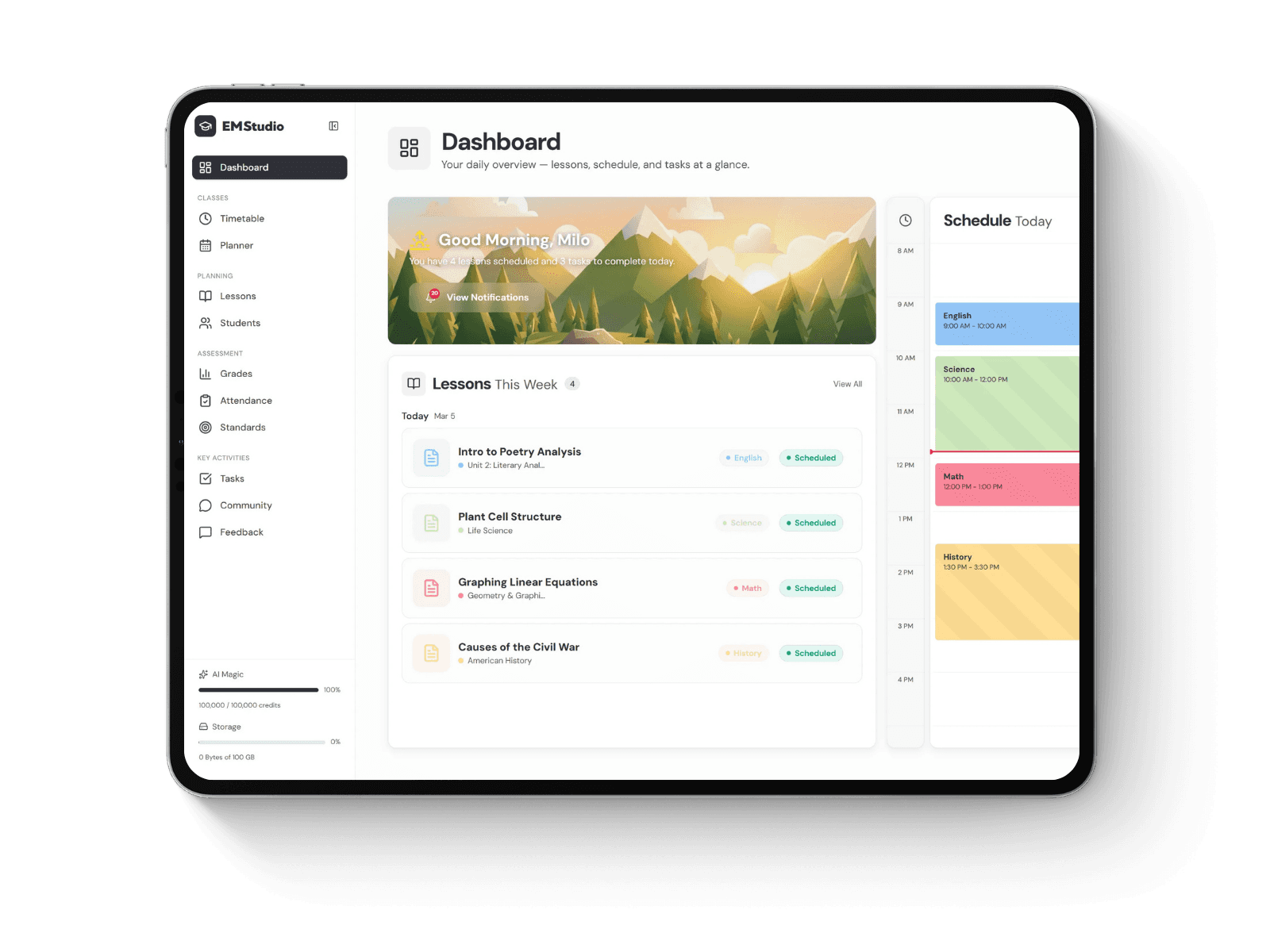
EMStudio is a free teaching management app — manage your classes, students, lessons, and more!
Learn More
Still grading everything by hand?
EMStudio is a free teaching management app — manage your classes, students, lessons, and more!
Learn More
Table of Contents
Before You Begin: Assessing Your Current Questioning Patterns
Calculate three baselines. First, your question-to-statement ratio: count questions versus directives. Shoot for one to three or better. Second, measure wait time with a stopwatch. Untrained teachers usually pause for less than one second. Third, track participation equity: divide unique student responders by total questions. If the same three to five students answer eighty percent of the time, you have a distribution problem that blocks inquiry-based learning.
Use this rubric to place yourself. Novice: eighty percent or more of your exchanges follow the Initiate-Response-Evaluate pattern. Developing: you mix DOK levels but remain the hub of all dialogue. Proficient: students use Socratic questioning on each other in chains. Expert: student-generated divergent questioning drives the lesson.
Once you have these numbers, audit your instructional practice fully. Effective questioning in teaching works best when built on honest data, not guesswork.
Step 1 — How Do You Audit Your Existing Questioning Baseline?
Audit your questioning baseline by recording a 20-minute class segment and coding each question using Bloom's Taxonomy or Webb's DOK levels. Tally closed versus open questions, measure actual wait time with a stopwatch, and calculate what percentage require simple recall versus analysis to establish concrete metrics.
You cannot improve what you do not measure. Before you try new questioning strategies for teachers, you need hard data on your current habits. Most of us think we ask plenty of higher-order thinking questions. The tape usually tells a different story.
Grab a clipboard and a stack of small sticky notes. During your next lesson, place one note on the board for every question you ask. After class, sort them into two piles: closed questions that ask for facts, and open questions that demand analysis. Research shows traditional classrooms average roughly 80 percent closed questions, so do not be shocked if your pile of factual recall dominates. That percentage becomes your baseline to beat next month.
Set up a simple spreadsheet with five columns: Timestamp, Question Verbatim, Bloom's Level, Wait-Time Duration, and Student Name. Record one 15-minute segment of your teaching, then code every question during your prep period. Watch for funneling, where you keep narrowing questions until students guess the answer you want. Check your actual wait time against the three seconds you think you pause. This reveals how often you truly use effective questioning techniques for teachers versus when you just quiz for the right response.
Print a blank Cognitive Rigor Matrix and plot your essential questions from last week where Bloom's Taxonomy meets Webb's DOK levels. You will likely see a heavy cluster in the lower left cells, with the Create and Evaluate columns sitting empty. That visual gap shows exactly where your questioning education needs to grow to support true inquiry-based learning. Those empty cells represent missed opportunities for student ownership.
Create a one-page Questioning Profile with these four metrics:
Percentage of higher-order questions versus recall.
Average wait time in seconds before you speak.
Participation equity score: unique speakers divided by total questions.
Distribution across clarifying, probing, and extending moves.
This audit exposes the gap between your intent and your impact. If you want to move toward Socratic questioning and divergent questioning that opens multiple pathways, you first need to see how tightly you currently control the conversation. Reviewing these metrics alongside diverse techniques in teaching can help you select specific moves to practice next.

Step 2 — Mapping Questions to Higher-Order Thinking Skills
Once you have your baseline audit from Step 1, you need a concrete framework to rank your questions. Bloom's taxonomy gives you six clear rungs to climb. Match your stems to these levels and you stop guessing about rigor. Keep this conversion chart taped inside your plan book or on your desk where you can see it during lessons.
Remember: What is...? Who...? When...?
Understand: How would you explain...? What does this mean...?
Apply: How would you use...? What would happen if...?
Analyze: What is the relationship...? Why does...work?
Evaluate: How would you justify...? Which is more valid...?
Create: How would you design...? What alternative...?
These levels form the backbone of effective questioning techniques in your classroom. When you map every question to a specific tier, you stop asking "good enough?" and start planning for higher-order thinking skills. This is questioning education at its most practical. You move from hoping students think deeply to engineering that depth with precision.
Try the Question Upgrade technique on your next lesson plan. Start with "What is photosynthesis?" That is Level 1. Pure memorization. Now push it up. Level 3 asks: "How would the absence of chlorophyll affect a plant's growth over 30 days?" Students must apply knowledge to a novel scenario. Level 4 demands: "Design an experiment to disprove the hypothesis that light color does not affect photosynthesis rates." Now they are constructing new knowledge from scratch. This progression mirrors Socratic methods of teaching by forcing students to examine their own assumptions about biology.
In 9th-grade World History, you can see this ladder clearly. Level 1 asks: "Identify the causes of WWI." Students list militarism and alliances. Level 2: "Summarize how alliances worked." Still recall, but with some processing. Level 3 requires real analysis: "Analyze which cause was most proximate using the documents provided." Level 4 pushes into evaluation and creation: "Evaluate whether the war was inevitable and create a counterfactual argument defending your position." You have moved from fact-checking to genuine historical inquiry.
Use this comparison matrix to convert your existing recall questions into instruments for inquiry-based learning and divergent questioning:
Traditional Recall: Did you like the character?
Higher-Order Replacement: How does the author's use of syntax manipulate your sympathy for the character?Traditional Recall: What is the formula for area?
Higher-Order Replacement: When would calculating area be useless for solving this real-world flooring problem?Traditional Recall: When did the Civil War end?
Higher-Order Replacement: How might Reconstruction have differed if the war ended two years earlier?Traditional Recall: Is this a prime number?
Higher-Order Replacement: Design a rule for quickly identifying non-primes between 50 and 100.Traditional Recall: What is the theme of this story?
Higher-Order Replacement: Evaluate which textual evidence most weakens your interpretation of the theme.
These questioning strategies in teaching turn passive reception into active construction. Your elicitation techniques in teaching should always aim to push students up at least one level from their comfort zone. Divergent questioning starts when you stop accepting the first right answer and start asking what else could be true. That is when wait time actually pays off.
Step 3 — How Do You Build Strategic Wait-Time Protocols?
Build strategic wait-time protocols by implementing Mary Budd Rowe's research: provide 3-5 seconds of silent pause after asking a question (Wait-Time I) and after a student responds (Wait-Time II). Use a visible timer, enforce 'thinking thumbs' instead of hand-raising, and resist rephrasing during the pause to increase cognitive depth.
Silence is your most powerful tool in questioning education. Most teachers wait less than one second before jumping in. That kills thinking.
Mary Budd Rowe discovered that extending pause length transforms Socratic questioning. Wait-Time I means counting three full seconds after you ask before anyone speaks. Wait-Time II means waiting three seconds after a student stops talking before you respond.
Use a physical sand timer or count "1-Mississippi, 2-Mississippi" silently to yourself. This mechanical approach helps improve student focus during the uncomfortable silence. Research confirms this simple wait time increases both the length and correctness of student responses dramatically.
Replace hand-raising with the "Thinking Thumb." Students place a thumb on their chest when ready, keeping hands down. This stops the ping-pong effect where only quick responders dominate the room.
Try this with 7th graders exploring proportional reasoning. Ask: "If three apples cost six dollars, why doesn't six apples cost nine dollars?" Watch the thumbs appear at different rates. The slower processors get space to work through the structure without someone shouting the answer first. This is where higher-order thinking begins.
Structure your inquiry-based learning with strict timing. Mandate thirty seconds of absolute individual think time before any discussion. Do not rephrase, clarify, or call on anyone during this half-minute.
Follow with ninety seconds of pair discussion, then open the floor. This protocol forces every brain to engage with the divergent questioning before social pressure dilutes the thinking. Students who need processing time get it; extroverts learn to wait.
Avoid "Pseudo-Wait-Time" behaviors that sabotage good questioning techniques for teachers. Rephrasing the question after 1.5 seconds trains students to wait you out. Calling on a different student immediately destroys trust in questioning techniques in the classroom. These habits undermine Bloom's taxonomy goals before students begin to climb.
Train yourself to count to five while maintaining eye contact with the entire room. If no thumb appears, stay silent. The discomfort you feel is the sound of cognition happening. This discipline separates effective questioning techniques in the classroom pdf recommendations from actual classroom practice.

Step 4 — Designing Question Sequences That Scaffold Inquiry
Not all questioning education sequences serve the same purpose. You choose between funneling and focusing based on your daily objective. Funneling narrows toward one correct answer—perfect for order of operations or emergency procedures. Focusing opens multiple pathways for literary analysis or historical interpretation. Decide first: Does this lesson require procedural fluency or inquiry? If fluency, funnel them toward the right steps. If inquiry, focus them on the evidence.
The Inquiry Arc moves students through three distinct stages. Pose an Anchor Question anyone can answer: "What do you notice in this 1890s factory photograph?" This entry point should require zero prior knowledge. Follow with Probe Questions that dig into evidence: "What details about the workers' hands are visible? What does the source omit about their ages?" End with Extension Questions that connect to broader systems: "How does this image's framing reflect industrial-era power structures?" This structure builds from observation to higher-order thinking without losing your APUSH students along the way.
In Socratic Seminars, your questioning method of teaching pdf probably suggests dividing the room into two circles. Inner circle participants ask using stems from the Institute for Learning: "What is your evidence?" or "Can you paraphrase what they just said?" Outer circle students track question types on a graphic organizer—marking each contribution as Clarifying, Probing, Synthesizing, or Challenging. This keeps everyone listening, not just the talkers. The organizer becomes their ticket to enter the inner circle for the next round.
Know when to drop inquiry entirely. Direct instruction wins for safety protocols, fire drills, or introducing foundational vocabulary where precision matters immediately and time is short. Skip the divergent questioning if students lack background knowledge to form hypotheses. You cannot discuss the causes of World War I if they do not yet know what happened at Sarajevo. Sometimes you just need to tell them, then practice the procedure twice.
These classroom questioning strategies work when matched to readiness. Your inquiry-based learning strategies should build ladders, not walls. Check for understanding after your Anchor Question before climbing higher. Watch for blank stares. If you see them, your Probe Questions are too abstract. Step back and review the image one more time.
Socratic questioning needs patience and discipline. Wait time between the Anchor and Probe phases lets students gather evidence from the documents. Rush this, and you get shallow guesses. Bloom's taxonomy matters here—ensure your Extension Questions hit the analyze or evaluate levels. Effective questioning strategies in the classroom require this constant calibration between support and challenge.

Step 5 — How Do You Shift Ownership to Student Questioners?
Shift ownership by teaching the Question Formulation Technique: present a provocative Question Focus, have small groups generate questions without judgment for four minutes, then categorize them as open or closed and practice converting between types. Assign rotating roles like Question Scribe and Devil's Advocate to ensure sustained student-generated inquiry.
The Right Question Institute's QFT protocol turns your students into the primary questioners in true inquiry-based learning. Introduce a Question Focus—a statement like "The Treaty of Versailles caused WWII" or a data set showing infant mortality rates. Set a timer for four minutes. Groups write every question that comes to mind without stopping to answer, judge, or edit. When time expires, they label each "Open" or "Closed" and rewrite one of each to become the opposite type. This builds the art of questioning in teaching directly into student hands.
For older students, use the Question Matrix to push past surface-level questioning and discussion techniques in the classroom. Draw a 4x4 grid. Across the top, write starters: "What if...", "How might...", "Why is...", "What would happen if...". Down the side, list topics: "...the character", "...the system", "...the future", "...the evidence". Your 11th graders analyzing The Great Gatsby might land on "How might the character of Daisy change if the system of old money collapsed?" This generates divergent questioning that hits Bloom's taxonomy levels you rarely reach with teacher prompts.
Rotating roles keep energy moving in a student-centered learning environment. Name a Question Scribe to chart queries on butcher paper. Appoint a Devil's Advocate who must pose one challenging question per seminar. Assign a Clarifier to interrupt you when terms need defining. Switch roles every Monday in your 25-student class so everyone practices active questioning techniques and develops higher-order thinking by winter break.
The Wonder Wall makes Socratic questioning visible and valued. Dedicate eight to ten linear feet of wall space. Students post sticky notes in three columns: "Need to Know" for upcoming content, "Curiosity" for tangential interests, and "Challenge" for disagreements with the text. You commit to addressing at least two per class period. This transforms how you lead effective student discussions from teacher performance to collective exploration, anchoring your questioning education practice in authentic student voice.

Sustaining Your Practice: Avoiding Common Implementation Pitfalls
You have built new habits around critical questioning techniques. Now you must keep them alive through the November slump and state testing season. Most questioning education initiatives die not from bad ideas, but from predictable missteps that drain your energy and confuse your students.
The first trap is the "Any questions?" tag. You say it while closing your laptop and stepping toward the door. Students hear the signal for dismissal, not inquiry. Replace it with specific metacognitive prompts that assume uncertainty rather than mastery.
Ask: "What part of this process feels most uncertain right now?"
Or direct: "Turn to your partner and ask one thing that is still unclear."
These counter the false assumption that students know what they do not know. They create the pause your teaching critical thinking lessons need to breathe. You stop performing closure and start opening doors.
Second, resist over-scaffolding through excessive sub-questions. When you break complex problems into baby steps—"What is 2+2? What is 4+4? Now what pattern do you see?"—you rob students of the cognitive work that builds higher-order thinking. Ask the complex question first: "What pattern governs these sums?" Then use wait time. Let them struggle productively while you resist the urge to hint.
Third, avoid evaluative listening. If you listen only for the correct answer, you cut off wrong answers mid-sentence. Students learn to guess what is in your head. They stop reasoning aloud. This kills critical questioning techniques before they start. Instead, deploy neutral follow-ups that value the thinking process.
Say: "Say more about that."
Ask: "What evidence supports that claim?"
Only after they explain do you confirm correctness. This builds the intellectual safety required for divergent questioning and Socratic questioning. It protects the risk-taking that inquiry-based learning demands. Students learn that wrong answers are data, not disasters, and that you value their reasoning more than their compliance.
Sustainability needs restraint. Adopt a One-Strategy-Per-Month commitment. Do not try to master all different types of questioning techniques for teachers at once. Pick one skill from Bloom's taxonomy levels and drill it until it becomes automatic.
October: Increase wait time to five seconds before accepting any answer.
November: Practice the Question Formulation Technique with your science unit.
December: Focus on Bloom's taxonomy analysis and evaluation questions only.
Support this with micro-observations. Record just five minutes of your class weekly on your phone. Watch who speaks and who waits. Do not watch the whole period. Finally, join a Professional Learning Community for monthly calibration. Use the same audit rubric from Section 1 to score your videos together. This keeps your questioning education goals honest without overwhelming your schedule or your sanity.

What Questioning Education Really Comes Down To
It is not about perfect Socratic seminars every day. It is about you asking fewer questions so your students ask more. When you audit your baseline against Bloom's taxonomy and build strategic wait-time protocols, you create space for genuine inquiry. You stop running quiz show volleys. You teach them to think.
The seven steps rebuild your classroom's DNA slowly. You shift from interrogator to architect. You design sequences that scaffold inquiry and then hand the keys to student questioners. You stop grading the speed of hands raised and start valuing the depth of their curiosity. Your role changes from answer-giver to guide through the messy process of real thinking.
Pick one step. Try the wait-time protocol with your 3rd graders tomorrow. Watch what happens when you stop filling the silence after asking a higher-order question. The discomfort is where the learning lives. That is questioning education. Everything else is just technique.

Before You Begin: Assessing Your Current Questioning Patterns
Calculate three baselines. First, your question-to-statement ratio: count questions versus directives. Shoot for one to three or better. Second, measure wait time with a stopwatch. Untrained teachers usually pause for less than one second. Third, track participation equity: divide unique student responders by total questions. If the same three to five students answer eighty percent of the time, you have a distribution problem that blocks inquiry-based learning.
Use this rubric to place yourself. Novice: eighty percent or more of your exchanges follow the Initiate-Response-Evaluate pattern. Developing: you mix DOK levels but remain the hub of all dialogue. Proficient: students use Socratic questioning on each other in chains. Expert: student-generated divergent questioning drives the lesson.
Once you have these numbers, audit your instructional practice fully. Effective questioning in teaching works best when built on honest data, not guesswork.
Step 1 — How Do You Audit Your Existing Questioning Baseline?
Audit your questioning baseline by recording a 20-minute class segment and coding each question using Bloom's Taxonomy or Webb's DOK levels. Tally closed versus open questions, measure actual wait time with a stopwatch, and calculate what percentage require simple recall versus analysis to establish concrete metrics.
You cannot improve what you do not measure. Before you try new questioning strategies for teachers, you need hard data on your current habits. Most of us think we ask plenty of higher-order thinking questions. The tape usually tells a different story.
Grab a clipboard and a stack of small sticky notes. During your next lesson, place one note on the board for every question you ask. After class, sort them into two piles: closed questions that ask for facts, and open questions that demand analysis. Research shows traditional classrooms average roughly 80 percent closed questions, so do not be shocked if your pile of factual recall dominates. That percentage becomes your baseline to beat next month.
Set up a simple spreadsheet with five columns: Timestamp, Question Verbatim, Bloom's Level, Wait-Time Duration, and Student Name. Record one 15-minute segment of your teaching, then code every question during your prep period. Watch for funneling, where you keep narrowing questions until students guess the answer you want. Check your actual wait time against the three seconds you think you pause. This reveals how often you truly use effective questioning techniques for teachers versus when you just quiz for the right response.
Print a blank Cognitive Rigor Matrix and plot your essential questions from last week where Bloom's Taxonomy meets Webb's DOK levels. You will likely see a heavy cluster in the lower left cells, with the Create and Evaluate columns sitting empty. That visual gap shows exactly where your questioning education needs to grow to support true inquiry-based learning. Those empty cells represent missed opportunities for student ownership.
Create a one-page Questioning Profile with these four metrics:
Percentage of higher-order questions versus recall.
Average wait time in seconds before you speak.
Participation equity score: unique speakers divided by total questions.
Distribution across clarifying, probing, and extending moves.
This audit exposes the gap between your intent and your impact. If you want to move toward Socratic questioning and divergent questioning that opens multiple pathways, you first need to see how tightly you currently control the conversation. Reviewing these metrics alongside diverse techniques in teaching can help you select specific moves to practice next.
Step 2 — Mapping Questions to Higher-Order Thinking Skills
Once you have your baseline audit from Step 1, you need a concrete framework to rank your questions. Bloom's taxonomy gives you six clear rungs to climb. Match your stems to these levels and you stop guessing about rigor. Keep this conversion chart taped inside your plan book or on your desk where you can see it during lessons.
Remember: What is...? Who...? When...?
Understand: How would you explain...? What does this mean...?
Apply: How would you use...? What would happen if...?
Analyze: What is the relationship...? Why does...work?
Evaluate: How would you justify...? Which is more valid...?
Create: How would you design...? What alternative...?
These levels form the backbone of effective questioning techniques in your classroom. When you map every question to a specific tier, you stop asking "good enough?" and start planning for higher-order thinking skills. This is questioning education at its most practical. You move from hoping students think deeply to engineering that depth with precision.
Try the Question Upgrade technique on your next lesson plan. Start with "What is photosynthesis?" That is Level 1. Pure memorization. Now push it up. Level 3 asks: "How would the absence of chlorophyll affect a plant's growth over 30 days?" Students must apply knowledge to a novel scenario. Level 4 demands: "Design an experiment to disprove the hypothesis that light color does not affect photosynthesis rates." Now they are constructing new knowledge from scratch. This progression mirrors Socratic methods of teaching by forcing students to examine their own assumptions about biology.
In 9th-grade World History, you can see this ladder clearly. Level 1 asks: "Identify the causes of WWI." Students list militarism and alliances. Level 2: "Summarize how alliances worked." Still recall, but with some processing. Level 3 requires real analysis: "Analyze which cause was most proximate using the documents provided." Level 4 pushes into evaluation and creation: "Evaluate whether the war was inevitable and create a counterfactual argument defending your position." You have moved from fact-checking to genuine historical inquiry.
Use this comparison matrix to convert your existing recall questions into instruments for inquiry-based learning and divergent questioning:
Traditional Recall: Did you like the character?
Higher-Order Replacement: How does the author's use of syntax manipulate your sympathy for the character?Traditional Recall: What is the formula for area?
Higher-Order Replacement: When would calculating area be useless for solving this real-world flooring problem?Traditional Recall: When did the Civil War end?
Higher-Order Replacement: How might Reconstruction have differed if the war ended two years earlier?Traditional Recall: Is this a prime number?
Higher-Order Replacement: Design a rule for quickly identifying non-primes between 50 and 100.Traditional Recall: What is the theme of this story?
Higher-Order Replacement: Evaluate which textual evidence most weakens your interpretation of the theme.
These questioning strategies in teaching turn passive reception into active construction. Your elicitation techniques in teaching should always aim to push students up at least one level from their comfort zone. Divergent questioning starts when you stop accepting the first right answer and start asking what else could be true. That is when wait time actually pays off.
Step 3 — How Do You Build Strategic Wait-Time Protocols?
Build strategic wait-time protocols by implementing Mary Budd Rowe's research: provide 3-5 seconds of silent pause after asking a question (Wait-Time I) and after a student responds (Wait-Time II). Use a visible timer, enforce 'thinking thumbs' instead of hand-raising, and resist rephrasing during the pause to increase cognitive depth.
Silence is your most powerful tool in questioning education. Most teachers wait less than one second before jumping in. That kills thinking.
Mary Budd Rowe discovered that extending pause length transforms Socratic questioning. Wait-Time I means counting three full seconds after you ask before anyone speaks. Wait-Time II means waiting three seconds after a student stops talking before you respond.
Use a physical sand timer or count "1-Mississippi, 2-Mississippi" silently to yourself. This mechanical approach helps improve student focus during the uncomfortable silence. Research confirms this simple wait time increases both the length and correctness of student responses dramatically.
Replace hand-raising with the "Thinking Thumb." Students place a thumb on their chest when ready, keeping hands down. This stops the ping-pong effect where only quick responders dominate the room.
Try this with 7th graders exploring proportional reasoning. Ask: "If three apples cost six dollars, why doesn't six apples cost nine dollars?" Watch the thumbs appear at different rates. The slower processors get space to work through the structure without someone shouting the answer first. This is where higher-order thinking begins.
Structure your inquiry-based learning with strict timing. Mandate thirty seconds of absolute individual think time before any discussion. Do not rephrase, clarify, or call on anyone during this half-minute.
Follow with ninety seconds of pair discussion, then open the floor. This protocol forces every brain to engage with the divergent questioning before social pressure dilutes the thinking. Students who need processing time get it; extroverts learn to wait.
Avoid "Pseudo-Wait-Time" behaviors that sabotage good questioning techniques for teachers. Rephrasing the question after 1.5 seconds trains students to wait you out. Calling on a different student immediately destroys trust in questioning techniques in the classroom. These habits undermine Bloom's taxonomy goals before students begin to climb.
Train yourself to count to five while maintaining eye contact with the entire room. If no thumb appears, stay silent. The discomfort you feel is the sound of cognition happening. This discipline separates effective questioning techniques in the classroom pdf recommendations from actual classroom practice.
Step 4 — Designing Question Sequences That Scaffold Inquiry
Not all questioning education sequences serve the same purpose. You choose between funneling and focusing based on your daily objective. Funneling narrows toward one correct answer—perfect for order of operations or emergency procedures. Focusing opens multiple pathways for literary analysis or historical interpretation. Decide first: Does this lesson require procedural fluency or inquiry? If fluency, funnel them toward the right steps. If inquiry, focus them on the evidence.
The Inquiry Arc moves students through three distinct stages. Pose an Anchor Question anyone can answer: "What do you notice in this 1890s factory photograph?" This entry point should require zero prior knowledge. Follow with Probe Questions that dig into evidence: "What details about the workers' hands are visible? What does the source omit about their ages?" End with Extension Questions that connect to broader systems: "How does this image's framing reflect industrial-era power structures?" This structure builds from observation to higher-order thinking without losing your APUSH students along the way.
In Socratic Seminars, your questioning method of teaching pdf probably suggests dividing the room into two circles. Inner circle participants ask using stems from the Institute for Learning: "What is your evidence?" or "Can you paraphrase what they just said?" Outer circle students track question types on a graphic organizer—marking each contribution as Clarifying, Probing, Synthesizing, or Challenging. This keeps everyone listening, not just the talkers. The organizer becomes their ticket to enter the inner circle for the next round.
Know when to drop inquiry entirely. Direct instruction wins for safety protocols, fire drills, or introducing foundational vocabulary where precision matters immediately and time is short. Skip the divergent questioning if students lack background knowledge to form hypotheses. You cannot discuss the causes of World War I if they do not yet know what happened at Sarajevo. Sometimes you just need to tell them, then practice the procedure twice.
These classroom questioning strategies work when matched to readiness. Your inquiry-based learning strategies should build ladders, not walls. Check for understanding after your Anchor Question before climbing higher. Watch for blank stares. If you see them, your Probe Questions are too abstract. Step back and review the image one more time.
Socratic questioning needs patience and discipline. Wait time between the Anchor and Probe phases lets students gather evidence from the documents. Rush this, and you get shallow guesses. Bloom's taxonomy matters here—ensure your Extension Questions hit the analyze or evaluate levels. Effective questioning strategies in the classroom require this constant calibration between support and challenge.
Step 5 — How Do You Shift Ownership to Student Questioners?
Shift ownership by teaching the Question Formulation Technique: present a provocative Question Focus, have small groups generate questions without judgment for four minutes, then categorize them as open or closed and practice converting between types. Assign rotating roles like Question Scribe and Devil's Advocate to ensure sustained student-generated inquiry.
The Right Question Institute's QFT protocol turns your students into the primary questioners in true inquiry-based learning. Introduce a Question Focus—a statement like "The Treaty of Versailles caused WWII" or a data set showing infant mortality rates. Set a timer for four minutes. Groups write every question that comes to mind without stopping to answer, judge, or edit. When time expires, they label each "Open" or "Closed" and rewrite one of each to become the opposite type. This builds the art of questioning in teaching directly into student hands.
For older students, use the Question Matrix to push past surface-level questioning and discussion techniques in the classroom. Draw a 4x4 grid. Across the top, write starters: "What if...", "How might...", "Why is...", "What would happen if...". Down the side, list topics: "...the character", "...the system", "...the future", "...the evidence". Your 11th graders analyzing The Great Gatsby might land on "How might the character of Daisy change if the system of old money collapsed?" This generates divergent questioning that hits Bloom's taxonomy levels you rarely reach with teacher prompts.
Rotating roles keep energy moving in a student-centered learning environment. Name a Question Scribe to chart queries on butcher paper. Appoint a Devil's Advocate who must pose one challenging question per seminar. Assign a Clarifier to interrupt you when terms need defining. Switch roles every Monday in your 25-student class so everyone practices active questioning techniques and develops higher-order thinking by winter break.
The Wonder Wall makes Socratic questioning visible and valued. Dedicate eight to ten linear feet of wall space. Students post sticky notes in three columns: "Need to Know" for upcoming content, "Curiosity" for tangential interests, and "Challenge" for disagreements with the text. You commit to addressing at least two per class period. This transforms how you lead effective student discussions from teacher performance to collective exploration, anchoring your questioning education practice in authentic student voice.
Sustaining Your Practice: Avoiding Common Implementation Pitfalls
You have built new habits around critical questioning techniques. Now you must keep them alive through the November slump and state testing season. Most questioning education initiatives die not from bad ideas, but from predictable missteps that drain your energy and confuse your students.
The first trap is the "Any questions?" tag. You say it while closing your laptop and stepping toward the door. Students hear the signal for dismissal, not inquiry. Replace it with specific metacognitive prompts that assume uncertainty rather than mastery.
Ask: "What part of this process feels most uncertain right now?"
Or direct: "Turn to your partner and ask one thing that is still unclear."
These counter the false assumption that students know what they do not know. They create the pause your teaching critical thinking lessons need to breathe. You stop performing closure and start opening doors.
Second, resist over-scaffolding through excessive sub-questions. When you break complex problems into baby steps—"What is 2+2? What is 4+4? Now what pattern do you see?"—you rob students of the cognitive work that builds higher-order thinking. Ask the complex question first: "What pattern governs these sums?" Then use wait time. Let them struggle productively while you resist the urge to hint.
Third, avoid evaluative listening. If you listen only for the correct answer, you cut off wrong answers mid-sentence. Students learn to guess what is in your head. They stop reasoning aloud. This kills critical questioning techniques before they start. Instead, deploy neutral follow-ups that value the thinking process.
Say: "Say more about that."
Ask: "What evidence supports that claim?"
Only after they explain do you confirm correctness. This builds the intellectual safety required for divergent questioning and Socratic questioning. It protects the risk-taking that inquiry-based learning demands. Students learn that wrong answers are data, not disasters, and that you value their reasoning more than their compliance.
Sustainability needs restraint. Adopt a One-Strategy-Per-Month commitment. Do not try to master all different types of questioning techniques for teachers at once. Pick one skill from Bloom's taxonomy levels and drill it until it becomes automatic.
October: Increase wait time to five seconds before accepting any answer.
November: Practice the Question Formulation Technique with your science unit.
December: Focus on Bloom's taxonomy analysis and evaluation questions only.
Support this with micro-observations. Record just five minutes of your class weekly on your phone. Watch who speaks and who waits. Do not watch the whole period. Finally, join a Professional Learning Community for monthly calibration. Use the same audit rubric from Section 1 to score your videos together. This keeps your questioning education goals honest without overwhelming your schedule or your sanity.
What Questioning Education Really Comes Down To
It is not about perfect Socratic seminars every day. It is about you asking fewer questions so your students ask more. When you audit your baseline against Bloom's taxonomy and build strategic wait-time protocols, you create space for genuine inquiry. You stop running quiz show volleys. You teach them to think.
The seven steps rebuild your classroom's DNA slowly. You shift from interrogator to architect. You design sequences that scaffold inquiry and then hand the keys to student questioners. You stop grading the speed of hands raised and start valuing the depth of their curiosity. Your role changes from answer-giver to guide through the messy process of real thinking.
Pick one step. Try the wait-time protocol with your 3rd graders tomorrow. Watch what happens when you stop filling the silence after asking a higher-order question. The discomfort is where the learning lives. That is questioning education. Everything else is just technique.
Still grading everything by hand?
EMStudio is a free teaching management app — manage your classes, students, lessons, and more!
Learn More
Still grading everything by hand?
EMStudio is a free teaching management app — manage your classes, students, lessons, and more!
Learn More




Notion4Teachers
Notion templates to simplify administrative tasks and enhance your teaching experience.



2026 Notion4Teachers. All Rights Reserved.
Notion4Teachers
Notion templates to simplify administrative tasks and enhance your teaching experience.
2026 Notion4Teachers. All Rights Reserved.
Notion4Teachers
Notion templates to simplify administrative tasks and enhance your teaching experience.
2026 Notion4Teachers. All Rights Reserved.