
12 New Teacher Tips for a Successful First Year
12 New Teacher Tips for a Successful First Year

Article by
Milo
ESL Content Coordinator & Educator
ESL Content Coordinator & Educator
All Posts
It's October. Your 7th graders are bouncing off the walls after lunch. Someone just spilled juice on your only copy of the quiz. You're staring at the mess and wondering if that credential program prepared you for this. Every new teacher hits this wall. It usually happens around week six, when the syllabus stops being a shield.
You don't need another theoretical framework. You need classroom procedures that stick, formative assessment tricks that take five minutes, and instructional strategies that keep kids awake. These twelve tips help any first year teacher spot teacher burnout early. They'll help you build a mentor teacher relationship that survives October.
Still grading everything by hand?
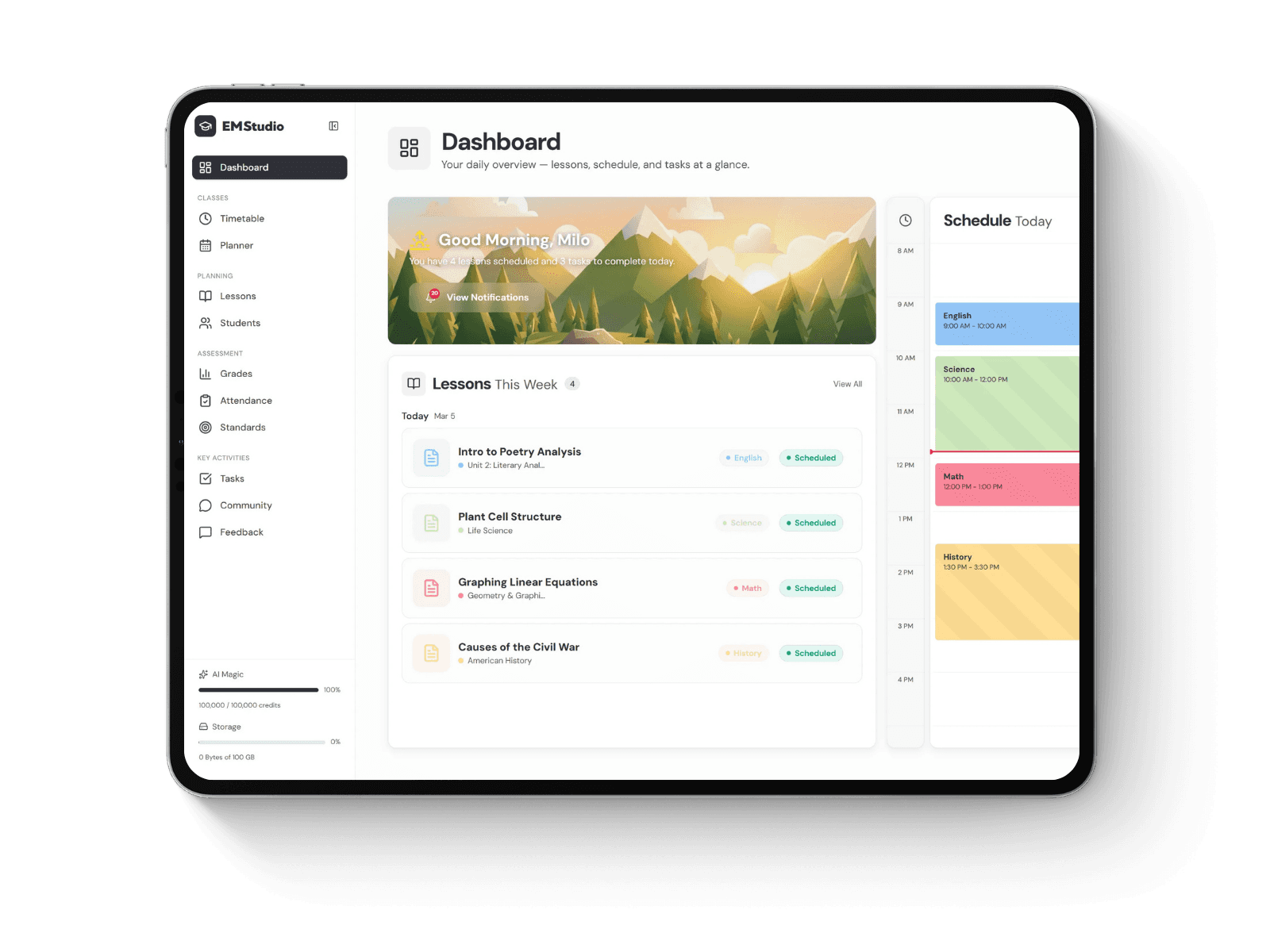
EMStudio is a free teaching management app — manage your classes, students, lessons, and more!
Learn More
Still grading everything by hand?
EMStudio is a free teaching management app — manage your classes, students, lessons, and more!
Learn More
Table of Contents
Classroom Management Foundations Every New Teacher Needs
Half of new teacher attrition stems from classroom management struggles. You can avoid the teacher burnout that drives colleagues out by November when you implement foundational classroom management strategies from day one. These teaching tips for new teachers focus on automaticity, not charisma.
Establish Clear Procedures from Day One
Master these five procedures using the See-Do-Review method. You model while students watch, they practice immediately, and you re-teach on days two and three until automatic.
Entering the classroom and starting the warm-up.
Obtaining materials and bathroom use without asking you.
Turning in work to the correct location.
Emergency protocols for drills.
Silent early finisher activities.
Use the 3-Step Procedure Protocol. Perform silently first. Narrate your thinking second. Have three volunteers model third. Then the whole class practices for exactly two minutes. Establishing clear classroom rules and procedures means seventh graders enter your science room and start the Do Now in 60 seconds. If it takes longer, remove steps like greeting at the door.
When to Stop and Re-teach: If fewer than 80% of students complete your entry routine within three seconds by day five, halt academic instruction. Use Doug Lemov's Do It Again technique. Have them re-enter until they meet the standard. Do not press forward with content until the foundation is solid.
Build Relationships Before Enforcing Rules
Implement the 2x10 Strategy starting week one. Spend two minutes per day for ten consecutive school days talking with your three highest-need students about non-academic topics. Ask about soccer practice or their new puppy. Track this on a simple chart. These conversations build the trust you need when you later correct their behavior.
Administer a Student Interest Inventory on day one. Ask five specific questions: favorite song or artist, something they are an expert at, one worry about your class, preferred nickname, and career interest. Reference these during instruction. When you compare photosynthesis to the TikTok trend they mentioned, you show you were listening.
Use Positive Reinforcement Systems
System | Best For | Setup |
|---|---|---|
ClassDojo | K-6 | Free, 5 minutes, needs parent smartphones |
Paper Ticket Economy | Grades 7-12 | No tech, requires banking system |
Table Points | Elementary | Builds team cohesion, no individual tracking |
Maintain the 4:1 ratio. Research shows four positive interactions for every one corrective interaction maintains behavioral momentum. Use a tally counter to track your ratio during the first month. Welcome to teaching means becoming aware of how often you nag versus how often you celebrate.
Handle Disruptions with Minimal Interruption
Use this Intervention Hierarchy by Disruption Level:
Strategy | Time Lost | Use When |
|---|---|---|
Proximity | 0 seconds | Student looks off-task |
Hand Signal | 2 seconds | Quiet reminder needed |
Quiet Verbal Redirect | 5 seconds | Signal ignored |
Public Correction | Avoid | Never for minor issues |
Aim for 90% non-verbal interventions. Master the Minimal Interruption Toolkit: The Look (raised eyebrows, eye contact), The Move (within three feet), and The Pause (five seconds of silence). Practice these with your mentor teacher before you go solo.
Follow the 10-Second Rule. Never stop instruction for more than ten seconds to address a minor disruption. Longer corrections mean the behavior is major and requires a private conversation after class. Public power struggles destroy your authority and waste instructional time.

What Are the Most Effective Teaching Strategies for New Teachers?
The most effective strategies include the gradual release model (I Do/We Do/You Do), daily formative assessment through 3-question exit tickets, manageable differentiation using Must-Do/May-Do lists, and structured cooperative learning like Numbered Heads Together. These frameworks reduce cognitive load while maximizing engagement.
You do not need twenty strategies. You need four that work every time. Master these and you will survive October without crying in your car.
Think of instruction as a flowchart. Introducing new content? Use Direct Instruction capped at ten minutes. Checking understanding? Shift to Guided Practice with you circulating. Applying skills? Release to Independent Practice. Closing the lesson? Deploy the Exit Ticket. This sequence prevents the common trap of talking for thirty minutes while students zone out.
John Hattie's Visible Learning research puts formative assessment at an effect size of 0.65, squarely in the high-impact zone. Re-teaching without checking for understanding first sits at 0.32. The math is simple: assess before you reteach. Guessing which kids need help wastes your evenings and their patience.
Do not attempt full differentiation for every student in week one as a new teacher. You will burn out by Halloween, and your classroom procedures will collapse under the weight of twenty different assignments. Instead, use Differentiation Lite: keep the same learning objective for everyone, but offer three levels of support. Hint cards for strugglers, partially completed examples for the middle, and challenge problems for early finishers. Same worksheet, different scaffolds. Your mentor teacher will thank you for not creating three separate tests.
Start with Simple Lesson Structures
Never lecture longer than ten minutes without giving students two minutes to process. The 10-2 Rule saves lives. Use this template: Hook (5 minutes), Mini-lesson (10 minutes), Guided Practice with you walking the room (10 minutes), Independent Practice (15 minutes), Exit Ticket (5 minutes). Stick to the clock.
During the I Do phase, work through two examples while thinking aloud. Verbalize your mistakes and corrections. Then do one example where students direct your steps. Only then release to We Do. Skipping this middle step leaves kids stranded when they try it alone.
Use Formative Assessment Daily
Implement the Daily Exit Ticket protocol. Three questions on a quarter-sheet:
Question 1 (content): Circle the correct answer or solve the problem.
Question 2 (metacognition): Rate your confidence 1-4 on the skill.
Question 3 (feedback): What is one question you still have?
Sort into three piles—Got It, Partial, Confused—in under five minutes to plan tomorrow's groups. Compare your options. Plickers use paper clickers—no student devices, instant bar graph projected on your board. Google Forms self-grade but require one-to-one access. Paper works when the Wi-Fi fails. For a first year teacher in a low-tech building, Plickers eliminates tech variables while giving you hard data. Check out these daily formative assessment examples for templates.
Differentiate Without Overwhelming Yourself
Run the Must Do/May Do system. All students complete the same three core tasks that hit the standard. Early finishers choose from two extension activities that deepen the learning. For example, in 7th-grade science: Must Do equals read the section, label the diagram, answer the four comprehension questions. May Do equals design an experiment or write a newspaper article from the cell's perspective. No separate worksheets. No teacher burnout from grading fifty different assignments.
Use tiered assignments without creating three separate documents. Hand out the same complex text with three levels of question prompts printed on different colored paper. Level 1 asks literal comprehension, Level 2 asks inference, Level 3 asks evaluation. Students self-select based on confidence, with your guidance. Same objective, different entry points.
Leverage Cooperative Learning Techniques
Try Numbered Heads Together. Students in groups of four number off one through four. You ask a question. The group ensures everyone knows the answer within two minutes. You randomly call a number—"All threes stand up"—and those students respond. No one hides. Grab this cooperative learning toolkit for more structures.
Assign concrete roles for group work and rotate weekly:
Facilitator keeps the group on task and reads directions aloud.
Timekeeper watches the clock and warns when five minutes remain.
Materials Manager distributes papers and collects supplies at the end.
Recorder writes the final answers that the group submits.
Never use groups larger than four or smaller than two. Three creates odd-person-out dynamics; five lets someone coast.

Where Can New Teachers Find Help and Professional Development?
New teachers should seek help from assigned mentor teachers for weekly 30-minute meetings, join Professional Learning Communities (PLCs) for collaborative planning, utilize curated websites like Edutopia and Cult of Pedagogy, and establish strict boundaries (no email after 7 PM) to prevent burnout. Documenting weekly reflections accelerates growth more than passive PD attendance.
You cannot do this alone. The first year will drown you if you try to solve every problem in isolation. Smart new teacher help comes from specific people, curated resources, and hard boundaries that protect your sanity.
Identify Your Mentor and Professional Learning Community
Meet with your mentor teacher weekly for exactly 30 minutes. Use this agenda: five minutes celebrating wins, twenty minutes solving one specific problem using student work samples, five minutes defining next steps. Come prepared with student writing or assessment data to analyze together. Building a successful relationship with your mentor requires structure, not random hallway conversations.
Arrange a shadow schedule. Observe your mentor or a master teacher for one full period monthly. Use instructional rounds protocol—focus on one specific element like transition time or question types, avoiding vague observations about "good teaching." Take notes on exactly how they hand out papers or start class. Specific classroom procedures stick better than broad philosophies.
If your school failed to assign a mentor, identify three veteran teachers and rotate monthly coffee meetings. Join or create a Professional Learning Community using the "What? So What? Now What?" structure. Bring one student work sample to 45-minute weekly meetings. If PLCs do not exist, build a vertical team with teachers from grades above and below you to track skill progression across years.
Curate Essential New Teacher Websites and Resources
Stop googling "classroom management" at midnight and bookmark these new teacher websites instead:
Edutopia: Evidence-based strategies and classroom management videos for immediate implementation.
Cult of Pedagogy: Deep dives into pedagogy with a secondary focus and practical tools.
The New Teacher Project: First-year specific tools and structured support resources.
r/Teachers: Reddit community for practical advice, venting, and real solutions.
Teachers Pay Teachers: Differentiated materials when you need them yesterday; budget $50 annually.
Visual learners need targeted YouTube channels. Smart Classroom Management by Michael Linsin delivers behavior strategies that actually work in chaotic rooms. The Lettered Classroom breaks down elementary literacy techniques step-by-step. Math with Mr. J provides middle school math tutorials perfect for flipped lessons or emergency sub plans. Use these for professional development for new teachers when you have fifteen minutes and need answers, not academic theory.
Set Boundaries to Prevent First-Year Burnout
Watch for the Sunday Night Anxiety Test. If you feel physically ill Sunday evenings, you are in the red zone of teacher burnout. Immediate intervention required: delegate one task like grading or copies, cancel one non-essential meeting, and schedule one mandatory fun activity. The Gates Foundation's Measures of Effective Teaching study found teachers work 53 hours weekly on average. Boundary setting is survival, not luxury.
Calculate your actual hourly wage by dividing your salary by 195 days, then by 10 hours. Keep that number visible when you consider unpaid overtime. Implement the Parked Car Rule: when the final bell rings, walk straight to your car without sitting down. Set an email auto-responder stating you check messages at 7 AM and 3:30 PM only. Evidence-based strategies for work-life balance protect your ability to teach next year.
Adopt the Good Enough Standard. Aim for 80 percent proficiency in lesson planning and grading rather than perfection. Perfectionism creates 60-hour weeks and empty tanks by December. Use the Touch It Once rule for papers—grade immediately or do not collect them. Stacks breed guilt and anxiety faster than they breed learning.
Document Weekly Reflections for Continuous Growth
End each week with a ten-minute Rose, Thorn, Bud reflection. Write one specific win involving a student or lesson. Document one challenge that blocked learning. Plan one idea for next week. Keep this in a Google Doc or physical notebook to track your growth trajectory throughout the year. Active documentation accelerates improvement faster than passive new teacher pd attendance ever could.
Create a Win Folder in your email or a physical file. Save every positive parent email, student thank-you note, and observation praise. Review this folder in February when first-year fatigue peaks and you question your career choice. These artifacts prove you are making progress even when it feels invisible.
Share your weekly reflections with your mentor during your scheduled meetings. Building a successful relationship with your mentor requires showing up with specific data about your practice, not just complaints. This habit transforms vague anxiety into actionable instructional strategies you can implement immediately.

How Do You Prioritize These Tips in Your First Month?
Prioritize relationship building and procedure mastery in week one, layer in academic routines and formative assessments during weeks two through four, and shift to data analysis and refinement by month two. This sequenced approach prevents overwhelm while building sustainable classroom systems.
You cannot do everything at once. Pick one priority per week or you will face teacher burnout by October.
Follow this first month roadmap. By day 5, students should enter silently and begin warm-ups within 60 seconds. By day 10, make 3 positive parent contacts. By day 20, assess and group students for intervention. These benchmarks keep you on track without crushing your spirit. Check your progress at key decision points. At the week 1 checkpoint, if name memorization sits below 90%, pause content and use name games. At the week 3 checkpoint, if exit ticket data shows less than 70% mastery, re-teach using a different modality. Trust the data, not the calendar.
Resist the curriculum coverage panic. You are not behind if veteran teachers are on page 50 and you are on page 30. Cover 80 percent of the curriculum deeply rather than 100 percent superficially. Students remember what they learned, not what you covered.
If you fall behind, cut these three things first:
Decorative bulletin boards that eat up Sunday nights.
Elaborate projects that require more prep than learning.
Non-essential homework that creates grading piles.
Your first-year survival guide depends on sanity, not Pinterest-worthy walls.
Week One: Focus on Names and Procedures
Use a seating chart with student photos from your SIS. Play Name and Motion with elementary students, where each child pairs a gesture with their name. For secondary, run Speed Dating where students interview each other and you quiz the class. Your goal is 100 percent name recall by day 3. Names are the foundation of classroom management.
If you hit 90 percent accuracy at the week 1 checkpoint, you may proceed with content. If not, pause and play more name games. This checkpoint prevents anonymity. Students behave better when they know you know them.
Teach one procedure per day. Cover entering the room, materials, bathroom, and emergencies. Use the Do It Again method. If the line is noisy, return to the door and practice until silent. Do not teach academic content until these classroom procedures become automatic. The ten minutes you spend practicing now saves hours later.
Drill the entry procedure until it is muscle memory. Students should know where to find their warm-up, how to submit homework, and what silence looks like. Practice transitions between activities. Time them. If it takes more than sixty seconds, do it again. Speed creates more time for learning.
A new teacher who skips this step spends the entire year managing chaos instead of teaching. Your tips for new teachers must start here. Without procedures, you cannot implement any other instructional strategies effectively.
Weeks Two to Four: Layer in Academic Routines
Week 2 introduces Turn and Talk protocols. Week 3 brings station rotations or a workshop model with twenty-minute blocks. Week 4 delivers your first major assessment. These instructional strategies build slowly so students master the structure before the content gets heavy.
For example, in 4th grade literacy, you might launch Daily 5 in week 2, start guided reading groups in week 3, and conduct your first running records in week 4. Each layer assumes the previous one is automatic. If students cannot handle independent stations, you are not ready for small groups.
Launch your first parent contact campaign now. Call three parents per week with specific positive news. Tell them you noticed Sarah helped a classmate or that Marcus improved his handwriting. Keep a simple log. You need this positive capital before you call about problems later.
Track your time during these weeks. If you are spending three hours grading each night, your system is broken. Simplify your rubrics. Use checklists. Ask your mentor teacher to review your workflow against the planning habits of highly effective educators.
First year teachers often front-load relationships and routines before diving into heavy content. This pacing prevents collapse.
Month Two and Beyond: Refine and Reflect
After your first unit assessment in week 6 or 8, create a simple tracker. Use Excel or paper. Identify students scoring below 70 percent. These kids form your intervention group. Schedule thirty minutes twice weekly for small group re-teaching using visual methods if you taught auditorily the first time.
Month 2 is for system refinement. Adjust seating charts based on behavior data. Streamline your grading system based on time tracking. Request a formal observation from your administrator for feedback, not evaluation. You need instructional strategies calibrated to your actual students, not your training videos.
Check in with your mentor teacher. Show them your formative assessment data. Ask what they would cut if they were behind. Veterans know that covering less material with mastery beats rushing through chapters.
Reflect on your energy levels. If you are exhausted, something must go. Maybe stop color-coding every handout. Maybe batch your copying on Fridays. Protect your evenings or you will not survive the year.

Getting Started with New Teacher
Your first year will not be perfect. You will forget to take attendance, lose a stack of papers, and wonder if teacher burnout is inevitable around mid-October. It is not. The difference between a first year teacher who survives and one who thrives is simply this: they focus on classroom procedures before flashy lesson plans, and they check for understanding every single day with quick formative assessment instead of guessing.
You do not need to use all twelve tips tomorrow. Pick the one that solves your biggest headache right now. Teach that procedure until students do it automatically. Use one exit ticket this week to see what actually stuck. Small wins add up faster than grand overhauls, and they keep you in the classroom next year.
Write down your three biggest time-wasters during transitions.
Pick one procedure to fix this week. Model it. Practice it.
Choose one formative assessment method to use daily for the next five days.
Block thirty minutes on Sunday for planning, not grading.

Classroom Management Foundations Every New Teacher Needs
Half of new teacher attrition stems from classroom management struggles. You can avoid the teacher burnout that drives colleagues out by November when you implement foundational classroom management strategies from day one. These teaching tips for new teachers focus on automaticity, not charisma.
Establish Clear Procedures from Day One
Master these five procedures using the See-Do-Review method. You model while students watch, they practice immediately, and you re-teach on days two and three until automatic.
Entering the classroom and starting the warm-up.
Obtaining materials and bathroom use without asking you.
Turning in work to the correct location.
Emergency protocols for drills.
Silent early finisher activities.
Use the 3-Step Procedure Protocol. Perform silently first. Narrate your thinking second. Have three volunteers model third. Then the whole class practices for exactly two minutes. Establishing clear classroom rules and procedures means seventh graders enter your science room and start the Do Now in 60 seconds. If it takes longer, remove steps like greeting at the door.
When to Stop and Re-teach: If fewer than 80% of students complete your entry routine within three seconds by day five, halt academic instruction. Use Doug Lemov's Do It Again technique. Have them re-enter until they meet the standard. Do not press forward with content until the foundation is solid.
Build Relationships Before Enforcing Rules
Implement the 2x10 Strategy starting week one. Spend two minutes per day for ten consecutive school days talking with your three highest-need students about non-academic topics. Ask about soccer practice or their new puppy. Track this on a simple chart. These conversations build the trust you need when you later correct their behavior.
Administer a Student Interest Inventory on day one. Ask five specific questions: favorite song or artist, something they are an expert at, one worry about your class, preferred nickname, and career interest. Reference these during instruction. When you compare photosynthesis to the TikTok trend they mentioned, you show you were listening.
Use Positive Reinforcement Systems
System | Best For | Setup |
|---|---|---|
ClassDojo | K-6 | Free, 5 minutes, needs parent smartphones |
Paper Ticket Economy | Grades 7-12 | No tech, requires banking system |
Table Points | Elementary | Builds team cohesion, no individual tracking |
Maintain the 4:1 ratio. Research shows four positive interactions for every one corrective interaction maintains behavioral momentum. Use a tally counter to track your ratio during the first month. Welcome to teaching means becoming aware of how often you nag versus how often you celebrate.
Handle Disruptions with Minimal Interruption
Use this Intervention Hierarchy by Disruption Level:
Strategy | Time Lost | Use When |
|---|---|---|
Proximity | 0 seconds | Student looks off-task |
Hand Signal | 2 seconds | Quiet reminder needed |
Quiet Verbal Redirect | 5 seconds | Signal ignored |
Public Correction | Avoid | Never for minor issues |
Aim for 90% non-verbal interventions. Master the Minimal Interruption Toolkit: The Look (raised eyebrows, eye contact), The Move (within three feet), and The Pause (five seconds of silence). Practice these with your mentor teacher before you go solo.
Follow the 10-Second Rule. Never stop instruction for more than ten seconds to address a minor disruption. Longer corrections mean the behavior is major and requires a private conversation after class. Public power struggles destroy your authority and waste instructional time.
What Are the Most Effective Teaching Strategies for New Teachers?
The most effective strategies include the gradual release model (I Do/We Do/You Do), daily formative assessment through 3-question exit tickets, manageable differentiation using Must-Do/May-Do lists, and structured cooperative learning like Numbered Heads Together. These frameworks reduce cognitive load while maximizing engagement.
You do not need twenty strategies. You need four that work every time. Master these and you will survive October without crying in your car.
Think of instruction as a flowchart. Introducing new content? Use Direct Instruction capped at ten minutes. Checking understanding? Shift to Guided Practice with you circulating. Applying skills? Release to Independent Practice. Closing the lesson? Deploy the Exit Ticket. This sequence prevents the common trap of talking for thirty minutes while students zone out.
John Hattie's Visible Learning research puts formative assessment at an effect size of 0.65, squarely in the high-impact zone. Re-teaching without checking for understanding first sits at 0.32. The math is simple: assess before you reteach. Guessing which kids need help wastes your evenings and their patience.
Do not attempt full differentiation for every student in week one as a new teacher. You will burn out by Halloween, and your classroom procedures will collapse under the weight of twenty different assignments. Instead, use Differentiation Lite: keep the same learning objective for everyone, but offer three levels of support. Hint cards for strugglers, partially completed examples for the middle, and challenge problems for early finishers. Same worksheet, different scaffolds. Your mentor teacher will thank you for not creating three separate tests.
Start with Simple Lesson Structures
Never lecture longer than ten minutes without giving students two minutes to process. The 10-2 Rule saves lives. Use this template: Hook (5 minutes), Mini-lesson (10 minutes), Guided Practice with you walking the room (10 minutes), Independent Practice (15 minutes), Exit Ticket (5 minutes). Stick to the clock.
During the I Do phase, work through two examples while thinking aloud. Verbalize your mistakes and corrections. Then do one example where students direct your steps. Only then release to We Do. Skipping this middle step leaves kids stranded when they try it alone.
Use Formative Assessment Daily
Implement the Daily Exit Ticket protocol. Three questions on a quarter-sheet:
Question 1 (content): Circle the correct answer or solve the problem.
Question 2 (metacognition): Rate your confidence 1-4 on the skill.
Question 3 (feedback): What is one question you still have?
Sort into three piles—Got It, Partial, Confused—in under five minutes to plan tomorrow's groups. Compare your options. Plickers use paper clickers—no student devices, instant bar graph projected on your board. Google Forms self-grade but require one-to-one access. Paper works when the Wi-Fi fails. For a first year teacher in a low-tech building, Plickers eliminates tech variables while giving you hard data. Check out these daily formative assessment examples for templates.
Differentiate Without Overwhelming Yourself
Run the Must Do/May Do system. All students complete the same three core tasks that hit the standard. Early finishers choose from two extension activities that deepen the learning. For example, in 7th-grade science: Must Do equals read the section, label the diagram, answer the four comprehension questions. May Do equals design an experiment or write a newspaper article from the cell's perspective. No separate worksheets. No teacher burnout from grading fifty different assignments.
Use tiered assignments without creating three separate documents. Hand out the same complex text with three levels of question prompts printed on different colored paper. Level 1 asks literal comprehension, Level 2 asks inference, Level 3 asks evaluation. Students self-select based on confidence, with your guidance. Same objective, different entry points.
Leverage Cooperative Learning Techniques
Try Numbered Heads Together. Students in groups of four number off one through four. You ask a question. The group ensures everyone knows the answer within two minutes. You randomly call a number—"All threes stand up"—and those students respond. No one hides. Grab this cooperative learning toolkit for more structures.
Assign concrete roles for group work and rotate weekly:
Facilitator keeps the group on task and reads directions aloud.
Timekeeper watches the clock and warns when five minutes remain.
Materials Manager distributes papers and collects supplies at the end.
Recorder writes the final answers that the group submits.
Never use groups larger than four or smaller than two. Three creates odd-person-out dynamics; five lets someone coast.
Where Can New Teachers Find Help and Professional Development?
New teachers should seek help from assigned mentor teachers for weekly 30-minute meetings, join Professional Learning Communities (PLCs) for collaborative planning, utilize curated websites like Edutopia and Cult of Pedagogy, and establish strict boundaries (no email after 7 PM) to prevent burnout. Documenting weekly reflections accelerates growth more than passive PD attendance.
You cannot do this alone. The first year will drown you if you try to solve every problem in isolation. Smart new teacher help comes from specific people, curated resources, and hard boundaries that protect your sanity.
Identify Your Mentor and Professional Learning Community
Meet with your mentor teacher weekly for exactly 30 minutes. Use this agenda: five minutes celebrating wins, twenty minutes solving one specific problem using student work samples, five minutes defining next steps. Come prepared with student writing or assessment data to analyze together. Building a successful relationship with your mentor requires structure, not random hallway conversations.
Arrange a shadow schedule. Observe your mentor or a master teacher for one full period monthly. Use instructional rounds protocol—focus on one specific element like transition time or question types, avoiding vague observations about "good teaching." Take notes on exactly how they hand out papers or start class. Specific classroom procedures stick better than broad philosophies.
If your school failed to assign a mentor, identify three veteran teachers and rotate monthly coffee meetings. Join or create a Professional Learning Community using the "What? So What? Now What?" structure. Bring one student work sample to 45-minute weekly meetings. If PLCs do not exist, build a vertical team with teachers from grades above and below you to track skill progression across years.
Curate Essential New Teacher Websites and Resources
Stop googling "classroom management" at midnight and bookmark these new teacher websites instead:
Edutopia: Evidence-based strategies and classroom management videos for immediate implementation.
Cult of Pedagogy: Deep dives into pedagogy with a secondary focus and practical tools.
The New Teacher Project: First-year specific tools and structured support resources.
r/Teachers: Reddit community for practical advice, venting, and real solutions.
Teachers Pay Teachers: Differentiated materials when you need them yesterday; budget $50 annually.
Visual learners need targeted YouTube channels. Smart Classroom Management by Michael Linsin delivers behavior strategies that actually work in chaotic rooms. The Lettered Classroom breaks down elementary literacy techniques step-by-step. Math with Mr. J provides middle school math tutorials perfect for flipped lessons or emergency sub plans. Use these for professional development for new teachers when you have fifteen minutes and need answers, not academic theory.
Set Boundaries to Prevent First-Year Burnout
Watch for the Sunday Night Anxiety Test. If you feel physically ill Sunday evenings, you are in the red zone of teacher burnout. Immediate intervention required: delegate one task like grading or copies, cancel one non-essential meeting, and schedule one mandatory fun activity. The Gates Foundation's Measures of Effective Teaching study found teachers work 53 hours weekly on average. Boundary setting is survival, not luxury.
Calculate your actual hourly wage by dividing your salary by 195 days, then by 10 hours. Keep that number visible when you consider unpaid overtime. Implement the Parked Car Rule: when the final bell rings, walk straight to your car without sitting down. Set an email auto-responder stating you check messages at 7 AM and 3:30 PM only. Evidence-based strategies for work-life balance protect your ability to teach next year.
Adopt the Good Enough Standard. Aim for 80 percent proficiency in lesson planning and grading rather than perfection. Perfectionism creates 60-hour weeks and empty tanks by December. Use the Touch It Once rule for papers—grade immediately or do not collect them. Stacks breed guilt and anxiety faster than they breed learning.
Document Weekly Reflections for Continuous Growth
End each week with a ten-minute Rose, Thorn, Bud reflection. Write one specific win involving a student or lesson. Document one challenge that blocked learning. Plan one idea for next week. Keep this in a Google Doc or physical notebook to track your growth trajectory throughout the year. Active documentation accelerates improvement faster than passive new teacher pd attendance ever could.
Create a Win Folder in your email or a physical file. Save every positive parent email, student thank-you note, and observation praise. Review this folder in February when first-year fatigue peaks and you question your career choice. These artifacts prove you are making progress even when it feels invisible.
Share your weekly reflections with your mentor during your scheduled meetings. Building a successful relationship with your mentor requires showing up with specific data about your practice, not just complaints. This habit transforms vague anxiety into actionable instructional strategies you can implement immediately.
How Do You Prioritize These Tips in Your First Month?
Prioritize relationship building and procedure mastery in week one, layer in academic routines and formative assessments during weeks two through four, and shift to data analysis and refinement by month two. This sequenced approach prevents overwhelm while building sustainable classroom systems.
You cannot do everything at once. Pick one priority per week or you will face teacher burnout by October.
Follow this first month roadmap. By day 5, students should enter silently and begin warm-ups within 60 seconds. By day 10, make 3 positive parent contacts. By day 20, assess and group students for intervention. These benchmarks keep you on track without crushing your spirit. Check your progress at key decision points. At the week 1 checkpoint, if name memorization sits below 90%, pause content and use name games. At the week 3 checkpoint, if exit ticket data shows less than 70% mastery, re-teach using a different modality. Trust the data, not the calendar.
Resist the curriculum coverage panic. You are not behind if veteran teachers are on page 50 and you are on page 30. Cover 80 percent of the curriculum deeply rather than 100 percent superficially. Students remember what they learned, not what you covered.
If you fall behind, cut these three things first:
Decorative bulletin boards that eat up Sunday nights.
Elaborate projects that require more prep than learning.
Non-essential homework that creates grading piles.
Your first-year survival guide depends on sanity, not Pinterest-worthy walls.
Week One: Focus on Names and Procedures
Use a seating chart with student photos from your SIS. Play Name and Motion with elementary students, where each child pairs a gesture with their name. For secondary, run Speed Dating where students interview each other and you quiz the class. Your goal is 100 percent name recall by day 3. Names are the foundation of classroom management.
If you hit 90 percent accuracy at the week 1 checkpoint, you may proceed with content. If not, pause and play more name games. This checkpoint prevents anonymity. Students behave better when they know you know them.
Teach one procedure per day. Cover entering the room, materials, bathroom, and emergencies. Use the Do It Again method. If the line is noisy, return to the door and practice until silent. Do not teach academic content until these classroom procedures become automatic. The ten minutes you spend practicing now saves hours later.
Drill the entry procedure until it is muscle memory. Students should know where to find their warm-up, how to submit homework, and what silence looks like. Practice transitions between activities. Time them. If it takes more than sixty seconds, do it again. Speed creates more time for learning.
A new teacher who skips this step spends the entire year managing chaos instead of teaching. Your tips for new teachers must start here. Without procedures, you cannot implement any other instructional strategies effectively.
Weeks Two to Four: Layer in Academic Routines
Week 2 introduces Turn and Talk protocols. Week 3 brings station rotations or a workshop model with twenty-minute blocks. Week 4 delivers your first major assessment. These instructional strategies build slowly so students master the structure before the content gets heavy.
For example, in 4th grade literacy, you might launch Daily 5 in week 2, start guided reading groups in week 3, and conduct your first running records in week 4. Each layer assumes the previous one is automatic. If students cannot handle independent stations, you are not ready for small groups.
Launch your first parent contact campaign now. Call three parents per week with specific positive news. Tell them you noticed Sarah helped a classmate or that Marcus improved his handwriting. Keep a simple log. You need this positive capital before you call about problems later.
Track your time during these weeks. If you are spending three hours grading each night, your system is broken. Simplify your rubrics. Use checklists. Ask your mentor teacher to review your workflow against the planning habits of highly effective educators.
First year teachers often front-load relationships and routines before diving into heavy content. This pacing prevents collapse.
Month Two and Beyond: Refine and Reflect
After your first unit assessment in week 6 or 8, create a simple tracker. Use Excel or paper. Identify students scoring below 70 percent. These kids form your intervention group. Schedule thirty minutes twice weekly for small group re-teaching using visual methods if you taught auditorily the first time.
Month 2 is for system refinement. Adjust seating charts based on behavior data. Streamline your grading system based on time tracking. Request a formal observation from your administrator for feedback, not evaluation. You need instructional strategies calibrated to your actual students, not your training videos.
Check in with your mentor teacher. Show them your formative assessment data. Ask what they would cut if they were behind. Veterans know that covering less material with mastery beats rushing through chapters.
Reflect on your energy levels. If you are exhausted, something must go. Maybe stop color-coding every handout. Maybe batch your copying on Fridays. Protect your evenings or you will not survive the year.
Getting Started with New Teacher
Your first year will not be perfect. You will forget to take attendance, lose a stack of papers, and wonder if teacher burnout is inevitable around mid-October. It is not. The difference between a first year teacher who survives and one who thrives is simply this: they focus on classroom procedures before flashy lesson plans, and they check for understanding every single day with quick formative assessment instead of guessing.
You do not need to use all twelve tips tomorrow. Pick the one that solves your biggest headache right now. Teach that procedure until students do it automatically. Use one exit ticket this week to see what actually stuck. Small wins add up faster than grand overhauls, and they keep you in the classroom next year.
Write down your three biggest time-wasters during transitions.
Pick one procedure to fix this week. Model it. Practice it.
Choose one formative assessment method to use daily for the next five days.
Block thirty minutes on Sunday for planning, not grading.
Still grading everything by hand?
EMStudio is a free teaching management app — manage your classes, students, lessons, and more!
Learn More
Still grading everything by hand?
EMStudio is a free teaching management app — manage your classes, students, lessons, and more!
Learn More





Notion4Teachers
Notion templates to simplify administrative tasks and enhance your teaching experience.



2026 Notion4Teachers. All Rights Reserved.
Notion4Teachers
Notion templates to simplify administrative tasks and enhance your teaching experience.
2026 Notion4Teachers. All Rights Reserved.
Notion4Teachers
Notion templates to simplify administrative tasks and enhance your teaching experience.
2026 Notion4Teachers. All Rights Reserved.