
12 Classroom Rules and Procedures That Transform Behavior
12 Classroom Rules and Procedures That Transform Behavior

Article by
Milo
ESL Content Coordinator & Educator
ESL Content Coordinator & Educator
All Posts
You’re losing minutes. Not to bad behavior, exactly, but to the thousand tiny friction points that eat your lesson: the backpack zippers during directions, the “what are we doing?” questions thirty seconds after you explained it, the line that takes four minutes to form because only three kids heard the signal. You posted your classroom rules in September. They’re still hanging there, laminated and ignored, while you spend half your energy managing the room instead of teaching in it.
This isn’t about being stricter. It’s about being clearer. The teachers who actually reclaim their instructional time aren’t running tighter ships through sheer force of will—they’ve built specific classroom routines and behavior expectations that run on autopilot. They’ve replaced vague posters with precise student engagement protocols. Below are twelve concrete procedures and classroom management strategies that stop the bleeding, from the essential daily routines that prevent morning chaos to the specific behavior interventions that keep power struggles from hijacking your afternoon.
Still grading everything by hand?
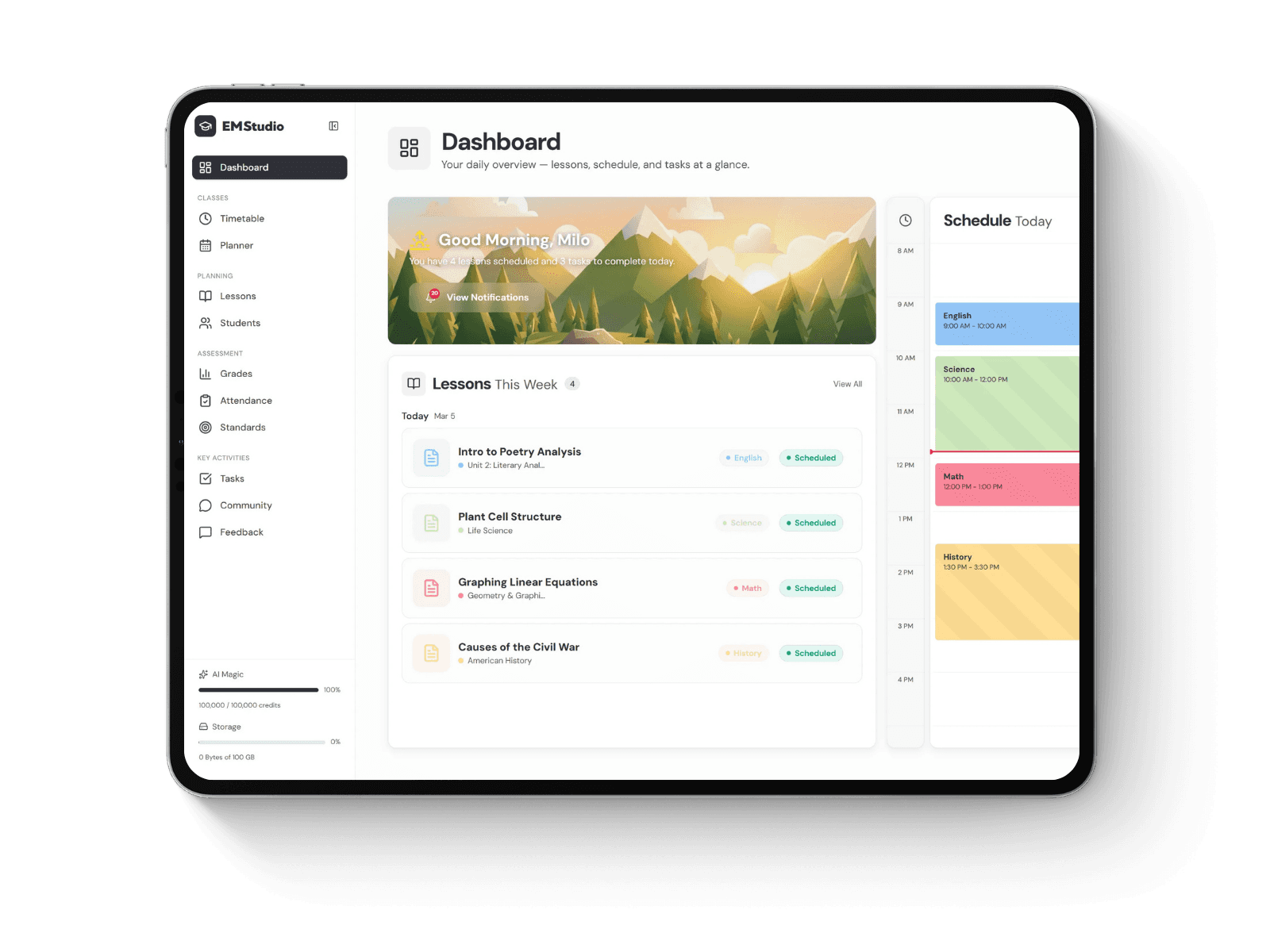
EMStudio is a free teaching management app — manage your classes, students, lessons, and more!
Learn More
Still grading everything by hand?
EMStudio is a free teaching management app — manage your classes, students, lessons, and more!
Learn More
Table of Contents
What Are the Essential Daily Procedures Every Classroom Needs?
Essential daily procedures include entry routines with "do now" tasks visible on the board, material submission through labeled bins or digital portals, and sub-60-second transitions using consistent auditory cues like chimes or countdown timers. These structures minimize instructional time loss, with research indicating efficient transitions can recover up to 15 minutes of daily instructional time.
Entering the Classroom Quietly and Prepared
You need an Entry 5 protocol that runs while you take attendance or handle the morning crisis at your door. In grades K-5, budget three to four minutes. In 6-12, cut that to two or three. The steps stay identical every day:
Sharpen your pencil.
Submit yesterday's work in the bin marked for your period.
Read the Do Now projected on the board.
Get required materials out.
Begin working silently.
For elementary, this means backpacks hit cubbies immediately. Homework goes in colored bins—red for Math, blue for ELA—so you can see from across the room who turned in what. They should be writing within 90 seconds. In secondary, use a physical inbox labeled "Period 1," "Period 2," or train them to hit the Google Classroom "Turn In" button before the bell rings. Either way, they complete the warm-up while you handle the business of starting class.
The Materials Check happens in the final 30 seconds. Students place three items on the front corners of their desks: notebook, pencil, and text. You scan the room from your doorway or desk. If you see empty corners, you know who isn't ready without calling out names or checking lists. No wasted minutes. No arguments. These classroom routines build the foundation for solid classroom rules and procedures because they teach students that learning starts before you speak a word.
Submitting Work Through Designated Channels
Paper isn't dead, but it needs a traffic system or it will bury you. For K-2, use labeled trays on a counter they can reach without climbing. For 3-12, deploy the 3-bin method. Use distinct colors so students never have to ask:
Green bin: IN for on-time work.
Yellow bin: OUT for graded papers to return.
Red bin: LATE for after-deadline submissions.
Digital workflows require the same physical clarity. If you use Google Classroom, screenshot the "Turn In" button location and the confirmation checkmark that appears after successful submission. Project it on day one and tape a printed copy to the wall. Students need to see that checkmark; without it, the work is still in draft mode and you will get the email at 11 PM. These time-saving classroom hacks eliminate the "I turned it in" arguments that eat your lunch period. Whether you run paper or pixels, your classroom expectations and procedures must make submission automatic, not optional, so you can focus on feedback instead of detective work.
Transitioning Between Activities in Under 60 Seconds
Transitions are where instruction dies a slow death. Set a hard limit: 60 seconds, no exceptions. Play the same chime every time, or use a 60-second clip of the Mission Impossible theme. Students hear the cue and execute cleanup:
Trash in the bin.
Materials stored.
Eyes front and voice off.
Or use the 3-2-1 Clean: three items in the desk, two feet on the floor, one voice silent. When the audio stops, they freeze in the "Eyes Front" position and wait for your next direction.
Research on classroom management strategies consistently shows that keeping transitions under 60 seconds correlates directly with higher instructional time. When you win back those minutes across six or seven transitions per day, you gain nearly 15 minutes of additional teaching time. That's a whole extra week of instruction per year. But you must protect the standard. If a transition runs long or gets chatty, revert to assigned seating for 24 hours and re-teach the procedure using Interactive Modeling—demonstrating the steps, practicing together, and correcting errors—before you grant flexibility again. These behavior expectations aren't rigid for rigidity's sake; they're the guardrails that let you actually teach instead of herd.
Which Rules Create a Respectful and Inclusive Environment?
Respectful environment rules include one-voice protocols during discussions using hand signals or talking chips, explicit personal space boundaries using arm's length visual markers, and mandated inclusive language practices including correct name pronunciation. These norms reduce conflict referrals and create psychological safety, particularly for students from marginalized backgrounds or with sensory processing needs.
One Voice at a Time During Discussions
Crosstalk kills instructional time. The One Voice protocol means exactly that: one speaker, everyone else listens. For whole-group discussions, require raised hands. No exceptions. But small groups need different strategies for classroom management. I use Talking Chips with grades 3 through 12. Give each student two poker chips or counting bears at the start of the discussion. They surrender one chip each time they speak. When the chips are gone, they listen until everyone has used theirs. It forces the loud kids to budget their words and gives quiet kids guaranteed airtime. Store the chips in a labeled pencil box; students grab them as they enter for literature circles.
The only exception is the Help hand signal: closed fist raised straight up. This means safety emergency or bathroom crisis, not "I forgot the page number." Teach it explicitly. Students may interrupt you without chips only for genuine emergencies. Otherwise, they use the Ask Three Then Me protocol: check with three classmates before bothering you with procedural questions. This cuts interruptions by seventy percent once it becomes routine.
Respecting Personal Space and Materials
Personal space violations trigger half the behavior interventions in my classroom. I teach the Bubble and Personal Space rule on day one. Students extend both arms and rotate 360 degrees. If they touch anyone or anything, they are too close. This works for 3rd graders in October and 8th graders in May. It gives a concrete visual instead of vague "give them space" instructions.
Material boundaries matter just as much. The hands on your own supplies only rule comes with a 3-step consequence ladder: verbal warning, relocation to an isolated desk, then parent conference plus restitution plan. I also enforce desk organization standards: nothing on the floor, four supplies maximum on the desk. Clutter creates tripping hazards and territorial disputes.
Choose your enforcement method carefully:
Public reminder: Use only during the first week of practice or for minor, accidental infractions. Works for quick calibration but humiliates students if overused.
Private conversation: Pull the student aside, state the specific boundary crossed, and restate the expectation. Preserves dignity and actually changes behavior for repeated violations.
When students violate space rules repeatedly, document using a private incident log rather than public correction. Note the time, the specific boundary crossed, and the trigger. This data reveals patterns—like whether the behavior happens during transitions or specific subjects—so you can adjust your classroom routines instead of just punishing the kid.
Using Inclusive Language and Names
Mispronouncing a student's name for nine months tells them they are invisible. During week one, I have students complete Name Pronunciation Guides on index cards: phonetic spelling like "Sow-n-ya" versus "Sonya," and a note about preferred nicknames. I practice during my prep period. If I mess up, I apologize immediately and try again. This simple act signals that you see them and follows basic culturally responsive teaching principles.
Language rules extend beyond names. Teach person-first language guidelines when discussing disabilities: "student with autism," not "autistic student." Define the difference between call-out and call-in culture. Call-out is public shaming: "You're wrong and here's why." Call-in is private correction: "I heard you say X; here's why that's harmful." Give students scripts. Call-out sounds like: "That's a stupid idea," "You're so bad at this," or "Why would you say that?" Call-in sounds like: "Can we talk about what you just said privately?" "I think you meant well, but that word hurts people," or "Let's look up why that's not accurate together."
These behavior expectations create the foundation for academic risk-taking. When students trust that their name matters and their space is safe, they engage. These aren't just rules for classroom management—they are the conditions that make learning possible.

What Academic Engagement Rules Prevent Disruptions?
Academic engagement rules preventing disruptions include device-free zones during direct instruction using numbered storage caddies, the "Three Before Me" help-seeking protocol requiring students to check notes and ask peers before requesting teacher assistance, and transparent late work policies with 24-hour grace windows. These standards maintain cognitive load and reduce teacher interruptions by up to 40%. When you protect instructional time from digital distractions and repetitive questioning, students learn to rely on available resources instead of defaulting to teacher dependence.
Device-Free Zones During Direct Instruction
I use the Phone Hotel system. It’s an over-door shoe organizer with clear pockets numbered to match student IDs or desk numbers. Alternatively, a magnetic caddy fixed to the whiteboard works for smaller classes. Students check their devices in during the bell ringer and retrieve them only when the dismissal bell rings—no mid-class retrieval for "emergencies" that inevitably involve Snapchat. The organizer hangs near my desk, so devices remain visible to me but impossible to reach without standing up and drawing attention. This physical barrier eliminates the temptation to "just check" notifications during mini-lessons.
Research backs the strictness. Studies on the Brain Drain effect show that merely having a phone within arm’s reach reduces available cognitive capacity for problem-solving tasks, even when the device is powered off. That buzzing sensation in your pocket? Your brain anticipates it, splitting focus. By removing devices entirely during direct instruction, you’re not being a tyrant; you’re preserving working memory for the content you’re teaching. These science-backed methods to improve student focus work because they remove the decision fatigue of "should I check it?"
Enforcement follows a clear ladder that students sign off on during the first week:
First violation: verbal warning and documented seating chart note.
Second violation: parent contact with photo of phone in hotel and reflection sheet.
Third violation: office referral and family meeting about academic integrity.
I never negotiate during the lesson; we discuss consequences privately after class to avoid power struggles in front of peers. These classroom rules around device management create predictable behavior management procedures that protect your sanity.
Asking Three Before Me for Help
The Three Before Me protocol stops the hand-waving frenzy that derails your small group instruction. I post a flowchart on the front board and teach it explicitly during the first week. The steps are:
Step 1: Check the Anchor Chart on the wall for the specific skill or formula.
Step 2: Ask your assigned Table Partner (I use A/B partners so everyone knows exactly who to turn to).
Step 3: Check the Class Website FAQ or digital notebook.
Step 4: Write your name on the Help Board and continue working until I reach you during independent work time.
I spend fifteen minutes modeling each step. I pretend to be a confused student, walk to the anchor chart, point at the relevant section, then turn to my partner and practice the exact sentence stem: "I’m stuck on number four. My notes say... but I don’t understand..." This rehearsal removes the social anxiety of asking peers and prevents the lazy default of raising hands immediately.
The key is teaching the exceptions explicitly so students know when to bypass the protocol. Students may interrupt you immediately for blood, vomiting, fire alarm, or technology failure during a digital standardized assessment. I role-play these scenarios during the first week: "Pretend your Chromebook just froze during the reading diagnostic. What do you do?" versus "You don’t understand question three on the worksheet. What do you do?" When kids know the urgency hierarchy, they don’t abuse the student engagement protocols.
Assignment Completion and Late Work Policies
Clear deadlines matter, but rigidity without mercy creates failure cycles. My high school syllabus states: Assignments submitted within 24 hours receive full credit; 24-48 hours = 10% penalty; after 48 hours = 50% maximum. The 24-hour window acknowledges that teenagers have complex schedules with jobs and family obligations, while the 50% cap maintains accountability without creating a zero that destroys their average permanently. However, elementary teachers often use the Weekend Grace Policy: work due Friday is accepted Monday with no penalty, acknowledging that family schedules and developmental time management differ for younger students.
I also issue one laminated Homework Rescue ticket per quarter. Students staple it to any late assignment for an automatic 48-hour extension with no questions asked and no grade penalty. This teaches time management without punitive consequences for the occasional bad week. When the ticket’s gone, they know the standard late policy applies.
Your classroom management plan classroom rules and procedures should reflect developmental differences:
Grade Band | Standard Policy | Grace Provisions |
|---|---|---|
K-2 | Work collected when finished; focus on completion over speed | Take-home folders checked Monday for Friday work; no penalties |
3-5 | Weekend Grace: Friday due date accepted Monday with full credit | One Homework Rescue ticket per quarter for 48-hour extension |
6-8 | 24-hour window full credit; 10% deduction days 2-3; 50% max after | One Rescue ticket per quarter; study hall completion option |
9-12 | 24-hour window full credit; 10% deduction 24-48h; 50% max after | One Rescue ticket per semester; no weekend grace |
These behavior expectations around academic work reduce your grading stress while teaching students that deadlines matter, but learning matters more. When classroom routines for late work are transparent, you spend less time negotiating with parents and more time planning instruction.

Which Procedures Matter Most for Different Grade Levels?
Grade-specific procedures include bathroom pass limits for elementary students using sign-out logs with 2-per-day maximums, cell phone storage in hanging pocket charts for middle school collected at entry, and flexible seating contracts with Monday-choice commitments for high school. Adapt complexity to developmental executive function capacity, increasing student autonomy gradually from K-12. Your classroom rules should match what kids can actually handle. A kindergartener can't manage the same freedom as a senior, and pretending they can wastes everyone's time.
K-2 | 3-5 | 6-8 | 9-12 |
2-Clip bathroom system (2 clothespins daily) | Hall pass on lanyard; one out at a time | Planner pass system with quarterly limits | Open policy; digital sign-out via PassTheClass |
Cubby storage until dismissal | Cubby storage until dismissal | Phone Hotel (hanging pocket chart) at entry | Face-Down on Corner or Yondr pouches |
Assigned seats only | Assigned seats with permission-based movement | Monday Choice with teacher override | Flexible seating contracts; full autonomy |
These differences reflect essential strategies by grade level. Younger students need hard limits and physical reminders. Older students need systems that respect their growing autonomy while protecting instructional time.
Bathroom and Hall Pass Protocols
In K-2, implement the 2-Clip System. Each student gets two clothespins on a chart by the door. Using the bathroom removes one clip. When the clips are gone, they wait until after lunch. The visual tracker matters more than you think. Five-year-olds can't mentally track "two times per day" without a physical reference. The procedure works like this:
Place two clothespins by each student's name on the chart at morning entry.
Student removes one clip and places it in the "In Use" bucket when leaving.
Return clip to chart after washing hands; no clip means waiting until after lunch.
Emergencies get a hand signal—three fingers raised—but abuse that privilege and you lose it for the week. Keep the chart at eye level so they can check their status without asking you.
Grades 3-5 shift to hall passes on lanyards. One student out at a time. The pass lives on a hook by the door; if the hook is empty, someone is already out. No pass, no exit. This age group tests boundaries constantly, so the physical scarcity of the pass controls the flow better than any verbal reminder.
For 6-12, use digital hall pass systems like SmartPass or E-Hallpass. Set automatic limits blocking students who exceed three passes per week without a nurse note. The system timestamps everything, so when the same kid asks to go every Tuesday during math, you have data to show parents. High schoolers can handle punch cards or open bathroom policies with digital sign-out tools like PassTheClass, but only if they've proven they won't wander the halls for twenty minutes.
Cell Phone Storage and Usage Windows
Elementary phones stay in cubbies until dismissal. Most kids don't have them anyway, but the rule prevents the ones who do from showing off during snack time. If a parent texts, the kid checks the cubby during lunch or after the final bell.
Middle school requires the Phone Hotel. Install a 30-slot hanging pocket organizer by your classroom door. The rules are simple:
Deposit phones during entry into your numbered pocket.
Retrieve only at dismissal or during designated Tech Windows—maybe the last ten minutes on Fridays.
Refusal to check in means immediate office referral; you don't argue with twelve-year-olds about devices.
The pocket chart makes the rule visual: empty slot means compliance, phone in pocket means consequence.
High school moves toward the Face-Down on Corner rule during direct instruction, shifting to Pocket or Pouch during independent work. Some schools use Yondr pouches; others use strict "away unless instructed" policies with visible storage. Define usage windows clearly: lunch only, or transition times between classes. The key consequence: violation means the phone goes to the office for parent pickup, not your desk. You are not a bank. Flexible seating boundaries and expectations work the same way—clear rules, consistent enforcement, no negotiation.
Flexible Seating Boundaries and Expectations
Start with the Monday Choice rule. The Flexible Seating Contract makes expectations explicit. Students agree to:
Choose their seat Monday morning during the entry task.
Remain in that seat Tuesday through Thursday unless the teacher directs otherwise.
Accept teacher override without argument if off-task behavior occurs.
Return furniture to Home Base layout and wipe the seat with a provided Lysol wipe before dismissal.
When students can't handle the freedom—when they fight over the wobble stool or hide in the reading nook to nap—revert to assigned seats for 48 hours with re-teaching of classroom routines. This serves as a behavior intervention rather than punishment. Choice is earned, not given. The cleaning checklist ensures you're not stuck stacking chairs while they bolt for the bus, and it protects your instructional time from turning into furniture management.

How Do You Teach and Reinforce Rules Without Power Struggles?
Teach rules without power struggles by co-creating expectations using the Interactive Modeling sequence where teachers demonstrate both incorrect and correct examples, then have students practice while receiving specific labeled praise. Avoid public confrontation; instead, use private signals and designated "take a break" spaces. When emotions escalate, implement cool-off periods before restorative conversations.
Use the Interactive Modeling Sequence
Most behavior problems stem from unclear expectations, not bad kids. When implementing classroom rules, show students exactly what you want rather than just telling them. This six-step process takes about ten minutes per procedure, but that initial investment saves roughly two hours of instructional time each month by preventing misunderstandings.
Follow this sequence:
State the expectation clearly. Say: "Watch me enter the classroom quietly and start the Do Now."
Demonstrate the wrong way. Exaggerate the mistake—slam the door, yell across the room, forget your pencil. Kids laugh, but they see the contrast.
Demonstrate the right way. Model exactly what you want: soft close, direct path to seat, materials out.
Have a volunteer practice. Pick your reliable kid first, not the one who struggles. Success breeds success.
Have the whole class practice. Everyone tries it. Watch closely.
Debrief what you saw. Name specific behaviors: "I noticed Maria put her backpack on the hook before sitting down."
You don't need a classroom rules and procedures powerpoint for this. You need ten minutes and a willingness to look slightly ridiculous during the wrong-way demonstration. If you want documentation, keep a classroom rules and procedures pdf in your binder for substitutes, but teach the actual classroom routines live.
Reinforce with Labeled Praise
Generic "good job" bounces off kids. Labeled praise sticks because it tells them exactly what they did right. Instead of "Great work," try: "I see Marcus has his materials ready and is reading the objective." This connects behavior expectations to specific actions.
Research on positive behavior support systems suggests maintaining a 4:1 ratio—four positive interactions for every one correction. That doesn't mean false cheerleading. It means catching them doing it right before they do it wrong. When you track classroom rules and procedures, note which students you've praised specifically today. It's easy to miss the quiet kids who follow every rule while you're managing the chaos.
Avoid Power Struggles
Never argue with a student in front of the class. You will lose even if you win. When a kid pushes back, use a private signal—a hand on the shoulder, a tilt of the head toward the hallway. Give them an out.
Set up a "take a break" space. This isn't punishment; it's a reset. A desk in the corner, a chair in the hallway, or a buddy teacher's room. When emotions run hot, point to the spot without commentary. They go, they breathe, they return when ready.
When you talk privately, use this script:
"I noticed you [specific behavior]."
"What happened?"
"What should you do differently next time?"
Don't use this during the escalation. If a kid is throwing chairs or sobbing, they can't process logic. Implement a cool-off period first. Wait twenty minutes, sometimes until the next day, then have the restorative conversation. This is where real behavior interventions happen—not in the heat of the moment, but in the quiet aftermath when the nervous system has regulated.
Remember, student engagement protocols only work when students feel safe enough to comply with your classroom rules. Your classroom management strategies should build that safety through clarity, not control.

Final Thoughts on Classroom Rules
You can have the prettiest bulletin board in the building, but if you don't teach your classroom routines like you teach long division, they won't stick. The teachers I know who actually enjoy teaching in February aren't the ones with the longest list of behavior expectations. They're the ones who stopped talking and started practicing. One minute of silent entry practiced five times beats ten minutes of lecturing about respect every single day.
So here's your action item for tomorrow morning. Pick the one procedure that made you want to scream today—maybe it was the line at the pencil sharpener or the chaos of turning in papers. Write down the exact steps. Not "be responsible." Write: "Stand up, push in chair, walk to bin, place paper face down, return to seat." Then teach it. Five minutes. No apologies. Practice it twice. When they get it right, move on. When they don't, do it again.
That single routine will save you hours before winter break. Master one. Then pick the next.

What Are the Essential Daily Procedures Every Classroom Needs?
Essential daily procedures include entry routines with "do now" tasks visible on the board, material submission through labeled bins or digital portals, and sub-60-second transitions using consistent auditory cues like chimes or countdown timers. These structures minimize instructional time loss, with research indicating efficient transitions can recover up to 15 minutes of daily instructional time.
Entering the Classroom Quietly and Prepared
You need an Entry 5 protocol that runs while you take attendance or handle the morning crisis at your door. In grades K-5, budget three to four minutes. In 6-12, cut that to two or three. The steps stay identical every day:
Sharpen your pencil.
Submit yesterday's work in the bin marked for your period.
Read the Do Now projected on the board.
Get required materials out.
Begin working silently.
For elementary, this means backpacks hit cubbies immediately. Homework goes in colored bins—red for Math, blue for ELA—so you can see from across the room who turned in what. They should be writing within 90 seconds. In secondary, use a physical inbox labeled "Period 1," "Period 2," or train them to hit the Google Classroom "Turn In" button before the bell rings. Either way, they complete the warm-up while you handle the business of starting class.
The Materials Check happens in the final 30 seconds. Students place three items on the front corners of their desks: notebook, pencil, and text. You scan the room from your doorway or desk. If you see empty corners, you know who isn't ready without calling out names or checking lists. No wasted minutes. No arguments. These classroom routines build the foundation for solid classroom rules and procedures because they teach students that learning starts before you speak a word.
Submitting Work Through Designated Channels
Paper isn't dead, but it needs a traffic system or it will bury you. For K-2, use labeled trays on a counter they can reach without climbing. For 3-12, deploy the 3-bin method. Use distinct colors so students never have to ask:
Green bin: IN for on-time work.
Yellow bin: OUT for graded papers to return.
Red bin: LATE for after-deadline submissions.
Digital workflows require the same physical clarity. If you use Google Classroom, screenshot the "Turn In" button location and the confirmation checkmark that appears after successful submission. Project it on day one and tape a printed copy to the wall. Students need to see that checkmark; without it, the work is still in draft mode and you will get the email at 11 PM. These time-saving classroom hacks eliminate the "I turned it in" arguments that eat your lunch period. Whether you run paper or pixels, your classroom expectations and procedures must make submission automatic, not optional, so you can focus on feedback instead of detective work.
Transitioning Between Activities in Under 60 Seconds
Transitions are where instruction dies a slow death. Set a hard limit: 60 seconds, no exceptions. Play the same chime every time, or use a 60-second clip of the Mission Impossible theme. Students hear the cue and execute cleanup:
Trash in the bin.
Materials stored.
Eyes front and voice off.
Or use the 3-2-1 Clean: three items in the desk, two feet on the floor, one voice silent. When the audio stops, they freeze in the "Eyes Front" position and wait for your next direction.
Research on classroom management strategies consistently shows that keeping transitions under 60 seconds correlates directly with higher instructional time. When you win back those minutes across six or seven transitions per day, you gain nearly 15 minutes of additional teaching time. That's a whole extra week of instruction per year. But you must protect the standard. If a transition runs long or gets chatty, revert to assigned seating for 24 hours and re-teach the procedure using Interactive Modeling—demonstrating the steps, practicing together, and correcting errors—before you grant flexibility again. These behavior expectations aren't rigid for rigidity's sake; they're the guardrails that let you actually teach instead of herd.
Which Rules Create a Respectful and Inclusive Environment?
Respectful environment rules include one-voice protocols during discussions using hand signals or talking chips, explicit personal space boundaries using arm's length visual markers, and mandated inclusive language practices including correct name pronunciation. These norms reduce conflict referrals and create psychological safety, particularly for students from marginalized backgrounds or with sensory processing needs.
One Voice at a Time During Discussions
Crosstalk kills instructional time. The One Voice protocol means exactly that: one speaker, everyone else listens. For whole-group discussions, require raised hands. No exceptions. But small groups need different strategies for classroom management. I use Talking Chips with grades 3 through 12. Give each student two poker chips or counting bears at the start of the discussion. They surrender one chip each time they speak. When the chips are gone, they listen until everyone has used theirs. It forces the loud kids to budget their words and gives quiet kids guaranteed airtime. Store the chips in a labeled pencil box; students grab them as they enter for literature circles.
The only exception is the Help hand signal: closed fist raised straight up. This means safety emergency or bathroom crisis, not "I forgot the page number." Teach it explicitly. Students may interrupt you without chips only for genuine emergencies. Otherwise, they use the Ask Three Then Me protocol: check with three classmates before bothering you with procedural questions. This cuts interruptions by seventy percent once it becomes routine.
Respecting Personal Space and Materials
Personal space violations trigger half the behavior interventions in my classroom. I teach the Bubble and Personal Space rule on day one. Students extend both arms and rotate 360 degrees. If they touch anyone or anything, they are too close. This works for 3rd graders in October and 8th graders in May. It gives a concrete visual instead of vague "give them space" instructions.
Material boundaries matter just as much. The hands on your own supplies only rule comes with a 3-step consequence ladder: verbal warning, relocation to an isolated desk, then parent conference plus restitution plan. I also enforce desk organization standards: nothing on the floor, four supplies maximum on the desk. Clutter creates tripping hazards and territorial disputes.
Choose your enforcement method carefully:
Public reminder: Use only during the first week of practice or for minor, accidental infractions. Works for quick calibration but humiliates students if overused.
Private conversation: Pull the student aside, state the specific boundary crossed, and restate the expectation. Preserves dignity and actually changes behavior for repeated violations.
When students violate space rules repeatedly, document using a private incident log rather than public correction. Note the time, the specific boundary crossed, and the trigger. This data reveals patterns—like whether the behavior happens during transitions or specific subjects—so you can adjust your classroom routines instead of just punishing the kid.
Using Inclusive Language and Names
Mispronouncing a student's name for nine months tells them they are invisible. During week one, I have students complete Name Pronunciation Guides on index cards: phonetic spelling like "Sow-n-ya" versus "Sonya," and a note about preferred nicknames. I practice during my prep period. If I mess up, I apologize immediately and try again. This simple act signals that you see them and follows basic culturally responsive teaching principles.
Language rules extend beyond names. Teach person-first language guidelines when discussing disabilities: "student with autism," not "autistic student." Define the difference between call-out and call-in culture. Call-out is public shaming: "You're wrong and here's why." Call-in is private correction: "I heard you say X; here's why that's harmful." Give students scripts. Call-out sounds like: "That's a stupid idea," "You're so bad at this," or "Why would you say that?" Call-in sounds like: "Can we talk about what you just said privately?" "I think you meant well, but that word hurts people," or "Let's look up why that's not accurate together."
These behavior expectations create the foundation for academic risk-taking. When students trust that their name matters and their space is safe, they engage. These aren't just rules for classroom management—they are the conditions that make learning possible.
What Academic Engagement Rules Prevent Disruptions?
Academic engagement rules preventing disruptions include device-free zones during direct instruction using numbered storage caddies, the "Three Before Me" help-seeking protocol requiring students to check notes and ask peers before requesting teacher assistance, and transparent late work policies with 24-hour grace windows. These standards maintain cognitive load and reduce teacher interruptions by up to 40%. When you protect instructional time from digital distractions and repetitive questioning, students learn to rely on available resources instead of defaulting to teacher dependence.
Device-Free Zones During Direct Instruction
I use the Phone Hotel system. It’s an over-door shoe organizer with clear pockets numbered to match student IDs or desk numbers. Alternatively, a magnetic caddy fixed to the whiteboard works for smaller classes. Students check their devices in during the bell ringer and retrieve them only when the dismissal bell rings—no mid-class retrieval for "emergencies" that inevitably involve Snapchat. The organizer hangs near my desk, so devices remain visible to me but impossible to reach without standing up and drawing attention. This physical barrier eliminates the temptation to "just check" notifications during mini-lessons.
Research backs the strictness. Studies on the Brain Drain effect show that merely having a phone within arm’s reach reduces available cognitive capacity for problem-solving tasks, even when the device is powered off. That buzzing sensation in your pocket? Your brain anticipates it, splitting focus. By removing devices entirely during direct instruction, you’re not being a tyrant; you’re preserving working memory for the content you’re teaching. These science-backed methods to improve student focus work because they remove the decision fatigue of "should I check it?"
Enforcement follows a clear ladder that students sign off on during the first week:
First violation: verbal warning and documented seating chart note.
Second violation: parent contact with photo of phone in hotel and reflection sheet.
Third violation: office referral and family meeting about academic integrity.
I never negotiate during the lesson; we discuss consequences privately after class to avoid power struggles in front of peers. These classroom rules around device management create predictable behavior management procedures that protect your sanity.
Asking Three Before Me for Help
The Three Before Me protocol stops the hand-waving frenzy that derails your small group instruction. I post a flowchart on the front board and teach it explicitly during the first week. The steps are:
Step 1: Check the Anchor Chart on the wall for the specific skill or formula.
Step 2: Ask your assigned Table Partner (I use A/B partners so everyone knows exactly who to turn to).
Step 3: Check the Class Website FAQ or digital notebook.
Step 4: Write your name on the Help Board and continue working until I reach you during independent work time.
I spend fifteen minutes modeling each step. I pretend to be a confused student, walk to the anchor chart, point at the relevant section, then turn to my partner and practice the exact sentence stem: "I’m stuck on number four. My notes say... but I don’t understand..." This rehearsal removes the social anxiety of asking peers and prevents the lazy default of raising hands immediately.
The key is teaching the exceptions explicitly so students know when to bypass the protocol. Students may interrupt you immediately for blood, vomiting, fire alarm, or technology failure during a digital standardized assessment. I role-play these scenarios during the first week: "Pretend your Chromebook just froze during the reading diagnostic. What do you do?" versus "You don’t understand question three on the worksheet. What do you do?" When kids know the urgency hierarchy, they don’t abuse the student engagement protocols.
Assignment Completion and Late Work Policies
Clear deadlines matter, but rigidity without mercy creates failure cycles. My high school syllabus states: Assignments submitted within 24 hours receive full credit; 24-48 hours = 10% penalty; after 48 hours = 50% maximum. The 24-hour window acknowledges that teenagers have complex schedules with jobs and family obligations, while the 50% cap maintains accountability without creating a zero that destroys their average permanently. However, elementary teachers often use the Weekend Grace Policy: work due Friday is accepted Monday with no penalty, acknowledging that family schedules and developmental time management differ for younger students.
I also issue one laminated Homework Rescue ticket per quarter. Students staple it to any late assignment for an automatic 48-hour extension with no questions asked and no grade penalty. This teaches time management without punitive consequences for the occasional bad week. When the ticket’s gone, they know the standard late policy applies.
Your classroom management plan classroom rules and procedures should reflect developmental differences:
Grade Band | Standard Policy | Grace Provisions |
|---|---|---|
K-2 | Work collected when finished; focus on completion over speed | Take-home folders checked Monday for Friday work; no penalties |
3-5 | Weekend Grace: Friday due date accepted Monday with full credit | One Homework Rescue ticket per quarter for 48-hour extension |
6-8 | 24-hour window full credit; 10% deduction days 2-3; 50% max after | One Rescue ticket per quarter; study hall completion option |
9-12 | 24-hour window full credit; 10% deduction 24-48h; 50% max after | One Rescue ticket per semester; no weekend grace |
These behavior expectations around academic work reduce your grading stress while teaching students that deadlines matter, but learning matters more. When classroom routines for late work are transparent, you spend less time negotiating with parents and more time planning instruction.
Which Procedures Matter Most for Different Grade Levels?
Grade-specific procedures include bathroom pass limits for elementary students using sign-out logs with 2-per-day maximums, cell phone storage in hanging pocket charts for middle school collected at entry, and flexible seating contracts with Monday-choice commitments for high school. Adapt complexity to developmental executive function capacity, increasing student autonomy gradually from K-12. Your classroom rules should match what kids can actually handle. A kindergartener can't manage the same freedom as a senior, and pretending they can wastes everyone's time.
K-2 | 3-5 | 6-8 | 9-12 |
2-Clip bathroom system (2 clothespins daily) | Hall pass on lanyard; one out at a time | Planner pass system with quarterly limits | Open policy; digital sign-out via PassTheClass |
Cubby storage until dismissal | Cubby storage until dismissal | Phone Hotel (hanging pocket chart) at entry | Face-Down on Corner or Yondr pouches |
Assigned seats only | Assigned seats with permission-based movement | Monday Choice with teacher override | Flexible seating contracts; full autonomy |
These differences reflect essential strategies by grade level. Younger students need hard limits and physical reminders. Older students need systems that respect their growing autonomy while protecting instructional time.
Bathroom and Hall Pass Protocols
In K-2, implement the 2-Clip System. Each student gets two clothespins on a chart by the door. Using the bathroom removes one clip. When the clips are gone, they wait until after lunch. The visual tracker matters more than you think. Five-year-olds can't mentally track "two times per day" without a physical reference. The procedure works like this:
Place two clothespins by each student's name on the chart at morning entry.
Student removes one clip and places it in the "In Use" bucket when leaving.
Return clip to chart after washing hands; no clip means waiting until after lunch.
Emergencies get a hand signal—three fingers raised—but abuse that privilege and you lose it for the week. Keep the chart at eye level so they can check their status without asking you.
Grades 3-5 shift to hall passes on lanyards. One student out at a time. The pass lives on a hook by the door; if the hook is empty, someone is already out. No pass, no exit. This age group tests boundaries constantly, so the physical scarcity of the pass controls the flow better than any verbal reminder.
For 6-12, use digital hall pass systems like SmartPass or E-Hallpass. Set automatic limits blocking students who exceed three passes per week without a nurse note. The system timestamps everything, so when the same kid asks to go every Tuesday during math, you have data to show parents. High schoolers can handle punch cards or open bathroom policies with digital sign-out tools like PassTheClass, but only if they've proven they won't wander the halls for twenty minutes.
Cell Phone Storage and Usage Windows
Elementary phones stay in cubbies until dismissal. Most kids don't have them anyway, but the rule prevents the ones who do from showing off during snack time. If a parent texts, the kid checks the cubby during lunch or after the final bell.
Middle school requires the Phone Hotel. Install a 30-slot hanging pocket organizer by your classroom door. The rules are simple:
Deposit phones during entry into your numbered pocket.
Retrieve only at dismissal or during designated Tech Windows—maybe the last ten minutes on Fridays.
Refusal to check in means immediate office referral; you don't argue with twelve-year-olds about devices.
The pocket chart makes the rule visual: empty slot means compliance, phone in pocket means consequence.
High school moves toward the Face-Down on Corner rule during direct instruction, shifting to Pocket or Pouch during independent work. Some schools use Yondr pouches; others use strict "away unless instructed" policies with visible storage. Define usage windows clearly: lunch only, or transition times between classes. The key consequence: violation means the phone goes to the office for parent pickup, not your desk. You are not a bank. Flexible seating boundaries and expectations work the same way—clear rules, consistent enforcement, no negotiation.
Flexible Seating Boundaries and Expectations
Start with the Monday Choice rule. The Flexible Seating Contract makes expectations explicit. Students agree to:
Choose their seat Monday morning during the entry task.
Remain in that seat Tuesday through Thursday unless the teacher directs otherwise.
Accept teacher override without argument if off-task behavior occurs.
Return furniture to Home Base layout and wipe the seat with a provided Lysol wipe before dismissal.
When students can't handle the freedom—when they fight over the wobble stool or hide in the reading nook to nap—revert to assigned seats for 48 hours with re-teaching of classroom routines. This serves as a behavior intervention rather than punishment. Choice is earned, not given. The cleaning checklist ensures you're not stuck stacking chairs while they bolt for the bus, and it protects your instructional time from turning into furniture management.
How Do You Teach and Reinforce Rules Without Power Struggles?
Teach rules without power struggles by co-creating expectations using the Interactive Modeling sequence where teachers demonstrate both incorrect and correct examples, then have students practice while receiving specific labeled praise. Avoid public confrontation; instead, use private signals and designated "take a break" spaces. When emotions escalate, implement cool-off periods before restorative conversations.
Use the Interactive Modeling Sequence
Most behavior problems stem from unclear expectations, not bad kids. When implementing classroom rules, show students exactly what you want rather than just telling them. This six-step process takes about ten minutes per procedure, but that initial investment saves roughly two hours of instructional time each month by preventing misunderstandings.
Follow this sequence:
State the expectation clearly. Say: "Watch me enter the classroom quietly and start the Do Now."
Demonstrate the wrong way. Exaggerate the mistake—slam the door, yell across the room, forget your pencil. Kids laugh, but they see the contrast.
Demonstrate the right way. Model exactly what you want: soft close, direct path to seat, materials out.
Have a volunteer practice. Pick your reliable kid first, not the one who struggles. Success breeds success.
Have the whole class practice. Everyone tries it. Watch closely.
Debrief what you saw. Name specific behaviors: "I noticed Maria put her backpack on the hook before sitting down."
You don't need a classroom rules and procedures powerpoint for this. You need ten minutes and a willingness to look slightly ridiculous during the wrong-way demonstration. If you want documentation, keep a classroom rules and procedures pdf in your binder for substitutes, but teach the actual classroom routines live.
Reinforce with Labeled Praise
Generic "good job" bounces off kids. Labeled praise sticks because it tells them exactly what they did right. Instead of "Great work," try: "I see Marcus has his materials ready and is reading the objective." This connects behavior expectations to specific actions.
Research on positive behavior support systems suggests maintaining a 4:1 ratio—four positive interactions for every one correction. That doesn't mean false cheerleading. It means catching them doing it right before they do it wrong. When you track classroom rules and procedures, note which students you've praised specifically today. It's easy to miss the quiet kids who follow every rule while you're managing the chaos.
Avoid Power Struggles
Never argue with a student in front of the class. You will lose even if you win. When a kid pushes back, use a private signal—a hand on the shoulder, a tilt of the head toward the hallway. Give them an out.
Set up a "take a break" space. This isn't punishment; it's a reset. A desk in the corner, a chair in the hallway, or a buddy teacher's room. When emotions run hot, point to the spot without commentary. They go, they breathe, they return when ready.
When you talk privately, use this script:
"I noticed you [specific behavior]."
"What happened?"
"What should you do differently next time?"
Don't use this during the escalation. If a kid is throwing chairs or sobbing, they can't process logic. Implement a cool-off period first. Wait twenty minutes, sometimes until the next day, then have the restorative conversation. This is where real behavior interventions happen—not in the heat of the moment, but in the quiet aftermath when the nervous system has regulated.
Remember, student engagement protocols only work when students feel safe enough to comply with your classroom rules. Your classroom management strategies should build that safety through clarity, not control.
Final Thoughts on Classroom Rules
You can have the prettiest bulletin board in the building, but if you don't teach your classroom routines like you teach long division, they won't stick. The teachers I know who actually enjoy teaching in February aren't the ones with the longest list of behavior expectations. They're the ones who stopped talking and started practicing. One minute of silent entry practiced five times beats ten minutes of lecturing about respect every single day.
So here's your action item for tomorrow morning. Pick the one procedure that made you want to scream today—maybe it was the line at the pencil sharpener or the chaos of turning in papers. Write down the exact steps. Not "be responsible." Write: "Stand up, push in chair, walk to bin, place paper face down, return to seat." Then teach it. Five minutes. No apologies. Practice it twice. When they get it right, move on. When they don't, do it again.
That single routine will save you hours before winter break. Master one. Then pick the next.
Still grading everything by hand?
EMStudio is a free teaching management app — manage your classes, students, lessons, and more!
Learn More
Still grading everything by hand?
EMStudio is a free teaching management app — manage your classes, students, lessons, and more!
Learn More





Notion4Teachers
Notion templates to simplify administrative tasks and enhance your teaching experience.



2026 Notion4Teachers. All Rights Reserved.
Notion4Teachers
Notion templates to simplify administrative tasks and enhance your teaching experience.
2026 Notion4Teachers. All Rights Reserved.
Notion4Teachers
Notion templates to simplify administrative tasks and enhance your teaching experience.
2026 Notion4Teachers. All Rights Reserved.