Auditory Learning: The Complete K-12 Classroom Guide
Auditory Learning: The Complete K-12 Classroom Guide

Article by
Milo
ESL Content Coordinator & Educator
ESL Content Coordinator & Educator
All Posts
You've got that kid who hums through silent reading but can quote your lecture from yesterday verbatim. Or the one who bombs the written quiz but aces it the moment you read the questions aloud. That's auditory learning showing up in your classroom—and it's probably making you nuts because most of our teaching is built for visual processing. Anchor charts. Graphic organizers. Silent independent work.
You've seen the "learning styles" posters from 2010. They didn't help. What you need is the actual science of how the brain processes sound, and strategies you can use tomorrow without rewriting your curriculum. This guide cuts through the outdated VAK model and gives you the real deal: how echoic memory works, why the phonological loop matters for your 3rd graders, and which auditory moves actually stick when you're managing 28 kids with IEPs, behavior plans, and a fire drill at 10:15.
Still grading everything by hand?
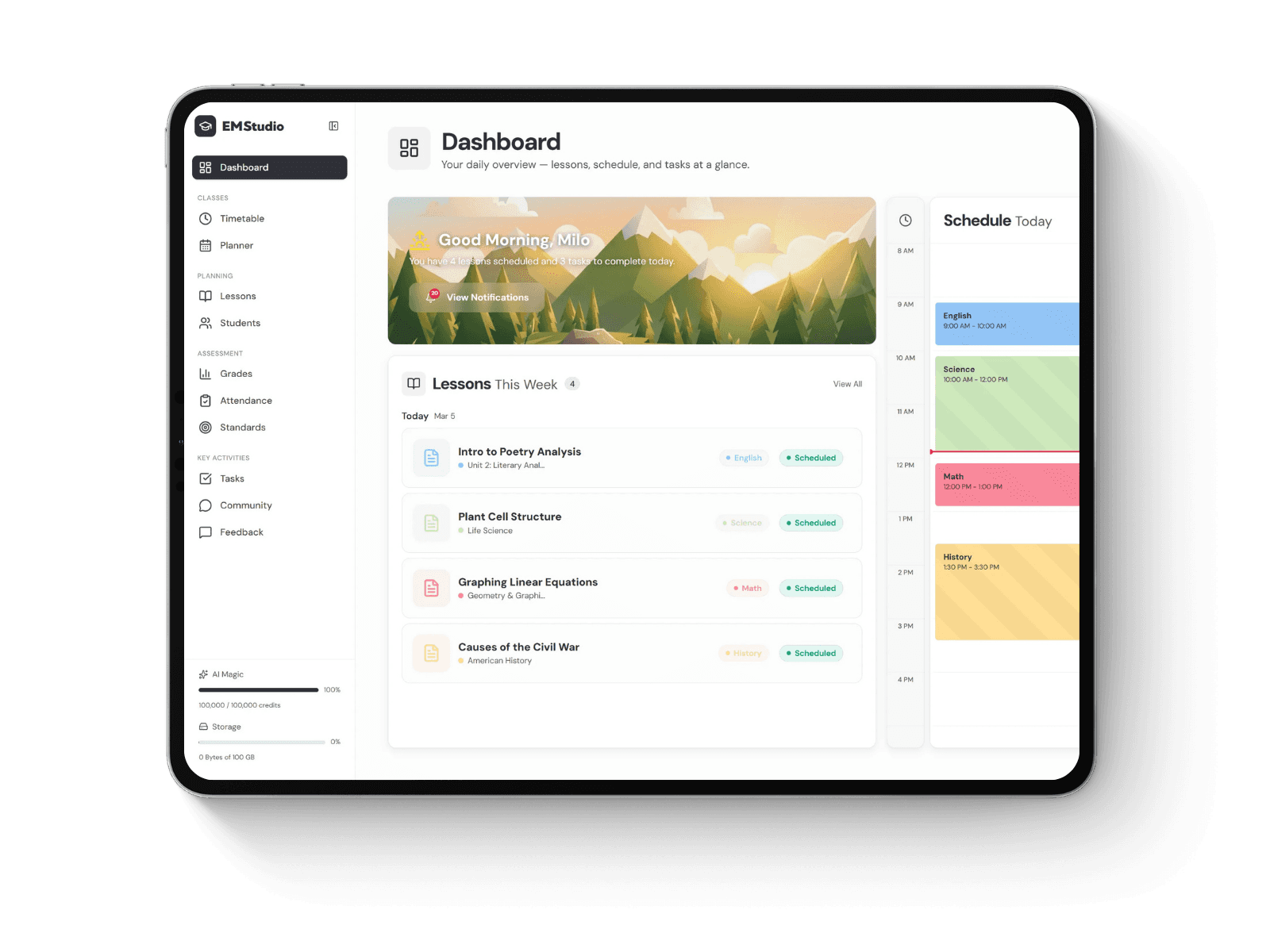
EMStudio is a free teaching management app — manage your classes, students, lessons, and more!
Learn More
Still grading everything by hand?
EMStudio is a free teaching management app — manage your classes, students, lessons, and more!
Learn More
Table of Contents
What Is Auditory Learning?
Auditory learning is a modality where students acquire and retain information most effectively through listening, speaking, and sound patterns. Aural learners process language through phonological loops, excelling in lectures, discussions, and verbal instructions. This learning style represents approximately 20-30% of the student population and differs from visual or kinesthetic processing in its reliance on acoustic encoding.
These learners encode information through the phonological loop, Baddeley's model of working memory that temporarily stores verbal content. Unlike visual spatial sketchpads that process diagrams and text, the phonological loop relies on acoustic rehearsal. This explains why an aural learner can remember a story you told but forget the chart you displayed. While the VARK model separates visual and read/write categories, auditory learning operates through sound symbolism and spoken patterns rather than printed symbols.
Defining the Auditory Learning Style and Aural Learner Profiles
An aural learner is not a student with auditory discrimination difficulties. The learner prefers sound because it creates stronger memory traces; a student with auditory processing disorder has a neurological disability affecting how the brain interprets sound signals. One benefits from classroom discussions, the other requires FM systems and preferential seating. Don't mistake a modality preference for a disability, or you'll frustrate a child who simply needs to hear the content.
Gardner's verbal-linguistic intelligence describes cognitive strength with language—poetry, persuasion, syntax. It is not the same as an auditory learning style, which concerns input channels. I've watched gifted debaters who process information visually, taking notes to understand spoken arguments, while quiet students with average verbal skills memorize entire lectures verbatim because they heard them. Understanding this distinction helps you design evidence-based best practices for different learning styles without conflating ability with modality.
Key Auditory Learner Characteristics Teachers Should Recognize
You can spot these students by watching how they handle information in real time. Look for these three classroom indicators:
Subvocalization during silent reading (grades 3-12) — lips moving slightly as they convert text to sound
Ability to repeat complex oral instructions verbatim, typically holding 7±2 items in working memory without writing anything down
Preference for phone calls over emails when communicating with you, often asking "Can you just explain it?" rather than reading handouts
These behaviors stem from superior echoic memory. The auditory sensory store holds information for 3-4 seconds, compared to visual memory's half-second decay. That extended buffer allows for verbal chain rehearsal. When a student repeats "photosynthesis uses sunlight" under their breath during a test, they're cycling that information through the phonological loop before it fades. This acoustic persistence gives aural learners an edge in discussion-based multisensory learning environments.

Why Does Auditory Learning Matter in Modern Classrooms?
Auditory learning matters because it supports language acquisition, accommodates diverse cognitive profiles under Universal Design for Learning (UDL), and requires minimal technology investment compared to visual tools. In modern blended classrooms, auditory strategies provide accessibility for remote learners and leverage the brain's efficient phonological processing systems for improved retention.
Universal Design for Learning Principle II demands multiple means of action and expression. This isn't educational jargon—it's the law of the land for accessibility compliance. When you provide text-to-speech options or let students submit audio responses, you're serving audible learners and those with an aural learning style who process information better through their ears than their eyes. I learned this the hard way when a student with dyslexia failed three written quizzes but aced the same content when I let him listen to the questions. The phonological loop in working memory can hold spoken words longer than visual text for many kids, especially those with reading disabilities.
Here's the budget reality that will make your principal listen: auditory tools cost almost nothing. A school license for a text-to-speech app runs $0-50 per student annually. Recording software like Audacity is free. Compare that to the $2,000+ price tag for an interactive flat panel display. For the cost of one smart board, you could outfit every audible learner in your building with quality headphones and decade-long subscriptions to audio libraries.
Post-pandemic classrooms need flexible communication. Asynchronous audio feedback—using tools like Mote or Vocaroo—lets you explain a math error or praise a thesis statement without demanding synchronous video calls. Your English language learners can replay your pronunciation of "photosynthesis" fifteen times without embarrassment. Students with weak auditory discrimination can practice distinguishing similar sounds at their own pace, not yours.
Despite growing up with screens, your students' brains remain acoustic machines. Neurological research confirms that acoustic encoding stays essential for language acquisition, even in digital-native students. The echoic memory system—your brain's audio buffer—kicks in before conscious thought, making sound the fastest route to vocabulary retention. When you read aloud while students follow along, you activate multisensory learning that strengthens verbal-linguistic intelligence more effectively than silent reading alone.
Low-cost implementation: Text-to-speech apps, voice recorders, and audio feedback tools typically cost $0-50 per student annually, compared to $2,000+ for interactive visual display systems.
Accessibility compliance: Providing audio options meets UDL guidelines for multiple means of expression and supports students with dyslexia, ADHD, and visual processing disorders.
Asynchronous flexibility: Audio feedback allows remote and hybrid learners to access personalized instruction without live video requirements or scheduling conflicts.

How Auditory Processing Shapes Student Retention
Memory System | Duration | Next Step for Retention |
Echoic memory (auditory) | 3–4 seconds | Rehearsal or chunking to move past sensory register |
Iconic memory (visual) | ~0.5 seconds | Rehearsal or chunking to move past sensory register |
The gap matters. A student can mentally repeat your sentence for a few seconds after you stop talking, whereas a flash of a diagram disappears almost instantly. This extended echo is why how memory functions during the learning process shapes your instruction. Auditory learning gives you a slightly longer window to catch attention, but only if you understand how to move that sound into working memory before the trace fades. Both sensory stores require active rehearsal—repeating, chunking, or connecting to prior knowledge—to push information into long-term storage.
Allan Paivio’s dual coding theory explains the power of pairing channels. When you combine auditory input with visual anchors, students build two distinct retrieval paths. However, forced unimodal auditory instruction creates cognitive overload for non-aural learners. Kids with strong verbal-linguistic intelligence might hang on every word. Others lose the thread because their phonological loop cannot buffer the stream fast enough, especially when background noise competes for the same auditory discrimination resources.
The Science of Sound Encoding and Memory Consolidation
Sound waves enter the ear canal, vibrate the tympanic membrane, and trigger microscopic hair cells inside the cochlea. These cells convert mechanical vibrations into electrical impulses that travel via the auditory nerve to the auditory cortex. From there, the hippocampus consolidates patterns into long-term storage during sleep and rest periods. This biological pathway explains why rhythm and rhyme boost encoding. Predictable patterns trigger dopamine release in the reward centers, signaling the brain that this information is worth keeping and cataloging.
Musical mnemonics exploit this mechanism with precision. When you teach the order of operations through a rap or state capitals through a melody, the melodic contours create additional retrieval cues beyond the words themselves. Students remember the pitch rise on "Columbus" or the rhythmic break in the sevens table. Research on sound symbolism shows these auditory markers anchor abstract facts in memory networks. The strategy works because it adds structural support to the neural encoding process, giving the hippocampus multiple patterns to file away.
However, this encoding strength assumes intact multisensory learning pathways. Pure auditory drilling works for students with specific auditory learner characteristics, yet it leaves behind kids who need visual or kinesthetic hooks to trigger the same dopamine response and consolidation.
Working Memory Capacity for Verbal and Auditory Input
The phonological loop operates like a small audio recorder with limited tape. Students can typically hold four to five unfamiliar phonemes or seven to nine familiar chunks for roughly fifteen to thirty seconds. Without chunking or active rehearsal, the buffer empties completely. You have witnessed this when you list five homework assignments orally and half the class immediately raises a hand asking for the third one. The information never made it past the loop into working memory.
Respect these hard constraints. Break oral instructions into bite-size segments: three steps maximum for elementary students, five for secondary. Pause between chunks. Let students rehearse the first step mentally or repeat it to a partner before you add the second. This prevents phonological loop overflow and reduces errors during independent practice. Watch for the glazed look—that is the loop maxing out.
Know precisely when to abandon auditory-heavy methods:
Do not rely on verbal instruction alone for students with diagnosed Auditory Processing Disorder (APD).
Avoid it in environments exceeding sixty decibels—cafeteria-style classrooms, spaces near the band room, or hallways during passing periods.
Skip it for complex procedural tasks requiring visual demonstration, like lab setups or geometric constructions.
In these cases, applications of information processing theory show that visual scaffolds reduce cognitive load better than verbal descriptions ever could.
Auditory Learner Strategies for Immediate Classroom Use
Stop letting students stare at you in silence while their thoughts evaporate. These six protocols take five to fifteen minutes to set up and force kids to use their phonological loop—that mental tape recorder where spoken words live temporarily before fading. Each includes prep time, cost, and grade bands so you can pick what fits tomorrow’s lesson.
Verbal Processing Protocols and Structured Think-Pair-Share
1. Turn and Talk Protocol
Set a visible 90-second timer. Give sentence stems that sound academic, not casual: “I hypothesize X because Y,” or “The text suggests...” Cold call systematically—rotate through your roster so every kid knows they’re next. No volunteers. Prep time is five minutes (write stems on the board). Works grades 2-12. Zero cost. The magic happens in the accountability; when students know you might call on either partner, both stay engaged instead of letting one kid do the mental work.
2. Think-Pair-Share with Rephrase
The standard version lets kids nod and fake understanding. Add this twist: Partner B must restate Partner A’s idea in their own words before adding their own. “So you’re saying the mitochondria produces energy, but I think...” This builds auditory discrimination—the ability to parse spoken language accurately. Takes two extra minutes. Huge payoff for listening skills in upper elementary through high school.
Audio Books and Text-to-Speech Technology Integration
Not every kid can decode at grade level. That doesn’t mean they should miss complex content. These auditory study strategies bridge the gap without breaking your budget.
3. Differentiated Audio Tools
Learning Ally: Human-narrated, dyslexia-specific. $135/year. Grades 3-12. Best for IEPs and 504 plans where robotic voices trigger frustration.
Epic!: Free educator account. K-8. Thousands of titles with professional read-aloud. Limited selection for high school literature.
NaturalReader: Freemium browser extension. All ages. The free robotic voice handles most web text and PDFs; premium adds natural voices for $9.99/month.
4. Audio Days Protocol
Designate “audio days” twice a week. Let students plug into texts two grade levels above their independent reading level. The echoic memory—that brief sensory storage for sounds—holds new vocabulary long enough for context to anchor meaning, even if they couldn’t read those words independently. Read more about the benefits of text-to-speech technology.
Musical Mnemonics and Rhythm-Based Retention Techniques
The brain loves rhythm more than rhyme. When you chunk information into 8-beat patterns, you tap into sound symbolism—the natural link between phonetics and meaning that predates writing.
5. Rhythmic Encoding Method
Clap or stomp while chanting. “Three times four is twelve, put it on the shelf” (clap-clap). Or “1492, Columbus sailed the ocean blue” with a steady drum beat. Creation time: 15 minutes per concept. Cost: zero. The rhythm creates a multisensory learning hook—auditory and kinesthetic—that outlasts silent reading by weeks. I still remember the preposition song from 1987.
6. Student-Created Beats
For grades 6-12, open Chrome Music Lab or Groove Pizza (both free, browser-based). Let kids build their own mnemonic loops. A student encoding the nitrogen cycle into a 4/4 beat owns that information. They’ll hum it during the test. These auditory learner strategies work because they hijack the brain’s tendency to loop catchy tunes instead of memorization lists.
Discussion-Based Assessment and Oral Exam Methods
Written tests miss kids with strong verbal-linguistic intelligence who choke under blue-book pressure but can talk circles around the content. Shift 30% of your assessment load to oral formats to capture what they actually know.
7. Socratic Seminars
Use the Fishbowl setup. Inner circle of 6-8 discusses while outer circle listens actively and takes “auditory notes”—tracking who said what and the quality of evidence cited. Swap halfway through. Grades 6-12 only; younger kids lack the executive function to listen and note-take simultaneously. Prep: one class period to model expectations and practice the rotation. Learn more about leading effective student discussions.
8. Podcast Assessments
Use Anchor (free via Spotify). Students record 3-5 minute responses to prompts, either solo analysis or paired debate. Grade with a transparent rubric: Clarity (40%), Evidence use (30%), Response to peer points (30%). This measures auditory learning comprehension directly—can they articulate complex ideas aloud without a script? Storage is cloud-based; no piles of paper to haul home.
Auditory Learning Examples Across Grade Levels and Subjects
Elementary Applications: Read-Alouds and Choral Response
In the early grades, auditory learning hooks into the phonological loop—that brief memory buffer where sounds loop until processed. Choral response for math facts uses this directly. You lead rhythmic chanting of multiplication tables for grades 1-3, five minutes daily at the start of math block. Raise your hand to cue the group response; drop it to cut them off. The rhythm builds automaticity while the hand signals provide visual anchors. Students train auditory discrimination between similar-sounding numbers like "sixteen" and "sixty." When the class finds the groove, you can feel the shift from strained recall to muscle memory.
Echo reading works the echoic memory during ELA blocks. You read a Fountas and Pinnell level A-J text aloud with exaggerated intonation. Students repeat verbatim, matching your pitch and pace. This isn't parroting; it's intensive phonological awareness training. The act of hearing then immediately reproducing strengthens neural pathways between sound and meaning. Use this during guided reading for ten minutes daily. You'll spot kids who struggle with sound symbolism—the connection between word sounds and concepts—because they flatten intonation or miss stress patterns. Those are your candidates for additional auditory drills.
Middle School Projects: Podcast Creation and Audio Discussions
Middle schoolers with strong verbal-linguistic intelligence often get shut out of fast-paced text discussions. Podcast creation fixes this. In 6th through 8th grade social studies, have students produce five-minute "Radio Diaries" using Soundtrap's free tier or GarageBand. Soundtrap allows thirty-minute exports on the free plan. Production spans three class periods: scripting historical narratives, recording voice and ambient sounds, and mixing layers. The constraint forces clarity. Students script first-person accounts, record "on-location" sound effects using their phones, and layer tracks. It's multisensory learning that keeps the auditory channel primary while adding tactile manipulation of sound waves.
For daily discussions without chaos, try Silent Discussion using Voxer or Google Voice. Post a complex question about the reading. Students reply with voice messages instead of text. They talk for sixty seconds, delete if they stumble, and re-record. This lets auditory processors think out loud without dominating classroom airtime. The thread builds overnight. You listen during your prep period and reply with your own voice notes. The class hears multiple perspectives in authentic voices, complete with tone and emphasis that written text strips away. Shy students often participate more when they can rehearse privately first.
High School Techniques: Verbal Debate and Lecture-Based Note Taking
High school auditory learners need preparation for advanced verbal argumentation. The Lincoln-Douglas debate format delivers. Run this in 9th through 12th grade with a value proposition framework: six-minute constructive speeches defending ethical positions. Students flow opponents' arguments in real-time, catching logical gaps through listening alone. The format rewards auditory learner examples of rapid processing and immediate synthesis. Students track arguments solely by ear, forcing reliance on working memory and verbal pattern recognition. Cross-examination reveals who truly heard the argument versus who read a prepared brief.
For note-taking, adapt Cornell Notes to serve the ear. During lectures, students fill the cue column with the oral questions you actually ask: "Why did the treaty fail?" Later, they record themselves summarizing notes rather than rewriting them. This creates a personal audio study guide. For complex lectures, supplement by transcribing lectures into clean study notes using AI tools, then reading them aloud. The sound of their own voice explaining concepts triggers stronger retention than silent re-reading.
Cross-Curricular Tools: Sound Mapping and Audio Feedback Loops
Sound mapping works across biology and environmental science. Students use free smartphone recording apps to capture three-minute biodiversity samples outside. Back in class, they upload recordings to Raven Lite from the Cornell Lab—free software generating visual spectrograms. They identify species by call patterns and analyze frequency ranges. This bridges auditory discrimination with visual pattern matching, letting students "see" the sounds they've heard.
Science classes document bird calls during field work.
Music classes analyze frequency distributions of instruments.
Art students match visual textures to audio frequencies in sound symbolism projects.
Close the feedback loop with Mote voice notes. Install the Chrome extension—free version gives thirty seconds per comment—and attach verbal feedback to Google Docs. Students hit play, hear your tone, then reply with their own voice note. A written paragraph becomes a threaded conversation. You'll catch misconceptions faster when they explain thinking aloud. The threads save automatically, documenting the verbal reasoning process. This works for math explanations, essay revisions, or lab reports. Students who process verbally finally show what they know without the writing bottleneck.
How Can You Identify Auditory Learners Without Formal Assessment?
Identify auditory learners by observing spontaneous verbal rehearsal during problem-solving, strong recall of song lyrics or conversations, and preferences for oral over written instructions. These students often read aloud subvocally, excel at following verbal multi-step directions, and demonstrate better comprehension after discussing content rather than reading silently.
The Diagnostic Checklist
Watch for these behaviors occurring three or more times per week:
You hear them muttering math facts or spelling words while working independently
They correct you with "but yesterday you said" and quote your exact phrasing
They remember song lyrics after one listen but cannot summarize a silent reading passage
They turn their heads toward sound sources, showing acute auditory discrimination
They request "just tell me" rather than reading written directions, and follow oral instructions better than visual ones
These students rely on their phonological loop to hold information. You will notice them using aural learning strategies naturally—repeating your explanations under their breath or creating rhythmic patterns to memorize facts.
Common Misidentification Traps
Do not confuse a strength with a compensation. Some children request oral instructions because decoding text is laborious, not because auditory learning is their optimal channel. If a student struggles equally with verbal and written directions, you are likely looking at a language processing issue rather than a learning preference.
Watch for the "echo chamber" error. Students with strong echoic memory can repeat what they heard without understanding it. Ask them to paraphrase, not parrot. If they can explain concepts in their own words after hearing them, the preference is real.
Preference Versus Disability
A preference means the student uses sound to organize thinking. A disability means sound is the barrier. Students with verbal-linguistic intelligence thrive on debate and verbal analysis. Students with auditory processing disorders may need you to slow down or repeat instructions despite having average intelligence.
True auditory learners often demonstrate sound symbolism awareness—they intuit connections between phonemes and meanings. Before finalizing your observation, test whether they benefit from multisensory learning or strictly need audio input. If a child fails to follow verbal directions but you suspect they prefer auditory input, consider addressing speech and language difficulties through technology to rule out underlying barriers rather than labeling it a learning style.
Implementation Roadmap: Your First Month Building an Auditory-Inclusive Environment
Week 1: Environmental audit. Download the Sound Meter app (it’s free). Measure current decibel levels during independent work. You want 35-45 dB. While you’re at it, spot three auditory tools you already use—maybe a bell, call-and-response, or background music. You’re likely supporting auditory learning already without knowing it.
Week 2: Deploy Turn and Talk. Use this protocol daily. Post a Voice Level chart:
0 = Silent
1 = Whisper
2 = Table talk
3 = Presenter voice
Train students to respect the 90-second timer. This builds phonological loop stamina without flooding echoic memory.
Week 3: Audio tech pilot. Introduce one tool—text-to-speech or voice recording. Select three Tech Helpers for peer support. Start with five volunteer students. Let them test auditory discrimination features and notice sound symbolism before you roll it out to everyone.
Week 4: Assessment and zoning. Survey students using a 3-point scale:
Too much talking
Just right
Need more audio
Rearrange seating into a Quiet Zone for visual processors and a Collaboration Zone for kids with strong verbal-linguistic intelligence. This is creating a sensory-friendly classroom environment that honors every auditory learning style while supporting multisensory learning.

Final Thoughts on Auditory Learning
The biggest shift happens when you stop treating auditory learning as a reward for finishing "real" work and start treating it as the work itself. That five-minute turn-and-talk isn't a break from the lesson—it is the lesson for kids who need to hear their own voice process the concept. Stop apologizing for letting them talk. When you trust the phonological loop to do its job, you stop wasting time reteaching kids who actually understood the content but simply needed to say it out loud to prove it to themselves.
Start today. Pick your trickiest lesson tomorrow and replace one silent reading passage with a "phone a friend" verbal explanation. Have students close their books, call an imaginary number, and teach the concept to the dial tone. If they can say it clearly, they know it. That single swap costs you nothing, takes three minutes, and builds the echoic memory connections that survive long after the worksheet gets tossed.
What Is Auditory Learning?
Auditory learning is a modality where students acquire and retain information most effectively through listening, speaking, and sound patterns. Aural learners process language through phonological loops, excelling in lectures, discussions, and verbal instructions. This learning style represents approximately 20-30% of the student population and differs from visual or kinesthetic processing in its reliance on acoustic encoding.
These learners encode information through the phonological loop, Baddeley's model of working memory that temporarily stores verbal content. Unlike visual spatial sketchpads that process diagrams and text, the phonological loop relies on acoustic rehearsal. This explains why an aural learner can remember a story you told but forget the chart you displayed. While the VARK model separates visual and read/write categories, auditory learning operates through sound symbolism and spoken patterns rather than printed symbols.
Defining the Auditory Learning Style and Aural Learner Profiles
An aural learner is not a student with auditory discrimination difficulties. The learner prefers sound because it creates stronger memory traces; a student with auditory processing disorder has a neurological disability affecting how the brain interprets sound signals. One benefits from classroom discussions, the other requires FM systems and preferential seating. Don't mistake a modality preference for a disability, or you'll frustrate a child who simply needs to hear the content.
Gardner's verbal-linguistic intelligence describes cognitive strength with language—poetry, persuasion, syntax. It is not the same as an auditory learning style, which concerns input channels. I've watched gifted debaters who process information visually, taking notes to understand spoken arguments, while quiet students with average verbal skills memorize entire lectures verbatim because they heard them. Understanding this distinction helps you design evidence-based best practices for different learning styles without conflating ability with modality.
Key Auditory Learner Characteristics Teachers Should Recognize
You can spot these students by watching how they handle information in real time. Look for these three classroom indicators:
Subvocalization during silent reading (grades 3-12) — lips moving slightly as they convert text to sound
Ability to repeat complex oral instructions verbatim, typically holding 7±2 items in working memory without writing anything down
Preference for phone calls over emails when communicating with you, often asking "Can you just explain it?" rather than reading handouts
These behaviors stem from superior echoic memory. The auditory sensory store holds information for 3-4 seconds, compared to visual memory's half-second decay. That extended buffer allows for verbal chain rehearsal. When a student repeats "photosynthesis uses sunlight" under their breath during a test, they're cycling that information through the phonological loop before it fades. This acoustic persistence gives aural learners an edge in discussion-based multisensory learning environments.
Why Does Auditory Learning Matter in Modern Classrooms?
Auditory learning matters because it supports language acquisition, accommodates diverse cognitive profiles under Universal Design for Learning (UDL), and requires minimal technology investment compared to visual tools. In modern blended classrooms, auditory strategies provide accessibility for remote learners and leverage the brain's efficient phonological processing systems for improved retention.
Universal Design for Learning Principle II demands multiple means of action and expression. This isn't educational jargon—it's the law of the land for accessibility compliance. When you provide text-to-speech options or let students submit audio responses, you're serving audible learners and those with an aural learning style who process information better through their ears than their eyes. I learned this the hard way when a student with dyslexia failed three written quizzes but aced the same content when I let him listen to the questions. The phonological loop in working memory can hold spoken words longer than visual text for many kids, especially those with reading disabilities.
Here's the budget reality that will make your principal listen: auditory tools cost almost nothing. A school license for a text-to-speech app runs $0-50 per student annually. Recording software like Audacity is free. Compare that to the $2,000+ price tag for an interactive flat panel display. For the cost of one smart board, you could outfit every audible learner in your building with quality headphones and decade-long subscriptions to audio libraries.
Post-pandemic classrooms need flexible communication. Asynchronous audio feedback—using tools like Mote or Vocaroo—lets you explain a math error or praise a thesis statement without demanding synchronous video calls. Your English language learners can replay your pronunciation of "photosynthesis" fifteen times without embarrassment. Students with weak auditory discrimination can practice distinguishing similar sounds at their own pace, not yours.
Despite growing up with screens, your students' brains remain acoustic machines. Neurological research confirms that acoustic encoding stays essential for language acquisition, even in digital-native students. The echoic memory system—your brain's audio buffer—kicks in before conscious thought, making sound the fastest route to vocabulary retention. When you read aloud while students follow along, you activate multisensory learning that strengthens verbal-linguistic intelligence more effectively than silent reading alone.
Low-cost implementation: Text-to-speech apps, voice recorders, and audio feedback tools typically cost $0-50 per student annually, compared to $2,000+ for interactive visual display systems.
Accessibility compliance: Providing audio options meets UDL guidelines for multiple means of expression and supports students with dyslexia, ADHD, and visual processing disorders.
Asynchronous flexibility: Audio feedback allows remote and hybrid learners to access personalized instruction without live video requirements or scheduling conflicts.
How Auditory Processing Shapes Student Retention
Memory System | Duration | Next Step for Retention |
Echoic memory (auditory) | 3–4 seconds | Rehearsal or chunking to move past sensory register |
Iconic memory (visual) | ~0.5 seconds | Rehearsal or chunking to move past sensory register |
The gap matters. A student can mentally repeat your sentence for a few seconds after you stop talking, whereas a flash of a diagram disappears almost instantly. This extended echo is why how memory functions during the learning process shapes your instruction. Auditory learning gives you a slightly longer window to catch attention, but only if you understand how to move that sound into working memory before the trace fades. Both sensory stores require active rehearsal—repeating, chunking, or connecting to prior knowledge—to push information into long-term storage.
Allan Paivio’s dual coding theory explains the power of pairing channels. When you combine auditory input with visual anchors, students build two distinct retrieval paths. However, forced unimodal auditory instruction creates cognitive overload for non-aural learners. Kids with strong verbal-linguistic intelligence might hang on every word. Others lose the thread because their phonological loop cannot buffer the stream fast enough, especially when background noise competes for the same auditory discrimination resources.
The Science of Sound Encoding and Memory Consolidation
Sound waves enter the ear canal, vibrate the tympanic membrane, and trigger microscopic hair cells inside the cochlea. These cells convert mechanical vibrations into electrical impulses that travel via the auditory nerve to the auditory cortex. From there, the hippocampus consolidates patterns into long-term storage during sleep and rest periods. This biological pathway explains why rhythm and rhyme boost encoding. Predictable patterns trigger dopamine release in the reward centers, signaling the brain that this information is worth keeping and cataloging.
Musical mnemonics exploit this mechanism with precision. When you teach the order of operations through a rap or state capitals through a melody, the melodic contours create additional retrieval cues beyond the words themselves. Students remember the pitch rise on "Columbus" or the rhythmic break in the sevens table. Research on sound symbolism shows these auditory markers anchor abstract facts in memory networks. The strategy works because it adds structural support to the neural encoding process, giving the hippocampus multiple patterns to file away.
However, this encoding strength assumes intact multisensory learning pathways. Pure auditory drilling works for students with specific auditory learner characteristics, yet it leaves behind kids who need visual or kinesthetic hooks to trigger the same dopamine response and consolidation.
Working Memory Capacity for Verbal and Auditory Input
The phonological loop operates like a small audio recorder with limited tape. Students can typically hold four to five unfamiliar phonemes or seven to nine familiar chunks for roughly fifteen to thirty seconds. Without chunking or active rehearsal, the buffer empties completely. You have witnessed this when you list five homework assignments orally and half the class immediately raises a hand asking for the third one. The information never made it past the loop into working memory.
Respect these hard constraints. Break oral instructions into bite-size segments: three steps maximum for elementary students, five for secondary. Pause between chunks. Let students rehearse the first step mentally or repeat it to a partner before you add the second. This prevents phonological loop overflow and reduces errors during independent practice. Watch for the glazed look—that is the loop maxing out.
Know precisely when to abandon auditory-heavy methods:
Do not rely on verbal instruction alone for students with diagnosed Auditory Processing Disorder (APD).
Avoid it in environments exceeding sixty decibels—cafeteria-style classrooms, spaces near the band room, or hallways during passing periods.
Skip it for complex procedural tasks requiring visual demonstration, like lab setups or geometric constructions.
In these cases, applications of information processing theory show that visual scaffolds reduce cognitive load better than verbal descriptions ever could.
Auditory Learner Strategies for Immediate Classroom Use
Stop letting students stare at you in silence while their thoughts evaporate. These six protocols take five to fifteen minutes to set up and force kids to use their phonological loop—that mental tape recorder where spoken words live temporarily before fading. Each includes prep time, cost, and grade bands so you can pick what fits tomorrow’s lesson.
Verbal Processing Protocols and Structured Think-Pair-Share
1. Turn and Talk Protocol
Set a visible 90-second timer. Give sentence stems that sound academic, not casual: “I hypothesize X because Y,” or “The text suggests...” Cold call systematically—rotate through your roster so every kid knows they’re next. No volunteers. Prep time is five minutes (write stems on the board). Works grades 2-12. Zero cost. The magic happens in the accountability; when students know you might call on either partner, both stay engaged instead of letting one kid do the mental work.
2. Think-Pair-Share with Rephrase
The standard version lets kids nod and fake understanding. Add this twist: Partner B must restate Partner A’s idea in their own words before adding their own. “So you’re saying the mitochondria produces energy, but I think...” This builds auditory discrimination—the ability to parse spoken language accurately. Takes two extra minutes. Huge payoff for listening skills in upper elementary through high school.
Audio Books and Text-to-Speech Technology Integration
Not every kid can decode at grade level. That doesn’t mean they should miss complex content. These auditory study strategies bridge the gap without breaking your budget.
3. Differentiated Audio Tools
Learning Ally: Human-narrated, dyslexia-specific. $135/year. Grades 3-12. Best for IEPs and 504 plans where robotic voices trigger frustration.
Epic!: Free educator account. K-8. Thousands of titles with professional read-aloud. Limited selection for high school literature.
NaturalReader: Freemium browser extension. All ages. The free robotic voice handles most web text and PDFs; premium adds natural voices for $9.99/month.
4. Audio Days Protocol
Designate “audio days” twice a week. Let students plug into texts two grade levels above their independent reading level. The echoic memory—that brief sensory storage for sounds—holds new vocabulary long enough for context to anchor meaning, even if they couldn’t read those words independently. Read more about the benefits of text-to-speech technology.
Musical Mnemonics and Rhythm-Based Retention Techniques
The brain loves rhythm more than rhyme. When you chunk information into 8-beat patterns, you tap into sound symbolism—the natural link between phonetics and meaning that predates writing.
5. Rhythmic Encoding Method
Clap or stomp while chanting. “Three times four is twelve, put it on the shelf” (clap-clap). Or “1492, Columbus sailed the ocean blue” with a steady drum beat. Creation time: 15 minutes per concept. Cost: zero. The rhythm creates a multisensory learning hook—auditory and kinesthetic—that outlasts silent reading by weeks. I still remember the preposition song from 1987.
6. Student-Created Beats
For grades 6-12, open Chrome Music Lab or Groove Pizza (both free, browser-based). Let kids build their own mnemonic loops. A student encoding the nitrogen cycle into a 4/4 beat owns that information. They’ll hum it during the test. These auditory learner strategies work because they hijack the brain’s tendency to loop catchy tunes instead of memorization lists.
Discussion-Based Assessment and Oral Exam Methods
Written tests miss kids with strong verbal-linguistic intelligence who choke under blue-book pressure but can talk circles around the content. Shift 30% of your assessment load to oral formats to capture what they actually know.
7. Socratic Seminars
Use the Fishbowl setup. Inner circle of 6-8 discusses while outer circle listens actively and takes “auditory notes”—tracking who said what and the quality of evidence cited. Swap halfway through. Grades 6-12 only; younger kids lack the executive function to listen and note-take simultaneously. Prep: one class period to model expectations and practice the rotation. Learn more about leading effective student discussions.
8. Podcast Assessments
Use Anchor (free via Spotify). Students record 3-5 minute responses to prompts, either solo analysis or paired debate. Grade with a transparent rubric: Clarity (40%), Evidence use (30%), Response to peer points (30%). This measures auditory learning comprehension directly—can they articulate complex ideas aloud without a script? Storage is cloud-based; no piles of paper to haul home.
Auditory Learning Examples Across Grade Levels and Subjects
Elementary Applications: Read-Alouds and Choral Response
In the early grades, auditory learning hooks into the phonological loop—that brief memory buffer where sounds loop until processed. Choral response for math facts uses this directly. You lead rhythmic chanting of multiplication tables for grades 1-3, five minutes daily at the start of math block. Raise your hand to cue the group response; drop it to cut them off. The rhythm builds automaticity while the hand signals provide visual anchors. Students train auditory discrimination between similar-sounding numbers like "sixteen" and "sixty." When the class finds the groove, you can feel the shift from strained recall to muscle memory.
Echo reading works the echoic memory during ELA blocks. You read a Fountas and Pinnell level A-J text aloud with exaggerated intonation. Students repeat verbatim, matching your pitch and pace. This isn't parroting; it's intensive phonological awareness training. The act of hearing then immediately reproducing strengthens neural pathways between sound and meaning. Use this during guided reading for ten minutes daily. You'll spot kids who struggle with sound symbolism—the connection between word sounds and concepts—because they flatten intonation or miss stress patterns. Those are your candidates for additional auditory drills.
Middle School Projects: Podcast Creation and Audio Discussions
Middle schoolers with strong verbal-linguistic intelligence often get shut out of fast-paced text discussions. Podcast creation fixes this. In 6th through 8th grade social studies, have students produce five-minute "Radio Diaries" using Soundtrap's free tier or GarageBand. Soundtrap allows thirty-minute exports on the free plan. Production spans three class periods: scripting historical narratives, recording voice and ambient sounds, and mixing layers. The constraint forces clarity. Students script first-person accounts, record "on-location" sound effects using their phones, and layer tracks. It's multisensory learning that keeps the auditory channel primary while adding tactile manipulation of sound waves.
For daily discussions without chaos, try Silent Discussion using Voxer or Google Voice. Post a complex question about the reading. Students reply with voice messages instead of text. They talk for sixty seconds, delete if they stumble, and re-record. This lets auditory processors think out loud without dominating classroom airtime. The thread builds overnight. You listen during your prep period and reply with your own voice notes. The class hears multiple perspectives in authentic voices, complete with tone and emphasis that written text strips away. Shy students often participate more when they can rehearse privately first.
High School Techniques: Verbal Debate and Lecture-Based Note Taking
High school auditory learners need preparation for advanced verbal argumentation. The Lincoln-Douglas debate format delivers. Run this in 9th through 12th grade with a value proposition framework: six-minute constructive speeches defending ethical positions. Students flow opponents' arguments in real-time, catching logical gaps through listening alone. The format rewards auditory learner examples of rapid processing and immediate synthesis. Students track arguments solely by ear, forcing reliance on working memory and verbal pattern recognition. Cross-examination reveals who truly heard the argument versus who read a prepared brief.
For note-taking, adapt Cornell Notes to serve the ear. During lectures, students fill the cue column with the oral questions you actually ask: "Why did the treaty fail?" Later, they record themselves summarizing notes rather than rewriting them. This creates a personal audio study guide. For complex lectures, supplement by transcribing lectures into clean study notes using AI tools, then reading them aloud. The sound of their own voice explaining concepts triggers stronger retention than silent re-reading.
Cross-Curricular Tools: Sound Mapping and Audio Feedback Loops
Sound mapping works across biology and environmental science. Students use free smartphone recording apps to capture three-minute biodiversity samples outside. Back in class, they upload recordings to Raven Lite from the Cornell Lab—free software generating visual spectrograms. They identify species by call patterns and analyze frequency ranges. This bridges auditory discrimination with visual pattern matching, letting students "see" the sounds they've heard.
Science classes document bird calls during field work.
Music classes analyze frequency distributions of instruments.
Art students match visual textures to audio frequencies in sound symbolism projects.
Close the feedback loop with Mote voice notes. Install the Chrome extension—free version gives thirty seconds per comment—and attach verbal feedback to Google Docs. Students hit play, hear your tone, then reply with their own voice note. A written paragraph becomes a threaded conversation. You'll catch misconceptions faster when they explain thinking aloud. The threads save automatically, documenting the verbal reasoning process. This works for math explanations, essay revisions, or lab reports. Students who process verbally finally show what they know without the writing bottleneck.
How Can You Identify Auditory Learners Without Formal Assessment?
Identify auditory learners by observing spontaneous verbal rehearsal during problem-solving, strong recall of song lyrics or conversations, and preferences for oral over written instructions. These students often read aloud subvocally, excel at following verbal multi-step directions, and demonstrate better comprehension after discussing content rather than reading silently.
The Diagnostic Checklist
Watch for these behaviors occurring three or more times per week:
You hear them muttering math facts or spelling words while working independently
They correct you with "but yesterday you said" and quote your exact phrasing
They remember song lyrics after one listen but cannot summarize a silent reading passage
They turn their heads toward sound sources, showing acute auditory discrimination
They request "just tell me" rather than reading written directions, and follow oral instructions better than visual ones
These students rely on their phonological loop to hold information. You will notice them using aural learning strategies naturally—repeating your explanations under their breath or creating rhythmic patterns to memorize facts.
Common Misidentification Traps
Do not confuse a strength with a compensation. Some children request oral instructions because decoding text is laborious, not because auditory learning is their optimal channel. If a student struggles equally with verbal and written directions, you are likely looking at a language processing issue rather than a learning preference.
Watch for the "echo chamber" error. Students with strong echoic memory can repeat what they heard without understanding it. Ask them to paraphrase, not parrot. If they can explain concepts in their own words after hearing them, the preference is real.
Preference Versus Disability
A preference means the student uses sound to organize thinking. A disability means sound is the barrier. Students with verbal-linguistic intelligence thrive on debate and verbal analysis. Students with auditory processing disorders may need you to slow down or repeat instructions despite having average intelligence.
True auditory learners often demonstrate sound symbolism awareness—they intuit connections between phonemes and meanings. Before finalizing your observation, test whether they benefit from multisensory learning or strictly need audio input. If a child fails to follow verbal directions but you suspect they prefer auditory input, consider addressing speech and language difficulties through technology to rule out underlying barriers rather than labeling it a learning style.
Implementation Roadmap: Your First Month Building an Auditory-Inclusive Environment
Week 1: Environmental audit. Download the Sound Meter app (it’s free). Measure current decibel levels during independent work. You want 35-45 dB. While you’re at it, spot three auditory tools you already use—maybe a bell, call-and-response, or background music. You’re likely supporting auditory learning already without knowing it.
Week 2: Deploy Turn and Talk. Use this protocol daily. Post a Voice Level chart:
0 = Silent
1 = Whisper
2 = Table talk
3 = Presenter voice
Train students to respect the 90-second timer. This builds phonological loop stamina without flooding echoic memory.
Week 3: Audio tech pilot. Introduce one tool—text-to-speech or voice recording. Select three Tech Helpers for peer support. Start with five volunteer students. Let them test auditory discrimination features and notice sound symbolism before you roll it out to everyone.
Week 4: Assessment and zoning. Survey students using a 3-point scale:
Too much talking
Just right
Need more audio
Rearrange seating into a Quiet Zone for visual processors and a Collaboration Zone for kids with strong verbal-linguistic intelligence. This is creating a sensory-friendly classroom environment that honors every auditory learning style while supporting multisensory learning.
Final Thoughts on Auditory Learning
The biggest shift happens when you stop treating auditory learning as a reward for finishing "real" work and start treating it as the work itself. That five-minute turn-and-talk isn't a break from the lesson—it is the lesson for kids who need to hear their own voice process the concept. Stop apologizing for letting them talk. When you trust the phonological loop to do its job, you stop wasting time reteaching kids who actually understood the content but simply needed to say it out loud to prove it to themselves.
Start today. Pick your trickiest lesson tomorrow and replace one silent reading passage with a "phone a friend" verbal explanation. Have students close their books, call an imaginary number, and teach the concept to the dial tone. If they can say it clearly, they know it. That single swap costs you nothing, takes three minutes, and builds the echoic memory connections that survive long after the worksheet gets tossed.
Still grading everything by hand?
EMStudio is a free teaching management app — manage your classes, students, lessons, and more!
Learn More
Still grading everything by hand?
EMStudio is a free teaching management app — manage your classes, students, lessons, and more!
Learn More



Notion4Teachers
Notion templates to simplify administrative tasks and enhance your teaching experience.



2026 Notion4Teachers. All Rights Reserved.
Notion4Teachers
Notion templates to simplify administrative tasks and enhance your teaching experience.
2026 Notion4Teachers. All Rights Reserved.
Notion4Teachers
Notion templates to simplify administrative tasks and enhance your teaching experience.
2026 Notion4Teachers. All Rights Reserved.