
12 Teachers Techniques in Teaching That Drive Student Success
12 Teachers Techniques in Teaching That Drive Student Success

Article by
Milo
ESL Content Coordinator & Educator
ESL Content Coordinator & Educator
All Posts
You’ve tried the strategies from your last PD session. You’ve read the books. You’ve watched the videos where the kids magically nod along and produce perfect work. Then you close the laptop, walk into your classroom, and watch half your students freeze up on the exact task you thought you’d explained perfectly. That gap between the theory and the reality is where most teachers techniques in teaching either sink or swim. It’s not about working harder; it’s about choosing the right move at the right moment.
Over fifteen years, I’ve watched techniques like instructional scaffolding and gradual release of responsibility fall flat as scripts, and transform struggling readers when used with precision. The difference comes down to specifics: how you model a thought process aloud, when you pull back support so cognitive load theory works in your favor, or how you pivot mid-lesson using formative assessment that actually tells you something.
This isn’t a list of “best practices” to slap on a bulletin board. These are the twelve techniques I return to when kids are stuck, when differentiation feels impossible, or when I react in real time to a room that’s gone sideways. Pick what fits your context. Adapt the rest.
Still grading everything by hand?
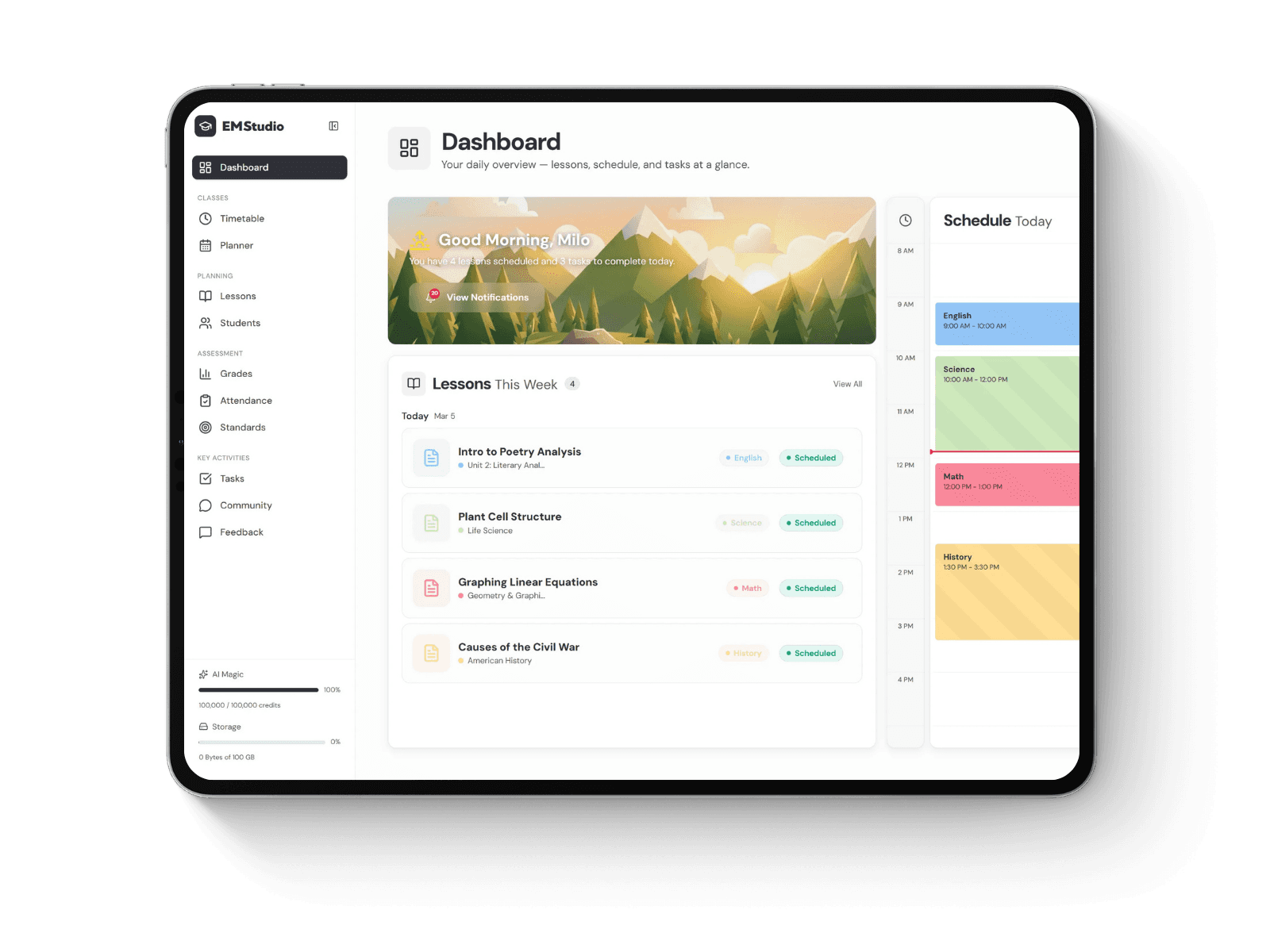
EMStudio is a free teaching management app — manage your classes, students, lessons, and more!
Learn More
Still grading everything by hand?
EMStudio is a free teaching management app — manage your classes, students, lessons, and more!
Learn More
Table of Contents
What Are the Most Effective Scaffolding Techniques for Skill Building?
The most effective scaffolding techniques include the gradual release 'I Do, We Do, You Do' framework, visual supports like graphic organizers and anchor charts, and strategic questioning using Bloom's Taxonomy. These methods provide temporary support structures that are systematically removed as students demonstrate mastery, with research indicating strong positive effects on skill acquisition and retention.
John Hattie's Visible Learning meta-analysis puts instructional scaffolding at an effect size of 0.82—nearly double the hinge point of 0.40. That means these approaches essentially guarantee a year of growth for students who might otherwise stall. Mastering these teachers techniques in teaching means combining pedagogical content knowledge with a willingness to let students struggle productively. Scaffolding works because it respects cognitive load theory: you handle the heavy lifting initially, then gradually shift the weight to students' shoulders. For a deeper look at structured support, explore evidence-based models for explicit direct instruction.
Not all scaffolds fit all skills. Match your support to the learning target:
Skill Category | Best Scaffolding Type | Example |
|---|---|---|
Procedural | Worked examples, cue cards | Math algorithms |
Declarative | Graphic organizers | Historical facts |
Conditional | Questioning chains | Literary analysis |
Plan to spend 15-20 minutes preparing these scaffolding techniques in teaching per lesson. These supports prove most effective for grades K-12 when removed systematically after three successful independent demonstrations. Keep them too long and you create learned helplessness. Pull them too early and you watch kids crash. This balance sits at the heart of effective teaching techniques.
The Gradual Release 'I Do, We Do, You Do' Framework
This gradual release of responsibility model moves from full teacher control to full student independence in three distinct phases. Time it precisely: 10-12 minutes for explicit demonstration (I Do), 15-18 minutes for guided practice with you circulating (We Do), and 12-15 minutes for independent application with immediate error analysis (You Do). The minutes matter—shortchange the We Do and you'll spot the errors too late. This structure differs from simple lecturing because the goal is obsolescence: you want students to need you less by the end of the period than they did at the start.
Watch it work with 4th graders tackling multi-digit multiplication. During I Do, you model 24 × 13 using base-ten blocks on the document camera: "I see three groups of twenty-four. I'll build twenty-four with two ten-rods and four units, three times below." You verbalize the carrying process: "I have twelve units here, but I can't write twelve in the ones place. I need to exchange ten units for one ten-rod and carry it over." Your think-aloud reveals the hidden cognitive moves experts usually hide.
In We Do, pairs build the problem at their desks while you walk. You catch the kid trading eight units instead of ten and redirect immediately. During You Do, students solve 36 × 14 independently while you scan for the three students still confusing the partial products. You pull them for a quick re-teach while the others check their work against the anchor chart. This cycle embodies formative assessment in motion—you gather real-time data on who owns the skill and who needs another round of support.
Visual Scaffolding Through Graphic Organizers and Anchor Charts
Visual scaffolds reduce working memory load by externalizing thinking. Choose your tool based on the thinking task:
Frayer Model (vocabulary development): 10 minutes to create on Chart Paper 24x32 inch. Divide into four quadrants: definition, characteristics, examples, non-examples. Remove when students independently define terms using examples and non-examples without the template.
Venn Diagram (compare/contrast): 10 minutes to create. Use for analyzing two characters, historical periods, or scientific concepts. Remove when students articulate similarities and differences in paragraph form without the overlapping circles.
Flow Chart (sequencing): 10 minutes to create. Map cause-effect relationships or historical timelines. Remove when students can retell or summarize processes chronologically without the arrows and boxes.
Anchor charts require specific standards to function as reference tools rather than decorations. Use bold color coding—red for process steps, blue for examples—to reduce cognitive load for struggling readers. Mount them at 5-foot height for middle school visibility; anything higher becomes wallpaper. Store charts by unit in labeled magazine boxes so students can retrieve them during independent practice. When the chart becomes a crutch rather than a reference—usually after three weeks or three successful independent uses—flip it to the blank side or move it to the library corner.
Strategic Questioning to Bridge Knowledge Gaps
Strategic questioning functions as invisible scaffolding, probing just enough to bridge the gap without handing over the answer. Structure your questions using Bloom's Taxonomy, moving from recall to creation for a 9th-grade biology unit on cell division:
Remember (recall definitions): "What structures disappear during prophase?" "Define mitosis in your own words." "List the stages of cell division in order."
Apply (use in new context): "How would the process change in a plant cell versus an animal cell?" "Predict what happens if the spindle fibers fail to attach." "Demonstrate the chromosome movement using these pipe cleaners."
Create (synthesize original work): "Design an experiment to test what disrupts cell division." "Develop a metaphor for the chromosome movement we observed." "Construct an argument defending why this process must be precise."
Wait 3-5 seconds after each question. Count it in your head: one-Mississippi, two-Mississippi. The silence feels eternal, but that's when the thinking happens. When students respond, probe deeper with specific follow-ups: "Tell me more about that," "What evidence supports your conclusion," or "How does this connect to our previous unit on photosynthesis?" These metacognitive strategies force students to examine their own thinking, making the learning stickier than simple recall ever could. The goal isn't the right answer—it's the right thinking.

Which Differentiated Instruction Techniques Reach Diverse Learners?
Differentiated instruction techniques that reach diverse learners include tiered assignments with multiple entry points, flexible grouping based on readiness and interest, and choice boards offering student-driven learning paths. These strategies adapt content, process, and product to individual needs while maintaining high standards for all students through responsive, data-driven grouping decisions.
Carol Ann Tomlinson's framework gives you three levers to pull. You can modify the content (what students learn), the process (how they make sense of it), or the product (how they demonstrate mastery). You base these decisions on three student traits: readiness (current skill level), interest (what hooks them), and learning profile (how they process information). This isn't about creating 25 different lesson plans. It's about designing flexible tasks that honor variance without crushing your prep time. When you align these adjustments with formative assessment data, you move from guesswork to precision.
When NOT to Differentiate: Some moments demand uniform instruction.
Don't differentiate during standardized testing preparation weeks—you need every student fluent in the exact format and expectations they'll face.
Skip it during safety protocol training where identical mastery prevents injury.
Avoid it during the first introduction of entirely novel concepts; when foundational schemas are missing, everyone needs the same initial input to avoid cognitive load theory violations that leave struggling students behind.
Use this formative assessment data to decide your approach. If a student performs below the 25th percentile, apply intensive instructional scaffolding with heavy support and reduced output demands. For the 25th to 75th percentile range, implement tiered assignments that stretch without breaking. Above the 75th percentile, use curriculum compacting: pre-assess, exempt them from mastered material, and substitute enrichment that demands metacognitive strategies and synthesis.
Tiered Assignment Design for Multiple Entry Points
Build three tiers for any complex task. Tier 1 (Foundational) provides sentence frames, word banks, and graphic organizers. Tier 2 (Grade-level) uses standard prompts with grade-appropriate text. Tier 3 (Advanced) requires synthesis of multiple sources or application to novel scenarios. I once ran a 7th-grade persuasive writing unit where all tiers answered the same essential question—"Is digital communication helping or hurting relationships?"—but Tier 1 used Lexile 800 articles with a provided claim frame, Tier 2 used Lexile 1000 with standard rubrics, and Tier 3 tackled Lexile 1200 texts plus a counterargument requirement. All three used the same rubric anchored to claim, evidence, and reasoning. The advanced kids weren't doing "more work"; they were doing more complex thinking with less scaffolding.
Yes, the first tiered assignment takes 25-30 minutes to design. You're essentially creating three versions of the same prompt. But you save these as templates. Next year's 7th graders get the same tiers, just updated articles. The non-negotiable is that every tier must address the identical essential question and use the same rubric criteria. This maintains equitable challenge; you're not lowering standards for Tier 1, you're adjusting the gradual release of responsibility to match current readiness while building toward independent mastery.
Flexible Grouping Strategies Based on Readiness and Interest
Static ability groups create tracking stigma and bored advanced learners. Instead, run a rotation protocol: administer a quick formative assessment every three weeks, then regroup. For collaborative tasks like lab work or literature circles, use heterogeneous groups of four to five students mixed by readiness and interest. This exposes struggling students to models while building pedagogical content knowledge in peer tutors. For targeted skill remediation—say, retaught fractions or phonics drills—use homogeneous groups so you can focus individualized instruction techniques without boring those who already get it. The mix keeps the classroom dynamic fluid and responsive.
Never let groups sit longer than four weeks. Kids figure out the "smart group" versus the "slow group" fast, and the damage to confidence lasts longer than the academic gain. I use color-coded index cards for transitions. Students grab their colored card from the pocket chart, find their matching color at a new table, and settle in under 90 seconds. This visibility keeps you honest about rotating kids and prevents the "permanent placement" problem that plagues techniques of teaching in a diverse classroom ppt that look good on slides but fail in practice. Quick transitions matter; every second spent moving is a second not spent learning.
Choice Boards for Student-Driven Learning Paths
Choice boards put metacognitive strategies in students' hands. Build a 3x3 grid in Google Slides—free, accessible, and easy to share through Google Classroom. Each row represents a different modality: top row visual, middle auditory, bottom kinesthetic. Each column addresses the same learning objective but through different media. In an 11th-grade US History Civil Rights unit, I offered a podcast episode analysis, an infographic timeline, or a mock interview script with movement leaders. Students had to select three activities forming a tic-tac-toe line, ensuring they hit different modalities while covering required content. The constraint of the line prevents them from picking only the "easy" options.
Implementation is straightforward. Students submit their three completed squares via Google Classroom. You provide feedback within 48 hours using a standardized rubric that focuses on the historical thinking skill, not the medium. This approach honors teachers techniques in teaching that respect student agency while maintaining academic rigor. For a more detailed look at designing these systems, check out our comprehensive guide to differentiated instruction or explore specific strategies for mixed-ability classrooms. The key is that choice doesn't mean chaos; the learning target stays fixed while the path becomes flexible, reducing cognitive load theory violations by letting students work with their strengths.

Modelling Techniques That Make Complex Concepts Stick
Rosenshine's Fourth Principle is simple: present new material in small steps. But small steps only help if you aren't flooding working memory. Cognitive Load Theory tells us students can hold about four novel items at once. Your modelling must strip away everything else.
That means hard limits. Cap any demonstration at twelve to fifteen minutes. Past that, you lose them. Working memory fills, eyes glaze, and you shift from teaching to performing.
Here is how three core modelling techniques in teaching balance clarity and demand:
Think-Alouds expose your raw thinking. Students watch you stumble, backtrack, and recover. The trade-off: this burns serious cognitive fuel. You cannot improvise and maintain quality.
Worked Examples show the solved product first. This cuts extraneous load dramatically. Risk: students nod along passively unless you force interaction.
Multi-Sensory Modelling taps multiple channels. Retention spikes when hand and eye work together. Cost: plan fifty to a hundred dollars for durable manipulatives, or budget laminating time for paper sets.
Among effective teachers techniques in teaching, these lesson delivery techniques share one trait: they front-load the instructional scaffolding so independent practice actually works.
Think-Alouds for Making Expert Thinking Visible
Script every word. Winging it turns into rambling.
Solve 3x + 5 = 20 at the board while narrating: "I notice the variable is trapped between multiplication and addition. This reminds me of peeling an onion—outer layers first. I predict subtracting five will simplify the left side. I'm confused by whether to divide first, but wait, the inverse of addition is subtraction. The strategy I'll use is undoing operations in reverse order." Subtract five. Continue: "Three x equals fifteen. Now I see division will isolate x."
Anchor your talk with five stems:
"I notice..."
"This reminds me of..."
"I predict..."
"I'm confused by..."
"The strategy I'll use is..."
Target two to three expert decisions per minute. Slower bores them; faster overwhelms. This builds metacognitive strategies in real time. Close with a three-minute formative assessment: "Write down which decision in my solution surprised you and why."
Worked Examples with Intentional Error Analysis
Apply the Worked Example Effect. Show the finish line before they run.
Display a completed 10th-grade geometry proof. Triangle ABC with transversal DE. Your proof claims the triangles are similar, but you deliberately misidentified the alternate interior angles in step three. Let them catch you.
Pair students for three minutes of error analysis. This prevents passive consumption. When they spot the mistake—that angle pair represents same-side interior, not alternate—hand them a parallel proof with fresh angle measures. They complete it independently while the example remains visible.
Never display only the final answer. Show three to four intermediate steps large enough to read from the back row. Each step acts as a signpost. Without them, students guess at the leap between lines and working memory crashes.
Multi-Sensory Modelling for Kinesthetic and Visual Learners
Run the Concrete-Representational-Abstract sequence for 3rd-grade fractions. Concrete first: students hold fraction tile manipulatives, snapping four quarters together to build one whole. A durable class set costs about twenty-four dollars. Paper versions work but fray after one unit.
After three to five days, shift to representational. Students draw bars on grid paper. Use explicit bridging language: "Remember when we moved the tiles? Now we're drawing what we did." The physical motion stops, but the visual anchor remains.
Three to five days later, drop to abstract. Numeric equations only. No pictures, no tiles. The symbols carry meaning because the prior stages built the mental model. This progression embodies gradual release of responsibility—from "I do with objects" to "we do with pictures" to "you do with numbers." It is among the most reliable visual learning techniques for kinesthetic learners, grounding abstract math in physical memory.
Your pedagogical content knowledge shows in the timing. Rush the stages and you build sand castles. Linger too long in concrete and students grow dependent on the tiles. Watch their faces. When they start ignoring the manipulatives and staring at the ceiling, you know the symbol is ready to stand alone.
How Do Reactive Teaching Techniques Transform Classroom Dynamics?
Reactive teaching techniques transform classrooms by using real-time formative assessment to adjust instruction immediately. These include responsive questioning chains that deepen understanding, strategic pivot strategies when lessons falter, and immediate feedback loops for skill correction. Teachers shift from rigid scripts to adaptive facilitation based on moment-to-moment student performance data.
Reactive teaching is formative-assessment-driven adaptive instruction. Unlike rigid lesson scripts where you march through slides regardless of blank stares, reacting techniques in teaching require you to continuously monitor student understanding and adjust on the fly. You watch faces, listen to turn-and-talk conversations, and use quick checks to decide: keep going or back up? This approach treats lesson plans as living documents rather than assembly-line schedules.
Your exit ticket data drives the next move:
If fewer than 70% of students show mastery, pivot immediately to reteaching using a different modality
At 71-85% accuracy, pair struggling students with peer tutors while you pull a small group for targeted support
At 86% or higher, accelerate into extension activities that deepen complexity
This decision tree only works when you've built formative assessment examples for immediate feedback into your lesson structure from minute one. Without that data, you're guessing.
Here's the hard truth. Reactive teaching demands serious pedagogical content knowledge. You cannot pivot to a visual representation of photosynthesis if you don't understand the electron transport chain yourself. Avoid complex pivots during your first year teaching new subject matter or with brand-new curriculum. When you're still figuring out what misconceptions typically arise, stick to the script until you know the content cold. Then layer in these adaptive teaching techniques.
Responsive Questioning Chains for Deeper Understanding
Build questioning chains using Bloom's Taxonomy progression. Start factual: "What is photosynthesis?" Move procedural: "How does chlorophyll capture light energy?" End evaluative: "Which environment maximizes photosynthetic efficiency?" This follows gradual release of responsibility—you guide students from dependent recall to independent analysis through carefully sequenced cognitive demands.
Wait time matters. Force yourself to count three full seconds. Five is better. Then use follow-up stems that push thinking without giving answers:
"Can you elaborate on that?"
"What makes you think that?"
"How does this evidence support your claim?"
These metacognitive strategies force students to examine their own reasoning, which is where real learning happens. This practice also supports developing adaptive thinking skills in students by making their thought processes visible rather than letting them hide behind yes-no answers.
Real-Time Pivot Strategies When Lessons Go Off-Track
When your mid-lesson check shows fewer than 70% mastery, execute a 5-minute pivot protocol. Immediately shift to a "micro-lesson" using an alternative representation. If you lectured, show a video clip. If they read text, switch to a diagram. The key is reducing cognitive load theory—presenting the same concept through a different entry point without adding new complexity that distracts from the core concept.
Maintain three "emergency lessons" per unit prepared in advance. These require zero prep time to deploy. One might be a Desmos activity for math, a PhET simulation for science, or a primary source image analysis for history. Having these various teaching techniques ready prevents panic when you realize half the class is lost. This is instructional scaffolding at its most practical—you're building safety nets before you need them, not scrambling for worksheets when the lesson tanks.
Immediate Feedback Loops for Skill Correction
Differentiate your feedback timing based on error type:
Immediate verbal correction within 30 seconds for procedural errors like math computation or grammar mechanics
Delayed written feedback within 48 hours for conceptual understanding like essay thesis quality or scientific argumentation
Immediate correction fixes habits before they cement; delayed feedback prevents cognitive overload during initial concept formation. Procedural skills need instant patching; conceptual frameworks need time to settle before critique.
Use hand signals for instant whole-class comprehension checks. Thumbs up means got it. Thumbs down means lost. Thumbs sideways indicates partial understanding requiring clarification. When you see sideways thumbs, you know exactly who needs the quick reteach. These teachers techniques in teaching work because they create a constant pulse of data without stopping the flow of instruction. You're not waiting for the Friday quiz to find out they're confused—you're catching it in real time and adjusting.

Building Your Personalized Teaching Techniques Toolkit
Most teachers have a grab-bag of strategies they've accumulated over years. Some work. Some are just comfortable. Before you add anything new, you need to see what you're actually doing. Pull out Charlotte Danielson's Framework for Teaching and look specifically at Domain 3: Instruction. This isn't bureaucratic box-checking. It's a diagnostic tool.
Look at your questioning techniques. Are you asking recall questions or pushing for analysis? Check your modelling. Do you show the thinking or just the finished product? Look at how you weave formative assessment into the flow. If you're stopping instruction to test, you're doing it wrong. The gaps you find here are where new teaching techniques for teachers will actually matter. I audited myself last year and realized I was doing heavy instructional scaffolding at the start of units but dropping it completely by week three. Kids were drowning in week five because I'd yanked the support too fast. Danielson's component 3c—engaging students in learning—was my weak spot. I was presenting content, not engaging with it.
Pick your battles. Two new techniques per semester. That's it. Any more and you'll do none of them well. Budget $0 to $75 for setup. Graphic organizers printed on card stock last longer than paper. A set of manipulatives for math or science runs about $30. Digital subscriptions like Kahoot or Blooket? Free tiers work fine for piloting. Don't buy the district license yet. Test first. I once spent $200 on a subscription to a metacognitive strategies platform before discovering my students preferred pencil and paper exit tickets. Money wasted. Stick to physical materials you can touch and adjust before going digital.
Run a 6-week pilot. Weeks 1-2: Micro-teach to five students. Not your whole class. Pick kids who will give you honest feedback—usually the ones who ask "why are we doing this?" Try your new questioning technique during lunch or intervention time. Watch their faces. If they look confused, your directions need work. Weeks 3-4: Single class pilot. One section. Keep the others as your control group. Document everything. Weeks 5-6: Full deployment if the data looks good. Collect exit ticket accuracy rates daily. If students aren't getting it, the technique isn't ready for prime time. Last spring I tested a new peer feedback protocol this way. The micro-teach revealed my directions were unclear—saved me from a week of chaos with thirty kids.
Here's your self-assessment rubric. Measure these weekly:
80% student engagement rate. Track participation cold. Who spoke? Who wrote? Who checked out? Use a simple tally sheet. Count hands raised, responses given, or contributions to pair-shares. If you're below 60% in week one, tweak before week three.
90% accuracy on formative checks. This means your instructional scaffolding is working, not that the work is too easy. Check three problems mid-class. If two kids get it wrong, stop and reteach. Don't wait for the quiz.
30% reduction in behavioral redirects. When you use effective instructional techniques, management issues often solve themselves because kids aren't bored or confused. Track how many times you stop instruction to correct behavior. If the number stays flat, the technique isn't engaging enough.
I learned this the hard way after trying to implement five new strategies in one September. By October, I was back to lecturing. Now I treat new instructional techniques like medication—start with a low dose and watch for side effects. If engagement drops or confusion rises, pause. It's not failure. It's data.
Cognitive load theory matters here. Don't add complexity until you've stripped away what's unnecessary. If you're introducing gradual release of responsibility, don't also launch a new seating chart and a new grading policy the same month. Your students' working memory can only handle so much novelty. I watched a colleague crash and burn trying to combine formative assessment technology with a new cooperative learning structure while also switching to standards-based grading. Too much. Pick one.
Your toolkit should reflect your pedagogical content knowledge. The strategies that work in AP History won't translate to 7th-grade math without modification. This is why auditing against Danielson first matters—you're not collecting shiny objects, you're filling specific holes. Your innovative teaching methods and strategies should solve problems you actually have, not problems you saw on Pinterest.
When you're ready to push past baseline competence, check out our guide on upping your game as an educator. But master these two techniques first.
Zen teaching techniques—the ones that look effortless—usually come from ruthless subtraction, not addition. Build your teachers techniques in teaching slowly. A toolkit with three sharp tools beats a garage full of broken equipment.
What's Next for Teachers Techniques In Teaching
You don't need all twelve techniques running tomorrow morning. Pick one. Maybe it's the gradual release of responsibility for that essay prompt that's been bombing, or a single formative assessment check-in during tomorrow's lab. The teachers who see real growth aren't the ones with the prettiest slideshows or the most complex station rotations. They're the ones who choose one strategy, use it until it becomes automatic, then stack another on top. Mastery beats variety every single time.
Watch your students closely today. Not for what they're getting wrong, but for where the cognitive load spikes—that heavy pause where cognitive load theory predicts they'll stall. That's your entry point. Add instructional scaffolding right there, model the thinking aloud, and watch who picks it up. You already know more than enough to help the kid in the second row who keeps staring at the wall. Start with that one child and that one moment. The rest of the toolkit can wait until next week.

What Are the Most Effective Scaffolding Techniques for Skill Building?
The most effective scaffolding techniques include the gradual release 'I Do, We Do, You Do' framework, visual supports like graphic organizers and anchor charts, and strategic questioning using Bloom's Taxonomy. These methods provide temporary support structures that are systematically removed as students demonstrate mastery, with research indicating strong positive effects on skill acquisition and retention.
John Hattie's Visible Learning meta-analysis puts instructional scaffolding at an effect size of 0.82—nearly double the hinge point of 0.40. That means these approaches essentially guarantee a year of growth for students who might otherwise stall. Mastering these teachers techniques in teaching means combining pedagogical content knowledge with a willingness to let students struggle productively. Scaffolding works because it respects cognitive load theory: you handle the heavy lifting initially, then gradually shift the weight to students' shoulders. For a deeper look at structured support, explore evidence-based models for explicit direct instruction.
Not all scaffolds fit all skills. Match your support to the learning target:
Skill Category | Best Scaffolding Type | Example |
|---|---|---|
Procedural | Worked examples, cue cards | Math algorithms |
Declarative | Graphic organizers | Historical facts |
Conditional | Questioning chains | Literary analysis |
Plan to spend 15-20 minutes preparing these scaffolding techniques in teaching per lesson. These supports prove most effective for grades K-12 when removed systematically after three successful independent demonstrations. Keep them too long and you create learned helplessness. Pull them too early and you watch kids crash. This balance sits at the heart of effective teaching techniques.
The Gradual Release 'I Do, We Do, You Do' Framework
This gradual release of responsibility model moves from full teacher control to full student independence in three distinct phases. Time it precisely: 10-12 minutes for explicit demonstration (I Do), 15-18 minutes for guided practice with you circulating (We Do), and 12-15 minutes for independent application with immediate error analysis (You Do). The minutes matter—shortchange the We Do and you'll spot the errors too late. This structure differs from simple lecturing because the goal is obsolescence: you want students to need you less by the end of the period than they did at the start.
Watch it work with 4th graders tackling multi-digit multiplication. During I Do, you model 24 × 13 using base-ten blocks on the document camera: "I see three groups of twenty-four. I'll build twenty-four with two ten-rods and four units, three times below." You verbalize the carrying process: "I have twelve units here, but I can't write twelve in the ones place. I need to exchange ten units for one ten-rod and carry it over." Your think-aloud reveals the hidden cognitive moves experts usually hide.
In We Do, pairs build the problem at their desks while you walk. You catch the kid trading eight units instead of ten and redirect immediately. During You Do, students solve 36 × 14 independently while you scan for the three students still confusing the partial products. You pull them for a quick re-teach while the others check their work against the anchor chart. This cycle embodies formative assessment in motion—you gather real-time data on who owns the skill and who needs another round of support.
Visual Scaffolding Through Graphic Organizers and Anchor Charts
Visual scaffolds reduce working memory load by externalizing thinking. Choose your tool based on the thinking task:
Frayer Model (vocabulary development): 10 minutes to create on Chart Paper 24x32 inch. Divide into four quadrants: definition, characteristics, examples, non-examples. Remove when students independently define terms using examples and non-examples without the template.
Venn Diagram (compare/contrast): 10 minutes to create. Use for analyzing two characters, historical periods, or scientific concepts. Remove when students articulate similarities and differences in paragraph form without the overlapping circles.
Flow Chart (sequencing): 10 minutes to create. Map cause-effect relationships or historical timelines. Remove when students can retell or summarize processes chronologically without the arrows and boxes.
Anchor charts require specific standards to function as reference tools rather than decorations. Use bold color coding—red for process steps, blue for examples—to reduce cognitive load for struggling readers. Mount them at 5-foot height for middle school visibility; anything higher becomes wallpaper. Store charts by unit in labeled magazine boxes so students can retrieve them during independent practice. When the chart becomes a crutch rather than a reference—usually after three weeks or three successful independent uses—flip it to the blank side or move it to the library corner.
Strategic Questioning to Bridge Knowledge Gaps
Strategic questioning functions as invisible scaffolding, probing just enough to bridge the gap without handing over the answer. Structure your questions using Bloom's Taxonomy, moving from recall to creation for a 9th-grade biology unit on cell division:
Remember (recall definitions): "What structures disappear during prophase?" "Define mitosis in your own words." "List the stages of cell division in order."
Apply (use in new context): "How would the process change in a plant cell versus an animal cell?" "Predict what happens if the spindle fibers fail to attach." "Demonstrate the chromosome movement using these pipe cleaners."
Create (synthesize original work): "Design an experiment to test what disrupts cell division." "Develop a metaphor for the chromosome movement we observed." "Construct an argument defending why this process must be precise."
Wait 3-5 seconds after each question. Count it in your head: one-Mississippi, two-Mississippi. The silence feels eternal, but that's when the thinking happens. When students respond, probe deeper with specific follow-ups: "Tell me more about that," "What evidence supports your conclusion," or "How does this connect to our previous unit on photosynthesis?" These metacognitive strategies force students to examine their own thinking, making the learning stickier than simple recall ever could. The goal isn't the right answer—it's the right thinking.
Which Differentiated Instruction Techniques Reach Diverse Learners?
Differentiated instruction techniques that reach diverse learners include tiered assignments with multiple entry points, flexible grouping based on readiness and interest, and choice boards offering student-driven learning paths. These strategies adapt content, process, and product to individual needs while maintaining high standards for all students through responsive, data-driven grouping decisions.
Carol Ann Tomlinson's framework gives you three levers to pull. You can modify the content (what students learn), the process (how they make sense of it), or the product (how they demonstrate mastery). You base these decisions on three student traits: readiness (current skill level), interest (what hooks them), and learning profile (how they process information). This isn't about creating 25 different lesson plans. It's about designing flexible tasks that honor variance without crushing your prep time. When you align these adjustments with formative assessment data, you move from guesswork to precision.
When NOT to Differentiate: Some moments demand uniform instruction.
Don't differentiate during standardized testing preparation weeks—you need every student fluent in the exact format and expectations they'll face.
Skip it during safety protocol training where identical mastery prevents injury.
Avoid it during the first introduction of entirely novel concepts; when foundational schemas are missing, everyone needs the same initial input to avoid cognitive load theory violations that leave struggling students behind.
Use this formative assessment data to decide your approach. If a student performs below the 25th percentile, apply intensive instructional scaffolding with heavy support and reduced output demands. For the 25th to 75th percentile range, implement tiered assignments that stretch without breaking. Above the 75th percentile, use curriculum compacting: pre-assess, exempt them from mastered material, and substitute enrichment that demands metacognitive strategies and synthesis.
Tiered Assignment Design for Multiple Entry Points
Build three tiers for any complex task. Tier 1 (Foundational) provides sentence frames, word banks, and graphic organizers. Tier 2 (Grade-level) uses standard prompts with grade-appropriate text. Tier 3 (Advanced) requires synthesis of multiple sources or application to novel scenarios. I once ran a 7th-grade persuasive writing unit where all tiers answered the same essential question—"Is digital communication helping or hurting relationships?"—but Tier 1 used Lexile 800 articles with a provided claim frame, Tier 2 used Lexile 1000 with standard rubrics, and Tier 3 tackled Lexile 1200 texts plus a counterargument requirement. All three used the same rubric anchored to claim, evidence, and reasoning. The advanced kids weren't doing "more work"; they were doing more complex thinking with less scaffolding.
Yes, the first tiered assignment takes 25-30 minutes to design. You're essentially creating three versions of the same prompt. But you save these as templates. Next year's 7th graders get the same tiers, just updated articles. The non-negotiable is that every tier must address the identical essential question and use the same rubric criteria. This maintains equitable challenge; you're not lowering standards for Tier 1, you're adjusting the gradual release of responsibility to match current readiness while building toward independent mastery.
Flexible Grouping Strategies Based on Readiness and Interest
Static ability groups create tracking stigma and bored advanced learners. Instead, run a rotation protocol: administer a quick formative assessment every three weeks, then regroup. For collaborative tasks like lab work or literature circles, use heterogeneous groups of four to five students mixed by readiness and interest. This exposes struggling students to models while building pedagogical content knowledge in peer tutors. For targeted skill remediation—say, retaught fractions or phonics drills—use homogeneous groups so you can focus individualized instruction techniques without boring those who already get it. The mix keeps the classroom dynamic fluid and responsive.
Never let groups sit longer than four weeks. Kids figure out the "smart group" versus the "slow group" fast, and the damage to confidence lasts longer than the academic gain. I use color-coded index cards for transitions. Students grab their colored card from the pocket chart, find their matching color at a new table, and settle in under 90 seconds. This visibility keeps you honest about rotating kids and prevents the "permanent placement" problem that plagues techniques of teaching in a diverse classroom ppt that look good on slides but fail in practice. Quick transitions matter; every second spent moving is a second not spent learning.
Choice Boards for Student-Driven Learning Paths
Choice boards put metacognitive strategies in students' hands. Build a 3x3 grid in Google Slides—free, accessible, and easy to share through Google Classroom. Each row represents a different modality: top row visual, middle auditory, bottom kinesthetic. Each column addresses the same learning objective but through different media. In an 11th-grade US History Civil Rights unit, I offered a podcast episode analysis, an infographic timeline, or a mock interview script with movement leaders. Students had to select three activities forming a tic-tac-toe line, ensuring they hit different modalities while covering required content. The constraint of the line prevents them from picking only the "easy" options.
Implementation is straightforward. Students submit their three completed squares via Google Classroom. You provide feedback within 48 hours using a standardized rubric that focuses on the historical thinking skill, not the medium. This approach honors teachers techniques in teaching that respect student agency while maintaining academic rigor. For a more detailed look at designing these systems, check out our comprehensive guide to differentiated instruction or explore specific strategies for mixed-ability classrooms. The key is that choice doesn't mean chaos; the learning target stays fixed while the path becomes flexible, reducing cognitive load theory violations by letting students work with their strengths.
Modelling Techniques That Make Complex Concepts Stick
Rosenshine's Fourth Principle is simple: present new material in small steps. But small steps only help if you aren't flooding working memory. Cognitive Load Theory tells us students can hold about four novel items at once. Your modelling must strip away everything else.
That means hard limits. Cap any demonstration at twelve to fifteen minutes. Past that, you lose them. Working memory fills, eyes glaze, and you shift from teaching to performing.
Here is how three core modelling techniques in teaching balance clarity and demand:
Think-Alouds expose your raw thinking. Students watch you stumble, backtrack, and recover. The trade-off: this burns serious cognitive fuel. You cannot improvise and maintain quality.
Worked Examples show the solved product first. This cuts extraneous load dramatically. Risk: students nod along passively unless you force interaction.
Multi-Sensory Modelling taps multiple channels. Retention spikes when hand and eye work together. Cost: plan fifty to a hundred dollars for durable manipulatives, or budget laminating time for paper sets.
Among effective teachers techniques in teaching, these lesson delivery techniques share one trait: they front-load the instructional scaffolding so independent practice actually works.
Think-Alouds for Making Expert Thinking Visible
Script every word. Winging it turns into rambling.
Solve 3x + 5 = 20 at the board while narrating: "I notice the variable is trapped between multiplication and addition. This reminds me of peeling an onion—outer layers first. I predict subtracting five will simplify the left side. I'm confused by whether to divide first, but wait, the inverse of addition is subtraction. The strategy I'll use is undoing operations in reverse order." Subtract five. Continue: "Three x equals fifteen. Now I see division will isolate x."
Anchor your talk with five stems:
"I notice..."
"This reminds me of..."
"I predict..."
"I'm confused by..."
"The strategy I'll use is..."
Target two to three expert decisions per minute. Slower bores them; faster overwhelms. This builds metacognitive strategies in real time. Close with a three-minute formative assessment: "Write down which decision in my solution surprised you and why."
Worked Examples with Intentional Error Analysis
Apply the Worked Example Effect. Show the finish line before they run.
Display a completed 10th-grade geometry proof. Triangle ABC with transversal DE. Your proof claims the triangles are similar, but you deliberately misidentified the alternate interior angles in step three. Let them catch you.
Pair students for three minutes of error analysis. This prevents passive consumption. When they spot the mistake—that angle pair represents same-side interior, not alternate—hand them a parallel proof with fresh angle measures. They complete it independently while the example remains visible.
Never display only the final answer. Show three to four intermediate steps large enough to read from the back row. Each step acts as a signpost. Without them, students guess at the leap between lines and working memory crashes.
Multi-Sensory Modelling for Kinesthetic and Visual Learners
Run the Concrete-Representational-Abstract sequence for 3rd-grade fractions. Concrete first: students hold fraction tile manipulatives, snapping four quarters together to build one whole. A durable class set costs about twenty-four dollars. Paper versions work but fray after one unit.
After three to five days, shift to representational. Students draw bars on grid paper. Use explicit bridging language: "Remember when we moved the tiles? Now we're drawing what we did." The physical motion stops, but the visual anchor remains.
Three to five days later, drop to abstract. Numeric equations only. No pictures, no tiles. The symbols carry meaning because the prior stages built the mental model. This progression embodies gradual release of responsibility—from "I do with objects" to "we do with pictures" to "you do with numbers." It is among the most reliable visual learning techniques for kinesthetic learners, grounding abstract math in physical memory.
Your pedagogical content knowledge shows in the timing. Rush the stages and you build sand castles. Linger too long in concrete and students grow dependent on the tiles. Watch their faces. When they start ignoring the manipulatives and staring at the ceiling, you know the symbol is ready to stand alone.
How Do Reactive Teaching Techniques Transform Classroom Dynamics?
Reactive teaching techniques transform classrooms by using real-time formative assessment to adjust instruction immediately. These include responsive questioning chains that deepen understanding, strategic pivot strategies when lessons falter, and immediate feedback loops for skill correction. Teachers shift from rigid scripts to adaptive facilitation based on moment-to-moment student performance data.
Reactive teaching is formative-assessment-driven adaptive instruction. Unlike rigid lesson scripts where you march through slides regardless of blank stares, reacting techniques in teaching require you to continuously monitor student understanding and adjust on the fly. You watch faces, listen to turn-and-talk conversations, and use quick checks to decide: keep going or back up? This approach treats lesson plans as living documents rather than assembly-line schedules.
Your exit ticket data drives the next move:
If fewer than 70% of students show mastery, pivot immediately to reteaching using a different modality
At 71-85% accuracy, pair struggling students with peer tutors while you pull a small group for targeted support
At 86% or higher, accelerate into extension activities that deepen complexity
This decision tree only works when you've built formative assessment examples for immediate feedback into your lesson structure from minute one. Without that data, you're guessing.
Here's the hard truth. Reactive teaching demands serious pedagogical content knowledge. You cannot pivot to a visual representation of photosynthesis if you don't understand the electron transport chain yourself. Avoid complex pivots during your first year teaching new subject matter or with brand-new curriculum. When you're still figuring out what misconceptions typically arise, stick to the script until you know the content cold. Then layer in these adaptive teaching techniques.
Responsive Questioning Chains for Deeper Understanding
Build questioning chains using Bloom's Taxonomy progression. Start factual: "What is photosynthesis?" Move procedural: "How does chlorophyll capture light energy?" End evaluative: "Which environment maximizes photosynthetic efficiency?" This follows gradual release of responsibility—you guide students from dependent recall to independent analysis through carefully sequenced cognitive demands.
Wait time matters. Force yourself to count three full seconds. Five is better. Then use follow-up stems that push thinking without giving answers:
"Can you elaborate on that?"
"What makes you think that?"
"How does this evidence support your claim?"
These metacognitive strategies force students to examine their own reasoning, which is where real learning happens. This practice also supports developing adaptive thinking skills in students by making their thought processes visible rather than letting them hide behind yes-no answers.
Real-Time Pivot Strategies When Lessons Go Off-Track
When your mid-lesson check shows fewer than 70% mastery, execute a 5-minute pivot protocol. Immediately shift to a "micro-lesson" using an alternative representation. If you lectured, show a video clip. If they read text, switch to a diagram. The key is reducing cognitive load theory—presenting the same concept through a different entry point without adding new complexity that distracts from the core concept.
Maintain three "emergency lessons" per unit prepared in advance. These require zero prep time to deploy. One might be a Desmos activity for math, a PhET simulation for science, or a primary source image analysis for history. Having these various teaching techniques ready prevents panic when you realize half the class is lost. This is instructional scaffolding at its most practical—you're building safety nets before you need them, not scrambling for worksheets when the lesson tanks.
Immediate Feedback Loops for Skill Correction
Differentiate your feedback timing based on error type:
Immediate verbal correction within 30 seconds for procedural errors like math computation or grammar mechanics
Delayed written feedback within 48 hours for conceptual understanding like essay thesis quality or scientific argumentation
Immediate correction fixes habits before they cement; delayed feedback prevents cognitive overload during initial concept formation. Procedural skills need instant patching; conceptual frameworks need time to settle before critique.
Use hand signals for instant whole-class comprehension checks. Thumbs up means got it. Thumbs down means lost. Thumbs sideways indicates partial understanding requiring clarification. When you see sideways thumbs, you know exactly who needs the quick reteach. These teachers techniques in teaching work because they create a constant pulse of data without stopping the flow of instruction. You're not waiting for the Friday quiz to find out they're confused—you're catching it in real time and adjusting.
Building Your Personalized Teaching Techniques Toolkit
Most teachers have a grab-bag of strategies they've accumulated over years. Some work. Some are just comfortable. Before you add anything new, you need to see what you're actually doing. Pull out Charlotte Danielson's Framework for Teaching and look specifically at Domain 3: Instruction. This isn't bureaucratic box-checking. It's a diagnostic tool.
Look at your questioning techniques. Are you asking recall questions or pushing for analysis? Check your modelling. Do you show the thinking or just the finished product? Look at how you weave formative assessment into the flow. If you're stopping instruction to test, you're doing it wrong. The gaps you find here are where new teaching techniques for teachers will actually matter. I audited myself last year and realized I was doing heavy instructional scaffolding at the start of units but dropping it completely by week three. Kids were drowning in week five because I'd yanked the support too fast. Danielson's component 3c—engaging students in learning—was my weak spot. I was presenting content, not engaging with it.
Pick your battles. Two new techniques per semester. That's it. Any more and you'll do none of them well. Budget $0 to $75 for setup. Graphic organizers printed on card stock last longer than paper. A set of manipulatives for math or science runs about $30. Digital subscriptions like Kahoot or Blooket? Free tiers work fine for piloting. Don't buy the district license yet. Test first. I once spent $200 on a subscription to a metacognitive strategies platform before discovering my students preferred pencil and paper exit tickets. Money wasted. Stick to physical materials you can touch and adjust before going digital.
Run a 6-week pilot. Weeks 1-2: Micro-teach to five students. Not your whole class. Pick kids who will give you honest feedback—usually the ones who ask "why are we doing this?" Try your new questioning technique during lunch or intervention time. Watch their faces. If they look confused, your directions need work. Weeks 3-4: Single class pilot. One section. Keep the others as your control group. Document everything. Weeks 5-6: Full deployment if the data looks good. Collect exit ticket accuracy rates daily. If students aren't getting it, the technique isn't ready for prime time. Last spring I tested a new peer feedback protocol this way. The micro-teach revealed my directions were unclear—saved me from a week of chaos with thirty kids.
Here's your self-assessment rubric. Measure these weekly:
80% student engagement rate. Track participation cold. Who spoke? Who wrote? Who checked out? Use a simple tally sheet. Count hands raised, responses given, or contributions to pair-shares. If you're below 60% in week one, tweak before week three.
90% accuracy on formative checks. This means your instructional scaffolding is working, not that the work is too easy. Check three problems mid-class. If two kids get it wrong, stop and reteach. Don't wait for the quiz.
30% reduction in behavioral redirects. When you use effective instructional techniques, management issues often solve themselves because kids aren't bored or confused. Track how many times you stop instruction to correct behavior. If the number stays flat, the technique isn't engaging enough.
I learned this the hard way after trying to implement five new strategies in one September. By October, I was back to lecturing. Now I treat new instructional techniques like medication—start with a low dose and watch for side effects. If engagement drops or confusion rises, pause. It's not failure. It's data.
Cognitive load theory matters here. Don't add complexity until you've stripped away what's unnecessary. If you're introducing gradual release of responsibility, don't also launch a new seating chart and a new grading policy the same month. Your students' working memory can only handle so much novelty. I watched a colleague crash and burn trying to combine formative assessment technology with a new cooperative learning structure while also switching to standards-based grading. Too much. Pick one.
Your toolkit should reflect your pedagogical content knowledge. The strategies that work in AP History won't translate to 7th-grade math without modification. This is why auditing against Danielson first matters—you're not collecting shiny objects, you're filling specific holes. Your innovative teaching methods and strategies should solve problems you actually have, not problems you saw on Pinterest.
When you're ready to push past baseline competence, check out our guide on upping your game as an educator. But master these two techniques first.
Zen teaching techniques—the ones that look effortless—usually come from ruthless subtraction, not addition. Build your teachers techniques in teaching slowly. A toolkit with three sharp tools beats a garage full of broken equipment.
What's Next for Teachers Techniques In Teaching
You don't need all twelve techniques running tomorrow morning. Pick one. Maybe it's the gradual release of responsibility for that essay prompt that's been bombing, or a single formative assessment check-in during tomorrow's lab. The teachers who see real growth aren't the ones with the prettiest slideshows or the most complex station rotations. They're the ones who choose one strategy, use it until it becomes automatic, then stack another on top. Mastery beats variety every single time.
Watch your students closely today. Not for what they're getting wrong, but for where the cognitive load spikes—that heavy pause where cognitive load theory predicts they'll stall. That's your entry point. Add instructional scaffolding right there, model the thinking aloud, and watch who picks it up. You already know more than enough to help the kid in the second row who keeps staring at the wall. Start with that one child and that one moment. The rest of the toolkit can wait until next week.
Still grading everything by hand?
EMStudio is a free teaching management app — manage your classes, students, lessons, and more!
Learn More
Still grading everything by hand?
EMStudio is a free teaching management app — manage your classes, students, lessons, and more!
Learn More





Notion4Teachers
Notion templates to simplify administrative tasks and enhance your teaching experience.



2026 Notion4Teachers. All Rights Reserved.
Notion4Teachers
Notion templates to simplify administrative tasks and enhance your teaching experience.
2026 Notion4Teachers. All Rights Reserved.
Notion4Teachers
Notion templates to simplify administrative tasks and enhance your teaching experience.
2026 Notion4Teachers. All Rights Reserved.