Playing Preschool: A Complete Guide for K-12 Educators
Playing Preschool: A Complete Guide for K-12 Educators

Article by
Milo
ESL Content Coordinator & Educator
ESL Content Coordinator & Educator
All Posts
You keep hearing that preschool should be play-based, but you're staring at a closet full of worksheets and a district pacing guide that expects letter recognition by October. Maybe you got moved from 3rd grade down to pre-K and now you're supposed to run centers that look like investigative play instead of guided reading groups. Or your administrator dropped a book about emergent curriculum on your desk and you're wondering how child-led anything actually hits the math standards.
That's where playing preschool comes in. It's not just letting kids color while you catch up on emails. It's a structured approach where you set up the environment, observe the schema play happening in the block corner, and know exactly when to jump in with sustained shared thinking to stretch that curiosity toward actual learning. I've used these methods both in half-day pre-K and when adapting them for my 1st graders who needed more movement.
This guide cuts through the early-childhood buzzwords. You'll see what a daily schedule actually looks like when you're using loose parts instead of workbook pages, how to document learning without stopping the fun, and why those five-year-olds building a "trap" out of recycling bins are actually doing rigorous work. No theory dumps—just what works when the bell rings.
Still grading everything by hand?
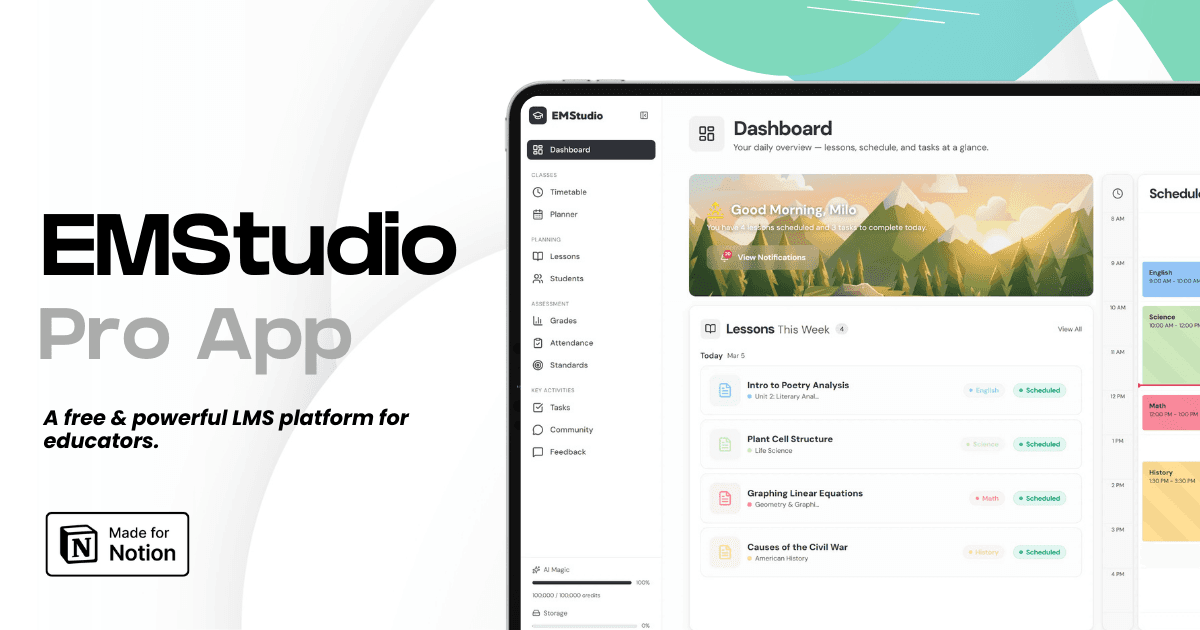
EMStudio is a free teaching management app — manage your classes, students, lessons, and more!
Learn More
Still grading everything by hand?
EMStudio is a free teaching management app — manage your classes, students, lessons, and more!
Learn More
Table of Contents
What Is Playing Preschool?
Playing preschool is a child-led educational approach for children ages 2.5 to 5 that uses play as the primary vehicle for learning. Unlike academic preschools that rely on worksheets and direct instruction, this model emphasizes hands-on exploration, social interaction, and teacher-facilitated discovery through extended play blocks of 60-90 minutes.
Most people encounter Playing Preschool through Susie Allison's Busy Toddler homeschool curriculum, a structured 190-day program for ages 2.5-5 that guides parents through daily play-based activities. But the term also describes a broader play based preschool philosophy gaining traction in early childhood centers. Both share the same core belief: children ages 3-5 don't need letter drills or calendar time. They need 60-90 minutes of uninterrupted investigative play to build the cognitive flexibility that actually predicts later academic success.
The difference between this approach and traditional preschool models shows up in four specific ways:
Teacher role: Facilitator who observes and extends play versus instructor delivering content.
Materials: Loose parts—blocks, fabric scraps, pinecones—versus worksheets and pre-cut crafts.
Time structure: Extended 60-90 minute blocks for deep engagement versus 20-minute rotations through centers.
Assessment: Observational portfolios documenting schema play patterns versus standardized readiness checklists.
The hardest part? Pushing back against curriculum push-down. Parents and administrators often demand kindergarten-readiness worksheets, confusing busyness with learning. You need clear language ready: "We're meeting standards through discovery. When Maya builds a ramp for her car, she's testing physics hypotheses and developing the fine motor control she'll need for handwriting. We're just not doing it with a worksheet." Child-centered learning achieves the same benchmarks as direct instruction, just through a different route.
Core Components of Play-Based Learning
Not all play qualifies as educational. For a play to learn preschool classroom to actually build cognitive skills, five elements must be present:
Child choice and autonomy: The child selects the activity, moves materials, and determines the play's direction.
Process over product orientation: The learning happens in the doing, not the finished artwork.
Imaginative elements: Assigning symbolic meaning—a block becomes a phone, a scarf becomes a cape.
Physical manipulation: Sensorimotor engagement with real materials, not screens or worksheets.
Positive affect: Genuine enjoyment without sticker charts or external rewards.
This is where Vygotsky's Zone of Proximal Development matters. You don't hand them a worksheet when they get stuck. You use sustained shared thinking—the "serve and return" pattern. Child stacks three blocks and pauses (serve). You say, "I wonder how high it can go" (return). They add a fourth block. You handed them the scaffold without taking over the crane.
How It Differs From Traditional Preschool Models
Let's compare the two approaches directly.
Traditional Academic Preschool runs on direct instruction, letter-of-the-week curriculum, and teacher-fronted circle time lasting 30-45 minutes. It produces visible work product—worksheets with names traced in dotted lines, identical craft projects. Parents see evidence of "learning." But research shows these gains often evaporate.
Playing Preschool uses an emergent curriculum based on children's questions. It looks messy. Children spend 45 minutes figuring out how to make a marble roll uphill using cardboard tubes. The teacher documents the learning through photos and dictation rather than checking boxes on a readiness assessment.
Here's the statistic that matters: by third grade, children from play based preschool programs show equal or better academic outcomes compared to those from academic preschools. The drill-based early education creates a "fade-out" effect once the worksheets stop, while the problem-solving skills built during extended play blocks persist. You're not choosing between play and academics. You're choosing between short-term compliance and long-term capacity.
Why Does Playing Preschool Matter for Development?
Research indicates that play-based preschool enhances executive function, with children showing stronger working memory and cognitive flexibility compared to didactic programs. The approach supports holistic development: children in high-quality play-based settings demonstrate advanced social negotiation skills and measurably better stress regulation through child-directed learning experiences.
John Hattie's Visible Learning meta-analyses put play-based pedagogies under the microscope, and the numbers tell a clear story about implementation quality. When teachers treat play as mere recess or step back into passive observation, effect sizes remain modest. But when educators practice sustained shared thinking—kneeling beside block builders to ask "what if we added a ramp here" or hypothesizing about why the tower fell—social-emotional learning gains consistently outpace traditional didactic instruction. The magic happens in the interaction, not the materials.
Quality playing preschool classrooms hit benchmarks that worksheet-based programs miss:
Vocabulary acquisition rates exceeding 2,000 words annually, typically through dramatic play where children negotiate roles and narrate scenarios.
Executive function improvements measured by classic delay-of-gratification tasks; children who engage in regular schema play wait longer and strategize better.
Spatial reasoning gains from complex block building with loose parts and ramps, which longitudinal studies link to later STEM achievement in middle school.
The critical failure mode is unstructured chaos: dumping materials on a table and calling it "child-centered learning." Without facilitation, children recycle the same shallow play patterns. Contrast this with intentional play using the HighScope plan-do-review cycle—children articulate intentions before building, execute the build, then reflect with the teacher. That structure transforms random activity into investigative play.
Cognitive Growth Through Play
Sustained play literally changes the brain. When children engage in uninterrupted emergent curriculum activities for 45 minutes or more, the prefrontal cortex activates in ways that build working memory and cognitive flexibility. Shorter periods never reach "mature play," that complex state where children integrate multiple schemas—like using blocks as phones while running a pretend pizza shop. You can see the difference in their focus; after 20 minutes they're just getting started, but at minute 45 they're orchestrating elaborate scenarios that require holding multiple rules in mind simultaneously.
Specific play types target specific cognitive skills. Water and sand play teaches conservation of quantity—pouring between containers of different shapes proves that volume stays constant despite appearance. Dramatic play develops symbolic representation, the foundation of literacy, when a stick becomes a horse or a scarf transforms into a river. Block building with ramps and tunnels builds causal reasoning as children test which angle sends the marble fastest. This is cognitive growth through play in real time, not theoretical.
Social-Emotional Development
Sociodramatic play creates a self-regulation staircase that predicts kindergarten readiness better than early reading scores. To sustain a doctor's office scenario, a child must inhibit impulses (stay in character rather than grab the stethoscope), hold complex rules in mind (patients wait, doctors ask questions), and switch flexibly when the plot shifts to a veterinarian clinic. These three demands—response inhibition, working memory, and cognitive flexibility—are the core components of executive function. Children who master them through daily play based learning preschool routines enter kindergarten ready to learn, not just ready to behave.
Most teachers interrupt too soon. When two children fight over the cash register, the instinct is to swoop in and solve it. That robs them of the 3-5 minute negotiation window where real social learning happens. Watch closely: during that window, children offer compromises ("You be cashier first, then me"), read facial cues, and experience the natural consequences of inflexibility. If you intervene at minute one, you teach dependence. If you wait, you build negotiators.
Physical and Creative Benefits
Outdoor investigative play delivers physical benefits that indoor academics cannot match. Programs with true play based learning preschool philosophies log 45-60 minutes of moderate-to-vigorous physical activity daily, compared to 20-30 minutes in classroom-heavy models. That gap matters; the CDC recommends 60 minutes for gross motor development, and children in movement-rich programs show better balance, core strength, and fine motor control for writing. They're not just healthier; they're physically ready to sit and focus when required.
Creativity requires specific materials, not cute crafts. Process art with liquid watercolors and large brushes—no coloring pages, no templates—correlates with higher divergent thinking scores. Children who regularly manipulate loose parts (bottle caps, fabric scraps, tree cookies) generate more novel solutions to problems than peers completing teacher-directed crafts. Traditional cut-and-paste templates might produce refrigerator-worthy results, but they don't build the neural pathways for innovation.

How Playing Preschool Actually Works in Practice
The schedule looks wrong on paper. Ninety minutes of uninterrupted morning exploration sounds like chaos when you're used to 20-minute rotations. But that's exactly what playing preschool requires for real neurological benefits. Anything less than 45 minutes barely gets children past the superficial stage of play. Deep investigative play needs time to spiral out, crash, rebuild, and settle. After those 90 minutes, you pull small groups for 20 minutes of targeted instruction while the rest continue working, then wrap with a 15-minute whole-class meeting. The traditional model of switching activities every 20 minutes trains kids to stay shallow. They never reach the complex schema play where real learning happens.
This is where sustained shared thinking enters. Based on Siraj-Blatchford's EPPE research, you join a child's play for five to ten minutes at a time. You kneel down and ask "What would happen if we moved this ramp higher?" not "What color is the block?" Open-ended questions push thinking forward. Quiz questions with predetermined answers shut it down. You're not the teacher right then. You're a curious co-investigator who happens to know slightly more about gravity.
Your room needs seven distinct learning areas: art, blocks, dramatic play, library, discovery/science, music/movement, and toys/games. Each child needs 35 to 50 square feet of usable floor space, roughly the size of a parking spot per kid. Seven areas in that footprint sounds impossible until you map it carefully. Rotate materials every two weeks, keeping 50% of items stored away. When the wooden animals return after being gone, they feel brand new. This rotation system supports emergent curriculum without buying new supplies constantly.
Child-Led Exploration Time
Free flow play means children choose their center, their materials, and their playmates for 60 to 90 minutes without forced rotation. No timers ding. No chart tells them when to move. You set up invitations to play provocative arrangements that suggest possibility without commanding it:
Shells arranged on mirrors next to baskets
Tape and cardboard tubes at the construction site
Water beads with scoops but no instructions
They decide whether the shells become currency, dinner plates, or dinosaur eggs. That's child-centered learning in action. They might spend 40 minutes just transporting sand from one container to another. That's not wasting time. It's schema play, and your job is to protect it from interruption.
Your body position matters more than your lesson plan. Kneel at eye level. Sit beside them in parallel play rather than hovering overhead. When you hover, you become the authority. When you sit shoulder-to-shoulder, you become a playmate. Use sportscasting narration: "I see you're balancing the flat block on top of the cylinder." No praise. No direction. Just observation that validates their process without judging it. Three-year-olds need this neutrality to build intrinsic motivation.
Teacher Facilitation Strategies
You rotate through three distinct stances during play. Each requires 15-plus hours of professional development to master. Most teachers default to the first because it feels safe. Push yourself toward the second even when it feels awkward:
The Stage Manager: Prepares the environment before children arrive, setting out loose parts and checking that the water table won't leak.
The Co-Player: Enters the dramatic play area as a customer at the restaurant or a patient at the doctor's office, modeling complex language and extending scenarios without taking over.
The Scribe: Documents learning stories, photographing block structures and writing down quotes for later portfolio reviews.
The Co-Player stance feels ridiculous at first. You'll sit in a tiny chair wearing a plastic hard hat, ordering a pizza made of pom-poms. But that's where vocabulary explodes.
Wait ten seconds. That's the rule. When a child struggles to fit the puzzle piece or zip the coat, count to ten before your hands move. Those seconds allow self-correction. They build frustration tolerance. Jumping in immediately teaches helplessness. Watching them figure it out teaches competence.
Environment Setup and Materials
Reggio Emilia calls the environment the third teacher. Paint your walls beige, white, or soft grey. Commercial characters Disney princesses, cartoon animals go in the closet. They script the play and limit imagination. Neutral palettes and natural lighting let children project their own stories onto the space. This is the foundation of environment setup and materials that actually support play based learning curriculum rather than just decorating a room.
Storage makes or breaks the independence. Follow these specifications:
Open shelving at 24 to 30 inches height
Clear containers without lids for visibility
Labels with photos plus words to support pre-literacy
Fewer than 20 items visible per center (the 20-toy rule)
If they can't see it, they won't use it. If they can't reach it, they'll ask you fifty times per morning. Rotating between storage and shelves keeps the investigative play fresh without overwhelming working memory. When you control the clutter, you control the attention.

Real-World Examples of Play-Based Curriculum Activities
When you're running a playing preschool classroom, these play based curriculum examples look like real life compressed into manageable chunks. Here are four specific setups that target clear learning goals, with the logistics you need to actually pull them off.
Dramatic Play Centers
Convert your corner into a grocery store using real empty food containers, price tags marked $1-$5, and a calculator or thrift-store cash register. Clip blank shopping lists to clipboards. Setup time: 20 minutes to arrange shelves and label items. Age modifications: Two-year-olds sort cereal boxes by color and size while five-year-olds write five-item lists, calculate totals, and make change. Observable standard: Child demonstrates one-to-one correspondence by placing five items in a basket while counting aloud, or recognizes numerals 1-5 on price tags.
This is emergent curriculum in action. When the cashier argues with the shopper about whether eggs cost three or four dollars, they're negotiating social roles and practicing print awareness. You might hear a four-year-old tell a peer, "You can't come in without a mask," reflecting real-world experiences through play. Rotate themes every three to four weeks—vet clinic, post office, restaurant—but keep half your materials constant. The same phones, clipboards, and writing tools stay out even when the context shifts. Kids need that anchor to feel secure during transitions. Check out our full guide to dramatic play centers for complete prop box inventories.
Outdoor Nature Exploration
Forest Friday means two hours outside minimum, rain or shine. Kids wear mud suits and rain boots while exploring with 5x magnifying glasses and bug boxes with air holes. Bring field guides with photographs, not drawings—preschoolers need to match the exact leaf shape they see on the ground rather than interpreting an illustration.
Investigative play outdoors requires safety protocols. Use a 1:6 adult-to-child ratio when introducing real tools like vegetable peelers for whittling sticks. Fill out risk-benefit assessment forms before letting kids climb specific trees; document the height, branch structure, and ground conditions. Carry a first aid kit and emergency whistle. Setup: 15 minutes to check boundaries and distribute gear. Age modifications: Three-year-olds collect pinecones and sort by texture; five-year-olds sketch leaf venation in nature journals and label parts. Observable standard: Child uses sustained shared thinking to hypothesize why a worm moves differently on concrete versus soil.
5x power magnifying glasses
Bug boxes with air holes
Field guides with photographs (not drawings)
Weather-appropriate gear: mud suits, rain boots
Sensory and Art Stations
Fill 20x20 inch trays with rainbow rice—mix two cups rice, one teaspoon vinegar, and food coloring, then dry overnight. Hide magnetic letters inside. Add measuring cups, funnels, and plastic tweezers. Setup: 30 minutes including dyeing time. Age modifications: Two-year-olds pour and scoop to develop wrist action; four-year-olds find letters to spell their names and sort by initial sounds. Observable standard: Child demonstrates fine motor control by transferring rice using a pincer grasp for one minute.
Keep art process-focused, not product-driven. Lay out 12x18 inch paper with liquid watercolors and thick brushes, never coloring books. Offer clay without tools initially—hand strength develops faster when they pinch and roll instead of cutting with scissors. Provide collage materials like fabric scraps and buttons without sample models to copy; child-centered learning means they decide if the sky belongs at the top. Spray bottles filled with water strengthen hand muscles better than markers. For more sensory setup specifics, see our sensory and art stations guide.
Block Building and Engineering
Unit blocks teach math better than foam. Real hardwood blocks follow standardized dimensions—1.375 by 5.5 by 11 inches—which lets kids discover that two unit blocks equal one double block. That's fractions before they can write numerals.
Kids progress through seven stages of block play. Add ramps and balls to explore incline and velocity. Post architectural photos nearby for inspiration. Use vocabulary like arch, balance, and stability during construction.
Stage 1: Carrying blocks (age 2)
Stage 2: Building rows (age 2.5)
Stage 3: Bridges (age 3)
Stage 4: Enclosures (age 3.5)
Stage 5: Patterns and symmetry (age 4)
Stage 6: Naming structures (age 4.5)
Stage 7: Dramatic play with blocks (age 5+)
Block Type | Material | Cost | Math Value |
|---|---|---|---|
Unit Blocks | Hardwood, specific dimensions | $200+ investment | Predicts later math achievement |
Foam Blocks | Lightweight | $50 set | Limited proportional reasoning |
Loose Parts | Free/recycled materials | Free | Creative but non-standardized |
Setup: Blocks stay out permanently on low shelves labeled with outlines. Age modifications: Three-year-olds experiment with schema play like enclosing spaces; five-year-olds draw blueprints on clipboards before building complex structures. Observable standard: Child explains that a tower collapsed due to a narrow base lacking stability, using the word balance correctly.
What Does a Daily Schedule Look Like?
A playing preschool schedule dedicates 60-90 minutes to uninterrupted child-led exploration, followed by 20-30 minute teacher-guided small groups and 15-minute whole-class gatherings. Unlike rigid academic preschools, transitions use songs or visual cues rather than bells, maintaining flow with 70% of the day devoted to free choice centers and outdoor play.
The difference becomes stark when you compare the actual clock:
Traditional Academic Preschool | Playing Preschool |
|---|---|
8:00-8:20 Calendar time | 8:00-9:30 Uninterrupted choice time |
8:20-8:40 Worksheets | 9:30-9:50 Small groups (embedded literacy/math) |
8:40-9:00 Whole-group reading | 9:50-10:20 Outdoor investigative play |
9:00-9:15 Snack | 10:20-10:35 Snack/conversation |
9:15-9:45 Rigid centers rotation | 10:35-11:05 Project time (emergent curriculum) |
9:45-10:00 Transition/clean up | 11:05-11:20 Story/music (whole group) |
10:00-10:30 Outdoor recess | 11:20-12:00 Lunch |
Notice the ratio: roughly 70% child-led exploration, 20% teacher-guided instruction, and 10% routines. In a play to learn preschool, that 70% block isn't "free time"—it's when the deepest learning happens through sustained shared thinking and schema play.
Don't sabotage your schedule with false choices. When you tell a child, "Finish your worksheet, then you can play," you turn play into a reward rather than the curriculum itself. This creates anxiety and destroys the intrinsic motivation that drives child-centered learning. The investigative play is the work, not the prize.
Balancing Structured and Unstructured Time
Quantify your day honestly. If you're running a true emergent curriculum, children should control 70% of their time through free play and center exploration. Teachers guide 20% through small groups and read-alouds. The remaining 10% covers meals and necessary routines. That "academic" content your administration worries about? It lives inside the 70% through intentional environment design—loose parts for math, writing tools in the dramatic play area, science tools at the sensory table.
Here's what a Tuesday morning actually looks like:
8:00-9:30 Arrival and uninterrupted choice time (block building, art studio, library)
9:30-9:50 Outdoor play (investigating ice melting in the water table)
9:50-10:10 Small group rotation (phonemic awareness games with 4 children)
10:10-10:30 Snack and conversation (no forced silence)
10:30-11:00 Project time (studying worms found during outdoor play)
11:00-11:15 Story and music (whole group, but children choose seating)
11:15-12:00 Lunch
Notice there's no rigid calendar time where 20 children sit on a carpet while one child points to the date. That routine eats 20 minutes that could belong to investigative play. Calendar concepts emerge naturally during snack ("Yesterday was cold, today is colder") or project work. This balancing structured and unstructured time respects how young brains actually develop.
Transitions Without Disrupting Flow
Transitions kill play. Every time you stop schema play abruptly, you lose the complex narrative a child was building. Your visual schedule system should use photographs of your actual classroom centers—not generic clip art—arranged linearly left-to-right to reinforce pre-literacy concepts. Children move their own photo from a "planning board" to the center they're visiting, making choices visible and intentional.
Use soft transitions instead of harsh interruptions. Five minutes before small groups, dim the lights or ring a gentle chime. This signals time is ending without the jarring effect of a bell or a teacher's voice cutting through concentration. Allow children to reach natural stopping points in their play schemas.
Three specific techniques preserve this flow:
The 3-minute warning with a sand timer. Place the timer on the table next to the child. When the sand runs out, they know transition is coming without you hovering.
The Clean-Up Robot song with specific actions. You sing "beep-beep, back up" and children reverse away from their play area, then "load items" as they pick up specific loose parts into bins. The routine becomes a game rather than a command.
Visual transition cards showing the next destination rather than verbal interruptions. Hand a child a photo card of the snack table instead of calling their name across the room. They finish their block tower, check the card, and move independently.
These small shifts protect the child's concentration while keeping your day moving.

Getting Started with Play-Based Learning in Your Classroom
You don't flip a switch to start a play based preschool curriculum. You phase it in over 90 days so you don't overwhelm yourself or the kids. Days 1 through 30, audit your space. Remove half your closed-ended toys—the ones that beep, flash, or only fit together one way. Replace them with natural materials: tree cookies, fabric scraps, cardboard tubes. Days 31 through 60, introduce the plan-do-review cycle. Kids tell you where they're playing, go do it, then show you what happened. Days 61 through 90, train parents to read your documentation. Send home photos with captions pointing out the math in the block tower or the literacy in the grocery list.
Before you move a single shelf, run through a 10-point classroom assessment checklist. Check your lighting quality: natural light should dominate for more than 50% of the day—fluorescent buzz kills sustained shared thinking. Measure your softness ratio: carpets and pillows must balance hard surfaces to keep noise below 50 decibels. Verify accessibility: children should reach 80% of materials independently. Count your loose parts: every center needs at least five different open-ended materials. Add checks for sight lines across all centers, clear pathways 36 inches wide, storage labels with photographs not words, water access for self-serve painting, a cozy retreat space for two children, and vertical surfaces for writing everywhere.
Assessing Your Current Space
Start with the closed-ended purge. Walk around with a laundry basket. Grab anything with batteries that can't be removed, puzzles that only work one way, and character toys that come with a pre-written script. If it does only one thing, it goes. Calculate your budget like this: for every $50 you spent on single-purpose toys, invest $200 in loose parts. Scarves, wooden boxes, stones, and fabric remnants transform into ten different things in a single morning. That's investigative play at work, and it costs less than replacing the plastic fire truck that lost its ladder.
Next, fix your furniture. Lower shelving to 24 inches so three-year-olds can see over the top and reach without tipping. Add rugs, pillows, or fabric canopies until you've covered enough hard floor to drop noise levels below 50 decibels. Acoustic overload shuts down schema play faster than any teacher direction. Check accessibility: 75% of materials should be available without your help. If you're fetching the paint or unscrewing the glue caps, you're not running child-centered learning. You're running a delivery service. For a deeper dive on sensory-friendly arrangements, see our guide on assessing your current space.
First Steps for Transitioning
Weeks one and two, shut your mouth and watch. Document current play patterns without intervening. Take photos. Notice who gravitates toward rotation schemas versus enclosure schemas. Week three, introduce plan-do-review using photographs. Show children pictures of center choices. Let them point to where they'll work. After cleanup, gather back and share. "I built a bridge" becomes a story about engineering and conflict resolution when you ask, "How did you keep it from falling?"
Weeks five through eight, post documentation panels at child height. These photos with captions show parents exactly which learning standards you hit during that grocery store game. Speaking of parents, send home learning letters every Friday during days 61 through 90. Explain that playing preschool isn't just "cute." It's rigorous learning. Attach a photo of the block tower with a note: "Diego counted 14 blocks and compared heights—measurement and data standards met."
Avoid three critical failures that kill momentum. First, stop interrupting every three to five minutes with teachable moments. Research shows kids need minimum ten-minute immersion before deep play begins. Constant hovering breaks their concentration. Second, don't swap all toys for electronic "educational" games or single-outcome puzzles. That defeats the purpose of emergent curriculum. Third, never skip documentation through photography and learning stories. Without visual proof, skeptical parents see chaos instead of complex learning, and you'll struggle to defend why Johnny spent 45 minutes "just" scooping sand.
Ready for the full shift to investigative play? Read our complete guide on transitioning to a play-based curriculum.
Put Playing Preschool to Work Tomorrow
The shift to child-centered learning isn't about buying more toys or scheduling extra recess. It's about stopping the urge to interrupt. When you watch a four-year-old stack blocks for twelve minutes without suggesting a "better" way to build, you practice the hardest part of this approach: trust. Trust that learning happens when you stop managing every moment. The magic isn't in the materials—it's in the space you create for emergent curriculum to surface.
Start tomorrow. Remove one adult-directed activity from your morning and replace it with a basket of loose parts—buttons, fabric scraps, empty spools. Sit nearby. Don't ask guiding questions. Just observe and jot down what you see. That ten minutes of sustained shared thinking that happens when a child explains their creation to a peer? That's your assessment data. That's the proof. You don't need a new curriculum package. You need permission to get out of the way.
What Is Playing Preschool?
Playing preschool is a child-led educational approach for children ages 2.5 to 5 that uses play as the primary vehicle for learning. Unlike academic preschools that rely on worksheets and direct instruction, this model emphasizes hands-on exploration, social interaction, and teacher-facilitated discovery through extended play blocks of 60-90 minutes.
Most people encounter Playing Preschool through Susie Allison's Busy Toddler homeschool curriculum, a structured 190-day program for ages 2.5-5 that guides parents through daily play-based activities. But the term also describes a broader play based preschool philosophy gaining traction in early childhood centers. Both share the same core belief: children ages 3-5 don't need letter drills or calendar time. They need 60-90 minutes of uninterrupted investigative play to build the cognitive flexibility that actually predicts later academic success.
The difference between this approach and traditional preschool models shows up in four specific ways:
Teacher role: Facilitator who observes and extends play versus instructor delivering content.
Materials: Loose parts—blocks, fabric scraps, pinecones—versus worksheets and pre-cut crafts.
Time structure: Extended 60-90 minute blocks for deep engagement versus 20-minute rotations through centers.
Assessment: Observational portfolios documenting schema play patterns versus standardized readiness checklists.
The hardest part? Pushing back against curriculum push-down. Parents and administrators often demand kindergarten-readiness worksheets, confusing busyness with learning. You need clear language ready: "We're meeting standards through discovery. When Maya builds a ramp for her car, she's testing physics hypotheses and developing the fine motor control she'll need for handwriting. We're just not doing it with a worksheet." Child-centered learning achieves the same benchmarks as direct instruction, just through a different route.
Core Components of Play-Based Learning
Not all play qualifies as educational. For a play to learn preschool classroom to actually build cognitive skills, five elements must be present:
Child choice and autonomy: The child selects the activity, moves materials, and determines the play's direction.
Process over product orientation: The learning happens in the doing, not the finished artwork.
Imaginative elements: Assigning symbolic meaning—a block becomes a phone, a scarf becomes a cape.
Physical manipulation: Sensorimotor engagement with real materials, not screens or worksheets.
Positive affect: Genuine enjoyment without sticker charts or external rewards.
This is where Vygotsky's Zone of Proximal Development matters. You don't hand them a worksheet when they get stuck. You use sustained shared thinking—the "serve and return" pattern. Child stacks three blocks and pauses (serve). You say, "I wonder how high it can go" (return). They add a fourth block. You handed them the scaffold without taking over the crane.
How It Differs From Traditional Preschool Models
Let's compare the two approaches directly.
Traditional Academic Preschool runs on direct instruction, letter-of-the-week curriculum, and teacher-fronted circle time lasting 30-45 minutes. It produces visible work product—worksheets with names traced in dotted lines, identical craft projects. Parents see evidence of "learning." But research shows these gains often evaporate.
Playing Preschool uses an emergent curriculum based on children's questions. It looks messy. Children spend 45 minutes figuring out how to make a marble roll uphill using cardboard tubes. The teacher documents the learning through photos and dictation rather than checking boxes on a readiness assessment.
Here's the statistic that matters: by third grade, children from play based preschool programs show equal or better academic outcomes compared to those from academic preschools. The drill-based early education creates a "fade-out" effect once the worksheets stop, while the problem-solving skills built during extended play blocks persist. You're not choosing between play and academics. You're choosing between short-term compliance and long-term capacity.
Why Does Playing Preschool Matter for Development?
Research indicates that play-based preschool enhances executive function, with children showing stronger working memory and cognitive flexibility compared to didactic programs. The approach supports holistic development: children in high-quality play-based settings demonstrate advanced social negotiation skills and measurably better stress regulation through child-directed learning experiences.
John Hattie's Visible Learning meta-analyses put play-based pedagogies under the microscope, and the numbers tell a clear story about implementation quality. When teachers treat play as mere recess or step back into passive observation, effect sizes remain modest. But when educators practice sustained shared thinking—kneeling beside block builders to ask "what if we added a ramp here" or hypothesizing about why the tower fell—social-emotional learning gains consistently outpace traditional didactic instruction. The magic happens in the interaction, not the materials.
Quality playing preschool classrooms hit benchmarks that worksheet-based programs miss:
Vocabulary acquisition rates exceeding 2,000 words annually, typically through dramatic play where children negotiate roles and narrate scenarios.
Executive function improvements measured by classic delay-of-gratification tasks; children who engage in regular schema play wait longer and strategize better.
Spatial reasoning gains from complex block building with loose parts and ramps, which longitudinal studies link to later STEM achievement in middle school.
The critical failure mode is unstructured chaos: dumping materials on a table and calling it "child-centered learning." Without facilitation, children recycle the same shallow play patterns. Contrast this with intentional play using the HighScope plan-do-review cycle—children articulate intentions before building, execute the build, then reflect with the teacher. That structure transforms random activity into investigative play.
Cognitive Growth Through Play
Sustained play literally changes the brain. When children engage in uninterrupted emergent curriculum activities for 45 minutes or more, the prefrontal cortex activates in ways that build working memory and cognitive flexibility. Shorter periods never reach "mature play," that complex state where children integrate multiple schemas—like using blocks as phones while running a pretend pizza shop. You can see the difference in their focus; after 20 minutes they're just getting started, but at minute 45 they're orchestrating elaborate scenarios that require holding multiple rules in mind simultaneously.
Specific play types target specific cognitive skills. Water and sand play teaches conservation of quantity—pouring between containers of different shapes proves that volume stays constant despite appearance. Dramatic play develops symbolic representation, the foundation of literacy, when a stick becomes a horse or a scarf transforms into a river. Block building with ramps and tunnels builds causal reasoning as children test which angle sends the marble fastest. This is cognitive growth through play in real time, not theoretical.
Social-Emotional Development
Sociodramatic play creates a self-regulation staircase that predicts kindergarten readiness better than early reading scores. To sustain a doctor's office scenario, a child must inhibit impulses (stay in character rather than grab the stethoscope), hold complex rules in mind (patients wait, doctors ask questions), and switch flexibly when the plot shifts to a veterinarian clinic. These three demands—response inhibition, working memory, and cognitive flexibility—are the core components of executive function. Children who master them through daily play based learning preschool routines enter kindergarten ready to learn, not just ready to behave.
Most teachers interrupt too soon. When two children fight over the cash register, the instinct is to swoop in and solve it. That robs them of the 3-5 minute negotiation window where real social learning happens. Watch closely: during that window, children offer compromises ("You be cashier first, then me"), read facial cues, and experience the natural consequences of inflexibility. If you intervene at minute one, you teach dependence. If you wait, you build negotiators.
Physical and Creative Benefits
Outdoor investigative play delivers physical benefits that indoor academics cannot match. Programs with true play based learning preschool philosophies log 45-60 minutes of moderate-to-vigorous physical activity daily, compared to 20-30 minutes in classroom-heavy models. That gap matters; the CDC recommends 60 minutes for gross motor development, and children in movement-rich programs show better balance, core strength, and fine motor control for writing. They're not just healthier; they're physically ready to sit and focus when required.
Creativity requires specific materials, not cute crafts. Process art with liquid watercolors and large brushes—no coloring pages, no templates—correlates with higher divergent thinking scores. Children who regularly manipulate loose parts (bottle caps, fabric scraps, tree cookies) generate more novel solutions to problems than peers completing teacher-directed crafts. Traditional cut-and-paste templates might produce refrigerator-worthy results, but they don't build the neural pathways for innovation.
How Playing Preschool Actually Works in Practice
The schedule looks wrong on paper. Ninety minutes of uninterrupted morning exploration sounds like chaos when you're used to 20-minute rotations. But that's exactly what playing preschool requires for real neurological benefits. Anything less than 45 minutes barely gets children past the superficial stage of play. Deep investigative play needs time to spiral out, crash, rebuild, and settle. After those 90 minutes, you pull small groups for 20 minutes of targeted instruction while the rest continue working, then wrap with a 15-minute whole-class meeting. The traditional model of switching activities every 20 minutes trains kids to stay shallow. They never reach the complex schema play where real learning happens.
This is where sustained shared thinking enters. Based on Siraj-Blatchford's EPPE research, you join a child's play for five to ten minutes at a time. You kneel down and ask "What would happen if we moved this ramp higher?" not "What color is the block?" Open-ended questions push thinking forward. Quiz questions with predetermined answers shut it down. You're not the teacher right then. You're a curious co-investigator who happens to know slightly more about gravity.
Your room needs seven distinct learning areas: art, blocks, dramatic play, library, discovery/science, music/movement, and toys/games. Each child needs 35 to 50 square feet of usable floor space, roughly the size of a parking spot per kid. Seven areas in that footprint sounds impossible until you map it carefully. Rotate materials every two weeks, keeping 50% of items stored away. When the wooden animals return after being gone, they feel brand new. This rotation system supports emergent curriculum without buying new supplies constantly.
Child-Led Exploration Time
Free flow play means children choose their center, their materials, and their playmates for 60 to 90 minutes without forced rotation. No timers ding. No chart tells them when to move. You set up invitations to play provocative arrangements that suggest possibility without commanding it:
Shells arranged on mirrors next to baskets
Tape and cardboard tubes at the construction site
Water beads with scoops but no instructions
They decide whether the shells become currency, dinner plates, or dinosaur eggs. That's child-centered learning in action. They might spend 40 minutes just transporting sand from one container to another. That's not wasting time. It's schema play, and your job is to protect it from interruption.
Your body position matters more than your lesson plan. Kneel at eye level. Sit beside them in parallel play rather than hovering overhead. When you hover, you become the authority. When you sit shoulder-to-shoulder, you become a playmate. Use sportscasting narration: "I see you're balancing the flat block on top of the cylinder." No praise. No direction. Just observation that validates their process without judging it. Three-year-olds need this neutrality to build intrinsic motivation.
Teacher Facilitation Strategies
You rotate through three distinct stances during play. Each requires 15-plus hours of professional development to master. Most teachers default to the first because it feels safe. Push yourself toward the second even when it feels awkward:
The Stage Manager: Prepares the environment before children arrive, setting out loose parts and checking that the water table won't leak.
The Co-Player: Enters the dramatic play area as a customer at the restaurant or a patient at the doctor's office, modeling complex language and extending scenarios without taking over.
The Scribe: Documents learning stories, photographing block structures and writing down quotes for later portfolio reviews.
The Co-Player stance feels ridiculous at first. You'll sit in a tiny chair wearing a plastic hard hat, ordering a pizza made of pom-poms. But that's where vocabulary explodes.
Wait ten seconds. That's the rule. When a child struggles to fit the puzzle piece or zip the coat, count to ten before your hands move. Those seconds allow self-correction. They build frustration tolerance. Jumping in immediately teaches helplessness. Watching them figure it out teaches competence.
Environment Setup and Materials
Reggio Emilia calls the environment the third teacher. Paint your walls beige, white, or soft grey. Commercial characters Disney princesses, cartoon animals go in the closet. They script the play and limit imagination. Neutral palettes and natural lighting let children project their own stories onto the space. This is the foundation of environment setup and materials that actually support play based learning curriculum rather than just decorating a room.
Storage makes or breaks the independence. Follow these specifications:
Open shelving at 24 to 30 inches height
Clear containers without lids for visibility
Labels with photos plus words to support pre-literacy
Fewer than 20 items visible per center (the 20-toy rule)
If they can't see it, they won't use it. If they can't reach it, they'll ask you fifty times per morning. Rotating between storage and shelves keeps the investigative play fresh without overwhelming working memory. When you control the clutter, you control the attention.
Real-World Examples of Play-Based Curriculum Activities
When you're running a playing preschool classroom, these play based curriculum examples look like real life compressed into manageable chunks. Here are four specific setups that target clear learning goals, with the logistics you need to actually pull them off.
Dramatic Play Centers
Convert your corner into a grocery store using real empty food containers, price tags marked $1-$5, and a calculator or thrift-store cash register. Clip blank shopping lists to clipboards. Setup time: 20 minutes to arrange shelves and label items. Age modifications: Two-year-olds sort cereal boxes by color and size while five-year-olds write five-item lists, calculate totals, and make change. Observable standard: Child demonstrates one-to-one correspondence by placing five items in a basket while counting aloud, or recognizes numerals 1-5 on price tags.
This is emergent curriculum in action. When the cashier argues with the shopper about whether eggs cost three or four dollars, they're negotiating social roles and practicing print awareness. You might hear a four-year-old tell a peer, "You can't come in without a mask," reflecting real-world experiences through play. Rotate themes every three to four weeks—vet clinic, post office, restaurant—but keep half your materials constant. The same phones, clipboards, and writing tools stay out even when the context shifts. Kids need that anchor to feel secure during transitions. Check out our full guide to dramatic play centers for complete prop box inventories.
Outdoor Nature Exploration
Forest Friday means two hours outside minimum, rain or shine. Kids wear mud suits and rain boots while exploring with 5x magnifying glasses and bug boxes with air holes. Bring field guides with photographs, not drawings—preschoolers need to match the exact leaf shape they see on the ground rather than interpreting an illustration.
Investigative play outdoors requires safety protocols. Use a 1:6 adult-to-child ratio when introducing real tools like vegetable peelers for whittling sticks. Fill out risk-benefit assessment forms before letting kids climb specific trees; document the height, branch structure, and ground conditions. Carry a first aid kit and emergency whistle. Setup: 15 minutes to check boundaries and distribute gear. Age modifications: Three-year-olds collect pinecones and sort by texture; five-year-olds sketch leaf venation in nature journals and label parts. Observable standard: Child uses sustained shared thinking to hypothesize why a worm moves differently on concrete versus soil.
5x power magnifying glasses
Bug boxes with air holes
Field guides with photographs (not drawings)
Weather-appropriate gear: mud suits, rain boots
Sensory and Art Stations
Fill 20x20 inch trays with rainbow rice—mix two cups rice, one teaspoon vinegar, and food coloring, then dry overnight. Hide magnetic letters inside. Add measuring cups, funnels, and plastic tweezers. Setup: 30 minutes including dyeing time. Age modifications: Two-year-olds pour and scoop to develop wrist action; four-year-olds find letters to spell their names and sort by initial sounds. Observable standard: Child demonstrates fine motor control by transferring rice using a pincer grasp for one minute.
Keep art process-focused, not product-driven. Lay out 12x18 inch paper with liquid watercolors and thick brushes, never coloring books. Offer clay without tools initially—hand strength develops faster when they pinch and roll instead of cutting with scissors. Provide collage materials like fabric scraps and buttons without sample models to copy; child-centered learning means they decide if the sky belongs at the top. Spray bottles filled with water strengthen hand muscles better than markers. For more sensory setup specifics, see our sensory and art stations guide.
Block Building and Engineering
Unit blocks teach math better than foam. Real hardwood blocks follow standardized dimensions—1.375 by 5.5 by 11 inches—which lets kids discover that two unit blocks equal one double block. That's fractions before they can write numerals.
Kids progress through seven stages of block play. Add ramps and balls to explore incline and velocity. Post architectural photos nearby for inspiration. Use vocabulary like arch, balance, and stability during construction.
Stage 1: Carrying blocks (age 2)
Stage 2: Building rows (age 2.5)
Stage 3: Bridges (age 3)
Stage 4: Enclosures (age 3.5)
Stage 5: Patterns and symmetry (age 4)
Stage 6: Naming structures (age 4.5)
Stage 7: Dramatic play with blocks (age 5+)
Block Type | Material | Cost | Math Value |
|---|---|---|---|
Unit Blocks | Hardwood, specific dimensions | $200+ investment | Predicts later math achievement |
Foam Blocks | Lightweight | $50 set | Limited proportional reasoning |
Loose Parts | Free/recycled materials | Free | Creative but non-standardized |
Setup: Blocks stay out permanently on low shelves labeled with outlines. Age modifications: Three-year-olds experiment with schema play like enclosing spaces; five-year-olds draw blueprints on clipboards before building complex structures. Observable standard: Child explains that a tower collapsed due to a narrow base lacking stability, using the word balance correctly.
What Does a Daily Schedule Look Like?
A playing preschool schedule dedicates 60-90 minutes to uninterrupted child-led exploration, followed by 20-30 minute teacher-guided small groups and 15-minute whole-class gatherings. Unlike rigid academic preschools, transitions use songs or visual cues rather than bells, maintaining flow with 70% of the day devoted to free choice centers and outdoor play.
The difference becomes stark when you compare the actual clock:
Traditional Academic Preschool | Playing Preschool |
|---|---|
8:00-8:20 Calendar time | 8:00-9:30 Uninterrupted choice time |
8:20-8:40 Worksheets | 9:30-9:50 Small groups (embedded literacy/math) |
8:40-9:00 Whole-group reading | 9:50-10:20 Outdoor investigative play |
9:00-9:15 Snack | 10:20-10:35 Snack/conversation |
9:15-9:45 Rigid centers rotation | 10:35-11:05 Project time (emergent curriculum) |
9:45-10:00 Transition/clean up | 11:05-11:20 Story/music (whole group) |
10:00-10:30 Outdoor recess | 11:20-12:00 Lunch |
Notice the ratio: roughly 70% child-led exploration, 20% teacher-guided instruction, and 10% routines. In a play to learn preschool, that 70% block isn't "free time"—it's when the deepest learning happens through sustained shared thinking and schema play.
Don't sabotage your schedule with false choices. When you tell a child, "Finish your worksheet, then you can play," you turn play into a reward rather than the curriculum itself. This creates anxiety and destroys the intrinsic motivation that drives child-centered learning. The investigative play is the work, not the prize.
Balancing Structured and Unstructured Time
Quantify your day honestly. If you're running a true emergent curriculum, children should control 70% of their time through free play and center exploration. Teachers guide 20% through small groups and read-alouds. The remaining 10% covers meals and necessary routines. That "academic" content your administration worries about? It lives inside the 70% through intentional environment design—loose parts for math, writing tools in the dramatic play area, science tools at the sensory table.
Here's what a Tuesday morning actually looks like:
8:00-9:30 Arrival and uninterrupted choice time (block building, art studio, library)
9:30-9:50 Outdoor play (investigating ice melting in the water table)
9:50-10:10 Small group rotation (phonemic awareness games with 4 children)
10:10-10:30 Snack and conversation (no forced silence)
10:30-11:00 Project time (studying worms found during outdoor play)
11:00-11:15 Story and music (whole group, but children choose seating)
11:15-12:00 Lunch
Notice there's no rigid calendar time where 20 children sit on a carpet while one child points to the date. That routine eats 20 minutes that could belong to investigative play. Calendar concepts emerge naturally during snack ("Yesterday was cold, today is colder") or project work. This balancing structured and unstructured time respects how young brains actually develop.
Transitions Without Disrupting Flow
Transitions kill play. Every time you stop schema play abruptly, you lose the complex narrative a child was building. Your visual schedule system should use photographs of your actual classroom centers—not generic clip art—arranged linearly left-to-right to reinforce pre-literacy concepts. Children move their own photo from a "planning board" to the center they're visiting, making choices visible and intentional.
Use soft transitions instead of harsh interruptions. Five minutes before small groups, dim the lights or ring a gentle chime. This signals time is ending without the jarring effect of a bell or a teacher's voice cutting through concentration. Allow children to reach natural stopping points in their play schemas.
Three specific techniques preserve this flow:
The 3-minute warning with a sand timer. Place the timer on the table next to the child. When the sand runs out, they know transition is coming without you hovering.
The Clean-Up Robot song with specific actions. You sing "beep-beep, back up" and children reverse away from their play area, then "load items" as they pick up specific loose parts into bins. The routine becomes a game rather than a command.
Visual transition cards showing the next destination rather than verbal interruptions. Hand a child a photo card of the snack table instead of calling their name across the room. They finish their block tower, check the card, and move independently.
These small shifts protect the child's concentration while keeping your day moving.
Getting Started with Play-Based Learning in Your Classroom
You don't flip a switch to start a play based preschool curriculum. You phase it in over 90 days so you don't overwhelm yourself or the kids. Days 1 through 30, audit your space. Remove half your closed-ended toys—the ones that beep, flash, or only fit together one way. Replace them with natural materials: tree cookies, fabric scraps, cardboard tubes. Days 31 through 60, introduce the plan-do-review cycle. Kids tell you where they're playing, go do it, then show you what happened. Days 61 through 90, train parents to read your documentation. Send home photos with captions pointing out the math in the block tower or the literacy in the grocery list.
Before you move a single shelf, run through a 10-point classroom assessment checklist. Check your lighting quality: natural light should dominate for more than 50% of the day—fluorescent buzz kills sustained shared thinking. Measure your softness ratio: carpets and pillows must balance hard surfaces to keep noise below 50 decibels. Verify accessibility: children should reach 80% of materials independently. Count your loose parts: every center needs at least five different open-ended materials. Add checks for sight lines across all centers, clear pathways 36 inches wide, storage labels with photographs not words, water access for self-serve painting, a cozy retreat space for two children, and vertical surfaces for writing everywhere.
Assessing Your Current Space
Start with the closed-ended purge. Walk around with a laundry basket. Grab anything with batteries that can't be removed, puzzles that only work one way, and character toys that come with a pre-written script. If it does only one thing, it goes. Calculate your budget like this: for every $50 you spent on single-purpose toys, invest $200 in loose parts. Scarves, wooden boxes, stones, and fabric remnants transform into ten different things in a single morning. That's investigative play at work, and it costs less than replacing the plastic fire truck that lost its ladder.
Next, fix your furniture. Lower shelving to 24 inches so three-year-olds can see over the top and reach without tipping. Add rugs, pillows, or fabric canopies until you've covered enough hard floor to drop noise levels below 50 decibels. Acoustic overload shuts down schema play faster than any teacher direction. Check accessibility: 75% of materials should be available without your help. If you're fetching the paint or unscrewing the glue caps, you're not running child-centered learning. You're running a delivery service. For a deeper dive on sensory-friendly arrangements, see our guide on assessing your current space.
First Steps for Transitioning
Weeks one and two, shut your mouth and watch. Document current play patterns without intervening. Take photos. Notice who gravitates toward rotation schemas versus enclosure schemas. Week three, introduce plan-do-review using photographs. Show children pictures of center choices. Let them point to where they'll work. After cleanup, gather back and share. "I built a bridge" becomes a story about engineering and conflict resolution when you ask, "How did you keep it from falling?"
Weeks five through eight, post documentation panels at child height. These photos with captions show parents exactly which learning standards you hit during that grocery store game. Speaking of parents, send home learning letters every Friday during days 61 through 90. Explain that playing preschool isn't just "cute." It's rigorous learning. Attach a photo of the block tower with a note: "Diego counted 14 blocks and compared heights—measurement and data standards met."
Avoid three critical failures that kill momentum. First, stop interrupting every three to five minutes with teachable moments. Research shows kids need minimum ten-minute immersion before deep play begins. Constant hovering breaks their concentration. Second, don't swap all toys for electronic "educational" games or single-outcome puzzles. That defeats the purpose of emergent curriculum. Third, never skip documentation through photography and learning stories. Without visual proof, skeptical parents see chaos instead of complex learning, and you'll struggle to defend why Johnny spent 45 minutes "just" scooping sand.
Ready for the full shift to investigative play? Read our complete guide on transitioning to a play-based curriculum.
Put Playing Preschool to Work Tomorrow
The shift to child-centered learning isn't about buying more toys or scheduling extra recess. It's about stopping the urge to interrupt. When you watch a four-year-old stack blocks for twelve minutes without suggesting a "better" way to build, you practice the hardest part of this approach: trust. Trust that learning happens when you stop managing every moment. The magic isn't in the materials—it's in the space you create for emergent curriculum to surface.
Start tomorrow. Remove one adult-directed activity from your morning and replace it with a basket of loose parts—buttons, fabric scraps, empty spools. Sit nearby. Don't ask guiding questions. Just observe and jot down what you see. That ten minutes of sustained shared thinking that happens when a child explains their creation to a peer? That's your assessment data. That's the proof. You don't need a new curriculum package. You need permission to get out of the way.
Still grading everything by hand?
EMStudio is a free teaching management app — manage your classes, students, lessons, and more!
Learn More
Still grading everything by hand?
EMStudio is a free teaching management app — manage your classes, students, lessons, and more!
Learn More

Notion4Teachers
Notion templates to simplify administrative tasks and enhance your teaching experience.



2026 Notion4Teachers. All Rights Reserved.
Notion4Teachers
Notion templates to simplify administrative tasks and enhance your teaching experience.
2026 Notion4Teachers. All Rights Reserved.
Notion4Teachers
Notion templates to simplify administrative tasks and enhance your teaching experience.
2026 Notion4Teachers. All Rights Reserved.