
Teaching Methodology: A Complete Guide for K-12 Educators
Teaching Methodology: A Complete Guide for K-12 Educators

Article by
Milo
ESL Content Coordinator & Educator
ESL Content Coordinator & Educator
All Posts
It's October, and your 7th graders are staring at the reading passage you assigned, pencils frozen. Three kids have their heads down, two are whispering by the window, and your carefully planned lesson is dissolving in real time.
This is where teaching methodology earns its keep. Not the buzzwords from last district PD, but the actual moves you make when curriculum design meets reality. The methods you choose shape everything from daily classroom management to long-term learning outcomes. Get them right, and your students build lasting understanding through solid scaffolding. Get them wrong, and you're managing chaos until June.
This guide cuts through the jargon. We'll look at what teaching methodology actually means (and how it differs from pedagogy), why it drives student success beyond test scores, five evidence-based approaches that work in real K-12 rooms, and how to switch methods mid-year without sacrificing instructional time. No theory for theory's sake. Just practical strategies you can use tomorrow.
Still grading everything by hand?
EMStudio is a free teaching management app — manage your classes, students, lessons, and more!
Learn More
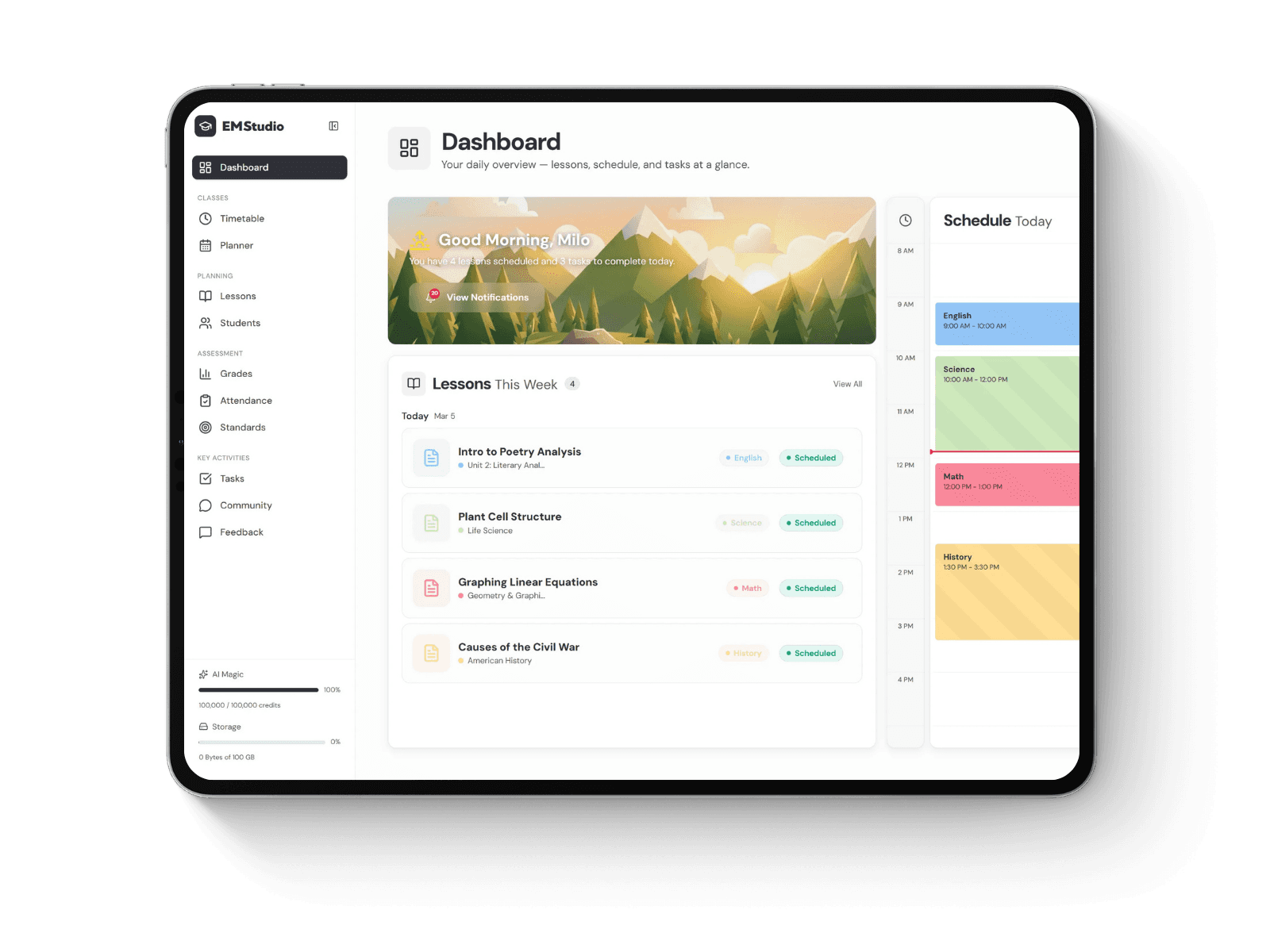
Still grading everything by hand?
EMStudio is a free teaching management app — manage your classes, students, lessons, and more!
Learn More
Table of Contents
What Is Teaching Methodology and How Does It Differ from Pedagogy?
Teaching methodology refers to the systematic framework and specific procedures used to deliver instruction, distinct from pedagogy which encompasses the philosophical theories and beliefs about learning. While pedagogy answers 'why' we teach, methodology answers 'how'—providing structured approaches like Direct Instruction or Inquiry-Based Learning to achieve specific learning objectives.
You need to know what you're actually doing in the classroom. Teaching methodology is your systematic plan—the "how"—while pedagogy is your philosophical stance on learning itself. They're related, but mixing them up leads to disjointed lessons that feel random to your students.
Think of it this way. Madeline Hunter's Mastery Teaching is a methodology—a system with steps for modeling, guided practice, and independent practice. John Dewey's constructivism is pedagogy—a belief that learning happens through experience. You can employ Hunter's steps while holding Dewey's beliefs, or reject both.
Picture a 5th-grade social studies lesson on the Boston Tea Party planned through a defining pedagogy and its relationship to instructional strategy framework rooted in Dewey. You stage a simulation where students experience unfair taxation through classroom currency, constructing understanding through experiential discovery.
Now plan that identical lesson through Hunter's Mastery Teaching methodology. You explicitly model the historical context using a primary source, check for understanding with targeted questions, then guide structured analysis of the Tea Party's economic impact. The system demands specific steps.
This distinction matters because instructional strategy sits below methodology. Robert Marzano clarifies in The Art and Science of Teaching: using a KWL chart is a strategy, a tactical activity. The complete Direct Instruction model—including pacing, questioning, and assessment—is a methodology. One is a tool; the other is the blueprint.
Your choice depends on cognitive demand. Bloom's Taxonomy guides this alignment. When objectives target Remember or Understand levels, Direct Instruction provides explicit support. When you aim for Create or Evaluate, Project-Based Learning offers required autonomy. Consider a flowchart: assess prior knowledge, analyze cognitive demand, then select your framework.
Defining Teaching Methodology vs. General Instructional Strategy
Montessori is a methodology. It demands three-hour uninterrupted work cycles, mixed-age groupings spanning three years, and specific didactic materials like the pink tower. A Think-Pair-Share is a strategy—a five-minute tactical move you insert into any lesson. Understanding this hierarchy prevents you from confusing your overall architecture with your daily tactics.
Here is the distinction in practice. Direct Instruction is a methodology; it encompasses daily review, new material presentation, guided practice, and independent practice with specific error correction. Using a graphic organizer is a strategy—one tool within various methodologies. Project-Based Learning is a methodology with defined phases of inquiry and public presentation; jigsaw grouping is a strategy for distributing expert knowledge within it.
Marzano frames this through ten design questions that determine your methodology. These include establishing rules and procedures versus designing individual lessons. When you answer these questions systematically, you create a coherent methodology rather than stringing together random activities.
The Role of Learning Objectives in Method Selection
Your objective determines your framework. If the target is procedural knowledge—say, solving multi-digit division—your methodology must include worked examples following Sweller's Cognitive Load Theory. Novices need explicit modeling to manage working memory. If the target is conditional knowledge—knowing when to apply division versus multiplication—shift to case-based inquiry where students analyze scenarios and justify selections.
Watch for the expertise reversal effect. When you use inquiry-based methods for foundational skill acquisition without prior knowledge, novices experience cognitive overload. They spend mental resources figuring out the procedure rather than conceptual relationships. I learned this with a grade 3 mathematics class attempting to discover the standard division algorithm through pure exploration. The students constructed misconceptions that took weeks to correct. Explicit instruction with careful scaffolding would have built the schema they needed first.
Map your SMART objectives to cognitive demand before selecting your approach. Remember and Understand levels from Bloom's Taxonomy align with explicit methodologies providing structure. Create and Evaluate levels demand open frameworks like Project-Based Learning. Match the method to the mental work required.
Why Does Teaching Methodology Determine Long-Term Student Success?
Teaching methodology determines long-term success by optimizing cognitive load management and building durable learning schemas. Evidence-based methods like Direct Instruction yield effect sizes of 0.59 compared to unstructured discovery. Methodologies that balance explicit instruction with student agency create stronger retention rates and intrinsic motivation persistence.
Your teaching methodology acts as the filter between curriculum and student memory. Choose wrong, and you overload working memory. Choose right, and you build mental models that last. The difference shows up six months later when students either retain the concept or draw a blank.
Cognitive Load Management and Knowledge Retention Rates
Cognitive Load Theory tells us working memory handles roughly seven items at once. John Sweller built on George Miller's 1956 research showing our brains hit a hard limit. When your teaching methodology floods students with extraneous information—cluttered worksheets, confusing navigation, redundant explanations—you burn through those seven slots before the actual content arrives.
Explicit instruction methodologies typically produce retention rates 40-60% higher than unstructured discovery for novice learners. John Hattie's meta-analysis puts Direct Instruction at an effect size of 0.59, while Problem-Based Learning sits around 0.32. That gap matters for foundational knowledge. You can't discover what you don't know exists. Active methodologies shine during units, but delayed assessments often reveal gaps.
Active methodologies assume students possess sufficient background knowledge to construct meaning. Novices lack those schemas. When you ask beginners to discover algebraic principles through pure inquiry, they invent incorrect rules that fossilize. The cognitive load of managing the inquiry process leaves no working memory for the actual math.
I saw this with 6th grade science. One section "discovered" density through a hands-on sink-or-float activity. High engagement, messy fun. Another section received explicit instruction with worked examples. Three weeks later, the discovery group couldn't define density. They had maladaptive expertise—appearing competent during the task while building no durable schema. You can't rely on behavioral engagement alone. Your assessment strategies must include delayed testing to catch it.
Smart learning methods distinguish between three loads. Extraneous load comes from poor design—cluttered worksheets. Intrinsic load is the content complexity. Germane load is productive schema building. In Algebra 1, novices solve faster with worked examples than pure problem-solving. The worked-example effect reduces extraneous cognitive load by 30-40%, freeing mental space for germane processing. That's brain-based teaching strategies at work.
Student Agency and Intrinsic Motivation Correlation
Self-Determination Theory changes how we view student buy-in. Deci and Ryan identified three psychological needs that curriculum design must satisfy: competence, autonomy, and relatedness. Strip away autonomy, and you get compliance without commitment. Strip away competence support, and you get anxiety or disengagement.
These learning methods exist on a spectrum. Genius Hour or 20% time offers massive autonomy. Students choose projects, set deadlines. But without scaffolding—without explicit skill instruction and formative assessment embedded in the process—students flounder. The methodology crashes when competence support disappears. You end up with three students thriving and seventeen lost.
Pure Direct Instruction sits at the opposite pole. It builds competence efficiently through clear modeling. But it often neglects autonomy. You get short-term gains followed by motivation collapse. I insert choice boards into explicit instruction. Students pick which problems to solve. Small autonomy injections sustain motivation without sacrificing learning.
Students in high-agency methodologies like project-based learning show higher college persistence in STEM fields. But only when those projects included sufficient explicit skill instruction alongside inquiry. The methodology can't be all discovery or all lecture. You need scaffolding that fades as students build expertise. That's the connection between intrinsic motivation and student agency and durable success.
Research tracking students for one year tells the story. Methodologies providing autonomy support within structure produce higher intrinsic motivation persistence. They outperform purely controlling or purely laissez-faire approaches. The sweet spot lies in structured choice. You define the learning target explicitly. Then you let students determine the path. This balance produces learning outcomes that stick because the brain encodes the memory alongside the agency that created it.

What Are the Five Evidence-Based Teaching Methodologies for K-12 Classrooms?
The five evidence-based teaching methodologies for K-12 are: Direct Instruction (explicit, teacher-led skill building), Inquiry-Based Learning (student-driven scientific investigation), the Spiral Method (cyclical content revisiting with increasing complexity), Cooperative Learning (structured peer collaboration with individual accountability), and Differentiated Instruction (tailored content for mixed-ability groups).
Pick your method based on what you're teaching, not your teaching philosophy. Phonics requires different architecture than physics labs. Each approach carries specific cognitive load demands and prerequisite conditions that determine whether students learn or just stay busy.
Methodology | Primary Use Case | Prep Time (Initial/Maintenance) | Evidence Base | When NOT to Use |
|---|---|---|---|---|
Direct Instruction | Foundational skills, phonics, algorithms | High / Low | Hattie 0.59 | Ill-structured domains without component skills |
Inquiry-Based Learning | Advanced science, research projects | High / High | Hattie PBL 0.32 | Novice learners, safety protocols |
Spiral Method | Complex subjects (math, evolution) | Medium / Medium | Bruner theory | Superficial coverage contexts |
Cooperative Learning | Social skills, complex problem-solving | Medium / Low | Hattie Reciprocal Teaching 0.74 | High-stakes testing, no accountability |
Differentiated Instruction | Mixed-ability classrooms | High / High | Tomlinson framework | When rigor lowers per tier |
Direct Instruction and Explicit Teaching Models
Rosenshine's 10 Principles of Instruction give Direct Instruction its skeleton. You start with daily review—five minutes retrieving yesterday's sound-spelling patterns. Then present new material in small steps, one phonics rule at a time, not three. Model explicitly (I Do) for ten minutes using decodable readers that target only the sounds you've taught, like /sh/ and /th/ for second graders. Shift to guided practice (We Do) where students whisper-read while you circulate, correcting errors immediately before they practice mistakes. Finish with independent practice (You Do) for another ten minutes. This thirty-minute architecture prevents cognitive overload while building automaticity.
John Hattie places Direct Instruction at 0.59, solid territory for foundational skills, declarative knowledge, and procedural fluency. Use this for explicit direct instruction models when teaching K-2 phonics or middle school algebra algorithms. Deploy this methodology heavily in K-2 for phonics and numeracy, where working memory constraints make discovery learning inefficient. Young children need the efficiency of explicit models before they can handle cognitive flexibility. Prerequisites include clear objectives and 80% success rates during guided practice. If students error repeatedly, your steps are too large.
Using Direct Instruction for ill-structured domains like creative writing or historical inquiry without first building component skills leads to rigid, formulaic student work. I've seen 4th graders produce robotic stories because they tried to apply the same five-paragraph algorithm to narrative fiction. The method backfires when students lack the declarative knowledge base to understand the steps they're executing, resulting in mechanical performance without comprehension. Never use this for laboratory safety protocols or emergency procedures where deviation risks injury.
Inquiry-Based Learning and Scientific Method Integration
The 5E Model structures inquiry-based learning framework without the chaos. Start with Engage: drop a discrepant event like two unopened soda cans sinking differently in water. Let students Explore hands-on with minimal direction—measuring, hypothesizing, failing. During Explain, resist the lecture. Force student-generated explanations first, then clarify misconceptions. Elaborate by applying the density concept to local watersheds, like my 7th graders testing phosphate levels in the creek behind school. Evaluate through embedded formative checks, not just final reports. This demands heavy front-loading of information literacy. Teach database navigation, source credibility checks, and citation before they research.
John Hattie's Problem-Based Learning effect size of 0.32 seems modest, but jumps significantly with older students who possess prior knowledge. Classroom Discussion shows a stronger 0.82 effect size when structured properly, suggesting inquiry works best with heavy teacher facilitation, not abandonment. Reserve this methodology for grades 9-12 tackling advanced concepts like evolutionary biology or constitutional interpretation, where students have the schema to support discovery. Prerequisites include content knowledge scaffolds and research skills. Without these, students google randomly and copy the first result.
Novice learners lack the background knowledge to construct meaning from discovery activities. Research suggests inquiry requires approximately 75% prior knowledge threshold to avoid cognitive overload. Never use pure inquiry for laboratory safety protocols, emergency procedures, or foundational skill acquisition. When students don't know what they don't know, they construct misconceptions that fossilize quickly and require twice the effort to unlearn later.
The Spiral Method of Teaching for Complex Subjects
Bruner's Spiral Curriculum acknowledges that complex subjects cannot be conquered in one unit. You revisit topics at increasing complexity: enactive (concrete), iconic (pictorial), symbolic (abstract). The Singapore Math Primary Mathematics series demonstrates this perfectly. First graders split pizzas with physical manipulatives. Third graders draw bar models showing 3/4 of 12. Sixth graders solve algebraic equations with fractional coefficients. Same concept, three representations over six years. This spiral method of teaching works for evolutionary biology or constitutional law, where single exposure cannot build schema. Schedule initial concept formation in three-week focused bursts, then return after six months for retrieval practice and deepening.
Use this approach for grades 3-5 mathematics particularly, where number sense requires multiple passes through the curriculum design. Prerequisites include vertical alignment meetings with colleagues to ensure you're building on previous years' language, not contradicting it. Track student progress across the spiral using formative assessment that checks both retention and transfer to new problem types. The spacing effect strengthens memory traces each time students encounter the material at a higher level of abstraction, preventing the forgetting curve from flattening learning outcomes.
Superficial coverage kills the spiral. Teachers mention fractions in October, then never return until May, wondering why students forgot. Spiraling requires intentional interleaving of problem types, not just repeating the same worksheet. Without increasing complexity—moving from concrete to abstract representations—students bore quickly and fail to transfer knowledge to novel contexts, rendering the spiral flat. Never spiral without escalating the cognitive demand.
Cooperative Learning and Peer Collaboration Structures
Johnson and Johnson's five essential elements separate cooperative learning structures from mere group work. You need positive interdependence (students need each other's contributions), individual accountability (each brain matters), promotive interaction (face-to-face support), social skills instruction (taught explicitly, not assumed), and group processing (metacognitive reflection). Structure Jigsaw by assigning home groups of four, then expert groups by topic. Use Numbered Heads Together for review games. Deploy Think-Pair-Share for processing complex questions. Group size matters. Keep 2-4 members for complex problem-solving; use 5-6 only for simple information-sharing tasks.
Hold students accountable with individual quizzes following group work, weighting grades 30% group product and 70% individual mastery. Reciprocal Teaching, a cooperative structure, shows a 0.74 effect size in Hattie's research. Target grades 6-8 for heavy cooperative learning, when social development peaks but content demands increase. These different teaching methods in education require explicit scaffolding of social skills before academic content appears. Classroom management shifts from teacher-centered to distributed leadership, with students monitoring their own collaboration norms.
Without individual accountability, 25-30% of students will "hitchhike" socially, letting peers carry the cognitive load while they coast. Never use unscripted cooperative learning without first teaching social skills explicitly. Group work fails catastrophically when teachers assign complex collaborative projects to students who cannot yet manage conflict, share materials, or coordinate turn-taking. The result is one student doing the work while others watch. Never use pure cooperation for high-stakes assessments.
Differentiated Instruction for Mixed-Ability Classrooms
Tomlinson's framework for differentiated instruction for diverse learners operates on three levers. Differentiate content through tiered assignments—same essential question, different access points. Differentiate process via learning contracts that let students choose sequence and pacing. Differentiate product using choice boards. In my 8th-grade ELA class reading Lord of the Flies, Tier 1 students receive graphic organizers and sentence starters. Tier 2 gets partial graphic organizers. Tier 3 designs their own analytical frameworks. All tiers analyze the same themes; the scaffolding adjusts, not the complexity of the text.
Use a five-question diagnostic pre-assessment to determine tier placement, not permanent tracking. Students move between tiers based on formative data showing mastery of specific standards. For advanced learners, use curriculum compacting: test out at 80% mastery, then pursue independent research rather than redundant practice of known material. This teaching methodology requires flexible grouping and multiple versions of materials, increasing prep time significantly during initial implementation but streamlining once the assessment strategies and resource library exist.
Differentiation fails when tiered assignments lower rigor rather than adjusting scaffolding. If Tier 1 analyzes theme while Tier 3 analyzes theme, symbol, and character arc, you've created a caste system, not differentiation. All tiers must grapple with the same essential questions and grade-level standards. The scaffolding adjusts, not the destination. Teachers who confuse differentiation with isolation create tracking systems that widen achievement gaps and doom lower tiers to simplified work forever.

How Do You Transition to a New Teaching Methodology Without Losing Instructional Time?
Audit your current practice against the Danielson Framework Domain 1 rubric, then roll out changes in 21-day phases starting with just 20% of your instructional time. Embed hinge questions every 15 minutes to check understanding, and never switch your grading criteria while you're piloting the new approach.
Auditing Your Current Instructional Approach and Constraints
The Danielson Framework for Teaching Domain 1 provides your starting line. Rate your current planning and preparation on the Levels 1-4 rubric. Be honest. A Level 2 rating on "Designing Coherent Instruction" reveals exactly where your new teaching methodology needs scaffolding. If you rate low on "Knowledge of Students," your shift to differentiated assessment strategies will fail without first fixing your data systems.
Time-tracking comes next. Spend five consecutive days logging every instructional minute using Toggl Track or paper logs. Look for time leaks. Those three-minute transitions between activities add up to fifteen lost minutes daily. Your new approach must accommodate these constraints, not ignore them. I once discovered I was losing twenty-two minutes to inefficient routines that better classroom management could reclaim.
Your physical and systemic constraints need mapping. Rate your context on a 1-5 scale. Consider Class Size (28 students versus 35+). Look at Technology Access (1:1 devices versus a shared cart). Check Physical Space (movable desks versus fixed rows). Note Curriculum Mandates (rigid pacing guide versus local control). Cooperative Learning requires a 4+ score on physical space. Don't force collaborative pods into fixed auditorium seating. If you score below 3 on technology access, avoid class teaching methods requiring constant device switching. These constraints determine which methodologies will actually survive in your room.
Baseline data matters. Use the IRIS Center's Classroom Observation System categories to calculate the percentage of time students spend in teacher-centered activities versus student-centered work. If you're at 80% lecture currently, jumping straight to full inquiry-based learning will crash your learning outcomes. Know your starting point before you shift your curriculum design.
Real costs exist. Initial prep adds roughly thirty minutes per lesson during month one, dropping to five minutes by month three. Complex methodologies like Project-Based Learning or teaching how to research through inquiry demand fifteen hours of professional development. Implementing educational change effectively means paying for substitute coverage during co-planning time. Don't steal your weekends. The district should cover this, not your evenings.
Phased Implementation with Embedded Formative Assessment
Overnight switches fail. Run a 21-day phased rollout. Days 1-7, deploy the new methodology in only 20% of instructional time. Try Tuesday and Thursday afternoons only. Pick a low-stakes unit, never state-testing preparation month. Days 8-14, expand to 50%. Days 15-21, go full adoption if data supports it. Never change your grading rubric during this pilot. Hold assessment strategies constant so you isolate variables correctly.
Aggressive checks save you. Drop a hinge question every fifteen minutes during the new methodology trials. "Which graph shows the correct relationship between photosynthesis and light intensity? A, B, C, or D?" Students show response cards. If eighty percent give thumbs-up, continue. If fewer than sixty percent respond correctly, pause immediately. Revert to explicit instruction for that specific objective.
Embedded formative assessment techniques save you from discovering failure three weeks later. They keep your teaching nature responsive and alive. You catch misconceptions while they are small.
Exit tickets use the 3-2-1 protocol: three things learned, two questions remaining, one real-world application. This takes ninety seconds and tells you if the new approach matches your students' readiness. Keep a reflection journal. Note time stamps when engagement drops. Watch for cognitive overload. These markers show you where to adjust your scaffolding.
Weekly data comparisons during Phase 2 reveal the truth. If your new methodology shows an achievement gap greater than fifteen percent compared to your baseline, troubleshoot immediately. Check cognitive load first. Are students overwhelmed by open-ended tasks? Then check prerequisite knowledge. Do they need more direct instruction before inquiry? Document everything with time stamps and student engagement markers in your reflection journal.
Know when to quit. If formative data shows less than seventy percent mastery on any objective, revert to your previous class teaching methods for that concept. Try again tomorrow with more scaffolding. This protects instructional time. You don't lose weeks to a failed experiment. Your learning outcomes stay intact while you refine the approach. Save the ambitious teaching how to research projects for Phase 3 when your systems are solid.

What Teaching Methodology Really Comes Down To
It is not the fancy term your administrator drops in PD. It is the sequence you use when you teach fractions on Monday morning. Teaching methodology is simply the deliberate structure you wrap around your content—how you group students, when you check for understanding, and whether you lecture or let them discover. You already have one, even if you never named it. The difference between thriving and surviving is whether that structure is intentional or accidental.
You do not need to rebuild your curriculum design this weekend. Pick one method—maybe the five-minute exit ticket from formative assessment—and run it for three weeks. Watch how your learning outcomes shift. Your classroom management will improve because kids know what to expect. Your assessment strategies will sharpen because you are collecting data daily, not just at the quarter.
Stop chasing perfection. Start chasing consistency. The best teachers are not the ones who know every theory; they are the ones who pick a few evidence-based moves and execute them well. Your students do not need a revolution. They need you to teach with purpose, one period at a time.
What Is Teaching Methodology and How Does It Differ from Pedagogy?
Teaching methodology refers to the systematic framework and specific procedures used to deliver instruction, distinct from pedagogy which encompasses the philosophical theories and beliefs about learning. While pedagogy answers 'why' we teach, methodology answers 'how'—providing structured approaches like Direct Instruction or Inquiry-Based Learning to achieve specific learning objectives.
You need to know what you're actually doing in the classroom. Teaching methodology is your systematic plan—the "how"—while pedagogy is your philosophical stance on learning itself. They're related, but mixing them up leads to disjointed lessons that feel random to your students.
Think of it this way. Madeline Hunter's Mastery Teaching is a methodology—a system with steps for modeling, guided practice, and independent practice. John Dewey's constructivism is pedagogy—a belief that learning happens through experience. You can employ Hunter's steps while holding Dewey's beliefs, or reject both.
Picture a 5th-grade social studies lesson on the Boston Tea Party planned through a defining pedagogy and its relationship to instructional strategy framework rooted in Dewey. You stage a simulation where students experience unfair taxation through classroom currency, constructing understanding through experiential discovery.
Now plan that identical lesson through Hunter's Mastery Teaching methodology. You explicitly model the historical context using a primary source, check for understanding with targeted questions, then guide structured analysis of the Tea Party's economic impact. The system demands specific steps.
This distinction matters because instructional strategy sits below methodology. Robert Marzano clarifies in The Art and Science of Teaching: using a KWL chart is a strategy, a tactical activity. The complete Direct Instruction model—including pacing, questioning, and assessment—is a methodology. One is a tool; the other is the blueprint.
Your choice depends on cognitive demand. Bloom's Taxonomy guides this alignment. When objectives target Remember or Understand levels, Direct Instruction provides explicit support. When you aim for Create or Evaluate, Project-Based Learning offers required autonomy. Consider a flowchart: assess prior knowledge, analyze cognitive demand, then select your framework.
Defining Teaching Methodology vs. General Instructional Strategy
Montessori is a methodology. It demands three-hour uninterrupted work cycles, mixed-age groupings spanning three years, and specific didactic materials like the pink tower. A Think-Pair-Share is a strategy—a five-minute tactical move you insert into any lesson. Understanding this hierarchy prevents you from confusing your overall architecture with your daily tactics.
Here is the distinction in practice. Direct Instruction is a methodology; it encompasses daily review, new material presentation, guided practice, and independent practice with specific error correction. Using a graphic organizer is a strategy—one tool within various methodologies. Project-Based Learning is a methodology with defined phases of inquiry and public presentation; jigsaw grouping is a strategy for distributing expert knowledge within it.
Marzano frames this through ten design questions that determine your methodology. These include establishing rules and procedures versus designing individual lessons. When you answer these questions systematically, you create a coherent methodology rather than stringing together random activities.
The Role of Learning Objectives in Method Selection
Your objective determines your framework. If the target is procedural knowledge—say, solving multi-digit division—your methodology must include worked examples following Sweller's Cognitive Load Theory. Novices need explicit modeling to manage working memory. If the target is conditional knowledge—knowing when to apply division versus multiplication—shift to case-based inquiry where students analyze scenarios and justify selections.
Watch for the expertise reversal effect. When you use inquiry-based methods for foundational skill acquisition without prior knowledge, novices experience cognitive overload. They spend mental resources figuring out the procedure rather than conceptual relationships. I learned this with a grade 3 mathematics class attempting to discover the standard division algorithm through pure exploration. The students constructed misconceptions that took weeks to correct. Explicit instruction with careful scaffolding would have built the schema they needed first.
Map your SMART objectives to cognitive demand before selecting your approach. Remember and Understand levels from Bloom's Taxonomy align with explicit methodologies providing structure. Create and Evaluate levels demand open frameworks like Project-Based Learning. Match the method to the mental work required.
Why Does Teaching Methodology Determine Long-Term Student Success?
Teaching methodology determines long-term success by optimizing cognitive load management and building durable learning schemas. Evidence-based methods like Direct Instruction yield effect sizes of 0.59 compared to unstructured discovery. Methodologies that balance explicit instruction with student agency create stronger retention rates and intrinsic motivation persistence.
Your teaching methodology acts as the filter between curriculum and student memory. Choose wrong, and you overload working memory. Choose right, and you build mental models that last. The difference shows up six months later when students either retain the concept or draw a blank.
Cognitive Load Management and Knowledge Retention Rates
Cognitive Load Theory tells us working memory handles roughly seven items at once. John Sweller built on George Miller's 1956 research showing our brains hit a hard limit. When your teaching methodology floods students with extraneous information—cluttered worksheets, confusing navigation, redundant explanations—you burn through those seven slots before the actual content arrives.
Explicit instruction methodologies typically produce retention rates 40-60% higher than unstructured discovery for novice learners. John Hattie's meta-analysis puts Direct Instruction at an effect size of 0.59, while Problem-Based Learning sits around 0.32. That gap matters for foundational knowledge. You can't discover what you don't know exists. Active methodologies shine during units, but delayed assessments often reveal gaps.
Active methodologies assume students possess sufficient background knowledge to construct meaning. Novices lack those schemas. When you ask beginners to discover algebraic principles through pure inquiry, they invent incorrect rules that fossilize. The cognitive load of managing the inquiry process leaves no working memory for the actual math.
I saw this with 6th grade science. One section "discovered" density through a hands-on sink-or-float activity. High engagement, messy fun. Another section received explicit instruction with worked examples. Three weeks later, the discovery group couldn't define density. They had maladaptive expertise—appearing competent during the task while building no durable schema. You can't rely on behavioral engagement alone. Your assessment strategies must include delayed testing to catch it.
Smart learning methods distinguish between three loads. Extraneous load comes from poor design—cluttered worksheets. Intrinsic load is the content complexity. Germane load is productive schema building. In Algebra 1, novices solve faster with worked examples than pure problem-solving. The worked-example effect reduces extraneous cognitive load by 30-40%, freeing mental space for germane processing. That's brain-based teaching strategies at work.
Student Agency and Intrinsic Motivation Correlation
Self-Determination Theory changes how we view student buy-in. Deci and Ryan identified three psychological needs that curriculum design must satisfy: competence, autonomy, and relatedness. Strip away autonomy, and you get compliance without commitment. Strip away competence support, and you get anxiety or disengagement.
These learning methods exist on a spectrum. Genius Hour or 20% time offers massive autonomy. Students choose projects, set deadlines. But without scaffolding—without explicit skill instruction and formative assessment embedded in the process—students flounder. The methodology crashes when competence support disappears. You end up with three students thriving and seventeen lost.
Pure Direct Instruction sits at the opposite pole. It builds competence efficiently through clear modeling. But it often neglects autonomy. You get short-term gains followed by motivation collapse. I insert choice boards into explicit instruction. Students pick which problems to solve. Small autonomy injections sustain motivation without sacrificing learning.
Students in high-agency methodologies like project-based learning show higher college persistence in STEM fields. But only when those projects included sufficient explicit skill instruction alongside inquiry. The methodology can't be all discovery or all lecture. You need scaffolding that fades as students build expertise. That's the connection between intrinsic motivation and student agency and durable success.
Research tracking students for one year tells the story. Methodologies providing autonomy support within structure produce higher intrinsic motivation persistence. They outperform purely controlling or purely laissez-faire approaches. The sweet spot lies in structured choice. You define the learning target explicitly. Then you let students determine the path. This balance produces learning outcomes that stick because the brain encodes the memory alongside the agency that created it.
What Are the Five Evidence-Based Teaching Methodologies for K-12 Classrooms?
The five evidence-based teaching methodologies for K-12 are: Direct Instruction (explicit, teacher-led skill building), Inquiry-Based Learning (student-driven scientific investigation), the Spiral Method (cyclical content revisiting with increasing complexity), Cooperative Learning (structured peer collaboration with individual accountability), and Differentiated Instruction (tailored content for mixed-ability groups).
Pick your method based on what you're teaching, not your teaching philosophy. Phonics requires different architecture than physics labs. Each approach carries specific cognitive load demands and prerequisite conditions that determine whether students learn or just stay busy.
Methodology | Primary Use Case | Prep Time (Initial/Maintenance) | Evidence Base | When NOT to Use |
|---|---|---|---|---|
Direct Instruction | Foundational skills, phonics, algorithms | High / Low | Hattie 0.59 | Ill-structured domains without component skills |
Inquiry-Based Learning | Advanced science, research projects | High / High | Hattie PBL 0.32 | Novice learners, safety protocols |
Spiral Method | Complex subjects (math, evolution) | Medium / Medium | Bruner theory | Superficial coverage contexts |
Cooperative Learning | Social skills, complex problem-solving | Medium / Low | Hattie Reciprocal Teaching 0.74 | High-stakes testing, no accountability |
Differentiated Instruction | Mixed-ability classrooms | High / High | Tomlinson framework | When rigor lowers per tier |
Direct Instruction and Explicit Teaching Models
Rosenshine's 10 Principles of Instruction give Direct Instruction its skeleton. You start with daily review—five minutes retrieving yesterday's sound-spelling patterns. Then present new material in small steps, one phonics rule at a time, not three. Model explicitly (I Do) for ten minutes using decodable readers that target only the sounds you've taught, like /sh/ and /th/ for second graders. Shift to guided practice (We Do) where students whisper-read while you circulate, correcting errors immediately before they practice mistakes. Finish with independent practice (You Do) for another ten minutes. This thirty-minute architecture prevents cognitive overload while building automaticity.
John Hattie places Direct Instruction at 0.59, solid territory for foundational skills, declarative knowledge, and procedural fluency. Use this for explicit direct instruction models when teaching K-2 phonics or middle school algebra algorithms. Deploy this methodology heavily in K-2 for phonics and numeracy, where working memory constraints make discovery learning inefficient. Young children need the efficiency of explicit models before they can handle cognitive flexibility. Prerequisites include clear objectives and 80% success rates during guided practice. If students error repeatedly, your steps are too large.
Using Direct Instruction for ill-structured domains like creative writing or historical inquiry without first building component skills leads to rigid, formulaic student work. I've seen 4th graders produce robotic stories because they tried to apply the same five-paragraph algorithm to narrative fiction. The method backfires when students lack the declarative knowledge base to understand the steps they're executing, resulting in mechanical performance without comprehension. Never use this for laboratory safety protocols or emergency procedures where deviation risks injury.
Inquiry-Based Learning and Scientific Method Integration
The 5E Model structures inquiry-based learning framework without the chaos. Start with Engage: drop a discrepant event like two unopened soda cans sinking differently in water. Let students Explore hands-on with minimal direction—measuring, hypothesizing, failing. During Explain, resist the lecture. Force student-generated explanations first, then clarify misconceptions. Elaborate by applying the density concept to local watersheds, like my 7th graders testing phosphate levels in the creek behind school. Evaluate through embedded formative checks, not just final reports. This demands heavy front-loading of information literacy. Teach database navigation, source credibility checks, and citation before they research.
John Hattie's Problem-Based Learning effect size of 0.32 seems modest, but jumps significantly with older students who possess prior knowledge. Classroom Discussion shows a stronger 0.82 effect size when structured properly, suggesting inquiry works best with heavy teacher facilitation, not abandonment. Reserve this methodology for grades 9-12 tackling advanced concepts like evolutionary biology or constitutional interpretation, where students have the schema to support discovery. Prerequisites include content knowledge scaffolds and research skills. Without these, students google randomly and copy the first result.
Novice learners lack the background knowledge to construct meaning from discovery activities. Research suggests inquiry requires approximately 75% prior knowledge threshold to avoid cognitive overload. Never use pure inquiry for laboratory safety protocols, emergency procedures, or foundational skill acquisition. When students don't know what they don't know, they construct misconceptions that fossilize quickly and require twice the effort to unlearn later.
The Spiral Method of Teaching for Complex Subjects
Bruner's Spiral Curriculum acknowledges that complex subjects cannot be conquered in one unit. You revisit topics at increasing complexity: enactive (concrete), iconic (pictorial), symbolic (abstract). The Singapore Math Primary Mathematics series demonstrates this perfectly. First graders split pizzas with physical manipulatives. Third graders draw bar models showing 3/4 of 12. Sixth graders solve algebraic equations with fractional coefficients. Same concept, three representations over six years. This spiral method of teaching works for evolutionary biology or constitutional law, where single exposure cannot build schema. Schedule initial concept formation in three-week focused bursts, then return after six months for retrieval practice and deepening.
Use this approach for grades 3-5 mathematics particularly, where number sense requires multiple passes through the curriculum design. Prerequisites include vertical alignment meetings with colleagues to ensure you're building on previous years' language, not contradicting it. Track student progress across the spiral using formative assessment that checks both retention and transfer to new problem types. The spacing effect strengthens memory traces each time students encounter the material at a higher level of abstraction, preventing the forgetting curve from flattening learning outcomes.
Superficial coverage kills the spiral. Teachers mention fractions in October, then never return until May, wondering why students forgot. Spiraling requires intentional interleaving of problem types, not just repeating the same worksheet. Without increasing complexity—moving from concrete to abstract representations—students bore quickly and fail to transfer knowledge to novel contexts, rendering the spiral flat. Never spiral without escalating the cognitive demand.
Cooperative Learning and Peer Collaboration Structures
Johnson and Johnson's five essential elements separate cooperative learning structures from mere group work. You need positive interdependence (students need each other's contributions), individual accountability (each brain matters), promotive interaction (face-to-face support), social skills instruction (taught explicitly, not assumed), and group processing (metacognitive reflection). Structure Jigsaw by assigning home groups of four, then expert groups by topic. Use Numbered Heads Together for review games. Deploy Think-Pair-Share for processing complex questions. Group size matters. Keep 2-4 members for complex problem-solving; use 5-6 only for simple information-sharing tasks.
Hold students accountable with individual quizzes following group work, weighting grades 30% group product and 70% individual mastery. Reciprocal Teaching, a cooperative structure, shows a 0.74 effect size in Hattie's research. Target grades 6-8 for heavy cooperative learning, when social development peaks but content demands increase. These different teaching methods in education require explicit scaffolding of social skills before academic content appears. Classroom management shifts from teacher-centered to distributed leadership, with students monitoring their own collaboration norms.
Without individual accountability, 25-30% of students will "hitchhike" socially, letting peers carry the cognitive load while they coast. Never use unscripted cooperative learning without first teaching social skills explicitly. Group work fails catastrophically when teachers assign complex collaborative projects to students who cannot yet manage conflict, share materials, or coordinate turn-taking. The result is one student doing the work while others watch. Never use pure cooperation for high-stakes assessments.
Differentiated Instruction for Mixed-Ability Classrooms
Tomlinson's framework for differentiated instruction for diverse learners operates on three levers. Differentiate content through tiered assignments—same essential question, different access points. Differentiate process via learning contracts that let students choose sequence and pacing. Differentiate product using choice boards. In my 8th-grade ELA class reading Lord of the Flies, Tier 1 students receive graphic organizers and sentence starters. Tier 2 gets partial graphic organizers. Tier 3 designs their own analytical frameworks. All tiers analyze the same themes; the scaffolding adjusts, not the complexity of the text.
Use a five-question diagnostic pre-assessment to determine tier placement, not permanent tracking. Students move between tiers based on formative data showing mastery of specific standards. For advanced learners, use curriculum compacting: test out at 80% mastery, then pursue independent research rather than redundant practice of known material. This teaching methodology requires flexible grouping and multiple versions of materials, increasing prep time significantly during initial implementation but streamlining once the assessment strategies and resource library exist.
Differentiation fails when tiered assignments lower rigor rather than adjusting scaffolding. If Tier 1 analyzes theme while Tier 3 analyzes theme, symbol, and character arc, you've created a caste system, not differentiation. All tiers must grapple with the same essential questions and grade-level standards. The scaffolding adjusts, not the destination. Teachers who confuse differentiation with isolation create tracking systems that widen achievement gaps and doom lower tiers to simplified work forever.
How Do You Transition to a New Teaching Methodology Without Losing Instructional Time?
Audit your current practice against the Danielson Framework Domain 1 rubric, then roll out changes in 21-day phases starting with just 20% of your instructional time. Embed hinge questions every 15 minutes to check understanding, and never switch your grading criteria while you're piloting the new approach.
Auditing Your Current Instructional Approach and Constraints
The Danielson Framework for Teaching Domain 1 provides your starting line. Rate your current planning and preparation on the Levels 1-4 rubric. Be honest. A Level 2 rating on "Designing Coherent Instruction" reveals exactly where your new teaching methodology needs scaffolding. If you rate low on "Knowledge of Students," your shift to differentiated assessment strategies will fail without first fixing your data systems.
Time-tracking comes next. Spend five consecutive days logging every instructional minute using Toggl Track or paper logs. Look for time leaks. Those three-minute transitions between activities add up to fifteen lost minutes daily. Your new approach must accommodate these constraints, not ignore them. I once discovered I was losing twenty-two minutes to inefficient routines that better classroom management could reclaim.
Your physical and systemic constraints need mapping. Rate your context on a 1-5 scale. Consider Class Size (28 students versus 35+). Look at Technology Access (1:1 devices versus a shared cart). Check Physical Space (movable desks versus fixed rows). Note Curriculum Mandates (rigid pacing guide versus local control). Cooperative Learning requires a 4+ score on physical space. Don't force collaborative pods into fixed auditorium seating. If you score below 3 on technology access, avoid class teaching methods requiring constant device switching. These constraints determine which methodologies will actually survive in your room.
Baseline data matters. Use the IRIS Center's Classroom Observation System categories to calculate the percentage of time students spend in teacher-centered activities versus student-centered work. If you're at 80% lecture currently, jumping straight to full inquiry-based learning will crash your learning outcomes. Know your starting point before you shift your curriculum design.
Real costs exist. Initial prep adds roughly thirty minutes per lesson during month one, dropping to five minutes by month three. Complex methodologies like Project-Based Learning or teaching how to research through inquiry demand fifteen hours of professional development. Implementing educational change effectively means paying for substitute coverage during co-planning time. Don't steal your weekends. The district should cover this, not your evenings.
Phased Implementation with Embedded Formative Assessment
Overnight switches fail. Run a 21-day phased rollout. Days 1-7, deploy the new methodology in only 20% of instructional time. Try Tuesday and Thursday afternoons only. Pick a low-stakes unit, never state-testing preparation month. Days 8-14, expand to 50%. Days 15-21, go full adoption if data supports it. Never change your grading rubric during this pilot. Hold assessment strategies constant so you isolate variables correctly.
Aggressive checks save you. Drop a hinge question every fifteen minutes during the new methodology trials. "Which graph shows the correct relationship between photosynthesis and light intensity? A, B, C, or D?" Students show response cards. If eighty percent give thumbs-up, continue. If fewer than sixty percent respond correctly, pause immediately. Revert to explicit instruction for that specific objective.
Embedded formative assessment techniques save you from discovering failure three weeks later. They keep your teaching nature responsive and alive. You catch misconceptions while they are small.
Exit tickets use the 3-2-1 protocol: three things learned, two questions remaining, one real-world application. This takes ninety seconds and tells you if the new approach matches your students' readiness. Keep a reflection journal. Note time stamps when engagement drops. Watch for cognitive overload. These markers show you where to adjust your scaffolding.
Weekly data comparisons during Phase 2 reveal the truth. If your new methodology shows an achievement gap greater than fifteen percent compared to your baseline, troubleshoot immediately. Check cognitive load first. Are students overwhelmed by open-ended tasks? Then check prerequisite knowledge. Do they need more direct instruction before inquiry? Document everything with time stamps and student engagement markers in your reflection journal.
Know when to quit. If formative data shows less than seventy percent mastery on any objective, revert to your previous class teaching methods for that concept. Try again tomorrow with more scaffolding. This protects instructional time. You don't lose weeks to a failed experiment. Your learning outcomes stay intact while you refine the approach. Save the ambitious teaching how to research projects for Phase 3 when your systems are solid.
What Teaching Methodology Really Comes Down To
It is not the fancy term your administrator drops in PD. It is the sequence you use when you teach fractions on Monday morning. Teaching methodology is simply the deliberate structure you wrap around your content—how you group students, when you check for understanding, and whether you lecture or let them discover. You already have one, even if you never named it. The difference between thriving and surviving is whether that structure is intentional or accidental.
You do not need to rebuild your curriculum design this weekend. Pick one method—maybe the five-minute exit ticket from formative assessment—and run it for three weeks. Watch how your learning outcomes shift. Your classroom management will improve because kids know what to expect. Your assessment strategies will sharpen because you are collecting data daily, not just at the quarter.
Stop chasing perfection. Start chasing consistency. The best teachers are not the ones who know every theory; they are the ones who pick a few evidence-based moves and execute them well. Your students do not need a revolution. They need you to teach with purpose, one period at a time.
Still grading everything by hand?
EMStudio is a free teaching management app — manage your classes, students, lessons, and more!
Learn More
Still grading everything by hand?
EMStudio is a free teaching management app — manage your classes, students, lessons, and more!
Learn More



Notion4Teachers
Notion templates to simplify administrative tasks and enhance your teaching experience.



2026 Notion4Teachers. All Rights Reserved.
Notion4Teachers
Notion templates to simplify administrative tasks and enhance your teaching experience.
2026 Notion4Teachers. All Rights Reserved.
Notion4Teachers
Notion templates to simplify administrative tasks and enhance your teaching experience.
2026 Notion4Teachers. All Rights Reserved.