Classroom Technology: A Complete Guide for K-12 Educators
Classroom Technology: A Complete Guide for K-12 Educators

Article by
Milo
ESL Content Coordinator & Educator
ESL Content Coordinator & Educator
All Posts
Are you tired of chasing the next shiny app while your old reliable tools gather dust? You’re not alone. Most teachers want classroom technology that actually helps kids learn, not just buzzwords from a vendor demo. The real challenge isn’t finding tools—it’s choosing the right ones and making them stick in your daily routine.
I’ve watched interactive whiteboards become expensive bulletin boards and 1:1 device programs turn into chaos without a plan. But I’ve also seen a single formative assessment tool save a teacher two hours of grading and catch a student’s misunderstanding before the test. The difference isn’t the price tag or the brand name. It’s whether the tool solves a real problem you face at 8:15 on a Tuesday morning.
This guide cuts through the noise. We’ll look at what actually works—from blended learning models that respect your prep time to digital citizenship curriculum that stops the “what do I do when a kid searches that?” panic. You’ll get specific strategies for integrating educational technology integration without burning out, plus real examples from elementary through high school. No theory-heavy jargon. Just practical steps for real classrooms.
Still grading everything by hand?
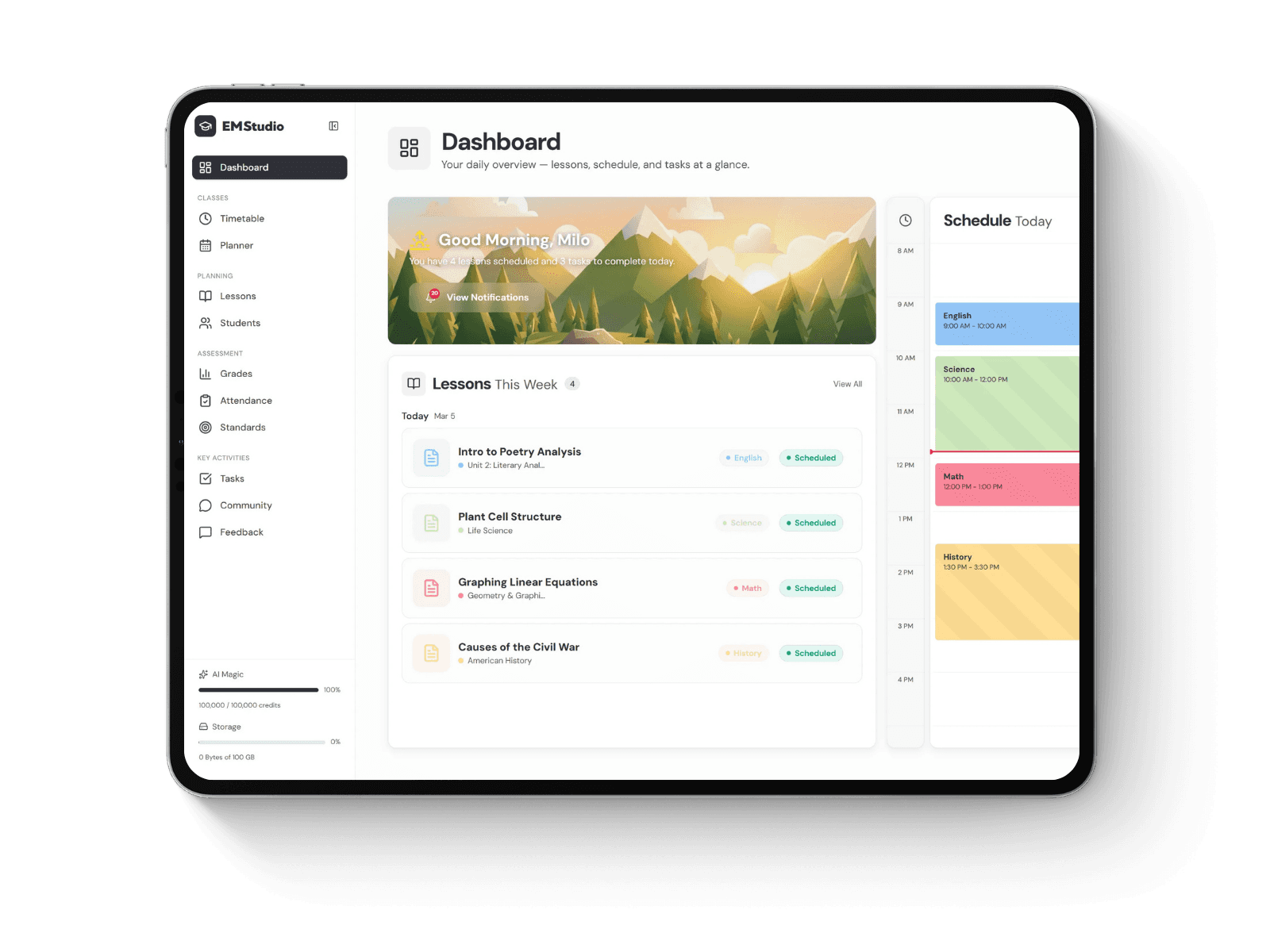
EMStudio is a free teaching management app — manage your classes, students, lessons, and more!
Learn More
Still grading everything by hand?
EMStudio is a free teaching management app — manage your classes, students, lessons, and more!
Learn More
Table of Contents
What Is Classroom Technology and How Has It Evolved?
Classroom technology is the integration of hardware, software, and network systems that support how you actually teach. It has shifted from 1990s computer labs where kids waited for weekly rotation to today's 1:1 devices and cloud platforms. The evolution of educational technology and its modern definitions shows we've moved from substitution to genuine transformation.
We used to wheel in the beige computer cart on Tuesdays. Now students pull out Chromebooks before the bell rings. That shift from scheduled access to ambient technology defines modern classroom technology in education.
The beige cart had a schedule taped to the side. Tuesday mornings, 9:15 AM, thirty minutes. That was your window for "computer time." Contrast that with the blended learning models we run now, where technology disappears into the background and learning moves to the foreground.
The SAMR model helps you gauge where your tools actually land. Substitution means using a digital worksheet instead of paper—same task, new format. Redefinition lets students create collaborative documentaries with global peer feedback. Most districts live in the middle: Augmentation and Modification. We use interactive whiteboards to manipulate math equations, not just project static slides.
In 1995, classrooms had four Apple IIe computers for every twenty-five kids. By 2005, interactive whiteboards from Smart Technologies turned chalk dust into digital ink. The 2010 iPad launch pushed 1:1 device programs into elementary schools, while 2020 forced every district to adopt LMS platforms overnight. Today's AI-powered adaptive platforms personalize practice in ways that make those 1990s drill-and-kill CD-ROMs look prehistoric.
Connectivity is now baseline, not bonus. NCES data confirms 99% of U.S. public schools maintain high-speed broadband meeting the 100 kbps per student minimum. That infrastructure shift enables real-time collaboration rather than isolated word processing. Your room likely has better bandwidth than most universities had in 2003.
An ict classroom differs fundamentally from the computer labs of 2003. Those labs emphasized isolated skill-building—keyboard practice and Oregon Trail. Modern environments require specific infrastructure:
Wi-Fi 6 pushing 1 Gbps minimum for simultaneous video streams
Cloud storage integration through Google Workspace or Microsoft 365
Synchronous communication tools for remote guests
Digital assessment platforms that sync grades via LTI 1.3 Advantage
Without these four elements, you have devices. With them, you have an ecosystem where data flows between students, teachers, and cloud resources without friction.
Digitalized classroom environments share specific DNA. Students control pacing through asynchronous video lessons. Feedback loops close within hours, not weeks. Content arrives multimodal—video, interactive simulations, audio explanations. Collaborative workspaces like Miro or Padlet replace poster paper, letting kids build knowledge together whether they're at home or desk three.
From Chalkboards to Interactive Displays: A Brief History
James Pillans invented the chalkboard in 1801. Teachers stood at slate while students sat in rows. Fast forward to 1992: Smart Technologies launched the first interactive whiteboards, letting kids manipulate objects on screen. By 2024, districts install 86-inch 4K displays with twenty-point multi-touch, turning wall space into collaborative workstations.
Federal money drives adoption timelines. Title II-D of No Child Left Behind (2002) poured specific funds into hardware, giving districts their first projectors. The 2010 iPad release triggered elementary 1:1 device programs nationwide. Then March 2020 hit, and districts scrambled to deploy educational technology integration at scale, accelerating LMS adoption by years in weeks.
Those pandemic purchases stuck around. We didn't return the Chromebooks when buildings reopened. Instead, we kept the 1:1 model and refined it, moving from emergency remote teaching to intentional blended learning models that mix face-to-face and digital instruction.
Defining the Modern ICT Classroom
A modern ict classroom isn't defined by counting Chromebooks. It's measured by data flow. When student work auto-syncs to cloud storage, grades pass back through LTI 1.3 Advantage standards, and you can see live collaboration happening in shared documents—that's ICT. The devices matter less than the connections between them.
You need three non-negotiables. First, 100 Mbps internet minimum per room—enough for thirty kids streaming video simultaneously. Second, cloud-based LMS integration that actually talks to your SIS. Third, automatic grade passback via LTI 1.3 Advantage, saving you from manual transfer hell on Sunday nights.
Real-time data exchange separates ICT from old computer labs. In 2003, students saved files to floppy disks and walked them to the teacher. Today, formative assessment tools push results to your dashboard while students still work. That immediacy changes what you teach tomorrow.
Key Characteristics of Digitalized Learning Environments
Digitalized classroom spaces flip the script. You talk less; they produce more. Static textbooks become dynamic playlists. Isolated worksheets transform into networked projects via Google Classroom or Microsoft Teams. The teacher shifts from sage to guide, and digital citizenship curriculum becomes as essential as the content itself.
The biggest measurable change sits in your gradebook. We moved from summative-only—unit tests every three weeks—to continuous formative assessment tools visible in real-time dashboards. Nearpod shows you which kids got question three wrong while they're still working. Pear Deck reveals misconceptions before the bell rings. You adjust tomorrow's lesson based on today's data.
Student agency marks the final shift. Kids choose their pace in blended learning models. They revisit video explanations, submit work at midnight, or collaborate across time zones. The classroom walls become permeable, and learning happens when the idea strikes, not just when the schedule permits.
Why Does Classroom Technology Matter for Modern Teaching?
Classroom technology matters when it adapts to each kid's level instead of teaching to the middle. It prepares students for jobs that demand digital fluency. But it only works when you use it to transform instruction, not just digitize worksheets.
Adaptive platforms like DreamBox Math and i-Ready don't just present the same lesson to everyone. They detect exactly where a student is struggling and adjust in real time. Kids performing two years below grade level can achieve 1.5x growth rates compared to traditional remediation by targeting specific skill gaps in focused 30-minute daily sessions.
The Bureau of Labor Statistics projects that 77% of current jobs require digital literacy. We're teaching spreadsheet navigation and cloud collaboration now, not just math and reading. But John Hattie's Visible Learning meta-analysis puts computer-assisted instruction at an effect size of 0.46 only when the educational technology integration aligns with strong pedagogy. Without that alignment, you get zero impact.
The benefits of classroom technology are real:
Personalization at scale that traditional classrooms cannot match.
Immediate feedback loops that close misconceptions in seconds, not days.
The risks are equally real:
The substitution trap—using $3,000 interactive displays as expensive chalkboards.
Increased screen time concerns requiring intentional offline breaks.
Closing Achievement Gaps with Adaptive Learning Tools
Adaptive learning platforms like Khan Academy and IXL read student response patterns in real time. When a third grader misses a fraction question, the algorithm identifies whether they misunderstood the numerator, the denominator, or the concept of parts and wholes. Then it serves the exact micro-lesson needed.
I watched a student working two years below grade level master fractions in six months through twenty minutes of daily adaptive practice. With worksheets alone, that same growth would have taken a full year of traditional remediation. The platform targeted specific skill gaps without wasting time on concepts he already knew, which is something paper assessments cannot do in real time.
The cost math is straightforward. Adaptive platforms run $5 to $15 per student annually. Compare that to $0 for paper materials. But these tools require 1:1 device programs to work effectively. A Chromebook runs $200 to $300 per unit with a five-year lifespan. You need the hardware investment to make the software magic happen.
Preparing Students for Digital Workplaces
The Bureau of Labor Statistics projects that 77% of current jobs require digital literacy. We need to map K-12 skills directly to these workplace realities. Fifth graders should manage shared Google Drive folders. Eighth graders need professional video conferencing skills. By twelfth grade, students collaborate asynchronously across time zones using Slack or Teams.
Specific competencies include:
Spreadsheet navigation and basic data analysis functions.
Video conferencing etiquette including camera framing at eye level and mute protocols.
Cloud document collaboration with version control and comment threads.
Basic troubleshooting for audio feedback and connectivity issues.
These represent the intersection of technology and teaching that defines a modern digital citizenship curriculum and makes graduates employable. They are the essential digital literacy skills framework that separates digital natives from digitally literate workers.
Blended learning models should include industry certification pathways. Adobe Creative Cloud runs about $30 per student annually and integrates into CTE courses. Microsoft Office Specialist credentials give graduates proof of competency that employers actually recognize. When a senior can show an employer their Adobe Certified Associate badge, that ed tech in the classroom just became a job placement tool.
Increasing Engagement Through Interactive Media
There's a difference between novelty engagement and cognitive engagement. The shiny new interactive whiteboards will captivate kids for two weeks. Then the magic wears off and you're left with an expensive projection screen. Real engagement comes from retrieval practice gamification using tools like Kahoot! or Quizizz that force students to recall information with meaningful feedback loops.
Nearpod VR field trips demonstrate this distinction clearly. When students virtually visit the Colosseum and answer embedded questions about Roman engineering, retention spikes compared to passive video watching. The immersive aspect creates spatial memory anchors that last. But you must limit VR sessions to fifteen minutes maximum in grades K-8. Beyond that, cybersickness kicks in and you've lost the learning entirely.
Sustained engagement requires that the educational technology integration creates productive struggle. Students should wrestle with concepts, receive immediate data on their misconceptions via formative assessment tools, and try again within seconds. That's the real promise of classroom educational technology—not replacing the teacher, but extending their ability to reach every student at the exact moment of confusion.

Essential Components of a Connected Classroom
Building effective classroom technology requires matching infrastructure to actual teaching needs. Map your plan to the four-tier hierarchy: Infrastructure (network), Device (endpoints), Platform (software), and Content (resources). Each tier must support SAML 2.0 single sign-on to prevent login nightmares.
Budget reality falls into two camps. Basic tech for classrooms ($2,000–$4,000 per room) covers a router upgrade, 30 Chromebooks, and a charging cart. Premium deployments ($8,000–$12,000) add 86-inch interactive displays, document cameras, 1:1 device programs, and full LMS licensing.
Here is where districts fail: buying endpoints before upgrading bandwidth. Schools that skip network prep see 40% slower adoption rates. You need 1 Mbps per concurrent student—30 students means 30 Mbps minimum per classroom. Match device ratios to grade levels. 1:1 device programs suit grades 6–12 with full-time use. 2:1 shared carts work for K–5 subject-specific rotations. BYOD cuts costs but demands spare loaner devices for equity.
Hardware Infrastructure: Devices, Displays, and Peripherals
Your display choice determines how students interact with content. Interactive whiteboards come in three flavors.
Technology | Cost | Lifespan | Considerations |
|---|---|---|---|
Interactive Flat Panel (86-inch) | $3,500–$5,000 | 10 years | No bulb replacements |
Interactive Projector | $1,200–$2,000 | 3–4 years | $200 annual bulbs, shadows |
Standard TV with casting | $800–$1,500 | 7–8 years | No touch capability |
Student devices vary by age and task. Chromebooks ($200–$300, 8-hour battery) dominate K–8 for their durability and price. I’ve watched third graders drop them from desks without damage. iPads ($300–$400) excel in creative apps but rarely last five years. Windows laptops ($400–$600) handle high school coding and CAD software. Buy rugged cases ($25/unit) for elementary; fifth graders destroy standard plastic by February.
Learning Management Systems and Instructional Software
The Platform tier lives or dies by your learning management system choice. Google Classroom costs nothing and integrates with G Suite, but the gradebook barely functions. Canvas runs $5–$10 per student, offers detailed analytics, and matches higher ed standards—perfect for preparing seniors. Schoology hits similar pricing with a stronger parent portal. Seesaw dominates K–5 with portfolio features that actually show growth.
Before buying, run this integration checklist:
Supports LTI 1.3 Advantage so students click once and access everything
Offers REST API for student information system integration
Meets FERPA compliance for student data privacy
Check our comprehensive guide to learning management systems for deeper comparisons. Missing any checklist item creates manual work for you.
Network Connectivity and Digital Security Protocols
Infrastructure underpins everything. Wi-Fi 6E access points ($300–$600 each) cut through interference in dense environments—place one per two classrooms. A 1,000-student school needs a minimum 1 Gbps internet pipe. Separate VLANs isolate student devices from administrative networks; you do not want a sophomore crashing your payroll system.
Security is non-negotiable. Deploy CIPA-compliant content filtering through Securly or GoGuardian. Sign student data privacy agreements following SDPC standards. Verify encryption at rest and in transit for any cloud storage. Read our guide on protecting student privacy in the age of edtech before clicking "accept" on vendor terms.
Test bandwidth quarterly. Thirty students streaming video simultaneously will crush a network that handled twenty just fine.
Digital Content Libraries and Open Educational Resources
The Content tier feeds your blended learning models. OER Commons and CK-12 offer free materials that require serious curation time—budget ten hours per unit to vet quality and fix broken links. Discovery Education or Newsela cost $2–$4 per student but arrive standards-aligned with built-in formative assessment tools.
Evaluate everything against this rubric:
WCAG 2.1 accessibility compliance for screen reader compatibility
Offline sync capabilities for students without home internet
Specific state standard alignment, not just "Common Core aligned" marketing
Free resources save budget but consume planning periods. Paid content saves time but locks you into annual contracts. Choose based on which resource your teachers will actually open on Monday morning.
How Teachers Integrate Digital Tools Into Daily Instruction
Classroom technology fails when teachers treat it as a digital photocopier. You need twenty to thirty hours of professional development to move from Substitution to Redefinition on the SAMR model. Without that training, your interactive whiteboards become expensive substitutes for worksheets.
Limit yourself to three core platforms per subject: one LMS, one content tool, and one assessment tool. Fifteen apps per semester creates app overload. Students forget passwords, and you spend half your time troubleshooting instead of teaching.
Successful 1:1 device programs require more than handing out Chromebooks. You need clear protocols for charging, storage, and appropriate use. Build your digital citizenship curriculum into the first two weeks before launching complex projects.
Blended Learning Rotations and Station Models
Run Station Rotation with three groups of ten in a class of thirty. Students rotate every fifteen minutes between stations. You need ten devices minimum for this model.
Set up your room with three distinct zones. Place your small-group table at the front corner for clear sightlines to all stations. Position Chromebooks at side tables with charging cables accessible for digital content work using DreamBox or Reading A-Z. Reserve the back area for offline collaborative activities with chart paper and manipulatives. This layout prevents traffic jams during fifteen-second transitions between rotations.
Implement the Flipped Classroom by assigning ten-minute Edpuzzle videos with embedded questions for homework. Students must hit a seventy percent completion rate before class starts. Use in-class time for application problems and small-group interventions. If fewer than seven in ten students watch the video, the model collapses and you revert to direct instruction.
Learn more about mastering blended learning models to optimize these rotations.
Project-Based Digital Inquiry and Research
Structure multi-week Project-Based Inquiry cycles following four phases:
Hypothesis: Students brainstorm questions on Padlet.
Research: Primary sources via PebbleGo for K-3, EBSCO for grades 6-12.
Creation: Visual assets built in Adobe Express or Canva.
Presentation: Flipgrid video responses showcase findings.
My eighth graders analyzed NASA climate datasets using this workflow last October. They tracked temperature anomalies over fifty years and presented their findings to the class.
Budget six days total: three for research, two for creation, one for presentation. Your role shifts from lecturer to facilitator. Carry a conferencing clipboard and check individual drafts rather than delivering whole-group instruction. Students using technology in the classroom should drive the inquiry process, not just consume information from screens.
Real-Time Assessment and Data-Driven Feedback
Match your formative assessment tools to your question type:
Nearpod: Best for draw responses and matching pairs during visual checks.
Pear Deck: Use draggable responses for sequencing activities.
GoFormative: Ideal when students upload photos showing math work.
Review dashboards within forty-eight hours. If fewer than sixty percent of students master the exit ticket, reteach immediately. Save time by setting up Google Forms with Flubaroo for auto-grading daily checks. This educational technology integration only works if you act on the data quickly rather than letting it sit until the weekend.
Collaborative Online Workspaces and Virtual Collaboration
Choose your tool based on primary instructional need:
Differentiation: Deploy adaptive software like IXL or Lexia.
Engagement: Run interactive presentations using Nearpod.
Collaboration: Open shared workspaces like Padlet or FigJam.
For synchronous work, migrate off Google Jamboard before its 2024 shutdown. Use FigJam or Microsoft Whiteboard instead. Cap groups at three to four students. Larger teams exhibit social loafing where one student does all the work while others watch.
Assign specific roles for asynchronous collaboration: facilitator, recorder, timekeeper, and tech troubleshooter. Use Flipgrid for three-minute video responses with moderation enabled before posting. Explore tech-enabled collaborative learning strategies to structure these roles effectively.

Real-World Applications Across Grade Levels and Subjects
Elementary: Gamified Math Centers and Digital Literacy Stations
I run math centers with five Chromebooks in the corner and headphone splitters for paired listening. Prodigy handles the RPG-style math practice for free, though the ads can nag kids to upgrade. Blooket works better for teacher-created question sets, but the free tier caps at sixty students. Both run off QR code login cards I laminate for K-2—no password typing means we start learning in ninety seconds, not nine minutes.
For literacy, Epic! Unlimited runs about five dollars per student annually and unlocks forty thousand books. I use it during independent reading blocks while I pull guided reading groups. TypingClub handles free keyboarding practice, while NetSmartz covers safety lessons. Digital citizenship happens in fifteen-minute weekly chunks via Common Sense Education. Screen time stays capped at twenty minutes for K-2 and thirty for grades 3-5. Any longer and they start clicking randomly just to finish.
Middle School: Virtual Science Labs and Historical Simulations
Gizmos by ExploreLearning costs three to four hundred dollars per classroom but replaces broken beakers and missing pH strips. I burn two full class periods teaching the interface before we touch content—rushing this step ruins everything. Students run PhET physics simulations or chemistry labs, then submit lab reports via Google Docs with my comments anchored to specific data tables. The investment pays off when the virtual titration actually works, unlike our real phenolphthalein that expired in 2019.
Minecraft Education Edition runs five dollars per student annually. In my eighth-grade ancient civilizations unit, kids research Roman engineering principles for twenty minutes, then spend twenty-five building functioning aqueducts in-game. We debrief for the final twenty minutes of our forty-five-minute period. The blocky graphics don't matter— they're arguing about gravity and arch support like real engineers. Mission US offers similar immersion for American History without the building mechanics.
High School: Digital Portfolio Creation and Advanced Coding Projects
Juniors in my advisory build Google Sites portfolios curating their best work from ninth through twelfth grade. Each entry requires a reflective essay explaining growth, not just a PDF attachment. Seniors export these to personal domains for college applications. I grade on navigation logic, multimedia variety, and concrete evidence of skill development over four years. Wix works for students who want sleeker design control, though the free tier slaps ads on their academic work.
For digital tools for teaching coding, my AP Computer Science Principles class uses Replit for browser-based coding—no installation headaches when the district IT locks down laptops. We integrate GitHub Classroom for version control instruction. Physical computing components like micro:bit units cost twenty dollars each and pair with Code.org's CSA curriculum. CTE pathways stack Adobe Creative Cloud certifications on top of these technical skills, giving graduates proof of workplace readiness.
Cross-Curricular: Global Connection Projects and Video Conferencing
Empatico matches my classroom with international partners for free video exchanges—perfect for K-8 empathy lessons. ePals digitizes the old pen-pal model across all grades. When time zones kill live conversations, we pivot to async Flipgrid video responses. The seven-hour difference with our partner school in Mumbai means someone is always half-asleep unless we plan carefully. This classroom technology requires more logistics than lesson planning, but the authentic audience transforms student motivation.
Virtual field trips via Zoom connect us to Smithsonian educators and NASA Mission Control tours at no cost. I test audio twenty-four hours prior every single time. Murphy's Law applies double to immersive learning with VR and AR. I keep a backup phone dial-in number written on a sticky note on my monitor. When the Wi-Fi hiccups, that analog backup saves the lesson.

Your First Steps to Building a High-Tech Classroom
Implement classroom technology in four phases. Spend two weeks on Audit, six weeks on Pilot with volunteer teachers, two weeks writing Protocols, then Scale gradually. Place go/no-go decision gates between each phase. If the pilot fails the metrics, stop and reassess.
Budget wisely. Allocate 30% to professional development, 50% to devices and software, 20% to infrastructure. Most districts blow 90% on hardware and 10% on training, then wonder why teachers use the $2,000 document camera as a paperweight. Map your curriculum before purchasing anything. If your lesson plans don't require display functionality, that camera becomes expensive shelf decor.
Plan for sustainability. Run devices on a three-year replacement cycle; residual value drops to 20% by year three. Audit software licenses annually and cancel the 15-20% that go unused. Require Google Certified Educator Level 1 or equivalent for all teachers managing 1:1 device programs.
Audit Your Current Digital Infrastructure and Gaps
Start with data, not shopping lists. Run a Speedtest in every classroom. You need 25 Mbps download minimum for 30 concurrent devices. Inventory every device. Flag anything over five years old or unable to update to the current OS. Those machines will crash during state testing.
Survey your teachers. Use a 5-point Likert scale to measure confidence with interactive whiteboards, LMS platforms, and formative assessment tools. Then identify three non-negotiable instructional needs. Video editing for journalism? CAD for engineering? Distinguish these from nice-to-haves. Buy the painkillers first.
Select One High-Impact Tool for Pilot Implementation
Pick one tool solving your audit's top priority. Choose IXL for differentiation, Nearpod for engagement, or Canvas for workflow. Recruit two or three volunteer teachers only. Never mandate pilot participants. Run the trial for six weeks.
Measure everything. Track student logins per week. Survey teacher satisfaction. Compare assessment scores. Require 80% teacher satisfaction and measurable student gains before district-wide rollout. If you don't hit both, kill the project or pivot. No exceptions.
Establish Digital Citizenship Protocols and Routines
Teach the fundamentals of digital citizenship for students using a scoped digital citizenship curriculum:
K-2: Password privacy and asking before clicking.
3-5: Cyberbullying reporting protocols.
6-8: Digital footprint permanence.
9-12: Ethical sourcing and copyright.
Use Common Sense Education's free curriculum. Build routines that stick. Device distribution takes under 90 seconds using numbered slots. Post a troubleshooting flowchart: Step 1 restart, Step 2 check Wi-Fi, Step 3 submit ticket. Require signed Acceptable Use Policies before any device checkout.
Scale Gradually with Professional Development Support
Structure PD for retention. Run a three-day summer institute for basics. Follow with monthly 90-minute PLCs for lesson study. Record just-in-time Loom tutorials under three minutes for integrating edtech seamlessly into your lesson plans. Sustainable educational technology integration requires ongoing support.
Expand to grade-level teams in year one, departments in year two, and the full school in year three. Provide sub coverage for observations. Require Google Certified Educator Level 1. Audit licenses annually to cut the 15-20% that go unused. Plan device replacement every three years; residual value drops to 20% by then anyway.

Should You Try Classroom Technology?
You already are. Every time you project a worksheet and skip the copy room, you're using classroom technology. The question isn't whether to adopt it, but how to choose tools that save you time, not steal it. I spent three years chasing every new app my district pushed. My students didn't learn more. They just got better at clicking. Now I pick one tool per semester and ignore the rest.
Pick one problem you have. Maybe it's the kid who misses grammar review because he's at speech therapy, or the vocabulary quizzes that eat your Sunday afternoons. Find one tool that fixes that specific pain point. Master it. Then decide if you need more. The best tech in your room isn't the fanciest—it's the one you use without thinking. Your students won't learn the tool. They'll learn the content. So what's the one task draining your energy this week that technology might solve?
What Is Classroom Technology and How Has It Evolved?
Classroom technology is the integration of hardware, software, and network systems that support how you actually teach. It has shifted from 1990s computer labs where kids waited for weekly rotation to today's 1:1 devices and cloud platforms. The evolution of educational technology and its modern definitions shows we've moved from substitution to genuine transformation.
We used to wheel in the beige computer cart on Tuesdays. Now students pull out Chromebooks before the bell rings. That shift from scheduled access to ambient technology defines modern classroom technology in education.
The beige cart had a schedule taped to the side. Tuesday mornings, 9:15 AM, thirty minutes. That was your window for "computer time." Contrast that with the blended learning models we run now, where technology disappears into the background and learning moves to the foreground.
The SAMR model helps you gauge where your tools actually land. Substitution means using a digital worksheet instead of paper—same task, new format. Redefinition lets students create collaborative documentaries with global peer feedback. Most districts live in the middle: Augmentation and Modification. We use interactive whiteboards to manipulate math equations, not just project static slides.
In 1995, classrooms had four Apple IIe computers for every twenty-five kids. By 2005, interactive whiteboards from Smart Technologies turned chalk dust into digital ink. The 2010 iPad launch pushed 1:1 device programs into elementary schools, while 2020 forced every district to adopt LMS platforms overnight. Today's AI-powered adaptive platforms personalize practice in ways that make those 1990s drill-and-kill CD-ROMs look prehistoric.
Connectivity is now baseline, not bonus. NCES data confirms 99% of U.S. public schools maintain high-speed broadband meeting the 100 kbps per student minimum. That infrastructure shift enables real-time collaboration rather than isolated word processing. Your room likely has better bandwidth than most universities had in 2003.
An ict classroom differs fundamentally from the computer labs of 2003. Those labs emphasized isolated skill-building—keyboard practice and Oregon Trail. Modern environments require specific infrastructure:
Wi-Fi 6 pushing 1 Gbps minimum for simultaneous video streams
Cloud storage integration through Google Workspace or Microsoft 365
Synchronous communication tools for remote guests
Digital assessment platforms that sync grades via LTI 1.3 Advantage
Without these four elements, you have devices. With them, you have an ecosystem where data flows between students, teachers, and cloud resources without friction.
Digitalized classroom environments share specific DNA. Students control pacing through asynchronous video lessons. Feedback loops close within hours, not weeks. Content arrives multimodal—video, interactive simulations, audio explanations. Collaborative workspaces like Miro or Padlet replace poster paper, letting kids build knowledge together whether they're at home or desk three.
From Chalkboards to Interactive Displays: A Brief History
James Pillans invented the chalkboard in 1801. Teachers stood at slate while students sat in rows. Fast forward to 1992: Smart Technologies launched the first interactive whiteboards, letting kids manipulate objects on screen. By 2024, districts install 86-inch 4K displays with twenty-point multi-touch, turning wall space into collaborative workstations.
Federal money drives adoption timelines. Title II-D of No Child Left Behind (2002) poured specific funds into hardware, giving districts their first projectors. The 2010 iPad release triggered elementary 1:1 device programs nationwide. Then March 2020 hit, and districts scrambled to deploy educational technology integration at scale, accelerating LMS adoption by years in weeks.
Those pandemic purchases stuck around. We didn't return the Chromebooks when buildings reopened. Instead, we kept the 1:1 model and refined it, moving from emergency remote teaching to intentional blended learning models that mix face-to-face and digital instruction.
Defining the Modern ICT Classroom
A modern ict classroom isn't defined by counting Chromebooks. It's measured by data flow. When student work auto-syncs to cloud storage, grades pass back through LTI 1.3 Advantage standards, and you can see live collaboration happening in shared documents—that's ICT. The devices matter less than the connections between them.
You need three non-negotiables. First, 100 Mbps internet minimum per room—enough for thirty kids streaming video simultaneously. Second, cloud-based LMS integration that actually talks to your SIS. Third, automatic grade passback via LTI 1.3 Advantage, saving you from manual transfer hell on Sunday nights.
Real-time data exchange separates ICT from old computer labs. In 2003, students saved files to floppy disks and walked them to the teacher. Today, formative assessment tools push results to your dashboard while students still work. That immediacy changes what you teach tomorrow.
Key Characteristics of Digitalized Learning Environments
Digitalized classroom spaces flip the script. You talk less; they produce more. Static textbooks become dynamic playlists. Isolated worksheets transform into networked projects via Google Classroom or Microsoft Teams. The teacher shifts from sage to guide, and digital citizenship curriculum becomes as essential as the content itself.
The biggest measurable change sits in your gradebook. We moved from summative-only—unit tests every three weeks—to continuous formative assessment tools visible in real-time dashboards. Nearpod shows you which kids got question three wrong while they're still working. Pear Deck reveals misconceptions before the bell rings. You adjust tomorrow's lesson based on today's data.
Student agency marks the final shift. Kids choose their pace in blended learning models. They revisit video explanations, submit work at midnight, or collaborate across time zones. The classroom walls become permeable, and learning happens when the idea strikes, not just when the schedule permits.
Why Does Classroom Technology Matter for Modern Teaching?
Classroom technology matters when it adapts to each kid's level instead of teaching to the middle. It prepares students for jobs that demand digital fluency. But it only works when you use it to transform instruction, not just digitize worksheets.
Adaptive platforms like DreamBox Math and i-Ready don't just present the same lesson to everyone. They detect exactly where a student is struggling and adjust in real time. Kids performing two years below grade level can achieve 1.5x growth rates compared to traditional remediation by targeting specific skill gaps in focused 30-minute daily sessions.
The Bureau of Labor Statistics projects that 77% of current jobs require digital literacy. We're teaching spreadsheet navigation and cloud collaboration now, not just math and reading. But John Hattie's Visible Learning meta-analysis puts computer-assisted instruction at an effect size of 0.46 only when the educational technology integration aligns with strong pedagogy. Without that alignment, you get zero impact.
The benefits of classroom technology are real:
Personalization at scale that traditional classrooms cannot match.
Immediate feedback loops that close misconceptions in seconds, not days.
The risks are equally real:
The substitution trap—using $3,000 interactive displays as expensive chalkboards.
Increased screen time concerns requiring intentional offline breaks.
Closing Achievement Gaps with Adaptive Learning Tools
Adaptive learning platforms like Khan Academy and IXL read student response patterns in real time. When a third grader misses a fraction question, the algorithm identifies whether they misunderstood the numerator, the denominator, or the concept of parts and wholes. Then it serves the exact micro-lesson needed.
I watched a student working two years below grade level master fractions in six months through twenty minutes of daily adaptive practice. With worksheets alone, that same growth would have taken a full year of traditional remediation. The platform targeted specific skill gaps without wasting time on concepts he already knew, which is something paper assessments cannot do in real time.
The cost math is straightforward. Adaptive platforms run $5 to $15 per student annually. Compare that to $0 for paper materials. But these tools require 1:1 device programs to work effectively. A Chromebook runs $200 to $300 per unit with a five-year lifespan. You need the hardware investment to make the software magic happen.
Preparing Students for Digital Workplaces
The Bureau of Labor Statistics projects that 77% of current jobs require digital literacy. We need to map K-12 skills directly to these workplace realities. Fifth graders should manage shared Google Drive folders. Eighth graders need professional video conferencing skills. By twelfth grade, students collaborate asynchronously across time zones using Slack or Teams.
Specific competencies include:
Spreadsheet navigation and basic data analysis functions.
Video conferencing etiquette including camera framing at eye level and mute protocols.
Cloud document collaboration with version control and comment threads.
Basic troubleshooting for audio feedback and connectivity issues.
These represent the intersection of technology and teaching that defines a modern digital citizenship curriculum and makes graduates employable. They are the essential digital literacy skills framework that separates digital natives from digitally literate workers.
Blended learning models should include industry certification pathways. Adobe Creative Cloud runs about $30 per student annually and integrates into CTE courses. Microsoft Office Specialist credentials give graduates proof of competency that employers actually recognize. When a senior can show an employer their Adobe Certified Associate badge, that ed tech in the classroom just became a job placement tool.
Increasing Engagement Through Interactive Media
There's a difference between novelty engagement and cognitive engagement. The shiny new interactive whiteboards will captivate kids for two weeks. Then the magic wears off and you're left with an expensive projection screen. Real engagement comes from retrieval practice gamification using tools like Kahoot! or Quizizz that force students to recall information with meaningful feedback loops.
Nearpod VR field trips demonstrate this distinction clearly. When students virtually visit the Colosseum and answer embedded questions about Roman engineering, retention spikes compared to passive video watching. The immersive aspect creates spatial memory anchors that last. But you must limit VR sessions to fifteen minutes maximum in grades K-8. Beyond that, cybersickness kicks in and you've lost the learning entirely.
Sustained engagement requires that the educational technology integration creates productive struggle. Students should wrestle with concepts, receive immediate data on their misconceptions via formative assessment tools, and try again within seconds. That's the real promise of classroom educational technology—not replacing the teacher, but extending their ability to reach every student at the exact moment of confusion.
Essential Components of a Connected Classroom
Building effective classroom technology requires matching infrastructure to actual teaching needs. Map your plan to the four-tier hierarchy: Infrastructure (network), Device (endpoints), Platform (software), and Content (resources). Each tier must support SAML 2.0 single sign-on to prevent login nightmares.
Budget reality falls into two camps. Basic tech for classrooms ($2,000–$4,000 per room) covers a router upgrade, 30 Chromebooks, and a charging cart. Premium deployments ($8,000–$12,000) add 86-inch interactive displays, document cameras, 1:1 device programs, and full LMS licensing.
Here is where districts fail: buying endpoints before upgrading bandwidth. Schools that skip network prep see 40% slower adoption rates. You need 1 Mbps per concurrent student—30 students means 30 Mbps minimum per classroom. Match device ratios to grade levels. 1:1 device programs suit grades 6–12 with full-time use. 2:1 shared carts work for K–5 subject-specific rotations. BYOD cuts costs but demands spare loaner devices for equity.
Hardware Infrastructure: Devices, Displays, and Peripherals
Your display choice determines how students interact with content. Interactive whiteboards come in three flavors.
Technology | Cost | Lifespan | Considerations |
|---|---|---|---|
Interactive Flat Panel (86-inch) | $3,500–$5,000 | 10 years | No bulb replacements |
Interactive Projector | $1,200–$2,000 | 3–4 years | $200 annual bulbs, shadows |
Standard TV with casting | $800–$1,500 | 7–8 years | No touch capability |
Student devices vary by age and task. Chromebooks ($200–$300, 8-hour battery) dominate K–8 for their durability and price. I’ve watched third graders drop them from desks without damage. iPads ($300–$400) excel in creative apps but rarely last five years. Windows laptops ($400–$600) handle high school coding and CAD software. Buy rugged cases ($25/unit) for elementary; fifth graders destroy standard plastic by February.
Learning Management Systems and Instructional Software
The Platform tier lives or dies by your learning management system choice. Google Classroom costs nothing and integrates with G Suite, but the gradebook barely functions. Canvas runs $5–$10 per student, offers detailed analytics, and matches higher ed standards—perfect for preparing seniors. Schoology hits similar pricing with a stronger parent portal. Seesaw dominates K–5 with portfolio features that actually show growth.
Before buying, run this integration checklist:
Supports LTI 1.3 Advantage so students click once and access everything
Offers REST API for student information system integration
Meets FERPA compliance for student data privacy
Check our comprehensive guide to learning management systems for deeper comparisons. Missing any checklist item creates manual work for you.
Network Connectivity and Digital Security Protocols
Infrastructure underpins everything. Wi-Fi 6E access points ($300–$600 each) cut through interference in dense environments—place one per two classrooms. A 1,000-student school needs a minimum 1 Gbps internet pipe. Separate VLANs isolate student devices from administrative networks; you do not want a sophomore crashing your payroll system.
Security is non-negotiable. Deploy CIPA-compliant content filtering through Securly or GoGuardian. Sign student data privacy agreements following SDPC standards. Verify encryption at rest and in transit for any cloud storage. Read our guide on protecting student privacy in the age of edtech before clicking "accept" on vendor terms.
Test bandwidth quarterly. Thirty students streaming video simultaneously will crush a network that handled twenty just fine.
Digital Content Libraries and Open Educational Resources
The Content tier feeds your blended learning models. OER Commons and CK-12 offer free materials that require serious curation time—budget ten hours per unit to vet quality and fix broken links. Discovery Education or Newsela cost $2–$4 per student but arrive standards-aligned with built-in formative assessment tools.
Evaluate everything against this rubric:
WCAG 2.1 accessibility compliance for screen reader compatibility
Offline sync capabilities for students without home internet
Specific state standard alignment, not just "Common Core aligned" marketing
Free resources save budget but consume planning periods. Paid content saves time but locks you into annual contracts. Choose based on which resource your teachers will actually open on Monday morning.
How Teachers Integrate Digital Tools Into Daily Instruction
Classroom technology fails when teachers treat it as a digital photocopier. You need twenty to thirty hours of professional development to move from Substitution to Redefinition on the SAMR model. Without that training, your interactive whiteboards become expensive substitutes for worksheets.
Limit yourself to three core platforms per subject: one LMS, one content tool, and one assessment tool. Fifteen apps per semester creates app overload. Students forget passwords, and you spend half your time troubleshooting instead of teaching.
Successful 1:1 device programs require more than handing out Chromebooks. You need clear protocols for charging, storage, and appropriate use. Build your digital citizenship curriculum into the first two weeks before launching complex projects.
Blended Learning Rotations and Station Models
Run Station Rotation with three groups of ten in a class of thirty. Students rotate every fifteen minutes between stations. You need ten devices minimum for this model.
Set up your room with three distinct zones. Place your small-group table at the front corner for clear sightlines to all stations. Position Chromebooks at side tables with charging cables accessible for digital content work using DreamBox or Reading A-Z. Reserve the back area for offline collaborative activities with chart paper and manipulatives. This layout prevents traffic jams during fifteen-second transitions between rotations.
Implement the Flipped Classroom by assigning ten-minute Edpuzzle videos with embedded questions for homework. Students must hit a seventy percent completion rate before class starts. Use in-class time for application problems and small-group interventions. If fewer than seven in ten students watch the video, the model collapses and you revert to direct instruction.
Learn more about mastering blended learning models to optimize these rotations.
Project-Based Digital Inquiry and Research
Structure multi-week Project-Based Inquiry cycles following four phases:
Hypothesis: Students brainstorm questions on Padlet.
Research: Primary sources via PebbleGo for K-3, EBSCO for grades 6-12.
Creation: Visual assets built in Adobe Express or Canva.
Presentation: Flipgrid video responses showcase findings.
My eighth graders analyzed NASA climate datasets using this workflow last October. They tracked temperature anomalies over fifty years and presented their findings to the class.
Budget six days total: three for research, two for creation, one for presentation. Your role shifts from lecturer to facilitator. Carry a conferencing clipboard and check individual drafts rather than delivering whole-group instruction. Students using technology in the classroom should drive the inquiry process, not just consume information from screens.
Real-Time Assessment and Data-Driven Feedback
Match your formative assessment tools to your question type:
Nearpod: Best for draw responses and matching pairs during visual checks.
Pear Deck: Use draggable responses for sequencing activities.
GoFormative: Ideal when students upload photos showing math work.
Review dashboards within forty-eight hours. If fewer than sixty percent of students master the exit ticket, reteach immediately. Save time by setting up Google Forms with Flubaroo for auto-grading daily checks. This educational technology integration only works if you act on the data quickly rather than letting it sit until the weekend.
Collaborative Online Workspaces and Virtual Collaboration
Choose your tool based on primary instructional need:
Differentiation: Deploy adaptive software like IXL or Lexia.
Engagement: Run interactive presentations using Nearpod.
Collaboration: Open shared workspaces like Padlet or FigJam.
For synchronous work, migrate off Google Jamboard before its 2024 shutdown. Use FigJam or Microsoft Whiteboard instead. Cap groups at three to four students. Larger teams exhibit social loafing where one student does all the work while others watch.
Assign specific roles for asynchronous collaboration: facilitator, recorder, timekeeper, and tech troubleshooter. Use Flipgrid for three-minute video responses with moderation enabled before posting. Explore tech-enabled collaborative learning strategies to structure these roles effectively.
Real-World Applications Across Grade Levels and Subjects
Elementary: Gamified Math Centers and Digital Literacy Stations
I run math centers with five Chromebooks in the corner and headphone splitters for paired listening. Prodigy handles the RPG-style math practice for free, though the ads can nag kids to upgrade. Blooket works better for teacher-created question sets, but the free tier caps at sixty students. Both run off QR code login cards I laminate for K-2—no password typing means we start learning in ninety seconds, not nine minutes.
For literacy, Epic! Unlimited runs about five dollars per student annually and unlocks forty thousand books. I use it during independent reading blocks while I pull guided reading groups. TypingClub handles free keyboarding practice, while NetSmartz covers safety lessons. Digital citizenship happens in fifteen-minute weekly chunks via Common Sense Education. Screen time stays capped at twenty minutes for K-2 and thirty for grades 3-5. Any longer and they start clicking randomly just to finish.
Middle School: Virtual Science Labs and Historical Simulations
Gizmos by ExploreLearning costs three to four hundred dollars per classroom but replaces broken beakers and missing pH strips. I burn two full class periods teaching the interface before we touch content—rushing this step ruins everything. Students run PhET physics simulations or chemistry labs, then submit lab reports via Google Docs with my comments anchored to specific data tables. The investment pays off when the virtual titration actually works, unlike our real phenolphthalein that expired in 2019.
Minecraft Education Edition runs five dollars per student annually. In my eighth-grade ancient civilizations unit, kids research Roman engineering principles for twenty minutes, then spend twenty-five building functioning aqueducts in-game. We debrief for the final twenty minutes of our forty-five-minute period. The blocky graphics don't matter— they're arguing about gravity and arch support like real engineers. Mission US offers similar immersion for American History without the building mechanics.
High School: Digital Portfolio Creation and Advanced Coding Projects
Juniors in my advisory build Google Sites portfolios curating their best work from ninth through twelfth grade. Each entry requires a reflective essay explaining growth, not just a PDF attachment. Seniors export these to personal domains for college applications. I grade on navigation logic, multimedia variety, and concrete evidence of skill development over four years. Wix works for students who want sleeker design control, though the free tier slaps ads on their academic work.
For digital tools for teaching coding, my AP Computer Science Principles class uses Replit for browser-based coding—no installation headaches when the district IT locks down laptops. We integrate GitHub Classroom for version control instruction. Physical computing components like micro:bit units cost twenty dollars each and pair with Code.org's CSA curriculum. CTE pathways stack Adobe Creative Cloud certifications on top of these technical skills, giving graduates proof of workplace readiness.
Cross-Curricular: Global Connection Projects and Video Conferencing
Empatico matches my classroom with international partners for free video exchanges—perfect for K-8 empathy lessons. ePals digitizes the old pen-pal model across all grades. When time zones kill live conversations, we pivot to async Flipgrid video responses. The seven-hour difference with our partner school in Mumbai means someone is always half-asleep unless we plan carefully. This classroom technology requires more logistics than lesson planning, but the authentic audience transforms student motivation.
Virtual field trips via Zoom connect us to Smithsonian educators and NASA Mission Control tours at no cost. I test audio twenty-four hours prior every single time. Murphy's Law applies double to immersive learning with VR and AR. I keep a backup phone dial-in number written on a sticky note on my monitor. When the Wi-Fi hiccups, that analog backup saves the lesson.
Your First Steps to Building a High-Tech Classroom
Implement classroom technology in four phases. Spend two weeks on Audit, six weeks on Pilot with volunteer teachers, two weeks writing Protocols, then Scale gradually. Place go/no-go decision gates between each phase. If the pilot fails the metrics, stop and reassess.
Budget wisely. Allocate 30% to professional development, 50% to devices and software, 20% to infrastructure. Most districts blow 90% on hardware and 10% on training, then wonder why teachers use the $2,000 document camera as a paperweight. Map your curriculum before purchasing anything. If your lesson plans don't require display functionality, that camera becomes expensive shelf decor.
Plan for sustainability. Run devices on a three-year replacement cycle; residual value drops to 20% by year three. Audit software licenses annually and cancel the 15-20% that go unused. Require Google Certified Educator Level 1 or equivalent for all teachers managing 1:1 device programs.
Audit Your Current Digital Infrastructure and Gaps
Start with data, not shopping lists. Run a Speedtest in every classroom. You need 25 Mbps download minimum for 30 concurrent devices. Inventory every device. Flag anything over five years old or unable to update to the current OS. Those machines will crash during state testing.
Survey your teachers. Use a 5-point Likert scale to measure confidence with interactive whiteboards, LMS platforms, and formative assessment tools. Then identify three non-negotiable instructional needs. Video editing for journalism? CAD for engineering? Distinguish these from nice-to-haves. Buy the painkillers first.
Select One High-Impact Tool for Pilot Implementation
Pick one tool solving your audit's top priority. Choose IXL for differentiation, Nearpod for engagement, or Canvas for workflow. Recruit two or three volunteer teachers only. Never mandate pilot participants. Run the trial for six weeks.
Measure everything. Track student logins per week. Survey teacher satisfaction. Compare assessment scores. Require 80% teacher satisfaction and measurable student gains before district-wide rollout. If you don't hit both, kill the project or pivot. No exceptions.
Establish Digital Citizenship Protocols and Routines
Teach the fundamentals of digital citizenship for students using a scoped digital citizenship curriculum:
K-2: Password privacy and asking before clicking.
3-5: Cyberbullying reporting protocols.
6-8: Digital footprint permanence.
9-12: Ethical sourcing and copyright.
Use Common Sense Education's free curriculum. Build routines that stick. Device distribution takes under 90 seconds using numbered slots. Post a troubleshooting flowchart: Step 1 restart, Step 2 check Wi-Fi, Step 3 submit ticket. Require signed Acceptable Use Policies before any device checkout.
Scale Gradually with Professional Development Support
Structure PD for retention. Run a three-day summer institute for basics. Follow with monthly 90-minute PLCs for lesson study. Record just-in-time Loom tutorials under three minutes for integrating edtech seamlessly into your lesson plans. Sustainable educational technology integration requires ongoing support.
Expand to grade-level teams in year one, departments in year two, and the full school in year three. Provide sub coverage for observations. Require Google Certified Educator Level 1. Audit licenses annually to cut the 15-20% that go unused. Plan device replacement every three years; residual value drops to 20% by then anyway.
Should You Try Classroom Technology?
You already are. Every time you project a worksheet and skip the copy room, you're using classroom technology. The question isn't whether to adopt it, but how to choose tools that save you time, not steal it. I spent three years chasing every new app my district pushed. My students didn't learn more. They just got better at clicking. Now I pick one tool per semester and ignore the rest.
Pick one problem you have. Maybe it's the kid who misses grammar review because he's at speech therapy, or the vocabulary quizzes that eat your Sunday afternoons. Find one tool that fixes that specific pain point. Master it. Then decide if you need more. The best tech in your room isn't the fanciest—it's the one you use without thinking. Your students won't learn the tool. They'll learn the content. So what's the one task draining your energy this week that technology might solve?
Still grading everything by hand?
EMStudio is a free teaching management app — manage your classes, students, lessons, and more!
Learn More
Still grading everything by hand?
EMStudio is a free teaching management app — manage your classes, students, lessons, and more!
Learn More


Notion4Teachers
Notion templates to simplify administrative tasks and enhance your teaching experience.



2026 Notion4Teachers. All Rights Reserved.
Notion4Teachers
Notion templates to simplify administrative tasks and enhance your teaching experience.
2026 Notion4Teachers. All Rights Reserved.
Notion4Teachers
Notion templates to simplify administrative tasks and enhance your teaching experience.
2026 Notion4Teachers. All Rights Reserved.