Lesson Plan Template: The Complete Setup Guide
Lesson Plan Template: The Complete Setup Guide

Article by
Milo
ESL Content Coordinator & Educator
ESL Content Coordinator & Educator
All Posts
You downloaded the district's lesson plan template last August. It had columns for standards and objectives, maybe a box for materials. By October, you were scribbling timing notes in the margins and taping sticky notes to track where you left off with 3rd period. The template looked official, but it wasn't built for what you actually do when the bell rings.
Most templates treat planning as a compliance exercise. They collect data for administrators but miss the mechanics of actual instruction: your pacing, your scaffolding for the kids who didn't get it yesterday, your exit ticket that tells you whether anyone learned anything. You need a template that works as hard as you do—one that accounts for backward design without requiring a PhD to fill out before your coffee gets cold.
This is the setup I actually use. It covers the pieces that matter—objectives, assessments, materials—but organizes them around how you move through a class period. No blank boxes staring back at you. Just a logical flow from your hook through your formative assessment, with space for the notes that help when you're standing in front of 28 kids.
Still grading everything by hand?
EMStudio is a free teaching management app — manage your classes, students, lessons, and more!
Learn More
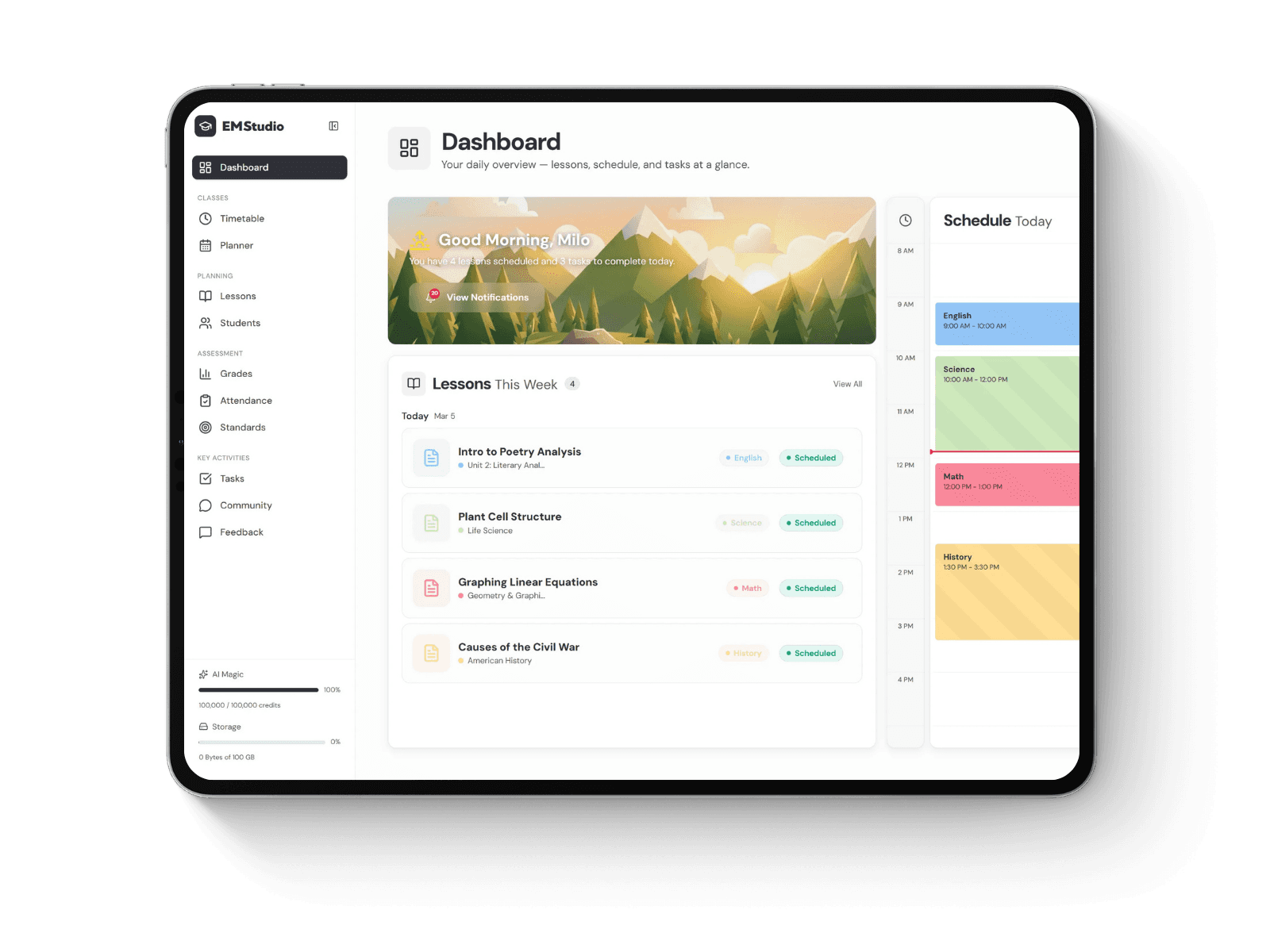
Still grading everything by hand?
EMStudio is a free teaching management app — manage your classes, students, lessons, and more!
Learn More
Table of Contents
What This Lesson Plan Template Includes
You get three versions. The Google Docs file lets you type directly into the fields and store everything in Drive. The lesson plan pdf works with Acrobat Reader 10 or newer if you prefer handwriting your plans during prep. The Google Slides version acts as a visual planner—great for curriculum mapping or sharing with your PLC. You need a free Google account for the Docs and Slides files. The PDF stands alone.
The template has eight fillable fields that cover the full instructional design cycle:
Subject/Topic and Grade Level
Duration/Period Length with space for period adjustments
Standards (CCSS, state, or district)
Learning Objective written with backward design in mind
Materials List for quick prep checks
Procedure with Timing Breakdown—your pacing guide for the block
Differentiation/Accommodations for scaffolding and extensions
Space for formative assessment checkpoints
Print specs matter when you're rushing to the copier at 7:15 AM. Files work on US Letter (8.5x11) and A4. Colors pop if you have a good printer, but the design stays readable in grayscale for school copiers. Margins are 1-inch all around so nothing gets cut off by that ancient machine in the workroom.
You also get five completed samples. These aren't blank shells—they're real lesson plan examples and templates you can study. One covers K-2 phonics using Orton-Gillingham strategies, another 3-5 multiplication with concrete models, plus middle school photosynthesis lab setup. For high school, you get 9-12 ELA rhetorical analysis of speeches and 9-12 math quadratic equations with error analysis. Each shows how the fields work in actual classrooms.
The template flexes from 30-minute intervention blocks up to 90-minute periods. The period adjustments column lets you scale activities up or down without rewriting the whole lesson plan. One column, multiple timeframes. It works for lesson plans for teachers pdf collectors and digital planners alike.

What Are the Essential Components Every Lesson Plan Needs?
Every lesson plan needs six core components: measurable learning objectives aligned to standards, a complete materials checklist, an engaging opening hook to activate prior knowledge, direct instruction with modeling, structured guided and independent practice, and formative closure with assessment strategies.
(1) Objectives
(2) Materials
(3) Hook
(4) Instruction
(5) Practice
(6) Closure
For a standard 50-minute period, allocate time deliberately: hook (5-10 min), direct instruction (10-15 min), practice (15-25 min), and closure (5-10 min). John Hattie's Visible Learning research supports this structure—teacher clarity shows an effect size of 0.75 and direct instruction 0.59, but both require specific elements like clear objectives and checks for understanding. Skip the closure component, and you trigger the failure mode: significantly reduced 24-hour retention. Studies indicate summarization strengthens memory consolidation, so that final five minutes is non-negotiable. Each component should align with the 'I Do, We Do, You Do' gradual release model to prevent cognitive overload.
Learning Objectives and Standards Alignment
Write objectives using the ABCD method: Audience (7th graders), Behavior (will calculate), Condition (using a calculator), Degree (with 90% accuracy). Map to specific standards using exact codes like CCSS.ELA-LITERACY.RI.4.1 or NGSS-MS-PS1-2, including both the code and full text. Differentiate between the learning objective (what students do) and the learning target (what they know); present both in student-friendly "I can..." language on your template. See our guide on aligning standards with your curriculum for specific workflows.
Materials and Preparation Checklist
Organize your materials checklist into three distinct categories: Teacher Materials (answer keys, rubrics, demonstration items), Student Materials (handouts, textbooks, devices), and Setup/Environment (furniture arrangement, tech checks, safety equipment). Budget prep time realistically: 15 minutes for standard lessons, 45 minutes for labs or hands-on activities, and 5 minutes for discussion-based classes. Include a Plan B row listing backup materials if technology fails—like printed PDFs of digital slides—or extension worksheets if the activity finishes early.
Opening Hook and Prior Knowledge Activation
Select from five proven hook types: an Essential Question ("Is water a renewable resource?"), a provocative 30-second video clip, a 3-minute Quick Write journal entry, a K-W-L graphic organizer, or a hands-on demonstration. Keep duration tight: 5-7 minutes for elementary (K-5) and 7-10 minutes for secondary (6-12) to maintain engagement without consuming practice time. Activate prior knowledge by referencing yesterday's lesson specifically ("Yesterday we analyzed character traits; today we compare two characters") or by using a 3-question diagnostic mini-quiz.
Direct Instruction and Modeling Strategies
Structure your direct instruction using the gradual release progression: I Do (5-7 minutes of explicit teacher modeling), We Do (8-12 minutes of guided practice with scaffolding), then You Do (10-15 minutes of independent application). Employ a think-aloud protocol: verbalize your cognitive processes while modeling ("I notice this word is unfamiliar, so I will use context clues by reading the sentences before and after..."). Set strict time limits: maximum 15 minutes for K-5 direct instruction, 12-20 minutes for grades 6-12, then transition to prevent passive learning.
Guided and Independent Practice Activities
During guided practice, organize students into small groups of 3-4 with teacher circulation checklists to track participation and misconceptions. Offer specific scaffolds for struggling learners: sentence starters, word banks, or concrete manipulatives. For independent practice, students work individually on application tasks while preparing their exit ticket. Include a clear decision trigger: if 70% or more of students struggle during guided practice, immediately pause independent work and reteach using alternative examples before releasing students to work alone.
Closure and Assessment Strategies
Close with a 3-2-1 Exit Ticket: students write 3 things they learned, 2 questions they still have, and 1 connection to prior knowledge or real-world application. Run a quick formative assessment checkpoint using thumbs up/sideways/down or a digital poll via Mentimeter or Poll Everywhere for immediate data. Browse our formative assessment examples for immediate use. Follow the homework extension rule: only assign additional work if objective mastery is below 80% in class; otherwise write "None" to respect student time and prevent busywork.

Step-by-Step Setup Guide
Follow this sequence when you create a lesson plan: Start with your standards, write the objective, map your sequence with timing, build differentiation, list materials, and design assessment. First-timers need about 45 minutes to complete the template. Once familiar, you'll finish in 20 minutes. Reusing the template for the same subject drops it to 10 minutes.
You can complete every step using free tools—Google Workspace, Canva Basic, or Common Curriculum's free tier. If you want premium features, Planbook.com runs $15/year and PlanbookEdu costs $12/year. Both automate standards tracking, but the free options work fine for curriculum mapping and daily instructional design.
Step 1 — Define Your Learning Objective and Success Criteria
Time Required: 8 minutes. Common Mistake: Using vague verbs like "understand" or "learn" instead of measurable actions.
Open the Bloom's Taxonomy verb wheel. Select action words like analyze, construct, or evaluate. Skip the vague terms that hide what students actually do.
Define success criteria using a 4-point rubric: Exceeds (4), Meets (3), Approaching (2), Beginning (1). Use student-friendly descriptions like "I can solve 8/10 problems correctly." For a 7th-grade science education lesson: "Students will differentiate between mitosis and meiosis using a Venn diagram with 90% accuracy (9 of 10 cells correctly labeled)." This backward design approach keeps your target visible and gradeable.
Step 2 — Map Your Instructional Sequence and Timing
Time Required: 10 minutes. Common Mistake: Forgetting transition time between activities.
Use the 10-20-30-10 rule for 50-minute periods: 10 minutes for the hook, 20 for instruction and modeling, 30 for guided and independent practice, and 10 for closure and formative assessment. This pacing guide prevents the common trap of lecturing for 40 minutes and leaving no time for practice.
Add buffer time: 2-3 minutes for materials distribution in elementary, or 1 minute in secondary. Draw a horizontal bar showing minutes 0-50. Color-code phases: Green for Hook, Blue for Instruction, Yellow for Practice, Red for Assessment. Visual timelines help you see where scaffolding fits best and reveal if you're overloading any single segment.
Step 3 — Build in Differentiation and Accommodations
Time Required: 7 minutes. Common Mistake: Planning only for the middle 60% of students.
Build three tiers of support from the start. See our guide on support differentiated instruction strategies for ready-to-use templates.
Tier 1 (Universal): Graphic organizers for all students, clear visual displays, chunked instructions. Suitable for 80% of class.
Tier 2 (Strategic): Small group with teacher (3-4 students), extended time (time-and-a-half), reduced assignment length (10 problems instead of 20), word banks.
Tier 3 (Intensive): One-on-one support, alternative assessment format (oral instead of written), modified text complexity (Lexile 200 points below grade level), fidget tools.
Building these tiers into your initial instructional design prevents the panic of last-minute modifications when a student struggles.
Step 4 — List Materials and Technology Requirements
Time Required: 5 minutes. Common Mistake: Assuming the Wi-Fi will work.
Run a tech check protocol 24 hours prior. Test all URLs, download backup PDFs of slides for internet outages, and verify login credentials for 30 student accounts. Calculate your quantity matrix: 30 students × 1 worksheet = 30 copies + 3 extras (10% buffer) + 1 teacher master = 34 total copies.
Check accessibility. Ensure materials work for colorblind students—use patterns and labels, not just color coding. Verify screen reader compatibility for digital texts by adding Alt text to images. These checks reflect the planning habits of highly effective educators who never let a tech glitch steal instructional minutes.
Step 5 — Add Assessment and Homework Extensions
Time Required: 5 minutes. Common Mistake: Creating assessments that take hours to grade.
Distinguish formative versus summative. The exit ticket is formative—it drives tomorrow's instruction. The end-of-unit test is summative—it reports mastery. Use the homework decision tree: if formative assessment shows ≥80% mastery, assign extension activities; if below 80%, assign review and practice on the same skill.
Design for grading reality. Calculate 2 minutes per student × 30 students = 60 minutes total grading time. Use multiple choice or rubric-based quick scores to stay within your planning period. This keeps your lesson plan realistic and sustainable week after week.

How Do You Customize This Template for Different Grade Levels?
Customize this lesson plan by adjusting time allocations. Elementary students need 10-15 minute activity blocks with physical movement, while secondary students handle 20-30 minute focused sessions. Modify language complexity, choose age-appropriate assessments, adjust independence levels, and select developmental strategies matching Piaget's cognitive stages.
Attention Span | Elementary: 10-15 minutes | Secondary: 20-30 minutes |
Group Size | Mixed ability groups | Leveled tracks |
Output Format | Drawings and manipulatives | Essays and labs |
Assessment Type | Observation and checklists | Written analysis |
Differentiation Focus | Reading level | Complexity of task |
Piaget's concrete operational stage (ages 7-11) requires manipulatives and visual aids, while the formal operational stage (12+) supports abstract reasoning and hypothetical scenarios. Using secondary-level independent work time (30+ minutes sustained) with 2nd graders leads to immediate off-task behavior and bathroom requests. Conversely, breaking high school lessons into 10-minute chunks destroys the deep thinking required for literary analysis or scientific inquiry.
Working memory constraints dictate your pacing guide. Elementary students hold 2-3 chunks of information in working memory; secondary students manage 5-7. This directly affects scaffolding—how many steps you include in directions before students lose the thread.
Elementary Classroom Adaptations
Break 60-minute classroom lessons into four distinct 12-15 minute stations or activities. Students rotate from carpet to desks to centers, getting essential physical movement between each shift. These short bursts align with developmental constraints while keeping engagement high.
Visual supports and transitions require specific tools:
Picture-based schedules for K-1 and icon-based checklists for non-readers to track progress without reading text.
Color-coded materials by table group (red group, blue group) for instant organization.
Attention getters like chimes, call-and-response phrases ("Class? Yes!"), or Time Timer visual countdown clocks to manage 25-30 student groups.
See our elementary education instructional guide for more curriculum mapping strategies specific to primary grades.
Middle and High School Modifications
Design 20-25 minute sustained work periods for Socratic seminars, 45-50 minute lab investigations, or writing workshops. This instructional design respects the extended focus secondary students need for genuine formative assessment through complex tasks. Rushing a high school lab into 15 minutes yields superficial results.
Build complexity and autonomy through:
Primary sources, scientific journals, and literary analysis with annotation strategies (underline claims, circle evidence, question marks for confusion).
Choice boards offering three activity options per objective.
Student-led discussions with talking stems and peer review protocols using "2 stars and 1 wish" format.
Our secondary education structure and implementation guide provides backward design frameworks for these longer blocks.

Pro Tips for Filling Out Your Template Efficiently
Stop writing your lesson plan every afternoon. That approach bleeds into your evening and kills your energy. Instead, use batch processing. Spend one Saturday morning aligning standards for an entire unit—four to six weeks of instruction—in a single two-hour session. Map your assessments, anchor texts, and major assignments against your pacing guide. Then during the week, you only need ten minutes per day to write specific objectives and formative assessments. Your backward design stays intact, but your brain gets weekday evenings back.
Digital Shortcuts That Actually Work
Use Google Docs voice typing for procedural narratives. Click Tools > Voice typing, then talk through the instructions exactly as you'd say them to a confused kid in the back row. "First, you're going to take out your notebook and open to the graphic organizer..." Transcribe, clean up the ums, done. It's faster than typing and sounds more human.
Set up auto-fill dropdowns for standards you reference constantly. Create a table with your state or district codes, then copy-paste. Always "Make a Copy" of your master template before you start. Never overwrite the original. You'll thank yourself next semester when you need clean scaffolding notes for a new group.
The Copy-Paste Trap
Here's a mistake that wastes everyone's time: copying objectives verbatim from curriculum guides. "Students will demonstrate understanding of multiplicative comparison" means nothing to a fourth grader. Translate every objective into student-friendly I can statements. "I can tell how many times bigger one number is than another." Clarity drives student ownership. Confusion kills momentum.
When to Skip This Template
This detailed format isn't for everything. Don't use it for project-based learning units stretching three or more days. Those need project planning templates with milestone checklists, not daily lesson plan cells. Don't use it for emergency sub plans either. Those require a simplified one-page format listing activities and materials, not differentiation details or curriculum mapping notes. Keep those separate.
Time-Saving Tools Compared
If you want digital help, three options dominate:
Common Curriculum is free and features drag-and-drop standards. Great for unit planning and backward design.
PlanbookEdu costs $12 per year and integrates with Google Classroom. Useful if you want standards auto-linked to assignments.
Word docs offer total control and work offline. Sometimes simple beats sophisticated.
These time-saving classroom hacks protect your planning period for actual instructional design instead of document wrestling.

How to Implement Your First Lesson Plan Tomorrow
You've spent hours on instructional design and backward design. Now comes the hard part: making it work with real kids in a real room. Start the night before with a hard stop on prep work.
Print everything. Then print ten percent more. That extra copy saves you when someone shows up without their notebook or a new student arrives mid-period. Test your tech—click every link, check the bulb on your projector, charge your clicker. Visualize the physical space: which path will you walk during transitions? Where will bodies bottleneck when they switch from desks to the lab tables? Map the route in your head so you don't trip over backpacks.
Pack your early finisher arsenal. Logic puzzles, review games, or riddles on index cards keep the fast workers busy while others catch up. Arrange your furniture now, not in the morning when you're juggling coffee and attendance. Review emergency procedures specific to this activity—if you're using Bunsen burners or scissors, know your exit routes and signals. Then sleep. Seven hours minimum. Teaching on four hours of rest is like trying to scaffold a lesson while underwater. You need your brain for formative assessment decisions.
Print materials with 10% extra copies.
Test all technology—links, bulbs, batteries.
Visualize transition routes and traffic patterns.
Prepare early finisher activities: logic puzzles, review games, or riddles.
Arrange furniture and final layout.
Review emergency procedures for this specific activity.
Sleep a minimum of seven hours.
Arrive thirty minutes early. Place materials in labeled bins by table group—Group 1, Group 2—so you aren't running around distributing papers while students settle. Write the agenda on the board with timestamps: 9:00-9:10 Hook, 9:10-9:25 Direct Instruction. Set up a visual timer where everyone can see it. These structures signal that you control the pacing guide, not the clock.
Stand at the door. Greet each student with a specific task: "Pick up the blue handout and start the warm-up." Have the Do Now posted and visible from the hallway. This prevents the entry chaos of thirty kids wandering in without purpose. The first five minutes set the tone for the entire lesson plan.
Prepare to pivot. If you finish ten minutes early, deploy a sponge activity—a quick Blooket review game, a Kahoot quiz, or a riddle that ties to your objective. Never let dead air fill your room. If you run long, decide now which practice activity becomes homework without breaking the objective's integrity. Usually the last worksheet or the extension problem can go home. The goal stays sacred; the method flexes.
When the bell rings, don't check your email. Spend three minutes writing a reflection. What worked? What flopped? Write exact timing adjustments: "Cut hook from 10 to 7 minutes," or "Add 5 minutes to guided practice." This data feeds your curriculum mapping and helps you create a lesson plan that actually fits your specific students. These small edits compound over the semester.
For more on making it through your first year, check out these essential survival strategies for new teachers. You've got this.

One Thing to Try This Week
The template won't teach your kids. You will. All the instructional design in the world won't matter if the plan sits in a folder while you wing it. The teachers who see real growth aren't the ones with the prettiest documents—they're the ones who actually look at their formative assessment notes mid-lesson and adjust. Stop aiming for perfect. Aim for present.
Do this now: Open your template and fill out just the objective and exit ticket for tomorrow's first period. That's it. Save the full curriculum mapping for later. When the bell rings tomorrow, you'll know exactly what success looks like and how you'll measure it in twelve minutes. Everything else is just details.
Remember, backward design sounds fancy, but it just means deciding how you'll know they got it before you decide how to teach it. Get that right, and even a messy template becomes a tool that actually helps you sleep Sunday night.

What This Lesson Plan Template Includes
You get three versions. The Google Docs file lets you type directly into the fields and store everything in Drive. The lesson plan pdf works with Acrobat Reader 10 or newer if you prefer handwriting your plans during prep. The Google Slides version acts as a visual planner—great for curriculum mapping or sharing with your PLC. You need a free Google account for the Docs and Slides files. The PDF stands alone.
The template has eight fillable fields that cover the full instructional design cycle:
Subject/Topic and Grade Level
Duration/Period Length with space for period adjustments
Standards (CCSS, state, or district)
Learning Objective written with backward design in mind
Materials List for quick prep checks
Procedure with Timing Breakdown—your pacing guide for the block
Differentiation/Accommodations for scaffolding and extensions
Space for formative assessment checkpoints
Print specs matter when you're rushing to the copier at 7:15 AM. Files work on US Letter (8.5x11) and A4. Colors pop if you have a good printer, but the design stays readable in grayscale for school copiers. Margins are 1-inch all around so nothing gets cut off by that ancient machine in the workroom.
You also get five completed samples. These aren't blank shells—they're real lesson plan examples and templates you can study. One covers K-2 phonics using Orton-Gillingham strategies, another 3-5 multiplication with concrete models, plus middle school photosynthesis lab setup. For high school, you get 9-12 ELA rhetorical analysis of speeches and 9-12 math quadratic equations with error analysis. Each shows how the fields work in actual classrooms.
The template flexes from 30-minute intervention blocks up to 90-minute periods. The period adjustments column lets you scale activities up or down without rewriting the whole lesson plan. One column, multiple timeframes. It works for lesson plans for teachers pdf collectors and digital planners alike.
What Are the Essential Components Every Lesson Plan Needs?
Every lesson plan needs six core components: measurable learning objectives aligned to standards, a complete materials checklist, an engaging opening hook to activate prior knowledge, direct instruction with modeling, structured guided and independent practice, and formative closure with assessment strategies.
(1) Objectives
(2) Materials
(3) Hook
(4) Instruction
(5) Practice
(6) Closure
For a standard 50-minute period, allocate time deliberately: hook (5-10 min), direct instruction (10-15 min), practice (15-25 min), and closure (5-10 min). John Hattie's Visible Learning research supports this structure—teacher clarity shows an effect size of 0.75 and direct instruction 0.59, but both require specific elements like clear objectives and checks for understanding. Skip the closure component, and you trigger the failure mode: significantly reduced 24-hour retention. Studies indicate summarization strengthens memory consolidation, so that final five minutes is non-negotiable. Each component should align with the 'I Do, We Do, You Do' gradual release model to prevent cognitive overload.
Learning Objectives and Standards Alignment
Write objectives using the ABCD method: Audience (7th graders), Behavior (will calculate), Condition (using a calculator), Degree (with 90% accuracy). Map to specific standards using exact codes like CCSS.ELA-LITERACY.RI.4.1 or NGSS-MS-PS1-2, including both the code and full text. Differentiate between the learning objective (what students do) and the learning target (what they know); present both in student-friendly "I can..." language on your template. See our guide on aligning standards with your curriculum for specific workflows.
Materials and Preparation Checklist
Organize your materials checklist into three distinct categories: Teacher Materials (answer keys, rubrics, demonstration items), Student Materials (handouts, textbooks, devices), and Setup/Environment (furniture arrangement, tech checks, safety equipment). Budget prep time realistically: 15 minutes for standard lessons, 45 minutes for labs or hands-on activities, and 5 minutes for discussion-based classes. Include a Plan B row listing backup materials if technology fails—like printed PDFs of digital slides—or extension worksheets if the activity finishes early.
Opening Hook and Prior Knowledge Activation
Select from five proven hook types: an Essential Question ("Is water a renewable resource?"), a provocative 30-second video clip, a 3-minute Quick Write journal entry, a K-W-L graphic organizer, or a hands-on demonstration. Keep duration tight: 5-7 minutes for elementary (K-5) and 7-10 minutes for secondary (6-12) to maintain engagement without consuming practice time. Activate prior knowledge by referencing yesterday's lesson specifically ("Yesterday we analyzed character traits; today we compare two characters") or by using a 3-question diagnostic mini-quiz.
Direct Instruction and Modeling Strategies
Structure your direct instruction using the gradual release progression: I Do (5-7 minutes of explicit teacher modeling), We Do (8-12 minutes of guided practice with scaffolding), then You Do (10-15 minutes of independent application). Employ a think-aloud protocol: verbalize your cognitive processes while modeling ("I notice this word is unfamiliar, so I will use context clues by reading the sentences before and after..."). Set strict time limits: maximum 15 minutes for K-5 direct instruction, 12-20 minutes for grades 6-12, then transition to prevent passive learning.
Guided and Independent Practice Activities
During guided practice, organize students into small groups of 3-4 with teacher circulation checklists to track participation and misconceptions. Offer specific scaffolds for struggling learners: sentence starters, word banks, or concrete manipulatives. For independent practice, students work individually on application tasks while preparing their exit ticket. Include a clear decision trigger: if 70% or more of students struggle during guided practice, immediately pause independent work and reteach using alternative examples before releasing students to work alone.
Closure and Assessment Strategies
Close with a 3-2-1 Exit Ticket: students write 3 things they learned, 2 questions they still have, and 1 connection to prior knowledge or real-world application. Run a quick formative assessment checkpoint using thumbs up/sideways/down or a digital poll via Mentimeter or Poll Everywhere for immediate data. Browse our formative assessment examples for immediate use. Follow the homework extension rule: only assign additional work if objective mastery is below 80% in class; otherwise write "None" to respect student time and prevent busywork.
Step-by-Step Setup Guide
Follow this sequence when you create a lesson plan: Start with your standards, write the objective, map your sequence with timing, build differentiation, list materials, and design assessment. First-timers need about 45 minutes to complete the template. Once familiar, you'll finish in 20 minutes. Reusing the template for the same subject drops it to 10 minutes.
You can complete every step using free tools—Google Workspace, Canva Basic, or Common Curriculum's free tier. If you want premium features, Planbook.com runs $15/year and PlanbookEdu costs $12/year. Both automate standards tracking, but the free options work fine for curriculum mapping and daily instructional design.
Step 1 — Define Your Learning Objective and Success Criteria
Time Required: 8 minutes. Common Mistake: Using vague verbs like "understand" or "learn" instead of measurable actions.
Open the Bloom's Taxonomy verb wheel. Select action words like analyze, construct, or evaluate. Skip the vague terms that hide what students actually do.
Define success criteria using a 4-point rubric: Exceeds (4), Meets (3), Approaching (2), Beginning (1). Use student-friendly descriptions like "I can solve 8/10 problems correctly." For a 7th-grade science education lesson: "Students will differentiate between mitosis and meiosis using a Venn diagram with 90% accuracy (9 of 10 cells correctly labeled)." This backward design approach keeps your target visible and gradeable.
Step 2 — Map Your Instructional Sequence and Timing
Time Required: 10 minutes. Common Mistake: Forgetting transition time between activities.
Use the 10-20-30-10 rule for 50-minute periods: 10 minutes for the hook, 20 for instruction and modeling, 30 for guided and independent practice, and 10 for closure and formative assessment. This pacing guide prevents the common trap of lecturing for 40 minutes and leaving no time for practice.
Add buffer time: 2-3 minutes for materials distribution in elementary, or 1 minute in secondary. Draw a horizontal bar showing minutes 0-50. Color-code phases: Green for Hook, Blue for Instruction, Yellow for Practice, Red for Assessment. Visual timelines help you see where scaffolding fits best and reveal if you're overloading any single segment.
Step 3 — Build in Differentiation and Accommodations
Time Required: 7 minutes. Common Mistake: Planning only for the middle 60% of students.
Build three tiers of support from the start. See our guide on support differentiated instruction strategies for ready-to-use templates.
Tier 1 (Universal): Graphic organizers for all students, clear visual displays, chunked instructions. Suitable for 80% of class.
Tier 2 (Strategic): Small group with teacher (3-4 students), extended time (time-and-a-half), reduced assignment length (10 problems instead of 20), word banks.
Tier 3 (Intensive): One-on-one support, alternative assessment format (oral instead of written), modified text complexity (Lexile 200 points below grade level), fidget tools.
Building these tiers into your initial instructional design prevents the panic of last-minute modifications when a student struggles.
Step 4 — List Materials and Technology Requirements
Time Required: 5 minutes. Common Mistake: Assuming the Wi-Fi will work.
Run a tech check protocol 24 hours prior. Test all URLs, download backup PDFs of slides for internet outages, and verify login credentials for 30 student accounts. Calculate your quantity matrix: 30 students × 1 worksheet = 30 copies + 3 extras (10% buffer) + 1 teacher master = 34 total copies.
Check accessibility. Ensure materials work for colorblind students—use patterns and labels, not just color coding. Verify screen reader compatibility for digital texts by adding Alt text to images. These checks reflect the planning habits of highly effective educators who never let a tech glitch steal instructional minutes.
Step 5 — Add Assessment and Homework Extensions
Time Required: 5 minutes. Common Mistake: Creating assessments that take hours to grade.
Distinguish formative versus summative. The exit ticket is formative—it drives tomorrow's instruction. The end-of-unit test is summative—it reports mastery. Use the homework decision tree: if formative assessment shows ≥80% mastery, assign extension activities; if below 80%, assign review and practice on the same skill.
Design for grading reality. Calculate 2 minutes per student × 30 students = 60 minutes total grading time. Use multiple choice or rubric-based quick scores to stay within your planning period. This keeps your lesson plan realistic and sustainable week after week.
How Do You Customize This Template for Different Grade Levels?
Customize this lesson plan by adjusting time allocations. Elementary students need 10-15 minute activity blocks with physical movement, while secondary students handle 20-30 minute focused sessions. Modify language complexity, choose age-appropriate assessments, adjust independence levels, and select developmental strategies matching Piaget's cognitive stages.
Attention Span | Elementary: 10-15 minutes | Secondary: 20-30 minutes |
Group Size | Mixed ability groups | Leveled tracks |
Output Format | Drawings and manipulatives | Essays and labs |
Assessment Type | Observation and checklists | Written analysis |
Differentiation Focus | Reading level | Complexity of task |
Piaget's concrete operational stage (ages 7-11) requires manipulatives and visual aids, while the formal operational stage (12+) supports abstract reasoning and hypothetical scenarios. Using secondary-level independent work time (30+ minutes sustained) with 2nd graders leads to immediate off-task behavior and bathroom requests. Conversely, breaking high school lessons into 10-minute chunks destroys the deep thinking required for literary analysis or scientific inquiry.
Working memory constraints dictate your pacing guide. Elementary students hold 2-3 chunks of information in working memory; secondary students manage 5-7. This directly affects scaffolding—how many steps you include in directions before students lose the thread.
Elementary Classroom Adaptations
Break 60-minute classroom lessons into four distinct 12-15 minute stations or activities. Students rotate from carpet to desks to centers, getting essential physical movement between each shift. These short bursts align with developmental constraints while keeping engagement high.
Visual supports and transitions require specific tools:
Picture-based schedules for K-1 and icon-based checklists for non-readers to track progress without reading text.
Color-coded materials by table group (red group, blue group) for instant organization.
Attention getters like chimes, call-and-response phrases ("Class? Yes!"), or Time Timer visual countdown clocks to manage 25-30 student groups.
See our elementary education instructional guide for more curriculum mapping strategies specific to primary grades.
Middle and High School Modifications
Design 20-25 minute sustained work periods for Socratic seminars, 45-50 minute lab investigations, or writing workshops. This instructional design respects the extended focus secondary students need for genuine formative assessment through complex tasks. Rushing a high school lab into 15 minutes yields superficial results.
Build complexity and autonomy through:
Primary sources, scientific journals, and literary analysis with annotation strategies (underline claims, circle evidence, question marks for confusion).
Choice boards offering three activity options per objective.
Student-led discussions with talking stems and peer review protocols using "2 stars and 1 wish" format.
Our secondary education structure and implementation guide provides backward design frameworks for these longer blocks.
Pro Tips for Filling Out Your Template Efficiently
Stop writing your lesson plan every afternoon. That approach bleeds into your evening and kills your energy. Instead, use batch processing. Spend one Saturday morning aligning standards for an entire unit—four to six weeks of instruction—in a single two-hour session. Map your assessments, anchor texts, and major assignments against your pacing guide. Then during the week, you only need ten minutes per day to write specific objectives and formative assessments. Your backward design stays intact, but your brain gets weekday evenings back.
Digital Shortcuts That Actually Work
Use Google Docs voice typing for procedural narratives. Click Tools > Voice typing, then talk through the instructions exactly as you'd say them to a confused kid in the back row. "First, you're going to take out your notebook and open to the graphic organizer..." Transcribe, clean up the ums, done. It's faster than typing and sounds more human.
Set up auto-fill dropdowns for standards you reference constantly. Create a table with your state or district codes, then copy-paste. Always "Make a Copy" of your master template before you start. Never overwrite the original. You'll thank yourself next semester when you need clean scaffolding notes for a new group.
The Copy-Paste Trap
Here's a mistake that wastes everyone's time: copying objectives verbatim from curriculum guides. "Students will demonstrate understanding of multiplicative comparison" means nothing to a fourth grader. Translate every objective into student-friendly I can statements. "I can tell how many times bigger one number is than another." Clarity drives student ownership. Confusion kills momentum.
When to Skip This Template
This detailed format isn't for everything. Don't use it for project-based learning units stretching three or more days. Those need project planning templates with milestone checklists, not daily lesson plan cells. Don't use it for emergency sub plans either. Those require a simplified one-page format listing activities and materials, not differentiation details or curriculum mapping notes. Keep those separate.
Time-Saving Tools Compared
If you want digital help, three options dominate:
Common Curriculum is free and features drag-and-drop standards. Great for unit planning and backward design.
PlanbookEdu costs $12 per year and integrates with Google Classroom. Useful if you want standards auto-linked to assignments.
Word docs offer total control and work offline. Sometimes simple beats sophisticated.
These time-saving classroom hacks protect your planning period for actual instructional design instead of document wrestling.
How to Implement Your First Lesson Plan Tomorrow
You've spent hours on instructional design and backward design. Now comes the hard part: making it work with real kids in a real room. Start the night before with a hard stop on prep work.
Print everything. Then print ten percent more. That extra copy saves you when someone shows up without their notebook or a new student arrives mid-period. Test your tech—click every link, check the bulb on your projector, charge your clicker. Visualize the physical space: which path will you walk during transitions? Where will bodies bottleneck when they switch from desks to the lab tables? Map the route in your head so you don't trip over backpacks.
Pack your early finisher arsenal. Logic puzzles, review games, or riddles on index cards keep the fast workers busy while others catch up. Arrange your furniture now, not in the morning when you're juggling coffee and attendance. Review emergency procedures specific to this activity—if you're using Bunsen burners or scissors, know your exit routes and signals. Then sleep. Seven hours minimum. Teaching on four hours of rest is like trying to scaffold a lesson while underwater. You need your brain for formative assessment decisions.
Print materials with 10% extra copies.
Test all technology—links, bulbs, batteries.
Visualize transition routes and traffic patterns.
Prepare early finisher activities: logic puzzles, review games, or riddles.
Arrange furniture and final layout.
Review emergency procedures for this specific activity.
Sleep a minimum of seven hours.
Arrive thirty minutes early. Place materials in labeled bins by table group—Group 1, Group 2—so you aren't running around distributing papers while students settle. Write the agenda on the board with timestamps: 9:00-9:10 Hook, 9:10-9:25 Direct Instruction. Set up a visual timer where everyone can see it. These structures signal that you control the pacing guide, not the clock.
Stand at the door. Greet each student with a specific task: "Pick up the blue handout and start the warm-up." Have the Do Now posted and visible from the hallway. This prevents the entry chaos of thirty kids wandering in without purpose. The first five minutes set the tone for the entire lesson plan.
Prepare to pivot. If you finish ten minutes early, deploy a sponge activity—a quick Blooket review game, a Kahoot quiz, or a riddle that ties to your objective. Never let dead air fill your room. If you run long, decide now which practice activity becomes homework without breaking the objective's integrity. Usually the last worksheet or the extension problem can go home. The goal stays sacred; the method flexes.
When the bell rings, don't check your email. Spend three minutes writing a reflection. What worked? What flopped? Write exact timing adjustments: "Cut hook from 10 to 7 minutes," or "Add 5 minutes to guided practice." This data feeds your curriculum mapping and helps you create a lesson plan that actually fits your specific students. These small edits compound over the semester.
For more on making it through your first year, check out these essential survival strategies for new teachers. You've got this.
One Thing to Try This Week
The template won't teach your kids. You will. All the instructional design in the world won't matter if the plan sits in a folder while you wing it. The teachers who see real growth aren't the ones with the prettiest documents—they're the ones who actually look at their formative assessment notes mid-lesson and adjust. Stop aiming for perfect. Aim for present.
Do this now: Open your template and fill out just the objective and exit ticket for tomorrow's first period. That's it. Save the full curriculum mapping for later. When the bell rings tomorrow, you'll know exactly what success looks like and how you'll measure it in twelve minutes. Everything else is just details.
Remember, backward design sounds fancy, but it just means deciding how you'll know they got it before you decide how to teach it. Get that right, and even a messy template becomes a tool that actually helps you sleep Sunday night.
Still grading everything by hand?
EMStudio is a free teaching management app — manage your classes, students, lessons, and more!
Learn More
Still grading everything by hand?
EMStudio is a free teaching management app — manage your classes, students, lessons, and more!
Learn More





Notion4Teachers
Notion templates to simplify administrative tasks and enhance your teaching experience.



2026 Notion4Teachers. All Rights Reserved.
Notion4Teachers
Notion templates to simplify administrative tasks and enhance your teaching experience.
2026 Notion4Teachers. All Rights Reserved.
Notion4Teachers
Notion templates to simplify administrative tasks and enhance your teaching experience.
2026 Notion4Teachers. All Rights Reserved.