
Savvas Realize Login and Navigation FAQ
Savvas Realize Login and Navigation FAQ

Article by
Milo
ESL Content Coordinator & Educator
ESL Content Coordinator & Educator
All Posts
Access Savvas Realize at savvasrealize.com using district-provided credentials. Teachers log in via email-based SSO, Google Workspace, or Clever integration, while students use 6-digit class codes or district-assigned IDs. Bookmark the direct URL for quick access, enable pop-ups in browser settings, and ensure cookies are allowed for full functionality.
Open your browser and head to savvasrealize.com. The page redirects from the old PearsonRealize.com address, so update your bookmarks. You will see four distinct entry points: a username field, a password field, a blue "Sign in with Google" button, and a "Sign in with Clever" button.
Your district administrator provisions accounts before the first day of school. You will receive a welcome email containing a temporary password that expires within 48 hours. Log in immediately and reset your credentials. Once inside, look for the My Savvas Training tile on your dashboard. It houses your onboarding modules for this digital curriculum platform, similar to the setup in i Ready for teachers.
Still grading everything by hand?
EMStudio is a free teaching management app — manage your classes, students, lessons, and more!
Learn More
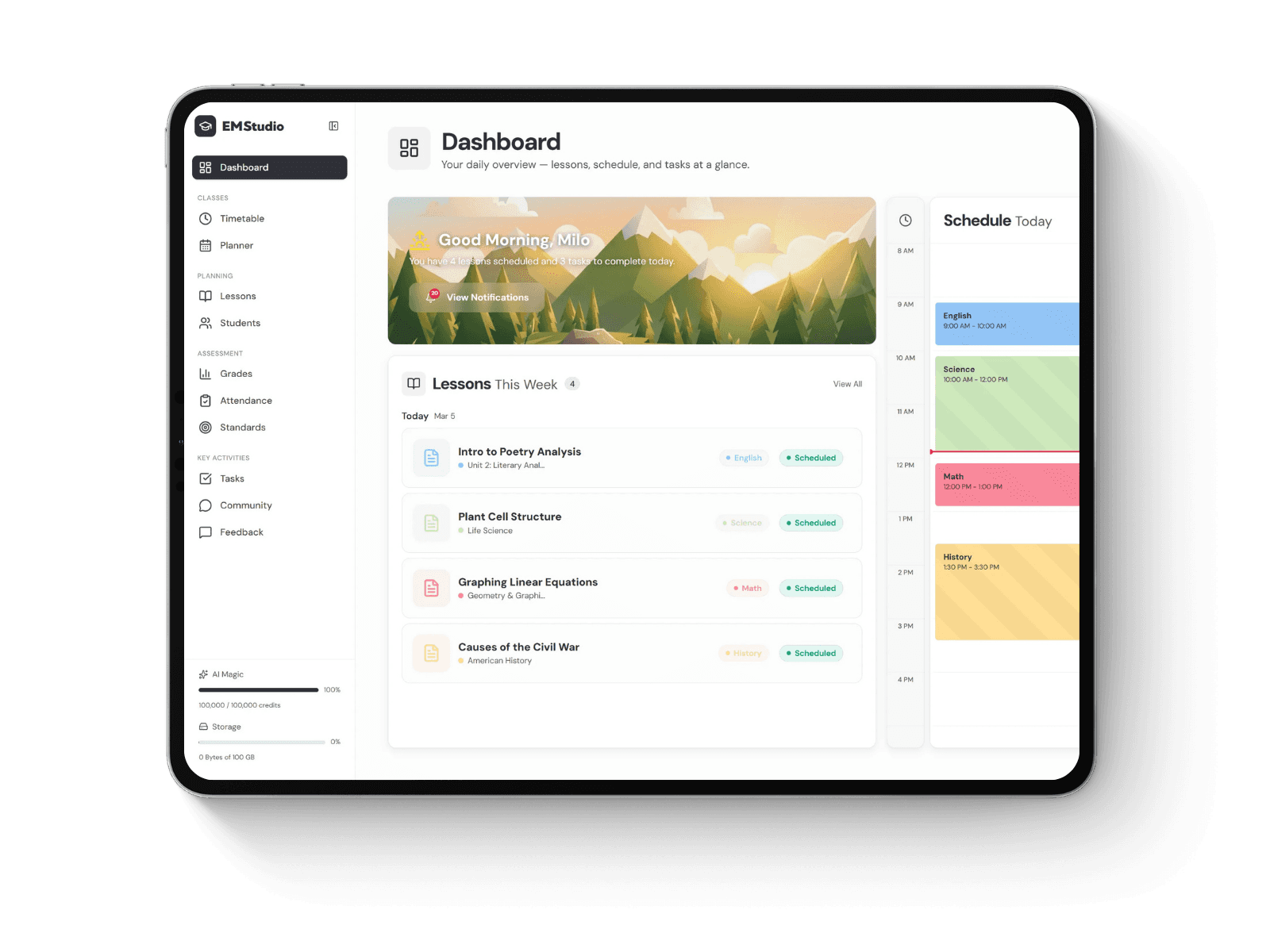
Still grading everything by hand?
EMStudio is a free teaching management app — manage your classes, students, lessons, and more!
Learn More
Table of Contents
How Do I Access the Savvas Realize Login Portal?
Teacher Login Steps and Credentials
Most districts use single sign-on to reduce password fatigue. If your school uses Google Workspace for Education, your super admin must enable the Savvas app in the admin console. Clever integration requires matching your district ID to SIS rosters. Watch for three common errors: "Authentication Failed" means bad credentials, "Domain Not Recognized" indicates SSO misconfiguration, and "Account Inactive" suggests an expired license. This educational technology requires proper data security in education platforms protocols.
Student Login Procedures and Class Codes
Teachers generate class codes under Classes > Manage Students > Add Students > Create Enrollment Code. These 6-digit alphanumeric codes expire after 30 days or a specific usage limit. Share the code verbally or display it on your board. Students click the "Join a Class" button on the savvas realize login page and enter the code to enroll immediately.
Districts handle credentials differently. Some issue temporary usernames in a firstname.lastname@district format. Others integrate permanent district IDs directly into the SIS. If you also use i Ready for students, the login flow mirrors that learning management system. Kindergarten through second grade typically use picture-based Clever badges, while grades three through twelve type alphanumeric credentials to access their online textbook. Guest access allows browsing without saving work; enrolled students see assigned formative assessment data.
Direct URL Access and Bookmarking Options
Skip the homepage and use direct links. Teachers should bookmark savvasrealize.com/community/login. Students go directly to savvasrealize.com/student. These paths bypass the general landing page entirely. Your browser needs Chrome 90+, Safari 14+, Firefox 88+, or Edge 90+ with cookies and JavaScript enabled. This ensures the learning management system loads properly.
On desktop, press Ctrl+D or Command+D to save the page. For mobile access, iOS Safari users tap Share > Add to Home Screen. Android Chrome users tap the menu and select Install App. You can also download the Realize Reader app for offline access to your online textbook on iPad and Android tablets. Consider these essential digital tools for new teachers when planning your workflow.
Where Can Students Find Their Assignments on Savvas Realize?
Students find assignments in the 'My Work' tile on their dashboard, organized by subject, due date, and class period. Click any activity to launch interactive content, instructional videos, and assessments. Green checkmarks indicate completed work, yellow clocks show pending assignments, and red flags mark overdue items requiring immediate attention.
Think of the dashboard as your classroom's digital backpack. Everything lives in one place, but you need to know which zipper to open. This learning management system centralizes every online textbook and activity.
The layout centers on the My Work tile. Left side holds the Classes dropdown menu. Top right displays the notification bell with red badge indicators for new teacher feedback.
Assignments lists current work.
Books houses the online textbook library.
Classes switches between periods.
Help opens support chat.
Account manages passwords.
Do not use the search bar to find assigned work. It searches the entire content library, not your teacher's specific assignments. New users waste ten minutes here daily. Click the To Do filter instead.
Savvas Realize uses three distinct assignment types. Auto-scored practice gives instant feedback with a green check or red X, serving as a formative assessment. Teacher-graded projects show a paper clip icon with attached rubrics. Adaptive study plans, marked with calculator icons, adjust based on your pre-test results. Look for the play button to launch instructional videos.
Navigating the Student Dashboard
The top bar holds the Classes switcher dropdown. Center grid displays program tiles like enVision Mathematics or myPerspectives ELA. Right sidebar shows a calendar view with color-coded due dates. Red means overdue, yellow means due today, green means completed.
Two tabs live at the top of every program page. Browse shows every lesson in the digital curriculum. Assignments shows only what your teacher selected. Click Assignments to avoid drowning in extras.
Locating Math and ELA Assignments
For math, click the enVision tile, then Topic, then Lesson. Look for Visual Learning videos or Practice assignments. High school students using MathXL for School will see a separate login prompt—don't panic, your credentials transfer through single sign-on.
ELA workflows differ slightly in myPerspectives. Close Read models, Write prompts, and Vocabulary games appear as separate line items. Check out these ELA curriculum resources for unit planning. Always click Turn In when finished; Save Draft only stores progress without submitting.
Accessing Interactive Tools and Resources
Four tools change how students interact with content. Desmos graphing calculator appears in Algebra 1 and above. Text-to-speech lives in the toolbar—highlight text, click the speaker. The sticky note icon opens a note-taking tool in Realize Reader. Math manipulatives like virtual base-ten blocks support 3rd graders in October.
Device compatibility matters. iPads handle touch gestures for drag-and-drop fractions. Chromebooks need a mouse for the same action. This educational technology works best when students track assignments for students using the built-in calendar, not i ready lessons or iready lessons which live on different platforms.

What Is the Difference Between Savvas Realize and i-Ready?
Savvas Realize is a comprehensive learning management system hosting publisher curriculum like enVision and myPerspectives with extensive teacher customization tools. i-Ready is an adaptive assessment and intervention platform generating personalized learning paths in math and ELA primarily for grades K-8 based on diagnostic results.
One platform delivers your textbook online. The other tests your kids and assigns remediation.
That distinction matters when you're deciding which screen deserves your class time.
Feature | Savvas Realize | i-Ready |
|---|---|---|
Primary Function | Learning management system + digital curriculum | Adaptive diagnostic + intervention tool |
Content Source | Publisher materials (enVision, myPerspectives) | Algorithm-generated personalized paths |
Grade Range | K-12 plus AP courses | Primarily K-8 |
Assessment Type | Formative checks embedded in lessons | Diagnostic testing 3x yearly |
Teacher Control Level | High: cherry-pick lessons, customize sequence | Moderate: assign standards, monitor adaptive paths |
The "math to do iready" experience feels like a video game. Students visit Pizza or Galaxy-themed worlds, earn coins for their avatars, and follow the algorithm's "My Path" through interactive problems. The interface uses bright colors, animated characters, and immediate auditory feedback. The i ready app restricts browsing to keep kids in their lane, preventing them from skipping ahead to content you haven't authorized.
Realize math looks like your textbook came alive. You assign Topic 4 Lesson 3 from enVision Mathematics, students see the same problems from their hardcover, and you can print the homework sheets for students who need paper copies. The layout matches your teacher's edition page numbers. No games. No coins. Just structured academics aligned to your district's pacing guide.
i-Ready runs diagnostics three times a year—fall, winter, spring. Students spend 45 minutes clicking through adaptive questions that get harder or easier based on their responses. You get placement bars showing who's "below grade level" and national percentile rankings. The data arrives weeks later, often after you've moved to new units.
Realize embeds formative assessment into daily work. Exit tickets, quick checks, and lesson quizzes provide immediate feedback while students still remember the lesson. John Hattie's research backs this up: frequent formative feedback carries an effect size of 0.73, while intermittent diagnostic testing sits at 0.48. That's the difference between adjusting tomorrow's lesson versus discovering gaps three months later when remediation requires backtracking.
Confusion happens when districts buy both. Some schools use the i ready program for diagnostic testing while teaching core math through Savvas Realize. Others purchase i ready classroom Mathematics—the actual curriculum product—which is separate from the diagnostic tool. Some administrators mistakenly believe the diagnostic includes lessons. Check your contracts carefully. You might have the assessment license without the curriculum, or vice versa, leaving you scrambling for materials.
Platform Interface and Navigation Comparison
Kids open the i ready app and land in "My Stuff"—a colorful dashboard with customizable avatars, arcade games, and coin counters. They can spend ten minutes selecting hair colors before starting math. The interface intentionally limits choice. Students can't browse ahead or skip around; they click "Start" and the algorithm serves the next lesson. Teachers cannot override the sequence easily.
Realize greets students with a grid of program tiles. They see enVision Mathematics, myPerspectives, or whatever your district adopted. From there, they access list views of assignments or browse the full table of contents. Students can preview upcoming chapters or review previous topics. No cartoons. No coins. Just academic content organized by chapter and lesson exactly like their physical books.
Your i-Ready teacher dashboard highlights "Student Growth" with color-coded bars showing grade-level placement—red for below, green for on track. You see domain scores like "Algebra & Algebraic Thinking" but drill-down options stay limited. You can't see the actual questions students missed. The reporting focuses on trends over time rather than daily specifics.
Realize shows "Assignment Status" with real-time progress bars. You filter by "Not Started," "In Progress," or "Submitted." You see exactly who finished the online textbook reading and who's still on question three. You can click into individual responses to see their work. For detailed data-driven teaching implementation, these granular views matter more than quarterly placement bars.
Savvas Realize Curriculum vs i-Ready Lessons
Realize follows your adopted textbook scope-and-sequence. If you're teaching enVision Math 2.0 Topic 4 Lesson 3, you assign exactly that. Students access the digital version of page 247, watch the prescribed video, and you print the PDF homework for those who need paper. The digital curriculum mirrors your teacher's edition perfectly. You control the pacing, not an algorithm.
i-Ready generates "My Path" lessons algorithmically based on Diagnostic results. A 5th grader might receive content ranging from 2nd grade fractions to 7th grade pre-algebra, depending on their gaps. The educational technology ignores your classroom pacing guide and focuses on individual skill remediation. This creates disjointed instruction where Monday covers addition and Tuesday jumps to perimeter without connection.
Here's the misconception: i-Ready provides supplemental intervention, not core instruction. Students complete 20-30 minute online lessons targeting specific skills. You cannot run a full math block on i-Ready alone. I learned this the hard way my first year using the program. My kids' benchmark scores flatlined because they never saw grade-level material. They became experts at 2nd grade math while failing 5th grade standards.
The platform delivers core instruction through 45-60 minute blended lessons. Realize supports whole-group introductions, small-group rotations, and independent practice. You get printable manipulatives and discussion prompts. If you're looking for the i ready classroom curriculum product—that's a separate purchase. Many teachers confuse the diagnostic tool with the full curriculum suite. Check your single sign-on portal to see which licenses you actually own.
Teacher Reporting and Classroom Management Tools
Realize offers item-level analysis. You see which questions Jamal missed, how long he spent on problem four, and whether he watched the instructional video. This granular data helps you reteach specific concepts during your next small group rotation. You can export the data to share with parents during conferences. For more platform-specific troubleshooting, see our Savvas Realize FAQ for educators.
i-Ready reports domain-level proficiency. You receive "Next Steps for Instruction" recommendations based on broad categories like "Measurement & Data" or "Reading Comprehension." The system tells you Johnny needs work on phonics, but not which specific sounds tripped him up. You'll need to give your own diagnostic to find the exact gap. This generalization frustrates teachers who want actionable data today.
Creating assignments in Savvas feels like curating a playlist. You cherry-pick specific pages from the online textbook, add a related video, attach a quiz, and schedule it for Tuesday. You maintain full control over the sequence and difficulty. You can differentiate by assigning different page ranges to different reading groups. This flexibility supports your lesson plans rather than replacing them.
i-Ready auto-assigns lessons based on diagnostic gaps. You can override this by selecting specific standards for "Teacher-Assigned Lessons," but the system prefers to drive. The platform pushes content automatically, reducing your planning time but limiting your ability to align with tomorrow's classroom activity. Students might work on skills you haven't introduced yet, creating confusion during your live instruction.

How Can Teachers Troubleshoot Common Savvas Realize Access Issues?
Clear browser cache and cookies, verify SSO credentials with district IT, check the Savvas System Status page for outages, and use the 'Forgot Password' link with your district email. For persistent issues, contact Savvas Support at 800-848-9500 with your district ID ready.
Most login headaches stem from cached credentials. Run through these five steps before calling anyone.
Step 1: Check the URL. Ensure you're at savvasrealize.com, not a phishing imitation. (2 minutes)
Step 2: Clear cache. Press Ctrl+Shift+Delete, select "All time," check cookies and cached images. (2 minutes)
Step 3: Try incognito mode. Open a private window and attempt login. (2 minutes)
Step 4: Verify district subscription status. Confirm your license hasn't expired. (2 minutes)
Step 5: Contact support. Call 800-848-9500 with your District ID ready. (2 minutes)
Chrome 90 or newer is mandatory for Savvas Realize. Older versions display a blank white screen after login. Safari 14+ is required; earlier versions freeze when loading PDFs from the online textbook. You must enable third-party cookies for single sign-on to function properly. Internet Explorer lost support in 2021 and will not load the platform.
Safari Private mode blocks the cookies required for Realize Reader. Chrome extensions create similar headaches. Ad blockers like uBlock Origin, privacy badgers, and password managers auto-filling old credentials break SSO redirects. You'll see specific errors: 'Error 403: Forbidden' or 'Session Expired - Please Log In Again'.
When your district uses Active Directory sync, never touch the self-service password reset on Savvas. That button is for Savvas-managed accounts only. Clicking it on an SSO-managed account creates a duplicate profile and locks the original. Your district IT must reset passwords through Google Admin Console or Active Directory.
Start with Tier 1: your district IT coordinator for SSO authentication failures. Tier 2 is Savvas Customer Care at 800-848-9500, available 8am-8pm ET. Tier 3 assigns a Success Manager to districts with 1000+ seats. Have your District ID, school name, error screenshot, and browser version ready.
Resetting Passwords and Recovering Accounts
Savvas-managed accounts use the 'Forgot Username/Password' link on the login page. The reset link lands in your district email and stays valid for 24 hours. Click it, set a new password, and you're back in. This works only for standalone accounts created directly with Savvas.
SSO-managed accounts require a different approach. These sync with your district's Active Directory or Google Workspace. You must reset passwords through Google Admin Console or district IT, never through Savvas. Clicking the Savvas reset button on an SSO account creates a duplicate profile and locks the original.
The lockout policy is strict. Five failed login attempts trigger a 30-minute freeze. Only district admins can unlock accounts via the SuccessNet admin portal. Never create duplicate accounts to bypass this. Duplicate profiles split student data between two locations, making it impossible to track formative assessment scores or assignment history accurately. This educational technology only works when each user maintains one clear identity.
If you see "Account already exists" during reset, you've triggered this conflict. Contact your district IT immediately with your District ID and employee number. They must merge the accounts or unlock the original. Attempting to create a third account only deepens the mess and separates student progress reports across multiple profiles.
Resolving Browser and Device Compatibility Problems
On mobile devices, iOS 14+ supports the Realize Reader app. Android users must use Chrome, not Samsung Internet, to access the digital curriculum. Always update browsers before the first day of school. This prevents most painless software updates conflicts that derail morning lessons.
Perform the Incognito Test. If the learning management system loads in private mode but fails in standard browsing, cached credentials or extensions are the culprit. Disable the three specific extensions mentioned above and clear saved passwords for the site. This resolves most access issues without further intervention.
Check your spam folder if the reset email doesn't appear within five minutes. District filters often catch automated messages from educational technology vendors.
Contacting Support and Finding Training Resources
Your first call for SSO authentication failures should be your district IT coordinator. They manage the connection between your identity provider and the platform. For platform-specific problems, contact Savvas Customer Care at 1-800-848-9500 between 8am and 8pm ET. Large districts with 1000+ seats receive a dedicated Success Manager as Tier 3 support.
Before calling, gather four items: your District ID, school name, a screenshot of the specific error message, and your browser version. This information moves you past Tier 1 scripts quickly. Visit Savvas.com/Support for live chat and the system status page when phone lines are busy.
For self-service learning, access the 'Savvas Realize Basics' course on the Savvas Training website. This free, one-hour module covers using the platform and creating assignments. Download 'Quick Start Guides' PDFs directly from the Help menu. Follow the 'Savvas Status' Twitter account for real-time outage updates. These resources support effective classroom technology integration without waiting for formal training days.
When submitting a support ticket, include the exact time and steps already tried. Savvas tracks known issues by district ID, flagging widespread outages immediately.

What This Means for Your Classroom
Savvas Realize is essentially your digital textbook shelf and gradebook rolled into one. Once your students are logged in through the district's single sign-on, the platform fades into the background. They access their enVision Mathematics or myView Literacy lessons, submit work, and you see the scores immediately. No paper handouts. No lost workbooks. Just the curriculum happening where you can actually track it in real time.
Stop using Savvas for what it isn't built to do. Unlike i-Ready, which diagnoses gaps, Savvas delivers the core digital curriculum. Run your interventions elsewhere. When login issues pop up—and they will during the first week—check the roster sync before you email IT. I've found that most "access denied" errors fix themselves once class lists update overnight.
Your takeaway? Treat this learning management system like a utility, not a project. Set up the bookmarks. Verify one test student can see the assignment. Then teach. The educational technology works best when you spend less time managing passwords and more time using the data it gives you to adjust tomorrow's lesson.

How Do I Access the Savvas Realize Login Portal?
Teacher Login Steps and Credentials
Most districts use single sign-on to reduce password fatigue. If your school uses Google Workspace for Education, your super admin must enable the Savvas app in the admin console. Clever integration requires matching your district ID to SIS rosters. Watch for three common errors: "Authentication Failed" means bad credentials, "Domain Not Recognized" indicates SSO misconfiguration, and "Account Inactive" suggests an expired license. This educational technology requires proper data security in education platforms protocols.
Student Login Procedures and Class Codes
Teachers generate class codes under Classes > Manage Students > Add Students > Create Enrollment Code. These 6-digit alphanumeric codes expire after 30 days or a specific usage limit. Share the code verbally or display it on your board. Students click the "Join a Class" button on the savvas realize login page and enter the code to enroll immediately.
Districts handle credentials differently. Some issue temporary usernames in a firstname.lastname@district format. Others integrate permanent district IDs directly into the SIS. If you also use i Ready for students, the login flow mirrors that learning management system. Kindergarten through second grade typically use picture-based Clever badges, while grades three through twelve type alphanumeric credentials to access their online textbook. Guest access allows browsing without saving work; enrolled students see assigned formative assessment data.
Direct URL Access and Bookmarking Options
Skip the homepage and use direct links. Teachers should bookmark savvasrealize.com/community/login. Students go directly to savvasrealize.com/student. These paths bypass the general landing page entirely. Your browser needs Chrome 90+, Safari 14+, Firefox 88+, or Edge 90+ with cookies and JavaScript enabled. This ensures the learning management system loads properly.
On desktop, press Ctrl+D or Command+D to save the page. For mobile access, iOS Safari users tap Share > Add to Home Screen. Android Chrome users tap the menu and select Install App. You can also download the Realize Reader app for offline access to your online textbook on iPad and Android tablets. Consider these essential digital tools for new teachers when planning your workflow.
Where Can Students Find Their Assignments on Savvas Realize?
Students find assignments in the 'My Work' tile on their dashboard, organized by subject, due date, and class period. Click any activity to launch interactive content, instructional videos, and assessments. Green checkmarks indicate completed work, yellow clocks show pending assignments, and red flags mark overdue items requiring immediate attention.
Think of the dashboard as your classroom's digital backpack. Everything lives in one place, but you need to know which zipper to open. This learning management system centralizes every online textbook and activity.
The layout centers on the My Work tile. Left side holds the Classes dropdown menu. Top right displays the notification bell with red badge indicators for new teacher feedback.
Assignments lists current work.
Books houses the online textbook library.
Classes switches between periods.
Help opens support chat.
Account manages passwords.
Do not use the search bar to find assigned work. It searches the entire content library, not your teacher's specific assignments. New users waste ten minutes here daily. Click the To Do filter instead.
Savvas Realize uses three distinct assignment types. Auto-scored practice gives instant feedback with a green check or red X, serving as a formative assessment. Teacher-graded projects show a paper clip icon with attached rubrics. Adaptive study plans, marked with calculator icons, adjust based on your pre-test results. Look for the play button to launch instructional videos.
Navigating the Student Dashboard
The top bar holds the Classes switcher dropdown. Center grid displays program tiles like enVision Mathematics or myPerspectives ELA. Right sidebar shows a calendar view with color-coded due dates. Red means overdue, yellow means due today, green means completed.
Two tabs live at the top of every program page. Browse shows every lesson in the digital curriculum. Assignments shows only what your teacher selected. Click Assignments to avoid drowning in extras.
Locating Math and ELA Assignments
For math, click the enVision tile, then Topic, then Lesson. Look for Visual Learning videos or Practice assignments. High school students using MathXL for School will see a separate login prompt—don't panic, your credentials transfer through single sign-on.
ELA workflows differ slightly in myPerspectives. Close Read models, Write prompts, and Vocabulary games appear as separate line items. Check out these ELA curriculum resources for unit planning. Always click Turn In when finished; Save Draft only stores progress without submitting.
Accessing Interactive Tools and Resources
Four tools change how students interact with content. Desmos graphing calculator appears in Algebra 1 and above. Text-to-speech lives in the toolbar—highlight text, click the speaker. The sticky note icon opens a note-taking tool in Realize Reader. Math manipulatives like virtual base-ten blocks support 3rd graders in October.
Device compatibility matters. iPads handle touch gestures for drag-and-drop fractions. Chromebooks need a mouse for the same action. This educational technology works best when students track assignments for students using the built-in calendar, not i ready lessons or iready lessons which live on different platforms.
What Is the Difference Between Savvas Realize and i-Ready?
Savvas Realize is a comprehensive learning management system hosting publisher curriculum like enVision and myPerspectives with extensive teacher customization tools. i-Ready is an adaptive assessment and intervention platform generating personalized learning paths in math and ELA primarily for grades K-8 based on diagnostic results.
One platform delivers your textbook online. The other tests your kids and assigns remediation.
That distinction matters when you're deciding which screen deserves your class time.
Feature | Savvas Realize | i-Ready |
|---|---|---|
Primary Function | Learning management system + digital curriculum | Adaptive diagnostic + intervention tool |
Content Source | Publisher materials (enVision, myPerspectives) | Algorithm-generated personalized paths |
Grade Range | K-12 plus AP courses | Primarily K-8 |
Assessment Type | Formative checks embedded in lessons | Diagnostic testing 3x yearly |
Teacher Control Level | High: cherry-pick lessons, customize sequence | Moderate: assign standards, monitor adaptive paths |
The "math to do iready" experience feels like a video game. Students visit Pizza or Galaxy-themed worlds, earn coins for their avatars, and follow the algorithm's "My Path" through interactive problems. The interface uses bright colors, animated characters, and immediate auditory feedback. The i ready app restricts browsing to keep kids in their lane, preventing them from skipping ahead to content you haven't authorized.
Realize math looks like your textbook came alive. You assign Topic 4 Lesson 3 from enVision Mathematics, students see the same problems from their hardcover, and you can print the homework sheets for students who need paper copies. The layout matches your teacher's edition page numbers. No games. No coins. Just structured academics aligned to your district's pacing guide.
i-Ready runs diagnostics three times a year—fall, winter, spring. Students spend 45 minutes clicking through adaptive questions that get harder or easier based on their responses. You get placement bars showing who's "below grade level" and national percentile rankings. The data arrives weeks later, often after you've moved to new units.
Realize embeds formative assessment into daily work. Exit tickets, quick checks, and lesson quizzes provide immediate feedback while students still remember the lesson. John Hattie's research backs this up: frequent formative feedback carries an effect size of 0.73, while intermittent diagnostic testing sits at 0.48. That's the difference between adjusting tomorrow's lesson versus discovering gaps three months later when remediation requires backtracking.
Confusion happens when districts buy both. Some schools use the i ready program for diagnostic testing while teaching core math through Savvas Realize. Others purchase i ready classroom Mathematics—the actual curriculum product—which is separate from the diagnostic tool. Some administrators mistakenly believe the diagnostic includes lessons. Check your contracts carefully. You might have the assessment license without the curriculum, or vice versa, leaving you scrambling for materials.
Platform Interface and Navigation Comparison
Kids open the i ready app and land in "My Stuff"—a colorful dashboard with customizable avatars, arcade games, and coin counters. They can spend ten minutes selecting hair colors before starting math. The interface intentionally limits choice. Students can't browse ahead or skip around; they click "Start" and the algorithm serves the next lesson. Teachers cannot override the sequence easily.
Realize greets students with a grid of program tiles. They see enVision Mathematics, myPerspectives, or whatever your district adopted. From there, they access list views of assignments or browse the full table of contents. Students can preview upcoming chapters or review previous topics. No cartoons. No coins. Just academic content organized by chapter and lesson exactly like their physical books.
Your i-Ready teacher dashboard highlights "Student Growth" with color-coded bars showing grade-level placement—red for below, green for on track. You see domain scores like "Algebra & Algebraic Thinking" but drill-down options stay limited. You can't see the actual questions students missed. The reporting focuses on trends over time rather than daily specifics.
Realize shows "Assignment Status" with real-time progress bars. You filter by "Not Started," "In Progress," or "Submitted." You see exactly who finished the online textbook reading and who's still on question three. You can click into individual responses to see their work. For detailed data-driven teaching implementation, these granular views matter more than quarterly placement bars.
Savvas Realize Curriculum vs i-Ready Lessons
Realize follows your adopted textbook scope-and-sequence. If you're teaching enVision Math 2.0 Topic 4 Lesson 3, you assign exactly that. Students access the digital version of page 247, watch the prescribed video, and you print the PDF homework for those who need paper. The digital curriculum mirrors your teacher's edition perfectly. You control the pacing, not an algorithm.
i-Ready generates "My Path" lessons algorithmically based on Diagnostic results. A 5th grader might receive content ranging from 2nd grade fractions to 7th grade pre-algebra, depending on their gaps. The educational technology ignores your classroom pacing guide and focuses on individual skill remediation. This creates disjointed instruction where Monday covers addition and Tuesday jumps to perimeter without connection.
Here's the misconception: i-Ready provides supplemental intervention, not core instruction. Students complete 20-30 minute online lessons targeting specific skills. You cannot run a full math block on i-Ready alone. I learned this the hard way my first year using the program. My kids' benchmark scores flatlined because they never saw grade-level material. They became experts at 2nd grade math while failing 5th grade standards.
The platform delivers core instruction through 45-60 minute blended lessons. Realize supports whole-group introductions, small-group rotations, and independent practice. You get printable manipulatives and discussion prompts. If you're looking for the i ready classroom curriculum product—that's a separate purchase. Many teachers confuse the diagnostic tool with the full curriculum suite. Check your single sign-on portal to see which licenses you actually own.
Teacher Reporting and Classroom Management Tools
Realize offers item-level analysis. You see which questions Jamal missed, how long he spent on problem four, and whether he watched the instructional video. This granular data helps you reteach specific concepts during your next small group rotation. You can export the data to share with parents during conferences. For more platform-specific troubleshooting, see our Savvas Realize FAQ for educators.
i-Ready reports domain-level proficiency. You receive "Next Steps for Instruction" recommendations based on broad categories like "Measurement & Data" or "Reading Comprehension." The system tells you Johnny needs work on phonics, but not which specific sounds tripped him up. You'll need to give your own diagnostic to find the exact gap. This generalization frustrates teachers who want actionable data today.
Creating assignments in Savvas feels like curating a playlist. You cherry-pick specific pages from the online textbook, add a related video, attach a quiz, and schedule it for Tuesday. You maintain full control over the sequence and difficulty. You can differentiate by assigning different page ranges to different reading groups. This flexibility supports your lesson plans rather than replacing them.
i-Ready auto-assigns lessons based on diagnostic gaps. You can override this by selecting specific standards for "Teacher-Assigned Lessons," but the system prefers to drive. The platform pushes content automatically, reducing your planning time but limiting your ability to align with tomorrow's classroom activity. Students might work on skills you haven't introduced yet, creating confusion during your live instruction.
How Can Teachers Troubleshoot Common Savvas Realize Access Issues?
Clear browser cache and cookies, verify SSO credentials with district IT, check the Savvas System Status page for outages, and use the 'Forgot Password' link with your district email. For persistent issues, contact Savvas Support at 800-848-9500 with your district ID ready.
Most login headaches stem from cached credentials. Run through these five steps before calling anyone.
Step 1: Check the URL. Ensure you're at savvasrealize.com, not a phishing imitation. (2 minutes)
Step 2: Clear cache. Press Ctrl+Shift+Delete, select "All time," check cookies and cached images. (2 minutes)
Step 3: Try incognito mode. Open a private window and attempt login. (2 minutes)
Step 4: Verify district subscription status. Confirm your license hasn't expired. (2 minutes)
Step 5: Contact support. Call 800-848-9500 with your District ID ready. (2 minutes)
Chrome 90 or newer is mandatory for Savvas Realize. Older versions display a blank white screen after login. Safari 14+ is required; earlier versions freeze when loading PDFs from the online textbook. You must enable third-party cookies for single sign-on to function properly. Internet Explorer lost support in 2021 and will not load the platform.
Safari Private mode blocks the cookies required for Realize Reader. Chrome extensions create similar headaches. Ad blockers like uBlock Origin, privacy badgers, and password managers auto-filling old credentials break SSO redirects. You'll see specific errors: 'Error 403: Forbidden' or 'Session Expired - Please Log In Again'.
When your district uses Active Directory sync, never touch the self-service password reset on Savvas. That button is for Savvas-managed accounts only. Clicking it on an SSO-managed account creates a duplicate profile and locks the original. Your district IT must reset passwords through Google Admin Console or Active Directory.
Start with Tier 1: your district IT coordinator for SSO authentication failures. Tier 2 is Savvas Customer Care at 800-848-9500, available 8am-8pm ET. Tier 3 assigns a Success Manager to districts with 1000+ seats. Have your District ID, school name, error screenshot, and browser version ready.
Resetting Passwords and Recovering Accounts
Savvas-managed accounts use the 'Forgot Username/Password' link on the login page. The reset link lands in your district email and stays valid for 24 hours. Click it, set a new password, and you're back in. This works only for standalone accounts created directly with Savvas.
SSO-managed accounts require a different approach. These sync with your district's Active Directory or Google Workspace. You must reset passwords through Google Admin Console or district IT, never through Savvas. Clicking the Savvas reset button on an SSO account creates a duplicate profile and locks the original.
The lockout policy is strict. Five failed login attempts trigger a 30-minute freeze. Only district admins can unlock accounts via the SuccessNet admin portal. Never create duplicate accounts to bypass this. Duplicate profiles split student data between two locations, making it impossible to track formative assessment scores or assignment history accurately. This educational technology only works when each user maintains one clear identity.
If you see "Account already exists" during reset, you've triggered this conflict. Contact your district IT immediately with your District ID and employee number. They must merge the accounts or unlock the original. Attempting to create a third account only deepens the mess and separates student progress reports across multiple profiles.
Resolving Browser and Device Compatibility Problems
On mobile devices, iOS 14+ supports the Realize Reader app. Android users must use Chrome, not Samsung Internet, to access the digital curriculum. Always update browsers before the first day of school. This prevents most painless software updates conflicts that derail morning lessons.
Perform the Incognito Test. If the learning management system loads in private mode but fails in standard browsing, cached credentials or extensions are the culprit. Disable the three specific extensions mentioned above and clear saved passwords for the site. This resolves most access issues without further intervention.
Check your spam folder if the reset email doesn't appear within five minutes. District filters often catch automated messages from educational technology vendors.
Contacting Support and Finding Training Resources
Your first call for SSO authentication failures should be your district IT coordinator. They manage the connection between your identity provider and the platform. For platform-specific problems, contact Savvas Customer Care at 1-800-848-9500 between 8am and 8pm ET. Large districts with 1000+ seats receive a dedicated Success Manager as Tier 3 support.
Before calling, gather four items: your District ID, school name, a screenshot of the specific error message, and your browser version. This information moves you past Tier 1 scripts quickly. Visit Savvas.com/Support for live chat and the system status page when phone lines are busy.
For self-service learning, access the 'Savvas Realize Basics' course on the Savvas Training website. This free, one-hour module covers using the platform and creating assignments. Download 'Quick Start Guides' PDFs directly from the Help menu. Follow the 'Savvas Status' Twitter account for real-time outage updates. These resources support effective classroom technology integration without waiting for formal training days.
When submitting a support ticket, include the exact time and steps already tried. Savvas tracks known issues by district ID, flagging widespread outages immediately.
What This Means for Your Classroom
Savvas Realize is essentially your digital textbook shelf and gradebook rolled into one. Once your students are logged in through the district's single sign-on, the platform fades into the background. They access their enVision Mathematics or myView Literacy lessons, submit work, and you see the scores immediately. No paper handouts. No lost workbooks. Just the curriculum happening where you can actually track it in real time.
Stop using Savvas for what it isn't built to do. Unlike i-Ready, which diagnoses gaps, Savvas delivers the core digital curriculum. Run your interventions elsewhere. When login issues pop up—and they will during the first week—check the roster sync before you email IT. I've found that most "access denied" errors fix themselves once class lists update overnight.
Your takeaway? Treat this learning management system like a utility, not a project. Set up the bookmarks. Verify one test student can see the assignment. Then teach. The educational technology works best when you spend less time managing passwords and more time using the data it gives you to adjust tomorrow's lesson.
Still grading everything by hand?
EMStudio is a free teaching management app — manage your classes, students, lessons, and more!
Learn More
Still grading everything by hand?
EMStudio is a free teaching management app — manage your classes, students, lessons, and more!
Learn More



Notion4Teachers
Notion templates to simplify administrative tasks and enhance your teaching experience.



2026 Notion4Teachers. All Rights Reserved.
Notion4Teachers
Notion templates to simplify administrative tasks and enhance your teaching experience.
2026 Notion4Teachers. All Rights Reserved.
Notion4Teachers
Notion templates to simplify administrative tasks and enhance your teaching experience.
2026 Notion4Teachers. All Rights Reserved.