
ELA Class: The Complete Guide for K-12 Educators
ELA Class: The Complete Guide for K-12 Educators

Article by
Milo
ESL Content Coordinator & Educator
ESL Content Coordinator & Educator
All Posts
I watched a seventh grader stare at the same paragraph for ten minutes during silent reading last Tuesday. She wasn't being defiant; the text complexity had jumped three levels from last month, and nobody had taught her how to break it down. That moment explains why your ela class needs more than just great books and good intentions. You need a system that moves kids from sounding out words to analyzing themes without losing them in the gaps between grade levels. I've seen the same stall happen with phonemic awareness in 3rd grade. It happens every year, and it matters.
This guide covers what actually works in K-12 English Language Arts, from kindergarten through twelfth grade in every district I've worked. We'll look at how balanced literacy fits with guided reading in primary classrooms, why the workshop model falls apart without clear structure, and how to sequence skills so sixth graders don't crash into close reading unprepared.
You'll get practical ways to handle basal readers, digital curriculum options, and the daily flow that keeps students progressing from September to June. Whether you're wrestling with a scripted program or building lessons from scratch, these moves predict long-term literacy success. Let's fix your instruction right now before another kid gets stuck staring at the page.
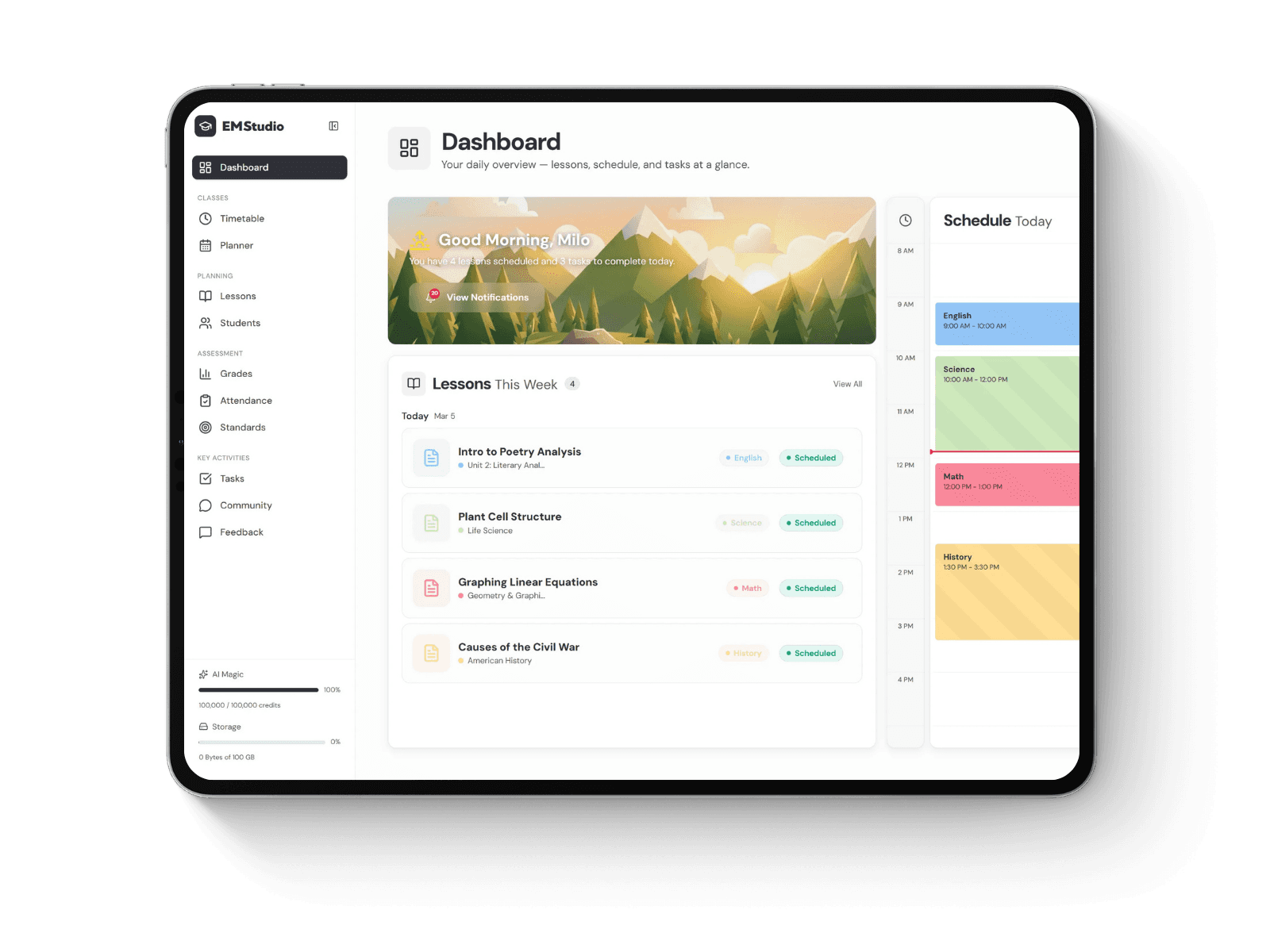
Still grading everything by hand?
EMStudio is a free teaching management app — manage your classes, students, lessons, and more!
Learn More
Still grading everything by hand?
EMStudio is a free teaching management app — manage your classes, students, lessons, and more!
Learn More
Table of Contents
What Is an ELA Class?
An ELA class fuses reading, writing, speaking, and listening into one cohesive literacy curriculum. It is not merely a reading class with novels, nor a writing class with essays. You teach all four domains simultaneously, using evidence-based literacy instruction aligned to Common Core or your state’s equivalent standards.
You will hear administrators use "ELA," "reading," and "English" interchangeably. Do not fall for this. Reading classes focus on decoding. English classes often mean literature study. ELA demands you integrate phonemic awareness, guided reading, composition, and discussion daily.
The architecture shifts by grade band. Kindergarten through third grade centers on learning to read—explicit phonics and fluency. By fourth grade, the pivot hits: students transition to reading to learn. They now use literacy skills to absorb science and history independently.
Elementary teachers wrestle with 90-to-120-minute literacy blocks. Middle school colleagues get 45-to-55-minute periods. Both configurations aim at the same target: producing students who handle grade-level text complexity without hand-holding.
The Four Pillars: Reading, Writing, Speaking, and Listening
Your schedule reveals your priorities. Most effective ela class structures divide time roughly like this:
Reading comprehension: 40%
Writing: 30%
Language and grammar: 20%
Speaking and listening: 10%
That final pillar often disappears unless you block it deliberately. Speaking and listening cannot be filler. The Common Core anchors them under "Comprehension and Collaboration." Students must evaluate speakers' points of view. You need Socratic seminars penciled into your calendar, not squeezed in after the essay.
Reading anchors align to "Key Ideas and Details." Think close reading and citing evidence. Writing maps to "Text Types and Purposes"—argumentation, informative pieces, narrative. When these four balance, you create a balanced literacy environment. Students communicate. They do not just complete worksheets.
The workshop model maintains this integration. You deliver a mini-lesson, then release students to apply skills across domains. One group engages in guided reading while another drafts persuasive letters. A third records podcast reviews. Everyone talks. Everyone writes. Everyone reads.
Elementary vs. Middle School ELA Structures
Time looks different across the building. In elementary, you likely manage a 90-to-120-minute literacy block. You pull small groups for guided reading while others rotate through stations. The Daily 5 structure or workshop model lets you differentiate phonics for struggling decoders while advanced readers tackle novels. Flexibility rules.
Middle school operates on different physics. You get 45-to-50-minute periods. Sometimes your district splits reading and writing into separate courses. Sometimes you teach unified ELA. Either way, the pace accelerates. You cannot spend three weeks on one picture book. Students switch teachers every hour.
The pivot point arrives at fifth grade. By June, students should independently handle texts between 800L and 1000L. That is the threshold for middle school ela curriculum. If they enter sixth grade below this level, content-area teachers assume they can read textbook chapters. They cannot slow down. Your elementary text complexity choices determine their success.
This represents the literacy baton pass. Elementary teachers build the aircraft. Middle school teachers teach them to fly through thunderstorms. When the foundation cracks, the flight gets rocky.
How Does Daily Instruction Flow in an Effective ELA Class?
Effective ela class routines follow a workshop model: ten to fifteen minutes of explicit mini-lessons, twenty to thirty minutes of differentiated small-group instruction, and five to ten minutes of closure. The Gradual Release of Responsibility framework guides this flow: teacher modeling ('I do'), guided practice ('we do'), and independent application ('you do').
This architecture protects instructional time. You teach a focused skill, then immediately release students to practice it. No marathon lectures.
Word study deserves ten minutes of dedicated phonemic awareness work. Fluency practice takes five. Comprehension strategy instruction needs fifteen minutes of close reading and discussion. Writing workshop requires thirty uninterrupted minutes for drafting and conferring.
The failure mode is real. When whole-group instruction exceeds twenty minutes, engagement drops hard. Kids check out. Never let whole-group segments run longer than fifteen minutes without partner processing or quick writes.
The Gradual Release of Responsibility Model
Fisher and Frey's framework keeps ela lessons moving through four distinct phases. You start with 'I Do' — ten minutes of direct modeling where you think aloud and demonstrate the strategy. This differs from explicit direct instruction models in its brevity and targeted focus. Students watch and listen. Then shift to 'We Do' — ten to fifteen minutes of guided practice. The class tackles a text together, offering ideas while you scaffold heavily.
Next comes 'You Do Together' — ten minutes of collaborative work with partners or small groups. Students apply the strategy while you circulate, listening in and catching misconceptions before they solidify. Finally, 'You Do Alone' — fifteen to twenty minutes of independent practice. Students demonstrate mastery without your immediate support. This phase reveals who truly owns the skill.
The common error? Stopping at 'We Do.' Teachers feel pressure to keep groups moving, so they skip the collaborative phase. Students then flounder during independent work because they haven't tested the strategy with peer support. Effective ela lesson plans cycle through all four phases daily. Never skip the middle steps.
Watch for the trap of staying in 'I Do' too long. You enjoy performing the text analysis. Students enjoy watching. But ownership transfers only when you stop talking and let them try. Set a timer for your modeling. When it buzzes, pass the cognitive load to your kids immediately.
Balancing Whole Group and Small Group Instruction
Small groups drive differentiation. You organize them by Fountas & Pinnell levels or specific strategy needs — maybe four 3rd graders struggling with visualizing, or six 7th graders ready for complex text complexity analysis. Groups of four to six students meet with you for fifteen to twenty minutes. Classmates rotate through independent literacy stations simultaneously.
Management makes or breaks this system. Project a digital timer so everyone sees the countdown. Run fifteen-minute rotations through four distinct stations:
Read to self: Students build stamina with self-selected texts at their level.
Word work: Students practice phonemic awareness and spelling patterns.
Writing: Students draft pieces from the current genre study.
Teacher table: You deliver targeted guided reading instruction.
Use a Daily 5 or similar workshop framework. Students know exactly where to go and what to do. This structure supports balanced literacy without chaos. You target specific skills at the teacher table while other students build independence. The rotation timer keeps you honest — when it buzzes, you wrap up, even mid-sentence.
Group size matters. Four students allows for deep conversation. Six is the absolute max for effective instruction. If you squeeze in seven, someone disappears. They hide behind the others. Keep groups tight and fluid. Reassess every six weeks. Move kids based on strategy mastery, not just levels.
Why Does ELA Class Design Predict Long-Term Literacy Success?
Research indicates that structured ELA class design significantly impacts long-term literacy achievement. Classes employing systematic skill progression, consistent routines, and evidence-based instructional practices show stronger outcomes. The cumulative nature of literacy development means gaps in foundational skills compound over time, making intentional curriculum architecture critical for preventing reading failure.
Your daily choices stack. Each lesson either builds a bridge or leaves a gap.
John Hattie’s Visible Learning research puts teacher clarity and systematic progression near the top of effect sizes for student achievement. When you explicitly show students what success looks like and sequence skills logically, you get measurable gains.
Contrast that with the fragmented "activity-based" instruction found in some balanced literacy programs—where Monday is making connections, Tuesday is visualizing, and Wednesday is inferring without coherent scope. Those activities keep kids busy. They rarely build mastery. You end up reteaching the same skills year after year because nothing stuck.
Teacher clarity means students can answer two questions without guessing: What am I learning? How will I know I got it? When you post the objective and model the thinking aloud, you remove ambiguity. Students stop wasting cognitive energy trying to figure out what you want and start using it to build reading skill.
The difference shows up in close reading tasks months later. Students from systematic reading curriculum elementary programs can handle text complexity because they possess the underlying decoding and vocabulary knowledge. Students from disjointed classrooms often guess based on pictures or context. You can spot the design flaw by October when half the class still struggles to decode grade-level passages.
Keith Stanovich identified the Matthew Effect in reading decades ago, explaining why your guided reading groupings in kindergarten matter so much. Early success in comprehension builds vocabulary and background knowledge exponentially. Early failure compounds gaps. The rich get richer. The poor get poorer. And the gap rarely closes without intensive intervention.
Catching these students requires double or triple the instructional time, and often the window has already narrowed. By second grade, the vocabulary gap can be thousands of words wide. You cannot worksheet your way out of that deficit in thirty-minute intervention blocks.
This is why K-2 ela class design is non-negotiable. You cannot wait until third grade to fix phonemic awareness gaps. By then, the momentum has shifted. Students who read well early read more, learn more words, and understand more concepts.
Students who struggle read less, learn fewer words, and fall further behind. The gap widens every month. You see it in the vocabulary they use during discussions. You see it in their ability to handle text complexity independently.
Then comes the 3rd grade shift. Research shows this clearly. Students reading on grade level by the end of third grade are far more likely to graduate high school and succeed academically. For low-income students, the correlation is even stronger. Your instructional choices in first grade echo into high school graduation rates.
Before third grade, students learn to read. After third grade, they read to learn. Your elementary reading curriculum must prioritize foundational skill mastery—decoding, fluency, basic comprehension—before this pivot point.
Waiting until fourth grade to address foundational gaps is like trying to fix the foundation while building the second story. The workshop model works only when the mini-lessons actually teach transferable skills using proven steps to teach reading skills, not just inviting students to "read for a while and see what happens." Structure matters more than the label on the box.
Architect your sequence backwards. Look at the complex texts you want them to access in fifth grade. Map the phonics, vocabulary, and knowledge requirements. Build your scope accordingly.
This backwards planning exposes holes. You might discover your current scope jumps from CVC words to multisyllabic comprehension passages without teaching blends or digraphs explicitly. That gap swallows struggling readers whole.
Check that every unit connects to the last. Look for phonemic awareness threads that weave through kindergarten into first grade. Verify that close reading strategies build from simple picture books to dense informational texts.
Good design prevents failure. Poor design predicts it.
Navigating Basal and Digital Curriculum Options
Choosing your into reading curriculum pathway determines whether your ela class breathes or suffocates. Compare the three models:
Pathway | Cost/Student | Prep Time | Differentiation | Text Quality |
|---|---|---|---|---|
Traditional Basal | $100-150 | High setup | Scripted | Anthologized |
Adaptive Digital | ~$40 | Low | Algorithm | Passages |
Hybrid | $60-80 | 3-4 hrs/week | Teacher-led | High, selected |
Basal programs create curriculum dependency. Teachers lose the muscle for responsive decisions and follow the manual blindly. Digital platforms reduce literature to comprehension clicks, killing the depth of close reading.
Districts with over 20% annual turnover need basal consistency. Stable teams with veterans thrive with hybrid models that grant autonomy over text complexity and pacing.
Into Reading and Wonders: Traditional Basal Programs
Into Reading (HMH) and Wonders (McGraw-Hill) anchor K-6 reading programs. Districts pay $100-150 per student annually for decodable readers, trade books, and access through digital curriculum platforms like Savvas Realize.
Launch takes 6-8 weeks. You inventory thousands of items, reorganize classroom libraries to match unit pacing, and align district calendars. The physical materials consume serious storage space.
The trap is curriculum dependency. When the manual scripts your guided reading groups and balanced literacy centers minute-by-minute, you march past the child stuck on phonemic awareness because the schedule demands it.
iReady ELA and Adaptive Digital Platforms
iReady ELA runs about $40 per student. Curriculum Associates delivers diagnostic assessments three times yearly—fall, winter, spring—with personalized instruction paths. Students need 1:1 devices for 30-45 minute weekly sessions.
Treat it as Tier 2 support, not core replacement. The algorithm manages phonemic awareness drills but cannot facilitate close reading of complex novels. Kids click through passages, learning to game the comprehension checks rather than wrestle with meaning.
Districts replacing the workshop model with adaptive software see dashboard green lights masking shallow literacy. Students complete modules but cannot sustain attention through a chapter book discussion.
Hybrid Models and Teacher-Created Supplementals
Hybrid approaches combine basal foundations with teacher curation:
Use the core program for K-2 phonemic awareness and decoding.
Select complex texts for grades 3-6 using Newsela, CommonLit, or Lucy Calkins Units of Study.
Build close reading sequences responsive to student interests, not pacing calendars.
Cost drops to $60-80 per student versus $120 for full basal. You invest 3-4 hours weekly locating texts and mapping sequences. The reward is responsiveness; when your ela class obsesses over a current event, you pivot immediately.
This model requires stable, experienced staffs who understand text complexity and guided reading deeply. High-turnover districts risk inconsistent instruction when every teacher selects different texts.
Architecting ELA Lesson Plans for Skill Progression
Backward Design From Standards
Work backward from the end. What should students actually do with RL.4.3? Write a literary essay comparing how two characters' actions reveal their values. That's your culminating task. Draft the essential question: "How do characters' actions reveal their values?" Before you plan the first day's opening activity, create the rubric. What does proficiency look like? Students cite specific textual evidence explaining how a character's choices reflect internal values. If you cannot describe mastery, you cannot teach toward it.
Map your unit across 4-6 weeks. Select 3-5 anchor texts showing diverse perspectives on one topic—the American Revolution, rainforest ecosystems, or space exploration. Build knowledge deliberately. Isolated stories from anthologies kill comprehension. When students read multiple texts about one coherent topic, they develop the background knowledge necessary to tackle harder passages later.
Sequence scaffolded lessons using the workshop model. Open with minilessons modeling character analysis. Move to guided reading groups with grade-level chapter books. End with independent close reading of complex passages. Check your plan against aligning standards with your curriculum weekly. Catch drift early, before you waste three weeks on character dioramas that look cute but teach zero about motivation.
Text Complexity and Knowledge Building
Evaluate every anchor text using both quantitative and qualitative measures. A fourth-grade book might clock 850L, landing in the Grade 4 band of 740-1010L. But check CCSS Appendix A criteria: the purpose might be implicit, the structure nonlinear, the language archaic or highly figurative. That text complexity demands additional scaffolding even if the Lexile looks right. Don't trust the number alone.
Implement the read-aloud to independence ladder. In K-1, read aloud texts at 800L+ daily. Try Charlotte's Web. They follow the complex plot while you handle the decoding and model phonemic awareness. Second and third graders need shared reading at grade level with heavy teacher support. By fourth and fifth grade, shift to guided reading with complex texts slightly above independent level. Kids must hear and discuss rich language they cannot yet read alone. This defines balanced literacy.
Stop jumping between random anthology stories. The knowledge gap research is clear: students comprehend better when they know the topic. Spend three weeks on rainforest ecosystems using multiple texts—narrative nonfiction, field guides, picture books. Build coherent background knowledge. Your ela class moves faster when students aren't starting from zero every Monday with a new isolated passage.
Embedded Formative Assessments
Even the best reading curriculum for elementary students fails without checks for understanding. Schedule running records every 6-8 weeks using Fountas & Pinnell benchmarks. Listen to kids read aloud. Note the errors. Flag students dropping below 90% accuracy immediately. Track results in a simple spreadsheet or mCLASS. Don't guess where they are. Know.
Check comprehension twice weekly using short constructed responses. Ask students to write 3-5 sentences analyzing the day's text. Collect these in composition notebooks. Flip through them weekly to spot patterns. No multiple choice. You need to see their thinking on paper.
Design exit tickets using the because/but/so framework. Students complete sentences about the text to demonstrate reasoning:
"The character left home because..." shows causal thinking.
"The character wanted to stay but..." shows contrast.
"The character felt lost so..." shows additive reasoning.
Avoid activity traps. Dioramas, crafts, and costume days consume hours without advancing standards-based skills. Every component must align to measurable outcomes from your rubric. If you cannot point to how the task builds the standard, cut it. Assessment data drives tomorrow's small groups, not cute classroom decorations.
Adapting ELA Class for English Learners and Diverse Readers
Your ela class includes students reading three grade levels below and others ready for AP. The mistake is handing the ELs a different book. Goldenberg's 2013 research is clear: use complex text with complex scaffolds. Watering down text complexity denies students the chance to build real academic language and close the achievement gap.
Build visual glossaries for Tier 2 vocabulary with images and native language cognates so students see the bridge between their L1 and academic English.
Use sentence frames for academic discourse using The Writing Revolution because/but/so protocol to force complex syntactic constructions beyond simple responses.
Structure partner reading with pause and ponder stops every 3-4 sentences for comprehension monitoring during fluency practice.
Scaffolds for EL Literacy Curriculum Objectives
Graphic organizers must mirror the text structure exactly. Use story maps for narrative units, cause/effect chains for informational articles, and argumentation maps for opinion pieces. Provide these with word banks in L1 for newcomer students so they can label the "climax" or "evidence" boxes in Spanish or Mandarin before adding English labels. This keeps the cognitive load on comprehension, not translation.
Oral language scaffolds must precede written output. Pre-teach 5-7 high-utility vocabulary words using Total Physical Response gestures so students physically act out words like "accumulate" or "resist." Provide sentence stems such as "According to the text..." and "I disagree because..." Allow native language discussion before demanding English output. The workshop model stalls when we skip this rehearsal stage. Students need to hear academic words five to seven times in context before they own them.
Implement sentence frames using The Writing Revolution's because/but/so protocol. These three conjunctions force students to construct complex relationships between ideas. "The character is angry because..." or "The solution works, but..." keeps syntax rigorous without overwhelming the writer. You will see fewer fragmented responses and more sophisticated reasoning as students internalize the connectors. Multilingual education strategies like these honor the el reading curriculum while respecting the student's first language.
Differentiating Texts Without Lowering Complexity
Never substitute a lower-level text for an EL. Instead, apply the chunking method: break complex grade-level texts into 200-300 word sections with margin annotations. Students place question marks for confusion and stars for importance directly on the photocopy. This keeps the text complexity high while making it manageable. You are teaching students how to grapple, not how to avoid hard reading. The margin annotations serve as conversation starters during your conference.
Use buddy reading protocols pairing ELs with patient, fluent readers for 15-minute sessions focusing on prosody and comprehension monitoring. Ensure the EL holds the text and tracks while the partner reads, then switches roles. The EL hears the rhythm of fluent reading while building habits that transfer to guided reading groups. I use this daily during the first six weeks of school. Structure these with pause and ponder stops every 3-4 sentences to check for understanding.
This approach aligns with Goldenberg's 2013 finding that ELs need access to grade-level material, not easier material. When you lower the text level, you reduce the vocabulary load and syntax exposure. Phonemic awareness and decoding practice happen alongside complex texts, not in place of them. Simplified texts often lack the subordinate clauses and academic connectors that define literary English. Keep the original syntax intact and change the task, not the text.
Oral Language Development Protocols
Structure turn and talks with accountable stems every 8-10 minutes of instruction. Students turn to partners for 30 seconds using specific frames like "The author believes... because..." or "This evidence suggests..." You circulate to listen for misconceptions. Do not let students opt out with "I agree." The speaking forces them to process the close reading in real time. If they cannot say it, they cannot write it.
Implement Socratic seminar modifications for ELs. Provide a pre-seminar vocabulary bank with definitions and images. Use an inner/outer circle format with speaking tickets—students must use two tickets before adding new ideas—and allow post-seminar written reflection in L1. This maintains the rigor of balanced literacy discussion protocols while giving language learners entry points. The tickets prevent dominant speakers from monopolizing the airtime while ensuring ELs contribute meaningfully.
These protocols prevent the silent period from becoming a permanent condition. Your el literacy curriculum must include daily opportunities for structured academic talk. Without it, students master decoding but never develop the language for literary analysis. Schedule these conversations deliberately. They are not filler; they are the work. Consistent practice builds the confidence needed for whole-group sharing.
Your First Month: Launching an Effective ELA Class
You have 20 days to build the foundation that carries your ela class through June. Skip the cutesy icebreakers. Start with data, build stamina, and lock in family support before October surprises hit.
Diagnostic Assessments and Data Organization
Administer the DIBELS 8 beginning-of-year benchmark to every student K-6 during the first five days. Score immediately using mCLASS or paper protocols. Do not wait for the district data team. Sort results into three tiers: At Benchmark (green), Below Benchmark (yellow), and Well Below Benchmark (red). These colors determine your guided reading groups for the first six-week rotation. Red kids see you first every day.
Run the San Diego Quick Assessment for sight words while DIBELS finishes. It takes 90 seconds per child. Collect a writing sample on day three. Ask students to write about their summer for 10 minutes. Score for conventions only, not creativity. You need to know who still confuses capital letters and periods before you ask them to perform close reading on grade-level text complexity.
Create a data tracking sheet in Google Sheets or Excel. Use these columns:
Student Name and Instructional Reading Level (F&P)
Phonics Skill Gap (short vowels, blends, multisyllabic words)
Writing Trait Score (1-5 scale for conventions)
English Learner status and DIBELS tier color
Update this every 6-8 weeks. Color-code the rows by tier. One glance shows you who needs phonemic awareness intervention and who is ready for advanced word study. Share this sheet with your intervention specialist and ESL teacher. They need this data more than your principal does.
Print the DIBELS reports in color. Tape the green, yellow, and red sheets into three separate piles. This physical sorting helps you visualize your class landscape better than a spreadsheet. You will reference these piles when parents ask why their child is in the "blue group" for guided reading.
Building Routines for Independent Literacy Work
Week three launches your workshop model. Do not start with 30 minutes of independent reading. You will lose them. Use the Daily 5 launch sequence and the 10 Steps to Independence. Day one and two, discuss "read to self" behaviors only. Create three anchor charts: Get Started Right Away, Stay in One Spot, and Read the Whole Time. Post them at student eye level. Start with three minutes of stamina. Yes, three. It feels ridiculous, but it works.
Days three and four, practice and check-in. Add two minutes daily until you hit 25-30 minutes of sustained independent reading. If they break stamina at 11 minutes, stop. Drop back to 9 minutes tomorrow. Build it like a muscle. Do not push through chaos. This patience pays off when you pull your guided reading groups without interruption in November while the rest of the class engages in silent reading or word work stations.
Organize your classroom library by genre and level. Label bins mystery, biography, sci-fi, or use A-Z color codes. Set up a checkout system using sign-out cards or the Classroom Checkout app. Schedule "book shopping" for once a week, not daily. Students need these essential classroom procedures to eliminate chaos locked down before you can focus on close reading mini-lessons.
Train two students as librarians. They shelve returns and help peers find "just right" books. You cannot manage checkout and teach phonemic awareness groups simultaneously. Delegate on day one.
Family Communication and Home-School Connections
By week five, shift focus to families. Send a literacy survey home via Google Forms or paper. Ask about preferred language, home reading habits, and library access. Follow up with phone calls within two weeks for any family indicating limited resources or requesting phonemic awareness support at home. A three-minute call in September prevents a three-month reading slide later. Do not wait for November conferences to discover a child has no books at home.
Create "home literacy kits" for families who need them. Include:
Two to three level-appropriate books in a gallon plastic bag
A reading log template with the 20-minute nightly expectation
A bookmark with questioning prompts ("Who is the main character? What is the problem?")
Translated instructions in Spanish, Vietnamese, or Arabic as needed
This is your balanced literacy bridge extending beyond school hours into the living room. When parents know exactly how to help, they help. When they are confused, they stay silent.
Send multilingual welcome letters explaining your ela class curriculum goals and the importance of nightly reading. Be specific. "We will master vowel teams by December" beats "We love reading." Train parent volunteers to help with classroom library organization and close reading small groups. They can level new donations, repair damaged books, or listen to fluency practice while you teach. You are building comprehensive family engagement plans that last the full year, not just Back to School Night.
Host a 20-minute volunteer training during drop-off one morning. Show them the checkout system and the difference between a torn page that needs tape and a book that needs replacing. Clear expectations prevent awkward conversations later.

The Bigger Picture on Ela Class
All the curriculum maps and guided reading rotations serve one end: students who can open a complex text and understand it without you. That's the job. Whether you're teaching phonemic awareness to first graders or close reading to sophomores, your ela class design determines whether kids build actual independence or just get really good at playing school. The architecture of your daily instruction matters more than the specific novel you choose.
You don't need the perfect basal program or a Pinterest-worthy classroom library. You need consistent routines that move every reader forward—English learners, struggling decoders, and the kids already reading two levels up. Nail the first month. Teach the transitions explicitly until they're automatic. Know exactly what skill comes next in your scope and sequence. Then adjust based on the writing they actually produce, not the scores in your gradebook.
Build the machine that builds the readers. Start tomorrow with one routine change.
What Is an ELA Class?
An ELA class fuses reading, writing, speaking, and listening into one cohesive literacy curriculum. It is not merely a reading class with novels, nor a writing class with essays. You teach all four domains simultaneously, using evidence-based literacy instruction aligned to Common Core or your state’s equivalent standards.
You will hear administrators use "ELA," "reading," and "English" interchangeably. Do not fall for this. Reading classes focus on decoding. English classes often mean literature study. ELA demands you integrate phonemic awareness, guided reading, composition, and discussion daily.
The architecture shifts by grade band. Kindergarten through third grade centers on learning to read—explicit phonics and fluency. By fourth grade, the pivot hits: students transition to reading to learn. They now use literacy skills to absorb science and history independently.
Elementary teachers wrestle with 90-to-120-minute literacy blocks. Middle school colleagues get 45-to-55-minute periods. Both configurations aim at the same target: producing students who handle grade-level text complexity without hand-holding.
The Four Pillars: Reading, Writing, Speaking, and Listening
Your schedule reveals your priorities. Most effective ela class structures divide time roughly like this:
Reading comprehension: 40%
Writing: 30%
Language and grammar: 20%
Speaking and listening: 10%
That final pillar often disappears unless you block it deliberately. Speaking and listening cannot be filler. The Common Core anchors them under "Comprehension and Collaboration." Students must evaluate speakers' points of view. You need Socratic seminars penciled into your calendar, not squeezed in after the essay.
Reading anchors align to "Key Ideas and Details." Think close reading and citing evidence. Writing maps to "Text Types and Purposes"—argumentation, informative pieces, narrative. When these four balance, you create a balanced literacy environment. Students communicate. They do not just complete worksheets.
The workshop model maintains this integration. You deliver a mini-lesson, then release students to apply skills across domains. One group engages in guided reading while another drafts persuasive letters. A third records podcast reviews. Everyone talks. Everyone writes. Everyone reads.
Elementary vs. Middle School ELA Structures
Time looks different across the building. In elementary, you likely manage a 90-to-120-minute literacy block. You pull small groups for guided reading while others rotate through stations. The Daily 5 structure or workshop model lets you differentiate phonics for struggling decoders while advanced readers tackle novels. Flexibility rules.
Middle school operates on different physics. You get 45-to-50-minute periods. Sometimes your district splits reading and writing into separate courses. Sometimes you teach unified ELA. Either way, the pace accelerates. You cannot spend three weeks on one picture book. Students switch teachers every hour.
The pivot point arrives at fifth grade. By June, students should independently handle texts between 800L and 1000L. That is the threshold for middle school ela curriculum. If they enter sixth grade below this level, content-area teachers assume they can read textbook chapters. They cannot slow down. Your elementary text complexity choices determine their success.
This represents the literacy baton pass. Elementary teachers build the aircraft. Middle school teachers teach them to fly through thunderstorms. When the foundation cracks, the flight gets rocky.
How Does Daily Instruction Flow in an Effective ELA Class?
Effective ela class routines follow a workshop model: ten to fifteen minutes of explicit mini-lessons, twenty to thirty minutes of differentiated small-group instruction, and five to ten minutes of closure. The Gradual Release of Responsibility framework guides this flow: teacher modeling ('I do'), guided practice ('we do'), and independent application ('you do').
This architecture protects instructional time. You teach a focused skill, then immediately release students to practice it. No marathon lectures.
Word study deserves ten minutes of dedicated phonemic awareness work. Fluency practice takes five. Comprehension strategy instruction needs fifteen minutes of close reading and discussion. Writing workshop requires thirty uninterrupted minutes for drafting and conferring.
The failure mode is real. When whole-group instruction exceeds twenty minutes, engagement drops hard. Kids check out. Never let whole-group segments run longer than fifteen minutes without partner processing or quick writes.
The Gradual Release of Responsibility Model
Fisher and Frey's framework keeps ela lessons moving through four distinct phases. You start with 'I Do' — ten minutes of direct modeling where you think aloud and demonstrate the strategy. This differs from explicit direct instruction models in its brevity and targeted focus. Students watch and listen. Then shift to 'We Do' — ten to fifteen minutes of guided practice. The class tackles a text together, offering ideas while you scaffold heavily.
Next comes 'You Do Together' — ten minutes of collaborative work with partners or small groups. Students apply the strategy while you circulate, listening in and catching misconceptions before they solidify. Finally, 'You Do Alone' — fifteen to twenty minutes of independent practice. Students demonstrate mastery without your immediate support. This phase reveals who truly owns the skill.
The common error? Stopping at 'We Do.' Teachers feel pressure to keep groups moving, so they skip the collaborative phase. Students then flounder during independent work because they haven't tested the strategy with peer support. Effective ela lesson plans cycle through all four phases daily. Never skip the middle steps.
Watch for the trap of staying in 'I Do' too long. You enjoy performing the text analysis. Students enjoy watching. But ownership transfers only when you stop talking and let them try. Set a timer for your modeling. When it buzzes, pass the cognitive load to your kids immediately.
Balancing Whole Group and Small Group Instruction
Small groups drive differentiation. You organize them by Fountas & Pinnell levels or specific strategy needs — maybe four 3rd graders struggling with visualizing, or six 7th graders ready for complex text complexity analysis. Groups of four to six students meet with you for fifteen to twenty minutes. Classmates rotate through independent literacy stations simultaneously.
Management makes or breaks this system. Project a digital timer so everyone sees the countdown. Run fifteen-minute rotations through four distinct stations:
Read to self: Students build stamina with self-selected texts at their level.
Word work: Students practice phonemic awareness and spelling patterns.
Writing: Students draft pieces from the current genre study.
Teacher table: You deliver targeted guided reading instruction.
Use a Daily 5 or similar workshop framework. Students know exactly where to go and what to do. This structure supports balanced literacy without chaos. You target specific skills at the teacher table while other students build independence. The rotation timer keeps you honest — when it buzzes, you wrap up, even mid-sentence.
Group size matters. Four students allows for deep conversation. Six is the absolute max for effective instruction. If you squeeze in seven, someone disappears. They hide behind the others. Keep groups tight and fluid. Reassess every six weeks. Move kids based on strategy mastery, not just levels.
Why Does ELA Class Design Predict Long-Term Literacy Success?
Research indicates that structured ELA class design significantly impacts long-term literacy achievement. Classes employing systematic skill progression, consistent routines, and evidence-based instructional practices show stronger outcomes. The cumulative nature of literacy development means gaps in foundational skills compound over time, making intentional curriculum architecture critical for preventing reading failure.
Your daily choices stack. Each lesson either builds a bridge or leaves a gap.
John Hattie’s Visible Learning research puts teacher clarity and systematic progression near the top of effect sizes for student achievement. When you explicitly show students what success looks like and sequence skills logically, you get measurable gains.
Contrast that with the fragmented "activity-based" instruction found in some balanced literacy programs—where Monday is making connections, Tuesday is visualizing, and Wednesday is inferring without coherent scope. Those activities keep kids busy. They rarely build mastery. You end up reteaching the same skills year after year because nothing stuck.
Teacher clarity means students can answer two questions without guessing: What am I learning? How will I know I got it? When you post the objective and model the thinking aloud, you remove ambiguity. Students stop wasting cognitive energy trying to figure out what you want and start using it to build reading skill.
The difference shows up in close reading tasks months later. Students from systematic reading curriculum elementary programs can handle text complexity because they possess the underlying decoding and vocabulary knowledge. Students from disjointed classrooms often guess based on pictures or context. You can spot the design flaw by October when half the class still struggles to decode grade-level passages.
Keith Stanovich identified the Matthew Effect in reading decades ago, explaining why your guided reading groupings in kindergarten matter so much. Early success in comprehension builds vocabulary and background knowledge exponentially. Early failure compounds gaps. The rich get richer. The poor get poorer. And the gap rarely closes without intensive intervention.
Catching these students requires double or triple the instructional time, and often the window has already narrowed. By second grade, the vocabulary gap can be thousands of words wide. You cannot worksheet your way out of that deficit in thirty-minute intervention blocks.
This is why K-2 ela class design is non-negotiable. You cannot wait until third grade to fix phonemic awareness gaps. By then, the momentum has shifted. Students who read well early read more, learn more words, and understand more concepts.
Students who struggle read less, learn fewer words, and fall further behind. The gap widens every month. You see it in the vocabulary they use during discussions. You see it in their ability to handle text complexity independently.
Then comes the 3rd grade shift. Research shows this clearly. Students reading on grade level by the end of third grade are far more likely to graduate high school and succeed academically. For low-income students, the correlation is even stronger. Your instructional choices in first grade echo into high school graduation rates.
Before third grade, students learn to read. After third grade, they read to learn. Your elementary reading curriculum must prioritize foundational skill mastery—decoding, fluency, basic comprehension—before this pivot point.
Waiting until fourth grade to address foundational gaps is like trying to fix the foundation while building the second story. The workshop model works only when the mini-lessons actually teach transferable skills using proven steps to teach reading skills, not just inviting students to "read for a while and see what happens." Structure matters more than the label on the box.
Architect your sequence backwards. Look at the complex texts you want them to access in fifth grade. Map the phonics, vocabulary, and knowledge requirements. Build your scope accordingly.
This backwards planning exposes holes. You might discover your current scope jumps from CVC words to multisyllabic comprehension passages without teaching blends or digraphs explicitly. That gap swallows struggling readers whole.
Check that every unit connects to the last. Look for phonemic awareness threads that weave through kindergarten into first grade. Verify that close reading strategies build from simple picture books to dense informational texts.
Good design prevents failure. Poor design predicts it.
Navigating Basal and Digital Curriculum Options
Choosing your into reading curriculum pathway determines whether your ela class breathes or suffocates. Compare the three models:
Pathway | Cost/Student | Prep Time | Differentiation | Text Quality |
|---|---|---|---|---|
Traditional Basal | $100-150 | High setup | Scripted | Anthologized |
Adaptive Digital | ~$40 | Low | Algorithm | Passages |
Hybrid | $60-80 | 3-4 hrs/week | Teacher-led | High, selected |
Basal programs create curriculum dependency. Teachers lose the muscle for responsive decisions and follow the manual blindly. Digital platforms reduce literature to comprehension clicks, killing the depth of close reading.
Districts with over 20% annual turnover need basal consistency. Stable teams with veterans thrive with hybrid models that grant autonomy over text complexity and pacing.
Into Reading and Wonders: Traditional Basal Programs
Into Reading (HMH) and Wonders (McGraw-Hill) anchor K-6 reading programs. Districts pay $100-150 per student annually for decodable readers, trade books, and access through digital curriculum platforms like Savvas Realize.
Launch takes 6-8 weeks. You inventory thousands of items, reorganize classroom libraries to match unit pacing, and align district calendars. The physical materials consume serious storage space.
The trap is curriculum dependency. When the manual scripts your guided reading groups and balanced literacy centers minute-by-minute, you march past the child stuck on phonemic awareness because the schedule demands it.
iReady ELA and Adaptive Digital Platforms
iReady ELA runs about $40 per student. Curriculum Associates delivers diagnostic assessments three times yearly—fall, winter, spring—with personalized instruction paths. Students need 1:1 devices for 30-45 minute weekly sessions.
Treat it as Tier 2 support, not core replacement. The algorithm manages phonemic awareness drills but cannot facilitate close reading of complex novels. Kids click through passages, learning to game the comprehension checks rather than wrestle with meaning.
Districts replacing the workshop model with adaptive software see dashboard green lights masking shallow literacy. Students complete modules but cannot sustain attention through a chapter book discussion.
Hybrid Models and Teacher-Created Supplementals
Hybrid approaches combine basal foundations with teacher curation:
Use the core program for K-2 phonemic awareness and decoding.
Select complex texts for grades 3-6 using Newsela, CommonLit, or Lucy Calkins Units of Study.
Build close reading sequences responsive to student interests, not pacing calendars.
Cost drops to $60-80 per student versus $120 for full basal. You invest 3-4 hours weekly locating texts and mapping sequences. The reward is responsiveness; when your ela class obsesses over a current event, you pivot immediately.
This model requires stable, experienced staffs who understand text complexity and guided reading deeply. High-turnover districts risk inconsistent instruction when every teacher selects different texts.
Architecting ELA Lesson Plans for Skill Progression
Backward Design From Standards
Work backward from the end. What should students actually do with RL.4.3? Write a literary essay comparing how two characters' actions reveal their values. That's your culminating task. Draft the essential question: "How do characters' actions reveal their values?" Before you plan the first day's opening activity, create the rubric. What does proficiency look like? Students cite specific textual evidence explaining how a character's choices reflect internal values. If you cannot describe mastery, you cannot teach toward it.
Map your unit across 4-6 weeks. Select 3-5 anchor texts showing diverse perspectives on one topic—the American Revolution, rainforest ecosystems, or space exploration. Build knowledge deliberately. Isolated stories from anthologies kill comprehension. When students read multiple texts about one coherent topic, they develop the background knowledge necessary to tackle harder passages later.
Sequence scaffolded lessons using the workshop model. Open with minilessons modeling character analysis. Move to guided reading groups with grade-level chapter books. End with independent close reading of complex passages. Check your plan against aligning standards with your curriculum weekly. Catch drift early, before you waste three weeks on character dioramas that look cute but teach zero about motivation.
Text Complexity and Knowledge Building
Evaluate every anchor text using both quantitative and qualitative measures. A fourth-grade book might clock 850L, landing in the Grade 4 band of 740-1010L. But check CCSS Appendix A criteria: the purpose might be implicit, the structure nonlinear, the language archaic or highly figurative. That text complexity demands additional scaffolding even if the Lexile looks right. Don't trust the number alone.
Implement the read-aloud to independence ladder. In K-1, read aloud texts at 800L+ daily. Try Charlotte's Web. They follow the complex plot while you handle the decoding and model phonemic awareness. Second and third graders need shared reading at grade level with heavy teacher support. By fourth and fifth grade, shift to guided reading with complex texts slightly above independent level. Kids must hear and discuss rich language they cannot yet read alone. This defines balanced literacy.
Stop jumping between random anthology stories. The knowledge gap research is clear: students comprehend better when they know the topic. Spend three weeks on rainforest ecosystems using multiple texts—narrative nonfiction, field guides, picture books. Build coherent background knowledge. Your ela class moves faster when students aren't starting from zero every Monday with a new isolated passage.
Embedded Formative Assessments
Even the best reading curriculum for elementary students fails without checks for understanding. Schedule running records every 6-8 weeks using Fountas & Pinnell benchmarks. Listen to kids read aloud. Note the errors. Flag students dropping below 90% accuracy immediately. Track results in a simple spreadsheet or mCLASS. Don't guess where they are. Know.
Check comprehension twice weekly using short constructed responses. Ask students to write 3-5 sentences analyzing the day's text. Collect these in composition notebooks. Flip through them weekly to spot patterns. No multiple choice. You need to see their thinking on paper.
Design exit tickets using the because/but/so framework. Students complete sentences about the text to demonstrate reasoning:
"The character left home because..." shows causal thinking.
"The character wanted to stay but..." shows contrast.
"The character felt lost so..." shows additive reasoning.
Avoid activity traps. Dioramas, crafts, and costume days consume hours without advancing standards-based skills. Every component must align to measurable outcomes from your rubric. If you cannot point to how the task builds the standard, cut it. Assessment data drives tomorrow's small groups, not cute classroom decorations.
Adapting ELA Class for English Learners and Diverse Readers
Your ela class includes students reading three grade levels below and others ready for AP. The mistake is handing the ELs a different book. Goldenberg's 2013 research is clear: use complex text with complex scaffolds. Watering down text complexity denies students the chance to build real academic language and close the achievement gap.
Build visual glossaries for Tier 2 vocabulary with images and native language cognates so students see the bridge between their L1 and academic English.
Use sentence frames for academic discourse using The Writing Revolution because/but/so protocol to force complex syntactic constructions beyond simple responses.
Structure partner reading with pause and ponder stops every 3-4 sentences for comprehension monitoring during fluency practice.
Scaffolds for EL Literacy Curriculum Objectives
Graphic organizers must mirror the text structure exactly. Use story maps for narrative units, cause/effect chains for informational articles, and argumentation maps for opinion pieces. Provide these with word banks in L1 for newcomer students so they can label the "climax" or "evidence" boxes in Spanish or Mandarin before adding English labels. This keeps the cognitive load on comprehension, not translation.
Oral language scaffolds must precede written output. Pre-teach 5-7 high-utility vocabulary words using Total Physical Response gestures so students physically act out words like "accumulate" or "resist." Provide sentence stems such as "According to the text..." and "I disagree because..." Allow native language discussion before demanding English output. The workshop model stalls when we skip this rehearsal stage. Students need to hear academic words five to seven times in context before they own them.
Implement sentence frames using The Writing Revolution's because/but/so protocol. These three conjunctions force students to construct complex relationships between ideas. "The character is angry because..." or "The solution works, but..." keeps syntax rigorous without overwhelming the writer. You will see fewer fragmented responses and more sophisticated reasoning as students internalize the connectors. Multilingual education strategies like these honor the el reading curriculum while respecting the student's first language.
Differentiating Texts Without Lowering Complexity
Never substitute a lower-level text for an EL. Instead, apply the chunking method: break complex grade-level texts into 200-300 word sections with margin annotations. Students place question marks for confusion and stars for importance directly on the photocopy. This keeps the text complexity high while making it manageable. You are teaching students how to grapple, not how to avoid hard reading. The margin annotations serve as conversation starters during your conference.
Use buddy reading protocols pairing ELs with patient, fluent readers for 15-minute sessions focusing on prosody and comprehension monitoring. Ensure the EL holds the text and tracks while the partner reads, then switches roles. The EL hears the rhythm of fluent reading while building habits that transfer to guided reading groups. I use this daily during the first six weeks of school. Structure these with pause and ponder stops every 3-4 sentences to check for understanding.
This approach aligns with Goldenberg's 2013 finding that ELs need access to grade-level material, not easier material. When you lower the text level, you reduce the vocabulary load and syntax exposure. Phonemic awareness and decoding practice happen alongside complex texts, not in place of them. Simplified texts often lack the subordinate clauses and academic connectors that define literary English. Keep the original syntax intact and change the task, not the text.
Oral Language Development Protocols
Structure turn and talks with accountable stems every 8-10 minutes of instruction. Students turn to partners for 30 seconds using specific frames like "The author believes... because..." or "This evidence suggests..." You circulate to listen for misconceptions. Do not let students opt out with "I agree." The speaking forces them to process the close reading in real time. If they cannot say it, they cannot write it.
Implement Socratic seminar modifications for ELs. Provide a pre-seminar vocabulary bank with definitions and images. Use an inner/outer circle format with speaking tickets—students must use two tickets before adding new ideas—and allow post-seminar written reflection in L1. This maintains the rigor of balanced literacy discussion protocols while giving language learners entry points. The tickets prevent dominant speakers from monopolizing the airtime while ensuring ELs contribute meaningfully.
These protocols prevent the silent period from becoming a permanent condition. Your el literacy curriculum must include daily opportunities for structured academic talk. Without it, students master decoding but never develop the language for literary analysis. Schedule these conversations deliberately. They are not filler; they are the work. Consistent practice builds the confidence needed for whole-group sharing.
Your First Month: Launching an Effective ELA Class
You have 20 days to build the foundation that carries your ela class through June. Skip the cutesy icebreakers. Start with data, build stamina, and lock in family support before October surprises hit.
Diagnostic Assessments and Data Organization
Administer the DIBELS 8 beginning-of-year benchmark to every student K-6 during the first five days. Score immediately using mCLASS or paper protocols. Do not wait for the district data team. Sort results into three tiers: At Benchmark (green), Below Benchmark (yellow), and Well Below Benchmark (red). These colors determine your guided reading groups for the first six-week rotation. Red kids see you first every day.
Run the San Diego Quick Assessment for sight words while DIBELS finishes. It takes 90 seconds per child. Collect a writing sample on day three. Ask students to write about their summer for 10 minutes. Score for conventions only, not creativity. You need to know who still confuses capital letters and periods before you ask them to perform close reading on grade-level text complexity.
Create a data tracking sheet in Google Sheets or Excel. Use these columns:
Student Name and Instructional Reading Level (F&P)
Phonics Skill Gap (short vowels, blends, multisyllabic words)
Writing Trait Score (1-5 scale for conventions)
English Learner status and DIBELS tier color
Update this every 6-8 weeks. Color-code the rows by tier. One glance shows you who needs phonemic awareness intervention and who is ready for advanced word study. Share this sheet with your intervention specialist and ESL teacher. They need this data more than your principal does.
Print the DIBELS reports in color. Tape the green, yellow, and red sheets into three separate piles. This physical sorting helps you visualize your class landscape better than a spreadsheet. You will reference these piles when parents ask why their child is in the "blue group" for guided reading.
Building Routines for Independent Literacy Work
Week three launches your workshop model. Do not start with 30 minutes of independent reading. You will lose them. Use the Daily 5 launch sequence and the 10 Steps to Independence. Day one and two, discuss "read to self" behaviors only. Create three anchor charts: Get Started Right Away, Stay in One Spot, and Read the Whole Time. Post them at student eye level. Start with three minutes of stamina. Yes, three. It feels ridiculous, but it works.
Days three and four, practice and check-in. Add two minutes daily until you hit 25-30 minutes of sustained independent reading. If they break stamina at 11 minutes, stop. Drop back to 9 minutes tomorrow. Build it like a muscle. Do not push through chaos. This patience pays off when you pull your guided reading groups without interruption in November while the rest of the class engages in silent reading or word work stations.
Organize your classroom library by genre and level. Label bins mystery, biography, sci-fi, or use A-Z color codes. Set up a checkout system using sign-out cards or the Classroom Checkout app. Schedule "book shopping" for once a week, not daily. Students need these essential classroom procedures to eliminate chaos locked down before you can focus on close reading mini-lessons.
Train two students as librarians. They shelve returns and help peers find "just right" books. You cannot manage checkout and teach phonemic awareness groups simultaneously. Delegate on day one.
Family Communication and Home-School Connections
By week five, shift focus to families. Send a literacy survey home via Google Forms or paper. Ask about preferred language, home reading habits, and library access. Follow up with phone calls within two weeks for any family indicating limited resources or requesting phonemic awareness support at home. A three-minute call in September prevents a three-month reading slide later. Do not wait for November conferences to discover a child has no books at home.
Create "home literacy kits" for families who need them. Include:
Two to three level-appropriate books in a gallon plastic bag
A reading log template with the 20-minute nightly expectation
A bookmark with questioning prompts ("Who is the main character? What is the problem?")
Translated instructions in Spanish, Vietnamese, or Arabic as needed
This is your balanced literacy bridge extending beyond school hours into the living room. When parents know exactly how to help, they help. When they are confused, they stay silent.
Send multilingual welcome letters explaining your ela class curriculum goals and the importance of nightly reading. Be specific. "We will master vowel teams by December" beats "We love reading." Train parent volunteers to help with classroom library organization and close reading small groups. They can level new donations, repair damaged books, or listen to fluency practice while you teach. You are building comprehensive family engagement plans that last the full year, not just Back to School Night.
Host a 20-minute volunteer training during drop-off one morning. Show them the checkout system and the difference between a torn page that needs tape and a book that needs replacing. Clear expectations prevent awkward conversations later.
The Bigger Picture on Ela Class
All the curriculum maps and guided reading rotations serve one end: students who can open a complex text and understand it without you. That's the job. Whether you're teaching phonemic awareness to first graders or close reading to sophomores, your ela class design determines whether kids build actual independence or just get really good at playing school. The architecture of your daily instruction matters more than the specific novel you choose.
You don't need the perfect basal program or a Pinterest-worthy classroom library. You need consistent routines that move every reader forward—English learners, struggling decoders, and the kids already reading two levels up. Nail the first month. Teach the transitions explicitly until they're automatic. Know exactly what skill comes next in your scope and sequence. Then adjust based on the writing they actually produce, not the scores in your gradebook.
Build the machine that builds the readers. Start tomorrow with one routine change.
Still grading everything by hand?
EMStudio is a free teaching management app — manage your classes, students, lessons, and more!
Learn More
Still grading everything by hand?
EMStudio is a free teaching management app — manage your classes, students, lessons, and more!
Learn More





Notion4Teachers
Notion templates to simplify administrative tasks and enhance your teaching experience.



2026 Notion4Teachers. All Rights Reserved.
Notion4Teachers
Notion templates to simplify administrative tasks and enhance your teaching experience.
2026 Notion4Teachers. All Rights Reserved.
Notion4Teachers
Notion templates to simplify administrative tasks and enhance your teaching experience.
2026 Notion4Teachers. All Rights Reserved.