
Elementary Ed Explained: A Complete Guide for K-5 Educators
Elementary Ed Explained: A Complete Guide for K-5 Educators

Article by
Milo
ESL Content Coordinator & Educator
ESL Content Coordinator & Educator
All Posts
You looked up elementary ed because you're trying to figure out what you actually signed up for. Maybe you're staring down your first job offer for a 2nd grade position and realizing you don't know if that covers phonemic awareness or just reading comprehension. Maybe you're a middle school teacher suddenly reassigned to 5th grade and wondering why these kids can't just sit down and take notes like your 8th graders used to. Or you're drowning in education school jargon—pedagogical content knowledge, formative assessment—and need to know which terms actually help you teach long division before lunch.
This isn't early childhood education, where the biggest win is getting everyone to nap at the same time. It's not middle school, where you can lecture for fifteen minutes without someone crying because their pencil broke. Elementary ed is the messy middle: teaching kids to decode words while they're still learning to regulate their emotions, using manipulatives to make fractions click, and mastering classroom management that keeps 25 small humans from mutiny when the Wi-Fi crashes during a video.
Here's what actually happens in K-5 classrooms: the structures that work, the strategies that save your sanity, and why this specific age range requires its own rulebook entirely.
Still grading everything by hand?
EMStudio is a free teaching management app — manage your classes, students, lessons, and more!
Learn More
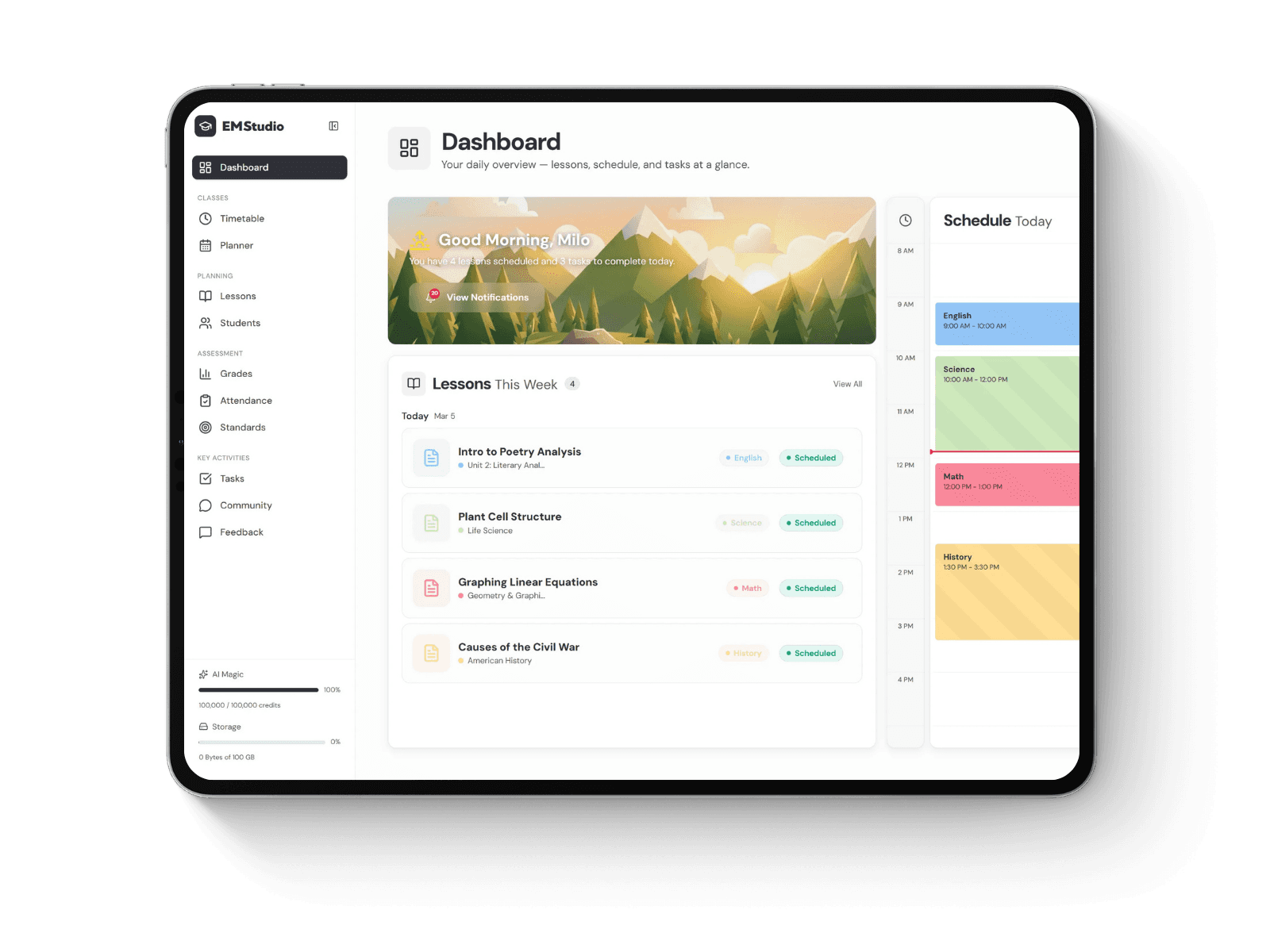
Still grading everything by hand?
EMStudio is a free teaching management app — manage your classes, students, lessons, and more!
Learn More
Table of Contents
What Is Elementary Ed?
Elementary ed encompasses the formal schooling of children from kindergarten through grade five, typically ages five to eleven. It establishes foundational literacy, numeracy, and social-emotional competencies through developmentally appropriate instruction aligned with state academic standards, preparing students for the cognitive demands of secondary education. Unlike secondary teachers who hold single-subject licenses, you'll earn a multiple-subject credential that authorizes you to teach everything from phonics to earth science. Your preparation focuses on pedagogical content knowledge for Piaget's concrete operational stage—kids who can logically sort manipulatives but still cry over skinned knees.
Three structures shape your daily work. State academic standards—whether Common Core State Standards or state equivalents—dictate what you teach. Mandatory instructional time requirements mandate six to seven hours of daily seat time, including specific PE minutes. Finally, mastery-based progression policies in twenty-six states determine whether a child moves to fourth grade based on reading proficiency rather than age alone.
Grade Levels and Age Ranges in Elementary Ed
In the US, elementary education covers kindergarten through fifth grade. Kindergarten serves five- to six-year-olds, though California offers transitional kindergarten for four-year-olds who miss the September 1 cutoff. Grades 1-3 are the primary years (ages 6-9), while grades 4-5 constitute upper elementary (ages 9-11). Most states require compulsory attendance from age six to sixteen, with enrollment deadlines typically falling on September 1. You'll see variations in kindergarten schedules—some districts still run half-day programs, though full-day has become the norm to meet instructional minute requirements.
Kindergarten: Ages 5-6, with transitional options for 4-year-olds in California and other states adopting similar models.
Primary grades: Ages 6-9 (grades 1-3), where you build foundational phonemic awareness and number sense.
Upper elementary: Ages 9-11 (grades 4-5), where content becomes more specialized and testing frequency increases.
Internationally, the boundaries blur. The UK's primary education spans Key Stage 1 (ages 5-7) and Key Stage 2 (ages 7-11), roughly matching our elementary span. This differs sharply from early childhood education, which covers pre-K and nursery programs focused on play-based learning rather than the structured academic standards and mandatory seat time you'll handle in elementary.
Core Subject Areas and Academic Standards
Your day breaks into five mandated blocks. English Language Arts requires ninety minutes daily—non-negotiable in most districts. Mathematics gets sixty minutes. Science follows NGSS or state equivalents emphasizing hands-on inquiry. Social Studies and related arts round out the schedule, with states like California mandating two hundred minutes of PE per ten days. These aren't guidelines; they're audit items during district walkthroughs.
Third grade is the pressure point. Twenty-six states now mandate retention for students who don't pass reading proficiency gates. You'll administer high-stakes math assessments in grades 3-5 as well. The standards driving your pacing guides depend on location—Common Core State Standards in forty-one states, TEKS in Texas, or Virginia SOL. These documents tell you exactly when to teach multi-digit addition or fractions, leaving little room for detours based on teachable moments.
English Language Arts: Minimum 90 minutes daily, focusing on reading, writing, speaking, and listening.
Mathematics: 60 minutes daily, progressing from concrete counting to abstract algebraic thinking.
Science and Social Studies: Often blocked together, with science emphasizing hands-on inquiry through NGSS standards.
PE and Related Arts: California requires 200 minutes per 10 days; other states vary but mandate specific minimums.
Developmental Milestones and Learning Objectives
Grades 2-5 hit Piaget's concrete operational stage—kids can think logically about actual objects and events, not abstract concepts. You'll see this when manipulatives suddenly make math click around February of second grade. Erikson's industry versus inferiority crisis runs ages 6-12; your formative assessment feedback matters tremendously during this window, determining whether a child develops competence or shuts down.
The benchmarks are specific. By June of third grade, students should read ninety words correct per minute on DIBELS 8th Edition. They need automatic recall of multiplication tables 0-10. Fine motor skills shift dramatically—handwriting instruction transitions to cursive in grade 3 where state law still requires it, while keyboarding expectations hit twenty-five words per minute by fifth grade.
Reading fluency: 90 words correct per minute by end of 3rd grade (DIBELS 8th Edition).
Math automaticity: Multiplication tables 0-10 mastered by end of 3rd grade.
Fine motor transition: Cursive instruction in grade 3, 25 wpm keyboarding by grade 5.
Your classroom management strategies must account for these developmental realities—you're teaching kids who can handle multiplication concepts but lack the executive function for long-term project management. For practical ways to hit these targets, see our essential strategies for cognitive development by grade level.

Why Does Elementary Ed Matter for Lifelong Success?
Research demonstrates that reading proficiency by third grade predicts high school graduation with four times greater accuracy than socioeconomic status. Elementary ed establishes neural pathways for literacy and numeracy. These connections become increasingly resistant to remediation after age twelve, directly correlating with lifetime earnings and civic participation. What happens in these years doesn't just predict middle school report cards; it determines whether a student qualifies for college-prep math or drops out to make rent.
The Matthew Effect in Reading
Keith Stanovich identified this phenomenon back in 1986. Students decoding below grade level by third grade face four times the dropout risk of their peers. That's the "rich get richer" dynamic in action. Early readers build vocabulary and background knowledge exponentially, while struggling readers fall further behind each year. John Hattie's Visible Learning meta-analysis puts the effect size for direct instruction in early literacy at 0.59—nearly double the average intervention impact. This isn't about drilling kids; it's about specific pedagogical content knowledge applied during the window when brains are still wiring themselves for text.
I've watched this play out in my own elementary school classrooms. The kids who miss phonemic awareness in kindergarten don't just struggle with chapter books in fourth grade—they start avoiding text entirely. By middle school, they're getting through coursework through workarounds rather than literacy. The gap widens not because older students can't learn, but because the academic world assumes automaticity they never developed.
When Early Gaps Compound
Academic deficits don't stay static; they grow exponentially like compound interest in reverse. A student missing number sense foundations in second grade requires increasingly expensive interventions in middle and high school. Districts spend significantly more per pupil on secondary remediation than on early prevention. This failure mode of inadequate preparation locks students out of advanced coursework and postsecondary options before they even reach freshman orientation.
Formative assessment catches these leaks before the dam breaks. Quick phonics screeners and math fact fluency checks in October identify struggling students early. These kids need science-backed methods to improve student focus and targeted support before the gap widens. Waiting for standardized spring testing wastes months of potential growth.
Brain Windows and Economic Reality
Ages five through ten represent critical neuroplasticity periods for phonological awareness and number sense. After age twelve, remediation faces three specific barriers:
The brain allocates less metabolic resources to novel linguistic patterns
Social-emotional development competes for attention and working memory
Academic shame complicates risk-taking necessary for skill acquisition
Manipulatives aren't toys; they're concrete anchors for abstract concepts. These tools must secure understanding before puberty rewires the brain for social processing instead. A fourth grader who never internalized place value with base-ten blocks now faces algebra with a shaky foundation.
The economic impact hits later. Students with strong elementary school math foundations access STEM careers at higher rates. These are the kids who worked with physical objects and visual fractions early. They show stronger lifetime earnings trajectories. When you teach a kid to decompose numbers in second grade, you're building cognitive architecture. They'll need it for algebraic thinking and financial literacy down the road.
Classroom management matters here too. A chaotic environment wastes these critical neurological windows. The early childhood education research is clear: secure, predictable classrooms allow brains to allocate resources to academic wiring rather than threat detection. You can't remediate lost time once those windows close.

How Elementary Ed Works: Classroom Models and Structures
Elementary ed looks simple from the outside. One teacher, twenty-five kids, a rug for morning meeting. But underneath, the architecture varies wildly. Your schedule depends on which model your district bets on, and that choice shapes everything from your prep time to how well you know your kids' families.
Self-Contained vs. Departmentalized Classroom Models
Most schools run one of three structures. In a self-contained classroom, you handle it all. Math, reading, science, social studies — plus the social skills crisis happening at the pencil sharpener. This dominates K-2 because young kids need attachment. Research shows stronger student-teacher bonds here, and it makes sense: you're their person for six hours.
Departmentalized models kick in around grade 3. Kids rotate between teachers for the four core subjects: math, science, ELA, and social studies. You specialize. If you have strong pedagogical content knowledge in math, you teach 120 kids that subject instead of struggling through fractions you barely understand. Team Teaching offers a third path: two teachers share 50 students with flexible grouping, though you need serious coordination to avoid simply splitting the class in half permanently.
The trade-offs hit three specific areas:
Teacher preparation: Self-contained requires generalist knowledge across domains; departmentalized demands content-specific endorsements and deeper subject expertise.
Parent communication: One point of contact versus tracking four or five teachers' grading policies and communication styles.
Implementation costs: Departmentalized needs 15-20% more prep periods and transition supervision staff.
Transitions eat time. Switching classes burns 15-20 minutes daily. That adds up to nearly two weeks of lost instruction yearly. Some kids crash in this model. Students with autism spectrum disorders who struggle with transitions often fail here. Don't try departmentalization without 45 minutes of common planning time for your team. Otherwise, you're just siloed and exhausted. Class size rules vary wildly. Texas mandates 22:1 for K-4. California allows 24:1 but permits districts to hit 28:1 by third grade. Those four extra bodies change how you manage classroom management and formative assessment.
Multi-Age and Looping Classroom Strategies
Looping means you keep your class for two years — teaching kindergarten then looping to first grade with the same crew. Multi-age classrooms combine grades in one room, often K-1 or 2-3 splits, usually because enrollment numbers don't divide cleanly.
The upside is diagnostic depth. By October of year two, you know exactly who still confuses /b/ and /d/ in phonemic awareness and which kids need manipulatives to grasp place value. You skip the August-September get-to-know-you phase entirely. For trauma-impacted kids, this stability is security. They don't spend fall wondering if the new teacher is safe.
The benefits stack up:
Enhanced diagnostic knowledge of individual learning patterns.
Reduced transition time in August and September of year two.
Attachment security for students with trauma histories or anxiety.
But looping requires a three-year commitment from you — the prep year, the loop year, and the recovery year. You need professional development spanning multiple grade levels, not just your single license band. Parents often resist "split" classes, fearing their child gets less attention. You have to sell the structure hard. I've seen looping work beautifully in primary school settings where early childhood education principles prioritize relationship continuity over rigid grade-level benchmarks.
Inclusion Practices and Special Education Integration
Federal law mandates Least Restrictive Environment (LRE), which usually means pushing special education services into the general classroom rather than pulling kids out. You either get a co-teacher pushing in, or you send kids to a resource room for targeted support. The legal standard is clear: start with the assumption that students belong in general education.
If you co-teach, you need to know the six models:
One Teach/One Assist: One leads while the other circulates — fine for behavior support, terrible for instruction.
Station Teaching: Split the class in half for different activities at separate stations.
Parallel Teaching: Duplicate the same lesson in two groups for better ratios.
Alternative Teaching: Pull a small group for pre-teaching vocabulary or reteaching fractions.
Team Teaching: Both teachers lead together, tag-teaming the lesson.
One Teach/One Observe: One collects data on specific IEP goals while the other runs class.
Success metrics matter. IDEA suggests considering 80% or more of the day in general education for most students. Paraprofessionals help, but clarify their role — instructional support differs from personal care. For essential strategies for building inclusive classrooms, start with clear co-teaching agreements before day one.

Elementary Ed vs. Primary School and Middle School: Key Differences
Elementary ed sits between two distinct worlds. You start with kids who need help tying shoes, and you send them off to middle school teachers who specialize in single subjects. The architecture of each tier changes the teaching entirely.
Feature | Primary School | Elementary Ed | Middle School |
|---|---|---|---|
Grades | Pre-K–K | 1–5 | 6–8 |
Ages | 3–5 | 6–11 | 11–14 |
Curriculum Model | Play-based (Creative Curriculum/HighScope) | Standards-based academic instruction | Content-specialist with bell schedules |
Student Ratios | 1:10 | 1:25 | 1:25+ |
Teacher Credentials | CDA or early childhood degree | State elementary certification | Subject certification with pedagogical content knowledge |
Daily Structure | Centers, snack, nap time | Self-contained or departmentalized | 6-period rotations, lockers |
Assessment philosophy shifts across these tiers. In elementary grades, you rely on criterion-referenced testing—does the kid hit the standard or not? You adjust tomorrow's lesson based on formative assessment data from today. Middle school often flips to norm-referenced groupings, sorting kids into advanced or remedial tracks based on percentile ranks rather than mastery alone.
Primary School Foundations: Pre-K Through Kindergarten
Walk into a Pre-K room and you'll smell snack time and hear the hum of discovery play. This is early childhood education, and it operates on different rules than your 3rd grade classroom. Pre-K runs on developmental play standards—Creative Curriculum or HighScope frameworks—rather than the academic standards driving elementary grades. You're watching for phonemic awareness emerging through songs and center time, not decoding words on a page.
The logistics hit different too. Pre-K teachers handle toileting assistance and schedule nap times. They track physical milestones alongside cognitive ones. Teacher qualifications split here as well. Pre-K educators might hold a CDA (Child Development Associate) or an early childhood degree, while elementary teachers need state certification covering K-5 or K-6. Classroom management in Pre-K means managing 10 kids with a co-teacher, whereas by 2nd grade you're solo with 25.
The Upper Elementary Shift: Grades 3-5
Third grade is the cliff. Twenty-six states now have mandatory retention laws. If a child isn't reading at grade level by the end of 3rd grade, they don't move to 4th. This creates a high-stakes testing environment that doesn't exist in primary grades. You shift from learning-to-read to reading-to-learn. Suddenly kids who struggled with phonics are drowning in science textbook vocabulary.
Math transforms too. You move from manipulatives—physical blocks and fraction bars—to abstract algorithmic thinking. Long division hits in 4th grade. Fraction operations require manipulating numbers without visual models. Homework loads jump following the 10-minutes-per-grade-level rule. Writing stamina becomes brutal; by 5th grade, you're expecting five-paragraph essays with evidence and transitions. The formative assessment data you collect shifts from "can they count" to "can they justify their mathematical reasoning."
Preparing Students for Middle School Transitions
By April of 5th grade, you're not just teaching content—you're teaching survival skills. Drill these five competencies until they're automatic:
Combination lock operation
Managing materials across multiple teachers
Hallway navigation with bell schedules
Locker organization systems
Recording homework in planners without prompts
The social-emotional shift is jarring. Kids move from single-teacher attachment to managing relationships with 6-8 content teachers who see them for 45 minutes. Peer pressure susceptibility spikes as they approach adolescence. When transitioning from primary to secondary education structures, the safety net disappears. Your 5th graders need to know how to self-advocate because their science teacher won't notice they're confused the way you do.

Practical Applications: Evidence-Based Strategies for Elementary Ed
Theory means nothing if it stays in your credential program binder. Here is what actually works in elementary ed classrooms when the bell rings at 8:15 and you have twenty-eight kids staring at you.
Differentiated Instruction for Diverse Learners
Carol Ann Tomlinson's framework breaks differentiation into three moves. You adjust content using assessment data like the Fountas & Pinnell Benchmark Assessment System (levels A-Z) to match readers to text. You vary process through learning stations where some kids use manipulatives while others sketch models or work in pairs. You offer product choice boards letting students demonstrate mastery through video, writing, or hands-on building.
Start with DIBELS 8th Edition for reading fluency benchmarking. It takes three minutes per student and tells you who needs phonemic awareness intervention versus who is ready for comprehension work. Run Must Do/May Do lists during independent blocks. The Must Do covers non-negotiable standards; the May Do offers extension. For math, design tiered assignments on the same standard: single-digit addition for baseline, multi-digit for grade level, and word problems requiring multiple operations for advanced learners. This requires strong pedagogical content knowledge—knowing not just what to teach but how to adjust the difficulty without changing the learning target.
Group flexibly. Change your guided reading groups every 6-8 weeks based on fresh formative assessment data. Watch for warning signs that you have slipped into tracking:
Static ability groups that never change composition.
No movement between groups even after new data shows growth.
Disproportionate representation by race or ethnicity in lower groups.
That is illegal tracking wearing differentiation's clothes. Instead, run math workshop rotations: teacher-led small group at the kidney table, independent practice with manipulatives, and a technology station for adaptive practice. Kids rotate every 15 minutes. Everyone gets what they need. See our comprehensive guide to mastering differentiated instruction for templates.
Social-Emotional Learning Integration Techniques
The CASEL competencies—self-awareness, self-management, social awareness, relationship skills, responsible decision-making—cannot be taught once a week. You need explicit instruction plus integration. Run morning meetings using the Responsive Classroom model: 20 minutes daily for greeting, sharing, activity, and morning message. It builds community and teaches turn-taking. This approach draws from early childhood education roots where social development is the curriculum.
Implement Second Step or Zones of Regulation for emotion management. Teach the Calm Classroom breathing exercises—three minutes daily, usually after recess. It resets the nervous system. When conflict arises, use restorative practices circles instead of sending kids to the office. Sit in a circle. Ask: "What happened? Who was affected? How do we make it right?" Set up a calming corner with sensory tools: stress balls, noise-canceling headphones, and a visual timer. It is not timeout; it is a self-regulation station that supports your classroom management without punishment.
CASEL recommends 15 minutes of explicit SEL instruction daily, woven throughout content areas. Use the RULER approach:
Recognizing emotion in self and others.
Understanding the causes and consequences of emotions.
Labeling emotions with precise vocabulary.
Expressing emotions appropriately.
Regulating emotions effectively.
When you read aloud, ask: "What zone is this character in?" That is SEL integrated with literacy, not an extra block in your schedule.
Family Engagement and Community Partnership Models
The Parent Teacher Home Visit Project model works. Conduct two voluntary visits per year—once before school starts and once in winter. Districts compensate teacher time. You sit on the porch, ask about hopes and dreams, and build trust before the first parent-teacher conference. It changes the dynamic from adversarial to partnership. In elementary ed, these relationships determine whether parents answer your call when problems arise.
For daily communication, pick one app and stick with it:
ClassDojo works for behavior tracking and classroom photos.
Remind is best for quick text blasts without sharing personal numbers.
Seesaw lets parents see portfolios and leave voice comments.
Send weekly newsletters with translation services—IDEA mandates this for IEP families, but do it for everyone. Use SignUpGenius to coordinate volunteers for field trips or classroom parties without the reply-all email chaos.
Host academic family nights with take-home activity kits. Show parents how to use the manipulatives you use in class. Create take-home leveled reader bags with books matched to their child's Fountas & Pinnell level. Run parent workshops on supporting phonemic awareness at home. Partner with the local high school for Reading Buddies—teenagers read with your first graders once a week. Get a local business to adopt your classroom for supplies. This is how you build the village elementary education requires. Check our strategies for creating comprehensive family engagement plans to get started.
How to Build a Career in Elementary Ed From Certification to Specialization?
Building a career in elementary ed requires completing a bachelor's degree in elementary education or an alternative certification program, passing state licensure examinations such as the Praxis 5001, and fulfilling student teaching requirements. Specializations include ESL, special education, or STEM integration, with advancement through National Board Certification. Most states follow a similar trajectory, though the specifics of your journey depend on whether you start with a traditional four-year program or pivot from another field.
Licensing Requirements and Alternative Certification Pathways
The standard path runs four years. You complete your bachelor's in primary education, then sit for the Praxis Elementary Education 5001. Passing scores vary—Virginia wants a 157, Pennsylvania demands 163. Some states use their own exams like the TExES or NYSTCE. Then comes student teaching: 12 to 16 weeks of full-time, unpaid work where you apply your pedagogical content knowledge in a real classroom with a veteran mentor. After that, you receive an initial license lasting one to three years. During this provisional period, you work under increased observation and must complete an induction program involving weekly mentoring sessions and portfolio reviews before earning your professional license.
If you already hold a bachelor's in another field, alternative certification offers a faster track:
Teach for America: Five-week summer institute, then immediate placement.
American Board: Fully online, six to twelve months of self-paced study.
State programs: Texas ACP or Florida EPI blend coursework with mentored teaching.
Be aware: districts often place alternatively certified teachers in high-need schools with limited mentoring. Budget for the full certification cost:
Background checks: $50–$100
Initial licensing fees: $100–$300
Renewal requirements: Varies by state (Illinois requires 120 professional development hours per five-year cycle)
The Interstate Agreement on Qualification of Educational Personnel smooths transfers between 46 states, but check carefully; some states force out-of-state teachers to retake exams.
Choosing Between Early Childhood and Upper Elementary Focus
Your license determines your daily reality. Early childhood education covers birth through grade three. You will handle toileting accidents, supervise nap time, and focus heavily on phonemic awareness and emergent literacy. Upper elementary—grades three to six—shifts toward content mastery, independent work, and standardized test preparation. You trade glue sticks for lab reports, but you gain deeper academic conversations. Third graders still need help tying shoes; sixth graders need help organizing binders for six different teachers. The social-emotional demands differ but never disappear.
Most elementary licenses cover K-6, while early childhood certifications stop at grade three. Dual certification makes you significantly more marketable, especially in smaller districts that need flexibility. The classroom tools differ too:
Early childhood: Sand trays, play dough, and counting bears for sensory-based learning.
Upper elementary: Fraction bars, algebra tiles, and scientific manipulatives for abstract concepts.
Your formative assessment strategies shift from observational checklists in kindergarten to written exit tickets in fifth grade. Choose based on your tolerance for physical care versus content complexity.
Professional Development and Advancement Opportunities
Once you have your footing, National Board Certification offers the most respected advancement path. The process costs $1,900 and takes about three years. You submit a portfolio with student work samples and video recordings of your teaching, then complete assessment center exercises. Successful candidates typically see salary increases between $2,000 and $10,000 annually, depending on the district. This credential signals mastery in classroom management and instruction. Many teachers report the reflection process alone improves their practice significantly, even before earning the certificate.
Beyond National Boards, micro-credentials provide flexible growth. Digital Promise offers stackable badges in areas like computational thinking or trauma-informed practices. These often translate to "lane changes" on salary schedules—moving from BA+15 to MA or MA+30. For a broader view of long-term planning, see our step-by-step guide for teacher career advancement. If you're looking for immediate options, explore these proven programs for professional growth. Whether you pursue administration, instructional coaching, or specialized endorsements, treat your development like a curriculum map—planned, sequenced, and regularly assessed.

Final Thoughts on Elementary Ed
You can have the prettiest bulletin boards and the quietest hallway lines, but if you don't know what your kids actually learned today, you're flying blind. Formative assessment isn't a buzzword—it's the clipboard you carry during small group work, the three questions you ask before the bell rings, the quick scan of their math journals while they work. That's the difference between teaching and hoping. Your pedagogical content knowledge matters, but only if you're checking whether it's actually sticking.
Here's your action item for tomorrow: Pick one lesson. Plan one specific moment where you'll check every single student's understanding before they leave the carpet or close their Chromebooks. A whiteboard response. A turn-and-talk with accountable listening. A single problem on an index card. Don't grade it. Just read it. Then actually adjust Wednesday's plan based on what you see, even if it means slowing down.
Great elementary ed isn't built on big programs or perfect curricula. It's built on thousands of these small, daily decisions. Make this one tomorrow.

What Is Elementary Ed?
Elementary ed encompasses the formal schooling of children from kindergarten through grade five, typically ages five to eleven. It establishes foundational literacy, numeracy, and social-emotional competencies through developmentally appropriate instruction aligned with state academic standards, preparing students for the cognitive demands of secondary education. Unlike secondary teachers who hold single-subject licenses, you'll earn a multiple-subject credential that authorizes you to teach everything from phonics to earth science. Your preparation focuses on pedagogical content knowledge for Piaget's concrete operational stage—kids who can logically sort manipulatives but still cry over skinned knees.
Three structures shape your daily work. State academic standards—whether Common Core State Standards or state equivalents—dictate what you teach. Mandatory instructional time requirements mandate six to seven hours of daily seat time, including specific PE minutes. Finally, mastery-based progression policies in twenty-six states determine whether a child moves to fourth grade based on reading proficiency rather than age alone.
Grade Levels and Age Ranges in Elementary Ed
In the US, elementary education covers kindergarten through fifth grade. Kindergarten serves five- to six-year-olds, though California offers transitional kindergarten for four-year-olds who miss the September 1 cutoff. Grades 1-3 are the primary years (ages 6-9), while grades 4-5 constitute upper elementary (ages 9-11). Most states require compulsory attendance from age six to sixteen, with enrollment deadlines typically falling on September 1. You'll see variations in kindergarten schedules—some districts still run half-day programs, though full-day has become the norm to meet instructional minute requirements.
Kindergarten: Ages 5-6, with transitional options for 4-year-olds in California and other states adopting similar models.
Primary grades: Ages 6-9 (grades 1-3), where you build foundational phonemic awareness and number sense.
Upper elementary: Ages 9-11 (grades 4-5), where content becomes more specialized and testing frequency increases.
Internationally, the boundaries blur. The UK's primary education spans Key Stage 1 (ages 5-7) and Key Stage 2 (ages 7-11), roughly matching our elementary span. This differs sharply from early childhood education, which covers pre-K and nursery programs focused on play-based learning rather than the structured academic standards and mandatory seat time you'll handle in elementary.
Core Subject Areas and Academic Standards
Your day breaks into five mandated blocks. English Language Arts requires ninety minutes daily—non-negotiable in most districts. Mathematics gets sixty minutes. Science follows NGSS or state equivalents emphasizing hands-on inquiry. Social Studies and related arts round out the schedule, with states like California mandating two hundred minutes of PE per ten days. These aren't guidelines; they're audit items during district walkthroughs.
Third grade is the pressure point. Twenty-six states now mandate retention for students who don't pass reading proficiency gates. You'll administer high-stakes math assessments in grades 3-5 as well. The standards driving your pacing guides depend on location—Common Core State Standards in forty-one states, TEKS in Texas, or Virginia SOL. These documents tell you exactly when to teach multi-digit addition or fractions, leaving little room for detours based on teachable moments.
English Language Arts: Minimum 90 minutes daily, focusing on reading, writing, speaking, and listening.
Mathematics: 60 minutes daily, progressing from concrete counting to abstract algebraic thinking.
Science and Social Studies: Often blocked together, with science emphasizing hands-on inquiry through NGSS standards.
PE and Related Arts: California requires 200 minutes per 10 days; other states vary but mandate specific minimums.
Developmental Milestones and Learning Objectives
Grades 2-5 hit Piaget's concrete operational stage—kids can think logically about actual objects and events, not abstract concepts. You'll see this when manipulatives suddenly make math click around February of second grade. Erikson's industry versus inferiority crisis runs ages 6-12; your formative assessment feedback matters tremendously during this window, determining whether a child develops competence or shuts down.
The benchmarks are specific. By June of third grade, students should read ninety words correct per minute on DIBELS 8th Edition. They need automatic recall of multiplication tables 0-10. Fine motor skills shift dramatically—handwriting instruction transitions to cursive in grade 3 where state law still requires it, while keyboarding expectations hit twenty-five words per minute by fifth grade.
Reading fluency: 90 words correct per minute by end of 3rd grade (DIBELS 8th Edition).
Math automaticity: Multiplication tables 0-10 mastered by end of 3rd grade.
Fine motor transition: Cursive instruction in grade 3, 25 wpm keyboarding by grade 5.
Your classroom management strategies must account for these developmental realities—you're teaching kids who can handle multiplication concepts but lack the executive function for long-term project management. For practical ways to hit these targets, see our essential strategies for cognitive development by grade level.
Why Does Elementary Ed Matter for Lifelong Success?
Research demonstrates that reading proficiency by third grade predicts high school graduation with four times greater accuracy than socioeconomic status. Elementary ed establishes neural pathways for literacy and numeracy. These connections become increasingly resistant to remediation after age twelve, directly correlating with lifetime earnings and civic participation. What happens in these years doesn't just predict middle school report cards; it determines whether a student qualifies for college-prep math or drops out to make rent.
The Matthew Effect in Reading
Keith Stanovich identified this phenomenon back in 1986. Students decoding below grade level by third grade face four times the dropout risk of their peers. That's the "rich get richer" dynamic in action. Early readers build vocabulary and background knowledge exponentially, while struggling readers fall further behind each year. John Hattie's Visible Learning meta-analysis puts the effect size for direct instruction in early literacy at 0.59—nearly double the average intervention impact. This isn't about drilling kids; it's about specific pedagogical content knowledge applied during the window when brains are still wiring themselves for text.
I've watched this play out in my own elementary school classrooms. The kids who miss phonemic awareness in kindergarten don't just struggle with chapter books in fourth grade—they start avoiding text entirely. By middle school, they're getting through coursework through workarounds rather than literacy. The gap widens not because older students can't learn, but because the academic world assumes automaticity they never developed.
When Early Gaps Compound
Academic deficits don't stay static; they grow exponentially like compound interest in reverse. A student missing number sense foundations in second grade requires increasingly expensive interventions in middle and high school. Districts spend significantly more per pupil on secondary remediation than on early prevention. This failure mode of inadequate preparation locks students out of advanced coursework and postsecondary options before they even reach freshman orientation.
Formative assessment catches these leaks before the dam breaks. Quick phonics screeners and math fact fluency checks in October identify struggling students early. These kids need science-backed methods to improve student focus and targeted support before the gap widens. Waiting for standardized spring testing wastes months of potential growth.
Brain Windows and Economic Reality
Ages five through ten represent critical neuroplasticity periods for phonological awareness and number sense. After age twelve, remediation faces three specific barriers:
The brain allocates less metabolic resources to novel linguistic patterns
Social-emotional development competes for attention and working memory
Academic shame complicates risk-taking necessary for skill acquisition
Manipulatives aren't toys; they're concrete anchors for abstract concepts. These tools must secure understanding before puberty rewires the brain for social processing instead. A fourth grader who never internalized place value with base-ten blocks now faces algebra with a shaky foundation.
The economic impact hits later. Students with strong elementary school math foundations access STEM careers at higher rates. These are the kids who worked with physical objects and visual fractions early. They show stronger lifetime earnings trajectories. When you teach a kid to decompose numbers in second grade, you're building cognitive architecture. They'll need it for algebraic thinking and financial literacy down the road.
Classroom management matters here too. A chaotic environment wastes these critical neurological windows. The early childhood education research is clear: secure, predictable classrooms allow brains to allocate resources to academic wiring rather than threat detection. You can't remediate lost time once those windows close.
How Elementary Ed Works: Classroom Models and Structures
Elementary ed looks simple from the outside. One teacher, twenty-five kids, a rug for morning meeting. But underneath, the architecture varies wildly. Your schedule depends on which model your district bets on, and that choice shapes everything from your prep time to how well you know your kids' families.
Self-Contained vs. Departmentalized Classroom Models
Most schools run one of three structures. In a self-contained classroom, you handle it all. Math, reading, science, social studies — plus the social skills crisis happening at the pencil sharpener. This dominates K-2 because young kids need attachment. Research shows stronger student-teacher bonds here, and it makes sense: you're their person for six hours.
Departmentalized models kick in around grade 3. Kids rotate between teachers for the four core subjects: math, science, ELA, and social studies. You specialize. If you have strong pedagogical content knowledge in math, you teach 120 kids that subject instead of struggling through fractions you barely understand. Team Teaching offers a third path: two teachers share 50 students with flexible grouping, though you need serious coordination to avoid simply splitting the class in half permanently.
The trade-offs hit three specific areas:
Teacher preparation: Self-contained requires generalist knowledge across domains; departmentalized demands content-specific endorsements and deeper subject expertise.
Parent communication: One point of contact versus tracking four or five teachers' grading policies and communication styles.
Implementation costs: Departmentalized needs 15-20% more prep periods and transition supervision staff.
Transitions eat time. Switching classes burns 15-20 minutes daily. That adds up to nearly two weeks of lost instruction yearly. Some kids crash in this model. Students with autism spectrum disorders who struggle with transitions often fail here. Don't try departmentalization without 45 minutes of common planning time for your team. Otherwise, you're just siloed and exhausted. Class size rules vary wildly. Texas mandates 22:1 for K-4. California allows 24:1 but permits districts to hit 28:1 by third grade. Those four extra bodies change how you manage classroom management and formative assessment.
Multi-Age and Looping Classroom Strategies
Looping means you keep your class for two years — teaching kindergarten then looping to first grade with the same crew. Multi-age classrooms combine grades in one room, often K-1 or 2-3 splits, usually because enrollment numbers don't divide cleanly.
The upside is diagnostic depth. By October of year two, you know exactly who still confuses /b/ and /d/ in phonemic awareness and which kids need manipulatives to grasp place value. You skip the August-September get-to-know-you phase entirely. For trauma-impacted kids, this stability is security. They don't spend fall wondering if the new teacher is safe.
The benefits stack up:
Enhanced diagnostic knowledge of individual learning patterns.
Reduced transition time in August and September of year two.
Attachment security for students with trauma histories or anxiety.
But looping requires a three-year commitment from you — the prep year, the loop year, and the recovery year. You need professional development spanning multiple grade levels, not just your single license band. Parents often resist "split" classes, fearing their child gets less attention. You have to sell the structure hard. I've seen looping work beautifully in primary school settings where early childhood education principles prioritize relationship continuity over rigid grade-level benchmarks.
Inclusion Practices and Special Education Integration
Federal law mandates Least Restrictive Environment (LRE), which usually means pushing special education services into the general classroom rather than pulling kids out. You either get a co-teacher pushing in, or you send kids to a resource room for targeted support. The legal standard is clear: start with the assumption that students belong in general education.
If you co-teach, you need to know the six models:
One Teach/One Assist: One leads while the other circulates — fine for behavior support, terrible for instruction.
Station Teaching: Split the class in half for different activities at separate stations.
Parallel Teaching: Duplicate the same lesson in two groups for better ratios.
Alternative Teaching: Pull a small group for pre-teaching vocabulary or reteaching fractions.
Team Teaching: Both teachers lead together, tag-teaming the lesson.
One Teach/One Observe: One collects data on specific IEP goals while the other runs class.
Success metrics matter. IDEA suggests considering 80% or more of the day in general education for most students. Paraprofessionals help, but clarify their role — instructional support differs from personal care. For essential strategies for building inclusive classrooms, start with clear co-teaching agreements before day one.
Elementary Ed vs. Primary School and Middle School: Key Differences
Elementary ed sits between two distinct worlds. You start with kids who need help tying shoes, and you send them off to middle school teachers who specialize in single subjects. The architecture of each tier changes the teaching entirely.
Feature | Primary School | Elementary Ed | Middle School |
|---|---|---|---|
Grades | Pre-K–K | 1–5 | 6–8 |
Ages | 3–5 | 6–11 | 11–14 |
Curriculum Model | Play-based (Creative Curriculum/HighScope) | Standards-based academic instruction | Content-specialist with bell schedules |
Student Ratios | 1:10 | 1:25 | 1:25+ |
Teacher Credentials | CDA or early childhood degree | State elementary certification | Subject certification with pedagogical content knowledge |
Daily Structure | Centers, snack, nap time | Self-contained or departmentalized | 6-period rotations, lockers |
Assessment philosophy shifts across these tiers. In elementary grades, you rely on criterion-referenced testing—does the kid hit the standard or not? You adjust tomorrow's lesson based on formative assessment data from today. Middle school often flips to norm-referenced groupings, sorting kids into advanced or remedial tracks based on percentile ranks rather than mastery alone.
Primary School Foundations: Pre-K Through Kindergarten
Walk into a Pre-K room and you'll smell snack time and hear the hum of discovery play. This is early childhood education, and it operates on different rules than your 3rd grade classroom. Pre-K runs on developmental play standards—Creative Curriculum or HighScope frameworks—rather than the academic standards driving elementary grades. You're watching for phonemic awareness emerging through songs and center time, not decoding words on a page.
The logistics hit different too. Pre-K teachers handle toileting assistance and schedule nap times. They track physical milestones alongside cognitive ones. Teacher qualifications split here as well. Pre-K educators might hold a CDA (Child Development Associate) or an early childhood degree, while elementary teachers need state certification covering K-5 or K-6. Classroom management in Pre-K means managing 10 kids with a co-teacher, whereas by 2nd grade you're solo with 25.
The Upper Elementary Shift: Grades 3-5
Third grade is the cliff. Twenty-six states now have mandatory retention laws. If a child isn't reading at grade level by the end of 3rd grade, they don't move to 4th. This creates a high-stakes testing environment that doesn't exist in primary grades. You shift from learning-to-read to reading-to-learn. Suddenly kids who struggled with phonics are drowning in science textbook vocabulary.
Math transforms too. You move from manipulatives—physical blocks and fraction bars—to abstract algorithmic thinking. Long division hits in 4th grade. Fraction operations require manipulating numbers without visual models. Homework loads jump following the 10-minutes-per-grade-level rule. Writing stamina becomes brutal; by 5th grade, you're expecting five-paragraph essays with evidence and transitions. The formative assessment data you collect shifts from "can they count" to "can they justify their mathematical reasoning."
Preparing Students for Middle School Transitions
By April of 5th grade, you're not just teaching content—you're teaching survival skills. Drill these five competencies until they're automatic:
Combination lock operation
Managing materials across multiple teachers
Hallway navigation with bell schedules
Locker organization systems
Recording homework in planners without prompts
The social-emotional shift is jarring. Kids move from single-teacher attachment to managing relationships with 6-8 content teachers who see them for 45 minutes. Peer pressure susceptibility spikes as they approach adolescence. When transitioning from primary to secondary education structures, the safety net disappears. Your 5th graders need to know how to self-advocate because their science teacher won't notice they're confused the way you do.
Practical Applications: Evidence-Based Strategies for Elementary Ed
Theory means nothing if it stays in your credential program binder. Here is what actually works in elementary ed classrooms when the bell rings at 8:15 and you have twenty-eight kids staring at you.
Differentiated Instruction for Diverse Learners
Carol Ann Tomlinson's framework breaks differentiation into three moves. You adjust content using assessment data like the Fountas & Pinnell Benchmark Assessment System (levels A-Z) to match readers to text. You vary process through learning stations where some kids use manipulatives while others sketch models or work in pairs. You offer product choice boards letting students demonstrate mastery through video, writing, or hands-on building.
Start with DIBELS 8th Edition for reading fluency benchmarking. It takes three minutes per student and tells you who needs phonemic awareness intervention versus who is ready for comprehension work. Run Must Do/May Do lists during independent blocks. The Must Do covers non-negotiable standards; the May Do offers extension. For math, design tiered assignments on the same standard: single-digit addition for baseline, multi-digit for grade level, and word problems requiring multiple operations for advanced learners. This requires strong pedagogical content knowledge—knowing not just what to teach but how to adjust the difficulty without changing the learning target.
Group flexibly. Change your guided reading groups every 6-8 weeks based on fresh formative assessment data. Watch for warning signs that you have slipped into tracking:
Static ability groups that never change composition.
No movement between groups even after new data shows growth.
Disproportionate representation by race or ethnicity in lower groups.
That is illegal tracking wearing differentiation's clothes. Instead, run math workshop rotations: teacher-led small group at the kidney table, independent practice with manipulatives, and a technology station for adaptive practice. Kids rotate every 15 minutes. Everyone gets what they need. See our comprehensive guide to mastering differentiated instruction for templates.
Social-Emotional Learning Integration Techniques
The CASEL competencies—self-awareness, self-management, social awareness, relationship skills, responsible decision-making—cannot be taught once a week. You need explicit instruction plus integration. Run morning meetings using the Responsive Classroom model: 20 minutes daily for greeting, sharing, activity, and morning message. It builds community and teaches turn-taking. This approach draws from early childhood education roots where social development is the curriculum.
Implement Second Step or Zones of Regulation for emotion management. Teach the Calm Classroom breathing exercises—three minutes daily, usually after recess. It resets the nervous system. When conflict arises, use restorative practices circles instead of sending kids to the office. Sit in a circle. Ask: "What happened? Who was affected? How do we make it right?" Set up a calming corner with sensory tools: stress balls, noise-canceling headphones, and a visual timer. It is not timeout; it is a self-regulation station that supports your classroom management without punishment.
CASEL recommends 15 minutes of explicit SEL instruction daily, woven throughout content areas. Use the RULER approach:
Recognizing emotion in self and others.
Understanding the causes and consequences of emotions.
Labeling emotions with precise vocabulary.
Expressing emotions appropriately.
Regulating emotions effectively.
When you read aloud, ask: "What zone is this character in?" That is SEL integrated with literacy, not an extra block in your schedule.
Family Engagement and Community Partnership Models
The Parent Teacher Home Visit Project model works. Conduct two voluntary visits per year—once before school starts and once in winter. Districts compensate teacher time. You sit on the porch, ask about hopes and dreams, and build trust before the first parent-teacher conference. It changes the dynamic from adversarial to partnership. In elementary ed, these relationships determine whether parents answer your call when problems arise.
For daily communication, pick one app and stick with it:
ClassDojo works for behavior tracking and classroom photos.
Remind is best for quick text blasts without sharing personal numbers.
Seesaw lets parents see portfolios and leave voice comments.
Send weekly newsletters with translation services—IDEA mandates this for IEP families, but do it for everyone. Use SignUpGenius to coordinate volunteers for field trips or classroom parties without the reply-all email chaos.
Host academic family nights with take-home activity kits. Show parents how to use the manipulatives you use in class. Create take-home leveled reader bags with books matched to their child's Fountas & Pinnell level. Run parent workshops on supporting phonemic awareness at home. Partner with the local high school for Reading Buddies—teenagers read with your first graders once a week. Get a local business to adopt your classroom for supplies. This is how you build the village elementary education requires. Check our strategies for creating comprehensive family engagement plans to get started.
How to Build a Career in Elementary Ed From Certification to Specialization?
Building a career in elementary ed requires completing a bachelor's degree in elementary education or an alternative certification program, passing state licensure examinations such as the Praxis 5001, and fulfilling student teaching requirements. Specializations include ESL, special education, or STEM integration, with advancement through National Board Certification. Most states follow a similar trajectory, though the specifics of your journey depend on whether you start with a traditional four-year program or pivot from another field.
Licensing Requirements and Alternative Certification Pathways
The standard path runs four years. You complete your bachelor's in primary education, then sit for the Praxis Elementary Education 5001. Passing scores vary—Virginia wants a 157, Pennsylvania demands 163. Some states use their own exams like the TExES or NYSTCE. Then comes student teaching: 12 to 16 weeks of full-time, unpaid work where you apply your pedagogical content knowledge in a real classroom with a veteran mentor. After that, you receive an initial license lasting one to three years. During this provisional period, you work under increased observation and must complete an induction program involving weekly mentoring sessions and portfolio reviews before earning your professional license.
If you already hold a bachelor's in another field, alternative certification offers a faster track:
Teach for America: Five-week summer institute, then immediate placement.
American Board: Fully online, six to twelve months of self-paced study.
State programs: Texas ACP or Florida EPI blend coursework with mentored teaching.
Be aware: districts often place alternatively certified teachers in high-need schools with limited mentoring. Budget for the full certification cost:
Background checks: $50–$100
Initial licensing fees: $100–$300
Renewal requirements: Varies by state (Illinois requires 120 professional development hours per five-year cycle)
The Interstate Agreement on Qualification of Educational Personnel smooths transfers between 46 states, but check carefully; some states force out-of-state teachers to retake exams.
Choosing Between Early Childhood and Upper Elementary Focus
Your license determines your daily reality. Early childhood education covers birth through grade three. You will handle toileting accidents, supervise nap time, and focus heavily on phonemic awareness and emergent literacy. Upper elementary—grades three to six—shifts toward content mastery, independent work, and standardized test preparation. You trade glue sticks for lab reports, but you gain deeper academic conversations. Third graders still need help tying shoes; sixth graders need help organizing binders for six different teachers. The social-emotional demands differ but never disappear.
Most elementary licenses cover K-6, while early childhood certifications stop at grade three. Dual certification makes you significantly more marketable, especially in smaller districts that need flexibility. The classroom tools differ too:
Early childhood: Sand trays, play dough, and counting bears for sensory-based learning.
Upper elementary: Fraction bars, algebra tiles, and scientific manipulatives for abstract concepts.
Your formative assessment strategies shift from observational checklists in kindergarten to written exit tickets in fifth grade. Choose based on your tolerance for physical care versus content complexity.
Professional Development and Advancement Opportunities
Once you have your footing, National Board Certification offers the most respected advancement path. The process costs $1,900 and takes about three years. You submit a portfolio with student work samples and video recordings of your teaching, then complete assessment center exercises. Successful candidates typically see salary increases between $2,000 and $10,000 annually, depending on the district. This credential signals mastery in classroom management and instruction. Many teachers report the reflection process alone improves their practice significantly, even before earning the certificate.
Beyond National Boards, micro-credentials provide flexible growth. Digital Promise offers stackable badges in areas like computational thinking or trauma-informed practices. These often translate to "lane changes" on salary schedules—moving from BA+15 to MA or MA+30. For a broader view of long-term planning, see our step-by-step guide for teacher career advancement. If you're looking for immediate options, explore these proven programs for professional growth. Whether you pursue administration, instructional coaching, or specialized endorsements, treat your development like a curriculum map—planned, sequenced, and regularly assessed.
Final Thoughts on Elementary Ed
You can have the prettiest bulletin boards and the quietest hallway lines, but if you don't know what your kids actually learned today, you're flying blind. Formative assessment isn't a buzzword—it's the clipboard you carry during small group work, the three questions you ask before the bell rings, the quick scan of their math journals while they work. That's the difference between teaching and hoping. Your pedagogical content knowledge matters, but only if you're checking whether it's actually sticking.
Here's your action item for tomorrow: Pick one lesson. Plan one specific moment where you'll check every single student's understanding before they leave the carpet or close their Chromebooks. A whiteboard response. A turn-and-talk with accountable listening. A single problem on an index card. Don't grade it. Just read it. Then actually adjust Wednesday's plan based on what you see, even if it means slowing down.
Great elementary ed isn't built on big programs or perfect curricula. It's built on thousands of these small, daily decisions. Make this one tomorrow.
Still grading everything by hand?
EMStudio is a free teaching management app — manage your classes, students, lessons, and more!
Learn More
Still grading everything by hand?
EMStudio is a free teaching management app — manage your classes, students, lessons, and more!
Learn More



Notion4Teachers
Notion templates to simplify administrative tasks and enhance your teaching experience.



2026 Notion4Teachers. All Rights Reserved.
Notion4Teachers
Notion templates to simplify administrative tasks and enhance your teaching experience.
2026 Notion4Teachers. All Rights Reserved.
Notion4Teachers
Notion templates to simplify administrative tasks and enhance your teaching experience.
2026 Notion4Teachers. All Rights Reserved.