
Secondary Education Explained for K-12 Educators
Secondary Education Explained for K-12 Educators

Article by
Milo
ESL Content Coordinator & Educator
ESL Content Coordinator & Educator
All Posts
You got the transfer notice. Starting Monday, you're teaching 6th grade—or maybe 9th. Either way, you keep seeing secondary education in district emails and wondering: does that mean middle school, high school, or both? And why does everyone act like you're supposed to already know the difference between a Carnegie unit and a credit recovery program?
It is a different world. Secondary education spans grades 6 through 12, but teaching it requires a shift in mindset. You're managing adolescent development while adjusting to departmentalized instruction. The middle school curriculum builds skills, but high school diploma requirements dictate whether a student walks across the stage. Every course counts toward postsecondary readiness, and the pacing assumes students rotate through multiple teachers daily.
This guide breaks down what secondary education actually looks like in practice—how it differs from elementary and higher ed, what makes an effective program, and the real challenges you'll face in the classroom. Whether you're switching grade levels or just decoding the jargon, here's what you need to know.
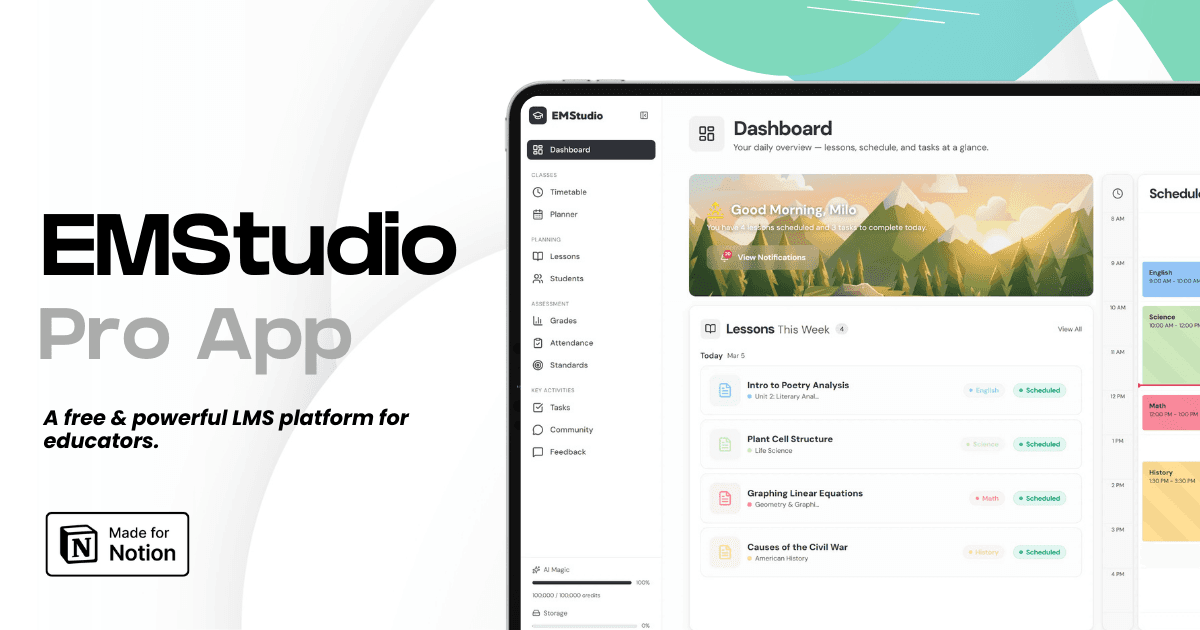
Still grading everything by hand?
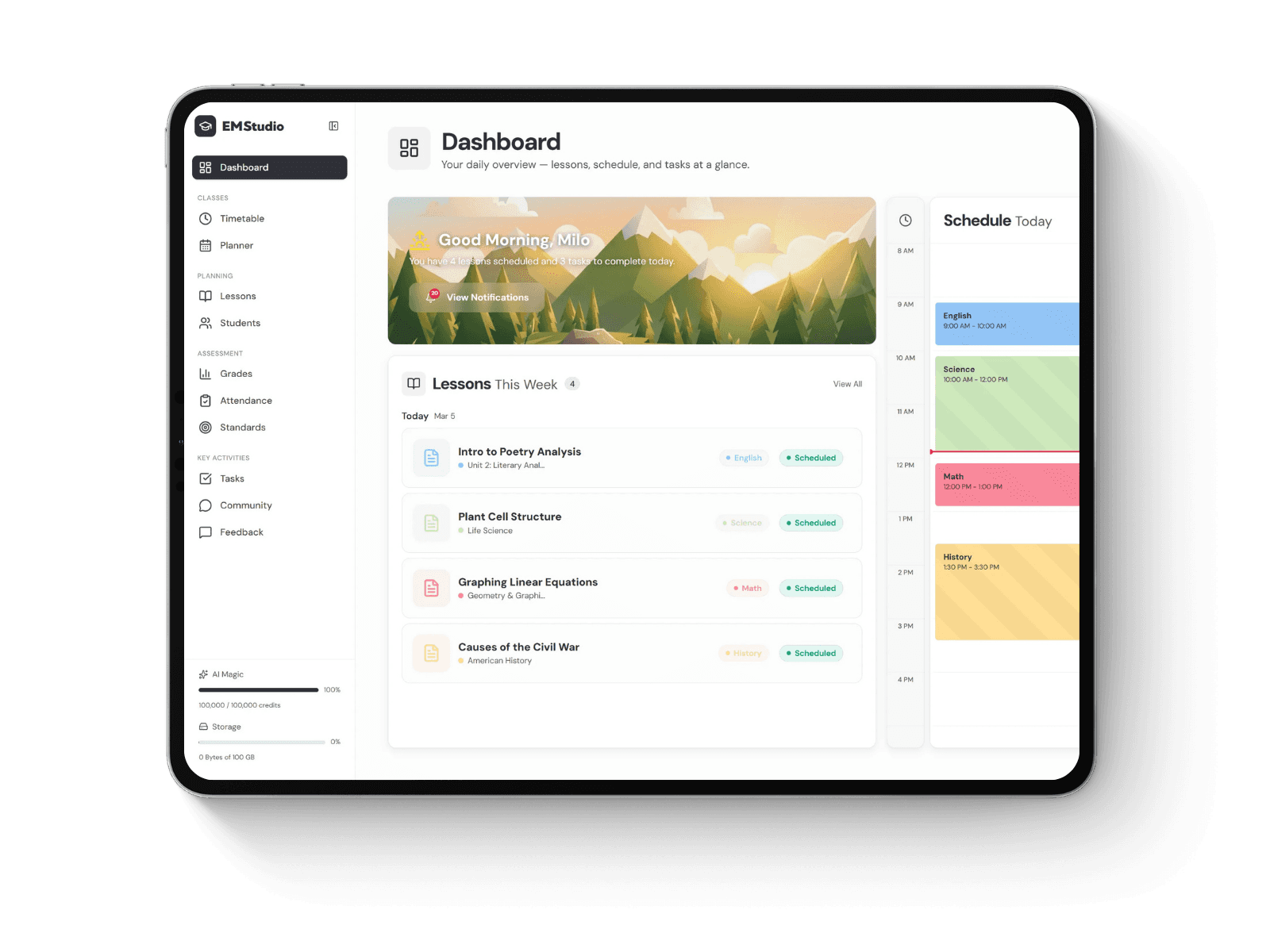
EMStudio is a free teaching management app — manage your classes, students, lessons, and more!
Learn More
Still grading everything by hand?
EMStudio is a free teaching management app — manage your classes, students, lessons, and more!
Learn More
Table of Contents
What Is Secondary Education?
Secondary education encompasses the formal schooling period following primary education, typically spanning grades 6 through 12 in the United States. It bridges foundational learning and postsecondary pathways, divided into middle school (grades 6-8) and high school (grades 9-12), with increasing specialization and credit-based progression systems.
Most districts use the 6-3-3 model: six years of elementary, three years of middle, three years of high school. Forty-two states follow this pattern. Others use 7-5 or 8-4 configurations depending on building capacities. The k12 meaning refers to the entire k through 12 continuum, but secondary education marks the shift from developmental learning to credit accumulation.
Here, the Carnegie unit rules. One credit equals 120 hours of instruction. State high school diploma requirements range from 21 credits (Alabama) to 26 (Texas). Grades start becoming permanent in 9th grade.
Configurations vary:
Middle school: Grades 6-8
Junior high: Grades 7-9
High school: Grades 9-12 or 10-12
The Middle School Bridge: Grades 6-8
The shift hits hard in 6th grade. Kids leave self-contained elementary classrooms—one teacher, 25 students, all subjects—and enter departmentalized instruction. Now they rotate through 4-6 content specialists daily. I watched my first cohort panic when they realized they couldn't ask their math teacher about the science fair project. The pace accelerates. Each teacher assumes their class is the priority, and 11-year-olds suddenly juggle six different homework policies.
Most schools build in an advisory period: 20-30 minutes daily for SEL check-ins, binder organization, and hallway navigation practice. This matters because the 11-13 age window coincides with massive brain development and social anxiety spikes. Advisors track grades, teach study skills, and sometimes just let kids breathe between bells. It's the safety net that catches kids who used to have one teacher checking in daily.
Specific transition challenges include:
Mastering locker combinations under time pressure
Navigating 3-minute passing periods without tardies
Managing multiple textbooks and digital logins
Interpreting complex bell schedules with A/B days
High School Credit Requirements: Grades 9-12
Credit accumulation drives everything. Students need 24-26 Carnegie units to graduate, typically distributed as 4 English, 3-4 Math, 3 Science, 3 Social Studies, 1-2 PE/Health, and 2 Foreign Language credits. Fail a semester of Algebra I, and you're digging out of that hole for four years. Every course choice affects the transcript. Counselors spend October panicking because seniors suddenly realize they need that half-credit of Art to graduate in May.
GPA calculations get complicated fast. Districts use unweighted 4.0 scales or weighted 5.0/6.0 scales for honors and AP courses. Class rank percentiles still matter for college admissions in many states, though some schools are moving to percentile bands. The math matters: a B in AP Physics might count as an A on a 5.0 scale, bumping a student into the top 10%.
Here's the kicker: grades 9-12 stay on permanent records for NCAA eligibility and university applications. Middle school grades disappear. This reality changes how we approach postsecondary readiness and preparing students for the rigors of college success starting freshman year. One failed quarter of English I follows them to college applications.
Alternative and Non-Traditional Pathways
Not every student follows the traditional route. The GED (General Educational Development) offers a non-diploma pathway for students ages 16 and older who exit traditional secondary education. Passing requires four subject tests with minimum scores of 145 each. It's a legitimate second chance, though employers and some colleges still view it differently than a standard diploma. I've had students take this route after family crises or financial necessity forced them to work full-time.
Early college high schools let students earn an associate degree concurrent with their diploma—60 college credits through community college partnerships. I've seen juniors graduate with both degrees, saving thousands in tuition. These programs compress four years of high school and two years of college into four or five years total. The workload is brutal, but the payoff is real.
Online charter options like K12 Inc. and Connections Academy serve grades 6-12 using asynchronous learning models. Students complete modules independently but must sit for state-mandated testing. These programs work for some athletes and performers, though the isolation challenges adolescent development in ways traditional middle school curriculum doesn't. The flexibility helps, but the missing social interaction shows up in different ways.

Why Does Secondary Education Matter for Adolescent Development?
Secondary education serves as the critical developmental bridge where adolescents consolidate academic skills, form identity, and prepare for economic independence. You'll see this play out neurologically: synaptic pruning peaks between ages 11-13 in your students, cementing neural pathways for executive function while their brains remain highly plastic. Hattie's Visible Learning confirms what you probably suspected—direct instruction (effect size 0.59) and feedback (0.72) hit differently during these years, while Bureau of Labor Statistics data shows high school diploma holders earn roughly $10,000 more annually than non-graduates. Within the broader education k12 continuum, secondary years mark Piaget's shift from concrete to formal operational thinking.
Academic Foundation and Critical Thinking
You'll watch students transition from counting apples to proving theorems. In departmentalized instruction, your 7th graders encounter algebraic variables while 10th graders test hypotheses in biology labs—concrete examples of formal operational thinking. Each discipline demands specific literacy from you: teaching historians to corroborate sources against context, scientists to critique methodology tables, mathematicians to follow logical proofs rather than just calculate.
The writing progression is real. Your sixth graders construct five-paragraph arguments; by senior year, they're weaving 8-10 page research papers with proper MLA citations. These assignments align with Carnegie unit requirements—120 hours of contact time per credit—ensuring depth over coverage. This isn't just about checking high school diploma requirements; you're implementing cognitive development strategies tailored by grade level.
Social-Emotional Growth and Identity Formation
Erikson called ages 12-18 the identity versus role confusion stage. You see this daily—students trying on personalities like costumes, sometimes shifting between class periods. Your advisory systems and extracurriculars provide the laboratory for this experimentation, offering structured peer interaction when dopamine sensitivity runs highest. Neurologically, adolescent brains light up for social rewards; those dopamine hits from peer approval explain the risk-taking and clique formation you navigate each February.
Implementing frameworks like RULER or Second Step Secondary means 15-minute daily lessons that channel this social energy productively. You might notice the difference during group work—students using emotional vocabulary instead of shutting down. When you ignore this window in your middle school curriculum, adolescent development stalls. When you honor it, students build the self-regulation that underpins all later learning.
Career Exploration and Postsecondary Planning
By junior year, your students need concrete pathways, not vague advice. You'll guide them through specific tools:
Naviance, Xello, or MaiaLearning for college inventories and transcript submission
Work-based learning: 120 internship hours, 4-8 hour job shadows, or dual enrollment (12-15 college credits per semester)
Career assessments: Holland Code (RIASEC) inventories or StrengthsFinder mapped against the 16 national career pathways
Meeting these benchmarks ensures true postsecondary readiness. For tracking progress, tools for postsecondary planning and financial support cut through what used to be clipboard chaos. You're building the bridge between secondary education and their future livelihood.
How Does Secondary Education Differ From Primary and Higher Ed?
Unlike primary education's generalist approach, secondary education employs content specialists managing 120-150 students across multiple sections, using Carnegie units and standardized assessments. The structure shifts from self-contained classrooms to departmentalized scheduling with 50-minute periods or block scheduling, emphasizing content mastery over basic skills acquisition.
Grade 6 serves as the pivot point in the k to 12 program. Students leave the developmental nurturing of elementary school and enter a system where credit accumulation begins and postsecondary readiness becomes the organizing principle. This transition fundamentally alters the middle school curriculum from exploratory to prerequisite-based.
Feature | Primary (K-5) | Secondary (6-12) | Higher Ed (13+) |
|---|---|---|---|
Teacher certification | Multiple Subject Credential | Single Subject Credential | Master's or Doctorate in field |
Daily schedule | Self-contained, 6 hours | Departmentalized, 6 periods or block | Variable, 2-4 classes |
Student load | 25-30 students | 120-150 students | 80-400 depending on institution |
Assessment types | Diagnostic and formative | State summatives, SAT/ACT, AP | Exams, papers, complex performance-based assessments |
Disciplinary consequences | Time-out, parent contact | Detention, suspension, expulsion with credit loss risk | Academic probation, dismissal |
Instructional Shifts: Generalist to Specialist Teaching
Elementary teachers hold Multiple Subject Credentials. They teach 25 kids for six hours straight, covering reading, math, science, and social studies at a surface level. You know the comfort of that self-contained room. Everything lives in one space.
Secondary teachers carry Single Subject Credentials. You teach five or six sections of 50 minutes each, seeing 120 to 150 students daily through departmentalized instruction. Instead of seven subjects, you drill deep into one discipline. You might teach only 11th-grade American Literature. That depth requires content expertise, not just pedagogical flexibility.
Structural Changes: Schedules, Credits, and Carnegie Units
The Carnegie unit defines secondary education: 120 contact hours equals 1.0 credit. This is the currency of the k to 12 program progression system and the foundation of high school diploma requirements. Students need 24 to 26 credits to graduate, earning 6 to 7 per year with specific grade-level requirements like Biology in 9th or 10th grade.
Secondary schools typically adopt one of three scheduling models:
Traditional six-period day with 50-minute classes.
4x4 block schedule with 90-minute classes daily for one semester.
A/B alternating block with 90-minute classes every other day.
Building this master schedule requires software like PowerScheduler or Infinite Campus to resolve course conflicts, teacher preps, and room assignments.
Assessment Complexity: Standardization and College Preparation
Elementary assessments track basic skills. Secondary education layers in high-stakes accountability. You face state summatives like SBAC or STAAR, college entrance exams like SAT and ACT, and credit-bearing tests like AP and IB. The College Board offers 38 AP subjects at $96 per exam. IB Diploma candidates face six exams plus Theory of Knowledge and an Extended Essay. These differ from complex performance-based assessments you might see in higher education or progressive elementary programs.
GPA calculation changes too. Honors and AP courses use weighted scales of 5.0 or 6.0 against the standard 4.0 unweighted scale. Class rank derived from these numbers directly affects university admissions. This assessment architecture supports adolescent development by introducing external accountability measures that mirror postsecondary expectations.

Core Components of Effective Secondary Programs
Strong secondary education programs balance four distinct quadrants: Academic Rigor, Career Preparation, SEL Support, and Extracurricular Integration. Ignore one, and your k twelve pipeline cracks. I have watched districts pour money into AP expansion while gutting CTE shops, or build advisory periods that devolve into chaos because nobody scripted the curriculum. Each component carries specific costs and distinct failure modes. Here is what actually works.
Rigorous Academic Standards and AP or IB Pathways
Advanced Placement exams cost $96 each for 2024-2025. Fee waivers drop this to $53 for low-income students, but your district pays the $43 gap. IB Diploma authorization runs $10,000-17,000 per school, plus $119-189 per exam. These numbers wreck prek 12 budgets fast, especially when you need alignment with middle school curriculum to feed the pipeline.
The investment pays only when students succeed. A score of 3 or higher earns college credit at 90% of public institutions. IB Diploma candidates pass at roughly 80% globally. But here is the failure mode I see everywhere: open enrollment without prerequisites. Schools let anyone sign up for APUSH to boost enrollment numbers. Pass rates plummet below 20%. Kids fail, morale tanks, and the $96 exam fee buys nothing but discouragement.
The fix is strict honors-level prerequisites and summer bridge programs. We started requiring successful completion of honors World History before AP European History. Pass rates jumped from 18% to 64% in two years. managing Advanced Placement study schedules helps, but only if students have the foundation to handle the workload.
Career Technical Education and Work-Based Learning
Career Technical Education (CTE) runs on Perkins V federal dollars. Funding flows to districts based on CTE concentrators—students who complete two or more courses in a career pathway sequence. One intro class does not count. You need the full sequence to trigger the funding formula.
The 16 Career Clusters include:
Health Science: CNA certification and clinical rotations in long-term care facilities
Information Technology: CompTIA A+ and network administration labs
Manufacturing: NIMS machining credentials and CNC operation
Hospitality: ServSafe certification and hotel management internships
Work-based learning requires documented hours. A 120-hour internship earns course credit. Youth apprenticeships start at age 16 and combine paid work with classroom instruction. Health pathways demand clinical rotations. The failure mode here is equipment. A welding program needs $40,000 in machines and consumables. Cut that budget, and you teach theory in a classroom. Students walk away with no industry credentials and no job prospects.
Advisory Systems and Social-Emotional Support
Advisory works only with tight ratios. Fifteen students per advisor, meeting 20-30 minutes daily. Anything larger becomes crowd control. This is where adolescent development gets real attention—academic counseling, SEL curriculum, and postsecondary readiness planning crammed into short, consistent blocks.
Specific curricula keep advisors from drowning. Second Step Secondary, RULER from Yale, or a school-developed framework using developmental assets provide scripts. Untrained teachers winging it fail hard. They revert to checking grades and quiet reading.
The death spiral looks like this: advisory becomes unstructured study hall. Kids do homework. Teachers take attendance and scroll their phones. Six months in, everyone questions why the master schedule was changed. The solution is assessment. Survey advisory climate every quarter. Train advisors in August and January. If it is not measured, it becomes a dumping ground for behavior problems and missing assignments.
Athletics, Arts, and Extracurricular Integration
Extracurriculars drive engagement, but they hide costs. Marching band and athletics often meet during zero period—7:00 to 7:30 AM. These hours rarely count toward state instructional minute requirements for high school diploma requirements. You are essentially running a free extension of the school day on goodwill and caffeine.
NCAA eligibility creates invisible curriculum demands. Division I athletes need 16 core courses, including four years of English and three years of math at Algebra I level or higher. Counselors must track this starting in ninth grade. Miss the mark, and a full-ride scholarship disappears because a student took the wrong math class in tenth grade.
Arts mandates add pressure. Texas and Arkansas require one fine arts credit for graduation. Other states follow. This forces departmentalized instruction schedules to accommodate band, choir, and theater without breaking the Carnegie unit bank. The failure mode is treating these as filler. When arts and athletics become scheduling headaches rather than developmental tools, students disengage. Treat them as core components, not extras tacked onto the edges of the day.
What Are the Most Pressing Challenges in Secondary Classrooms Today?
Contemporary secondary classrooms face post-pandemic learning loss with significant gaps in foundational math and literacy, alongside unprecedented digital distraction from smartphones. Educators must balance rigorous college preparatory curricula with diverse career pathways while managing increased mental health crises and behavioral disruptions in overcrowded classrooms.
Addressing Learning Loss and Foundational Skill Gaps
NWEA MAP assessment data from 2022-2023 shows 8th graders remained 6-8 percentile points behind in math compared to 2019 pre-pandemic baselines. These aren't just numbers on a spreadsheet. I see it when my 9th graders struggle with fractions that they should have mastered in 6th grade, and it derails the entire middle school curriculum progression.
Schools often make the mistake of placing struggling students in remedial courses stripped of grade-level content. These "zombie courses" trap kids in endless loops of below-grade work. The fix is accelerated learning with just-in-time support. Instead of pull-out models that fragment the day, use double-block periods—90 minutes daily for mathematics or reading remediation. This keeps students in grade-level content while filling gaps.
For RTI/MTSS implementation, schools need specific structures:
Tier 2 interventions require 30 minutes, 3-4 days per week
Progress monitoring every 2 weeks using AIMSweb or DIBELS
Budget $3,000-$8,000 annually for intervention software per 500-student site
Managing Cell Phones and Digital Distractions
Teachers report losing 10-15 minutes of instructional time per 50-minute period to phone management when schools lack unified policies. That adds up to nearly a month of lost instruction per year. Without science-backed methods to improve student focus, you're fighting a losing battle against TikTok and Snapchat during departmentalized instruction.
The failure mode here is letting each teacher enforce their own rules. Inconsistent classroom-level enforcement creates more conflict than no policy at all. Students test boundaries daily, and without administrative backup, you become the phone police instead of the content teacher.
Solutions require district-wide commitment. Cost breakdowns reveal clear winners:
Yondr pouch systems: $15-25 per student annually for locking pouches
Cubby storage systems: $200-400 per classroom
Physical pouches eliminate the "emergency" arguments and create necessary separation between adolescents and devices
Balancing College Preparation With Career Readiness
Secondary education struggles to serve two masters. In California, A-G requirements for university admission clash with CTE pathway credits, forcing students to choose between art/music and career technical courses. This creates a false dichotomy that hurts adolescent development and wastes potential.
The "college-for-all" messaging alienates students concentrating in CTE programs. The fix is the "2 or 4 plus 2" framework: every student prepares for 2-year college, 4-year university, or a 2-year credential. This respects all pathways while maintaining high school diploma requirements that align with postsecondary readiness.
Budget constraints show up in counselor staffing across pre k through 12 systems:
National average ratio: 408:1
ASCA recommended ratio: 250:1
Cost to hire one additional counselor: $60,000-$85,000 annually
With ratios at 400-plus to one, students get 20 minutes of scheduling advice and zero career exploration. That investment prevents costly dropouts and misaligned course selections that waste Carnegie units in K-12 systems.

How Can Elementary Teachers Transition to Secondary Settings?
Elementary educators transitioning to secondary settings must shift from classroom generalist to content expert, adapting management from authority-based systems to relationship-driven frameworks with adolescents. Success requires mastering 50-minute period pacing, content-specific pedagogy, and age-appropriate boundary setting while leveraging elementary strengths in differentiation and engagement.
Mastering Content Specialization Over Generalist Knowledge
You spent years knowing a little about a lot. Fifth grade science, math, reading—you taught it all. Secondary education demands you know one subject deeply. The certification path has three distinct requirements:
Pass the Praxis II Single Subject Assessment. Budget $130 for the exam, and know your state's cut scores: 153 for English Language Arts, 160 for Mathematics. California teachers take the CSET instead, with subtests running $99 to $134 each. Study like your career depends on it, because it does. Elementary Praxis exams test pedagogy; secondary exams assume you already know how to teach and instead probe your content knowledge at the undergraduate level.
Complete 30 semester hours in your content area to meet ESSA "highly qualified" teacher requirements. This isn't bureaucratic fluff. When you're teaching Carnegie unit courses that count toward high school diploma requirements, you need genuine expertise in, say, cellular biology or American literature—not just enthusiasm. You might need night classes if your elementary degree lacked depth in your chosen subject.
Finish clinical practice. Complete student teaching or an alternative certification program specific to grades 6-12. Then, shift your PLC allegiance. In elementary, you met with other 4th grade teachers to discuss spelling bees. Now you'll join the 9th-grade English team or the Chemistry department. Departmentalized instruction means your conversations focus on vertical alignment toward postsecondary readiness, analyzing why last year's seniors struggled with rhetorical analysis so this year's juniors don't repeat the pattern. The topics feel heavier. They are.
Adjusting Management Styles for Adolescent Autonomy
Those ClassDojo avatars and clip charts? They signal elementary school to 14-year-olds, and not in a good way. Adolescents need autonomy, not public behavior tracking. Make these specific swaps:
Replace public tracking with private transparency. Switch to the CHAMPS model—Conversation, Help, Activity, Movement, Participation, Success—or restorative practice circles. These frameworks respect adolescent development stages where peer opinion matters more than teacher approval. Ditch the treasure box. Instead, use Canvas or Google Classroom for complete grade transparency. When students monitor their own progress toward middle school curriculum standards, they develop executive function skills that clip charts never taught.
Change your attention signals. "1-2-3 eyes on me" works for 7-year-olds; it embarrasses 7th graders and triggers eye rolls from juniors. Try non-verbal cues like raising your hand and waiting, a specific song transition, or countdown timers projected on the screen.
Adopt foundational classroom management for new settings. You need systems that treat students as emerging adults, not children to be managed. The power dynamic shifts from "I control you" to "we respect this learning space together." It takes longer to establish, but it lasts through May.
Building Authentic Relationships Without Authority Conflicts
The 5:1 positive-to-negative interaction ratio still applies—five affirmations for every correction—but the delivery changes entirely. Adolescents smell inauthentic praise from the hallway. They'd rather you say nothing than compliment their hoodie just to check the ratio box. Build relationships through these adjustments:
Maintain formality. Use "Mr." or "Ms. Lastname" unless your specific school culture demands otherwise. Never friend students on social media, even after they graduate if you still teach their siblings. Boundaries prevent the "cool teacher" trap that undermines your authority when you need to fail a senior who won't submit work required for their diploma. You're preparing them for professional norms, not summer camp.
Find a 10-week mentor. Partner with a veteran secondary teacher for induction focusing specifically on content pacing—how to fit meaningful learning into 50-minute periods without rushing or leaving early—and assessment design that mirrors college expectations. Your elementary strength in differentiation still matters; you'll just apply it to credit recovery for students who failed Algebra I last year.
Shift to specific feedback. Stickers and stamps insult 16-year-olds. Use specific, actionable written feedback with rubrics. Hattie's research shows an effect size of 0.72 for this approach with secondary learners—much higher than generic praise. "Your thesis lacks a clear claim about the author's purpose" works. "Great job!" doesn't. And don't forget building strong relationships with parents; in secondary, you're navigating parent expectations for postsecondary readiness, not just playground behavior. The emails are longer. The stakes feel higher.
Remember: the k through 12 education continuum connects your past expertise to this new setting. You bring engagement strategies that bored juniors desperately need. You just need to package them for bigger kids with bigger futures at stake.

Your First Month Implementation Checklist
Your first month in secondary education sets the tone for the entire year. Adolescent development moves fast, and these first four weeks determine whether you're playing catch-up or teaching from a solid foundation. Use this checklist to pace yourself through establishing classroom rules and procedures without burning out.
Week 1: Establishing Procedures and Initial Relationships
Days 1-2: Teach the non-negotiables. Model the entry routine, exit routine, attention signal, paper submission, and bathroom protocol. Have students practice each one until they do it automatically. If they mess up on Tuesday, stop and redo it. This investment pays off when you're managing departmentalized instruction and see six different classes per day. Consistency now prevents chaos during October when energy drops.
Days 3-5: Administer inventories. Give learning style assessments like VARK and interest surveys. These aren't fluff; they tell you who needs to move during transitions and who will actually read the novel you assign. Record results in your lesson planning checklist to reference when you form groups later. File the paper copies in your data binder before they disappear.
By Friday: Contact 30% of families. Call or email five students' parents with specific positive news about something you noticed in class. Keep a running tally so you don't contact the same two kids' parents twice while ignoring others. These early wins build trust you'll need when you call about missing work later in the quarter.
Weeks 2-3: Diagnostic Assessment and Differentiation Setup
Day 8: Run diagnostics. Administer NWEA MAP (45 minutes) or a teacher-created pre-test covering 80 percent prior grade standards and 20 percent current grade material. Block time for Renaissance Star 360 if that's your district's tool. The data reveals who missed last year's fractions or grammar standards before you waste time reteaching mastered content. Score these immediately.
Day 9-10: Create flexible groups. Sort students into three tiers: intensive (below 25th percentile), strategic (25th-75th), and benchmark (above 75th). Use these for small group rotations while keeping the groups fluid. Plan your seating chart to allow quick movement between stations without 10 minutes of shuffling desks.
By Day 10: Schedule interventions. Identify the bottom 20 percent for Tier 2 support—30 minutes, three times weekly. Document in your RTI software with specific skill deficits noted. Middle school curriculum moves fast; catch gaps now or face high school diploma requirements panic later when you realize a 9th grader never mastered 7th grade reading and you're racing the Carnegie unit clock with no time to remediate.
Week 4: Long-Term Systems and Parent Communication Protocols
Day 15: Publish reassessment policy. Specify redo conditions: all original work completed, remediation attended, and grade caps (80 percent or full replacement). Post it on the wall and in your LMS so there's no argument in October when everyone suddenly wants to raise their grade. Send a copy home for signatures.
Day 16-17: Lock in communication protocols. Commit to 24-48 hour email response times. Create your weekly newsletter template in Canvas or Smore. Send parent portal activation instructions with screenshots showing exactly where grades and missing assignments live. Test the portal yourself to confirm the links work.
Day 20: Self-assessment checkpoint. Review your pacing guide against what you actually taught. Was Week 1 too fast? Do you need to slow down Unit 2 to ensure postsecondary readiness? Check that your assignments match adolescent development needs for social interaction and autonomy. Adjust now before the next unit starts.
Final Thoughts on Secondary Education
The difference between surviving and thriving in secondary education comes down to one shift: treating adolescents as emerging experts rather than oversized children. They smell condescension from the hallway. When you hand over real choices—picking their research topic, deciding how to demonstrate mastery, managing group dynamics without constant refereeing—you stop fighting for attention and start channeling it. That autonomy is the fuel for every standard you need to cover.
Start today. Pull up your next week’s lesson plans and delete one teacher-led activity. Replace it with ten minutes where students choose between three valid ways to process the same content. Watch who lights up when they get to decide. That’s your data point. Secondary teaching isn't about controlling 120 personalities; it's about building structures where they learn to control themselves. Get that right, and the content takes care of itself.

What Is Secondary Education?
Secondary education encompasses the formal schooling period following primary education, typically spanning grades 6 through 12 in the United States. It bridges foundational learning and postsecondary pathways, divided into middle school (grades 6-8) and high school (grades 9-12), with increasing specialization and credit-based progression systems.
Most districts use the 6-3-3 model: six years of elementary, three years of middle, three years of high school. Forty-two states follow this pattern. Others use 7-5 or 8-4 configurations depending on building capacities. The k12 meaning refers to the entire k through 12 continuum, but secondary education marks the shift from developmental learning to credit accumulation.
Here, the Carnegie unit rules. One credit equals 120 hours of instruction. State high school diploma requirements range from 21 credits (Alabama) to 26 (Texas). Grades start becoming permanent in 9th grade.
Configurations vary:
Middle school: Grades 6-8
Junior high: Grades 7-9
High school: Grades 9-12 or 10-12
The Middle School Bridge: Grades 6-8
The shift hits hard in 6th grade. Kids leave self-contained elementary classrooms—one teacher, 25 students, all subjects—and enter departmentalized instruction. Now they rotate through 4-6 content specialists daily. I watched my first cohort panic when they realized they couldn't ask their math teacher about the science fair project. The pace accelerates. Each teacher assumes their class is the priority, and 11-year-olds suddenly juggle six different homework policies.
Most schools build in an advisory period: 20-30 minutes daily for SEL check-ins, binder organization, and hallway navigation practice. This matters because the 11-13 age window coincides with massive brain development and social anxiety spikes. Advisors track grades, teach study skills, and sometimes just let kids breathe between bells. It's the safety net that catches kids who used to have one teacher checking in daily.
Specific transition challenges include:
Mastering locker combinations under time pressure
Navigating 3-minute passing periods without tardies
Managing multiple textbooks and digital logins
Interpreting complex bell schedules with A/B days
High School Credit Requirements: Grades 9-12
Credit accumulation drives everything. Students need 24-26 Carnegie units to graduate, typically distributed as 4 English, 3-4 Math, 3 Science, 3 Social Studies, 1-2 PE/Health, and 2 Foreign Language credits. Fail a semester of Algebra I, and you're digging out of that hole for four years. Every course choice affects the transcript. Counselors spend October panicking because seniors suddenly realize they need that half-credit of Art to graduate in May.
GPA calculations get complicated fast. Districts use unweighted 4.0 scales or weighted 5.0/6.0 scales for honors and AP courses. Class rank percentiles still matter for college admissions in many states, though some schools are moving to percentile bands. The math matters: a B in AP Physics might count as an A on a 5.0 scale, bumping a student into the top 10%.
Here's the kicker: grades 9-12 stay on permanent records for NCAA eligibility and university applications. Middle school grades disappear. This reality changes how we approach postsecondary readiness and preparing students for the rigors of college success starting freshman year. One failed quarter of English I follows them to college applications.
Alternative and Non-Traditional Pathways
Not every student follows the traditional route. The GED (General Educational Development) offers a non-diploma pathway for students ages 16 and older who exit traditional secondary education. Passing requires four subject tests with minimum scores of 145 each. It's a legitimate second chance, though employers and some colleges still view it differently than a standard diploma. I've had students take this route after family crises or financial necessity forced them to work full-time.
Early college high schools let students earn an associate degree concurrent with their diploma—60 college credits through community college partnerships. I've seen juniors graduate with both degrees, saving thousands in tuition. These programs compress four years of high school and two years of college into four or five years total. The workload is brutal, but the payoff is real.
Online charter options like K12 Inc. and Connections Academy serve grades 6-12 using asynchronous learning models. Students complete modules independently but must sit for state-mandated testing. These programs work for some athletes and performers, though the isolation challenges adolescent development in ways traditional middle school curriculum doesn't. The flexibility helps, but the missing social interaction shows up in different ways.
Why Does Secondary Education Matter for Adolescent Development?
Secondary education serves as the critical developmental bridge where adolescents consolidate academic skills, form identity, and prepare for economic independence. You'll see this play out neurologically: synaptic pruning peaks between ages 11-13 in your students, cementing neural pathways for executive function while their brains remain highly plastic. Hattie's Visible Learning confirms what you probably suspected—direct instruction (effect size 0.59) and feedback (0.72) hit differently during these years, while Bureau of Labor Statistics data shows high school diploma holders earn roughly $10,000 more annually than non-graduates. Within the broader education k12 continuum, secondary years mark Piaget's shift from concrete to formal operational thinking.
Academic Foundation and Critical Thinking
You'll watch students transition from counting apples to proving theorems. In departmentalized instruction, your 7th graders encounter algebraic variables while 10th graders test hypotheses in biology labs—concrete examples of formal operational thinking. Each discipline demands specific literacy from you: teaching historians to corroborate sources against context, scientists to critique methodology tables, mathematicians to follow logical proofs rather than just calculate.
The writing progression is real. Your sixth graders construct five-paragraph arguments; by senior year, they're weaving 8-10 page research papers with proper MLA citations. These assignments align with Carnegie unit requirements—120 hours of contact time per credit—ensuring depth over coverage. This isn't just about checking high school diploma requirements; you're implementing cognitive development strategies tailored by grade level.
Social-Emotional Growth and Identity Formation
Erikson called ages 12-18 the identity versus role confusion stage. You see this daily—students trying on personalities like costumes, sometimes shifting between class periods. Your advisory systems and extracurriculars provide the laboratory for this experimentation, offering structured peer interaction when dopamine sensitivity runs highest. Neurologically, adolescent brains light up for social rewards; those dopamine hits from peer approval explain the risk-taking and clique formation you navigate each February.
Implementing frameworks like RULER or Second Step Secondary means 15-minute daily lessons that channel this social energy productively. You might notice the difference during group work—students using emotional vocabulary instead of shutting down. When you ignore this window in your middle school curriculum, adolescent development stalls. When you honor it, students build the self-regulation that underpins all later learning.
Career Exploration and Postsecondary Planning
By junior year, your students need concrete pathways, not vague advice. You'll guide them through specific tools:
Naviance, Xello, or MaiaLearning for college inventories and transcript submission
Work-based learning: 120 internship hours, 4-8 hour job shadows, or dual enrollment (12-15 college credits per semester)
Career assessments: Holland Code (RIASEC) inventories or StrengthsFinder mapped against the 16 national career pathways
Meeting these benchmarks ensures true postsecondary readiness. For tracking progress, tools for postsecondary planning and financial support cut through what used to be clipboard chaos. You're building the bridge between secondary education and their future livelihood.
How Does Secondary Education Differ From Primary and Higher Ed?
Unlike primary education's generalist approach, secondary education employs content specialists managing 120-150 students across multiple sections, using Carnegie units and standardized assessments. The structure shifts from self-contained classrooms to departmentalized scheduling with 50-minute periods or block scheduling, emphasizing content mastery over basic skills acquisition.
Grade 6 serves as the pivot point in the k to 12 program. Students leave the developmental nurturing of elementary school and enter a system where credit accumulation begins and postsecondary readiness becomes the organizing principle. This transition fundamentally alters the middle school curriculum from exploratory to prerequisite-based.
Feature | Primary (K-5) | Secondary (6-12) | Higher Ed (13+) |
|---|---|---|---|
Teacher certification | Multiple Subject Credential | Single Subject Credential | Master's or Doctorate in field |
Daily schedule | Self-contained, 6 hours | Departmentalized, 6 periods or block | Variable, 2-4 classes |
Student load | 25-30 students | 120-150 students | 80-400 depending on institution |
Assessment types | Diagnostic and formative | State summatives, SAT/ACT, AP | Exams, papers, complex performance-based assessments |
Disciplinary consequences | Time-out, parent contact | Detention, suspension, expulsion with credit loss risk | Academic probation, dismissal |
Instructional Shifts: Generalist to Specialist Teaching
Elementary teachers hold Multiple Subject Credentials. They teach 25 kids for six hours straight, covering reading, math, science, and social studies at a surface level. You know the comfort of that self-contained room. Everything lives in one space.
Secondary teachers carry Single Subject Credentials. You teach five or six sections of 50 minutes each, seeing 120 to 150 students daily through departmentalized instruction. Instead of seven subjects, you drill deep into one discipline. You might teach only 11th-grade American Literature. That depth requires content expertise, not just pedagogical flexibility.
Structural Changes: Schedules, Credits, and Carnegie Units
The Carnegie unit defines secondary education: 120 contact hours equals 1.0 credit. This is the currency of the k to 12 program progression system and the foundation of high school diploma requirements. Students need 24 to 26 credits to graduate, earning 6 to 7 per year with specific grade-level requirements like Biology in 9th or 10th grade.
Secondary schools typically adopt one of three scheduling models:
Traditional six-period day with 50-minute classes.
4x4 block schedule with 90-minute classes daily for one semester.
A/B alternating block with 90-minute classes every other day.
Building this master schedule requires software like PowerScheduler or Infinite Campus to resolve course conflicts, teacher preps, and room assignments.
Assessment Complexity: Standardization and College Preparation
Elementary assessments track basic skills. Secondary education layers in high-stakes accountability. You face state summatives like SBAC or STAAR, college entrance exams like SAT and ACT, and credit-bearing tests like AP and IB. The College Board offers 38 AP subjects at $96 per exam. IB Diploma candidates face six exams plus Theory of Knowledge and an Extended Essay. These differ from complex performance-based assessments you might see in higher education or progressive elementary programs.
GPA calculation changes too. Honors and AP courses use weighted scales of 5.0 or 6.0 against the standard 4.0 unweighted scale. Class rank derived from these numbers directly affects university admissions. This assessment architecture supports adolescent development by introducing external accountability measures that mirror postsecondary expectations.
Core Components of Effective Secondary Programs
Strong secondary education programs balance four distinct quadrants: Academic Rigor, Career Preparation, SEL Support, and Extracurricular Integration. Ignore one, and your k twelve pipeline cracks. I have watched districts pour money into AP expansion while gutting CTE shops, or build advisory periods that devolve into chaos because nobody scripted the curriculum. Each component carries specific costs and distinct failure modes. Here is what actually works.
Rigorous Academic Standards and AP or IB Pathways
Advanced Placement exams cost $96 each for 2024-2025. Fee waivers drop this to $53 for low-income students, but your district pays the $43 gap. IB Diploma authorization runs $10,000-17,000 per school, plus $119-189 per exam. These numbers wreck prek 12 budgets fast, especially when you need alignment with middle school curriculum to feed the pipeline.
The investment pays only when students succeed. A score of 3 or higher earns college credit at 90% of public institutions. IB Diploma candidates pass at roughly 80% globally. But here is the failure mode I see everywhere: open enrollment without prerequisites. Schools let anyone sign up for APUSH to boost enrollment numbers. Pass rates plummet below 20%. Kids fail, morale tanks, and the $96 exam fee buys nothing but discouragement.
The fix is strict honors-level prerequisites and summer bridge programs. We started requiring successful completion of honors World History before AP European History. Pass rates jumped from 18% to 64% in two years. managing Advanced Placement study schedules helps, but only if students have the foundation to handle the workload.
Career Technical Education and Work-Based Learning
Career Technical Education (CTE) runs on Perkins V federal dollars. Funding flows to districts based on CTE concentrators—students who complete two or more courses in a career pathway sequence. One intro class does not count. You need the full sequence to trigger the funding formula.
The 16 Career Clusters include:
Health Science: CNA certification and clinical rotations in long-term care facilities
Information Technology: CompTIA A+ and network administration labs
Manufacturing: NIMS machining credentials and CNC operation
Hospitality: ServSafe certification and hotel management internships
Work-based learning requires documented hours. A 120-hour internship earns course credit. Youth apprenticeships start at age 16 and combine paid work with classroom instruction. Health pathways demand clinical rotations. The failure mode here is equipment. A welding program needs $40,000 in machines and consumables. Cut that budget, and you teach theory in a classroom. Students walk away with no industry credentials and no job prospects.
Advisory Systems and Social-Emotional Support
Advisory works only with tight ratios. Fifteen students per advisor, meeting 20-30 minutes daily. Anything larger becomes crowd control. This is where adolescent development gets real attention—academic counseling, SEL curriculum, and postsecondary readiness planning crammed into short, consistent blocks.
Specific curricula keep advisors from drowning. Second Step Secondary, RULER from Yale, or a school-developed framework using developmental assets provide scripts. Untrained teachers winging it fail hard. They revert to checking grades and quiet reading.
The death spiral looks like this: advisory becomes unstructured study hall. Kids do homework. Teachers take attendance and scroll their phones. Six months in, everyone questions why the master schedule was changed. The solution is assessment. Survey advisory climate every quarter. Train advisors in August and January. If it is not measured, it becomes a dumping ground for behavior problems and missing assignments.
Athletics, Arts, and Extracurricular Integration
Extracurriculars drive engagement, but they hide costs. Marching band and athletics often meet during zero period—7:00 to 7:30 AM. These hours rarely count toward state instructional minute requirements for high school diploma requirements. You are essentially running a free extension of the school day on goodwill and caffeine.
NCAA eligibility creates invisible curriculum demands. Division I athletes need 16 core courses, including four years of English and three years of math at Algebra I level or higher. Counselors must track this starting in ninth grade. Miss the mark, and a full-ride scholarship disappears because a student took the wrong math class in tenth grade.
Arts mandates add pressure. Texas and Arkansas require one fine arts credit for graduation. Other states follow. This forces departmentalized instruction schedules to accommodate band, choir, and theater without breaking the Carnegie unit bank. The failure mode is treating these as filler. When arts and athletics become scheduling headaches rather than developmental tools, students disengage. Treat them as core components, not extras tacked onto the edges of the day.
What Are the Most Pressing Challenges in Secondary Classrooms Today?
Contemporary secondary classrooms face post-pandemic learning loss with significant gaps in foundational math and literacy, alongside unprecedented digital distraction from smartphones. Educators must balance rigorous college preparatory curricula with diverse career pathways while managing increased mental health crises and behavioral disruptions in overcrowded classrooms.
Addressing Learning Loss and Foundational Skill Gaps
NWEA MAP assessment data from 2022-2023 shows 8th graders remained 6-8 percentile points behind in math compared to 2019 pre-pandemic baselines. These aren't just numbers on a spreadsheet. I see it when my 9th graders struggle with fractions that they should have mastered in 6th grade, and it derails the entire middle school curriculum progression.
Schools often make the mistake of placing struggling students in remedial courses stripped of grade-level content. These "zombie courses" trap kids in endless loops of below-grade work. The fix is accelerated learning with just-in-time support. Instead of pull-out models that fragment the day, use double-block periods—90 minutes daily for mathematics or reading remediation. This keeps students in grade-level content while filling gaps.
For RTI/MTSS implementation, schools need specific structures:
Tier 2 interventions require 30 minutes, 3-4 days per week
Progress monitoring every 2 weeks using AIMSweb or DIBELS
Budget $3,000-$8,000 annually for intervention software per 500-student site
Managing Cell Phones and Digital Distractions
Teachers report losing 10-15 minutes of instructional time per 50-minute period to phone management when schools lack unified policies. That adds up to nearly a month of lost instruction per year. Without science-backed methods to improve student focus, you're fighting a losing battle against TikTok and Snapchat during departmentalized instruction.
The failure mode here is letting each teacher enforce their own rules. Inconsistent classroom-level enforcement creates more conflict than no policy at all. Students test boundaries daily, and without administrative backup, you become the phone police instead of the content teacher.
Solutions require district-wide commitment. Cost breakdowns reveal clear winners:
Yondr pouch systems: $15-25 per student annually for locking pouches
Cubby storage systems: $200-400 per classroom
Physical pouches eliminate the "emergency" arguments and create necessary separation between adolescents and devices
Balancing College Preparation With Career Readiness
Secondary education struggles to serve two masters. In California, A-G requirements for university admission clash with CTE pathway credits, forcing students to choose between art/music and career technical courses. This creates a false dichotomy that hurts adolescent development and wastes potential.
The "college-for-all" messaging alienates students concentrating in CTE programs. The fix is the "2 or 4 plus 2" framework: every student prepares for 2-year college, 4-year university, or a 2-year credential. This respects all pathways while maintaining high school diploma requirements that align with postsecondary readiness.
Budget constraints show up in counselor staffing across pre k through 12 systems:
National average ratio: 408:1
ASCA recommended ratio: 250:1
Cost to hire one additional counselor: $60,000-$85,000 annually
With ratios at 400-plus to one, students get 20 minutes of scheduling advice and zero career exploration. That investment prevents costly dropouts and misaligned course selections that waste Carnegie units in K-12 systems.
How Can Elementary Teachers Transition to Secondary Settings?
Elementary educators transitioning to secondary settings must shift from classroom generalist to content expert, adapting management from authority-based systems to relationship-driven frameworks with adolescents. Success requires mastering 50-minute period pacing, content-specific pedagogy, and age-appropriate boundary setting while leveraging elementary strengths in differentiation and engagement.
Mastering Content Specialization Over Generalist Knowledge
You spent years knowing a little about a lot. Fifth grade science, math, reading—you taught it all. Secondary education demands you know one subject deeply. The certification path has three distinct requirements:
Pass the Praxis II Single Subject Assessment. Budget $130 for the exam, and know your state's cut scores: 153 for English Language Arts, 160 for Mathematics. California teachers take the CSET instead, with subtests running $99 to $134 each. Study like your career depends on it, because it does. Elementary Praxis exams test pedagogy; secondary exams assume you already know how to teach and instead probe your content knowledge at the undergraduate level.
Complete 30 semester hours in your content area to meet ESSA "highly qualified" teacher requirements. This isn't bureaucratic fluff. When you're teaching Carnegie unit courses that count toward high school diploma requirements, you need genuine expertise in, say, cellular biology or American literature—not just enthusiasm. You might need night classes if your elementary degree lacked depth in your chosen subject.
Finish clinical practice. Complete student teaching or an alternative certification program specific to grades 6-12. Then, shift your PLC allegiance. In elementary, you met with other 4th grade teachers to discuss spelling bees. Now you'll join the 9th-grade English team or the Chemistry department. Departmentalized instruction means your conversations focus on vertical alignment toward postsecondary readiness, analyzing why last year's seniors struggled with rhetorical analysis so this year's juniors don't repeat the pattern. The topics feel heavier. They are.
Adjusting Management Styles for Adolescent Autonomy
Those ClassDojo avatars and clip charts? They signal elementary school to 14-year-olds, and not in a good way. Adolescents need autonomy, not public behavior tracking. Make these specific swaps:
Replace public tracking with private transparency. Switch to the CHAMPS model—Conversation, Help, Activity, Movement, Participation, Success—or restorative practice circles. These frameworks respect adolescent development stages where peer opinion matters more than teacher approval. Ditch the treasure box. Instead, use Canvas or Google Classroom for complete grade transparency. When students monitor their own progress toward middle school curriculum standards, they develop executive function skills that clip charts never taught.
Change your attention signals. "1-2-3 eyes on me" works for 7-year-olds; it embarrasses 7th graders and triggers eye rolls from juniors. Try non-verbal cues like raising your hand and waiting, a specific song transition, or countdown timers projected on the screen.
Adopt foundational classroom management for new settings. You need systems that treat students as emerging adults, not children to be managed. The power dynamic shifts from "I control you" to "we respect this learning space together." It takes longer to establish, but it lasts through May.
Building Authentic Relationships Without Authority Conflicts
The 5:1 positive-to-negative interaction ratio still applies—five affirmations for every correction—but the delivery changes entirely. Adolescents smell inauthentic praise from the hallway. They'd rather you say nothing than compliment their hoodie just to check the ratio box. Build relationships through these adjustments:
Maintain formality. Use "Mr." or "Ms. Lastname" unless your specific school culture demands otherwise. Never friend students on social media, even after they graduate if you still teach their siblings. Boundaries prevent the "cool teacher" trap that undermines your authority when you need to fail a senior who won't submit work required for their diploma. You're preparing them for professional norms, not summer camp.
Find a 10-week mentor. Partner with a veteran secondary teacher for induction focusing specifically on content pacing—how to fit meaningful learning into 50-minute periods without rushing or leaving early—and assessment design that mirrors college expectations. Your elementary strength in differentiation still matters; you'll just apply it to credit recovery for students who failed Algebra I last year.
Shift to specific feedback. Stickers and stamps insult 16-year-olds. Use specific, actionable written feedback with rubrics. Hattie's research shows an effect size of 0.72 for this approach with secondary learners—much higher than generic praise. "Your thesis lacks a clear claim about the author's purpose" works. "Great job!" doesn't. And don't forget building strong relationships with parents; in secondary, you're navigating parent expectations for postsecondary readiness, not just playground behavior. The emails are longer. The stakes feel higher.
Remember: the k through 12 education continuum connects your past expertise to this new setting. You bring engagement strategies that bored juniors desperately need. You just need to package them for bigger kids with bigger futures at stake.
Your First Month Implementation Checklist
Your first month in secondary education sets the tone for the entire year. Adolescent development moves fast, and these first four weeks determine whether you're playing catch-up or teaching from a solid foundation. Use this checklist to pace yourself through establishing classroom rules and procedures without burning out.
Week 1: Establishing Procedures and Initial Relationships
Days 1-2: Teach the non-negotiables. Model the entry routine, exit routine, attention signal, paper submission, and bathroom protocol. Have students practice each one until they do it automatically. If they mess up on Tuesday, stop and redo it. This investment pays off when you're managing departmentalized instruction and see six different classes per day. Consistency now prevents chaos during October when energy drops.
Days 3-5: Administer inventories. Give learning style assessments like VARK and interest surveys. These aren't fluff; they tell you who needs to move during transitions and who will actually read the novel you assign. Record results in your lesson planning checklist to reference when you form groups later. File the paper copies in your data binder before they disappear.
By Friday: Contact 30% of families. Call or email five students' parents with specific positive news about something you noticed in class. Keep a running tally so you don't contact the same two kids' parents twice while ignoring others. These early wins build trust you'll need when you call about missing work later in the quarter.
Weeks 2-3: Diagnostic Assessment and Differentiation Setup
Day 8: Run diagnostics. Administer NWEA MAP (45 minutes) or a teacher-created pre-test covering 80 percent prior grade standards and 20 percent current grade material. Block time for Renaissance Star 360 if that's your district's tool. The data reveals who missed last year's fractions or grammar standards before you waste time reteaching mastered content. Score these immediately.
Day 9-10: Create flexible groups. Sort students into three tiers: intensive (below 25th percentile), strategic (25th-75th), and benchmark (above 75th). Use these for small group rotations while keeping the groups fluid. Plan your seating chart to allow quick movement between stations without 10 minutes of shuffling desks.
By Day 10: Schedule interventions. Identify the bottom 20 percent for Tier 2 support—30 minutes, three times weekly. Document in your RTI software with specific skill deficits noted. Middle school curriculum moves fast; catch gaps now or face high school diploma requirements panic later when you realize a 9th grader never mastered 7th grade reading and you're racing the Carnegie unit clock with no time to remediate.
Week 4: Long-Term Systems and Parent Communication Protocols
Day 15: Publish reassessment policy. Specify redo conditions: all original work completed, remediation attended, and grade caps (80 percent or full replacement). Post it on the wall and in your LMS so there's no argument in October when everyone suddenly wants to raise their grade. Send a copy home for signatures.
Day 16-17: Lock in communication protocols. Commit to 24-48 hour email response times. Create your weekly newsletter template in Canvas or Smore. Send parent portal activation instructions with screenshots showing exactly where grades and missing assignments live. Test the portal yourself to confirm the links work.
Day 20: Self-assessment checkpoint. Review your pacing guide against what you actually taught. Was Week 1 too fast? Do you need to slow down Unit 2 to ensure postsecondary readiness? Check that your assignments match adolescent development needs for social interaction and autonomy. Adjust now before the next unit starts.
Final Thoughts on Secondary Education
The difference between surviving and thriving in secondary education comes down to one shift: treating adolescents as emerging experts rather than oversized children. They smell condescension from the hallway. When you hand over real choices—picking their research topic, deciding how to demonstrate mastery, managing group dynamics without constant refereeing—you stop fighting for attention and start channeling it. That autonomy is the fuel for every standard you need to cover.
Start today. Pull up your next week’s lesson plans and delete one teacher-led activity. Replace it with ten minutes where students choose between three valid ways to process the same content. Watch who lights up when they get to decide. That’s your data point. Secondary teaching isn't about controlling 120 personalities; it's about building structures where they learn to control themselves. Get that right, and the content takes care of itself.
Still grading everything by hand?
EMStudio is a free teaching management app — manage your classes, students, lessons, and more!
Learn More
Still grading everything by hand?
EMStudio is a free teaching management app — manage your classes, students, lessons, and more!
Learn More



Notion4Teachers
Notion templates to simplify administrative tasks and enhance your teaching experience.



2026 Notion4Teachers. All Rights Reserved.
Notion4Teachers
Notion templates to simplify administrative tasks and enhance your teaching experience.
2026 Notion4Teachers. All Rights Reserved.
Notion4Teachers
Notion templates to simplify administrative tasks and enhance your teaching experience.
2026 Notion4Teachers. All Rights Reserved.