
Open Up Resources Explained for K-12 Educators
Open Up Resources Explained for K-12 Educators

Article by
Milo
ESL Content Coordinator & Educator
ESL Content Coordinator & Educator
All Posts
EdReports gave green ratings to every gateway of Open Up Resources’ two flagship curricula. That’s not common. Most commercial textbooks get partial credit or fail on usability, especially on alignment to grade-level standards. When a curriculum scores all green, it means you’re not spending Sundays rewriting lessons to match your state math or ELA standards. You get your weekends back.
Open Up Resources is the nonprofit that publishes these full-course curricula—Illustrative Mathematics for grades 6-8 and EL Education for K-8 literacy—as openly licensed materials. Districts adopt them to stop paying $80 per student for textbooks that sit in lockers while teachers photocopy the one decent page. Instead, you get problem-based learning units built for student discussion, not silent worksheet completion. The content lives online, often delivered through the Kiddom platform or as free PDFs, but the real difference is in the lesson structure. Every activity builds toward a specific standards-aligned outcome, and the teacher guide flags exactly where 7th graders typically get stuck on proportional relationships or where 3rd graders confuse phonics patterns. You’re not guessing what the standard means or hunting for a supplemental video. You’re teaching with materials that have already been vetted for quality, and you can modify them without breaking copyright law.
Still grading everything by hand?
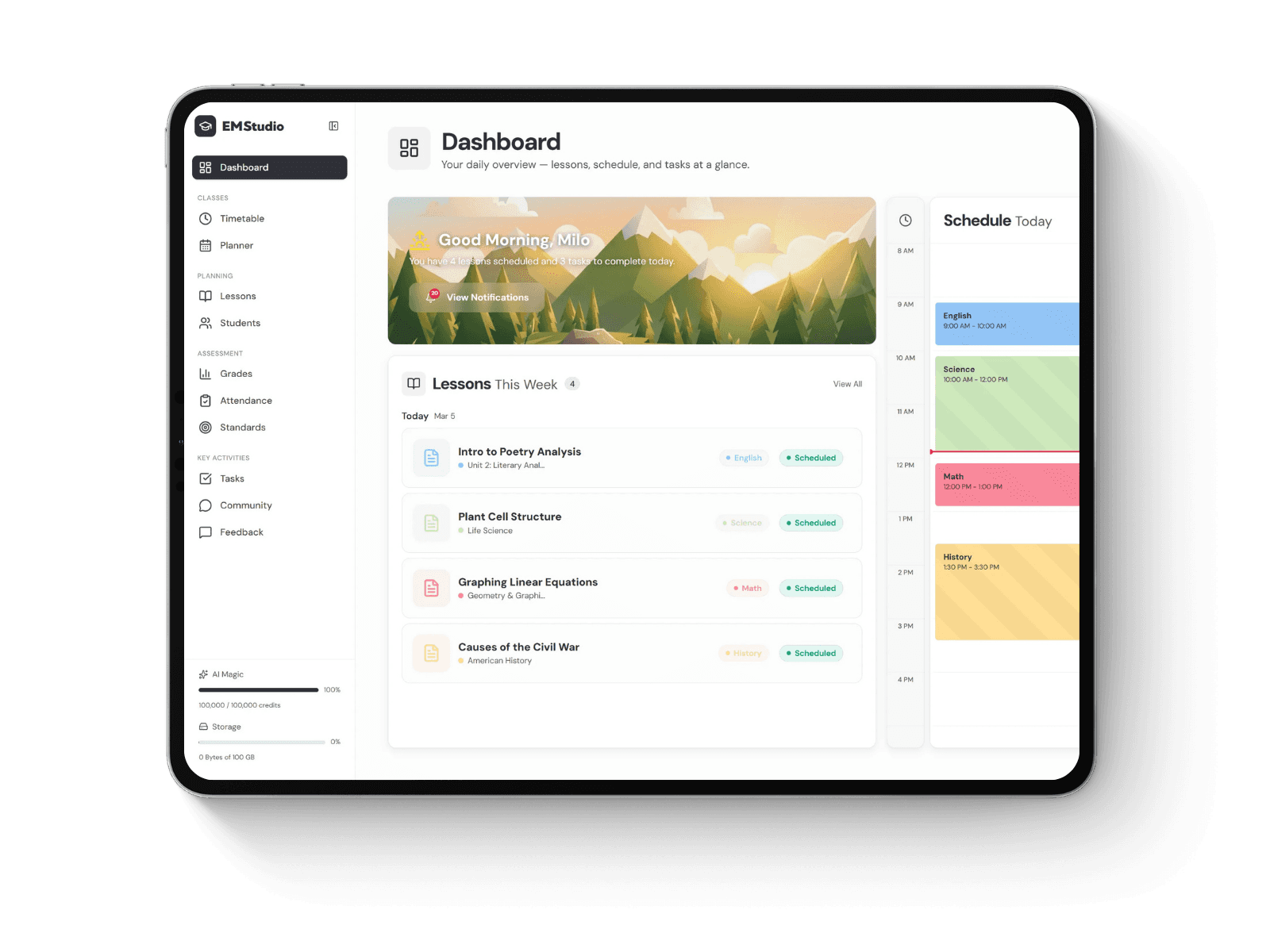
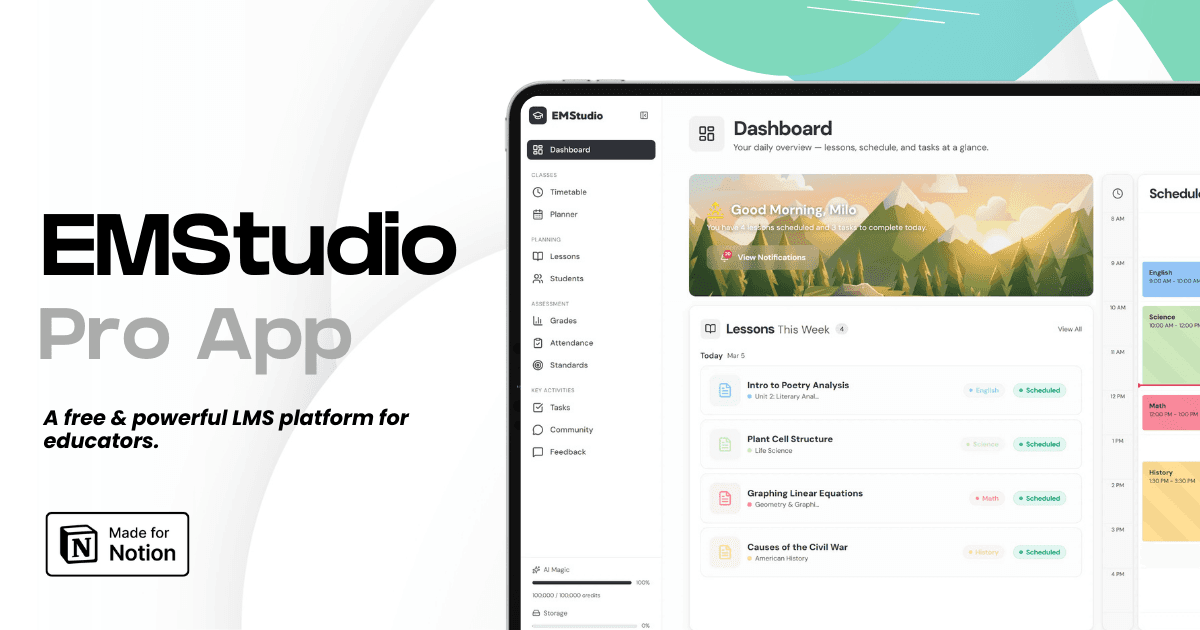
EMStudio is a free teaching management app — manage your classes, students, lessons, and more!
Learn More
Still grading everything by hand?
EMStudio is a free teaching management app — manage your classes, students, lessons, and more!
Learn More
Table of Contents
What Is Open Up Resources?
Open Up Resources is a nonprofit organization founded in 2016 that publishes free, standards-aligned curricula for mathematics and English language arts. Unlike commercial publishers, they offer high-quality instructional materials under open licenses, making rigorous content accessible to all districts regardless of budget constraints. They don't write the curriculum themselves. Instead, they serve as the publisher and distributor for proven programs created by experts like Illustrative Mathematics and EL Education. Headquartered in California, Open Up Resources now reaches over 10 million students nationwide through three primary curriculum families: Illustrative Mathematics 6-8 and High School, EL Education K-8 Language Arts, and Bookworms K-5 Reading. While Pearson and McGraw Hill charge districts $80 to $120 per student annually for textbook licenses, Open Up Resources operates on a $0 licensing model. Everything carries a Creative Commons CC BY license, meaning you can adapt, translate, or redistribute the materials without asking permission or cutting a check.
The Organization's Mission and History
Open Up Resources started in 2016 as a 501(c)(3) nonprofit with a straightforward mission: increase equity in education by eliminating cost barriers to quality curriculum. The founders were veterans from large urban districts who had watched schools struggle to afford standards-aligned materials while students sat with decade-old textbooks. Their breakthrough came through a pivotal partnership with Illustrative Mathematics, authored by mathematician Bill McCallum and his team. This collaboration launched their first mathematics curriculum and established their model—marrying expert-authored content with nonprofit distribution channels. Unlike freemium platforms that hook you with free samples then charge for assessments or answer keys, Open Up Resources maintains a "free forever" commitment. They specifically target underserved districts where a $100 per student textbook fee would consume the entire annual instructional materials budget.
Core Philosophy and Pedagogical Approach
The mathematics curricula follow a problem-based learning approach rooted in the 5 Practices for Orchestrating Productive Mathematics Discussions framework by Smith and Stein. Students grapple with unfamiliar problems before receiving direct instruction. In a typical 7th-grade lesson on proportional relationships, your students might spend 15 minutes debating which pizza deal is actually cheaper—calculating unit rates in groups—before you summarize the mathematical structure they just discovered through their own reasoning. The ELA programs from EL Education build knowledge through complex texts and mastery-based progression, using student-engaged assessment strategies developed from Expeditionary Learning research. This core philosophy and pedagogical approach differs fundamentally from scripted basal programs. It assumes teachers make professional decisions about when to intervene and when to let students struggle productively with grade-level content.
Free Open Educational Resources vs. Licensed Materials
The Creative Commons CC BY license changes everything about how you interact with curriculum. Traditional textbooks operate under "all rights reserved" copyright—you cannot modify a Pearson chapter or translate a McGraw Hill worksheet without legal permission and licensing fees. With Open Up Resources, you own the perpetual right to adapt, remix, and share. Download the digital PDFs or editable Google Doc versions for exactly zero dollars. If you want print copies, third-party providers like Bob's Print or Kendall Hunt ship student workbooks for roughly $25 to $40 per student—about one-third the cost of commercial alternatives. For districts wanting digital interactivity, the Kiddom platform offers enhanced versions with automated grading and pacing tools for $6 to $12 per student annually. The curriculum content itself remains free regardless; you're only paying for the digital platform wrapper, not the intellectual property.

Why Does Open Up Resources Matter for Standards-Aligned Teaching?
Open Up Resources matters because it provides EdReports top-rated, standards-aligned curricula at no licensing cost, ensuring districts with limited budgets can access rigorous instructional materials. Research consistently shows high-quality curriculum significantly impacts student achievement, making free, equitable access a powerful lever for educational equity.
Equity and Accessibility for All Districts
Your district's budget shouldn't determine whether students get quality math and literacy instruction. Open Up Resources removes that barrier entirely. The open up curriculum runs on any device with PDF capability—old Chromebooks, tablets, even phones. Optimal implementation uses 1:1 devices for the digital platform, but the materials work offline too. Students without home internet can take printable packets home, solving the homework equity problem that sinks many digital-first programs. I've seen kids completing math problems on paper at kitchen tables because their hotspot died, then uploading photos when they got back to school.
The cost difference is stark. Traditional math textbook adoptions run $80-120 per student. Open Up Resources charges $0 for the license. You pay only for optional print materials (around $25 per student) or the Kiddom platform (about $8 per student). Small rural districts report saving over $200,000 on single adoptions. Large urban districts scale to 100,000+ students without writing a single licensing check. That money stays in your building for paraprofessionals, interventionists, or whatever your kids actually need.
Cost Component | Traditional Publisher | Open Up Resources |
|---|---|---|
License Fee | $80-120 per student | $0 |
Print Materials | Included in license | ~$25 per student |
Digital Platform | Proprietary, locked | ~$8 per student (Kiddom) |
Rigorous Standards Alignment
You can't afford to waste instructional time on materials that don't hit your standards. Illustrative Mathematics and EL Education both earned 'all green' ratings from EdReports for grades 6-8 and high school. That means they meet expectations across all three gateways: focus and coherence, rigor and mathematical practices, and usability. These aren't self-reported claims. Independent reviewers verified that every lesson aligns with Common Core State Standards for Math and ELA, plus state-specific standards like Texas TEKS where applicable.
The EdReports evaluation process uses a 'gateway' system. Materials must pass Gateway 1 (focus and coherence) to be reviewed for Gateway 2 (rigor and practices). Both curricula cleared all bars. When you're planning units, you know the rigorous standards alignment is built in, not retrofit. You won't find yourself scrambling to supplement gaps in the standards map two weeks before state testing. The coherence means your 7th grade lessons actually build on what students learned in 6th, rather than repeating content or jumping ahead with missing prerequisites. You can trust the scope and sequence. That's rare in free materials.
Research-Based Instructional Design
This isn't curriculum designed by committee. Illustrative Mathematics builds on decades of research in cognitively guided instruction and problem-based learning from researchers like Hiebert and Carpenter. EL Education grounds its literacy work in Outward Bound experiential learning principles and current reading research. The design prioritizes productive struggle and mathematical discourse—students talk through problems before you explain solutions. You're not lecturing from a script; you're facilitating structured exploration that pushes students to connect concepts.
These methods align with Rosenshine's Principles of Instruction and Hattie's visible learning research. Hattie's meta-analysis shows problem-based learning achieves effect sizes of 0.61-0.71 in mathematics when teachers facilitate effectively. That's significant growth potential. The catch? Implementation fidelity varies. The curriculum provides the framework, but you still need to manage the pacing and questioning techniques that make the approach work. It's not a magic script, but it's a research-backed foundation that beats reinventing your units from scratch or relying on worksheets that don't push thinking. You get the structure; you bring the teaching.

How Open Up Resources Structures Its Curriculum
The open up curriculum follows a predictable rhythm that makes long-term planning straightforward. This standards-aligned curriculum earned top marks from EdReports for its focus, coherence, and rigor. Here is how the architecture breaks down:
Unit structure: 6-8 units per grade, each containing 15-25 lessons
Daily lesson components: warm-up, 2-3 activities, lesson synthesis, cool-down
Assessment sequence: pre-unit diagnostic, mid-unit check, end-of-unit assessment
Teacher supports: facilitation notes, anticipation charts
Math lessons run 45-60 minutes; ELA requires 90-minute literacy blocks. The pacing calendars span approximately 160 instructional days, leaving room for testing and reteaching.
Be warned: this is not a scripted direct instruction program. Open Up Resources demands problem-based learning and inquiry-based facilitation. If your district wants teachers reading from a script while students fill in blanks, this will fail. Teachers unprepared for student-centered discourse need additional professional learning before diving in.
Unit and Lesson Architecture
Illustrative Mathematics drives the math structure. Each lesson starts with a 10-minute warm-up connecting prior knowledge to the day's task. Activities 1-3 take 25-30 minutes of problem-based group work where students wrestle with concepts before you explain them. The lesson synthesis gives you 10 minutes to consolidate learning through strategic questioning. A 5-minute cool-down serves as your formative exit ticket, showing who gets it and who needs small-group support tomorrow.
EL Education structures ELA differently but with the same intentionality. The opening uses protocols for engagement like Think-Pair-Share or Back-to-Back Face-to-Face. Work time centers on complex text analysis and evidence-based writing. Closing and assessment checks for understanding through exit tickets or discussion reflections. The pacing feels tight but workable.
The flow remains consistent across units. Grade 6 Math Unit 1 "Area and Surface Area" contains 18 lessons covering exactly 4 weeks at 45 minutes per day. You know exactly where you are heading without guessing about timing.
Embedded Assessment and Progress Monitoring
The embedded assessment and progress monitoring system gives you three distinct checkpoints. Pre-unit diagnostics use 5 questions to check prerequisites and flag gaps. Mid-unit assessments arrive after lesson 10-12 to catch misconceptions before they cement. End-of-unit assessments run 60-90 minutes and are comprehensive, covering all standards addressed.
Formative assessment happens daily through embedded opportunities. Collect cool-downs in math to see who nailed the learning target. Use Quick Writes in ELA to check comprehension and writing fluency. Run ongoing portfolio checks for long-term growth. Track it all on teacher recording sheets that map directly to standards mastery.
You can deliver assessments as Google Forms through the Kiddom platform for auto-grading and instant data, or print PDFs for paper administration when devices are unavailable.
Differentiation and Accessibility Features
The differentiation and accessibility features actually work without creating extra work for you. All materials meet WCAG 2.1 guidelines and work with screen readers. Spanish translations cover math K-12 and selected ELA units, which is crucial for your multilingual learners.
Look for "Are You Ready for More?" extension problems in math that push advanced students deeper. Find "Supporting English Language Learners" notes with sentence frames and vocabulary supports. Use "Preparation for Future Learning" supports for students below grade level who need prerequisite work.
Concrete example: For a 4th-grade ML student in ELA, use the provided word banks and modified writing templates while keeping the complex anchor text accessible through oral reading protocols. You do not dumb down the text; you scaffold the access so every student grapples with grade-level complexity.
Digital Platform Integration
You have two delivery options depending on your tech reality. The Kiddom platform offers interactive activities, auto-graded assessments, and real-time monitoring dashboards. Downloadable PDFs and Google Docs provide static, fully modifiable versions that let you tweak directions or add your own examples.
LMS integrations include Google Classroom for one-click assignment posting, plus Canvas and Schoology via LTI. Roster via CSV upload or use Clever/ClassLink SSO to sync with your SIS.
Offline functionality varies by choice. PDFs download completely for asynchronous access anywhere, including buses and homes without internet. Kiddom requires intermittent connectivity but caches content for periods of disconnection, so a brief outage does not crash the lesson.
What Subjects and Grade Levels Does Open Up Resources Cover?
Open Up Resources covers Illustrative Mathematics for grades 6-8 and high school, plus EL Education Language Arts for grades K-8. You won't find a full high school ELA curriculum here—grades 9-12 aren't currently available—but they do offer the Bookworms K-5 reading program and supplemental social studies through Reading with Relevance. Everything is standards-aligned curriculum that has earned top ratings from EdReports, so you know the materials hold up to scrutiny.
Mathematics Curriculum (6-8 and High School)
For middle school, you get Illustrative Mathematics Grade 6, Grade 7, and Grade 8. They also offer accelerated pathways—IM Accelerated Grade 6/7 and Grade 7/8—which compact two years into one for students ready to move faster. High school covers IM Algebra 1, Geometry, and Algebra 2, plus Mathematics I/II/III for states using integrated pathways. They recently added Calculus support materials too, though those are supplements rather than full courses.
Access is flexible. The digital versions live free on the Kiddom platform or as downloadable PDFs. If you want print, Kendall Hunt or Bob's Print will ship you student workbooks for roughly $35 per kid. That's cheaper than most textbook adoptions, and the content is the same rigorous mathematics curriculum for middle and high school that pushes problem-based learning rather than lecture-and-worksheet routines.
English Language Arts (K-12)
The K-5 program uses EL Education Language Arts, with four modules per grade focused on building knowledge and literacy skills. Each module takes about 8 weeks and requires trade books not included in the free materials—budget $100-150 per classroom for those novels and picture books. Grades 6-8 follow the same EL Education structure with four modules per year, hitting reading, writing, speaking, and language standards through compelling topics like frogs or the American Revolution.
Here's the gap: Open Up Resources does not publish high school ELA. If you need grades 9-12, you'll look elsewhere—maybe Odell Education or your state's recommended list. For K-8 though, the progression is solid and sequenced, with the same high expectations you'd find in private school curricula.
Social Studies and Science Offerings
Science is limited. Unlike FOSS or STEMscopes, there's no full K-12 science curriculum here. What they do offer is Reading with Relevance, an SEL-integrated social studies and literacy curriculum for grades 6-12 that uses culturally responsive texts. It's designed to build empathy while teaching standards, often pairing a novel with historical documents or current events.
They also publish the Talking Points series for ELLs and world language support. These aren't full content courses but rather discussion protocols and language scaffolds to help multilingual students access grade-level work across subjects.
Intervention and Supplemental Programs
For students behind grade level, they offer math acceleration and fluency materials targeting grades 3-8. These work best for tutoring or Tier 2 intervention settings, not as replacement curricula. Math Milestones provides assessment tools to pinpoint exactly where learning gaps start—whether it's fractions in 4th grade or ratios in 6th.
Their High-Quality Tutoring Program materials are built for small groups, specifically 1:3 or 1:4 ratios with 30-minute structured sessions. If you're running after-school math labs or pulling kids during intervention blocks, these sequences give you scripted activities without reinventing the wheel. The materials assume you have limited time and need to move fast.

Practical Classroom Applications: Teaching with Open Up Resources
Facilitation Strategies for Student-Centered Learning
The 5 Practices framework keeps you from becoming the sage on the stage. Start with Anticipate: before teaching that 8th-grade linear equations lesson, predict three approaches students might take—building a table of values, sketching a graph, or jumping straight to algebraic manipulation. Sketch these out on your planning template. When students work in groups, Monitor with a conferring checklist. Walk the room with specific questions ready: "What do you notice about the slope here?" or "How does your table match your partner's graph?" Carry a clipboard and note which groups are using which strategy.
Next, Select students to share based on mathematical trajectory. Don't pick the kid with the perfect answer first. Choose someone who used a table, then someone who graphed, then the algebraic approach. Sequence these from concrete to abstract so the class sees the progression of thinking. Finally, Connect the strategies back to the learning goal: "How did Jamal's table help us see what Maria found in her equation?"
Use talk moves to keep the thinking on them. Try "Say more," "Who can rephrase that?" or "What do others think?" Give them facilitation strategies for student-centered learning room to breathe. Rescue too early and you rob them of the struggle. Wait three to five minutes before offering scaffolding. Each activity needs eight to twelve minutes minimum—anything less and you're just checking boxes rather than building understanding.
Leveraging the Teacher Community and Coaching
You don't have to figure this out alone. The Open Up Resources Math Community Facebook group has over 40,000 members posting lesson tweaks and student work samples daily. Search the archives before you reinvent a lesson someone already fixed. Weekly Twitter chats at #OpenUpMath solve specific problems in real time—why that warm-up flopped or how to pace Unit 4 without losing your mind. The Kiddom platform also hosts educator networks where you can share assessments and see how others modified the same activity.
Free support only goes so far. When you need intensive help, virtual coaching runs $200 to $400 per hour for individual sessions, or $2,500 for full-day site-based support. These aren't generic PD sessions—they watch your classroom videos and troubleshoot your specific blockers. The Implementation Leaders certification program trains in-house coaches to sustain the work without keeping outside consultants on retainer.
Before you pay anything, mine the free professional learning library. On-demand modules cover every unit overview in thirty to forty-five minute chunks. Watch these during prep periods to see teacher community and coaching in action through classroom videos that show actual facilitation moves.
Adapting Materials for Diverse Learners
Multilingual learners need more than vocabulary lists. Use the embedded language supports in the teacher materials, but also try the Three Reads protocol: first read for context, second for mathematics, third for questioning. Let students discuss in their native language before demanding English output. The concepts matter more than the language of delivery, and comprehension builds when they can grapple in the language they think in.
For students with IEPs, stop at three problems instead of five. The learning happens in the depth, not the volume. Pull the graphic organizers straight from the Teacher Guide—they're already aligned to the lesson goals. Extend time for cool-downs; the five-minute closing reflection often reveals more than the main activity about what actually stuck.
Advanced students get "Are You Ready for More?" extension problems at the end of each lesson. Better yet, make them peer tutors or assign "expert groups" to prepare presentations for the following day. But watch your pacing. Common mistakes include:
Lecturing instead of facilitating
Skipping the synthesis at lesson's end
Not allowing enough productive struggle time
If you intervene before eight minutes, you're doing the thinking for them. Let them sweat a little.

How Do You Get Started with Open Up Resources Implementation?
To get started, create a free educator account at openupresources.org, verify your school email, and access the curriculum via downloadable PDFs or the Kiddom platform. Download the Unit 1 materials and pacing guide, gather required materials (manipulatives for math or anchor texts for ELA), and join the Facebook community for daily implementation support.
Here is the fastest path from zero to your first lesson:
Step 1 (15 minutes): Account creation and verification
Step 2 (30 minutes): Platform orientation and navigation
Step 3 (2 hours): Unit 1 planning and material gathering
Step 4 (ongoing): Professional learning selection
Before you begin, check your technology prerequisites:
Compatible device (Chromebook, laptop, or tablet)
PDF reader capable of handling large documents
Internet for initial download, or USB option for offline districts
If your district blocks curriculum sites, request the USB drive option during account setup. Open Up Resources mails physical drives pre-loaded with all PDFs to offline districts at no cost.
Step 1 — Creating Your Educator Account
Head to openupresources.org/educators and click Create Account. Use your school email—personal Gmail or Yahoo addresses get rejected automatically. Select your role (teacher, coach, or administrator) to customize your dashboard. The system sends a verification link within two minutes; check your spam folder if it doesn't arrive immediately.
Choose your access method during creating your educator account. Click Download Materials for immediate PDF access to print or save to your drive. Alternatively, select Launch Digital Curriculum to set up the Kiddom integration, which lets you assign lessons digitally and track student progress. Both options remain free.
Step 2 — Navigating the Digital Platform
In the Kiddom platform, the left sidebar shows Units > Lessons > Activities. The right panel displays teacher notes, EdReports alignment details, and a toggle to preview the student view. Try assigning Lesson 1.1 to your class roster now—click the assign button in the top right, select your section, and set a due date. Students see only the activity, not your teaching notes.
If you chose PDF access, master the folder structure first. Each unit contains three subfolders: Student Materials (workbooks and handouts), Teacher Guide (lesson plans), and Assessments (rubrics and checklists). Import these into Google Drive to edit pacing calendars or add your own notes directly onto the PDFs.
Step 3 — Planning Your First Unit
Print the Unit 1 Scope and Sequence immediately. For Illustrative Mathematics, this spans 160 days; for EL Education, expect 180 days. If your district mandates this open up curriculum district-wide, use the Year 1 Implementation Blueprint pacing guide rather than teacher self-pacing. The blueprint builds in assessment days and remediation weeks that individual teachers often skip, then regret later.
Map your calendar: Identify holidays and testing windows, adjust the pacing guide accordingly. For Grade 6 Math Unit 1, gather tangrams, geometry toolkits, and grid paper. Planning your first unit in a problem-based learning classroom requires front-loading—plan to spend 2-3 days on Lesson 1.1 establishing norms. Rushing this foundation sinks the year.
Step 4 — Accessing Professional Learning and Support
Register for the free Unit 1 Overview webinar (90 minutes, offered monthly). Access the Facilitation Guide videos (5-10 minutes each) through your dashboard—these show exactly how to launch each activity without lecturing. These free resources cover the pedagogical shifts required for standards-aligned curriculum implementation.
If you need deeper support, request a quote for site-based professional learning ($2,500/day plus travel) or enroll in the Virtual Learning Series ($500 per teacher for 6 sessions). Join the Facebook community—approval takes 24 hours. Introduce yourself with grade level and timeline; mention you're new to open up resources and you'll get twenty helpful responses by dinner.

Open Up Resources vs. Traditional and Commercial Alternatives
Choosing between Open Up Resources, commercial giants like Pearson or McGraw Hill, and other OER options like EngageNY means weighing cost structure, pedagogical model, modification rights, and support systems. Open Up Resources and Illustrative Mathematics run on perpetual licenses with problem-based learning at the core. Commercial alternatives lock content behind annual subscriptions and scripted direct instruction. Other OER like EL Education or Eureka Math sit somewhere in between.
When should you pick what? Go with Open Up Resources if you have teachers who can facilitate discussions and your budget is tight. Choose commercial programs if your staff needs heavy scripting and you want a dedicated rep on speed dial.
Cost and Licensing Models
Open Up costs nothing for the license. You might pay $25-40 per student for printed workbooks, and $6-12 for the Kiddom platform if you want digital tracking. Commercial programs charge $80-120 for the license alone, plus $30 for print materials and $15 for digital platform access. Multiply that across 500 students and you are looking at serious budget gaps.
The licensing matters long-term. Open Up uses CC BY, meaning you can modify lessons forever without renewal fees. Commercial platforms usually require annual subscriptions; stop paying and you lose access to the digital content and teacher guides.
But watch the hidden costs. Quality professional learning for Open Up runs $2,000-10,000 depending on your district size and how many coaches you train. Commercial bundles often include "free" training that is really just sales presentations masquerading as pedagogy.
Instructional Approach and Flexibility
Commercial programs treat teachers as deliverers reading from scripts. Open Up treats you as a facilitator guiding student discovery. This shift requires serious instructional approach and flexibility from your staff. The standards-aligned curriculum demands 45-60 minutes of solid instructional time daily. Commercial series pad their programs with busywork worksheets designed for 30-minute blocks.
You can reorder units in Open Up or swap context examples to match your community demographics. Try modifying a locked Pearson PDF. You cannot change a word. The content is frozen by copyright restrictions that limit responsiveness to your specific students.
That flexibility is powerful, but only if your teachers understand the problem-based learning progression. Without that foundation, the materials feel loose and chaotic rather than intentionally open.
Support and Implementation Services
Commercial publishers give you an 800 number and an assigned sales rep who answers quickly. Open Up offers community-based peer support through Facebook groups and optional paid coaching from implementation specialists. The EdReports top ratings for EL Education and Illustrative Mathematics do not automatically translate to smooth implementation without human support.
Districts report a stark difference in first-year satisfaction. Without paid coaching, Open Up implementations show roughly 60% teacher satisfaction according to internal district surveys. With coaching investment, that jumps to 85%. These are not peer-reviewed studies, but the pattern repeats across multiple sites.
Materials quality differs practically. Commercial textbooks include glossy consumable workbooks. Open Up requires you to print materials or buy print-on-demand, which sometimes costs more per page than bulk textbooks despite the free license.

What Is Open Up Resources?
Open Up Resources is a nonprofit organization founded in 2016 that publishes free, standards-aligned curricula for mathematics and English language arts. Unlike commercial publishers, they offer high-quality instructional materials under open licenses, making rigorous content accessible to all districts regardless of budget constraints. They don't write the curriculum themselves. Instead, they serve as the publisher and distributor for proven programs created by experts like Illustrative Mathematics and EL Education. Headquartered in California, Open Up Resources now reaches over 10 million students nationwide through three primary curriculum families: Illustrative Mathematics 6-8 and High School, EL Education K-8 Language Arts, and Bookworms K-5 Reading. While Pearson and McGraw Hill charge districts $80 to $120 per student annually for textbook licenses, Open Up Resources operates on a $0 licensing model. Everything carries a Creative Commons CC BY license, meaning you can adapt, translate, or redistribute the materials without asking permission or cutting a check.
The Organization's Mission and History
Open Up Resources started in 2016 as a 501(c)(3) nonprofit with a straightforward mission: increase equity in education by eliminating cost barriers to quality curriculum. The founders were veterans from large urban districts who had watched schools struggle to afford standards-aligned materials while students sat with decade-old textbooks. Their breakthrough came through a pivotal partnership with Illustrative Mathematics, authored by mathematician Bill McCallum and his team. This collaboration launched their first mathematics curriculum and established their model—marrying expert-authored content with nonprofit distribution channels. Unlike freemium platforms that hook you with free samples then charge for assessments or answer keys, Open Up Resources maintains a "free forever" commitment. They specifically target underserved districts where a $100 per student textbook fee would consume the entire annual instructional materials budget.
Core Philosophy and Pedagogical Approach
The mathematics curricula follow a problem-based learning approach rooted in the 5 Practices for Orchestrating Productive Mathematics Discussions framework by Smith and Stein. Students grapple with unfamiliar problems before receiving direct instruction. In a typical 7th-grade lesson on proportional relationships, your students might spend 15 minutes debating which pizza deal is actually cheaper—calculating unit rates in groups—before you summarize the mathematical structure they just discovered through their own reasoning. The ELA programs from EL Education build knowledge through complex texts and mastery-based progression, using student-engaged assessment strategies developed from Expeditionary Learning research. This core philosophy and pedagogical approach differs fundamentally from scripted basal programs. It assumes teachers make professional decisions about when to intervene and when to let students struggle productively with grade-level content.
Free Open Educational Resources vs. Licensed Materials
The Creative Commons CC BY license changes everything about how you interact with curriculum. Traditional textbooks operate under "all rights reserved" copyright—you cannot modify a Pearson chapter or translate a McGraw Hill worksheet without legal permission and licensing fees. With Open Up Resources, you own the perpetual right to adapt, remix, and share. Download the digital PDFs or editable Google Doc versions for exactly zero dollars. If you want print copies, third-party providers like Bob's Print or Kendall Hunt ship student workbooks for roughly $25 to $40 per student—about one-third the cost of commercial alternatives. For districts wanting digital interactivity, the Kiddom platform offers enhanced versions with automated grading and pacing tools for $6 to $12 per student annually. The curriculum content itself remains free regardless; you're only paying for the digital platform wrapper, not the intellectual property.
Why Does Open Up Resources Matter for Standards-Aligned Teaching?
Open Up Resources matters because it provides EdReports top-rated, standards-aligned curricula at no licensing cost, ensuring districts with limited budgets can access rigorous instructional materials. Research consistently shows high-quality curriculum significantly impacts student achievement, making free, equitable access a powerful lever for educational equity.
Equity and Accessibility for All Districts
Your district's budget shouldn't determine whether students get quality math and literacy instruction. Open Up Resources removes that barrier entirely. The open up curriculum runs on any device with PDF capability—old Chromebooks, tablets, even phones. Optimal implementation uses 1:1 devices for the digital platform, but the materials work offline too. Students without home internet can take printable packets home, solving the homework equity problem that sinks many digital-first programs. I've seen kids completing math problems on paper at kitchen tables because their hotspot died, then uploading photos when they got back to school.
The cost difference is stark. Traditional math textbook adoptions run $80-120 per student. Open Up Resources charges $0 for the license. You pay only for optional print materials (around $25 per student) or the Kiddom platform (about $8 per student). Small rural districts report saving over $200,000 on single adoptions. Large urban districts scale to 100,000+ students without writing a single licensing check. That money stays in your building for paraprofessionals, interventionists, or whatever your kids actually need.
Cost Component | Traditional Publisher | Open Up Resources |
|---|---|---|
License Fee | $80-120 per student | $0 |
Print Materials | Included in license | ~$25 per student |
Digital Platform | Proprietary, locked | ~$8 per student (Kiddom) |
Rigorous Standards Alignment
You can't afford to waste instructional time on materials that don't hit your standards. Illustrative Mathematics and EL Education both earned 'all green' ratings from EdReports for grades 6-8 and high school. That means they meet expectations across all three gateways: focus and coherence, rigor and mathematical practices, and usability. These aren't self-reported claims. Independent reviewers verified that every lesson aligns with Common Core State Standards for Math and ELA, plus state-specific standards like Texas TEKS where applicable.
The EdReports evaluation process uses a 'gateway' system. Materials must pass Gateway 1 (focus and coherence) to be reviewed for Gateway 2 (rigor and practices). Both curricula cleared all bars. When you're planning units, you know the rigorous standards alignment is built in, not retrofit. You won't find yourself scrambling to supplement gaps in the standards map two weeks before state testing. The coherence means your 7th grade lessons actually build on what students learned in 6th, rather than repeating content or jumping ahead with missing prerequisites. You can trust the scope and sequence. That's rare in free materials.
Research-Based Instructional Design
This isn't curriculum designed by committee. Illustrative Mathematics builds on decades of research in cognitively guided instruction and problem-based learning from researchers like Hiebert and Carpenter. EL Education grounds its literacy work in Outward Bound experiential learning principles and current reading research. The design prioritizes productive struggle and mathematical discourse—students talk through problems before you explain solutions. You're not lecturing from a script; you're facilitating structured exploration that pushes students to connect concepts.
These methods align with Rosenshine's Principles of Instruction and Hattie's visible learning research. Hattie's meta-analysis shows problem-based learning achieves effect sizes of 0.61-0.71 in mathematics when teachers facilitate effectively. That's significant growth potential. The catch? Implementation fidelity varies. The curriculum provides the framework, but you still need to manage the pacing and questioning techniques that make the approach work. It's not a magic script, but it's a research-backed foundation that beats reinventing your units from scratch or relying on worksheets that don't push thinking. You get the structure; you bring the teaching.
How Open Up Resources Structures Its Curriculum
The open up curriculum follows a predictable rhythm that makes long-term planning straightforward. This standards-aligned curriculum earned top marks from EdReports for its focus, coherence, and rigor. Here is how the architecture breaks down:
Unit structure: 6-8 units per grade, each containing 15-25 lessons
Daily lesson components: warm-up, 2-3 activities, lesson synthesis, cool-down
Assessment sequence: pre-unit diagnostic, mid-unit check, end-of-unit assessment
Teacher supports: facilitation notes, anticipation charts
Math lessons run 45-60 minutes; ELA requires 90-minute literacy blocks. The pacing calendars span approximately 160 instructional days, leaving room for testing and reteaching.
Be warned: this is not a scripted direct instruction program. Open Up Resources demands problem-based learning and inquiry-based facilitation. If your district wants teachers reading from a script while students fill in blanks, this will fail. Teachers unprepared for student-centered discourse need additional professional learning before diving in.
Unit and Lesson Architecture
Illustrative Mathematics drives the math structure. Each lesson starts with a 10-minute warm-up connecting prior knowledge to the day's task. Activities 1-3 take 25-30 minutes of problem-based group work where students wrestle with concepts before you explain them. The lesson synthesis gives you 10 minutes to consolidate learning through strategic questioning. A 5-minute cool-down serves as your formative exit ticket, showing who gets it and who needs small-group support tomorrow.
EL Education structures ELA differently but with the same intentionality. The opening uses protocols for engagement like Think-Pair-Share or Back-to-Back Face-to-Face. Work time centers on complex text analysis and evidence-based writing. Closing and assessment checks for understanding through exit tickets or discussion reflections. The pacing feels tight but workable.
The flow remains consistent across units. Grade 6 Math Unit 1 "Area and Surface Area" contains 18 lessons covering exactly 4 weeks at 45 minutes per day. You know exactly where you are heading without guessing about timing.
Embedded Assessment and Progress Monitoring
The embedded assessment and progress monitoring system gives you three distinct checkpoints. Pre-unit diagnostics use 5 questions to check prerequisites and flag gaps. Mid-unit assessments arrive after lesson 10-12 to catch misconceptions before they cement. End-of-unit assessments run 60-90 minutes and are comprehensive, covering all standards addressed.
Formative assessment happens daily through embedded opportunities. Collect cool-downs in math to see who nailed the learning target. Use Quick Writes in ELA to check comprehension and writing fluency. Run ongoing portfolio checks for long-term growth. Track it all on teacher recording sheets that map directly to standards mastery.
You can deliver assessments as Google Forms through the Kiddom platform for auto-grading and instant data, or print PDFs for paper administration when devices are unavailable.
Differentiation and Accessibility Features
The differentiation and accessibility features actually work without creating extra work for you. All materials meet WCAG 2.1 guidelines and work with screen readers. Spanish translations cover math K-12 and selected ELA units, which is crucial for your multilingual learners.
Look for "Are You Ready for More?" extension problems in math that push advanced students deeper. Find "Supporting English Language Learners" notes with sentence frames and vocabulary supports. Use "Preparation for Future Learning" supports for students below grade level who need prerequisite work.
Concrete example: For a 4th-grade ML student in ELA, use the provided word banks and modified writing templates while keeping the complex anchor text accessible through oral reading protocols. You do not dumb down the text; you scaffold the access so every student grapples with grade-level complexity.
Digital Platform Integration
You have two delivery options depending on your tech reality. The Kiddom platform offers interactive activities, auto-graded assessments, and real-time monitoring dashboards. Downloadable PDFs and Google Docs provide static, fully modifiable versions that let you tweak directions or add your own examples.
LMS integrations include Google Classroom for one-click assignment posting, plus Canvas and Schoology via LTI. Roster via CSV upload or use Clever/ClassLink SSO to sync with your SIS.
Offline functionality varies by choice. PDFs download completely for asynchronous access anywhere, including buses and homes without internet. Kiddom requires intermittent connectivity but caches content for periods of disconnection, so a brief outage does not crash the lesson.
What Subjects and Grade Levels Does Open Up Resources Cover?
Open Up Resources covers Illustrative Mathematics for grades 6-8 and high school, plus EL Education Language Arts for grades K-8. You won't find a full high school ELA curriculum here—grades 9-12 aren't currently available—but they do offer the Bookworms K-5 reading program and supplemental social studies through Reading with Relevance. Everything is standards-aligned curriculum that has earned top ratings from EdReports, so you know the materials hold up to scrutiny.
Mathematics Curriculum (6-8 and High School)
For middle school, you get Illustrative Mathematics Grade 6, Grade 7, and Grade 8. They also offer accelerated pathways—IM Accelerated Grade 6/7 and Grade 7/8—which compact two years into one for students ready to move faster. High school covers IM Algebra 1, Geometry, and Algebra 2, plus Mathematics I/II/III for states using integrated pathways. They recently added Calculus support materials too, though those are supplements rather than full courses.
Access is flexible. The digital versions live free on the Kiddom platform or as downloadable PDFs. If you want print, Kendall Hunt or Bob's Print will ship you student workbooks for roughly $35 per kid. That's cheaper than most textbook adoptions, and the content is the same rigorous mathematics curriculum for middle and high school that pushes problem-based learning rather than lecture-and-worksheet routines.
English Language Arts (K-12)
The K-5 program uses EL Education Language Arts, with four modules per grade focused on building knowledge and literacy skills. Each module takes about 8 weeks and requires trade books not included in the free materials—budget $100-150 per classroom for those novels and picture books. Grades 6-8 follow the same EL Education structure with four modules per year, hitting reading, writing, speaking, and language standards through compelling topics like frogs or the American Revolution.
Here's the gap: Open Up Resources does not publish high school ELA. If you need grades 9-12, you'll look elsewhere—maybe Odell Education or your state's recommended list. For K-8 though, the progression is solid and sequenced, with the same high expectations you'd find in private school curricula.
Social Studies and Science Offerings
Science is limited. Unlike FOSS or STEMscopes, there's no full K-12 science curriculum here. What they do offer is Reading with Relevance, an SEL-integrated social studies and literacy curriculum for grades 6-12 that uses culturally responsive texts. It's designed to build empathy while teaching standards, often pairing a novel with historical documents or current events.
They also publish the Talking Points series for ELLs and world language support. These aren't full content courses but rather discussion protocols and language scaffolds to help multilingual students access grade-level work across subjects.
Intervention and Supplemental Programs
For students behind grade level, they offer math acceleration and fluency materials targeting grades 3-8. These work best for tutoring or Tier 2 intervention settings, not as replacement curricula. Math Milestones provides assessment tools to pinpoint exactly where learning gaps start—whether it's fractions in 4th grade or ratios in 6th.
Their High-Quality Tutoring Program materials are built for small groups, specifically 1:3 or 1:4 ratios with 30-minute structured sessions. If you're running after-school math labs or pulling kids during intervention blocks, these sequences give you scripted activities without reinventing the wheel. The materials assume you have limited time and need to move fast.
Practical Classroom Applications: Teaching with Open Up Resources
Facilitation Strategies for Student-Centered Learning
The 5 Practices framework keeps you from becoming the sage on the stage. Start with Anticipate: before teaching that 8th-grade linear equations lesson, predict three approaches students might take—building a table of values, sketching a graph, or jumping straight to algebraic manipulation. Sketch these out on your planning template. When students work in groups, Monitor with a conferring checklist. Walk the room with specific questions ready: "What do you notice about the slope here?" or "How does your table match your partner's graph?" Carry a clipboard and note which groups are using which strategy.
Next, Select students to share based on mathematical trajectory. Don't pick the kid with the perfect answer first. Choose someone who used a table, then someone who graphed, then the algebraic approach. Sequence these from concrete to abstract so the class sees the progression of thinking. Finally, Connect the strategies back to the learning goal: "How did Jamal's table help us see what Maria found in her equation?"
Use talk moves to keep the thinking on them. Try "Say more," "Who can rephrase that?" or "What do others think?" Give them facilitation strategies for student-centered learning room to breathe. Rescue too early and you rob them of the struggle. Wait three to five minutes before offering scaffolding. Each activity needs eight to twelve minutes minimum—anything less and you're just checking boxes rather than building understanding.
Leveraging the Teacher Community and Coaching
You don't have to figure this out alone. The Open Up Resources Math Community Facebook group has over 40,000 members posting lesson tweaks and student work samples daily. Search the archives before you reinvent a lesson someone already fixed. Weekly Twitter chats at #OpenUpMath solve specific problems in real time—why that warm-up flopped or how to pace Unit 4 without losing your mind. The Kiddom platform also hosts educator networks where you can share assessments and see how others modified the same activity.
Free support only goes so far. When you need intensive help, virtual coaching runs $200 to $400 per hour for individual sessions, or $2,500 for full-day site-based support. These aren't generic PD sessions—they watch your classroom videos and troubleshoot your specific blockers. The Implementation Leaders certification program trains in-house coaches to sustain the work without keeping outside consultants on retainer.
Before you pay anything, mine the free professional learning library. On-demand modules cover every unit overview in thirty to forty-five minute chunks. Watch these during prep periods to see teacher community and coaching in action through classroom videos that show actual facilitation moves.
Adapting Materials for Diverse Learners
Multilingual learners need more than vocabulary lists. Use the embedded language supports in the teacher materials, but also try the Three Reads protocol: first read for context, second for mathematics, third for questioning. Let students discuss in their native language before demanding English output. The concepts matter more than the language of delivery, and comprehension builds when they can grapple in the language they think in.
For students with IEPs, stop at three problems instead of five. The learning happens in the depth, not the volume. Pull the graphic organizers straight from the Teacher Guide—they're already aligned to the lesson goals. Extend time for cool-downs; the five-minute closing reflection often reveals more than the main activity about what actually stuck.
Advanced students get "Are You Ready for More?" extension problems at the end of each lesson. Better yet, make them peer tutors or assign "expert groups" to prepare presentations for the following day. But watch your pacing. Common mistakes include:
Lecturing instead of facilitating
Skipping the synthesis at lesson's end
Not allowing enough productive struggle time
If you intervene before eight minutes, you're doing the thinking for them. Let them sweat a little.
How Do You Get Started with Open Up Resources Implementation?
To get started, create a free educator account at openupresources.org, verify your school email, and access the curriculum via downloadable PDFs or the Kiddom platform. Download the Unit 1 materials and pacing guide, gather required materials (manipulatives for math or anchor texts for ELA), and join the Facebook community for daily implementation support.
Here is the fastest path from zero to your first lesson:
Step 1 (15 minutes): Account creation and verification
Step 2 (30 minutes): Platform orientation and navigation
Step 3 (2 hours): Unit 1 planning and material gathering
Step 4 (ongoing): Professional learning selection
Before you begin, check your technology prerequisites:
Compatible device (Chromebook, laptop, or tablet)
PDF reader capable of handling large documents
Internet for initial download, or USB option for offline districts
If your district blocks curriculum sites, request the USB drive option during account setup. Open Up Resources mails physical drives pre-loaded with all PDFs to offline districts at no cost.
Step 1 — Creating Your Educator Account
Head to openupresources.org/educators and click Create Account. Use your school email—personal Gmail or Yahoo addresses get rejected automatically. Select your role (teacher, coach, or administrator) to customize your dashboard. The system sends a verification link within two minutes; check your spam folder if it doesn't arrive immediately.
Choose your access method during creating your educator account. Click Download Materials for immediate PDF access to print or save to your drive. Alternatively, select Launch Digital Curriculum to set up the Kiddom integration, which lets you assign lessons digitally and track student progress. Both options remain free.
Step 2 — Navigating the Digital Platform
In the Kiddom platform, the left sidebar shows Units > Lessons > Activities. The right panel displays teacher notes, EdReports alignment details, and a toggle to preview the student view. Try assigning Lesson 1.1 to your class roster now—click the assign button in the top right, select your section, and set a due date. Students see only the activity, not your teaching notes.
If you chose PDF access, master the folder structure first. Each unit contains three subfolders: Student Materials (workbooks and handouts), Teacher Guide (lesson plans), and Assessments (rubrics and checklists). Import these into Google Drive to edit pacing calendars or add your own notes directly onto the PDFs.
Step 3 — Planning Your First Unit
Print the Unit 1 Scope and Sequence immediately. For Illustrative Mathematics, this spans 160 days; for EL Education, expect 180 days. If your district mandates this open up curriculum district-wide, use the Year 1 Implementation Blueprint pacing guide rather than teacher self-pacing. The blueprint builds in assessment days and remediation weeks that individual teachers often skip, then regret later.
Map your calendar: Identify holidays and testing windows, adjust the pacing guide accordingly. For Grade 6 Math Unit 1, gather tangrams, geometry toolkits, and grid paper. Planning your first unit in a problem-based learning classroom requires front-loading—plan to spend 2-3 days on Lesson 1.1 establishing norms. Rushing this foundation sinks the year.
Step 4 — Accessing Professional Learning and Support
Register for the free Unit 1 Overview webinar (90 minutes, offered monthly). Access the Facilitation Guide videos (5-10 minutes each) through your dashboard—these show exactly how to launch each activity without lecturing. These free resources cover the pedagogical shifts required for standards-aligned curriculum implementation.
If you need deeper support, request a quote for site-based professional learning ($2,500/day plus travel) or enroll in the Virtual Learning Series ($500 per teacher for 6 sessions). Join the Facebook community—approval takes 24 hours. Introduce yourself with grade level and timeline; mention you're new to open up resources and you'll get twenty helpful responses by dinner.
Open Up Resources vs. Traditional and Commercial Alternatives
Choosing between Open Up Resources, commercial giants like Pearson or McGraw Hill, and other OER options like EngageNY means weighing cost structure, pedagogical model, modification rights, and support systems. Open Up Resources and Illustrative Mathematics run on perpetual licenses with problem-based learning at the core. Commercial alternatives lock content behind annual subscriptions and scripted direct instruction. Other OER like EL Education or Eureka Math sit somewhere in between.
When should you pick what? Go with Open Up Resources if you have teachers who can facilitate discussions and your budget is tight. Choose commercial programs if your staff needs heavy scripting and you want a dedicated rep on speed dial.
Cost and Licensing Models
Open Up costs nothing for the license. You might pay $25-40 per student for printed workbooks, and $6-12 for the Kiddom platform if you want digital tracking. Commercial programs charge $80-120 for the license alone, plus $30 for print materials and $15 for digital platform access. Multiply that across 500 students and you are looking at serious budget gaps.
The licensing matters long-term. Open Up uses CC BY, meaning you can modify lessons forever without renewal fees. Commercial platforms usually require annual subscriptions; stop paying and you lose access to the digital content and teacher guides.
But watch the hidden costs. Quality professional learning for Open Up runs $2,000-10,000 depending on your district size and how many coaches you train. Commercial bundles often include "free" training that is really just sales presentations masquerading as pedagogy.
Instructional Approach and Flexibility
Commercial programs treat teachers as deliverers reading from scripts. Open Up treats you as a facilitator guiding student discovery. This shift requires serious instructional approach and flexibility from your staff. The standards-aligned curriculum demands 45-60 minutes of solid instructional time daily. Commercial series pad their programs with busywork worksheets designed for 30-minute blocks.
You can reorder units in Open Up or swap context examples to match your community demographics. Try modifying a locked Pearson PDF. You cannot change a word. The content is frozen by copyright restrictions that limit responsiveness to your specific students.
That flexibility is powerful, but only if your teachers understand the problem-based learning progression. Without that foundation, the materials feel loose and chaotic rather than intentionally open.
Support and Implementation Services
Commercial publishers give you an 800 number and an assigned sales rep who answers quickly. Open Up offers community-based peer support through Facebook groups and optional paid coaching from implementation specialists. The EdReports top ratings for EL Education and Illustrative Mathematics do not automatically translate to smooth implementation without human support.
Districts report a stark difference in first-year satisfaction. Without paid coaching, Open Up implementations show roughly 60% teacher satisfaction according to internal district surveys. With coaching investment, that jumps to 85%. These are not peer-reviewed studies, but the pattern repeats across multiple sites.
Materials quality differs practically. Commercial textbooks include glossy consumable workbooks. Open Up requires you to print materials or buy print-on-demand, which sometimes costs more per page than bulk textbooks despite the free license.
Still grading everything by hand?
EMStudio is a free teaching management app — manage your classes, students, lessons, and more!
Learn More
Still grading everything by hand?
EMStudio is a free teaching management app — manage your classes, students, lessons, and more!
Learn More



Notion4Teachers
Notion templates to simplify administrative tasks and enhance your teaching experience.



2026 Notion4Teachers. All Rights Reserved.
Notion4Teachers
Notion templates to simplify administrative tasks and enhance your teaching experience.
2026 Notion4Teachers. All Rights Reserved.
Notion4Teachers
Notion templates to simplify administrative tasks and enhance your teaching experience.
2026 Notion4Teachers. All Rights Reserved.