
15 Teachers Sharing Platforms and Strategies That Work
15 Teachers Sharing Platforms and Strategies That Work

Article by
Milo
ESL Content Coordinator & Educator
ESL Content Coordinator & Educator
All Posts
Most district-mandated professional development wastes your planning period. It keeps you isolated in your own bubble. Teachers sharing what actually works happens in parking lots and text threads. I'm talking about lesson failures, tweaked worksheets, and managing Chromebooks when three screens are broken. Not in training rooms with stale coffee. You already know the best ideas come from the teacher next door. Not the consultant who visited in 2019 and never taught under state test pressure.
I've sat through enough instructional rounds where everyone nods politely. No one mentions the kid who threw a chair. Real educator collaboration means swapping the Google Form that kept 3rd graders engaged during April testing. It means texting a photo of your failed anchor chart so your colleague can fix it before third period. That kind of resource exchange saves sanity on Tuesday mornings when nothing goes right.
This post skips the theory about professional learning communities. Fifteen veteran teachers share the digital platforms and district-level systems they use for pedagogical sharing right now. You'll hear about teacher networking on Instagram at 9 PM. You'll get peer observation methods that actually change practice. These are the strategies that survive the daily grind of real classrooms.
Still grading everything by hand?
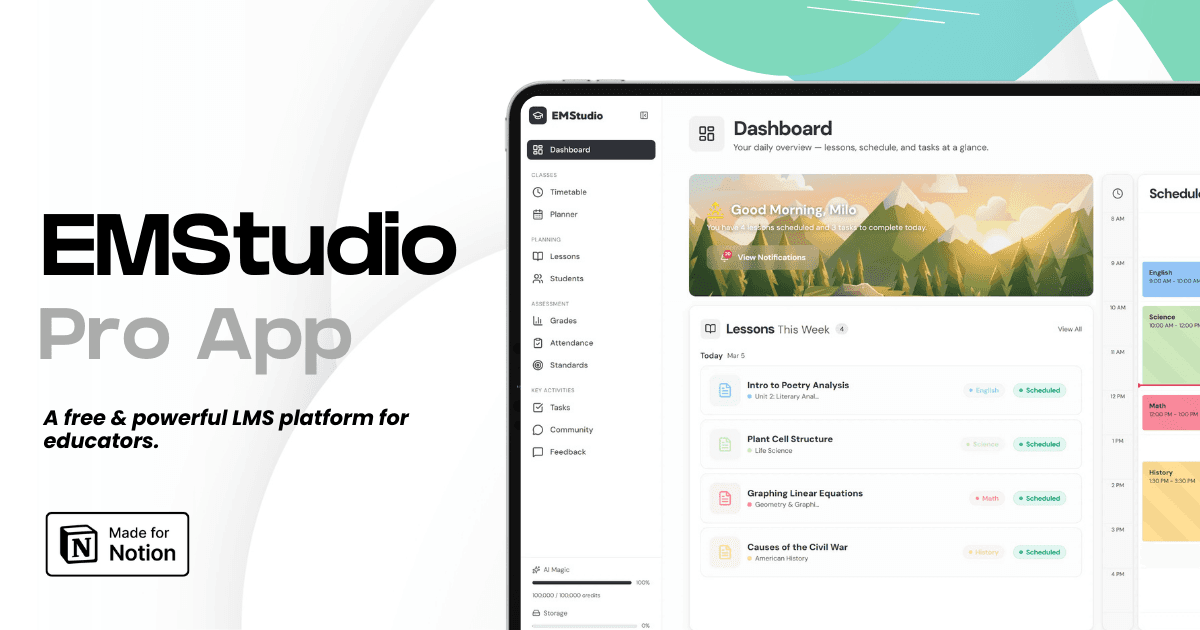
EMStudio is a free teaching management app — manage your classes, students, lessons, and more!
Learn More
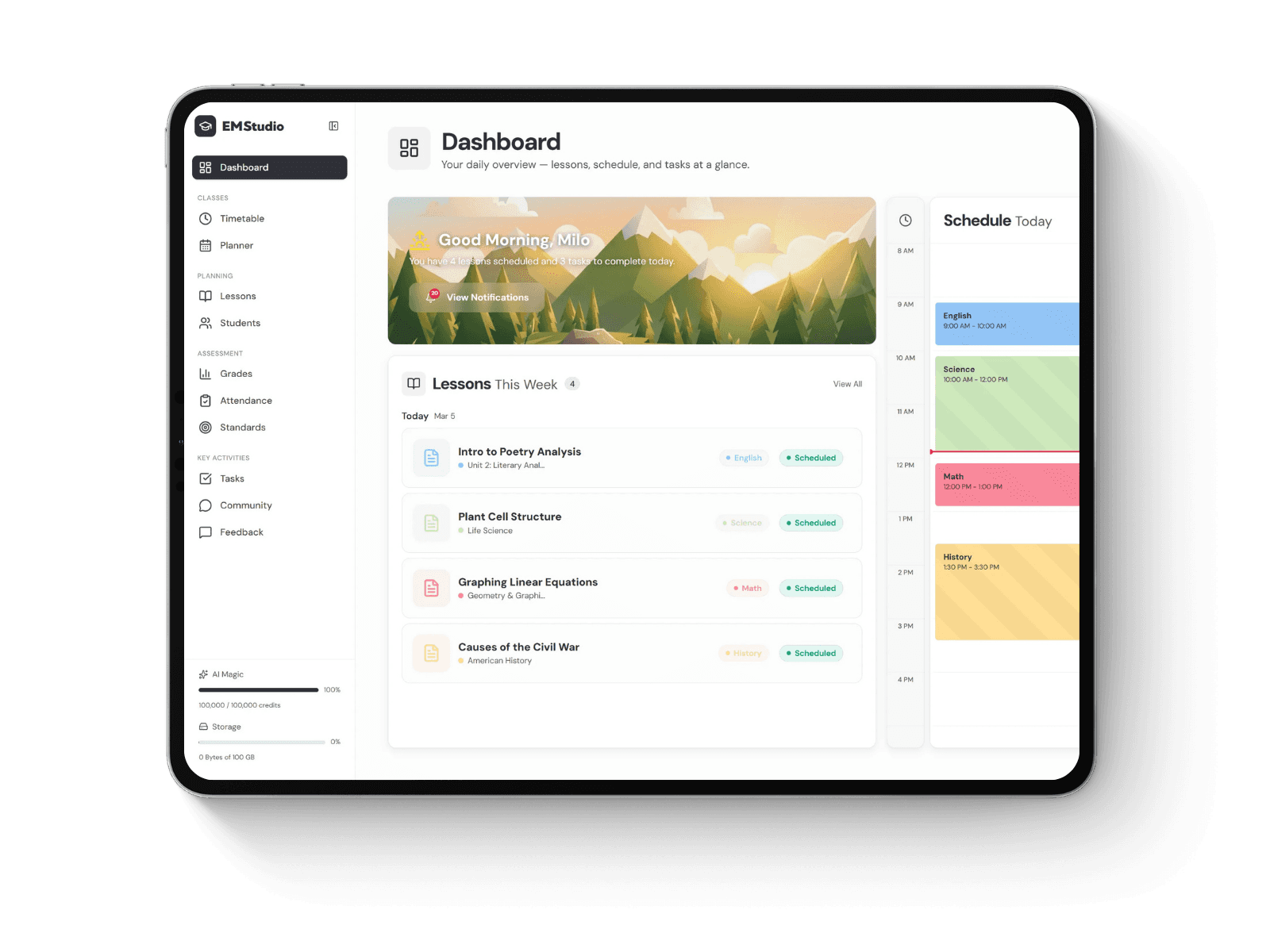
Still grading everything by hand?
EMStudio is a free teaching management app — manage your classes, students, lessons, and more!
Learn More
Table of Contents
Digital Platforms for Teachers Sharing Curriculum Resources
You need a teacher to teacher website that loads when the district Wi-Fi crawls. I have tested three platforms across different buildings:
Share My Lesson offers free AFT partnership access to 1.3 million CCSS-aligned resources. Upload takes five minutes with automatic standards tagging.
Teachers Pay Teachers serves 7 million users with 70% creator royalties on items over $2.50, dropping to 55% below that. Initial store setup demands two hours including 1500x1500 cover images. Prices range from $0 to $500 depending on unit size.
Notion Education provides free Plus plans. Configuration takes thirty minutes to set shared workspace permissions for grade-level teams.
District firewalls usually block TPT's commercial domains while allowing educational URLs. When IT blocks TPT, submit a whitelist request citing John Hattie's research: collective teacher efficacy carries a 1.57 effect size on student achievement, and teachers sharing resources builds that efficacy. Alternatively, download on personal devices for USB transfer, or push for district-wide TPT School Access licenses.
Share My Lesson and Open Resource Libraries
Share My Lesson operates as one of the largest open resource libraries for educators. The Remix feature lets you adapt existing lessons without violating copyright.
Full downloads require free AFT membership registration, a five-minute process. The Collections tool organizes units by standard for your professional learning community. I used it last October to find a 3rd-grade fractions lesson, then remixed it to include my school's math manipulatives. The automatic CCSS tagging saved me from cross-referencing standards manually.
Search uses standard filters. You avoid the algorithms that push sponsored content down the page.
Teachers Pay Teachers for Original Content Exchange
Teachers Pay Teachers dominates the resource exchange market with 7 million users. The royalty structure pays 70% on items over $2.50, dropping to 55% below that threshold.
Easel by TPT allows digital annotation directly on PDFs. Best-selling elementary resources hit a 15-minute prep sweet spot—complex enough to justify purchase, simple enough for Tuesday implementation. I have found essential teachers pay resources here, particularly for novel studies.
The initial two-hour store setup pays off if you plan to sell your own materials. When IT blocks the site, download on personal devices for USB transfer or advocate for TPT School Access licenses.
Notion and Collaborative Documentation Tools
Notion Education offers a different approach to educator collaboration. The free Plus plan supports real-time shared documentation.
The Teacher Planner template includes linked databases for units, standards, and assessments. Permission settings control access: 'Can edit' for co-teachers, 'Can comment' for department review during instructional rounds, 'Can view' for district sharing.
Setup takes thirty minutes to configure workspace permissions for grade-level teams. I moved my 4th-grade team's planning there last spring. We stopped emailing Word documents, commenting directly on database entries during each instructional round.
Social Media Communities Where Teachers Share Daily
You scroll during lunch. You get ideas before bed. These spaces move faster than district email chains ever could.
The influence of social media on teacher collaboration shows up in your classroom Monday morning. One screenshot saves you forty minutes of planning. You will find teachers sharing wins and losses daily, not just during scheduled PD.
Instagram Teacher Accounts for Visual Inspiration
These five accounts post daily around 7 PM EST when you're finally sitting down. They drive serious pedagogical sharing.
@thetututeacher: Classroom management with 800K followers watching her reset procedures.
@luckylittlelearners: K-2 content reaching 500K teachers.
@teachingwithamountainview: Upper elementary math strategies.
@thedaringenglishteacher: Secondary ELA resources.
@mrsrussellsroom: STEM integration ideas.
Carousels breaking down lesson steps hit 15% save rates. Reels showing transitions get algorithm priority. Story templates run "This or That" polls that keep you connecting with educators on social platforms during commercial breaks.
Mix broad tags like #teacherlife with niche ones like #5thgradescience. Post at 7-9 PM EST for peak educator collaboration. When @thetututeacher posts a voice-level chart, thousands of classrooms quiet down the next morning.
Facebook Groups for Grade-Level Specific Support
Teaching with Jillian Starr brings 200K members for general inspiration. But you solve specific curriculum questions in micro-groups like "2nd Grade Teachers Only" with 15K members who actually teach your standards.
Three-question screenings verify grade level and school type before approval.
The Units feature organizes files by subject for easy browsing.
The Files tab search finds archived resources instantly.
Watch the promo rules. About 60% of large groups ban direct TPT links in posts. Work around it by putting the link in your profile and referencing it. This teacherforteachers approach keeps the resource exchange useful, not sales-heavy.
The screening process matters. Wrong answers get rejected. This keeps the instructional rounds focused on relevant practitioners, not marketers.
X and Threads for Real-Time Problem Solving
Tuesday nights at 7 PM ET, #edchat trends with 500+ participants troubleshooting in real time. You post a problem. You get answers before the hour ends.
Search "Teachers Helping Teachers" when you need immediate crowdsourcing. X forces you into 280 characters, which oddly helps you clarify the actual issue. Threads gives you 500 characters for complex RTI scenarios or IEP questions that need context.
Anonymize every detail. Change genders, switch subjects, remove dates.
Build an "edutwitter" block list fast to filter toxic accounts.
Use the expanded character count for MTSS explanations that need nuance.
Support from teacher to teacher works best when you protect your classroom while asking your pedagogical questions. The character limit teaches brevity. You learn to cut fluff and ask exactly what you need about that difficult conference or failed lab.

What Are the Best District-Level Sharing Systems?
The best district-level sharing systems combine DuFour-model Professional Learning Communities with structured mentorship. PLCs require 90-minute weekly cycles with trained facilitators and clear data protocols, while cross-school mentorships provide contextual support through classroom observation and co-planning time.
Districts serious about teachers helping teachers need systems, not wishful thinking. You are choosing between three proven models for educator collaboration, each with distinct costs and time demands. Pick wrong and you burn goodwill.
Your options range from $0 to $500 per teacher annually. professional learning communities (PLCs) demand 90 minutes weekly plus substitute coverage. Wikis cost nothing but require setup labor. cross-school mentorship pairings run on release time coverage and stipends. Match the teach share tool to your district's pain point.
Professional Learning Communities (PLCs)
DuFour-model PLCs run on four essential questions:
What do students need to know?
How will we know they learned it?
What will we do if they don't?
What if they already do?
Your weekly 90-minute agenda splits into ten minutes reviewing data, forty minutes digging into strategies, and ten minutes locking down action steps. Budget for substitute coverage: each teacher needs a half-day release monthly for instructional rounds or data analysis.
Run these voluntary only. Districts paying $25 hourly stipends see 40% higher engagement than forced participation. Watch for "PLC-lite" warning signs like agenda-less meetings or administrative paperwork replacing instructional focus. Mandatory compliance kills the collaboration you are trying to build.
Make it tangible with the Evidence of Learning protocol. Teachers bring anonymized student work from last week's common formative assessment. Use a Parking Lot poster to capture off-topic issues for later. Track intervention effectiveness in a shared Progress Monitor spreadsheet so you know what actually moves the needle.
Internal District Wikis and Shared Drives
Google Workspace works for most districts. Use Sites for static resources like pacing guides, Drive for living documents teachers actually edit. Microsoft SharePoint costs more but offers advanced metadata tagging and automated approval workflows that prevent broken links when someone moves a file.
Version control saves your sanity. Enforce a strict folder taxonomy: Academic Year > Subject > Unit > Resource Type. Name every file with YYMMDD prefixes so "20241015_Ecosystems_Quiz" sorts correctly by date. Without this structure, your resource exchange becomes a graveyard of "Final_Final_Edit2" documents that waste planning time.
Cross-School Mentorship Pairings
The 3-2-1 structure works across a semester-long commitment. Novice teachers observe expert partners three times, then meet for two co-planning sessions where they actually build lessons together. The semester closes with one reverse observation where the veteran watches the newbie and gives feedback using a strict protocol.
This is teachers sharing at its most contextual, beating teacher networking events that never change classroom practice. You cannot google your way through your specific building's culture. Schedule monthly 90-minute release time blocks covered by central office staff or retired teacher subs. One semester commitments work better than year-long marches that fade by February.
How Do Teachers Share Through Professional Associations?
Teachers share most effectively through professional associations via peer-reviewed platforms like NCTE's ReadWriteThink and NCTM's Illuminations. Union libraries provide immediate practical resources, while conference networks enable deep pedagogical exchange through structured proposals and presentation opportunities. You avoid the Pinterest rabbit holes and get classroom-tested strategies.
Teachers sharing through these organizations follow rigorous peer-review standards. That independence means they can host controversial discussions and current research without administrative approval. You pay $50 to $150 annually, but you bypass the district firewall of approved vendors.
Union-Sponsored Resource Libraries
NEA's Works4Me arrives as a weekly email blast every Monday morning. Three vetted strategies hit your inbox:
A classroom management tip for immediate use.
A curriculum shortcut that saves planning time.
A time-saver for administrative tasks.
State dues average $200 annually, though the email archive stretches back to 2001 and requires no login to search. You can filter by grade band or subject right from the preview pane.
AFT partners with Share My Lesson for their teacher share platform. Every upload undergoes peer review by three practicing classroom teachers who check for standards alignment and instructional accuracy. They reject resources with broken links, unclear objectives, or outdated pedagogy. This vetting catches errors I've seen circulate on open forums, like worksheets misrepresenting the scientific method.
District firewalls create headaches. Some IT departments block all union URLs during contract seasons or permanently. When the site won't load on school WiFi, switch to mobile data or wait until you reach home. Last October my district blocked NEA servers during negotiations; I pulled the behavior strategies on my phone during my planning period. The workarounds are annoying, but the resources outperform random Google results.
Subject-Specific Association Platforms (NCTE, NCTM)
These platforms offer curated resource exchange systems that beat generic search results:
NCTE ReadWriteThink: Literacy lessons aligned to IRA standards. The Standards Navigator shows vertical alignment K-12. $50 annually includes Journal archives to 1912.
NCTM Illuminations: Interactive math tools with Common Core alignment. Chromebook-compatible applets replace broken Flash sites. Peer-reviewed for accuracy and engagement.
NSTA Next Gen Navigator: NGSS resources with three-dimensional learning. Lesson plans integrate core ideas, crosscutting concepts, and science practices.
The Standards Navigator tool traces how skills develop from kindergarten through twelfth grade. You can identify exactly what your sixth graders should have retained from fourth grade, then download the mini-lesson that bridges the gap. I used their argumentative writing framework last October to diagnose why my 7th graders struggled with evidence; the vertical view revealed missing foundational work from two years prior.
NCTM's tools solve real hardware problems. The fraction number line applet works on Chromebooks without Flash, which matters since so many legacy math sites broke when browsers dropped support. I've watched 4th graders finally understand equivalence using these visual models after textbook diagrams confused them.
These associations function as professional learning communities built around content expertise, not just geography. The journals alone justify the membership cost. NCTE's research publications include empirical studies on instructional strategies that actually move achievement data, not just theoretical frameworks written by professors who haven't seen a classroom since 1995.
Conference Presentation Networks
NSTA requires presenters submit a 250-word abstract eight months before the conference. Accepted presenters receive a $150 discount off registration. You can propose either format:
50-minute session: Standard presentation with Q&A.
2-hour workshop: Hands-on implementation with take-home materials.
The selection committee scores proposals on innovation, replicability, and evidence of student impact. They reject half the submissions, which keeps the quality high.
The Teacher Share Fair format turns the gymnasium into a rotation zone. Presenters set up at tables while attendees move through 10-minute micro-presentations. You catch six new strategies in an hour without committing to a full session. I presented our school's close reading protocol there last year. Three teachers from different states emailed photos of their student work two months later showing how they adapted it for their classrooms.
EdCamp offers the opposite structure: the unconference model. These events are free, held on Saturdays, and built that morning by participants. No vendors, no keynotes, no paid speakers. You write a topic on a sticky note if you want to lead a discussion, or you vote with your feet by leaving sessions that don't serve you. The schedule builds at 8 AM based on actual teacher needs, not corporate sponsorships. This is pure teacher networking without the glossy brochure waste.

Peer Observation and In-Person Collaboration Methods
Lesson Study Groups Across Classrooms
Japanese Lesson Study adapts well to US schools when you commit the time. Four to six teachers form a professional learning community to collaboratively plan a two-week unit tied to your school improvement plan—maybe "increasing academic discourse." You designate one public "research lesson" where twenty-plus observers watch a single class period.
The debrief runs ninety minutes using strict evidence-only protocols. No one says "I liked" or "great job." The presenting teacher reflects for five minutes. Observers share data for fifteen—statements like "I heard three students ask clarifying questions." A knowledgeable other connects findings to research for ten minutes. Total investment: twelve to fifteen hours across six weeks.
This teacher networking approach eliminates evaluation anxiety by design. The Observation Protocol bans judgment words entirely. You focus only on what you saw and heard, not what you think worked. This pedagogical sharing creates genuine resource exchange without competition.
Co-Teaching Arrangements for Skill Sharing
You have six collaborative teaching models for K-12 teams to choose from. Each serves different inclusion contexts:
One Teach/One Observe: One teacher leads while the other collects data. Use sparingly for IEP documentation.
One Teach/One Assist: The second teacher circulates to help individuals. Cap at twenty percent of time for IEP inclusion to avoid overuse.
Parallel Teaching: Split the class fifty-fifty for differentiated instruction. Best for ESL push-in contexts.
Station Teaching: Rotate students every fifteen minutes through co-taught stations.
Alternative Teaching: One teacher pulls a small group for remediation while the other leads the main class.
Team Teaching: Both teachers deliver simultaneous dialogue. Perfect for debate lessons.
Before every lesson, hold a mandatory five-minute huddle using the Co-Teaching Implementation Checklist. Map physical space, noise levels, and signal systems for attention. After class, debrief for five minutes on what modifications worked.
Learn more about effective co-teaching techniques to avoid the trap of one teacher leading while the other observes. Successful educator collaboration here means both professionals share the instructional load equally.
Vertical Alignment Teams for Grade Transitions
Sixth-grade teachers meet with seventh-grade every spring for educator collaboration on writing rubrics and closing the transition gap. The jump between these grades often shocks students. You bring student work samples and map the Skills Ladder showing how concrete manipulatives in sixth grade evolve into abstract equations in seventh.
Peer observation supports this vertical work when you use the Zone of Proximal Development framework for feedback. Observation Protocol forms ban judgment words entirely. Observers record only data—"I noticed four students referenced the anchor chart"—never "you were unclear." This protects trust and keeps the focus on student learning.
Instructional rounds work best here: teams visit the grade above or below for twenty minutes, then compare notes. Teachers sharing resources across grade levels prevents the "reteach everything" phenomenon in August. This pedagogical sharing builds a true professional learning community.
How to Choose the Right Sharing Method for Your Needs?
Match your sharing method to available time and tech comfort: use social media for 15-minute daily troubleshooting, district professional learning communities for 90-minute weekly systemic alignment, and subject associations for quarterly deep dives including instructional rounds. Start with one platform to avoid overwhelm, then layer additional communities based on specific curriculum needs.
Start with a time audit. Categorize your current prep: planning, grading, admin. Identify 30-minute slots for a One In, One Out rule—every resource downloaded requires uploading one original within 30 days. Warning: platform hopping causes burnout. Pick one primary channel for teacher networking and one backup, then stop.
Assessing Your Time Availability and Tech Comfort
Use this tech rubric:
Can you attach a PDF? Start with Facebook groups for teacher share opportunities.
Can you build spreadsheets with filters? Use Notion wikis.
Can you code HTML? Customize SharePoint.
Follow the 20-minute setup rule. If initial configuration exceeds this, choose simpler tools. Teachers sharing resources effectively pick platforms they master in one prep period.
Matching Resources to Your Specific Grade and Subject
ELA teachers need NCTE's lesson databases for pedagogical sharing. Math teachers use NCTM Illuminations. STEM educators rely on Twitter for #STEMchat resource exchange.
Elementary generalists prioritize Instagram for visual ideas. Secondary departmentalized educators need subject association journals. Special Ed teachers require district mentorship for IEP compliance. Match your choosing the right teacher planner to these grade-level needs.
Building Sustainable Sharing Habits
Implement the Weekly Win protocol. Every Friday, document one successful 10-minute activity in a shared drive before leaving. This maintains educator collaboration without weekend overwhelm.
Use the Tiny Habit method: stack sharing onto existing routines. After your morning coffee, post one idea. If you haven't shared in 21 days, the habit breaks. Set calendar reminders for days 7, 14, and 21. Pair this with sustainable planning habits for effective teachers.
Digital Platforms for Teachers Sharing Curriculum Resources
You need a teacher to teacher website that loads when the district Wi-Fi crawls. I have tested three platforms across different buildings:
Share My Lesson offers free AFT partnership access to 1.3 million CCSS-aligned resources. Upload takes five minutes with automatic standards tagging.
Teachers Pay Teachers serves 7 million users with 70% creator royalties on items over $2.50, dropping to 55% below that. Initial store setup demands two hours including 1500x1500 cover images. Prices range from $0 to $500 depending on unit size.
Notion Education provides free Plus plans. Configuration takes thirty minutes to set shared workspace permissions for grade-level teams.
District firewalls usually block TPT's commercial domains while allowing educational URLs. When IT blocks TPT, submit a whitelist request citing John Hattie's research: collective teacher efficacy carries a 1.57 effect size on student achievement, and teachers sharing resources builds that efficacy. Alternatively, download on personal devices for USB transfer, or push for district-wide TPT School Access licenses.
Share My Lesson and Open Resource Libraries
Share My Lesson operates as one of the largest open resource libraries for educators. The Remix feature lets you adapt existing lessons without violating copyright.
Full downloads require free AFT membership registration, a five-minute process. The Collections tool organizes units by standard for your professional learning community. I used it last October to find a 3rd-grade fractions lesson, then remixed it to include my school's math manipulatives. The automatic CCSS tagging saved me from cross-referencing standards manually.
Search uses standard filters. You avoid the algorithms that push sponsored content down the page.
Teachers Pay Teachers for Original Content Exchange
Teachers Pay Teachers dominates the resource exchange market with 7 million users. The royalty structure pays 70% on items over $2.50, dropping to 55% below that threshold.
Easel by TPT allows digital annotation directly on PDFs. Best-selling elementary resources hit a 15-minute prep sweet spot—complex enough to justify purchase, simple enough for Tuesday implementation. I have found essential teachers pay resources here, particularly for novel studies.
The initial two-hour store setup pays off if you plan to sell your own materials. When IT blocks the site, download on personal devices for USB transfer or advocate for TPT School Access licenses.
Notion and Collaborative Documentation Tools
Notion Education offers a different approach to educator collaboration. The free Plus plan supports real-time shared documentation.
The Teacher Planner template includes linked databases for units, standards, and assessments. Permission settings control access: 'Can edit' for co-teachers, 'Can comment' for department review during instructional rounds, 'Can view' for district sharing.
Setup takes thirty minutes to configure workspace permissions for grade-level teams. I moved my 4th-grade team's planning there last spring. We stopped emailing Word documents, commenting directly on database entries during each instructional round.
Social Media Communities Where Teachers Share Daily
You scroll during lunch. You get ideas before bed. These spaces move faster than district email chains ever could.
The influence of social media on teacher collaboration shows up in your classroom Monday morning. One screenshot saves you forty minutes of planning. You will find teachers sharing wins and losses daily, not just during scheduled PD.
Instagram Teacher Accounts for Visual Inspiration
These five accounts post daily around 7 PM EST when you're finally sitting down. They drive serious pedagogical sharing.
@thetututeacher: Classroom management with 800K followers watching her reset procedures.
@luckylittlelearners: K-2 content reaching 500K teachers.
@teachingwithamountainview: Upper elementary math strategies.
@thedaringenglishteacher: Secondary ELA resources.
@mrsrussellsroom: STEM integration ideas.
Carousels breaking down lesson steps hit 15% save rates. Reels showing transitions get algorithm priority. Story templates run "This or That" polls that keep you connecting with educators on social platforms during commercial breaks.
Mix broad tags like #teacherlife with niche ones like #5thgradescience. Post at 7-9 PM EST for peak educator collaboration. When @thetututeacher posts a voice-level chart, thousands of classrooms quiet down the next morning.
Facebook Groups for Grade-Level Specific Support
Teaching with Jillian Starr brings 200K members for general inspiration. But you solve specific curriculum questions in micro-groups like "2nd Grade Teachers Only" with 15K members who actually teach your standards.
Three-question screenings verify grade level and school type before approval.
The Units feature organizes files by subject for easy browsing.
The Files tab search finds archived resources instantly.
Watch the promo rules. About 60% of large groups ban direct TPT links in posts. Work around it by putting the link in your profile and referencing it. This teacherforteachers approach keeps the resource exchange useful, not sales-heavy.
The screening process matters. Wrong answers get rejected. This keeps the instructional rounds focused on relevant practitioners, not marketers.
X and Threads for Real-Time Problem Solving
Tuesday nights at 7 PM ET, #edchat trends with 500+ participants troubleshooting in real time. You post a problem. You get answers before the hour ends.
Search "Teachers Helping Teachers" when you need immediate crowdsourcing. X forces you into 280 characters, which oddly helps you clarify the actual issue. Threads gives you 500 characters for complex RTI scenarios or IEP questions that need context.
Anonymize every detail. Change genders, switch subjects, remove dates.
Build an "edutwitter" block list fast to filter toxic accounts.
Use the expanded character count for MTSS explanations that need nuance.
Support from teacher to teacher works best when you protect your classroom while asking your pedagogical questions. The character limit teaches brevity. You learn to cut fluff and ask exactly what you need about that difficult conference or failed lab.
What Are the Best District-Level Sharing Systems?
The best district-level sharing systems combine DuFour-model Professional Learning Communities with structured mentorship. PLCs require 90-minute weekly cycles with trained facilitators and clear data protocols, while cross-school mentorships provide contextual support through classroom observation and co-planning time.
Districts serious about teachers helping teachers need systems, not wishful thinking. You are choosing between three proven models for educator collaboration, each with distinct costs and time demands. Pick wrong and you burn goodwill.
Your options range from $0 to $500 per teacher annually. professional learning communities (PLCs) demand 90 minutes weekly plus substitute coverage. Wikis cost nothing but require setup labor. cross-school mentorship pairings run on release time coverage and stipends. Match the teach share tool to your district's pain point.
Professional Learning Communities (PLCs)
DuFour-model PLCs run on four essential questions:
What do students need to know?
How will we know they learned it?
What will we do if they don't?
What if they already do?
Your weekly 90-minute agenda splits into ten minutes reviewing data, forty minutes digging into strategies, and ten minutes locking down action steps. Budget for substitute coverage: each teacher needs a half-day release monthly for instructional rounds or data analysis.
Run these voluntary only. Districts paying $25 hourly stipends see 40% higher engagement than forced participation. Watch for "PLC-lite" warning signs like agenda-less meetings or administrative paperwork replacing instructional focus. Mandatory compliance kills the collaboration you are trying to build.
Make it tangible with the Evidence of Learning protocol. Teachers bring anonymized student work from last week's common formative assessment. Use a Parking Lot poster to capture off-topic issues for later. Track intervention effectiveness in a shared Progress Monitor spreadsheet so you know what actually moves the needle.
Internal District Wikis and Shared Drives
Google Workspace works for most districts. Use Sites for static resources like pacing guides, Drive for living documents teachers actually edit. Microsoft SharePoint costs more but offers advanced metadata tagging and automated approval workflows that prevent broken links when someone moves a file.
Version control saves your sanity. Enforce a strict folder taxonomy: Academic Year > Subject > Unit > Resource Type. Name every file with YYMMDD prefixes so "20241015_Ecosystems_Quiz" sorts correctly by date. Without this structure, your resource exchange becomes a graveyard of "Final_Final_Edit2" documents that waste planning time.
Cross-School Mentorship Pairings
The 3-2-1 structure works across a semester-long commitment. Novice teachers observe expert partners three times, then meet for two co-planning sessions where they actually build lessons together. The semester closes with one reverse observation where the veteran watches the newbie and gives feedback using a strict protocol.
This is teachers sharing at its most contextual, beating teacher networking events that never change classroom practice. You cannot google your way through your specific building's culture. Schedule monthly 90-minute release time blocks covered by central office staff or retired teacher subs. One semester commitments work better than year-long marches that fade by February.
How Do Teachers Share Through Professional Associations?
Teachers share most effectively through professional associations via peer-reviewed platforms like NCTE's ReadWriteThink and NCTM's Illuminations. Union libraries provide immediate practical resources, while conference networks enable deep pedagogical exchange through structured proposals and presentation opportunities. You avoid the Pinterest rabbit holes and get classroom-tested strategies.
Teachers sharing through these organizations follow rigorous peer-review standards. That independence means they can host controversial discussions and current research without administrative approval. You pay $50 to $150 annually, but you bypass the district firewall of approved vendors.
Union-Sponsored Resource Libraries
NEA's Works4Me arrives as a weekly email blast every Monday morning. Three vetted strategies hit your inbox:
A classroom management tip for immediate use.
A curriculum shortcut that saves planning time.
A time-saver for administrative tasks.
State dues average $200 annually, though the email archive stretches back to 2001 and requires no login to search. You can filter by grade band or subject right from the preview pane.
AFT partners with Share My Lesson for their teacher share platform. Every upload undergoes peer review by three practicing classroom teachers who check for standards alignment and instructional accuracy. They reject resources with broken links, unclear objectives, or outdated pedagogy. This vetting catches errors I've seen circulate on open forums, like worksheets misrepresenting the scientific method.
District firewalls create headaches. Some IT departments block all union URLs during contract seasons or permanently. When the site won't load on school WiFi, switch to mobile data or wait until you reach home. Last October my district blocked NEA servers during negotiations; I pulled the behavior strategies on my phone during my planning period. The workarounds are annoying, but the resources outperform random Google results.
Subject-Specific Association Platforms (NCTE, NCTM)
These platforms offer curated resource exchange systems that beat generic search results:
NCTE ReadWriteThink: Literacy lessons aligned to IRA standards. The Standards Navigator shows vertical alignment K-12. $50 annually includes Journal archives to 1912.
NCTM Illuminations: Interactive math tools with Common Core alignment. Chromebook-compatible applets replace broken Flash sites. Peer-reviewed for accuracy and engagement.
NSTA Next Gen Navigator: NGSS resources with three-dimensional learning. Lesson plans integrate core ideas, crosscutting concepts, and science practices.
The Standards Navigator tool traces how skills develop from kindergarten through twelfth grade. You can identify exactly what your sixth graders should have retained from fourth grade, then download the mini-lesson that bridges the gap. I used their argumentative writing framework last October to diagnose why my 7th graders struggled with evidence; the vertical view revealed missing foundational work from two years prior.
NCTM's tools solve real hardware problems. The fraction number line applet works on Chromebooks without Flash, which matters since so many legacy math sites broke when browsers dropped support. I've watched 4th graders finally understand equivalence using these visual models after textbook diagrams confused them.
These associations function as professional learning communities built around content expertise, not just geography. The journals alone justify the membership cost. NCTE's research publications include empirical studies on instructional strategies that actually move achievement data, not just theoretical frameworks written by professors who haven't seen a classroom since 1995.
Conference Presentation Networks
NSTA requires presenters submit a 250-word abstract eight months before the conference. Accepted presenters receive a $150 discount off registration. You can propose either format:
50-minute session: Standard presentation with Q&A.
2-hour workshop: Hands-on implementation with take-home materials.
The selection committee scores proposals on innovation, replicability, and evidence of student impact. They reject half the submissions, which keeps the quality high.
The Teacher Share Fair format turns the gymnasium into a rotation zone. Presenters set up at tables while attendees move through 10-minute micro-presentations. You catch six new strategies in an hour without committing to a full session. I presented our school's close reading protocol there last year. Three teachers from different states emailed photos of their student work two months later showing how they adapted it for their classrooms.
EdCamp offers the opposite structure: the unconference model. These events are free, held on Saturdays, and built that morning by participants. No vendors, no keynotes, no paid speakers. You write a topic on a sticky note if you want to lead a discussion, or you vote with your feet by leaving sessions that don't serve you. The schedule builds at 8 AM based on actual teacher needs, not corporate sponsorships. This is pure teacher networking without the glossy brochure waste.
Peer Observation and In-Person Collaboration Methods
Lesson Study Groups Across Classrooms
Japanese Lesson Study adapts well to US schools when you commit the time. Four to six teachers form a professional learning community to collaboratively plan a two-week unit tied to your school improvement plan—maybe "increasing academic discourse." You designate one public "research lesson" where twenty-plus observers watch a single class period.
The debrief runs ninety minutes using strict evidence-only protocols. No one says "I liked" or "great job." The presenting teacher reflects for five minutes. Observers share data for fifteen—statements like "I heard three students ask clarifying questions." A knowledgeable other connects findings to research for ten minutes. Total investment: twelve to fifteen hours across six weeks.
This teacher networking approach eliminates evaluation anxiety by design. The Observation Protocol bans judgment words entirely. You focus only on what you saw and heard, not what you think worked. This pedagogical sharing creates genuine resource exchange without competition.
Co-Teaching Arrangements for Skill Sharing
You have six collaborative teaching models for K-12 teams to choose from. Each serves different inclusion contexts:
One Teach/One Observe: One teacher leads while the other collects data. Use sparingly for IEP documentation.
One Teach/One Assist: The second teacher circulates to help individuals. Cap at twenty percent of time for IEP inclusion to avoid overuse.
Parallel Teaching: Split the class fifty-fifty for differentiated instruction. Best for ESL push-in contexts.
Station Teaching: Rotate students every fifteen minutes through co-taught stations.
Alternative Teaching: One teacher pulls a small group for remediation while the other leads the main class.
Team Teaching: Both teachers deliver simultaneous dialogue. Perfect for debate lessons.
Before every lesson, hold a mandatory five-minute huddle using the Co-Teaching Implementation Checklist. Map physical space, noise levels, and signal systems for attention. After class, debrief for five minutes on what modifications worked.
Learn more about effective co-teaching techniques to avoid the trap of one teacher leading while the other observes. Successful educator collaboration here means both professionals share the instructional load equally.
Vertical Alignment Teams for Grade Transitions
Sixth-grade teachers meet with seventh-grade every spring for educator collaboration on writing rubrics and closing the transition gap. The jump between these grades often shocks students. You bring student work samples and map the Skills Ladder showing how concrete manipulatives in sixth grade evolve into abstract equations in seventh.
Peer observation supports this vertical work when you use the Zone of Proximal Development framework for feedback. Observation Protocol forms ban judgment words entirely. Observers record only data—"I noticed four students referenced the anchor chart"—never "you were unclear." This protects trust and keeps the focus on student learning.
Instructional rounds work best here: teams visit the grade above or below for twenty minutes, then compare notes. Teachers sharing resources across grade levels prevents the "reteach everything" phenomenon in August. This pedagogical sharing builds a true professional learning community.
How to Choose the Right Sharing Method for Your Needs?
Match your sharing method to available time and tech comfort: use social media for 15-minute daily troubleshooting, district professional learning communities for 90-minute weekly systemic alignment, and subject associations for quarterly deep dives including instructional rounds. Start with one platform to avoid overwhelm, then layer additional communities based on specific curriculum needs.
Start with a time audit. Categorize your current prep: planning, grading, admin. Identify 30-minute slots for a One In, One Out rule—every resource downloaded requires uploading one original within 30 days. Warning: platform hopping causes burnout. Pick one primary channel for teacher networking and one backup, then stop.
Assessing Your Time Availability and Tech Comfort
Use this tech rubric:
Can you attach a PDF? Start with Facebook groups for teacher share opportunities.
Can you build spreadsheets with filters? Use Notion wikis.
Can you code HTML? Customize SharePoint.
Follow the 20-minute setup rule. If initial configuration exceeds this, choose simpler tools. Teachers sharing resources effectively pick platforms they master in one prep period.
Matching Resources to Your Specific Grade and Subject
ELA teachers need NCTE's lesson databases for pedagogical sharing. Math teachers use NCTM Illuminations. STEM educators rely on Twitter for #STEMchat resource exchange.
Elementary generalists prioritize Instagram for visual ideas. Secondary departmentalized educators need subject association journals. Special Ed teachers require district mentorship for IEP compliance. Match your choosing the right teacher planner to these grade-level needs.
Building Sustainable Sharing Habits
Implement the Weekly Win protocol. Every Friday, document one successful 10-minute activity in a shared drive before leaving. This maintains educator collaboration without weekend overwhelm.
Use the Tiny Habit method: stack sharing onto existing routines. After your morning coffee, post one idea. If you haven't shared in 21 days, the habit breaks. Set calendar reminders for days 7, 14, and 21. Pair this with sustainable planning habits for effective teachers.
Still grading everything by hand?
EMStudio is a free teaching management app — manage your classes, students, lessons, and more!
Learn More
Still grading everything by hand?
EMStudio is a free teaching management app — manage your classes, students, lessons, and more!
Learn More



Notion4Teachers
Notion templates to simplify administrative tasks and enhance your teaching experience.



2026 Notion4Teachers. All Rights Reserved.
Notion4Teachers
Notion templates to simplify administrative tasks and enhance your teaching experience.
2026 Notion4Teachers. All Rights Reserved.
Notion4Teachers
Notion templates to simplify administrative tasks and enhance your teaching experience.
2026 Notion4Teachers. All Rights Reserved.