
Collaborative Teaching Models: 12 Methods for K-12 Teams
Collaborative Teaching Models: 12 Methods for K-12 Teams

Article by
Milo
ESL Content Coordinator & Educator
ESL Content Coordinator & Educator
All Posts
You got the email: starting next week, you'll have a co-teacher. Maybe it's a special education push-in support, maybe an ESL specialist, maybe you're the one walking into someone else's room. Either way, Monday arrives and you face the awkward dance—two adults, one whiteboard, and zero clarity on who leads what. This is where most collaborative teaching models fall apart before they start. Without a shared language for roles, one person ends up monitoring behavior while the other does all the teaching.
I've seen it fail both ways. The gen ed teacher treats the specialist like a glorified aide. The specialist jumps in at the wrong moment and derails the lesson. Students smell the disconnect immediately. But when these partnerships work—when you move past "you take the back row, I'll take the front"—the results for inclusive education are immediate. Kids get differentiated instruction in real time, not as an afterthought.
This post breaks down 12 specific structures—from basic one-teach-one-assist to parallel teaching and station rotations—so you can pick the right fit for your content and actually split the workload. No more guessing who grades what. No more silent resentment during shared planning periods.
Still grading everything by hand?
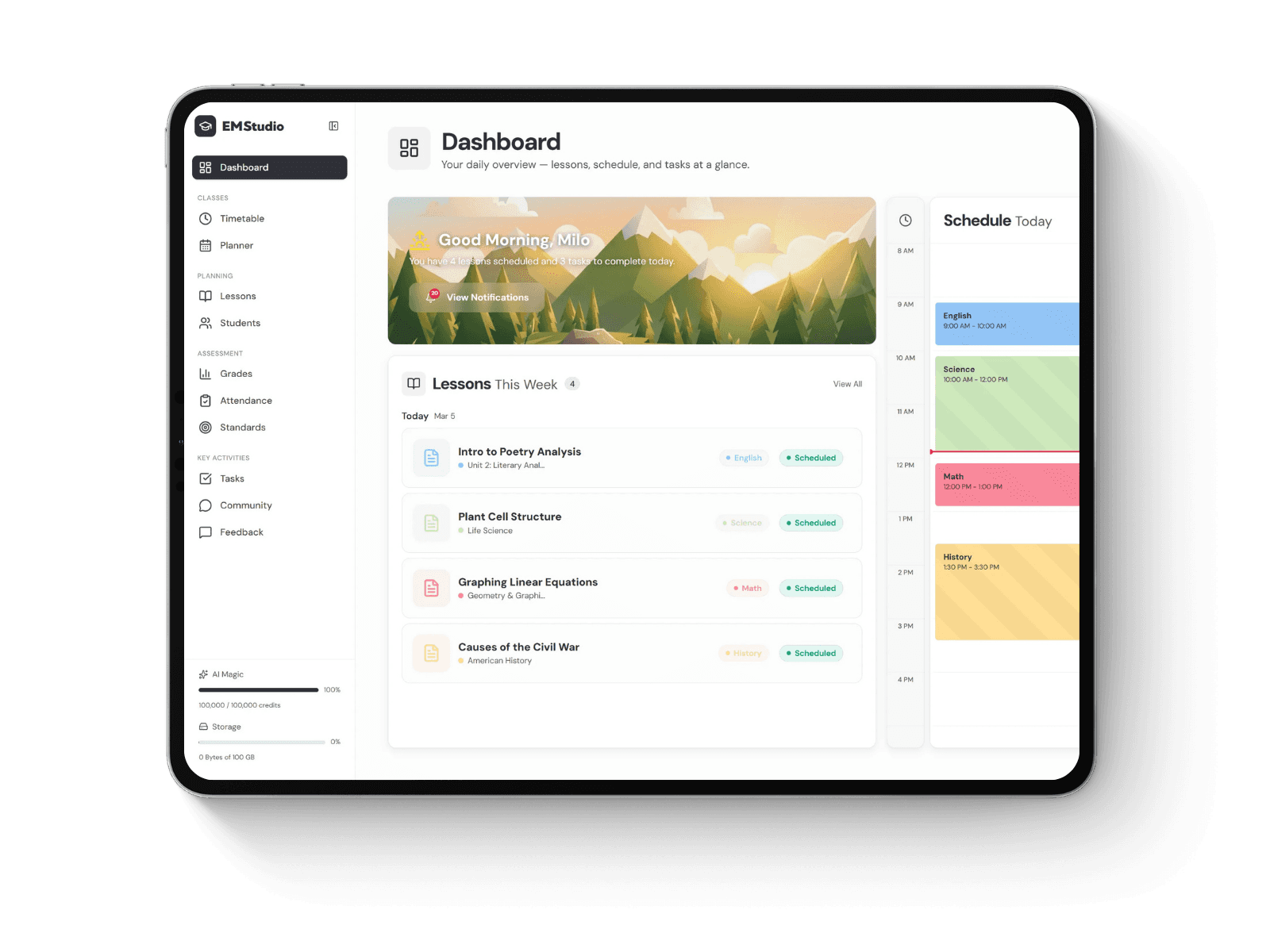
EMStudio is a free teaching management app — manage your classes, students, lessons, and more!
Learn More
Still grading everything by hand?
EMStudio is a free teaching management app — manage your classes, students, lessons, and more!
Learn More
Table of Contents
What Are the Foundational Collaborative Teaching Models?
The four foundational collaborative teaching models are One Teach, One Observe, where one instructor leads while the other collects data; One Teach, One Assist, featuring a lead teacher and circulating support; Station Teaching, with students rotating through multiple learning zones; and Parallel Teaching, which splits the class into two heterogeneous groups receiving simultaneous instruction from both educators. These structures form the backbone of successful inclusive education and special education push-in programs.
Model | Ideal Class Size | Preparation Time | Teacher Lead | Primary Use Case |
|---|---|---|---|---|
One Teach, One Observe | Max 28 | Low | Single | Data collection |
One Teach, One Assist | Max 28 | Low | Single | Differentiation |
Station Teaching | Max 28 | High | Dual | Content delivery |
Parallel Teaching | Max 28 | Medium | Dual | Differentiation |
John Hattie's Visible Learning meta-analysis puts teacher clarity at an effect size of 0.75—nearly double the hinge point for meaningful impact. These co teaching models support that clarity when you implement them with defined roles and explicit learning objectives. Without that structure, you waste the second adult in the room, and students lose the benefit of true teacher collaboration.
One Teach, One Observe specifically fails when observation lacks structured protocols. Don't passively watch. Use the Danielson Framework domains or a targeted Frequency Count Form rather than generalized observation.
Consider a 7th-grade math class with 32 students, eight carrying IEPs. Using the parallel teaching model, you split the room into two groups of 16 for a geometry lesson. One group uses physical manipulatives with one teacher. The other uses digital tools with the second teacher. You switch halfway. Both groups access the same standard through different modalities.
One Teach, One Observe
In this model, the observer uses a targeted data collection tool, not passive watching. Use an Engagement Tracking Sheet, recording on/off task behavior every two minutes. Or collect ABC (Antecedent-Behavior-Consequence) data for specific students.
During a 45-minute 10th-grade biology lecture, the special education teacher tracks on-task behavior of five specific students with IEPs using a frequency count form while the general educator leads instruction. The data reveals patterns—like specific students checking out during slide transitions—that you'd miss while monitoring the whole room.
One Teach, One Assist
This one teach one assist structure often devolves into hierarchy, with the special educator becoming a "classroom assistant." The directive is clear: use proactive support strategies only. You're circulating with visual cue cards for three ELL students, managing fidget tools for two students with ADHD, and pre-teaching vocabulary to four struggling readers during the lesson introduction. You anticipate barriers and remove them before they block learning.
This is not helping with papers.
This is not grading during instruction.
This is not standing at the back of the room.
Station Teaching
This model requires significant preparation. You run 3-4 stations rotating every 12-15 minutes within a 90-minute block period. Cap groups at 6-8 students maximum per station. Both teachers lead content stations; neither floats as backup. This setup aligns with universal design for learning, offering multiple means of engagement.
In 9th-grade English using learning stations that work:
Station 1: Teacher A guides thesis writing.
Station 2: Teacher B facilitates evidence analysis.
Station 3: Independent peer review using a checklist.
Station 4: Tech-based Grammarly Premium review.
Timing is everything. You need visible timers and clear acoustic cues for transitions.
Parallel Teaching
You split a class of 28 into two groups of 14 in physically separate areas with acoustic barriers—minimum six feet separation. This parallel teaching model requires tight planning and instructional coaching to ensure both groups receive equivalent cognitive demand. Both teachers deliver the same content simultaneously, supporting differentiated instruction through varied processes.
For 4th-grade multiplication, Group A with Teacher A uses the standard algorithm with base-ten blocks. Group B with Teacher B uses the area model with advanced word problems. You reconvene for ten minutes of shared closure comparing methods. This isn't tracking—both groups meet the same learning target.
For more on implementation, see our guide to effective co-teaching techniques.
What Are Advanced Co-Teaching Strategies?
Advanced co-teaching strategies include Alternative Teaching for targeted small-group intervention, Team Teaching featuring simultaneous instruction by both educators, Complementary Teaching integrating multimedia or demonstrations with live instruction, and the Workshop Model combining mini-lessons with guided independent practice and conferencing.
Think of these as the black belt level of collaborative teaching models. They require more coordination than the basics. You cannot wing these during your prep period.
Marilyn Friend's research on implementation fidelity is clear: advanced models of coteaching require a minimum of 45 minutes of shared planning time weekly. Without it, you are pretending to co-teach. You also need to know where you stand on the trust ladder. Team Teaching demands high trust—usually a year or more of partnership. Alternative Teaching needs moderate trust and clear communication. Complementary Teaching actually works with newer pairs because the roles stay distinct.
Resources matter too. Alternative Teaching requires extra space or portable divider screens (budget $150-400) or access to an empty classroom or hallway. If you are doing Station Teaching, you need prep time for three to four different activity sets. And here is a hard truth about Team Teaching: it fails when you have not agreed on content sequence or classroom management philosophy. Students notice the disconnect immediately. Instead of enhanced instruction, they get confusion about who is in charge.
Alternative Teaching (Small Group Instruction)
You pull a small group of three to six students for twenty to thirty minutes. The other teacher supervises the remaining twenty-plus students. This is targeted intervention or enrichment, not punishment.
Last month, during an 8th-grade science lab on chemical reactions, I watched one teacher take five students who scored below 70% on yesterday's quiz into the hallway. She used a portable whiteboard for reteaching atomic structure. The other teacher supervised twenty-three students at lab stations with a paraeducator floating between groups. The hallway group returned after twenty minutes, caught up, and jumped into the final station. That only works if the lead teacher trusts you to handle the chaos of Bunsen burners without them.
Team Teaching (Tag Team Approach)
Both of you deliver instruction simultaneously. You finish each other's sentences, debate perspectives respectfully, or demonstrate different problem-solving methods. It looks like a conversation in front of the kids.
In an 11th-grade AP History class I observed, two teachers switched roles every eight to ten minutes during document analysis. They used verbal cues like "tagging in" or "building on that point" to model academic discourse. In 12th-grade Civics, I have seen teachers present opposing Constitutional interpretations—one arguing Federalist, one Anti-Federalist—while students tracked the debate. This requires scripting. You need that minimum 45-minute weekly planning time to map who covers which standard and how you will hand off the conversation. If one of you believes in strict seating charts and the other allows flexible grouping, students will exploit the gap instead of learning from your teamwork.
Complementary Teaching
The general education teacher presents content while the special education teacher demonstrates, uses media, interprets sign language, or adds kinesthetic elements simultaneously. The instruction is layered in real time.
During a 6th-grade social studies unit on ancient Egypt, the general education teacher lectured on burial practices while the special education teacher simultaneously built a digital pyramid in Minecraft Education Edition projected on the screen. Students saw the spatial structure form as they heard about the cultural significance. This is differentiated instruction and universal design for learning in action. Because the roles are distinct—one talks, one shows—it works even if you have only been partners for a month. You do not need the psychic connection that Team Teaching requires.
Workshop Model Co-Teaching
The structure is tight: a ten to fifteen minute mini-lesson led by one teacher, followed by twenty to thirty minutes of independent work time with both teachers conferring with students one-on-one or in small groups. No one sits at their desk during the work block. You are both active, both coaching, both assessing.
In a 3rd-grade writing workshop, Teacher A demonstrated hook writing using a mentor text while Teacher B managed the transition to writing time and helped students settle with their notebooks. Then both circulated to twenty-six students, conferring for three to five minutes each using a digital conferring notes app like Google Keep or Notability. This is where your toolkit for cooperative learning becomes necessary. You need systems for tracking who you have met with and what you taught them, or you will both end up talking to the same struggling writer while the advanced kids check out. The power here is in the doubled attention—twenty-six kids getting expert feedback in thirty minutes because two adults are doing the work.

Specialized Collaborative Models for Diverse Learners
General co-teaching arrangements fall apart when faced with highly specific needs. These four collaborative teaching models address distinct populations, but they carry strict entry requirements. IDEA mandates Least Restrictive Environment (LRE), meaning your IEP service delivery grid must justify placement decisions. Document these models properly, and you prove compliance; choose the wrong one, and you’re explaining to parents why their child missed 400 minutes of special education service.
Check your prerequisites before committing:
Collaborative Consultation requires a specialist caseload under 15. Any higher, and the "consultation" becomes a 90-second hallway handoff.
Language Acquisition demands either a bilingual para or ESL-certified teacher, plus administrators willing to protect 45-minute planning blocks.
Behavioral Intervention Support needs BCBA consultation availability and FBA/BIP training (typically 6-8 hours of professional development) for both partners.
Know when to walk away. Do not use Collaborative Consultation for students needing more than 20% of their day in special education—it’s indirect service, not replacement. Skip Inclusion Support without IEP goal alignment; otherwise you're performing crowd control. Language Acquisition fails without WIDA standards training; you'll conflate content objectives with language objectives. And Behavioral Intervention Support without proper training is just two adults hovering anxiously while the student escalates.
Collaborative Consultation Model
This is indirect service. The SLP, OT, or special education teacher consults with you during planning time to adapt curriculum—modifying assignments, suggesting scaffolds—then you implement alone. They never push in during instruction. It works when the general educator has solid management and needs strategies and collaboration for IEP success rather than an extra body in the room.
When scheduled for less than 30 minutes weekly, this devolves into "drive-by consulting"—a pop-in conversation by the copier that changes nothing. Do not use this for students in crisis or those requiring daily direct instruction on IEP goals. Example: A speech therapist consults with a 2nd-grade teacher on language supports for three students with expressive language disorders. The therapist provides visual supports and sentence frames; the teacher embeds them during morning meeting and independent writing without the therapist present. This exemplifies instructional coaching over special education push-in.
Inclusion Support for IEP Implementation
In this inclusive education approach, the special education teacher pushes in specifically to monitor IEP goal progress and document accommodation usage—extended time, calculator, read-aloud. This isn't about content delivery; it's about data collection and differentiated instruction adjustments. The special educator acts as a mobile tracker and small-group strategist.
Without alignment to the IEP goal grid, this becomes glorified babysitting. Real co teaching examples include a 9th-grade algebra special educator who tracks accommodation usage for six students using a Google Form checklist. She reviews the data every Friday, adjusting small group formation for the following week based on who hasn't mastered solving linear equations. The general educator pushes forward with new content while she provides the universal design for learning supports documented in the IEP. This precision separates methods of co teaching from mere presence.
Language Acquisition Co-Teaching (ELD/ESL)
This model integrates WIDA Can Do Descriptors with grade-level standards, requiring the ESL teacher and content teacher to co-plan language objectives alongside content objectives. You need 45-minute planning blocks minimum. It also requires WIDA certification or 18 hours of ELD methodology training to avoid mismatched expectations.
Example: In 7th-grade science, the ESL teacher pre-teaches tier 2 vocabulary—photosynthesis, chlorophyll—using visual word walls while the science teacher focuses on concept application. During the lab, both circulate monitoring language production against WIDA descriptors. Technology for ESL teachers can track Can Do progress, but the teacher collaboration during that protected planning time determines whether emerging bilinguals access the content or just copy notes.
Behavioral Intervention Support Model
A BCBA or behavior specialist co-teaches to implement specific Behavior Intervention Plan (BIP) strategies. One teacher delivers instruction while the other implements the token economy, visual schedule adjustments, or tracks frequency data. This is intensive types of coteaching reserved for students with Tier 3 supports.
Concrete example: In a 5th-grade classroom, a student with a Tier 3 FBA/BIP requires constant data collection. The general educator leads the math lesson on fractions while the special educator stands near the target student implementing check-in/check-out and tracking ABC (Antecedent-Behavior-Consequence) data on a frequency sheet. This requires behavioral interventions in education expertise, not just patience. Without BCBA oversight, you're guessing at function-based interventions rather than following the co teaching research on evidence-based practice.

How Do You Choose the Right Model for Your Classroom?
You choose the right collaborative teaching model by running a three-step diagnostic. First, assess the percentage of students with IEPs or intensive Tier 2/3 needs—if over 40% of your roster requires intervention, use Parallel Teaching or Station Teaching; if under 15%, One Teach One Assist suffices. Second, match content complexity to the model; algorithmic standards need different handling than inquiry-based projects. Third, evaluate physical space constraints and common planning periods. If you lack walls or aligned prep time, several models collapse immediately regardless of student need.
Use the Intensity of Need scale (1-5) as your framework directive. Level 1-2 students thrive with One Teach One Assist. Level 3 needs Parallel Teaching. Levels 4-5 require Alternative Teaching or Station Teaching with intensive support.
Model | Optimal Max Class Size | Prep Time (hrs/wk) | Trust Level (1-3) | Need Intensity (1-5) | Best Content Type |
|---|---|---|---|---|---|
One Teach, One Assist | 32 | 0.5 | 1 | 1-2 | Algorithmic |
One Teach, One Observe (Data) | 32 | 0.5 | 2 | 1-2 | Either |
One Teach, One Observe (Behavior) | 28 | 0.5 | 2 | 3-4 | Either |
Parallel Teaching (Readiness) | 24 | 2 | 2 | 3 | Algorithmic |
Parallel Teaching (Content) | 24 | 2.5 | 2 | 2-3 | Inquiry-based |
Station Teaching (4 stations) | 24 | 3 | 2 | 3-4 | Inquiry-based |
Station Teaching (5 stations) | 20 | 4 | 2 | 4-5 | Inquiry-based |
Alternative Teaching (Pull-out) | 16 | 2 | 3 | 4-5 | Either |
Alternative Teaching (In-class) | 20 | 2 | 3 | 4-5 | Either |
Team Teaching (Shared) | 28 | 3 | 3 | 2-4 | Inquiry-based |
Complementary Teaching | 28 | 1.5 | 2 | 2-3 | Inquiry-based |
One Group, One Assist | 26 | 1 | 2 | 3-4 | Algorithmic |
Assess Student Needs and IEP Goals
Start with your screening data. Pull up DIBELS, STAR Reading, or i-Ready and sort your roster into performance bands. Students scoring in the red zone (intensive need) require Alternative Teaching or Station Teaching with intensive support. Yellow zone (strategic intervention) pairs well with Parallel Teaching, where you split the class by skill level and run the same lesson at different tiers. Green zone (core) can survive with One Teach One Assist, though I rarely recommend it for true inclusive education goals.
Next, review actual IEP service minutes. If a student's IEP mandates more than 300 minutes of direct service weekly, prioritize models with sustained adult support like Alternative or Team Teaching. One Teach One Assist fails here because the assisting role is too reactive—you can't provide systematic, explicit instruction while also managing behaviors. This aligns with true special education push-in models where service minutes translate to direct instruction, not just proximity.
Apply the Intensity of Need scale from 1 to 5. Level 1-2 students succeed with One Teach One Assist. Level 3 needs the differentiation of Parallel Teaching. Levels 4-5 require the targeted small-group focus of Alternative Teaching or intensive Station rotations. If your data shows over 40% of the class reading below grade level, eliminate One Teach One Observe from consideration immediately—you need both teachers actively facilitating, not one collecting data while students flounder.
Match Models to Content Complexity and Standards
Content complexity determines whether you split the learning or multiply the teaching. Algorithmic standards—math computation procedures, grammar rules, chemistry stoichiometry—suit Parallel Teaching perfectly. You divide the class by diagnostic data and run identical lessons at different depths. I used this with 10th-grade Chemistry stoichiometry problems; it worked because the steps were predictable and I could tier difficulty without creating entirely new curricula.
Inquiry-based standards demand different setups. Consider these pairings:
Science labs and design challenges: Team Teaching for safety and academic discourse
Socratic seminars and debate prep: Team Teaching or Station Teaching to maximize student-to-teacher ratios
Primary source analysis in history: Station Teaching with document analysis at different complexity levels
Eighth-grade debate prep collapses under Parallel Teaching because learners miss the spontaneous exchange of ideas that happens when both teachers co-facilitate. This approach supports universal design for learning by providing multiple means of engagement without retrofitting lessons after the fact.
Budget reality check: Team Teaching and Alternative Teaching require additional materials or physical space modifications—think headphone sets, divider panels, or duplicate lab kits. Station Teaching demands the highest prep time investment at 3 to 4 hours weekly to create meaningful, differentiated stations. Before you commit, audit your mastering differentiated instruction resources. If you lack funds for extras, default to Parallel Teaching with paper-based differentiation rather than elaborate station setups.
Evaluate Classroom Logistics and Physical Space
Get out your tape measure. Station Teaching requires minimum 400 square feet to accommodate four stations with six-foot diameter per group; anything less creates traffic jams and chaos. Parallel Teaching demands acoustic separation—noise dampening panels, bookcases as buffers, or ideally separate rooms—to prevent the "bleed-through" effect where one group's discussion disrupts the other's concentration. If you can hear the other teacher's voice while you're teaching, the model fails.
Verify your master schedule before August in-service. Team Teaching and Complementary Teaching require aligned common planning time—minimum 45 minutes weekly—to be feasible. Without it, you default to reactive One Teach One Assist because you can't coordinate lesson arcs. Successful teacher collaboration requires structural support, not just good intentions. If schedules don't align, choose Station Teaching with independent stations or One Teach One Observe for data collection cycles.
Avoid the critical mistake I see every year: implementing Station Teaching with classes over 30 students without adequate space or acoustic separation. When ambient noise exceeds 50 decibels between stations, students cannot process verbal instructions and behavior tanks. If you're teaching 32 kids in a 350-square-foot portable with paper-thin walls, Parallel Teaching in separate locations or Alternative Teaching with a pull-out group will save your sanity. These logistical tips for co teaching separate sustainable partnerships from burned-out experiments.

How Do You Build Sustainable Co-Teaching Partnerships?
Build sustainable co-teaching partnerships by establishing non-negotiable weekly planning time with shared digital protocols, creating written responsibility matrices defining grading and communication roles, and implementing monthly effectiveness audits using student outcome data to determine when to rotate instructional models. John Hattie's research on collective teacher efficacy shows an effect size of 1.57—nearly quadruple the impact of typical interventions—making this investment in partnership building the foundation of effective inclusive education.
The narrative arc spans three years. Months 1-2 establish norms and roles. Month 6 brings the first conflict, resolved using protocols. Year 2 rotates models based on data. By Year 3, you mentor new pairs through peer support networks for teachers. Watch for parallel play—teachers splitting the room without pedagogical interaction—or the "special ed as assistant" hierarchy.
Establish Communication Protocols and Shared Planning Time
Sustainability requires non-negotiable structural support: minimum 45 minutes weekly common planning time protected by administration, either through shared prep periods or before/after school coverage with sub relief. Principals must treat this window like a class coverage—no phone calls, no sub requests, no emergency duties. Without this protected time, 80% of partnerships fail within 18 months regardless of good intentions.
Block Tuesday mornings. Create a shared Google Drive folder using the naming convention Period3_Math_Unit4_Lesson12 so resources remain findable in October when you're drowning in paperwork. When both teachers have editing rights to the same document, you avoid the version-control nightmares that kill trust. Establish effective communication in education norms: 24-hour email response times and a text thread reserved strictly for urgent student issues—meltdowns, safety concerns, or last-minute sub requests. This discipline prevents the Sunday night panic when you realize neither of you prepared the modified reading passage.
Use a four-block lesson template for every unit: standards/objectives, differentiation strategies, assessments/exit tickets, and specific teacher roles for each segment. Document who facilitates the anticipatory set, who manages the small-group rotation, and who conducts the exit ticket review. Specify who adjusts the scaffolds for the three students reading two levels below grade, ensuring universal design for learning happens in real time. These planning habits of highly effective educators prevent teacher collaboration from defaulting to solo teaching side by side.
Define Roles and Responsibilities Clearly
Ambiguity destroys partnerships. Write the Role Responsibility Matrix during week one, before grading piles up and parents start calling. Sign it and tape it inside your planning binder. The general educator handles content accuracy grading and general parent contact. The special educator tracks IEP accommodation compliance and manages IEP-specific parent communication. Both handle behavior management and modifications.
In 10th-grade English, the matrix looks concrete. The general educator grades essay content, grammar, and mechanics. The special educator tracks IEP goal progress—organization, sentence fluency—embedded within those same essays and monitors accommodation usage logs. For the research paper unit, the general educator teaches citation structure while the special educator breaks down the executive functioning required to manage sources. For failing grades, both teachers join parent conference calls, alternating who leads. Materials preparation rotates weekly: one teacher sources the complex article while the other creates the differentiated versions for readers two levels below grade. This clarity ensures neither teacher assumes the other handled the modification.
This written clarity prevents the "special ed as assistant" hierarchy where the special educator silently passes papers while the general educator lectures, a common failure in special education push-in models. It also stops parallel play, where teachers split the room physically but never pedagogically interact, essentially running two isolated classrooms under the guise of coteaching. Without this clarity, you default to the path of least resistance—one teacher talking, one teacher monitoring—destroying the academic benefits of co teaching for students with disabilities.
Monitor Effectiveness and Rotate Models as Needed
Conduct monthly audits using the Partnership Health Checklist:
Shared email response time under 24 hours
Mutual classroom key access
Shared digital folder organization
Equal voice in parent conferences
Joint attendance at IEP meetings
Division of grading responsibilities
Conflict resolution protocol documented
Weekly planning attendance 90%+
Student outcome parity with solo-taught sections
Administrator check-ins quarterly
The pivotal moment arrives when common assessment data shows your co-taught section trailing solo-taught sections by more than 10%. That achievement gap triggers immediate model rotation or communication protocol adjustment. Resist the urge to blame student motivation when you see the gap. Instead, examine your collaborative teaching models. Use five-minute video reviews or peer observation checklists from your instructional coaching team to identify exactly where instruction fragments—whether one teacher dominates whole-group time or students with IEPs slip through cracks during transitions.
Plan your rotation calendar strategically: use foundational models like one teach/one observe from August through October while building trust and learning student needs. Shift to advanced models like parallel or station teaching from November through March as content complexity increases. By November, you should know which students need the small-group intensity that station teaching provides. Reserve specialized models like alternative teaching for April and May, targeting specific skills before standardized testing. This systematic approach delivers the full benefits of co teaching rather than stagnant, watered-down instruction. This data-driven rotation prevents the fossilization that turns dynamic coteaching into static, ineffective shadowing.
The Future of Collaborative Teaching Models in the Classroom
You can memorize every collaborative teaching model in this guide and still struggle if you don't talk to each other. The color-coded schedules, the acronyms, the fancy lesson plan templates—none of it matters if you and your partner aren't having honest conversations about who does what. The biggest difference I've seen isn't between parallel teaching and station teaching; it's between teams who meet for ten minutes every morning and teams who only speak in the hallway between bells.
Pick one model. Just one. Look at your schedule for tomorrow and find one 20-minute block where you can try it. Don't wait for the perfect co-planning session or the district training day. Try something small, watch what happens, and talk about it at lunch. That single attempt teaches you more about inclusive education than any article ever could.
Your students don't care which framework you picked. They care that two adults showed up, worked together, and noticed when they needed help. Start there.

What Are the Foundational Collaborative Teaching Models?
The four foundational collaborative teaching models are One Teach, One Observe, where one instructor leads while the other collects data; One Teach, One Assist, featuring a lead teacher and circulating support; Station Teaching, with students rotating through multiple learning zones; and Parallel Teaching, which splits the class into two heterogeneous groups receiving simultaneous instruction from both educators. These structures form the backbone of successful inclusive education and special education push-in programs.
Model | Ideal Class Size | Preparation Time | Teacher Lead | Primary Use Case |
|---|---|---|---|---|
One Teach, One Observe | Max 28 | Low | Single | Data collection |
One Teach, One Assist | Max 28 | Low | Single | Differentiation |
Station Teaching | Max 28 | High | Dual | Content delivery |
Parallel Teaching | Max 28 | Medium | Dual | Differentiation |
John Hattie's Visible Learning meta-analysis puts teacher clarity at an effect size of 0.75—nearly double the hinge point for meaningful impact. These co teaching models support that clarity when you implement them with defined roles and explicit learning objectives. Without that structure, you waste the second adult in the room, and students lose the benefit of true teacher collaboration.
One Teach, One Observe specifically fails when observation lacks structured protocols. Don't passively watch. Use the Danielson Framework domains or a targeted Frequency Count Form rather than generalized observation.
Consider a 7th-grade math class with 32 students, eight carrying IEPs. Using the parallel teaching model, you split the room into two groups of 16 for a geometry lesson. One group uses physical manipulatives with one teacher. The other uses digital tools with the second teacher. You switch halfway. Both groups access the same standard through different modalities.
One Teach, One Observe
In this model, the observer uses a targeted data collection tool, not passive watching. Use an Engagement Tracking Sheet, recording on/off task behavior every two minutes. Or collect ABC (Antecedent-Behavior-Consequence) data for specific students.
During a 45-minute 10th-grade biology lecture, the special education teacher tracks on-task behavior of five specific students with IEPs using a frequency count form while the general educator leads instruction. The data reveals patterns—like specific students checking out during slide transitions—that you'd miss while monitoring the whole room.
One Teach, One Assist
This one teach one assist structure often devolves into hierarchy, with the special educator becoming a "classroom assistant." The directive is clear: use proactive support strategies only. You're circulating with visual cue cards for three ELL students, managing fidget tools for two students with ADHD, and pre-teaching vocabulary to four struggling readers during the lesson introduction. You anticipate barriers and remove them before they block learning.
This is not helping with papers.
This is not grading during instruction.
This is not standing at the back of the room.
Station Teaching
This model requires significant preparation. You run 3-4 stations rotating every 12-15 minutes within a 90-minute block period. Cap groups at 6-8 students maximum per station. Both teachers lead content stations; neither floats as backup. This setup aligns with universal design for learning, offering multiple means of engagement.
In 9th-grade English using learning stations that work:
Station 1: Teacher A guides thesis writing.
Station 2: Teacher B facilitates evidence analysis.
Station 3: Independent peer review using a checklist.
Station 4: Tech-based Grammarly Premium review.
Timing is everything. You need visible timers and clear acoustic cues for transitions.
Parallel Teaching
You split a class of 28 into two groups of 14 in physically separate areas with acoustic barriers—minimum six feet separation. This parallel teaching model requires tight planning and instructional coaching to ensure both groups receive equivalent cognitive demand. Both teachers deliver the same content simultaneously, supporting differentiated instruction through varied processes.
For 4th-grade multiplication, Group A with Teacher A uses the standard algorithm with base-ten blocks. Group B with Teacher B uses the area model with advanced word problems. You reconvene for ten minutes of shared closure comparing methods. This isn't tracking—both groups meet the same learning target.
For more on implementation, see our guide to effective co-teaching techniques.
What Are Advanced Co-Teaching Strategies?
Advanced co-teaching strategies include Alternative Teaching for targeted small-group intervention, Team Teaching featuring simultaneous instruction by both educators, Complementary Teaching integrating multimedia or demonstrations with live instruction, and the Workshop Model combining mini-lessons with guided independent practice and conferencing.
Think of these as the black belt level of collaborative teaching models. They require more coordination than the basics. You cannot wing these during your prep period.
Marilyn Friend's research on implementation fidelity is clear: advanced models of coteaching require a minimum of 45 minutes of shared planning time weekly. Without it, you are pretending to co-teach. You also need to know where you stand on the trust ladder. Team Teaching demands high trust—usually a year or more of partnership. Alternative Teaching needs moderate trust and clear communication. Complementary Teaching actually works with newer pairs because the roles stay distinct.
Resources matter too. Alternative Teaching requires extra space or portable divider screens (budget $150-400) or access to an empty classroom or hallway. If you are doing Station Teaching, you need prep time for three to four different activity sets. And here is a hard truth about Team Teaching: it fails when you have not agreed on content sequence or classroom management philosophy. Students notice the disconnect immediately. Instead of enhanced instruction, they get confusion about who is in charge.
Alternative Teaching (Small Group Instruction)
You pull a small group of three to six students for twenty to thirty minutes. The other teacher supervises the remaining twenty-plus students. This is targeted intervention or enrichment, not punishment.
Last month, during an 8th-grade science lab on chemical reactions, I watched one teacher take five students who scored below 70% on yesterday's quiz into the hallway. She used a portable whiteboard for reteaching atomic structure. The other teacher supervised twenty-three students at lab stations with a paraeducator floating between groups. The hallway group returned after twenty minutes, caught up, and jumped into the final station. That only works if the lead teacher trusts you to handle the chaos of Bunsen burners without them.
Team Teaching (Tag Team Approach)
Both of you deliver instruction simultaneously. You finish each other's sentences, debate perspectives respectfully, or demonstrate different problem-solving methods. It looks like a conversation in front of the kids.
In an 11th-grade AP History class I observed, two teachers switched roles every eight to ten minutes during document analysis. They used verbal cues like "tagging in" or "building on that point" to model academic discourse. In 12th-grade Civics, I have seen teachers present opposing Constitutional interpretations—one arguing Federalist, one Anti-Federalist—while students tracked the debate. This requires scripting. You need that minimum 45-minute weekly planning time to map who covers which standard and how you will hand off the conversation. If one of you believes in strict seating charts and the other allows flexible grouping, students will exploit the gap instead of learning from your teamwork.
Complementary Teaching
The general education teacher presents content while the special education teacher demonstrates, uses media, interprets sign language, or adds kinesthetic elements simultaneously. The instruction is layered in real time.
During a 6th-grade social studies unit on ancient Egypt, the general education teacher lectured on burial practices while the special education teacher simultaneously built a digital pyramid in Minecraft Education Edition projected on the screen. Students saw the spatial structure form as they heard about the cultural significance. This is differentiated instruction and universal design for learning in action. Because the roles are distinct—one talks, one shows—it works even if you have only been partners for a month. You do not need the psychic connection that Team Teaching requires.
Workshop Model Co-Teaching
The structure is tight: a ten to fifteen minute mini-lesson led by one teacher, followed by twenty to thirty minutes of independent work time with both teachers conferring with students one-on-one or in small groups. No one sits at their desk during the work block. You are both active, both coaching, both assessing.
In a 3rd-grade writing workshop, Teacher A demonstrated hook writing using a mentor text while Teacher B managed the transition to writing time and helped students settle with their notebooks. Then both circulated to twenty-six students, conferring for three to five minutes each using a digital conferring notes app like Google Keep or Notability. This is where your toolkit for cooperative learning becomes necessary. You need systems for tracking who you have met with and what you taught them, or you will both end up talking to the same struggling writer while the advanced kids check out. The power here is in the doubled attention—twenty-six kids getting expert feedback in thirty minutes because two adults are doing the work.
Specialized Collaborative Models for Diverse Learners
General co-teaching arrangements fall apart when faced with highly specific needs. These four collaborative teaching models address distinct populations, but they carry strict entry requirements. IDEA mandates Least Restrictive Environment (LRE), meaning your IEP service delivery grid must justify placement decisions. Document these models properly, and you prove compliance; choose the wrong one, and you’re explaining to parents why their child missed 400 minutes of special education service.
Check your prerequisites before committing:
Collaborative Consultation requires a specialist caseload under 15. Any higher, and the "consultation" becomes a 90-second hallway handoff.
Language Acquisition demands either a bilingual para or ESL-certified teacher, plus administrators willing to protect 45-minute planning blocks.
Behavioral Intervention Support needs BCBA consultation availability and FBA/BIP training (typically 6-8 hours of professional development) for both partners.
Know when to walk away. Do not use Collaborative Consultation for students needing more than 20% of their day in special education—it’s indirect service, not replacement. Skip Inclusion Support without IEP goal alignment; otherwise you're performing crowd control. Language Acquisition fails without WIDA standards training; you'll conflate content objectives with language objectives. And Behavioral Intervention Support without proper training is just two adults hovering anxiously while the student escalates.
Collaborative Consultation Model
This is indirect service. The SLP, OT, or special education teacher consults with you during planning time to adapt curriculum—modifying assignments, suggesting scaffolds—then you implement alone. They never push in during instruction. It works when the general educator has solid management and needs strategies and collaboration for IEP success rather than an extra body in the room.
When scheduled for less than 30 minutes weekly, this devolves into "drive-by consulting"—a pop-in conversation by the copier that changes nothing. Do not use this for students in crisis or those requiring daily direct instruction on IEP goals. Example: A speech therapist consults with a 2nd-grade teacher on language supports for three students with expressive language disorders. The therapist provides visual supports and sentence frames; the teacher embeds them during morning meeting and independent writing without the therapist present. This exemplifies instructional coaching over special education push-in.
Inclusion Support for IEP Implementation
In this inclusive education approach, the special education teacher pushes in specifically to monitor IEP goal progress and document accommodation usage—extended time, calculator, read-aloud. This isn't about content delivery; it's about data collection and differentiated instruction adjustments. The special educator acts as a mobile tracker and small-group strategist.
Without alignment to the IEP goal grid, this becomes glorified babysitting. Real co teaching examples include a 9th-grade algebra special educator who tracks accommodation usage for six students using a Google Form checklist. She reviews the data every Friday, adjusting small group formation for the following week based on who hasn't mastered solving linear equations. The general educator pushes forward with new content while she provides the universal design for learning supports documented in the IEP. This precision separates methods of co teaching from mere presence.
Language Acquisition Co-Teaching (ELD/ESL)
This model integrates WIDA Can Do Descriptors with grade-level standards, requiring the ESL teacher and content teacher to co-plan language objectives alongside content objectives. You need 45-minute planning blocks minimum. It also requires WIDA certification or 18 hours of ELD methodology training to avoid mismatched expectations.
Example: In 7th-grade science, the ESL teacher pre-teaches tier 2 vocabulary—photosynthesis, chlorophyll—using visual word walls while the science teacher focuses on concept application. During the lab, both circulate monitoring language production against WIDA descriptors. Technology for ESL teachers can track Can Do progress, but the teacher collaboration during that protected planning time determines whether emerging bilinguals access the content or just copy notes.
Behavioral Intervention Support Model
A BCBA or behavior specialist co-teaches to implement specific Behavior Intervention Plan (BIP) strategies. One teacher delivers instruction while the other implements the token economy, visual schedule adjustments, or tracks frequency data. This is intensive types of coteaching reserved for students with Tier 3 supports.
Concrete example: In a 5th-grade classroom, a student with a Tier 3 FBA/BIP requires constant data collection. The general educator leads the math lesson on fractions while the special educator stands near the target student implementing check-in/check-out and tracking ABC (Antecedent-Behavior-Consequence) data on a frequency sheet. This requires behavioral interventions in education expertise, not just patience. Without BCBA oversight, you're guessing at function-based interventions rather than following the co teaching research on evidence-based practice.
How Do You Choose the Right Model for Your Classroom?
You choose the right collaborative teaching model by running a three-step diagnostic. First, assess the percentage of students with IEPs or intensive Tier 2/3 needs—if over 40% of your roster requires intervention, use Parallel Teaching or Station Teaching; if under 15%, One Teach One Assist suffices. Second, match content complexity to the model; algorithmic standards need different handling than inquiry-based projects. Third, evaluate physical space constraints and common planning periods. If you lack walls or aligned prep time, several models collapse immediately regardless of student need.
Use the Intensity of Need scale (1-5) as your framework directive. Level 1-2 students thrive with One Teach One Assist. Level 3 needs Parallel Teaching. Levels 4-5 require Alternative Teaching or Station Teaching with intensive support.
Model | Optimal Max Class Size | Prep Time (hrs/wk) | Trust Level (1-3) | Need Intensity (1-5) | Best Content Type |
|---|---|---|---|---|---|
One Teach, One Assist | 32 | 0.5 | 1 | 1-2 | Algorithmic |
One Teach, One Observe (Data) | 32 | 0.5 | 2 | 1-2 | Either |
One Teach, One Observe (Behavior) | 28 | 0.5 | 2 | 3-4 | Either |
Parallel Teaching (Readiness) | 24 | 2 | 2 | 3 | Algorithmic |
Parallel Teaching (Content) | 24 | 2.5 | 2 | 2-3 | Inquiry-based |
Station Teaching (4 stations) | 24 | 3 | 2 | 3-4 | Inquiry-based |
Station Teaching (5 stations) | 20 | 4 | 2 | 4-5 | Inquiry-based |
Alternative Teaching (Pull-out) | 16 | 2 | 3 | 4-5 | Either |
Alternative Teaching (In-class) | 20 | 2 | 3 | 4-5 | Either |
Team Teaching (Shared) | 28 | 3 | 3 | 2-4 | Inquiry-based |
Complementary Teaching | 28 | 1.5 | 2 | 2-3 | Inquiry-based |
One Group, One Assist | 26 | 1 | 2 | 3-4 | Algorithmic |
Assess Student Needs and IEP Goals
Start with your screening data. Pull up DIBELS, STAR Reading, or i-Ready and sort your roster into performance bands. Students scoring in the red zone (intensive need) require Alternative Teaching or Station Teaching with intensive support. Yellow zone (strategic intervention) pairs well with Parallel Teaching, where you split the class by skill level and run the same lesson at different tiers. Green zone (core) can survive with One Teach One Assist, though I rarely recommend it for true inclusive education goals.
Next, review actual IEP service minutes. If a student's IEP mandates more than 300 minutes of direct service weekly, prioritize models with sustained adult support like Alternative or Team Teaching. One Teach One Assist fails here because the assisting role is too reactive—you can't provide systematic, explicit instruction while also managing behaviors. This aligns with true special education push-in models where service minutes translate to direct instruction, not just proximity.
Apply the Intensity of Need scale from 1 to 5. Level 1-2 students succeed with One Teach One Assist. Level 3 needs the differentiation of Parallel Teaching. Levels 4-5 require the targeted small-group focus of Alternative Teaching or intensive Station rotations. If your data shows over 40% of the class reading below grade level, eliminate One Teach One Observe from consideration immediately—you need both teachers actively facilitating, not one collecting data while students flounder.
Match Models to Content Complexity and Standards
Content complexity determines whether you split the learning or multiply the teaching. Algorithmic standards—math computation procedures, grammar rules, chemistry stoichiometry—suit Parallel Teaching perfectly. You divide the class by diagnostic data and run identical lessons at different depths. I used this with 10th-grade Chemistry stoichiometry problems; it worked because the steps were predictable and I could tier difficulty without creating entirely new curricula.
Inquiry-based standards demand different setups. Consider these pairings:
Science labs and design challenges: Team Teaching for safety and academic discourse
Socratic seminars and debate prep: Team Teaching or Station Teaching to maximize student-to-teacher ratios
Primary source analysis in history: Station Teaching with document analysis at different complexity levels
Eighth-grade debate prep collapses under Parallel Teaching because learners miss the spontaneous exchange of ideas that happens when both teachers co-facilitate. This approach supports universal design for learning by providing multiple means of engagement without retrofitting lessons after the fact.
Budget reality check: Team Teaching and Alternative Teaching require additional materials or physical space modifications—think headphone sets, divider panels, or duplicate lab kits. Station Teaching demands the highest prep time investment at 3 to 4 hours weekly to create meaningful, differentiated stations. Before you commit, audit your mastering differentiated instruction resources. If you lack funds for extras, default to Parallel Teaching with paper-based differentiation rather than elaborate station setups.
Evaluate Classroom Logistics and Physical Space
Get out your tape measure. Station Teaching requires minimum 400 square feet to accommodate four stations with six-foot diameter per group; anything less creates traffic jams and chaos. Parallel Teaching demands acoustic separation—noise dampening panels, bookcases as buffers, or ideally separate rooms—to prevent the "bleed-through" effect where one group's discussion disrupts the other's concentration. If you can hear the other teacher's voice while you're teaching, the model fails.
Verify your master schedule before August in-service. Team Teaching and Complementary Teaching require aligned common planning time—minimum 45 minutes weekly—to be feasible. Without it, you default to reactive One Teach One Assist because you can't coordinate lesson arcs. Successful teacher collaboration requires structural support, not just good intentions. If schedules don't align, choose Station Teaching with independent stations or One Teach One Observe for data collection cycles.
Avoid the critical mistake I see every year: implementing Station Teaching with classes over 30 students without adequate space or acoustic separation. When ambient noise exceeds 50 decibels between stations, students cannot process verbal instructions and behavior tanks. If you're teaching 32 kids in a 350-square-foot portable with paper-thin walls, Parallel Teaching in separate locations or Alternative Teaching with a pull-out group will save your sanity. These logistical tips for co teaching separate sustainable partnerships from burned-out experiments.
How Do You Build Sustainable Co-Teaching Partnerships?
Build sustainable co-teaching partnerships by establishing non-negotiable weekly planning time with shared digital protocols, creating written responsibility matrices defining grading and communication roles, and implementing monthly effectiveness audits using student outcome data to determine when to rotate instructional models. John Hattie's research on collective teacher efficacy shows an effect size of 1.57—nearly quadruple the impact of typical interventions—making this investment in partnership building the foundation of effective inclusive education.
The narrative arc spans three years. Months 1-2 establish norms and roles. Month 6 brings the first conflict, resolved using protocols. Year 2 rotates models based on data. By Year 3, you mentor new pairs through peer support networks for teachers. Watch for parallel play—teachers splitting the room without pedagogical interaction—or the "special ed as assistant" hierarchy.
Establish Communication Protocols and Shared Planning Time
Sustainability requires non-negotiable structural support: minimum 45 minutes weekly common planning time protected by administration, either through shared prep periods or before/after school coverage with sub relief. Principals must treat this window like a class coverage—no phone calls, no sub requests, no emergency duties. Without this protected time, 80% of partnerships fail within 18 months regardless of good intentions.
Block Tuesday mornings. Create a shared Google Drive folder using the naming convention Period3_Math_Unit4_Lesson12 so resources remain findable in October when you're drowning in paperwork. When both teachers have editing rights to the same document, you avoid the version-control nightmares that kill trust. Establish effective communication in education norms: 24-hour email response times and a text thread reserved strictly for urgent student issues—meltdowns, safety concerns, or last-minute sub requests. This discipline prevents the Sunday night panic when you realize neither of you prepared the modified reading passage.
Use a four-block lesson template for every unit: standards/objectives, differentiation strategies, assessments/exit tickets, and specific teacher roles for each segment. Document who facilitates the anticipatory set, who manages the small-group rotation, and who conducts the exit ticket review. Specify who adjusts the scaffolds for the three students reading two levels below grade, ensuring universal design for learning happens in real time. These planning habits of highly effective educators prevent teacher collaboration from defaulting to solo teaching side by side.
Define Roles and Responsibilities Clearly
Ambiguity destroys partnerships. Write the Role Responsibility Matrix during week one, before grading piles up and parents start calling. Sign it and tape it inside your planning binder. The general educator handles content accuracy grading and general parent contact. The special educator tracks IEP accommodation compliance and manages IEP-specific parent communication. Both handle behavior management and modifications.
In 10th-grade English, the matrix looks concrete. The general educator grades essay content, grammar, and mechanics. The special educator tracks IEP goal progress—organization, sentence fluency—embedded within those same essays and monitors accommodation usage logs. For the research paper unit, the general educator teaches citation structure while the special educator breaks down the executive functioning required to manage sources. For failing grades, both teachers join parent conference calls, alternating who leads. Materials preparation rotates weekly: one teacher sources the complex article while the other creates the differentiated versions for readers two levels below grade. This clarity ensures neither teacher assumes the other handled the modification.
This written clarity prevents the "special ed as assistant" hierarchy where the special educator silently passes papers while the general educator lectures, a common failure in special education push-in models. It also stops parallel play, where teachers split the room physically but never pedagogically interact, essentially running two isolated classrooms under the guise of coteaching. Without this clarity, you default to the path of least resistance—one teacher talking, one teacher monitoring—destroying the academic benefits of co teaching for students with disabilities.
Monitor Effectiveness and Rotate Models as Needed
Conduct monthly audits using the Partnership Health Checklist:
Shared email response time under 24 hours
Mutual classroom key access
Shared digital folder organization
Equal voice in parent conferences
Joint attendance at IEP meetings
Division of grading responsibilities
Conflict resolution protocol documented
Weekly planning attendance 90%+
Student outcome parity with solo-taught sections
Administrator check-ins quarterly
The pivotal moment arrives when common assessment data shows your co-taught section trailing solo-taught sections by more than 10%. That achievement gap triggers immediate model rotation or communication protocol adjustment. Resist the urge to blame student motivation when you see the gap. Instead, examine your collaborative teaching models. Use five-minute video reviews or peer observation checklists from your instructional coaching team to identify exactly where instruction fragments—whether one teacher dominates whole-group time or students with IEPs slip through cracks during transitions.
Plan your rotation calendar strategically: use foundational models like one teach/one observe from August through October while building trust and learning student needs. Shift to advanced models like parallel or station teaching from November through March as content complexity increases. By November, you should know which students need the small-group intensity that station teaching provides. Reserve specialized models like alternative teaching for April and May, targeting specific skills before standardized testing. This systematic approach delivers the full benefits of co teaching rather than stagnant, watered-down instruction. This data-driven rotation prevents the fossilization that turns dynamic coteaching into static, ineffective shadowing.
The Future of Collaborative Teaching Models in the Classroom
You can memorize every collaborative teaching model in this guide and still struggle if you don't talk to each other. The color-coded schedules, the acronyms, the fancy lesson plan templates—none of it matters if you and your partner aren't having honest conversations about who does what. The biggest difference I've seen isn't between parallel teaching and station teaching; it's between teams who meet for ten minutes every morning and teams who only speak in the hallway between bells.
Pick one model. Just one. Look at your schedule for tomorrow and find one 20-minute block where you can try it. Don't wait for the perfect co-planning session or the district training day. Try something small, watch what happens, and talk about it at lunch. That single attempt teaches you more about inclusive education than any article ever could.
Your students don't care which framework you picked. They care that two adults showed up, worked together, and noticed when they needed help. Start there.
Still grading everything by hand?
EMStudio is a free teaching management app — manage your classes, students, lessons, and more!
Learn More
Still grading everything by hand?
EMStudio is a free teaching management app — manage your classes, students, lessons, and more!
Learn More




Notion4Teachers
Notion templates to simplify administrative tasks and enhance your teaching experience.



2026 Notion4Teachers. All Rights Reserved.
Notion4Teachers
Notion templates to simplify administrative tasks and enhance your teaching experience.
2026 Notion4Teachers. All Rights Reserved.
Notion4Teachers
Notion templates to simplify administrative tasks and enhance your teaching experience.
2026 Notion4Teachers. All Rights Reserved.