
Curriculum Development: 6 Steps to Create Your Own
Curriculum Development: 6 Steps to Create Your Own

Article by
Milo
ESL Content Coordinator & Educator
ESL Content Coordinator & Educator
All Posts
You open the district pacing guide and close it again. It doesn't fit your kids, your schedule, or the reality of fourth period after lunch. Maybe you're staring at state standards wondering how to turn them into actual lessons, or you're building an elective from zero with no textbook. Curriculum development sounds like a graduate seminar, but really it's the work of turning requirements into sequences that make sense for real students in real time.
You've already done pieces of this. You know which learning objectives actually stuck last year and which standards need three days instead of one. The difference is doing it intentionally—mapping vertical alignment so 7th grade prepares kids for 8th, building a pacing guide that accounts for snow days and assemblies, and designing formative assessment that feeds tomorrow's lesson. That's instructional design, not just lesson planning.
This is the six-step process I use to build curriculum that survives contact with 8th graders, AP classes, and whatever surprise assembly gets called on Tuesday. From auditing your current resources to designing learning experiences that keep kids awake.
Still grading everything by hand?
EMStudio is a free teaching management app — manage your classes, students, lessons, and more!
Learn More
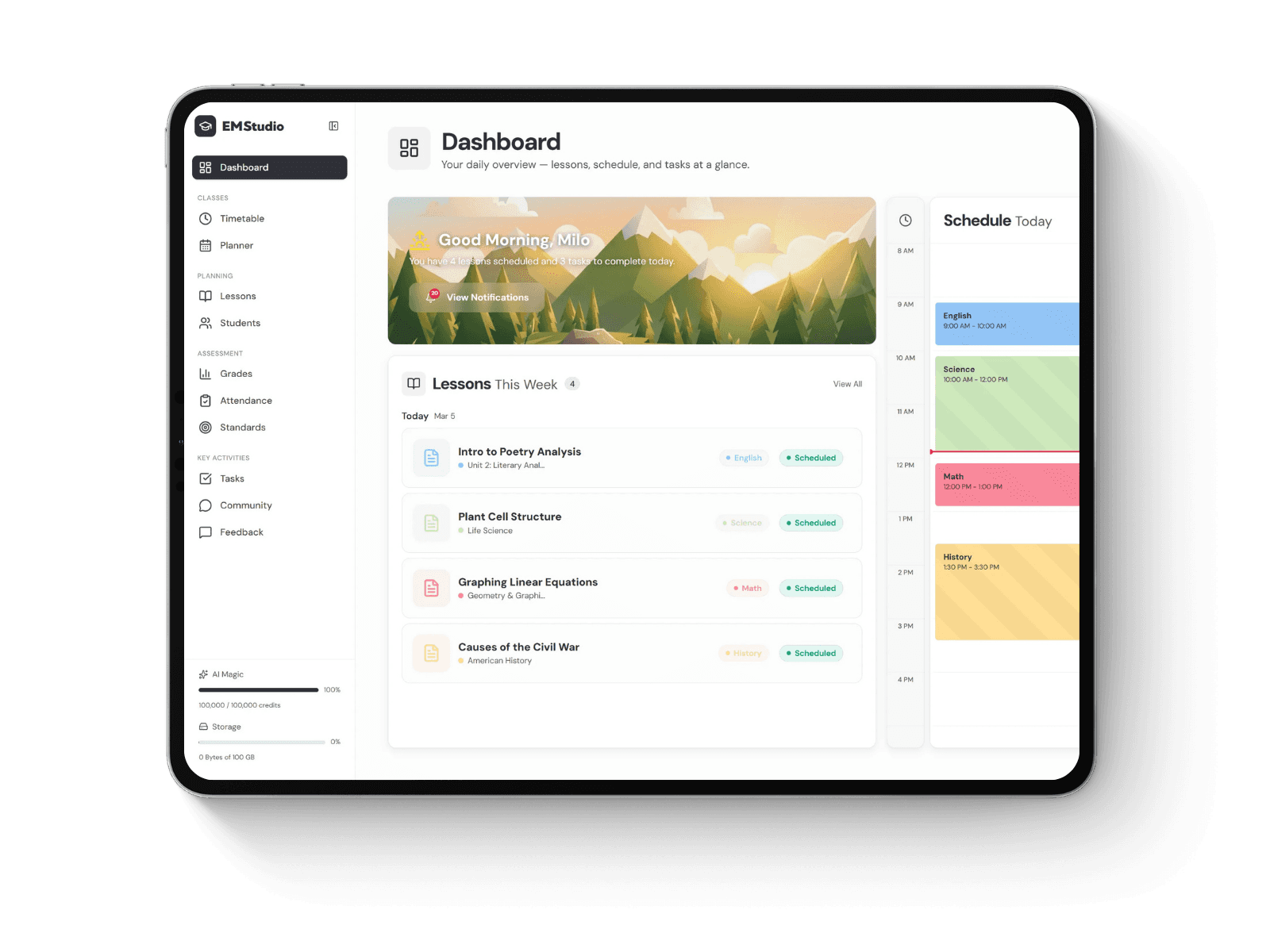
Still grading everything by hand?
EMStudio is a free teaching management app — manage your classes, students, lessons, and more!
Learn More
Table of Contents
Auditing Your Current Standards and Resources
You cannot build a solid curriculum on top of a mess. Before you buy one more digital license, you need to see exactly what you already own, what you actually use, and where the holes are. This is the unglamorous first step of curriculum development for teachers, and it saves you from drowning in redundant subscriptions.
Create a Curriculum Audit Matrix. Use a simple spreadsheet. Down the left column, list every resource your district pays for. Include your basal textbooks—HMH Into Reading, Savvas MyView, or whatever sits in your storage closet. Add your digital licenses: IXL, Nearpod, Discovery Education. Do not forget the freebies teachers grabbed from Pinterest or the supplementary kits you inherited.
Across the top, list your specific standards: CCSS, NGSS, or your state’s equivalents. Now fill in the grid. Mark which resource covers which standard.
Basal textbooks and teacher editions
District-purchased digital licenses (math fluency apps, literacy platforms)
Supplementary materials (leveled readers, science kits, intervention binders)
Next, score the alignment. Use Webb’s Depth of Knowledge levels on a 1–4 scale. A resource that only hits recall questions gets a 1. Something that demands strategic thinking gets a 3 or 4. Calculate the percentage of your power standards each resource covers. If a program hits less than 70% of your power standards, flag it. That gap determines your real resources for curriculum development.
Now check your bills. Look for subscriptions costing $15 or more per student with usage rates under 20%. These are vampires. I once found a district paying $22 per student for a video platform teachers opened twice a year. Cut it. Replace expensive gaps with OER Commons or Khan Academy for specific learning objectives.
Check vertical alignment while you are in the matrix. Does your 4th-grade material repeat what 3rd grade already mastered? Does it skip foundational skills needed for 5th? Map this against your pacing guide to see if you have three different programs teaching the same phonics skill in October.
Note which resources include built-in formative assessment and which require you to build checks from scratch. This audit reveals the truth about your standards alignment and stops you from paying for shelfware. It also shapes your daily instructional design more than any glossy cover suggests.

Step 1 — Analyze Learner Needs and Define Your Vision
Gathering Baseline Assessment Data
You can't start curriculum development in a vacuum. Before you write a single learning objective, you need to know exactly who is sitting in your classrooms and what they already know.
Start with the numbers. Pull your NWEA MAP Growth percentile bands from the first screening. Flag every student below the 40th percentile for intervention; these kids need more than grade-level pacing. Cross-reference this with your district benchmark data from the first three weeks of school to spot immediate gaps.
Then dig deeper. Collect prior-year state test scale scores and conduct error analysis on last year's final exams. Look for patterns—if 60% of last year's 7th graders missed the same two fraction standards, that's where you start. Within the first ten school days, administer diagnostic assessments to establish baseline performance bands:
Use DIBELS 8th Edition for reading fluency and accuracy.
Use GMADE for math computation and concepts.
Finally, build a Learner Profile Dashboard for each student. Track reading levels using DIBELS or Fountas & Pinnell, note ELL proficiency using WIDA levels 1-6, and list IEP accommodations and 504 plans. This isn't busywork. When you know that three of your students read at a Level J and two are WIDA level 2, you define specific accessibility requirements before you design your first unit.
Conducting Stakeholder Input Sessions
Data tells you what students know; people tell you what they need. involving school stakeholders in the vision-setting process early prevents you from building a curriculum that looks good on paper but fails in practice.
Schedule 45-minute focus groups with 5-7 parents per session. Offer childcare and translation services for evening meetings—if parents can't attend, their voices vanish from your instructional design. Run Google Forms for broader input; aim for 200+ respondents specifically regarding cultural responsiveness needs. These responses reveal blind spots in your standards alignment that test scores never will.
For students in grades 5-12, deploy 5-point Likert scale surveys asking about topic interest and career relevance. They'll tell you straight up if your planned unit on quadratic equations feels pointless. Conduct 30-minute structured teacher interviews using protocol questions to uncover vertical alignment issues—your 4th grade teacher knows exactly which reading skills are missing when kids arrive from 3rd.
Don't stop at the school walls. Interview community partners—local employers and community college admissions staff—to identify essential skills gaps that academic standards miss. If the manufacturing plant down the street needs workers who can read technical manuals but your standards only emphasize literary analysis, that's a disconnect you need to fix now.

Step 2 — Map Measurable Objectives to Standards
You can't frame a house without blueprints. Same goes for curriculum development and curriculum design. Before writing lesson plans, you need to know exactly what students should do at the end—and how you'll know they did it. This step anchors your vision to measurable learning objectives.
Applying Backward Design Principles
Use Wiggins and McTighe's Understanding by Design template. Stage 1 defines transfer goals and essential questions. Stage 2 builds your performance tasks and other evidence. Stage 3 designs the learning plan using WHERETO elements: Where are we going? How will we Hook them? What will they Explore? How do they Reflect? How do we Evaluate and Tailor? How will we Organize?
Start with a GRASPS task. Last fall, my 9th graders took the Role of environmental scientists addressing the Audience of city council. Their Situation: analyze local climate data showing temperature shifts. Their Product: a policy proposal with budget implications. When you design this before planning lessons, you avoid the "activity trap" where busywork replaces learning.
Map each objective to specific Depth of Knowledge (DOK) levels:
DOK 1: Recall definitions or facts.
DOK 2: Apply skills to familiar tasks.
DOK 3: Strategize and justify reasoning.
DOK 4: Synthesize multiple sources over extended time.
If your standard demands DOK 3 strategic thinking, your quiz can't stop at DOK 1 recall. Check every assessment against this ladder. Vertical alignment depends on this precision—if 7th grade stops at DOK 2, 8th grade can't start at DOK 4.
Avoid the Coverage Trap. Don't try to hit all 40+ standards superficially. Select 8-12 power standards per year using Achieve the Core's focus documents. Mastering standards-based curriculum means choosing depth over breadth while maintaining standards alignment. Students remember what they use, not what they skim.
Building in Differentiation Pathways
Carol Ann Tomlinson's framework keeps differentiation realistic. Create three tiered pathways for every unit: foundational, grade-level, and advanced. Set hard numbers for movement based on pre-assessment data. On my tests, under 60% means foundational support with targeted interventions, 60-85% stays grade-level with standard pacing, above 85% moves to advanced extensions. Kids shift tiers after each formative assessment. No one gets trapped in a label.
I use RAFT assignments with built-in complexity tiers:
Level 1: Sentence frames and word banks provided.
Level 2: Paragraph structures and graphic organizers.
Level 3: Independent research and synthesis required.
Same Role, Audience, Format, and Topic. Different cognitive load. All pathways lead to the same essential understanding, just through different doors.
Choice boards add agency. I offer six activities per unit; students select four to complete based on preference and readiness. Options range from visual concept maps to kinesthetic builds to oral presentations. When you make a curriculum with these pathways built into your instructional design and pacing guide from day one, you save hours of retrofitting later. Retrofitting differentiation onto a rigid pacing guide fails every time. For specific tactics on managing these tiers, see our guide on supporting differentiated instruction strategies.
Step 3 — Build Your Scope and Sequence
Your scope and sequence is the master spreadsheet that keeps your curriculum development from becoming a pile of disconnected units. When you build a curriculum, you need more than isolated learning objectives. You need a roadmap that shows standards alignment across the entire year. Create columns for Unit Name, Standards, Suggested Days, Essential Questions, Assessment Dates, and Required Resources. This living document shows you the year at a glance and keeps your team honest about what you can actually teach in 180 days.
Checking Vertical Alignment Across Grade Levels
Stop teaching in a vacuum. Pull your vertical team together with the Coherence Map from Achieve the Core spread across the table. Trace the thread of prerequisite skills from grade to grade. If 6th graders are hitting ratios in October, did 5th grade nail fraction fluency by June? Check. Look for destructive redundancy—that awkward moment when you realize both 8th and 9th grade teach To Kill a Mockingbird. Science teachers, make sure lab skills build complexity year-over-year; micropipettes shouldn't feel brand new in high school biology if middle schoolers used them first.
Cross-grade alignment meetings work best when teachers bring actual student work samples. A 4th grade fraction model tells the 5th grade team more than any standard description ever could.
Watch for these common alignment gaps:
Math: Jumping into fraction operations without visual model foundations from the previous year
ELA: The same novel taught in two consecutive grades, killing student engagement
Science: Lab equipment introduced at identical complexity levels instead of building skills
Social Studies: Writing expectations that leap from 5-paragraph essays to 10-page research papers
Document your decisions in the vertical alignment chart so new teachers don't accidentally skip prerequisite skills. For a deeper look at mapping these connections, see our essential guide to curriculum mapping.
Creating Realistic Pacing Guides
Start with 165 days, not 180. Subtract 10 for standardized testing and 5 for assemblies, field trips, and the inevitable snow day. Then carve out 20% buffer time for reteaching and enrichment. That leaves you with roughly 132 days of actual new instruction. Build your pacing guide around reality, not the fantasy calendar from August.
Your daily schedule changes everything. Forty-five minute periods require tight transitions and split labs across multiple days. Ninety-minute blocks let you dig deeper but demand variety every twenty minutes to maintain focus. Semester-long courses compress year-long content into 18 weeks—you'll need to cut redundancies, not essentials.
Smart buffers save your sanity:
Three-day review blocks before major assessments
Five emergency days for weather closures or assembly disruptions
Weekly formative assessment time built into the unit, not added on
Use our build your scope and sequence planner to map this out without the spreadsheet headaches.

Step 4 — How Do You Design Engaging Learning Experiences?
Design engaging learning experiences by anchoring units in authentic problems using the 5E model or Understanding by Design framework. Select evidence-based strategies matched to Hattie's effect sizes—prioritize feedback (0.72), classroom discussion (0.65), and spaced practice (0.65). Balance direct instruction with inquiry-based tasks, incorporate student choice through tiered assignments, and connect content to local community issues for relevance.
Selecting Evidence-Based Instructional Strategies
Stop guessing which activities actually work. John Hattie's meta-analyses give us hard numbers. Focus your energy on strategies with effect sizes above 0.40. Feedback clocks in at 0.72—meaning specific responses to student work move the needle more than almost anything else. Classroom discussion hits 0.65. Spaced practice at 0.65 beats cramming every time. Direct instruction still earns 0.59, so don't throw out explicit teaching despite current trends. Skip the flashy stuff under 0.40 unless absolutely necessary.
Match your method to the material. Teaching math algorithms or grammar rules? Use explicit instruction with worked examples. Students need to see the process locked in place before they vary it. For scientific inquiry or historical analysis, shift to problem-based learning or the 5E Instructional Model—Engage, Explore, Explain, Elaborate, Evaluate. Secondary ELA teachers get serious mileage from Socratic Seminars for text analysis. Elementary teachers rely on Number Talks for numeracy.
Keep bodies moving. Every fifteen to twenty minutes, change the input.
Gallery Walks for peer analysis
Stand Up-Hand Up-Pair Up for discussion
GoNoodle brain breaks for primary grades
Novice learners need worked examples and gradual release: I do, we do, you do. Build in formative assessment checkpoints during the "we do" phase to catch errors before they solidify. That's your curriculum development safety net for complex tasks.
Curating Digital and Analog Resources
Your instructional design is only as good as the materials students actually touch. Check EdReports.org before adopting anything. Their ratings separate truly aligned curriculum from publisher fluff. Free OER like EngageNY or OpenUp Resources often beat expensive subscriptions on standards alignment. Paid platforms like Discovery Education or Nearpod win on usability and ready-made interactivity. Choose based on your available prep time, not just the sticker price.
Early childhood teachers should study the reggio emilia curriculum approach—project-based with heavy documentation of student thinking through photos and transcripts. If you're teaching within american curriculum models like AP or IB, you'll need specific strategies aligned to those external exam requirements. The smarts curriculum weaves SEL into academic content, which helps when your learning objectives include collaboration and self-regulation alongside content mastery.
Don't neglect the physical world. Leveled readers for ELA, base-ten blocks or algebra tiles for math, actual primary source documents for social studies. These tangible resources create anchor experiences that digital supplements can't replace. Build your building a digital resource library alongside your physical kits. And when selecting innovative teaching methods and instructional strategies, check them against your pacing guide and vertical alignment requirements first.

Step 5 — How Do You Build Assessments That Validate Learning?
Build validating assessments by aligning cognitive complexity to objectives using Webb's Depth of Knowledge or Bloom's Taxonomy. Match your learning objectives to the appropriate DOK level: recall definitions (DOK 1), apply skills or concepts (DOK 2), engage in strategic thinking (DOK 3), or extended thinking over time (DOK 4). Design formative checkpoints—exit tickets, hinge questions revealing specific misconceptions, and digital polls—to monitor daily progress without burning your planning period on grading. Develop summative performance tasks using the GRASPS framework with rubrics that clearly distinguish proficiency from mastery, ensuring assessments require transfer of knowledge to novel contexts rather than regurgitation.
Designing Formative Checkpoints
Implement daily or every-other-day checks to catch gaps before they widen. Use three-question exit tickets that hit different DOK levels: one recall, one application, one analysis. For procedural math lessons, try thumbs up/down or single-sentence summaries. Digital polling through Mentimeter or quick quizzes with immediate feedback loops show you who got stuck on question three before the bell rings. Review this data within 48 hours to form reteach groups while the content is still fresh.
Write hinge questions with diagnostic distractors that reveal specific misconceptions. If half your class picks option B, and you designed B to catch the common error of adding instead of multiplying, you know exactly what to reteach tomorrow. If your district uses Success for All curriculum, use their cooperative learning assessments built into the pacing guide. For standards alignment tracking, free curriculum tools like MasteryConnect or Formative let you tag questions to specific standards and spot vertical alignment gaps across grade levels. Use common formative assessments (CFAs) across your grade-level PLC to ensure you're all measuring the same learning objectives. Calibrate your scoring with anchor papers before you grade—what looks like "mastery" to you might look like "approaching" to your colleague down the hall. This consistency matters when you're making intervention decisions.
Developing Summative Performance Tasks
Create authentic performance tasks that force students to transfer knowledge to unfamiliar situations. Have 8th graders model a real community issue mathematically, or ask 11th graders to compare literary devices across three texts with an original thesis. Run full science experiments with complete lab reports, not just fill-in-the-blank worksheets. The GRASPS framework helps you design these: establish the Goal, define the student's Role, identify the Audience, set the Situation, specify the Product, and align to standards alignment criteria from the start.
Distinguish proficiency from mastery in your rubrics. Proficiency means they met the standard; mastery means they synthesized the concept with prior knowledge or created something new. Include student self-assessment using single-point rubrics where kids identify the specific gap between their current work and mastery criteria. This shifts the conversation from "What did I get?" to "What do I need to fix?" For a complete guide to performance assessments and more formative and summative assessment techniques, see our deep dives. Solid curriculum development builds assessment into the instructional design from day one, not as an afterthought you slap on at the end of the unit.

Step 6 — Implement, Monitor, and Refine
Start small or you'll fix a plane while flying it. Run your pilot with two or three volunteer teachers—specifically not your superstars—for three weeks using one complete unit. Have them keep daily implementation logs tracking what actually happened versus what your pacing guide predicted. Collect student engagement data using a simple observation rubric and compare pre/post assessment results.
Pilot Requirements: 2 teachers, 3 weeks, $500 stipend per teacher
Full Implementation: All teachers, full year, $2,000 training budget
Watch for the implementation dip—that expected first-year drop of 5-10% in scores while teachers adjust to new materials. If you only test with high-performing teachers, you'll build a curriculum that works in ideal conditions but collapses in average classrooms.
Running Pilot Tests with Sample Units
Define success metrics before the first bell rings. You want to see >80% student engagement measured by an observation protocol, fewer than 15% of kids failing the unit assessment, and teachers rating feasibility above 4 out of 5. Avoid the temptation to hand this to your best teacher whose classroom runs like a Swiss watch; you need to see how this plays with the teacher who struggles with transitions and has three kids with IEPs.
Run daily 10-minute debriefs during those three weeks. Ask specific questions: Which directions confused kids? Which lessons took 45 minutes instead of the planned 30? What prerequisite skills were missing that you assumed they had? This data-informed curriculum development approach catches the gaps between your instructional design and reality before you print 500 copies.
Establishing Data-Driven Revision Cycles
Set up PDSA (Plan-Do-Study-Act) cycles every six to eight weeks. Review item analysis to flag any question where fewer than 60% of students showed mastery. Those items need rewriting for clarity or better standards alignment, not just reteaching.
During PLCs, bring student work samples from the 25th, 50th, and 75th percentiles. Lay them out and look for patterns. Did the errors stem from curriculum design—like an unclear sequence or vertical alignment issues between grade levels—or from implementation gaps where the teacher skipped a formative assessment or misunderstood the learning objectives? Know the difference before you revise. This is how you create better curriculum that survives real classrooms with real kids, not just looks good in a binder.

Sustaining Your Curriculum for Long-Term Success
Your curriculum development doesn't end at launch. Treat it like a garden that needs seasonal tending, not a monument that stands forever. A three-year maintenance cycle keeps your materials sharp and your teachers sane.
The Three-Year Cycle
Year One: Run full implementation with monthly PLC check-ins. Review formative assessment data to catch pacing problems early. Don't wait until June to discover that Unit 4 takes three weeks, not one.
Year Two: Shift to refinement. Analyze what worked, cut what flopped, and adjust your pacing guide based on actual student performance. This is when vertical alignment issues surface—fix them here.
Year Three: Conduct a full review against updated standards or recent research. Rewrite learning objectives if they've drifted from your instructional design goals.
Real Costs of Ownership
Math curriculum companies charge annually. Free OER saves money upfront but costs time. Creating a curriculum in-house requires stipends. Here's the breakdown:
Source | Cost Structure |
|---|---|
Illustrative Math | $25 per student annually |
Eureka Math | $35 per student annually |
OpenUp Resources (OER) | Free (print costs extra) |
Homemade Development | $2,000 per teacher in stipends for writing time |
Keep Your Files Current
Nothing kills trust like teachers using last year's broken PDF. Use Google Workspace with dated filenames—Unit1_Lesson3_2024.v2—or SharePoint version control. Archive old versions in a "Deprecated" folder so they don't resurface during a frantic Sunday night search.
Plan the Training
New hires need 40 hours of initial training before they touch the standards alignment documents. Veterans need 12 hours annually to cover new units. Budget for curriculum coaches during Years One and Two; they catch misalignment before it becomes habit.

Final Thoughts on Curriculum Development
You can spend months perfecting your scope and sequence, but curriculum development only matters when a kid actually learns something. The teachers who see real growth aren't the ones with the prettiest binders. They're the ones who build a little, test it with actual students, and fix what breaks. Instructional design isn't a finished product you hand to the district—it's a loop you run every week.
So here's your homework: open your plan book to next Tuesday. Pick one learning objective and ask yourself, "If I stood at the door at the end of class, what could each kid show me to prove they got this?" Write that down. That's your assessment. Now work backwards for ten minutes. Build one task that forces them to produce that evidence. You've already done more intentional standards alignment than most pacing guides provide. Everything else can wait until Wednesday.

Auditing Your Current Standards and Resources
You cannot build a solid curriculum on top of a mess. Before you buy one more digital license, you need to see exactly what you already own, what you actually use, and where the holes are. This is the unglamorous first step of curriculum development for teachers, and it saves you from drowning in redundant subscriptions.
Create a Curriculum Audit Matrix. Use a simple spreadsheet. Down the left column, list every resource your district pays for. Include your basal textbooks—HMH Into Reading, Savvas MyView, or whatever sits in your storage closet. Add your digital licenses: IXL, Nearpod, Discovery Education. Do not forget the freebies teachers grabbed from Pinterest or the supplementary kits you inherited.
Across the top, list your specific standards: CCSS, NGSS, or your state’s equivalents. Now fill in the grid. Mark which resource covers which standard.
Basal textbooks and teacher editions
District-purchased digital licenses (math fluency apps, literacy platforms)
Supplementary materials (leveled readers, science kits, intervention binders)
Next, score the alignment. Use Webb’s Depth of Knowledge levels on a 1–4 scale. A resource that only hits recall questions gets a 1. Something that demands strategic thinking gets a 3 or 4. Calculate the percentage of your power standards each resource covers. If a program hits less than 70% of your power standards, flag it. That gap determines your real resources for curriculum development.
Now check your bills. Look for subscriptions costing $15 or more per student with usage rates under 20%. These are vampires. I once found a district paying $22 per student for a video platform teachers opened twice a year. Cut it. Replace expensive gaps with OER Commons or Khan Academy for specific learning objectives.
Check vertical alignment while you are in the matrix. Does your 4th-grade material repeat what 3rd grade already mastered? Does it skip foundational skills needed for 5th? Map this against your pacing guide to see if you have three different programs teaching the same phonics skill in October.
Note which resources include built-in formative assessment and which require you to build checks from scratch. This audit reveals the truth about your standards alignment and stops you from paying for shelfware. It also shapes your daily instructional design more than any glossy cover suggests.
Step 1 — Analyze Learner Needs and Define Your Vision
Gathering Baseline Assessment Data
You can't start curriculum development in a vacuum. Before you write a single learning objective, you need to know exactly who is sitting in your classrooms and what they already know.
Start with the numbers. Pull your NWEA MAP Growth percentile bands from the first screening. Flag every student below the 40th percentile for intervention; these kids need more than grade-level pacing. Cross-reference this with your district benchmark data from the first three weeks of school to spot immediate gaps.
Then dig deeper. Collect prior-year state test scale scores and conduct error analysis on last year's final exams. Look for patterns—if 60% of last year's 7th graders missed the same two fraction standards, that's where you start. Within the first ten school days, administer diagnostic assessments to establish baseline performance bands:
Use DIBELS 8th Edition for reading fluency and accuracy.
Use GMADE for math computation and concepts.
Finally, build a Learner Profile Dashboard for each student. Track reading levels using DIBELS or Fountas & Pinnell, note ELL proficiency using WIDA levels 1-6, and list IEP accommodations and 504 plans. This isn't busywork. When you know that three of your students read at a Level J and two are WIDA level 2, you define specific accessibility requirements before you design your first unit.
Conducting Stakeholder Input Sessions
Data tells you what students know; people tell you what they need. involving school stakeholders in the vision-setting process early prevents you from building a curriculum that looks good on paper but fails in practice.
Schedule 45-minute focus groups with 5-7 parents per session. Offer childcare and translation services for evening meetings—if parents can't attend, their voices vanish from your instructional design. Run Google Forms for broader input; aim for 200+ respondents specifically regarding cultural responsiveness needs. These responses reveal blind spots in your standards alignment that test scores never will.
For students in grades 5-12, deploy 5-point Likert scale surveys asking about topic interest and career relevance. They'll tell you straight up if your planned unit on quadratic equations feels pointless. Conduct 30-minute structured teacher interviews using protocol questions to uncover vertical alignment issues—your 4th grade teacher knows exactly which reading skills are missing when kids arrive from 3rd.
Don't stop at the school walls. Interview community partners—local employers and community college admissions staff—to identify essential skills gaps that academic standards miss. If the manufacturing plant down the street needs workers who can read technical manuals but your standards only emphasize literary analysis, that's a disconnect you need to fix now.
Step 2 — Map Measurable Objectives to Standards
You can't frame a house without blueprints. Same goes for curriculum development and curriculum design. Before writing lesson plans, you need to know exactly what students should do at the end—and how you'll know they did it. This step anchors your vision to measurable learning objectives.
Applying Backward Design Principles
Use Wiggins and McTighe's Understanding by Design template. Stage 1 defines transfer goals and essential questions. Stage 2 builds your performance tasks and other evidence. Stage 3 designs the learning plan using WHERETO elements: Where are we going? How will we Hook them? What will they Explore? How do they Reflect? How do we Evaluate and Tailor? How will we Organize?
Start with a GRASPS task. Last fall, my 9th graders took the Role of environmental scientists addressing the Audience of city council. Their Situation: analyze local climate data showing temperature shifts. Their Product: a policy proposal with budget implications. When you design this before planning lessons, you avoid the "activity trap" where busywork replaces learning.
Map each objective to specific Depth of Knowledge (DOK) levels:
DOK 1: Recall definitions or facts.
DOK 2: Apply skills to familiar tasks.
DOK 3: Strategize and justify reasoning.
DOK 4: Synthesize multiple sources over extended time.
If your standard demands DOK 3 strategic thinking, your quiz can't stop at DOK 1 recall. Check every assessment against this ladder. Vertical alignment depends on this precision—if 7th grade stops at DOK 2, 8th grade can't start at DOK 4.
Avoid the Coverage Trap. Don't try to hit all 40+ standards superficially. Select 8-12 power standards per year using Achieve the Core's focus documents. Mastering standards-based curriculum means choosing depth over breadth while maintaining standards alignment. Students remember what they use, not what they skim.
Building in Differentiation Pathways
Carol Ann Tomlinson's framework keeps differentiation realistic. Create three tiered pathways for every unit: foundational, grade-level, and advanced. Set hard numbers for movement based on pre-assessment data. On my tests, under 60% means foundational support with targeted interventions, 60-85% stays grade-level with standard pacing, above 85% moves to advanced extensions. Kids shift tiers after each formative assessment. No one gets trapped in a label.
I use RAFT assignments with built-in complexity tiers:
Level 1: Sentence frames and word banks provided.
Level 2: Paragraph structures and graphic organizers.
Level 3: Independent research and synthesis required.
Same Role, Audience, Format, and Topic. Different cognitive load. All pathways lead to the same essential understanding, just through different doors.
Choice boards add agency. I offer six activities per unit; students select four to complete based on preference and readiness. Options range from visual concept maps to kinesthetic builds to oral presentations. When you make a curriculum with these pathways built into your instructional design and pacing guide from day one, you save hours of retrofitting later. Retrofitting differentiation onto a rigid pacing guide fails every time. For specific tactics on managing these tiers, see our guide on supporting differentiated instruction strategies.
Step 3 — Build Your Scope and Sequence
Your scope and sequence is the master spreadsheet that keeps your curriculum development from becoming a pile of disconnected units. When you build a curriculum, you need more than isolated learning objectives. You need a roadmap that shows standards alignment across the entire year. Create columns for Unit Name, Standards, Suggested Days, Essential Questions, Assessment Dates, and Required Resources. This living document shows you the year at a glance and keeps your team honest about what you can actually teach in 180 days.
Checking Vertical Alignment Across Grade Levels
Stop teaching in a vacuum. Pull your vertical team together with the Coherence Map from Achieve the Core spread across the table. Trace the thread of prerequisite skills from grade to grade. If 6th graders are hitting ratios in October, did 5th grade nail fraction fluency by June? Check. Look for destructive redundancy—that awkward moment when you realize both 8th and 9th grade teach To Kill a Mockingbird. Science teachers, make sure lab skills build complexity year-over-year; micropipettes shouldn't feel brand new in high school biology if middle schoolers used them first.
Cross-grade alignment meetings work best when teachers bring actual student work samples. A 4th grade fraction model tells the 5th grade team more than any standard description ever could.
Watch for these common alignment gaps:
Math: Jumping into fraction operations without visual model foundations from the previous year
ELA: The same novel taught in two consecutive grades, killing student engagement
Science: Lab equipment introduced at identical complexity levels instead of building skills
Social Studies: Writing expectations that leap from 5-paragraph essays to 10-page research papers
Document your decisions in the vertical alignment chart so new teachers don't accidentally skip prerequisite skills. For a deeper look at mapping these connections, see our essential guide to curriculum mapping.
Creating Realistic Pacing Guides
Start with 165 days, not 180. Subtract 10 for standardized testing and 5 for assemblies, field trips, and the inevitable snow day. Then carve out 20% buffer time for reteaching and enrichment. That leaves you with roughly 132 days of actual new instruction. Build your pacing guide around reality, not the fantasy calendar from August.
Your daily schedule changes everything. Forty-five minute periods require tight transitions and split labs across multiple days. Ninety-minute blocks let you dig deeper but demand variety every twenty minutes to maintain focus. Semester-long courses compress year-long content into 18 weeks—you'll need to cut redundancies, not essentials.
Smart buffers save your sanity:
Three-day review blocks before major assessments
Five emergency days for weather closures or assembly disruptions
Weekly formative assessment time built into the unit, not added on
Use our build your scope and sequence planner to map this out without the spreadsheet headaches.
Step 4 — How Do You Design Engaging Learning Experiences?
Design engaging learning experiences by anchoring units in authentic problems using the 5E model or Understanding by Design framework. Select evidence-based strategies matched to Hattie's effect sizes—prioritize feedback (0.72), classroom discussion (0.65), and spaced practice (0.65). Balance direct instruction with inquiry-based tasks, incorporate student choice through tiered assignments, and connect content to local community issues for relevance.
Selecting Evidence-Based Instructional Strategies
Stop guessing which activities actually work. John Hattie's meta-analyses give us hard numbers. Focus your energy on strategies with effect sizes above 0.40. Feedback clocks in at 0.72—meaning specific responses to student work move the needle more than almost anything else. Classroom discussion hits 0.65. Spaced practice at 0.65 beats cramming every time. Direct instruction still earns 0.59, so don't throw out explicit teaching despite current trends. Skip the flashy stuff under 0.40 unless absolutely necessary.
Match your method to the material. Teaching math algorithms or grammar rules? Use explicit instruction with worked examples. Students need to see the process locked in place before they vary it. For scientific inquiry or historical analysis, shift to problem-based learning or the 5E Instructional Model—Engage, Explore, Explain, Elaborate, Evaluate. Secondary ELA teachers get serious mileage from Socratic Seminars for text analysis. Elementary teachers rely on Number Talks for numeracy.
Keep bodies moving. Every fifteen to twenty minutes, change the input.
Gallery Walks for peer analysis
Stand Up-Hand Up-Pair Up for discussion
GoNoodle brain breaks for primary grades
Novice learners need worked examples and gradual release: I do, we do, you do. Build in formative assessment checkpoints during the "we do" phase to catch errors before they solidify. That's your curriculum development safety net for complex tasks.
Curating Digital and Analog Resources
Your instructional design is only as good as the materials students actually touch. Check EdReports.org before adopting anything. Their ratings separate truly aligned curriculum from publisher fluff. Free OER like EngageNY or OpenUp Resources often beat expensive subscriptions on standards alignment. Paid platforms like Discovery Education or Nearpod win on usability and ready-made interactivity. Choose based on your available prep time, not just the sticker price.
Early childhood teachers should study the reggio emilia curriculum approach—project-based with heavy documentation of student thinking through photos and transcripts. If you're teaching within american curriculum models like AP or IB, you'll need specific strategies aligned to those external exam requirements. The smarts curriculum weaves SEL into academic content, which helps when your learning objectives include collaboration and self-regulation alongside content mastery.
Don't neglect the physical world. Leveled readers for ELA, base-ten blocks or algebra tiles for math, actual primary source documents for social studies. These tangible resources create anchor experiences that digital supplements can't replace. Build your building a digital resource library alongside your physical kits. And when selecting innovative teaching methods and instructional strategies, check them against your pacing guide and vertical alignment requirements first.
Step 5 — How Do You Build Assessments That Validate Learning?
Build validating assessments by aligning cognitive complexity to objectives using Webb's Depth of Knowledge or Bloom's Taxonomy. Match your learning objectives to the appropriate DOK level: recall definitions (DOK 1), apply skills or concepts (DOK 2), engage in strategic thinking (DOK 3), or extended thinking over time (DOK 4). Design formative checkpoints—exit tickets, hinge questions revealing specific misconceptions, and digital polls—to monitor daily progress without burning your planning period on grading. Develop summative performance tasks using the GRASPS framework with rubrics that clearly distinguish proficiency from mastery, ensuring assessments require transfer of knowledge to novel contexts rather than regurgitation.
Designing Formative Checkpoints
Implement daily or every-other-day checks to catch gaps before they widen. Use three-question exit tickets that hit different DOK levels: one recall, one application, one analysis. For procedural math lessons, try thumbs up/down or single-sentence summaries. Digital polling through Mentimeter or quick quizzes with immediate feedback loops show you who got stuck on question three before the bell rings. Review this data within 48 hours to form reteach groups while the content is still fresh.
Write hinge questions with diagnostic distractors that reveal specific misconceptions. If half your class picks option B, and you designed B to catch the common error of adding instead of multiplying, you know exactly what to reteach tomorrow. If your district uses Success for All curriculum, use their cooperative learning assessments built into the pacing guide. For standards alignment tracking, free curriculum tools like MasteryConnect or Formative let you tag questions to specific standards and spot vertical alignment gaps across grade levels. Use common formative assessments (CFAs) across your grade-level PLC to ensure you're all measuring the same learning objectives. Calibrate your scoring with anchor papers before you grade—what looks like "mastery" to you might look like "approaching" to your colleague down the hall. This consistency matters when you're making intervention decisions.
Developing Summative Performance Tasks
Create authentic performance tasks that force students to transfer knowledge to unfamiliar situations. Have 8th graders model a real community issue mathematically, or ask 11th graders to compare literary devices across three texts with an original thesis. Run full science experiments with complete lab reports, not just fill-in-the-blank worksheets. The GRASPS framework helps you design these: establish the Goal, define the student's Role, identify the Audience, set the Situation, specify the Product, and align to standards alignment criteria from the start.
Distinguish proficiency from mastery in your rubrics. Proficiency means they met the standard; mastery means they synthesized the concept with prior knowledge or created something new. Include student self-assessment using single-point rubrics where kids identify the specific gap between their current work and mastery criteria. This shifts the conversation from "What did I get?" to "What do I need to fix?" For a complete guide to performance assessments and more formative and summative assessment techniques, see our deep dives. Solid curriculum development builds assessment into the instructional design from day one, not as an afterthought you slap on at the end of the unit.
Step 6 — Implement, Monitor, and Refine
Start small or you'll fix a plane while flying it. Run your pilot with two or three volunteer teachers—specifically not your superstars—for three weeks using one complete unit. Have them keep daily implementation logs tracking what actually happened versus what your pacing guide predicted. Collect student engagement data using a simple observation rubric and compare pre/post assessment results.
Pilot Requirements: 2 teachers, 3 weeks, $500 stipend per teacher
Full Implementation: All teachers, full year, $2,000 training budget
Watch for the implementation dip—that expected first-year drop of 5-10% in scores while teachers adjust to new materials. If you only test with high-performing teachers, you'll build a curriculum that works in ideal conditions but collapses in average classrooms.
Running Pilot Tests with Sample Units
Define success metrics before the first bell rings. You want to see >80% student engagement measured by an observation protocol, fewer than 15% of kids failing the unit assessment, and teachers rating feasibility above 4 out of 5. Avoid the temptation to hand this to your best teacher whose classroom runs like a Swiss watch; you need to see how this plays with the teacher who struggles with transitions and has three kids with IEPs.
Run daily 10-minute debriefs during those three weeks. Ask specific questions: Which directions confused kids? Which lessons took 45 minutes instead of the planned 30? What prerequisite skills were missing that you assumed they had? This data-informed curriculum development approach catches the gaps between your instructional design and reality before you print 500 copies.
Establishing Data-Driven Revision Cycles
Set up PDSA (Plan-Do-Study-Act) cycles every six to eight weeks. Review item analysis to flag any question where fewer than 60% of students showed mastery. Those items need rewriting for clarity or better standards alignment, not just reteaching.
During PLCs, bring student work samples from the 25th, 50th, and 75th percentiles. Lay them out and look for patterns. Did the errors stem from curriculum design—like an unclear sequence or vertical alignment issues between grade levels—or from implementation gaps where the teacher skipped a formative assessment or misunderstood the learning objectives? Know the difference before you revise. This is how you create better curriculum that survives real classrooms with real kids, not just looks good in a binder.
Sustaining Your Curriculum for Long-Term Success
Your curriculum development doesn't end at launch. Treat it like a garden that needs seasonal tending, not a monument that stands forever. A three-year maintenance cycle keeps your materials sharp and your teachers sane.
The Three-Year Cycle
Year One: Run full implementation with monthly PLC check-ins. Review formative assessment data to catch pacing problems early. Don't wait until June to discover that Unit 4 takes three weeks, not one.
Year Two: Shift to refinement. Analyze what worked, cut what flopped, and adjust your pacing guide based on actual student performance. This is when vertical alignment issues surface—fix them here.
Year Three: Conduct a full review against updated standards or recent research. Rewrite learning objectives if they've drifted from your instructional design goals.
Real Costs of Ownership
Math curriculum companies charge annually. Free OER saves money upfront but costs time. Creating a curriculum in-house requires stipends. Here's the breakdown:
Source | Cost Structure |
|---|---|
Illustrative Math | $25 per student annually |
Eureka Math | $35 per student annually |
OpenUp Resources (OER) | Free (print costs extra) |
Homemade Development | $2,000 per teacher in stipends for writing time |
Keep Your Files Current
Nothing kills trust like teachers using last year's broken PDF. Use Google Workspace with dated filenames—Unit1_Lesson3_2024.v2—or SharePoint version control. Archive old versions in a "Deprecated" folder so they don't resurface during a frantic Sunday night search.
Plan the Training
New hires need 40 hours of initial training before they touch the standards alignment documents. Veterans need 12 hours annually to cover new units. Budget for curriculum coaches during Years One and Two; they catch misalignment before it becomes habit.
Final Thoughts on Curriculum Development
You can spend months perfecting your scope and sequence, but curriculum development only matters when a kid actually learns something. The teachers who see real growth aren't the ones with the prettiest binders. They're the ones who build a little, test it with actual students, and fix what breaks. Instructional design isn't a finished product you hand to the district—it's a loop you run every week.
So here's your homework: open your plan book to next Tuesday. Pick one learning objective and ask yourself, "If I stood at the door at the end of class, what could each kid show me to prove they got this?" Write that down. That's your assessment. Now work backwards for ten minutes. Build one task that forces them to produce that evidence. You've already done more intentional standards alignment than most pacing guides provide. Everything else can wait until Wednesday.
Still grading everything by hand?
EMStudio is a free teaching management app — manage your classes, students, lessons, and more!
Learn More
Still grading everything by hand?
EMStudio is a free teaching management app — manage your classes, students, lessons, and more!
Learn More




Notion4Teachers
Notion templates to simplify administrative tasks and enhance your teaching experience.



2026 Notion4Teachers. All Rights Reserved.
Notion4Teachers
Notion templates to simplify administrative tasks and enhance your teaching experience.
2026 Notion4Teachers. All Rights Reserved.
Notion4Teachers
Notion templates to simplify administrative tasks and enhance your teaching experience.
2026 Notion4Teachers. All Rights Reserved.