
Active Classroom Strategies: 12 Ways to Increase Engagement
Active Classroom Strategies: 12 Ways to Increase Engagement

Article by
Milo
ESL Content Coordinator & Educator
ESL Content Coordinator & Educator
All Posts
You know the look. Twenty-five students staring at you with that glazed expression while you explain the lesson for the third time. You’ve asked “Any questions?” twice. Nobody moves. You’re doing all the work, and they’re doing all the sitting. That disconnect is exactly why you searched for this. You need an active classroom where students actually do something with the material instead of just watching you perform it.
But here’s the catch: you don’t have three hours to cut out laminated cards or design elaborate escape rooms. You need strategies that work tomorrow—techniques that get kids talking, moving, and teaching each other without turning your prep into a second job. This post covers twelve approaches I’ve actually used, from low-prep cooperative learning structures to simple tech tools that support real-time formative assessment. We’ll look at ways to build in kinesthetic learning without chaos, and how peer teaching can do the heavy lifting for differentiated instruction.
The goal isn’t entertainment. It’s engagement that leads to learning. Let’s build you a sustainable routine that keeps students processing information instead of just receiving it, shifting from teacher performance to real student-centered learning.
Still grading everything by hand?
EMStudio is a free teaching management app — manage your classes, students, lessons, and more!
Learn More
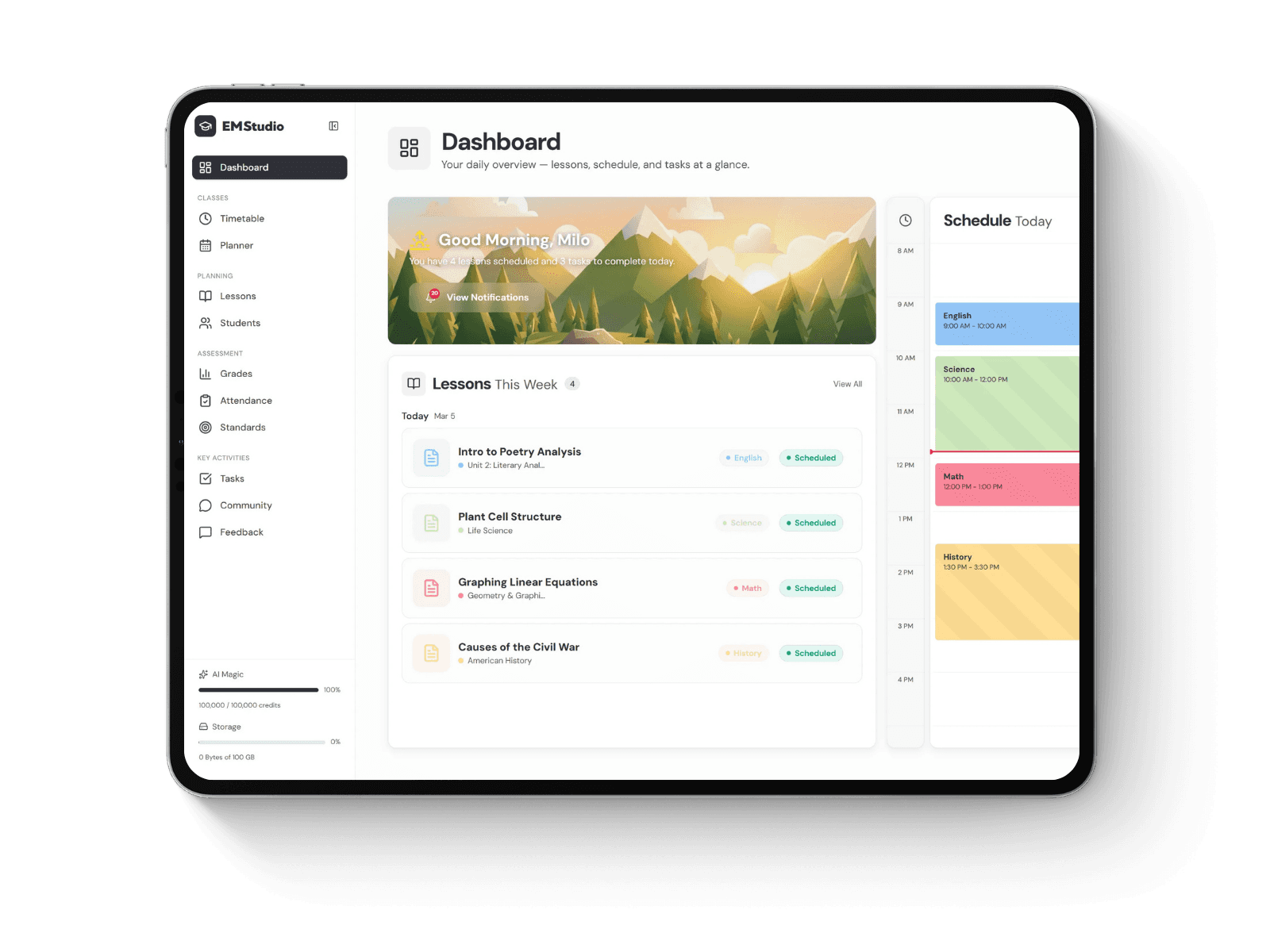
Still grading everything by hand?
EMStudio is a free teaching management app — manage your classes, students, lessons, and more!
Learn More
Table of Contents
What Are the Best Low-Prep Active Classroom Strategies?
The best low-prep active classroom strategies include Think-Pair-Share with sentence stems (2-minute partner rotations), Entrance Tickets where students physically sort themselves by confidence levels using sticky notes, and Four Corners debates requiring only masking tape and posted signs. Each takes under 5 minutes to launch and works across K-12 with minimal materials.
Low-prep means under 5 minutes setup, zero photocopying, and no technology dependency. You won't need IT support or a working projector. These fit 50-minute periods where every minute counts.
Think-Pair-Share: 0-3 minutes prep. Pairs. K-12. Focus: comprehension and peer teaching.
Entrance Tickets: 0-3 minutes prep. Whole class. K-12. Focus: formative assessment.
Four Corners: 0-3 minutes prep. Whole class. K-12. Focus: analysis and kinesthetic learning.
Watch the failure mode. Never use Think-Pair-Share during initial direct instruction of brand-new concepts when cognitive load is highest. Rosenshine's Principle states that daily review requires established prior knowledge before elaborative interrogation. Asking students to discuss material they just heard creates cognitive overload. Wait until they've practiced the concept once.
When you do deploy it for active participation in class, use strict timing: 30 seconds silent writing (think), 90 seconds with shoulder partners using A/B assignments (pair), 2 minutes rotating through 3-4 pairs using random selection (share).
Think-Pair-Share with Accountable Talk
Use numbered heads—Partner A and Partner B—so nobody sleeps through their turn. Display a visual timer on your smartboard. I use the 2-4-2 structure: 2 minutes for silent writing (the "think"), 4 minutes for the pair phase using a stand-up handshake protocol with shoulder partners, and 2 minutes for whole-class sharing using popsicle sticks or a digital name picker. This prevents the activity from ballooning.
Give them sentence stems for accountable talk. Try these: "I agree/disagree because...", "Can you clarify what you meant by...", and "I want to add to that idea...". These three phrases keep the cooperative learning focused and prevent the conversation from devolving into "I liked what you said." The stems force students to engage with the actual content, not just the air.
Entrance and Exit Tickets with Movement
The Human Bar Graph turns your wall into a formative assessment tool. Post three anchor charts labeled "Expert," "Getting There," and "Need Help." Hand out 3x3 sticky notes—one per student, color-coded by class period so you can track which section is where. Position the charts at three different wall stations to prevent the bottleneck that kills your transition time.
Students physically place their notes on the chart that matches their confidence level. I've used this for 9th-grade math exit tickets and 4th-grade reading comprehension checks. It takes 90 seconds for a class of 30. You scan the wall and instantly know who needs small-group reteaching. This is differentiated instruction in real time. For more methods like this, see our immediate formative assessment examples.
Four Corners Discussion Protocols
Four Corners gets them moving for kinesthetic learning with nothing but masking tape. Create quadrants on your floor labeled Strongly Agree, Agree, Disagree, and Strongly Disagree. Post a controversial statement tied to your curriculum—something like "The character's decision was justified" for ELA or "This historical event was inevitable" for social studies.
Add a safety valve. Place a "Pass" option at the center of the room for students uncomfortable with public stances. Once they choose corners, give them 2-minute huddles to prepare arguments. Require a rotating spokesperson so the same three kids don't dominate. This creates genuine student-centered learning and peer teaching as they defend positions. Check our ultimate guide to active learning strategies for more active engagement strategies.
How Can You Build Active Engagement Through Technology?
Technology builds active engagement through real-time polling tools like Mentimeter (free tier: 2 questions per presentation), collaborative boards like Padlet (free for 3 boards), and gamified platforms like Blooket or Gimkit that process 60 students simultaneously on free accounts. These tools reduce teacher talk time while increasing response rates from typical 5-6 raised hands to 100% participation.
Choosing tools for your active classroom means matching constraints to reality.
Interactive Polling (Mentimeter, Kahoot): Setup takes 3 minutes. Free tiers vary—Mentimeter gives you 2 questions per event with unlimited audience; Kahoot allows 50 players. Needs 1:1 devices or phones. Best for grades 5-12. Winner for instant formative assessment.
Collaboration Boards (Padlet, Jamboard): Setup takes 5 minutes. Padlet offers 3 free boards; Jamboard is free with Google Workspace. Works on shared devices or phones. Best for grades 3-12. Winner for tech-enabled collaborative learning and peer teaching.
Gamified Review (Blooket, Gimkit): Setup takes 2 minutes if you import existing question sets. Blooket handles 60 free players; Gimkit limits you to 5 kits on free accounts. Requires 1:1. Best for grades 3-8. Winner for kinesthetic learning and student-centered learning energy.
Know when to skip the tech. If your WiFi drops more than once a week, if setup exceeds 5 minutes, or if the activity is just multiple choice without a peer discussion component, you have a glorified worksheet. Stick to paper and save the bandwidth.
When platforms crash—and they will—keep paper slips with A/B/C/D printed large for instant polling backups. If your collaborative board won't load, use a "parking lot" poster where students write questions on sticky notes by hand. The proven gamification methods work only if the tech stays out of the way.
Interactive Polling for Real-Time Feedback
Mentimeter works best for opening hooks. Create a word cloud asking, "What comes to mind when you hear [topic]?" Enable the profanity filter—middle schoolers will test it. Display full-screen so students see responses populate in real time. Give 25 students exactly 30 seconds to respond. The visual cloud builds anticipation. It beats asking for volunteers and hearing the same three voices.
No 1:1 devices? Use Plickers. Print the free QR code cards—each student gets one card with four sides (A/B/C/D). You display the question, they hold up their card oriented to show their answer, and you scan the room with your phone. Two minutes to distribute cards, zero tech for the kids. Perfect for quick checks in an active engagement in the classroom routine without the WiFi risk.
Digital Collaboration Boards
Padlet shines for KWL+ charts. Create a board with four columns: Know, Want to know, Learned, and Still Confused. Turn moderation on for K-8 to catch off-topic posts. Give a 7th-grade science class of 28 students five minutes to drop sticky notes. The "Still Confused" column gives you differentiated instruction data for tomorrow's small groups. That's tech-enabled collaborative learning with actual purpose.
Google Workspace schools can use Jamboard as a backup. Assign colors by group—Group 1 uses blue stickies, Group 2 uses green. After the initial post, run a gallery walk where groups rotate to add comments on others' boards. This adds cooperative learning and peer teaching to the digital space without complex setup.
Gamified Review Platforms
Blooket's "Gold Quest" mode keeps everyone invested. Import a 20-question Quizlet set in 30 seconds, set the timer to 10 minutes, and start. Students earn gold randomly, not just for correct answers, so your low-performers stay in the game until the final minute. The randomness drives active engagement strategies in the classroom better than traditional point systems. Up to 60 students can join on a free account.
Gimkit offers two distinct flavors. Use "Classic" for elementary grades 3-5—the straightforward earning works for younger kids. Switch to "Trust No One" (the Among Us-style mode) for middle school; the suspicion mechanic fuels peer interaction and keeps the room loud in a good way. Remember, free accounts cap you at 5 kits. After that, it's $4.99 monthly for unlimited. Don't build your curriculum around the free tier if you plan to use it weekly. For more on proven gamification methods, start with the free options but budget for the upgrade if the tool proves itself.

Collaborative Learning Structures for Active Participation
Some cooperative learning strategies move the needle more than others. Hattie's research backs this up: Reciprocal Teaching sits at 0.74, well above the hinge point. Literature Circles tap into peer tutoring aspects at 0.48. Jigsaw Method hits 0.44. These aren't just group work—they're student-centered learning structures where every student must participate or the activity breaks. That visibility is what makes the learning stick in an active classroom.
Before you start, check your prerequisites. Groups need 4-5 students for Jigsaw, 4-6 for Literature Circles. Students must know how to disagree without insults and how to track time themselves with a visible timer. Most importantly, they need 80% accuracy on baseline content before they teach it to peers. You can't explain mitochondria if you still think they're part of the skeletal system. I usually give a four-question entrance ticket the day before; if half the class bombs it, we do direct instruction first.
Watch for hitchhikers who ride the group's work and over-workers who dominate every conversation. Assign numbered roles 1-4 so every task has an owner and you can cold-call by number. Give individual quizzes after group work—five questions, no notes, graded separately from the group score. Use observation checklists during the activity to track who actually spoke, recording checkmarks when you hear specific students explain a concept.
Jigsaw Method for Content Mastery
Start with expert groups. Send four students to each corner of the room with the same primary source—6th graders might tackle four ancient civilizations while 11th-grade AP Biology students handle four organelle functions. This bit of movement activates kinesthetic learning and prevents the accidental mixing that happens when groups sit too close. Give them twenty minutes to read, annotate, and discuss their expert material. Then have them create a three-bullet teaching guide on a cheat sheet template. When they return to their home groups, they rotate through fifteen minutes of teaching, getting three to four minutes each to explain their topic while classmates take notes on a scaffolded graphic organizer. End with a five-question individual quiz to catch the hitchhikers who didn't pay attention during the expert round.
The physical separation matters. When I taught Mesopotamia versus Egypt, keeping the experts in distinct corners prevented chaos. For older students, the cheat sheet becomes their only teaching aid—no reading paragraphs verbatim. This forces them to actually understand the material rather than parrot it, hitting that 0.44 effect size through genuine peer teaching rather than superficial copying.
Literature Circles with Defined Roles
For middle school, six roles keep everyone busy. With five or six students per circle, everyone has a specific job that prevents the "I didn't have anything to do" excuse:
Discussion Director: Asks five questions
Literary Luminary: Selects three key passages
Connector: Finds text-to-world links
Word Wizard: Defines five vocabulary words
Illustrator: Draws a visual summary
Summarizer: Delivers a three-sentence recap
Run it in chunks. Twenty minutes of silent reading first—no exceptions, phones in the caddy. Then fifteen minutes of role preparation using job sheets that spell out exactly what to look for and where to record it. The final ten minutes is the circle discussion, but use a fishbowl setup: half the class discusses while the other half observes with a checklist tracking specific examples of active participation in the classroom, then switch. This doubles your formative assessment data and keeps the outer circle from checking out. For more on setting these up, see collaborative learning methods that drive results.
Peer Instruction and Reciprocal Teaching
Reciprocal Teaching runs on a four-step cycle that takes about eight minutes total. Students predict what comes next for two minutes, clarify by identifying two confusing terms from the text, create one test question for their partner, and finish with a thirty-second oral summary. That 0.74 effect size comes from the cognitive lift of teaching the material back rather than just hearing it.
For Peer Instruction with clickers or polling apps, show a conceptual question—maybe a physics momentum problem or a dangling modifier sentence. Students vote individually in thirty seconds, then turn to a neighbor for two minutes of debate using sentence stems like "I think it's A because..." Revote immediately. If you don't hit 70% correct on the second vote, stop and reteach the concept right then. This creates instant differentiated instruction based on real data, not guesses. When you're ready to dive deeper into discussion techniques, check out leading effective student discussions.

Movement-Based Examples of Active Engagement in the Classroom
Match your strategy to your constraints, not Pinterest ideals:
5 minutes: Use stand and share protocols or a quick snowball toss
20 minutes: Set up a gallery walk or human sentence activity
Limited space: Stick to vertical learning at desks
Gym available: Unlock full-body kinesthetic learning like vocabulary charades
Review topic: Gallery walks where students add to existing knowledge
New content: Cooperative learning games that focus attention on unfamiliar material
Research on brain breaks is clear: two to five minutes of moderate physical activity—think standing discussions or walking to a station—improves attention for the following twenty minutes of instruction. Safety requires non-negotiable protocols. Use a distinct chime or a countdown from five to signal freeze; practice this until the room goes silent by "one." Students need arm's length spacing on all sides, which you can check by having them touch fingertips with neighbors. Designate "home base" spots—desks or chairs at the room's edge—for anyone with physical limitations who needs to observe or participate with minimal movement.
Strategy | Space (sq ft/student) | Noise (1-10) | Prep Time | Best Grades |
|---|---|---|---|---|
Gallery Walk | 15 | 4 | 15 min | 6-12 |
Stand and Share | 4 | 5 | 2 min | 9-12 |
Human Sentence | 20 | 7 | 10 min | 3-5 |
Gallery Walks with Interactive Stations
For thirty students, create six stations with four to five students each. Place stations on the perimeter to maintain flow and prevent the traffic jam that happens when kids crisscross the room. Rotate every four minutes. Use an "appointment clock" system where students pre-select three partners before the bell rings—they write names at 3, 6, and 9 o'clock on a paper clock. This eliminates the off-task wandering that happens when kids choose partners mid-activity.
Each station needs chart paper serving as a graffiti board. Students add one insight per rotation using a marker color matching their group number—Group 1 uses red, Group 2 uses blue. This creates instant differentiated instruction through color-coding contributions. End with a five-minute "tour" phase where each station's spokesperson explains the accumulated wisdom to the class. This peer teaching moment reinforces the student-centered learning aspect while giving you formative assessment data on who grasped the concepts versus who copied.
Stand and Share Discussion Protocols
Distinguish between "Stand and Share" and "Stand and Deliver." In Stand and Share, students rise when they want to contribute to the discussion, then sit when finished. The simple act of standing increases blood flow and alertness compared to sedentary hand-raising. Limit this to ten minutes to prevent fatigue; I use it with eleventh-grade Socratic seminars when the discussion goes flat around minute twelve. It forces the energy shift without derailing the academic focus into a free-for-all.
The "Snowball" technique works for tactile learners in eighth-grade ELA. Students write a theme identification on scrap paper, crumple it into a ball, and toss it to the center of the room after you say "snowball fight." Each student retrieves a different ball, reads the answer aloud, and stands if they agree with the content. Disagreements spark the next round of discussion. This blends movement with active learning games for the classroom without requiring much space.
Kinesthetic Vocabulary Building Games
"Vocabulary Charades" suits fourth through sixth graders reviewing academic vocabulary. Divide into teams of four. Each team sends one performer to the front where they draw a word card—no proper nouns allowed, only academic terms like "photosynthesis" or "democracy." They have thirty seconds to act it out while their team guesses. Ten words per session keeps the pace brisk without burning out your actors or losing the kids waiting in the audience.
The "Human Sentence" grammar game requires a twenty-foot clear space. Students hold word cards—articles, nouns, verbs, adjectives—and physically arrange themselves into grammatically correct sentences. Third through fifth graders physically feel how word order changes meaning when they must unlink arms and reconfigure. This connects directly to psychomotor learning principles. Maintaining an active classroom doesn't mean chaos; it means strategic use of space to cement abstract grammar concepts into muscle memory.

Building Your Sustainable Active Classroom Routine
You don't build an active classroom overnight. You build it one Tuesday at a time, until students walk in expecting to move, talk, and think—not just copy notes. Real student-centered learning happens when sustainability matters more than spectacle. If it takes you 45 minutes to prep a 10-minute activity, you'll quit by November.
The Six-Week Rollout
Week 1-2 is all about norms. Don't launch a complex cooperative learning protocol on day one. Teach attention signals first. Practice the transition from pairs back to seats until it's under 10 seconds. If they can't hear your cue above the noise, nothing else works.
Week 3-4, add one strategy. Just one. Maybe Think-Pair-Share or a Four Corners debate. Run it three times that week. Fix what breaks. By week 4, students should own the routine without you explaining it.
Month 2 is when you rotate. Build a simple calendar: Mondays are peer teaching reviews, Wednesdays are kinesthetic learning stations. Watch your time splits. Secondary teachers should aim for 70% active, 30% passive instruction. Elementary needs more structure—shoot for 60% active, 40% direct instruction. That 60/40 split keeps 2nd graders from melting down while still honoring their need to move.
What This Actually Costs
Level | Price Range | Tools |
|---|---|---|
Free | $0 | Think-Pair-Share, Four Corners, standing discussions |
Low-cost | $30–$50/year | Blooket Plus ($30), class set of whiteboards ($50) |
Investment | $500+ | Student response clickers, flexible seating bundles |
Buy the clickers only after you've proven that formative assessment drives your instruction daily, not just during observation week.
When It Goes Wrong
"Activity for activity's sake" kills momentum fast. If you can't write the learning objective next to the movement, scrap it. Every stand-up-and-move moment must connect to the standard.
"Loss of control" usually means you skipped the signal. Pick a chime, a hand raise, or a countdown. Practice the freeze three times every single day for the first two weeks. By October, they'll stop mid-sentence when you raise your hand.
"Uneven participation" happens when the same three kids dominate. Fix it with random calling protocols. Popsicle sticks work. So does Cold Call with a warning: "I'm going to ask someone in 10 seconds, so everyone should have an answer ready."
The Keep-or-Ditch Checklist
Before you permanently adopt any strategy, run it through this differentiated instruction filter:
Prep time stays under 5 minutes. If it takes longer, it's a special occasion, not a routine.
Students can run it without you. Independence is the goal.
It aligns with your standards. No fluffy "engagement" without evidence.
You see proof of learning on an exit ticket or quick check.
Kids ask for it again. Negative student feedback is data too.
Building these routines requires planning for student engagement with the same discipline you use for grading. The planning habits of highly effective educators include reviewing which strategies made the cut each Friday. Keep what works. Kill what doesn't. Your active participation in the classroom should serve the learning, not the other way around.
Final Thoughts on Active Classroom
You don't need all twelve strategies running tomorrow. Pick one. The biggest difference comes from consistency, not variety. I watched a colleague run "Stand and Share" every single Monday for three years. Her kids knew the drill by October, and by February they were leading the discussions themselves. That's the goal: structures so familiar that students stop thinking about the rules and start thinking about the content.
Start with the one that fixes your biggest pain point. If transitions eat your lunch, try the movement-based reset. If you're talking to the same three kids, deploy a cooperative learning structure. Set a timer for two minutes during your prep today and write the steps on a sticky note. Put it on your laptop.
Active classroom isn't a program you buy. It's a decision you make every time you realize you've been talking for ten minutes and hand the thinking back to the kids. Make that decision once today. Then make it again tomorrow.
What Are the Best Low-Prep Active Classroom Strategies?
The best low-prep active classroom strategies include Think-Pair-Share with sentence stems (2-minute partner rotations), Entrance Tickets where students physically sort themselves by confidence levels using sticky notes, and Four Corners debates requiring only masking tape and posted signs. Each takes under 5 minutes to launch and works across K-12 with minimal materials.
Low-prep means under 5 minutes setup, zero photocopying, and no technology dependency. You won't need IT support or a working projector. These fit 50-minute periods where every minute counts.
Think-Pair-Share: 0-3 minutes prep. Pairs. K-12. Focus: comprehension and peer teaching.
Entrance Tickets: 0-3 minutes prep. Whole class. K-12. Focus: formative assessment.
Four Corners: 0-3 minutes prep. Whole class. K-12. Focus: analysis and kinesthetic learning.
Watch the failure mode. Never use Think-Pair-Share during initial direct instruction of brand-new concepts when cognitive load is highest. Rosenshine's Principle states that daily review requires established prior knowledge before elaborative interrogation. Asking students to discuss material they just heard creates cognitive overload. Wait until they've practiced the concept once.
When you do deploy it for active participation in class, use strict timing: 30 seconds silent writing (think), 90 seconds with shoulder partners using A/B assignments (pair), 2 minutes rotating through 3-4 pairs using random selection (share).
Think-Pair-Share with Accountable Talk
Use numbered heads—Partner A and Partner B—so nobody sleeps through their turn. Display a visual timer on your smartboard. I use the 2-4-2 structure: 2 minutes for silent writing (the "think"), 4 minutes for the pair phase using a stand-up handshake protocol with shoulder partners, and 2 minutes for whole-class sharing using popsicle sticks or a digital name picker. This prevents the activity from ballooning.
Give them sentence stems for accountable talk. Try these: "I agree/disagree because...", "Can you clarify what you meant by...", and "I want to add to that idea...". These three phrases keep the cooperative learning focused and prevent the conversation from devolving into "I liked what you said." The stems force students to engage with the actual content, not just the air.
Entrance and Exit Tickets with Movement
The Human Bar Graph turns your wall into a formative assessment tool. Post three anchor charts labeled "Expert," "Getting There," and "Need Help." Hand out 3x3 sticky notes—one per student, color-coded by class period so you can track which section is where. Position the charts at three different wall stations to prevent the bottleneck that kills your transition time.
Students physically place their notes on the chart that matches their confidence level. I've used this for 9th-grade math exit tickets and 4th-grade reading comprehension checks. It takes 90 seconds for a class of 30. You scan the wall and instantly know who needs small-group reteaching. This is differentiated instruction in real time. For more methods like this, see our immediate formative assessment examples.
Four Corners Discussion Protocols
Four Corners gets them moving for kinesthetic learning with nothing but masking tape. Create quadrants on your floor labeled Strongly Agree, Agree, Disagree, and Strongly Disagree. Post a controversial statement tied to your curriculum—something like "The character's decision was justified" for ELA or "This historical event was inevitable" for social studies.
Add a safety valve. Place a "Pass" option at the center of the room for students uncomfortable with public stances. Once they choose corners, give them 2-minute huddles to prepare arguments. Require a rotating spokesperson so the same three kids don't dominate. This creates genuine student-centered learning and peer teaching as they defend positions. Check our ultimate guide to active learning strategies for more active engagement strategies.
How Can You Build Active Engagement Through Technology?
Technology builds active engagement through real-time polling tools like Mentimeter (free tier: 2 questions per presentation), collaborative boards like Padlet (free for 3 boards), and gamified platforms like Blooket or Gimkit that process 60 students simultaneously on free accounts. These tools reduce teacher talk time while increasing response rates from typical 5-6 raised hands to 100% participation.
Choosing tools for your active classroom means matching constraints to reality.
Interactive Polling (Mentimeter, Kahoot): Setup takes 3 minutes. Free tiers vary—Mentimeter gives you 2 questions per event with unlimited audience; Kahoot allows 50 players. Needs 1:1 devices or phones. Best for grades 5-12. Winner for instant formative assessment.
Collaboration Boards (Padlet, Jamboard): Setup takes 5 minutes. Padlet offers 3 free boards; Jamboard is free with Google Workspace. Works on shared devices or phones. Best for grades 3-12. Winner for tech-enabled collaborative learning and peer teaching.
Gamified Review (Blooket, Gimkit): Setup takes 2 minutes if you import existing question sets. Blooket handles 60 free players; Gimkit limits you to 5 kits on free accounts. Requires 1:1. Best for grades 3-8. Winner for kinesthetic learning and student-centered learning energy.
Know when to skip the tech. If your WiFi drops more than once a week, if setup exceeds 5 minutes, or if the activity is just multiple choice without a peer discussion component, you have a glorified worksheet. Stick to paper and save the bandwidth.
When platforms crash—and they will—keep paper slips with A/B/C/D printed large for instant polling backups. If your collaborative board won't load, use a "parking lot" poster where students write questions on sticky notes by hand. The proven gamification methods work only if the tech stays out of the way.
Interactive Polling for Real-Time Feedback
Mentimeter works best for opening hooks. Create a word cloud asking, "What comes to mind when you hear [topic]?" Enable the profanity filter—middle schoolers will test it. Display full-screen so students see responses populate in real time. Give 25 students exactly 30 seconds to respond. The visual cloud builds anticipation. It beats asking for volunteers and hearing the same three voices.
No 1:1 devices? Use Plickers. Print the free QR code cards—each student gets one card with four sides (A/B/C/D). You display the question, they hold up their card oriented to show their answer, and you scan the room with your phone. Two minutes to distribute cards, zero tech for the kids. Perfect for quick checks in an active engagement in the classroom routine without the WiFi risk.
Digital Collaboration Boards
Padlet shines for KWL+ charts. Create a board with four columns: Know, Want to know, Learned, and Still Confused. Turn moderation on for K-8 to catch off-topic posts. Give a 7th-grade science class of 28 students five minutes to drop sticky notes. The "Still Confused" column gives you differentiated instruction data for tomorrow's small groups. That's tech-enabled collaborative learning with actual purpose.
Google Workspace schools can use Jamboard as a backup. Assign colors by group—Group 1 uses blue stickies, Group 2 uses green. After the initial post, run a gallery walk where groups rotate to add comments on others' boards. This adds cooperative learning and peer teaching to the digital space without complex setup.
Gamified Review Platforms
Blooket's "Gold Quest" mode keeps everyone invested. Import a 20-question Quizlet set in 30 seconds, set the timer to 10 minutes, and start. Students earn gold randomly, not just for correct answers, so your low-performers stay in the game until the final minute. The randomness drives active engagement strategies in the classroom better than traditional point systems. Up to 60 students can join on a free account.
Gimkit offers two distinct flavors. Use "Classic" for elementary grades 3-5—the straightforward earning works for younger kids. Switch to "Trust No One" (the Among Us-style mode) for middle school; the suspicion mechanic fuels peer interaction and keeps the room loud in a good way. Remember, free accounts cap you at 5 kits. After that, it's $4.99 monthly for unlimited. Don't build your curriculum around the free tier if you plan to use it weekly. For more on proven gamification methods, start with the free options but budget for the upgrade if the tool proves itself.
Collaborative Learning Structures for Active Participation
Some cooperative learning strategies move the needle more than others. Hattie's research backs this up: Reciprocal Teaching sits at 0.74, well above the hinge point. Literature Circles tap into peer tutoring aspects at 0.48. Jigsaw Method hits 0.44. These aren't just group work—they're student-centered learning structures where every student must participate or the activity breaks. That visibility is what makes the learning stick in an active classroom.
Before you start, check your prerequisites. Groups need 4-5 students for Jigsaw, 4-6 for Literature Circles. Students must know how to disagree without insults and how to track time themselves with a visible timer. Most importantly, they need 80% accuracy on baseline content before they teach it to peers. You can't explain mitochondria if you still think they're part of the skeletal system. I usually give a four-question entrance ticket the day before; if half the class bombs it, we do direct instruction first.
Watch for hitchhikers who ride the group's work and over-workers who dominate every conversation. Assign numbered roles 1-4 so every task has an owner and you can cold-call by number. Give individual quizzes after group work—five questions, no notes, graded separately from the group score. Use observation checklists during the activity to track who actually spoke, recording checkmarks when you hear specific students explain a concept.
Jigsaw Method for Content Mastery
Start with expert groups. Send four students to each corner of the room with the same primary source—6th graders might tackle four ancient civilizations while 11th-grade AP Biology students handle four organelle functions. This bit of movement activates kinesthetic learning and prevents the accidental mixing that happens when groups sit too close. Give them twenty minutes to read, annotate, and discuss their expert material. Then have them create a three-bullet teaching guide on a cheat sheet template. When they return to their home groups, they rotate through fifteen minutes of teaching, getting three to four minutes each to explain their topic while classmates take notes on a scaffolded graphic organizer. End with a five-question individual quiz to catch the hitchhikers who didn't pay attention during the expert round.
The physical separation matters. When I taught Mesopotamia versus Egypt, keeping the experts in distinct corners prevented chaos. For older students, the cheat sheet becomes their only teaching aid—no reading paragraphs verbatim. This forces them to actually understand the material rather than parrot it, hitting that 0.44 effect size through genuine peer teaching rather than superficial copying.
Literature Circles with Defined Roles
For middle school, six roles keep everyone busy. With five or six students per circle, everyone has a specific job that prevents the "I didn't have anything to do" excuse:
Discussion Director: Asks five questions
Literary Luminary: Selects three key passages
Connector: Finds text-to-world links
Word Wizard: Defines five vocabulary words
Illustrator: Draws a visual summary
Summarizer: Delivers a three-sentence recap
Run it in chunks. Twenty minutes of silent reading first—no exceptions, phones in the caddy. Then fifteen minutes of role preparation using job sheets that spell out exactly what to look for and where to record it. The final ten minutes is the circle discussion, but use a fishbowl setup: half the class discusses while the other half observes with a checklist tracking specific examples of active participation in the classroom, then switch. This doubles your formative assessment data and keeps the outer circle from checking out. For more on setting these up, see collaborative learning methods that drive results.
Peer Instruction and Reciprocal Teaching
Reciprocal Teaching runs on a four-step cycle that takes about eight minutes total. Students predict what comes next for two minutes, clarify by identifying two confusing terms from the text, create one test question for their partner, and finish with a thirty-second oral summary. That 0.74 effect size comes from the cognitive lift of teaching the material back rather than just hearing it.
For Peer Instruction with clickers or polling apps, show a conceptual question—maybe a physics momentum problem or a dangling modifier sentence. Students vote individually in thirty seconds, then turn to a neighbor for two minutes of debate using sentence stems like "I think it's A because..." Revote immediately. If you don't hit 70% correct on the second vote, stop and reteach the concept right then. This creates instant differentiated instruction based on real data, not guesses. When you're ready to dive deeper into discussion techniques, check out leading effective student discussions.
Movement-Based Examples of Active Engagement in the Classroom
Match your strategy to your constraints, not Pinterest ideals:
5 minutes: Use stand and share protocols or a quick snowball toss
20 minutes: Set up a gallery walk or human sentence activity
Limited space: Stick to vertical learning at desks
Gym available: Unlock full-body kinesthetic learning like vocabulary charades
Review topic: Gallery walks where students add to existing knowledge
New content: Cooperative learning games that focus attention on unfamiliar material
Research on brain breaks is clear: two to five minutes of moderate physical activity—think standing discussions or walking to a station—improves attention for the following twenty minutes of instruction. Safety requires non-negotiable protocols. Use a distinct chime or a countdown from five to signal freeze; practice this until the room goes silent by "one." Students need arm's length spacing on all sides, which you can check by having them touch fingertips with neighbors. Designate "home base" spots—desks or chairs at the room's edge—for anyone with physical limitations who needs to observe or participate with minimal movement.
Strategy | Space (sq ft/student) | Noise (1-10) | Prep Time | Best Grades |
|---|---|---|---|---|
Gallery Walk | 15 | 4 | 15 min | 6-12 |
Stand and Share | 4 | 5 | 2 min | 9-12 |
Human Sentence | 20 | 7 | 10 min | 3-5 |
Gallery Walks with Interactive Stations
For thirty students, create six stations with four to five students each. Place stations on the perimeter to maintain flow and prevent the traffic jam that happens when kids crisscross the room. Rotate every four minutes. Use an "appointment clock" system where students pre-select three partners before the bell rings—they write names at 3, 6, and 9 o'clock on a paper clock. This eliminates the off-task wandering that happens when kids choose partners mid-activity.
Each station needs chart paper serving as a graffiti board. Students add one insight per rotation using a marker color matching their group number—Group 1 uses red, Group 2 uses blue. This creates instant differentiated instruction through color-coding contributions. End with a five-minute "tour" phase where each station's spokesperson explains the accumulated wisdom to the class. This peer teaching moment reinforces the student-centered learning aspect while giving you formative assessment data on who grasped the concepts versus who copied.
Stand and Share Discussion Protocols
Distinguish between "Stand and Share" and "Stand and Deliver." In Stand and Share, students rise when they want to contribute to the discussion, then sit when finished. The simple act of standing increases blood flow and alertness compared to sedentary hand-raising. Limit this to ten minutes to prevent fatigue; I use it with eleventh-grade Socratic seminars when the discussion goes flat around minute twelve. It forces the energy shift without derailing the academic focus into a free-for-all.
The "Snowball" technique works for tactile learners in eighth-grade ELA. Students write a theme identification on scrap paper, crumple it into a ball, and toss it to the center of the room after you say "snowball fight." Each student retrieves a different ball, reads the answer aloud, and stands if they agree with the content. Disagreements spark the next round of discussion. This blends movement with active learning games for the classroom without requiring much space.
Kinesthetic Vocabulary Building Games
"Vocabulary Charades" suits fourth through sixth graders reviewing academic vocabulary. Divide into teams of four. Each team sends one performer to the front where they draw a word card—no proper nouns allowed, only academic terms like "photosynthesis" or "democracy." They have thirty seconds to act it out while their team guesses. Ten words per session keeps the pace brisk without burning out your actors or losing the kids waiting in the audience.
The "Human Sentence" grammar game requires a twenty-foot clear space. Students hold word cards—articles, nouns, verbs, adjectives—and physically arrange themselves into grammatically correct sentences. Third through fifth graders physically feel how word order changes meaning when they must unlink arms and reconfigure. This connects directly to psychomotor learning principles. Maintaining an active classroom doesn't mean chaos; it means strategic use of space to cement abstract grammar concepts into muscle memory.
Building Your Sustainable Active Classroom Routine
You don't build an active classroom overnight. You build it one Tuesday at a time, until students walk in expecting to move, talk, and think—not just copy notes. Real student-centered learning happens when sustainability matters more than spectacle. If it takes you 45 minutes to prep a 10-minute activity, you'll quit by November.
The Six-Week Rollout
Week 1-2 is all about norms. Don't launch a complex cooperative learning protocol on day one. Teach attention signals first. Practice the transition from pairs back to seats until it's under 10 seconds. If they can't hear your cue above the noise, nothing else works.
Week 3-4, add one strategy. Just one. Maybe Think-Pair-Share or a Four Corners debate. Run it three times that week. Fix what breaks. By week 4, students should own the routine without you explaining it.
Month 2 is when you rotate. Build a simple calendar: Mondays are peer teaching reviews, Wednesdays are kinesthetic learning stations. Watch your time splits. Secondary teachers should aim for 70% active, 30% passive instruction. Elementary needs more structure—shoot for 60% active, 40% direct instruction. That 60/40 split keeps 2nd graders from melting down while still honoring their need to move.
What This Actually Costs
Level | Price Range | Tools |
|---|---|---|
Free | $0 | Think-Pair-Share, Four Corners, standing discussions |
Low-cost | $30–$50/year | Blooket Plus ($30), class set of whiteboards ($50) |
Investment | $500+ | Student response clickers, flexible seating bundles |
Buy the clickers only after you've proven that formative assessment drives your instruction daily, not just during observation week.
When It Goes Wrong
"Activity for activity's sake" kills momentum fast. If you can't write the learning objective next to the movement, scrap it. Every stand-up-and-move moment must connect to the standard.
"Loss of control" usually means you skipped the signal. Pick a chime, a hand raise, or a countdown. Practice the freeze three times every single day for the first two weeks. By October, they'll stop mid-sentence when you raise your hand.
"Uneven participation" happens when the same three kids dominate. Fix it with random calling protocols. Popsicle sticks work. So does Cold Call with a warning: "I'm going to ask someone in 10 seconds, so everyone should have an answer ready."
The Keep-or-Ditch Checklist
Before you permanently adopt any strategy, run it through this differentiated instruction filter:
Prep time stays under 5 minutes. If it takes longer, it's a special occasion, not a routine.
Students can run it without you. Independence is the goal.
It aligns with your standards. No fluffy "engagement" without evidence.
You see proof of learning on an exit ticket or quick check.
Kids ask for it again. Negative student feedback is data too.
Building these routines requires planning for student engagement with the same discipline you use for grading. The planning habits of highly effective educators include reviewing which strategies made the cut each Friday. Keep what works. Kill what doesn't. Your active participation in the classroom should serve the learning, not the other way around.
Final Thoughts on Active Classroom
You don't need all twelve strategies running tomorrow. Pick one. The biggest difference comes from consistency, not variety. I watched a colleague run "Stand and Share" every single Monday for three years. Her kids knew the drill by October, and by February they were leading the discussions themselves. That's the goal: structures so familiar that students stop thinking about the rules and start thinking about the content.
Start with the one that fixes your biggest pain point. If transitions eat your lunch, try the movement-based reset. If you're talking to the same three kids, deploy a cooperative learning structure. Set a timer for two minutes during your prep today and write the steps on a sticky note. Put it on your laptop.
Active classroom isn't a program you buy. It's a decision you make every time you realize you've been talking for ten minutes and hand the thinking back to the kids. Make that decision once today. Then make it again tomorrow.
Still grading everything by hand?
EMStudio is a free teaching management app — manage your classes, students, lessons, and more!
Learn More
Still grading everything by hand?
EMStudio is a free teaching management app — manage your classes, students, lessons, and more!
Learn More


Notion4Teachers
Notion templates to simplify administrative tasks and enhance your teaching experience.



2026 Notion4Teachers. All Rights Reserved.
Notion4Teachers
Notion templates to simplify administrative tasks and enhance your teaching experience.
2026 Notion4Teachers. All Rights Reserved.
Notion4Teachers
Notion templates to simplify administrative tasks and enhance your teaching experience.
2026 Notion4Teachers. All Rights Reserved.