
12 Online Resources for Educators That Transform Classrooms
12 Online Resources for Educators That Transform Classrooms

Article by
Milo
ESL Content Coordinator & Educator
ESL Content Coordinator & Educator
All Posts
Last Tuesday, I watched a 7th grader named Marcus stare at a blank Google Doc for twenty minutes. He had the device, the wifi, and the prompt—but no idea where to start until I pulled up a scaffolded graphic organizer I'd found the night before. That's the gap online resources for educators actually fill: they turn those frozen moments into forward motion.
You've been there. Your admin drops a new curriculum standard on Thursday, your observation is Monday, and you need something that works for your English learners, your advanced kids, and that small group that never finishes anything. The internet has ten million options. Most are garbage. A handful will save your sanity.
This post cuts through the noise. I've tested these tools in real classrooms—during hybrid learning, during standardized testing crunch time, during that week in February when everyone forgets how to behave. These twelve sites actually deliver what they promise, whether you need ready-made lessons, free open materials, or tools that keep phones from becoming weapons.
Still grading everything by hand?
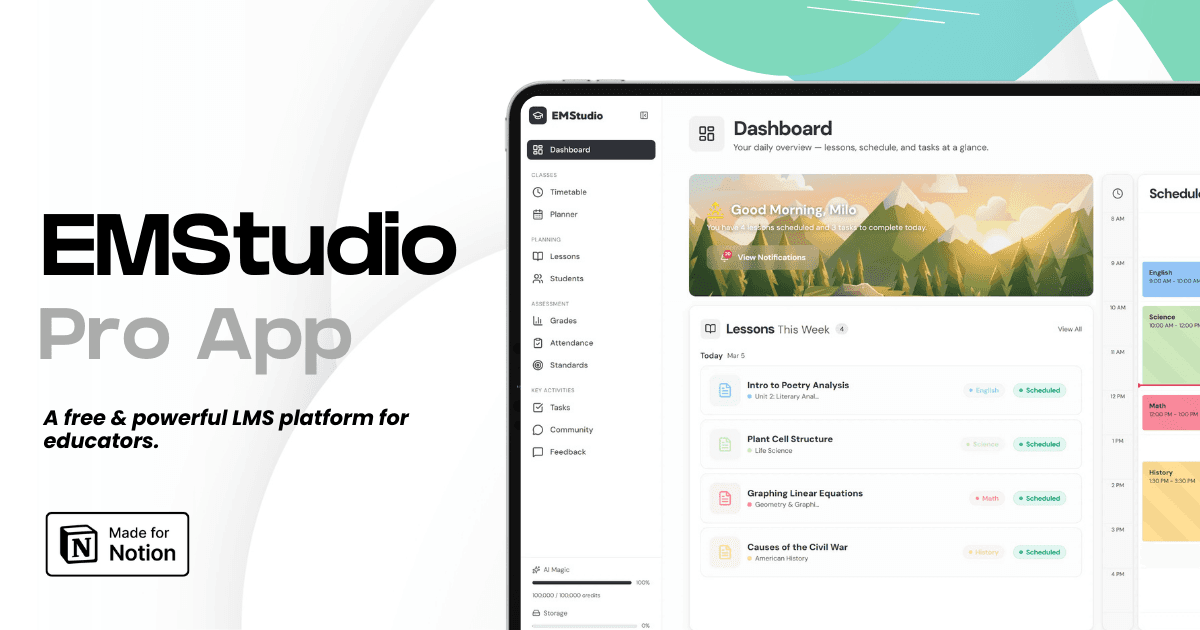
EMStudio is a free teaching management app — manage your classes, students, lessons, and more!
Learn More
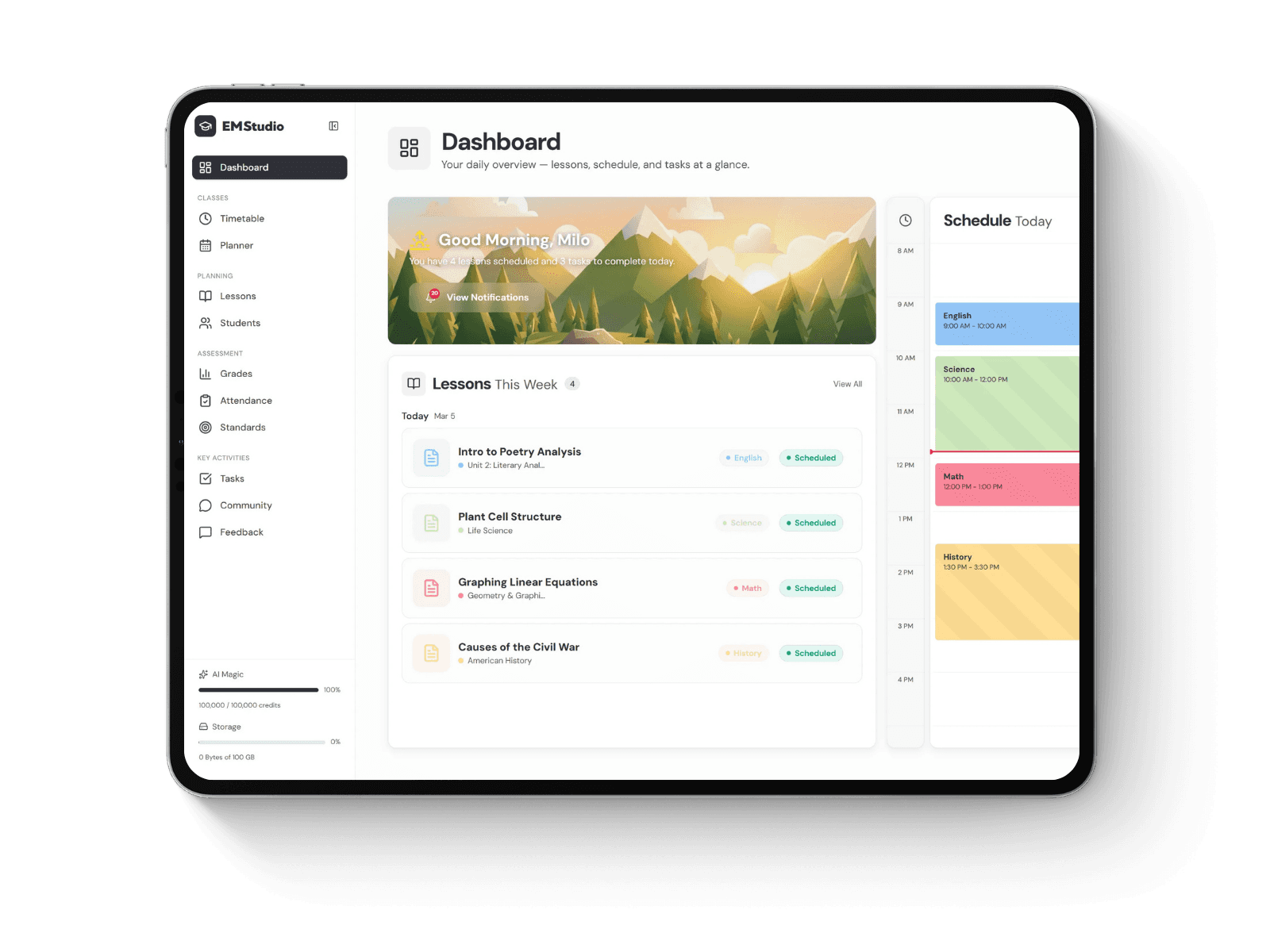
Still grading everything by hand?
EMStudio is a free teaching management app — manage your classes, students, lessons, and more!
Learn More
Table of Contents
What Are the Best Sites for Ready-Made Lessons and Curriculum?
The best sites for ready-made lessons include PBS LearningMedia for standards-aligned multimedia, BetterLesson for comprehensive 180-day units with coaching support, and Teachers Pay Teachers for community-created niche materials. Choose PBS for free high-quality video, BetterLesson for structured unit planning, and TPT for specific novel studies or seasonal content.
Supplemental materials fill a single period. Full curriculum units map your entire semester. The trade-off is simple: you save prep time upfront, but you spend it back checking alignment with your district's pacing guide.
Here is how the three heavyweights compare. PBS LearningMedia is free for PreK-12 with deep state standards alignment requiring zero prep. BetterLesson offers free full units but charges $2,000-5,000 for school-wide coaching services. Teachers Pay Teachers runs $3-15 per resource with variable alignment depth and potential formatting fixes.
PBS LearningMedia: Standards-Aligned Multimedia Lessons
PBS LearningMedia hosts over 30,000 free resources mapped to state-specific codes, McREL standards, and NGSS. You search by your exact state standard code, not just general topics. The platform integrates with Google Classroom and Clever, supporting up to 60 students per assignment on a 100% free tier.
The content library spans all grades. NOVA video clips serve grades 6-12 science with lab follow-ups. Arthur clips handle K-2 social-emotional learning scenarios. Ken Burns documentary segments anchor grades 9-12 history discussions. Each includes discussion guides.
I used the NOVA evolution clips last March when my biology pacing guide shifted unexpectedly. The state-by-state standards mapping tool showed me exactly which NGSS code the clip hit. Zero prep, total alignment, and the kids actually watched the full eight minutes.
BetterLesson: Comprehensive Unit Plans and Teaching Strategies
BetterLesson built its reputation on the Master Teacher Project. These are not theoretical plans. They film actual teachers in actual classrooms showing specific moves—how to redirect a student, when to pause for a turn-and-talk, how to use formative assessment mid-lesson.
Each unit follows a four-lesson cycle: Plan, Teach, Reflect, Share. The plans include built-in differentiated instruction strategies for ELL students and Tier 2 interventions. You get complete 180-day arcs for ELA and math, not just isolated activities.
Individual access to lesson plans remains free. The paid tier brings coaching services running $2,000-5,000 for site-wide licenses. If your district pays, you get weekly check-ins. If not, the units still stand alone as robust online resources for educators who need full-year structure without the sticker shock.
Teachers Pay Teachers: Community-Created Classroom Resources
Teachers Pay Teachers operates as a marketplace with 7 million items. Quality varies, so vet carefully. Look for "Top Rated" badges, 4.5+ stars with 100+ reviews, and "Licensed for Commercial Use" tags on clip art to avoid copyright violations.
Price benchmarks run $3-5 for single worksheets, $8-15 for novel units, and $25-40 for year-long curriculum maps. These essential community-created resources for every subject shine when you need a specific novel study or a Halloween math activity that actually engages 8th graders.
Verify seller permissions for any excerpt over 300 words or copyrighted images. Use the "Original educational materials" filter. Watch for red flags: lessons that skip Universal Design for Learning principles or lack SPED accommodations signal misaligned pacing. If the preview shows Comic Sans and no page numbers, close the tab. Your prep time matters too much to spend it fixing someone else's rushed upload.

Where Can Educators Find Free Open Educational Resources?
Educators can find free open educational resources at OER Commons (50,000+ CC-licensed materials), CK-12 Foundation (adaptive STEM FlexBooks), and Smithsonian Learning Lab (6 million+ primary sources). These platforms offer full modification rights under Creative Commons licenses, unlike copyrighted free materials, making them ideal for customization and redistribution.
Free does not mean open. That worksheet from a random blog might cost nothing, but you cannot legally edit it or share it with your co-teacher. True Open Educational Resources give you explicit rights to modify and redistribute.
Most free teaching websites for teachers operate under traditional copyright. You can print the PDF for your own students, but you cannot translate it for your ESOL class or post it on your district server. Open ed resources use Creative Commons licenses that explicitly permit remixing for differentiated instruction.
Right | OER (Creative Commons) | Free-but-Copyrighted |
|---|---|---|
Modify content | Yes | No |
Redistribute to team | Yes | No |
Attribution required | Yes | No |
John Hilton III synthesized multiple studies comparing OER to commercial textbooks. His findings show no significant difference in student learning outcomes between open resources and $120 textbooks. The only major difference is cost.
Choose your license based on classroom use:
CC BY: Permissive. Commercial use allowed. Use this for district curriculum projects.
CC BY-NC: Non-commercial only. Safe for classroom handouts, risky if you later sell your unit.
CC BY-SA: Share-alike. Your modified versions must carry the same license. Perfect for teacher collaboratives.
Traditional Copyright: Restricted. Individual use only. Most Pinterest freebies fall here.
These online resources for educators remove the legal guesswork from adaptation. You can modify materials for Universal Design for Learning without copyright anxiety. Read our complete guide to open educational resources for K-12 educators to understand license nuances.
OER Commons: Curated Open Textbooks and Course Materials
OER Commons hosts over 50,000 resources that you can legally modify. The Open Author interface works like a simple drag-and-drop lesson builder. You pull in text, images, and videos, then export to PDF, HTML, or Common Cartridge format for direct import into your learning management systems. No reformatting required.
Every resource carries alignment tags. You can search by specific standard codes like NGSS MS-PS1-2 or C3 Framework indicators. This beats scrolling through vague "grade 7 science" folders that may not match your pacing guide.
The Hubs feature shows localized implementations. Washington State and Houston ISD maintain curated collections reflecting their scope and sequences. Dedicated microsites support adult basic education and ESOL programs with specialized vocabularies. You can see exactly how another 7th-grade team arranged content for their formative assessment cycles.
CK-12 Foundation: Adaptive Math and Science Content
CK-12 Foundation offers FlexBooks 2.0, modular textbooks where you hide or show sections based on your pacing. You can embed videos and 3D simulations directly into the text. The platform covers over 5,000 concepts across grades K-12, and everything is 100% free including student accounts.
The adaptive practice engine adjusts difficulty in real-time. If a student misses three questions on polynomial factoring, the algorithm provides targeted hints before escalating. Braingenie targets specific math skill gaps with short practice sets.
PLIX interactives help students visualize conceptual physics. The mobile app works offline, so students on buses or with limited home WiFi can still access content. It runs on Chromebooks and tablets without paid licenses.
Smithsonian Learning Lab: Primary Source Collections and Activities
The Smithsonian Learning Lab contains over 6 million digitized artifacts. You can curate 10 to 20 items into a Collection that functions like a digital textbook. Add your own annotations and discussion prompts to guide student inquiry.
Primary sources range from Civil War letters to Apollo program scientific instruments. Native American cultural artifacts include contextualized provenance information. These materials support digital citizenship lessons about source verification and historical bias.
The platform integrates via LTI into most LMS platforms. AP US History teachers find ready-made analysis worksheets aligned to the exam. Elementary teachers need heavier scaffolding templates, but the visual richness works perfectly for middle and high school inquiry projects.

Which Platforms Offer the Best Professional Development for Teachers?
Top professional development platforms include edWeb.net for free CE webinars and PLCs, Coursera for university-certified graduate courses ($49/month Specializations), and Teaching Channel for classroom observation videos. Select edWeb for immediate CE credits, Coursera for formal credentials, and Teaching Channel for instructional strategy modeling.
Match the platform to your credential deadline.
If you need CE credits immediately, head to edWeb.net. If you need graduate credit for salary advancement, choose Coursera. If you need to see exactly how a veteran teacher handles a disruptive student during a math lesson, Teaching Channel is your best bet. These online resources for educators serve different purposes.
edWeb.net: Free, one-hour sessions, CEU certificates via quiz, async webinars.
Coursera: $49/month, 4-6 week courses, graduate ACE credit, cohort discussion.
Teaching Channel: $99/year, on-demand videos, PDP certificates, video annotation.
PD fails when administrators don't protect implementation time, when district initiatives conflict with course content, or when you sit through sessions without applying strategies the next day. teaching trainings to advance your career only work when you have space to practice.
edWeb.net: Free Webinars and Professional Learning Communities
edWeb hosts over 5,000 recorded webinars covering everything from classroom management to STEM integration, with new live sessions daily. Join professional learning communities like "Tech in the Classroom" (12,000 members), "Social-Emotional Learning" (8,500 members), or "Literacy and Critical Thinking" (9,000 members). These groups stay active between events, sharing specific resources for literacy coaches and tech integrators who need peer support.
Earning credit is straightforward. Watch live or recorded, answer a five-question quiz to confirm attendance, and download your PDF certificate immediately. Most states accept these for recertification. The platform carries no subscription fees.
The limitation is clear: no graduate credit is available. You get strictly professional development hours and learning, not transcript credits for salary lanes.
Coursera for Educators: University-Certified Teaching Courses
Coursera features University of Pennsylvania Learning Sciences courses and Johns Hopkins assessment specializations among its rigorous teacher learning resources. Take "Learning How to Learn" from McMaster University, "Foundations of Teaching for Learning" from Commonwealth Education Trust, or "Assessment in Higher Education" from University of Illinois. These courses run four to six weeks with weekly modules and peer-reviewed assignments.
The $49 monthly fee covers Specializations with certificates. Or pay $399 yearly for Coursera Plus and unlimited access. Some courses carry American Council on Education (ACE) recommended credit accepted by over 2,000 universities for 3-6 transferable graduate credits. Financial aid is available for educators who qualify.
Unlike one-hour webinars, these require sustained effort. You will write lesson plans and receive feedback from global peers. The credential carries weight on resumes and district application packets.
Teaching Channel: Classroom Video Examples and Strategy Breakdowns
Teaching Channel offers 1,500+ unedited 15-minute classroom segments mapped to the Danielson Framework. Teachers voiceover their decision points in real time. You will see authentic formative assessment techniques and differentiated instruction strategies, not polished productions with paid actors.
The Lesson Planning Utility provides downloadable unit plans matched to videos showing standards-based grading implementation. You can filter by grade level and subject. Tch Plus costs $8.25 monthly for coaching videos and includes video annotation tools for PLCs.
Upload your own clips for peer feedback within your PLC using the platform's annotation features. proven professional growth programs require seeing master teachers handle the same struggles you face daily.

What Digital Tools Maximize Student Engagement and Management?
Digital tools maximizing engagement include ClassDojo for K-5 behavior tracking and parent communication, Microsoft Flip for video discussions with 3-minute response limits, and Quizizz for gamified formative assessments. ClassDojo manages classroom culture, Flip amplifies student voice, and Quizizz provides real-time data with meme-based feedback.
But here's the catch. Technology only works when it changes how students learn, not just where they do it. If you're swapping worksheets for PDFs, you're wasting your time.
John Hattie's Visible Learning research puts technology's effect size at 0.42—barely above the hinge point of 0.40. That number jumps only when you use tech for immediate feedback and collaboration, not mere digitization. Think SAMR model: substitution adds nothing, but redefinition changes the task entirely. These aren't just digital worksheets. They're formative assessment engines that change the feedback loop.
Tool | Primary Use | Grades | Devices | Privacy | Setup |
|---|---|---|---|---|---|
ClassDojo | Behavior & Communication | K-5 | Tablet-friendly | FERPA-compliant | 15 minutes |
Microsoft Flip | Video Discussion | 3-12 | Chromebook-optimized | COPPA-compliant | 10 minutes |
Quizizz | Gamified Assessment | 6-12 | Universal | Standard | 5 minutes |
ClassDojo: Behavior Tracking and Parent Communication Systems
ClassDojo runs on a point economy. You build categories like "On Task" and "Helping Others" for positive reinforcement, alongside "Off Task" or "Disrespectful" for redirects. Each carries weight—you might assign +1 for participation but -2 for disruption. The system tracks patterns over time, showing you exactly when Malik checks out every Tuesday afternoon. I've caught attention issues weeks before referrals by watching trends. The free version includes everything you need.
Parents see these updates in real time. The app sends weekly digests automatically, translates private messages into 35 languages instantly, and handles event reminders with RSVP tracking. I've seen parent engagement hit 95% in Title I pilot schools where email failed completely. When Maria's mom responds at midnight in Spanish and I read it in English at 6 AM, that's a conversation that wouldn't have happened. Setup takes about fifteen minutes per class.
But watch the public display. Showing negative points on the smartboard humiliates kids and creates shame. For middle schoolers, switch to private tracking only to avoid embarrassment. The portfolio feature—where students upload photo evidence—works better for older kids anyway. FERPA compliance is built-in, though you'll need signed parent consent forms before adding any child. Templates are included.
Flipgrid (Flip): Video Discussion Platforms for Student Voice
Microsoft Flip (formerly Flipgrid) gives every student a voice without the anxiety of live speaking. You organize classes into grids with topic threads, post prompts, and kids record video responses ranging from 30 seconds to 3 minutes. They can add stickers, draw on whiteboards, or upload external clips. The time limit forces concise thinking—no more rambling five-minute speeches. My quietest 7th grader explained photosynthesis better on Flip than she ever did in person, simply because she could re-record until it felt right. The platform is 100% free.
Accessibility is built deep. Immersive Reader converts text prompts to speech for struggling readers. Automatic closed captions generate within seconds, and full transcripts support deaf and hard-of-hearing students. I've used it successfully on Chromebooks with internet as slow as 1 Mbps; the platform compresses video efficiently without killing quality. The Chromebook-optimized interface means no lag on older district devices that struggle with heavier video platforms.
Security matters when kids film themselves. Set grids to "Hidden" so only you see responses initially, then approve individual videos for public viewing. Password-protect grids for extra safety. The moderation tools prevent cyberbullying, and the teacher apps that transform classrooms include this one for good reason. Students need webcam and microphone permissions, which IT grants through Google Workspace or Microsoft 365. Setup takes ten minutes unless your firewall blocks camera access.
Quizizz: Gamified Formative Assessments and Live Activities
Quizizz turns worksheets into games without the cringe. Students see meme-based feedback—celebration GIFs for correct answers, sympathetic images for misses. Research suggests this emotional hook increases retention compared to traditional "Correct/Incorrect" text. Leaderboards can be disabled for anxious kids, and power-ups reward streaks. The gamification methods to boost student interest actually work here because the jokes land with 6th graders who ignore standard worksheets.
The backend data reveals everything. Item analysis shows exactly which question 60% of the class missed. Time-spent metrics flag guessing, and standards tracking identifies gaps across units. I've caught students clicking through in 4 seconds; the data doesn't lie about engagement. You can export results directly to your gradebook with one click, saving the transfer time that usually eats your planning period.
Four modes cover every scenario. Classic mode runs live competition. Team mode forces collaboration. Test mode removes points for formal grades. Homework mode spreads assignments over two weeks. Differentiated instruction happens automatically through "Read Aloud" and unlimited retries. You need 1:1 devices for live mode, but paper mode works for homework. Integration with Google Classroom and Canvas is seamless, making this a staple among online resources for educators who track progress. Setup takes five minutes if you import existing banks.

How Do You Evaluate Which Resources Fit Your Teaching Context?
Evaluate resources by auditing standards alignment using backward design, checking WCAG 2.1 AA accessibility features for screen readers and color contrast, and planning 30-60-90 day implementation timelines. Pilot tools with single units before full adoption, verify FERPA compliance for student data, and confirm export options prevent lock-in.
You have forty-five minutes to plan next week. Don't waste it learning a tool your kids can't access or that doesn't map to your standards.
Watch for Shiny Object Syndrome. Abandoning tools mid-year fragments data and confuses kids. Set a rule: no new platforms between November and March. Check license expiration dates—avoid renewals during winter break. Verify admin buy-in for paid tiers over $500/year before you fall in love with premium features.
Use this decision flowchart. If your students read below the 50th percentile, prioritize text-to-speech over dense PDFs. Teaching inquiry science? Prioritize simulation platforms over video lectures. Limited devices? Choose phone-friendly apps that work on old Chromebooks. Match the tool to the constraint, not the hype.
Assessing Alignment with Learning Objectives and Standards
Use Backward Design. Pull state standard codes—not topics, codes. Look for verbatim matches. "Analyze author's purpose" differs from "identify main idea."
Use a 4-point rubric. 4 (Exemplary): direct standard quote matches resource. 3 (Aligned): skill matches, vocabulary differs. 2 (Partial): prerequisite only. 1 (Misaligned): off-topic. Below 3 stays supplemental.
Run the Gold Standard Test. Can students achieve the objective without your translation? If not, it's supplemental. Document in a three-column chart: Standard Code, Activity, Evidence. When questioned on different types of educational technology and their uses, show the chart.
Check Open Educational Resources with the same rigor. Free NASA simulations dazzle, but if they don't hit your specific physical science standards, they're Friday entertainment. Differentiated instruction demands every resource aligns to the same objective. All roads lead to the standard code.
Checking for Accessibility Features and Equity Considerations
Start with WCAG 2.1 AA. Run WAVE on the site. No reply to errors? Move on. Check 4.5:1 color contrast. Test with NVDA. Can you submit without a mouse? If not, assistive tech users are locked out.
Verify human-generated captions; auto-captions below 95% butcher "mitochondria." For ELL families, check Spanish, Mandarin, and Arabic—not just one. Look for audio glossaries. Bandwidth under 5 Mbps for rural schools. Works on old Android phones? Ensure color isn't the only information channel. Red means dangerous fails colorblind students; add text labels. That's Universal Design for Learning.
Digital citizenship requires access. If half your class can't load the formative assessment, you're measuring Wi-Fi, not learning. Keep PDF backups. Teacher websites rarely mention screen readers. You must check. One inaccessible button bars a student from the assignment.
Planning for Sustainable Implementation and Time Management
Follow the 30-60-90 Day Implementation Timeline.
Days 1–30: Pilot with one class period or 20% of students for a single unit.
Days 31–60: Evaluate pre/post achievement data and student Likert surveys. Log your prep time.
Days 61–90: Full rollout or abandonment. No guilt. If it didn't move the needle, kill it.
Set a Sunset Clause: calendar reminder 30 days before renewal. Two logins? Cancel. Calculate real costs: subscription plus ten hours training for learning management systems. Verify FERPA/COPPA. Get signed DPAs. Check data exit strategies—can you export PDF/CSV if they close?
When integrating EdTech seamlessly into your lesson plans, demand 99.5% uptime and under-24-hour support. Test it: email at 2 PM Tuesday. No reply by Wednesday? Imagine testing week.
Avoid tool fatigue. Using five platforms fragments focus. Pick three covering 90% of needs. If a new online resources for educators candidate doesn't replace an existing tool, it adds weight, not value. The best websites for teaching and learning solve specific problems, not imaginary ones.

What This Means for Your Classroom
You don't need all twelve. Pick one resource that solves tomorrow's specific headache. Maybe that's a formative assessment tool to check who got the reading. Or an Open Educational Resource to fill a curriculum gap. Start there. Master it. Then add another.
The best online resources for educators don't replace your judgment. They buy you time to actually teach. When a learning management system handles the paperwork, you can focus on the kid who needs differentiated instruction. That's the transformation. Not the tool itself, but what you do with the minutes you get back.
Your context matters most. The flashy app your colleague loves might flop in your room. Trust your gut. If a platform adds steps, drop it. If it clears space for real connection, keep it. Your students need you more than they need another login.

What Are the Best Sites for Ready-Made Lessons and Curriculum?
The best sites for ready-made lessons include PBS LearningMedia for standards-aligned multimedia, BetterLesson for comprehensive 180-day units with coaching support, and Teachers Pay Teachers for community-created niche materials. Choose PBS for free high-quality video, BetterLesson for structured unit planning, and TPT for specific novel studies or seasonal content.
Supplemental materials fill a single period. Full curriculum units map your entire semester. The trade-off is simple: you save prep time upfront, but you spend it back checking alignment with your district's pacing guide.
Here is how the three heavyweights compare. PBS LearningMedia is free for PreK-12 with deep state standards alignment requiring zero prep. BetterLesson offers free full units but charges $2,000-5,000 for school-wide coaching services. Teachers Pay Teachers runs $3-15 per resource with variable alignment depth and potential formatting fixes.
PBS LearningMedia: Standards-Aligned Multimedia Lessons
PBS LearningMedia hosts over 30,000 free resources mapped to state-specific codes, McREL standards, and NGSS. You search by your exact state standard code, not just general topics. The platform integrates with Google Classroom and Clever, supporting up to 60 students per assignment on a 100% free tier.
The content library spans all grades. NOVA video clips serve grades 6-12 science with lab follow-ups. Arthur clips handle K-2 social-emotional learning scenarios. Ken Burns documentary segments anchor grades 9-12 history discussions. Each includes discussion guides.
I used the NOVA evolution clips last March when my biology pacing guide shifted unexpectedly. The state-by-state standards mapping tool showed me exactly which NGSS code the clip hit. Zero prep, total alignment, and the kids actually watched the full eight minutes.
BetterLesson: Comprehensive Unit Plans and Teaching Strategies
BetterLesson built its reputation on the Master Teacher Project. These are not theoretical plans. They film actual teachers in actual classrooms showing specific moves—how to redirect a student, when to pause for a turn-and-talk, how to use formative assessment mid-lesson.
Each unit follows a four-lesson cycle: Plan, Teach, Reflect, Share. The plans include built-in differentiated instruction strategies for ELL students and Tier 2 interventions. You get complete 180-day arcs for ELA and math, not just isolated activities.
Individual access to lesson plans remains free. The paid tier brings coaching services running $2,000-5,000 for site-wide licenses. If your district pays, you get weekly check-ins. If not, the units still stand alone as robust online resources for educators who need full-year structure without the sticker shock.
Teachers Pay Teachers: Community-Created Classroom Resources
Teachers Pay Teachers operates as a marketplace with 7 million items. Quality varies, so vet carefully. Look for "Top Rated" badges, 4.5+ stars with 100+ reviews, and "Licensed for Commercial Use" tags on clip art to avoid copyright violations.
Price benchmarks run $3-5 for single worksheets, $8-15 for novel units, and $25-40 for year-long curriculum maps. These essential community-created resources for every subject shine when you need a specific novel study or a Halloween math activity that actually engages 8th graders.
Verify seller permissions for any excerpt over 300 words or copyrighted images. Use the "Original educational materials" filter. Watch for red flags: lessons that skip Universal Design for Learning principles or lack SPED accommodations signal misaligned pacing. If the preview shows Comic Sans and no page numbers, close the tab. Your prep time matters too much to spend it fixing someone else's rushed upload.
Where Can Educators Find Free Open Educational Resources?
Educators can find free open educational resources at OER Commons (50,000+ CC-licensed materials), CK-12 Foundation (adaptive STEM FlexBooks), and Smithsonian Learning Lab (6 million+ primary sources). These platforms offer full modification rights under Creative Commons licenses, unlike copyrighted free materials, making them ideal for customization and redistribution.
Free does not mean open. That worksheet from a random blog might cost nothing, but you cannot legally edit it or share it with your co-teacher. True Open Educational Resources give you explicit rights to modify and redistribute.
Most free teaching websites for teachers operate under traditional copyright. You can print the PDF for your own students, but you cannot translate it for your ESOL class or post it on your district server. Open ed resources use Creative Commons licenses that explicitly permit remixing for differentiated instruction.
Right | OER (Creative Commons) | Free-but-Copyrighted |
|---|---|---|
Modify content | Yes | No |
Redistribute to team | Yes | No |
Attribution required | Yes | No |
John Hilton III synthesized multiple studies comparing OER to commercial textbooks. His findings show no significant difference in student learning outcomes between open resources and $120 textbooks. The only major difference is cost.
Choose your license based on classroom use:
CC BY: Permissive. Commercial use allowed. Use this for district curriculum projects.
CC BY-NC: Non-commercial only. Safe for classroom handouts, risky if you later sell your unit.
CC BY-SA: Share-alike. Your modified versions must carry the same license. Perfect for teacher collaboratives.
Traditional Copyright: Restricted. Individual use only. Most Pinterest freebies fall here.
These online resources for educators remove the legal guesswork from adaptation. You can modify materials for Universal Design for Learning without copyright anxiety. Read our complete guide to open educational resources for K-12 educators to understand license nuances.
OER Commons: Curated Open Textbooks and Course Materials
OER Commons hosts over 50,000 resources that you can legally modify. The Open Author interface works like a simple drag-and-drop lesson builder. You pull in text, images, and videos, then export to PDF, HTML, or Common Cartridge format for direct import into your learning management systems. No reformatting required.
Every resource carries alignment tags. You can search by specific standard codes like NGSS MS-PS1-2 or C3 Framework indicators. This beats scrolling through vague "grade 7 science" folders that may not match your pacing guide.
The Hubs feature shows localized implementations. Washington State and Houston ISD maintain curated collections reflecting their scope and sequences. Dedicated microsites support adult basic education and ESOL programs with specialized vocabularies. You can see exactly how another 7th-grade team arranged content for their formative assessment cycles.
CK-12 Foundation: Adaptive Math and Science Content
CK-12 Foundation offers FlexBooks 2.0, modular textbooks where you hide or show sections based on your pacing. You can embed videos and 3D simulations directly into the text. The platform covers over 5,000 concepts across grades K-12, and everything is 100% free including student accounts.
The adaptive practice engine adjusts difficulty in real-time. If a student misses three questions on polynomial factoring, the algorithm provides targeted hints before escalating. Braingenie targets specific math skill gaps with short practice sets.
PLIX interactives help students visualize conceptual physics. The mobile app works offline, so students on buses or with limited home WiFi can still access content. It runs on Chromebooks and tablets without paid licenses.
Smithsonian Learning Lab: Primary Source Collections and Activities
The Smithsonian Learning Lab contains over 6 million digitized artifacts. You can curate 10 to 20 items into a Collection that functions like a digital textbook. Add your own annotations and discussion prompts to guide student inquiry.
Primary sources range from Civil War letters to Apollo program scientific instruments. Native American cultural artifacts include contextualized provenance information. These materials support digital citizenship lessons about source verification and historical bias.
The platform integrates via LTI into most LMS platforms. AP US History teachers find ready-made analysis worksheets aligned to the exam. Elementary teachers need heavier scaffolding templates, but the visual richness works perfectly for middle and high school inquiry projects.
Which Platforms Offer the Best Professional Development for Teachers?
Top professional development platforms include edWeb.net for free CE webinars and PLCs, Coursera for university-certified graduate courses ($49/month Specializations), and Teaching Channel for classroom observation videos. Select edWeb for immediate CE credits, Coursera for formal credentials, and Teaching Channel for instructional strategy modeling.
Match the platform to your credential deadline.
If you need CE credits immediately, head to edWeb.net. If you need graduate credit for salary advancement, choose Coursera. If you need to see exactly how a veteran teacher handles a disruptive student during a math lesson, Teaching Channel is your best bet. These online resources for educators serve different purposes.
edWeb.net: Free, one-hour sessions, CEU certificates via quiz, async webinars.
Coursera: $49/month, 4-6 week courses, graduate ACE credit, cohort discussion.
Teaching Channel: $99/year, on-demand videos, PDP certificates, video annotation.
PD fails when administrators don't protect implementation time, when district initiatives conflict with course content, or when you sit through sessions without applying strategies the next day. teaching trainings to advance your career only work when you have space to practice.
edWeb.net: Free Webinars and Professional Learning Communities
edWeb hosts over 5,000 recorded webinars covering everything from classroom management to STEM integration, with new live sessions daily. Join professional learning communities like "Tech in the Classroom" (12,000 members), "Social-Emotional Learning" (8,500 members), or "Literacy and Critical Thinking" (9,000 members). These groups stay active between events, sharing specific resources for literacy coaches and tech integrators who need peer support.
Earning credit is straightforward. Watch live or recorded, answer a five-question quiz to confirm attendance, and download your PDF certificate immediately. Most states accept these for recertification. The platform carries no subscription fees.
The limitation is clear: no graduate credit is available. You get strictly professional development hours and learning, not transcript credits for salary lanes.
Coursera for Educators: University-Certified Teaching Courses
Coursera features University of Pennsylvania Learning Sciences courses and Johns Hopkins assessment specializations among its rigorous teacher learning resources. Take "Learning How to Learn" from McMaster University, "Foundations of Teaching for Learning" from Commonwealth Education Trust, or "Assessment in Higher Education" from University of Illinois. These courses run four to six weeks with weekly modules and peer-reviewed assignments.
The $49 monthly fee covers Specializations with certificates. Or pay $399 yearly for Coursera Plus and unlimited access. Some courses carry American Council on Education (ACE) recommended credit accepted by over 2,000 universities for 3-6 transferable graduate credits. Financial aid is available for educators who qualify.
Unlike one-hour webinars, these require sustained effort. You will write lesson plans and receive feedback from global peers. The credential carries weight on resumes and district application packets.
Teaching Channel: Classroom Video Examples and Strategy Breakdowns
Teaching Channel offers 1,500+ unedited 15-minute classroom segments mapped to the Danielson Framework. Teachers voiceover their decision points in real time. You will see authentic formative assessment techniques and differentiated instruction strategies, not polished productions with paid actors.
The Lesson Planning Utility provides downloadable unit plans matched to videos showing standards-based grading implementation. You can filter by grade level and subject. Tch Plus costs $8.25 monthly for coaching videos and includes video annotation tools for PLCs.
Upload your own clips for peer feedback within your PLC using the platform's annotation features. proven professional growth programs require seeing master teachers handle the same struggles you face daily.
What Digital Tools Maximize Student Engagement and Management?
Digital tools maximizing engagement include ClassDojo for K-5 behavior tracking and parent communication, Microsoft Flip for video discussions with 3-minute response limits, and Quizizz for gamified formative assessments. ClassDojo manages classroom culture, Flip amplifies student voice, and Quizizz provides real-time data with meme-based feedback.
But here's the catch. Technology only works when it changes how students learn, not just where they do it. If you're swapping worksheets for PDFs, you're wasting your time.
John Hattie's Visible Learning research puts technology's effect size at 0.42—barely above the hinge point of 0.40. That number jumps only when you use tech for immediate feedback and collaboration, not mere digitization. Think SAMR model: substitution adds nothing, but redefinition changes the task entirely. These aren't just digital worksheets. They're formative assessment engines that change the feedback loop.
Tool | Primary Use | Grades | Devices | Privacy | Setup |
|---|---|---|---|---|---|
ClassDojo | Behavior & Communication | K-5 | Tablet-friendly | FERPA-compliant | 15 minutes |
Microsoft Flip | Video Discussion | 3-12 | Chromebook-optimized | COPPA-compliant | 10 minutes |
Quizizz | Gamified Assessment | 6-12 | Universal | Standard | 5 minutes |
ClassDojo: Behavior Tracking and Parent Communication Systems
ClassDojo runs on a point economy. You build categories like "On Task" and "Helping Others" for positive reinforcement, alongside "Off Task" or "Disrespectful" for redirects. Each carries weight—you might assign +1 for participation but -2 for disruption. The system tracks patterns over time, showing you exactly when Malik checks out every Tuesday afternoon. I've caught attention issues weeks before referrals by watching trends. The free version includes everything you need.
Parents see these updates in real time. The app sends weekly digests automatically, translates private messages into 35 languages instantly, and handles event reminders with RSVP tracking. I've seen parent engagement hit 95% in Title I pilot schools where email failed completely. When Maria's mom responds at midnight in Spanish and I read it in English at 6 AM, that's a conversation that wouldn't have happened. Setup takes about fifteen minutes per class.
But watch the public display. Showing negative points on the smartboard humiliates kids and creates shame. For middle schoolers, switch to private tracking only to avoid embarrassment. The portfolio feature—where students upload photo evidence—works better for older kids anyway. FERPA compliance is built-in, though you'll need signed parent consent forms before adding any child. Templates are included.
Flipgrid (Flip): Video Discussion Platforms for Student Voice
Microsoft Flip (formerly Flipgrid) gives every student a voice without the anxiety of live speaking. You organize classes into grids with topic threads, post prompts, and kids record video responses ranging from 30 seconds to 3 minutes. They can add stickers, draw on whiteboards, or upload external clips. The time limit forces concise thinking—no more rambling five-minute speeches. My quietest 7th grader explained photosynthesis better on Flip than she ever did in person, simply because she could re-record until it felt right. The platform is 100% free.
Accessibility is built deep. Immersive Reader converts text prompts to speech for struggling readers. Automatic closed captions generate within seconds, and full transcripts support deaf and hard-of-hearing students. I've used it successfully on Chromebooks with internet as slow as 1 Mbps; the platform compresses video efficiently without killing quality. The Chromebook-optimized interface means no lag on older district devices that struggle with heavier video platforms.
Security matters when kids film themselves. Set grids to "Hidden" so only you see responses initially, then approve individual videos for public viewing. Password-protect grids for extra safety. The moderation tools prevent cyberbullying, and the teacher apps that transform classrooms include this one for good reason. Students need webcam and microphone permissions, which IT grants through Google Workspace or Microsoft 365. Setup takes ten minutes unless your firewall blocks camera access.
Quizizz: Gamified Formative Assessments and Live Activities
Quizizz turns worksheets into games without the cringe. Students see meme-based feedback—celebration GIFs for correct answers, sympathetic images for misses. Research suggests this emotional hook increases retention compared to traditional "Correct/Incorrect" text. Leaderboards can be disabled for anxious kids, and power-ups reward streaks. The gamification methods to boost student interest actually work here because the jokes land with 6th graders who ignore standard worksheets.
The backend data reveals everything. Item analysis shows exactly which question 60% of the class missed. Time-spent metrics flag guessing, and standards tracking identifies gaps across units. I've caught students clicking through in 4 seconds; the data doesn't lie about engagement. You can export results directly to your gradebook with one click, saving the transfer time that usually eats your planning period.
Four modes cover every scenario. Classic mode runs live competition. Team mode forces collaboration. Test mode removes points for formal grades. Homework mode spreads assignments over two weeks. Differentiated instruction happens automatically through "Read Aloud" and unlimited retries. You need 1:1 devices for live mode, but paper mode works for homework. Integration with Google Classroom and Canvas is seamless, making this a staple among online resources for educators who track progress. Setup takes five minutes if you import existing banks.
How Do You Evaluate Which Resources Fit Your Teaching Context?
Evaluate resources by auditing standards alignment using backward design, checking WCAG 2.1 AA accessibility features for screen readers and color contrast, and planning 30-60-90 day implementation timelines. Pilot tools with single units before full adoption, verify FERPA compliance for student data, and confirm export options prevent lock-in.
You have forty-five minutes to plan next week. Don't waste it learning a tool your kids can't access or that doesn't map to your standards.
Watch for Shiny Object Syndrome. Abandoning tools mid-year fragments data and confuses kids. Set a rule: no new platforms between November and March. Check license expiration dates—avoid renewals during winter break. Verify admin buy-in for paid tiers over $500/year before you fall in love with premium features.
Use this decision flowchart. If your students read below the 50th percentile, prioritize text-to-speech over dense PDFs. Teaching inquiry science? Prioritize simulation platforms over video lectures. Limited devices? Choose phone-friendly apps that work on old Chromebooks. Match the tool to the constraint, not the hype.
Assessing Alignment with Learning Objectives and Standards
Use Backward Design. Pull state standard codes—not topics, codes. Look for verbatim matches. "Analyze author's purpose" differs from "identify main idea."
Use a 4-point rubric. 4 (Exemplary): direct standard quote matches resource. 3 (Aligned): skill matches, vocabulary differs. 2 (Partial): prerequisite only. 1 (Misaligned): off-topic. Below 3 stays supplemental.
Run the Gold Standard Test. Can students achieve the objective without your translation? If not, it's supplemental. Document in a three-column chart: Standard Code, Activity, Evidence. When questioned on different types of educational technology and their uses, show the chart.
Check Open Educational Resources with the same rigor. Free NASA simulations dazzle, but if they don't hit your specific physical science standards, they're Friday entertainment. Differentiated instruction demands every resource aligns to the same objective. All roads lead to the standard code.
Checking for Accessibility Features and Equity Considerations
Start with WCAG 2.1 AA. Run WAVE on the site. No reply to errors? Move on. Check 4.5:1 color contrast. Test with NVDA. Can you submit without a mouse? If not, assistive tech users are locked out.
Verify human-generated captions; auto-captions below 95% butcher "mitochondria." For ELL families, check Spanish, Mandarin, and Arabic—not just one. Look for audio glossaries. Bandwidth under 5 Mbps for rural schools. Works on old Android phones? Ensure color isn't the only information channel. Red means dangerous fails colorblind students; add text labels. That's Universal Design for Learning.
Digital citizenship requires access. If half your class can't load the formative assessment, you're measuring Wi-Fi, not learning. Keep PDF backups. Teacher websites rarely mention screen readers. You must check. One inaccessible button bars a student from the assignment.
Planning for Sustainable Implementation and Time Management
Follow the 30-60-90 Day Implementation Timeline.
Days 1–30: Pilot with one class period or 20% of students for a single unit.
Days 31–60: Evaluate pre/post achievement data and student Likert surveys. Log your prep time.
Days 61–90: Full rollout or abandonment. No guilt. If it didn't move the needle, kill it.
Set a Sunset Clause: calendar reminder 30 days before renewal. Two logins? Cancel. Calculate real costs: subscription plus ten hours training for learning management systems. Verify FERPA/COPPA. Get signed DPAs. Check data exit strategies—can you export PDF/CSV if they close?
When integrating EdTech seamlessly into your lesson plans, demand 99.5% uptime and under-24-hour support. Test it: email at 2 PM Tuesday. No reply by Wednesday? Imagine testing week.
Avoid tool fatigue. Using five platforms fragments focus. Pick three covering 90% of needs. If a new online resources for educators candidate doesn't replace an existing tool, it adds weight, not value. The best websites for teaching and learning solve specific problems, not imaginary ones.
What This Means for Your Classroom
You don't need all twelve. Pick one resource that solves tomorrow's specific headache. Maybe that's a formative assessment tool to check who got the reading. Or an Open Educational Resource to fill a curriculum gap. Start there. Master it. Then add another.
The best online resources for educators don't replace your judgment. They buy you time to actually teach. When a learning management system handles the paperwork, you can focus on the kid who needs differentiated instruction. That's the transformation. Not the tool itself, but what you do with the minutes you get back.
Your context matters most. The flashy app your colleague loves might flop in your room. Trust your gut. If a platform adds steps, drop it. If it clears space for real connection, keep it. Your students need you more than they need another login.
Still grading everything by hand?
EMStudio is a free teaching management app — manage your classes, students, lessons, and more!
Learn More
Still grading everything by hand?
EMStudio is a free teaching management app — manage your classes, students, lessons, and more!
Learn More




Notion4Teachers
Notion templates to simplify administrative tasks and enhance your teaching experience.



2026 Notion4Teachers. All Rights Reserved.
Notion4Teachers
Notion templates to simplify administrative tasks and enhance your teaching experience.
2026 Notion4Teachers. All Rights Reserved.
Notion4Teachers
Notion templates to simplify administrative tasks and enhance your teaching experience.
2026 Notion4Teachers. All Rights Reserved.