
AI Lesson Plan Template for K-12 Educators
AI Lesson Plan Template for K-12 Educators

Article by
Milo
ESL Content Coordinator & Educator
ESL Content Coordinator & Educator
All Posts
Teachers spend an average of 12 hours per week on lesson planning outside of contract hours, according to RAND Corporation's 2022 survey. That is nearly a day and a half of unpaid work. An ai lesson plan template cuts that time in half only if you stop treating generative AI like a search engine and start using it as an instructional design partner. I tested automated workflows with my 7th graders last semester, and the difference came down to structure. Without a consistent framework, you get generic worksheets. With one, you get activities that actually align to your standards.
This post gives you the system I now use daily. You will get the five core components every plan needs, a step-by-step setup guide that works from kindergarten through AP Chemistry, and strategies for differentiating instruction across grade levels. I have also included a prompt engineering library with copy-and-paste examples you can use immediately. No theory. Just the template structure and AI prompts that survive first contact with real classrooms.
Still grading everything by hand?
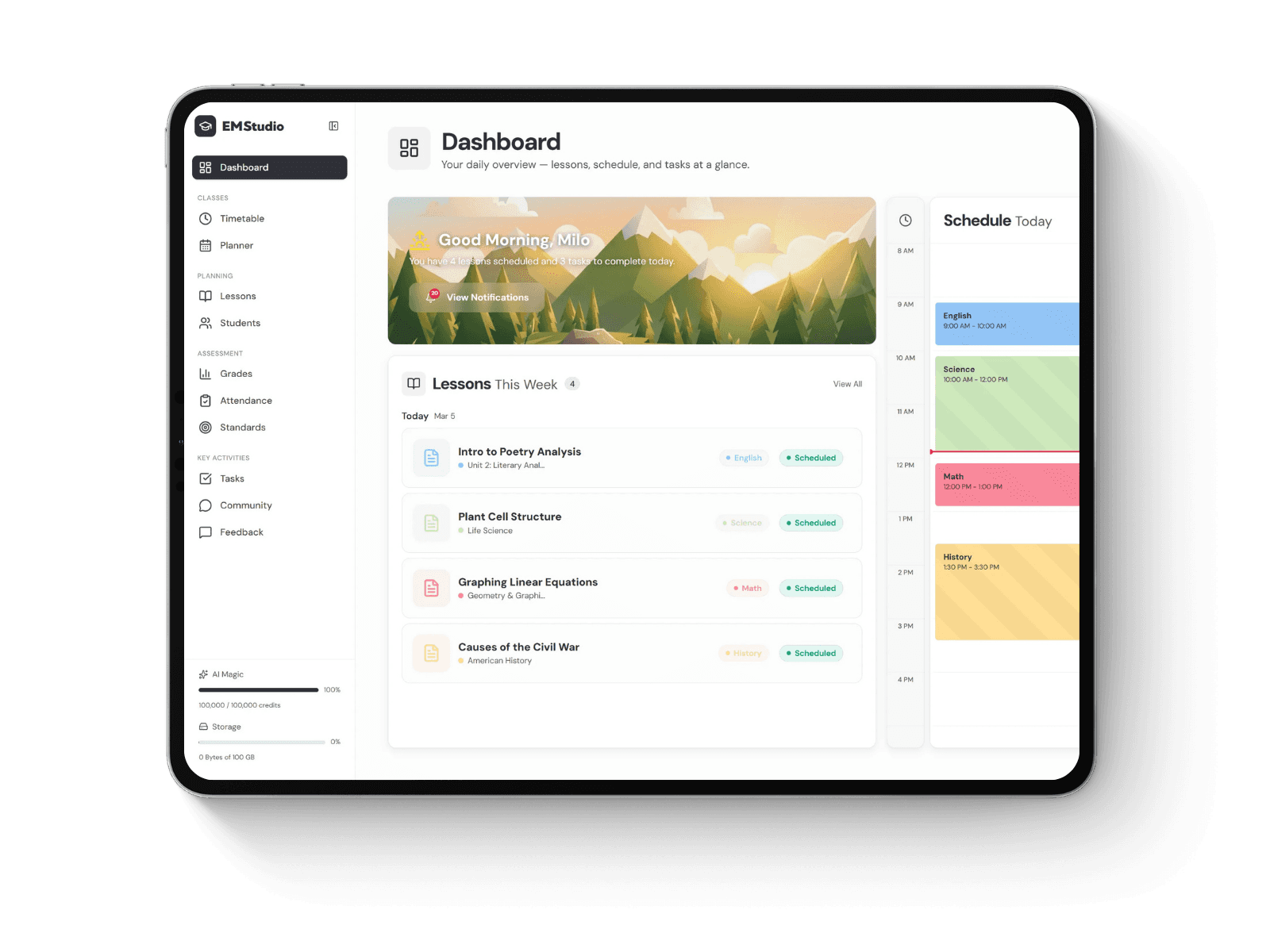
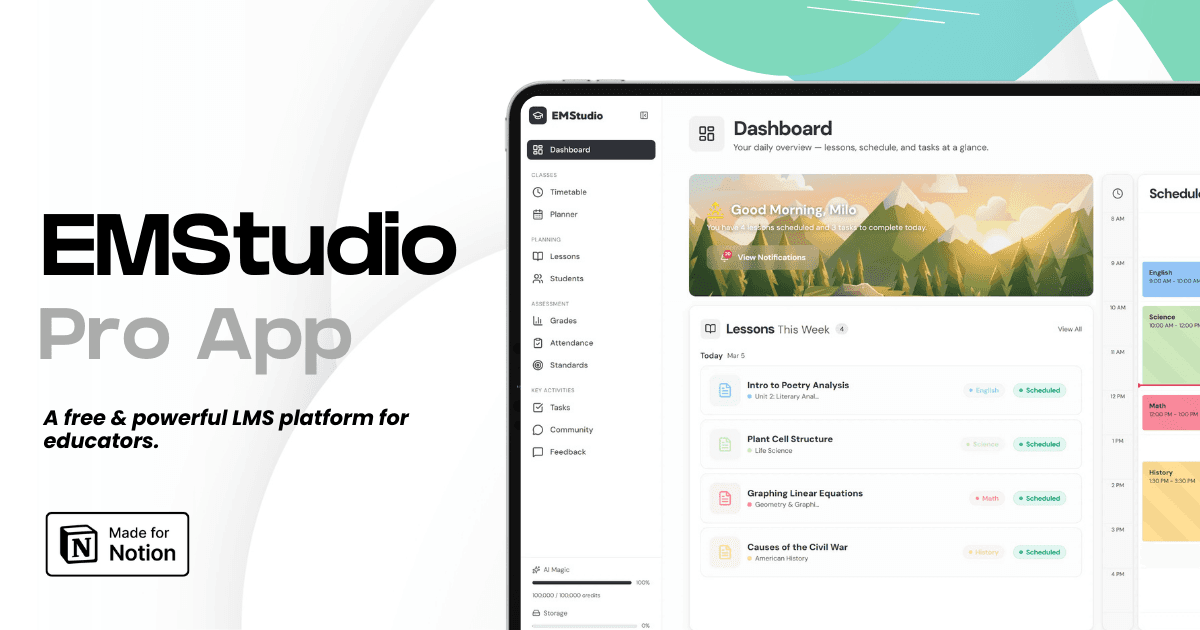
EMStudio is a free teaching management app — manage your classes, students, lessons, and more!
Learn More
Still grading everything by hand?
EMStudio is a free teaching management app — manage your classes, students, lessons, and more!
Learn More
Table of Contents
What This AI Lesson Plan Template Includes
This template gives you a complete ai lesson plan system in one Google Doc. It cuts your weekly planning from 12 hours to 90 minutes using ChatGPT-4, Claude 3.5 Sonnet, or Google Gemini 1.5 Pro. You get full standards alignment, differentiation strategies, and assessments that actually match your objectives. It is the lesson plan ai tool I wish I had last year.
Teachers report spending 12 to 15 hours weekly on lesson planning. That is time you do not have. This template uses generative AI in education. You drop down to 3 or 4 hours weekly. With practice, you hit 90 minutes.
You receive a downloadable Google Doc. It has five linked sections based on our foundational lesson plan template. It aligns with Charlotte Danielson Framework and Marzano evaluations. Export to PDF for submission or share the link with your coach. The sections talk to each other. Changes in your objectives automatically update your assessments.
The template auto-maps to major standards with exact codes:
Common Core State Standards (CCSS)
Next Generation Science Standards (NGSS)
State frameworks like TEKS and SOL
It pulls those codes directly into your objectives section. No more flipping through benchmark binders.
The system handles curriculum alignment automatically. You enter your topic, and the AI matches it to your pacing guide.
I built this for ChatGPT-4, Claude 3.5 Sonnet, and Google Gemini 1.5 Pro. Each handles the prompt engineering differently, so I included model-specific instructions. You get consistent output regardless of which tool your district allows. The automated lesson planning works the same way with OpenAI or Anthropic.
Method | Time | Standards Alignment | Differentiation Depth | Assessment Variety | Reflection Detail |
|---|---|---|---|---|---|
Traditional | 12 hrs/week | Manual lookup | Generic notes | 3-4 types | Brief summary |
AI-Assisted | 3 hrs/week | Auto-matched | 3-4 strategies | 5-6 types | Prompted sections |
Full AI Template | 90 min/week | Exact CCSS/NGSS codes | Individualized tiers | Full range | Data-driven analysis |

Template Structure: The Five Core Components
This ai lesson plan template runs as a closed loop. 1. Learning Objective Generator creates measurable goals. 2. Activity Sequence Builder blocks your time. 3. Differentiation Matrix tiers the work. 4. Assessment Rubric Creator builds the scale. 5. Reflection and Adjustment Log feeds data back to component one.
You input standards at the top. Each section populates the next. Nothing exists in isolation.
Learning Objective Generator
Select Bloom's Taxonomy verbs by grade band. Use identify and describe for K-2. Choose analyze, evaluate, or create for grades 9-12. The system tags each objective with a Depth of Knowledge (DOK) level from 1 to 4.
It checks your standard code against your district's database. The generator applies SMART criteria automatically. Good prompt engineering here means specifying your exact standard code.
Activity Sequence Builder
Block time in 10-minute chunks for elementary, 15 for secondary. Structure follows a three-part arc: hook (10 min), exploration (15-20 min), synthesis (10 min). Hattie's effect size of 0.59 supports direct instruction in the hook.
Hyperlink materials in the margin. Flag prep time as under 15 minutes or 30+. I always overestimate by five minutes. This ai lesson planning system flags conflicts if you exceed your block.
Differentiation Matrix
Build three tiers. Green covers 70% with on-grade work. Yellow serves 20% with scaffolds like sentence starters for ELLs. Red extends 10% with complexity ladders. Adjust based on your class demographics.
This connects to your differentiated instruction strategies. The matrix auto-populates modifications based on IEP flags. Generative AI in education works best with specific student data.
Assessment Rubric Creator
Generate a 4-point scale: Beginning, Developing, Proficient, Advanced. Each level includes an exemplar student response. Success criteria use the measurable verb from your objective in student-friendly language.
Insert formative checkpoints at 25%, 50%, and 75% of class time. These aren't graded. They tell you who needs to move tiers. This ensures curriculum alignment stays tight.
Reflection and Adjustment Log
Timestamp actual duration against your plan. Note if you ran over by eight minutes. Record specific misconceptions you heard. I write down exactly what the student said.
Archive failed materials and wins. Tag work samples with engagement levels. This data feeds component one next week. The loop closes. Your ai lesson planner gets smarter with each cycle of instructional design.

Step-by-Step Setup Guide
Step 1: Configure Your Subject and Standards Parameters
Start by picking your engine. I use ChatGPT-4 for heavy differentiated instruction work or Claude 3.5 when I need to dump in 100k tokens of district curriculum context. Be specific about your kids: 28 students, 40% IEP, 12 ELL. The AI needs this to gauge complexity.
Lock in your standards framework—CCSS, NGSS, TEKS, or your state's flavor. Don't write "fractions." Input 5.NF.A.1 or 7.RP.A.2. Exact codes prevent the AI from hallucinating scope. This precision is what separates a usable ai lesson plan from generic mush.
Step 2: Set Constraints for Time and Resources
Tell the truth about your room. Is it 42 minutes or 90-minute block? 1:1 devices, shared cart, or paper-only? I once forgot to mention we had zero tech that week. The AI spat out a chatgpt lesson plan full of Desmos activities we couldn't open.
Set your budget ceiling: $0, under $20, or unlimited. Check boxes for prerequisite knowledge your kids actually possess. Mention co-teachers or push-in support for IEP students. These guardrails keep automated lesson planning grounded in your physical reality.
Step 3: Generate Initial Output and Review
Use chain-of-thought prompting. First ask for the unpacked standard. Then the objective. Then the sequence. This forces the AI to show its work. When I tried creating lesson plans with Notion AI, this sequential approach caught gaps before they became classroom disasters.
Check the math. If your period is 50 minutes and the activities sum to 58, flag it. Verify the standards codes exist. Look for hallucinated resources. Generative AI in education is confident even when it's wrong. You are the fact-checker.
Step 4: Refine Using Iterative Prompts
Now iterate. Paste the output back with specific commands: "Reduce cognitive load for 3rd graders" or "Replace worksheet with collaborative task." I often request "Add kinesthetic component" when the lesson plan maker gives me too much sit-and-get.
Adjust your temperature setting. Use 0.3 for factual consistency in curriculum alignment. Bump to 0.7 only when brainstorming creative hooks. Low temperature keeps prompt engineering predictable. High temperature invites wild ideas that might work—or might waste your prep period.

How Do You Customize This Template for Different Grade Levels?
Customize this ai lesson plan template by matching Bloom's Taxonomy to where your kids actually are. Elementary students need remember/understand tasks with 400-600 Lexile texts and 15-minute blocks. High schoolers handle evaluate/create levels with 1100+ Lexile texts and 90-minute inquiries.
Scale differentiated instruction across three dimensions of instructional design. Cognitive complexity progresses from concrete manipulation to abstract analysis. Text complexity moves from 400L picture books to 1100L primary sources. Time allocation stretches from 15-minute rotations to multi-day inquiries.
Elementary School Modifications
Elementary students need concrete anchors. K-2 learners require sensory-motor breaks every 15 minutes and picture-based instructions. Third through fifth graders handle 20-minute focused segments before needing transition.
Build in phonics scaffolding for ELA and concrete manipulatives—base-10 blocks, fraction tiles—for math. Every activity needs visual supports embedded directly in your chatgpt lesson plans. See our elementary education framework for sensory break schedules.
Middle School Adaptations
Middle schoolers straddle concrete and abstract thinking. Sixth through eighth graders thrive with Think-Pair-Share protocols and argumentation frameworks that bridge hands-on models to conceptual understanding.
Structure periods for 45 minutes with maximum three transitions. Lost minutes kill momentum in this age group. Incorporate metacognitive strategies explicitly—ask students to explain their thinking process, not just their answer.
High School Extensions
High school students need independent inquiry. Design 2-3 day extended projects with primary source analysis and synthesis across disciplines. AP and IB curriculum alignment requires explicit college readiness skills.
Accommodate 90-minute block schedules with four distinct phases: initial inquiry, research protocol, Socratic seminar, and independent writing. Generative AI in education helps here—use it to differentiate primary source complexity while maintaining historical accuracy. Check our secondary education requirements guide.

AI Prompt Library: Copy-and-Paste Examples
Copy these prompts directly into your lesson plan creator. I use these with ChatGPT or Claude during my prep period when I need a solid draft fast. Replace the bracketed variables before you paste.
Initial Lesson Generation Prompt
Create a [SUBJECT] lesson for [GRADE] aligned to [STANDARD]. Include: 1) Learning objective using Bloom's verb at [DOK LEVEL], 2) 3-part activity sequence with timestamps adding to [MINUTES], 3) Differentiation for IEP and ELL, 4) Exit ticket. Use [THEME] for engagement. Format output as markdown table.
This handles your curriculum alignment and instructional design in one shot. I ran this last week for 7th-grade probability with a food truck theme. The AI built the table in 30 seconds.
When it's time to share or archive your lesson materials, convert your Markdown files to PDF to keep the formatting consistent across devices.
Differentiation for IEPs and ELLs Prompt
Modify the lesson for: a) auditory processing disorder (add visual timeline), b) ELL WIDA level 3 (add cognates and sentence stems), c) reading disability (audio support). Provide alternative assessments for each with time modifications.
Generative AI in education handles differentiated instruction well because it never forgets the accommodation codes. I paste this immediately after the initial generation prompt to get specific supports like extra time 1.5x or reduced answer choices without rewriting the whole plan.
Cross-Curricular Connection Prompt
Connect this to [SECONDARY SUBJECT] standards [CODE]. Identify 2 integration points where skills transfer and create shared vocabulary list of 5 terms with definitions appropriate for [GRADE].
I use this to force automated lesson planning to build bridges between my content and literacy or math standards. Check out these AI strategies for language teachers if you want deeper ELL integration. The shared vocab list saves me from translating terms manually.
Formative Assessment Creation Prompt
Generate 3 hinge questions targeting common misconceptions about [TOPIC], 2 protocol variations (Turn and Talk vs Write-Pair-Share), and a 5-question digital exit ticket with auto-grading logic for [PLATFORM].
This completes your AI lesson plan with built-in checks for understanding. I specify Google Forms or Microsoft Forms so the prompt engineering produces question formats that actually import correctly. The hinge questions catch the kids who nod but don't get it.

Common Mistakes to Avoid When Using AI for Lesson Planning
Over-Reliance on Generic Activities Without Context
Last week I watched a student teacher present an ai lesson plan packed with "Turn and Talk" moments unrelated to photosynthesis. The kids chatted about weekends instead. Poor instructional design hides behind vague verbs when automated lesson planning lacks specific content ties.
Fix this with sharper prompt engineering. Require justification using cause-effect language:
Replace "students will discuss" with specific questions tied to objectives.
Define group roles for every group task.
List exact materials instead of "worksheet time."
If the lesson plan writer cannot justify the activity using cause-effect language, delete it.
Ignoring Specific Classroom Demographics
My 4th graders noticed immediately when every math word problem featured "Aiden and his mom" buying ski gear. They started calling it "the rich kid worksheet." Generative AI in education often defaults to dominant culture assumptions that undermine differentiated instruction.
Run the 10-Check Diversity Audit:
Scan protagonist names for cultural variety.
Check holiday references assuming specific celebrations.
Verify family structures beyond nuclear models.
Audit homework for printer or internet requirements.
One worksheet asked students to "research your stock portfolio." I teach in a Title I school. That went to recycling.
Skipping the Human Review and Personalization Step
Never teach straight from the AI output. I learned this when a "history fact" about Lincoln inventing the cotton gin appeared in a generated passage. Human review in the age of AI requires a mandatory 15-minute protocol.
Use the 4-C Filter to check curriculum alignment:
Content accuracy: Verify science and history facts against authoritative sources.
Cultural sensitivity: Scan for biased names or scenarios.
Cognitive appropriateness: Confirm DOK levels match your students.
Classroom feasibility: Check that materials exist in your supply closet.
Watch for hallucination red flags like dates that feel too tidy or statistics without sources.
Your First Week Implementation Checklist
Days 1-2: Template Setup and First Generation
Download the Google Doc template and set up your account for ai for lesson plans. I pay the $20 for ChatGPT Plus to avoid the free tier's rate limits when generating my first ai lesson plan. Feed the model your demographics: 28 students, 15% IEP, 20% ELL.
Input standards codes for your first unit (10-15 lessons)
Generate lessons 1-3 only—don't binge-create
Deliverable: 3 complete plans in template format
Lock in curriculum alignment early. Time allocation: 2 hours total.
Days 3-4: Refinement and Peer Review
Run a Double-Blind Review with a colleague. Both evaluate lesson two independently using the rubric—check accuracy, engagement, and differentiated instruction. Compare scores; aim for 90% inter-rater reliability.
Refine your prompt engineering based on gaps found
Generate lessons 4-10 with improved instructions
Deliverable: Refined prompt library and 7 additional lessons
Stress-test for quality instructional design and responsible generative AI in education practices before scaling.
Day 5: Pilot Testing and Adjustment Logging
Test lesson one in your lowest-stakes period—maybe that Friday afternoon class. Time each segment with a stopwatch. Record actual versus planned timing in your lesson planning checklist or Reflection Log.
Note student engagement as high, medium, or low per activity
Adjust lessons 11-15 based on timing data and misconceptions
Deliverable: Adjusted week 2 plans and completed reflection log
Your automated lesson planning workflow is now grounded in real classroom data.
Ai Lesson Plan: The 3-Step Kickoff
Stop treating generative AI in education like a magic wand. It is a drafting partner. I have watched automated lesson planning save my Sundays, but only because I stopped expecting perfection on the first click. Build the template. Check the standards. Then teach.
Curriculum alignment still sits on your shoulders. No chatbot knows that your 7th graders bombed the last unit on fractions, so you need three extra days of review. Use this ai lesson plan structure to speed up the boring parts — formatting, objectives, basic sequencing — so you have energy left for the instructional design that actually reaches kids.
Copy the template into your planning tool today.
Run one prompt from the library for next week’s lesson.
Check every AI-generated objective against your district’s scope and sequence.
What This AI Lesson Plan Template Includes
This template gives you a complete ai lesson plan system in one Google Doc. It cuts your weekly planning from 12 hours to 90 minutes using ChatGPT-4, Claude 3.5 Sonnet, or Google Gemini 1.5 Pro. You get full standards alignment, differentiation strategies, and assessments that actually match your objectives. It is the lesson plan ai tool I wish I had last year.
Teachers report spending 12 to 15 hours weekly on lesson planning. That is time you do not have. This template uses generative AI in education. You drop down to 3 or 4 hours weekly. With practice, you hit 90 minutes.
You receive a downloadable Google Doc. It has five linked sections based on our foundational lesson plan template. It aligns with Charlotte Danielson Framework and Marzano evaluations. Export to PDF for submission or share the link with your coach. The sections talk to each other. Changes in your objectives automatically update your assessments.
The template auto-maps to major standards with exact codes:
Common Core State Standards (CCSS)
Next Generation Science Standards (NGSS)
State frameworks like TEKS and SOL
It pulls those codes directly into your objectives section. No more flipping through benchmark binders.
The system handles curriculum alignment automatically. You enter your topic, and the AI matches it to your pacing guide.
I built this for ChatGPT-4, Claude 3.5 Sonnet, and Google Gemini 1.5 Pro. Each handles the prompt engineering differently, so I included model-specific instructions. You get consistent output regardless of which tool your district allows. The automated lesson planning works the same way with OpenAI or Anthropic.
Method | Time | Standards Alignment | Differentiation Depth | Assessment Variety | Reflection Detail |
|---|---|---|---|---|---|
Traditional | 12 hrs/week | Manual lookup | Generic notes | 3-4 types | Brief summary |
AI-Assisted | 3 hrs/week | Auto-matched | 3-4 strategies | 5-6 types | Prompted sections |
Full AI Template | 90 min/week | Exact CCSS/NGSS codes | Individualized tiers | Full range | Data-driven analysis |
Template Structure: The Five Core Components
This ai lesson plan template runs as a closed loop. 1. Learning Objective Generator creates measurable goals. 2. Activity Sequence Builder blocks your time. 3. Differentiation Matrix tiers the work. 4. Assessment Rubric Creator builds the scale. 5. Reflection and Adjustment Log feeds data back to component one.
You input standards at the top. Each section populates the next. Nothing exists in isolation.
Learning Objective Generator
Select Bloom's Taxonomy verbs by grade band. Use identify and describe for K-2. Choose analyze, evaluate, or create for grades 9-12. The system tags each objective with a Depth of Knowledge (DOK) level from 1 to 4.
It checks your standard code against your district's database. The generator applies SMART criteria automatically. Good prompt engineering here means specifying your exact standard code.
Activity Sequence Builder
Block time in 10-minute chunks for elementary, 15 for secondary. Structure follows a three-part arc: hook (10 min), exploration (15-20 min), synthesis (10 min). Hattie's effect size of 0.59 supports direct instruction in the hook.
Hyperlink materials in the margin. Flag prep time as under 15 minutes or 30+. I always overestimate by five minutes. This ai lesson planning system flags conflicts if you exceed your block.
Differentiation Matrix
Build three tiers. Green covers 70% with on-grade work. Yellow serves 20% with scaffolds like sentence starters for ELLs. Red extends 10% with complexity ladders. Adjust based on your class demographics.
This connects to your differentiated instruction strategies. The matrix auto-populates modifications based on IEP flags. Generative AI in education works best with specific student data.
Assessment Rubric Creator
Generate a 4-point scale: Beginning, Developing, Proficient, Advanced. Each level includes an exemplar student response. Success criteria use the measurable verb from your objective in student-friendly language.
Insert formative checkpoints at 25%, 50%, and 75% of class time. These aren't graded. They tell you who needs to move tiers. This ensures curriculum alignment stays tight.
Reflection and Adjustment Log
Timestamp actual duration against your plan. Note if you ran over by eight minutes. Record specific misconceptions you heard. I write down exactly what the student said.
Archive failed materials and wins. Tag work samples with engagement levels. This data feeds component one next week. The loop closes. Your ai lesson planner gets smarter with each cycle of instructional design.
Step-by-Step Setup Guide
Step 1: Configure Your Subject and Standards Parameters
Start by picking your engine. I use ChatGPT-4 for heavy differentiated instruction work or Claude 3.5 when I need to dump in 100k tokens of district curriculum context. Be specific about your kids: 28 students, 40% IEP, 12 ELL. The AI needs this to gauge complexity.
Lock in your standards framework—CCSS, NGSS, TEKS, or your state's flavor. Don't write "fractions." Input 5.NF.A.1 or 7.RP.A.2. Exact codes prevent the AI from hallucinating scope. This precision is what separates a usable ai lesson plan from generic mush.
Step 2: Set Constraints for Time and Resources
Tell the truth about your room. Is it 42 minutes or 90-minute block? 1:1 devices, shared cart, or paper-only? I once forgot to mention we had zero tech that week. The AI spat out a chatgpt lesson plan full of Desmos activities we couldn't open.
Set your budget ceiling: $0, under $20, or unlimited. Check boxes for prerequisite knowledge your kids actually possess. Mention co-teachers or push-in support for IEP students. These guardrails keep automated lesson planning grounded in your physical reality.
Step 3: Generate Initial Output and Review
Use chain-of-thought prompting. First ask for the unpacked standard. Then the objective. Then the sequence. This forces the AI to show its work. When I tried creating lesson plans with Notion AI, this sequential approach caught gaps before they became classroom disasters.
Check the math. If your period is 50 minutes and the activities sum to 58, flag it. Verify the standards codes exist. Look for hallucinated resources. Generative AI in education is confident even when it's wrong. You are the fact-checker.
Step 4: Refine Using Iterative Prompts
Now iterate. Paste the output back with specific commands: "Reduce cognitive load for 3rd graders" or "Replace worksheet with collaborative task." I often request "Add kinesthetic component" when the lesson plan maker gives me too much sit-and-get.
Adjust your temperature setting. Use 0.3 for factual consistency in curriculum alignment. Bump to 0.7 only when brainstorming creative hooks. Low temperature keeps prompt engineering predictable. High temperature invites wild ideas that might work—or might waste your prep period.
How Do You Customize This Template for Different Grade Levels?
Customize this ai lesson plan template by matching Bloom's Taxonomy to where your kids actually are. Elementary students need remember/understand tasks with 400-600 Lexile texts and 15-minute blocks. High schoolers handle evaluate/create levels with 1100+ Lexile texts and 90-minute inquiries.
Scale differentiated instruction across three dimensions of instructional design. Cognitive complexity progresses from concrete manipulation to abstract analysis. Text complexity moves from 400L picture books to 1100L primary sources. Time allocation stretches from 15-minute rotations to multi-day inquiries.
Elementary School Modifications
Elementary students need concrete anchors. K-2 learners require sensory-motor breaks every 15 minutes and picture-based instructions. Third through fifth graders handle 20-minute focused segments before needing transition.
Build in phonics scaffolding for ELA and concrete manipulatives—base-10 blocks, fraction tiles—for math. Every activity needs visual supports embedded directly in your chatgpt lesson plans. See our elementary education framework for sensory break schedules.
Middle School Adaptations
Middle schoolers straddle concrete and abstract thinking. Sixth through eighth graders thrive with Think-Pair-Share protocols and argumentation frameworks that bridge hands-on models to conceptual understanding.
Structure periods for 45 minutes with maximum three transitions. Lost minutes kill momentum in this age group. Incorporate metacognitive strategies explicitly—ask students to explain their thinking process, not just their answer.
High School Extensions
High school students need independent inquiry. Design 2-3 day extended projects with primary source analysis and synthesis across disciplines. AP and IB curriculum alignment requires explicit college readiness skills.
Accommodate 90-minute block schedules with four distinct phases: initial inquiry, research protocol, Socratic seminar, and independent writing. Generative AI in education helps here—use it to differentiate primary source complexity while maintaining historical accuracy. Check our secondary education requirements guide.
AI Prompt Library: Copy-and-Paste Examples
Copy these prompts directly into your lesson plan creator. I use these with ChatGPT or Claude during my prep period when I need a solid draft fast. Replace the bracketed variables before you paste.
Initial Lesson Generation Prompt
Create a [SUBJECT] lesson for [GRADE] aligned to [STANDARD]. Include: 1) Learning objective using Bloom's verb at [DOK LEVEL], 2) 3-part activity sequence with timestamps adding to [MINUTES], 3) Differentiation for IEP and ELL, 4) Exit ticket. Use [THEME] for engagement. Format output as markdown table.
This handles your curriculum alignment and instructional design in one shot. I ran this last week for 7th-grade probability with a food truck theme. The AI built the table in 30 seconds.
When it's time to share or archive your lesson materials, convert your Markdown files to PDF to keep the formatting consistent across devices.
Differentiation for IEPs and ELLs Prompt
Modify the lesson for: a) auditory processing disorder (add visual timeline), b) ELL WIDA level 3 (add cognates and sentence stems), c) reading disability (audio support). Provide alternative assessments for each with time modifications.
Generative AI in education handles differentiated instruction well because it never forgets the accommodation codes. I paste this immediately after the initial generation prompt to get specific supports like extra time 1.5x or reduced answer choices without rewriting the whole plan.
Cross-Curricular Connection Prompt
Connect this to [SECONDARY SUBJECT] standards [CODE]. Identify 2 integration points where skills transfer and create shared vocabulary list of 5 terms with definitions appropriate for [GRADE].
I use this to force automated lesson planning to build bridges between my content and literacy or math standards. Check out these AI strategies for language teachers if you want deeper ELL integration. The shared vocab list saves me from translating terms manually.
Formative Assessment Creation Prompt
Generate 3 hinge questions targeting common misconceptions about [TOPIC], 2 protocol variations (Turn and Talk vs Write-Pair-Share), and a 5-question digital exit ticket with auto-grading logic for [PLATFORM].
This completes your AI lesson plan with built-in checks for understanding. I specify Google Forms or Microsoft Forms so the prompt engineering produces question formats that actually import correctly. The hinge questions catch the kids who nod but don't get it.
Common Mistakes to Avoid When Using AI for Lesson Planning
Over-Reliance on Generic Activities Without Context
Last week I watched a student teacher present an ai lesson plan packed with "Turn and Talk" moments unrelated to photosynthesis. The kids chatted about weekends instead. Poor instructional design hides behind vague verbs when automated lesson planning lacks specific content ties.
Fix this with sharper prompt engineering. Require justification using cause-effect language:
Replace "students will discuss" with specific questions tied to objectives.
Define group roles for every group task.
List exact materials instead of "worksheet time."
If the lesson plan writer cannot justify the activity using cause-effect language, delete it.
Ignoring Specific Classroom Demographics
My 4th graders noticed immediately when every math word problem featured "Aiden and his mom" buying ski gear. They started calling it "the rich kid worksheet." Generative AI in education often defaults to dominant culture assumptions that undermine differentiated instruction.
Run the 10-Check Diversity Audit:
Scan protagonist names for cultural variety.
Check holiday references assuming specific celebrations.
Verify family structures beyond nuclear models.
Audit homework for printer or internet requirements.
One worksheet asked students to "research your stock portfolio." I teach in a Title I school. That went to recycling.
Skipping the Human Review and Personalization Step
Never teach straight from the AI output. I learned this when a "history fact" about Lincoln inventing the cotton gin appeared in a generated passage. Human review in the age of AI requires a mandatory 15-minute protocol.
Use the 4-C Filter to check curriculum alignment:
Content accuracy: Verify science and history facts against authoritative sources.
Cultural sensitivity: Scan for biased names or scenarios.
Cognitive appropriateness: Confirm DOK levels match your students.
Classroom feasibility: Check that materials exist in your supply closet.
Watch for hallucination red flags like dates that feel too tidy or statistics without sources.
Your First Week Implementation Checklist
Days 1-2: Template Setup and First Generation
Download the Google Doc template and set up your account for ai for lesson plans. I pay the $20 for ChatGPT Plus to avoid the free tier's rate limits when generating my first ai lesson plan. Feed the model your demographics: 28 students, 15% IEP, 20% ELL.
Input standards codes for your first unit (10-15 lessons)
Generate lessons 1-3 only—don't binge-create
Deliverable: 3 complete plans in template format
Lock in curriculum alignment early. Time allocation: 2 hours total.
Days 3-4: Refinement and Peer Review
Run a Double-Blind Review with a colleague. Both evaluate lesson two independently using the rubric—check accuracy, engagement, and differentiated instruction. Compare scores; aim for 90% inter-rater reliability.
Refine your prompt engineering based on gaps found
Generate lessons 4-10 with improved instructions
Deliverable: Refined prompt library and 7 additional lessons
Stress-test for quality instructional design and responsible generative AI in education practices before scaling.
Day 5: Pilot Testing and Adjustment Logging
Test lesson one in your lowest-stakes period—maybe that Friday afternoon class. Time each segment with a stopwatch. Record actual versus planned timing in your lesson planning checklist or Reflection Log.
Note student engagement as high, medium, or low per activity
Adjust lessons 11-15 based on timing data and misconceptions
Deliverable: Adjusted week 2 plans and completed reflection log
Your automated lesson planning workflow is now grounded in real classroom data.
Ai Lesson Plan: The 3-Step Kickoff
Stop treating generative AI in education like a magic wand. It is a drafting partner. I have watched automated lesson planning save my Sundays, but only because I stopped expecting perfection on the first click. Build the template. Check the standards. Then teach.
Curriculum alignment still sits on your shoulders. No chatbot knows that your 7th graders bombed the last unit on fractions, so you need three extra days of review. Use this ai lesson plan structure to speed up the boring parts — formatting, objectives, basic sequencing — so you have energy left for the instructional design that actually reaches kids.
Copy the template into your planning tool today.
Run one prompt from the library for next week’s lesson.
Check every AI-generated objective against your district’s scope and sequence.
Still grading everything by hand?
EMStudio is a free teaching management app — manage your classes, students, lessons, and more!
Learn More
Still grading everything by hand?
EMStudio is a free teaching management app — manage your classes, students, lessons, and more!
Learn More



Notion4Teachers
Notion templates to simplify administrative tasks and enhance your teaching experience.



2026 Notion4Teachers. All Rights Reserved.
Notion4Teachers
Notion templates to simplify administrative tasks and enhance your teaching experience.
2026 Notion4Teachers. All Rights Reserved.
Notion4Teachers
Notion templates to simplify administrative tasks and enhance your teaching experience.
2026 Notion4Teachers. All Rights Reserved.