
AI Lesson Plan Template for Teachers: Complete Setup Guide
AI Lesson Plan Template for Teachers: Complete Setup Guide

Article by
Milo
ESL Content Coordinator & Educator
ESL Content Coordinator & Educator
All Posts
Most teachers burning hours on ChatGPT are doing it wrong. They type "create a lesson plan about the Civil War" and get generic worksheets back—then blame the tool. I've watched colleagues spend forty-five minutes wrestling with generative AI in education only to produce something they'd never actually teach. An ai lesson plan isn't about replacing your judgment; it's about speeding up the instructional decisions you already make daily. You need a template that forces the machine to think like a veteran educator, not a chatbot spitting buzzwords.
Last spring, I stopped typing raw prompts into the void. I built a structured template with locked variables for standards, differentiation groups, and exit ticket formats for my 7th graders. Suddenly, automated lesson design took ten minutes, not forty. The template handles the formatting busywork while I focus on whether they'll actually engage with the primary source. That's what this guide delivers: a system that makes instructional planning technology work for actual Tuesday mornings, not theoretical perfect classrooms.
This setup covers prompt engineering for teachers at every level. You'll get the core components, the exact steps to customize it for kindergarten or AP Bio, and the curriculum mapping AI tricks that keep your pacing on track when admin drops a new district assessment. I use ChatGPT prompts for educators that reference this template every Sunday night. No fluff about "the future of learning"—just the system that lets me watch football, not plan lessons.
Still grading everything by hand?
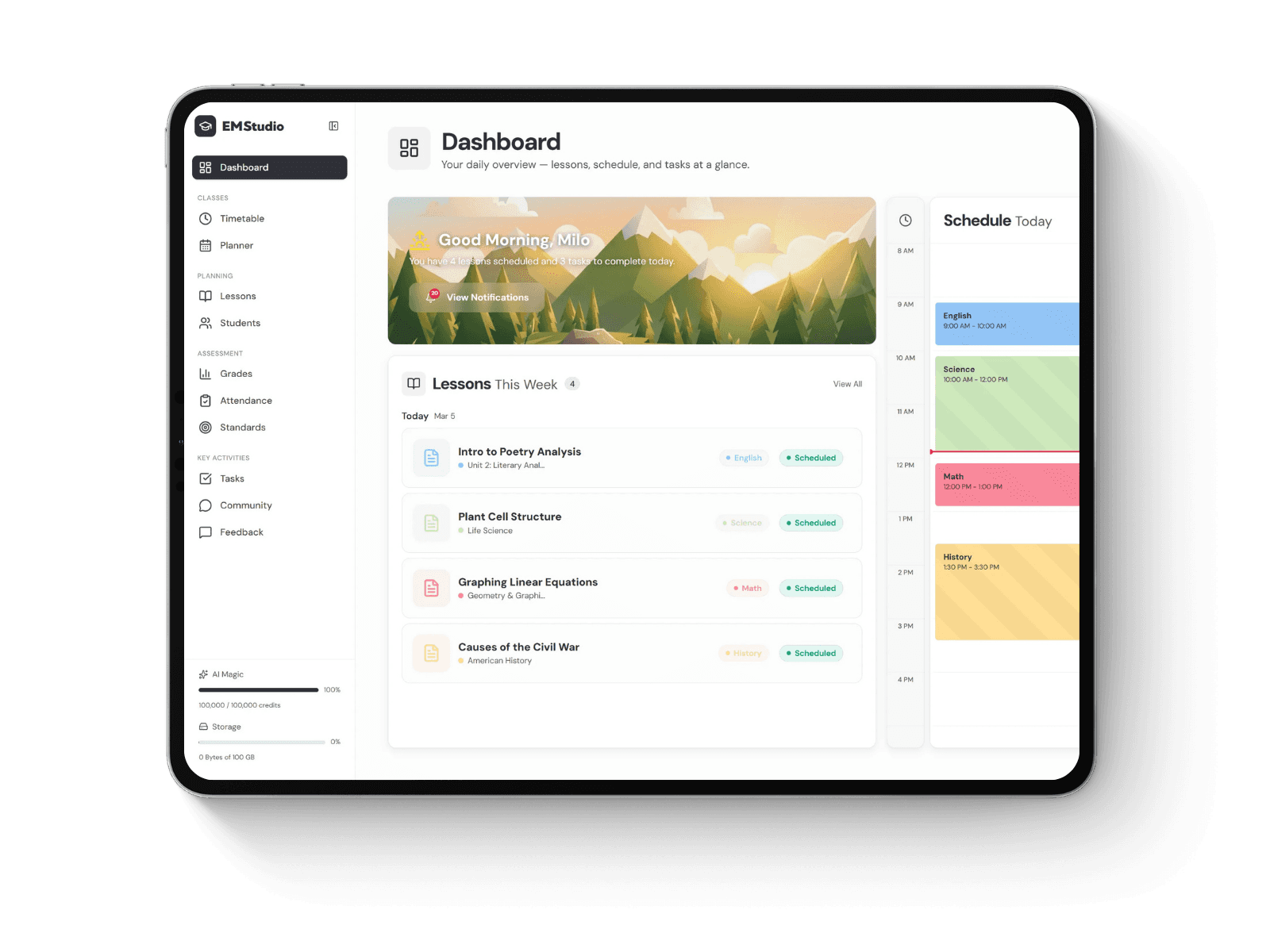
EMStudio is a free teaching management app — manage your classes, students, lessons, and more!
Learn More
Still grading everything by hand?
EMStudio is a free teaching management app — manage your classes, students, lessons, and more!
Learn More
Table of Contents
What This Template Covers
This template gives you three concrete tools. You get a reusable AI prompt library with ten core prompts, a differentiation matrix with three tiers (grade-level, one year above, one year below), and a quality assurance rubric that uses a five-point checklist. These aren't abstract frameworks. They are the exact documents I use when creating lesson plans with Notion AI.
Last October, I watched my 7th graders struggle with a density lab I wrote at midnight. The instructions were vague. The extension activities were an afterthought. I spent ninety minutes building that plan the old way. Ninety minutes of cross-referencing standards, hunting for primary sources, and guessing at differentiation. The next morning, I rebuilt the same lesson using generative AI in education. Twenty minutes total, including the ten minutes I spent reviewing the output for accuracy. The AI didn't remove my judgment. It removed the blank-page paralysis.
That efficiency gain is the entire point. Traditional ai lesson planning workflows often fail because teachers treat the AI like a replacement brain. This template treats it like a tireless intern who drafts fast but needs an editor. You will cut your planning time by seventy percent. You will not cut your standards alignment or your pedagogical voice.
You can run these prompts through ChatGPT-4 (requires a Plus subscription), Claude 3.5 Sonnet (free tier available), or MagicSchool AI (built for education, free tier allows one hundred generations monthly). Each handles prompt engineering for teachers slightly differently. ChatGPT-4 excels at creative scenarios. Claude writes cleaner rubrics. MagicSchool has built-in guardrails for student data privacy. Pick one. The template works across all three.
I built this for three specific groups. First, K-12 classroom teachers drowning in prep periods that last forty-five minutes but require sixty minutes of work. Second, instructional coaches who jump between kindergarten phonics and AP Biology in the same afternoon. Third, homeschool parents managing multi-age groups where a single read-aloud needs to stretch from ages six to fourteen. If you fit any of these, automated lesson design isn't a luxury. It is survival.
The system functions as a planning autopilot. It handles the mechanical work of curriculum mapping AI and initial instructional planning technology setup. You remain the pilot. You verify the flight path.
A reusable library of ten ChatGPT prompts for educators that generate learning objectives, assessment criteria, and activity sequences.
A three-tier differentiation matrix that modifies any lesson for grade-level, advanced, and emerging learners without rewriting the entire plan.
A five-point quality rubric to check AI outputs for bias, age-appropriateness, and standards alignment before the lesson reaches students.

Core Components of the AI Lesson Plan Template
Traditional lesson plans are static documents. You write the objective, list the materials, and hope the pacing works for everyone. An ai lesson plan treats each section as a responsive variable that adjusts to your actual students.
Traditional Component | AI-Enhanced Component |
|---|---|
Students will understand photosynthesis | Students will analyze chemical reactants using diagram analysis with 80% accuracy |
Differentiation: add a worksheet for strugglers | Three complete instructional paths with specific accommodations and extensions |
Materials list from memory | Generated inventory with safety checks and alternatives |
Assessment: chapter test on Friday | Aligned exit ticket with real-time misconception checker |
Last October, my 7th grade science class bombed a quiz because I wrote "understand cell division" in my traditional plan. That failure taught me why precision matters.
Adaptive Objective Generator replaces vague aims with measurable outcomes. The system pulls Bloom's Taxonomy action verbs—analyze, evaluate, synthesize—and attaches specific formulas. You get "Students will analyze X using Y strategy with 80% accuracy" instead of "learn about the topic." When I used the generator for that same cell division unit, it produced "students will identify the phases of mitosis using microscopic images with 80% precision." No more guesswork about whether they met the standard.
Differentiation Matrix builds three simultaneous pathways instead of afterthought modifications. Tier 1 maintains grade-level rigor with peer support protocols and structured collaboration routines. Tier 2 extends one year above grade level using complex texts and abstract reasoning tasks for early finishers. Tier 3 adjusts one year below with graphic organizers, sentence stems, and reduced text load for students needing scaffolding. The matrix populates these tiers automatically using your curriculum mapping AI data.
AI Prompt Library eliminates blank-page syndrome. This isn't generic advice cobbled from Facebook groups. You get ten specialized ChatGPT prompts for educators built for generative AI in education and instructional planning technology:
Anticipatory set generator that hooks students in ninety seconds
Vocabulary tiering for three distinct readiness levels
Exit ticket creator aligned to your daily learning target
Text set curator finding leveled articles on any topic
Engagement protocol selector matching activity to energy level
Misconception checker predicting where students will trip
Accommodation adapter modifying any task for IEP requirements
Homework differentiator assigning tiered practice automatically
Reflection question writer generating metacognitive prompts
Material list compiler checking inventory against your cabinets
Each prompt is pre-engineered with proper context windows and role assignments. You skip the prompt engineering for teachers learning curve entirely.
Quality Assurance Protocol runs a 5-point rubric before you commit to the lesson. First, standards alignment verification checks against your state framework. Second, age-appropriate vocabulary scanning uses Lexile readability metrics. Third, safety and materials feasibility flags requests for chemicals you cannot store. Fourth, cultural responsiveness audits content against your classroom demographics. Fifth, assessment validity verifies that your exit ticket actually measures the learning target. This systematic check catches embarrassing errors.
Ready to implement these components? Follow the lesson plan template setup guide for step-by-step configuration. If you want to feed existing lectures into your automated lesson design, try enhancing lesson planning with transcribed lectures to populate your lesson plan creator with content for your ai lesson plans.
Step-by-Step Setup Guide
Getting started with generative AI in education requires ten minutes of upfront configuration. Skip this setup and you'll waste hours reformatting outputs later.
Step 1: Pick Your Tool
Your choice depends on budget and tech patience. I use ChatGPT Plus when I need heavy customization—it's $20 monthly but lets me build detailed ChatGPT prompts for educators that follow my exact pacing. MagicSchool AI offers a free tier with pre-built templates; great if you want a chatgpt lesson plan alternative in thirty seconds without prompt writing. Claude Pro costs the same as ChatGPT but handles longer documents better—ideal when you're uploading entire unit maps for curriculum mapping AI or district scope-and-sequence documents.
Match the tool to your profile. Low tech comfort and zero budget? Choose MagicSchool AI free tier. It writes decent lesson plan maker outputs without prompt engineering for teachers. Moderate tech skills with $20 to spend? ChatGPT Plus wins for customization. High tech level doing heavy curriculum work? Claude Pro processes your entire quarter's pacing guide in one shot.
Step 2: Feed It Your Template
Copy this exact structure into the AI's "Custom Instructions" or "System Prompt" field: Standards, Objective, Materials, Opening [10 min], Direct Instruction [5 min], Guided Practice [10 min], Independent Practice [15 min], Closure [5 min]. This creates your automated lesson design framework. Every chatgpt lesson plan you generate will match your district's required format, saving you from copy-pasting headers every morning.
Step 3: Build Your Context Library
Upload three to five examples of your best past lessons—200 to 500 words each. I uploaded my 7th-grade cell biology unit from last October. The AI studied my formatting quirks, my tendency to front-load vocabulary, and my habit of using exit tickets for closure. This context library trains the instructional planning technology to sound like you, not a textbook. Without these samples, every output feels like it was written by a robot in a different state.
Step 4: Master the 4-Part Prompt
Never type "make a lesson about photosynthesis." Use this syntax: [Subject: 7th Grade Life Science] + [Standard: MS-LS1-2] + [Time: 45 minutes] + [Differentiation need: 3 IEPs requiring reading support].
Example: "Subject: 8th Grade US History. Standard: NCSS-Theme 2. Time: 50 minutes. Differentiation: 4 ELL students need visual supports." Specificity eliminates vague outputs. The AI returns exactly what you need instead of generic fluff.
Step 5: Verify Before You Print
Check three things. First, standard numbers—AI hallucinates CCSS codes. It might invent "7.RL.8.2" which doesn't exist. Always cross-check against official PDFs. Second, prerequisite knowledge gaps. If the AI assumes kids already know mitosis but you haven't taught it, the lesson collapses in the first five minutes. Third, material availability. The AI loves suggesting document cameras or lab kits you don't own. Keep a sticky note listing your actual tech: projector, Chromebooks, whiteboards.
When NOT to Use AI
Skip automated lesson design for three scenarios. Complex socio-emotional lessons—like processing a school tragedy or facilitating restorative justice circles—require human judgment no algorithm possesses. Culturally sensitive topics demand local knowledge about your specific community's history and values. New curriculum pilots where pedagogical intent is still evolving need your brain, not a prediction model. When the pedagogy is still shifting week to week, the AI gives you last year's wrong answer. These moments require the step-by-step guide to streamlining your planning that only you can write.

How Do You Customize This Template for Different Grade Levels?
To customize ai lesson plan templates by grade level, adjust prompt complexity and output format. Elementary needs concrete manipulatives and 15-minute blocks. Middle school requires socio-emotional hooks and collaborative protocols. High school needs inquiry-based frameworks and primary source analysis. Modify AI temperature settings—0.3 for littles, 0.7 for seniors—and specify reading Lexile ranges in every prompt.
Elementary customization starts with the concrete-pictorial-abstract progression. I tell the AI to include brain breaks every 15 minutes and list specific manipulatives—unifix cubes for math, digital base-ten blocks for remote days. Set your temperature to 0.3 for consistent, literal output. Here's the catch: AI over-intellectualizes K-2 content constantly. I add the constraint "use 2-syllable words maximum" to keep language appropriate for emerging readers.
The manipulatives list saves me during supply prep. When the AI suggests "digital fraction bars," I know exactly what tabs to open. Without that constraint, I'd get vague references to "visual aids" that collect dust in my closet.
Middle school runs on social energy. Last October, my 7th graders checked out during a lecture-heavy ecosystems unit until I required turn and talk protocols every 7-10 minutes. Now I prompt for SEL check-ins—mood meters or 60-second journaling hooks—and name specific games like Kahoot, Bumball, or Quizizz. Set temperature to 0.5 for balanced creativity that matches their chaotic brilliance.
High school customization needs intellectual rigor. I prompt for inquiry-based frameworks like the 5E Model or PBL structures. Require primary source analysis protocols and college-preparatory writing scaffolds using claim-evidence-reasoning structures. Bump the temperature to 0.7. This generates the complex, abstract thinking teenagers need for authentic engagement with content.
This temperature difference matters. At 0.3, ChatGPT plays it safe with literal instructions. At 0.7, it generates sophisticated hypotheses and counterarguments that challenge my juniors to think, not just memorize.
Watch how the same standard shifts across grades. For ecosystems, I prompt K-2: "Students draw and label producers and consumers in a forest habitat using 2-syllable words." For 6-8: "Students model and explain energy transfer through food webs, incorporating turn-and-talk protocols." For 9-12: "Students analyze and evaluate human impact on ecosystem stability using primary source data and CER writing frames."
Notice the verb shift. "Draw" needs concrete representation. "Model" requires symbolic thinking. "Analyze" asks for abstract evaluation. Match your verb to the developmental stage, and your chatgpt lesson plans actually fit the kids in front of you.
This is prompt engineering for teachers and ChatGPT prompts for educators in action. You're not asking for "a good lesson." You're specifying the cognitive load, the social structure, and the text complexity. That precision transforms generative AI in education and instructional planning technology from gimmicks into tools that respect your students' brains.
Append specific Lexile ranges to every prompt. I use BR200L-500L for K-2, 500L-950L for 3-5, 850L-1300L for 6-8, and 1100L-1600L for 9-12. This aligns text complexity with developmental readiness. These ranges support differentiated instruction strategies and help with mastering differentiated instruction for diverse learners without extra planning hours.
When I batch-create units, this approach becomes curriculum mapping AI and lesson plan ai that actually works. The Lexile constraints keep vertical alignment honest across grade levels. Automated lesson design pulls grade-level material while I sip cold coffee and actually look at my students' faces.
Best Practices for AI Lesson Planning Success
AI lesson planning saves time only if the output actually works in your room. Generated content often looks perfect on screen until you notice the math problem assumes every family owns a car or the history "fact" is completely wrong. Build these four habits into your workflow before you print a single worksheet.
Never copy-paste AI output directly into your slides.
Run content through a bias audit using CAST UDL guidelines.
Save successful prompts in a Google Sheets database.
Before finalizing any plan, run the Jimmy Test.
Watch for these five warning signs before you commit to a generated plan.
The AI suggests activities requiring materials you don't have in your closet or budget.
The assessment verb doesn't align with your objective.
Time allocations sum to more than your class period.
Cultural examples rely on stereotypes, not authentic representation.
The plan lacks accommodations for IEP or 504 needs, even when specified clearly in your prompt.
When evaluating the best AI tools for teachers, workflow discipline beats fancy features. These practices align with the planning habits of highly effective educators: build systems first, then optimize.

Launching Your AI Lesson Plan System
Start small. You don't need to overhaul your entire curriculum mapping AI process on Monday morning. Pick one tool, one template, and one low-stakes lesson to test your ai lesson plan workflow. You can always scale up once the pilot proves itself in your actual classroom.
Spend Day 1 and 2 setting up your ai lesson planner and customizing your prompt templates with your actual bell schedule and classroom norms baked right in. Days 3 and 4, pilot exactly one lesson—maybe a Tuesday warm-up or a Friday exit ticket. Not the whole unit. On Day 5, spend ten minutes with a reflection journal. Note what felt natural and what sounded like a robot wrote it while you watched the clock.
Find your AI Buddy. Identify one colleague in your department or PLC who is also experimenting with generative AI in education. When your ChatGPT prompts for educators return nonsense or off-topic examples, text them immediately. Build a shared drive folder for successful prompts so your whole team benefits from each other's prompt engineering for teachers breakthroughs. Collective efficacy beats working in isolation every single time.
Track your wins with cold, hard data. Use a simple timer app to log your planning time; aim for a 60 percent reduction by week four. Measure student engagement during automated lesson design hooks by counting hands or active responses—shoot for 85 percent participation. Last October, I tried an AI-generated opening hook about zombie economics with my 11th graders. Seventeen of twenty hands shot up immediately. That metric told me the tool was worth the learning curve, even when the tech felt clunky.
When outputs feel generic—like they could work for any subject—add specificity. Insert student personas ("My class has twelve ELLs and loves basketball") or demand textbook alignment ("Write this specifically for Earth Science Chapter 3"). This constraint transforms bland into targeted. Specificity is the difference between busywork and actual learning.
Schedule thirty minutes at month-end to review your instructional planning technology tools and curate your prompt library. Archive the duds that generated mediocre activities or off-target vocabulary. Refine the winners by adding tighter constraints based on what you observed in class. Add new prompts based on seasonal topics or shifting standards before your next curriculum mapping AI session begins. This keeps your ai lesson plan system sharp and relevant.
As you integrate EdTech seamlessly into your lesson plans, remember that speed means nothing without quality. Review our complete educational technology integration guide to ensure your new workflow actually serves your students, not just your schedule. The goal is better teaching, not just faster planning for its own sake.

What's Next for Ai Lesson Plan
You have the template. You have the prompts. Now the real work starts. I’ve watched too many teachers download a tool, get excited for a week, then slide back to old habits when the grading piles up. Pick one unit next month. Use the template for every lesson in that unit. See what happens when you’re not starting from a blank page every Sunday night.
Generative AI in education is moving fast. The models get smarter every semester, but the fundamentals stay the same: clear objectives, good questions, and knowing your kids. Prompt engineering for teachers won’t be a special skill for long. It’ll be like knowing how to use a search engine. The teachers who stay ahead are the ones who treat automated lesson design as a starting point, not a replacement for their judgment.
Keep tweaking your template. Share what works with your team. The technology will change, but the need for solid instructional planning technology won’t. Stay curious. Stay skeptical. Keep teaching.

What This Template Covers
This template gives you three concrete tools. You get a reusable AI prompt library with ten core prompts, a differentiation matrix with three tiers (grade-level, one year above, one year below), and a quality assurance rubric that uses a five-point checklist. These aren't abstract frameworks. They are the exact documents I use when creating lesson plans with Notion AI.
Last October, I watched my 7th graders struggle with a density lab I wrote at midnight. The instructions were vague. The extension activities were an afterthought. I spent ninety minutes building that plan the old way. Ninety minutes of cross-referencing standards, hunting for primary sources, and guessing at differentiation. The next morning, I rebuilt the same lesson using generative AI in education. Twenty minutes total, including the ten minutes I spent reviewing the output for accuracy. The AI didn't remove my judgment. It removed the blank-page paralysis.
That efficiency gain is the entire point. Traditional ai lesson planning workflows often fail because teachers treat the AI like a replacement brain. This template treats it like a tireless intern who drafts fast but needs an editor. You will cut your planning time by seventy percent. You will not cut your standards alignment or your pedagogical voice.
You can run these prompts through ChatGPT-4 (requires a Plus subscription), Claude 3.5 Sonnet (free tier available), or MagicSchool AI (built for education, free tier allows one hundred generations monthly). Each handles prompt engineering for teachers slightly differently. ChatGPT-4 excels at creative scenarios. Claude writes cleaner rubrics. MagicSchool has built-in guardrails for student data privacy. Pick one. The template works across all three.
I built this for three specific groups. First, K-12 classroom teachers drowning in prep periods that last forty-five minutes but require sixty minutes of work. Second, instructional coaches who jump between kindergarten phonics and AP Biology in the same afternoon. Third, homeschool parents managing multi-age groups where a single read-aloud needs to stretch from ages six to fourteen. If you fit any of these, automated lesson design isn't a luxury. It is survival.
The system functions as a planning autopilot. It handles the mechanical work of curriculum mapping AI and initial instructional planning technology setup. You remain the pilot. You verify the flight path.
A reusable library of ten ChatGPT prompts for educators that generate learning objectives, assessment criteria, and activity sequences.
A three-tier differentiation matrix that modifies any lesson for grade-level, advanced, and emerging learners without rewriting the entire plan.
A five-point quality rubric to check AI outputs for bias, age-appropriateness, and standards alignment before the lesson reaches students.
Core Components of the AI Lesson Plan Template
Traditional lesson plans are static documents. You write the objective, list the materials, and hope the pacing works for everyone. An ai lesson plan treats each section as a responsive variable that adjusts to your actual students.
Traditional Component | AI-Enhanced Component |
|---|---|
Students will understand photosynthesis | Students will analyze chemical reactants using diagram analysis with 80% accuracy |
Differentiation: add a worksheet for strugglers | Three complete instructional paths with specific accommodations and extensions |
Materials list from memory | Generated inventory with safety checks and alternatives |
Assessment: chapter test on Friday | Aligned exit ticket with real-time misconception checker |
Last October, my 7th grade science class bombed a quiz because I wrote "understand cell division" in my traditional plan. That failure taught me why precision matters.
Adaptive Objective Generator replaces vague aims with measurable outcomes. The system pulls Bloom's Taxonomy action verbs—analyze, evaluate, synthesize—and attaches specific formulas. You get "Students will analyze X using Y strategy with 80% accuracy" instead of "learn about the topic." When I used the generator for that same cell division unit, it produced "students will identify the phases of mitosis using microscopic images with 80% precision." No more guesswork about whether they met the standard.
Differentiation Matrix builds three simultaneous pathways instead of afterthought modifications. Tier 1 maintains grade-level rigor with peer support protocols and structured collaboration routines. Tier 2 extends one year above grade level using complex texts and abstract reasoning tasks for early finishers. Tier 3 adjusts one year below with graphic organizers, sentence stems, and reduced text load for students needing scaffolding. The matrix populates these tiers automatically using your curriculum mapping AI data.
AI Prompt Library eliminates blank-page syndrome. This isn't generic advice cobbled from Facebook groups. You get ten specialized ChatGPT prompts for educators built for generative AI in education and instructional planning technology:
Anticipatory set generator that hooks students in ninety seconds
Vocabulary tiering for three distinct readiness levels
Exit ticket creator aligned to your daily learning target
Text set curator finding leveled articles on any topic
Engagement protocol selector matching activity to energy level
Misconception checker predicting where students will trip
Accommodation adapter modifying any task for IEP requirements
Homework differentiator assigning tiered practice automatically
Reflection question writer generating metacognitive prompts
Material list compiler checking inventory against your cabinets
Each prompt is pre-engineered with proper context windows and role assignments. You skip the prompt engineering for teachers learning curve entirely.
Quality Assurance Protocol runs a 5-point rubric before you commit to the lesson. First, standards alignment verification checks against your state framework. Second, age-appropriate vocabulary scanning uses Lexile readability metrics. Third, safety and materials feasibility flags requests for chemicals you cannot store. Fourth, cultural responsiveness audits content against your classroom demographics. Fifth, assessment validity verifies that your exit ticket actually measures the learning target. This systematic check catches embarrassing errors.
Ready to implement these components? Follow the lesson plan template setup guide for step-by-step configuration. If you want to feed existing lectures into your automated lesson design, try enhancing lesson planning with transcribed lectures to populate your lesson plan creator with content for your ai lesson plans.
Step-by-Step Setup Guide
Getting started with generative AI in education requires ten minutes of upfront configuration. Skip this setup and you'll waste hours reformatting outputs later.
Step 1: Pick Your Tool
Your choice depends on budget and tech patience. I use ChatGPT Plus when I need heavy customization—it's $20 monthly but lets me build detailed ChatGPT prompts for educators that follow my exact pacing. MagicSchool AI offers a free tier with pre-built templates; great if you want a chatgpt lesson plan alternative in thirty seconds without prompt writing. Claude Pro costs the same as ChatGPT but handles longer documents better—ideal when you're uploading entire unit maps for curriculum mapping AI or district scope-and-sequence documents.
Match the tool to your profile. Low tech comfort and zero budget? Choose MagicSchool AI free tier. It writes decent lesson plan maker outputs without prompt engineering for teachers. Moderate tech skills with $20 to spend? ChatGPT Plus wins for customization. High tech level doing heavy curriculum work? Claude Pro processes your entire quarter's pacing guide in one shot.
Step 2: Feed It Your Template
Copy this exact structure into the AI's "Custom Instructions" or "System Prompt" field: Standards, Objective, Materials, Opening [10 min], Direct Instruction [5 min], Guided Practice [10 min], Independent Practice [15 min], Closure [5 min]. This creates your automated lesson design framework. Every chatgpt lesson plan you generate will match your district's required format, saving you from copy-pasting headers every morning.
Step 3: Build Your Context Library
Upload three to five examples of your best past lessons—200 to 500 words each. I uploaded my 7th-grade cell biology unit from last October. The AI studied my formatting quirks, my tendency to front-load vocabulary, and my habit of using exit tickets for closure. This context library trains the instructional planning technology to sound like you, not a textbook. Without these samples, every output feels like it was written by a robot in a different state.
Step 4: Master the 4-Part Prompt
Never type "make a lesson about photosynthesis." Use this syntax: [Subject: 7th Grade Life Science] + [Standard: MS-LS1-2] + [Time: 45 minutes] + [Differentiation need: 3 IEPs requiring reading support].
Example: "Subject: 8th Grade US History. Standard: NCSS-Theme 2. Time: 50 minutes. Differentiation: 4 ELL students need visual supports." Specificity eliminates vague outputs. The AI returns exactly what you need instead of generic fluff.
Step 5: Verify Before You Print
Check three things. First, standard numbers—AI hallucinates CCSS codes. It might invent "7.RL.8.2" which doesn't exist. Always cross-check against official PDFs. Second, prerequisite knowledge gaps. If the AI assumes kids already know mitosis but you haven't taught it, the lesson collapses in the first five minutes. Third, material availability. The AI loves suggesting document cameras or lab kits you don't own. Keep a sticky note listing your actual tech: projector, Chromebooks, whiteboards.
When NOT to Use AI
Skip automated lesson design for three scenarios. Complex socio-emotional lessons—like processing a school tragedy or facilitating restorative justice circles—require human judgment no algorithm possesses. Culturally sensitive topics demand local knowledge about your specific community's history and values. New curriculum pilots where pedagogical intent is still evolving need your brain, not a prediction model. When the pedagogy is still shifting week to week, the AI gives you last year's wrong answer. These moments require the step-by-step guide to streamlining your planning that only you can write.
How Do You Customize This Template for Different Grade Levels?
To customize ai lesson plan templates by grade level, adjust prompt complexity and output format. Elementary needs concrete manipulatives and 15-minute blocks. Middle school requires socio-emotional hooks and collaborative protocols. High school needs inquiry-based frameworks and primary source analysis. Modify AI temperature settings—0.3 for littles, 0.7 for seniors—and specify reading Lexile ranges in every prompt.
Elementary customization starts with the concrete-pictorial-abstract progression. I tell the AI to include brain breaks every 15 minutes and list specific manipulatives—unifix cubes for math, digital base-ten blocks for remote days. Set your temperature to 0.3 for consistent, literal output. Here's the catch: AI over-intellectualizes K-2 content constantly. I add the constraint "use 2-syllable words maximum" to keep language appropriate for emerging readers.
The manipulatives list saves me during supply prep. When the AI suggests "digital fraction bars," I know exactly what tabs to open. Without that constraint, I'd get vague references to "visual aids" that collect dust in my closet.
Middle school runs on social energy. Last October, my 7th graders checked out during a lecture-heavy ecosystems unit until I required turn and talk protocols every 7-10 minutes. Now I prompt for SEL check-ins—mood meters or 60-second journaling hooks—and name specific games like Kahoot, Bumball, or Quizizz. Set temperature to 0.5 for balanced creativity that matches their chaotic brilliance.
High school customization needs intellectual rigor. I prompt for inquiry-based frameworks like the 5E Model or PBL structures. Require primary source analysis protocols and college-preparatory writing scaffolds using claim-evidence-reasoning structures. Bump the temperature to 0.7. This generates the complex, abstract thinking teenagers need for authentic engagement with content.
This temperature difference matters. At 0.3, ChatGPT plays it safe with literal instructions. At 0.7, it generates sophisticated hypotheses and counterarguments that challenge my juniors to think, not just memorize.
Watch how the same standard shifts across grades. For ecosystems, I prompt K-2: "Students draw and label producers and consumers in a forest habitat using 2-syllable words." For 6-8: "Students model and explain energy transfer through food webs, incorporating turn-and-talk protocols." For 9-12: "Students analyze and evaluate human impact on ecosystem stability using primary source data and CER writing frames."
Notice the verb shift. "Draw" needs concrete representation. "Model" requires symbolic thinking. "Analyze" asks for abstract evaluation. Match your verb to the developmental stage, and your chatgpt lesson plans actually fit the kids in front of you.
This is prompt engineering for teachers and ChatGPT prompts for educators in action. You're not asking for "a good lesson." You're specifying the cognitive load, the social structure, and the text complexity. That precision transforms generative AI in education and instructional planning technology from gimmicks into tools that respect your students' brains.
Append specific Lexile ranges to every prompt. I use BR200L-500L for K-2, 500L-950L for 3-5, 850L-1300L for 6-8, and 1100L-1600L for 9-12. This aligns text complexity with developmental readiness. These ranges support differentiated instruction strategies and help with mastering differentiated instruction for diverse learners without extra planning hours.
When I batch-create units, this approach becomes curriculum mapping AI and lesson plan ai that actually works. The Lexile constraints keep vertical alignment honest across grade levels. Automated lesson design pulls grade-level material while I sip cold coffee and actually look at my students' faces.
Best Practices for AI Lesson Planning Success
AI lesson planning saves time only if the output actually works in your room. Generated content often looks perfect on screen until you notice the math problem assumes every family owns a car or the history "fact" is completely wrong. Build these four habits into your workflow before you print a single worksheet.
Never copy-paste AI output directly into your slides.
Run content through a bias audit using CAST UDL guidelines.
Save successful prompts in a Google Sheets database.
Before finalizing any plan, run the Jimmy Test.
Watch for these five warning signs before you commit to a generated plan.
The AI suggests activities requiring materials you don't have in your closet or budget.
The assessment verb doesn't align with your objective.
Time allocations sum to more than your class period.
Cultural examples rely on stereotypes, not authentic representation.
The plan lacks accommodations for IEP or 504 needs, even when specified clearly in your prompt.
When evaluating the best AI tools for teachers, workflow discipline beats fancy features. These practices align with the planning habits of highly effective educators: build systems first, then optimize.
Launching Your AI Lesson Plan System
Start small. You don't need to overhaul your entire curriculum mapping AI process on Monday morning. Pick one tool, one template, and one low-stakes lesson to test your ai lesson plan workflow. You can always scale up once the pilot proves itself in your actual classroom.
Spend Day 1 and 2 setting up your ai lesson planner and customizing your prompt templates with your actual bell schedule and classroom norms baked right in. Days 3 and 4, pilot exactly one lesson—maybe a Tuesday warm-up or a Friday exit ticket. Not the whole unit. On Day 5, spend ten minutes with a reflection journal. Note what felt natural and what sounded like a robot wrote it while you watched the clock.
Find your AI Buddy. Identify one colleague in your department or PLC who is also experimenting with generative AI in education. When your ChatGPT prompts for educators return nonsense or off-topic examples, text them immediately. Build a shared drive folder for successful prompts so your whole team benefits from each other's prompt engineering for teachers breakthroughs. Collective efficacy beats working in isolation every single time.
Track your wins with cold, hard data. Use a simple timer app to log your planning time; aim for a 60 percent reduction by week four. Measure student engagement during automated lesson design hooks by counting hands or active responses—shoot for 85 percent participation. Last October, I tried an AI-generated opening hook about zombie economics with my 11th graders. Seventeen of twenty hands shot up immediately. That metric told me the tool was worth the learning curve, even when the tech felt clunky.
When outputs feel generic—like they could work for any subject—add specificity. Insert student personas ("My class has twelve ELLs and loves basketball") or demand textbook alignment ("Write this specifically for Earth Science Chapter 3"). This constraint transforms bland into targeted. Specificity is the difference between busywork and actual learning.
Schedule thirty minutes at month-end to review your instructional planning technology tools and curate your prompt library. Archive the duds that generated mediocre activities or off-target vocabulary. Refine the winners by adding tighter constraints based on what you observed in class. Add new prompts based on seasonal topics or shifting standards before your next curriculum mapping AI session begins. This keeps your ai lesson plan system sharp and relevant.
As you integrate EdTech seamlessly into your lesson plans, remember that speed means nothing without quality. Review our complete educational technology integration guide to ensure your new workflow actually serves your students, not just your schedule. The goal is better teaching, not just faster planning for its own sake.
What's Next for Ai Lesson Plan
You have the template. You have the prompts. Now the real work starts. I’ve watched too many teachers download a tool, get excited for a week, then slide back to old habits when the grading piles up. Pick one unit next month. Use the template for every lesson in that unit. See what happens when you’re not starting from a blank page every Sunday night.
Generative AI in education is moving fast. The models get smarter every semester, but the fundamentals stay the same: clear objectives, good questions, and knowing your kids. Prompt engineering for teachers won’t be a special skill for long. It’ll be like knowing how to use a search engine. The teachers who stay ahead are the ones who treat automated lesson design as a starting point, not a replacement for their judgment.
Keep tweaking your template. Share what works with your team. The technology will change, but the need for solid instructional planning technology won’t. Stay curious. Stay skeptical. Keep teaching.
Still grading everything by hand?
EMStudio is a free teaching management app — manage your classes, students, lessons, and more!
Learn More
Still grading everything by hand?
EMStudio is a free teaching management app — manage your classes, students, lessons, and more!
Learn More



Notion4Teachers
Notion templates to simplify administrative tasks and enhance your teaching experience.



2026 Notion4Teachers. All Rights Reserved.
Notion4Teachers
Notion templates to simplify administrative tasks and enhance your teaching experience.
2026 Notion4Teachers. All Rights Reserved.
Notion4Teachers
Notion templates to simplify administrative tasks and enhance your teaching experience.
2026 Notion4Teachers. All Rights Reserved.