
15 Teacher Apps That Transform K-12 Classrooms
15 Teacher Apps That Transform K-12 Classrooms

Article by
Milo
ESL Content Coordinator & Educator
ESL Content Coordinator & Educator
All Posts
Most teacher apps are digital junk drawers. We download them hoping they'll fix our workflow, then abandon them by October when the novelty wears off. I've wasted more prep periods testing "game-changing" tools than I care to admit.
The few that stick actually earn their spot on my home screen. They don't promise to revolutionize education or use buzzwords like "transformative learning." They just cut my grading time in half or keep 3rd graders from losing their minds during indoor recess.
This list cuts the noise. These fifteen tools survived real classroom use—mine and my colleagues'—through spotty wifi and standardized testing weeks. No fluff, just what works when the copier jams and you need backup.
Still grading everything by hand?
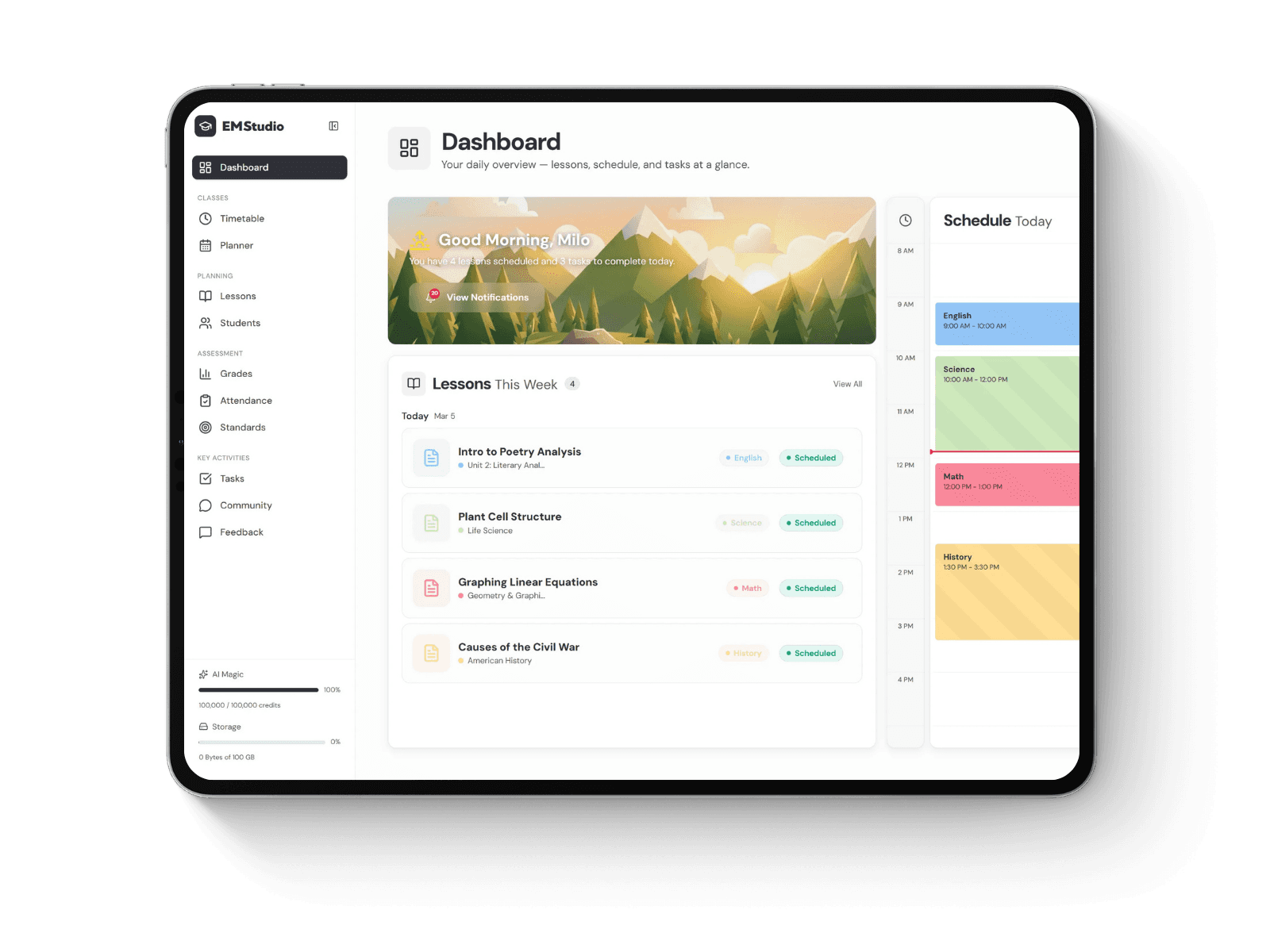
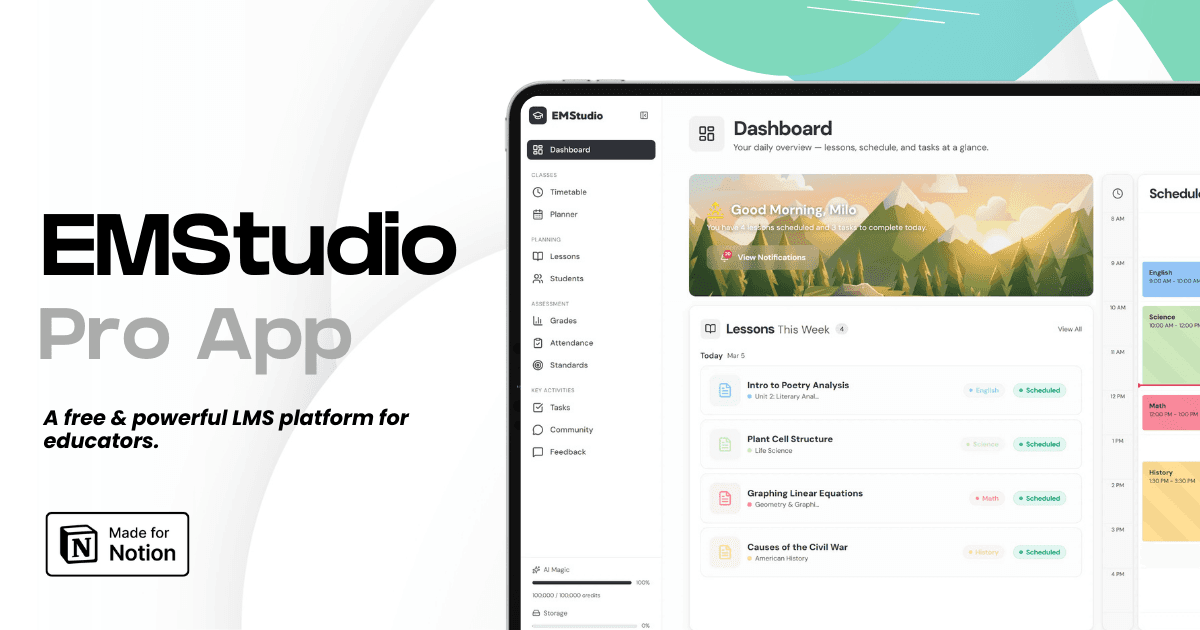
EMStudio is a free teaching management app — manage your classes, students, lessons, and more!
Learn More
Still grading everything by hand?
EMStudio is a free teaching management app — manage your classes, students, lessons, and more!
Learn More
Table of Contents
What Are the Best Classroom Management Apps?
The best classroom management apps include ClassDojo for K-5 behavior tracking with positive reinforcement points, Nearpod for real-time lesson monitoring across devices, and Google Classroom for assignment workflow organization. These tools reduce transition time, provide immediate behavior feedback, and centralize digital resources while supporting consistent classroom expectations. For a deeper dive into AI-powered solutions, check out our comprehensive AI Tools for Teachers guide at lmspedia.org.
Teachers lose significant instructional time to transitions and behavior interruptions. Hattie's Visible Learning shows classroom management carries an effect size of 0.52 on student achievement. Smart educational technology cuts those losses immediately.
App | Best Grade Range | Primary Function | Setup Time | Cost |
|---|---|---|---|---|
ClassDojo | K-2 | Behavior | 5 min | Free/Premium |
Nearpod | 3-8 | Lesson control | 20 min | Free/Premium |
Google Classroom | 6-12 | Workflow | 15 min | Free/Paid tiers |
Watch the failure modes. ClassDojo's extrinsic rewards lose efficacy for high schoolers per Self-Determination Theory. Google Classroom requires reliable broadband—no offline mode. Nearpod demands 1:1 devices; avoid it if you're sharing 5 iPads among 30 students.
Choose based on your chaos. Managing 25+ high-energy elementary students? Go with ClassDojo and a digital behavior tracking sheet. Running secondary stations? Nearpod controls the flow. If paperless collection is your headache, implement Google Classroom for your learning management system needs.
ClassDojo for Behavior Tracking and Positive Reinforcement
The Dojo points system runs on instant feedback. You tap +1 for "Helping Others" or -1 for "Off Task" while students watch their monster avatars on the projected dashboard. I used this with 2nd graders during centers, and the visual tracking cut transition time by half. Teachers can also use Custom Recognition Pins to celebrate students who consistently demonstrate helpfulness, focus, or positive classroom habits.
Setup takes five minutes using a Google account. The free tier includes two classes of 35 students, behavior tracking, and parent messaging. ClassDojo Plus costs $8 per student yearly (or $59.99 for individual teachers) and adds student portfolios, school-wide stories, and SEL content.
For K-2, display QR login codes so students scan with tablets. Parent onboarding requires email or SMS invitation—expect 85% acceptance in Title I schools when you send translated welcome videos.
Nearpod for Real-Time Student Monitoring
Nearpod operates in two modes. Live Lesson lets you control slide advancement while viewing real-time student responses on your dashboard. Student-Paced mode supports asynchronous learning and differentiated instruction for absent kids or rotating centers.
Device requirements are strict. Students need individual Chromebooks, iPads, or smartphones. Shared devices work but force logout/login between users. VR features demand 2 Mbps internet per device.
Upload existing PowerPoint or Google Slides, then drag-and-drop interactive elements like Draw It, Polls, Quizzes, or VR Field Trips. The premade library contains 15,000+ standards-aligned lessons searchable by CCSS or NGSS codes for formative assessment.
Google Classroom for Assignment Workflow and Organization
Google Classroom handles the paper chase, anchoring your digital learning tools in one place. Create an assignment, attach Google Docs with "Make a copy for each student," and watch Drive folders organize themselves automatically. Grades pass back to PowerSchool or Infinite Campus via OneRoster integration.
It runs on Google Workspace for Education Fundamentals (free) or Plus ($50 per student yearly). Fundamentals includes Classroom, Drive, and Docs. Plus adds Meet recordings, practice sets, and enhanced security features.
Know the limits before you commit. No built-in gradebook calculations—export to Google Sheets for averaging. The rubric tool supports 10 criteria maximum. Assignment organization follows strict chronology; you get no unit folder view without rigorous naming conventions. Pair it with effective classroom management strategies to maximize the workflow gains.
Which Interactive Apps Engage Students Most?
Interactive apps that engage students most include Kahoot for competitive gamified quizzes supporting up to 2000 players, Padlet for collaborative visual brainstorming with 6 board formats, and Flipgrid for asynchronous video discussions with auto-captioning. These tools leverage Hattie's research showing classroom discussion has an effect size of 0.82 on achievement.
Hattie's research changed how I pick teacher apps. Classroom discussion scores 0.82 for impact; feedback hits 0.70. These interactive apps for teachers operationalize those strategies at scale, turning passive consumption into active participation.
Kahoot brings high energy but penalizes anxious kids who freeze under the countdown. Padlet organizes thinking visually yet needs moderation. Flipgrid builds speaking skills, though some panic at the camera. Each digital learning tool demands trade-offs.
Don't use Kahoot for high-stakes tests. The five-second timer creates stereotype threat for students with processing delays. I've seen 504 students shut down during "fun" reviews. Padlet requires COPPA compliance for under-13 users.
Introduce one app per quarter. Start with Kahoot for low-stakes Friday review using classroom gamification methods, then Padlet for brainstorming, and Flipgrid for book talks. Train digital citizenship protocols before unlocking features.
Kahoot for Gamified Quizzes and Friendly Competition
I run Classic mode for individuals, Team mode for groups, or Ghost mode against previous scores. Free accounts cap at 100 players; paid handles 2000. Team mode reduces anxiety while maintaining engagement.
Use Puzzle for sequencing, Slider for math, Type Answer for spelling, and Drop Pin for geography. "Blind Kahoot" introduces new concepts through guided questions. Export the spreadsheet to see which questions caused confusion.
Space sessions 48-72 hours apart. Daily use kills novelty. I schedule Tuesdays and Thursdays, never Mondays. This rhythm keeps educational technology feeling special.
Padlet for Collaborative Brainstorming Boards
Wall works for freeform brainstorming, Shelf organizes categories, Stream creates timelines, Grid suits math arrays, Map pins literature settings, and Canvas displays images. I used Map with 7th graders tracking The Giver characters.
Enable Moderation—posts hit your inbox before going public. Set keyword filters and disable comments. Free accounts limit you to 3 padlets; Teacher Pro gives unlimited boards for differentiated instruction.
Padlet works for grades 3-12. K-2 needs heavy scaffolding. The interface supports screen readers and 30+ languages, more accessible than most learning management system tools for ELL students.
Flipgrid for Asynchronous Video Discussions
Set recording limits from 15 seconds to 10 minutes. Students use whiteboard overlays for math or AR filters. Microsoft Immersive Reader reads prompts aloud. This asynchronous learning extends discussion beyond the bell.
Threading happens through video replies. Students respond to peers with clips. Guest mode lets experts join without accounts. I use these innovative tools to engage and inspire shy students who won't raise hands.
Kahoot brings high energy but penalizes anxious kids who freeze under the countdown. Padlet organizes thinking visually yet needs moderation. Flipgrid builds speaking skills, though some panic at the camera. AhaSlides for unscored brainstorming, word clouds, and idea boards that gather thinking rather than test it. Each digital learning tool demands trade-offs.
AhaSlides for Ungraded Brainstorming and Idea Gathering
Some of what you need from a class has no right answer. AhaSlides runs word clouds, open-ended responses, rating scales, ranking, Q&A, and a brainstorm board where students post ideas and upvote each other's, all unscored and all sitting in the same deck as your regular slides. Students join with a code on any device, no app and no account needed.
I use the brainstorm board for pre-writing. Students post thesis angles anonymously, the class upvotes, and the top three become the mini-lesson. A rating scale before a unit test surfaces who is bluffing about being ready. Anonymous mode is what makes both work with juniors and seniors who will not risk looking uncertain in front of peers. Add a quiz slide when you do want scores and a leaderboard.

What Assessment Tools Save Teachers the Most Time?
Assessment tools saving teachers the most time include Gradescope for AI-assisted STEM grading with dynamic rubrics, Formative for live feedback with auto-scoring capabilities, and Edpuzzle for embedded video comprehension checks. These apps reduce objective-item grading time by 50-70% while providing immediate data for instructional adjustments.
Teachers spend approximately 31% of professional time on assessment-related tasks. These teacher apps reclaim those hours without cutting feedback quality.
Choose based on your content. Grading handwritten STEM work with equations? Use Gradescope. Checking understanding mid-lesson for instant reteaching? Use Formative. Verifying video comprehension? Use Edpuzzle.
Gradescope for AI-Assisted Grading and Rubrics
Gradescope's bubble sheet scanning processes 250 sheets in 10 minutes with 99% accuracy. Dynamic rubrics let you change point values retroactively across all submissions. However, the AI fails on cursive handwriting or non-standard equation notation, requiring manual verification.
The free tier covers unlimited students with basic AI grading. Institution licenses ($10-15/student/year) add plagiarism detection, LMS grade passback, and group assignment features. Use the 'Rubric Builder' with 0-4 point scales aligned to state rubrics, and assign 'Grading Groups' so co-teachers or TAs split the workload while Gradescope reconciles inter-rater reliability.
Formative for Live Feedback and Auto-Scoring
I watched my 7th graders work through proportions on Formative last October. Their scratchwork populated in real-time as they drew models. Green circles indicated correct answers instantly while red circles flagged the three kids who needed immediate intervention before they solidified misconceptions.
Auto-scoring only works with multiple choice, numeric, and short answer with exact match. Open responses need manual grading despite AI-generated feedback suggestions. Tag responses with RTI intervention codes and export to Google Sheets. Research shows teachers using this live-view format correct errors three times faster than with traditional exit tickets or static formative assessment examples for immediate use.
Edpuzzle for Interactive Video-Based Checks
Trim YouTube, Khan Academy, or uploaded videos and insert multiple choice or open-ended questions at specific timestamps. The 'Notes' feature forces students to pause and summarize before continuing. Auto-generated captions support 30+ languages with adjustable playback speed from 0.5x to 2x for accessibility.
The analytics dashboard tracks completion percentage, number of re-watches per segment, and question accuracy rates. However, it cannot verify actual watching without embedded questions every 30-45 seconds. The free tier limits you to 20 videos; Pro costs $12 monthly for unlimited videos and screen recording features.
These apps store sensitive academic data. Verify vendors sign state-specific NDPA agreements and comply with FERPA before uploading IEP data or 504 plans. Your digital tools for practice tests must protect student privacy as rigorously as they perform.

Communication Apps That Connect School and Home
Consistent parent communication correlates with 40% higher homework completion rates. I've watched this in my 7th grade classroom—when parents know what's due, kids turn it in. Among teacher apps for family contact, Remind works best for quick text-like alerts. Seesaw wins for portfolio visibility. Bloomz handles scheduling.
All three offer free tiers sufficient for most teachers. Remind Premium costs $10 monthly for voice calling. Seesaw for Schools runs $12 per student yearly with admin analytics. Bloomz Premium is $9.99 monthly and includes volunteer background checks.
Each has failure modes. Remind's 140-character limit frustrates detailed explanations—use it for announcements, not IEP discussions. Seesaw requires parent email access and fails without phone support in low-literacy communities. Bloomz stores volunteer SSNs for background checks—verify district data retention policies.
Check for Clever or ClassLink rostering to avoid manual CSV uploads. For more on reaching families, see our parent communication strategies for modern teachers.
Remind for Instant Two-Way Messaging and Announcements
Remind offers one-way announcements or two-way messaging. You're capped at 140 characters per message with translation to 90+ languages. Parents hit 'stamp' reactions—checkmarks, X's, or stars—to acknowledge without typing.
Phone numbers stay hidden. I see "Mom of Sarah" instead of digits, protecting everyone during custody disputes. Export full message history for compliance if administration requests records.
Attach PDFs, images, or voice clips up to 10MB. I schedule messages for 7:30 AM delivery instead of midnight, and timezone auto-detection handles my military families overseas.
Seesaw for Digital Student Portfolios and Family Updates
Seesaw organizes learning into Journal view—chronological work samples—and Skills view organized by standards mastery. Family members access via individual secure logins with no peeking at other students' work.
The activity library holds 10,000+ vetted activities searchable by standard code like 4.NF.B.3. I differentiate by assigning specific activities to specific students without broadcasting modifications to the class. For guidance, read our post on creating effective student portfolios.
Students upload photos, videos, drawings, or voice recordings. I approve items before they hit family feeds to catch privacy violations like classmates in photo backgrounds.
Bloomz for Conference Scheduling and Volunteer Coordination
Bloomz automates logistics that eat my planning periods. Parents book conference slots with calendar sync for Google, Outlook, or Apple. Timezone conversion handles military families. The 24-hour reminder emails cut my no-shows by about 60%.
Volunteer coordination lets me create sign-up lists for chaperones or supplies. I set maximum slots like "4 drivers needed" and the waitlist manages itself.
Behavior transparency shows real-time logs with color-coded statuses. I attach photo documentation to incident reports and keep private notes visible only to parents, not other staff.
Lesson Planning Apps for Streamlined Curriculum Prep
Standards-aligned instruction shows an effect size of 0.59 in Hattie's research. These teacher apps and learning apps for teachers operationalize that alignment without the Sunday-night spreadsheet cross-referencing. Teachers using these digital learning tools save three to four hours weekly compared to paper planners—no more copying forward lessons or hunting for standards codes. That's time you can spend on actual differentiated instruction instead of wrestling with outdated educational technology.
Planboard for Standards-Aligned Digital Planning
Planboard comes pre-loaded with CCSS Math and ELA, NGSS Science, C3 Social Studies, and all fifty state standards. You drag and drop standards onto your digital lesson plan template, then generate Coverage Reports that flag which standards you haven't touched in three weeks.
I spent three hours in August learning the rotation setup for our A/B block schedule, but now it handles our 6-day cycle and 2-hour delays automatically. The substitute view hides student IEP details while showing the actual lesson.
Share plans with your PLC to comment and suggest edits, or view vertical alignment across grade levels to prevent gaps—like ensuring your 4th grade fractions unit connects to 5th grade expectations.
CommonLit for Differentiated Text Resources
CommonLit offers texts from 400L to 1300L Lexile with Guided Reading Mode that chunks text for struggling readers. Each piece includes five to eight standards-aligned questions functioning as formative assessment, with Part A/Part B evidence pairs and tech-enhanced drag-and-drop sequencing.
The Related Media videos build background knowledge for ELLs, and the Spanish library holds 800+ translated texts. You can filter by literary devices like irony or metaphor for focused mini-lessons.
Avoid assigning texts below 400L without read-aloud support; the platform assumes reading stamina that younger learners haven't built yet. Last October, my 7th graders annotated "The Lottery" simultaneously while I monitored their evidence highlighting in real time.
Canva for Education for Visual Materials and Templates
Canva's education templates require specific dimensions: use 8.5 by 11 inches for worksheets, 16:9 for presentations, and 24 by 36 inches for anchor charts. For faster slide creation, incorporating DecksyAI presentation templates provides structured layouts that fit seamlessly into these standard dimensions. Download as PPTX, PDF Print for high resolution, PNG for embedding in Google Slides, or MP4 for animated presentations.
The Magic Resize tool converts my Instagram posts into parent newsletter headers automatically. With one million copyright-cleared images, three thousand fonts, and Brand Kits that lock our school colors, I don't worry about copyright violations.
Draft My Lesson for Complete Lesson Generation
For teachers who want a complete lesson rather than just a digital planning calendar, Draft My Lesson turns a short brief into a standards-aligned lesson plan, student handout, and exercises, ready to review and print.

How Do You Choose the Right Apps for Your Classroom?
Audit your workflow and pick teacher apps that plug specific leaks—grading, parent emails, behavior logs. Verify learning management system compatibility and pilot one tool per category for two weeks. Select three maximum: one for management, one for engagement, and one for assessment.
List your top three time-wasters. I match mine to digital learning tools: a formative assessment app for grading and an asynchronous learning tracker. Stop at three. Teachers using five or more apps see 40% lower student adoption rates.
Check educational technology specs first. Last year my 8th graders couldn't access an iOS-only tool on our Chromebooks. Verify bandwidth—Edpuzzle needs 5 Mbps; ClassDojo works offline. Insist on Clever or ClassLink rostering to save ten hours of setup.
Confirm vendors sign Student Data Privacy Consortium agreements. For voice apps like Flipgrid, verify COPPA and FERPA compliance with district legal before leveraging educational apps for enhanced learning.
Pilot with one class for two weeks. Abort if support exceeds thirty minutes daily. Train students on platform etiquette and provide alternatives for video opt-outs. Run teach the teacher sessions on differentiated instruction protocols.
The Bigger Picture on Teacher Apps
The best teacher apps aren't the ones with the most features — they're the ones you'll actually use on a Tuesday afternoon when the copier is broken and you have twelve minutes before lunch. I've watched colleagues get excited about shiny new educational technology, then abandon it after a week because it just added to their workload. The apps that stick are the ones that solve real problems: the parent who never checks email, the student who needs differentiated instruction without fanfare, the formative assessment you can scan while students are packing up.
The filter gets stricter when you are planning for kids on IEPs rather than the class average. Most classroom apps assume a student can already produce the sounds and sentences they are being asked to type or record, which quietly leaves speech and language goals to be handled somewhere else. Bjorem Speech makes the cue cards, sound decks and visual supports SLPs use for that work, and general-ed teachers borrow them often enough for phonics blocks and small-group intervention that they are worth knowing about before you build your app stack.
Grab one digital learning tool that fixes your biggest daily frustration. Run it for a month. Let students get comfortable before you add another. Your classroom doesn't need a complete tech overhaul; it needs reliable helpers that free you up to teach. When the apps fade into the background and the learning moves to the front, that's when you know you've chosen right. That's the real transformation — not the tools themselves, but the space they create for you to connect with your kids.
There is a second filter worth applying, which is what a tool costs you rather than what it saves. The prep periods lost to testing "game-changing" software are the same periods you would otherwise spend resetting before the afternoon block, and teacher burnout rarely announces itself in a staff meeting. Free Yourself works the other side of that equation, building scent-based rituals around mood and wind-down. Small, but small repeatable things are what survive a Tuesday in October.
What Are the Best Classroom Management Apps?
The best classroom management apps include ClassDojo for K-5 behavior tracking with positive reinforcement points, Nearpod for real-time lesson monitoring across devices, and Google Classroom for assignment workflow organization. These tools reduce transition time, provide immediate behavior feedback, and centralize digital resources while supporting consistent classroom expectations. For a deeper dive into AI-powered solutions, check out our comprehensive AI Tools for Teachers guide at lmspedia.org.
Teachers lose significant instructional time to transitions and behavior interruptions. Hattie's Visible Learning shows classroom management carries an effect size of 0.52 on student achievement. Smart educational technology cuts those losses immediately.
App | Best Grade Range | Primary Function | Setup Time | Cost |
|---|---|---|---|---|
ClassDojo | K-2 | Behavior | 5 min | Free/Premium |
Nearpod | 3-8 | Lesson control | 20 min | Free/Premium |
Google Classroom | 6-12 | Workflow | 15 min | Free/Paid tiers |
Watch the failure modes. ClassDojo's extrinsic rewards lose efficacy for high schoolers per Self-Determination Theory. Google Classroom requires reliable broadband—no offline mode. Nearpod demands 1:1 devices; avoid it if you're sharing 5 iPads among 30 students.
Choose based on your chaos. Managing 25+ high-energy elementary students? Go with ClassDojo and a digital behavior tracking sheet. Running secondary stations? Nearpod controls the flow. If paperless collection is your headache, implement Google Classroom for your learning management system needs.
ClassDojo for Behavior Tracking and Positive Reinforcement
The Dojo points system runs on instant feedback. You tap +1 for "Helping Others" or -1 for "Off Task" while students watch their monster avatars on the projected dashboard. I used this with 2nd graders during centers, and the visual tracking cut transition time by half. Teachers can also use Custom Recognition Pins to celebrate students who consistently demonstrate helpfulness, focus, or positive classroom habits.
Setup takes five minutes using a Google account. The free tier includes two classes of 35 students, behavior tracking, and parent messaging. ClassDojo Plus costs $8 per student yearly (or $59.99 for individual teachers) and adds student portfolios, school-wide stories, and SEL content.
For K-2, display QR login codes so students scan with tablets. Parent onboarding requires email or SMS invitation—expect 85% acceptance in Title I schools when you send translated welcome videos.
Nearpod for Real-Time Student Monitoring
Nearpod operates in two modes. Live Lesson lets you control slide advancement while viewing real-time student responses on your dashboard. Student-Paced mode supports asynchronous learning and differentiated instruction for absent kids or rotating centers.
Device requirements are strict. Students need individual Chromebooks, iPads, or smartphones. Shared devices work but force logout/login between users. VR features demand 2 Mbps internet per device.
Upload existing PowerPoint or Google Slides, then drag-and-drop interactive elements like Draw It, Polls, Quizzes, or VR Field Trips. The premade library contains 15,000+ standards-aligned lessons searchable by CCSS or NGSS codes for formative assessment.
Google Classroom for Assignment Workflow and Organization
Google Classroom handles the paper chase, anchoring your digital learning tools in one place. Create an assignment, attach Google Docs with "Make a copy for each student," and watch Drive folders organize themselves automatically. Grades pass back to PowerSchool or Infinite Campus via OneRoster integration.
It runs on Google Workspace for Education Fundamentals (free) or Plus ($50 per student yearly). Fundamentals includes Classroom, Drive, and Docs. Plus adds Meet recordings, practice sets, and enhanced security features.
Know the limits before you commit. No built-in gradebook calculations—export to Google Sheets for averaging. The rubric tool supports 10 criteria maximum. Assignment organization follows strict chronology; you get no unit folder view without rigorous naming conventions. Pair it with effective classroom management strategies to maximize the workflow gains.
Which Interactive Apps Engage Students Most?
Interactive apps that engage students most include Kahoot for competitive gamified quizzes supporting up to 2000 players, Padlet for collaborative visual brainstorming with 6 board formats, and Flipgrid for asynchronous video discussions with auto-captioning. These tools leverage Hattie's research showing classroom discussion has an effect size of 0.82 on achievement.
Hattie's research changed how I pick teacher apps. Classroom discussion scores 0.82 for impact; feedback hits 0.70. These interactive apps for teachers operationalize those strategies at scale, turning passive consumption into active participation.
Kahoot brings high energy but penalizes anxious kids who freeze under the countdown. Padlet organizes thinking visually yet needs moderation. Flipgrid builds speaking skills, though some panic at the camera. Each digital learning tool demands trade-offs.
Don't use Kahoot for high-stakes tests. The five-second timer creates stereotype threat for students with processing delays. I've seen 504 students shut down during "fun" reviews. Padlet requires COPPA compliance for under-13 users.
Introduce one app per quarter. Start with Kahoot for low-stakes Friday review using classroom gamification methods, then Padlet for brainstorming, and Flipgrid for book talks. Train digital citizenship protocols before unlocking features.
Kahoot for Gamified Quizzes and Friendly Competition
I run Classic mode for individuals, Team mode for groups, or Ghost mode against previous scores. Free accounts cap at 100 players; paid handles 2000. Team mode reduces anxiety while maintaining engagement.
Use Puzzle for sequencing, Slider for math, Type Answer for spelling, and Drop Pin for geography. "Blind Kahoot" introduces new concepts through guided questions. Export the spreadsheet to see which questions caused confusion.
Space sessions 48-72 hours apart. Daily use kills novelty. I schedule Tuesdays and Thursdays, never Mondays. This rhythm keeps educational technology feeling special.
Padlet for Collaborative Brainstorming Boards
Wall works for freeform brainstorming, Shelf organizes categories, Stream creates timelines, Grid suits math arrays, Map pins literature settings, and Canvas displays images. I used Map with 7th graders tracking The Giver characters.
Enable Moderation—posts hit your inbox before going public. Set keyword filters and disable comments. Free accounts limit you to 3 padlets; Teacher Pro gives unlimited boards for differentiated instruction.
Padlet works for grades 3-12. K-2 needs heavy scaffolding. The interface supports screen readers and 30+ languages, more accessible than most learning management system tools for ELL students.
Flipgrid for Asynchronous Video Discussions
Set recording limits from 15 seconds to 10 minutes. Students use whiteboard overlays for math or AR filters. Microsoft Immersive Reader reads prompts aloud. This asynchronous learning extends discussion beyond the bell.
Threading happens through video replies. Students respond to peers with clips. Guest mode lets experts join without accounts. I use these innovative tools to engage and inspire shy students who won't raise hands.
Kahoot brings high energy but penalizes anxious kids who freeze under the countdown. Padlet organizes thinking visually yet needs moderation. Flipgrid builds speaking skills, though some panic at the camera. AhaSlides for unscored brainstorming, word clouds, and idea boards that gather thinking rather than test it. Each digital learning tool demands trade-offs.
AhaSlides for Ungraded Brainstorming and Idea Gathering
Some of what you need from a class has no right answer. AhaSlides runs word clouds, open-ended responses, rating scales, ranking, Q&A, and a brainstorm board where students post ideas and upvote each other's, all unscored and all sitting in the same deck as your regular slides. Students join with a code on any device, no app and no account needed.
I use the brainstorm board for pre-writing. Students post thesis angles anonymously, the class upvotes, and the top three become the mini-lesson. A rating scale before a unit test surfaces who is bluffing about being ready. Anonymous mode is what makes both work with juniors and seniors who will not risk looking uncertain in front of peers. Add a quiz slide when you do want scores and a leaderboard.
What Assessment Tools Save Teachers the Most Time?
Assessment tools saving teachers the most time include Gradescope for AI-assisted STEM grading with dynamic rubrics, Formative for live feedback with auto-scoring capabilities, and Edpuzzle for embedded video comprehension checks. These apps reduce objective-item grading time by 50-70% while providing immediate data for instructional adjustments.
Teachers spend approximately 31% of professional time on assessment-related tasks. These teacher apps reclaim those hours without cutting feedback quality.
Choose based on your content. Grading handwritten STEM work with equations? Use Gradescope. Checking understanding mid-lesson for instant reteaching? Use Formative. Verifying video comprehension? Use Edpuzzle.
Gradescope for AI-Assisted Grading and Rubrics
Gradescope's bubble sheet scanning processes 250 sheets in 10 minutes with 99% accuracy. Dynamic rubrics let you change point values retroactively across all submissions. However, the AI fails on cursive handwriting or non-standard equation notation, requiring manual verification.
The free tier covers unlimited students with basic AI grading. Institution licenses ($10-15/student/year) add plagiarism detection, LMS grade passback, and group assignment features. Use the 'Rubric Builder' with 0-4 point scales aligned to state rubrics, and assign 'Grading Groups' so co-teachers or TAs split the workload while Gradescope reconciles inter-rater reliability.
Formative for Live Feedback and Auto-Scoring
I watched my 7th graders work through proportions on Formative last October. Their scratchwork populated in real-time as they drew models. Green circles indicated correct answers instantly while red circles flagged the three kids who needed immediate intervention before they solidified misconceptions.
Auto-scoring only works with multiple choice, numeric, and short answer with exact match. Open responses need manual grading despite AI-generated feedback suggestions. Tag responses with RTI intervention codes and export to Google Sheets. Research shows teachers using this live-view format correct errors three times faster than with traditional exit tickets or static formative assessment examples for immediate use.
Edpuzzle for Interactive Video-Based Checks
Trim YouTube, Khan Academy, or uploaded videos and insert multiple choice or open-ended questions at specific timestamps. The 'Notes' feature forces students to pause and summarize before continuing. Auto-generated captions support 30+ languages with adjustable playback speed from 0.5x to 2x for accessibility.
The analytics dashboard tracks completion percentage, number of re-watches per segment, and question accuracy rates. However, it cannot verify actual watching without embedded questions every 30-45 seconds. The free tier limits you to 20 videos; Pro costs $12 monthly for unlimited videos and screen recording features.
These apps store sensitive academic data. Verify vendors sign state-specific NDPA agreements and comply with FERPA before uploading IEP data or 504 plans. Your digital tools for practice tests must protect student privacy as rigorously as they perform.
Communication Apps That Connect School and Home
Consistent parent communication correlates with 40% higher homework completion rates. I've watched this in my 7th grade classroom—when parents know what's due, kids turn it in. Among teacher apps for family contact, Remind works best for quick text-like alerts. Seesaw wins for portfolio visibility. Bloomz handles scheduling.
All three offer free tiers sufficient for most teachers. Remind Premium costs $10 monthly for voice calling. Seesaw for Schools runs $12 per student yearly with admin analytics. Bloomz Premium is $9.99 monthly and includes volunteer background checks.
Each has failure modes. Remind's 140-character limit frustrates detailed explanations—use it for announcements, not IEP discussions. Seesaw requires parent email access and fails without phone support in low-literacy communities. Bloomz stores volunteer SSNs for background checks—verify district data retention policies.
Check for Clever or ClassLink rostering to avoid manual CSV uploads. For more on reaching families, see our parent communication strategies for modern teachers.
Remind for Instant Two-Way Messaging and Announcements
Remind offers one-way announcements or two-way messaging. You're capped at 140 characters per message with translation to 90+ languages. Parents hit 'stamp' reactions—checkmarks, X's, or stars—to acknowledge without typing.
Phone numbers stay hidden. I see "Mom of Sarah" instead of digits, protecting everyone during custody disputes. Export full message history for compliance if administration requests records.
Attach PDFs, images, or voice clips up to 10MB. I schedule messages for 7:30 AM delivery instead of midnight, and timezone auto-detection handles my military families overseas.
Seesaw for Digital Student Portfolios and Family Updates
Seesaw organizes learning into Journal view—chronological work samples—and Skills view organized by standards mastery. Family members access via individual secure logins with no peeking at other students' work.
The activity library holds 10,000+ vetted activities searchable by standard code like 4.NF.B.3. I differentiate by assigning specific activities to specific students without broadcasting modifications to the class. For guidance, read our post on creating effective student portfolios.
Students upload photos, videos, drawings, or voice recordings. I approve items before they hit family feeds to catch privacy violations like classmates in photo backgrounds.
Bloomz for Conference Scheduling and Volunteer Coordination
Bloomz automates logistics that eat my planning periods. Parents book conference slots with calendar sync for Google, Outlook, or Apple. Timezone conversion handles military families. The 24-hour reminder emails cut my no-shows by about 60%.
Volunteer coordination lets me create sign-up lists for chaperones or supplies. I set maximum slots like "4 drivers needed" and the waitlist manages itself.
Behavior transparency shows real-time logs with color-coded statuses. I attach photo documentation to incident reports and keep private notes visible only to parents, not other staff.
Lesson Planning Apps for Streamlined Curriculum Prep
Standards-aligned instruction shows an effect size of 0.59 in Hattie's research. These teacher apps and learning apps for teachers operationalize that alignment without the Sunday-night spreadsheet cross-referencing. Teachers using these digital learning tools save three to four hours weekly compared to paper planners—no more copying forward lessons or hunting for standards codes. That's time you can spend on actual differentiated instruction instead of wrestling with outdated educational technology.
Planboard for Standards-Aligned Digital Planning
Planboard comes pre-loaded with CCSS Math and ELA, NGSS Science, C3 Social Studies, and all fifty state standards. You drag and drop standards onto your digital lesson plan template, then generate Coverage Reports that flag which standards you haven't touched in three weeks.
I spent three hours in August learning the rotation setup for our A/B block schedule, but now it handles our 6-day cycle and 2-hour delays automatically. The substitute view hides student IEP details while showing the actual lesson.
Share plans with your PLC to comment and suggest edits, or view vertical alignment across grade levels to prevent gaps—like ensuring your 4th grade fractions unit connects to 5th grade expectations.
CommonLit for Differentiated Text Resources
CommonLit offers texts from 400L to 1300L Lexile with Guided Reading Mode that chunks text for struggling readers. Each piece includes five to eight standards-aligned questions functioning as formative assessment, with Part A/Part B evidence pairs and tech-enhanced drag-and-drop sequencing.
The Related Media videos build background knowledge for ELLs, and the Spanish library holds 800+ translated texts. You can filter by literary devices like irony or metaphor for focused mini-lessons.
Avoid assigning texts below 400L without read-aloud support; the platform assumes reading stamina that younger learners haven't built yet. Last October, my 7th graders annotated "The Lottery" simultaneously while I monitored their evidence highlighting in real time.
Canva for Education for Visual Materials and Templates
Canva's education templates require specific dimensions: use 8.5 by 11 inches for worksheets, 16:9 for presentations, and 24 by 36 inches for anchor charts. For faster slide creation, incorporating DecksyAI presentation templates provides structured layouts that fit seamlessly into these standard dimensions. Download as PPTX, PDF Print for high resolution, PNG for embedding in Google Slides, or MP4 for animated presentations.
The Magic Resize tool converts my Instagram posts into parent newsletter headers automatically. With one million copyright-cleared images, three thousand fonts, and Brand Kits that lock our school colors, I don't worry about copyright violations.
Draft My Lesson for Complete Lesson Generation
For teachers who want a complete lesson rather than just a digital planning calendar, Draft My Lesson turns a short brief into a standards-aligned lesson plan, student handout, and exercises, ready to review and print.
How Do You Choose the Right Apps for Your Classroom?
Audit your workflow and pick teacher apps that plug specific leaks—grading, parent emails, behavior logs. Verify learning management system compatibility and pilot one tool per category for two weeks. Select three maximum: one for management, one for engagement, and one for assessment.
List your top three time-wasters. I match mine to digital learning tools: a formative assessment app for grading and an asynchronous learning tracker. Stop at three. Teachers using five or more apps see 40% lower student adoption rates.
Check educational technology specs first. Last year my 8th graders couldn't access an iOS-only tool on our Chromebooks. Verify bandwidth—Edpuzzle needs 5 Mbps; ClassDojo works offline. Insist on Clever or ClassLink rostering to save ten hours of setup.
Confirm vendors sign Student Data Privacy Consortium agreements. For voice apps like Flipgrid, verify COPPA and FERPA compliance with district legal before leveraging educational apps for enhanced learning.
Pilot with one class for two weeks. Abort if support exceeds thirty minutes daily. Train students on platform etiquette and provide alternatives for video opt-outs. Run teach the teacher sessions on differentiated instruction protocols.
The Bigger Picture on Teacher Apps
The best teacher apps aren't the ones with the most features — they're the ones you'll actually use on a Tuesday afternoon when the copier is broken and you have twelve minutes before lunch. I've watched colleagues get excited about shiny new educational technology, then abandon it after a week because it just added to their workload. The apps that stick are the ones that solve real problems: the parent who never checks email, the student who needs differentiated instruction without fanfare, the formative assessment you can scan while students are packing up.
The filter gets stricter when you are planning for kids on IEPs rather than the class average. Most classroom apps assume a student can already produce the sounds and sentences they are being asked to type or record, which quietly leaves speech and language goals to be handled somewhere else. Bjorem Speech makes the cue cards, sound decks and visual supports SLPs use for that work, and general-ed teachers borrow them often enough for phonics blocks and small-group intervention that they are worth knowing about before you build your app stack.
Grab one digital learning tool that fixes your biggest daily frustration. Run it for a month. Let students get comfortable before you add another. Your classroom doesn't need a complete tech overhaul; it needs reliable helpers that free you up to teach. When the apps fade into the background and the learning moves to the front, that's when you know you've chosen right. That's the real transformation — not the tools themselves, but the space they create for you to connect with your kids.
There is a second filter worth applying, which is what a tool costs you rather than what it saves. The prep periods lost to testing "game-changing" software are the same periods you would otherwise spend resetting before the afternoon block, and teacher burnout rarely announces itself in a staff meeting. Free Yourself works the other side of that equation, building scent-based rituals around mood and wind-down. Small, but small repeatable things are what survive a Tuesday in October.
Still grading everything by hand?
EMStudio is a free teaching management app — manage your classes, students, lessons, and more!
Learn More
Still grading everything by hand?
EMStudio is a free teaching management app — manage your classes, students, lessons, and more!
Learn More



Notion4Teachers
Notion templates to simplify administrative tasks and enhance your teaching experience.



2026 Notion4Teachers. All Rights Reserved.
Notion4Teachers
Notion templates to simplify administrative tasks and enhance your teaching experience.
2026 Notion4Teachers. All Rights Reserved.
Notion4Teachers
Notion templates to simplify administrative tasks and enhance your teaching experience.
2026 Notion4Teachers. All Rights Reserved.