
One Stop Teacher Shop: 15 Free Resource Collections for Teachers
One Stop Teacher Shop: 15 Free Resource Collections for Teachers

Article by
Milo
ESL Content Coordinator & Educator
ESL Content Coordinator & Educator
All Posts
Last Tuesday, my colleague Sarah spent her entire prep period digging through Pinterest for a decimal worksheet that matched our fourth grade standards. She found three versions, printed them all, and still was not sure which one actually worked—meanwhile, her spiral review packets sat untouched on her desk. That's the trap. We waste hours hunting for resources when we need a one stop teacher shop with quality materials that are already vetted, organized, and ready to teach. You should not need five different passwords just to find a reading passage or a math exit ticket.
This post covers fifteen free collections I've used in my classroom. You will find ready-to-teach lessons saving your Sunday nights, formative assessment tools tracking progress without paperwork, and classroom economy systems running themselves. I have pulled subject-specific materials for Math and ELA, curriculum mapping templates fitting real schedules, and substitute plans not requiring rewriting your morning work routines. Whether you need assessments grading themselves or behavior tracking students manage, these sites deliver. No more clicking through twenty tabs. Just free resources that work, collected in one place so you can drink your coffee while it is hot.
Still grading everything by hand?
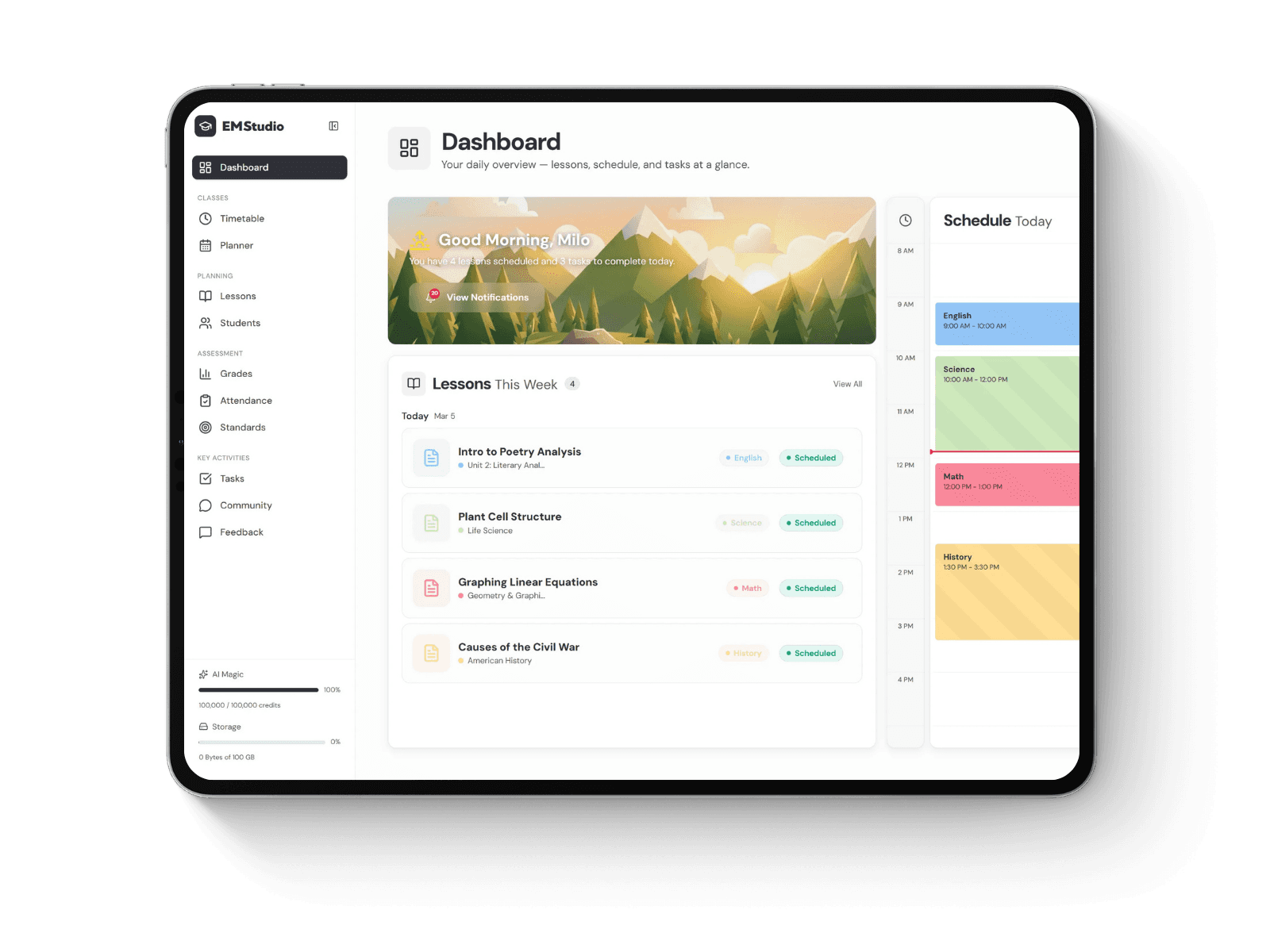
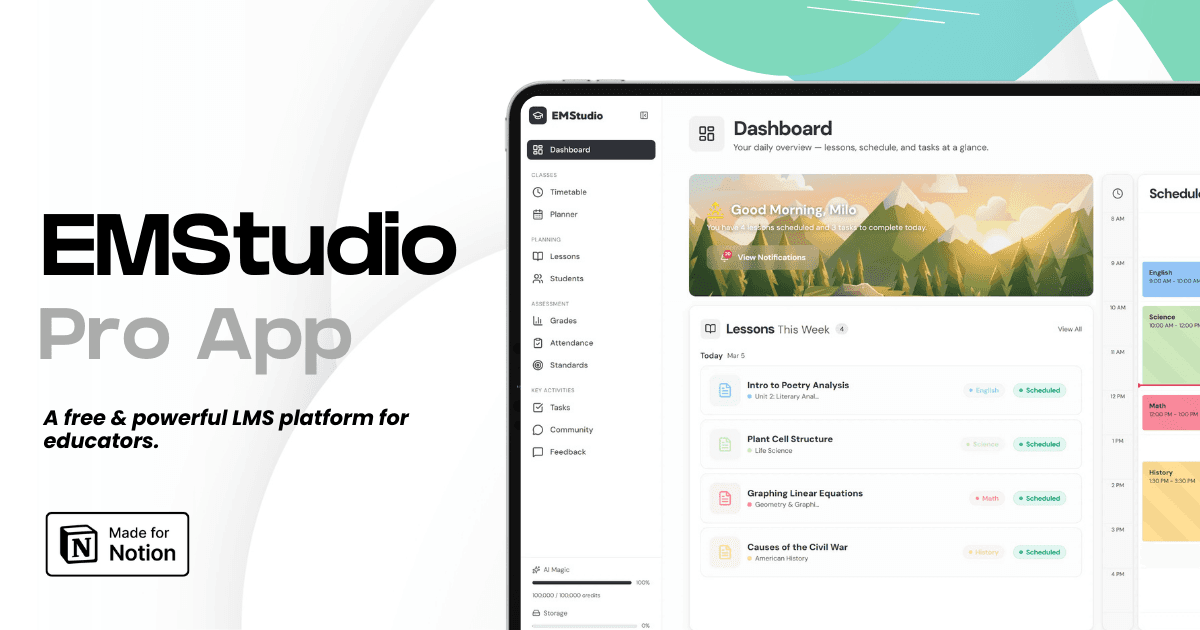
EMStudio is a free teaching management app — manage your classes, students, lessons, and more!
Learn More
Still grading everything by hand?
EMStudio is a free teaching management app — manage your classes, students, lessons, and more!
Learn More
Table of Contents
What Are the Best Free Ready-to-Teach Lesson Collections?
The best free ready-to-teach lesson collections include spiral review math packs, weekly language arts bundles, and seasonal activities from sites like One Stop Teacher Shop, which offer 5-day sample packs covering all standards with zero prep time required. These free teacher resources eliminate the Sunday night scramble by providing answer keys and structured pacing.
New teachers often learn this the hard way. Hours spent hunting for decent worksheets yield blurry clip art and answer keys that don't match the questions. Quality matters more than cuteness.
Source | Prep Time | Standards | Format |
|---|---|---|---|
One Stop Teacher Shop | 0-15 mins | CCSS/TEKS | |
Lucky Little Learners | 0-10 mins | CCSS | PDF/Editable |
Teaching with a Mountain View | 10-15 mins | CCSS |
In my 3rd grade classroom, I used the Daily Math Review system with 28 students. Each morning they grabbed individual whiteboards and worked through 5 problems covering place value, multiplication facts, and word problems. The routine took 10 minutes. We reviewed answers immediately while I took attendance. Free tiers typically limit you to 5-10 pages per resource, while paid bundles offer 180 days of spiral review.
John Hattie's Visible Learning research shows distributed practice has an effect size of 0.59 for direct instruction. The One Stop Teacher Shop spiral reviews align with this by spacing out place value and operations across weeks rather than blocking them into single units. This daily retrieval practice beats cramming.
Downloading unvetted "cute" worksheets without checking answer keys can waste 45 minutes of prep time fixing errors during instruction. One teacher printed 30 copies of a color-by-code activity only to discover the math problems had typos in the answer key. Check every answer key before you print.
Daily Math Review Packs
The One Stop Teacher Shop Daily Math Review follows a strict weekly rhythm that makes morning work predictable. Monday through Thursday, students complete 5 problems targeting place value, operations, and word problems. Friday brings a 10-question quiz assessing the week's skills without consuming the whole period.
The system works with 28 students using individual whiteboards for 10-minute daily practice. The whiteboards let you scan the room instantly to see who had the quotient backwards or who was still drawing arrays. This leaves time for the formative assessment data to guide small groups.
The problems spiral back to previous units, so kids see multiplication facts in October and again in January. This distributed practice cements retention better than chapter tests that students forget by winter break. Free samples include one week; the full year bundle contains 36 weeks aligned to your curriculum mapping. Store them in bins labeled by week for your substitute plans. When a sub sees "Week 12, Day 3" on the board, they know exactly what to hand out.
Weekly Language Arts Bundles
Weekly Language Arts Bundles attack grammar, phonics, and writing conventions in one shot. Each pack covers parts of speech, vowel teams, and sentence editing across four days. These work perfectly for 2nd grade during a 20-minute morning work block.
Monday focuses on phonics while you check homework folders. Tuesday brings grammar practice like distinguishing nouns from verbs. Wednesday mixes both skills. Thursday targets writing conventions. Answer keys sit in a basket for self-checking. This builds autonomy.
The bundles connect to essential teacher-created resources for every subject by focusing on skill repetition rather than cute clip art. The format stays consistent week to week, so students spend zero minutes figuring out directions. They know the routine. You know the standards are covered. This consistency keeps your classroom economy running smoothly during transitions.
Seasonal Activity Sets
Seasonal Activity Sets save you during high-energy weeks when regular routines fail. Each month offers specific resources:
September: Back-to-School icebreakers with All About Me templates.
October: Math color-by-code sheets targeting addition facts.
December: Holiday writing prompts that hit narrative standards.
You can print 30 copies in 5 minutes flat. The free teaching resources for teachers in these packs typically include 3-5 activities per month. Store them in labeled folders by month so you can grab October math when a fire drill cancels your science experiment. Prep is minimal: print, copy, hand out. No elaborate set up. Just solid skill practice wrapped in timely themes.
Where Can Teachers Find Free Assessment and Tracking Tools?
Teachers can find free assessment tools on One Stop Teacher Shop, Teachers Pay Teachers, and district resource banks, including standards-based checklists for 30 students, auto-grading Google Forms exit tickets, and Excel progress monitors. Research suggests digital tracking reduces grading time by 60% compared to paper methods.
Stop grading papers during lunch. These tools handle the data collection so you can actually teach.
Do not use complex Google Sheets trackers for classes over 32 students without aide support. I tried this with 34 fifth graders last year. Data entry took 45 minutes weekly versus 5 minutes for simple paper checklists. The formulas broke constantly. Without a paraprofessional, you will abandon it by October.
You need tools that match your actual class size and assessment type:
ESGI software offers a 60-day free trial and assesses 25 students on sight words in 10 minutes using a laptop or tablet.
Google Forms exit tickets auto-grade up to 100 responses instantly and export to spreadsheets.
Single-page CCSS checklists accommodate 30 students per page in 8-point font for quick whole-class scanning.
Choose based on what you are measuring:
If assessing reading fluency, use ESGI.
If checking daily conceptual understanding, use Google Forms.
If tracking long-term standards mastery for IEP documentation, use paper checklists.
Digital tools work best for daily snapshots. Paper works best for legal documentation and quarterly reviews.
Standards-Based Grading Checklists
The CCSS Standards-Based Grading Checklist format uses a 2-page spread per student. It covers all ELA and Math standards for 3rd grade. Each standard has three small date boxes for recording mastery attempts. Print these on 11x17 paper at the start of the year. They survive 36 weeks in a binder without falling apart or tearing at the holes.
These work best for parent conferences. Teachers can flip to any student and show exactly which multiplication standards they mastered in October versus January. The paper format means you can hand the binder to a substitute without explaining software logins. It works during internet outages or when the district server crashes.
You can find templates on free teacher resources websites or curriculum mapping archives. Look for versions that include the standard number and brief description. Avoid checklists that require writing the full standard text. You will run out of space by December.
Many teachers on One Stop Teacher Shop share these as free educational resources for teachers. Search for "CCSS checklist 30 students" to find the compact versions. The 8-point font looks tiny on screen but prints clearly on laser printers. Bring a sample to your admin to show how you are tracking standards without buying expensive software licenses.
Digital Exit Ticket Templates
Digital Exit Ticket Templates using Google Forms follow a strict 3-question format. Question one checks basic recall from the lesson. Question two requires application of the skill. Question three asks students to rate their confidence level. Install the Flubaroo add-on to auto-grade the first two questions instantly while leaving the third for manual review.
Results populate in a color-coded spreadsheet. Red highlights scores below 70%. Yellow marks the 70-89% range. Green shows 90% and above. I scan this during passing period to see who needs reteaching tomorrow. It takes 30 seconds to identify the three kids who missed the concept entirely.
These digital assessment tracking tools work best for formative assessment during spiral review units. Do not use them for high-stakes grades. Students need to know these are check-ins, not gotchas. Set the form to collect email addresses automatically so you know who responded, even if they forget to type their name.
You can find templates in the shared folders of most district Google Domains. Look for versions that include the standard in the title. Copy the form to your drive and modify the questions to match your specific objective. Save the original as a master template for next year.
Progress Monitoring Spreadsheets
Progress Monitoring Spreadsheets for RTI track 15 students maximum per sheet. Enter weekly fluency words-per-minute data into designated columns. Pre-built Excel formulas calculate the slope of improvement automatically. Target growth is 1.5 words per week for 1st graders and 1.0 word for 3rd graders. The formula highlights students falling below the trend line.
These work best for tier two reading groups. The visual graph flags students who need intervention adjustments after four data points. This triggers your progress monitoring steps for K-12 classrooms. Print the slope graph for IEP meetings. Parents understand a line going up better than a list of numbers in a gradebook.
Keep the spreadsheet simple. Only track one skill per column. Do not attempt to monitor morning work, classroom economy points, and substitute plans in the same file. You will create a data monster that eats your Sunday evenings. Single-purpose sheets survive the whole year. Multi-purpose sheets get abandoned by Halloween.
Create a new tab for each assessment window. Label them Fall, Winter, and Spring. This keeps the active data sheet clean while preserving historical trends. When the district asks for growth data during evaluation meetings, you have three clean tabs ready to screenshot. No one wants to scroll through 36 weeks of raw numbers during a 20-minute conference.

Which Free Classroom Management Resources Actually Work?
Free classroom management resources that work include clip chart systems with private reflection sheets, digital parent communication logs via Class Dojo free tier supporting 35 students, and classroom job boards rotating every 4 weeks to build expertise and reduce transition time by 40%.
Most free behavior systems fail because teachers download them without matching the tool to their specific classroom trauma profile or IEP load. I learned this the hard way with a 4th grade class three years ago.
Clip Charts: Pro—immediate visual feedback for 30 students. Con—public shaming risk for trauma-informed classrooms.
Class Dojo free tier: Pro—parent messaging translation for 35 students. Con—screen time dependency.
Token Economy printable bucks: Pro—tangible intermediate rewards. Con—2-hour initial setup laminating and cutting.
Research on classroom jobs suggests rotating every four weeks—not weekly—reduces transition time by 40% and builds procedural expertise. Students need time to master a job before switching. Weekly rotations waste instructional minutes on retraining.
Avoid behavior charts for students with IEPs involving anxiety or ADHD. Public clip-downs reinforce negative behaviors and trigger shame spirals. Use private reflection sheets and self-monitoring checklists instead. These teacher downloads track triggers without humiliation.
Behavior Chart Systems
The Color-Coded Behavior Clip Chart uses seven levels: Outstanding, Great Job, Good Day, Ready to Learn, Think About It, Teacher's Choice, and Parent Contact. Most teachers print these on bright cardstock and laminate them for durability. Hang the chart near your whiteboard where everyone can see it during spiral review time.
Effective implementation requires a corresponding reflection sheet. When students clip below green to "Think About It" or lower, they complete the sheet during the five minutes of recess they miss. The sheet asks what triggered the behavior, what they could do differently, and how they will repair any harm. This turns consequences into learning, not punishment.
Teachers using this system with 4th graders often remove public names. Each student gets a numbered clothespin instead. The anonymity protects sensitive kids while preserving the visual feedback. For classroom economy enthusiasts, pairing this with a point system creates immediate accountability without public shaming. Match the chart to your formative assessment data to spot patterns.
Parent Communication Logs
Parent Communication Log templates work best in a three-ring binder with alphabetical A-Z tabs. Each page tracks 25 students' contact dates, method (phone, email, or app), and follow-up required. You get space for 10 interaction entries per student per quarter. Print these on different colored paper for each quarter to track frequency visually.
This analog system outperforms digital logs during conferences. Administrators love seeing the paper trail, and you avoid losing data when district servers crash. Keep the binder near your substitute plans so guest teachers can reference your effective parent communication strategies if issues arise. The physical binder also signals professionalism to parents who visit your room.
For high-volume contact classrooms, color-code entries: yellow for academic concerns, pink for behavior, blue for health updates. This creates instant visual patterns when you flip through. Print these logs from one stop teacher shop collections, which bundle free classroom resources for teachers with curriculum mapping tools. Store the binder in a locked drawer to maintain privacy compliance.
Classroom Job Rotation Boards
Classroom Job Rotation Boards using pocket charts keep 28 students engaged with 20 jobs. Some jobs have two people. Rotate every four weeks to match the research on expertise building. Post the schedule near your door so students check it during entry routine.
Job titles matter. Line Leader sets the pace. Paper Passer distributes morning work. Tech Support charges Chromebooks and troubleshoots logins. Botanist waters plants and tracks growth. Add Librarian to organize leveled readers and Sanitizer to wipe high-touch surfaces after lunch. Specific duties prevent the "everyone help" chaos that wastes time.
Post the rotation next to your classroom rules and procedures that transform behavior. Students check the board during formative assessment transitions. The four-week rotation means by week three, most 3rd graders execute their jobs without prompting. Transition time drops from five minutes to three. That adds up to 40 hours of reclaimed instruction yearly. Use teacher downloads for job application templates to let students request preferred positions.

Subject-Specific Free Teaching Materials for Math and ELA
Elementary Math Centers
Second graders need movement. I run four stations simultaneously during our 60-minute math block. Students rotate every 15 minutes with 5-minute transitions for cleanup. This keeps engagement high and allows me to pull small groups for formative assessment.
Station one uses Place Value Task Cards with base-ten blocks for hands-on learning.
Station two is Addition War, where students flip cards and add to compare sums.
Station three features 120 Chart Puzzles that reinforce number sense patterns.
Station four holds Word Problem Journals for applying skills to real contexts.
For specific skill practice, I print 24 task cards targeting 2-digit addition with regrouping. Another bin holds 12 classroom objects for measuring to the nearest inch. I also laminate a telling-time matching game for 5-minute intervals. These materials provide daily spiral review and work as emergency substitute plans.
These math teacher resources to transform your classroom require minimal prep. Print on cardstock and laminate for three years of durability. Last year, my sub managed the full block while I was home with the flu.
Reading Comprehension Passages
Fourth graders need consistent exposure to complex texts. I use 250-word passages in the Lexile 600-800 range. Each passage includes five questions targeting specific skills. This predictable format builds confidence while hitting grade-level standards.
Main idea identification starts the question sequence.
Inference questions require using text clues to draw conclusions.
Vocabulary in context challenges students to define words using surrounding sentences.
Author purpose analysis asks why the writer created the piece.
Text evidence citation requires quoting specific details to support answers.
I organize these texts to support my curriculum mapping. Science-themed nonfiction covers butterfly life cycles and simple machines paired with fiction folktales. For my 28 students, I print three versions. This collection acts as a one stop teacher shop for free educational resources for students.
Differentiation happens through question complexity. Some circle answers while others write sentences. These free online teaching resources for teachers work for morning work. Explore free digital libraries for reading comprehension for more texts.
Writing Prompt Journals
Middle schoolers stall when faced with blank pages. I use 180 prompts organized by month to eliminate decision fatigue. Each prompt demands a 10-minute quick write, building fluency without overwhelming reluctant writers.
September focuses on narrative memory and personal experience stories.
October shifts to descriptive Halloween scenes using sensory details.
November brings persuasive letters arguing school policy changes.
I format these journals for practicality. Three-hole punch pages for binders. Print two prompts per sheet to save paper. Every page includes a CUPS editing checklist.
Capitalization at the start of sentences and proper nouns.
Usage rules for subject-verb agreement and verb tense.
Punctuation for end marks and comma placement.
Spelling of high-frequency words and content vocabulary.
The target is 150 words per entry. For digital submission, I use the free BOOM Learning tier supporting five students simultaneously. This fits rotating classroom economy stations where students earn points. These prompts also serve as emergency substitute plans.

What Free Teacher Planning Resources Save the Most Time?
Free planning resources that save the most time include editable curriculum map templates reducing weekly planning by 3 hours, comprehensive 10-section substitute binders with emergency lesson plans for 3-day coverage, and year-long pacing guides aligning 180 instructional days to state standards.
You need tools that do the thinking for you. These three resources remove the blank-page panic and keep your instruction moving forward.
Curriculum Map Templates
Curriculum map templates save approximately 3 hours weekly by pre-aligning units to standards. Use Airtable or Google Sheets with color-coding: blue for tested standards, yellow for reviewed. This visual system prevents the Sunday night scramble of re-checking standards documents or searching for misplaced lesson plans from the previous year.
A template uses a month-by-month grid from August through May. Include these columns:
Unit Title and duration in days
Standards with specific CCSS numbers listed
Assessment Dates for pre-tests and post-tests
Resource links to your digital files
Your September Place Value Unit covers 3.NBT.1 and 3.NBT.2 with pre-tests on Sept 5 and post-tests on Sept 30. You see exactly where spiral review fits between major units and can spot instructional gaps three months before they derail your pacing.
For a complete guide to curriculum mapping, read our detailed breakdown. One Stop Teacher Shop offers free templates with this exact layout. The color-coding shows which standards need heavy formative assessment and which need lighter morning work coverage. You stop guessing about weekly pacing decisions.
Substitute Teacher Binders
The 10-section binder includes emergency plans for 3 full days, a class list with medical alerts highlighted in red, and other critical information. I left this exact binder during a family emergency in my 4th grade classroom. The secretary reported zero office calls because the sub found everything needed.
Include these sections:
Emergency plans for 3 full days of coverage
Class list with 28 students and medical alerts in red
Seating chart with photos for quick identification
Daily schedule with times and transition procedures
Behavior management quick guide
Office extension list for emergencies
Section 7 holds Emergency Lessons: 3 days of standalone activities requiring no copies. These include a read aloud with sticky note questions, math fact fluency games with cards, and a writing prompt asking students to compose a letter to their future self. These work for grades 3-5 with 25-30 students and require no technology or photocopying. Store the cards in a ziplock bag taped inside the binder so they never get lost.
Include your classroom economy cheat sheet so subs understand your token system. Add freeteacher login credentials for digital substitute plans if you use online platforms. Keep the binder on your desk, not locked in a drawer, for immediate sub access. This prevents the 6 AM panic of writing last-minute sub plans while driving to the hospital.
Year-Long Pacing Guides
If your district faces frequent pacing changes due to snow days or testing windows, choose editable Google Doc pacing guides over PDF year-long plans. PDFs look pretty but become obsolete the moment your administrator shifts the math assessment window. Editable docs let you type directly into the table and adjust dates in real time during faculty meetings without reprinting 50-page documents.
ELA pacing guides map 36 weeks across 180 instructional days. Account for these interruptions:
10 days for standardized testing windows
5 days for review before major assessments
Snow days and weather delays
Field trips and assembly schedules
Week 14 might cover opinion writing for 4 days and a Veterans Day close read for 1 day. You prevent the spring crunch by seeing exactly when to teach persuasive essays before state testing windows open. This visibility prevents the November panic of realizing you have six weeks of content left and only four weeks remaining before winter break.
The best free online resources for teachers include these pre-loaded calendars. Download the Google Doc version. When snow days hit in February, drag and drop units without reformatting page breaks. Save the original as a template and create a working copy for the current year. Your curriculum mapping stays accurate during unpredictable winter months without wasting paper or ink.

How to Download and Organize Free Teaching Resources Efficiently
You need a system before you hoard 500 unlabeled PDFs. I learned this in my 4th grade year when I spent 20 minutes hunting for a spiral review worksheet while my kids sat idle. Structure saves sanity.
Setting Up Your Digital Filing System
Create one Master Folder in Google Drive or OneDrive. Inside it, limit yourself to four levels deep: Subject > Month > Resource Type. Any deeper and the search lag will drive you crazy when you're grabbing morning work between bells. Your formative assessment PDFs should appear instantly, not after a spinning wheel.
Use color-coding so you spot folders fast:
Red = Math
Blue = ELA
Green = Science
Create a '00-ADMIN' folder at the top level for rosters, substitute plans, and curriculum mapping documents. The double-zero keeps it alphabetical first. Keep classroom economy trackers and permission slips here so you always know where to find them.
Limit nesting to four levels maximum. Deeper folders slow down Google Drive's search function when you're hunting for specific activities during your prep period. Flat structure wins over fancy organization every time.
Only keep the current trimester active in your main drive. Archive the rest to an external hard drive to keep sync speeds fast. When you build a digital resource library, consistency beats perfection.
Pick a naming convention and stick to it: GradeSubject_Topic_Date_Source. For example: 3Math_Multiplication_Aug2024_OSTS. This tells you exactly what's inside without opening the file. No more guessing which "final_final.pdf" is the real one.
Batch Downloading Strategies
Stop clicking individual download buttons. Install DownThemAll or Chrono Download Manager in your browser first. These extensions grab 50+ resources simultaneously from sites hosting free teaching resources uk or domestic materials.
When downloading from one stop teacher shop, this approach saves roughly two hours compared to individual clicks. Browser extensions scan the page for all downloadable links. You select the PDFs you want, set your destination folder, and walk away while it works.
Create your destination subfolder before you start. Otherwise, you'll dump everything onto your desktop and create a new mess to solve.
On Teachers Pay Teachers, use the 'Add to Cart' feature for up to 20 freebies. Then hit 'Download All.' Skip the individual clicks.
For One Stop Teacher Shop specifically, sign up for their email list. They'll deliver 10 free resources as a single zip file straight to your inbox. Unzip directly into your pre-organized subfolders immediately. Don't let them sit in your Downloads folder for later. That folder is where good lessons go to die.
Organizing by Subject and Month
Create 12 monthly folders within each subject folder. January through December. When you download something for October centers or November formative assessment activities, move it immediately to the correct month. Do not leave files in your Downloads folder.
Use descriptive file names that follow a pattern. '3rd_Math_PlaceValue_Week2_Sept.pdf' beats 'freebie_final_REAL.pdf' every time. Include the grade, subject, topic, week, and month. Your future self will thank you when you're planning morning work six months from now.
Consistent naming also helps when you're sharing files with co-teachers. Everyone knows exactly which file to use without opening three different versions to check.
Implement the 5-Minute Weekly Cleanup Rule. Every Friday, spend five minutes on these tasks:
Delete files under 1MB—these are usually cover pages or thumbnails, not actual content.
Merge related PDFs using PDFsam Basic (it's free) to reduce file count.
Archive anything you haven't touched in six months to an external drive.
Keep your active folder under 5GB so your cloud sync doesn't lag during class. When you create a teaching resource organizer, these habits separate the teachers who find materials in ten seconds from those who waste half a prep period searching.

What Are the Best Free Ready-to-Teach Lesson Collections?
The best free ready-to-teach lesson collections include spiral review math packs, weekly language arts bundles, and seasonal activities from sites like One Stop Teacher Shop, which offer 5-day sample packs covering all standards with zero prep time required. These free teacher resources eliminate the Sunday night scramble by providing answer keys and structured pacing.
New teachers often learn this the hard way. Hours spent hunting for decent worksheets yield blurry clip art and answer keys that don't match the questions. Quality matters more than cuteness.
Source | Prep Time | Standards | Format |
|---|---|---|---|
One Stop Teacher Shop | 0-15 mins | CCSS/TEKS | |
Lucky Little Learners | 0-10 mins | CCSS | PDF/Editable |
Teaching with a Mountain View | 10-15 mins | CCSS |
In my 3rd grade classroom, I used the Daily Math Review system with 28 students. Each morning they grabbed individual whiteboards and worked through 5 problems covering place value, multiplication facts, and word problems. The routine took 10 minutes. We reviewed answers immediately while I took attendance. Free tiers typically limit you to 5-10 pages per resource, while paid bundles offer 180 days of spiral review.
John Hattie's Visible Learning research shows distributed practice has an effect size of 0.59 for direct instruction. The One Stop Teacher Shop spiral reviews align with this by spacing out place value and operations across weeks rather than blocking them into single units. This daily retrieval practice beats cramming.
Downloading unvetted "cute" worksheets without checking answer keys can waste 45 minutes of prep time fixing errors during instruction. One teacher printed 30 copies of a color-by-code activity only to discover the math problems had typos in the answer key. Check every answer key before you print.
Daily Math Review Packs
The One Stop Teacher Shop Daily Math Review follows a strict weekly rhythm that makes morning work predictable. Monday through Thursday, students complete 5 problems targeting place value, operations, and word problems. Friday brings a 10-question quiz assessing the week's skills without consuming the whole period.
The system works with 28 students using individual whiteboards for 10-minute daily practice. The whiteboards let you scan the room instantly to see who had the quotient backwards or who was still drawing arrays. This leaves time for the formative assessment data to guide small groups.
The problems spiral back to previous units, so kids see multiplication facts in October and again in January. This distributed practice cements retention better than chapter tests that students forget by winter break. Free samples include one week; the full year bundle contains 36 weeks aligned to your curriculum mapping. Store them in bins labeled by week for your substitute plans. When a sub sees "Week 12, Day 3" on the board, they know exactly what to hand out.
Weekly Language Arts Bundles
Weekly Language Arts Bundles attack grammar, phonics, and writing conventions in one shot. Each pack covers parts of speech, vowel teams, and sentence editing across four days. These work perfectly for 2nd grade during a 20-minute morning work block.
Monday focuses on phonics while you check homework folders. Tuesday brings grammar practice like distinguishing nouns from verbs. Wednesday mixes both skills. Thursday targets writing conventions. Answer keys sit in a basket for self-checking. This builds autonomy.
The bundles connect to essential teacher-created resources for every subject by focusing on skill repetition rather than cute clip art. The format stays consistent week to week, so students spend zero minutes figuring out directions. They know the routine. You know the standards are covered. This consistency keeps your classroom economy running smoothly during transitions.
Seasonal Activity Sets
Seasonal Activity Sets save you during high-energy weeks when regular routines fail. Each month offers specific resources:
September: Back-to-School icebreakers with All About Me templates.
October: Math color-by-code sheets targeting addition facts.
December: Holiday writing prompts that hit narrative standards.
You can print 30 copies in 5 minutes flat. The free teaching resources for teachers in these packs typically include 3-5 activities per month. Store them in labeled folders by month so you can grab October math when a fire drill cancels your science experiment. Prep is minimal: print, copy, hand out. No elaborate set up. Just solid skill practice wrapped in timely themes.
Where Can Teachers Find Free Assessment and Tracking Tools?
Teachers can find free assessment tools on One Stop Teacher Shop, Teachers Pay Teachers, and district resource banks, including standards-based checklists for 30 students, auto-grading Google Forms exit tickets, and Excel progress monitors. Research suggests digital tracking reduces grading time by 60% compared to paper methods.
Stop grading papers during lunch. These tools handle the data collection so you can actually teach.
Do not use complex Google Sheets trackers for classes over 32 students without aide support. I tried this with 34 fifth graders last year. Data entry took 45 minutes weekly versus 5 minutes for simple paper checklists. The formulas broke constantly. Without a paraprofessional, you will abandon it by October.
You need tools that match your actual class size and assessment type:
ESGI software offers a 60-day free trial and assesses 25 students on sight words in 10 minutes using a laptop or tablet.
Google Forms exit tickets auto-grade up to 100 responses instantly and export to spreadsheets.
Single-page CCSS checklists accommodate 30 students per page in 8-point font for quick whole-class scanning.
Choose based on what you are measuring:
If assessing reading fluency, use ESGI.
If checking daily conceptual understanding, use Google Forms.
If tracking long-term standards mastery for IEP documentation, use paper checklists.
Digital tools work best for daily snapshots. Paper works best for legal documentation and quarterly reviews.
Standards-Based Grading Checklists
The CCSS Standards-Based Grading Checklist format uses a 2-page spread per student. It covers all ELA and Math standards for 3rd grade. Each standard has three small date boxes for recording mastery attempts. Print these on 11x17 paper at the start of the year. They survive 36 weeks in a binder without falling apart or tearing at the holes.
These work best for parent conferences. Teachers can flip to any student and show exactly which multiplication standards they mastered in October versus January. The paper format means you can hand the binder to a substitute without explaining software logins. It works during internet outages or when the district server crashes.
You can find templates on free teacher resources websites or curriculum mapping archives. Look for versions that include the standard number and brief description. Avoid checklists that require writing the full standard text. You will run out of space by December.
Many teachers on One Stop Teacher Shop share these as free educational resources for teachers. Search for "CCSS checklist 30 students" to find the compact versions. The 8-point font looks tiny on screen but prints clearly on laser printers. Bring a sample to your admin to show how you are tracking standards without buying expensive software licenses.
Digital Exit Ticket Templates
Digital Exit Ticket Templates using Google Forms follow a strict 3-question format. Question one checks basic recall from the lesson. Question two requires application of the skill. Question three asks students to rate their confidence level. Install the Flubaroo add-on to auto-grade the first two questions instantly while leaving the third for manual review.
Results populate in a color-coded spreadsheet. Red highlights scores below 70%. Yellow marks the 70-89% range. Green shows 90% and above. I scan this during passing period to see who needs reteaching tomorrow. It takes 30 seconds to identify the three kids who missed the concept entirely.
These digital assessment tracking tools work best for formative assessment during spiral review units. Do not use them for high-stakes grades. Students need to know these are check-ins, not gotchas. Set the form to collect email addresses automatically so you know who responded, even if they forget to type their name.
You can find templates in the shared folders of most district Google Domains. Look for versions that include the standard in the title. Copy the form to your drive and modify the questions to match your specific objective. Save the original as a master template for next year.
Progress Monitoring Spreadsheets
Progress Monitoring Spreadsheets for RTI track 15 students maximum per sheet. Enter weekly fluency words-per-minute data into designated columns. Pre-built Excel formulas calculate the slope of improvement automatically. Target growth is 1.5 words per week for 1st graders and 1.0 word for 3rd graders. The formula highlights students falling below the trend line.
These work best for tier two reading groups. The visual graph flags students who need intervention adjustments after four data points. This triggers your progress monitoring steps for K-12 classrooms. Print the slope graph for IEP meetings. Parents understand a line going up better than a list of numbers in a gradebook.
Keep the spreadsheet simple. Only track one skill per column. Do not attempt to monitor morning work, classroom economy points, and substitute plans in the same file. You will create a data monster that eats your Sunday evenings. Single-purpose sheets survive the whole year. Multi-purpose sheets get abandoned by Halloween.
Create a new tab for each assessment window. Label them Fall, Winter, and Spring. This keeps the active data sheet clean while preserving historical trends. When the district asks for growth data during evaluation meetings, you have three clean tabs ready to screenshot. No one wants to scroll through 36 weeks of raw numbers during a 20-minute conference.
Which Free Classroom Management Resources Actually Work?
Free classroom management resources that work include clip chart systems with private reflection sheets, digital parent communication logs via Class Dojo free tier supporting 35 students, and classroom job boards rotating every 4 weeks to build expertise and reduce transition time by 40%.
Most free behavior systems fail because teachers download them without matching the tool to their specific classroom trauma profile or IEP load. I learned this the hard way with a 4th grade class three years ago.
Clip Charts: Pro—immediate visual feedback for 30 students. Con—public shaming risk for trauma-informed classrooms.
Class Dojo free tier: Pro—parent messaging translation for 35 students. Con—screen time dependency.
Token Economy printable bucks: Pro—tangible intermediate rewards. Con—2-hour initial setup laminating and cutting.
Research on classroom jobs suggests rotating every four weeks—not weekly—reduces transition time by 40% and builds procedural expertise. Students need time to master a job before switching. Weekly rotations waste instructional minutes on retraining.
Avoid behavior charts for students with IEPs involving anxiety or ADHD. Public clip-downs reinforce negative behaviors and trigger shame spirals. Use private reflection sheets and self-monitoring checklists instead. These teacher downloads track triggers without humiliation.
Behavior Chart Systems
The Color-Coded Behavior Clip Chart uses seven levels: Outstanding, Great Job, Good Day, Ready to Learn, Think About It, Teacher's Choice, and Parent Contact. Most teachers print these on bright cardstock and laminate them for durability. Hang the chart near your whiteboard where everyone can see it during spiral review time.
Effective implementation requires a corresponding reflection sheet. When students clip below green to "Think About It" or lower, they complete the sheet during the five minutes of recess they miss. The sheet asks what triggered the behavior, what they could do differently, and how they will repair any harm. This turns consequences into learning, not punishment.
Teachers using this system with 4th graders often remove public names. Each student gets a numbered clothespin instead. The anonymity protects sensitive kids while preserving the visual feedback. For classroom economy enthusiasts, pairing this with a point system creates immediate accountability without public shaming. Match the chart to your formative assessment data to spot patterns.
Parent Communication Logs
Parent Communication Log templates work best in a three-ring binder with alphabetical A-Z tabs. Each page tracks 25 students' contact dates, method (phone, email, or app), and follow-up required. You get space for 10 interaction entries per student per quarter. Print these on different colored paper for each quarter to track frequency visually.
This analog system outperforms digital logs during conferences. Administrators love seeing the paper trail, and you avoid losing data when district servers crash. Keep the binder near your substitute plans so guest teachers can reference your effective parent communication strategies if issues arise. The physical binder also signals professionalism to parents who visit your room.
For high-volume contact classrooms, color-code entries: yellow for academic concerns, pink for behavior, blue for health updates. This creates instant visual patterns when you flip through. Print these logs from one stop teacher shop collections, which bundle free classroom resources for teachers with curriculum mapping tools. Store the binder in a locked drawer to maintain privacy compliance.
Classroom Job Rotation Boards
Classroom Job Rotation Boards using pocket charts keep 28 students engaged with 20 jobs. Some jobs have two people. Rotate every four weeks to match the research on expertise building. Post the schedule near your door so students check it during entry routine.
Job titles matter. Line Leader sets the pace. Paper Passer distributes morning work. Tech Support charges Chromebooks and troubleshoots logins. Botanist waters plants and tracks growth. Add Librarian to organize leveled readers and Sanitizer to wipe high-touch surfaces after lunch. Specific duties prevent the "everyone help" chaos that wastes time.
Post the rotation next to your classroom rules and procedures that transform behavior. Students check the board during formative assessment transitions. The four-week rotation means by week three, most 3rd graders execute their jobs without prompting. Transition time drops from five minutes to three. That adds up to 40 hours of reclaimed instruction yearly. Use teacher downloads for job application templates to let students request preferred positions.
Subject-Specific Free Teaching Materials for Math and ELA
Elementary Math Centers
Second graders need movement. I run four stations simultaneously during our 60-minute math block. Students rotate every 15 minutes with 5-minute transitions for cleanup. This keeps engagement high and allows me to pull small groups for formative assessment.
Station one uses Place Value Task Cards with base-ten blocks for hands-on learning.
Station two is Addition War, where students flip cards and add to compare sums.
Station three features 120 Chart Puzzles that reinforce number sense patterns.
Station four holds Word Problem Journals for applying skills to real contexts.
For specific skill practice, I print 24 task cards targeting 2-digit addition with regrouping. Another bin holds 12 classroom objects for measuring to the nearest inch. I also laminate a telling-time matching game for 5-minute intervals. These materials provide daily spiral review and work as emergency substitute plans.
These math teacher resources to transform your classroom require minimal prep. Print on cardstock and laminate for three years of durability. Last year, my sub managed the full block while I was home with the flu.
Reading Comprehension Passages
Fourth graders need consistent exposure to complex texts. I use 250-word passages in the Lexile 600-800 range. Each passage includes five questions targeting specific skills. This predictable format builds confidence while hitting grade-level standards.
Main idea identification starts the question sequence.
Inference questions require using text clues to draw conclusions.
Vocabulary in context challenges students to define words using surrounding sentences.
Author purpose analysis asks why the writer created the piece.
Text evidence citation requires quoting specific details to support answers.
I organize these texts to support my curriculum mapping. Science-themed nonfiction covers butterfly life cycles and simple machines paired with fiction folktales. For my 28 students, I print three versions. This collection acts as a one stop teacher shop for free educational resources for students.
Differentiation happens through question complexity. Some circle answers while others write sentences. These free online teaching resources for teachers work for morning work. Explore free digital libraries for reading comprehension for more texts.
Writing Prompt Journals
Middle schoolers stall when faced with blank pages. I use 180 prompts organized by month to eliminate decision fatigue. Each prompt demands a 10-minute quick write, building fluency without overwhelming reluctant writers.
September focuses on narrative memory and personal experience stories.
October shifts to descriptive Halloween scenes using sensory details.
November brings persuasive letters arguing school policy changes.
I format these journals for practicality. Three-hole punch pages for binders. Print two prompts per sheet to save paper. Every page includes a CUPS editing checklist.
Capitalization at the start of sentences and proper nouns.
Usage rules for subject-verb agreement and verb tense.
Punctuation for end marks and comma placement.
Spelling of high-frequency words and content vocabulary.
The target is 150 words per entry. For digital submission, I use the free BOOM Learning tier supporting five students simultaneously. This fits rotating classroom economy stations where students earn points. These prompts also serve as emergency substitute plans.
What Free Teacher Planning Resources Save the Most Time?
Free planning resources that save the most time include editable curriculum map templates reducing weekly planning by 3 hours, comprehensive 10-section substitute binders with emergency lesson plans for 3-day coverage, and year-long pacing guides aligning 180 instructional days to state standards.
You need tools that do the thinking for you. These three resources remove the blank-page panic and keep your instruction moving forward.
Curriculum Map Templates
Curriculum map templates save approximately 3 hours weekly by pre-aligning units to standards. Use Airtable or Google Sheets with color-coding: blue for tested standards, yellow for reviewed. This visual system prevents the Sunday night scramble of re-checking standards documents or searching for misplaced lesson plans from the previous year.
A template uses a month-by-month grid from August through May. Include these columns:
Unit Title and duration in days
Standards with specific CCSS numbers listed
Assessment Dates for pre-tests and post-tests
Resource links to your digital files
Your September Place Value Unit covers 3.NBT.1 and 3.NBT.2 with pre-tests on Sept 5 and post-tests on Sept 30. You see exactly where spiral review fits between major units and can spot instructional gaps three months before they derail your pacing.
For a complete guide to curriculum mapping, read our detailed breakdown. One Stop Teacher Shop offers free templates with this exact layout. The color-coding shows which standards need heavy formative assessment and which need lighter morning work coverage. You stop guessing about weekly pacing decisions.
Substitute Teacher Binders
The 10-section binder includes emergency plans for 3 full days, a class list with medical alerts highlighted in red, and other critical information. I left this exact binder during a family emergency in my 4th grade classroom. The secretary reported zero office calls because the sub found everything needed.
Include these sections:
Emergency plans for 3 full days of coverage
Class list with 28 students and medical alerts in red
Seating chart with photos for quick identification
Daily schedule with times and transition procedures
Behavior management quick guide
Office extension list for emergencies
Section 7 holds Emergency Lessons: 3 days of standalone activities requiring no copies. These include a read aloud with sticky note questions, math fact fluency games with cards, and a writing prompt asking students to compose a letter to their future self. These work for grades 3-5 with 25-30 students and require no technology or photocopying. Store the cards in a ziplock bag taped inside the binder so they never get lost.
Include your classroom economy cheat sheet so subs understand your token system. Add freeteacher login credentials for digital substitute plans if you use online platforms. Keep the binder on your desk, not locked in a drawer, for immediate sub access. This prevents the 6 AM panic of writing last-minute sub plans while driving to the hospital.
Year-Long Pacing Guides
If your district faces frequent pacing changes due to snow days or testing windows, choose editable Google Doc pacing guides over PDF year-long plans. PDFs look pretty but become obsolete the moment your administrator shifts the math assessment window. Editable docs let you type directly into the table and adjust dates in real time during faculty meetings without reprinting 50-page documents.
ELA pacing guides map 36 weeks across 180 instructional days. Account for these interruptions:
10 days for standardized testing windows
5 days for review before major assessments
Snow days and weather delays
Field trips and assembly schedules
Week 14 might cover opinion writing for 4 days and a Veterans Day close read for 1 day. You prevent the spring crunch by seeing exactly when to teach persuasive essays before state testing windows open. This visibility prevents the November panic of realizing you have six weeks of content left and only four weeks remaining before winter break.
The best free online resources for teachers include these pre-loaded calendars. Download the Google Doc version. When snow days hit in February, drag and drop units without reformatting page breaks. Save the original as a template and create a working copy for the current year. Your curriculum mapping stays accurate during unpredictable winter months without wasting paper or ink.
How to Download and Organize Free Teaching Resources Efficiently
You need a system before you hoard 500 unlabeled PDFs. I learned this in my 4th grade year when I spent 20 minutes hunting for a spiral review worksheet while my kids sat idle. Structure saves sanity.
Setting Up Your Digital Filing System
Create one Master Folder in Google Drive or OneDrive. Inside it, limit yourself to four levels deep: Subject > Month > Resource Type. Any deeper and the search lag will drive you crazy when you're grabbing morning work between bells. Your formative assessment PDFs should appear instantly, not after a spinning wheel.
Use color-coding so you spot folders fast:
Red = Math
Blue = ELA
Green = Science
Create a '00-ADMIN' folder at the top level for rosters, substitute plans, and curriculum mapping documents. The double-zero keeps it alphabetical first. Keep classroom economy trackers and permission slips here so you always know where to find them.
Limit nesting to four levels maximum. Deeper folders slow down Google Drive's search function when you're hunting for specific activities during your prep period. Flat structure wins over fancy organization every time.
Only keep the current trimester active in your main drive. Archive the rest to an external hard drive to keep sync speeds fast. When you build a digital resource library, consistency beats perfection.
Pick a naming convention and stick to it: GradeSubject_Topic_Date_Source. For example: 3Math_Multiplication_Aug2024_OSTS. This tells you exactly what's inside without opening the file. No more guessing which "final_final.pdf" is the real one.
Batch Downloading Strategies
Stop clicking individual download buttons. Install DownThemAll or Chrono Download Manager in your browser first. These extensions grab 50+ resources simultaneously from sites hosting free teaching resources uk or domestic materials.
When downloading from one stop teacher shop, this approach saves roughly two hours compared to individual clicks. Browser extensions scan the page for all downloadable links. You select the PDFs you want, set your destination folder, and walk away while it works.
Create your destination subfolder before you start. Otherwise, you'll dump everything onto your desktop and create a new mess to solve.
On Teachers Pay Teachers, use the 'Add to Cart' feature for up to 20 freebies. Then hit 'Download All.' Skip the individual clicks.
For One Stop Teacher Shop specifically, sign up for their email list. They'll deliver 10 free resources as a single zip file straight to your inbox. Unzip directly into your pre-organized subfolders immediately. Don't let them sit in your Downloads folder for later. That folder is where good lessons go to die.
Organizing by Subject and Month
Create 12 monthly folders within each subject folder. January through December. When you download something for October centers or November formative assessment activities, move it immediately to the correct month. Do not leave files in your Downloads folder.
Use descriptive file names that follow a pattern. '3rd_Math_PlaceValue_Week2_Sept.pdf' beats 'freebie_final_REAL.pdf' every time. Include the grade, subject, topic, week, and month. Your future self will thank you when you're planning morning work six months from now.
Consistent naming also helps when you're sharing files with co-teachers. Everyone knows exactly which file to use without opening three different versions to check.
Implement the 5-Minute Weekly Cleanup Rule. Every Friday, spend five minutes on these tasks:
Delete files under 1MB—these are usually cover pages or thumbnails, not actual content.
Merge related PDFs using PDFsam Basic (it's free) to reduce file count.
Archive anything you haven't touched in six months to an external drive.
Keep your active folder under 5GB so your cloud sync doesn't lag during class. When you create a teaching resource organizer, these habits separate the teachers who find materials in ten seconds from those who waste half a prep period searching.
Still grading everything by hand?
EMStudio is a free teaching management app — manage your classes, students, lessons, and more!
Learn More
Still grading everything by hand?
EMStudio is a free teaching management app — manage your classes, students, lessons, and more!
Learn More




Notion4Teachers
Notion templates to simplify administrative tasks and enhance your teaching experience.



2026 Notion4Teachers. All Rights Reserved.
Notion4Teachers
Notion templates to simplify administrative tasks and enhance your teaching experience.
2026 Notion4Teachers. All Rights Reserved.
Notion4Teachers
Notion templates to simplify administrative tasks and enhance your teaching experience.
2026 Notion4Teachers. All Rights Reserved.