
Kindergarten Teacher: 4 Steps to Launch Your Career
Kindergarten Teacher: 4 Steps to Launch Your Career

Article by
Milo
ESL Content Coordinator & Educator
ESL Content Coordinator & Educator
All Posts
It's late September and your kindergarteners have finally stopped crying at drop-off. Now you're managing the controlled chaos of 22 five-year-olds who all need the bathroom at once—except the one who's asleep in the library corner and the other who's eating a crayon. That's the real job of a kindergarten teacher. It's not all fingerpaint and story time; it's teaching foundational reading skills while someone cries because their shoe is untied, another kid asks why the hamster died, and the photocopier jams for the third time this morning.
If you want to get there, you need more than patience and a cupboard full of glue sticks. You need a bachelor's degree in early childhood or elementary education, a semester of student teaching placement in a real kindergarten classroom where you'll test your classroom management strategies, and passing scores on your state's certification exams. This post breaks down those four concrete steps—from teacher preparation program to teaching license application—to get you hired without the usual bureaucratic runaround.
Still grading everything by hand?
EMStudio is a free teaching management app — manage your classes, students, lessons, and more!
Learn More
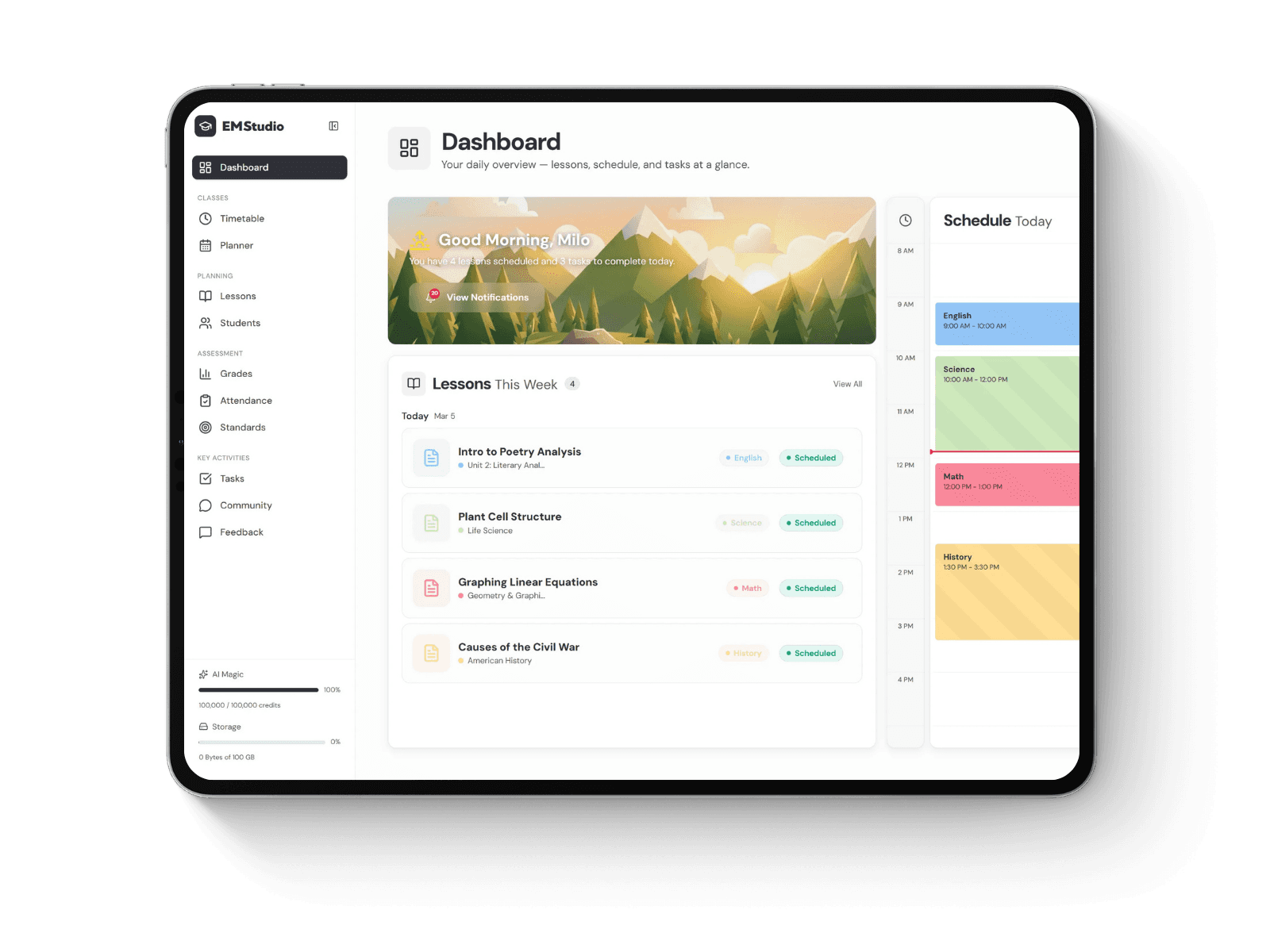
Still grading everything by hand?
EMStudio is a free teaching management app — manage your classes, students, lessons, and more!
Learn More
Table of Contents
What Are the Basic Requirements to Become a Kindergarten Teacher?
The requirements for kindergarten teacher certification include a bachelor's degree in early childhood or elementary education (120-130 credits), completion of state-approved teacher preparation coursework, passing scores on certification exams like Praxis 5025, and FBI/state background clearances. Most states require 12-16 weeks of student teaching in a kindergarten classroom.
The paperwork feels endless. I remember standing in line for fingerprinting twice because my first receipt smudged. But each requirement serves a purpose—protecting kids and ensuring you can actually teach them.
Educational Prerequisites and Degree Requirements
You need a Bachelor of Science in Early Childhood Education (PK-3) or a Bachelor of Arts in Elementary Education (K-6). The BS leans heavier on child psychology and developmental science, while the BA includes broader liberal arts electives. Both require CAEP accreditation and a minimum 2.75 GPA for admission into the teacher preparation program.
Credits break down into three buckets: 45 credits of general education, 30 credits of professional education theory, and 15 credits of specialized coursework. Those specialized classes include Language Acquisition, Math Methods for Primary Grades, and Science for Young Learners. You cannot skip the methods courses—state auditors check transcripts specifically for these during your teaching license application.
Your student teaching placement consumes the final semester. You will spend 12-16 weeks full-time in a kindergarten classroom under a mentor teacher's supervision. During this period, you submit lesson plans, handle parent communication, and demonstrate classroom management strategies while university supervisors score your performance using district rubrics.
Essential Skills and Personal Qualities for Early Childhood Educators
This job is physical. You must lift 40 pounds regularly, kneel on tile floors for thirty minutes during circle time, and project your voice clearly to twenty-five students playing outside. During my student teaching placement in a 5-year-old classroom, I learned that soft-spoken teachers lose control the moment the class steps onto the playground. You will sit on small plastic chairs and bend to tie shoes thirty times daily.
Universities assess your readiness using the CLASS framework. You need scores of 5 or higher in Emotional Support and Classroom Organization. The edTPA portfolio requires a passing score of 38 out of 75, demonstrating your ability to plan, instruct, and assess phonics lessons using Orton-Gillingham or similar structured literacy methods.
The CLASS tool measures three domains critical to early childhood: Positive Climate, Teacher Sensitivity, and Regard for Student Perspectives. Observers watch your interactions during reading blocks and transitions. A score below 5 in any domain triggers remediation before you can graduate from your teacher preparation program.
Districts also measure your classroom management strategies through transition efficiency—moving 25 five-year-olds from carpet to centers in under 90 seconds without chaos.
State-Specific Background Checks and Clearance Requirements
Every state uses a three-tiered system. First, FBI fingerprinting through vendors like IdentGO costs $50-75 and takes 2-6 weeks. Second, your state police criminal history check runs $10-25. Third, the Child Abuse History Clearance must be dated within 6-12 months of your hire date.
State | Credit Hours | GPA | Special Requirements |
Texas | 120 | 2.5 | ESL Certification |
California | 120-130 | 3.0 | CSET Multiple Subject + RICA |
Florida | 120 | 2.5 | FTCE PreK-3 |
Processing times vary. Clean records clear in 48 hours; common names or international students face 8-week delays. Submit early to avoid missing your student teaching placement.
If your background check reveals misdemeanors involving moral turpitude or any felony, most states automatically suspend your teaching license application. The appeals board reviews mitigating circumstances—time elapsed, rehabilitation evidence—but the timeline stretches 90-180 days. During this limbo, you cannot student teach or accept job offers.
Some districts require essential safety certifications like CPR. See general elementary teacher requirements for broader context.
Step 1 — Earn Your Bachelor's Degree in Early Childhood or Elementary Education
I learned the hard way that not all education degrees lead to classrooms. My college roommate graduated with a Child Development major and a 3.8 GPA, then found out she couldn't sit for the certification exam. She spent 18 months and $13,000 in post-baccalaureate courses just to qualify for her teaching license application.
Kindergarten teacher schooling varies wildly by institution. Public in-state programs average $9,000 per year, totaling $36,000 for four years. Out-of-state tuition runs $28,000 annually, hitting $112,000 total. Private colleges charge roughly $40,000 per year, bringing total costs to $160,000. You cannot teach kindergarten without this degree, so budget accordingly.
Pick a teacher preparation program with CAEP accreditation. Programs approved by the Council for the Accreditation of Educator Preparation report a 94% first-time certification exam pass rate. Non-accredited programs average only 67%. That gap represents months of your life spent re-testing.
Watch for the trap of non-licensure majors. Child Studies or general Child Development programs often lack state approval. Graduates cannot sit for certification exams. They must complete 18 to 24 additional credits—costing $8,000 to $15,000—before they can even apply for student teaching placement. Some universities market these as "pre-teaching" tracks, which is misleading. Read the fine print on your degree audit.
Your major determines where you can teach:
Major Track | Grade Authorization | Job Market Reality |
|---|---|---|
Early Childhood Education | PreK-3 or K-3 (state dependent) | Limited to early grades; deep expertise |
Elementary Education | K-6 or K-8 | Flexible; can shift to 3rd or 4th grade |
Child Development | None (non-licensure) | Requires 1-2 years additional coursework |
If you want the option to move to upper elementary later, explore elementary education degree pathways before you enroll.
Choosing the Right Major and Specialization Track
CAEP accreditation carries more weight than regional stamps like SACS or HLC. While regional accreditors verify academic standards, CAEP evaluates clinical practice quality, cooperating teacher training, candidate retention, and lesson plan rigor. Principals know the difference and routinely check for CAEP approval before reviewing transcripts.
Grade-level authorization splits by state. Early Childhood Education licenses typically cover PreK-3, restricting you to preschool through second grade. Some states extend to K-4. Elementary Education degrees authorize K-6 or K-8, giving you room to move up if you burn out on tying shoes. In Texas, Early Childhood covers PK-3 while Elementary covers EC-6. Check your state codes before enrolling.
Choose Early Childhood Education only if you want to specialize exclusively in five- and six-year-olds. The coursework dives deep into play-based pedagogy, sensory integration, and developmental screening. You learn to teach reading through fingerplays. But this narrow focus limits job prospects. I started with Early Childhood but watched colleagues with Elementary licenses pick up fourth-grade sub jobs during layoffs while I sat home eligible only for preschool openings.
Consider dual certification if available. Pairing Early Childhood Education with Special Education adds 18 credits—six additional classes—but districts pay premiums for teachers qualified to handle both general education and IEP modifications. In inclusion-heavy kindergarten classrooms, this combination makes you hireable immediately. Add ESL endorsements later if needed, but dual certification during your initial degree saves time.
Key Kindergarten Teacher Classes and Coursework Components
Effective kindergarten teacher classes go beyond theory about learning. You need specific instructional methods for emergent learners who still lose teeth and cry for their mothers. These five courses form the backbone of quality preparation:
Emergent Literacy Instruction (3 credits): Master phonemic awareness strategies—segmenting, blending, rhyming—that bridge oral language to print. You learn to administer DIBELS and support English language learners with visual cues.
Child Development and Learning (3 credits): Study Piaget, Vygotsky, and Erikson to understand why kindergarteners cannot mentally reverse operations or sit still for 45 minutes.
Mathematics for Primary Grades (3 credits): Work with ten frames and rekenreks to develop compositional thinking. Stop counting by ones; start seeing five-and-three as eight.
Classroom Management and Positive Behavior Support (3 credits): Learn PBIS tiers, de-escalation, and teaching self-regulation without punishing five-year-olds for developmentally normal behavior.
Assessment and Evaluation of Young Children (3 credits): Practice running records, anecdotal observations, and capturing growth through work samples rather than standardized tests.
Before your student teaching placement, you must complete 100 hours of guided observation. Quality programs split these across developmental stages: 25 hours with infants and toddlers to understand foundational milestones, 25 in preschool settings to observe play-based learning, and 50 in K-2 classrooms to see the transition to academics. That K-2 block matters most. You need to witness how kindergarten stamina and literacy expectations differ from first grade. Skip these hours and you will flounder during your first week.
I spent my final 25 K-2 hours in an urban kindergarten watching a veteran teacher implement classroom management strategies during centers. She used proximity, visual cues, and pre-taught transitions without raising her voice once. That single semester taught me more about keeping five-year-olds engaged than any lecture on behaviorism ever could.

Step 2 — Complete Student Teaching in a Kindergarten Classroom
Student teaching demands 600 to 900 clock hours across 12 to 16 weeks. You follow the mentor's schedule exactly—usually 7:30 AM to 3:30 PM—while gradually taking control of the classroom. The progression moves fast: Weeks 1-2 you observe and assist with routines, Weeks 3-6 you run small groups and transitions, and by Week 7 you're leading full days with your mentor observing from the back.
Your competency builds on a strict timeline. Week 4, you must lead two consecutive hours including a read-aloud and math center. Week 8 requires four hours of instruction plus your first parent conference. Week 12 caps the experience with full-day management and attendance at an IEP meeting. University coordinators secure your placement one semester ahead, matching you to urban or suburban sites, Title I schools, or inclusion classrooms based on your demographic preferences and career goals.
Your mentor must hold three years of experience and "highly effective" ratings. Miss more than 16 hours and you repeat the entire semester. Skip weekly reflection logs or earn an unsatisfactory evaluation, and you enter remediation that extends your timeline by months.
Securing a Quality Student Teaching Placement Site
Apply four to six months before your target semester—March for Fall placement, October for Spring. Your file needs a negative TB test, physical exam, liability insurance through your student teaching association ($40 to $50), an updated resume, and transcripts proving 90+ credits completed. Without these documents, your coordinator cannot submit your name to district HR offices. Start gathering materials early because TB results take two weeks.
Your placement setting shapes your preparedness. Urban districts throw you into high-diversity environments where behavior management dominates your learning. Suburban placements typically offer abundant resources but intense parent involvement. Specialized tracks include dual-language immersion, Montessori certification, or inclusive special education settings with co-teaching models.
I spent my placement in a Title I kindergarten room where 80% of students were English learners. That September, I learned more about differentiation in three weeks than I had in two years of coursework. Being a kindergarten teacher in that environment meant adapting everything—visual schedules, simplified directions, hands-on manipulatives—immediately. That experience prepared me for the realities far better than any syllabus could.
Maximizing Your Mentorship and Classroom Hours
Structure your mentor relationship deliberately. Hold weekly 30-minute formal conferences using the Charlotte Danielson Framework, plus daily ten-minute debriefs after dismissal. These conversations target specific domains: classroom management, student engagement, assessment techniques. Complete mid-term and final evaluations together, and document everything: three video recordings of your lessons, edTPA portfolio components, and signed hour logs verifying your 600+ clock hours.
Hit measurable benchmarks before your exit. You need 90% lesson plan implementation fidelity, competency in all four Danielson domains—Planning, Classroom Environment, Instruction, and Professional Responsibilities—and positive feedback from 80% of parent interactions. Your early childhood education philosophy gets tested against real classroom management strategies here. The theory from your teacher preparation program meets practice during these weeks.
Focus on building a successful relationship with your mentor teacher early; their evaluation determines whether you advance to your teaching license application or spend another semester repeating this step. Ask for feedback before they offer it. Bring specific questions about your elementary education degree coursework and how it applies to their classroom routines. Show up fifteen minutes early every day. Those minutes demonstrate professionalism that transcripts cannot show.

Step 3 — Pass Your State's Teacher Certification Exams
You can't walk into a kindergarten classroom without clearing this hurdle first. Most states require the Praxis Core Academic Skills tests or their own equivalent exams. I sat for mine during my final semester while juggling student teaching placement hours and those brutal lesson plan reflections required for any future kindergarten teacher.
Understanding the Praxis and State-Specific Test Requirements
The Praxis Core breaks into three sections: Reading (passing typically 156), Writing (162), and Math (150). You can take these as separate two-hour tests at $90 each, or combine them into one five-hour session for $150. Most districts prefer the combined option simply for scheduling convenience, though your brain might disagree after hour four.
For kindergarten teacher certification, you'll likely need the Praxis Subject Assessment Code 5025 (Early Childhood Education) rather than 5018 (Elementary Education). The 5025 covers 120 selected-response questions across language arts, math, social studies, science, and health for grades K-3. Costs run $120 for the test plus $50 for score reporting to your state education department.
Not every state uses Praxis. Texas requires the TExES PPR (160 passing score), California demands the CSET Multiple Subject, and New York uses the CST Multi-Subject. The Interstate Agreement covers 46 states for reciprocity, but 18 states—including California and Arizona—add extra state history or constitution exams. Computer-based testing runs continuously for Praxis, while some state-specific exams lock you into specific dates with limited windows.
Study Strategies and Resources for First-Time Success
Structure your prep around three resource tiers. Start with the free ETS Study Companion as your foundation. Add the Mometrix study guide ($40) for targeted review, then subscribe to 240 Tutoring ($40/month) for full practice banks. I found utilizing practice exams for certification success meant scoring at least 10 points above the cut score before attempting the official exam.
Follow a six to eight-week schedule with 90 minutes daily, alternating content areas to avoid burnout. Khan Academy helps refresh math concepts specifically. If you fail, you face a 28-day waiting period between attempts and a maximum of six tries per year.
Arrive 30 minutes early with government-issued photo ID and two #2 pencils for paper-based sections. Leave your phone in the locker and verify your calculator is approved; unapproved models invalidate scores. Schedule your exam at least three to four weeks before your teaching license application deadline. Unofficial scores appear immediately for selected-response sections, but official reports take 10 to 16 days. Don't test during your student teaching placement's busiest weeks—you'll need clear headspace for both the exam and your classroom management strategies in the field.

Step 4 — How Do You Apply for and Maintain Your Teaching License?
Apply for your teaching license through your state education department's online portal, submitting transcripts, exam scores ($50-200 fee), and fingerprint clearances. Initial licenses remain valid for 2-5 years; maintain them by completing 6-12 graduate credits or 100+ professional development hours before renewal deadlines.
I waited too long to submit my fingerprints. My kindergarten teacher job offer hung in limbo for three weeks while the state processed my background check. Submit everything early.
After your teacher preparation program completion, create an account on your state portal—TEACH NY, ECOS TX, or similar. Upload your elementary education degree transcripts, Praxis PDFs, and student teaching placement verification. Pay the $50-200 fee. Processing takes 4-12 weeks.
Navigating the Certification Application Process
Gather documents before you start. You need sealed official transcripts sent three weeks early, Praxis score reports from your ETS account, and a student teaching letter on university letterhead. Western and Midwest states process in 4-8 weeks; the Northeast takes 8-12. Track your case number.
Provisional licenses let you start teaching while awaiting final review. I began setting up my early childhood education classroom on a provisional license in August. Just don't let it expire mid-year.
Background Checks, Fees, and License Renewal Requirements
Your initial license lasts 2-5 years—five in Pennsylvania, three in Florida, four in Illinois. Renewal requires 6-12 graduate credits or 100-150 PD hours split between content-specific training and classroom management strategies. Budget $40-75 for fingerprint renewal every 3-5 years. Late renewals cost $25-100 monthly. Let it lapse past 30 days, and your district suspends you.
If you lapse beyond five years, you need 9-12 additional credits to reinstate. Twenty-three percent of new teachers delay renewal due to incomplete PD hours, forcing them into substitute pools. To be a kindergarten teacher long-term, consider National Board Certification—it satisfies renewal for ten years and earns $2,000-5,000 annual stipends in 34 states.

Landing Your First Kindergarten Position and Preparing for Day One
Peak hiring for a kindergarten teacher runs April through June for August starts. Apply to 15-20 districts. The BLS shows a median salary of $60,660 (2023), but expect $45,000-$52,000 starting out depending on your district's cost of living adjustment.
Missing the April window is the fastest way to miss your shot. Never negotiate salary before you hold the offer letter. Charter schools might hire on emergency permits without full certification, but that limits your long-term kindergarten career growth.
Wait until you pass your teaching license application before applying to charters on emergency status. Principals respect candidates who complete proper teacher preparation program pathways.
Crafting Your Student Teaching Portfolio and Resume
Keep your resume to one page. Display your certification number and 600+ student teaching placement hours at the top. List four or five specific early childhood education courses under relevant coursework.
Build a digital portfolio using Google Sites or Weebly. Include 5-7 complete lesson plans aligned to CCSS or state standards. Add your classroom management plan with visual supports, assessment samples like running records, and 3-5 classroom setup photos with student faces blurred.
Organize it with tabs for Philosophy, Management, Instruction, Assessment, and Professionalism. Bring a physical binder with sheet protectors as backup for interviews in buildings with spotty Wi-Fi or strict firewalls. Your elementary education degree prepared you for this; show the evidence.
Include one unit plan showing five-day progression. Principals want to see long-term planning, not single activities. Link directly to PDFs rather than uploading heavy video files that won't load on school internet.
Acing the Kindergarten Teacher Interview
Prepare for scenario questions like, "A kindergartener cries for 20 minutes on day one—what are your first three actions?" Practice your response until it sounds natural. Know your classroom management strategies cold.
Expect five standards. Describe your 90-minute structured literacy block and explain PBIS de-escalation steps for behavior crises.
Discuss specific IEP and 504 modifications. Mention ClassDojo or Remind for family engagement. Clarify that you use observational assessments, not standardized tests, to gauge kindergarten readiness.
Bring a 15-minute demo lesson using kindergarten lesson plans for your first weeks or a Mo Willems picture book. Pack your own magnetic letters and whiteboards.
Treat the interview panel as your students to show management techniques. Practice a quick phonemic awareness game like segmenting sounds with rubber bands.
Ask about the mentor system. Districts with strong induction programs retain new teachers longer. This signals you are serious about professional growth, not just surviving year one.
Setting Up Your First Classroom Environment
Budget $200 to $500 for out-of-pocket supplies. Start setting up two weeks before school opens.
Arrange 20 to 25 student desks in groups of four. Position your teacher desk to view all areas.
Create distinct zones. Your carpet meeting area needs 8 by 10 feet. Build four to six learning centers housing four students each.
Set up a calming corner with sensory tools. Hang your word wall at 24 to 36 inches—right at child eye level. Check out effective early childhood classroom design for layout ideas.
I arranged desks in rows my first August. By day three, I realized five-year-olds need face-to-face contact, not isolation. I pushed them into groups of four during my planning period.
You need six centers: Blocks, Dramatic Play, Art with easels, Library with 150+ books, Writing, and Science Discovery. Stock 25 glue sticks, 50 Ticonderoga beginner pencils, and 25 blunt scissors.
Print name tags with first names only. Prepare carpet spots for lining up.
Plan for two-hour gradual release days during week one, building to full six-hour days by week two. Read about writing welcome notes for your new students before they arrive.

Where Kindergarten Teacher Is Heading
The kindergarten teacher role is shifting fast. I've watched phonics make a comeback while play-based learning fights for its place at the table. Social-emotional learning isn't a buzzword anymore—it's half the job. States are tightening certification requirements too, especially around reading science and trauma-informed practices.
Stay sharp by building your early literacy expertise now. I spend my summers digging into new phonemic awareness strategies, not because my district requires it, but because the kids showing up in August need different support than they did five years ago. Technology keeps creeping into our blocks and circle time, but relationship-building remains the skill no app can replace.
Your first year will overwhelm you. That's normal. Focus on mastering classroom management and solid reading instruction—everything else builds from there. The teachers who thrive in this field keep learning long after they hang that teaching license on the wall.
What Are the Basic Requirements to Become a Kindergarten Teacher?
The requirements for kindergarten teacher certification include a bachelor's degree in early childhood or elementary education (120-130 credits), completion of state-approved teacher preparation coursework, passing scores on certification exams like Praxis 5025, and FBI/state background clearances. Most states require 12-16 weeks of student teaching in a kindergarten classroom.
The paperwork feels endless. I remember standing in line for fingerprinting twice because my first receipt smudged. But each requirement serves a purpose—protecting kids and ensuring you can actually teach them.
Educational Prerequisites and Degree Requirements
You need a Bachelor of Science in Early Childhood Education (PK-3) or a Bachelor of Arts in Elementary Education (K-6). The BS leans heavier on child psychology and developmental science, while the BA includes broader liberal arts electives. Both require CAEP accreditation and a minimum 2.75 GPA for admission into the teacher preparation program.
Credits break down into three buckets: 45 credits of general education, 30 credits of professional education theory, and 15 credits of specialized coursework. Those specialized classes include Language Acquisition, Math Methods for Primary Grades, and Science for Young Learners. You cannot skip the methods courses—state auditors check transcripts specifically for these during your teaching license application.
Your student teaching placement consumes the final semester. You will spend 12-16 weeks full-time in a kindergarten classroom under a mentor teacher's supervision. During this period, you submit lesson plans, handle parent communication, and demonstrate classroom management strategies while university supervisors score your performance using district rubrics.
Essential Skills and Personal Qualities for Early Childhood Educators
This job is physical. You must lift 40 pounds regularly, kneel on tile floors for thirty minutes during circle time, and project your voice clearly to twenty-five students playing outside. During my student teaching placement in a 5-year-old classroom, I learned that soft-spoken teachers lose control the moment the class steps onto the playground. You will sit on small plastic chairs and bend to tie shoes thirty times daily.
Universities assess your readiness using the CLASS framework. You need scores of 5 or higher in Emotional Support and Classroom Organization. The edTPA portfolio requires a passing score of 38 out of 75, demonstrating your ability to plan, instruct, and assess phonics lessons using Orton-Gillingham or similar structured literacy methods.
The CLASS tool measures three domains critical to early childhood: Positive Climate, Teacher Sensitivity, and Regard for Student Perspectives. Observers watch your interactions during reading blocks and transitions. A score below 5 in any domain triggers remediation before you can graduate from your teacher preparation program.
Districts also measure your classroom management strategies through transition efficiency—moving 25 five-year-olds from carpet to centers in under 90 seconds without chaos.
State-Specific Background Checks and Clearance Requirements
Every state uses a three-tiered system. First, FBI fingerprinting through vendors like IdentGO costs $50-75 and takes 2-6 weeks. Second, your state police criminal history check runs $10-25. Third, the Child Abuse History Clearance must be dated within 6-12 months of your hire date.
State | Credit Hours | GPA | Special Requirements |
Texas | 120 | 2.5 | ESL Certification |
California | 120-130 | 3.0 | CSET Multiple Subject + RICA |
Florida | 120 | 2.5 | FTCE PreK-3 |
Processing times vary. Clean records clear in 48 hours; common names or international students face 8-week delays. Submit early to avoid missing your student teaching placement.
If your background check reveals misdemeanors involving moral turpitude or any felony, most states automatically suspend your teaching license application. The appeals board reviews mitigating circumstances—time elapsed, rehabilitation evidence—but the timeline stretches 90-180 days. During this limbo, you cannot student teach or accept job offers.
Some districts require essential safety certifications like CPR. See general elementary teacher requirements for broader context.
Step 1 — Earn Your Bachelor's Degree in Early Childhood or Elementary Education
I learned the hard way that not all education degrees lead to classrooms. My college roommate graduated with a Child Development major and a 3.8 GPA, then found out she couldn't sit for the certification exam. She spent 18 months and $13,000 in post-baccalaureate courses just to qualify for her teaching license application.
Kindergarten teacher schooling varies wildly by institution. Public in-state programs average $9,000 per year, totaling $36,000 for four years. Out-of-state tuition runs $28,000 annually, hitting $112,000 total. Private colleges charge roughly $40,000 per year, bringing total costs to $160,000. You cannot teach kindergarten without this degree, so budget accordingly.
Pick a teacher preparation program with CAEP accreditation. Programs approved by the Council for the Accreditation of Educator Preparation report a 94% first-time certification exam pass rate. Non-accredited programs average only 67%. That gap represents months of your life spent re-testing.
Watch for the trap of non-licensure majors. Child Studies or general Child Development programs often lack state approval. Graduates cannot sit for certification exams. They must complete 18 to 24 additional credits—costing $8,000 to $15,000—before they can even apply for student teaching placement. Some universities market these as "pre-teaching" tracks, which is misleading. Read the fine print on your degree audit.
Your major determines where you can teach:
Major Track | Grade Authorization | Job Market Reality |
|---|---|---|
Early Childhood Education | PreK-3 or K-3 (state dependent) | Limited to early grades; deep expertise |
Elementary Education | K-6 or K-8 | Flexible; can shift to 3rd or 4th grade |
Child Development | None (non-licensure) | Requires 1-2 years additional coursework |
If you want the option to move to upper elementary later, explore elementary education degree pathways before you enroll.
Choosing the Right Major and Specialization Track
CAEP accreditation carries more weight than regional stamps like SACS or HLC. While regional accreditors verify academic standards, CAEP evaluates clinical practice quality, cooperating teacher training, candidate retention, and lesson plan rigor. Principals know the difference and routinely check for CAEP approval before reviewing transcripts.
Grade-level authorization splits by state. Early Childhood Education licenses typically cover PreK-3, restricting you to preschool through second grade. Some states extend to K-4. Elementary Education degrees authorize K-6 or K-8, giving you room to move up if you burn out on tying shoes. In Texas, Early Childhood covers PK-3 while Elementary covers EC-6. Check your state codes before enrolling.
Choose Early Childhood Education only if you want to specialize exclusively in five- and six-year-olds. The coursework dives deep into play-based pedagogy, sensory integration, and developmental screening. You learn to teach reading through fingerplays. But this narrow focus limits job prospects. I started with Early Childhood but watched colleagues with Elementary licenses pick up fourth-grade sub jobs during layoffs while I sat home eligible only for preschool openings.
Consider dual certification if available. Pairing Early Childhood Education with Special Education adds 18 credits—six additional classes—but districts pay premiums for teachers qualified to handle both general education and IEP modifications. In inclusion-heavy kindergarten classrooms, this combination makes you hireable immediately. Add ESL endorsements later if needed, but dual certification during your initial degree saves time.
Key Kindergarten Teacher Classes and Coursework Components
Effective kindergarten teacher classes go beyond theory about learning. You need specific instructional methods for emergent learners who still lose teeth and cry for their mothers. These five courses form the backbone of quality preparation:
Emergent Literacy Instruction (3 credits): Master phonemic awareness strategies—segmenting, blending, rhyming—that bridge oral language to print. You learn to administer DIBELS and support English language learners with visual cues.
Child Development and Learning (3 credits): Study Piaget, Vygotsky, and Erikson to understand why kindergarteners cannot mentally reverse operations or sit still for 45 minutes.
Mathematics for Primary Grades (3 credits): Work with ten frames and rekenreks to develop compositional thinking. Stop counting by ones; start seeing five-and-three as eight.
Classroom Management and Positive Behavior Support (3 credits): Learn PBIS tiers, de-escalation, and teaching self-regulation without punishing five-year-olds for developmentally normal behavior.
Assessment and Evaluation of Young Children (3 credits): Practice running records, anecdotal observations, and capturing growth through work samples rather than standardized tests.
Before your student teaching placement, you must complete 100 hours of guided observation. Quality programs split these across developmental stages: 25 hours with infants and toddlers to understand foundational milestones, 25 in preschool settings to observe play-based learning, and 50 in K-2 classrooms to see the transition to academics. That K-2 block matters most. You need to witness how kindergarten stamina and literacy expectations differ from first grade. Skip these hours and you will flounder during your first week.
I spent my final 25 K-2 hours in an urban kindergarten watching a veteran teacher implement classroom management strategies during centers. She used proximity, visual cues, and pre-taught transitions without raising her voice once. That single semester taught me more about keeping five-year-olds engaged than any lecture on behaviorism ever could.
Step 2 — Complete Student Teaching in a Kindergarten Classroom
Student teaching demands 600 to 900 clock hours across 12 to 16 weeks. You follow the mentor's schedule exactly—usually 7:30 AM to 3:30 PM—while gradually taking control of the classroom. The progression moves fast: Weeks 1-2 you observe and assist with routines, Weeks 3-6 you run small groups and transitions, and by Week 7 you're leading full days with your mentor observing from the back.
Your competency builds on a strict timeline. Week 4, you must lead two consecutive hours including a read-aloud and math center. Week 8 requires four hours of instruction plus your first parent conference. Week 12 caps the experience with full-day management and attendance at an IEP meeting. University coordinators secure your placement one semester ahead, matching you to urban or suburban sites, Title I schools, or inclusion classrooms based on your demographic preferences and career goals.
Your mentor must hold three years of experience and "highly effective" ratings. Miss more than 16 hours and you repeat the entire semester. Skip weekly reflection logs or earn an unsatisfactory evaluation, and you enter remediation that extends your timeline by months.
Securing a Quality Student Teaching Placement Site
Apply four to six months before your target semester—March for Fall placement, October for Spring. Your file needs a negative TB test, physical exam, liability insurance through your student teaching association ($40 to $50), an updated resume, and transcripts proving 90+ credits completed. Without these documents, your coordinator cannot submit your name to district HR offices. Start gathering materials early because TB results take two weeks.
Your placement setting shapes your preparedness. Urban districts throw you into high-diversity environments where behavior management dominates your learning. Suburban placements typically offer abundant resources but intense parent involvement. Specialized tracks include dual-language immersion, Montessori certification, or inclusive special education settings with co-teaching models.
I spent my placement in a Title I kindergarten room where 80% of students were English learners. That September, I learned more about differentiation in three weeks than I had in two years of coursework. Being a kindergarten teacher in that environment meant adapting everything—visual schedules, simplified directions, hands-on manipulatives—immediately. That experience prepared me for the realities far better than any syllabus could.
Maximizing Your Mentorship and Classroom Hours
Structure your mentor relationship deliberately. Hold weekly 30-minute formal conferences using the Charlotte Danielson Framework, plus daily ten-minute debriefs after dismissal. These conversations target specific domains: classroom management, student engagement, assessment techniques. Complete mid-term and final evaluations together, and document everything: three video recordings of your lessons, edTPA portfolio components, and signed hour logs verifying your 600+ clock hours.
Hit measurable benchmarks before your exit. You need 90% lesson plan implementation fidelity, competency in all four Danielson domains—Planning, Classroom Environment, Instruction, and Professional Responsibilities—and positive feedback from 80% of parent interactions. Your early childhood education philosophy gets tested against real classroom management strategies here. The theory from your teacher preparation program meets practice during these weeks.
Focus on building a successful relationship with your mentor teacher early; their evaluation determines whether you advance to your teaching license application or spend another semester repeating this step. Ask for feedback before they offer it. Bring specific questions about your elementary education degree coursework and how it applies to their classroom routines. Show up fifteen minutes early every day. Those minutes demonstrate professionalism that transcripts cannot show.
Step 3 — Pass Your State's Teacher Certification Exams
You can't walk into a kindergarten classroom without clearing this hurdle first. Most states require the Praxis Core Academic Skills tests or their own equivalent exams. I sat for mine during my final semester while juggling student teaching placement hours and those brutal lesson plan reflections required for any future kindergarten teacher.
Understanding the Praxis and State-Specific Test Requirements
The Praxis Core breaks into three sections: Reading (passing typically 156), Writing (162), and Math (150). You can take these as separate two-hour tests at $90 each, or combine them into one five-hour session for $150. Most districts prefer the combined option simply for scheduling convenience, though your brain might disagree after hour four.
For kindergarten teacher certification, you'll likely need the Praxis Subject Assessment Code 5025 (Early Childhood Education) rather than 5018 (Elementary Education). The 5025 covers 120 selected-response questions across language arts, math, social studies, science, and health for grades K-3. Costs run $120 for the test plus $50 for score reporting to your state education department.
Not every state uses Praxis. Texas requires the TExES PPR (160 passing score), California demands the CSET Multiple Subject, and New York uses the CST Multi-Subject. The Interstate Agreement covers 46 states for reciprocity, but 18 states—including California and Arizona—add extra state history or constitution exams. Computer-based testing runs continuously for Praxis, while some state-specific exams lock you into specific dates with limited windows.
Study Strategies and Resources for First-Time Success
Structure your prep around three resource tiers. Start with the free ETS Study Companion as your foundation. Add the Mometrix study guide ($40) for targeted review, then subscribe to 240 Tutoring ($40/month) for full practice banks. I found utilizing practice exams for certification success meant scoring at least 10 points above the cut score before attempting the official exam.
Follow a six to eight-week schedule with 90 minutes daily, alternating content areas to avoid burnout. Khan Academy helps refresh math concepts specifically. If you fail, you face a 28-day waiting period between attempts and a maximum of six tries per year.
Arrive 30 minutes early with government-issued photo ID and two #2 pencils for paper-based sections. Leave your phone in the locker and verify your calculator is approved; unapproved models invalidate scores. Schedule your exam at least three to four weeks before your teaching license application deadline. Unofficial scores appear immediately for selected-response sections, but official reports take 10 to 16 days. Don't test during your student teaching placement's busiest weeks—you'll need clear headspace for both the exam and your classroom management strategies in the field.
Step 4 — How Do You Apply for and Maintain Your Teaching License?
Apply for your teaching license through your state education department's online portal, submitting transcripts, exam scores ($50-200 fee), and fingerprint clearances. Initial licenses remain valid for 2-5 years; maintain them by completing 6-12 graduate credits or 100+ professional development hours before renewal deadlines.
I waited too long to submit my fingerprints. My kindergarten teacher job offer hung in limbo for three weeks while the state processed my background check. Submit everything early.
After your teacher preparation program completion, create an account on your state portal—TEACH NY, ECOS TX, or similar. Upload your elementary education degree transcripts, Praxis PDFs, and student teaching placement verification. Pay the $50-200 fee. Processing takes 4-12 weeks.
Navigating the Certification Application Process
Gather documents before you start. You need sealed official transcripts sent three weeks early, Praxis score reports from your ETS account, and a student teaching letter on university letterhead. Western and Midwest states process in 4-8 weeks; the Northeast takes 8-12. Track your case number.
Provisional licenses let you start teaching while awaiting final review. I began setting up my early childhood education classroom on a provisional license in August. Just don't let it expire mid-year.
Background Checks, Fees, and License Renewal Requirements
Your initial license lasts 2-5 years—five in Pennsylvania, three in Florida, four in Illinois. Renewal requires 6-12 graduate credits or 100-150 PD hours split between content-specific training and classroom management strategies. Budget $40-75 for fingerprint renewal every 3-5 years. Late renewals cost $25-100 monthly. Let it lapse past 30 days, and your district suspends you.
If you lapse beyond five years, you need 9-12 additional credits to reinstate. Twenty-three percent of new teachers delay renewal due to incomplete PD hours, forcing them into substitute pools. To be a kindergarten teacher long-term, consider National Board Certification—it satisfies renewal for ten years and earns $2,000-5,000 annual stipends in 34 states.
Landing Your First Kindergarten Position and Preparing for Day One
Peak hiring for a kindergarten teacher runs April through June for August starts. Apply to 15-20 districts. The BLS shows a median salary of $60,660 (2023), but expect $45,000-$52,000 starting out depending on your district's cost of living adjustment.
Missing the April window is the fastest way to miss your shot. Never negotiate salary before you hold the offer letter. Charter schools might hire on emergency permits without full certification, but that limits your long-term kindergarten career growth.
Wait until you pass your teaching license application before applying to charters on emergency status. Principals respect candidates who complete proper teacher preparation program pathways.
Crafting Your Student Teaching Portfolio and Resume
Keep your resume to one page. Display your certification number and 600+ student teaching placement hours at the top. List four or five specific early childhood education courses under relevant coursework.
Build a digital portfolio using Google Sites or Weebly. Include 5-7 complete lesson plans aligned to CCSS or state standards. Add your classroom management plan with visual supports, assessment samples like running records, and 3-5 classroom setup photos with student faces blurred.
Organize it with tabs for Philosophy, Management, Instruction, Assessment, and Professionalism. Bring a physical binder with sheet protectors as backup for interviews in buildings with spotty Wi-Fi or strict firewalls. Your elementary education degree prepared you for this; show the evidence.
Include one unit plan showing five-day progression. Principals want to see long-term planning, not single activities. Link directly to PDFs rather than uploading heavy video files that won't load on school internet.
Acing the Kindergarten Teacher Interview
Prepare for scenario questions like, "A kindergartener cries for 20 minutes on day one—what are your first three actions?" Practice your response until it sounds natural. Know your classroom management strategies cold.
Expect five standards. Describe your 90-minute structured literacy block and explain PBIS de-escalation steps for behavior crises.
Discuss specific IEP and 504 modifications. Mention ClassDojo or Remind for family engagement. Clarify that you use observational assessments, not standardized tests, to gauge kindergarten readiness.
Bring a 15-minute demo lesson using kindergarten lesson plans for your first weeks or a Mo Willems picture book. Pack your own magnetic letters and whiteboards.
Treat the interview panel as your students to show management techniques. Practice a quick phonemic awareness game like segmenting sounds with rubber bands.
Ask about the mentor system. Districts with strong induction programs retain new teachers longer. This signals you are serious about professional growth, not just surviving year one.
Setting Up Your First Classroom Environment
Budget $200 to $500 for out-of-pocket supplies. Start setting up two weeks before school opens.
Arrange 20 to 25 student desks in groups of four. Position your teacher desk to view all areas.
Create distinct zones. Your carpet meeting area needs 8 by 10 feet. Build four to six learning centers housing four students each.
Set up a calming corner with sensory tools. Hang your word wall at 24 to 36 inches—right at child eye level. Check out effective early childhood classroom design for layout ideas.
I arranged desks in rows my first August. By day three, I realized five-year-olds need face-to-face contact, not isolation. I pushed them into groups of four during my planning period.
You need six centers: Blocks, Dramatic Play, Art with easels, Library with 150+ books, Writing, and Science Discovery. Stock 25 glue sticks, 50 Ticonderoga beginner pencils, and 25 blunt scissors.
Print name tags with first names only. Prepare carpet spots for lining up.
Plan for two-hour gradual release days during week one, building to full six-hour days by week two. Read about writing welcome notes for your new students before they arrive.
Where Kindergarten Teacher Is Heading
The kindergarten teacher role is shifting fast. I've watched phonics make a comeback while play-based learning fights for its place at the table. Social-emotional learning isn't a buzzword anymore—it's half the job. States are tightening certification requirements too, especially around reading science and trauma-informed practices.
Stay sharp by building your early literacy expertise now. I spend my summers digging into new phonemic awareness strategies, not because my district requires it, but because the kids showing up in August need different support than they did five years ago. Technology keeps creeping into our blocks and circle time, but relationship-building remains the skill no app can replace.
Your first year will overwhelm you. That's normal. Focus on mastering classroom management and solid reading instruction—everything else builds from there. The teachers who thrive in this field keep learning long after they hang that teaching license on the wall.
Still grading everything by hand?
EMStudio is a free teaching management app — manage your classes, students, lessons, and more!
Learn More
Still grading everything by hand?
EMStudio is a free teaching management app — manage your classes, students, lessons, and more!
Learn More





Notion4Teachers
Notion templates to simplify administrative tasks and enhance your teaching experience.



2026 Notion4Teachers. All Rights Reserved.
Notion4Teachers
Notion templates to simplify administrative tasks and enhance your teaching experience.
2026 Notion4Teachers. All Rights Reserved.
Notion4Teachers
Notion templates to simplify administrative tasks and enhance your teaching experience.
2026 Notion4Teachers. All Rights Reserved.