
Critical Pedagogy: Principles and Classroom Applications
Critical Pedagogy: Principles and Classroom Applications

Article by
Milo
ESL Content Coordinator & Educator
ESL Content Coordinator & Educator
All Posts
It's October, and your 7th graders are looking at the textbook's version of the Civil Rights Movement. You see the gaps—the missing voices, the tidy resolution, the way it makes history feel finished instead of ongoing—and you wonder if there's a better way to teach this. That's where critical pedagogy comes in.
I've spent years watching teachers wrestle with curriculum that feels disconnected from kids' actual lives. We all know the moment when a student raises their hand and asks, "Why are we learning this?" Critical pedagogy gives us language and tools to answer honestly—to show how knowledge relates to power, and how classrooms can either reproduce the status quo or interrupt it.
This isn't about adding a "social justice week" to your calendar or swapping one reading for another. It's about rethinking how we relate to students, what we count as valid knowledge, and who gets to ask the questions. The sections ahead break down the principles I've actually used—not just theory from a grad school syllabus, but the real work of teaching against the grain.
Still grading everything by hand?
EMStudio is a free teaching management app — manage your classes, students, lessons, and more!
Learn More
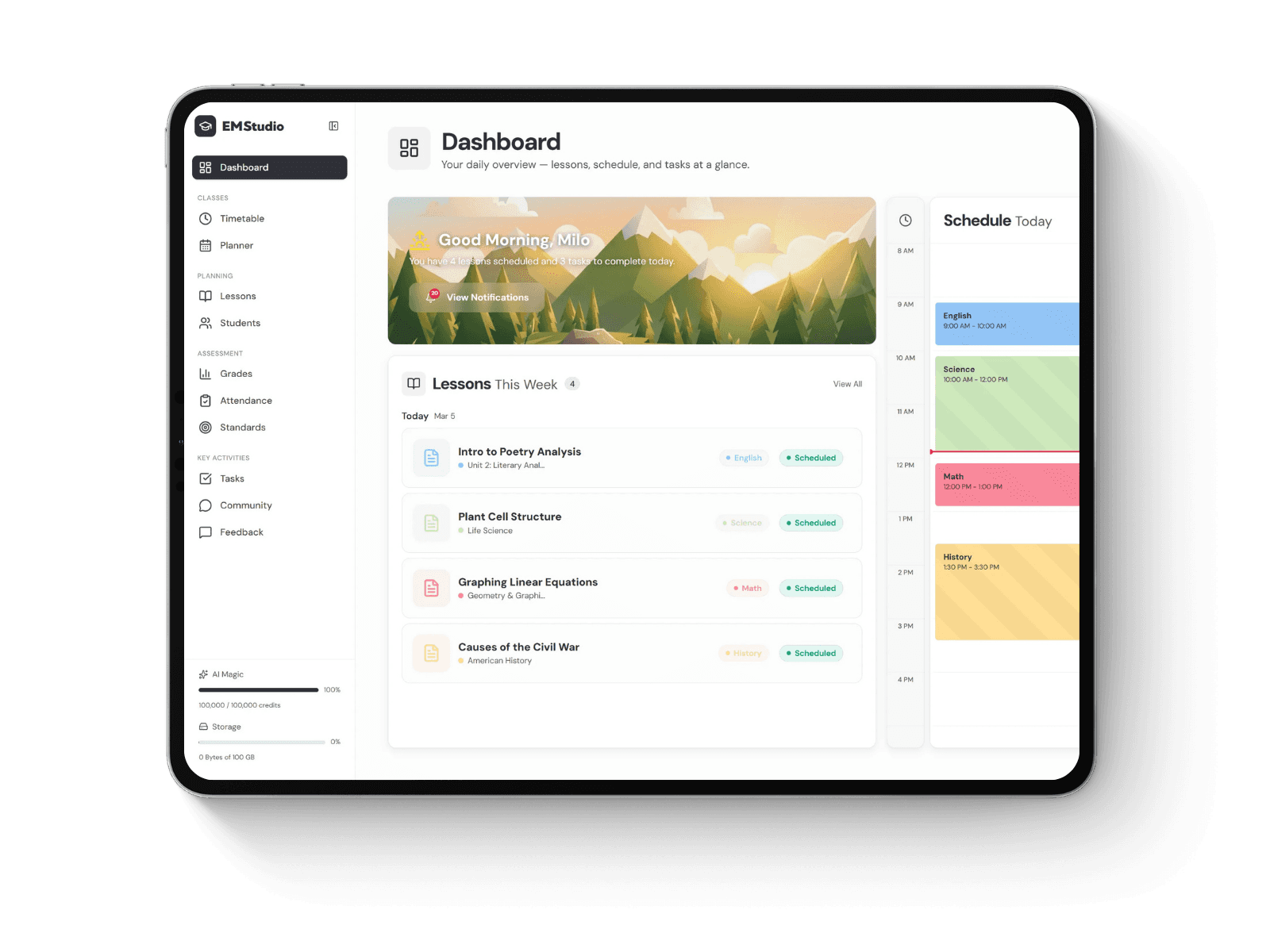
Still grading everything by hand?
EMStudio is a free teaching management app — manage your classes, students, lessons, and more!
Learn More
Table of Contents
What Is Critical Pedagogy? A Working Definition for Educators?
Critical pedagogy is an educational philosophy that examines how power structures, culture, and politics shape knowledge and schooling. Developed by Paulo Freire in his 1968 work Pedagogy of the Oppressed, it rejects the banking model of education where teachers deposit facts into passive students, instead promoting dialogue, problem-posing questions, and critical consciousness development. I first encountered Freire during my graduate work, and I remember thinking how much my own schooling had felt like that vault he described. That disconnect hit me hard. I was already teaching fifth grade, watching my students sit quietly while I deposited information I wasn't sure they needed.
The Philosophical Roots: Freire and the Banking Model
Freire developed the banking concept while working with illiterate peasants in Brazil during the 1960s. He watched traditional adult literacy programs treat students as empty vaults and teachers as depositors, stuffing heads with facts that maintained the status quo. This wasn't just bad teaching methodology; it was political. The foundational concepts of Paulo Freire emerged from this specific context where reading the word was tied directly to reading the world. Literacy meant power, and the banking model deliberately kept that power from the oppressed by making education a passive act of receiving rather than a practice of knowing. The history of critical pedagogy starts with these adult learners recognizing that their conditions weren't natural.
The banking model claims neutrality. It says, "I'm just teaching facts," while quietly training students to adapt to existing power structures rather than question them. Freire called this hegemony—the way dominant groups make their worldview seem like common sense.
When we fill worksheets with right answers and single interpretations, we aren't being objective. We're depositing a specific version of reality that keeps things as they are. I see this when standardized test prep trains kids to find the one correct answer instead of asking why those four options are the only choices given. The critical pedagogy philosophy of education exposes this myth of neutrality.
Problem-Posing Education vs. Traditional Instruction
Problem-posing education looks nothing like the banking model. Instead of depositing facts, teachers present problems coded in language from students' actual lives. I did this last year with my seventh graders when we examined why our school library had three times as many books about wars than about local community organizers. We started with their observation—"Why are all the hero stories about soldiers?"—and decoded it together.
They noticed the imbalance before I pointed it out. That's the critical pedagogy meaning in practice: starting with student reality, not curriculum pacing guides. It respects what they already know.
The mechanism matters. Teachers pose generative themes using student language, then investigate underlying conditions through dialogue. This creates what Freire called conscientization—the process of waking up to how social and political forces shape your daily experience. It leads to praxis, which is reflection plus action.
My seniors last semester moved from discussing food deserts in their neighborhood to mapping the actual distances families walk to buy fresh vegetables, then presenting their findings to the city council. The dialogic education approach made them stakeholders instead of spectators.
This shift changes everything. Traditional instruction asks students to adapt to the world as it is. Critical pedagogy asks them to imagine the world as it could be. The problem-posing education strategies work from fourth grade through twelfth because they start with what kids already know and care about, not abstract concepts from textbooks.
The history of critical pedagogy shows us that when we trust students to name their own problems, they engage more deeply than with any canned lesson I could create. They stop waiting for permission to think.
Why Does Critical Pedagogy Matter in K-12 Education Today?
Critical pedagogy matters because research suggests students engage more deeply when curriculum connects to lived experiences and social realities. It prepares learners to analyze systems of power, participate meaningfully in democracy, and address persistent equity gaps that standardized, one-size-fits-all educational models often fail to resolve for marginalized communities.
Studies consistently show that students from marginalized backgrounds disengage when schools treat their cultural knowledge as baggage to leave at the door. When we frame home languages, community histories, and family practices as assets rather than deficits, attendance improves and achievement rises. I have watched this play out in my own classroom—when 7th graders analyzed food deserts in their neighborhood instead of generic textbook examples, they wrote three times as much and actually asked for peer feedback.
None of this means abandoning standards or ignoring the reality of state testing. We teach within constraints. But critical pedagogy theory asks us to make space for students to question why certain knowledge gets tested while other wisdom gets ignored. It prepares them for citizenship beyond the bubble sheet, teaching them to recognize hegemony when they see it marketed as common sense.
John Dewey laid the groundwork for this in American schools a century ago, arguing that education should prepare students for democratic life, not just vocational training. Dewey focused on experiential learning and social growth, but Paulo Freire pushed further into explicitly political territory with his focus on liberation from oppression. Where Dewey hoped schools would strengthen democracy, Freire demanded they dismantle the banking model that deposits facts into passive recipients, replacing it with problem-posing education that sparks conscientization.
That distinction matters for K-12 teachers today. We can embrace dialogic education and praxis without staging a revolution in the cafeteria. When we shift from lecturing to genuine dialogue about texts that reflect students' realities, we are practicing critical pedagogy in education. This approach fits naturally with student-centered learning models that prioritize student voice and choice over teacher control. Reading Pedagogy of the Oppressed helps, but you do not need to be a philosopher to start. On critical pedagogy, my advice is simple: listen more than you speak, and let students name the problems they see before you rush to fix them.
The equity data is hard to ignore. Schools that treat diversity as a problem to solve see wider achievement gaps. Schools that use critical pedagogy to validate multiple perspectives and challenge dominant narratives see marginalized students persist through high school and into college at higher rates. We are not just teaching content; we are teaching students to read the world so they can write their own futures.
The Five Core Principles That Drive Critical Pedagogy
Skip even one of these five principles and you risk cult pedagogy. You get surface rituals like circle seating without transformative substance. I learned this when I ran a unit that looked radical but was just traditional banking model instruction wearing red pedagogy like a costume.
Dialogue as Democratic Practice
Freire called it the teacher-student with students-teachers. Dialogic education isn't discussion where I deposit information into passive recipients. It is reciprocal communication between subjects who teach each other.
I use facilitating democratic dialogue in the classroom protocols like Harkness or fishbowl. I track airtime to ensure no single voice dominates more than twenty percent. We start with words students actually use to describe their lived experiences, not the academic vocabulary I pre-selected from the textbook.
Praxis: The Cycle of Reflection and Action
Praxis means reflecting and acting upon the world to transform it, not logging volunteer hours. True praxis needs six weeks minimum. Weeks one and two bring concrete experience. Week three is for critical reflection. Weeks four and five hold action or exhibition. Week six yields new critical understanding.
This cycle beats charity work. When students ran a food drive, that was charity treating symptoms. When they mapped grocery stores against income levels for six weeks, they exposed food apartheid. That praxis targeted root causes, not symptoms.
Conscientization and Critical Consciousness
Conscientization means developing critical consciousness that recognizes social, political, and economic contradictions in daily life. Developmental readiness matters here. Seventh through twelfth graders can analyze systemic hegemony abstractly. My fifth graders stick to concrete fairness concepts only.
Last year my eighth graders analyzed local food deserts by plotting grocery locations against census data and interviewing corner store owners. They saw the contradiction between free-market narratives and their neighborhood's lack of fresh food. The moment they named the pattern as engineered rather than accidental, I watched critical consciousness emerge in real time.
Curriculum as Politically Situated
Curriculum is never neutral, no matter what the textbook reps tell you. Content analyses show standard textbooks reflect dominant cultural narratives eighty percent of the time, erasing red pedagogy perspectives.
I audit every unit first. I count historical figures by race and gender. I identify missing perspectives. I examine language used for colonization events. Critical pedagogy demands we challenge these omissions actively. I budget zero to two hundred dollars yearly for supplemental counter-narrative texts from independent publishers.
Student Agency and Authentic Voice
Agency goes deeper than student choice menus. In authentic critical pedagogy examples, learners generate the essential questions that drive the unit, not just select options from my predetermined list. Youth Participatory Action Research, or YPAR, is the gold standard here.
My students identify a community problem, design the study methodology, collect and analyze data, and present findings to actual decision-makers who can change policy. Last semester they presented zoning research to the city council. If the work never reaches an authentic audience beyond our classroom walls, it fails to validate student voice as legitimate knowledge worth hearing.
Critical Pedagogy vs. Traditional Models: What Actually Changes?
In critical pedagogy classrooms, the teacher shifts from authority figure to facilitator, reducing lecture time from roughly 80% to 40% of class. Knowledge becomes co-created through dialogue rather than deposited, while assessment shifts from standardized tests toward authentic demonstrations like exhibitions, portfolios, and student-designed projects with public audiences.
Dimension | Traditional Model | Critical Pedagogy Model | When to Use Traditional |
|---|---|---|---|
Teacher Role | Authority figure, "sage on stage." Teacher talk dominates 70-80% of class time. | Facilitator, "guide on side." Teacher talk drops to 40-50% to make room for dialogic education. | First 2-3 weeks of school while building relationships, or during safety emergencies requiring clear command. |
Knowledge Construction | Received knowledge. Textbook as objective truth. Banking model deposits information. | Co-created knowledge. Community elders and conflicting sources validated. Problem-posing approach. | When students lack foundational schema for inquiry, or when teaching non-negotiable safety procedures. |
Assessment | Standardization. 80% individual work, curve grading, multiple choice. Teacher-made rubrics. | Authentic performance assessments. 60% collaborative, exhibitions, portfolios. Co-constructed rubrics. | Diagnostic testing at year's start, or during district-mandated standardized testing windows. |
Teacher Role: Authority Figure vs. Facilitator
I used to think critical pedagogy meant abdicating all authority on day one. That was a mistake, and my 4th period devolved into chaos because of it. You still open as the "sage on stage," talking seventy to eighty percent of the time while establishing safety norms and relationships. But by week three, shift to forty or fifty percent teacher talk, becoming the "guide on side" who facilitates.
The danger is the unconscious power grab. When a student challenges your facilitation during a heated discussion, your instinct is to revert to teacher-as-boss. Without intentional protocols, you will reclaim authority. I keep a sticky note on my laptop reminding me to pause before intervening. That small delay prevents me from undermining the dialogic education we're building.
Knowledge Construction: Received vs. Co-Created
In traditional models, knowledge arrives pre-packaged. Students take Cornell notes on the textbook because it represents objective truth—the banking model Freire warned us about. I did this for years in AP History; kids memorized the "right" answer, recited it back, and forgot it by June. The goal was replication, not questioning.
Critical pedagogy examples look messier. Last semester, my seniors analyzed conflicting sources about redlining, including oral histories from community elders. Instead of seeking one correct answer sanctioned by the textbook, we used problem-posing methods to examine how hegemony shaped the official record. When Maria pointed out that the county map contradicted her grandmother's memory, we didn't dismiss the contradiction. We investigated it as evidence of co-created knowledge emerging through dialogue and praxis.
Assessment: Standardization vs. Authentic Demonstration
Standardized testing dominates traditional classrooms, with eighty percent of grades tied to individual multiple choice work. You write the rubric in August behind closed doors. The kids meet your criteria or they don't. It's efficient, but rarely produces conscientization.
In critical pedagogy classrooms, we use authentic performance assessments like exhibitions, weighting collaboration at sixty percent. Students co-construct rubrics by examining models, deciding what constitutes quality evidence. We still align to standards, but use backward design connecting them to inquiry rather than test prep. Last year, my juniors designed a museum exhibit on local labor history that met every state standard while reaching three hundred community members. That's assessment as praxis.
Major Branches: From Culturally Sustaining to Reality Pedagogy
Critical pedagogy isn't monolithic. Django Paris and Samy Alim introduced Culturally Sustaining Pedagogy in 2017, using multilingual text sets that treat indigenous languages as cognitive resources. Christopher Emdin published Reality Pedagogy in 2016 with the 5 C's framework. Ibram X. Kendi's antiracist approach applies equity audits to school policy regardless of intent. Jennifer Sandlin and colleagues defined Public Pedagogy through community documentation partnerships.
Choose your entry point based on your kids. If you serve Indigenous communities, start with Sandy Grande's Red Pedagogy. For urban youth of color, Reality Pedagogy offers immediate resonance. In predominantly white schools, Antiracist Pedagogy confronts systemic privilege. culturally responsive teaching practices provide the foundation, but these branches offer specific praxis.
Culturally Sustaining and Culturally Relevant Pedagogy
Paris and Alim's 2017 framework differs sharply from Ladson-Billings' 1995 work. Where culturally relevant teaching often treats home culture as a bridge to dominant norms, culturally sustaining pedagogy treats pluralism as permanent. It rejects the hegemony of assimilation outright.
The signature practice uses multilingual text sets positioning indigenous languages as cognitive resources, not transitional tools for English acquisition. I watch 7th graders code-switch intentionally in dual-language poetry units, analyzing how linguistic power structures operate when they move between Spanish and academic English. Teachers using anti-bias education frameworks find support here, but this treats bilingualism as intellectual capacity rather than deficit to overcome.
Reality Pedagogy and the #HipHopEd Movement
Christopher Emdin's Reality Pedagogy rests on the 5 C's framework. This isn't hip hop pedagogy as reward music or Friday fun. It's an intellectual framework validating urban youth cultural capital as serious academic currency.
Cosmopolitan: Creating community norms together.
Code: Honoring language and communication patterns.
Content: Connecting curriculum to student realities.
Competition: Academic battle as analysis—like rap battles debating historical interpretation.
Curation: Students as knowledge producers.
I've seen physics taught through breakdancing, making Content embodied rather than banking model memorization. This moves toward conscientization through problem-posing dialogic education.
Antiracist and Decolonial Approaches
Kendi's framework applied to schools means examining policies producing inequitable outcomes regardless of intent. The signature practice is the equity audit: tracking who gets into advanced courses, who gets suspended, which families get called back. Look at your referral data with unflinching honesty.
Decolonial pedagogy challenges Eurocentrism in STEM by centering indigenous scientific knowledge like ethnobotany or traditional land management. One history teacher contrasts the Declaration of Independence with the Haudenosaunee Confederacy's Great Law of Peace. Students see whose knowledge counts as legitimate, disrupting the narrative that treats indigenous wisdom as folklore rather than empirical science.
Public Pedagogy and Community-Engaged Learning
Public Pedagogy extends learning beyond school walls into museums, community centers, and digital spaces where youth already gather. Sandlin and colleagues emphasize that education happens everywhere, not just in classrooms bound by bells.
The hard requirement is partnership. You collaborate with community-based organizations for roughly 20% of instructional time, rethinking your calendar significantly. One example: students documenting neighborhood gentrification through digital storytelling alongside local historical societies. This is praxis—reflection and action bound together in community context rather than isolated academic exercise.
What Does Critical Pedagogy Look Like Across Grade Levels?
In elementary grades, critical pedagogy appears as investigations of playground fairness using picture books like Something Happened in Our Town. Middle schoolers analyze identity formation and media representation, while high school students conduct Youth Participatory Action Research (YPAR) addressing policy issues like discipline disparities through 6-8 week inquiry cycles. The approach shifts with cognitive development, moving from concrete community problems to abstract systemic analysis.
Elementary: Inquiry and Social Justice Foundations
Focus on concrete operations. K-2 students can't grasp abstract hegemony, but they understand who gets the good swings at recess. I use The Name Jar and Something Happened in Our Town to start conversations about kindness and fairness, not systemic oppression. Young children lack the emotional scaffolding to process historical trauma without anxiety, so we steer clear of graphic depictions of injustice.
We keep units short, about two to three weeks, and stay within the classroom community. Last year, my third graders spent ten days investigating who had access to the library's comfy chairs during independent reading. They mapped the seating chart, interviewed classmates, and proposed a fair rotation system.
That's praxis at eight years old: identifying a problem, analyzing power dynamics, and taking collective action. They learn that fairness means everyone's voice matters, not just equal minutes on the equipment.
Middle School: Identity Exploration and Civic Engagement
Middle schoolers are obsessed with identity formation, which makes this the perfect time to examine how media constructs reality. I run four to five week units where students deconstruct Instagram ads using protocols adapted from media literacy frameworks. They spot the banking model in action: commercials depositing ideas about who should look a certain way without dialogue.
Advisory periods become dialogic education spaces. Twenty minutes daily, we circle up using restorative questions. When our district proposed changing the bell schedule, my seventh graders investigated how it would impact sports and after-school jobs.
They presented to the school board, practicing civic engagement without drowning in abstraction. The personal is becoming political, but still grounded in their immediate experience. They recognize how problem-posing differs from the passive receipt of information.
High School: Systemic Analysis and Action Projects
High school is where critical pedagogy in education example becomes fully realized through YPAR. Students spend six to eight weeks investigating systemic issues like tracking policies or cafeteria food deserts. They read original Freire excerpts alongside district discipline data, moving from conscientization to authentic praxis.
Last spring, my juniors analyzed suspension records by race and presented findings to the city council. These aren't hypothetical exercises. I connect them with real-world action projects for high schoolers that demand public pedagogy—transforming private complaints into public discourse. The critical pedagogy ppt they create for community stakeholders carries more weight than any exam.
By senior year, they're problem-posing to power, not just to each other. These projects take time. Rushing through a two-week "social justice unit" defeats the purpose of deep inquiry.
Common Implementation Mistakes That Undermine Critical Pedagogy
Confusing Chaos with Student-Led Learning
I learned this the hard way in my first year attempting Freirean methods. I thought critical pedagogy meant removing all structure to resist the banking model. Within two weeks, my 10th graders were having lively debates about their weekend plans while the text sat ignored, and I was spending more time managing volume than managing thinking. The room looked free, but nothing stuck.
The warning sign hits you mid-class: the room buzzes with high energy and noise, but when you ask what intellectual question they explored, you get blank stares. They cannot articulate what they learned intellectually. That is not dialogic education; it is just chaos wearing a critical mask, and it burns out both you and your students fast.
My recovery protocol was simple but humbling. I returned to explicit community agreements written collectively on day one, then taught discussion protocols like Socratic seminar structures before attempting any problem-posing again. Freedom requires scaffolding. Effective classroom management is not the enemy of critical consciousness; it is the container that holds it safely.
Neglecting Standards Under the Guise of Relevance
Early in my praxis, I treated standards as pure hegemony to be rejected. I skipped the district pacing guide to pursue what I thought was authentic conscientization. Then quarterly assessments arrived, and my students could not identify point of view in historical documents. I had failed them while patting myself on the back for being relevant.
The error is assuming critical inquiry replaces standards rather than exceeds them. Now I use backward design to show exactly how analyzing primary sources meets CCSS.ELA-LITERACY.RH.9-10.6, which requires comparing authors' points of view. When students deconstruct whose voice is missing from a textbook chapter, they are mastering that specific literacy standard, not avoiding it.
I maintain pacing guides that map every critical unit to district quarterly assessments. This documentation protects the work when administrators question the approach. They see alignment; students see relevance. It is not selling out. It is proving that breaking from the banking model actually builds the skills the standards demand.
The Teacher-as-Savior Narrative
This one cuts deep because it feels like care when it is actually colonization. I have caught myself thinking, "They need me to give them voice," as if my students arrived voiceless. That is the white savior trope wearing critical pedagogy like a costume, and it destroys the trust necessary for real praxis to occur.
The warning sign is linguistic. Listen for yourself saying "I am rescuing them" or speaking for their experiences during discussions. If you are doing the giving, you are still centering yourself. True problem-posing requires students to generate the problems, not receive your generosity like a gift.
My prevention strategy includes mandatory cultural humility training and accountability partners from my students' communities who check my curriculum. I also track a co-construction checklist: by week six, students must generate sixty percent of our discussion questions. If I am still driving the inquiry, I have not decolonized the classroom. I have just decorated my cult pedagogy with colorful post-its.

Your First Semester Roadmap: Building Critical Pedagogy Step by Step
Audit Your Current Curriculum for Dominant Narratives
I always tell teachers to start with what they have before buying anything new. Weeks one and two are for auditing your current curriculum for dominant narratives. Pull your three most-used textbooks and create a simple matrix on a sheet of paper. Count the named historical figures by race and gender. Note whose stories get full chapters versus sidebar mentions. I did this with my 8th-grade U.S. history text and found 73% of named figures were white men. That number tells you exactly whose hegemony you're reinforcing through your current materials.
Pick two dominant narratives to complicate this semester. Maybe it's "Columbus discovered America" or "The Civil War was about states' rights." Write these on sticky notes on your desk where you'll see them daily. You don't need to rewrite your entire curriculum yet. Just commit to disrupting these specific stories with counter-evidence. You can streamline your curriculum audit by focusing only on these two threads rather than boiling the ocean and burning out by October.
For counter-narratives, you don't need a district grant. Budget zero to 150 dollars for supplemental texts or free resources. I pull excerpts from The Critical Pedagogy Reader by Darder and colleagues for theory, and use free lesson plans from the Zinn Education Project for classroom-ready materials. One well-chosen primary source that contradicts your textbook beats a shopping cart full of glossy workbooks that gather dust on the shelf.
Establish Community Agreements for Authentic Dialogue
Weeks three and four shift from materials to community. You need agreements before you need debates. I establish five non-negotiables with my classes and write them on chart paper:
"Step up, step back" for participation equity.
"Disagree with ideas not people."
"Impact over intent."
"Confidentiality."
"Right to pass."
Practice these protocols with low-stakes topics before touching anything controversial. Spend two weeks arguing about the best lunch spot in town or whether pineapple belongs on pizza. Let students violate the agreements naturally so you can pause and model the repair. This is praxis in real time. When someone interrupts, stop everything. Ask the group what agreement was broken and how we return to dialogic education. It feels clunky at first. That's the point. Better to stumble over pizza toppings than over police brutality statistics.
Enforce consistently starting week three. If you let "impact over intent" slide once because you're rushing to cover content, you've taught students that speed matters more than community. When I pause instruction to address a violated agreement, I'm showing that the process of learning is as important as the facts we memorize. This shift away from the banking model of education takes patience, but it builds the trust you need for real conscientization to happen in your room.
Pilot One Unit with Problem-Posing Essential Questions
Weeks five through fifteen are your pilot. Pick one unit to transform using problem-posing driving questions. Write three questions that are genuinely un-Google-able. "Who benefits from the narrative that poverty is caused by individual failure?" has no single correct answer that Wikipedia can provide. Neither does "How does your neighborhood's zoning history affect your school's funding?" If Google can answer it in three sentences, rewrite it until it requires original thought and local investigation. I spend a full planning period crafting these because everything else hangs on them.
Partner with one community organization. I once worked with a local food pantry for a unit on economic justice. Students interviewed staff, analyzed inventory data, and presented findings to the board. Find your local library, community center, or advocacy group. Authentic audiences change how students approach their work. They stop writing for the teacher and start writing for their neighbors. The quality jumps immediately when they know actual community members will read their words.
Plan a public exhibition by week fifteen. This could be a gallery walk in the cafeteria, a community forum at the public library, or a digital publication shared with local leaders. Student work must leave the classroom walls. When my 11th graders presented their research on school discipline disparities to our school board, they experienced what Freire meant by conscientization. They saw themselves as active subjects in their own education, not passive objects receiving information. That's critical pedagogy in action, and it starts with one brave unit.
Getting Started with Critical Pedagogy
I used to think critical pedagogy meant dropping my curriculum to teach heavy theory to third graders. It doesn't. It means noticing which textbook examples silently reinforce hegemony, then asking students what stories are missing. I started by swapping one reading passage and asking who wasn't at the table. The discussion that followed lasted twenty minutes.
My first real attempt failed because I lectured about oppression instead of letting kids uncover power dynamics themselves. That's just the banking model wearing new clothes. Real praxis happens when students question their immediate world—why the lunch line looks the way it does, whose history gets the mural downtown. Conscientization starts with your specific community, not abstract jargon.
Audit one lesson next week. Count whose voices dominate the text.
Replace one voice with a primary source from your students' actual neighborhood.
Ask three questions that have no answer in the teacher's edition.
Listen to the silence after you ask them. That pause is where the work begins.
What Is Critical Pedagogy? A Working Definition for Educators?
Critical pedagogy is an educational philosophy that examines how power structures, culture, and politics shape knowledge and schooling. Developed by Paulo Freire in his 1968 work Pedagogy of the Oppressed, it rejects the banking model of education where teachers deposit facts into passive students, instead promoting dialogue, problem-posing questions, and critical consciousness development. I first encountered Freire during my graduate work, and I remember thinking how much my own schooling had felt like that vault he described. That disconnect hit me hard. I was already teaching fifth grade, watching my students sit quietly while I deposited information I wasn't sure they needed.
The Philosophical Roots: Freire and the Banking Model
Freire developed the banking concept while working with illiterate peasants in Brazil during the 1960s. He watched traditional adult literacy programs treat students as empty vaults and teachers as depositors, stuffing heads with facts that maintained the status quo. This wasn't just bad teaching methodology; it was political. The foundational concepts of Paulo Freire emerged from this specific context where reading the word was tied directly to reading the world. Literacy meant power, and the banking model deliberately kept that power from the oppressed by making education a passive act of receiving rather than a practice of knowing. The history of critical pedagogy starts with these adult learners recognizing that their conditions weren't natural.
The banking model claims neutrality. It says, "I'm just teaching facts," while quietly training students to adapt to existing power structures rather than question them. Freire called this hegemony—the way dominant groups make their worldview seem like common sense.
When we fill worksheets with right answers and single interpretations, we aren't being objective. We're depositing a specific version of reality that keeps things as they are. I see this when standardized test prep trains kids to find the one correct answer instead of asking why those four options are the only choices given. The critical pedagogy philosophy of education exposes this myth of neutrality.
Problem-Posing Education vs. Traditional Instruction
Problem-posing education looks nothing like the banking model. Instead of depositing facts, teachers present problems coded in language from students' actual lives. I did this last year with my seventh graders when we examined why our school library had three times as many books about wars than about local community organizers. We started with their observation—"Why are all the hero stories about soldiers?"—and decoded it together.
They noticed the imbalance before I pointed it out. That's the critical pedagogy meaning in practice: starting with student reality, not curriculum pacing guides. It respects what they already know.
The mechanism matters. Teachers pose generative themes using student language, then investigate underlying conditions through dialogue. This creates what Freire called conscientization—the process of waking up to how social and political forces shape your daily experience. It leads to praxis, which is reflection plus action.
My seniors last semester moved from discussing food deserts in their neighborhood to mapping the actual distances families walk to buy fresh vegetables, then presenting their findings to the city council. The dialogic education approach made them stakeholders instead of spectators.
This shift changes everything. Traditional instruction asks students to adapt to the world as it is. Critical pedagogy asks them to imagine the world as it could be. The problem-posing education strategies work from fourth grade through twelfth because they start with what kids already know and care about, not abstract concepts from textbooks.
The history of critical pedagogy shows us that when we trust students to name their own problems, they engage more deeply than with any canned lesson I could create. They stop waiting for permission to think.
Why Does Critical Pedagogy Matter in K-12 Education Today?
Critical pedagogy matters because research suggests students engage more deeply when curriculum connects to lived experiences and social realities. It prepares learners to analyze systems of power, participate meaningfully in democracy, and address persistent equity gaps that standardized, one-size-fits-all educational models often fail to resolve for marginalized communities.
Studies consistently show that students from marginalized backgrounds disengage when schools treat their cultural knowledge as baggage to leave at the door. When we frame home languages, community histories, and family practices as assets rather than deficits, attendance improves and achievement rises. I have watched this play out in my own classroom—when 7th graders analyzed food deserts in their neighborhood instead of generic textbook examples, they wrote three times as much and actually asked for peer feedback.
None of this means abandoning standards or ignoring the reality of state testing. We teach within constraints. But critical pedagogy theory asks us to make space for students to question why certain knowledge gets tested while other wisdom gets ignored. It prepares them for citizenship beyond the bubble sheet, teaching them to recognize hegemony when they see it marketed as common sense.
John Dewey laid the groundwork for this in American schools a century ago, arguing that education should prepare students for democratic life, not just vocational training. Dewey focused on experiential learning and social growth, but Paulo Freire pushed further into explicitly political territory with his focus on liberation from oppression. Where Dewey hoped schools would strengthen democracy, Freire demanded they dismantle the banking model that deposits facts into passive recipients, replacing it with problem-posing education that sparks conscientization.
That distinction matters for K-12 teachers today. We can embrace dialogic education and praxis without staging a revolution in the cafeteria. When we shift from lecturing to genuine dialogue about texts that reflect students' realities, we are practicing critical pedagogy in education. This approach fits naturally with student-centered learning models that prioritize student voice and choice over teacher control. Reading Pedagogy of the Oppressed helps, but you do not need to be a philosopher to start. On critical pedagogy, my advice is simple: listen more than you speak, and let students name the problems they see before you rush to fix them.
The equity data is hard to ignore. Schools that treat diversity as a problem to solve see wider achievement gaps. Schools that use critical pedagogy to validate multiple perspectives and challenge dominant narratives see marginalized students persist through high school and into college at higher rates. We are not just teaching content; we are teaching students to read the world so they can write their own futures.
The Five Core Principles That Drive Critical Pedagogy
Skip even one of these five principles and you risk cult pedagogy. You get surface rituals like circle seating without transformative substance. I learned this when I ran a unit that looked radical but was just traditional banking model instruction wearing red pedagogy like a costume.
Dialogue as Democratic Practice
Freire called it the teacher-student with students-teachers. Dialogic education isn't discussion where I deposit information into passive recipients. It is reciprocal communication between subjects who teach each other.
I use facilitating democratic dialogue in the classroom protocols like Harkness or fishbowl. I track airtime to ensure no single voice dominates more than twenty percent. We start with words students actually use to describe their lived experiences, not the academic vocabulary I pre-selected from the textbook.
Praxis: The Cycle of Reflection and Action
Praxis means reflecting and acting upon the world to transform it, not logging volunteer hours. True praxis needs six weeks minimum. Weeks one and two bring concrete experience. Week three is for critical reflection. Weeks four and five hold action or exhibition. Week six yields new critical understanding.
This cycle beats charity work. When students ran a food drive, that was charity treating symptoms. When they mapped grocery stores against income levels for six weeks, they exposed food apartheid. That praxis targeted root causes, not symptoms.
Conscientization and Critical Consciousness
Conscientization means developing critical consciousness that recognizes social, political, and economic contradictions in daily life. Developmental readiness matters here. Seventh through twelfth graders can analyze systemic hegemony abstractly. My fifth graders stick to concrete fairness concepts only.
Last year my eighth graders analyzed local food deserts by plotting grocery locations against census data and interviewing corner store owners. They saw the contradiction between free-market narratives and their neighborhood's lack of fresh food. The moment they named the pattern as engineered rather than accidental, I watched critical consciousness emerge in real time.
Curriculum as Politically Situated
Curriculum is never neutral, no matter what the textbook reps tell you. Content analyses show standard textbooks reflect dominant cultural narratives eighty percent of the time, erasing red pedagogy perspectives.
I audit every unit first. I count historical figures by race and gender. I identify missing perspectives. I examine language used for colonization events. Critical pedagogy demands we challenge these omissions actively. I budget zero to two hundred dollars yearly for supplemental counter-narrative texts from independent publishers.
Student Agency and Authentic Voice
Agency goes deeper than student choice menus. In authentic critical pedagogy examples, learners generate the essential questions that drive the unit, not just select options from my predetermined list. Youth Participatory Action Research, or YPAR, is the gold standard here.
My students identify a community problem, design the study methodology, collect and analyze data, and present findings to actual decision-makers who can change policy. Last semester they presented zoning research to the city council. If the work never reaches an authentic audience beyond our classroom walls, it fails to validate student voice as legitimate knowledge worth hearing.
Critical Pedagogy vs. Traditional Models: What Actually Changes?
In critical pedagogy classrooms, the teacher shifts from authority figure to facilitator, reducing lecture time from roughly 80% to 40% of class. Knowledge becomes co-created through dialogue rather than deposited, while assessment shifts from standardized tests toward authentic demonstrations like exhibitions, portfolios, and student-designed projects with public audiences.
Dimension | Traditional Model | Critical Pedagogy Model | When to Use Traditional |
|---|---|---|---|
Teacher Role | Authority figure, "sage on stage." Teacher talk dominates 70-80% of class time. | Facilitator, "guide on side." Teacher talk drops to 40-50% to make room for dialogic education. | First 2-3 weeks of school while building relationships, or during safety emergencies requiring clear command. |
Knowledge Construction | Received knowledge. Textbook as objective truth. Banking model deposits information. | Co-created knowledge. Community elders and conflicting sources validated. Problem-posing approach. | When students lack foundational schema for inquiry, or when teaching non-negotiable safety procedures. |
Assessment | Standardization. 80% individual work, curve grading, multiple choice. Teacher-made rubrics. | Authentic performance assessments. 60% collaborative, exhibitions, portfolios. Co-constructed rubrics. | Diagnostic testing at year's start, or during district-mandated standardized testing windows. |
Teacher Role: Authority Figure vs. Facilitator
I used to think critical pedagogy meant abdicating all authority on day one. That was a mistake, and my 4th period devolved into chaos because of it. You still open as the "sage on stage," talking seventy to eighty percent of the time while establishing safety norms and relationships. But by week three, shift to forty or fifty percent teacher talk, becoming the "guide on side" who facilitates.
The danger is the unconscious power grab. When a student challenges your facilitation during a heated discussion, your instinct is to revert to teacher-as-boss. Without intentional protocols, you will reclaim authority. I keep a sticky note on my laptop reminding me to pause before intervening. That small delay prevents me from undermining the dialogic education we're building.
Knowledge Construction: Received vs. Co-Created
In traditional models, knowledge arrives pre-packaged. Students take Cornell notes on the textbook because it represents objective truth—the banking model Freire warned us about. I did this for years in AP History; kids memorized the "right" answer, recited it back, and forgot it by June. The goal was replication, not questioning.
Critical pedagogy examples look messier. Last semester, my seniors analyzed conflicting sources about redlining, including oral histories from community elders. Instead of seeking one correct answer sanctioned by the textbook, we used problem-posing methods to examine how hegemony shaped the official record. When Maria pointed out that the county map contradicted her grandmother's memory, we didn't dismiss the contradiction. We investigated it as evidence of co-created knowledge emerging through dialogue and praxis.
Assessment: Standardization vs. Authentic Demonstration
Standardized testing dominates traditional classrooms, with eighty percent of grades tied to individual multiple choice work. You write the rubric in August behind closed doors. The kids meet your criteria or they don't. It's efficient, but rarely produces conscientization.
In critical pedagogy classrooms, we use authentic performance assessments like exhibitions, weighting collaboration at sixty percent. Students co-construct rubrics by examining models, deciding what constitutes quality evidence. We still align to standards, but use backward design connecting them to inquiry rather than test prep. Last year, my juniors designed a museum exhibit on local labor history that met every state standard while reaching three hundred community members. That's assessment as praxis.
Major Branches: From Culturally Sustaining to Reality Pedagogy
Critical pedagogy isn't monolithic. Django Paris and Samy Alim introduced Culturally Sustaining Pedagogy in 2017, using multilingual text sets that treat indigenous languages as cognitive resources. Christopher Emdin published Reality Pedagogy in 2016 with the 5 C's framework. Ibram X. Kendi's antiracist approach applies equity audits to school policy regardless of intent. Jennifer Sandlin and colleagues defined Public Pedagogy through community documentation partnerships.
Choose your entry point based on your kids. If you serve Indigenous communities, start with Sandy Grande's Red Pedagogy. For urban youth of color, Reality Pedagogy offers immediate resonance. In predominantly white schools, Antiracist Pedagogy confronts systemic privilege. culturally responsive teaching practices provide the foundation, but these branches offer specific praxis.
Culturally Sustaining and Culturally Relevant Pedagogy
Paris and Alim's 2017 framework differs sharply from Ladson-Billings' 1995 work. Where culturally relevant teaching often treats home culture as a bridge to dominant norms, culturally sustaining pedagogy treats pluralism as permanent. It rejects the hegemony of assimilation outright.
The signature practice uses multilingual text sets positioning indigenous languages as cognitive resources, not transitional tools for English acquisition. I watch 7th graders code-switch intentionally in dual-language poetry units, analyzing how linguistic power structures operate when they move between Spanish and academic English. Teachers using anti-bias education frameworks find support here, but this treats bilingualism as intellectual capacity rather than deficit to overcome.
Reality Pedagogy and the #HipHopEd Movement
Christopher Emdin's Reality Pedagogy rests on the 5 C's framework. This isn't hip hop pedagogy as reward music or Friday fun. It's an intellectual framework validating urban youth cultural capital as serious academic currency.
Cosmopolitan: Creating community norms together.
Code: Honoring language and communication patterns.
Content: Connecting curriculum to student realities.
Competition: Academic battle as analysis—like rap battles debating historical interpretation.
Curation: Students as knowledge producers.
I've seen physics taught through breakdancing, making Content embodied rather than banking model memorization. This moves toward conscientization through problem-posing dialogic education.
Antiracist and Decolonial Approaches
Kendi's framework applied to schools means examining policies producing inequitable outcomes regardless of intent. The signature practice is the equity audit: tracking who gets into advanced courses, who gets suspended, which families get called back. Look at your referral data with unflinching honesty.
Decolonial pedagogy challenges Eurocentrism in STEM by centering indigenous scientific knowledge like ethnobotany or traditional land management. One history teacher contrasts the Declaration of Independence with the Haudenosaunee Confederacy's Great Law of Peace. Students see whose knowledge counts as legitimate, disrupting the narrative that treats indigenous wisdom as folklore rather than empirical science.
Public Pedagogy and Community-Engaged Learning
Public Pedagogy extends learning beyond school walls into museums, community centers, and digital spaces where youth already gather. Sandlin and colleagues emphasize that education happens everywhere, not just in classrooms bound by bells.
The hard requirement is partnership. You collaborate with community-based organizations for roughly 20% of instructional time, rethinking your calendar significantly. One example: students documenting neighborhood gentrification through digital storytelling alongside local historical societies. This is praxis—reflection and action bound together in community context rather than isolated academic exercise.
What Does Critical Pedagogy Look Like Across Grade Levels?
In elementary grades, critical pedagogy appears as investigations of playground fairness using picture books like Something Happened in Our Town. Middle schoolers analyze identity formation and media representation, while high school students conduct Youth Participatory Action Research (YPAR) addressing policy issues like discipline disparities through 6-8 week inquiry cycles. The approach shifts with cognitive development, moving from concrete community problems to abstract systemic analysis.
Elementary: Inquiry and Social Justice Foundations
Focus on concrete operations. K-2 students can't grasp abstract hegemony, but they understand who gets the good swings at recess. I use The Name Jar and Something Happened in Our Town to start conversations about kindness and fairness, not systemic oppression. Young children lack the emotional scaffolding to process historical trauma without anxiety, so we steer clear of graphic depictions of injustice.
We keep units short, about two to three weeks, and stay within the classroom community. Last year, my third graders spent ten days investigating who had access to the library's comfy chairs during independent reading. They mapped the seating chart, interviewed classmates, and proposed a fair rotation system.
That's praxis at eight years old: identifying a problem, analyzing power dynamics, and taking collective action. They learn that fairness means everyone's voice matters, not just equal minutes on the equipment.
Middle School: Identity Exploration and Civic Engagement
Middle schoolers are obsessed with identity formation, which makes this the perfect time to examine how media constructs reality. I run four to five week units where students deconstruct Instagram ads using protocols adapted from media literacy frameworks. They spot the banking model in action: commercials depositing ideas about who should look a certain way without dialogue.
Advisory periods become dialogic education spaces. Twenty minutes daily, we circle up using restorative questions. When our district proposed changing the bell schedule, my seventh graders investigated how it would impact sports and after-school jobs.
They presented to the school board, practicing civic engagement without drowning in abstraction. The personal is becoming political, but still grounded in their immediate experience. They recognize how problem-posing differs from the passive receipt of information.
High School: Systemic Analysis and Action Projects
High school is where critical pedagogy in education example becomes fully realized through YPAR. Students spend six to eight weeks investigating systemic issues like tracking policies or cafeteria food deserts. They read original Freire excerpts alongside district discipline data, moving from conscientization to authentic praxis.
Last spring, my juniors analyzed suspension records by race and presented findings to the city council. These aren't hypothetical exercises. I connect them with real-world action projects for high schoolers that demand public pedagogy—transforming private complaints into public discourse. The critical pedagogy ppt they create for community stakeholders carries more weight than any exam.
By senior year, they're problem-posing to power, not just to each other. These projects take time. Rushing through a two-week "social justice unit" defeats the purpose of deep inquiry.
Common Implementation Mistakes That Undermine Critical Pedagogy
Confusing Chaos with Student-Led Learning
I learned this the hard way in my first year attempting Freirean methods. I thought critical pedagogy meant removing all structure to resist the banking model. Within two weeks, my 10th graders were having lively debates about their weekend plans while the text sat ignored, and I was spending more time managing volume than managing thinking. The room looked free, but nothing stuck.
The warning sign hits you mid-class: the room buzzes with high energy and noise, but when you ask what intellectual question they explored, you get blank stares. They cannot articulate what they learned intellectually. That is not dialogic education; it is just chaos wearing a critical mask, and it burns out both you and your students fast.
My recovery protocol was simple but humbling. I returned to explicit community agreements written collectively on day one, then taught discussion protocols like Socratic seminar structures before attempting any problem-posing again. Freedom requires scaffolding. Effective classroom management is not the enemy of critical consciousness; it is the container that holds it safely.
Neglecting Standards Under the Guise of Relevance
Early in my praxis, I treated standards as pure hegemony to be rejected. I skipped the district pacing guide to pursue what I thought was authentic conscientization. Then quarterly assessments arrived, and my students could not identify point of view in historical documents. I had failed them while patting myself on the back for being relevant.
The error is assuming critical inquiry replaces standards rather than exceeds them. Now I use backward design to show exactly how analyzing primary sources meets CCSS.ELA-LITERACY.RH.9-10.6, which requires comparing authors' points of view. When students deconstruct whose voice is missing from a textbook chapter, they are mastering that specific literacy standard, not avoiding it.
I maintain pacing guides that map every critical unit to district quarterly assessments. This documentation protects the work when administrators question the approach. They see alignment; students see relevance. It is not selling out. It is proving that breaking from the banking model actually builds the skills the standards demand.
The Teacher-as-Savior Narrative
This one cuts deep because it feels like care when it is actually colonization. I have caught myself thinking, "They need me to give them voice," as if my students arrived voiceless. That is the white savior trope wearing critical pedagogy like a costume, and it destroys the trust necessary for real praxis to occur.
The warning sign is linguistic. Listen for yourself saying "I am rescuing them" or speaking for their experiences during discussions. If you are doing the giving, you are still centering yourself. True problem-posing requires students to generate the problems, not receive your generosity like a gift.
My prevention strategy includes mandatory cultural humility training and accountability partners from my students' communities who check my curriculum. I also track a co-construction checklist: by week six, students must generate sixty percent of our discussion questions. If I am still driving the inquiry, I have not decolonized the classroom. I have just decorated my cult pedagogy with colorful post-its.
Your First Semester Roadmap: Building Critical Pedagogy Step by Step
Audit Your Current Curriculum for Dominant Narratives
I always tell teachers to start with what they have before buying anything new. Weeks one and two are for auditing your current curriculum for dominant narratives. Pull your three most-used textbooks and create a simple matrix on a sheet of paper. Count the named historical figures by race and gender. Note whose stories get full chapters versus sidebar mentions. I did this with my 8th-grade U.S. history text and found 73% of named figures were white men. That number tells you exactly whose hegemony you're reinforcing through your current materials.
Pick two dominant narratives to complicate this semester. Maybe it's "Columbus discovered America" or "The Civil War was about states' rights." Write these on sticky notes on your desk where you'll see them daily. You don't need to rewrite your entire curriculum yet. Just commit to disrupting these specific stories with counter-evidence. You can streamline your curriculum audit by focusing only on these two threads rather than boiling the ocean and burning out by October.
For counter-narratives, you don't need a district grant. Budget zero to 150 dollars for supplemental texts or free resources. I pull excerpts from The Critical Pedagogy Reader by Darder and colleagues for theory, and use free lesson plans from the Zinn Education Project for classroom-ready materials. One well-chosen primary source that contradicts your textbook beats a shopping cart full of glossy workbooks that gather dust on the shelf.
Establish Community Agreements for Authentic Dialogue
Weeks three and four shift from materials to community. You need agreements before you need debates. I establish five non-negotiables with my classes and write them on chart paper:
"Step up, step back" for participation equity.
"Disagree with ideas not people."
"Impact over intent."
"Confidentiality."
"Right to pass."
Practice these protocols with low-stakes topics before touching anything controversial. Spend two weeks arguing about the best lunch spot in town or whether pineapple belongs on pizza. Let students violate the agreements naturally so you can pause and model the repair. This is praxis in real time. When someone interrupts, stop everything. Ask the group what agreement was broken and how we return to dialogic education. It feels clunky at first. That's the point. Better to stumble over pizza toppings than over police brutality statistics.
Enforce consistently starting week three. If you let "impact over intent" slide once because you're rushing to cover content, you've taught students that speed matters more than community. When I pause instruction to address a violated agreement, I'm showing that the process of learning is as important as the facts we memorize. This shift away from the banking model of education takes patience, but it builds the trust you need for real conscientization to happen in your room.
Pilot One Unit with Problem-Posing Essential Questions
Weeks five through fifteen are your pilot. Pick one unit to transform using problem-posing driving questions. Write three questions that are genuinely un-Google-able. "Who benefits from the narrative that poverty is caused by individual failure?" has no single correct answer that Wikipedia can provide. Neither does "How does your neighborhood's zoning history affect your school's funding?" If Google can answer it in three sentences, rewrite it until it requires original thought and local investigation. I spend a full planning period crafting these because everything else hangs on them.
Partner with one community organization. I once worked with a local food pantry for a unit on economic justice. Students interviewed staff, analyzed inventory data, and presented findings to the board. Find your local library, community center, or advocacy group. Authentic audiences change how students approach their work. They stop writing for the teacher and start writing for their neighbors. The quality jumps immediately when they know actual community members will read their words.
Plan a public exhibition by week fifteen. This could be a gallery walk in the cafeteria, a community forum at the public library, or a digital publication shared with local leaders. Student work must leave the classroom walls. When my 11th graders presented their research on school discipline disparities to our school board, they experienced what Freire meant by conscientization. They saw themselves as active subjects in their own education, not passive objects receiving information. That's critical pedagogy in action, and it starts with one brave unit.
Getting Started with Critical Pedagogy
I used to think critical pedagogy meant dropping my curriculum to teach heavy theory to third graders. It doesn't. It means noticing which textbook examples silently reinforce hegemony, then asking students what stories are missing. I started by swapping one reading passage and asking who wasn't at the table. The discussion that followed lasted twenty minutes.
My first real attempt failed because I lectured about oppression instead of letting kids uncover power dynamics themselves. That's just the banking model wearing new clothes. Real praxis happens when students question their immediate world—why the lunch line looks the way it does, whose history gets the mural downtown. Conscientization starts with your specific community, not abstract jargon.
Audit one lesson next week. Count whose voices dominate the text.
Replace one voice with a primary source from your students' actual neighborhood.
Ask three questions that have no answer in the teacher's edition.
Listen to the silence after you ask them. That pause is where the work begins.
Still grading everything by hand?
EMStudio is a free teaching management app — manage your classes, students, lessons, and more!
Learn More
Still grading everything by hand?
EMStudio is a free teaching management app — manage your classes, students, lessons, and more!
Learn More




Notion4Teachers
Notion templates to simplify administrative tasks and enhance your teaching experience.



2026 Notion4Teachers. All Rights Reserved.
Notion4Teachers
Notion templates to simplify administrative tasks and enhance your teaching experience.
2026 Notion4Teachers. All Rights Reserved.
Notion4Teachers
Notion templates to simplify administrative tasks and enhance your teaching experience.
2026 Notion4Teachers. All Rights Reserved.