
Pedagogy of the Oppressed: A Teacher's Guide
Pedagogy of the Oppressed: A Teacher's Guide

Article by
Milo
ESL Content Coordinator & Educator
ESL Content Coordinator & Educator
All Posts
You've probably heard pedagogy of the oppressed dropped in a district PD or spotted it on a required reading list. Someone mentioned the banking concept of education and told you to stop treating kids like empty vaults. But nobody explained how to actually do this while managing 32 sixth-graders and a fire drill schedule.
Paulo Freire wrote the book in 1968, and yes, it's thick with theory. But strip away the political philosophy and you get practical tools: the dialogical method, problem-posing education, and conscientization—which just means helping kids recognize they can think critically about their own world. These aren't college seminar tricks. They work in elementary reading circles and high school history debates.
This guide cuts the jargon. We'll look at what Freire actually suggested, why critical pedagogy matters when half your class checks out during lecture, and how to apply praxis—the cycle of reflection and action—without redesigning your entire curriculum. You don't need to be a philosopher. You just need strategies that respect your students' brains.
Still grading everything by hand?
EMStudio is a free teaching management app — manage your classes, students, lessons, and more!
Learn More
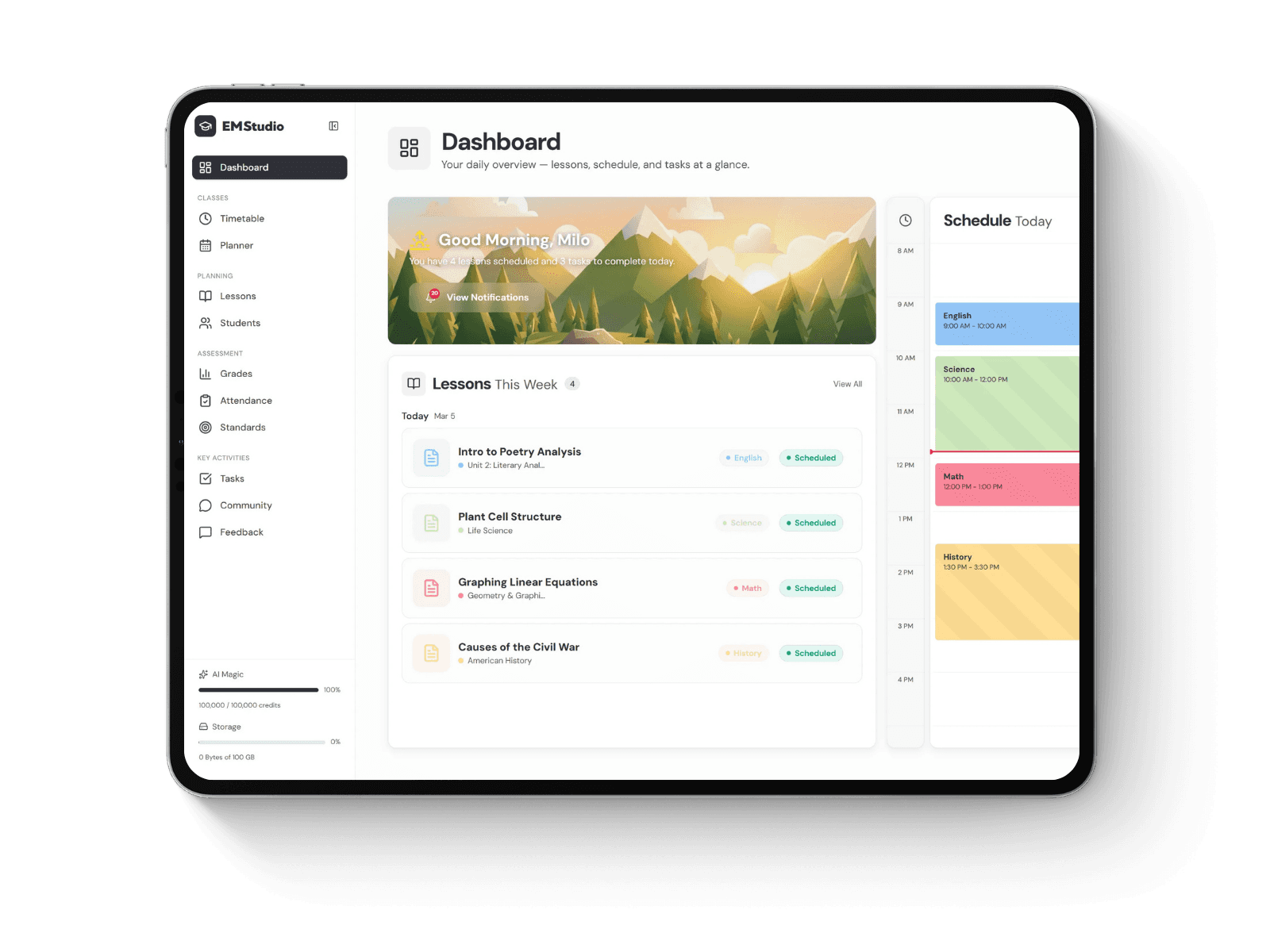
Still grading everything by hand?
EMStudio is a free teaching management app — manage your classes, students, lessons, and more!
Learn More
Table of Contents
What Is Pedagogy of the Oppressed?
Pedagogy of the Oppressed is Paulo Freire's 1968 critical pedagogy framework that rejects banking education—where teachers deposit facts into passive students—in favor of problem-posing education. It develops critical consciousness through dialogue between teachers and students as co-investigators who name reality in order to transform it.
Freire developed these ideas teaching literacy to 300 adult peasant farmers in Northeast Brazil during the early 1960s. He wasn't handing out phonics worksheets. He showed up with generative words—terms like terra (land), trabalho (work), and fome (hunger)—that reflected their actual struggles. When a student read the word "plough" while holding the rusted tool they used daily, they weren't just decoding letters. They were recognizing their own knowledge as valid and worth examining. This approach stands in contrast to other foundational pedagogical frameworks that treat students as blank slates.
Banking Education vs. Problem-Posing Education
Freire called traditional teaching the banking concept of education. Picture students as empty vaults and the teacher making deposits. You see this in five specific teacher behaviors: extended lecturing where you talk for twenty minutes without checking what students already know; standardized testing used as a sorting mechanism rather than a diagnostic tool; desks arranged in rigid rows facing forward like an audience at a play; prohibiting questions about relevance ("Because it's on the test" shuts down inquiry); and predetermined outcomes where you decide the learning target before you meet the class, allowing no room for student input on what matters.
Now flip the script. In problem-posing education, the teacher-student becomes student-teacher. Take a standard biology unit on photosynthesis. Instead of lecturing on chlorophyll while kids copy definitions into notebooks, you start with a community crisis: the local grocery store closed, creating a food desert two miles wide, and the school garden failed last season. Students generate questions before you introduce any content. Why did the oak trees in the vacant lot survive the drought when the tomatoes died? They collect soil samples, interview elderly neighbors about farming practices, and map sunlight patterns. You introduce the Calvin cycle only when they hit a wall explaining how plants manufacture sugar without rich topsoil. The content serves the investigation, not the other way around.
Conscientization and Critical Consciousness
Freire coined the Portuguese term consciencização—conscientization—to describe the process of recognizing social, political, and economic contradictions and taking action against oppressive elements. It differs from mere awareness or consciousness-raising because it demands praxis: the constant interplay of reflection and action. You don't truly know something until you act on it and then reflect on that action. This connects directly to developing critical consciousness in your classroom.
Students typically move through distinct stages. First comes magical consciousness, or intransitive thought—pure fatalism. You hear a student say: "I failed the reading test because I'm just unlucky," or "My family is cursed with bad grades." Next emerges naive consciousness—blaming the individual. "I failed because I didn't try hard enough. If I just work harder next time, I'll make it." Finally, students reach critical consciousness—structural analysis. "These standardized assessment tools don't account for my linguistic assets as a bilingual speaker, and that's by design. The system was built to sort me into a specific track, not to measure what I actually know." The shift happens when students stop asking "How do I fit into the system?" and start asking "Who built this system, who maintains it, and who benefits from my failure?"
Dialogue as the Foundation of Humanization
For Freire, dialogue is not classroom discussion or casual conversation. It is the encounter between humans mediated by the world to name and transform reality. This differs sharply from Socratic questioning, which essentially leads students toward answers the teacher has already predetermined. True dialogue begins with student-generated words and builds theory from their lived experience.
Three specific protocols create the conditions for genuine dialogue:
Wait Time 3: You wait three full seconds after asking a question before calling on anyone. This disrupts the teacher's control of the tempo and builds epistemological curiosity by signaling that complex thought is valued over quick recall.
No Hands: You use randomized calling or a deck of name cards instead of taking raised hands. This democratizes participation so that loud, confident voices don't dominate, forcing you to hear from the back row and the quiet kids.
Chalk Talk: You post chart paper on walls and students write responses silently with markers. Introverted processors get equal footing with verbal processors, and you watch the collective thinking develop in real time without the pressure of immediate speech.
How Does Paulo Freire's Method Actually Work?
Freire's method operates through praxis—a continuous cycle of action, critical reflection, and new action—where teachers and students collaboratively investigate generative themes from the community. The teacher acts as a facilitator, not an expert, using dialogue to help students move from perception of their reality to critical intervention in that reality. You don't lecture about injustice; you help students name their own reality, then act on it.
The Cycle of Praxis: Action and Reflection
I ran this cycle with sophomores studying environmental justice last spring. It only works if you stop treating class time as content delivery and start treating it as investigation where students collect the data.
First comes the investigation of generative themes through community walks. Twenty minutes. Students carry phones through their own blocks, documenting storm drains that flood, photographing the bus stops where they wait in the dark, mapping the invisible infrastructure of their daily lives. Last year, my kids spent twenty minutes investigating water quality behind the school. They didn't need me to tell them the creek was polluted. They could smell it. But when they mapped the drainage against fast-food dumpster locations, they started seeing systems instead of accidents.
Next, thirty minutes of thematic decoding through visual codifications. Students layer photos over census maps, creating concrete representations of abstract problems. One student projected an image of the intersection where three kids got mugged last year, then overlaid the city's "safe corridor" map. The gap between the two images does the teaching. You say nothing. You let them look and name the contradiction.
Then twenty-five minutes of problematization. You ask the questions that sting. Why does this exist? Who profits from this arrangement? You avoid rhetorical questions with obvious answers. This is Socratic inquiry that hurts. Students move from "that's just how it is" to recognizing that someone built it this way on purpose. That's conscientization beginning—the awakening to see reality as changeable.
Finally, fifteen minutes planning direct action. Reflection must lead to action, not more discussion. My kids moved from analyzing those pollution maps to presenting findings at city council. Another group organized a community garden on the vacant lot behind campus. Praxis means the cycle continues: action, reflection, new action. If you stop at reflection, you're just having a therapy session.
The Teacher as Facilitator, Not Expert
You have to kill your inner sage. Harder than it sounds after years of being the smartest person in the room. But if you're serious about facilitating meaningful classroom dialogue, you have to stop validating every answer as right or wrong.
In the banking concept of education, you deposit facts, validate correct responses, and control the clock. In problem-posing education, you pose contradictions and follow student inquiry. The behavioral shifts look like this:
Banking Behaviors | Facilitation Behaviors |
|---|---|
Provides answers before questions fully form | Poses contradictions and limit-situations |
Validates responses as correct or incorrect | Validates student knowledge as legitimate |
Controls pacing and sequence rigidly | Follows student inquiry, adjusts timing |
Uses expert language: "You must understand" | Uses co-investigator language: "We seek together" |
Covers all content | Provides minimum critical universe only |
The shift feels terrifying. When a student asks "Why do we have standardized tests?" the banking teacher explains the policy. The facilitator asks, "Who gains when you're too tired to question the curriculum?" and lets the silence hang. You're not being unhelpful. You're being honest about complexity.
Then there's the limit-situation. You introduce content that challenges students' perceived limits—the boundaries they think are natural or unchangeable. I showed my class state statistics on school funding disparities alongside photos of their own broken AC units and 35-kid classes. I didn't say "this is unfair." I let the numbers sit there. The tension does the teaching. You maintain that discomfort without prescribing the solution. They have to name the problem and the path themselves. That's the difference between charity work and freire pedagogy of the oppressed.
Generative Themes From Students' Lived Reality
You cannot pick "recycling" because it fits your science standards. Generative themes are the concrete representation of the existential situation—the actual reality students inhabit that contains both their current oppression and the possibility of transformation. They're discovered through investigation, not selected from a social justice Pinterest board. Teacher-selected themes fail because students can smell the inauthenticity. When you decide the unit is about recycling because you need to hit those environmental standards, you're still depositing knowledge. You're just using flashier content.
Freire's 1968 text outlines epochal units—historical moments where contradictions become visible and speakable. You find these by listening to the community, not assuming you know what matters. Here's the extraction method:
Conduct anonymous community interviews. Minimum fifteen. Use open-ended prompts: "What makes this neighborhood hard to live in?" "When do you feel powerless walking home?" Don't suggest answers. Just listen and record exactly what they say.
Code responses for recurring contradictions or limit-situations. If eight students mention crossing dangerous intersections without signals, that's not anecdote. That's data revealing an epochal unit where human safety conflicts with city planning priorities.
Select themes that emerge from multiple sources and can be investigated using your academic standards. The intersection safety theme works for physics (force and motion), civics (urban planning), and math (statistical analysis). That's your unit. Not recycling.
When themes truly come from students' lived reality, the shift from perception to critical intervention happens organically. They recognize the difference between the world as given and the world as possible. That's when pedagogy of the oppressed stops being theory in a textbook and becomes the actual work of education.
Why Does Pedagogy of the Oppressed Matter for K-12 Education Today?
It matters because research indicates student engagement drops significantly under compliance-based models after elementary grades. Critical pedagogy offers measurable improvements in retention and civic participation by centering student agency, particularly for marginalized learners who experience traditional banking concept of education as cultural domination rather than authentic humanization. When you shift from depositing facts to genuine dialogical method, you stop managing bodies and start developing minds.
Moving Beyond Compliance-Based Classrooms
John Hattie's Visible Learning research gives us hard numbers on what actually moves achievement. Collective teacher efficacy scores an effect size of 1.57, and self-reported grades hit 1.33—both high-impact practices that require student agency, not passive reception. Meanwhile, engagement research shows sharp declines after 4th grade when pedagogy of the oppressed education principles are ignored in favor of control. The data is clear: when teachers and students co-construct learning, everyone wins.
You can spot a banking model classroom in five minutes. Look for these five indicators during your next walkthrough:
Silent hallways treated as a virtue rather than a compliance measure
Seated-at-desk requirements for "on-task" behavior
Teacher-controlled transitions via call-and-response chants
Standardized consequences applied regardless of context or relationship
Extrinsic reward systems—points, prizes, pizza parties—driving all motivation
Contrast this with classrooms practicing critical pedagogy. Students manage transitions using non-verbal cues they designed themselves. Choice boards let them demonstrate mastery through a written essay, podcast, or visual art piece—whatever fits their voice. When conflict arises, they use restorative circles rather than waiting for teacher judgment. These practices align with Hattie's findings on student expectations: when kids believe they can influence their learning environment, achievement follows.
Centering Marginalized Student Voices in School Systems
There's a difference between adding diverse voices and shifting who holds power. Reading texts about oppression is surface-level representation; inviting community elders to co-teach as validated knowledge holders is epistemological authority. This distinction matters because anti-bias education in the classroom requires more than exposure—it demands structural change.
Move your students from voice to power. Start with the "Who Decides?" audit. List ten classroom decisions:
Seating arrangements
Bathroom pass protocols
Project topics and formats
Assessment timing and retake policies
Late work acceptance criteria
Classroom job assignments
Discussion norms and hand-raising rules
Anchor chart content and placement
Peer feedback protocols
End-of-unit celebration formats
Mark which are negotiable versus non-negotiable. Your goal? Move three to five decisions to student negotiation within the first semester. This isn't chaos; it's conscientization in action. Real power shows up in mechanisms like student representation on grading committees, curriculum review boards where kids have veto power over texts, and student-led parent conferences where they explain their growth to families.
These structures embody culturally responsive teaching principles by validating that marginalized students possess knowledge worth teaching, not just receiving. When you share authority, you practice the praxis Freire demanded: reflection and action upon the world to transform it.
What Are the Most Common Misconceptions About Freire's Approach?
Common misconceptions about Pedagogy of the Oppressed include that Freire opposes all structure—he actually requires rigorous standards co-constructed with students; that it only suits adult literacy, when adapted versions succeed in K-12 settings; and that it's inherently partisan, though Freire explicitly framed it as humanization rather than political indoctrination.
It Means Teachers Don't Teach or Set Standards
The banking concept of education dies hard. Many assume that rejecting it means rejecting standards, assessment, or direct instruction. It doesn't.
Freire addresses this directly in Chapter 2, distinguishing between authority and authoritarianism. He writes that "authority must be freed from authoritarianism"—not eliminated, but transformed. Teachers retain "true authority" by providing "indispensable tools" (reading strategies, mathematical notation, safety protocols) while refusing authoritarianism that prevents student agency.
Myth | Reality |
|---|---|
Teachers relinquish all authority and standards | Teachers exercise authority without authoritarianism by co-constructing rigorous requirements with students |
No grades or deadlines exist | Teachers assess through negotiated rubrics and flexible deadlines rather than unilateral imposition |
Classroom management disappears | Safety standards remain non-negotiable; students understand rules through dialogue rather than fear |
Behavioral evidence shows the difference. Freirean teachers still assign rigorous texts like The House on Mango Street and assess mastery, but students help design the rubrics. You still enforce lab safety, but students investigate why those protocols protect human dignity. The dialogical method requires your expertise; it simply refuses to use it as a weapon.
It's Only Relevant for Adult Literacy Programs
Paulo Freire developed his method with Brazilian peasants and urban workers in 1968. That historical fact traps some educators into thinking conscientization requires adult life experience.
The mechanism of reading the word and reading the world applies to any age capable of symbolic thought—typically around age 8, or 3rd grade. In Milwaukee public schools, 4th graders tested local creek water quality, analyzing data against EPA standards while questioning why their neighborhood faced higher pollution rates. Chicago 7th graders mapped food deserts using ratios and proportions, calculating travel times to grocery stores versus corner stores.
Specific programs prove the adaptability:
The Mosaic Curriculum in Philadelphia engaged elementary students in ethnographic studies of their neighborhoods, treating their communities as texts worthy of analysis.
Tucson's Mexican American Studies program (before its ban) used Reading and Writing the World frameworks with high schoolers, outperforming peers on state standardized tests.
Youth Participatory Action Research (YPAR) in Oakland public high schools trained students in statistical methods to investigate school discipline disparities.
Theatre of the Oppressed techniques adapted from Augusto Boal help middle schoolers rehearse conflict resolution through embodied praxis.
These aren't watered-down versions. They're rigorous applications of problem-posing education scaled for developmental stages.
It's Too Radical or Political for Public Schools
This fear confuses taking sides with indoctrination. Freire explicitly rejects imposing his views on students. He argues instead that "neutrality" in the face of oppression is impossible—it functionally supports the status quo.
The distinction matters. Partisan means standing with the oppressed against dehumanization. Indoctrination means imposing predetermined conclusions. In Chapter 2, Freire insists that teachers using the dialogical method cannot deposit their political views into students. Instead, they investigate generative themes that emerge from students' own lived realities.
You can implement this within public school constraints:
Align investigations with existing literacy standards—analyzing school funding formulas using mathematical modeling meets Common Core requirements while engaging structural critique.
Avoid endorsing candidates or parties; investigate "why" questions (Why does this neighborhood flood?) rather than campaigning.
Use the code of ethics framework: focus on reading the word and the world as literacy practice, not partisan advocacy.
This keeps critical pedagogy within professional boundaries while refusing the false neutrality that hides systemic inequities.
Practical Applications for Elementary and Secondary Classrooms
Literacy Instruction That Investigates Real Community Issues
Last year I watched a 7th-grade class in the Bronx dismantle the myth of "food choice." Their teacher had them photograph the bodega on the corner and compare it to the supermarket three miles away in the suburbs. The kids didn't just read about food deserts—they decoded them. Using Freire's process of codification, students snapped photos of store displays, catalogued prices, and interviewed shoppers about what they actually bought versus what they wanted to buy. This is pedagogy of the oppressed in action: treating students as analysts of their own reality, not empty vessels.
The six-week unit followed the decoding sequence:
Photograph local store displays and code the visual messages
Conduct thematic investigation surveys with shoppers
Maintain dialogue journals with the teacher unpacking power dynamics
Culminate in a bilingual zine distributed at the community center
The zine contained infographics showing price disparities and student-written policy proposals. They hit reading standards through nonfiction analysis and writing standards through real argumentation. It wasn't a cute add-on; it was the assessment, read by actual neighborhood residents who brought copies to the next town council meeting.
Math and Science Curriculum Based on Local Problems
In a Philadelphia high school, 10th graders studying linear functions didn't start with textbook slope problems. They started with redlining. Using GIS mapping software and historical housing data from their own zip codes, students calculated the geometry of segregation. They plotted coordinates of 1930s "redlined" districts against current asthma rates and grocery store locations. The math standards—coordinate geometry, linear functions, data analysis—met the generative theme of housing justice. Students presented their findings to a local fair housing committee; one student's grandfather recognized his own block on the 1936 map.
For younger kids, a 3rd-grade class tested the creek behind their playground. They used dollar-store pH strips, not expensive probes, because problem-posing education doesn't require grants. Twice a week for a month, they waded in (rubber boots provided), recorded data in field notebooks, and graphed results on butcher paper in the hallway. When the pH dropped after a rainstorm, they called the local watershed organization. Those third graders presented their findings to actual hydrologists, meeting Next Generation Science Standards for data collection while learning that science belongs to the community, not just the laboratory. The watershed group changed their monitoring schedule based on the kids' data.
Subject | Traditional Approach | Freirean Approach | Time Allocation | Assessment Difference |
|---|---|---|---|---|
Literacy | Teacher selects texts; 4 weeks reading novels; test on themes | Students photograph neighborhood; 6 weeks decoding visual texts; community zine | +2 weeks for field work | Rubric co-designed with community center director |
Math/Science | Textbook word problems; worksheets; unit test | GIS mapping of local redlining or creek testing; public data presentation | 3 weeks inquiry vs 2 weeks lecture | Authentic audience feedback + self-reflection |
Student-Led Inquiry and Negotiated Curriculum Design
The Parkway Program in Philadelphia figured this out decades ago. Here's how you adapt it: present your state standards bare-bones, then ask students to propose three possible units that could hit those competencies. Use preferential ballots for voting. Before the vote, you map each proposal to the required standards—if it doesn't align, it doesn't make the ballot. You maintain veto power only for safety or legal issues, never because you simply prefer teaching Romeo and Juliet over graphic novels. That's the hard part: letting go when the class chooses podcasting over your favorite poetry unit.
Once the topic is chosen, co-design the assessment using the Tuning Protocol from the Coalition of Essential Schools. You draft a rubric; students critique it using student-led inquiry models. I've seen 10th graders reject a teacher's "participation" category because it rewarded loud voices over careful listening. They replaced it with "evidence of perspective-taking." That's conscientization in action—students analyzing the power dynamics of their own grading. The teacher had to accept the change.
Restorative Practices and Power-Sharing in Classroom Management
There's a toxic version of this work where teachers script the "critical" conclusion in advance. You know the type: the teacher asks "leading" questions until students parrot back that capitalism is bad or that recycling saves the world. That's just the banking concept of education wearing a critical pedagogy mask. Freire called this false charity. Real dialogical method means you don't know where the conversation will end when you start the circle. If you're herding kids toward your predetermined political stance, you're doing marketing, not education.
Compare two circle practices. In the banking model, you set the agenda, ask the questions, and determine the outcome. In the Freirean model, students use the Chalk Talk method—silent writing on chart paper—to co-create the circle questions before anyone speaks. They determine the agenda items. They facilitate while you participate as observer. One implementing restorative practices strategy that works: a Student-Teacher Committee meets weekly for 20 minutes, with rotating roles (facilitator, note-taker, timekeeper). Decisions get recorded in public minutes posted by the door. When students review curriculum pacing and classroom norms with real voting power, you stop managing behavior and start sharing power. That's praxis.
How Can Teachers Begin Implementing Critical Pedagogy Tomorrow?
Teachers can begin by conducting a power audit of classroom spaces—who controls talk time, seating, and assessment—then co-creating two norms with students using the Fist to Five protocol, and finally identifying one generative theme from the local community to investigate for 20 minutes using academic skills. You don't need a committee meeting to start implementing pedagogy of the oppressed principles. You need a stopwatch, four pieces of chart paper, and the willingness to be uncomfortable for fifty minutes.
Step 1: Audit Current Power Dynamics in Your Classroom
Start with the Power Audit Checklist. For three days, tally who controls four specific domains:
Physical space: who decides if desks move and where backpacks go
Temporal space: who controls when pencils go down and when lines form
Intellectual space: who asks the questions and determines topics
Assessment: who writes the rubric and evaluates the work
I use my phone's stopwatch and a simple reflection log to track talk time. Most teachers clock in at 80% without realizing they're monologuing. Your target: cut that to 40% within three weeks. Not by going silent, but by structuring turn-and-talks and quick-writes before you clarify. Then identify three decisions you currently make alone—seating arrangements, extension deadlines, or discussion topics—and move them to student negotiation within the first month. This requires zero administrative sign-off. You're simply changing who sits where or who picks the research question. The shift is invisible to anyone watching from the hallway, but students feel it immediately when they choose their own groups. That's the first move away from the banking concept of education.
Step 2: Co-Create Norms and Learning Objectives With Students
Post four chart papers on the walls with these prompts: How do we want to feel here? What helps us learn? What blocks us? How do we repair harm? Students rotate in small groups, adding ideas with markers. This becomes your living community building framework. Then use Fist to Five to build consensus—fist means hard no, five means full yes. Don't skip the dissenters. Ask the fists what would move them to a three. You need five co-created norms signed by every student, replacing your laminated rules poster. Schedule a review date six weeks out so students know these rules breathe and change.
Too many teachers treat this as decoration. They let students talk more but still control every outcome. That's not dialogue; that's ventilation. Dialogical method requires that students actually change the structure of the learning, not just the volume. If you're using "turn and talk" to manage behavior rather than to construct knowledge together, you're still operating within the banking concept of education. Student voice without structural power is just noise.
Step 3: Design Lessons Around Generative Themes From Your Community
Pick one 50-minute lesson to redesign using the praxis cycle. Start with investigation: students draw cognitive maps of their neighborhood from memory, marking sites of tension or joy with post-it notes. Identify the limit-situation—the contradiction that keeps showing up, like the food desert near the school or the unsafe crossing. Decode it using academic skills. Maybe it's analyzing traffic patterns with math standards or writing persuasive letters with ELA benchmarks. Problematize by asking who benefits from the current situation. Act by determining what you can actually do—present data to the city council, design a safer route, or document the issue.
This is problem-posing education in action. Your theme must align with at least two state standards. This isn't to water down critical pedagogy; it's armor against administrators who ask why you're "wasting time." You're hitting the same standards, just starting from student reality instead of the textbook. This is your minimum viable shift. Don't try to transform the whole curriculum by Friday. Redesign one lesson. Use active learning strategies that center conscientization—reading the world before reading the word. That's how you move from freire pedagogy of the oppressed theory to practice without burning out.
Final Thoughts on Pedagogy Of The Oppressed
Stop covering content. Start uncovering it. That is the whole shift. You do not need to burn your lesson plans or turn every class into a debate club. You simply need to stop being the answer key. When you quit depositing facts and start asking real questions—questions you genuinely do not know the answer to—you flip the switch from banking concept of education to problem-posing education. The room changes. Kids lean in because their ideas matter, not because they guessed what you wanted to hear.
Tomorrow, pick one lesson. Replace your summary slide with one genuine question about the text, the math problem, or the historical event. Wait. Let the silence hang. When a student speaks, ask them why instead of correcting them. That single move—trading a lecture minute for a thinking minute—plants the seed for conscientization. You will not transform your school in a day. But you will prove to yourself that critical pedagogy fits inside a forty-five minute period. That is enough to start.
What Is Pedagogy of the Oppressed?
Pedagogy of the Oppressed is Paulo Freire's 1968 critical pedagogy framework that rejects banking education—where teachers deposit facts into passive students—in favor of problem-posing education. It develops critical consciousness through dialogue between teachers and students as co-investigators who name reality in order to transform it.
Freire developed these ideas teaching literacy to 300 adult peasant farmers in Northeast Brazil during the early 1960s. He wasn't handing out phonics worksheets. He showed up with generative words—terms like terra (land), trabalho (work), and fome (hunger)—that reflected their actual struggles. When a student read the word "plough" while holding the rusted tool they used daily, they weren't just decoding letters. They were recognizing their own knowledge as valid and worth examining. This approach stands in contrast to other foundational pedagogical frameworks that treat students as blank slates.
Banking Education vs. Problem-Posing Education
Freire called traditional teaching the banking concept of education. Picture students as empty vaults and the teacher making deposits. You see this in five specific teacher behaviors: extended lecturing where you talk for twenty minutes without checking what students already know; standardized testing used as a sorting mechanism rather than a diagnostic tool; desks arranged in rigid rows facing forward like an audience at a play; prohibiting questions about relevance ("Because it's on the test" shuts down inquiry); and predetermined outcomes where you decide the learning target before you meet the class, allowing no room for student input on what matters.
Now flip the script. In problem-posing education, the teacher-student becomes student-teacher. Take a standard biology unit on photosynthesis. Instead of lecturing on chlorophyll while kids copy definitions into notebooks, you start with a community crisis: the local grocery store closed, creating a food desert two miles wide, and the school garden failed last season. Students generate questions before you introduce any content. Why did the oak trees in the vacant lot survive the drought when the tomatoes died? They collect soil samples, interview elderly neighbors about farming practices, and map sunlight patterns. You introduce the Calvin cycle only when they hit a wall explaining how plants manufacture sugar without rich topsoil. The content serves the investigation, not the other way around.
Conscientization and Critical Consciousness
Freire coined the Portuguese term consciencização—conscientization—to describe the process of recognizing social, political, and economic contradictions and taking action against oppressive elements. It differs from mere awareness or consciousness-raising because it demands praxis: the constant interplay of reflection and action. You don't truly know something until you act on it and then reflect on that action. This connects directly to developing critical consciousness in your classroom.
Students typically move through distinct stages. First comes magical consciousness, or intransitive thought—pure fatalism. You hear a student say: "I failed the reading test because I'm just unlucky," or "My family is cursed with bad grades." Next emerges naive consciousness—blaming the individual. "I failed because I didn't try hard enough. If I just work harder next time, I'll make it." Finally, students reach critical consciousness—structural analysis. "These standardized assessment tools don't account for my linguistic assets as a bilingual speaker, and that's by design. The system was built to sort me into a specific track, not to measure what I actually know." The shift happens when students stop asking "How do I fit into the system?" and start asking "Who built this system, who maintains it, and who benefits from my failure?"
Dialogue as the Foundation of Humanization
For Freire, dialogue is not classroom discussion or casual conversation. It is the encounter between humans mediated by the world to name and transform reality. This differs sharply from Socratic questioning, which essentially leads students toward answers the teacher has already predetermined. True dialogue begins with student-generated words and builds theory from their lived experience.
Three specific protocols create the conditions for genuine dialogue:
Wait Time 3: You wait three full seconds after asking a question before calling on anyone. This disrupts the teacher's control of the tempo and builds epistemological curiosity by signaling that complex thought is valued over quick recall.
No Hands: You use randomized calling or a deck of name cards instead of taking raised hands. This democratizes participation so that loud, confident voices don't dominate, forcing you to hear from the back row and the quiet kids.
Chalk Talk: You post chart paper on walls and students write responses silently with markers. Introverted processors get equal footing with verbal processors, and you watch the collective thinking develop in real time without the pressure of immediate speech.
How Does Paulo Freire's Method Actually Work?
Freire's method operates through praxis—a continuous cycle of action, critical reflection, and new action—where teachers and students collaboratively investigate generative themes from the community. The teacher acts as a facilitator, not an expert, using dialogue to help students move from perception of their reality to critical intervention in that reality. You don't lecture about injustice; you help students name their own reality, then act on it.
The Cycle of Praxis: Action and Reflection
I ran this cycle with sophomores studying environmental justice last spring. It only works if you stop treating class time as content delivery and start treating it as investigation where students collect the data.
First comes the investigation of generative themes through community walks. Twenty minutes. Students carry phones through their own blocks, documenting storm drains that flood, photographing the bus stops where they wait in the dark, mapping the invisible infrastructure of their daily lives. Last year, my kids spent twenty minutes investigating water quality behind the school. They didn't need me to tell them the creek was polluted. They could smell it. But when they mapped the drainage against fast-food dumpster locations, they started seeing systems instead of accidents.
Next, thirty minutes of thematic decoding through visual codifications. Students layer photos over census maps, creating concrete representations of abstract problems. One student projected an image of the intersection where three kids got mugged last year, then overlaid the city's "safe corridor" map. The gap between the two images does the teaching. You say nothing. You let them look and name the contradiction.
Then twenty-five minutes of problematization. You ask the questions that sting. Why does this exist? Who profits from this arrangement? You avoid rhetorical questions with obvious answers. This is Socratic inquiry that hurts. Students move from "that's just how it is" to recognizing that someone built it this way on purpose. That's conscientization beginning—the awakening to see reality as changeable.
Finally, fifteen minutes planning direct action. Reflection must lead to action, not more discussion. My kids moved from analyzing those pollution maps to presenting findings at city council. Another group organized a community garden on the vacant lot behind campus. Praxis means the cycle continues: action, reflection, new action. If you stop at reflection, you're just having a therapy session.
The Teacher as Facilitator, Not Expert
You have to kill your inner sage. Harder than it sounds after years of being the smartest person in the room. But if you're serious about facilitating meaningful classroom dialogue, you have to stop validating every answer as right or wrong.
In the banking concept of education, you deposit facts, validate correct responses, and control the clock. In problem-posing education, you pose contradictions and follow student inquiry. The behavioral shifts look like this:
Banking Behaviors | Facilitation Behaviors |
|---|---|
Provides answers before questions fully form | Poses contradictions and limit-situations |
Validates responses as correct or incorrect | Validates student knowledge as legitimate |
Controls pacing and sequence rigidly | Follows student inquiry, adjusts timing |
Uses expert language: "You must understand" | Uses co-investigator language: "We seek together" |
Covers all content | Provides minimum critical universe only |
The shift feels terrifying. When a student asks "Why do we have standardized tests?" the banking teacher explains the policy. The facilitator asks, "Who gains when you're too tired to question the curriculum?" and lets the silence hang. You're not being unhelpful. You're being honest about complexity.
Then there's the limit-situation. You introduce content that challenges students' perceived limits—the boundaries they think are natural or unchangeable. I showed my class state statistics on school funding disparities alongside photos of their own broken AC units and 35-kid classes. I didn't say "this is unfair." I let the numbers sit there. The tension does the teaching. You maintain that discomfort without prescribing the solution. They have to name the problem and the path themselves. That's the difference between charity work and freire pedagogy of the oppressed.
Generative Themes From Students' Lived Reality
You cannot pick "recycling" because it fits your science standards. Generative themes are the concrete representation of the existential situation—the actual reality students inhabit that contains both their current oppression and the possibility of transformation. They're discovered through investigation, not selected from a social justice Pinterest board. Teacher-selected themes fail because students can smell the inauthenticity. When you decide the unit is about recycling because you need to hit those environmental standards, you're still depositing knowledge. You're just using flashier content.
Freire's 1968 text outlines epochal units—historical moments where contradictions become visible and speakable. You find these by listening to the community, not assuming you know what matters. Here's the extraction method:
Conduct anonymous community interviews. Minimum fifteen. Use open-ended prompts: "What makes this neighborhood hard to live in?" "When do you feel powerless walking home?" Don't suggest answers. Just listen and record exactly what they say.
Code responses for recurring contradictions or limit-situations. If eight students mention crossing dangerous intersections without signals, that's not anecdote. That's data revealing an epochal unit where human safety conflicts with city planning priorities.
Select themes that emerge from multiple sources and can be investigated using your academic standards. The intersection safety theme works for physics (force and motion), civics (urban planning), and math (statistical analysis). That's your unit. Not recycling.
When themes truly come from students' lived reality, the shift from perception to critical intervention happens organically. They recognize the difference between the world as given and the world as possible. That's when pedagogy of the oppressed stops being theory in a textbook and becomes the actual work of education.
Why Does Pedagogy of the Oppressed Matter for K-12 Education Today?
It matters because research indicates student engagement drops significantly under compliance-based models after elementary grades. Critical pedagogy offers measurable improvements in retention and civic participation by centering student agency, particularly for marginalized learners who experience traditional banking concept of education as cultural domination rather than authentic humanization. When you shift from depositing facts to genuine dialogical method, you stop managing bodies and start developing minds.
Moving Beyond Compliance-Based Classrooms
John Hattie's Visible Learning research gives us hard numbers on what actually moves achievement. Collective teacher efficacy scores an effect size of 1.57, and self-reported grades hit 1.33—both high-impact practices that require student agency, not passive reception. Meanwhile, engagement research shows sharp declines after 4th grade when pedagogy of the oppressed education principles are ignored in favor of control. The data is clear: when teachers and students co-construct learning, everyone wins.
You can spot a banking model classroom in five minutes. Look for these five indicators during your next walkthrough:
Silent hallways treated as a virtue rather than a compliance measure
Seated-at-desk requirements for "on-task" behavior
Teacher-controlled transitions via call-and-response chants
Standardized consequences applied regardless of context or relationship
Extrinsic reward systems—points, prizes, pizza parties—driving all motivation
Contrast this with classrooms practicing critical pedagogy. Students manage transitions using non-verbal cues they designed themselves. Choice boards let them demonstrate mastery through a written essay, podcast, or visual art piece—whatever fits their voice. When conflict arises, they use restorative circles rather than waiting for teacher judgment. These practices align with Hattie's findings on student expectations: when kids believe they can influence their learning environment, achievement follows.
Centering Marginalized Student Voices in School Systems
There's a difference between adding diverse voices and shifting who holds power. Reading texts about oppression is surface-level representation; inviting community elders to co-teach as validated knowledge holders is epistemological authority. This distinction matters because anti-bias education in the classroom requires more than exposure—it demands structural change.
Move your students from voice to power. Start with the "Who Decides?" audit. List ten classroom decisions:
Seating arrangements
Bathroom pass protocols
Project topics and formats
Assessment timing and retake policies
Late work acceptance criteria
Classroom job assignments
Discussion norms and hand-raising rules
Anchor chart content and placement
Peer feedback protocols
End-of-unit celebration formats
Mark which are negotiable versus non-negotiable. Your goal? Move three to five decisions to student negotiation within the first semester. This isn't chaos; it's conscientization in action. Real power shows up in mechanisms like student representation on grading committees, curriculum review boards where kids have veto power over texts, and student-led parent conferences where they explain their growth to families.
These structures embody culturally responsive teaching principles by validating that marginalized students possess knowledge worth teaching, not just receiving. When you share authority, you practice the praxis Freire demanded: reflection and action upon the world to transform it.
What Are the Most Common Misconceptions About Freire's Approach?
Common misconceptions about Pedagogy of the Oppressed include that Freire opposes all structure—he actually requires rigorous standards co-constructed with students; that it only suits adult literacy, when adapted versions succeed in K-12 settings; and that it's inherently partisan, though Freire explicitly framed it as humanization rather than political indoctrination.
It Means Teachers Don't Teach or Set Standards
The banking concept of education dies hard. Many assume that rejecting it means rejecting standards, assessment, or direct instruction. It doesn't.
Freire addresses this directly in Chapter 2, distinguishing between authority and authoritarianism. He writes that "authority must be freed from authoritarianism"—not eliminated, but transformed. Teachers retain "true authority" by providing "indispensable tools" (reading strategies, mathematical notation, safety protocols) while refusing authoritarianism that prevents student agency.
Myth | Reality |
|---|---|
Teachers relinquish all authority and standards | Teachers exercise authority without authoritarianism by co-constructing rigorous requirements with students |
No grades or deadlines exist | Teachers assess through negotiated rubrics and flexible deadlines rather than unilateral imposition |
Classroom management disappears | Safety standards remain non-negotiable; students understand rules through dialogue rather than fear |
Behavioral evidence shows the difference. Freirean teachers still assign rigorous texts like The House on Mango Street and assess mastery, but students help design the rubrics. You still enforce lab safety, but students investigate why those protocols protect human dignity. The dialogical method requires your expertise; it simply refuses to use it as a weapon.
It's Only Relevant for Adult Literacy Programs
Paulo Freire developed his method with Brazilian peasants and urban workers in 1968. That historical fact traps some educators into thinking conscientization requires adult life experience.
The mechanism of reading the word and reading the world applies to any age capable of symbolic thought—typically around age 8, or 3rd grade. In Milwaukee public schools, 4th graders tested local creek water quality, analyzing data against EPA standards while questioning why their neighborhood faced higher pollution rates. Chicago 7th graders mapped food deserts using ratios and proportions, calculating travel times to grocery stores versus corner stores.
Specific programs prove the adaptability:
The Mosaic Curriculum in Philadelphia engaged elementary students in ethnographic studies of their neighborhoods, treating their communities as texts worthy of analysis.
Tucson's Mexican American Studies program (before its ban) used Reading and Writing the World frameworks with high schoolers, outperforming peers on state standardized tests.
Youth Participatory Action Research (YPAR) in Oakland public high schools trained students in statistical methods to investigate school discipline disparities.
Theatre of the Oppressed techniques adapted from Augusto Boal help middle schoolers rehearse conflict resolution through embodied praxis.
These aren't watered-down versions. They're rigorous applications of problem-posing education scaled for developmental stages.
It's Too Radical or Political for Public Schools
This fear confuses taking sides with indoctrination. Freire explicitly rejects imposing his views on students. He argues instead that "neutrality" in the face of oppression is impossible—it functionally supports the status quo.
The distinction matters. Partisan means standing with the oppressed against dehumanization. Indoctrination means imposing predetermined conclusions. In Chapter 2, Freire insists that teachers using the dialogical method cannot deposit their political views into students. Instead, they investigate generative themes that emerge from students' own lived realities.
You can implement this within public school constraints:
Align investigations with existing literacy standards—analyzing school funding formulas using mathematical modeling meets Common Core requirements while engaging structural critique.
Avoid endorsing candidates or parties; investigate "why" questions (Why does this neighborhood flood?) rather than campaigning.
Use the code of ethics framework: focus on reading the word and the world as literacy practice, not partisan advocacy.
This keeps critical pedagogy within professional boundaries while refusing the false neutrality that hides systemic inequities.
Practical Applications for Elementary and Secondary Classrooms
Literacy Instruction That Investigates Real Community Issues
Last year I watched a 7th-grade class in the Bronx dismantle the myth of "food choice." Their teacher had them photograph the bodega on the corner and compare it to the supermarket three miles away in the suburbs. The kids didn't just read about food deserts—they decoded them. Using Freire's process of codification, students snapped photos of store displays, catalogued prices, and interviewed shoppers about what they actually bought versus what they wanted to buy. This is pedagogy of the oppressed in action: treating students as analysts of their own reality, not empty vessels.
The six-week unit followed the decoding sequence:
Photograph local store displays and code the visual messages
Conduct thematic investigation surveys with shoppers
Maintain dialogue journals with the teacher unpacking power dynamics
Culminate in a bilingual zine distributed at the community center
The zine contained infographics showing price disparities and student-written policy proposals. They hit reading standards through nonfiction analysis and writing standards through real argumentation. It wasn't a cute add-on; it was the assessment, read by actual neighborhood residents who brought copies to the next town council meeting.
Math and Science Curriculum Based on Local Problems
In a Philadelphia high school, 10th graders studying linear functions didn't start with textbook slope problems. They started with redlining. Using GIS mapping software and historical housing data from their own zip codes, students calculated the geometry of segregation. They plotted coordinates of 1930s "redlined" districts against current asthma rates and grocery store locations. The math standards—coordinate geometry, linear functions, data analysis—met the generative theme of housing justice. Students presented their findings to a local fair housing committee; one student's grandfather recognized his own block on the 1936 map.
For younger kids, a 3rd-grade class tested the creek behind their playground. They used dollar-store pH strips, not expensive probes, because problem-posing education doesn't require grants. Twice a week for a month, they waded in (rubber boots provided), recorded data in field notebooks, and graphed results on butcher paper in the hallway. When the pH dropped after a rainstorm, they called the local watershed organization. Those third graders presented their findings to actual hydrologists, meeting Next Generation Science Standards for data collection while learning that science belongs to the community, not just the laboratory. The watershed group changed their monitoring schedule based on the kids' data.
Subject | Traditional Approach | Freirean Approach | Time Allocation | Assessment Difference |
|---|---|---|---|---|
Literacy | Teacher selects texts; 4 weeks reading novels; test on themes | Students photograph neighborhood; 6 weeks decoding visual texts; community zine | +2 weeks for field work | Rubric co-designed with community center director |
Math/Science | Textbook word problems; worksheets; unit test | GIS mapping of local redlining or creek testing; public data presentation | 3 weeks inquiry vs 2 weeks lecture | Authentic audience feedback + self-reflection |
Student-Led Inquiry and Negotiated Curriculum Design
The Parkway Program in Philadelphia figured this out decades ago. Here's how you adapt it: present your state standards bare-bones, then ask students to propose three possible units that could hit those competencies. Use preferential ballots for voting. Before the vote, you map each proposal to the required standards—if it doesn't align, it doesn't make the ballot. You maintain veto power only for safety or legal issues, never because you simply prefer teaching Romeo and Juliet over graphic novels. That's the hard part: letting go when the class chooses podcasting over your favorite poetry unit.
Once the topic is chosen, co-design the assessment using the Tuning Protocol from the Coalition of Essential Schools. You draft a rubric; students critique it using student-led inquiry models. I've seen 10th graders reject a teacher's "participation" category because it rewarded loud voices over careful listening. They replaced it with "evidence of perspective-taking." That's conscientization in action—students analyzing the power dynamics of their own grading. The teacher had to accept the change.
Restorative Practices and Power-Sharing in Classroom Management
There's a toxic version of this work where teachers script the "critical" conclusion in advance. You know the type: the teacher asks "leading" questions until students parrot back that capitalism is bad or that recycling saves the world. That's just the banking concept of education wearing a critical pedagogy mask. Freire called this false charity. Real dialogical method means you don't know where the conversation will end when you start the circle. If you're herding kids toward your predetermined political stance, you're doing marketing, not education.
Compare two circle practices. In the banking model, you set the agenda, ask the questions, and determine the outcome. In the Freirean model, students use the Chalk Talk method—silent writing on chart paper—to co-create the circle questions before anyone speaks. They determine the agenda items. They facilitate while you participate as observer. One implementing restorative practices strategy that works: a Student-Teacher Committee meets weekly for 20 minutes, with rotating roles (facilitator, note-taker, timekeeper). Decisions get recorded in public minutes posted by the door. When students review curriculum pacing and classroom norms with real voting power, you stop managing behavior and start sharing power. That's praxis.
How Can Teachers Begin Implementing Critical Pedagogy Tomorrow?
Teachers can begin by conducting a power audit of classroom spaces—who controls talk time, seating, and assessment—then co-creating two norms with students using the Fist to Five protocol, and finally identifying one generative theme from the local community to investigate for 20 minutes using academic skills. You don't need a committee meeting to start implementing pedagogy of the oppressed principles. You need a stopwatch, four pieces of chart paper, and the willingness to be uncomfortable for fifty minutes.
Step 1: Audit Current Power Dynamics in Your Classroom
Start with the Power Audit Checklist. For three days, tally who controls four specific domains:
Physical space: who decides if desks move and where backpacks go
Temporal space: who controls when pencils go down and when lines form
Intellectual space: who asks the questions and determines topics
Assessment: who writes the rubric and evaluates the work
I use my phone's stopwatch and a simple reflection log to track talk time. Most teachers clock in at 80% without realizing they're monologuing. Your target: cut that to 40% within three weeks. Not by going silent, but by structuring turn-and-talks and quick-writes before you clarify. Then identify three decisions you currently make alone—seating arrangements, extension deadlines, or discussion topics—and move them to student negotiation within the first month. This requires zero administrative sign-off. You're simply changing who sits where or who picks the research question. The shift is invisible to anyone watching from the hallway, but students feel it immediately when they choose their own groups. That's the first move away from the banking concept of education.
Step 2: Co-Create Norms and Learning Objectives With Students
Post four chart papers on the walls with these prompts: How do we want to feel here? What helps us learn? What blocks us? How do we repair harm? Students rotate in small groups, adding ideas with markers. This becomes your living community building framework. Then use Fist to Five to build consensus—fist means hard no, five means full yes. Don't skip the dissenters. Ask the fists what would move them to a three. You need five co-created norms signed by every student, replacing your laminated rules poster. Schedule a review date six weeks out so students know these rules breathe and change.
Too many teachers treat this as decoration. They let students talk more but still control every outcome. That's not dialogue; that's ventilation. Dialogical method requires that students actually change the structure of the learning, not just the volume. If you're using "turn and talk" to manage behavior rather than to construct knowledge together, you're still operating within the banking concept of education. Student voice without structural power is just noise.
Step 3: Design Lessons Around Generative Themes From Your Community
Pick one 50-minute lesson to redesign using the praxis cycle. Start with investigation: students draw cognitive maps of their neighborhood from memory, marking sites of tension or joy with post-it notes. Identify the limit-situation—the contradiction that keeps showing up, like the food desert near the school or the unsafe crossing. Decode it using academic skills. Maybe it's analyzing traffic patterns with math standards or writing persuasive letters with ELA benchmarks. Problematize by asking who benefits from the current situation. Act by determining what you can actually do—present data to the city council, design a safer route, or document the issue.
This is problem-posing education in action. Your theme must align with at least two state standards. This isn't to water down critical pedagogy; it's armor against administrators who ask why you're "wasting time." You're hitting the same standards, just starting from student reality instead of the textbook. This is your minimum viable shift. Don't try to transform the whole curriculum by Friday. Redesign one lesson. Use active learning strategies that center conscientization—reading the world before reading the word. That's how you move from freire pedagogy of the oppressed theory to practice without burning out.
Final Thoughts on Pedagogy Of The Oppressed
Stop covering content. Start uncovering it. That is the whole shift. You do not need to burn your lesson plans or turn every class into a debate club. You simply need to stop being the answer key. When you quit depositing facts and start asking real questions—questions you genuinely do not know the answer to—you flip the switch from banking concept of education to problem-posing education. The room changes. Kids lean in because their ideas matter, not because they guessed what you wanted to hear.
Tomorrow, pick one lesson. Replace your summary slide with one genuine question about the text, the math problem, or the historical event. Wait. Let the silence hang. When a student speaks, ask them why instead of correcting them. That single move—trading a lecture minute for a thinking minute—plants the seed for conscientization. You will not transform your school in a day. But you will prove to yourself that critical pedagogy fits inside a forty-five minute period. That is enough to start.
Still grading everything by hand?
EMStudio is a free teaching management app — manage your classes, students, lessons, and more!
Learn More
Still grading everything by hand?
EMStudio is a free teaching management app — manage your classes, students, lessons, and more!
Learn More



Notion4Teachers
Notion templates to simplify administrative tasks and enhance your teaching experience.



2026 Notion4Teachers. All Rights Reserved.
Notion4Teachers
Notion templates to simplify administrative tasks and enhance your teaching experience.
2026 Notion4Teachers. All Rights Reserved.
Notion4Teachers
Notion templates to simplify administrative tasks and enhance your teaching experience.
2026 Notion4Teachers. All Rights Reserved.