12 Project Based Learning Projects for Real-World Impact
12 Project Based Learning Projects for Real-World Impact

Article by
Milo
ESL Content Coordinator & Educator
ESL Content Coordinator & Educator
All Posts
The best STEM-focused project based learning projects include urban garden sustainability analysis for grades 5-8, bridge engineering challenges with budget constraints for grades 6-9, community health data visualization for grades 8-12, and renewable energy prototyping for grades 7-10. Each integrates authentic measurement, iterative design, and community presentation.
These project based learning lesson plans survived real classrooms. They target grades 5–12 and run 2–6 weeks, demanding sustained inquiry. John Hattie’s Visible Learning research clocks inquiry-based methods at an effect size of 0.61, but only with time to iterate. You need two prototyping drafts and real data—no fakes. Watch costs: elementary stays under $50, middle school runs $50–$200, high school tops $200 for sensors or 3D printing. These pbl project ideas pair with integrative STEM education strategies that build student agency.
Students ask a driving question: can we grow food here? They use Google Earth Pro (free) to map 100–400 sq ft plots. Then they assess:
Still grading everything by hand?
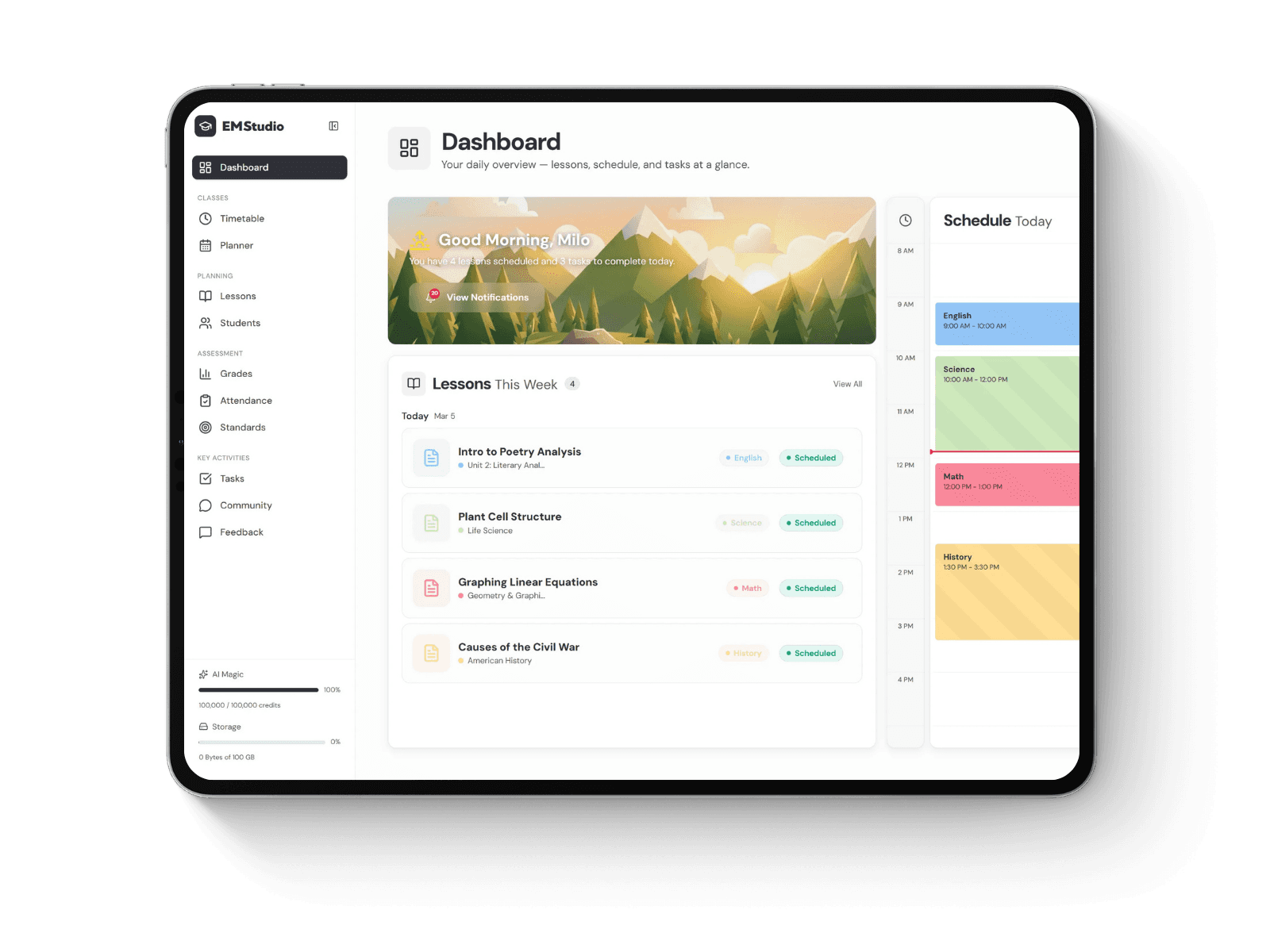
EMStudio is a free teaching management app — manage your classes, students, lessons, and more!
Learn More
Still grading everything by hand?
EMStudio is a free teaching management app — manage your classes, students, lessons, and more!
Learn More
Table of Contents
What Are the Best STEM-Focused Project Based Learning Projects?
Project Name | Grade Band | Duration | Primary Tools | Authentic Audience | Cost Range | Key Standards |
|---|---|---|---|---|---|---|
Urban Garden Design | 5–8 | 4 weeks | Google Earth Pro, LaMotte kits | PTA, City Sustainability Board | $15–$50 | NGSS MS-ETS1, Math 5.MD.A.1 |
Bridge Engineering | 6–9 | 3 weeks | West Point Bridge Designer | Public showcase | $15–$30 | NGSS MS-ETS1-2, Math 6.RP.A.3 |
Community Health Data | 8–12 | 5 weeks | Google Forms, Tableau Public | County Health Officials | $0–$25 | NGSS HS-LS1, Math S-ID.B.5 |
Renewable Energy | 7–10 | 6 weeks | LittleBits, Kill-a-Watt meters | School Facilities Manager | $50–$500 | NGSS MS-PS3, Math 7.RP.A.1 |
Urban Garden Design and Sustainability Analysis
Test soil with LaMotte N-P-K kits ($23) or your NRCS office
Calculate yield: 16 carrots per sq ft
Present plans to the PTA or city board
Four weeks of authentic assessment. Grades 5–8.
Bridge Engineering Challenge with Real-World Constraints
Prototype in West Point Bridge Designer (free). Then build under strict rules:
Max 50 popsicle sticks
Elmer’s white glue only
14-inch span, 10 kg load for 30 seconds
Students track costs in Google Sheets ($0.05 per stick) and compete in a public showcase. Grades 6–9.
Community Health Data Collection and Visualization
Partner with your county health department for IRB-approved protocols. Students craft 15-question Google Forms, collect 50 responses via stratified sampling, and visualize trends in Tableau Public (free).
The public product—infographic posters—goes to actual health officials. Five weeks, grades 8–12.
Renewable Energy Solution Prototyping
Teams build wind turbines or solar chargers using LittleBits ($300) or DIY parts ($50). They measure real wattage with Kill-a-Watt meters ($20) and calculate savings against the $0.13/kWh national average.
The pitch goes to your facilities manager. Real student agency. Grades 7–10.
How Can Social Studies Teachers Implement Project Based Learning Projects?
Social studies teachers can implement PBL through local history museum curation using Omeka or physical exhibits, cultural exchange podcasts recorded with Audacity or Anchor, civic action campaigns targeting real policy changes, and historical documentaries created with WeVideo or Adobe Spark. Each requires primary source analysis and authentic audience presentation. These project based learning projects follow the NCSS C3 Framework: students develop a driving question, apply concepts, evaluate sources through sustained inquiry, and communicate conclusions. You need 1:1 devices or rotating station models. Budget 4-8 weeks. Elementary students need modified documents (2-3 page excerpts with vocabulary support); high schoolers use full archival texts from Library of Congress or National Archives.
Local History Museum Exhibit Curation
Partner with your local historical society to access 5-7 primary artifacts—letters, photos, farm tools, or business ledgers. Students practice sourcing as they analyze provenance and bias in each item. They build digital collections using Omeka.net (free basic plan for educators), entering Dublin Core metadata fields for each artifact. Alternatively, teams design 10x10ft physical exhibit panels using foam core ($30 per panel). Both formats require historical argumentation.
This authentic assessment demands curatorial decisions. Which three artifacts best tell the story? What context do viewers need to understand a 1940s ration book? Students script exhibit labels under 75 words and arrange the physical or digital narrative flow. Host an opening reception inviting descendants of the subjects or community elders to view the public product.
Grades 7-11 handle this well during a six-week timeline. You will need to conduct a needs assessment of your local archives first. Many historical societies have boxes of uncurated materials waiting for student attention. The opening reception provides real audience feedback that shapes final grades rather than arbitrary point values.
Cultural Exchange Podcast Series Production
Students record 15-20 minute episodes using Audacity (free, open source) or Anchor.fm (free with Spotify hosting). Partner with sister schools via Empatico or Skype in the Classroom. The format requires a three-episode arc: introduction, deep dive topic analysis, and synthesis conclusion. This structure reinforces continuity and change as students compare their daily lives with those of their international partners.
Scripting forces clarity. Students cannot ramble when explaining complex cultural practices to a peer audience thousands of miles away. They upload finished episodes to your school podcast feed or submit to the NPR Student Podcast Challenge. The authentic assessment comes from listener feedback and download analytics, not just your rubric. The student agency emerges when they choose which cultural practices merit deep exploration.
Grades 6-10 thrive here. You will need microphones—USB headsets work fine—but the software costs nothing. This ranks among the most flexible pbl ideas for global connections without travel budgets. Student teams rotate roles: host, researcher, audio engineer, and outreach coordinator. Episodes remain online as digital portfolios long after the semester ends.
Civic Action Campaign for Community Issues
Identify a live local issue—a zoning variance, school board policy change, or infrastructure project. Students analyze causation by tracing how the problem developed through specific decisions and historical trends. They must attend one city council meeting, draft formal letters using prescribed municipal format, and create a Change.org petition with a measurable goal like 500 signatures.
The public product culminates in a three-minute public comment delivered during open forum. This is not a simulation. Students face real council members and affected citizens. The project based lesson plan requires flexibility; timelines shift if meetings reschedule. Budget 4-8 weeks depending on the legislative calendar and student agency levels. Some groups will want to extend timelines to see actual council votes.
Grades 8-12 handle the pressure. You act as coach, not director. Research templates from digital tools for history classrooms help students organize evidence. Students learn that civic participation requires persistence and thick skin when officials disagree with their positions. The authentic assessment happens when they count actual signatures and track policy changes months later.
Historical Documentary Filmmaking Project
Produce 5-7 minute documentary films using WeVideo ($4/student/year education pricing) or Adobe Spark Video (free). Requirements include minimum three primary source interviews, archival footage with Fair Use documentation, and a narration script with an argumentative thesis statement. Students practice sourcing by verifying the authenticity and context of every image and clip they include. This prevents the common error of using Hollywood films as historical evidence.
Editing teaches economy. Five minutes fills fast when covering the Great Migration or Civil Rights milestones. Students must prioritize evidence and cut favorite clips that lack relevance. Screen the final films at a local library film festival or submit to C-SPAN StudentCam. The driving question drives every cut: What changed, and who decided? Students defend their editorial choices during post-screening discussions with local historians.
Grades 9-12 need this level of complexity. The sustained inquiry lasts six to eight weeks. Adobe Spark offers a free entry point if budgets are tight, though WeVideo provides better collaboration features for team projects. The public product screens for community audiences who ask hard questions during Q&A sessions.
What Cross-Curricular Project Based Learning Projects Work Across Grade Levels?
Effective cross-curricular project based learning projects include school-wide sustainability initiatives coordinating math and science, entrepreneurship units combining economics and ELA, service learning with documentation portfolios, and children's book creation integrating art and literacy for community libraries. These work across grades 3-12 with adjusted complexity and authentic community impact.
The best implementations use the "same project, different complexity" model. Third graders measure classroom lights with simple tally charts; eighth graders audit the entire HVAC system using algebraic formulas. Both follow identical timelines and culminate in the same public product presentation to local stakeholders. This requires your grade-level team to commit to that 45-minute common planning time weekly. You need two teachers minimum, ideally three. Otherwise you get silos where the math teacher thinks it's an art project and the art teacher thinks it's math.
Research on contextualized learning programs shows students demonstrate 15-20% higher content retention when applying knowledge to community problems versus decontextualized exercises. A contextualized learning program sticks because the math matters to the actual electric bill, not a worksheet.
Here's how these four projects break down by logistics:
Grade Band: Elementary (3-5), Middle (6-8), High (9-12) — all four projects scale across these bands with adjusted rubrics.
Subject Integration: Sustainability combines Math/Science/ELA; Entrepreneurship pairs Economics/ELA/Math; Service Learning blends Civics/ELA/Art; Children's Books fuse ELA/Art/Library Science.
Leadership Structure: Single teacher can run children's books; co-teaching required for sustainability audits and entrepreneurship; service learning needs department coordination.
Final Product Format: Sustainability uses physical presentations and spreadsheets; entrepreneurship requires digital pitch decks; service learning builds digital portfolios; children's books produce physical bound copies.
Prevent token integration by building shared rubrics with weighted standards from each discipline. A sustainability project might weight 40% math calculations, 40% science analysis, 20% communication. Everyone grades their piece using the same criteria. Students see that each subject carries actual academic weight, not just decorative fluff.
School-Wide Sustainability Initiative Planning
Start with twenty Kill-a-Watt meters ($19 on Amazon). Have teams measure phantom loads across twenty-plus classrooms for two weeks. Third graders log the data; eighth graders calculate actual kWh usage and cost projections. Twelfth graders analyze carbon footprint data and write the persuasive proposal to your facilities director. This is project based learning projects at work—same equipment, different complexity.
This sustained inquiry requires real student agency. They decide which rooms to audit. They determine what "vampire power" actually costs your district. The math matters because it hits the actual electric bill. The public product is a presentation to the school board with 5-year projection spreadsheets and specific cost-saving recommendations. The audit often becomes a baseline for district-wide energy policy changes.
You cannot do this alone. Coordinate with the science teacher for data analysis and the ELA teacher for proposal writing. Split the grading: forty percent math calculations, forty percent scientific reasoning, twenty percent communication. That weighting prevents token integration and creates authentic assessment.
Entrepreneurship and Business Plan Development
Adapt Junior Achievement "It's My Business" (free curriculum) or NFTE materials. Teams receive $50 seed money as a repayable loan structure. They track every expense in Google Sheets, develop a ten-slide pitch deck, and present to local business owners in a Shark Tank format. All profits go to a selected charity. The loan repayment structure teaches real financial accountability.
This works across middle and high school because the accounting gets more sophisticated. Sixth graders sell handmade goods; twelfth graders develop service businesses with complex supply chains. The driving question stays constant: how do you create value and sustain it? Check our guide on entrepreneurial leadership projects for more project based learning resources.
Co-teach with the economics teacher and ELA instructor. The math teacher handles the loan amortization; ELA coaches the pitch delivery. Use a shared rubric weighted for financial literacy, business logic, and presentation skills.
Community Service Learning with Documentation
Partner with a registered 501(c)(3) organization for a twenty-hour minimum service requirement per student. This is not just volunteering; it's a needs assessment followed by action. Students build digital portfolios in Google Sites containing photos, client testimonials, and 500-word reflection essays connecting their service to specific course content standards.
The sustained inquiry happens as they document progress weekly. They analyze whether the food bank actually needs more can drives or better inventory systems. The public product is a presentation at a community service expo with program directors attending. Seventh graders focus on observation and basic documentation; twelfth graders conduct program evaluations and recommend operational changes. Directors often hire students for summer work based on these portfolio presentations.
Coordinate with social studies for the civic engagement piece and ELA for the reflective writing. This creates authentic assessment of both service and academic standards.
Interactive Children's Book Creation for Local Libraries
Students write 500-800 word narratives targeting ages four to six. They illustrate using Canva for Education (free) or Book Creator ($60/year class license). The project requires them to study early literacy development—what vocabulary fits? They bind two copies: one for your school library, one donated to the public library storytime program. Librarians provide feedback on binding durability and font size choices.
Include an "About the Author" page and discuss the ISBN registration process. Fourth graders write simple circular stories; eighth graders develop dual-language editions with cultural research. Host a read-aloud event at your local branch. This is building interdisciplinary curriculum that serves actual community needs.
Partner with the art teacher for illustration techniques and the librarian for storytime protocol. The final product sits on real shelves, giving students genuine public product validation.

How to Adapt Project Based Learning Projects for Different Grade Levels?
Adapt project based learning projects by scaffolding elementary students with daily checklists and constrained choices, middle schoolers with role assignments and milestone deadlines, and high schoolers with client contracts and public exhibitions. Avoid grade mismatch: elementary students fail with abstract driving questions, while high schoolers disengage from sanitized, fake scenarios.
John Hattie's research shows inquiry-based learning achieves a 0.61 effect size only when properly scaffolded to match cognitive development strategies by grade. Mismatch kills the project. Elementary kids drown in vague instructions because they need concrete daily outcomes. High schoolers check out when you ask them to "pretend" instead of engaging with authentic assessment.
Elementary (K-5) | Middle (6-8) | High School (9-12) |
|---|---|---|
Driving Question Complexity: Concrete ("How do we make our garden grow?") | Driving Question Complexity: Bridging abstract ("How does our garden affect the ecosystem?") | Driving Question Complexity: Fully abstract ("How do urban gardens address food justice?") |
Optimal Group Size: 2-3 students | Optimal Group Size: 3-4 students | Optimal Group Size: 4-5 students |
Teacher Role: Facilitator with daily check-ins | Teacher Role: Guide with milestone monitoring | Teacher Role: Consultant on demand |
Assessment Type: Observation and checklist | Assessment Type: Mixed: rubric + process grade | Assessment Type: Portfolio with authentic assessment |
Critical Failure Mode: Abstract questions without concrete scaffolds | Critical Failure Mode: Hitchhiking when groups exceed 4 members | Critical Failure Mode: Fake scenarios without real stakes |
Three implementation mistakes destroy project based learning lesson plan template effectiveness:
Using abstract driving questions for elementary students (e.g., "What is justice?") without concrete scaffolds.
Providing high schoolers with "fake" audiences (e.g., "pretend you're the mayor") rather than real clients.
Assigning middle school group work without individual accountability mechanisms, leading to hitchhiking.
Research confirms middle school groups fail when exceeding 4 members due to diffusion of responsibility. Elementary groups of 2-3 minimize conflict while building collaboration basics.
Scaffolding Complexity for Elementary Students
Elementary sustained inquiry requires "thin-sliced" driving questions answerable in 1-2 weeks maximum. This becomes your example of project based learning lesson plan for primary grades. Provide daily exit tickets with smiley-face rubrics using a 3-point scale.
Limit groups to 2-3 students with assigned roles: Materials Manager, Recorder, or Speaker. You act as "guide on side" with 15-minute mini-lessons every other day. Apply mastering differentiated instruction by never assigning research requiring reading above grade level.
Middle School Modifications for Independence
Implement group contracts with specific consequence clauses including grade reduction for missed deadlines. Use a pbl lesson plan template that builds in weekly checkpoints via Google Forms.
Use a 4-role system: Researcher, Designer, Editor, Presenter with mandatory rotation halfway through. Require each student to produce an individual written component—typically a 500-word reflection—alongside the group product. This prevents hitchhiking and builds student agency.
High School Extensions for Authentic Audiences
Begin with a needs assessment to identify real community problems. Secure actual client Requests for Proposal from nonprofits or city offices. Budget ranges should include $50-500 in real dollars, not monopoly money.
Host public product exhibition nights with community jury feedback. Partner with local university service learning programs for mentor support. Avoid sanitized scenarios without real stakes.
Implementation Roadmap: Launching Your First Project Based Learning Unit
Step 1: Plan (Weeks -3 to -2). Download the Buck Institute Gold Standard Design Framework from PBLworks.org. It's free. Grab a project based learning plan example while you're there. Draft your driving question using this exact frame: "How can we [specific action] for [real audience] to [measurable outcome]?" Then identify three potential community partners. Email your local chamber of commerce or cold-message on LinkedIn. Expect a 30-40% response rate.
Step 2: Prepare (Week -1). Finalize your pbl lesson plan. Co-create a Know/Need-to-Know chart with students on chart paper or a Miro board. This chart is your living needs assessment. Build your authentic assessment rubric with three weighted categories: Content Knowledge (40%), Success Skills (30%), and Product Quality (30%). Use a 4-point scale. Secure materials by requesting $200 from your admin or posting a DonorsChoose project. Most fund within two weeks.
Step 3: Launch (Day 1). Kick off with an entry event. Bring in a guest speaker, show a documentary clip, or take a field trip. Hand out the project calendar showing four milestones: draft check, peer review, revision, and final presentation. This clarity builds student agency from day one.
Step 4: Facilitate (Weeks 1-3). Run 15-minute "just-in-time" workshops when groups hit specific skill gaps. Resist lecturing. Let sustained inquiry drive the work. Use project management tools for teachers like Trello or Padlet so you can see progress at a glance. Do daily five-minute check-ins using the Temperature Gauge protocol: thumbs up, sideways, or down for group health.
Step 5: Present (Final Week). Host the public product presentation. Invite at least five external adults from your community. Have students complete a 3-2-1 reflection: three things learned, two skills gained, one question remaining. Use Glow and Grow for peer critique. One specific positive, one specific suggestion.
Step 6: Archive (Post-Project). Save exemplar project based learning projects and free project based learning lesson plans for next year's classes. Send thank-you notes to partners within 48 hours. Track your time. First implementations run 20-30 hours of prep. Reusing the same project drops that to 10-15 hours. For detailed planning structures, see this step-by-step guide for designing PBL curriculum and our comprehensive lesson plan template.

Project Based Learning Projects: The 3-Step Kickoff
You've seen the STEM builds, the Social Studies investigations, and the cross-curricular bridges that actually stick. The best project based learning projects share one trait: a driving question that sparks sustained inquiry instead of quick answers. Grade level adaptations matter less than giving students real agency to chase dead ends and revise.
Stop waiting for perfect conditions. Swap one upcoming test for authentic assessment and let kids wrestle with a genuine problem. That messy launch beats another year of "when will I use this?"
Draft one driving question from a unit you teach next month.
Design the rubric as an authentic assessment before day one.
Block 20 minutes this week for sustained inquiry protocols.
Launch with one class, not your whole schedule.
What Are the Best STEM-Focused Project Based Learning Projects?
Project Name | Grade Band | Duration | Primary Tools | Authentic Audience | Cost Range | Key Standards |
|---|---|---|---|---|---|---|
Urban Garden Design | 5–8 | 4 weeks | Google Earth Pro, LaMotte kits | PTA, City Sustainability Board | $15–$50 | NGSS MS-ETS1, Math 5.MD.A.1 |
Bridge Engineering | 6–9 | 3 weeks | West Point Bridge Designer | Public showcase | $15–$30 | NGSS MS-ETS1-2, Math 6.RP.A.3 |
Community Health Data | 8–12 | 5 weeks | Google Forms, Tableau Public | County Health Officials | $0–$25 | NGSS HS-LS1, Math S-ID.B.5 |
Renewable Energy | 7–10 | 6 weeks | LittleBits, Kill-a-Watt meters | School Facilities Manager | $50–$500 | NGSS MS-PS3, Math 7.RP.A.1 |
Urban Garden Design and Sustainability Analysis
Test soil with LaMotte N-P-K kits ($23) or your NRCS office
Calculate yield: 16 carrots per sq ft
Present plans to the PTA or city board
Four weeks of authentic assessment. Grades 5–8.
Bridge Engineering Challenge with Real-World Constraints
Prototype in West Point Bridge Designer (free). Then build under strict rules:
Max 50 popsicle sticks
Elmer’s white glue only
14-inch span, 10 kg load for 30 seconds
Students track costs in Google Sheets ($0.05 per stick) and compete in a public showcase. Grades 6–9.
Community Health Data Collection and Visualization
Partner with your county health department for IRB-approved protocols. Students craft 15-question Google Forms, collect 50 responses via stratified sampling, and visualize trends in Tableau Public (free).
The public product—infographic posters—goes to actual health officials. Five weeks, grades 8–12.
Renewable Energy Solution Prototyping
Teams build wind turbines or solar chargers using LittleBits ($300) or DIY parts ($50). They measure real wattage with Kill-a-Watt meters ($20) and calculate savings against the $0.13/kWh national average.
The pitch goes to your facilities manager. Real student agency. Grades 7–10.
How Can Social Studies Teachers Implement Project Based Learning Projects?
Social studies teachers can implement PBL through local history museum curation using Omeka or physical exhibits, cultural exchange podcasts recorded with Audacity or Anchor, civic action campaigns targeting real policy changes, and historical documentaries created with WeVideo or Adobe Spark. Each requires primary source analysis and authentic audience presentation. These project based learning projects follow the NCSS C3 Framework: students develop a driving question, apply concepts, evaluate sources through sustained inquiry, and communicate conclusions. You need 1:1 devices or rotating station models. Budget 4-8 weeks. Elementary students need modified documents (2-3 page excerpts with vocabulary support); high schoolers use full archival texts from Library of Congress or National Archives.
Local History Museum Exhibit Curation
Partner with your local historical society to access 5-7 primary artifacts—letters, photos, farm tools, or business ledgers. Students practice sourcing as they analyze provenance and bias in each item. They build digital collections using Omeka.net (free basic plan for educators), entering Dublin Core metadata fields for each artifact. Alternatively, teams design 10x10ft physical exhibit panels using foam core ($30 per panel). Both formats require historical argumentation.
This authentic assessment demands curatorial decisions. Which three artifacts best tell the story? What context do viewers need to understand a 1940s ration book? Students script exhibit labels under 75 words and arrange the physical or digital narrative flow. Host an opening reception inviting descendants of the subjects or community elders to view the public product.
Grades 7-11 handle this well during a six-week timeline. You will need to conduct a needs assessment of your local archives first. Many historical societies have boxes of uncurated materials waiting for student attention. The opening reception provides real audience feedback that shapes final grades rather than arbitrary point values.
Cultural Exchange Podcast Series Production
Students record 15-20 minute episodes using Audacity (free, open source) or Anchor.fm (free with Spotify hosting). Partner with sister schools via Empatico or Skype in the Classroom. The format requires a three-episode arc: introduction, deep dive topic analysis, and synthesis conclusion. This structure reinforces continuity and change as students compare their daily lives with those of their international partners.
Scripting forces clarity. Students cannot ramble when explaining complex cultural practices to a peer audience thousands of miles away. They upload finished episodes to your school podcast feed or submit to the NPR Student Podcast Challenge. The authentic assessment comes from listener feedback and download analytics, not just your rubric. The student agency emerges when they choose which cultural practices merit deep exploration.
Grades 6-10 thrive here. You will need microphones—USB headsets work fine—but the software costs nothing. This ranks among the most flexible pbl ideas for global connections without travel budgets. Student teams rotate roles: host, researcher, audio engineer, and outreach coordinator. Episodes remain online as digital portfolios long after the semester ends.
Civic Action Campaign for Community Issues
Identify a live local issue—a zoning variance, school board policy change, or infrastructure project. Students analyze causation by tracing how the problem developed through specific decisions and historical trends. They must attend one city council meeting, draft formal letters using prescribed municipal format, and create a Change.org petition with a measurable goal like 500 signatures.
The public product culminates in a three-minute public comment delivered during open forum. This is not a simulation. Students face real council members and affected citizens. The project based lesson plan requires flexibility; timelines shift if meetings reschedule. Budget 4-8 weeks depending on the legislative calendar and student agency levels. Some groups will want to extend timelines to see actual council votes.
Grades 8-12 handle the pressure. You act as coach, not director. Research templates from digital tools for history classrooms help students organize evidence. Students learn that civic participation requires persistence and thick skin when officials disagree with their positions. The authentic assessment happens when they count actual signatures and track policy changes months later.
Historical Documentary Filmmaking Project
Produce 5-7 minute documentary films using WeVideo ($4/student/year education pricing) or Adobe Spark Video (free). Requirements include minimum three primary source interviews, archival footage with Fair Use documentation, and a narration script with an argumentative thesis statement. Students practice sourcing by verifying the authenticity and context of every image and clip they include. This prevents the common error of using Hollywood films as historical evidence.
Editing teaches economy. Five minutes fills fast when covering the Great Migration or Civil Rights milestones. Students must prioritize evidence and cut favorite clips that lack relevance. Screen the final films at a local library film festival or submit to C-SPAN StudentCam. The driving question drives every cut: What changed, and who decided? Students defend their editorial choices during post-screening discussions with local historians.
Grades 9-12 need this level of complexity. The sustained inquiry lasts six to eight weeks. Adobe Spark offers a free entry point if budgets are tight, though WeVideo provides better collaboration features for team projects. The public product screens for community audiences who ask hard questions during Q&A sessions.
What Cross-Curricular Project Based Learning Projects Work Across Grade Levels?
Effective cross-curricular project based learning projects include school-wide sustainability initiatives coordinating math and science, entrepreneurship units combining economics and ELA, service learning with documentation portfolios, and children's book creation integrating art and literacy for community libraries. These work across grades 3-12 with adjusted complexity and authentic community impact.
The best implementations use the "same project, different complexity" model. Third graders measure classroom lights with simple tally charts; eighth graders audit the entire HVAC system using algebraic formulas. Both follow identical timelines and culminate in the same public product presentation to local stakeholders. This requires your grade-level team to commit to that 45-minute common planning time weekly. You need two teachers minimum, ideally three. Otherwise you get silos where the math teacher thinks it's an art project and the art teacher thinks it's math.
Research on contextualized learning programs shows students demonstrate 15-20% higher content retention when applying knowledge to community problems versus decontextualized exercises. A contextualized learning program sticks because the math matters to the actual electric bill, not a worksheet.
Here's how these four projects break down by logistics:
Grade Band: Elementary (3-5), Middle (6-8), High (9-12) — all four projects scale across these bands with adjusted rubrics.
Subject Integration: Sustainability combines Math/Science/ELA; Entrepreneurship pairs Economics/ELA/Math; Service Learning blends Civics/ELA/Art; Children's Books fuse ELA/Art/Library Science.
Leadership Structure: Single teacher can run children's books; co-teaching required for sustainability audits and entrepreneurship; service learning needs department coordination.
Final Product Format: Sustainability uses physical presentations and spreadsheets; entrepreneurship requires digital pitch decks; service learning builds digital portfolios; children's books produce physical bound copies.
Prevent token integration by building shared rubrics with weighted standards from each discipline. A sustainability project might weight 40% math calculations, 40% science analysis, 20% communication. Everyone grades their piece using the same criteria. Students see that each subject carries actual academic weight, not just decorative fluff.
School-Wide Sustainability Initiative Planning
Start with twenty Kill-a-Watt meters ($19 on Amazon). Have teams measure phantom loads across twenty-plus classrooms for two weeks. Third graders log the data; eighth graders calculate actual kWh usage and cost projections. Twelfth graders analyze carbon footprint data and write the persuasive proposal to your facilities director. This is project based learning projects at work—same equipment, different complexity.
This sustained inquiry requires real student agency. They decide which rooms to audit. They determine what "vampire power" actually costs your district. The math matters because it hits the actual electric bill. The public product is a presentation to the school board with 5-year projection spreadsheets and specific cost-saving recommendations. The audit often becomes a baseline for district-wide energy policy changes.
You cannot do this alone. Coordinate with the science teacher for data analysis and the ELA teacher for proposal writing. Split the grading: forty percent math calculations, forty percent scientific reasoning, twenty percent communication. That weighting prevents token integration and creates authentic assessment.
Entrepreneurship and Business Plan Development
Adapt Junior Achievement "It's My Business" (free curriculum) or NFTE materials. Teams receive $50 seed money as a repayable loan structure. They track every expense in Google Sheets, develop a ten-slide pitch deck, and present to local business owners in a Shark Tank format. All profits go to a selected charity. The loan repayment structure teaches real financial accountability.
This works across middle and high school because the accounting gets more sophisticated. Sixth graders sell handmade goods; twelfth graders develop service businesses with complex supply chains. The driving question stays constant: how do you create value and sustain it? Check our guide on entrepreneurial leadership projects for more project based learning resources.
Co-teach with the economics teacher and ELA instructor. The math teacher handles the loan amortization; ELA coaches the pitch delivery. Use a shared rubric weighted for financial literacy, business logic, and presentation skills.
Community Service Learning with Documentation
Partner with a registered 501(c)(3) organization for a twenty-hour minimum service requirement per student. This is not just volunteering; it's a needs assessment followed by action. Students build digital portfolios in Google Sites containing photos, client testimonials, and 500-word reflection essays connecting their service to specific course content standards.
The sustained inquiry happens as they document progress weekly. They analyze whether the food bank actually needs more can drives or better inventory systems. The public product is a presentation at a community service expo with program directors attending. Seventh graders focus on observation and basic documentation; twelfth graders conduct program evaluations and recommend operational changes. Directors often hire students for summer work based on these portfolio presentations.
Coordinate with social studies for the civic engagement piece and ELA for the reflective writing. This creates authentic assessment of both service and academic standards.
Interactive Children's Book Creation for Local Libraries
Students write 500-800 word narratives targeting ages four to six. They illustrate using Canva for Education (free) or Book Creator ($60/year class license). The project requires them to study early literacy development—what vocabulary fits? They bind two copies: one for your school library, one donated to the public library storytime program. Librarians provide feedback on binding durability and font size choices.
Include an "About the Author" page and discuss the ISBN registration process. Fourth graders write simple circular stories; eighth graders develop dual-language editions with cultural research. Host a read-aloud event at your local branch. This is building interdisciplinary curriculum that serves actual community needs.
Partner with the art teacher for illustration techniques and the librarian for storytime protocol. The final product sits on real shelves, giving students genuine public product validation.
How to Adapt Project Based Learning Projects for Different Grade Levels?
Adapt project based learning projects by scaffolding elementary students with daily checklists and constrained choices, middle schoolers with role assignments and milestone deadlines, and high schoolers with client contracts and public exhibitions. Avoid grade mismatch: elementary students fail with abstract driving questions, while high schoolers disengage from sanitized, fake scenarios.
John Hattie's research shows inquiry-based learning achieves a 0.61 effect size only when properly scaffolded to match cognitive development strategies by grade. Mismatch kills the project. Elementary kids drown in vague instructions because they need concrete daily outcomes. High schoolers check out when you ask them to "pretend" instead of engaging with authentic assessment.
Elementary (K-5) | Middle (6-8) | High School (9-12) |
|---|---|---|
Driving Question Complexity: Concrete ("How do we make our garden grow?") | Driving Question Complexity: Bridging abstract ("How does our garden affect the ecosystem?") | Driving Question Complexity: Fully abstract ("How do urban gardens address food justice?") |
Optimal Group Size: 2-3 students | Optimal Group Size: 3-4 students | Optimal Group Size: 4-5 students |
Teacher Role: Facilitator with daily check-ins | Teacher Role: Guide with milestone monitoring | Teacher Role: Consultant on demand |
Assessment Type: Observation and checklist | Assessment Type: Mixed: rubric + process grade | Assessment Type: Portfolio with authentic assessment |
Critical Failure Mode: Abstract questions without concrete scaffolds | Critical Failure Mode: Hitchhiking when groups exceed 4 members | Critical Failure Mode: Fake scenarios without real stakes |
Three implementation mistakes destroy project based learning lesson plan template effectiveness:
Using abstract driving questions for elementary students (e.g., "What is justice?") without concrete scaffolds.
Providing high schoolers with "fake" audiences (e.g., "pretend you're the mayor") rather than real clients.
Assigning middle school group work without individual accountability mechanisms, leading to hitchhiking.
Research confirms middle school groups fail when exceeding 4 members due to diffusion of responsibility. Elementary groups of 2-3 minimize conflict while building collaboration basics.
Scaffolding Complexity for Elementary Students
Elementary sustained inquiry requires "thin-sliced" driving questions answerable in 1-2 weeks maximum. This becomes your example of project based learning lesson plan for primary grades. Provide daily exit tickets with smiley-face rubrics using a 3-point scale.
Limit groups to 2-3 students with assigned roles: Materials Manager, Recorder, or Speaker. You act as "guide on side" with 15-minute mini-lessons every other day. Apply mastering differentiated instruction by never assigning research requiring reading above grade level.
Middle School Modifications for Independence
Implement group contracts with specific consequence clauses including grade reduction for missed deadlines. Use a pbl lesson plan template that builds in weekly checkpoints via Google Forms.
Use a 4-role system: Researcher, Designer, Editor, Presenter with mandatory rotation halfway through. Require each student to produce an individual written component—typically a 500-word reflection—alongside the group product. This prevents hitchhiking and builds student agency.
High School Extensions for Authentic Audiences
Begin with a needs assessment to identify real community problems. Secure actual client Requests for Proposal from nonprofits or city offices. Budget ranges should include $50-500 in real dollars, not monopoly money.
Host public product exhibition nights with community jury feedback. Partner with local university service learning programs for mentor support. Avoid sanitized scenarios without real stakes.
Implementation Roadmap: Launching Your First Project Based Learning Unit
Step 1: Plan (Weeks -3 to -2). Download the Buck Institute Gold Standard Design Framework from PBLworks.org. It's free. Grab a project based learning plan example while you're there. Draft your driving question using this exact frame: "How can we [specific action] for [real audience] to [measurable outcome]?" Then identify three potential community partners. Email your local chamber of commerce or cold-message on LinkedIn. Expect a 30-40% response rate.
Step 2: Prepare (Week -1). Finalize your pbl lesson plan. Co-create a Know/Need-to-Know chart with students on chart paper or a Miro board. This chart is your living needs assessment. Build your authentic assessment rubric with three weighted categories: Content Knowledge (40%), Success Skills (30%), and Product Quality (30%). Use a 4-point scale. Secure materials by requesting $200 from your admin or posting a DonorsChoose project. Most fund within two weeks.
Step 3: Launch (Day 1). Kick off with an entry event. Bring in a guest speaker, show a documentary clip, or take a field trip. Hand out the project calendar showing four milestones: draft check, peer review, revision, and final presentation. This clarity builds student agency from day one.
Step 4: Facilitate (Weeks 1-3). Run 15-minute "just-in-time" workshops when groups hit specific skill gaps. Resist lecturing. Let sustained inquiry drive the work. Use project management tools for teachers like Trello or Padlet so you can see progress at a glance. Do daily five-minute check-ins using the Temperature Gauge protocol: thumbs up, sideways, or down for group health.
Step 5: Present (Final Week). Host the public product presentation. Invite at least five external adults from your community. Have students complete a 3-2-1 reflection: three things learned, two skills gained, one question remaining. Use Glow and Grow for peer critique. One specific positive, one specific suggestion.
Step 6: Archive (Post-Project). Save exemplar project based learning projects and free project based learning lesson plans for next year's classes. Send thank-you notes to partners within 48 hours. Track your time. First implementations run 20-30 hours of prep. Reusing the same project drops that to 10-15 hours. For detailed planning structures, see this step-by-step guide for designing PBL curriculum and our comprehensive lesson plan template.
Project Based Learning Projects: The 3-Step Kickoff
You've seen the STEM builds, the Social Studies investigations, and the cross-curricular bridges that actually stick. The best project based learning projects share one trait: a driving question that sparks sustained inquiry instead of quick answers. Grade level adaptations matter less than giving students real agency to chase dead ends and revise.
Stop waiting for perfect conditions. Swap one upcoming test for authentic assessment and let kids wrestle with a genuine problem. That messy launch beats another year of "when will I use this?"
Draft one driving question from a unit you teach next month.
Design the rubric as an authentic assessment before day one.
Block 20 minutes this week for sustained inquiry protocols.
Launch with one class, not your whole schedule.
Still grading everything by hand?
EMStudio is a free teaching management app — manage your classes, students, lessons, and more!
Learn More
Still grading everything by hand?
EMStudio is a free teaching management app — manage your classes, students, lessons, and more!
Learn More

Notion4Teachers
Notion templates to simplify administrative tasks and enhance your teaching experience.



2026 Notion4Teachers. All Rights Reserved.
Notion4Teachers
Notion templates to simplify administrative tasks and enhance your teaching experience.
2026 Notion4Teachers. All Rights Reserved.
Notion4Teachers
Notion templates to simplify administrative tasks and enhance your teaching experience.
2026 Notion4Teachers. All Rights Reserved.