
15 Classroom Board Solutions for Every Teaching Style
15 Classroom Board Solutions for Every Teaching Style

Article by
Milo
ESL Content Coordinator & Educator
ESL Content Coordinator & Educator
All Posts
Do you actually need a new classroom board, or will that stained whiteboard survive another year? You need a new one. I taught with a ghost-gray board for three years, and my third graders squinted to see math models from the back row. Your instructional board anchors your entire room. When the dry erase surface fails, your visuals fail, and your kids check out fast. The right magnetic display does not just hold markers; it holds attention.
The market floods you with options. Porcelain steel, glass, interactive panels, rolling carts with flip sides. I have purchased six boards across twelve years—some were steals from district surplus, others peeled within three months and trapped permanent marker ink forever. You need a teaching wall that works bell-to-bell. You need a surface that erases completely and holds heavy anchor charts without sliding down mid-lesson. Whether you are mounting a permanent fixture or selecting a portable solution for small group rotations, your classroom setup depends on getting this material right.
This guide breaks down fifteen specific classroom board solutions I have tested or watched colleagues use daily. We will look at full-size magnetic options that dominate your front wall, rolling boards that flex with your lesson flow, and interactive digital displays that actually justify their four-figure price tags. You will find subject-specific picks with printed math grid lines and music staves. We will also cover wall mounting options and material types—because choosing between porcelain steel and melamine is not just a budget question. Let us find the board that matches your teaching style.
Still grading everything by hand?
EMStudio is a free teaching management app — manage your classes, students, lessons, and more!
Learn More

Still grading everything by hand?
EMStudio is a free teaching management app — manage your classes, students, lessons, and more!
Learn More
Table of Contents
What Are the Best Full-Size Magnetic Classroom Boards for Daily Instruction?
The best full-size magnetic classroom boards include commercial-grade porcelain steel options like the Quartet Prestige 2 (4×8 ft) for heavy daily use. Lightweight melamine boards such as the Universal UNV43622 (4×6 ft) suit elementary settings with lighter traffic. Combo cork-and-write boards split your essential classroom learning space components between magnetic writing and pinning displays.
Your choice depends on daily usage hours and what you hang on the surface. Porcelain survives decades of aggressive erasing. Melamine works for anchor charts and occasional notes. Pick wrong, and you'll stare at ghost marks for five years.
Model | Surface | Warranty | Magnetic Hold | Weight |
|---|---|---|---|---|
Quartet Prestige 2 (4×8 ft) | Porcelain | 25 years | 15 lbs | 85 lbs |
Ghent SPC410B (4×10 ft) | Porcelain | 50 years | 15 lbs | 120 lbs |
Universal UNV43622 (4×6 ft) | Melamine | 5 years | 2 lbs | 35 lbs |
Porcelain boards handle 6+ hours of daily instruction. Melamine works for 2-3 hours of intermittent use. Warning: melamine surfaces ghost permanently if markers sit uncleaned for 24 hours.
Mounting differs dramatically by weight:
Porcelain boards need lag bolts into three studs spaced 16 inches on center, supporting 200+ lbs.
Melamine boards under 50 lbs mount with drywall anchors.
Professional installation runs $150; DIY requires a level and a second pair of hands.
Commercial-Grade Porcelain Steel Boards for Heavy-Duty Use
The Quartet Prestige 2 (4×8 ft, $450) uses 28-gauge porcelain enamel steel. The Ghent SPC410B (4×10 ft, $620) offers extra width for side-by-side centers. Both carry 25-50 year warranties and handle 6+ hours of daily instruction.
These instructional boards accept rare earth magnets holding 15+ lbs of laminated posters. At 85-120 lbs, they require structural mounting into three studs 16 inches on center. Professional installation costs around $150.
Surface hardness hits 5-6 on the Mohs scale. Dropped scissors or magnet edges won't scratch the teaching wall. This dry erase surface stays pristine through decades of aggressive erasing.
Lightweight Melamine Options for Elementary Classrooms
The Universal UNV43622 (4×6 ft, $180) and Iceberg ICE33041 use resin-infused paper surfaces. These teacher boards weigh 35-45 lbs, allowing drywall anchor installation. They accept only lightweight ceramic magnets holding 1 lb maximum.
I learned this the hard way in third grade. I left a rainbow of marker colors up over a three-day weekend. The board absorbed the ink permanently, leaving ghost marks. Now I clean my magnetic display every afternoon with water only—alcohol causes hazing on melamine.
These work best for grades K-5 with 2-3 hours of intermittent daily writing. The 3-5 year lifespan matches how often elementary teachers refresh their classroom setup.
Combo Cork-and-Write Boards for Multi-Function Walls
The Best-Rite Combo-Rite (48×36", $320) and Ghent Combination boards split your wall space. Choose 50/50 or 70/30 configurations between cork and magnetic sections. The self-healing cork accepts push pins for anchor charts.
The magnetic section uses porcelain or painted steel for daily writing. You can pin standards on the cork and solve math problems on the whiteboard without switching walls. Aluminum ABC trim frames both sections cleanly.
Mounting requires only two studs for the 48-inch width, supporting boards under 50 lbs. This suits older buildings with irregular stud spacing. You get dual function without the weight of full-size porcelain.

Which Portable and Rolling Classroom Boards Offer Maximum Flexibility?
Portable classroom boards offering maximum flexibility include double-sided mobile units like the Best-Rite 96-inch Platinum Reversible ($350-$500) with locking casters for safety, folding presentation boards featuring 4-inch deep storage trays, and adjustable-height easel boards spanning 42-72 inches to accommodate both kindergarten students and standing high school teachers.
Fixed teaching walls limit your options. When I taught 7th grade in a portable classroom with no wall space, rolling boards turned corners into collaboration zones.
Best-Rite Platinum Reversible ($480, 150 lbs, 96×48 inches, porcelain steel both sides, 4 locking casters). Best for station rotation with 4-6 students per side.
VIVO Mobile Stand ($120, fits 48×36 boards, height 59-64 inches). Best for swapping between classrooms or temporary setups.
Quartet Folding Presentation Board ($85, 72×36 inches open, 28 lbs, 4-inch tray). Best for PD sessions and multi-purpose rooms.
Choose double-sided for station rotations, folding for multi-purpose rooms, and adjustable-height for multi-grade classrooms or teachers who alternate between sitting and standing.
Locking casters must engage with fifty pounds of force to prevent student movement. Any unit over sixty inches tall requires a twenty-four by twenty-four inch base to prevent tipping.
Double-Sided Mobile Whiteboards for Collaborative Stations
The Best-Rite Platinum Reversible measures ninety-six by forty-eight inches. This magnetic display unit weighs one hundred fifty pounds and rolls on four casters with brake locks. The base supports three hundred pounds.
I used this during a 7th grade poetry unit. Four students brainstormed on the reverse while I taught on the front. Always engage the wheel locks before writing to prevent drift.
Folding Presentation Boards with Built-In Storage Trays
The Quartet Presentation Easel spans seventy-two by thirty-six inches open, folding to twenty-four by thirty-six inches. The four-inch molded tray holds markers securely. It weighs twenty-eight pounds.
The melamine dry erase surface wipes clean but lacks magnetic properties. Use sticky tack for papers. This instructional board works perfectly for PD sessions where you cannot store permanent fixtures.
Adjustable-Height Easel Boards for Different Grade Levels
The VIVO Mobile Whiteboard Stand adjusts from fifty-nine to sixty-four inches with tilt from zero to forty-five degrees. It accommodates boards up to forty-eight by thirty-six inches. The twenty-four by twenty-four inch base prevents tipping near flexible seating and mobile furniture configurations.
Assembly takes twenty-five minutes with a Phillips head screwdriver. The stand holds fifty pounds maximum. I have used this in a K-5 art room where third graders pulled it down for center work.

What Are the Top-Rated Interactive Digital Classroom Boards?
Top-rated interactive digital classroom boards include the Promethean ActivPanel 9 (75-inch, $3,200) with 20-point touch capability, Epson BrightLink projectors ($1,400) for 1080p budget solutions, and Rise Vision displays ($100-$300) for classroom sign management and visual rotation timers. Each tier serves different instructional needs and infrastructure constraints. Your choice depends on available wall space, budget, and how many students interact simultaneously.
Plan your classroom setup before you buy. These tools range from full teaching walls to simple digital timers, and the price gaps are massive.
Promethean ActivPanel 9: $3,200 + $45/year electricity. Pros: 20-point touch, no lamps. Cons: 10-hour training required, needs WiFi 6 infrastructure.
Epson BrightLink 1485Fi: $1,400 + $80 lamp/5,000 hours. Pros: 2-hour setup, retrofits existing whiteboards. Cons: Monthly calibration, 2-point touch only.
Rise Vision/Fire TV Stick: $100 hardware + free software. Pros: 30-minute setup, classroom sign capability. Cons: No touch interaction, requires separate HDMI display.
Interactive panels: 6-foot proximity to 110V outlet, wall rated for 150+ lbs, WiFi 6 (802.11ax) for screen mirroring.
Projectors: 8-10 foot throw distance, 4,000+ lumens for lights-on visibility, solid ceiling mount.
Digital signage: HDMI port and internet connection only.
Purchasing 4K panels without 25 Mbps minimum bandwidth per device causes lag during screen mirroring.
Installing projectors without keystone correction creates distorted images on your instructional board.
Neglecting to budget for replacement stylus pens at $25-$60 each when students lose them.
Touch-Screen Smart Displays for Multimedia Integration
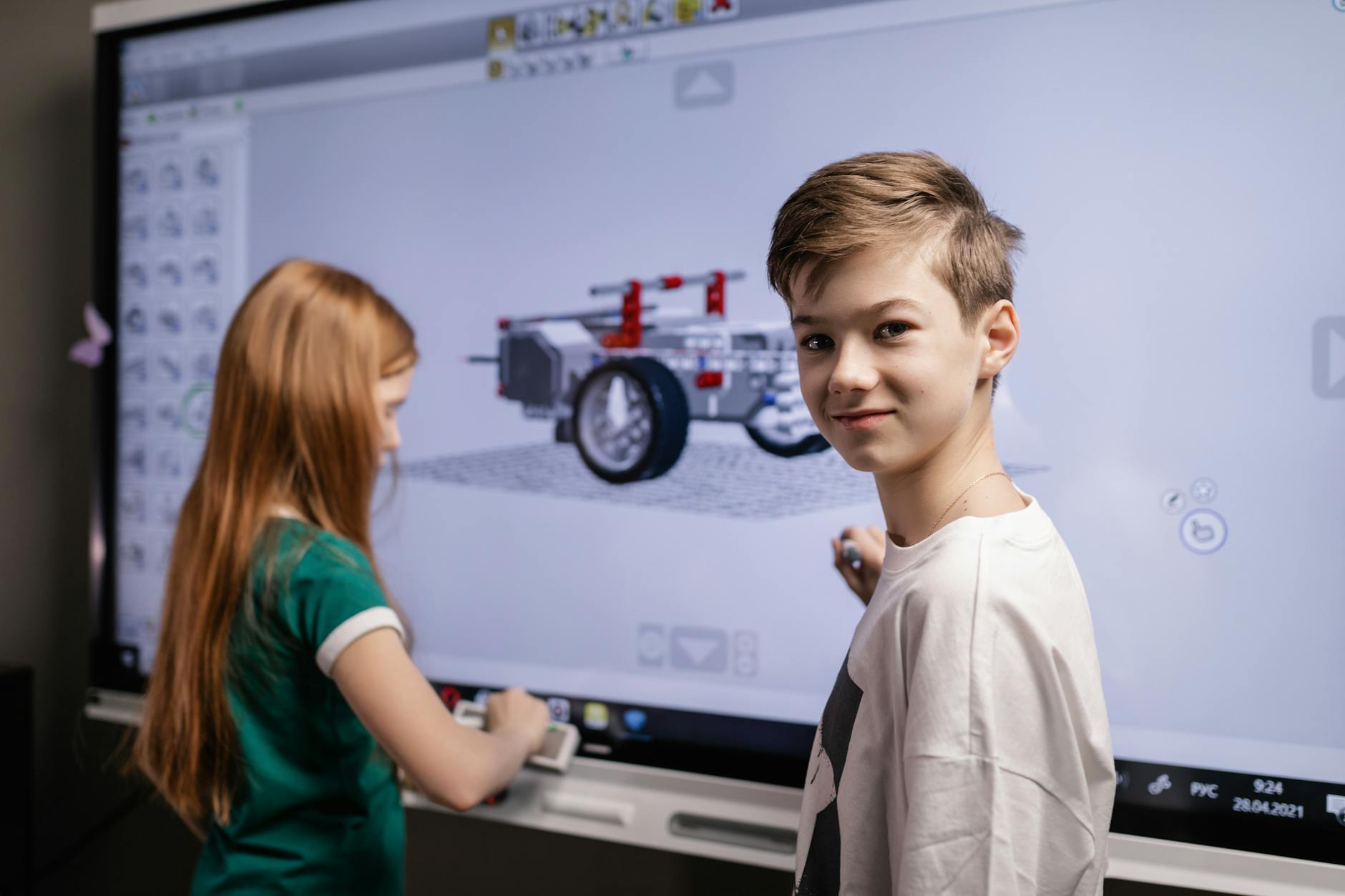
The Promethean ActivPanel 9 and SMART Board MX086-V3 turn your teaching wall into a giant tablet. These panels offer 4K resolution and 20 simultaneous touch points, letting multiple students work math problems side by side. I watched my 7th graders collaborate on a digital dashboard for daily classroom routines using the embedded Android 11 system.
The hardware needs are serious. You need a 110V outlet within 6 feet and a wall rated for 150+ lbs. WiFi 6 handles 30 devices mirroring screens simultaneously. Budget $3,200 for the 75-inch Promethean or $4,100 for the 86-inch SMART Board, plus ten hours of training to use all features.
Interactive Projector Systems for Budget-Conscious Schools
The Epson BrightLink 1485Fi ($1,400) and Boxlight ProColor transform existing whiteboards into interactive surfaces. These projectors deliver 1080p resolution and 5,000 lumens, bright enough to see with lights on. You get interactive capability via pen or finger with 2-point touch.
You need 8-10 feet of throw distance for a 100-inch image. The lamp lasts 10,000 hours in ECO mode, but budget $80 for replacements. Monthly calibration takes 15 minutes. This setup works best when retrofitting current dry erase surfaces rather than mounting heavy panels.
Installation requires two hours and solid ceiling mounts. Unlike panels, these won't strain your walls, making them ideal for older buildings with questionable structural support.
Digital Signage Boards for Rotation Schedules and Visual Timers
Rise Vision on a Fire TV Stick 4K ($50) or TrilbyTV ($150/year) converts any TV into a dynamic classroom sign. These systems run 1080p displays with cloud-based playlist management. You schedule content rotation for daily agendas or station timers.
You need only an HDMI port and internet connection. The Rise Vision free tier handles most teacher needs. Setup takes 30 minutes, not days. Use these for countdown timers during rotation stations or emergency alerts.
Unlike interactive panels, these work as visual aids rather than touch interfaces. They complement your magnetic display or dry erase surface without replacing it.
Subject-Specific Classroom Boards That Streamline Daily Lessons
Stop drawing staffs by hand. These three instructional board designs match specific subjects.
Music Staff Whiteboard (48×36", Westcott, $150): 1.5" spacing, magnetic notes included. Grades 3-12.
XY Coordinate Grid (40×40", Nasco, $120): 1" grid, 30 plotting magnets included. Grades 6-8.
Penmanship Board (72×48", School Outfitters, $200): 2" ruling with dotted midline. Grades PreK-2.
Buy the right accessories. Music boards need spare magnetic note heads ($25 per 20). Math boards need colored dot magnets ($15). Penmanship boards need Expo Chisel Tip markers ($12/dozen) for thick lines.
Plan your classroom setup carefully. Music requires 10-foot viewing distance. Math grids need 8 feet. Penmanship boards mount 24 inches from the floor.
Music Staff Whiteboards for Elementary Band and Choir
The Westcott Music Staff Whiteboard measures 48 by 36 inches and costs $150. It displays a permanent black five-line staff with 1.5-inch spacing. Treble and bass clef symbols sit printed at the left edge, ready for immediate use. The surface handles daily erasing without ghosting.
The board includes 20 magnetic note heads covering quarters, eighths, and halves. Mounting requires hitting two studs for the 48-inch width. Students need a 10-foot viewing distance to distinguish line versus space notes clearly. Budget an extra $25 for a backup set of 20 note heads.
Grid and Graph Boards for Middle School Math Visualization
The Nasco XY Coordinate Grid Board spans 40 by 40 inches for $120. One-inch grid lines cross the dry erase surface, with X and Y axes labeled negative 10 to positive 10. The origin sits dead center. Pair this with specialized math teacher resources for visualization to maximize impact.
You get 30 colored magnetic dots for plotting coordinate pairs. Choose melamine for budget or porcelain for longevity. Budget option: apply one-inch grid washi tape ($8) to a plain board for temporary lessons. Position the teaching wall so students sit eight feet back to see grid intersections without squinting.
Penmanship Line Boards for Early Writing Development
The Best-Rite Penmanship Board measures 72 by 48 inches in field orientation and costs $200. It shows two-inch solid baselines with one-inch dotted midlines in D'Nealian style. Lines print in light blue or gray to fade behind student writing. The large format fits multiple words.
Mount the bottom edge 24 inches from the floor for PreK-2 eye level. Use Expo Chisel Tip markers broadside to model thick letter strokes. The magnetic display accepts letter tiles, but the printed lines matter most. This classroom board eliminates redrawing guidelines. I watched my Kindergarteners trace letters confidently once the lines stayed put.

How Do You Choose Between Material Types and Mounting Options?
Choose porcelain steel for high-use areas (20+ year lifespan, $400-$800), tempered glass for modern aesthetics (magnetic, $600-$1,200), or melamine for light use (5-year lifespan, $100-$300). Wall-mounted suits permanent classrooms, mobile benefits shared spaces, and freestanding works for rooms with cinderblock walls where drilling is restricted.
Your classroom board is an investment, not an accessory. Pick the wrong surface and you'll fight ghosting stains for years. Pick the wrong mount and your teaching wall becomes a liability.
Comparing Porcelain, Glass, and Melamine Durability
Porcelain enamel steel: 25-30 year lifespan, $6/sq ft, accepts rare earth magnets up to 20 lbs, resistant to acetone. Clean with any solvent except abrasive powders.
Tempered glass: Lifetime warranty, $10/sq ft, rare earth magnets only 5 lbs max, scratches at Mohs 6. Clean with glass cleaner only; fingerprints show constantly.
Melamine: 3-5 year lifespan, $2/sq ft, lightweight magnets 1 lb max, damaged by isopropyl alcohol. Clean with water and mild soap only.
Ghosting tells the real story. Porcelain and glass erase completely for decades. Melamine starts ghosting within six months. I learned this in my 7th-grade classroom when my melamine teaching wall held permanent marker shadows after just one semester of daily grammar lessons. The surface looked tired before winter break.
Wall-Mounted vs. Mobile vs. Freestanding Configurations
Wall-mounted: Requires finding studs at 16-inch centers and using lag bolts. No additional hardware cost, but missing studs causes catastrophic failure.
Mobile: 4-inch locking casters add $80-$150 to cost and require 3×3 ft floor space. Best for shared spaces.
Freestanding: A-frame legs require no wall damage, but physics limits stability to 48×36-inch boards maximum.
Avoid melamine if humidity exceeds 60 percent—the backing bubbles and warps. Never hang glass without hitting studs; a 150-pound sheet ripping from drywall creates a safety hazard. Skip porcelain for portable applications at 100-plus pounds. Repair costs sting: glass replacement runs $400-plus, while porcelain chip repair kits cost around $50. Melamine isn't worth repairing.
Size Considerations for Small Groups vs. Whole-Class Instruction
Calculate width using this formula: student count multiplied by 0.25 feet. For 28 students, you need a 7-foot minimum width. Height varies by level: 48 to 60 inches for elementary, 48 to 72 inches for secondary. Maintain sight lines using 2-inch letter height per 10 feet of viewing distance. Students thirty feet back need 3-inch letters.
Small groups of four to six students manage with 24-by-36-inch surfaces. Position the bottom edge 36 inches from the floor—seated eye level. For best practices for integrating whiteboards, ensure your magnetic display area accommodates anchor charts without blocking sight lines. An undersized instructional board forces constant erasing, breaking lesson flow. When in doubt, go wider.
Budget-Friendly Classroom Board Alternatives Under $100
You don't need $400 to add writing space to your classroom board area. These three budget whiteboard alternatives get you through the year for under $100 total. Run the cost-per-year math before you buy. A $45 decal that lasts two years beats a $15 panel that ghosts in six months and needs replacing twice annually. Your classroom setup depends on smart short-term spending, not perfect magnetic display capabilities.
Peel-and-Stick Whiteboard Wall Decals for Flexible Spaces
The Fathead Dry-Erase Wall Decal runs $45 for a 48×36 inch sheet. Budget $22.50 per year since the surface scratches within two years. The 3M adhesive backing sticks to smooth painted drywall in twenty minutes. You peel, position, and smooth out bubbles.
But check your walls first. Orange peel or knockdown texture defeats the adhesive. The decal bubbles and peels within weeks on textured surfaces. It's also not magnetic, so forget hanging anchor charts with magnets.
Clean this dry erase surface with microfiber cloths only. Chemicals attack the adhesive and cause the edges to curl. When the surface stops erasing cleanly or the corners lift, replace it.
Shower Board Panels from Home Improvement Stores
The Thrifty White Hardboard Panel costs $13 to $18 at Home Depot for a 48×96 inch sheet. Cut it to size with a table saw. A four-by-four foot section weighs about 25 pounds. Wrap the sharp edges with colored duct tape or plastic T-molding at fifty cents per foot.
Expect ghosting within three months of daily use. The melamine surface stains permanently by day ninety. When students can't read your notes from ten feet away, upgrade. I used this method my first year teaching 7th grade math while waiting for district funding. It survived one semester before looking grimy.
Clean it weekly with a Magic Eraser to extend the life slightly. Store spare panels flat to prevent warping. This instructional board solution works best as a temporary teaching wall while you secure permanent funding.
Reversible Tabletop Boards for Centers and Small Groups
The Charles Leonard Double-Sided Lap Boards set costs $35 for twelve 9×12 inch boards. That's roughly $17.50 per year over two years. One side has lines; the other is blank. Use them for centers or small groups of four to six students.
They're useless for whole-class instruction. Everyone in the back row sees nothing. Store them vertically in wire dishwasher racks from thrift stores for ten dollars, or use magazine files. This prevents scratching. Use Expo Low-Odor Fine Tip markers—chisel tips bleed on small surfaces.
Track replacement needs to track your classroom materials and inventory. When half your boards look permanently gray even after cleaning, budget for the upgrade. Stacking them flat in bins creates a scratched plastic smell that drives you crazy.

How to Set Up Your Teacher Board for Maximum Impact?
Set up your teacher board by dividing it into three zones: left side for daily learning objectives (visible from 20 feet), center for agendas and anchor charts, and right side for magnetic storage caddies holding markers and erasers. Use color-coded washi tape to create boundaries without damaging surfaces.
I learned this layout after watching my 7th graders crane their necks to read crooked objectives. Follow this protocol for your classroom board:
Position the bottom edge 36 inches from the floor—seated eye level.
Keep the top below 78 inches to avoid reaching.
Test lighting for glare within 30 degrees of direct sunlight.
Never use permanent markers; isopropyl alcohol fixes accidents.
Limit displays to three anchor charts maximum to prevent clutter.
Run a seasonal maintenance schedule:
Weekly: Wipe with Expo cleaner ($8).
Monthly: Inspect mounting hardware.
Quarterly: Replace washi tape borders.
Summer: Deep clean with Meguiar's automotive polish on porcelain only.
Organizing Zones for Objectives, Agendas, and Anchor Charts
Divide your teaching wall using 1-inch colored washi tape into three distinct operational zones. Zone 1 occupies the left 20 percent—reserve this for Daily Learning Objectives written in 3-inch black letters visible from 20 feet. Zone 2 takes the center 60 percent; mount a Scholastic magnetic pocket chart ($18) here for your daily agenda.
Zone 3 covers the right 20 percent for reference materials using 3M Command hooks or magnetic clips, but limit yourself to two or three anchor charts maximum to prevent clutter. Update Zone 1 daily, Zone 2 weekly, and Zone 3 monthly. See our guide on building effective anchor charts for instruction.
Magnetic Storage Solutions to Keep Supplies Within Reach
Stock your magnetic display with three organizers. The Expo Magnetic Marker Caddy ($12) holds eight markers horizontally to prevent drying. Add the Learning Resources Magnetic Storage Pocket ($8, 9×7 inches) for erasers. Use Officemate Magnets ($6/4-pack, 250-lb pull strength) for heavy charts. Ensure 250+ lb pull-strength magnets for any storage above students. Mount caddies below 60 inches from the floor to prevent head injuries if they fall. Review your teacher supply checklist for organizational success before school starts.

Where Does Classroom Board Fit in Your Practice?
You've seen the options. The heavy-duty magnetic display bolted to your wall. The rolling whiteboard you wheel to the back corner when you need floor space. The right classroom board depends on what actually happens in your room. If you're projecting slides all day, that glossy interactive panel makes sense. If you're writing equations and slapping up anchor charts, a simple dry erase surface wins every time.
Don't overthink the mount. A rolling instructional board saves you when admin changes your room assignment again. A wall-mounted setup keeps your front wall clean and permanent. Either way, stop tolerating ghosted markers and dented corners. Your board is where the thinking happens. Treat it like essential equipment, not an afterthought.
Look hard at your teaching style. Are you a wanderer who needs mobility, or an anchor who stays front and center? Which classroom board will actually change how you teach tomorrow?

What Are the Best Full-Size Magnetic Classroom Boards for Daily Instruction?
The best full-size magnetic classroom boards include commercial-grade porcelain steel options like the Quartet Prestige 2 (4×8 ft) for heavy daily use. Lightweight melamine boards such as the Universal UNV43622 (4×6 ft) suit elementary settings with lighter traffic. Combo cork-and-write boards split your essential classroom learning space components between magnetic writing and pinning displays.
Your choice depends on daily usage hours and what you hang on the surface. Porcelain survives decades of aggressive erasing. Melamine works for anchor charts and occasional notes. Pick wrong, and you'll stare at ghost marks for five years.
Model | Surface | Warranty | Magnetic Hold | Weight |
|---|---|---|---|---|
Quartet Prestige 2 (4×8 ft) | Porcelain | 25 years | 15 lbs | 85 lbs |
Ghent SPC410B (4×10 ft) | Porcelain | 50 years | 15 lbs | 120 lbs |
Universal UNV43622 (4×6 ft) | Melamine | 5 years | 2 lbs | 35 lbs |
Porcelain boards handle 6+ hours of daily instruction. Melamine works for 2-3 hours of intermittent use. Warning: melamine surfaces ghost permanently if markers sit uncleaned for 24 hours.
Mounting differs dramatically by weight:
Porcelain boards need lag bolts into three studs spaced 16 inches on center, supporting 200+ lbs.
Melamine boards under 50 lbs mount with drywall anchors.
Professional installation runs $150; DIY requires a level and a second pair of hands.
Commercial-Grade Porcelain Steel Boards for Heavy-Duty Use
The Quartet Prestige 2 (4×8 ft, $450) uses 28-gauge porcelain enamel steel. The Ghent SPC410B (4×10 ft, $620) offers extra width for side-by-side centers. Both carry 25-50 year warranties and handle 6+ hours of daily instruction.
These instructional boards accept rare earth magnets holding 15+ lbs of laminated posters. At 85-120 lbs, they require structural mounting into three studs 16 inches on center. Professional installation costs around $150.
Surface hardness hits 5-6 on the Mohs scale. Dropped scissors or magnet edges won't scratch the teaching wall. This dry erase surface stays pristine through decades of aggressive erasing.
Lightweight Melamine Options for Elementary Classrooms
The Universal UNV43622 (4×6 ft, $180) and Iceberg ICE33041 use resin-infused paper surfaces. These teacher boards weigh 35-45 lbs, allowing drywall anchor installation. They accept only lightweight ceramic magnets holding 1 lb maximum.
I learned this the hard way in third grade. I left a rainbow of marker colors up over a three-day weekend. The board absorbed the ink permanently, leaving ghost marks. Now I clean my magnetic display every afternoon with water only—alcohol causes hazing on melamine.
These work best for grades K-5 with 2-3 hours of intermittent daily writing. The 3-5 year lifespan matches how often elementary teachers refresh their classroom setup.
Combo Cork-and-Write Boards for Multi-Function Walls
The Best-Rite Combo-Rite (48×36", $320) and Ghent Combination boards split your wall space. Choose 50/50 or 70/30 configurations between cork and magnetic sections. The self-healing cork accepts push pins for anchor charts.
The magnetic section uses porcelain or painted steel for daily writing. You can pin standards on the cork and solve math problems on the whiteboard without switching walls. Aluminum ABC trim frames both sections cleanly.
Mounting requires only two studs for the 48-inch width, supporting boards under 50 lbs. This suits older buildings with irregular stud spacing. You get dual function without the weight of full-size porcelain.
Which Portable and Rolling Classroom Boards Offer Maximum Flexibility?
Portable classroom boards offering maximum flexibility include double-sided mobile units like the Best-Rite 96-inch Platinum Reversible ($350-$500) with locking casters for safety, folding presentation boards featuring 4-inch deep storage trays, and adjustable-height easel boards spanning 42-72 inches to accommodate both kindergarten students and standing high school teachers.
Fixed teaching walls limit your options. When I taught 7th grade in a portable classroom with no wall space, rolling boards turned corners into collaboration zones.
Best-Rite Platinum Reversible ($480, 150 lbs, 96×48 inches, porcelain steel both sides, 4 locking casters). Best for station rotation with 4-6 students per side.
VIVO Mobile Stand ($120, fits 48×36 boards, height 59-64 inches). Best for swapping between classrooms or temporary setups.
Quartet Folding Presentation Board ($85, 72×36 inches open, 28 lbs, 4-inch tray). Best for PD sessions and multi-purpose rooms.
Choose double-sided for station rotations, folding for multi-purpose rooms, and adjustable-height for multi-grade classrooms or teachers who alternate between sitting and standing.
Locking casters must engage with fifty pounds of force to prevent student movement. Any unit over sixty inches tall requires a twenty-four by twenty-four inch base to prevent tipping.
Double-Sided Mobile Whiteboards for Collaborative Stations
The Best-Rite Platinum Reversible measures ninety-six by forty-eight inches. This magnetic display unit weighs one hundred fifty pounds and rolls on four casters with brake locks. The base supports three hundred pounds.
I used this during a 7th grade poetry unit. Four students brainstormed on the reverse while I taught on the front. Always engage the wheel locks before writing to prevent drift.
Folding Presentation Boards with Built-In Storage Trays
The Quartet Presentation Easel spans seventy-two by thirty-six inches open, folding to twenty-four by thirty-six inches. The four-inch molded tray holds markers securely. It weighs twenty-eight pounds.
The melamine dry erase surface wipes clean but lacks magnetic properties. Use sticky tack for papers. This instructional board works perfectly for PD sessions where you cannot store permanent fixtures.
Adjustable-Height Easel Boards for Different Grade Levels
The VIVO Mobile Whiteboard Stand adjusts from fifty-nine to sixty-four inches with tilt from zero to forty-five degrees. It accommodates boards up to forty-eight by thirty-six inches. The twenty-four by twenty-four inch base prevents tipping near flexible seating and mobile furniture configurations.
Assembly takes twenty-five minutes with a Phillips head screwdriver. The stand holds fifty pounds maximum. I have used this in a K-5 art room where third graders pulled it down for center work.
What Are the Top-Rated Interactive Digital Classroom Boards?
Top-rated interactive digital classroom boards include the Promethean ActivPanel 9 (75-inch, $3,200) with 20-point touch capability, Epson BrightLink projectors ($1,400) for 1080p budget solutions, and Rise Vision displays ($100-$300) for classroom sign management and visual rotation timers. Each tier serves different instructional needs and infrastructure constraints. Your choice depends on available wall space, budget, and how many students interact simultaneously.
Plan your classroom setup before you buy. These tools range from full teaching walls to simple digital timers, and the price gaps are massive.
Promethean ActivPanel 9: $3,200 + $45/year electricity. Pros: 20-point touch, no lamps. Cons: 10-hour training required, needs WiFi 6 infrastructure.
Epson BrightLink 1485Fi: $1,400 + $80 lamp/5,000 hours. Pros: 2-hour setup, retrofits existing whiteboards. Cons: Monthly calibration, 2-point touch only.
Rise Vision/Fire TV Stick: $100 hardware + free software. Pros: 30-minute setup, classroom sign capability. Cons: No touch interaction, requires separate HDMI display.
Interactive panels: 6-foot proximity to 110V outlet, wall rated for 150+ lbs, WiFi 6 (802.11ax) for screen mirroring.
Projectors: 8-10 foot throw distance, 4,000+ lumens for lights-on visibility, solid ceiling mount.
Digital signage: HDMI port and internet connection only.
Purchasing 4K panels without 25 Mbps minimum bandwidth per device causes lag during screen mirroring.
Installing projectors without keystone correction creates distorted images on your instructional board.
Neglecting to budget for replacement stylus pens at $25-$60 each when students lose them.
Touch-Screen Smart Displays for Multimedia Integration
The Promethean ActivPanel 9 and SMART Board MX086-V3 turn your teaching wall into a giant tablet. These panels offer 4K resolution and 20 simultaneous touch points, letting multiple students work math problems side by side. I watched my 7th graders collaborate on a digital dashboard for daily classroom routines using the embedded Android 11 system.
The hardware needs are serious. You need a 110V outlet within 6 feet and a wall rated for 150+ lbs. WiFi 6 handles 30 devices mirroring screens simultaneously. Budget $3,200 for the 75-inch Promethean or $4,100 for the 86-inch SMART Board, plus ten hours of training to use all features.
Interactive Projector Systems for Budget-Conscious Schools
The Epson BrightLink 1485Fi ($1,400) and Boxlight ProColor transform existing whiteboards into interactive surfaces. These projectors deliver 1080p resolution and 5,000 lumens, bright enough to see with lights on. You get interactive capability via pen or finger with 2-point touch.
You need 8-10 feet of throw distance for a 100-inch image. The lamp lasts 10,000 hours in ECO mode, but budget $80 for replacements. Monthly calibration takes 15 minutes. This setup works best when retrofitting current dry erase surfaces rather than mounting heavy panels.
Installation requires two hours and solid ceiling mounts. Unlike panels, these won't strain your walls, making them ideal for older buildings with questionable structural support.
Digital Signage Boards for Rotation Schedules and Visual Timers
Rise Vision on a Fire TV Stick 4K ($50) or TrilbyTV ($150/year) converts any TV into a dynamic classroom sign. These systems run 1080p displays with cloud-based playlist management. You schedule content rotation for daily agendas or station timers.
You need only an HDMI port and internet connection. The Rise Vision free tier handles most teacher needs. Setup takes 30 minutes, not days. Use these for countdown timers during rotation stations or emergency alerts.
Unlike interactive panels, these work as visual aids rather than touch interfaces. They complement your magnetic display or dry erase surface without replacing it.
Subject-Specific Classroom Boards That Streamline Daily Lessons
Stop drawing staffs by hand. These three instructional board designs match specific subjects.
Music Staff Whiteboard (48×36", Westcott, $150): 1.5" spacing, magnetic notes included. Grades 3-12.
XY Coordinate Grid (40×40", Nasco, $120): 1" grid, 30 plotting magnets included. Grades 6-8.
Penmanship Board (72×48", School Outfitters, $200): 2" ruling with dotted midline. Grades PreK-2.
Buy the right accessories. Music boards need spare magnetic note heads ($25 per 20). Math boards need colored dot magnets ($15). Penmanship boards need Expo Chisel Tip markers ($12/dozen) for thick lines.
Plan your classroom setup carefully. Music requires 10-foot viewing distance. Math grids need 8 feet. Penmanship boards mount 24 inches from the floor.
Music Staff Whiteboards for Elementary Band and Choir
The Westcott Music Staff Whiteboard measures 48 by 36 inches and costs $150. It displays a permanent black five-line staff with 1.5-inch spacing. Treble and bass clef symbols sit printed at the left edge, ready for immediate use. The surface handles daily erasing without ghosting.
The board includes 20 magnetic note heads covering quarters, eighths, and halves. Mounting requires hitting two studs for the 48-inch width. Students need a 10-foot viewing distance to distinguish line versus space notes clearly. Budget an extra $25 for a backup set of 20 note heads.
Grid and Graph Boards for Middle School Math Visualization
The Nasco XY Coordinate Grid Board spans 40 by 40 inches for $120. One-inch grid lines cross the dry erase surface, with X and Y axes labeled negative 10 to positive 10. The origin sits dead center. Pair this with specialized math teacher resources for visualization to maximize impact.
You get 30 colored magnetic dots for plotting coordinate pairs. Choose melamine for budget or porcelain for longevity. Budget option: apply one-inch grid washi tape ($8) to a plain board for temporary lessons. Position the teaching wall so students sit eight feet back to see grid intersections without squinting.
Penmanship Line Boards for Early Writing Development
The Best-Rite Penmanship Board measures 72 by 48 inches in field orientation and costs $200. It shows two-inch solid baselines with one-inch dotted midlines in D'Nealian style. Lines print in light blue or gray to fade behind student writing. The large format fits multiple words.
Mount the bottom edge 24 inches from the floor for PreK-2 eye level. Use Expo Chisel Tip markers broadside to model thick letter strokes. The magnetic display accepts letter tiles, but the printed lines matter most. This classroom board eliminates redrawing guidelines. I watched my Kindergarteners trace letters confidently once the lines stayed put.
How Do You Choose Between Material Types and Mounting Options?
Choose porcelain steel for high-use areas (20+ year lifespan, $400-$800), tempered glass for modern aesthetics (magnetic, $600-$1,200), or melamine for light use (5-year lifespan, $100-$300). Wall-mounted suits permanent classrooms, mobile benefits shared spaces, and freestanding works for rooms with cinderblock walls where drilling is restricted.
Your classroom board is an investment, not an accessory. Pick the wrong surface and you'll fight ghosting stains for years. Pick the wrong mount and your teaching wall becomes a liability.
Comparing Porcelain, Glass, and Melamine Durability
Porcelain enamel steel: 25-30 year lifespan, $6/sq ft, accepts rare earth magnets up to 20 lbs, resistant to acetone. Clean with any solvent except abrasive powders.
Tempered glass: Lifetime warranty, $10/sq ft, rare earth magnets only 5 lbs max, scratches at Mohs 6. Clean with glass cleaner only; fingerprints show constantly.
Melamine: 3-5 year lifespan, $2/sq ft, lightweight magnets 1 lb max, damaged by isopropyl alcohol. Clean with water and mild soap only.
Ghosting tells the real story. Porcelain and glass erase completely for decades. Melamine starts ghosting within six months. I learned this in my 7th-grade classroom when my melamine teaching wall held permanent marker shadows after just one semester of daily grammar lessons. The surface looked tired before winter break.
Wall-Mounted vs. Mobile vs. Freestanding Configurations
Wall-mounted: Requires finding studs at 16-inch centers and using lag bolts. No additional hardware cost, but missing studs causes catastrophic failure.
Mobile: 4-inch locking casters add $80-$150 to cost and require 3×3 ft floor space. Best for shared spaces.
Freestanding: A-frame legs require no wall damage, but physics limits stability to 48×36-inch boards maximum.
Avoid melamine if humidity exceeds 60 percent—the backing bubbles and warps. Never hang glass without hitting studs; a 150-pound sheet ripping from drywall creates a safety hazard. Skip porcelain for portable applications at 100-plus pounds. Repair costs sting: glass replacement runs $400-plus, while porcelain chip repair kits cost around $50. Melamine isn't worth repairing.
Size Considerations for Small Groups vs. Whole-Class Instruction
Calculate width using this formula: student count multiplied by 0.25 feet. For 28 students, you need a 7-foot minimum width. Height varies by level: 48 to 60 inches for elementary, 48 to 72 inches for secondary. Maintain sight lines using 2-inch letter height per 10 feet of viewing distance. Students thirty feet back need 3-inch letters.
Small groups of four to six students manage with 24-by-36-inch surfaces. Position the bottom edge 36 inches from the floor—seated eye level. For best practices for integrating whiteboards, ensure your magnetic display area accommodates anchor charts without blocking sight lines. An undersized instructional board forces constant erasing, breaking lesson flow. When in doubt, go wider.
Budget-Friendly Classroom Board Alternatives Under $100
You don't need $400 to add writing space to your classroom board area. These three budget whiteboard alternatives get you through the year for under $100 total. Run the cost-per-year math before you buy. A $45 decal that lasts two years beats a $15 panel that ghosts in six months and needs replacing twice annually. Your classroom setup depends on smart short-term spending, not perfect magnetic display capabilities.
Peel-and-Stick Whiteboard Wall Decals for Flexible Spaces
The Fathead Dry-Erase Wall Decal runs $45 for a 48×36 inch sheet. Budget $22.50 per year since the surface scratches within two years. The 3M adhesive backing sticks to smooth painted drywall in twenty minutes. You peel, position, and smooth out bubbles.
But check your walls first. Orange peel or knockdown texture defeats the adhesive. The decal bubbles and peels within weeks on textured surfaces. It's also not magnetic, so forget hanging anchor charts with magnets.
Clean this dry erase surface with microfiber cloths only. Chemicals attack the adhesive and cause the edges to curl. When the surface stops erasing cleanly or the corners lift, replace it.
Shower Board Panels from Home Improvement Stores
The Thrifty White Hardboard Panel costs $13 to $18 at Home Depot for a 48×96 inch sheet. Cut it to size with a table saw. A four-by-four foot section weighs about 25 pounds. Wrap the sharp edges with colored duct tape or plastic T-molding at fifty cents per foot.
Expect ghosting within three months of daily use. The melamine surface stains permanently by day ninety. When students can't read your notes from ten feet away, upgrade. I used this method my first year teaching 7th grade math while waiting for district funding. It survived one semester before looking grimy.
Clean it weekly with a Magic Eraser to extend the life slightly. Store spare panels flat to prevent warping. This instructional board solution works best as a temporary teaching wall while you secure permanent funding.
Reversible Tabletop Boards for Centers and Small Groups
The Charles Leonard Double-Sided Lap Boards set costs $35 for twelve 9×12 inch boards. That's roughly $17.50 per year over two years. One side has lines; the other is blank. Use them for centers or small groups of four to six students.
They're useless for whole-class instruction. Everyone in the back row sees nothing. Store them vertically in wire dishwasher racks from thrift stores for ten dollars, or use magazine files. This prevents scratching. Use Expo Low-Odor Fine Tip markers—chisel tips bleed on small surfaces.
Track replacement needs to track your classroom materials and inventory. When half your boards look permanently gray even after cleaning, budget for the upgrade. Stacking them flat in bins creates a scratched plastic smell that drives you crazy.
How to Set Up Your Teacher Board for Maximum Impact?
Set up your teacher board by dividing it into three zones: left side for daily learning objectives (visible from 20 feet), center for agendas and anchor charts, and right side for magnetic storage caddies holding markers and erasers. Use color-coded washi tape to create boundaries without damaging surfaces.
I learned this layout after watching my 7th graders crane their necks to read crooked objectives. Follow this protocol for your classroom board:
Position the bottom edge 36 inches from the floor—seated eye level.
Keep the top below 78 inches to avoid reaching.
Test lighting for glare within 30 degrees of direct sunlight.
Never use permanent markers; isopropyl alcohol fixes accidents.
Limit displays to three anchor charts maximum to prevent clutter.
Run a seasonal maintenance schedule:
Weekly: Wipe with Expo cleaner ($8).
Monthly: Inspect mounting hardware.
Quarterly: Replace washi tape borders.
Summer: Deep clean with Meguiar's automotive polish on porcelain only.
Organizing Zones for Objectives, Agendas, and Anchor Charts
Divide your teaching wall using 1-inch colored washi tape into three distinct operational zones. Zone 1 occupies the left 20 percent—reserve this for Daily Learning Objectives written in 3-inch black letters visible from 20 feet. Zone 2 takes the center 60 percent; mount a Scholastic magnetic pocket chart ($18) here for your daily agenda.
Zone 3 covers the right 20 percent for reference materials using 3M Command hooks or magnetic clips, but limit yourself to two or three anchor charts maximum to prevent clutter. Update Zone 1 daily, Zone 2 weekly, and Zone 3 monthly. See our guide on building effective anchor charts for instruction.
Magnetic Storage Solutions to Keep Supplies Within Reach
Stock your magnetic display with three organizers. The Expo Magnetic Marker Caddy ($12) holds eight markers horizontally to prevent drying. Add the Learning Resources Magnetic Storage Pocket ($8, 9×7 inches) for erasers. Use Officemate Magnets ($6/4-pack, 250-lb pull strength) for heavy charts. Ensure 250+ lb pull-strength magnets for any storage above students. Mount caddies below 60 inches from the floor to prevent head injuries if they fall. Review your teacher supply checklist for organizational success before school starts.
Where Does Classroom Board Fit in Your Practice?
You've seen the options. The heavy-duty magnetic display bolted to your wall. The rolling whiteboard you wheel to the back corner when you need floor space. The right classroom board depends on what actually happens in your room. If you're projecting slides all day, that glossy interactive panel makes sense. If you're writing equations and slapping up anchor charts, a simple dry erase surface wins every time.
Don't overthink the mount. A rolling instructional board saves you when admin changes your room assignment again. A wall-mounted setup keeps your front wall clean and permanent. Either way, stop tolerating ghosted markers and dented corners. Your board is where the thinking happens. Treat it like essential equipment, not an afterthought.
Look hard at your teaching style. Are you a wanderer who needs mobility, or an anchor who stays front and center? Which classroom board will actually change how you teach tomorrow?
Still grading everything by hand?
EMStudio is a free teaching management app — manage your classes, students, lessons, and more!
Learn More
Still grading everything by hand?
EMStudio is a free teaching management app — manage your classes, students, lessons, and more!
Learn More




Notion4Teachers
Notion templates to simplify administrative tasks and enhance your teaching experience.



2026 Notion4Teachers. All Rights Reserved.
Notion4Teachers
Notion templates to simplify administrative tasks and enhance your teaching experience.
2026 Notion4Teachers. All Rights Reserved.
Notion4Teachers
Notion templates to simplify administrative tasks and enhance your teaching experience.
2026 Notion4Teachers. All Rights Reserved.