How Schools Are Redesigning Curriculum Beyond Traditional Learning Models
How Schools Are Redesigning Curriculum Beyond Traditional Learning Models

Article by
Milo
ESL Content Coordinator & Educator
ESL Content Coordinator & Educator
All Posts
Education has a tension running through it that most teachers feel but don't always name directly. On one side: a curriculum structure built for a different era, optimised for standardised outputs and measurable conformity. On the other: students who need to think, adapt, collaborate, and create in ways that the traditional model was never designed to develop.
The schools doing the most interesting work right now are the ones leaning into that tension rather than ignoring it, redesigning how and what they teach in ways that prepare students for a world that traditional curriculum was never built to address.
Still grading everything by hand?
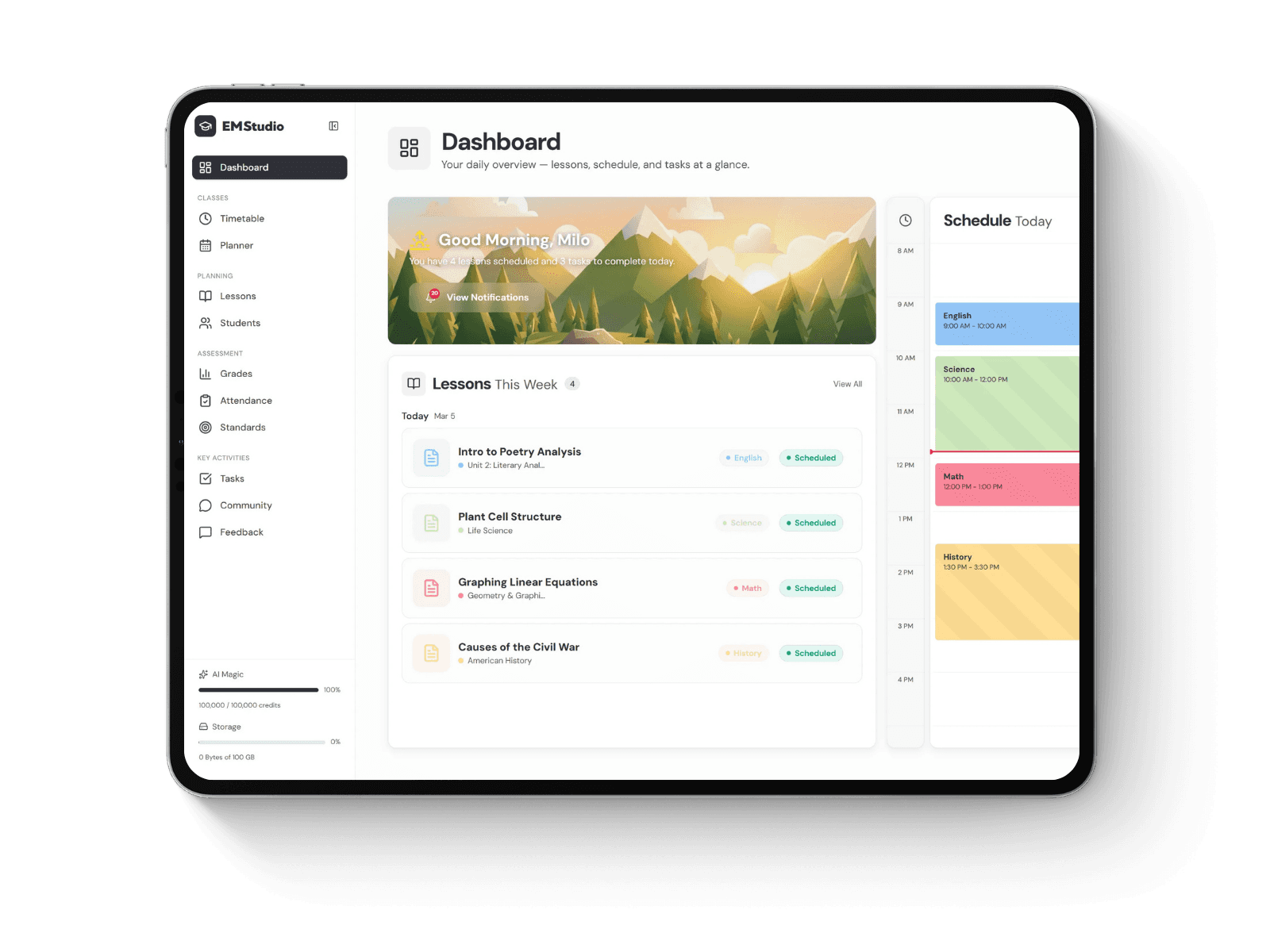
EMStudio is a free teaching management app — manage your classes, students, lessons, and more!
Learn More
Still grading everything by hand?
EMStudio is a free teaching management app — manage your classes, students, lessons, and more!
Learn More
Table of Contents
What's Wrong With the Traditional Model
Before talking about alternatives, it's worth being honest about what the traditional model does well, and where it falls short.
Traditional curriculum delivers consistency. It ensures that students cover defined content, that teachers work from shared frameworks, and that outcomes can be measured and compared across cohorts. For certain types of knowledge and certain institutional purposes, that consistency has real value.
But the traditional model was built on assumptions that are increasingly hard to defend. That information is scarce and must be transmitted efficiently from expert to novice. That standardised testing accurately reflects what students know and can do. That the same curriculum sequence serves all learners in the same way. And that preparing students for the workforce means filling them with specific content rather than developing the capabilities that allow them to keep learning throughout their lives.
Each of these assumptions is challenged by how work, knowledge, and society actually function in 2026.
What Redesigned Curriculum Actually Looks Like
The shift away from traditional models isn't uniform, different schools are making different choices based on their context, their community, and their educational philosophy. But certain approaches are appearing consistently in schools that are doing this work seriously.
Project-based and inquiry-based learning moves from content delivery to question-driven exploration. Students work on extended projects that require them to apply knowledge from multiple disciplines, make real decisions, and produce genuine outputs, not just answer exam questions. The content is still there; it's encountered through the work rather than delivered before it.
Integration across subject areas challenges the assumption that knowledge is naturally divided into discrete subjects. A project exploring climate change draws on science, mathematics, economics, ethics, and communication simultaneously. Students experience knowledge as connected and applicable rather than siloed and abstract.
Student agency in learning design gives students meaningful choices about what they explore, how they demonstrate understanding, and how they pace their own development. This isn't abandoning structure, it's building the metacognitive skills that allow learners to manage their own learning throughout their lives.
Assessment that reflects actual capability moves beyond standardised tests toward portfolios, presentations, peer review, and real-world application. What can the student actually do with what they know? That question is harder to answer with a test score but considerably more meaningful.
International Frameworks That Support the Shift
One of the most established frameworks for curriculum redesign at the school level is the International Baccalaureate programme. Understanding the IB program vs traditional curriculum distinction is useful for educators trying to understand what a coherent alternative to traditional models actually looks like in practice. Madison Country Day School has produced a particularly clear and useful breakdown of these differences. It covers how the IB approach to knowledge, assessment, and learner development contrasts with traditional curriculum at every level.
The IB framework is one of the better-documented examples of a coherent alternative to traditional curriculum, built around international-mindedness, inquiry, and the development of learner attributes alongside content knowledge. It's not the only framework, but understanding how it differs from traditional models illuminates the broader conversation about curriculum redesign.
The broader goals of the programme are also reflected by the International Baccalaureate Organization, which highlights benefits such as critical thinking, intercultural awareness, independent learning skills, and stronger preparation for higher education and long-term learning.
The Role of Teachers in Curriculum Redesign
This is the part that textbooks about educational reform often underemphasise. Curriculum redesign doesn't happen by changing a document. It happens through teachers who understand the philosophy, have the pedagogical skills to implement it, and are given the institutional support to do so.
The skills most relevant to redesigned curriculum approaches include:
Facilitation rather than transmission — designing and managing learning experiences rather than delivering information
Formative assessment — reading student understanding in real time and adjusting accordingly, rather than relying on summative tests to reveal what was missed
Collaborative planning — working across subject boundaries with colleagues to design integrated units
Coaching metacognition — helping students understand their own learning processes, not just the content being studied
Managing inquiry — the ability to hold productive ambiguity open long enough for genuine exploration, rather than resolving it too quickly into neat answers
These are different skills from those required for traditional curriculum delivery, and they require both professional development and institutional cultures that value and support this kind of teaching.
What Schools Need to Get Right
The schools that succeed at curriculum redesign share certain characteristics. They:
Start with clear educational philosophy — not just "we want to be innovative" but a genuine articulation of what they believe about how children learn and what education is for
Build teacher capacity before expecting teacher performance — professional development that's sustained and specific, not a single training day
Involve parents in the conversation — curriculum change can feel threatening to parents whose own education was traditional; transparency and explanation builds the community support that sustains reform
Evaluate honestly — measuring whether the redesign is actually producing the outcomes it claims, and being willing to adjust when it isn't
Give the reform time — curriculum redesign doesn't produce results in a single year; the commitment needs to be institutional and long-term
Conclusion
The traditional curriculum isn't broken in every dimension, but it's increasingly misaligned with the world students are being educated for. The schools doing the most interesting work are those that have been honest about that misalignment and willing to design something better.
That redesign is hard, ongoing, and deeply dependent on teacher expertise and institutional commitment. But the schools that have done it well are producing graduates who are genuinely better prepared, not just for university entrance, but for the lifelong learning that the modern world demands.
The conversation about curriculum is one of the most important ones in education right now. It deserves the seriousness it's finally starting to receive.
What's Wrong With the Traditional Model
Before talking about alternatives, it's worth being honest about what the traditional model does well, and where it falls short.
Traditional curriculum delivers consistency. It ensures that students cover defined content, that teachers work from shared frameworks, and that outcomes can be measured and compared across cohorts. For certain types of knowledge and certain institutional purposes, that consistency has real value.
But the traditional model was built on assumptions that are increasingly hard to defend. That information is scarce and must be transmitted efficiently from expert to novice. That standardised testing accurately reflects what students know and can do. That the same curriculum sequence serves all learners in the same way. And that preparing students for the workforce means filling them with specific content rather than developing the capabilities that allow them to keep learning throughout their lives.
Each of these assumptions is challenged by how work, knowledge, and society actually function in 2026.
What Redesigned Curriculum Actually Looks Like
The shift away from traditional models isn't uniform, different schools are making different choices based on their context, their community, and their educational philosophy. But certain approaches are appearing consistently in schools that are doing this work seriously.
Project-based and inquiry-based learning moves from content delivery to question-driven exploration. Students work on extended projects that require them to apply knowledge from multiple disciplines, make real decisions, and produce genuine outputs, not just answer exam questions. The content is still there; it's encountered through the work rather than delivered before it.
Integration across subject areas challenges the assumption that knowledge is naturally divided into discrete subjects. A project exploring climate change draws on science, mathematics, economics, ethics, and communication simultaneously. Students experience knowledge as connected and applicable rather than siloed and abstract.
Student agency in learning design gives students meaningful choices about what they explore, how they demonstrate understanding, and how they pace their own development. This isn't abandoning structure, it's building the metacognitive skills that allow learners to manage their own learning throughout their lives.
Assessment that reflects actual capability moves beyond standardised tests toward portfolios, presentations, peer review, and real-world application. What can the student actually do with what they know? That question is harder to answer with a test score but considerably more meaningful.
International Frameworks That Support the Shift
One of the most established frameworks for curriculum redesign at the school level is the International Baccalaureate programme. Understanding the IB program vs traditional curriculum distinction is useful for educators trying to understand what a coherent alternative to traditional models actually looks like in practice. Madison Country Day School has produced a particularly clear and useful breakdown of these differences. It covers how the IB approach to knowledge, assessment, and learner development contrasts with traditional curriculum at every level.
The IB framework is one of the better-documented examples of a coherent alternative to traditional curriculum, built around international-mindedness, inquiry, and the development of learner attributes alongside content knowledge. It's not the only framework, but understanding how it differs from traditional models illuminates the broader conversation about curriculum redesign.
The broader goals of the programme are also reflected by the International Baccalaureate Organization, which highlights benefits such as critical thinking, intercultural awareness, independent learning skills, and stronger preparation for higher education and long-term learning.
The Role of Teachers in Curriculum Redesign
This is the part that textbooks about educational reform often underemphasise. Curriculum redesign doesn't happen by changing a document. It happens through teachers who understand the philosophy, have the pedagogical skills to implement it, and are given the institutional support to do so.
The skills most relevant to redesigned curriculum approaches include:
Facilitation rather than transmission — designing and managing learning experiences rather than delivering information
Formative assessment — reading student understanding in real time and adjusting accordingly, rather than relying on summative tests to reveal what was missed
Collaborative planning — working across subject boundaries with colleagues to design integrated units
Coaching metacognition — helping students understand their own learning processes, not just the content being studied
Managing inquiry — the ability to hold productive ambiguity open long enough for genuine exploration, rather than resolving it too quickly into neat answers
These are different skills from those required for traditional curriculum delivery, and they require both professional development and institutional cultures that value and support this kind of teaching.
What Schools Need to Get Right
The schools that succeed at curriculum redesign share certain characteristics. They:
Start with clear educational philosophy — not just "we want to be innovative" but a genuine articulation of what they believe about how children learn and what education is for
Build teacher capacity before expecting teacher performance — professional development that's sustained and specific, not a single training day
Involve parents in the conversation — curriculum change can feel threatening to parents whose own education was traditional; transparency and explanation builds the community support that sustains reform
Evaluate honestly — measuring whether the redesign is actually producing the outcomes it claims, and being willing to adjust when it isn't
Give the reform time — curriculum redesign doesn't produce results in a single year; the commitment needs to be institutional and long-term
Conclusion
The traditional curriculum isn't broken in every dimension, but it's increasingly misaligned with the world students are being educated for. The schools doing the most interesting work are those that have been honest about that misalignment and willing to design something better.
That redesign is hard, ongoing, and deeply dependent on teacher expertise and institutional commitment. But the schools that have done it well are producing graduates who are genuinely better prepared, not just for university entrance, but for the lifelong learning that the modern world demands.
The conversation about curriculum is one of the most important ones in education right now. It deserves the seriousness it's finally starting to receive.
Still grading everything by hand?
EMStudio is a free teaching management app — manage your classes, students, lessons, and more!
Learn More
Still grading everything by hand?
EMStudio is a free teaching management app — manage your classes, students, lessons, and more!
Learn More


Notion4Teachers
Notion templates to simplify administrative tasks and enhance your teaching experience.



2026 Notion4Teachers. All Rights Reserved.
Notion4Teachers
Notion templates to simplify administrative tasks and enhance your teaching experience.
2026 Notion4Teachers. All Rights Reserved.
Notion4Teachers
Notion templates to simplify administrative tasks and enhance your teaching experience.
2026 Notion4Teachers. All Rights Reserved.