
Schools for Teacher: 5 Steps to Choose the Right Program
Schools for Teacher: 5 Steps to Choose the Right Program

Article by
Milo
ESL Content Coordinator & Educator
ESL Content Coordinator & Educator
All Posts
I watched a first-year teacher cry in the copy room last October. She had finished her student teaching placement feeling confident, but her educator licensure exam kept tripping her up. She realized too late that her teacher preparation program had never actually prepared her for the Praxis examination format she faced. Three years of pedagogical coursework, and she still couldn't parse the test questions. That moment stuck with me because it wasn't her fault. She had picked schools for teacher training based on convenience and marketing, not on whether they actually delivered what working teachers need.
Choosing the right program isn't about picking the closest campus or the one with the flashiest website. You need to know which institutions offer CAEP accreditation that principals recognize, guarantee quality student teaching placements in diverse settings, and build in real preparation for your state's specific licensure hurdles. I learned this the hard way after transferring between two programs early in my career—one taught theory, the other taught me how to manage a room of 8th graders when the fire alarm went off during a lab.
The difference matters when you're standing in front of thirty kids for the first time.
This guide walks through five concrete steps to evaluate any teacher preparation program before you submit a single application. We'll cover how to match degree paths to your actual career goals, verify state approval status, calculate the true cost to become a teacher, and secure financial aid that doesn't bury you in debt. I'll also point out the mistakes I see new teachers make when choosing schools for teacher preparation—errors that leave them scrambling for reciprocity paperwork or retaking expensive exams months after graduation.
Still grading everything by hand?
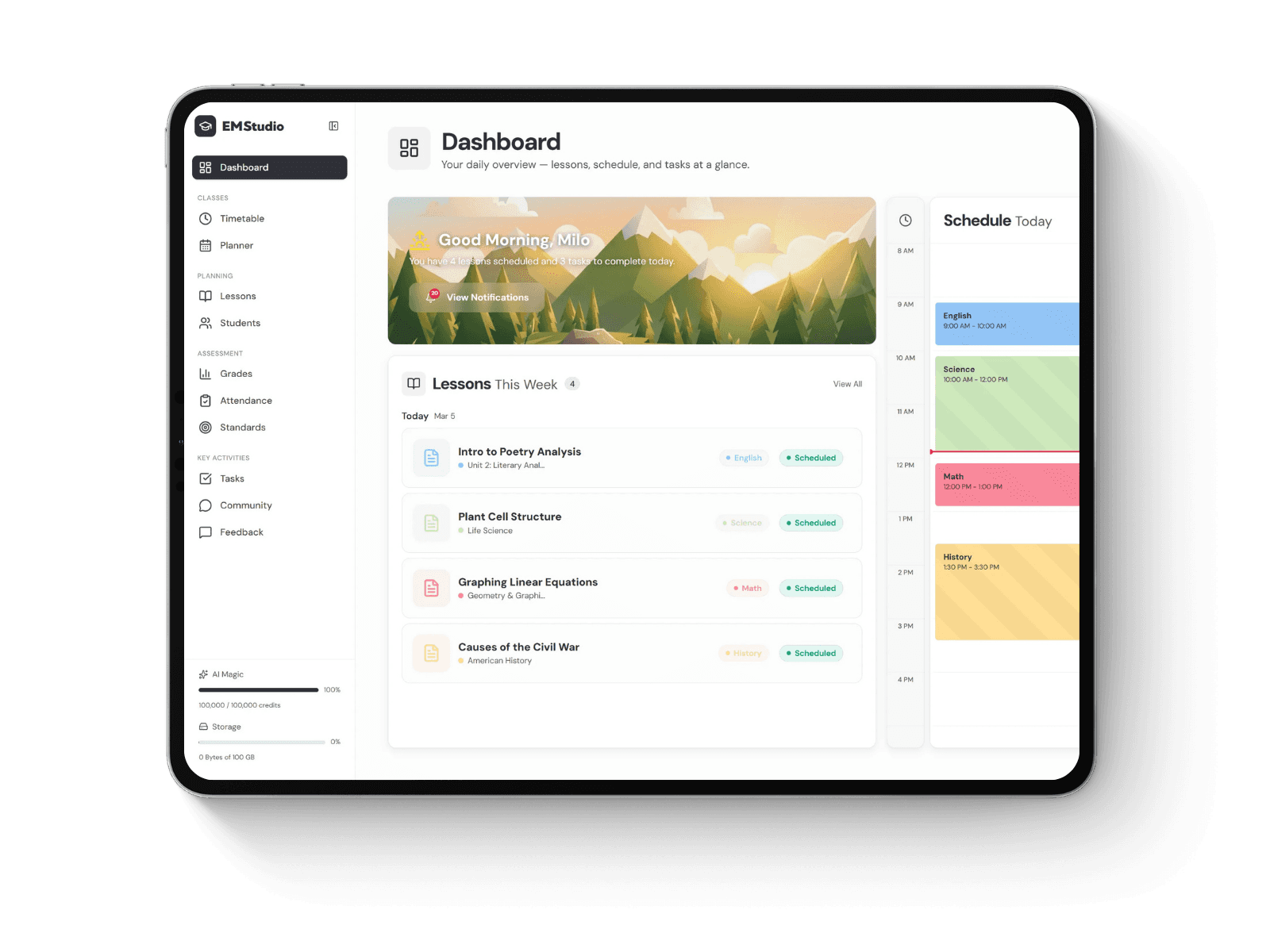
EMStudio is a free teaching management app — manage your classes, students, lessons, and more!
Learn More
Still grading everything by hand?
EMStudio is a free teaching management app — manage your classes, students, lessons, and more!
Learn More
Table of Contents
What Do You Need Before Applying to Teaching Schools?
Before applying to teaching schools, you need a bachelor's degree (any field), minimum 2.75-3.0 GPA, passing scores on basic skills assessments like Praxis Core ($150) or CBEST ($41 per section), cleared background checks, and 20-40 hours of classroom observation experience. Some programs require prerequisite courses in child development or subject-specific content.
People ask to become a teacher what do you need besides patience and a big heart. I sat in the back of a 4th grade classroom for twenty hours before I ever submitted an application. Watching a veteran teacher manage transitions and failed lessons showed me more about the job than any brochure could. You need proof you can handle reality.
Most schools for teacher preparation want evidence you can finish what you start. They check boxes before they check your character. You will waste money on applications if you skip even one requirement. These six items form the baseline for every accredited program in the country. No exceptions. Gather them first.
Bachelor's degree in any field. You do not need an education major to start a teacher preparation program.
GPA of 2.75 to 3.0 minimum. Some CAEP-accredited programs demand higher for admission consideration.
Basic skills test scores. Budget $150 for Praxis Core or $41 per section for CBEST.
Cleared criminal background check and fingerprinting. Costs run $50 to $75 depending on your district.
20 to 40 hours of documented classroom observation. Log every hour with a supervising teacher's signature.
Prerequisite coursework, usually 3 credits in child development psychology or similar pedagogical coursework requirements.
Those twenty to forty hours of observation matter more than you think. Admissions committees want to see you survived a full school day without running for the exit. Get your hours documented on official letterhead. Signed logs prove you actually showed up and paid attention. Shadow different grade levels if possible.
Prerequisites vary by program. Some demand specific psychology credits completed before you step into a methods course. Others let you take them concurrently during your first semester. Read the fine print. Surprises delay your student teaching placement by entire semesters.
Career changers with degrees in biology or business often worry their transcripts won't count. Call the admissions office directly. Ask specifically about deficiency courses for non-education backgrounds. Many programs welcome career changers but require extra pedagogical coursework before you begin student teaching placement. Get the list in writing.
If you earned your degree outside the United States, you need a NACES evaluation. That runs $200 to $400 and takes four to six weeks. Do not wait until the deadline. International transcripts delay applications more often than any other issue. Start this process six months early.
Schedule your Praxis examination six to eight weeks before your application deadline. Scores take two to three weeks to reach the program. If you fail a section, you face a 30-day waiting period before retaking it. Miss the window and you miss the semester. Some states also require subject-specific Praxis II tests for secondary licensure. Budget for those extra fees. Check your state's educator licensure requirements carefully before you register.
Some states require the edTPA during your student teaching placement, not for admission. You do not want to complete an entire teacher preparation program only to discover you skipped a mandatory assessment for certification. Verify this detail before you enroll. Ask specifically about cut scores. Each state sets its own passing mark.
Understanding these concrete requirements answers the question "i want to become a teacher where do i start" with actual steps, not vague encouragement. Review the essential teacher preparation program steps to map your timeline month by month. Honestly assess whether you possess the core traits and characteristics of a good teacher before committing to this career path. Teaching rewards the prepared and punishes the rushed.

Step 1 — Determine Which Degree Path Matches Your Career Goals
You need the right credential for the job you want. The path you choose depends on your existing credits. It also depends on the grade level you hope to teach. Pick wrong, and you waste years and money.
When you research teacher education programs for every career path, you will see four main routes. Each leads to educator licensure, but the timeline and cost vary wildly. Your current academic standing determines which door is actually open to you. A 22-year-old sophomore faces different choices than a 35-year-old paralegal.
Degree Path | Timeline | Total Cost | Best Candidate | Certification Outcome |
|---|---|---|---|---|
Bachelor's in Education | 4 years full-time | $20,000-$40,000 (public in-state) | Traditional students ages 18-22 | Initial educator licensure |
Master of Arts in Teaching (MAT) | 12-18 months intensive | $25,000-$50,000 | Career changers with unrelated BA | Initial educator licensure |
Master of Education (M.Ed.) | 2 years part-time | $30,000-$60,000 | Licensed teachers seeking advancement | Advanced or specialist certification |
Alternative Certification | 6-18 months while working | $5,000-$15,000 | Emergency permit holders, paraprofessionals with AA | Provisional to full licensure |
The question of to become a teacher what degree is needed has no single answer. I learned this mentoring a 7th grade science student teacher last spring. She arrived with a biology degree and zero interest in a second bachelor's. She chose the MAT route instead. Fourteen months later, she had her educator licensure and a job offer at the middle school down the street. She skipped the freshman dorms entirely.
Use this logic to decide your entry point:
If you have zero college credits, pursue a Bachelor's in Education at a four-year university.
If you hold a BA in an unrelated field, choose the MAT for initial certification.
If you work as a paraprofessional with an AA degree, combine Alternative Certification with BA completion programs.
If you plan to become a principal later, earn initial licensure first, then pursue an M.Ed.
Your grade-level focus determines your specific coursework requirements. Early Childhood PK-3 covers developmental psychology and emergent literacy strategies. You learn play-based instruction methods. Elementary K-6 requires broad content knowledge across math, science, and reading instruction methods. You teach every subject. Secondary 6-12 needs deep subject expertise plus specific training in adolescent development and content-area literacy. Special Education K-12 adds assessment protocols, IEP development, and inclusive classroom management techniques.
Any reputable teacher preparation program includes a supervised student teaching placement. You need those classroom hours to qualify for certification. You also complete pedagogical coursework in curriculum design and assessment methods. You must pass your state's Praxis examination or equivalent content knowledge tests. Some states require additional pedagogy assessments. Look for CAEP accreditation when comparing program quality. Review the elementary teacher requirements and career guide for specifics on primary grade pathways.
Consider the concrete scenario. You are 28 years old with a biology degree. You want secondary science certification. You should choose a 14-month MAT program with embedded student teaching. You should never consider a second bachelor's degree. You will spend less tuition money and start earning a salary eighteen months sooner than the undergraduate route. You avoid freshman English and repeat science labs. This is how you become an educator without starting your academic career over.
The M.Ed. path confuses many new candidates. It does not lead to initial licensure. You cannot use it to start teaching. You use it to add endorsements or prepare for administration after you already hold a teaching license.
Alternative Certification works if you already work in schools for teacher assistant roles and need quick licensure. It costs less but offers less support. You trade tuition savings for intense on-the-job training during your first year. Many programs pair you with a mentor teacher. You teach full-time while taking evening classes.

Step 2 — How Do You Verify State Approval and Program Accreditation?
Check your state's Department of Education website for approved program lists. Confirm national accreditation through CAEP or AAQEP. Look for first-time licensure exam pass rates above 80%. Verify the program leads to initial certification, not just a degree.
A degree without state approval is just expensive wallpaper. You cannot earn educator licensure from an unapproved program. Verify first, apply second.
Follow this five-step protocol before submitting any application:
Search CAEP accredited providers at caepnet.org to confirm the school meets national standards for classes needed to become a teacher.
Cross-check with your state DOE approved list. Texas uses TEA. New York uses NYSED. California uses CTC. Every state maintains a public registry.
Verify NASDTEC reciprocity stage. Stage 1 or 2 means seamless transfer to other states. Stage 3 or 4 creates licensing headaches if you relocate.
Request edTPA or Praxis examination pass rate data. Target 80% or higher first-time pass rates. Anything below suggests weak pedagogical coursework.
Confirm student teaching placement is arranged by the university. Self-placed student teaching often lacks oversight and can delay your license.
Watch for these red flags that scream "avoid":
The teacher preparation program lacks CAEP accreditation or AAQEP recognition.
Marketing promises you can "teach in six weeks" without student teaching.
No physical presence or approved partnership in your target state.
Admissions cannot provide graduate employment statistics within six months.
They demand full tuition payment before showing you their accreditation documentation.
Verify these specific accrediting bodies before enrolling:
CAEP (Council for the Accreditation of Educator Preparation) — the gold standard for teacher preparation program review.
AAQEP (Association for Advancing Quality in Educator Preparation) — an alternative national accreditor with rigorous standards.
State-specific recognition from agencies like the Virginia Department of Education or Illinois State Board of Education.
I watched a colleague complete an entire online schools for teacher certificate before discovering it lacked NASDTEC Stage 1 status. She had trained for 7th grade science. She had to retake half her classes needed to become a teacher at a new university. Six months of salary vanished. Three thousand dollars wasted.
Modernizing teacher preparation for the 21st century means holding programs accountable to data, not just marketing. Demand proof of outcomes.
Quality preparation shows in exam results. Strong programs publish their Praxis examination pass rates openly. They detail their student teaching placement network. They explain exactly how their pedagogical coursework connects to classroom management realities.
Check the fine print. Some programs grant degrees but not initial educator licensure. Others prepare you for substitute permits, not full certification. Read the program outcomes page carefully. Call the state licensing office directly. Ask specifically: "Does Program X lead to a standard teaching license in this state?" Get the answer in writing.
Remember that CAEP accreditation covers the big picture. It ensures the program prepares effective educators who boost student learning. But state approval matters more for immediate employment. You need both. A CAEP-accredited program without state approval still leaves you unlicensed. A state-approved program without CAEP accreditation might limit your mobility later.
When you call admissions, ask direct questions. Where do graduates teach? What percentage pass their licensure exams on the first attempt? Who arranges the student teaching placement? If they hesitate, hang up. Good programs have these answers ready. They track their graduates. They know their data. They are proud of their results.
Self-placed student teaching is a trap. Some online programs ask you to find your own cooperating teacher. You scramble to convince a local principal. The university provides little supervision. Your portfolio suffers. Your recommendation letters lack credibility. Insist on university-arranged placements with vetted mentors who understand your classes needed to become a teacher.
NASDTEC stages confuse everyone. Stage 1 means your license transfers to most states with minimal paperwork. Stage 2 requires additional testing. Stage 3 needs a year of teaching in the original state first. Stage 4 restricts reciprocity entirely. Ask your admissions counselor: "What NASDTEC stage is this program?" If they do not know, find another program.
Document everything. Screenshot the state approval page showing your program listed. Save the CAEP accreditation certificate PDF. Email the admissions director confirming your student teaching placement will be arranged, not self-placed. Keep these files until you hold your actual teaching license in hand. Bureaucracy loses paperwork. Protect yourself.

Step 3 — Calculate the Cost to Become a Teacher and Secure Financial Aid
Choosing schools for teacher preparation means facing sticker shock head-on. You will spend money on tuition, fees, books, and testing. You will also lose wages during your student teaching placement. Most people underestimate the true cost to become a teacher by focusing only on tuition bills. The full picture includes four months of lost income and Praxis examination fees that stack up fast.
Public In-State | $15,000 – $25,000 |
Public Out-of-State | $35,000 – $50,000 |
Private Institution | $40,000 – $70,000 |
Alternative Certification | $5,000 – $15,000 |
Opportunity Cost (Student Teaching) | 3-4 months lost wages |
Multiply your current monthly take-home pay by three and a half months. That figure is your hidden tuition bill. If you earn $3,500 per month waiting tables or working retail, your student teaching placement effectively costs $12,250 in lost wages. Add that to your actual tuition to see the real cost to become a teacher. Most candidates miss this calculation when comparing programs.
During my 5th grade student teaching placement in October, I calculated my missed bartending income. Sixteen weeks of unpaid full-time work cost me roughly $6,400. That amount exceeded my tuition bill for the semester. I ate peanut butter sandwiches for three months while completing my pedagogical coursework and CAEP accreditation requirements.
Federal and state programs reduce your out-of-pocket expenses significantly. You can stack multiple funding sources to cover tuition and living costs simultaneously. Apply for everything during your admissions process. Check your eligibility when planning for education costs and financial support early in your junior year.
The TEACH Grant provides $4,000 per year for up to four years while you complete your teacher preparation program.
Teacher Loan Forgiveness wipes $17,500 from your balance if you teach math, science, or special education in low-income schools for five consecutive years.
State scholarships like the NY STEM Incentive Program or Tennessee Promise cover tuition for specific certification paths.
School-based graduate assistantships cover tuition while you supervise study halls or grade papers for professors.
The TEACH Grant requires four years of service in a high-need field at a low-income school. Fail that commitment, and the grant converts to a loan with interest. You must certify your teaching position annually to maintain the grant status. Many new teachers lose track of these forms during their hectic first year.
Teacher Loan Forgiveness works differently than grants. You must hold federal direct loans and make 120 qualifying payments first. Elementary and general subject teachers qualify for only $5,000. You need five consecutive years of service in a qualifying low-income school. These programs reduce your total educator licensure expenses substantially.
Graduate assistantships require twenty hours of weekly work. You might tutor undergraduates or supervise dormitories. The stipend usually covers nine credit hours per semester. This option works best for traditional students without full-time jobs or children. The time trade-off mirrors the student teaching placement commitment.
Calculate your break-even point before enrolling. Compare your total debt against regional starting salaries. The math looks different depending on where you plan to work. You need realistic income projections to evaluate costs of post-secondary education and ROI effectively.
Rural districts in the Midwest start teachers at $38,000 to $42,000 annually. Urban coastal districts pay $55,000 to $65,000. Southern states often fall between $35,000 and $45,000. A $50,000 debt load requires $500 monthly payments for ten years. That payment consumes 15 percent of a California salary but 18 percent of a Kansas paycheck.
Map your five-year trajectory explicitly. Year one covers living expenses and loan payments from your $42,000 salary. You have roughly $2,800 monthly after taxes. Subtract $500 for loans, leaving $2,300 for rent and food. By year five, your salary hits $48,000 and your loan balance drops by half. You break even when your remaining debt equals three months of saved income.
Keep your projected monthly payment below 20 percent of your expected starting salary. On a $40,000 rural salary, that means capping total debt at roughly $25,000. Higher ratios trap teachers in payment plans that outlast their classroom careers. Avoid programs that require $60,000 loans for a $38,000 starting position.
Budget $300 to $500 for Praxis examination fees during your program. Most states require two to three subject tests plus the pedagogical assessment. CAEP accreditation ensures your program meets testing preparation standards. Unaccredited schools for teacher candidates often leave you paying for extra study materials or retakes.
Alternative certification programs cost less upfront but move faster. You pay $5,000 to $15,000 for condensed coursework while drawing a salary as a teacher of record. This model eliminates the opportunity cost problem entirely. However, you learn classroom management while managing thirty students solo. The stress costs something too.

What Mistakes Should You Avoid When Choosing Schools for Teacher Preparation?
Avoid unaccredited programs promising quick certification without clinical hours, failing to verify interstate licensure reciprocity agreements, and overlooking student teaching support structures. Never enroll without checking published licensure exam pass rates and graduate employment data. Watch for schools lacking CAEP accreditation or state approval, as these may leave you permanently ineligible for educator licensure.
I learned the hard way during my own preparation. My first choice offered no help securing a student teaching placement, leaving me to cold-call principals while completing heavy pedagogical coursework. That stress wasn't necessary, and it nearly derailed my graduation timeline.
The wrong teacher preparation program wastes thousands of dollars and delays your career by years. Watch for these seven red flags before you submit any deposits.
Enrolling in unaccredited 'quick cert' mills promising you can teach in six weeks. Legitimate programs require rigorous classes to be a teacher plus supervised hours. Verify CAEP accreditation first.
Ignoring NASDTEC reciprocity between Stage 1 and Stage 4 states. If you want to become a teacher across state lines, verify interstate agreements first or face additional testing requirements later.
Failing to verify who arranges your student teaching placement. Some schools hand you a phone list. Others coordinate with partner districts. Self-placement during your final semester causes unnecessary burnout.
Choosing narrow single endorsements over marketable dual certifications. A standalone elementary license limits you. Pairing it with SPED or ESL makes you hireable. I watched principals skip single-cert candidates during 4th grade hiring.
Missing priority deadlines, typically December 1 for fall cohorts. Programs require background checks, transcript reviews, and Praxis examination scores before admission. Waiting until spring leaves you waiting another full year.
Underestimating the edTPA portfolio time commitment. This assessment needs 40+ hours of video recording, lesson analysis, and academic writing while you are student teaching. Many candidates underestimate this and submit incomplete portfolios.
Not checking 6-month graduate employment rates. Quality programs publish this data transparently. If fewer than 70% of graduates land teaching jobs within six months, ask hard questions about their reputation and support.
These mistakes share a common thread: they prioritize convenience over quality. Programs that advertise 'teach in weeks' or promise minimal fieldwork prey on career changers who need income quickly. Resist the shortcut.
Subpar programs often cost more than reputable ones while delivering less. I watched colleagues pay premium prices for unaccredited classes to be a teacher that wouldn't transfer anywhere. They had to start over.
CAEP accreditation ensures your pedagogical coursework meets national standards. Without it, you may pass every Praxis examination but still face license rejection. State education departments maintain approved school lists. Check yours before paying any application fees or deposits.
Dual certifications in SPED, ESL, or STEM open doors. My 4th grade team needed someone with special education credentials last year. The candidate with dual endorsements got the job over ten single-certified applicants.
Do not choose 100% online programs for initial licensure if your state requires face-to-face student teaching hours. Some states reject virtual field experiences outright, leaving you unlicensed despite completing all classes to be a teacher.
Similarly, do not attend out-of-state schools for teacher preparation without verifying NASDTEC agreements. You might finish the entire program only to discover your license won't transfer home. That mistake strands you with debt and no classroom.
If you realize you're enrolled in a subpar program, act fast. Transfer credits immediately to a regionally accredited institution before you lose tuition dollars and time. Most regionally accredited colleges accept credits from other accredited schools, but diploma mill credits hold no value and waste your money.
Many candidates pursue emergency permits while completing proper certification through approved pathways. This lets you earn a paycheck while fixing your credentials. Add missing endorsements through state-approved alternative routes once you secure initial licensure and employment.
Document every transfer and transcript to avoid common mistakes when managing teacher records. Keep copies of syllabi and course descriptions. These details save you when licensing offices question your preparation or when you apply for reciprocity later.
Smart professional planning for new teachers starts before you enroll. Choose programs that support you from admission through your first job offer. Your future students deserve a teacher who prepared properly.

What Do You Need Before Applying to Teaching Schools?
Before applying to teaching schools, you need a bachelor's degree (any field), minimum 2.75-3.0 GPA, passing scores on basic skills assessments like Praxis Core ($150) or CBEST ($41 per section), cleared background checks, and 20-40 hours of classroom observation experience. Some programs require prerequisite courses in child development or subject-specific content.
People ask to become a teacher what do you need besides patience and a big heart. I sat in the back of a 4th grade classroom for twenty hours before I ever submitted an application. Watching a veteran teacher manage transitions and failed lessons showed me more about the job than any brochure could. You need proof you can handle reality.
Most schools for teacher preparation want evidence you can finish what you start. They check boxes before they check your character. You will waste money on applications if you skip even one requirement. These six items form the baseline for every accredited program in the country. No exceptions. Gather them first.
Bachelor's degree in any field. You do not need an education major to start a teacher preparation program.
GPA of 2.75 to 3.0 minimum. Some CAEP-accredited programs demand higher for admission consideration.
Basic skills test scores. Budget $150 for Praxis Core or $41 per section for CBEST.
Cleared criminal background check and fingerprinting. Costs run $50 to $75 depending on your district.
20 to 40 hours of documented classroom observation. Log every hour with a supervising teacher's signature.
Prerequisite coursework, usually 3 credits in child development psychology or similar pedagogical coursework requirements.
Those twenty to forty hours of observation matter more than you think. Admissions committees want to see you survived a full school day without running for the exit. Get your hours documented on official letterhead. Signed logs prove you actually showed up and paid attention. Shadow different grade levels if possible.
Prerequisites vary by program. Some demand specific psychology credits completed before you step into a methods course. Others let you take them concurrently during your first semester. Read the fine print. Surprises delay your student teaching placement by entire semesters.
Career changers with degrees in biology or business often worry their transcripts won't count. Call the admissions office directly. Ask specifically about deficiency courses for non-education backgrounds. Many programs welcome career changers but require extra pedagogical coursework before you begin student teaching placement. Get the list in writing.
If you earned your degree outside the United States, you need a NACES evaluation. That runs $200 to $400 and takes four to six weeks. Do not wait until the deadline. International transcripts delay applications more often than any other issue. Start this process six months early.
Schedule your Praxis examination six to eight weeks before your application deadline. Scores take two to three weeks to reach the program. If you fail a section, you face a 30-day waiting period before retaking it. Miss the window and you miss the semester. Some states also require subject-specific Praxis II tests for secondary licensure. Budget for those extra fees. Check your state's educator licensure requirements carefully before you register.
Some states require the edTPA during your student teaching placement, not for admission. You do not want to complete an entire teacher preparation program only to discover you skipped a mandatory assessment for certification. Verify this detail before you enroll. Ask specifically about cut scores. Each state sets its own passing mark.
Understanding these concrete requirements answers the question "i want to become a teacher where do i start" with actual steps, not vague encouragement. Review the essential teacher preparation program steps to map your timeline month by month. Honestly assess whether you possess the core traits and characteristics of a good teacher before committing to this career path. Teaching rewards the prepared and punishes the rushed.
Step 1 — Determine Which Degree Path Matches Your Career Goals
You need the right credential for the job you want. The path you choose depends on your existing credits. It also depends on the grade level you hope to teach. Pick wrong, and you waste years and money.
When you research teacher education programs for every career path, you will see four main routes. Each leads to educator licensure, but the timeline and cost vary wildly. Your current academic standing determines which door is actually open to you. A 22-year-old sophomore faces different choices than a 35-year-old paralegal.
Degree Path | Timeline | Total Cost | Best Candidate | Certification Outcome |
|---|---|---|---|---|
Bachelor's in Education | 4 years full-time | $20,000-$40,000 (public in-state) | Traditional students ages 18-22 | Initial educator licensure |
Master of Arts in Teaching (MAT) | 12-18 months intensive | $25,000-$50,000 | Career changers with unrelated BA | Initial educator licensure |
Master of Education (M.Ed.) | 2 years part-time | $30,000-$60,000 | Licensed teachers seeking advancement | Advanced or specialist certification |
Alternative Certification | 6-18 months while working | $5,000-$15,000 | Emergency permit holders, paraprofessionals with AA | Provisional to full licensure |
The question of to become a teacher what degree is needed has no single answer. I learned this mentoring a 7th grade science student teacher last spring. She arrived with a biology degree and zero interest in a second bachelor's. She chose the MAT route instead. Fourteen months later, she had her educator licensure and a job offer at the middle school down the street. She skipped the freshman dorms entirely.
Use this logic to decide your entry point:
If you have zero college credits, pursue a Bachelor's in Education at a four-year university.
If you hold a BA in an unrelated field, choose the MAT for initial certification.
If you work as a paraprofessional with an AA degree, combine Alternative Certification with BA completion programs.
If you plan to become a principal later, earn initial licensure first, then pursue an M.Ed.
Your grade-level focus determines your specific coursework requirements. Early Childhood PK-3 covers developmental psychology and emergent literacy strategies. You learn play-based instruction methods. Elementary K-6 requires broad content knowledge across math, science, and reading instruction methods. You teach every subject. Secondary 6-12 needs deep subject expertise plus specific training in adolescent development and content-area literacy. Special Education K-12 adds assessment protocols, IEP development, and inclusive classroom management techniques.
Any reputable teacher preparation program includes a supervised student teaching placement. You need those classroom hours to qualify for certification. You also complete pedagogical coursework in curriculum design and assessment methods. You must pass your state's Praxis examination or equivalent content knowledge tests. Some states require additional pedagogy assessments. Look for CAEP accreditation when comparing program quality. Review the elementary teacher requirements and career guide for specifics on primary grade pathways.
Consider the concrete scenario. You are 28 years old with a biology degree. You want secondary science certification. You should choose a 14-month MAT program with embedded student teaching. You should never consider a second bachelor's degree. You will spend less tuition money and start earning a salary eighteen months sooner than the undergraduate route. You avoid freshman English and repeat science labs. This is how you become an educator without starting your academic career over.
The M.Ed. path confuses many new candidates. It does not lead to initial licensure. You cannot use it to start teaching. You use it to add endorsements or prepare for administration after you already hold a teaching license.
Alternative Certification works if you already work in schools for teacher assistant roles and need quick licensure. It costs less but offers less support. You trade tuition savings for intense on-the-job training during your first year. Many programs pair you with a mentor teacher. You teach full-time while taking evening classes.
Step 2 — How Do You Verify State Approval and Program Accreditation?
Check your state's Department of Education website for approved program lists. Confirm national accreditation through CAEP or AAQEP. Look for first-time licensure exam pass rates above 80%. Verify the program leads to initial certification, not just a degree.
A degree without state approval is just expensive wallpaper. You cannot earn educator licensure from an unapproved program. Verify first, apply second.
Follow this five-step protocol before submitting any application:
Search CAEP accredited providers at caepnet.org to confirm the school meets national standards for classes needed to become a teacher.
Cross-check with your state DOE approved list. Texas uses TEA. New York uses NYSED. California uses CTC. Every state maintains a public registry.
Verify NASDTEC reciprocity stage. Stage 1 or 2 means seamless transfer to other states. Stage 3 or 4 creates licensing headaches if you relocate.
Request edTPA or Praxis examination pass rate data. Target 80% or higher first-time pass rates. Anything below suggests weak pedagogical coursework.
Confirm student teaching placement is arranged by the university. Self-placed student teaching often lacks oversight and can delay your license.
Watch for these red flags that scream "avoid":
The teacher preparation program lacks CAEP accreditation or AAQEP recognition.
Marketing promises you can "teach in six weeks" without student teaching.
No physical presence or approved partnership in your target state.
Admissions cannot provide graduate employment statistics within six months.
They demand full tuition payment before showing you their accreditation documentation.
Verify these specific accrediting bodies before enrolling:
CAEP (Council for the Accreditation of Educator Preparation) — the gold standard for teacher preparation program review.
AAQEP (Association for Advancing Quality in Educator Preparation) — an alternative national accreditor with rigorous standards.
State-specific recognition from agencies like the Virginia Department of Education or Illinois State Board of Education.
I watched a colleague complete an entire online schools for teacher certificate before discovering it lacked NASDTEC Stage 1 status. She had trained for 7th grade science. She had to retake half her classes needed to become a teacher at a new university. Six months of salary vanished. Three thousand dollars wasted.
Modernizing teacher preparation for the 21st century means holding programs accountable to data, not just marketing. Demand proof of outcomes.
Quality preparation shows in exam results. Strong programs publish their Praxis examination pass rates openly. They detail their student teaching placement network. They explain exactly how their pedagogical coursework connects to classroom management realities.
Check the fine print. Some programs grant degrees but not initial educator licensure. Others prepare you for substitute permits, not full certification. Read the program outcomes page carefully. Call the state licensing office directly. Ask specifically: "Does Program X lead to a standard teaching license in this state?" Get the answer in writing.
Remember that CAEP accreditation covers the big picture. It ensures the program prepares effective educators who boost student learning. But state approval matters more for immediate employment. You need both. A CAEP-accredited program without state approval still leaves you unlicensed. A state-approved program without CAEP accreditation might limit your mobility later.
When you call admissions, ask direct questions. Where do graduates teach? What percentage pass their licensure exams on the first attempt? Who arranges the student teaching placement? If they hesitate, hang up. Good programs have these answers ready. They track their graduates. They know their data. They are proud of their results.
Self-placed student teaching is a trap. Some online programs ask you to find your own cooperating teacher. You scramble to convince a local principal. The university provides little supervision. Your portfolio suffers. Your recommendation letters lack credibility. Insist on university-arranged placements with vetted mentors who understand your classes needed to become a teacher.
NASDTEC stages confuse everyone. Stage 1 means your license transfers to most states with minimal paperwork. Stage 2 requires additional testing. Stage 3 needs a year of teaching in the original state first. Stage 4 restricts reciprocity entirely. Ask your admissions counselor: "What NASDTEC stage is this program?" If they do not know, find another program.
Document everything. Screenshot the state approval page showing your program listed. Save the CAEP accreditation certificate PDF. Email the admissions director confirming your student teaching placement will be arranged, not self-placed. Keep these files until you hold your actual teaching license in hand. Bureaucracy loses paperwork. Protect yourself.
Step 3 — Calculate the Cost to Become a Teacher and Secure Financial Aid
Choosing schools for teacher preparation means facing sticker shock head-on. You will spend money on tuition, fees, books, and testing. You will also lose wages during your student teaching placement. Most people underestimate the true cost to become a teacher by focusing only on tuition bills. The full picture includes four months of lost income and Praxis examination fees that stack up fast.
Public In-State | $15,000 – $25,000 |
Public Out-of-State | $35,000 – $50,000 |
Private Institution | $40,000 – $70,000 |
Alternative Certification | $5,000 – $15,000 |
Opportunity Cost (Student Teaching) | 3-4 months lost wages |
Multiply your current monthly take-home pay by three and a half months. That figure is your hidden tuition bill. If you earn $3,500 per month waiting tables or working retail, your student teaching placement effectively costs $12,250 in lost wages. Add that to your actual tuition to see the real cost to become a teacher. Most candidates miss this calculation when comparing programs.
During my 5th grade student teaching placement in October, I calculated my missed bartending income. Sixteen weeks of unpaid full-time work cost me roughly $6,400. That amount exceeded my tuition bill for the semester. I ate peanut butter sandwiches for three months while completing my pedagogical coursework and CAEP accreditation requirements.
Federal and state programs reduce your out-of-pocket expenses significantly. You can stack multiple funding sources to cover tuition and living costs simultaneously. Apply for everything during your admissions process. Check your eligibility when planning for education costs and financial support early in your junior year.
The TEACH Grant provides $4,000 per year for up to four years while you complete your teacher preparation program.
Teacher Loan Forgiveness wipes $17,500 from your balance if you teach math, science, or special education in low-income schools for five consecutive years.
State scholarships like the NY STEM Incentive Program or Tennessee Promise cover tuition for specific certification paths.
School-based graduate assistantships cover tuition while you supervise study halls or grade papers for professors.
The TEACH Grant requires four years of service in a high-need field at a low-income school. Fail that commitment, and the grant converts to a loan with interest. You must certify your teaching position annually to maintain the grant status. Many new teachers lose track of these forms during their hectic first year.
Teacher Loan Forgiveness works differently than grants. You must hold federal direct loans and make 120 qualifying payments first. Elementary and general subject teachers qualify for only $5,000. You need five consecutive years of service in a qualifying low-income school. These programs reduce your total educator licensure expenses substantially.
Graduate assistantships require twenty hours of weekly work. You might tutor undergraduates or supervise dormitories. The stipend usually covers nine credit hours per semester. This option works best for traditional students without full-time jobs or children. The time trade-off mirrors the student teaching placement commitment.
Calculate your break-even point before enrolling. Compare your total debt against regional starting salaries. The math looks different depending on where you plan to work. You need realistic income projections to evaluate costs of post-secondary education and ROI effectively.
Rural districts in the Midwest start teachers at $38,000 to $42,000 annually. Urban coastal districts pay $55,000 to $65,000. Southern states often fall between $35,000 and $45,000. A $50,000 debt load requires $500 monthly payments for ten years. That payment consumes 15 percent of a California salary but 18 percent of a Kansas paycheck.
Map your five-year trajectory explicitly. Year one covers living expenses and loan payments from your $42,000 salary. You have roughly $2,800 monthly after taxes. Subtract $500 for loans, leaving $2,300 for rent and food. By year five, your salary hits $48,000 and your loan balance drops by half. You break even when your remaining debt equals three months of saved income.
Keep your projected monthly payment below 20 percent of your expected starting salary. On a $40,000 rural salary, that means capping total debt at roughly $25,000. Higher ratios trap teachers in payment plans that outlast their classroom careers. Avoid programs that require $60,000 loans for a $38,000 starting position.
Budget $300 to $500 for Praxis examination fees during your program. Most states require two to three subject tests plus the pedagogical assessment. CAEP accreditation ensures your program meets testing preparation standards. Unaccredited schools for teacher candidates often leave you paying for extra study materials or retakes.
Alternative certification programs cost less upfront but move faster. You pay $5,000 to $15,000 for condensed coursework while drawing a salary as a teacher of record. This model eliminates the opportunity cost problem entirely. However, you learn classroom management while managing thirty students solo. The stress costs something too.
What Mistakes Should You Avoid When Choosing Schools for Teacher Preparation?
Avoid unaccredited programs promising quick certification without clinical hours, failing to verify interstate licensure reciprocity agreements, and overlooking student teaching support structures. Never enroll without checking published licensure exam pass rates and graduate employment data. Watch for schools lacking CAEP accreditation or state approval, as these may leave you permanently ineligible for educator licensure.
I learned the hard way during my own preparation. My first choice offered no help securing a student teaching placement, leaving me to cold-call principals while completing heavy pedagogical coursework. That stress wasn't necessary, and it nearly derailed my graduation timeline.
The wrong teacher preparation program wastes thousands of dollars and delays your career by years. Watch for these seven red flags before you submit any deposits.
Enrolling in unaccredited 'quick cert' mills promising you can teach in six weeks. Legitimate programs require rigorous classes to be a teacher plus supervised hours. Verify CAEP accreditation first.
Ignoring NASDTEC reciprocity between Stage 1 and Stage 4 states. If you want to become a teacher across state lines, verify interstate agreements first or face additional testing requirements later.
Failing to verify who arranges your student teaching placement. Some schools hand you a phone list. Others coordinate with partner districts. Self-placement during your final semester causes unnecessary burnout.
Choosing narrow single endorsements over marketable dual certifications. A standalone elementary license limits you. Pairing it with SPED or ESL makes you hireable. I watched principals skip single-cert candidates during 4th grade hiring.
Missing priority deadlines, typically December 1 for fall cohorts. Programs require background checks, transcript reviews, and Praxis examination scores before admission. Waiting until spring leaves you waiting another full year.
Underestimating the edTPA portfolio time commitment. This assessment needs 40+ hours of video recording, lesson analysis, and academic writing while you are student teaching. Many candidates underestimate this and submit incomplete portfolios.
Not checking 6-month graduate employment rates. Quality programs publish this data transparently. If fewer than 70% of graduates land teaching jobs within six months, ask hard questions about their reputation and support.
These mistakes share a common thread: they prioritize convenience over quality. Programs that advertise 'teach in weeks' or promise minimal fieldwork prey on career changers who need income quickly. Resist the shortcut.
Subpar programs often cost more than reputable ones while delivering less. I watched colleagues pay premium prices for unaccredited classes to be a teacher that wouldn't transfer anywhere. They had to start over.
CAEP accreditation ensures your pedagogical coursework meets national standards. Without it, you may pass every Praxis examination but still face license rejection. State education departments maintain approved school lists. Check yours before paying any application fees or deposits.
Dual certifications in SPED, ESL, or STEM open doors. My 4th grade team needed someone with special education credentials last year. The candidate with dual endorsements got the job over ten single-certified applicants.
Do not choose 100% online programs for initial licensure if your state requires face-to-face student teaching hours. Some states reject virtual field experiences outright, leaving you unlicensed despite completing all classes to be a teacher.
Similarly, do not attend out-of-state schools for teacher preparation without verifying NASDTEC agreements. You might finish the entire program only to discover your license won't transfer home. That mistake strands you with debt and no classroom.
If you realize you're enrolled in a subpar program, act fast. Transfer credits immediately to a regionally accredited institution before you lose tuition dollars and time. Most regionally accredited colleges accept credits from other accredited schools, but diploma mill credits hold no value and waste your money.
Many candidates pursue emergency permits while completing proper certification through approved pathways. This lets you earn a paycheck while fixing your credentials. Add missing endorsements through state-approved alternative routes once you secure initial licensure and employment.
Document every transfer and transcript to avoid common mistakes when managing teacher records. Keep copies of syllabi and course descriptions. These details save you when licensing offices question your preparation or when you apply for reciprocity later.
Smart professional planning for new teachers starts before you enroll. Choose programs that support you from admission through your first job offer. Your future students deserve a teacher who prepared properly.
Still grading everything by hand?
EMStudio is a free teaching management app — manage your classes, students, lessons, and more!
Learn More
Still grading everything by hand?
EMStudio is a free teaching management app — manage your classes, students, lessons, and more!
Learn More



Notion4Teachers
Notion templates to simplify administrative tasks and enhance your teaching experience.



2026 Notion4Teachers. All Rights Reserved.
Notion4Teachers
Notion templates to simplify administrative tasks and enhance your teaching experience.
2026 Notion4Teachers. All Rights Reserved.
Notion4Teachers
Notion templates to simplify administrative tasks and enhance your teaching experience.
2026 Notion4Teachers. All Rights Reserved.