
Characteristics of a Good Teacher: Essential Traits for Educators
Characteristics of a Good Teacher: Essential Traits for Educators

Article by
Milo
ESL Content Coordinator & Educator
ESL Content Coordinator & Educator
All Posts
Research from Stanford economist Eric Hanushek shows that teacher quality is the single strongest in-school predictor of student achievement—outweighing class size, facilities, or curriculum materials. The characteristics of a good teacher aren't just nice-to-have traits; they're measurable factors that create persistent learning gaps between classrooms next door to each other.
But what exactly separates teachers who move the needle from those who merely get through the day? After fifteen years in the classroom and another five coaching new teachers, I've watched some educators thrive while others burn out. It's rarely about raw intelligence or charisma. Instead, it comes down to specific, teachable traits that combine pedagogical knowledge with genuine human connection.
Here's what actually matters—and what you can develop starting tomorrow.
Still grading everything by hand?
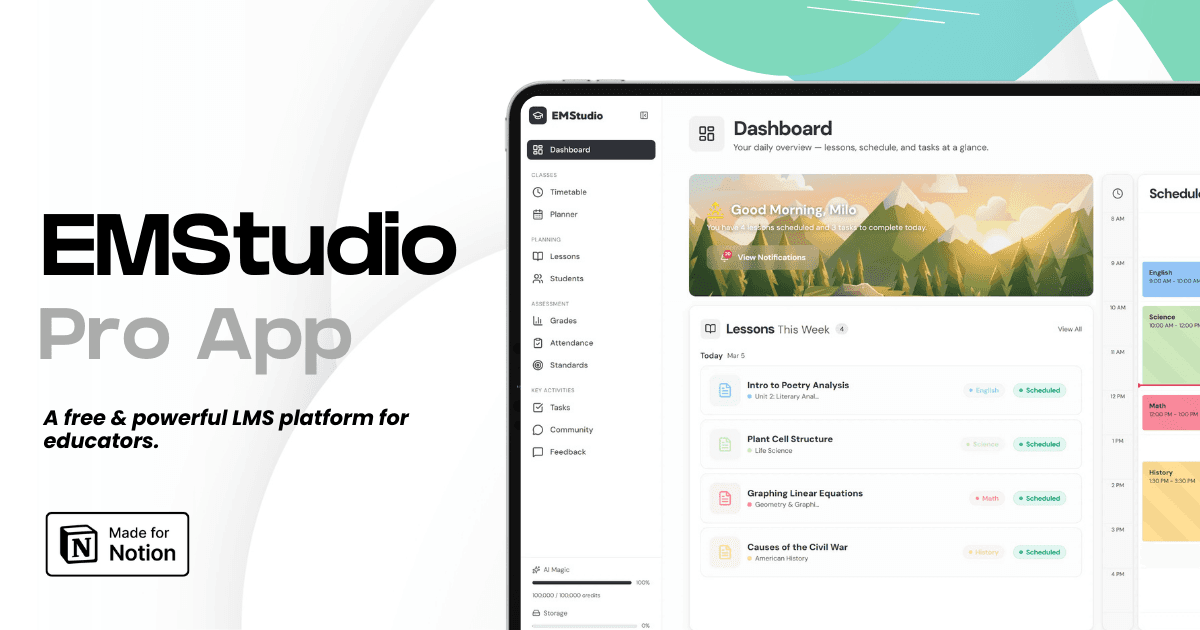
EMStudio is a free teaching management app — manage your classes, students, lessons, and more!
Learn More
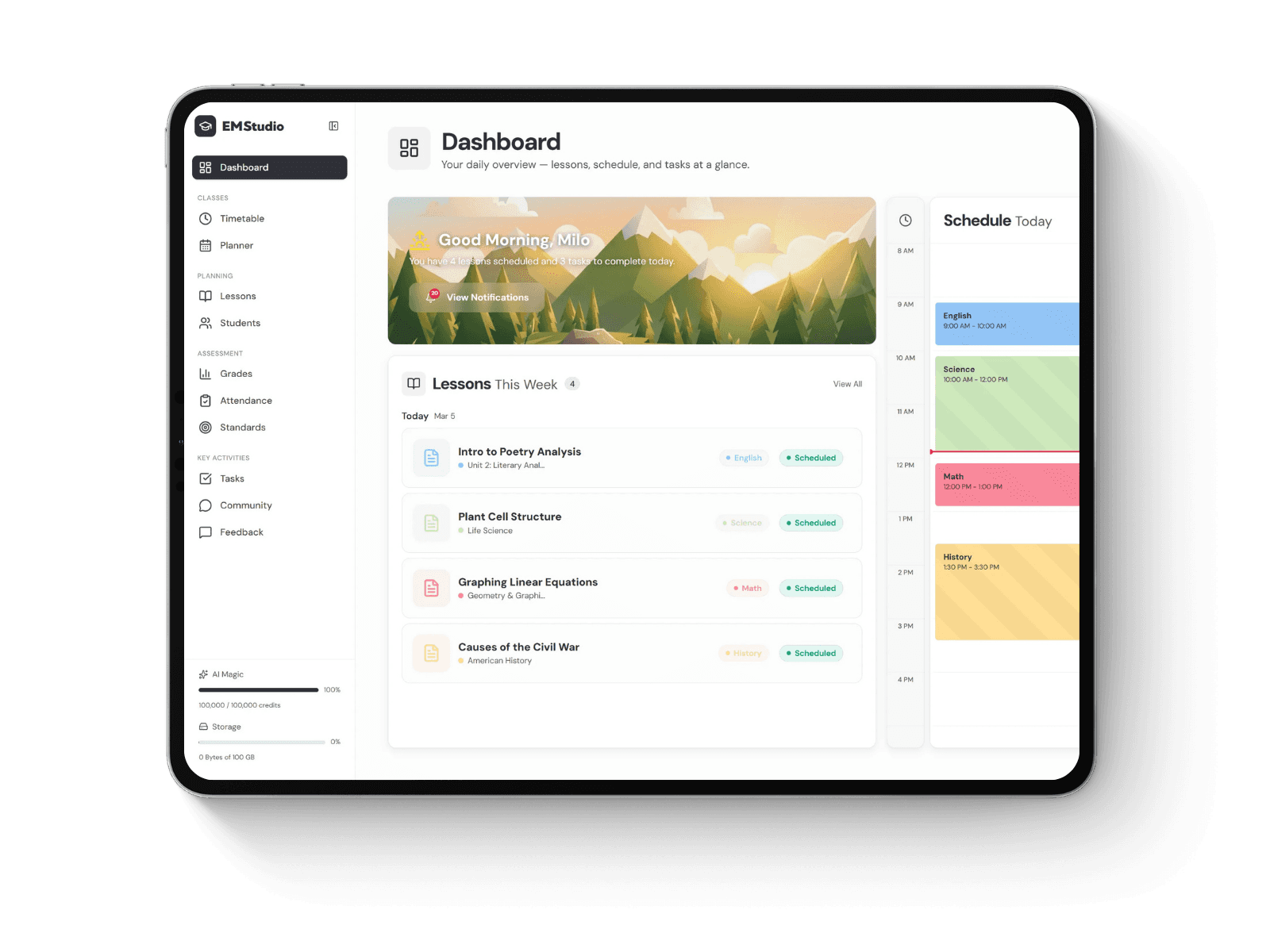
Still grading everything by hand?
EMStudio is a free teaching management app — manage your classes, students, lessons, and more!
Learn More
Table of Contents
What Are the Defining Characteristics of a Good Teacher?
The defining characteristics of a good teacher include strong pedagogical content knowledge, instructional clarity (effect size 0.75), high teacher credibility (0.90), positive relationships with students (0.48), quality feedback (0.70), proactive classroom management, and genuine passion for subject matter. These traits combine content expertise with relational skills to maximize student learning outcomes.
I spent years thinking charisma mattered most. It doesn't. Structure beats performance every time. The research confirms what veteran teachers quietly know: clarity and consistency drive student achievement more than entertaining delivery.
Pedagogical Content Knowledge: You understand your content deeply and know exactly where students trip up. You see misconceptions coming before the kids do. You catch the precise moment a 6th grader confuses mean with median. Effect size: 0.90.
Instructional clarity: Your directions make sense the first time without repetitive reteaching. Students start working within 90 seconds because your T-unit sentences average 9-14 words. Effect size: 0.75.
Proactive classroom management strategies: You design routines that stop chaos before it starts. Your 3rd graders transition to reading groups in 20 seconds without you speaking. Effect size: 0.40.
Teacher credibility: Students believe you know your stuff and have their best interests at heart. You admit when you don't know and circle back with correct information. Effect size: 0.90.
Teacher-student relationships: You know your kids as humans, not just test scores. You maintain a 3:1 positive-to-corrective interaction ratio during every class period. Effect size: 0.48.
Quality feedback: You tell students exactly what they did well and specifically what to fix. Your essay comments reference rubric criteria by name. Effect size: 0.70.
Passion measured by student engagement: Your enthusiasm for the content is genuine and contagious. Students voluntarily stay after the bell to finish the historical debate. Effect size: 0.40.
Many new teachers confuse characteristics of an effective teacher with being an entertainer. I tried that my first year. My jokes landed, but my directions didn't, and learning gains hovered near zero. Clear organization beats charisma every time. Structured lessons with tight transitions produce higher effect sizes than flashy presentations that lack focus. Facilitators build sustainable systems; performers chase cheap laughs that fade fast.
You can measure these traits in your own room. Track your T-unit length during explanations; keep sentences between 9 and 14 words for middle schoolers. Count your interactions: aim for three positive comments for every one correction. Monitor on-task rates during independent work; target above 85 percent. These numbers don't lie.
Developing these traits builds teacher efficacy and requires intentional professional development in specific instructional strategies. Start with one area this week. If you want a roadmap for becoming the best teacher you can possibly be, focus on clarity and relationships first. The data says they matter more than perfection.
Why Do Teacher Characteristics Matter for Student Success?
Teacher characteristics matter because research indicates teacher quality is the strongest school-based influence on student achievement, accounting for roughly 30% of variance in outcomes. Effective teachers produce measurable long-term impacts including higher lifetime earnings, better college enrollment rates, and closed achievement gaps, while consecutive ineffective teachers create cumulative learning losses that widen gaps by 50 percentile points over three years.
Research consistently shows that teacher quality drives about 30% of the variance in student achievement. That beats shrinking class sizes (effect size 0.21) or piling on homework (0.29). You could buy fifteen new desks or assign fifty worksheets. None of it touches the impact of who's standing at the front.
The characteristics of a good teacher translate directly into paychecks decades later. Kids with top-quartile teachers in grades 3-8 earn $50,000 more over their lifetimes. They enroll in college at higher rates. I've watched former students come back years later. You can trace their confidence back to specific classrooms where someone refused to let them hide.
The flip side hurts. Three years in a row with bottom-quartile teachers creates a cumulative disaster. Achievement gaps don't just persist. They blow open by 50 percentile points compared to kids who lucked into consecutive top-tier instructors. That's not a small slide. That's a chasm that separates futures.
Consecutive ineffective years compound like bad interest. By year three, struggling readers aren't just behind. They've internalized the message that school doesn't work for them. These aren't lazy kids. They're casualties of classroom management strategies that prioritized quiet over learning. Or instructional strategies that never checked for understanding.
Here's how great teachers reverse that spiral. High-teacher efficacy boosts a student's academic self-concept with an effect size of 0.48. Really good teachers pause for three to five seconds after asking questions. They push past recall. Over 40% of their questions demand analysis or evaluation. Kids notice when you think they can think.
These aren't innate talents. They're essential teacher skills every educator needs today. You develop them through deliberate practice and solid professional development. When I shifted my wait time from one second to four, hands raised doubled. Small moves, massive returns.
Deep pedagogical content knowledge matters. It separates those who know the math from those who know why kids miss the math. Last October, my third graders kept bombing two-digit subtraction. Turns out they didn't understand regrouping conceptually. A colleague with stronger PCK spotted the breakdown in place-value understanding immediately. She fixed it in two days.
You can't script this. Teacher characteristics like patience and adaptability show up in microseconds. When you decide whether to reteach or move on. When you choose whether that eye roll deserves conversation or silence. These choices accumulate into trust. Trust accelerates learning. The data just confirms what we see in June when certain classes are visibly different.

How Do Pedagogical Knowledge and Instructional Skills Work Together?
Pedagogical knowledge and instructional skills merge through Pedagogical Content Knowledge (PCK), which turns subject matter expertise into forms students can actually use. While content knowledge gives you the "what," PCK gives you the "how"—knowing when to use direct instruction (effect size 0.59) for beginners versus inquiry methods (0.46) for advanced learners, making information accessible rather than just accurate.
You can know calculus cold and still fail to teach it. PCK is the bridge between expertise and learning.
Lee Shulman coined pedagogical content knowledge in the 1980s to describe the specific domain of knowing how to transform subject matter into forms accessible to learners. It is not general content knowledge. It is the "function machine" metaphor you use for algebra, or the way you represent fractions with pizza slices instead of abstract numerators. This specific transformation distinguishes characteristics of a great teacher from subject matter experts who cannot teach.
Think of instructional strategies as a decision matrix. Direct Instruction carries a Hattie effect size of 0.59 and works best for foundational skills when students have less than 50% prior knowledge. I use it for 2nd graders learning phonics rules or 9th graders tackling atomic structure for the first time. Inquiry-Based Learning scores 0.46 and suits advanced students with over 70% prior knowledge—like AP Biology students designing original experiments or 11th graders conducting literary analysis without prompts. Match the method to the learner, not your teaching preference.
The difference shows up in a 10th-grade English classroom analyzing Shakespeare. Content knowledge alone means reciting iambic pentameter rules: "da-DUM, da-DUM, five feet per line." Students nod. They do not learn. PCK means having students stomp the "beat" while reading lines aloud, using physical movement to reduce cognitive load. You are not just accurate; you are accessible. When you skip this step because "they should know this by now," you have fallen into the curse of knowledge bias. You assume background knowledge that does not exist. Your expertise becomes a wall, not a bridge.
This bias wrecks classroom management strategies too. Confused students check out or act out. When I assumed my 7th graders understood metaphor because we "covered" it in October, I lost them for three weeks. PCK demands you check for understanding at every step, not just at the unit test.
Developing these characteristics of a good teacher requires ongoing professional development focused on PCK, not just content updates. Your teacher efficacy grows when you master defining pedagogy and instructional frameworks that prioritize student thinking over teacher presentation. This alignment between what you know and how you teach drives student achievement more than advanced degrees in your subject area ever will. Strong PCK means reading the room and adjusting in real time.
What Interpersonal and Communication Traits Define Effective Educators?
Effective educators demonstrate empathy, active listening using protocols like LADDER (Look, Ask, Don't interrupt, Don't change subject, Empathize, Respond), and assertive communication that maintains psychological safety. They balance teacher talk to 40-60% of class time, use perspective-taking to understand student challenges, and respond to frustration with curiosity rather than authority, building trust through consistent, clear, and respectful interactions.
Your words build the room. Every response to a frustrated kid either opens a door or slams it shut. I've learned that characteristics of a good teacher show up most clearly in those split-second reactions when a lesson falls apart.
Communication style shapes everything. Here's how four approaches compare in practice:
Style | Specific Verbal Example | Body Language | Student Impact | Appropriate Context |
|---|---|---|---|---|
Assertive | "I see you're frustrated. Let's take 3 breaths and try again." | Open posture, steady eye contact, uncrossed arms | High psychological safety and clarity | Daily instruction and relationship building |
Passive | "I guess we can skip it if you want..." | Shoulders hunched, looking away, shifting weight | Confusion about expectations and boundaries | Never (undermines teacher efficacy and pedagogical content knowledge) |
Aggressive | "Just do it now because I said so." | Pointing finger, crossed arms, raised voice | Fear, anxiety, and surface compliance | True safety emergencies only |
Passive-Aggressive | "Some students actually care about their grades." | Sarcastic tone, eye rolling, heavy sighs | Resentment, broken trust, and hostility | Never (actively damages student achievement) |
When a 6th grader mutters "This is stupid," your reaction reveals your professional development in real time. The LADDER protocol saves me daily: Look at the student directly, Ask what specifically feels stuck, Don't interrupt their explanation, Don't change the subject to their attitude or behavior, Empathize with the difficulty they're experiencing, then Respond with a solution.
Low emotional intelligence sounds like: "That's disrespectful. Go to the hall." The student shuts down. High emotional intelligence asks: "This feels pointless right now. Which part lost you?" The first destroys instructional strategies. The second builds the trust needed for real learning.
I time myself. Better teacher talk less. Aim for 40-60% student talk time using the stopwatch method: click start when you speak, stop when they do. Vosaic video analysis confirms what you suspect. When I hit 70% talk time, I see glazed eyes and fidgeting. The effect size on retention drops by roughly 0.30 when we dominate the airwaves. Silence feels awkward. Let it sit anyway.
Before I grade that empty worksheet, I use Perspective-Taking Protocols. I write three sentences from the student's viewpoint: "I slept three hours because my baby sister cried. I didn't eat breakfast. This math feels impossible right now." This takes 60 seconds. It transforms my feedback from judgment to support, turning classroom management strategies into human connection that lasts beyond the lesson.
Mastering these interpersonal skills creates effective communication in education that reaches even your most resistant learners.
Classroom Management and Emotional Intelligence in Practice
The characteristics of a good teacher show up most clearly when chaos looms. Emotional intelligence separates the teachers who survive October from the ones who thrive through June. I learned this the hard way during my third year. I realized I was managing behavior, not building relationships.
Goleman's framework gives you five concrete levers. For self-awareness, I write a daily rose-thorn-bud journal: what bloomed, what pricked me, what's budding tomorrow. It takes three minutes before I leave. Self-regulation means the 6-second pause rule—count six seconds before reacting to that thrown pencil or sarcastic comment. The delay lets your prefrontal cortex catch up.
Motivation requires SMART goals tied to your professional development, not just district mandates. I set one goal per quarter—like increasing wait time to five seconds—and track it. Empathy shows up in quarterly student interest inventories. I ask what they're watching, playing, worried about. Last spring, knowing half my class obsessed over a video game helped me redesign a math review that actually landed.
For social skills, I teach conflict resolution scripts explicitly. "I feel ___ when you ___ because ___" becomes our mantra. Two kids argued over a lab partner spot last week. They used the script without me. That's the mastering emotional intelligence skills payoff.
Now, classroom management strategies split into two camps. CHAMPS gives you high structure: Conversation level, Help procedure, Activity objective, Movement allowed, Participation expected, Success criteria. I use CHAMPS when I'm prepping 8th graders for state testing or when my roster hits 40. It removes ambiguity.
Responsive Classroom builds community first. Morning meetings, interactive modeling, and logical consequences. I switch to this for K-5 or when I need social-emotional focus over content coverage. Neither is "nice" versus "strict"—they're tools for different jobs.
Kounin's with-it-ness keeps you three moves ahead. I scan the room every 30 seconds—what he called "eye darts." While I'm explaining photosynthesis, I'm watching the kid in back start to peel his eraser. I overlap: handing back papers while simultaneously redirecting a whisperer with a hand signal. Momentum matters too. If transitions take longer than 60 seconds in middle school—or 90 in elementary—you've lost the room. I time them with my phone until the class hits the benchmark consistently.
Watch for emotional labor burnout. It creeps up. Stage one is surface acting—smiling through the observation while your head pounds. Stage two hits when you start dreading certain students' voices. Stage three feels like nothing you do matters anymore.
When I hit stage one, I use the 5-minute emotional reset between classes. Box-breathing: four counts in, hold, out, hold. Or I walk to the drinking fountain the long way. These aren't luxuries. They're proven classroom management strategies that protect your teacher efficacy and ultimately student achievement.
Adaptability and Continuous Professional Growth
Adaptability is a core characteristics of a good teacher that separates veterans from those who burn out. You can't teach the same lesson plan nine weeks straight and expect it to work. I learned this my third year. A perfectly good fractions unit bombed because my kids couldn't multiply yet. I had to rebuild the whole sequence on the fly. That's when I started measuring how often I actually changed course.
Start tracking your instructional pivots. These are moments you scrap Plan A for Plan B based on real-time data. I aim for two to three meaningful adjustments weekly. Last Tuesday, my exit tickets showed half the class confused about theme. I ditched the symbolism worksheet. We did guided annotation instead. Use an If-Then planning template. If 70% miss the concept, Then reteach using visual anchors before moving on.
Stop sitting through PD that doesn't fit your needs. Micro-credentials from ASCD or Digital Promise run $150-400. They require actual portfolio work you can use in class. Traditional professional development costs districts roughly $50 per hour with 15-hour minimums. You often sit in a cafeteria hearing generic strategies.
Split your time carefully. Spend 60% on traditional PD for core instructional strategies like literacy and numeracy. The other 40% goes to micro-credentials for your specific niche. That's my comprehensive professional growth strategy. The portfolio pieces alone are worth more than attendance certificates.
Guard your time with the 80/20 Innovation Rule. Spend 80% of instructional minutes on high-effect strategies. Think direct instruction with checks for understanding, specific feedback, and worked examples. These drive student achievement. The other 20%? That's your sandbox for gamification or PBL experiments. Keep an innovation log. Note when engagement spikes but learning drops. I learned the hard way that escape rooms look fun but often sacrifice content depth for the sake of the puzzle.
Your PLC should run on DuFour's four questions. What do we want students to learn? How will we know they learned it? What will we do if they don't? What if they already know it? Meet 90 minutes weekly using protocol templates from All Things PLC. No agenda, no meeting. These structures built my teacher efficacy more than any conference. They force you to look at actual student work instead of talking about teaching.
Characteristics of an effective teacher aren't fixed traits. They're practices you build through deliberate reflection. Focus on pedagogical content knowledge and solid classroom management strategies that match your personality. Serious about upping your game as a educator? Treat adaptability like a muscle you train. It's not a personality type you inherit. Track your pivots. Log your innovations. The data tells you where you're growing.

How Can You Develop These Characteristics in Your Own Teaching?
Develop these characteristics by completing a baseline self-assessment using Charlotte Danielson's Framework, then implementing a 30-60-90 day growth plan targeting specific high-impact strategies like wait time and formative assessment. Record video lessons for analysis, establish an accountability partnership with a mentor using the GROW model, and track progress through student surveys to ensure continuous improvement in classroom practice.
Start with Charlotte Danielson's Framework for Teaching. Download the free rubric from danielson-group.org and score yourself on Domains 2 and 3. I focused on classroom environment and instruction, rating myself 1-4 on components like managing student behavior and using questioning techniques. Be brutally honest. That baseline shows exactly which characteristics of a good teacher you own and which gaps are hurting your pedagogical content knowledge.
Next, build your 30-60-90 day plan. Days 1-30, master wait time. Count to five silently after every question. Days 31-60, add exit tickets using the 3-2-1 protocol: three things they learned, two questions, one connection. Days 61-90, call five families weekly with positive news. This structured professional development builds your classroom management strategies and parent relationships simultaneously. Small wins stack fast.
Video doesn't lie. Use your smartphone or invest in a Swivl ($400) if your PTA has funds. Record fifteen minutes during a discussion-based lesson, then review it using Edthena or a simple self-rubric. Count your open-ended questions. Aim for sixty percent. Track student talk time versus yours. Target forty percent student voice. Check your proximity. Did you reach all four quadrants of the room within ten minutes?
You cannot do this alone. Find a mentor using the Critical Friends protocol or Cognitive Coaching model. Meet bi-weekly for twenty minutes using the GROW model: establish the Goal, examine the Reality, explore Options, determine the Will. Most districts sponsor this free. External coaching costs $75-150 hourly, but a trusted colleague with fresh eyes works wonders for your teacher efficacy and growth.
Finally, measure what matters. Administer the Tripod 7Cs or Panorama Education survey at weeks one, thirty, sixty, and ninety. Watch for a ten percent bump in Care and Clarify categories. Pair this data with your planning habits of highly effective educators to cement these instructional strategies. Becoming a better teacher isn't mystical. It is deliberate practice, tracked and tweaked until student achievement jumps and you embody the characteristics of a great teacher.

Getting Started with Characteristics Of A Good Teacher
You don't need to master every trait by Monday. I spent two years refining my classroom management strategies before my room ran smoothly. Pick one characteristic and practice it deliberately for thirty days. Small shifts beat overwhelming overhauls every time. Your sanity matters more than checking every box on some ideal teacher list.
Your teacher efficacy builds when you stack small wins. Better pedagogical content knowledge comes from fixing one failed lesson. Improved student achievement happens when you tweak your questioning in one unit. Start with one thing. Measure the change. Repeat what works until it becomes automatic.
Pick the one trait from this list that drains your energy most right now.
Implement one specific, tiny change during next week's lessons.
Write down what happened—what worked and what flopped completely.
Adjust your approach and try again before the month ends.

What Are the Defining Characteristics of a Good Teacher?
The defining characteristics of a good teacher include strong pedagogical content knowledge, instructional clarity (effect size 0.75), high teacher credibility (0.90), positive relationships with students (0.48), quality feedback (0.70), proactive classroom management, and genuine passion for subject matter. These traits combine content expertise with relational skills to maximize student learning outcomes.
I spent years thinking charisma mattered most. It doesn't. Structure beats performance every time. The research confirms what veteran teachers quietly know: clarity and consistency drive student achievement more than entertaining delivery.
Pedagogical Content Knowledge: You understand your content deeply and know exactly where students trip up. You see misconceptions coming before the kids do. You catch the precise moment a 6th grader confuses mean with median. Effect size: 0.90.
Instructional clarity: Your directions make sense the first time without repetitive reteaching. Students start working within 90 seconds because your T-unit sentences average 9-14 words. Effect size: 0.75.
Proactive classroom management strategies: You design routines that stop chaos before it starts. Your 3rd graders transition to reading groups in 20 seconds without you speaking. Effect size: 0.40.
Teacher credibility: Students believe you know your stuff and have their best interests at heart. You admit when you don't know and circle back with correct information. Effect size: 0.90.
Teacher-student relationships: You know your kids as humans, not just test scores. You maintain a 3:1 positive-to-corrective interaction ratio during every class period. Effect size: 0.48.
Quality feedback: You tell students exactly what they did well and specifically what to fix. Your essay comments reference rubric criteria by name. Effect size: 0.70.
Passion measured by student engagement: Your enthusiasm for the content is genuine and contagious. Students voluntarily stay after the bell to finish the historical debate. Effect size: 0.40.
Many new teachers confuse characteristics of an effective teacher with being an entertainer. I tried that my first year. My jokes landed, but my directions didn't, and learning gains hovered near zero. Clear organization beats charisma every time. Structured lessons with tight transitions produce higher effect sizes than flashy presentations that lack focus. Facilitators build sustainable systems; performers chase cheap laughs that fade fast.
You can measure these traits in your own room. Track your T-unit length during explanations; keep sentences between 9 and 14 words for middle schoolers. Count your interactions: aim for three positive comments for every one correction. Monitor on-task rates during independent work; target above 85 percent. These numbers don't lie.
Developing these traits builds teacher efficacy and requires intentional professional development in specific instructional strategies. Start with one area this week. If you want a roadmap for becoming the best teacher you can possibly be, focus on clarity and relationships first. The data says they matter more than perfection.
Why Do Teacher Characteristics Matter for Student Success?
Teacher characteristics matter because research indicates teacher quality is the strongest school-based influence on student achievement, accounting for roughly 30% of variance in outcomes. Effective teachers produce measurable long-term impacts including higher lifetime earnings, better college enrollment rates, and closed achievement gaps, while consecutive ineffective teachers create cumulative learning losses that widen gaps by 50 percentile points over three years.
Research consistently shows that teacher quality drives about 30% of the variance in student achievement. That beats shrinking class sizes (effect size 0.21) or piling on homework (0.29). You could buy fifteen new desks or assign fifty worksheets. None of it touches the impact of who's standing at the front.
The characteristics of a good teacher translate directly into paychecks decades later. Kids with top-quartile teachers in grades 3-8 earn $50,000 more over their lifetimes. They enroll in college at higher rates. I've watched former students come back years later. You can trace their confidence back to specific classrooms where someone refused to let them hide.
The flip side hurts. Three years in a row with bottom-quartile teachers creates a cumulative disaster. Achievement gaps don't just persist. They blow open by 50 percentile points compared to kids who lucked into consecutive top-tier instructors. That's not a small slide. That's a chasm that separates futures.
Consecutive ineffective years compound like bad interest. By year three, struggling readers aren't just behind. They've internalized the message that school doesn't work for them. These aren't lazy kids. They're casualties of classroom management strategies that prioritized quiet over learning. Or instructional strategies that never checked for understanding.
Here's how great teachers reverse that spiral. High-teacher efficacy boosts a student's academic self-concept with an effect size of 0.48. Really good teachers pause for three to five seconds after asking questions. They push past recall. Over 40% of their questions demand analysis or evaluation. Kids notice when you think they can think.
These aren't innate talents. They're essential teacher skills every educator needs today. You develop them through deliberate practice and solid professional development. When I shifted my wait time from one second to four, hands raised doubled. Small moves, massive returns.
Deep pedagogical content knowledge matters. It separates those who know the math from those who know why kids miss the math. Last October, my third graders kept bombing two-digit subtraction. Turns out they didn't understand regrouping conceptually. A colleague with stronger PCK spotted the breakdown in place-value understanding immediately. She fixed it in two days.
You can't script this. Teacher characteristics like patience and adaptability show up in microseconds. When you decide whether to reteach or move on. When you choose whether that eye roll deserves conversation or silence. These choices accumulate into trust. Trust accelerates learning. The data just confirms what we see in June when certain classes are visibly different.
How Do Pedagogical Knowledge and Instructional Skills Work Together?
Pedagogical knowledge and instructional skills merge through Pedagogical Content Knowledge (PCK), which turns subject matter expertise into forms students can actually use. While content knowledge gives you the "what," PCK gives you the "how"—knowing when to use direct instruction (effect size 0.59) for beginners versus inquiry methods (0.46) for advanced learners, making information accessible rather than just accurate.
You can know calculus cold and still fail to teach it. PCK is the bridge between expertise and learning.
Lee Shulman coined pedagogical content knowledge in the 1980s to describe the specific domain of knowing how to transform subject matter into forms accessible to learners. It is not general content knowledge. It is the "function machine" metaphor you use for algebra, or the way you represent fractions with pizza slices instead of abstract numerators. This specific transformation distinguishes characteristics of a great teacher from subject matter experts who cannot teach.
Think of instructional strategies as a decision matrix. Direct Instruction carries a Hattie effect size of 0.59 and works best for foundational skills when students have less than 50% prior knowledge. I use it for 2nd graders learning phonics rules or 9th graders tackling atomic structure for the first time. Inquiry-Based Learning scores 0.46 and suits advanced students with over 70% prior knowledge—like AP Biology students designing original experiments or 11th graders conducting literary analysis without prompts. Match the method to the learner, not your teaching preference.
The difference shows up in a 10th-grade English classroom analyzing Shakespeare. Content knowledge alone means reciting iambic pentameter rules: "da-DUM, da-DUM, five feet per line." Students nod. They do not learn. PCK means having students stomp the "beat" while reading lines aloud, using physical movement to reduce cognitive load. You are not just accurate; you are accessible. When you skip this step because "they should know this by now," you have fallen into the curse of knowledge bias. You assume background knowledge that does not exist. Your expertise becomes a wall, not a bridge.
This bias wrecks classroom management strategies too. Confused students check out or act out. When I assumed my 7th graders understood metaphor because we "covered" it in October, I lost them for three weeks. PCK demands you check for understanding at every step, not just at the unit test.
Developing these characteristics of a good teacher requires ongoing professional development focused on PCK, not just content updates. Your teacher efficacy grows when you master defining pedagogy and instructional frameworks that prioritize student thinking over teacher presentation. This alignment between what you know and how you teach drives student achievement more than advanced degrees in your subject area ever will. Strong PCK means reading the room and adjusting in real time.
What Interpersonal and Communication Traits Define Effective Educators?
Effective educators demonstrate empathy, active listening using protocols like LADDER (Look, Ask, Don't interrupt, Don't change subject, Empathize, Respond), and assertive communication that maintains psychological safety. They balance teacher talk to 40-60% of class time, use perspective-taking to understand student challenges, and respond to frustration with curiosity rather than authority, building trust through consistent, clear, and respectful interactions.
Your words build the room. Every response to a frustrated kid either opens a door or slams it shut. I've learned that characteristics of a good teacher show up most clearly in those split-second reactions when a lesson falls apart.
Communication style shapes everything. Here's how four approaches compare in practice:
Style | Specific Verbal Example | Body Language | Student Impact | Appropriate Context |
|---|---|---|---|---|
Assertive | "I see you're frustrated. Let's take 3 breaths and try again." | Open posture, steady eye contact, uncrossed arms | High psychological safety and clarity | Daily instruction and relationship building |
Passive | "I guess we can skip it if you want..." | Shoulders hunched, looking away, shifting weight | Confusion about expectations and boundaries | Never (undermines teacher efficacy and pedagogical content knowledge) |
Aggressive | "Just do it now because I said so." | Pointing finger, crossed arms, raised voice | Fear, anxiety, and surface compliance | True safety emergencies only |
Passive-Aggressive | "Some students actually care about their grades." | Sarcastic tone, eye rolling, heavy sighs | Resentment, broken trust, and hostility | Never (actively damages student achievement) |
When a 6th grader mutters "This is stupid," your reaction reveals your professional development in real time. The LADDER protocol saves me daily: Look at the student directly, Ask what specifically feels stuck, Don't interrupt their explanation, Don't change the subject to their attitude or behavior, Empathize with the difficulty they're experiencing, then Respond with a solution.
Low emotional intelligence sounds like: "That's disrespectful. Go to the hall." The student shuts down. High emotional intelligence asks: "This feels pointless right now. Which part lost you?" The first destroys instructional strategies. The second builds the trust needed for real learning.
I time myself. Better teacher talk less. Aim for 40-60% student talk time using the stopwatch method: click start when you speak, stop when they do. Vosaic video analysis confirms what you suspect. When I hit 70% talk time, I see glazed eyes and fidgeting. The effect size on retention drops by roughly 0.30 when we dominate the airwaves. Silence feels awkward. Let it sit anyway.
Before I grade that empty worksheet, I use Perspective-Taking Protocols. I write three sentences from the student's viewpoint: "I slept three hours because my baby sister cried. I didn't eat breakfast. This math feels impossible right now." This takes 60 seconds. It transforms my feedback from judgment to support, turning classroom management strategies into human connection that lasts beyond the lesson.
Mastering these interpersonal skills creates effective communication in education that reaches even your most resistant learners.
Classroom Management and Emotional Intelligence in Practice
The characteristics of a good teacher show up most clearly when chaos looms. Emotional intelligence separates the teachers who survive October from the ones who thrive through June. I learned this the hard way during my third year. I realized I was managing behavior, not building relationships.
Goleman's framework gives you five concrete levers. For self-awareness, I write a daily rose-thorn-bud journal: what bloomed, what pricked me, what's budding tomorrow. It takes three minutes before I leave. Self-regulation means the 6-second pause rule—count six seconds before reacting to that thrown pencil or sarcastic comment. The delay lets your prefrontal cortex catch up.
Motivation requires SMART goals tied to your professional development, not just district mandates. I set one goal per quarter—like increasing wait time to five seconds—and track it. Empathy shows up in quarterly student interest inventories. I ask what they're watching, playing, worried about. Last spring, knowing half my class obsessed over a video game helped me redesign a math review that actually landed.
For social skills, I teach conflict resolution scripts explicitly. "I feel ___ when you ___ because ___" becomes our mantra. Two kids argued over a lab partner spot last week. They used the script without me. That's the mastering emotional intelligence skills payoff.
Now, classroom management strategies split into two camps. CHAMPS gives you high structure: Conversation level, Help procedure, Activity objective, Movement allowed, Participation expected, Success criteria. I use CHAMPS when I'm prepping 8th graders for state testing or when my roster hits 40. It removes ambiguity.
Responsive Classroom builds community first. Morning meetings, interactive modeling, and logical consequences. I switch to this for K-5 or when I need social-emotional focus over content coverage. Neither is "nice" versus "strict"—they're tools for different jobs.
Kounin's with-it-ness keeps you three moves ahead. I scan the room every 30 seconds—what he called "eye darts." While I'm explaining photosynthesis, I'm watching the kid in back start to peel his eraser. I overlap: handing back papers while simultaneously redirecting a whisperer with a hand signal. Momentum matters too. If transitions take longer than 60 seconds in middle school—or 90 in elementary—you've lost the room. I time them with my phone until the class hits the benchmark consistently.
Watch for emotional labor burnout. It creeps up. Stage one is surface acting—smiling through the observation while your head pounds. Stage two hits when you start dreading certain students' voices. Stage three feels like nothing you do matters anymore.
When I hit stage one, I use the 5-minute emotional reset between classes. Box-breathing: four counts in, hold, out, hold. Or I walk to the drinking fountain the long way. These aren't luxuries. They're proven classroom management strategies that protect your teacher efficacy and ultimately student achievement.
Adaptability and Continuous Professional Growth
Adaptability is a core characteristics of a good teacher that separates veterans from those who burn out. You can't teach the same lesson plan nine weeks straight and expect it to work. I learned this my third year. A perfectly good fractions unit bombed because my kids couldn't multiply yet. I had to rebuild the whole sequence on the fly. That's when I started measuring how often I actually changed course.
Start tracking your instructional pivots. These are moments you scrap Plan A for Plan B based on real-time data. I aim for two to three meaningful adjustments weekly. Last Tuesday, my exit tickets showed half the class confused about theme. I ditched the symbolism worksheet. We did guided annotation instead. Use an If-Then planning template. If 70% miss the concept, Then reteach using visual anchors before moving on.
Stop sitting through PD that doesn't fit your needs. Micro-credentials from ASCD or Digital Promise run $150-400. They require actual portfolio work you can use in class. Traditional professional development costs districts roughly $50 per hour with 15-hour minimums. You often sit in a cafeteria hearing generic strategies.
Split your time carefully. Spend 60% on traditional PD for core instructional strategies like literacy and numeracy. The other 40% goes to micro-credentials for your specific niche. That's my comprehensive professional growth strategy. The portfolio pieces alone are worth more than attendance certificates.
Guard your time with the 80/20 Innovation Rule. Spend 80% of instructional minutes on high-effect strategies. Think direct instruction with checks for understanding, specific feedback, and worked examples. These drive student achievement. The other 20%? That's your sandbox for gamification or PBL experiments. Keep an innovation log. Note when engagement spikes but learning drops. I learned the hard way that escape rooms look fun but often sacrifice content depth for the sake of the puzzle.
Your PLC should run on DuFour's four questions. What do we want students to learn? How will we know they learned it? What will we do if they don't? What if they already know it? Meet 90 minutes weekly using protocol templates from All Things PLC. No agenda, no meeting. These structures built my teacher efficacy more than any conference. They force you to look at actual student work instead of talking about teaching.
Characteristics of an effective teacher aren't fixed traits. They're practices you build through deliberate reflection. Focus on pedagogical content knowledge and solid classroom management strategies that match your personality. Serious about upping your game as a educator? Treat adaptability like a muscle you train. It's not a personality type you inherit. Track your pivots. Log your innovations. The data tells you where you're growing.
How Can You Develop These Characteristics in Your Own Teaching?
Develop these characteristics by completing a baseline self-assessment using Charlotte Danielson's Framework, then implementing a 30-60-90 day growth plan targeting specific high-impact strategies like wait time and formative assessment. Record video lessons for analysis, establish an accountability partnership with a mentor using the GROW model, and track progress through student surveys to ensure continuous improvement in classroom practice.
Start with Charlotte Danielson's Framework for Teaching. Download the free rubric from danielson-group.org and score yourself on Domains 2 and 3. I focused on classroom environment and instruction, rating myself 1-4 on components like managing student behavior and using questioning techniques. Be brutally honest. That baseline shows exactly which characteristics of a good teacher you own and which gaps are hurting your pedagogical content knowledge.
Next, build your 30-60-90 day plan. Days 1-30, master wait time. Count to five silently after every question. Days 31-60, add exit tickets using the 3-2-1 protocol: three things they learned, two questions, one connection. Days 61-90, call five families weekly with positive news. This structured professional development builds your classroom management strategies and parent relationships simultaneously. Small wins stack fast.
Video doesn't lie. Use your smartphone or invest in a Swivl ($400) if your PTA has funds. Record fifteen minutes during a discussion-based lesson, then review it using Edthena or a simple self-rubric. Count your open-ended questions. Aim for sixty percent. Track student talk time versus yours. Target forty percent student voice. Check your proximity. Did you reach all four quadrants of the room within ten minutes?
You cannot do this alone. Find a mentor using the Critical Friends protocol or Cognitive Coaching model. Meet bi-weekly for twenty minutes using the GROW model: establish the Goal, examine the Reality, explore Options, determine the Will. Most districts sponsor this free. External coaching costs $75-150 hourly, but a trusted colleague with fresh eyes works wonders for your teacher efficacy and growth.
Finally, measure what matters. Administer the Tripod 7Cs or Panorama Education survey at weeks one, thirty, sixty, and ninety. Watch for a ten percent bump in Care and Clarify categories. Pair this data with your planning habits of highly effective educators to cement these instructional strategies. Becoming a better teacher isn't mystical. It is deliberate practice, tracked and tweaked until student achievement jumps and you embody the characteristics of a great teacher.
Getting Started with Characteristics Of A Good Teacher
You don't need to master every trait by Monday. I spent two years refining my classroom management strategies before my room ran smoothly. Pick one characteristic and practice it deliberately for thirty days. Small shifts beat overwhelming overhauls every time. Your sanity matters more than checking every box on some ideal teacher list.
Your teacher efficacy builds when you stack small wins. Better pedagogical content knowledge comes from fixing one failed lesson. Improved student achievement happens when you tweak your questioning in one unit. Start with one thing. Measure the change. Repeat what works until it becomes automatic.
Pick the one trait from this list that drains your energy most right now.
Implement one specific, tiny change during next week's lessons.
Write down what happened—what worked and what flopped completely.
Adjust your approach and try again before the month ends.
Still grading everything by hand?
EMStudio is a free teaching management app — manage your classes, students, lessons, and more!
Learn More
Still grading everything by hand?
EMStudio is a free teaching management app — manage your classes, students, lessons, and more!
Learn More



Notion4Teachers
Notion templates to simplify administrative tasks and enhance your teaching experience.



2026 Notion4Teachers. All Rights Reserved.
Notion4Teachers
Notion templates to simplify administrative tasks and enhance your teaching experience.
2026 Notion4Teachers. All Rights Reserved.
Notion4Teachers
Notion templates to simplify administrative tasks and enhance your teaching experience.
2026 Notion4Teachers. All Rights Reserved.