
15 Online Teaching Platforms for K-12 Educators
15 Online Teaching Platforms for K-12 Educators

Article by
Milo
ESL Content Coordinator & Educator
ESL Content Coordinator & Educator
All Posts
According to the National Center for Education Statistics, 94% of public schools provided digital devices to students during the 2022-23 school year. That hardware sits on every desk now. But devices are expensive paperweights without the right online teaching platforms running on them. You know the daily mess. One tab for your learning management system. Another for video calls. Three more for assessments. Something else entirely for math practice. You lose hours weekly just managing logins instead of teaching. The fragmentation kills your pacing.
This guide cuts through that noise. I have tested dozens of these tools in actual classrooms — from full virtual classroom software to simple assessment apps. I will show you which platforms handle both synchronous learning tools for live instruction and asynchronous learning platforms for homework. You will find specific recommendations for digital curriculum delivery, student engagement technology, and subject-specific instruction. No corporate fluff. Just tested tools that save you time.
Still grading everything by hand?
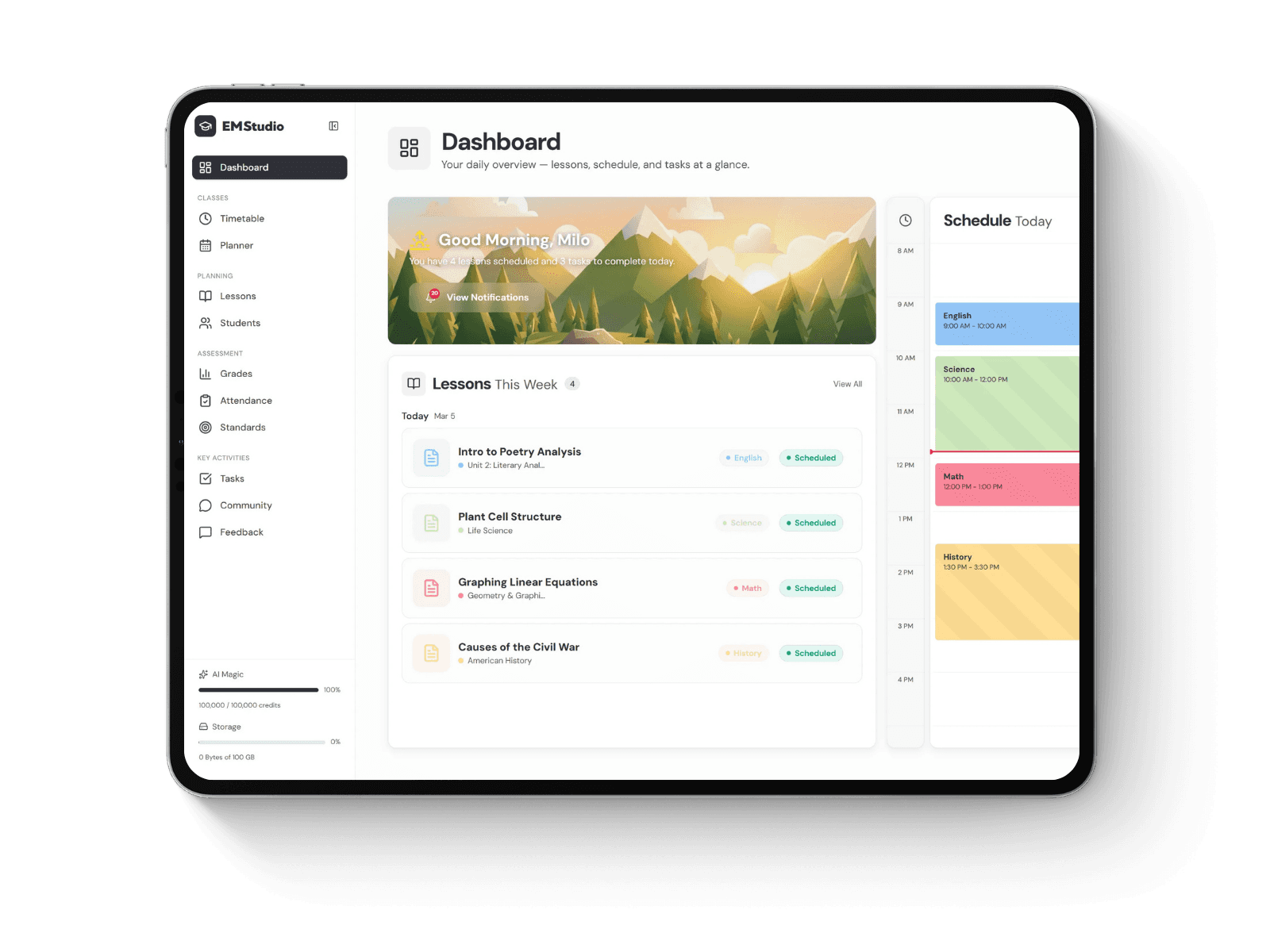
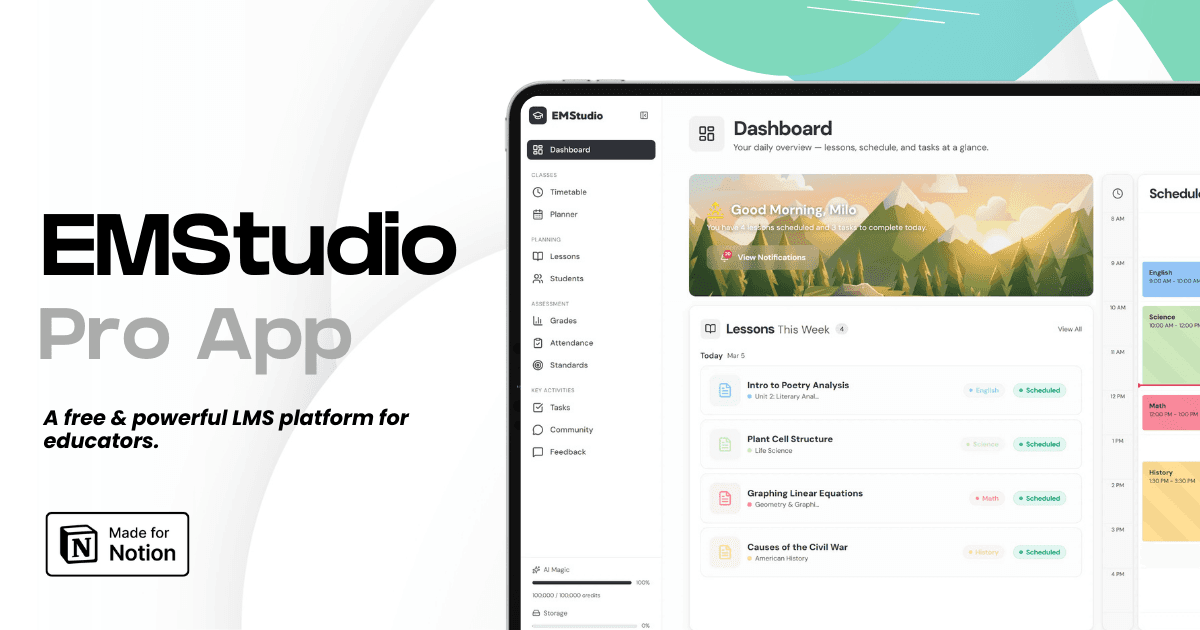
EMStudio is a free teaching management app — manage your classes, students, lessons, and more!
Learn More
Still grading everything by hand?
EMStudio is a free teaching management app — manage your classes, students, lessons, and more!
Learn More
Table of Contents
What Are the Best All-in-One Online Teaching Platforms?
The best all-in-one online teaching platforms for K-12 are Canvas, Google Classroom, and Schoology. Canvas offers extensive customization for secondary schools, Google Classroom provides tight integration with Workspace tools for free, and Schoology delivers robust assessment features within the PowerSchool ecosystem. Each supports blended learning with mobile apps and parent access portals.
You need one platform that handles assignments, grades, and parent communication without driving you insane. These three dominate K-12 for good reason—they actually work when the Wi-Fi sputters and 30 kids log in simultaneously. Pick the wrong one, and you'll spend September troubleshooting instead of teaching.
Here is how they compare across the metrics that matter most when you're evaluating online teaching platforms for your district.
Feature | Canvas | Google Classroom | Schoology |
|---|---|---|---|
Cost per student | $5–10/year (institutional) | Free | Contact sales |
Setup time | 2–3 weeks | 1 day | 3–6 months |
Storage limits | 500MB (Free) / Unlimited (Paid) | 20GB per user | Unlimited (Enterprise) |
Parent portal quality | Observer accounts with full visibility | Weekly email summaries only | Automated daily digests |
Google/Office integration | LTI plugins required | Native Google Workspace | Office 365 sync available |
Choose Canvas for secondary schools with dedicated tech coordinators who can manage the complexity. Pick Google Classroom if your district already lives in Workspace. Go with Schoology if you need standards-based grading and have time for a semester-long rollout.
Canvas
Canvas offers two distinct tiers. The Free for Teacher account gives you 500MB of file storage and works for a single instructor, but lacks admin controls and analytics. Paid institutional tiers run $5–10 per student annually and unlock unlimited storage, SIS integration, and district-wide oversight that keeps IT directors happy.
The platform shines in grades 6–12 through mastery paths for differentiated instruction. You can set up conditional release so students who bomb the pre-test get remediation videos while others skip ahead to the project. The LTI integration accepts unlimited external tools—I connected Nearpod, Flipgrid, and Khan Academy last year without calling IT once.
The trade-off is time. Expect to spend 8–10 hours in professional development before you can build a decent module without crying. Compare that to Google Classroom's 2-hour learning curve. Canvas also requires a comprehensive learning management systems approach to implementation, not a weekend setup. If you have a tech coordinator on staff, the power is worth the pain. Without one, you'll stare at the dashboard during August wondering why nothing makes sense.
Google Classroom
Google Classroom runs free but carries hard limits. You can run 20 active classes per teacher with 1,000 students per class. Each user gets 20GB storage in Education Fundamentals—enough for Docs and Slides, but you'll hit the cap fast if students upload video projects instead of linking them.
The magic happens in Drive integration. When you create an assignment, Classroom automatically generates a folder for each student with their name already on it. In a 1:1 Chromebook environment, students open their work directly from the Classwork tab. It connects to 100+ Google Workspace tools natively, from Forms quizzes to Meet links that appear with one click.
The catch? No built-in gradebook calculations. You cannot weight categories or drop lowest scores inside Classroom. You either export to your SIS manually or buy GradeSync plugins. For high school teachers calculating GPAs, this limitation stings every quarter when you realize you need to re-export everything because one kid turned in late work after you already submitted progress reports.
Schoology
Schoology splits between Basic and Enterprise. Basic works for small pilots but lacks admin analytics and bulk user management—critical once you cross 500 students. Enterprise requires contacting sales for pricing and typically needs 3–6 months for full PowerSchool ecosystem integration. Do not promise your principal a January launch if you start shopping in December.
The assessment engine justifies the wait for many districts. You get 16 question types including hotspot and audio response, plus automatic alignment with Common Core standards. When you build a quiz, you can tag specific standards and generate reports showing exactly which kids mastered 3.NBT.2 and which ones need reteaching before the state test hits.
Parent access runs deeper than competitors. The system sends automated email digests showing upcoming assignments and missing work. Parents create their own accounts linked to their student's profile, so they see grades in real-time without you forwarding screenshots. It cuts down on the "what's my kid missing?" emails by about half, though you'll still get the occasional reply from a parent who hit the wrong button.
Which Video Conferencing Tools Function Best as Teaching Platforms?
Zoom for Education, Microsoft Teams, and Google Meet lead for K-12 video instruction. Zoom offers the most reliable breakout rooms for small group work, Teams integrates deeply with Office 365 assignments, and Meet provides the simplest interface for Google schools. All three include essential security features like waiting rooms and recording capabilities.
Your district probably picked one of these three last March. Each handles the basics—video, chat, screen share—but the differences show up when you try to run actual instruction. These synchronous learning tools became essential infrastructure overnight.
Breakout room capacities vary significantly:
Zoom: 50 rooms, 200 participants per room.
Google Meet: 100 rooms only with Education Plus license.
Teams: 50 rooms, 300 participants total.
Security controls work differently across platforms:
Zoom: Waiting rooms with admit-all options for known classes.
Teams: Lobby bypass for internal users, manual admit for guests.
Meet: Knock requests requiring host approval for every entry.
Bandwidth requirements matter for rural districts:
Zoom: 3.0 Mbps up/down for 720p video.
Teams: 1.5 Mbps minimum.
Meet: 3.2 Mbps for HD—problematic for rural districts capped at 1.5 Mbps.
Recording limitations affect your archiving strategy:
Zoom: 0.5GB-5GB cloud storage depending on license tier.
Teams: Microsoft Stream storage quotas apply; check your admin console.
Meet: 30-day cloud retention in standard tier before auto-deletion.
Zoom for Education
Free Zoom cuts you off at 40 minutes for group meetings—fine for tutoring, useless for block scheduling. The Zoom for Education license removes time limits and adds SSO so students click through your portal without typing meeting IDs. I’ve run 90-minute labs without the panic of a ticking clock. Your IT department manages licenses through the admin dashboard, which also controls whether students can chat privately or share screens.
You can pre-assign breakout rooms via CSV import when teaching classes of 30+. Upload your roster with room numbers before class starts—no dragging names while kids wait. The polling feature allows up to 50 polls per meeting; I use these for exit tickets during synchronous learning blocks. Create polls as multiple choice or word clouds, then download results as CSV for your gradebook. This beats shouting over breakout room noise to check understanding.
Live transcription is available but you must enable it as host every single meeting—it’s not automatic. For ADA compliance, you’ll need third-party captioning integration via API. I’ve found this works best when setting up a virtual classroom with dedicated accessibility protocols. The transcription saves as a VTT file, searchable later for IEP documentation of who said what during discussions.
Microsoft Teams
Teams organizes into Class teams for students and PLC teams for staff collaboration. The assignments tab includes rubric integration—attach your standards-based rubric and grade inside the platform without downloading files. Class Notebook integration means each student gets their own section automatically, visible only to you and them. I post warm-up activities in the Class Notebook tab, and students complete them before I admit them from the lobby.
Use the General channel for announcements only—mute it for students to prevent chatter. Create private channels for IEP student groups or gifted pull-outs—though you’re capped at 30 private channels per team. I organize mine by period, with one private channel per small group rotation to keep noise down. Each private channel gets its own file storage and assignment distribution, so differentiation stays invisible to the main group.
Teams runs heavy on system resources. Older devices need 4GB RAM minimum compared to Meet’s 2GB requirement. I’ve watched Chromebooks from 2018 choke on Teams video while handling Meet smoothly during the same network conditions. If your district has aging hardware, this hardware reality decides your online teaching platforms choice before pedagogical preference enters the conversation.
Google Meet
Google Meet limits depend on your license tier. Education Fundamentals caps at 100 participants; the Teaching and Learning Upgrade bumps you to 250. For elementary co-teaching models with push-in support, that extra headroom matters—two teachers plus specialists eat 4-5 seats immediately. I’ve hit the 100-person wall during whole-grade assemblies, forcing us to stream instead of meet interactively.
Live captions work in English only but process locally—no internet lag for transcription services. The integrated Google Jamboard launches with one click for digital whiteboarding, though it lacks the precision of dedicated virtual classroom software. Low-light mode salvages video quality on older Chromebooks; I’ve seen it rescue lessons in windowless interior classrooms during winter months when the sun sets by 4:30 PM.
Meet integrates tightly with your existing Google Workspace workflow. Students join directly from Google Classroom assignment posts—no separate links to lose or typo-ridden emails. Automatic attendance tracking via Google Workspace audit logs saves me ten minutes per class; the system logs who joined when, exportable to Sheets for documentation. This digital curriculum delivery method reduces administrative friction compared to manual sign-in sheets or separate LMS attendance modules.

What Interactive Whiteboard Platforms Transform Online Lessons?
Nearpod, Pear Deck, and Lessonspace transform online lessons through interactive whiteboards. Nearpod excels with virtual reality field trips and collaborative drawing, Pear Deck integrates directly into Google Slides for immediate student feedback, and Lessonspace offers specialized STEM tools including advanced equation editors and multi-user graphing capabilities for math and science instruction.
These three online teaching tools for teachers bridge the gap between lecture and interaction. They turn passive screen time into active participation. Each platform takes a different path to engagement, so your choice depends on your subject, class size, and tolerance for prep work.
Nearpod runs 30 students on its free Silver tier and specializes in VR field trips that require mobile devices. Pear Deck handles 100 students per session as a Google Slides add-on, making it ideal for large lectures. Lessonspace offers true multi-user whiteboarding but limits you to 3 concurrent spaces on the free plan. Paid tiers unlock higher limits across all three virtual classroom software options.
Nearpod works on any modern browser, but VR features demand smartphones or headsets you probably don't have class sets of. Pear Deck requires students to install Chrome extensions, which fails on locked-down district iPads or requires IT approval. Lessonspace needs WebRTC support, meaning older iPads running Safari won't connect at all. Test your blended learning technology on actual student devices before the bell rings.
Nearpod lessons consume 45 to 60 minutes of build time from scratch. Pear Deck adds only 10 minutes to existing Google Slides decks you already use. Lessonspace requires no prep; you collaborate in real-time during the session. Factor this time difference into your weekly planning when integrating whiteboards in the classroom.
These platforms crash when bandwidth drops below 2 Mbps per student, which happens when three classes share a router. Phones with screens smaller than 4.7 inches make the drawing tools useless for detailed work. Always have a PDF backup ready. Your synchronous learning tools are only as reliable as your weakest connection.
Nearpod
Nearpod Silver gives you 50MB storage and caps sessions at 30 students. Gold costs $159 yearly and raises limits to 75 students and 100MB storage. That jump matters when you teach high school sections of 35 kids.
The platform shines with three modes. Time to Climb gamifies quizzes with mountain-climbing animations. Draw It turns every student device into a collaborative whiteboard. VR field trips work best when students use phones with the Nearpod app inserted into cardboard viewers.
You get 8,500+ pre-made lessons aligned to CCSS standards. Search by standard number, not keyword, for faster results. Most content targets 3rd through 12th grade. Edit lessons before assigning; the built-in text often needs tweaking for your specific kids.
Pear Deck
Pear Deck Free limits you to 5 slides with interactive elements per presentation. Premium runs $149.99 yearly for unlimited interactive slides. That paywall hits hard when you build 20-slide inquiry decks.
Install the Google Slides add-on in two minutes from the Chrome Web Store. It also works with Microsoft PowerPoint Online, though some features stay in beta. Students join via joinpd.com and see your slides sync in real-time on their Chromebooks.
Students drag pins onto images, type text responses, enter numbers, or draw with fingers or mice. Drawing requires touchscreens or trackpads; Chromebook styluses work best. The draggable feature works wonders for map labeling or categorization tasks in social studies.
Lessonspace
Lessonspace free tier includes 2GB storage and 3 concurrent teaching spaces. Pro costs $15 monthly for unlimited spaces and storage. That price point attracts tutors and intervention specialists more than full classroom teachers.
This online teaching platform built its reputation on math and science features. The LaTeX equation editor renders complex formulas instantly. Desmos graphing calculator integration allows multiple students to manipulate the same graph simultaneously. A code editor supports 12 programming languages for CS instruction.
Lessonspace maxes out at 12 students for optimal performance, not 30. The tool suits 1:1 tutoring and small pull-out groups. Don't try to run your full 6th period through it; the whiteboard lags with too many cursors moving at once.

Assessment-Focused Platforms for Real-Time Feedback
Kahoot!
Kahoot! turns your review session into a game show. Students race to tap the correct color block on their phones while a synth beat pulses and a countdown timer burns red. It is pure summative assessment wrapped in fierce competition. Among synchronous learning tools, it delivers the highest energy and noise levels. Everyone sees the leaderboard after each question. That adrenaline works for some kids. For others, it triggers serious performance anxiety.
Research shows competitive formats boost engagement but stress out roughly 15-20% of your class. You will spot them frozen on question three while classmates cheer. Switch to team mode. Groups of three or four share one device. The pressure diffuses, and you still get the data you need without leaving anyone behind. It changes the vibe from individual combat to collaborative problem solving.
The free tier caps you at ten players per game. That is two tables of fifth graders, not a full class. Upgrade to Pro for $7.99 monthly to host 100 players and upload custom background images. Free accounts stick to multiple choice, true/false, and puzzle questions. You cannot collect written explanations or math work. No open response exists on the free plan.
Grading happens the instant the last question closes. Kahoot! spits out an Excel or CSV file with raw scores only. No partial credit exists. A student either picked the right hexagon or did not. Export takes two clicks. You get percentages, not standards alignment.
Use Kahoot! for end-of-unit review, not daily checks for understanding. The platform rewards speed over depth. A student who knows the concept but reads slowly will score lower than a guesser with fast thumbs. It is an online teaching platform for teachers who need quick engagement, not nuanced diagnostic data.
Formative
Formative (formerly GoFormative) operates like a window into your students' brains while they work. You watch them answer in real time with a half-second delay. Type an equation into the draw tool, and you see exactly where a seventh grader got stuck on the slope calculation. It is non-competitive visual feedback designed for understanding, not speed.
Tag each question to CCSS or state standards before class starts. The platform generates mastery reports automatically. You will know which kids nailed 6.RP.A.3 and which ones need reteaching before the bell rings. Unlike basic learning management system gradebooks, Formative syncs rosters directly and enables automatic grade passback to Google Classroom without copy-paste.
The free tier allows thirty students. That covers most single sections. Open response questions require manual grading. Plan on two to three minutes to review thirty short answers. Drag a feedback stamp onto specific sentences. Students see your comments instantly and can revise their work before submitting final answers. This creates a conversation rather than a dead end.
Real-time monitoring shows you:
Live keystrokes and drawing strokes as students work.
Exact moments where students pause or delete answers.
Color-coded mastery levels for each standard tag.
This tool fits formative and summative assessment strategies that require seeing student thinking, not just their final click. Export options include standards-based reports and CSV files. Unlike gamified rivals, Formative prioritizes process over points.
The draw tool transforms math instruction. Students sketch graphs or long division steps with their fingers on Chromebook trackpads or tablets. You spot the calculation error in the first step rather than seeing only a wrong final answer. That specificity cuts your reteaching time in half during the next class period.
Quizizz
Quizizz offers two distinct rhythms. Live mode runs like a traditional quiz, while Homework mode lets students tackle questions asynchronously at kitchen tables or on bus rides. Memes pop up between questions celebrating correct answers or mocking wrong ones. Turn those off for IEP accommodations or formal assessments requiring reduced distractions.
The question bank holds over thirty million teacher-created items. Search by standard or keyword. Need a quiz on photosynthesis for eighth graders? Five hundred options appear in seconds. Power-ups add gamification like double points or extra time. Disable them entirely when the stakes are high. You control the environment completely.
Free accounts host unlimited students, though they will watch short ads between rounds. The platform tracks detailed time-per-question analytics. You see that Marcus spent four minutes on item four while others finished in thirty seconds. That data reveals hesitation and uncertainty, not just wrong answers. You know exactly which concepts caused pause.
Grading is automatic for multiple choice and fill-in-the-blank. Open-ended questions land in your dashboard for manual review. Export detailed spreadsheets showing every click and timestamp. Quizizz works best as an asynchronous learning platform for homework checks or station rotations. The data exports to Excel or CSV for further analysis in your preferred gradebook.
Among online teaching platforms, Quizizz stands out for self-paced practice. Students who finish early review missed questions immediately. Struggling learners work through twenty items without the shame of a public leaderboard. Everyone moves at their own speed.

Subject-Specific Platforms for Specialized Instruction
Desmos for Mathematics
Desmos Classroom gives you free access to the Activity Builder. You can build custom lessons or pull pre-made activities aligned to Open Up Resources and Illustrative Mathematics for grades 6 through 12. The graphing calculator handles linear equations through calculus, plus scientific and geometry tools built for algebraic reasoning.
Here is the catch. Desmos requires abstract algebraic thinking. It is the wrong choice for K-5 arithmetic. Younger students need physical manipulatives to build number sense, not digital sliders and coordinate planes. I watched a 2nd grader cry because she could not drag the parabola with her finger the way she wanted. Stick to middle and high school algebra through calculus.
Building your first Activity Builder lesson takes 30 minutes. You drag in graph screens, text boxes, and student response boxes to build the flow. After that, you duplicate and tweak existing activities. The calculator works offline as a PWA, so students without constant Wi-Fi can still graph and explore functions. COPPA compliance means the calculator collects no student data in calculator-only mode. For more specialized math teacher resources, check our full guide.
Flipgrid for Language Arts
Flipgrid—now called Flip—runs asynchronous video discussions for language arts and ELL classes in grades 3 through 12. You create a grid for each class section in about ten minutes, then post topic prompts with 3-minute video limits. The Immersive Reader integration reads prompt text aloud for struggling readers or ELL students who need translation support.
Always enable Video Moderation during setup. Without it, students see each other's videos immediately. That is a FERPA violation waiting to happen. I learned this after a student posted a video about her home address that went live instantly. Turn moderation on before you share the grid code. This ten-minute setup step prevents privacy breaches and keeps you compliant.
Flipgrid requires continuous connectivity for video processing. Three-minute video uploads fail on connections under 1 Mbps. For students with spotty home Wi-Fi, provide a phone number so they submit via SMS instead. The platform processes video on Microsoft's servers, not the device, so there is no offline capability. Use this for literature discussions where tone of voice and fluency matter more than text alone.
Scratch for Computer Science
Scratch teaches block-based coding to students ages 8 through 16. Students drag logic blocks to build games and animations. The blocks have text labels, so students need reading comprehension to use them effectively. This makes it perfect for 4th through 8th grade computational thinking. Not earlier grades.
The biggest mistake I see is skipping the Studio setup. Teachers let students publish projects to the open community of 92 million users. You must serve as the administrator to control visibility. Follow these steps to avoid privacy breaches:
Create a private class studio before students sign up.
Enable "Teacher Approval" on all project submissions.
Turn off commenting or set it to approved-only.
Teach students never to share full names or locations in project notes.
Scratch offers an offline editor for Windows and Mac when Wi-Fi is unreliable, though you cannot share projects until you reconnect. For curriculum, CS First provides ready-made modules aligned to CSTA standards for grades 4 through 8. These digital tools for teaching coding work best when you front-load digital citizenship lessons about privacy.

How Do You Select the Right Online Teaching Platform for Your Classroom?
Select an online teaching platform by first determining your budget constraints and device ecosystem. Prioritize Canvas or Schoology for comprehensive LMS needs, Google Classroom for simplicity, or specialized tools like Nearpod for engagement. Pilot with five students for one week before full implementation, verifying COPPA compliance and bandwidth requirements under 5 Mbps per device.
You do not need another login to manage. Pick the tool that matches your devices, your budget, and how you actually teach. Everything else is noise.
Start with your wallet. Free online teaching platforms work for tight budgets, but premium learning management systems like Canvas or Schoology automate the grading grunt work.
Next, look at what sits on student desks. 1:1 Chromebooks play nicest with Google Classroom. Windows districts run smoother on Microsoft Teams or Canvas. Mixed device carts demand browser-based tools that work on six-year-old iPads and brand-new Dell laptops alike.
Finally, name your main goal. If you need digital curriculum delivery, look for robust content libraries with built-in videos and text. If you need student engagement technology, prioritize synchronous learning tools with built-in polls and breakouts. Assessment-heavy courses need asynchronous learning platforms with sophisticated rubrics and question banks.
Map your rollout in weeks, not days. Rushing guarantees frustrated emails at 11 PM.
Week 1: Connect your SIS and sync rosters. Test login credentials with five volunteer students from different grade levels.
Week 2: Run the pilot. Watch where kids get stuck. Check our blended learning implementation guide for troubleshooting tips.
Week 3: Host one 45-minute staff PD session. Demo the assign button, not every feature.
Week 4: Go live with parent communication explaining the new virtual classroom software and how to check grades.
Some tools look shiny but break under real classroom conditions. Avoid any platform still requiring Java plugins—they are obsolete and security nightmares.
Demand COPPA and FERPA documentation upfront. If the sales rep hesitates, walk away. Read our breakdown of data security in education platforms before signing contracts.
Test bandwidth during peak usage. If one student streaming video crashes the lesson for others, you need lighter asynchronous learning platforms or better infrastructure. Five Mbps per device is the ceiling, not the floor. Rural districts with spotty connectivity should avoid heavy virtual classroom software that drops calls when three kids turn on cameras.
Free is never free. Google Classroom costs zero dollars but ate five hours of my week manually transferring grades to the SIS until we got a sync tool. Premium blended learning platforms run $100 to $300 yearly, yet they auto-sync scores and parent notifications. Calculate your hourly rate against that subscription fee. Five hours of your prep time is worth more than the license cost.
Trust your pilot data, not the vendor demo. When your fifth-graders can log in without raising their hands, you picked the right online teaching platform. Start small, adjust fast, and remember that good teaching matters more than perfect software. The best tool is the one you will actually use on a Tuesday afternoon when the Wi-Fi is glitching and the copy machine is broken.
What Are the Best All-in-One Online Teaching Platforms?
The best all-in-one online teaching platforms for K-12 are Canvas, Google Classroom, and Schoology. Canvas offers extensive customization for secondary schools, Google Classroom provides tight integration with Workspace tools for free, and Schoology delivers robust assessment features within the PowerSchool ecosystem. Each supports blended learning with mobile apps and parent access portals.
You need one platform that handles assignments, grades, and parent communication without driving you insane. These three dominate K-12 for good reason—they actually work when the Wi-Fi sputters and 30 kids log in simultaneously. Pick the wrong one, and you'll spend September troubleshooting instead of teaching.
Here is how they compare across the metrics that matter most when you're evaluating online teaching platforms for your district.
Feature | Canvas | Google Classroom | Schoology |
|---|---|---|---|
Cost per student | $5–10/year (institutional) | Free | Contact sales |
Setup time | 2–3 weeks | 1 day | 3–6 months |
Storage limits | 500MB (Free) / Unlimited (Paid) | 20GB per user | Unlimited (Enterprise) |
Parent portal quality | Observer accounts with full visibility | Weekly email summaries only | Automated daily digests |
Google/Office integration | LTI plugins required | Native Google Workspace | Office 365 sync available |
Choose Canvas for secondary schools with dedicated tech coordinators who can manage the complexity. Pick Google Classroom if your district already lives in Workspace. Go with Schoology if you need standards-based grading and have time for a semester-long rollout.
Canvas
Canvas offers two distinct tiers. The Free for Teacher account gives you 500MB of file storage and works for a single instructor, but lacks admin controls and analytics. Paid institutional tiers run $5–10 per student annually and unlock unlimited storage, SIS integration, and district-wide oversight that keeps IT directors happy.
The platform shines in grades 6–12 through mastery paths for differentiated instruction. You can set up conditional release so students who bomb the pre-test get remediation videos while others skip ahead to the project. The LTI integration accepts unlimited external tools—I connected Nearpod, Flipgrid, and Khan Academy last year without calling IT once.
The trade-off is time. Expect to spend 8–10 hours in professional development before you can build a decent module without crying. Compare that to Google Classroom's 2-hour learning curve. Canvas also requires a comprehensive learning management systems approach to implementation, not a weekend setup. If you have a tech coordinator on staff, the power is worth the pain. Without one, you'll stare at the dashboard during August wondering why nothing makes sense.
Google Classroom
Google Classroom runs free but carries hard limits. You can run 20 active classes per teacher with 1,000 students per class. Each user gets 20GB storage in Education Fundamentals—enough for Docs and Slides, but you'll hit the cap fast if students upload video projects instead of linking them.
The magic happens in Drive integration. When you create an assignment, Classroom automatically generates a folder for each student with their name already on it. In a 1:1 Chromebook environment, students open their work directly from the Classwork tab. It connects to 100+ Google Workspace tools natively, from Forms quizzes to Meet links that appear with one click.
The catch? No built-in gradebook calculations. You cannot weight categories or drop lowest scores inside Classroom. You either export to your SIS manually or buy GradeSync plugins. For high school teachers calculating GPAs, this limitation stings every quarter when you realize you need to re-export everything because one kid turned in late work after you already submitted progress reports.
Schoology
Schoology splits between Basic and Enterprise. Basic works for small pilots but lacks admin analytics and bulk user management—critical once you cross 500 students. Enterprise requires contacting sales for pricing and typically needs 3–6 months for full PowerSchool ecosystem integration. Do not promise your principal a January launch if you start shopping in December.
The assessment engine justifies the wait for many districts. You get 16 question types including hotspot and audio response, plus automatic alignment with Common Core standards. When you build a quiz, you can tag specific standards and generate reports showing exactly which kids mastered 3.NBT.2 and which ones need reteaching before the state test hits.
Parent access runs deeper than competitors. The system sends automated email digests showing upcoming assignments and missing work. Parents create their own accounts linked to their student's profile, so they see grades in real-time without you forwarding screenshots. It cuts down on the "what's my kid missing?" emails by about half, though you'll still get the occasional reply from a parent who hit the wrong button.
Which Video Conferencing Tools Function Best as Teaching Platforms?
Zoom for Education, Microsoft Teams, and Google Meet lead for K-12 video instruction. Zoom offers the most reliable breakout rooms for small group work, Teams integrates deeply with Office 365 assignments, and Meet provides the simplest interface for Google schools. All three include essential security features like waiting rooms and recording capabilities.
Your district probably picked one of these three last March. Each handles the basics—video, chat, screen share—but the differences show up when you try to run actual instruction. These synchronous learning tools became essential infrastructure overnight.
Breakout room capacities vary significantly:
Zoom: 50 rooms, 200 participants per room.
Google Meet: 100 rooms only with Education Plus license.
Teams: 50 rooms, 300 participants total.
Security controls work differently across platforms:
Zoom: Waiting rooms with admit-all options for known classes.
Teams: Lobby bypass for internal users, manual admit for guests.
Meet: Knock requests requiring host approval for every entry.
Bandwidth requirements matter for rural districts:
Zoom: 3.0 Mbps up/down for 720p video.
Teams: 1.5 Mbps minimum.
Meet: 3.2 Mbps for HD—problematic for rural districts capped at 1.5 Mbps.
Recording limitations affect your archiving strategy:
Zoom: 0.5GB-5GB cloud storage depending on license tier.
Teams: Microsoft Stream storage quotas apply; check your admin console.
Meet: 30-day cloud retention in standard tier before auto-deletion.
Zoom for Education
Free Zoom cuts you off at 40 minutes for group meetings—fine for tutoring, useless for block scheduling. The Zoom for Education license removes time limits and adds SSO so students click through your portal without typing meeting IDs. I’ve run 90-minute labs without the panic of a ticking clock. Your IT department manages licenses through the admin dashboard, which also controls whether students can chat privately or share screens.
You can pre-assign breakout rooms via CSV import when teaching classes of 30+. Upload your roster with room numbers before class starts—no dragging names while kids wait. The polling feature allows up to 50 polls per meeting; I use these for exit tickets during synchronous learning blocks. Create polls as multiple choice or word clouds, then download results as CSV for your gradebook. This beats shouting over breakout room noise to check understanding.
Live transcription is available but you must enable it as host every single meeting—it’s not automatic. For ADA compliance, you’ll need third-party captioning integration via API. I’ve found this works best when setting up a virtual classroom with dedicated accessibility protocols. The transcription saves as a VTT file, searchable later for IEP documentation of who said what during discussions.
Microsoft Teams
Teams organizes into Class teams for students and PLC teams for staff collaboration. The assignments tab includes rubric integration—attach your standards-based rubric and grade inside the platform without downloading files. Class Notebook integration means each student gets their own section automatically, visible only to you and them. I post warm-up activities in the Class Notebook tab, and students complete them before I admit them from the lobby.
Use the General channel for announcements only—mute it for students to prevent chatter. Create private channels for IEP student groups or gifted pull-outs—though you’re capped at 30 private channels per team. I organize mine by period, with one private channel per small group rotation to keep noise down. Each private channel gets its own file storage and assignment distribution, so differentiation stays invisible to the main group.
Teams runs heavy on system resources. Older devices need 4GB RAM minimum compared to Meet’s 2GB requirement. I’ve watched Chromebooks from 2018 choke on Teams video while handling Meet smoothly during the same network conditions. If your district has aging hardware, this hardware reality decides your online teaching platforms choice before pedagogical preference enters the conversation.
Google Meet
Google Meet limits depend on your license tier. Education Fundamentals caps at 100 participants; the Teaching and Learning Upgrade bumps you to 250. For elementary co-teaching models with push-in support, that extra headroom matters—two teachers plus specialists eat 4-5 seats immediately. I’ve hit the 100-person wall during whole-grade assemblies, forcing us to stream instead of meet interactively.
Live captions work in English only but process locally—no internet lag for transcription services. The integrated Google Jamboard launches with one click for digital whiteboarding, though it lacks the precision of dedicated virtual classroom software. Low-light mode salvages video quality on older Chromebooks; I’ve seen it rescue lessons in windowless interior classrooms during winter months when the sun sets by 4:30 PM.
Meet integrates tightly with your existing Google Workspace workflow. Students join directly from Google Classroom assignment posts—no separate links to lose or typo-ridden emails. Automatic attendance tracking via Google Workspace audit logs saves me ten minutes per class; the system logs who joined when, exportable to Sheets for documentation. This digital curriculum delivery method reduces administrative friction compared to manual sign-in sheets or separate LMS attendance modules.
What Interactive Whiteboard Platforms Transform Online Lessons?
Nearpod, Pear Deck, and Lessonspace transform online lessons through interactive whiteboards. Nearpod excels with virtual reality field trips and collaborative drawing, Pear Deck integrates directly into Google Slides for immediate student feedback, and Lessonspace offers specialized STEM tools including advanced equation editors and multi-user graphing capabilities for math and science instruction.
These three online teaching tools for teachers bridge the gap between lecture and interaction. They turn passive screen time into active participation. Each platform takes a different path to engagement, so your choice depends on your subject, class size, and tolerance for prep work.
Nearpod runs 30 students on its free Silver tier and specializes in VR field trips that require mobile devices. Pear Deck handles 100 students per session as a Google Slides add-on, making it ideal for large lectures. Lessonspace offers true multi-user whiteboarding but limits you to 3 concurrent spaces on the free plan. Paid tiers unlock higher limits across all three virtual classroom software options.
Nearpod works on any modern browser, but VR features demand smartphones or headsets you probably don't have class sets of. Pear Deck requires students to install Chrome extensions, which fails on locked-down district iPads or requires IT approval. Lessonspace needs WebRTC support, meaning older iPads running Safari won't connect at all. Test your blended learning technology on actual student devices before the bell rings.
Nearpod lessons consume 45 to 60 minutes of build time from scratch. Pear Deck adds only 10 minutes to existing Google Slides decks you already use. Lessonspace requires no prep; you collaborate in real-time during the session. Factor this time difference into your weekly planning when integrating whiteboards in the classroom.
These platforms crash when bandwidth drops below 2 Mbps per student, which happens when three classes share a router. Phones with screens smaller than 4.7 inches make the drawing tools useless for detailed work. Always have a PDF backup ready. Your synchronous learning tools are only as reliable as your weakest connection.
Nearpod
Nearpod Silver gives you 50MB storage and caps sessions at 30 students. Gold costs $159 yearly and raises limits to 75 students and 100MB storage. That jump matters when you teach high school sections of 35 kids.
The platform shines with three modes. Time to Climb gamifies quizzes with mountain-climbing animations. Draw It turns every student device into a collaborative whiteboard. VR field trips work best when students use phones with the Nearpod app inserted into cardboard viewers.
You get 8,500+ pre-made lessons aligned to CCSS standards. Search by standard number, not keyword, for faster results. Most content targets 3rd through 12th grade. Edit lessons before assigning; the built-in text often needs tweaking for your specific kids.
Pear Deck
Pear Deck Free limits you to 5 slides with interactive elements per presentation. Premium runs $149.99 yearly for unlimited interactive slides. That paywall hits hard when you build 20-slide inquiry decks.
Install the Google Slides add-on in two minutes from the Chrome Web Store. It also works with Microsoft PowerPoint Online, though some features stay in beta. Students join via joinpd.com and see your slides sync in real-time on their Chromebooks.
Students drag pins onto images, type text responses, enter numbers, or draw with fingers or mice. Drawing requires touchscreens or trackpads; Chromebook styluses work best. The draggable feature works wonders for map labeling or categorization tasks in social studies.
Lessonspace
Lessonspace free tier includes 2GB storage and 3 concurrent teaching spaces. Pro costs $15 monthly for unlimited spaces and storage. That price point attracts tutors and intervention specialists more than full classroom teachers.
This online teaching platform built its reputation on math and science features. The LaTeX equation editor renders complex formulas instantly. Desmos graphing calculator integration allows multiple students to manipulate the same graph simultaneously. A code editor supports 12 programming languages for CS instruction.
Lessonspace maxes out at 12 students for optimal performance, not 30. The tool suits 1:1 tutoring and small pull-out groups. Don't try to run your full 6th period through it; the whiteboard lags with too many cursors moving at once.
Assessment-Focused Platforms for Real-Time Feedback
Kahoot!
Kahoot! turns your review session into a game show. Students race to tap the correct color block on their phones while a synth beat pulses and a countdown timer burns red. It is pure summative assessment wrapped in fierce competition. Among synchronous learning tools, it delivers the highest energy and noise levels. Everyone sees the leaderboard after each question. That adrenaline works for some kids. For others, it triggers serious performance anxiety.
Research shows competitive formats boost engagement but stress out roughly 15-20% of your class. You will spot them frozen on question three while classmates cheer. Switch to team mode. Groups of three or four share one device. The pressure diffuses, and you still get the data you need without leaving anyone behind. It changes the vibe from individual combat to collaborative problem solving.
The free tier caps you at ten players per game. That is two tables of fifth graders, not a full class. Upgrade to Pro for $7.99 monthly to host 100 players and upload custom background images. Free accounts stick to multiple choice, true/false, and puzzle questions. You cannot collect written explanations or math work. No open response exists on the free plan.
Grading happens the instant the last question closes. Kahoot! spits out an Excel or CSV file with raw scores only. No partial credit exists. A student either picked the right hexagon or did not. Export takes two clicks. You get percentages, not standards alignment.
Use Kahoot! for end-of-unit review, not daily checks for understanding. The platform rewards speed over depth. A student who knows the concept but reads slowly will score lower than a guesser with fast thumbs. It is an online teaching platform for teachers who need quick engagement, not nuanced diagnostic data.
Formative
Formative (formerly GoFormative) operates like a window into your students' brains while they work. You watch them answer in real time with a half-second delay. Type an equation into the draw tool, and you see exactly where a seventh grader got stuck on the slope calculation. It is non-competitive visual feedback designed for understanding, not speed.
Tag each question to CCSS or state standards before class starts. The platform generates mastery reports automatically. You will know which kids nailed 6.RP.A.3 and which ones need reteaching before the bell rings. Unlike basic learning management system gradebooks, Formative syncs rosters directly and enables automatic grade passback to Google Classroom without copy-paste.
The free tier allows thirty students. That covers most single sections. Open response questions require manual grading. Plan on two to three minutes to review thirty short answers. Drag a feedback stamp onto specific sentences. Students see your comments instantly and can revise their work before submitting final answers. This creates a conversation rather than a dead end.
Real-time monitoring shows you:
Live keystrokes and drawing strokes as students work.
Exact moments where students pause or delete answers.
Color-coded mastery levels for each standard tag.
This tool fits formative and summative assessment strategies that require seeing student thinking, not just their final click. Export options include standards-based reports and CSV files. Unlike gamified rivals, Formative prioritizes process over points.
The draw tool transforms math instruction. Students sketch graphs or long division steps with their fingers on Chromebook trackpads or tablets. You spot the calculation error in the first step rather than seeing only a wrong final answer. That specificity cuts your reteaching time in half during the next class period.
Quizizz
Quizizz offers two distinct rhythms. Live mode runs like a traditional quiz, while Homework mode lets students tackle questions asynchronously at kitchen tables or on bus rides. Memes pop up between questions celebrating correct answers or mocking wrong ones. Turn those off for IEP accommodations or formal assessments requiring reduced distractions.
The question bank holds over thirty million teacher-created items. Search by standard or keyword. Need a quiz on photosynthesis for eighth graders? Five hundred options appear in seconds. Power-ups add gamification like double points or extra time. Disable them entirely when the stakes are high. You control the environment completely.
Free accounts host unlimited students, though they will watch short ads between rounds. The platform tracks detailed time-per-question analytics. You see that Marcus spent four minutes on item four while others finished in thirty seconds. That data reveals hesitation and uncertainty, not just wrong answers. You know exactly which concepts caused pause.
Grading is automatic for multiple choice and fill-in-the-blank. Open-ended questions land in your dashboard for manual review. Export detailed spreadsheets showing every click and timestamp. Quizizz works best as an asynchronous learning platform for homework checks or station rotations. The data exports to Excel or CSV for further analysis in your preferred gradebook.
Among online teaching platforms, Quizizz stands out for self-paced practice. Students who finish early review missed questions immediately. Struggling learners work through twenty items without the shame of a public leaderboard. Everyone moves at their own speed.
Subject-Specific Platforms for Specialized Instruction
Desmos for Mathematics
Desmos Classroom gives you free access to the Activity Builder. You can build custom lessons or pull pre-made activities aligned to Open Up Resources and Illustrative Mathematics for grades 6 through 12. The graphing calculator handles linear equations through calculus, plus scientific and geometry tools built for algebraic reasoning.
Here is the catch. Desmos requires abstract algebraic thinking. It is the wrong choice for K-5 arithmetic. Younger students need physical manipulatives to build number sense, not digital sliders and coordinate planes. I watched a 2nd grader cry because she could not drag the parabola with her finger the way she wanted. Stick to middle and high school algebra through calculus.
Building your first Activity Builder lesson takes 30 minutes. You drag in graph screens, text boxes, and student response boxes to build the flow. After that, you duplicate and tweak existing activities. The calculator works offline as a PWA, so students without constant Wi-Fi can still graph and explore functions. COPPA compliance means the calculator collects no student data in calculator-only mode. For more specialized math teacher resources, check our full guide.
Flipgrid for Language Arts
Flipgrid—now called Flip—runs asynchronous video discussions for language arts and ELL classes in grades 3 through 12. You create a grid for each class section in about ten minutes, then post topic prompts with 3-minute video limits. The Immersive Reader integration reads prompt text aloud for struggling readers or ELL students who need translation support.
Always enable Video Moderation during setup. Without it, students see each other's videos immediately. That is a FERPA violation waiting to happen. I learned this after a student posted a video about her home address that went live instantly. Turn moderation on before you share the grid code. This ten-minute setup step prevents privacy breaches and keeps you compliant.
Flipgrid requires continuous connectivity for video processing. Three-minute video uploads fail on connections under 1 Mbps. For students with spotty home Wi-Fi, provide a phone number so they submit via SMS instead. The platform processes video on Microsoft's servers, not the device, so there is no offline capability. Use this for literature discussions where tone of voice and fluency matter more than text alone.
Scratch for Computer Science
Scratch teaches block-based coding to students ages 8 through 16. Students drag logic blocks to build games and animations. The blocks have text labels, so students need reading comprehension to use them effectively. This makes it perfect for 4th through 8th grade computational thinking. Not earlier grades.
The biggest mistake I see is skipping the Studio setup. Teachers let students publish projects to the open community of 92 million users. You must serve as the administrator to control visibility. Follow these steps to avoid privacy breaches:
Create a private class studio before students sign up.
Enable "Teacher Approval" on all project submissions.
Turn off commenting or set it to approved-only.
Teach students never to share full names or locations in project notes.
Scratch offers an offline editor for Windows and Mac when Wi-Fi is unreliable, though you cannot share projects until you reconnect. For curriculum, CS First provides ready-made modules aligned to CSTA standards for grades 4 through 8. These digital tools for teaching coding work best when you front-load digital citizenship lessons about privacy.
How Do You Select the Right Online Teaching Platform for Your Classroom?
Select an online teaching platform by first determining your budget constraints and device ecosystem. Prioritize Canvas or Schoology for comprehensive LMS needs, Google Classroom for simplicity, or specialized tools like Nearpod for engagement. Pilot with five students for one week before full implementation, verifying COPPA compliance and bandwidth requirements under 5 Mbps per device.
You do not need another login to manage. Pick the tool that matches your devices, your budget, and how you actually teach. Everything else is noise.
Start with your wallet. Free online teaching platforms work for tight budgets, but premium learning management systems like Canvas or Schoology automate the grading grunt work.
Next, look at what sits on student desks. 1:1 Chromebooks play nicest with Google Classroom. Windows districts run smoother on Microsoft Teams or Canvas. Mixed device carts demand browser-based tools that work on six-year-old iPads and brand-new Dell laptops alike.
Finally, name your main goal. If you need digital curriculum delivery, look for robust content libraries with built-in videos and text. If you need student engagement technology, prioritize synchronous learning tools with built-in polls and breakouts. Assessment-heavy courses need asynchronous learning platforms with sophisticated rubrics and question banks.
Map your rollout in weeks, not days. Rushing guarantees frustrated emails at 11 PM.
Week 1: Connect your SIS and sync rosters. Test login credentials with five volunteer students from different grade levels.
Week 2: Run the pilot. Watch where kids get stuck. Check our blended learning implementation guide for troubleshooting tips.
Week 3: Host one 45-minute staff PD session. Demo the assign button, not every feature.
Week 4: Go live with parent communication explaining the new virtual classroom software and how to check grades.
Some tools look shiny but break under real classroom conditions. Avoid any platform still requiring Java plugins—they are obsolete and security nightmares.
Demand COPPA and FERPA documentation upfront. If the sales rep hesitates, walk away. Read our breakdown of data security in education platforms before signing contracts.
Test bandwidth during peak usage. If one student streaming video crashes the lesson for others, you need lighter asynchronous learning platforms or better infrastructure. Five Mbps per device is the ceiling, not the floor. Rural districts with spotty connectivity should avoid heavy virtual classroom software that drops calls when three kids turn on cameras.
Free is never free. Google Classroom costs zero dollars but ate five hours of my week manually transferring grades to the SIS until we got a sync tool. Premium blended learning platforms run $100 to $300 yearly, yet they auto-sync scores and parent notifications. Calculate your hourly rate against that subscription fee. Five hours of your prep time is worth more than the license cost.
Trust your pilot data, not the vendor demo. When your fifth-graders can log in without raising their hands, you picked the right online teaching platform. Start small, adjust fast, and remember that good teaching matters more than perfect software. The best tool is the one you will actually use on a Tuesday afternoon when the Wi-Fi is glitching and the copy machine is broken.
Still grading everything by hand?
EMStudio is a free teaching management app — manage your classes, students, lessons, and more!
Learn More
Still grading everything by hand?
EMStudio is a free teaching management app — manage your classes, students, lessons, and more!
Learn More



Notion4Teachers
Notion templates to simplify administrative tasks and enhance your teaching experience.



2026 Notion4Teachers. All Rights Reserved.
Notion4Teachers
Notion templates to simplify administrative tasks and enhance your teaching experience.
2026 Notion4Teachers. All Rights Reserved.
Notion4Teachers
Notion templates to simplify administrative tasks and enhance your teaching experience.
2026 Notion4Teachers. All Rights Reserved.