
Micro Schooling: A Complete Guide for K-12 Educators
Micro Schooling: A Complete Guide for K-12 Educators

Article by
Milo
ESL Content Coordinator & Educator
ESL Content Coordinator & Educator
All Posts
I watched a fourth-grader named Marcus stare at his workbook for twenty minutes last October. Thirty-two kids in the room, thirty-two different speeds, and he was still stuck on equivalent fractions while I was already demo-ing decimal conversion on the smartboard. The silence of him falling behind felt louder than my lesson. That moment keeps coming back to me when I talk with teachers leaving district jobs to launch micro schooling programs—tiny, intentional learning environments where a kid like Marcus doesn't get lost in the crowd because the entire structure is built around noticing when someone needs to pause.
This isn't just about escaping burnout or bureaucracy, though that's often where it starts. It's about design. Micro schooling swaps the factory model for mixed-age classrooms, mastery-based learning, and the Socratic method practiced around a kitchen table, not a lectern. Whether you're already running a learning pod from your dining room, joining an educational cooperative with other frustrated parents and teachers, or just curious about how small group instruction actually works when you control the schedule, this guide covers the operational reality—not the Pinterest fantasy.
We'll look at what technically defines these models, why experienced educators are walking away from pensions to start them, how they run day-to-day without a central office handling compliance or curriculum, and exactly what it takes to transition from district teacher to micro school founder. No jargon from ed-tech sales teams. No statistics pulled from thin air. Just practical steps from teachers who've already made the jump and are figuring it out as they go.
Still grading everything by hand?
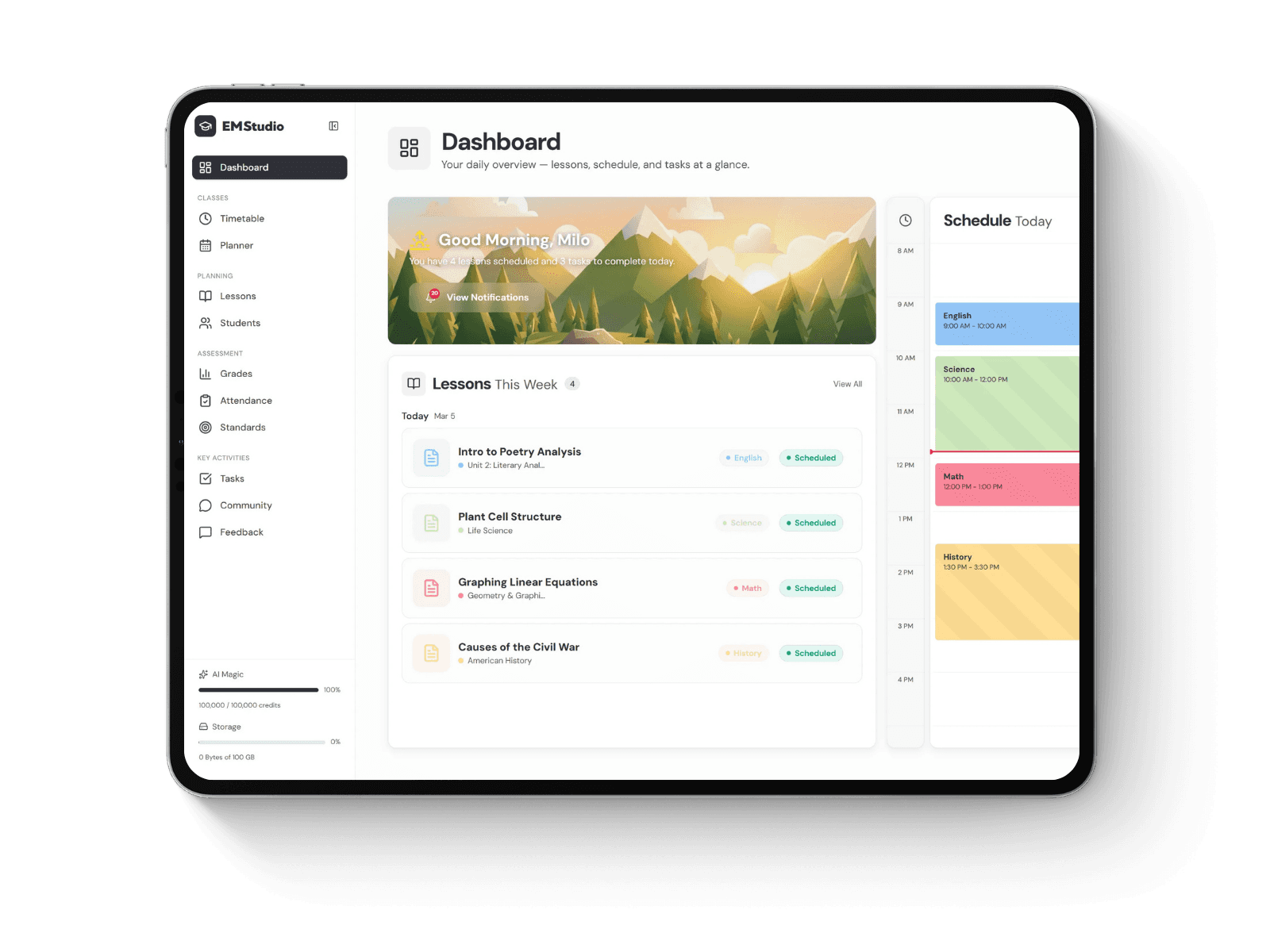
EMStudio is a free teaching management app — manage your classes, students, lessons, and more!
Learn More
Still grading everything by hand?
EMStudio is a free teaching management app — manage your classes, students, lessons, and more!
Learn More
Table of Contents
What Is Micro Schooling?
Micro schooling is a small-scale educational model serving 10–25 students in mixed-age settings, emphasizing personalized, mastery-based learning over standardized curricula. Typically operated as private entities or parent cooperatives, these schools combine the flexibility of homeschooling with the structure of institutional education, often utilizing community spaces and Socratic teaching methods.
It's a learning co op with actual structure. Fifteen kids max, spanning three grade levels, working through math at their own pace while sitting at repurposed church tables.
Micro schooling caps enrollment at 10–25 students, often grouping them in mixed-age classrooms like K–2, 3–5, or 6–8 configurations. Annual tuition typically falls between $3,000 and $15,000, though many operate as educational cooperatives with sliding scales. Student-teacher ratios sit at 8:1 or lower. Unlike the 1970s free schools that rejected structure entirely, modern micro schools use mastery-based learning frameworks—think Core Knowledge or project-based models—with lean operational budgets that skip the administrative bloat.
Feature | Micro Schools | Traditional Schools | Homeschools |
|---|---|---|---|
Regulatory oversight | State registration | District compliance | Portfolio review |
Socialization structure | Intentional mixed-age mentoring | Same-age cohorts | Family-dependent |
Curriculum control | Guide-facilitated | District-mandated | Parent-selected |
Cost structure | Tuition ($3k-$15k) | Tax-funded | Curriculum-only expenses |
The model accelerated after 2020. What started as pandemic-era learning pods evolved into permanent institutional structures. Acton Academy now runs 300+ franchise locations globally, using a learner-driven model with heavy emphasis on Socratic method. Prenda operates a network across Arizona, connecting students with "guides" in home-based micro schools. Wildflower Schools, inspired by Montessori teaching methods, sprout in retail storefronts with mixed-age environments serving 15-30 children.
Defining the Modern Micro School Model
The modern micro school bears little resemblance to the unstructured "free schools" of the 1970s. Those experiments often lacked curricula entirely. Today's models run on structured frameworks like Classical Conversations or project-based systems with clear scope and sequence. I visited one last spring where 4th and 5th graders worked through the same history cycle, but the older kids analyzed primary sources while younger ones illustrated timelines.
The adult in the room isn't a lecturer. They're a guide, trained in the Socratic method. They avoid standing at a whiteboard for 45-minute periods. Students tackle small group instruction in 2-hour deep work blocks, not rotating through fragmented class periods. When I observed a guide in a converted yoga studio, three 2nd graders and two 3rd graders spent ninety minutes building geometric proofs with blocks. No bells rang.
Space requirements stay lean. A 500-1,200 square foot room handles 15 students comfortably, often utilizing churches, community centers, or converted retail spaces. You need 100+ Mbps internet, individual Chromebooks or tablets, and learning management systems like Canvas adapted for multi-age cohorts tracking mastery, not seat time.
Core Characteristics and Structural Elements
Five elements define these schools:
Mixed-age classrooms spanning 2-3 traditional grade levels.
Mastery-based learning where students advance upon demonstrated competency, not birthday.
Socratic method seminars with student-led discussions.
Lean overhead requiring parents to contribute 2-4 hours weekly.
Financial sustainability through tuition under $15,000 annually, below traditional private schools but requiring more than homeschooling cost structures.
Governance splits into two camps. Democratic models like the Columbus Learning Cooperative use consensus-based decision making among parents and guides. Founder-led models rely on a single educational entrepreneur calling the shots. Both work, but the power dynamics differ significantly.
Meeting rhythms replace traditional reporting. Weekly community meetings address conflicts and celebrate work. Monthly parent governance handles budgets. Quarterly student-led conferences replace report cards, with children presenting portfolios to parents and guides. I've sat in on these. An 8-year-old explaining their growth in persuasive writing beats a standardized test score any day.
Micro Schooling vs. Traditional Classrooms and Homeschools
Choosing between models depends on your constraints. Traditional schools fit families needing special education services or dual-income convenience. Homeschooling suits those wanting maximum flexibility with single-family control. Micro schooling fills the middle ground for parents seeking community support with personalized pacing, but needs parental involvement and tuition comparable to homeschooling cost structures. If you work full-time without flexibility, micro schooling won't serve you.
Be realistic about limitations. Micro schools generally cannot accommodate severe behavioral needs requiring dedicated one-on-one aides or extensive therapeutic services. The small staff and limited square footage create hard constraints. If your child has an IEP requiring a full-time paraprofessional, the local public school remains your best legal option.
Accreditation concerns worry parents unnecessarily. Most micro schools register as private schools with their state, requiring basic compliance but not full accreditation. Others operate as homeschool hybrids under umbrella oversight. Students graduate with private school diplomas or homeschool transcripts. Admissions offices treat these similarly to traditional private schools when accompanied by robust portfolios demonstrating mastery-based learning. The documentation looks different—narrative evaluations not letter grades—but college pathways remain fully open.

Why Are Educators Choosing Micro Schooling Models?
Educators choose micro schooling to escape standardized testing pressures and large class sizes, instead prioritizing individualized learning paths and strong community bonds. The model particularly serves twice-exceptional learners, student-athletes, and families seeking flexibility, offering student-teacher ratios of 8:1 or lower compared to traditional 25:1 averages.
We're exhausted. Twenty-five kids staring back, pacing guides dictating every minute, and testing windows swallowing a month of instruction. Micro schooling offers an exit ramp from the factory model without forcing families into homeschooling alone.
Standardized testing consumes 20 to 30 instructional days annually in most districts. That's six weeks lost to prep and administration. Class sizes of 25 to 30 make individualized attention mathematically impossible; you can circulate to each student once per period if you're lucky. Rigid pacing guides leave no room for a student who wants to spend three weeks on sharks instead of the mandated two days.
John Hattie's Visible Learning research puts small group instruction at an effect size of 0.47, significantly impacting student achievement. In a traditional classroom, you might manage this twice weekly. In a micro schooling mixed-age classroom with eight students, it's daily reality.
The model attracts specific populations. Twice-exceptional learners—gifted with ADHD or dyslexia—find space to accelerate while receiving support. Elite student-athletes training 20+ hours weekly need flexibility for gymnastics or swimming schedules. Students with anxiety or ASD benefit from sensory-friendly environments capped at 15 students. The noise reduction is measurable: micro school classrooms average 45-55 decibels versus 65+ in traditional cafeterias and large classrooms.
When NOT to Choose Micro Schooling
This model isn't universal. Families requiring dual full-time incomes without workplace flexibility struggle; micro schools lack the substitute teacher pipeline of districts. Students needing intensive services—speech therapy five times weekly or full-time behavioral intervention—often find traditional public schools better resourced. If you lack emergency educational backup for days when guides are ill, the instability hurts more than helps.
Personalized Learning at Scale
Mastery-based learning means a student progresses when they demonstrate understanding, not when the calendar flips. I taught a third-grader who burned through 4th-grade mathematics in three months using Beast Academy and Khan Academy. She spent fourteen months wrestling with reading comprehension, diving deep into complex texts without the shame of retention or the label of "behind." No one asked what grade she was in. They asked what problem she was solving.
The assessment cycle is rhythmic and human. Every Friday, guides conduct fifteen-minute one-on-one check-ins. The student brings their portfolio; the guide asks probing questions. Monthly reviews replace traditional report cards with narrative feedback and artifact collection. Every twelve weeks, the community gathers for public exhibitions where students present projects to parents, local experts, and peers, defending their learning like doctoral candidates.
Technology enables this personalization without isolating students. Each child uses a Chromebook for 60 to 90 minutes daily, cycling through adaptive math and literacy software like IXL or DreamBox. This solo time allows guides to circulate for small group instruction and project facilitation during the remaining hours. Walk into a mixed-age classroom and you'll see a seven-year-old exploring 2nd-grade phonics at a corner table while an eleven-year-old tackles 7th-grade pre-algebra on the floor nearby. No tracking. No labels. Just readiness-based grouping that shifts weekly.
The learning pod structure makes this feasible. With eight students instead of twenty-eight, a guide can actually read every essay, watch every math strategy video, and adjust tomorrow's plan based on today's confusion. You don't need a data team. You need a notebook and the time to use it.
Building Community Through Learning Co Ops
The Columbus Learning Cooperative demonstrates how co-op learning center models function as genuine democracies. Students and parents hold equal voting rights on every policy, from attendance requirements to discipline approaches. There is no standardized curriculum imposed from above; learning emerges from student interests and community needs. They operate Tuesday through Thursday, 9am to 3pm, reserving Mondays for independent study and Fridays for field studies at museums, apprenticeships with local makers, or wilderness immersion. Learn more about these co-op learning models.
Financial transparency defines the educational cooperative approach. Monthly tuition runs $800-$1,200 with sliding scales based on family income. That money covers facility rental—often a church basement or community center room—learning materials, and part-time facilitator stipends of $2,500-$4,000 monthly. This is accessible economics compared to traditional private schools charging $30,000 annually, but it requires sweat equity.
Parent commitment structures look nothing like traditional volunteer hours:
Families rotate as "room parents" for 2-3 hours weekly, maintaining the learning environment.
They teach specialized workshops—carpentry, Python coding, Mandarin conversation—trading professional expertise for tuition reduction.
Others handle administrative volunteering: bookkeeping, social media marketing, or building maintenance.
You cannot drop off your child and disappear. This is community building in education through shared labor and shared risk. You know the adult guiding your child because you interviewed them together. When conflict arises, you work it out as neighbors, not as customers lodging complaints with a distant administration.
Flexibility for Diverse Learning Needs
The schedule bends for real lives. A competitive gymnast training 25 hours weekly attends from 10am to 2pm four days weekly, completing core academics without the 7:30am bell. A student with rheumatoid arthritis books medical appointments without accruing "sick days" that trigger truancy interventions. Families pursuing "worldschooling" depart for 6-8 week travel blocks, continuing projects asynchronously through shared Notion dashboards and video check-ins with guides.
Sensory accommodations happen without bureaucratic warfare:
Noise-reducing headphones hang on hooks for anyone who needs them—no IEP paperwork required.
Fidget tools occupy communal bins; lighting prioritizes natural sun over fluorescent tubes.
Reset spaces—quiet corners with weighted blankets—remain accessible without the stigma of "going to the nurse."
The ambient noise level hovers at 45-55 decibels, library-quiet compared to the 65+ decibel roar of traditional hallways. For students with anxiety or ASD, groups under 15 students provide intimacy without isolation. You learn everyone's name by day three.
For twice-exceptional learners—those gifted in mathematics but struggling with dysgraphia, for instance—variations are normal, not exceptional. They can calculate calculus concepts while dictating essays to voice-to-text software, participating fully in the Socratic method circles that include ages 6 through 12. The diversity of developmental stages sparks richer debate than a classroom of 30 identical 10-year-olds ever could.

How Do Micro Schools Operate in Practice?
Micro schools operate through four distinct models: parent-run co-op learning centers utilizing rotated leadership, cooperative courses in distance education combining synchronous online instruction with local meetups, hybrid learning pods blending home instruction with part-time classroom gathering, and community partnership models leveraging libraries, museums, and business apprenticeships for space and resources.
Most micro schools serve 8 to 15 students. They meet in living rooms, church basements, or rented storefronts. Parents share teaching duties or hire guides. Costs run from nearly free to $1,500 monthly depending on the model.
Model | Startup Costs | Space Requirements | Adult-Student Ratio | Technology Needs |
|---|---|---|---|---|
Co Op Learning Center | $500–$2,000 | Rotating homes, 600 sq ft | 1:4 to 1:6 | Basic laptops |
Cooperative Course in Distance Education | $1,000–$3,000 | Virtual with local hubs | 1:8 to 1:12 | High-speed internet, Zoom |
Hybrid Learning Pods | $5,000–$15,000 | Rented micro-campus | 1:8 to 1:12 | Learning platforms |
Community Partnership | $200–$1,000 | Library/museum rooms | 1:6 to 1:10 | Shared devices |
Parent-run cooperatives break even at 6 families sharing costs. Hired-guide models need 10-12 students paying $1,000 monthly to sustain. Full micro campuses with rented facilities require 15+ students at $1,500 per month. Columbus Learning Cooperative runs on a sliding scale of $600-$1,200 with an 18-student cap.
Co-ops often file as homeschool hybrids with minimal oversight. Distance education cooperatives must follow online learning mandates in states like California and New York. Community partnerships require facility-use permits and liability coverage of $1-2 million, costing $800-$1,500 annually.
The Co Op Learning Center Approach
Three to four families form a teaching pod. Each parent facilitates one day weekly, running 9am to 2pm. Curriculum agreements dictate the sequence—Core Knowledge, Build Your Library, or seasonal unit studies. Space requirements include 600 square feet minimum, outdoor access for gross motor breaks, functional bathrooms, and liability insurance. That policy costs $800 to $1,500 annually for $1-2 million coverage, protecting against accidents during climbing or science experiments.
I watched a 4th grader named Marcus transform during our Tuesday co-op last October. He struggled in traditional settings but thrived when his father led the science block using kitchen chemistry. Our daily rhythm follows a consistent arc:
9:00–9:30: Community meeting for calendar review and conflict resolution practice.
9:30–11:00: Deep work block focusing on math and literacy through small group instruction.
11:00–12:00: Project time for hands-on social studies and science exploration.
12:00–12:30: Shared lunch period.
12:30–1:30: Rotating specials—watercolor art, recorder music, or park PE—based on parent expertise.
1:30–2:00: Closing circle and cleanup rotation.
This model needs serious commitment. Parents trade professional hours for educational control and relationship building. Cooperative learning strategies work well here because the adult knows every child's triggers and strengths. The mixed-age classroom allows younger students to model older ones during writing workshops. Mastery-based learning happens naturally when you have the flexibility to spend three weeks on fractions because you are not rushing to a standardized test date.
Cooperative Courses in Distance Education
A co operative course in distance education gathers students in physical locations while remote teachers deliver live instruction via video conference. Students meet in homes, libraries, or community centers with robust internet infrastructure. The technology stack includes Zoom breakout rooms for small-group collaboration, Slack or Discord channels for asynchronous questions between classes, and Google Workspace for shared documents and portfolios. Groups top out at 8 to 12 students per video session to maintain engagement and allow for genuine Socratic method dialogue rather than lecture-only formats.
Providers vary widely in philosophy and cost. Synthesis School charges $500 monthly for cohorts using gamified problem-solving. Primer Microschools runs $400 monthly with project-based themes. Outschool pods organize at $200 to $300 monthly. The local host parent supervises physical space, manages tech troubleshooting, distributes physical manipulatives, and handles nutrition breaks. This role requires current first aid certification and comprehensive background checks, adding $100 to $200 in startup compliance costs per family annually.
This model bridges geographic and expertise gaps. Rural students access urban subject-matter specialists. Suburban families find necessary peer groups for distance learning and technology integration without the capital expense of building a full campus. The local host focuses on behavior management and technical logistics while the remote teacher handles rigorous content expertise and assessment. It works best for self-directed middle and high school students who can manage headphones and independent work periods.
Hybrid Learning Pods and Micro Networks
Hybrid learning pods blend home instruction with part-time classroom gathering. Most run two to three days in-person—Monday/Wednesday/Friday or Tuesday/Thursday schedules—with families handling the remaining days. Curriculum providers include Sonder Academy for Montessori-based progression, Wildflower Schools for mixed-age immersion, or Acton Academy for entrepreneurial Socratic method workflows. Transportation happens via organized carpools using apps like HopSkipDrive or parent rotation schedules tracked in shared spreadsheets.
Staffing defines the budget. Parent-facilitated models keep costs low but demand time. Hiring a guide costs $25 to $45 hourly. Classification matters: 1099 independent contractors work for part-time roles under 20 hours weekly, avoiding payroll taxes but offering less control over methods. W-2 employees cost more with workers' compensation and unemployment insurance but provide consistent presence. Budgets typically allocate:
60–70% to facilitator compensation and payroll taxes.
20% to facility rent, utilities, and learning materials.
10–20% to emergency reserves and insurance deductibles.
This model offers the structure of school without the institutional bureaucracy. Students build genuine community during in-person days while maintaining strong family connection during home instruction periods. The educational cooperative structure allows families to specialize based on strengths—one parent teaches advanced math, another handles literature circles, a third manages field trip logistics. Successful learning pod groups revisit their charter every semester to adjust logistics as children grow and circumstances shift.
Community Partnership and Resource Models
Community partnership models leverage existing public infrastructure. Libraries offer meeting rooms free or for $50 daily. YMCA program spaces rent for $75 to $150 daily with built-in insurance. Museums provide partnership rates for recurring education programs. Municipal recreation centers offer gym access for physical education. High school students pursue apprenticeships with local tech startups, veterinary clinics, or construction firms for credit through work-based learning programs.
Resource sharing cuts costs dramatically. Public library cards replace $2,000+ curriculum purchases through interlibrary loan and digital databases like Kanopy and Libby. Museum memberships cover expensive science lab equipment and expert instructor access. University extension programs provide advanced mathematics and writing support at reduced rates. Parks departments supply regulation fields and courts for physical education without the burden of facility maintenance. This model works best for secondary students who can navigate between sites independently during the day.
Governance stays light. Informal unincorporated associations work for groups under ten families with strong trust. LLCs provide liability protection for larger collaborations or when handling significant money. Partnership agreements must specify space use hours, insurance responsibility, cancellation policies, and damage protocols. Micro schooling through community assets requires relationship maintenance—attending city council meetings, writing thank-you notes to librarians, and making sure students leave spaces cleaner than they found them.
How to Start or Transition to Micro Schooling?
Starting a micro school requires navigating state-specific legal frameworks (registering as private schools or homeschool hybrids), securing liability insurance, recruiting 8–12 founding families, and designing sustainable financial models with six-month operating reserves. Success depends on clear governance structures, curriculum selection aligned with state standards, and gradual scaling from pilot programs to full enrollment.
You don't need a PhD to start. You need a business license, six months of savings, and eight families who trust you. I watched a colleague launch her educational cooperative in a church basement with $12,000 and a spreadsheet. That's the reality—not venture capital, just grit.
Follow this eight-month implementation timeline:
Month 1: File LLC or nonprofit paperwork and register with your state as a private school or homeschool hybrid.
Month 2: Scout locations and secure general liability insurance ($1-2 million coverage) plus accident medical coverage.
Month 3: Select curriculum and order supplies for your mixed-age classroom environment.
Month 4: Recruit families through local Facebook groups and homeschool networks.
Month 5: Secure signed contracts and deposits from at least six families before signing any facility lease.
Month 6: Hire and train your guide in mastery-based learning and Socratic method facilitation.
Month 7: Run a pilot week with discounted tuition to test schedules and workflows.
Month 8: Launch full enrollment with 8-12 students in your learning pod.
Watch for four critical failure modes. First, calling your program a "school" without proper registration can trigger private school regulations requiring certified teachers and facility inspections you cannot pass. Second, opening without six months of operating reserves ($15,000-$30,000) leaves you exposed when families withdraw mid-year or pay late. Third, attempting to teach full-time while managing operations guarantees founder burnout by month four. Fourth, vague parent contracts create explosive disputes over religious content, vaccination requirements, or discipline philosophies.
Choose your legal structure carefully. An LLC offers limited liability and pass-through taxation, perfect for micro schools under 20 students. A 501(c)(3) nonprofit requires board governance and takes two years to establish, but suits community-centered models seeking grants. Check your state specifically: California requires private school affidavits filed with the district superintendent; Texas allows unlicensed facilitation under homeschool law; New York needs extensive paperwork, quarterly reports, and compliance with 180-day attendance requirements.
Legal Requirements and Compliance Frameworks
State laws vary wildly. In California, you file a private school affidavit and maintain daily attendance logs. New York requires quarterly reports to the district and standardized testing in specific grades. Pennsylvania mandates portfolio reviews by certified evaluators and 180 days of instruction. Meanwhile, Texas, Oklahoma, and Idaho allow you to operate as a "hybrid homeschool" with minimal reporting—sometimes just a letter of intent.
Background checks are non-negotiable. California requires DOJ and FBI Live Scan fingerprinting for all adults with supervisory authority. Pennsylvania needs FBI fingerprinting plus Child Abuse Clearance. Most states require annual renewal. Insurance needs include general liability ($1-2 million), accident medical coverage for students, and professional liability if you offer specialized therapy or instruction.
Fire codes matter once you serve 12+ children. You need maximum occupancy postings, two distinct exit routes, and monthly drill documentation. I learned this the hard way when our local fire marshal shut down a learning pod I advised for missing illuminated exit signs. Check occupancy limits before you sign that lease.
Curriculum Design and Resource Allocation
You don't need $500 textbooks. Quality open-source options include:
Core Knowledge offers free, secular, sequential curricula for K-8.
OpenStax provides high school science and math textbooks at no cost.
Khan Academy handles adaptive math practice and standards tracking.
Build Your Library costs $50 per year for literature-based history and science.
Supplement with Little Passports for geography, KiwiCo for STEM projects, and Reading Eggs for early literacy. Use this budget to streamline your curriculum development framework with shared digital resources rather than buying individual workbooks for every child.
Budget using the 50/25/15/10 formula. Allocate 50% to facilitator salaries, 25% to rent and utilities, 15% to curriculum and supplies, and 10% to administrative costs and emergency reserves. In a mixed-age classroom, invest in manipulatives spanning K-6 like Cuisenaire rods and base-ten blocks. Build leveled libraries covering Fountas & Pinnell levels A-Z. Science equipment should serve elementary through middle school—microscopes and chemistry kits scale well across ages.
Technology requires $300-$500 per student for Chromebooks, headphones, and software licenses. Prioritize durable hardware over fancy features. Third graders destroy delicate keyboards by February.
Recruiting Initial Families and Students
Find your first families where they already gather. Post in Facebook groups like Secular Eclectic Academic, Wild+Free, and local homeschool networks. Partner with Instagram micro-influencers in alternative education. Try Nextdoor community boards and local parenting magazines. Create a one-page PDF explaining your model, tuition, and schedule. Offer free two-hour trial days so parents experience the Socratic method in action.
Hit your numbers. Break-even requires 8-10 students. Ideal cohort size is 12-15 for effective small group instruction. Maximum capacity sits at 20-25 before you need additional guides and larger facilities. Your enrollment contract must specify tuition payment schedules (monthly vs. semester), 30-day withdrawal notice with deposit forfeiture, behavior expectations signed by both parent and student, and illness policies including COVID protocols.
Interview families for mission alignment, not just academic fit. One disruptive family can destroy a mastery-based learning culture. Ask about their discipline philosophy and screen time rules at home. Use these marketing strategies for educational services to attract families who share your vision. If you're transitioning from homeschooling, read about starting a non-traditional learning journey to understand the mindset shift required.
Scaling from Pilot Program to Sustainable Model
Financial benchmarks keep you solvent. At 12 students paying $1,200 monthly, you hit self-sustaining revenue ($14,400 annual per student). Hire your first additional guide at 18 students to maintain low ratios. Rent a dedicated facility at 20+ students rather than sharing church basements. Transition governance as you grow: founder-led up to 15 families, then a parent advisory board, then a full board of directors at 25 families.
Document everything. Create an operations manual covering emergency procedures, curriculum scope, and parent communication protocols. Cross-train parents in administration to prevent single points of failure. The columbus learning cooperative model scales by opening additional days or locations under the same governance structure rather than franchising. Alternatively, the Acton Academy model franchises with $15,000-$25,000 fees but requires strict brand compliance and standardized systems.
Watch for warning signs: cash flow gaps, guide turnover exceeding 50% annually, or parent conflicts requiring mediation. These signal unsustainable growth. Maintain an exit strategy with orderly student transition plans, transcript transfer procedures, and pro-rated refund policies. Remember, micro schooling works best as a community asset, not a rapid growth startup. Keep it human-sized and financially conservative.
What Micro Schooling Really Comes Down To
Micro schooling strips away the bureaucracy that keeps you from actually teaching. It’s just you, a small group of kids, and the freedom to teach how you know works best. No scripted curricula. No hallway duty. No 150 names to memorize by Friday.
Running a learning pod from your dining room or guiding mastery-based learning in a storefront—the engine stays the same. Relationships come first, content second. You’ll know Sarah’s ready to move on because you watched her work yesterday, not because a pacing guide said so.
You don’t need a charter or a trust fund to start. You need five families who trust you, a space that fits them, and the guts to try something different. After fifteen years in traditional classrooms, I can tell you this: teaching gets fun again when you can actually see every kid’s face. That’s what micro schooling offers. Nothing more, nothing less.

What Is Micro Schooling?
Micro schooling is a small-scale educational model serving 10–25 students in mixed-age settings, emphasizing personalized, mastery-based learning over standardized curricula. Typically operated as private entities or parent cooperatives, these schools combine the flexibility of homeschooling with the structure of institutional education, often utilizing community spaces and Socratic teaching methods.
It's a learning co op with actual structure. Fifteen kids max, spanning three grade levels, working through math at their own pace while sitting at repurposed church tables.
Micro schooling caps enrollment at 10–25 students, often grouping them in mixed-age classrooms like K–2, 3–5, or 6–8 configurations. Annual tuition typically falls between $3,000 and $15,000, though many operate as educational cooperatives with sliding scales. Student-teacher ratios sit at 8:1 or lower. Unlike the 1970s free schools that rejected structure entirely, modern micro schools use mastery-based learning frameworks—think Core Knowledge or project-based models—with lean operational budgets that skip the administrative bloat.
Feature | Micro Schools | Traditional Schools | Homeschools |
|---|---|---|---|
Regulatory oversight | State registration | District compliance | Portfolio review |
Socialization structure | Intentional mixed-age mentoring | Same-age cohorts | Family-dependent |
Curriculum control | Guide-facilitated | District-mandated | Parent-selected |
Cost structure | Tuition ($3k-$15k) | Tax-funded | Curriculum-only expenses |
The model accelerated after 2020. What started as pandemic-era learning pods evolved into permanent institutional structures. Acton Academy now runs 300+ franchise locations globally, using a learner-driven model with heavy emphasis on Socratic method. Prenda operates a network across Arizona, connecting students with "guides" in home-based micro schools. Wildflower Schools, inspired by Montessori teaching methods, sprout in retail storefronts with mixed-age environments serving 15-30 children.
Defining the Modern Micro School Model
The modern micro school bears little resemblance to the unstructured "free schools" of the 1970s. Those experiments often lacked curricula entirely. Today's models run on structured frameworks like Classical Conversations or project-based systems with clear scope and sequence. I visited one last spring where 4th and 5th graders worked through the same history cycle, but the older kids analyzed primary sources while younger ones illustrated timelines.
The adult in the room isn't a lecturer. They're a guide, trained in the Socratic method. They avoid standing at a whiteboard for 45-minute periods. Students tackle small group instruction in 2-hour deep work blocks, not rotating through fragmented class periods. When I observed a guide in a converted yoga studio, three 2nd graders and two 3rd graders spent ninety minutes building geometric proofs with blocks. No bells rang.
Space requirements stay lean. A 500-1,200 square foot room handles 15 students comfortably, often utilizing churches, community centers, or converted retail spaces. You need 100+ Mbps internet, individual Chromebooks or tablets, and learning management systems like Canvas adapted for multi-age cohorts tracking mastery, not seat time.
Core Characteristics and Structural Elements
Five elements define these schools:
Mixed-age classrooms spanning 2-3 traditional grade levels.
Mastery-based learning where students advance upon demonstrated competency, not birthday.
Socratic method seminars with student-led discussions.
Lean overhead requiring parents to contribute 2-4 hours weekly.
Financial sustainability through tuition under $15,000 annually, below traditional private schools but requiring more than homeschooling cost structures.
Governance splits into two camps. Democratic models like the Columbus Learning Cooperative use consensus-based decision making among parents and guides. Founder-led models rely on a single educational entrepreneur calling the shots. Both work, but the power dynamics differ significantly.
Meeting rhythms replace traditional reporting. Weekly community meetings address conflicts and celebrate work. Monthly parent governance handles budgets. Quarterly student-led conferences replace report cards, with children presenting portfolios to parents and guides. I've sat in on these. An 8-year-old explaining their growth in persuasive writing beats a standardized test score any day.
Micro Schooling vs. Traditional Classrooms and Homeschools
Choosing between models depends on your constraints. Traditional schools fit families needing special education services or dual-income convenience. Homeschooling suits those wanting maximum flexibility with single-family control. Micro schooling fills the middle ground for parents seeking community support with personalized pacing, but needs parental involvement and tuition comparable to homeschooling cost structures. If you work full-time without flexibility, micro schooling won't serve you.
Be realistic about limitations. Micro schools generally cannot accommodate severe behavioral needs requiring dedicated one-on-one aides or extensive therapeutic services. The small staff and limited square footage create hard constraints. If your child has an IEP requiring a full-time paraprofessional, the local public school remains your best legal option.
Accreditation concerns worry parents unnecessarily. Most micro schools register as private schools with their state, requiring basic compliance but not full accreditation. Others operate as homeschool hybrids under umbrella oversight. Students graduate with private school diplomas or homeschool transcripts. Admissions offices treat these similarly to traditional private schools when accompanied by robust portfolios demonstrating mastery-based learning. The documentation looks different—narrative evaluations not letter grades—but college pathways remain fully open.
Why Are Educators Choosing Micro Schooling Models?
Educators choose micro schooling to escape standardized testing pressures and large class sizes, instead prioritizing individualized learning paths and strong community bonds. The model particularly serves twice-exceptional learners, student-athletes, and families seeking flexibility, offering student-teacher ratios of 8:1 or lower compared to traditional 25:1 averages.
We're exhausted. Twenty-five kids staring back, pacing guides dictating every minute, and testing windows swallowing a month of instruction. Micro schooling offers an exit ramp from the factory model without forcing families into homeschooling alone.
Standardized testing consumes 20 to 30 instructional days annually in most districts. That's six weeks lost to prep and administration. Class sizes of 25 to 30 make individualized attention mathematically impossible; you can circulate to each student once per period if you're lucky. Rigid pacing guides leave no room for a student who wants to spend three weeks on sharks instead of the mandated two days.
John Hattie's Visible Learning research puts small group instruction at an effect size of 0.47, significantly impacting student achievement. In a traditional classroom, you might manage this twice weekly. In a micro schooling mixed-age classroom with eight students, it's daily reality.
The model attracts specific populations. Twice-exceptional learners—gifted with ADHD or dyslexia—find space to accelerate while receiving support. Elite student-athletes training 20+ hours weekly need flexibility for gymnastics or swimming schedules. Students with anxiety or ASD benefit from sensory-friendly environments capped at 15 students. The noise reduction is measurable: micro school classrooms average 45-55 decibels versus 65+ in traditional cafeterias and large classrooms.
When NOT to Choose Micro Schooling
This model isn't universal. Families requiring dual full-time incomes without workplace flexibility struggle; micro schools lack the substitute teacher pipeline of districts. Students needing intensive services—speech therapy five times weekly or full-time behavioral intervention—often find traditional public schools better resourced. If you lack emergency educational backup for days when guides are ill, the instability hurts more than helps.
Personalized Learning at Scale
Mastery-based learning means a student progresses when they demonstrate understanding, not when the calendar flips. I taught a third-grader who burned through 4th-grade mathematics in three months using Beast Academy and Khan Academy. She spent fourteen months wrestling with reading comprehension, diving deep into complex texts without the shame of retention or the label of "behind." No one asked what grade she was in. They asked what problem she was solving.
The assessment cycle is rhythmic and human. Every Friday, guides conduct fifteen-minute one-on-one check-ins. The student brings their portfolio; the guide asks probing questions. Monthly reviews replace traditional report cards with narrative feedback and artifact collection. Every twelve weeks, the community gathers for public exhibitions where students present projects to parents, local experts, and peers, defending their learning like doctoral candidates.
Technology enables this personalization without isolating students. Each child uses a Chromebook for 60 to 90 minutes daily, cycling through adaptive math and literacy software like IXL or DreamBox. This solo time allows guides to circulate for small group instruction and project facilitation during the remaining hours. Walk into a mixed-age classroom and you'll see a seven-year-old exploring 2nd-grade phonics at a corner table while an eleven-year-old tackles 7th-grade pre-algebra on the floor nearby. No tracking. No labels. Just readiness-based grouping that shifts weekly.
The learning pod structure makes this feasible. With eight students instead of twenty-eight, a guide can actually read every essay, watch every math strategy video, and adjust tomorrow's plan based on today's confusion. You don't need a data team. You need a notebook and the time to use it.
Building Community Through Learning Co Ops
The Columbus Learning Cooperative demonstrates how co-op learning center models function as genuine democracies. Students and parents hold equal voting rights on every policy, from attendance requirements to discipline approaches. There is no standardized curriculum imposed from above; learning emerges from student interests and community needs. They operate Tuesday through Thursday, 9am to 3pm, reserving Mondays for independent study and Fridays for field studies at museums, apprenticeships with local makers, or wilderness immersion. Learn more about these co-op learning models.
Financial transparency defines the educational cooperative approach. Monthly tuition runs $800-$1,200 with sliding scales based on family income. That money covers facility rental—often a church basement or community center room—learning materials, and part-time facilitator stipends of $2,500-$4,000 monthly. This is accessible economics compared to traditional private schools charging $30,000 annually, but it requires sweat equity.
Parent commitment structures look nothing like traditional volunteer hours:
Families rotate as "room parents" for 2-3 hours weekly, maintaining the learning environment.
They teach specialized workshops—carpentry, Python coding, Mandarin conversation—trading professional expertise for tuition reduction.
Others handle administrative volunteering: bookkeeping, social media marketing, or building maintenance.
You cannot drop off your child and disappear. This is community building in education through shared labor and shared risk. You know the adult guiding your child because you interviewed them together. When conflict arises, you work it out as neighbors, not as customers lodging complaints with a distant administration.
Flexibility for Diverse Learning Needs
The schedule bends for real lives. A competitive gymnast training 25 hours weekly attends from 10am to 2pm four days weekly, completing core academics without the 7:30am bell. A student with rheumatoid arthritis books medical appointments without accruing "sick days" that trigger truancy interventions. Families pursuing "worldschooling" depart for 6-8 week travel blocks, continuing projects asynchronously through shared Notion dashboards and video check-ins with guides.
Sensory accommodations happen without bureaucratic warfare:
Noise-reducing headphones hang on hooks for anyone who needs them—no IEP paperwork required.
Fidget tools occupy communal bins; lighting prioritizes natural sun over fluorescent tubes.
Reset spaces—quiet corners with weighted blankets—remain accessible without the stigma of "going to the nurse."
The ambient noise level hovers at 45-55 decibels, library-quiet compared to the 65+ decibel roar of traditional hallways. For students with anxiety or ASD, groups under 15 students provide intimacy without isolation. You learn everyone's name by day three.
For twice-exceptional learners—those gifted in mathematics but struggling with dysgraphia, for instance—variations are normal, not exceptional. They can calculate calculus concepts while dictating essays to voice-to-text software, participating fully in the Socratic method circles that include ages 6 through 12. The diversity of developmental stages sparks richer debate than a classroom of 30 identical 10-year-olds ever could.
How Do Micro Schools Operate in Practice?
Micro schools operate through four distinct models: parent-run co-op learning centers utilizing rotated leadership, cooperative courses in distance education combining synchronous online instruction with local meetups, hybrid learning pods blending home instruction with part-time classroom gathering, and community partnership models leveraging libraries, museums, and business apprenticeships for space and resources.
Most micro schools serve 8 to 15 students. They meet in living rooms, church basements, or rented storefronts. Parents share teaching duties or hire guides. Costs run from nearly free to $1,500 monthly depending on the model.
Model | Startup Costs | Space Requirements | Adult-Student Ratio | Technology Needs |
|---|---|---|---|---|
Co Op Learning Center | $500–$2,000 | Rotating homes, 600 sq ft | 1:4 to 1:6 | Basic laptops |
Cooperative Course in Distance Education | $1,000–$3,000 | Virtual with local hubs | 1:8 to 1:12 | High-speed internet, Zoom |
Hybrid Learning Pods | $5,000–$15,000 | Rented micro-campus | 1:8 to 1:12 | Learning platforms |
Community Partnership | $200–$1,000 | Library/museum rooms | 1:6 to 1:10 | Shared devices |
Parent-run cooperatives break even at 6 families sharing costs. Hired-guide models need 10-12 students paying $1,000 monthly to sustain. Full micro campuses with rented facilities require 15+ students at $1,500 per month. Columbus Learning Cooperative runs on a sliding scale of $600-$1,200 with an 18-student cap.
Co-ops often file as homeschool hybrids with minimal oversight. Distance education cooperatives must follow online learning mandates in states like California and New York. Community partnerships require facility-use permits and liability coverage of $1-2 million, costing $800-$1,500 annually.
The Co Op Learning Center Approach
Three to four families form a teaching pod. Each parent facilitates one day weekly, running 9am to 2pm. Curriculum agreements dictate the sequence—Core Knowledge, Build Your Library, or seasonal unit studies. Space requirements include 600 square feet minimum, outdoor access for gross motor breaks, functional bathrooms, and liability insurance. That policy costs $800 to $1,500 annually for $1-2 million coverage, protecting against accidents during climbing or science experiments.
I watched a 4th grader named Marcus transform during our Tuesday co-op last October. He struggled in traditional settings but thrived when his father led the science block using kitchen chemistry. Our daily rhythm follows a consistent arc:
9:00–9:30: Community meeting for calendar review and conflict resolution practice.
9:30–11:00: Deep work block focusing on math and literacy through small group instruction.
11:00–12:00: Project time for hands-on social studies and science exploration.
12:00–12:30: Shared lunch period.
12:30–1:30: Rotating specials—watercolor art, recorder music, or park PE—based on parent expertise.
1:30–2:00: Closing circle and cleanup rotation.
This model needs serious commitment. Parents trade professional hours for educational control and relationship building. Cooperative learning strategies work well here because the adult knows every child's triggers and strengths. The mixed-age classroom allows younger students to model older ones during writing workshops. Mastery-based learning happens naturally when you have the flexibility to spend three weeks on fractions because you are not rushing to a standardized test date.
Cooperative Courses in Distance Education
A co operative course in distance education gathers students in physical locations while remote teachers deliver live instruction via video conference. Students meet in homes, libraries, or community centers with robust internet infrastructure. The technology stack includes Zoom breakout rooms for small-group collaboration, Slack or Discord channels for asynchronous questions between classes, and Google Workspace for shared documents and portfolios. Groups top out at 8 to 12 students per video session to maintain engagement and allow for genuine Socratic method dialogue rather than lecture-only formats.
Providers vary widely in philosophy and cost. Synthesis School charges $500 monthly for cohorts using gamified problem-solving. Primer Microschools runs $400 monthly with project-based themes. Outschool pods organize at $200 to $300 monthly. The local host parent supervises physical space, manages tech troubleshooting, distributes physical manipulatives, and handles nutrition breaks. This role requires current first aid certification and comprehensive background checks, adding $100 to $200 in startup compliance costs per family annually.
This model bridges geographic and expertise gaps. Rural students access urban subject-matter specialists. Suburban families find necessary peer groups for distance learning and technology integration without the capital expense of building a full campus. The local host focuses on behavior management and technical logistics while the remote teacher handles rigorous content expertise and assessment. It works best for self-directed middle and high school students who can manage headphones and independent work periods.
Hybrid Learning Pods and Micro Networks
Hybrid learning pods blend home instruction with part-time classroom gathering. Most run two to three days in-person—Monday/Wednesday/Friday or Tuesday/Thursday schedules—with families handling the remaining days. Curriculum providers include Sonder Academy for Montessori-based progression, Wildflower Schools for mixed-age immersion, or Acton Academy for entrepreneurial Socratic method workflows. Transportation happens via organized carpools using apps like HopSkipDrive or parent rotation schedules tracked in shared spreadsheets.
Staffing defines the budget. Parent-facilitated models keep costs low but demand time. Hiring a guide costs $25 to $45 hourly. Classification matters: 1099 independent contractors work for part-time roles under 20 hours weekly, avoiding payroll taxes but offering less control over methods. W-2 employees cost more with workers' compensation and unemployment insurance but provide consistent presence. Budgets typically allocate:
60–70% to facilitator compensation and payroll taxes.
20% to facility rent, utilities, and learning materials.
10–20% to emergency reserves and insurance deductibles.
This model offers the structure of school without the institutional bureaucracy. Students build genuine community during in-person days while maintaining strong family connection during home instruction periods. The educational cooperative structure allows families to specialize based on strengths—one parent teaches advanced math, another handles literature circles, a third manages field trip logistics. Successful learning pod groups revisit their charter every semester to adjust logistics as children grow and circumstances shift.
Community Partnership and Resource Models
Community partnership models leverage existing public infrastructure. Libraries offer meeting rooms free or for $50 daily. YMCA program spaces rent for $75 to $150 daily with built-in insurance. Museums provide partnership rates for recurring education programs. Municipal recreation centers offer gym access for physical education. High school students pursue apprenticeships with local tech startups, veterinary clinics, or construction firms for credit through work-based learning programs.
Resource sharing cuts costs dramatically. Public library cards replace $2,000+ curriculum purchases through interlibrary loan and digital databases like Kanopy and Libby. Museum memberships cover expensive science lab equipment and expert instructor access. University extension programs provide advanced mathematics and writing support at reduced rates. Parks departments supply regulation fields and courts for physical education without the burden of facility maintenance. This model works best for secondary students who can navigate between sites independently during the day.
Governance stays light. Informal unincorporated associations work for groups under ten families with strong trust. LLCs provide liability protection for larger collaborations or when handling significant money. Partnership agreements must specify space use hours, insurance responsibility, cancellation policies, and damage protocols. Micro schooling through community assets requires relationship maintenance—attending city council meetings, writing thank-you notes to librarians, and making sure students leave spaces cleaner than they found them.
How to Start or Transition to Micro Schooling?
Starting a micro school requires navigating state-specific legal frameworks (registering as private schools or homeschool hybrids), securing liability insurance, recruiting 8–12 founding families, and designing sustainable financial models with six-month operating reserves. Success depends on clear governance structures, curriculum selection aligned with state standards, and gradual scaling from pilot programs to full enrollment.
You don't need a PhD to start. You need a business license, six months of savings, and eight families who trust you. I watched a colleague launch her educational cooperative in a church basement with $12,000 and a spreadsheet. That's the reality—not venture capital, just grit.
Follow this eight-month implementation timeline:
Month 1: File LLC or nonprofit paperwork and register with your state as a private school or homeschool hybrid.
Month 2: Scout locations and secure general liability insurance ($1-2 million coverage) plus accident medical coverage.
Month 3: Select curriculum and order supplies for your mixed-age classroom environment.
Month 4: Recruit families through local Facebook groups and homeschool networks.
Month 5: Secure signed contracts and deposits from at least six families before signing any facility lease.
Month 6: Hire and train your guide in mastery-based learning and Socratic method facilitation.
Month 7: Run a pilot week with discounted tuition to test schedules and workflows.
Month 8: Launch full enrollment with 8-12 students in your learning pod.
Watch for four critical failure modes. First, calling your program a "school" without proper registration can trigger private school regulations requiring certified teachers and facility inspections you cannot pass. Second, opening without six months of operating reserves ($15,000-$30,000) leaves you exposed when families withdraw mid-year or pay late. Third, attempting to teach full-time while managing operations guarantees founder burnout by month four. Fourth, vague parent contracts create explosive disputes over religious content, vaccination requirements, or discipline philosophies.
Choose your legal structure carefully. An LLC offers limited liability and pass-through taxation, perfect for micro schools under 20 students. A 501(c)(3) nonprofit requires board governance and takes two years to establish, but suits community-centered models seeking grants. Check your state specifically: California requires private school affidavits filed with the district superintendent; Texas allows unlicensed facilitation under homeschool law; New York needs extensive paperwork, quarterly reports, and compliance with 180-day attendance requirements.
Legal Requirements and Compliance Frameworks
State laws vary wildly. In California, you file a private school affidavit and maintain daily attendance logs. New York requires quarterly reports to the district and standardized testing in specific grades. Pennsylvania mandates portfolio reviews by certified evaluators and 180 days of instruction. Meanwhile, Texas, Oklahoma, and Idaho allow you to operate as a "hybrid homeschool" with minimal reporting—sometimes just a letter of intent.
Background checks are non-negotiable. California requires DOJ and FBI Live Scan fingerprinting for all adults with supervisory authority. Pennsylvania needs FBI fingerprinting plus Child Abuse Clearance. Most states require annual renewal. Insurance needs include general liability ($1-2 million), accident medical coverage for students, and professional liability if you offer specialized therapy or instruction.
Fire codes matter once you serve 12+ children. You need maximum occupancy postings, two distinct exit routes, and monthly drill documentation. I learned this the hard way when our local fire marshal shut down a learning pod I advised for missing illuminated exit signs. Check occupancy limits before you sign that lease.
Curriculum Design and Resource Allocation
You don't need $500 textbooks. Quality open-source options include:
Core Knowledge offers free, secular, sequential curricula for K-8.
OpenStax provides high school science and math textbooks at no cost.
Khan Academy handles adaptive math practice and standards tracking.
Build Your Library costs $50 per year for literature-based history and science.
Supplement with Little Passports for geography, KiwiCo for STEM projects, and Reading Eggs for early literacy. Use this budget to streamline your curriculum development framework with shared digital resources rather than buying individual workbooks for every child.
Budget using the 50/25/15/10 formula. Allocate 50% to facilitator salaries, 25% to rent and utilities, 15% to curriculum and supplies, and 10% to administrative costs and emergency reserves. In a mixed-age classroom, invest in manipulatives spanning K-6 like Cuisenaire rods and base-ten blocks. Build leveled libraries covering Fountas & Pinnell levels A-Z. Science equipment should serve elementary through middle school—microscopes and chemistry kits scale well across ages.
Technology requires $300-$500 per student for Chromebooks, headphones, and software licenses. Prioritize durable hardware over fancy features. Third graders destroy delicate keyboards by February.
Recruiting Initial Families and Students
Find your first families where they already gather. Post in Facebook groups like Secular Eclectic Academic, Wild+Free, and local homeschool networks. Partner with Instagram micro-influencers in alternative education. Try Nextdoor community boards and local parenting magazines. Create a one-page PDF explaining your model, tuition, and schedule. Offer free two-hour trial days so parents experience the Socratic method in action.
Hit your numbers. Break-even requires 8-10 students. Ideal cohort size is 12-15 for effective small group instruction. Maximum capacity sits at 20-25 before you need additional guides and larger facilities. Your enrollment contract must specify tuition payment schedules (monthly vs. semester), 30-day withdrawal notice with deposit forfeiture, behavior expectations signed by both parent and student, and illness policies including COVID protocols.
Interview families for mission alignment, not just academic fit. One disruptive family can destroy a mastery-based learning culture. Ask about their discipline philosophy and screen time rules at home. Use these marketing strategies for educational services to attract families who share your vision. If you're transitioning from homeschooling, read about starting a non-traditional learning journey to understand the mindset shift required.
Scaling from Pilot Program to Sustainable Model
Financial benchmarks keep you solvent. At 12 students paying $1,200 monthly, you hit self-sustaining revenue ($14,400 annual per student). Hire your first additional guide at 18 students to maintain low ratios. Rent a dedicated facility at 20+ students rather than sharing church basements. Transition governance as you grow: founder-led up to 15 families, then a parent advisory board, then a full board of directors at 25 families.
Document everything. Create an operations manual covering emergency procedures, curriculum scope, and parent communication protocols. Cross-train parents in administration to prevent single points of failure. The columbus learning cooperative model scales by opening additional days or locations under the same governance structure rather than franchising. Alternatively, the Acton Academy model franchises with $15,000-$25,000 fees but requires strict brand compliance and standardized systems.
Watch for warning signs: cash flow gaps, guide turnover exceeding 50% annually, or parent conflicts requiring mediation. These signal unsustainable growth. Maintain an exit strategy with orderly student transition plans, transcript transfer procedures, and pro-rated refund policies. Remember, micro schooling works best as a community asset, not a rapid growth startup. Keep it human-sized and financially conservative.
What Micro Schooling Really Comes Down To
Micro schooling strips away the bureaucracy that keeps you from actually teaching. It’s just you, a small group of kids, and the freedom to teach how you know works best. No scripted curricula. No hallway duty. No 150 names to memorize by Friday.
Running a learning pod from your dining room or guiding mastery-based learning in a storefront—the engine stays the same. Relationships come first, content second. You’ll know Sarah’s ready to move on because you watched her work yesterday, not because a pacing guide said so.
You don’t need a charter or a trust fund to start. You need five families who trust you, a space that fits them, and the guts to try something different. After fifteen years in traditional classrooms, I can tell you this: teaching gets fun again when you can actually see every kid’s face. That’s what micro schooling offers. Nothing more, nothing less.
Still grading everything by hand?
EMStudio is a free teaching management app — manage your classes, students, lessons, and more!
Learn More
Still grading everything by hand?
EMStudio is a free teaching management app — manage your classes, students, lessons, and more!
Learn More



Notion4Teachers
Notion templates to simplify administrative tasks and enhance your teaching experience.



2026 Notion4Teachers. All Rights Reserved.
Notion4Teachers
Notion templates to simplify administrative tasks and enhance your teaching experience.
2026 Notion4Teachers. All Rights Reserved.
Notion4Teachers
Notion templates to simplify administrative tasks and enhance your teaching experience.
2026 Notion4Teachers. All Rights Reserved.