
Discovery Based Learning: Complete Guide for K-12 Teachers
Discovery Based Learning: Complete Guide for K-12 Teachers

Article by
Milo
ESL Content Coordinator & Educator
ESL Content Coordinator & Educator
All Posts
Discovery based learning is an instructional approach where students construct understanding through exploration and problem-solving with minimal direct instruction. Rooted in Jerome Bruner's constructivist theory, it emphasizes active inquiry, pattern recognition, and autonomous knowledge construction not passive information reception.
Students wrestle with concepts before you name them. They manipulate materials, notice patterns, and articulate rules on their own terms. This is the heart of the discovery learning method. You step back so they can step up.
Jerome Bruner formalized this approach in his 1961 paper The Act of Discovery. He argued that learning sticks when students reorganize data themselves without receiving pre-digested explanations. The teacher sets up the conditions; the student does the cognitive work. You become the architect of the maze, not the tour guide.
Still grading everything by hand?
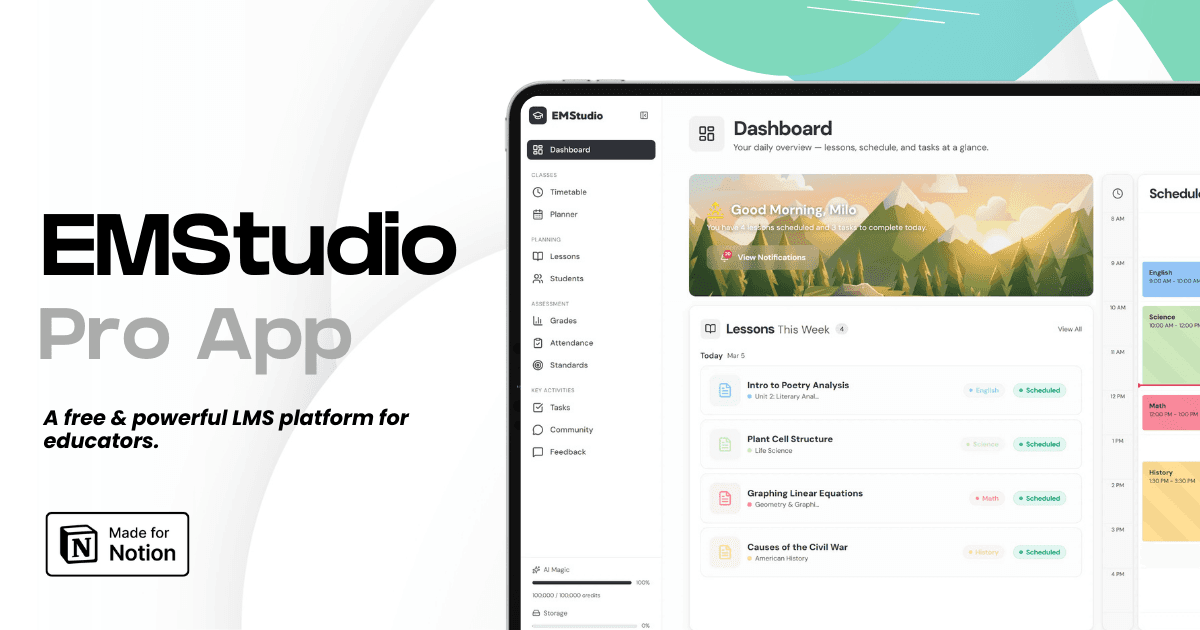
EMStudio is a free teaching management app — manage your classes, students, lessons, and more!
Learn More
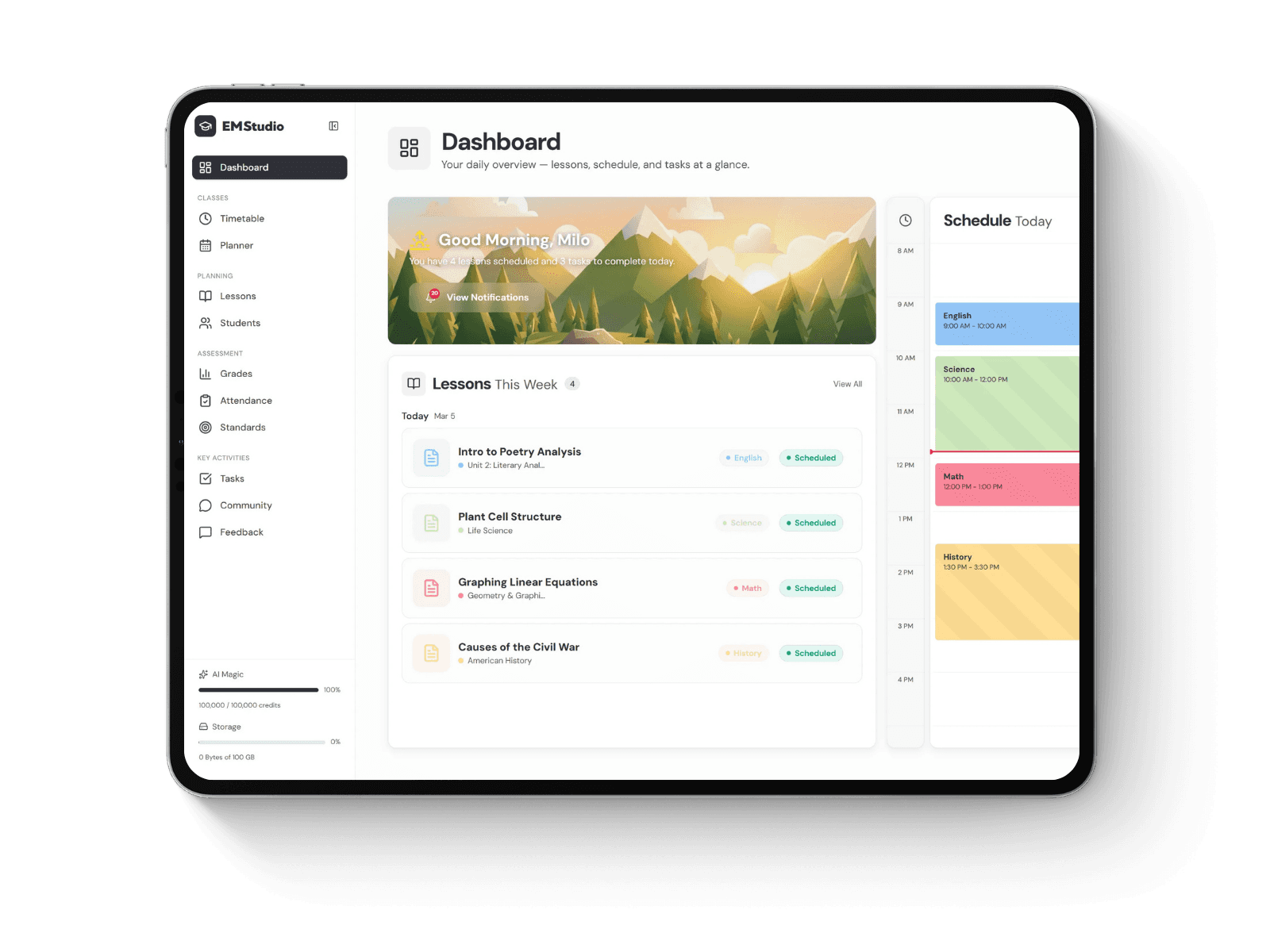
Still grading everything by hand?
EMStudio is a free teaching management app — manage your classes, students, lessons, and more!
Learn More
Table of Contents
What Is Discovery Based Learning?
Defining the Discovery Method of Teaching
Bruner called this the "Aha! moment"—that split second when scattered observations crystallize into understanding. It happens when a child notices that all squares have four equal sides after sorting pattern blocks for ten minutes, not when you flash a definition on the board. The discovery method of teaching examples often look chaotic from the outside: kids talking, materials spread across desks, wrong answers floating around. But that noise is the sound of brains sorting information.
In my 3rd-grade classroom, I watched Maria rotate triangles to form hexagons during our fifteen-minute exploration phase. She didn't know the area formula yet. She just knew six triangles covered the hexagon perfectly. When she shouted, "It's always six!"—that was the Aha! Bruner described. I hadn't taught area. She had discovered it through active learning strategies that let her manipulate physical objects.
Bruner emphasized inductive reasoning over deductive approaches. Students examine examples to induce the rule, avoiding the deductive approach where you provide the rule first. This mirrors how scientists work, forming hypotheses from evidence while avoiding pre-formed conclusions.
This is not the Socratic method, where teachers guide students toward predetermined answers through carefully sequenced questions. In pure discovery learning, even the teacher might not know exactly what patterns will emerge. That uncertainty is the point.
Theoretical Foundations and Jerome Bruner
Bruner directed the Harvard Center for Cognitive Studies during the 1960s, where he merged Piaget's constructivism with classroom practice. He believed children actively build knowledge structures through experience, not passive reception. This became the bedrock of constructivist teaching and separated true discovery learning method from simple trial-and-error worksheets or unstructured busy work.
His spiral curriculum concept means we revisit topics at increasing complexity. First graders touch geometric solids (enactive representation). Third graders draw them (iconic). Fifth graders calculate volume using formulas (symbolic). Each loop up the spiral builds on the last. Nothing gets taught once and dropped; instead, knowledge deepens with each return.
These three modes of representation—enactive, iconic, symbolic—map onto how discovery based learning unfolds in problem-based learning scenarios. Students start with physical manipulation, move to images or diagrams, and finally grasp abstract symbols. Skipping straight to the symbolic level, Bruner warned, leaves understanding shallow and brittle. You get mimicry, not mastery.
This explains why discovery method of teaching examples often look messy early on. The enactive stage is noisy. But that noise is necessary before the iconic and symbolic stages can anchor properly in long-term memory.
How Discovery Learning Differs From Direct Instruction
John Hattie's Visible Learning meta-analysis puts direct instruction at an effect size of 0.59 versus 0.46 for inquiry-based learning. Those numbers matter, but they tell half the story. Direct instruction excels at building surface knowledge quickly. Discovery learning builds transfer and flexibility. Students who discover ratios through mixing paint remember them six months later better than those who memorized the colon symbol first.
Aspect | Direct Instruction | Discovery Learning |
|---|---|---|
Teacher Role | Lecturer, explicit modeler ("I do") | Facilitator, questioner ("You do first") |
Student Role | Listener, practice follower | Investigator, pattern seeker |
Optimal Content Type | Procedures, facts, algorithms | Concepts, relationships, problem-solving |
Cognitive Load Implications | Managed, chunked, reduced | Higher initial load, productive struggle |
Time Structure | 5-10 minutes explicit teaching | 15-20 minutes exploration phase |
The time structures differ sharply. Direct instruction typically runs five to ten minutes of explicit teaching followed by guided practice. The discovery approach needs fifteen to twenty minutes of upfront exploration. A 3rd-grade class exploring geometric patterns with pattern blocks needs that full quarter hour of unstructured manipulation before area formulas make sense. That's fifteen minutes of wrong answers, restarts, and productive confusion that pays off in deeper retention.
You can read more about how discovery learning differs from direct instruction in our detailed breakdown. Choose direct instruction when students need efficient skill acquisition. Choose the discovery learning method when you want them to own the concept and apply it in novel situations without prompting.
Why Does Discovery Based Learning Matter for Student Outcomes?
Discovery based learning improves long-term conceptual retention and develops critical thinking skills by requiring students to actively process information. Research indicates it builds autonomous learners capable of transferring knowledge to novel situations, though it requires more time than direct instruction for initial skill acquisition.
Research in conceptual physics demonstrates this retention gap clearly. Students taught through active learning strategies retained core principles at rates 20-30% higher than lecture-based peers when tested six months later. The physics education research tracking these cohorts shows that passive note-taking creates fragile memory traces, while grappling with problems builds durable mental models. Active processing makes memory stick.
Barry Zimmerman's self-regulated learning framework explains why this happens. Discovery learning in the classroom activates all three phases of his model: forethought (planning approaches), performance (executing strategies), and self-reflection (evaluating results). The Motivated Strategies for Learning Questionnaire (MSLQ) consistently measures stronger self-regulation in students who regularly solve problems through inquiry without relying on worked examples. They learn to manage their own cognition.
Long-Term Retention and Conceptual Understanding
Conceptual knowledge sticks better than procedural fluency when students discover it themselves. Studies comparing inquiry-based learning to direct instruction show a clear trade-off: initial skill acquisition takes roughly 25% longer, but six-month retention of underlying principles improves by 20-30%. That delayed payoff matters more than the quick win. You sacrifice a day now to gain a month later.
I saw this with my 7th graders during a unit on energy transfer. The group that spent three days designing insulation prototypes remembered the second law of thermodynamics in May. The group that took notes from my slides in October had forgotten it by December. They could quote definitions immediately after the lecture. They could not apply them later. The discovery group could explain why their coffee got cold; the lecture group just knew there was a law about it.
Procedural steps fade fast. Conceptual webs remain. Constructivist teaching forces students to build those webs themselves. They cannot borrow yours. The extra time upfront pays dividends when you do not have to reteach everything before the state test.
Building Critical Thinking and Autonomous Learners
Discovery activities target the upper levels of Bloom's Taxonomy. While direct instruction often stops at Remember and Understand, problem-based learning pushes students into Analyze and Evaluate territory—levels 4 and 5. Students must break down complex scenarios and judge the quality of solutions, not just recall facts. This shift shows up on standardized critical thinking measures.
Students working through experiential education units demonstrate measurable gains on the Watson-Glaser Critical Thinking Appraisal. They get better at recognizing assumptions, evaluating arguments, and drawing inferences because they practice these moves daily through Socratic method discussions and hands-on investigation. The test scores rise because students internalize the logic patterns through repeated discovery, not memorization drills. You are not just delivering content; you are training cognitive habits.
This connects directly to building critical thinking and autonomous learners. When students expect to figure things out independently, they stop raising their hands the moment problems get ambiguous. They develop the tolerance for uncertainty that real learning requires. That autonomy stays with them long after they leave your room. They become adults who Google solutions before asking for help.
How Does Discovery Based Learning Work in the Classroom?
Discovery based learning operates through structured inquiry cycles where teachers facilitate rather than lecture. Using frameworks like the 5E model (Engage, Explore, Explain, Elaborate, Evaluate), teachers pose problems, provide materials, and use strategic questioning while students investigate patterns and construct understanding collaboratively.
The Cycle of Inquiry and Exploration
In a 45-minute middle school period, timing is everything. I start with Engage: a 5-minute hook like showing a discrepant event or posing a mystery question. Students transition quickly to Explore, spending 15 minutes hands-on with manipulatives while I circulate. This is where the cycle of inquiry and exploration lives.
Next comes Explain: 10 minutes where students lead the discussion, sharing patterns they noticed while I facilitate connections to formal concepts using their language. We move to Elaborate for another 10 minutes, extending the thinking with a new variable or real-world application that tests their new understanding. Finally, Evaluate takes 5 minutes through an exit ticket or quick concept map that reveals lingering gaps. Transitions between phases eat about 1-2 minutes each, so I keep materials staged and expectations tight to maximize discovery time.
Watch for cognitive overload. When I see 8th graders off-task for three straight minutes or making the same procedural error repeatedly, I pivot immediately. That frustration signals Sweller's Cognitive Load Theory in action—working memory is maxed. I shift from pure discovery to guided discovery or brief direct instruction, clarifying the misconception before returning to exploration. This prevents students from practicing errors or shutting down completely.
The Teacher's Role as Facilitator
You are not the sage on the stage. During discovery learning in the classroom, you circulate with a notebook, listening for misconceptions and dropping strategic questions rather than delivering answers. Your job is to make them think harder, not to make the thinking easier.
I use stems from the Socratic method to push thinking without stealing the discovery. Try asking, "What evidence supports your claim?" or "How does this compare to what we saw yesterday?" I also use "What would happen if we changed this variable?" and "Why do you think that pattern emerged?" Finally, "Can you explain the pattern your group noticed?" forces students to articulate their reasoning clearly. These questions honor constructivist teaching by making students do the cognitive heavy lifting instead of relying on teacher confirmation or guessing what I want to hear.
Your silence is a powerful tool. When an 8th grader asks if they're right, I pause for five seconds before responding. That pause invites deeper thinking and often prompts them to correct themselves. If a table is genuinely stuck after real effort, I point them to another group rather than rescuing them with the solution. This builds the resilience that experiential education needs and keeps me from becoming the human answer key.
Structuring the Learning Environment for Discovery
Room layout matters more than you think for discovery based learning. I arrange hexagonal tables for groups of four or five so every student faces the center and can reach shared materials without stretching across the space. Each table gets three or four discovery kits—complete sets of tools, texts, or tech needed for the day's investigation—so no one waits for supplies while others work.
I enforce the "3-before-me" protocol religiously in my 8th grade science room. Before raising a hand to ask me, students must consult three sources: their notes, a peer, and a reference material. This rule prevents bottlenecking at my desk and builds genuine student autonomy. Since implementing it, my interruption rate dropped by half and groups stayed in the active learning strategies zone longer.
Problem-based learning needs clear physical and procedural pathways. I designate one student per table as the "materials manager" to handle supplies, keeping transitions under 30 seconds between phases. Post the daily inquiry question prominently where everyone can see it from their seat. When the physical space supports movement and collaboration rather than rigid rows, inquiry-based learning flows naturally without the chaos that makes some teachers abandon discovery methods entirely.

What Are the Three Types of Discovery Learning?
The three types of discovery learning are pure discovery (minimal guidance), guided discovery (structured scaffolding and hints), and enhanced discovery (technology/multimedia supports). Pure discovery risks cognitive overload; guided discovery uses gradual release; enhanced discovery incorporates visual and interactive aids to reduce extraneous load.
Pure discovery offers zero guidance and high cognitive load within discovery based learning, reserving it for gifted learners only. Guided discovery provides forty to sixty percent support through scaffolded release, proving optimal for grade three and above. Enhanced discovery supplies twenty to thirty percent guidance via multimedia supports, excelling with complex abstract concepts like chemical equilibrium or fractional relationships.
John Sweller’s cognitive load research warns that pure discovery increases extraneous load dangerously for novices, derailing inquiry-based learning before it starts. When I taught 8th grade physical science, I handed out batteries, bulbs, and wires without circuit diagrams. Sixty percent of my students built incorrect mental models that required triple the reteaching time to correct. Never deploy pure discovery for introductory algebra or foundational reading skills where misconception formation proves catastrophic.
Pure Discovery
Students explore raw materials without hints, diagrams, or teacher intervention. You hand them batteries, bulbs, and wires, then step back while they stumble through failed connections until something lights up—or more likely, doesn’t. The teacher remains silent.
The danger here is brutal and well-documented. Sweller’s cognitive load research demonstrates that novice learners lack the schema to process unlimited variables simultaneously. They construct flawed understandings with total confidence, cementing errors through trial and error. Those misconceptions fossilize within minutes and resist correction. I learned this the hard way watching my 8th graders invent impossible current flow patterns. That single mistake took three full weeks of targeted reteaching to dismantle.
Reserve pure discovery for gifted populations with robust background knowledge only. For grade-level classes, it wastes instructional time, spikes frustration, and builds knowledge that must be unlearned before real learning begins.
Guided Discovery Method
This is the guided discovery method of teaching that actually works in real classrooms. You follow Pearson and Gallagher’s Gradual Release of Responsibility model: I Do (model thinking aloud while solving a sample problem), We Do (guided practice with scaffolds), You Do (independent discovery with monitoring). It applies the Socratic method through structured questioning rather than silence and bridges experiential education with accountability.
The scaffold delivery system matters more than the theory. I use physical hint cards with three distinct levels. Green hints offer vague nudges ("Check your diagram against the model"). Yellow hints provide specific questions ("What happens if you reverse the battery polarity?"). Red hints give direct instruction ("Connect the wire to the positive terminal first, then test").
This forty to sixty percent guidance level hits the instructional sweet spot for grades three through twelve. Students experience productive struggle without drowning in confusion. It remains constructivist teaching at its core, but with guardrails that prevent wrong turns into misconception territory.
Enhanced Discovery
Enhanced discovery layers strategic technology and multimedia supports onto the inquiry process. You retain twenty to thirty percent guidance while incorporating PhET interactive simulations, Desmos virtual manipulatives, or Geoboard apps that respond instantly to student input. These active learning strategies prevent cognitive overload while preserving student agency.
These digital tools dual-code information through simultaneous visual and text channels, reducing extraneous cognitive load while maintaining genuine exploration. Last month, my seventh graders explored fraction equivalence using dynamic visual models that split and resize bars in real time. They manipulated the denominators digitally before I ever introduced the standard multiplication algorithm on paper. They owned the conceptual understanding first.
This approach excels with complex abstract concepts invisible to the naked eye—molecular motion, electromagnetic fields, quadratic relationships, or historical population trends. The technology makes the invisible visible and the abstract tangible without removing the cognitive heavy lifting from the student. It differs from pure problem-based learning by embedding supports that prevent the frustration that kills curiosity.

What Are Effective Discovery Based Learning Examples by Subject?
Science students derive density formulas by dropping objects in water. Fourth graders build area concepts with colored tiles. Tenth graders piece together Civil Rights causes from conflicting newspaper accounts. Eighth graders invent sentence-combining rules by studying patterns. These discovery method of teaching examples represent discovery based learning at its most effective—students acting as investigators, not recipients.
Science: Inquiry-Based Labs and Hypothesis Testing
I set out eight objects on lab tables: a rubber stopper, a candle, a steel bolt, a cork, a glass marble, a plastic button, an aluminum cylinder, and a wooden cube. Each group gets a triple-beam balance, a 100-mL graduated cylinder, and a tub of water. The prompt is simple: predict which objects will sink, test your predictions, then find the mathematical pattern that separates floaters from sinkers.
Students measure mass and volume through water displacement. They record data for an hour, arguing about significant figures and whether the candle counts as submerged. Eventually, someone divides mass by volume for the bolt and gets 7.8 g/cm³, then notices the cork yields 0.2. The waterline sits at 1.0 g/cm³. They circle the threshold on their whiteboards. Only then do I write the word density on the board. This is inquiry-based learning at its most concrete.
The formula D=M/V isn't told; it's excavated from their own measurements. When students calculate the density of the candle (0.9) and watch it bob like a cork, the concept sticks because they built it themselves. That moment of recognition—when the numbers finally explain the floating—cements the relationship between mass, volume, and buoyancy deeper than any lecture could.
Mathematics: Open-Ended Problem Solving Tasks
Hand fourth graders a bag of one-inch square tiles and a 3-by-5 inch index card. Ask them to cover the rectangle completely without gaps or overlaps, then count the tiles. They will arrange twelve, then fifteen, then eventually discover that three rows of five cover the space perfectly. The room fills with the sound of plastic clicking against paper.
Next, give them an irregular shape—a blob drawn on grid paper. They try to cover it with whole tiles, then snap tiles in half to fill the gaps. Someone notices that counting the full squares and adding the half squares yields the same result as multiplying length by width. They write their own formula on notebook paper before I ever mention A=L×W. These open-ended problem solving tasks in mathematics represent problem-based learning that turns abstract formulas into physical discoveries.
The pattern blocks serve as manipulatives that make the invisible visible. Students who later encounter area problems on standardized tests often sketch the invisible tiles in the margins, reconstructing the discovery to verify their calculations.
Social Studies: Primary Source Document Analysis
Tenth graders encounter four documents on their desks: a 1963 Birmingham newspaper editorial condemning "outside agitators," a photograph of children being hosed by firemen, a transcript of George Wallace's inauguration speech, and a letter from a Freedom Rider to her mother. The question on the board reads: "Why did the Civil Rights Act of 1964 pass?" I offer no lecture, no textbook summary.
Groups corroborate the evidence, noting that the newspaper and Wallace agree on states' rights while the photo and letter tell a different story. They argue about which source carries more weight. Through this primary source document analysis, students construct their own thesis about shifting public opinion and federal intervention. The constructivist teaching approach needs they build historical arguments from raw materials, not consume predigested narratives.
When we finally read the actual text of the Act two days later, students already understand its provisions because they have wrestled with the problems it attempted to solve. The legislation makes sense as a response to their own discoveries about violence and protest.
Literacy: Literary Pattern Discovery and Theme Exploration
Eighth graders receive a handout with ten pairs of simple sentences. "Maria walked to school. Maria carried her backpack." "The dog barked loudly. The dog woke the neighbors." They work in pairs to combine each pair into one smooth sentence without repeating words. The room grows quiet except for the scratch of pencils testing different arrangements and whispered debates about whether "and" or "but" sounds better.
After twenty minutes, I ask for the pattern. A student volunteers: "You drop the second subject and use a comma with 'and.'" Another notices you can also delete the repeated verb in certain cases. They write their rules on chart paper, creating grammar instruction from the inside out. This experiential education approach mirrors how toddlers learn language—through pattern recognition, not rule memorization.
Only after they have articulated the conventions do I introduce the formal terms: compound sentences, coordinating conjunctions, comma splices. The Socratic method guided them to name the concepts themselves. When they later encounter complex sentences in their next novel study, they recognize the structure because they invented the combining rules through active learning strategies, not direct instruction.
How Can Teachers Start Implementing Discovery Based Learning?
Teachers should start with brief guided discovery activities (10-15 minutes), use strategic questioning rather than telling, and assess inquiry processes not just answers. Begin with low-stakes explorations in familiar content areas, provide scaffolding via hint cards, and gradually increase autonomy as students develop self-regulation skills.
Start small. One botched discovery lesson can poison students against inquiry for weeks. Pick a single concept you know well, and give yourself permission to pause the activity if chaos erupts.
Roll out discovery based learning in three phases. Weeks 1-2, run 10-minute guided discovery warm-ups at the start of existing lessons. Weeks 3-4, shift to 20-minute inquiry stations where students rotate through hands-on tasks. By week 5, attempt full 45-minute discovery cycles. Build in hard stop points: if 40% of students wander off-task for more than three minutes, revert to direct instruction that day. You can try again tomorrow.
For PLCs or coaching cycles, search for discovery method of teaching ppt templates that include observation protocols. These downloadable presentations give peer coaches specific look-fors, such as wait-time duration or the ratio of student-to-teacher talk. Bring those slides to your next department meeting.
Start With Low-Stakes Guided Discovery Activities
Launch with 10-15 minute Mystery Box activities. Seal unfamiliar objects in paper bags—magnets, gears, or texture cubes—and have students draft observation lists without peeking. Use think-pair-share protocols so quieter voices surface before whole-group discussion. This guided discovery method of teaching builds risk tolerance without wrecking your pacing guide. The sealed bag creates artificial constraint; students cannot cheat by looking, so they must rely on evidence.
I once ran this with my 5th graders using mystery powders for a physical science unit. They shook the bags, debated whether the contents were liquid or solid, and argued about mass without me defining the terms. One student insisted the bag held "wet sand" because of the shifting weight; another claimed "salt" because of the grit sound. When we finally opened the bags, the collective "oh" carried more weight than any textbook definition.
Keep these early explorations in content students recognize. If they are fighting both new vocabulary and new procedures, cognitive overload wins. Familiar topics let them focus on the inquiry process itself. Think-pair-share reduces the social risk of being wrong. Students test their theories on a single peer before exposing them to the whole class. That thirty-second buffer prevents shutdowns.
Scaffold Student Inquiry With Strategic Questioning
Implement a hint card system to keep yourself from rescuing too fast. Level 1 green cards pose a redirect question. Level 2 yellow cards offer a partial example. Level 3 red cards show a worked example. Train students to exhaust all three hint levels before they raise a hand for you. This scaffold student inquiry with strategic questioning approach preserves your sanity while building their persistence.
The Socratic method works here, but only if you genuinely wait for answers. Count to ten after you ask. If you break the silence with a hint, you have just taught them that endurance lasts nine seconds. Use the cards as your crutch so you do not become theirs.
Problem-based learning stalls when teachers jump to the solution. Set a timer on your phone: five minutes of struggle minimum before any red card appears. Students need to sit with confusion long enough to recognize that discomfort is part of thinking. Inquiry-based learning needs that we value confusion as a cognitive state. When we clear it up immediately, we rob students of the chance to navigate ambiguity. The hint cards create a buffer zone between struggle and rescue.
Shift Assessment Focus to Process Over Product
Move from grading answers to grading thinking. Use process portfolios that document each inquiry step: initial question, hypothesis, evidence log, and conclusion. Score these on a 4-point rubric that rewards revision and evidence quality over correctness. Include a "beautiful oops" section where students analyze mistakes that led to new insights. This shift assessment focus to process over product aligns grades with constructivist teaching goals.
Experiential education fails when the only metric is the final product. If a student builds a bridge that collapses but can explain exactly why the tension failed, they have mastered more engineering than the group whose bridge stood but who copied the design. Ask them to annotate photos of failed attempts with technical vocabulary.
Active learning strategies require active assessment strategies. Stop using multiple choice for inquiry units. Instead, assign a one-page reflection: "What dead end did you hit, and what did you try next?" That sentence tells you more about their scientific reasoning than any worksheet completion rate. When students see that you value their wrong turns, they stop hiding them.
Getting Started with Discovery Based Learning
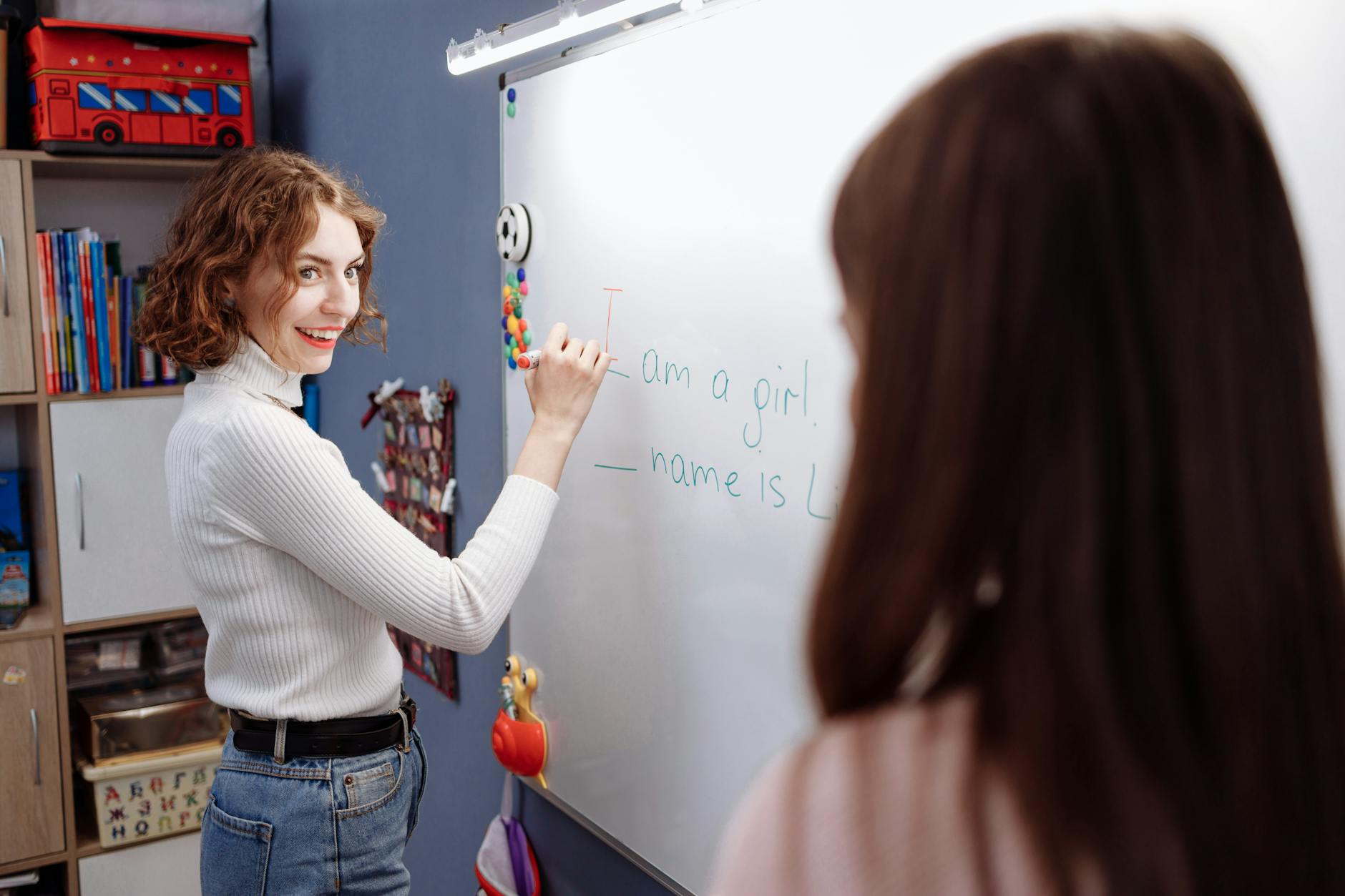
You don't need to rebuild your entire curriculum this weekend. Pick one lesson next week where you usually lecture for fifteen minutes. Cut that to three minutes, hand out the materials, and let the kids wrestle with the concept first. I started with a single inquiry-based learning station on Fridays. That was it.
The payoff comes when you see a student who usually zones out suddenly lean forward because they actually want to know why the pattern works. That moment beats any perfectly scripted presentation. Start small, watch what happens, and build from there.
Choose one lesson next week to convert to a 5-minute problem-first format.
Gather concrete materials—blocks, graphs, or simple lab supplies—so students can manipulate the concept.
Write exactly one open-ended question on the board, then stop talking and let them figure it out.

What Is Discovery Based Learning?
Defining the Discovery Method of Teaching
Bruner called this the "Aha! moment"—that split second when scattered observations crystallize into understanding. It happens when a child notices that all squares have four equal sides after sorting pattern blocks for ten minutes, not when you flash a definition on the board. The discovery method of teaching examples often look chaotic from the outside: kids talking, materials spread across desks, wrong answers floating around. But that noise is the sound of brains sorting information.
In my 3rd-grade classroom, I watched Maria rotate triangles to form hexagons during our fifteen-minute exploration phase. She didn't know the area formula yet. She just knew six triangles covered the hexagon perfectly. When she shouted, "It's always six!"—that was the Aha! Bruner described. I hadn't taught area. She had discovered it through active learning strategies that let her manipulate physical objects.
Bruner emphasized inductive reasoning over deductive approaches. Students examine examples to induce the rule, avoiding the deductive approach where you provide the rule first. This mirrors how scientists work, forming hypotheses from evidence while avoiding pre-formed conclusions.
This is not the Socratic method, where teachers guide students toward predetermined answers through carefully sequenced questions. In pure discovery learning, even the teacher might not know exactly what patterns will emerge. That uncertainty is the point.
Theoretical Foundations and Jerome Bruner
Bruner directed the Harvard Center for Cognitive Studies during the 1960s, where he merged Piaget's constructivism with classroom practice. He believed children actively build knowledge structures through experience, not passive reception. This became the bedrock of constructivist teaching and separated true discovery learning method from simple trial-and-error worksheets or unstructured busy work.
His spiral curriculum concept means we revisit topics at increasing complexity. First graders touch geometric solids (enactive representation). Third graders draw them (iconic). Fifth graders calculate volume using formulas (symbolic). Each loop up the spiral builds on the last. Nothing gets taught once and dropped; instead, knowledge deepens with each return.
These three modes of representation—enactive, iconic, symbolic—map onto how discovery based learning unfolds in problem-based learning scenarios. Students start with physical manipulation, move to images or diagrams, and finally grasp abstract symbols. Skipping straight to the symbolic level, Bruner warned, leaves understanding shallow and brittle. You get mimicry, not mastery.
This explains why discovery method of teaching examples often look messy early on. The enactive stage is noisy. But that noise is necessary before the iconic and symbolic stages can anchor properly in long-term memory.
How Discovery Learning Differs From Direct Instruction
John Hattie's Visible Learning meta-analysis puts direct instruction at an effect size of 0.59 versus 0.46 for inquiry-based learning. Those numbers matter, but they tell half the story. Direct instruction excels at building surface knowledge quickly. Discovery learning builds transfer and flexibility. Students who discover ratios through mixing paint remember them six months later better than those who memorized the colon symbol first.
Aspect | Direct Instruction | Discovery Learning |
|---|---|---|
Teacher Role | Lecturer, explicit modeler ("I do") | Facilitator, questioner ("You do first") |
Student Role | Listener, practice follower | Investigator, pattern seeker |
Optimal Content Type | Procedures, facts, algorithms | Concepts, relationships, problem-solving |
Cognitive Load Implications | Managed, chunked, reduced | Higher initial load, productive struggle |
Time Structure | 5-10 minutes explicit teaching | 15-20 minutes exploration phase |
The time structures differ sharply. Direct instruction typically runs five to ten minutes of explicit teaching followed by guided practice. The discovery approach needs fifteen to twenty minutes of upfront exploration. A 3rd-grade class exploring geometric patterns with pattern blocks needs that full quarter hour of unstructured manipulation before area formulas make sense. That's fifteen minutes of wrong answers, restarts, and productive confusion that pays off in deeper retention.
You can read more about how discovery learning differs from direct instruction in our detailed breakdown. Choose direct instruction when students need efficient skill acquisition. Choose the discovery learning method when you want them to own the concept and apply it in novel situations without prompting.
Why Does Discovery Based Learning Matter for Student Outcomes?
Discovery based learning improves long-term conceptual retention and develops critical thinking skills by requiring students to actively process information. Research indicates it builds autonomous learners capable of transferring knowledge to novel situations, though it requires more time than direct instruction for initial skill acquisition.
Research in conceptual physics demonstrates this retention gap clearly. Students taught through active learning strategies retained core principles at rates 20-30% higher than lecture-based peers when tested six months later. The physics education research tracking these cohorts shows that passive note-taking creates fragile memory traces, while grappling with problems builds durable mental models. Active processing makes memory stick.
Barry Zimmerman's self-regulated learning framework explains why this happens. Discovery learning in the classroom activates all three phases of his model: forethought (planning approaches), performance (executing strategies), and self-reflection (evaluating results). The Motivated Strategies for Learning Questionnaire (MSLQ) consistently measures stronger self-regulation in students who regularly solve problems through inquiry without relying on worked examples. They learn to manage their own cognition.
Long-Term Retention and Conceptual Understanding
Conceptual knowledge sticks better than procedural fluency when students discover it themselves. Studies comparing inquiry-based learning to direct instruction show a clear trade-off: initial skill acquisition takes roughly 25% longer, but six-month retention of underlying principles improves by 20-30%. That delayed payoff matters more than the quick win. You sacrifice a day now to gain a month later.
I saw this with my 7th graders during a unit on energy transfer. The group that spent three days designing insulation prototypes remembered the second law of thermodynamics in May. The group that took notes from my slides in October had forgotten it by December. They could quote definitions immediately after the lecture. They could not apply them later. The discovery group could explain why their coffee got cold; the lecture group just knew there was a law about it.
Procedural steps fade fast. Conceptual webs remain. Constructivist teaching forces students to build those webs themselves. They cannot borrow yours. The extra time upfront pays dividends when you do not have to reteach everything before the state test.
Building Critical Thinking and Autonomous Learners
Discovery activities target the upper levels of Bloom's Taxonomy. While direct instruction often stops at Remember and Understand, problem-based learning pushes students into Analyze and Evaluate territory—levels 4 and 5. Students must break down complex scenarios and judge the quality of solutions, not just recall facts. This shift shows up on standardized critical thinking measures.
Students working through experiential education units demonstrate measurable gains on the Watson-Glaser Critical Thinking Appraisal. They get better at recognizing assumptions, evaluating arguments, and drawing inferences because they practice these moves daily through Socratic method discussions and hands-on investigation. The test scores rise because students internalize the logic patterns through repeated discovery, not memorization drills. You are not just delivering content; you are training cognitive habits.
This connects directly to building critical thinking and autonomous learners. When students expect to figure things out independently, they stop raising their hands the moment problems get ambiguous. They develop the tolerance for uncertainty that real learning requires. That autonomy stays with them long after they leave your room. They become adults who Google solutions before asking for help.
How Does Discovery Based Learning Work in the Classroom?
Discovery based learning operates through structured inquiry cycles where teachers facilitate rather than lecture. Using frameworks like the 5E model (Engage, Explore, Explain, Elaborate, Evaluate), teachers pose problems, provide materials, and use strategic questioning while students investigate patterns and construct understanding collaboratively.
The Cycle of Inquiry and Exploration
In a 45-minute middle school period, timing is everything. I start with Engage: a 5-minute hook like showing a discrepant event or posing a mystery question. Students transition quickly to Explore, spending 15 minutes hands-on with manipulatives while I circulate. This is where the cycle of inquiry and exploration lives.
Next comes Explain: 10 minutes where students lead the discussion, sharing patterns they noticed while I facilitate connections to formal concepts using their language. We move to Elaborate for another 10 minutes, extending the thinking with a new variable or real-world application that tests their new understanding. Finally, Evaluate takes 5 minutes through an exit ticket or quick concept map that reveals lingering gaps. Transitions between phases eat about 1-2 minutes each, so I keep materials staged and expectations tight to maximize discovery time.
Watch for cognitive overload. When I see 8th graders off-task for three straight minutes or making the same procedural error repeatedly, I pivot immediately. That frustration signals Sweller's Cognitive Load Theory in action—working memory is maxed. I shift from pure discovery to guided discovery or brief direct instruction, clarifying the misconception before returning to exploration. This prevents students from practicing errors or shutting down completely.
The Teacher's Role as Facilitator
You are not the sage on the stage. During discovery learning in the classroom, you circulate with a notebook, listening for misconceptions and dropping strategic questions rather than delivering answers. Your job is to make them think harder, not to make the thinking easier.
I use stems from the Socratic method to push thinking without stealing the discovery. Try asking, "What evidence supports your claim?" or "How does this compare to what we saw yesterday?" I also use "What would happen if we changed this variable?" and "Why do you think that pattern emerged?" Finally, "Can you explain the pattern your group noticed?" forces students to articulate their reasoning clearly. These questions honor constructivist teaching by making students do the cognitive heavy lifting instead of relying on teacher confirmation or guessing what I want to hear.
Your silence is a powerful tool. When an 8th grader asks if they're right, I pause for five seconds before responding. That pause invites deeper thinking and often prompts them to correct themselves. If a table is genuinely stuck after real effort, I point them to another group rather than rescuing them with the solution. This builds the resilience that experiential education needs and keeps me from becoming the human answer key.
Structuring the Learning Environment for Discovery
Room layout matters more than you think for discovery based learning. I arrange hexagonal tables for groups of four or five so every student faces the center and can reach shared materials without stretching across the space. Each table gets three or four discovery kits—complete sets of tools, texts, or tech needed for the day's investigation—so no one waits for supplies while others work.
I enforce the "3-before-me" protocol religiously in my 8th grade science room. Before raising a hand to ask me, students must consult three sources: their notes, a peer, and a reference material. This rule prevents bottlenecking at my desk and builds genuine student autonomy. Since implementing it, my interruption rate dropped by half and groups stayed in the active learning strategies zone longer.
Problem-based learning needs clear physical and procedural pathways. I designate one student per table as the "materials manager" to handle supplies, keeping transitions under 30 seconds between phases. Post the daily inquiry question prominently where everyone can see it from their seat. When the physical space supports movement and collaboration rather than rigid rows, inquiry-based learning flows naturally without the chaos that makes some teachers abandon discovery methods entirely.
What Are the Three Types of Discovery Learning?
The three types of discovery learning are pure discovery (minimal guidance), guided discovery (structured scaffolding and hints), and enhanced discovery (technology/multimedia supports). Pure discovery risks cognitive overload; guided discovery uses gradual release; enhanced discovery incorporates visual and interactive aids to reduce extraneous load.
Pure discovery offers zero guidance and high cognitive load within discovery based learning, reserving it for gifted learners only. Guided discovery provides forty to sixty percent support through scaffolded release, proving optimal for grade three and above. Enhanced discovery supplies twenty to thirty percent guidance via multimedia supports, excelling with complex abstract concepts like chemical equilibrium or fractional relationships.
John Sweller’s cognitive load research warns that pure discovery increases extraneous load dangerously for novices, derailing inquiry-based learning before it starts. When I taught 8th grade physical science, I handed out batteries, bulbs, and wires without circuit diagrams. Sixty percent of my students built incorrect mental models that required triple the reteaching time to correct. Never deploy pure discovery for introductory algebra or foundational reading skills where misconception formation proves catastrophic.
Pure Discovery
Students explore raw materials without hints, diagrams, or teacher intervention. You hand them batteries, bulbs, and wires, then step back while they stumble through failed connections until something lights up—or more likely, doesn’t. The teacher remains silent.
The danger here is brutal and well-documented. Sweller’s cognitive load research demonstrates that novice learners lack the schema to process unlimited variables simultaneously. They construct flawed understandings with total confidence, cementing errors through trial and error. Those misconceptions fossilize within minutes and resist correction. I learned this the hard way watching my 8th graders invent impossible current flow patterns. That single mistake took three full weeks of targeted reteaching to dismantle.
Reserve pure discovery for gifted populations with robust background knowledge only. For grade-level classes, it wastes instructional time, spikes frustration, and builds knowledge that must be unlearned before real learning begins.
Guided Discovery Method
This is the guided discovery method of teaching that actually works in real classrooms. You follow Pearson and Gallagher’s Gradual Release of Responsibility model: I Do (model thinking aloud while solving a sample problem), We Do (guided practice with scaffolds), You Do (independent discovery with monitoring). It applies the Socratic method through structured questioning rather than silence and bridges experiential education with accountability.
The scaffold delivery system matters more than the theory. I use physical hint cards with three distinct levels. Green hints offer vague nudges ("Check your diagram against the model"). Yellow hints provide specific questions ("What happens if you reverse the battery polarity?"). Red hints give direct instruction ("Connect the wire to the positive terminal first, then test").
This forty to sixty percent guidance level hits the instructional sweet spot for grades three through twelve. Students experience productive struggle without drowning in confusion. It remains constructivist teaching at its core, but with guardrails that prevent wrong turns into misconception territory.
Enhanced Discovery
Enhanced discovery layers strategic technology and multimedia supports onto the inquiry process. You retain twenty to thirty percent guidance while incorporating PhET interactive simulations, Desmos virtual manipulatives, or Geoboard apps that respond instantly to student input. These active learning strategies prevent cognitive overload while preserving student agency.
These digital tools dual-code information through simultaneous visual and text channels, reducing extraneous cognitive load while maintaining genuine exploration. Last month, my seventh graders explored fraction equivalence using dynamic visual models that split and resize bars in real time. They manipulated the denominators digitally before I ever introduced the standard multiplication algorithm on paper. They owned the conceptual understanding first.
This approach excels with complex abstract concepts invisible to the naked eye—molecular motion, electromagnetic fields, quadratic relationships, or historical population trends. The technology makes the invisible visible and the abstract tangible without removing the cognitive heavy lifting from the student. It differs from pure problem-based learning by embedding supports that prevent the frustration that kills curiosity.
What Are Effective Discovery Based Learning Examples by Subject?
Science students derive density formulas by dropping objects in water. Fourth graders build area concepts with colored tiles. Tenth graders piece together Civil Rights causes from conflicting newspaper accounts. Eighth graders invent sentence-combining rules by studying patterns. These discovery method of teaching examples represent discovery based learning at its most effective—students acting as investigators, not recipients.
Science: Inquiry-Based Labs and Hypothesis Testing
I set out eight objects on lab tables: a rubber stopper, a candle, a steel bolt, a cork, a glass marble, a plastic button, an aluminum cylinder, and a wooden cube. Each group gets a triple-beam balance, a 100-mL graduated cylinder, and a tub of water. The prompt is simple: predict which objects will sink, test your predictions, then find the mathematical pattern that separates floaters from sinkers.
Students measure mass and volume through water displacement. They record data for an hour, arguing about significant figures and whether the candle counts as submerged. Eventually, someone divides mass by volume for the bolt and gets 7.8 g/cm³, then notices the cork yields 0.2. The waterline sits at 1.0 g/cm³. They circle the threshold on their whiteboards. Only then do I write the word density on the board. This is inquiry-based learning at its most concrete.
The formula D=M/V isn't told; it's excavated from their own measurements. When students calculate the density of the candle (0.9) and watch it bob like a cork, the concept sticks because they built it themselves. That moment of recognition—when the numbers finally explain the floating—cements the relationship between mass, volume, and buoyancy deeper than any lecture could.
Mathematics: Open-Ended Problem Solving Tasks
Hand fourth graders a bag of one-inch square tiles and a 3-by-5 inch index card. Ask them to cover the rectangle completely without gaps or overlaps, then count the tiles. They will arrange twelve, then fifteen, then eventually discover that three rows of five cover the space perfectly. The room fills with the sound of plastic clicking against paper.
Next, give them an irregular shape—a blob drawn on grid paper. They try to cover it with whole tiles, then snap tiles in half to fill the gaps. Someone notices that counting the full squares and adding the half squares yields the same result as multiplying length by width. They write their own formula on notebook paper before I ever mention A=L×W. These open-ended problem solving tasks in mathematics represent problem-based learning that turns abstract formulas into physical discoveries.
The pattern blocks serve as manipulatives that make the invisible visible. Students who later encounter area problems on standardized tests often sketch the invisible tiles in the margins, reconstructing the discovery to verify their calculations.
Social Studies: Primary Source Document Analysis
Tenth graders encounter four documents on their desks: a 1963 Birmingham newspaper editorial condemning "outside agitators," a photograph of children being hosed by firemen, a transcript of George Wallace's inauguration speech, and a letter from a Freedom Rider to her mother. The question on the board reads: "Why did the Civil Rights Act of 1964 pass?" I offer no lecture, no textbook summary.
Groups corroborate the evidence, noting that the newspaper and Wallace agree on states' rights while the photo and letter tell a different story. They argue about which source carries more weight. Through this primary source document analysis, students construct their own thesis about shifting public opinion and federal intervention. The constructivist teaching approach needs they build historical arguments from raw materials, not consume predigested narratives.
When we finally read the actual text of the Act two days later, students already understand its provisions because they have wrestled with the problems it attempted to solve. The legislation makes sense as a response to their own discoveries about violence and protest.
Literacy: Literary Pattern Discovery and Theme Exploration
Eighth graders receive a handout with ten pairs of simple sentences. "Maria walked to school. Maria carried her backpack." "The dog barked loudly. The dog woke the neighbors." They work in pairs to combine each pair into one smooth sentence without repeating words. The room grows quiet except for the scratch of pencils testing different arrangements and whispered debates about whether "and" or "but" sounds better.
After twenty minutes, I ask for the pattern. A student volunteers: "You drop the second subject and use a comma with 'and.'" Another notices you can also delete the repeated verb in certain cases. They write their rules on chart paper, creating grammar instruction from the inside out. This experiential education approach mirrors how toddlers learn language—through pattern recognition, not rule memorization.
Only after they have articulated the conventions do I introduce the formal terms: compound sentences, coordinating conjunctions, comma splices. The Socratic method guided them to name the concepts themselves. When they later encounter complex sentences in their next novel study, they recognize the structure because they invented the combining rules through active learning strategies, not direct instruction.
How Can Teachers Start Implementing Discovery Based Learning?
Teachers should start with brief guided discovery activities (10-15 minutes), use strategic questioning rather than telling, and assess inquiry processes not just answers. Begin with low-stakes explorations in familiar content areas, provide scaffolding via hint cards, and gradually increase autonomy as students develop self-regulation skills.
Start small. One botched discovery lesson can poison students against inquiry for weeks. Pick a single concept you know well, and give yourself permission to pause the activity if chaos erupts.
Roll out discovery based learning in three phases. Weeks 1-2, run 10-minute guided discovery warm-ups at the start of existing lessons. Weeks 3-4, shift to 20-minute inquiry stations where students rotate through hands-on tasks. By week 5, attempt full 45-minute discovery cycles. Build in hard stop points: if 40% of students wander off-task for more than three minutes, revert to direct instruction that day. You can try again tomorrow.
For PLCs or coaching cycles, search for discovery method of teaching ppt templates that include observation protocols. These downloadable presentations give peer coaches specific look-fors, such as wait-time duration or the ratio of student-to-teacher talk. Bring those slides to your next department meeting.
Start With Low-Stakes Guided Discovery Activities
Launch with 10-15 minute Mystery Box activities. Seal unfamiliar objects in paper bags—magnets, gears, or texture cubes—and have students draft observation lists without peeking. Use think-pair-share protocols so quieter voices surface before whole-group discussion. This guided discovery method of teaching builds risk tolerance without wrecking your pacing guide. The sealed bag creates artificial constraint; students cannot cheat by looking, so they must rely on evidence.
I once ran this with my 5th graders using mystery powders for a physical science unit. They shook the bags, debated whether the contents were liquid or solid, and argued about mass without me defining the terms. One student insisted the bag held "wet sand" because of the shifting weight; another claimed "salt" because of the grit sound. When we finally opened the bags, the collective "oh" carried more weight than any textbook definition.
Keep these early explorations in content students recognize. If they are fighting both new vocabulary and new procedures, cognitive overload wins. Familiar topics let them focus on the inquiry process itself. Think-pair-share reduces the social risk of being wrong. Students test their theories on a single peer before exposing them to the whole class. That thirty-second buffer prevents shutdowns.
Scaffold Student Inquiry With Strategic Questioning
Implement a hint card system to keep yourself from rescuing too fast. Level 1 green cards pose a redirect question. Level 2 yellow cards offer a partial example. Level 3 red cards show a worked example. Train students to exhaust all three hint levels before they raise a hand for you. This scaffold student inquiry with strategic questioning approach preserves your sanity while building their persistence.
The Socratic method works here, but only if you genuinely wait for answers. Count to ten after you ask. If you break the silence with a hint, you have just taught them that endurance lasts nine seconds. Use the cards as your crutch so you do not become theirs.
Problem-based learning stalls when teachers jump to the solution. Set a timer on your phone: five minutes of struggle minimum before any red card appears. Students need to sit with confusion long enough to recognize that discomfort is part of thinking. Inquiry-based learning needs that we value confusion as a cognitive state. When we clear it up immediately, we rob students of the chance to navigate ambiguity. The hint cards create a buffer zone between struggle and rescue.
Shift Assessment Focus to Process Over Product
Move from grading answers to grading thinking. Use process portfolios that document each inquiry step: initial question, hypothesis, evidence log, and conclusion. Score these on a 4-point rubric that rewards revision and evidence quality over correctness. Include a "beautiful oops" section where students analyze mistakes that led to new insights. This shift assessment focus to process over product aligns grades with constructivist teaching goals.
Experiential education fails when the only metric is the final product. If a student builds a bridge that collapses but can explain exactly why the tension failed, they have mastered more engineering than the group whose bridge stood but who copied the design. Ask them to annotate photos of failed attempts with technical vocabulary.
Active learning strategies require active assessment strategies. Stop using multiple choice for inquiry units. Instead, assign a one-page reflection: "What dead end did you hit, and what did you try next?" That sentence tells you more about their scientific reasoning than any worksheet completion rate. When students see that you value their wrong turns, they stop hiding them.
Getting Started with Discovery Based Learning
You don't need to rebuild your entire curriculum this weekend. Pick one lesson next week where you usually lecture for fifteen minutes. Cut that to three minutes, hand out the materials, and let the kids wrestle with the concept first. I started with a single inquiry-based learning station on Fridays. That was it.
The payoff comes when you see a student who usually zones out suddenly lean forward because they actually want to know why the pattern works. That moment beats any perfectly scripted presentation. Start small, watch what happens, and build from there.
Choose one lesson next week to convert to a 5-minute problem-first format.
Gather concrete materials—blocks, graphs, or simple lab supplies—so students can manipulate the concept.
Write exactly one open-ended question on the board, then stop talking and let them figure it out.
Still grading everything by hand?
EMStudio is a free teaching management app — manage your classes, students, lessons, and more!
Learn More
Still grading everything by hand?
EMStudio is a free teaching management app — manage your classes, students, lessons, and more!
Learn More


Notion4Teachers
Notion templates to simplify administrative tasks and enhance your teaching experience.



2026 Notion4Teachers. All Rights Reserved.
Notion4Teachers
Notion templates to simplify administrative tasks and enhance your teaching experience.
2026 Notion4Teachers. All Rights Reserved.
Notion4Teachers
Notion templates to simplify administrative tasks and enhance your teaching experience.
2026 Notion4Teachers. All Rights Reserved.