
Carol Ann Tomlinson: Differentiated Instruction Guide
Carol Ann Tomlinson: Differentiated Instruction Guide

Article by
Milo
ESL Content Coordinator & Educator
ESL Content Coordinator & Educator
All Posts
Differentiation sounds like teacher martyrdom until you read Carol Ann Tomlinson. For years, "meet every kid where they are" felt like code for "create 25 separate lesson plans." Tomlinson cut through that noise. She showed us how to adjust respectful tasks and readiness-based instruction without burning out.
Her framework isn't about perfection. It's about purposeful shifts. You still teach the same standards. You just stop pretending that one worksheet fits the kid who reads at grade level and the one who’s two years behind. That's the gift Tomlinson gave us: permission to be strategic instead of superheroic.
Still grading everything by hand?
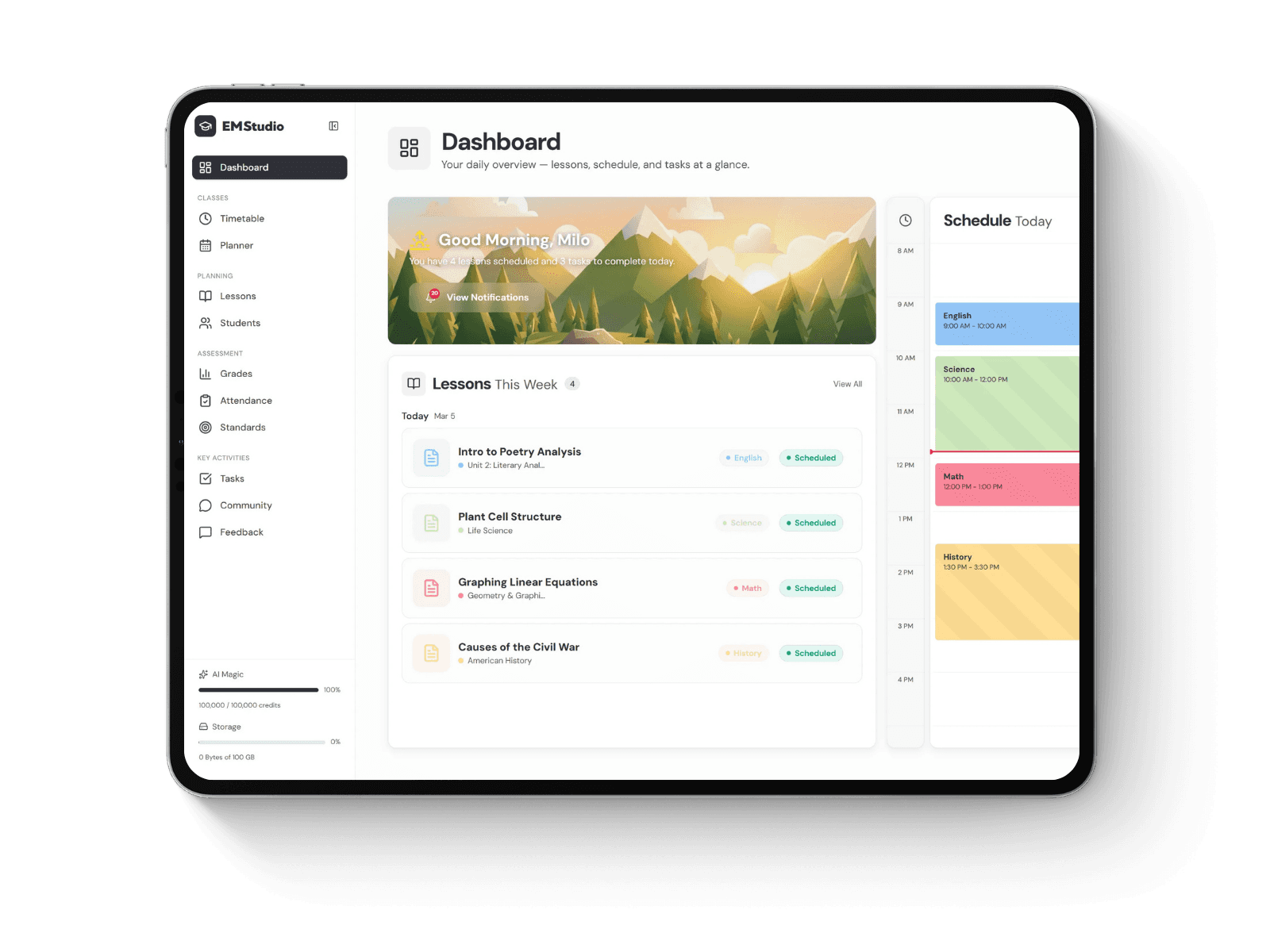
EMStudio is a free teaching management app — manage your classes, students, lessons, and more!
Learn More
Still grading everything by hand?
EMStudio is a free teaching management app — manage your classes, students, lessons, and more!
Learn More
Table of Contents
Who Is Carol Ann Tomlinson and What Shaped Her Educational Philosophy?
Carol Ann Tomlinson is Professor Emerita at the University of Virginia's Curry School of Education and a former Virginia Teacher of the Year. A classroom teacher for 21 years, she developed the framework for differentiated instruction through seminal works like How to Differentiate Instruction in Mixed-Ability Classrooms and The Differentiated Classroom.
Carol Ann Tomlinson spent 21 years in elementary and special education classrooms across Virginia. She earned Virginia Teacher of the Year in 1974. Now she is Professor Emerita at the University of Virginia Curry School of Education.
Those years in special education formed her core belief. When you write IEPs, you learn that one size fits nobody. You modify content, process, and product daily. Tomlinson noticed that general education teachers lacked these tools. They taught to the middle by default. She watched struggling learners shut down and advanced learners stall out. Both groups deserved better.
Her special education background revealed a truth: heterogeneous grouping isn't an obstacle. It's the reality of every classroom. Even "tracked" classes contain wide skill ranges. Tomlinson argued that differentiation isn't a special ed strategy ported to general ed. It's good teaching, period.
Her books built the field from scratch:
How to Differentiate Instruction in Mixed-Ability Classrooms (ASCD, 1999) — The foundational text that introduced readiness-based instruction to mainstream audiences.
The Differentiated Classroom: Responding to the Needs of All Learners (1999) — Practical classroom management and design strategies.
Fulfilling the Promise of the Differentiated Classroom (2003) — Advanced techniques for teachers already implementing basics.
Leading and Managing a Differentiated Classroom (2010) — Solutions for the logistics: time, space, and student independence.
These books gave teachers permission to stop teaching to the mythological "average student." They provided concrete tools: anchor activities for early finishers, flexible grouping strategies, and learning profile inventories. You finally had language for what you already sensed was wrong with one-size-fits-all lessons.
In 2006, she partnered with Jay McTighe on Integrating Differentiated Instruction and Understanding by Design. McTighe brought backward design — starting with essential questions. Tomlinson brought responsive instruction — adjusting the path based on learner needs. Together they solved the biggest criticism of differentiation: that it lacked rigor. Their collaboration proved you can differentiate and teach for deep understanding simultaneously. You don't sacrifice high standards for individualization.
Pre-assessment drives everything in her model. You can't differentiate blind. Tomlinson advocates quick diagnostics before every unit. These aren't graded. They're coordinates. They tell you who needs curriculum compacting and who needs foundational support. Without this data, you guess. With it, you teach intentionally.
Tomlinson's philosophy rests on respectful tasks. This is non-negotiable. You give all students the same essential understandings and skills. Nobody gets a watered-down worksheet while others do "real" work. You design tasks that challenge every learner appropriately.
She identifies three leverage points for adjusting instruction. First, readiness: where the student is relative to the learning target. Second, interest: what motivates them. Third, learning profile: how they process information best. You rarely adjust for all three simultaneously. You choose based on the lesson's core goal.
Curriculum compacting exemplifies her approach. When pre-assessment shows a student already masters 80% of the unit, you eliminate the review. You replace it with extension activities that push deeper thinking. The student doesn't earn free time. They earn harder problems.
Tiered assignments work similarly. Every tier addresses the same essential question. Tier one provides heavy scaffolding. Tier three needs independent synthesis. Students choose or are assigned tiers based on readiness. Everyone climbs the same mountain. The trails differ in steepness.
Tomlinson explicitly rejects "dumbing down." She warns against the trap of giving struggling students cut-and-paste busywork while advanced students get more worksheets. Both assignments insult the learner. Respectful tasks maintain high expectations for everyone. The difference lies in the support provided, not the destination.
Today, her framework appears in teacher prep programs nationwide. Districts hire Tomlinson-trained consultants to overhaul instruction. If you search for carol ann thompson differentiated instruction, you'll still find her resources. The name matters less than the commitment to every learner.
Her authority still stems from those 21 years in the classroom. She tested these ideas on Monday mornings with real 8-year-olds. That matters.

What Is Differentiated Instruction According to Carol Ann Tomlinson?
According to Carol Ann Tomlinson, differentiated instruction is a systematic approach to planning curriculum that recognizes students differ in readiness, interest, and learning profile. It involves proactively modifying four classroom elements—content, process, product, and affect—based on ongoing assessment, not reacting to differences with one-size-fits-all lessons.
Tomlinson calls it "classroom practice that looks eyeball to eyeball with the reality that kids differ." You plan for variance before you teach, not scramble after half the class fails.
The four elements are content (what they learn), process (how they make sense of it), product (how they show mastery), and affect/environment (the climate). You adjust for readiness, interest, and learning profile. This isn't 27 lesson plans. It's a flexible framework that handles variance without crushing your sanity.
Here's what it is not. It is not tracking—permanent groups where kids get stuck in the "low" reading group all year. It is not individualized instruction with a 1:1 ratio nobody has. And it is definitely not teaching the same thing 27 ways at once. Differentiation happens in the interaction between you and the student, not just the materials.
The approach is proactive. You use ongoing assessment—exit tickets, observations—to inform tomorrow's grouping. The goal is respectful tasks: work that challenges each learner without labeling anyone as "less than."
Tomlinson identifies four non-negotiables for true differentiation:
Focus on essential concepts and skills that every student must master.
Responsive teaching based on student readiness, interest, and learning profile—not just teaching to the middle.
Respectful work that is equally engaging and demanding for all learners, regardless of tier.
Flexible grouping that changes based on data, not fixed tracks that follow kids all year.
Differentiating Content for Student Readiness
Tiering is your primary tool for content differentiation. You keep the essential standard identical but adjust the complexity of the materials. For example, in a 7th-grade social studies unit on the Civil War, all students analyze primary sources, but Tier 1 works with 800L Lexile excerpts featuring vocabulary supports, Tier 2 uses 1000L texts with standard academic language, and Tier 3 tackles 1200L+ original documents with minimal scaffolding. Everyone learns about sectionalism; the depth varies.
Curriculum compacting serves your gifted learners who show mastery on pre-assessments. You eliminate 50-70% of previously mastered content and replace it with extension activities. I once had a 4th grader who tested out of our entire fractions unit. We contracted for him to design a survey and analyze data using statistical concepts while the class built foundational skills. No worksheets, just deeper thinking.
Learning contracts negotiate criteria between you and the student. The contract specifies what the student will learn, how they'll demonstrate it, and the timeline. This builds autonomy while making sure standards coverage. You can find more practical applications in these differentiated instruction examples for every classroom.
In a 5th-grade science unit on ecosystems, tiering looks like this: Tier 1 students identify three organisms and describe basic predator-prey relationships. Tier 2 students analyze energy transfer through food webs and predict population changes. Tier 3 students design sustainable ecosystem models that address carrying capacity and resource limitations. All three groups address the same essential standard about interactions in ecosystems.
Differentiating Process Through Instructional Strategies
Process differentiation changes how students engage with the material based on their learning profile or readiness needs. Three strategies anchor my practice.
Learning Stations work best for skill practice and kinesthetic learners. Set up 3-4 stations rotating every 15 minutes. Each station addresses the same skill at different complexity levels. In a middle school ELA class, Station A might focus on identifying figurative language with graphic organizers, Station B on analyzing the purpose of specific metaphors, and Station C on creating original figurative language that mimics an author's style.
Think-Pair-Share variations adjust the complexity of peer interaction. For struggling learners, stick with standard Think-Pair-Share to build confidence. For advanced learners, use Think-Pair-Square: after pairs discuss, they join another pair to debate or synthesize viewpoints. This adds the cognitive load of negotiation and perspective-taking.
RAFT writing (Role-Audience-Format-Topic) differentiates by learning profile per Sternberg's Triarchic Theory. Analytical learners write scientific reports. Creative learners draft dialogues between historical figures. Practical learners compose letters to city council. Same content, different entry points. Digital tools help manage these variations—see this guide on using digital tools to support differentiated instruction.
Differentiating Product Based on Learning Preferences
Product differentiation lets students demonstrate mastery through modalities that fit their strengths while meeting identical standards. Choice boards organized in a Tic-Tac-Toe format offer nine options representing varied intelligences. Students complete three in a row. One column might include creating a podcast interview, writing a traditional essay, or building a physical demonstration.
Tiered rubrics use four columns where complexity scales but criteria align to standards. The "meets standard" column describes grade-level expectations. The "approaching" column defines scaffolded expectations with support structures visible. The "exceeds" column adds sophisticated analysis or application requirements. Everyone aims for the same learning target; the path varies in steepness.
Authentic assessment options include podcasts, essays, demonstrations, or oral defenses. A student strong in verbal-linguistic intelligence might write an editorial about climate change. A student with strong bodily-kinesthetic intelligence might design and present a working model of a sustainable city.
Critical distinction: All students demonstrate mastery of the same essential standards. Avoid the "menu of fun versus menu of work" trap where advanced students create videos while struggling students fill out worksheets. Respectful tasks mean the podcast and the essay both require rigorous analysis, evidence citation, and clear communication. The format differs; the cognitive demand remains equal.

How Does the Differentiated Classroom Model Actually Work?
Tomlinson's differentiated classroom operates through continuous assessment cycles that inform flexible grouping decisions. Teachers use pre-assessments to determine entry points, monitor progress through ongoing checks for understanding, and reorganize student groups every 2-3 weeks while maintaining respectful tasks that ensure equal challenge and engagement for all learners.
You don't differentiate once at the start of the year. You do it Monday morning, check Wednesday, and adjust Friday. The system breathes with your students.
The cycle spins weekly. You pre-assess before the unit hits—maybe a quick curriculum compacting pre-test or entrance card—to see who already knows the material. You plan instruction based on that data, then deploy formative assessment examples for immediate classroom use during the lesson. Check who gets it. Adjust tomorrow's groups. Summative data closes the loop and feeds the next unit. This isn't quarterly. It's Tuesday.
The biggest trap? Creating "high," "medium," and "low" groups in September and keeping them until June. Carol ann tomlinson never advocated for static tracking. Your groups should shift based on the learning target.
Use readiness-based instruction for math computation—who needs the base-ten blocks versus who’s ready for abstract algorithms? Switch to interest groups for social studies research projects. Shuffle by learning profile for science labs—visual learners versus kinesthetic. Same kids, different configurations, depending on what you're teaching.
You need both numbers and intuition. Formal tools give you data to justify grouping decisions to parents and administrators. Informal tools let you adjust on the fly when you see confusion on a student's face.
Formal Assessment Tools
Curriculum-based measures track specific skill mastery against grade-level standards.
Exit tickets collect quick data at the lesson's end to plan tomorrow's groups.
3-2-1 organizers (three facts, two questions, one connection) reveal depth of understanding.
Informal Assessment Tools
Fist-to-Five checks confidence levels in thirty seconds—no paper required.
Observation checklists track behaviors and misconceptions while students work.
Conferencing notes capture individual reading or math conversations.
Entrance cards diagnose yesterday's homework before the bell rings.
Pre-Assessment and Continuous Assessment Cycles
Start with KWL+ charts, 3-2-1 organizers, and curriculum compacting pre-tests. If a student scores 85% or higher, they hit mastery. Time for compaction—skip the drill and move to extension. These tools diagnose before you teach.
Administer these 2-3 days before the unit starts. Spend twenty minutes on item analysis—not just the score, but which questions they missed. Identify skill gaps versus whole-class concepts. Use this data to form your initial groups and flag kids needing compacting.
The data tells you who needs the foundational skill review and who's ready for the compacted curriculum. Don't guess. The twenty minutes you spend analyzing saves you two weeks of bored students acting out or lost students drowning.
This cycle repeats weekly. You’re not waiting for the end-of-unit test to discover half the class missed the concept. Check Monday, pivot Tuesday. That’s the rhythm of carol tomlinson the differentiated classroom.
Flexible Grouping and Task Design Principles
Group by readiness (skill level), interest (topic choice from surveys), or learning profile (how they process information). Keep groups small—three to five students lets everyone talk. Larger groups hide kids.
Change these groups every 2-3 weeks, or by unit. Never keep permanent "bluebirds" and "redbirds." When students aren't at your teacher station, they need anchor activities—logic puzzles, extension readings, or creative writing—that extend learning without interrupting your small-group instruction. No coloring sheets. Real work.
This heterogeneous grouping and homogeneous grouping dance keeps the classroom fluid. Students learn to work with everyone while getting targeted support when they need it.
Managing the Physical and Emotional Learning Environment
Arrange furniture in clusters, not rows. Create resource zones with tiered assignments—leveled texts, manipulatives, and choice boards at different heights. Designate a quiet corner for independent work and a clear "teacher station" for small-group instruction. See our flexible seating implementation guide for layouts that actually work.
The emotional environment matters as much as the physical. Respectful tasks mean every student works on essential understandings at their challenge level. No busy work—like coloring maps for early finishers. No dumbed-down work—like simplified vocabulary lists for struggling readers. Same complexity, different entry points. That’s the contract in a differentiated classroom tomlinson style.

Why Does Tomlinson's Framework Matter for Modern K-12 Classrooms?
Tomlinson's framework matters because modern classrooms contain wider achievement gaps than ever, with educators reporting variance of 4-6 grade levels in single classes post-pandemic. Her approach provides a sustainable structure for addressing heterogeneity without reverting to tracking, making sure advanced learners progress while struggling students receive necessary scaffolding within truly inclusive settings.
You have fifth graders reading at second grade level sitting beside others ready for seventh grade content. This isn't rare anymore. It's Tuesday. Carol Ann Tomlinson's framework gives you permission to stop teaching to the imaginary middle and start teaching the actual kids in your chairs.
Since 2021, I've watched diagnostic scores spread like never before. Walk into a typical middle school ELA class and you'll find reading levels spanning from third to ninth grade. Math classes show similar gaps. Some kids never mastered multiplication while others are ready for algebra.
Traditional whole-group instruction fails here. It bores your advanced learners and loses your struggling ones simultaneously. Tomlinson's readiness-based instruction lets you address this heterogeneous grouping reality without splitting kids into ability tracks that doom struggling learners to lower expectations. You can keep everyone together while pushing each student forward from where they actually are.
Ability grouping feels like the easy answer. It isn't. When you send kids to the "low" reading group, they know. They stop trying. Tomlinson's framework keeps kids in heterogeneous classrooms while giving you tools to meet them where they are. You avoid the stigma of the bluebirds and the buzzards while actually serving both groups better.
Here's where teachers crash: trying to differentiate content, process, product, and affect simultaneously from day one. Don't. You'll burn out by October. I tried it my first year and nearly quit. Start with one element—usually content through tiered assignments—and master it. Add curriculum compacting for your advanced learners next month. Build slowly. Fulfilling the promise of the differentiated classroom requires sustainable practice, not superhero effort. For a roadmap on pacing this work, see our comprehensive guide to mastering differentiated instruction.
Content: What students learn.
Process: How they make sense of it.
Product: How they show mastery.
Affect: The learning environment and student engagement.
Studies on mixed-ability classes show something counterintuitive: when you use respectful tasks aligned to grade-level standards, everyone benefits. Your high flyers solidify understanding by explaining concepts to peers. Your struggling learners see models of advanced thinking without being segregated into the "low group." The key is making sure tasks are equally engaging, equally rigorous, just adjusted for learning profile and readiness. No busywork for anyone.
I saw this last year with a science project on ecosystems. My advanced students researched biomes and taught mini-lessons to small groups. My struggling learners heard those explanations from peers, not just me, which made the concepts click faster. Everyone worked with grade-level vocabulary and concepts. The tasks looked different but the rigor stayed constant.
Inclusive settings work better when you have actual strategies. Tomlinson gives you those strategies. You stop making excuses about why you can't meet diverse needs and start using tiered assignments that allow every student to grapple with the same essential questions at their own entry point.
People confuse tomlinson and differentiated instruction with Universal Design for Learning, but they're partners, not twins. UDL removes barriers upfront—offering text-to-speech to everyone. Ann tomlinson differentiated instruction adds the responsive layer: watching who needs that text-to-speech, who needs the advanced article, who needs the graphic organizer. UDL builds the ramp. Tomlinson decides who needs to use it today. You need both. UDL without responsiveness creates choice paralysis. Differentiation without universal access leaves kids behind before you even start.

Practical Applications: Tomlinson's Strategies Across Grade Levels
Differentiation changes shape as students mature. What works for 2nd graders fails with juniors. Carol tomlinson differentiated instruction recognizes that developmental levels dictate strategy.
The table below breaks down exactly how readiness-based instruction shifts across grade spans.
Grade Level | Subject Area | Differentiation Strategy | Readiness Indicator | Teacher Prep Time |
|---|---|---|---|---|
Elementary | Mathematics | Learning stations (15-20 min rotations) | Accuracy with concrete materials | 20 minutes |
Elementary | Reading | Text Plus leveled libraries | Lexile range and comprehension | 30 minutes |
Middle School | Science | RAFT writing (45-50 min activity) | Complexity of chosen role | 45 minutes |
Middle School | All subjects | Anchor activities for early finishers | Task completion speed | 15 minutes |
High School | English | Tiered literature circles | Depth of analytical role | 2 hours |
High School | Mathematics | Homework menus (Must/May/Choose) | Procedural vs. application mastery | 1 hour |
High School | Research | Tiered projects (2 weeks with checkpoints) | Source analysis level | 3 hours |
Elementary Classroom Implementation Examples
In a differentiated classroom tomlinson designs, elementary students learn through touch and movement. You won't find worksheets in neat rows. You'll find kids rotating through stations every fifteen minutes with base-ten blocks in their fists. This is readiness-based instruction made physical.
Take 2nd-grade double-digit addition. You create three tiered assignments using the Concrete-Representational-Abstract framework. All students solve the same five word problems, but their entry points differ.
Tier 1 manipulates base-ten blocks to build 24+37 concretely.
Tier 2 draws pictures representing the blocks before calculating.
Tier 3 uses standard algorithms with mental math checks for regrouping.
The blocks don't make the work easier. They make the abstraction concrete. Kids using manipulatives explain their thinking to peers using algorithms. Heterogeneous grouping at this level isn't ability tracking. It's giving students multiple representations of the same concept simultaneously.
Fourth graders studying the Revolutionary War use "Text Plus." You pose one essential question: "Who really won the war?" Students access texts ranging from 600L picture book biographies to 1000L primary source excerpts based on their learning profile.
You teach different comprehension strategies for each level. Kids with picture books practice summarizing illustrations. Kids with primary sources practice corroborating facts across documents. Everyone discusses the same essential question during closing circle.
Stations run 15-20 minutes per rotation. Any longer and you lose them. Prep takes twenty minutes for simple choice boards or forty-five for full leveled station sets. You front-load the work so students self-navigate once the timer starts.
These differentiation tactics for elementary educators honor developmental reality. Young children need physical access to concepts before symbols make sense.
Middle School Differentiation Tactics
Middle schoolers are social animals caught between childhood logic and adult abstraction. Carol ann tomlinson knows that differentiation here leverages peer interaction. Seventh graders need to talk, move, and choose.
Try a 45-50 minute RAFT on cell organelles. Students pick roles based on complexity.
Mitochondria writes to the CEO analyzing the cell's energy economy.
Cell Membrane writes to the Security Guard describing transport protocols.
Nucleus writes to the Mayor explaining command and control functions.
All demonstrate understanding of cell function, but the cognitive lift varies significantly. The CEO letter requires systems thinking about energy transfer. The security guard memo focuses on description and access. Students self-select their challenge level honestly. Kids know when they're ready for the CEO letter versus the security guard memo. That autonomy builds investment.
You need anchor activities for early finishers. These aren't busy work.
Extension labs previewing tomorrow's content.
Vocabulary puzzles reinforcing yesterday's terms.
Current event articles connecting to unit themes.
When three kids finish the lab in twelve minutes while others need thirty, you can't afford "I'm done" interruptions. Point them to the anchor folder. These activities aren't punishment. They're privileges. Early finishers get first crack at the microscope slides or extension articles.
This is where teaching strategies for mixed-ability classrooms become survival skills. You aren't tracking kids into ability groups. You're offering respectful tasks within heterogeneous groups.
Prep time sits between elementary and high school. A complex RAFT takes about an hour to build. Anchor activities require initial creation but run themselves after that.
High School and Advanced Subject Adaptations
High school students detect fake work immediately. Carol tomlinson differentiated instruction requires authentic complexity here. Juniors and seniors want intellectual work that mirrors college and career tasks.
In AP English Literature circles, assign differentiated role sheets based on current skill level. Everyone rotates roles each novel.
Basic role picks key passages and explains significance.
Intermediate role connects text to real-world contexts and current events.
Advanced role tracks symbols thematically across the entire novel.
No one gets stuck as the "dumb job" kid for the whole semester. By June, every student has practiced high-level analysis. The respectful tasks ensure everyone contributes meaningfully.
Algebra II homework menus offer structured autonomy within readiness parameters.
Must Do: Three procedural problems everyone completes.
May Do: Two word problems for application practice.
Choose: One proof or complex application selected by the student.
You ensure standards mastery while honoring varying confidence levels. Students pick their challenge, but everyone meets the baseline.
Tiered research projects span two weeks with checkpoints on days three, seven, and ten. You spend three hours prepping tiered guidelines and rubrics. Students at advanced tiers analyze primary sources while others master secondary synthesis. Both meet the standard, but the sophistication differs.
Curriculum compacting becomes important for students demonstrating early mastery. They skip review and launch into independent study. You use learning profile data to determine who needs the full lesson versus the compacted version. High school differentiation looks like college prep.

How Can Teachers Start Implementing Tomlinson's Methods Tomorrow?
Teachers should begin by auditing current practices against Tomlinson's four-element framework, then select just one element—either content, process, or product—to differentiate in a single upcoming unit. Start with a low-stakes 2-week trial using one strategy like tiered exit tickets or choice boards, gathering student feedback before expanding to additional elements.
Pick a unit you already teach well. You need strong curriculum knowledge before you can bend it. Don't try to differentiate what you barely understand.
Audit Your Current Practices Against Tomlinson's Principles
Pull out your current unit plans. Look for evidence of readiness-based instruction. Ask yourself: Do you use pre-assessment to determine entry points, or do you teach to the middle and hope to catch stragglers later?
Do you group flexibly based on data, shifting between heterogeneous grouping and homogeneous skill groups as needs change? Are your tasks respectful tasks—equally engaging and demanding for every learner, never dumbed-down? Do students have genuine voice and choice in how they demonstrate learning? Is every tier aligned to grade-level standards?
Do I use pre-assessment to determine entry points?
Do I group flexibly based on data?
Are tasks respectful and equally engaging?
Do students have voice and choice?
Is work aligned to grade-level standards for all?
Rate your current practice 1-4 on each of carol ann tomlinson's four elements: content, process, product, and affect. Identify your lowest score. If you fall below 3 on pre-assessment, stop there. Build that foundation before attempting curriculum compacting or tiering. This audit takes one planning period but saves weeks of misfired lessons.
Watch for three implementation failures. First, never give advanced students simply "more work"—extra worksheets instead of complex tasks. Second, avoid grading on effort or completion for struggling learners while demanding mastery from others. All students meet standards; the path differs. Third, resist creating 27 individual lesson plans. Differentiated instruction carol ann tomlinson style means flexible groups, not daily solo IEPs.
Select One Element to Differentiate First
Use this decision flowchart. If your class has more than two years of reading variance, start with Content tiering. If engagement is low, start with Product choice. If behavior issues dominate, start with Process and affect modifications. Match your starting point to your biggest pain point.
Understand the trade-offs. Content differentiation requires 30-40% more planning time initially but reduces reteaching by 50% once established, according to veteran teachers following planning habits of highly effective educators. Product differentiation boosts engagement significantly but needs new rubric design for each option. Process differentiation builds metacognition and allows you to address learning profile differences, but requires strong classroom management routines first.
Follow this timeline religiously. Week 1: audit current practice against the tomlinson differentiated instruction book framework. Weeks 2-3: plan one tiered assignment in your strongest subject using readiness-based instruction. Week 4: implement and gather student feedback through exit tickets. Month 2: add a second element. Initial planning takes 30-40% more time, but you gain it back through reduced remediation.
Start with Content tiering where your curriculum knowledge is deepest. Use the "parallel tasks" method—same context, different complexity—not completely different assignments. Both groups analyze the Boston Tea Party, but one uses a primary source text at 4th grade level, the other at 8th. This keeps your sanity intact while you learn the system.
Build Your Differentiation Toolkit Gradually
Stock your toolbox with three essentials. First, a learning profile inventory using Sternberg's Triarchic Theory or VARK to understand how students process information. Second, readiness check templates using Google Forms with conditional logic that shows different questions based on previous answers, giving you instant data for readiness-based instruction. Third, anchor activity folders labeled "I'm Done, Now What?" containing 5-6 ongoing enrichment options for early finishers who need challenge, not more of the same.
Don't go alone. Bookmark ASCD's "Differentiation Central" website and Tomlinson's archived "Differentiation Daily" blog for tiered assignments examples. Mandatory: collaborate with your instructional coach or mentor for your first three differentiation attempts. Isolation breeds the 27-lesson-plan nightmare where you try to individualize everything. Collaboration keeps you sane and catches design flaws before you launch.
Build slowly. Master one curriculum compacting strategy before adding another. Document what works in a simple notebook. Note which heterogeneous grouping arrangements sparked the best discussions. Next year, you'll have a library of respectful tasks ready to deploy. That's how steps to transform your instructional practice become permanent habits rather than one-off experiments.
Remember: you are not writing 27 separate lessons. You are designing two or three tiers of one lesson. Use the same anchor text, same essential question, same assessment criteria. The tomlinson differentiated instruction book emphasizes commonalities, not differences. Keep the learning target identical; change the route.
Carol Ann Tomlinson: The 3-Step Kickoff
Tomlinson's framework isn't a curriculum you buy. It's a lens for viewing your students. Once you start seeing the difference between a kid's readiness and their learning profile, you can't unsee it. The frustration of watching a student tune out during a whole-group lesson shifts from annoyance to diagnostic data. You realize the gap isn't motivation—it's match.
Respectful tasks are the litmus test. If you wouldn't want to do the "dumbed down" version of an assignment, neither do they. Heterogeneous grouping works only when you've taught the protocols and designed exits for different readiness levels. Otherwise you're just seating struggling kids next to confident ones and hoping osmosis happens.
Readiness-based instruction isn't about creating thirty separate lesson plans. It's about adjusting the entry point or the complexity of the practice while keeping the essential learning target identical. Start with one lesson this week. Adjust the dial until the fit feels right for the kids who usually struggle and the ones who usually finish early. That's where the growth happens.
Audit tomorrow's lesson for respectful tasks. If the "easy" version feels like busywork, redesign it.
Group four students with different skill levels for one heterogeneous grouping activity. Give each a specific role that requires their strength.
Administer a three-question readiness-based instruction check at the start of class. Sort responses into two groups for differentiated mini-lessons.
Offer one choice that targets a different learning profile—let students draw, write, or speak their response to the same prompt.

Who Is Carol Ann Tomlinson and What Shaped Her Educational Philosophy?
Carol Ann Tomlinson is Professor Emerita at the University of Virginia's Curry School of Education and a former Virginia Teacher of the Year. A classroom teacher for 21 years, she developed the framework for differentiated instruction through seminal works like How to Differentiate Instruction in Mixed-Ability Classrooms and The Differentiated Classroom.
Carol Ann Tomlinson spent 21 years in elementary and special education classrooms across Virginia. She earned Virginia Teacher of the Year in 1974. Now she is Professor Emerita at the University of Virginia Curry School of Education.
Those years in special education formed her core belief. When you write IEPs, you learn that one size fits nobody. You modify content, process, and product daily. Tomlinson noticed that general education teachers lacked these tools. They taught to the middle by default. She watched struggling learners shut down and advanced learners stall out. Both groups deserved better.
Her special education background revealed a truth: heterogeneous grouping isn't an obstacle. It's the reality of every classroom. Even "tracked" classes contain wide skill ranges. Tomlinson argued that differentiation isn't a special ed strategy ported to general ed. It's good teaching, period.
Her books built the field from scratch:
How to Differentiate Instruction in Mixed-Ability Classrooms (ASCD, 1999) — The foundational text that introduced readiness-based instruction to mainstream audiences.
The Differentiated Classroom: Responding to the Needs of All Learners (1999) — Practical classroom management and design strategies.
Fulfilling the Promise of the Differentiated Classroom (2003) — Advanced techniques for teachers already implementing basics.
Leading and Managing a Differentiated Classroom (2010) — Solutions for the logistics: time, space, and student independence.
These books gave teachers permission to stop teaching to the mythological "average student." They provided concrete tools: anchor activities for early finishers, flexible grouping strategies, and learning profile inventories. You finally had language for what you already sensed was wrong with one-size-fits-all lessons.
In 2006, she partnered with Jay McTighe on Integrating Differentiated Instruction and Understanding by Design. McTighe brought backward design — starting with essential questions. Tomlinson brought responsive instruction — adjusting the path based on learner needs. Together they solved the biggest criticism of differentiation: that it lacked rigor. Their collaboration proved you can differentiate and teach for deep understanding simultaneously. You don't sacrifice high standards for individualization.
Pre-assessment drives everything in her model. You can't differentiate blind. Tomlinson advocates quick diagnostics before every unit. These aren't graded. They're coordinates. They tell you who needs curriculum compacting and who needs foundational support. Without this data, you guess. With it, you teach intentionally.
Tomlinson's philosophy rests on respectful tasks. This is non-negotiable. You give all students the same essential understandings and skills. Nobody gets a watered-down worksheet while others do "real" work. You design tasks that challenge every learner appropriately.
She identifies three leverage points for adjusting instruction. First, readiness: where the student is relative to the learning target. Second, interest: what motivates them. Third, learning profile: how they process information best. You rarely adjust for all three simultaneously. You choose based on the lesson's core goal.
Curriculum compacting exemplifies her approach. When pre-assessment shows a student already masters 80% of the unit, you eliminate the review. You replace it with extension activities that push deeper thinking. The student doesn't earn free time. They earn harder problems.
Tiered assignments work similarly. Every tier addresses the same essential question. Tier one provides heavy scaffolding. Tier three needs independent synthesis. Students choose or are assigned tiers based on readiness. Everyone climbs the same mountain. The trails differ in steepness.
Tomlinson explicitly rejects "dumbing down." She warns against the trap of giving struggling students cut-and-paste busywork while advanced students get more worksheets. Both assignments insult the learner. Respectful tasks maintain high expectations for everyone. The difference lies in the support provided, not the destination.
Today, her framework appears in teacher prep programs nationwide. Districts hire Tomlinson-trained consultants to overhaul instruction. If you search for carol ann thompson differentiated instruction, you'll still find her resources. The name matters less than the commitment to every learner.
Her authority still stems from those 21 years in the classroom. She tested these ideas on Monday mornings with real 8-year-olds. That matters.
What Is Differentiated Instruction According to Carol Ann Tomlinson?
According to Carol Ann Tomlinson, differentiated instruction is a systematic approach to planning curriculum that recognizes students differ in readiness, interest, and learning profile. It involves proactively modifying four classroom elements—content, process, product, and affect—based on ongoing assessment, not reacting to differences with one-size-fits-all lessons.
Tomlinson calls it "classroom practice that looks eyeball to eyeball with the reality that kids differ." You plan for variance before you teach, not scramble after half the class fails.
The four elements are content (what they learn), process (how they make sense of it), product (how they show mastery), and affect/environment (the climate). You adjust for readiness, interest, and learning profile. This isn't 27 lesson plans. It's a flexible framework that handles variance without crushing your sanity.
Here's what it is not. It is not tracking—permanent groups where kids get stuck in the "low" reading group all year. It is not individualized instruction with a 1:1 ratio nobody has. And it is definitely not teaching the same thing 27 ways at once. Differentiation happens in the interaction between you and the student, not just the materials.
The approach is proactive. You use ongoing assessment—exit tickets, observations—to inform tomorrow's grouping. The goal is respectful tasks: work that challenges each learner without labeling anyone as "less than."
Tomlinson identifies four non-negotiables for true differentiation:
Focus on essential concepts and skills that every student must master.
Responsive teaching based on student readiness, interest, and learning profile—not just teaching to the middle.
Respectful work that is equally engaging and demanding for all learners, regardless of tier.
Flexible grouping that changes based on data, not fixed tracks that follow kids all year.
Differentiating Content for Student Readiness
Tiering is your primary tool for content differentiation. You keep the essential standard identical but adjust the complexity of the materials. For example, in a 7th-grade social studies unit on the Civil War, all students analyze primary sources, but Tier 1 works with 800L Lexile excerpts featuring vocabulary supports, Tier 2 uses 1000L texts with standard academic language, and Tier 3 tackles 1200L+ original documents with minimal scaffolding. Everyone learns about sectionalism; the depth varies.
Curriculum compacting serves your gifted learners who show mastery on pre-assessments. You eliminate 50-70% of previously mastered content and replace it with extension activities. I once had a 4th grader who tested out of our entire fractions unit. We contracted for him to design a survey and analyze data using statistical concepts while the class built foundational skills. No worksheets, just deeper thinking.
Learning contracts negotiate criteria between you and the student. The contract specifies what the student will learn, how they'll demonstrate it, and the timeline. This builds autonomy while making sure standards coverage. You can find more practical applications in these differentiated instruction examples for every classroom.
In a 5th-grade science unit on ecosystems, tiering looks like this: Tier 1 students identify three organisms and describe basic predator-prey relationships. Tier 2 students analyze energy transfer through food webs and predict population changes. Tier 3 students design sustainable ecosystem models that address carrying capacity and resource limitations. All three groups address the same essential standard about interactions in ecosystems.
Differentiating Process Through Instructional Strategies
Process differentiation changes how students engage with the material based on their learning profile or readiness needs. Three strategies anchor my practice.
Learning Stations work best for skill practice and kinesthetic learners. Set up 3-4 stations rotating every 15 minutes. Each station addresses the same skill at different complexity levels. In a middle school ELA class, Station A might focus on identifying figurative language with graphic organizers, Station B on analyzing the purpose of specific metaphors, and Station C on creating original figurative language that mimics an author's style.
Think-Pair-Share variations adjust the complexity of peer interaction. For struggling learners, stick with standard Think-Pair-Share to build confidence. For advanced learners, use Think-Pair-Square: after pairs discuss, they join another pair to debate or synthesize viewpoints. This adds the cognitive load of negotiation and perspective-taking.
RAFT writing (Role-Audience-Format-Topic) differentiates by learning profile per Sternberg's Triarchic Theory. Analytical learners write scientific reports. Creative learners draft dialogues between historical figures. Practical learners compose letters to city council. Same content, different entry points. Digital tools help manage these variations—see this guide on using digital tools to support differentiated instruction.
Differentiating Product Based on Learning Preferences
Product differentiation lets students demonstrate mastery through modalities that fit their strengths while meeting identical standards. Choice boards organized in a Tic-Tac-Toe format offer nine options representing varied intelligences. Students complete three in a row. One column might include creating a podcast interview, writing a traditional essay, or building a physical demonstration.
Tiered rubrics use four columns where complexity scales but criteria align to standards. The "meets standard" column describes grade-level expectations. The "approaching" column defines scaffolded expectations with support structures visible. The "exceeds" column adds sophisticated analysis or application requirements. Everyone aims for the same learning target; the path varies in steepness.
Authentic assessment options include podcasts, essays, demonstrations, or oral defenses. A student strong in verbal-linguistic intelligence might write an editorial about climate change. A student with strong bodily-kinesthetic intelligence might design and present a working model of a sustainable city.
Critical distinction: All students demonstrate mastery of the same essential standards. Avoid the "menu of fun versus menu of work" trap where advanced students create videos while struggling students fill out worksheets. Respectful tasks mean the podcast and the essay both require rigorous analysis, evidence citation, and clear communication. The format differs; the cognitive demand remains equal.
How Does the Differentiated Classroom Model Actually Work?
Tomlinson's differentiated classroom operates through continuous assessment cycles that inform flexible grouping decisions. Teachers use pre-assessments to determine entry points, monitor progress through ongoing checks for understanding, and reorganize student groups every 2-3 weeks while maintaining respectful tasks that ensure equal challenge and engagement for all learners.
You don't differentiate once at the start of the year. You do it Monday morning, check Wednesday, and adjust Friday. The system breathes with your students.
The cycle spins weekly. You pre-assess before the unit hits—maybe a quick curriculum compacting pre-test or entrance card—to see who already knows the material. You plan instruction based on that data, then deploy formative assessment examples for immediate classroom use during the lesson. Check who gets it. Adjust tomorrow's groups. Summative data closes the loop and feeds the next unit. This isn't quarterly. It's Tuesday.
The biggest trap? Creating "high," "medium," and "low" groups in September and keeping them until June. Carol ann tomlinson never advocated for static tracking. Your groups should shift based on the learning target.
Use readiness-based instruction for math computation—who needs the base-ten blocks versus who’s ready for abstract algorithms? Switch to interest groups for social studies research projects. Shuffle by learning profile for science labs—visual learners versus kinesthetic. Same kids, different configurations, depending on what you're teaching.
You need both numbers and intuition. Formal tools give you data to justify grouping decisions to parents and administrators. Informal tools let you adjust on the fly when you see confusion on a student's face.
Formal Assessment Tools
Curriculum-based measures track specific skill mastery against grade-level standards.
Exit tickets collect quick data at the lesson's end to plan tomorrow's groups.
3-2-1 organizers (three facts, two questions, one connection) reveal depth of understanding.
Informal Assessment Tools
Fist-to-Five checks confidence levels in thirty seconds—no paper required.
Observation checklists track behaviors and misconceptions while students work.
Conferencing notes capture individual reading or math conversations.
Entrance cards diagnose yesterday's homework before the bell rings.
Pre-Assessment and Continuous Assessment Cycles
Start with KWL+ charts, 3-2-1 organizers, and curriculum compacting pre-tests. If a student scores 85% or higher, they hit mastery. Time for compaction—skip the drill and move to extension. These tools diagnose before you teach.
Administer these 2-3 days before the unit starts. Spend twenty minutes on item analysis—not just the score, but which questions they missed. Identify skill gaps versus whole-class concepts. Use this data to form your initial groups and flag kids needing compacting.
The data tells you who needs the foundational skill review and who's ready for the compacted curriculum. Don't guess. The twenty minutes you spend analyzing saves you two weeks of bored students acting out or lost students drowning.
This cycle repeats weekly. You’re not waiting for the end-of-unit test to discover half the class missed the concept. Check Monday, pivot Tuesday. That’s the rhythm of carol tomlinson the differentiated classroom.
Flexible Grouping and Task Design Principles
Group by readiness (skill level), interest (topic choice from surveys), or learning profile (how they process information). Keep groups small—three to five students lets everyone talk. Larger groups hide kids.
Change these groups every 2-3 weeks, or by unit. Never keep permanent "bluebirds" and "redbirds." When students aren't at your teacher station, they need anchor activities—logic puzzles, extension readings, or creative writing—that extend learning without interrupting your small-group instruction. No coloring sheets. Real work.
This heterogeneous grouping and homogeneous grouping dance keeps the classroom fluid. Students learn to work with everyone while getting targeted support when they need it.
Managing the Physical and Emotional Learning Environment
Arrange furniture in clusters, not rows. Create resource zones with tiered assignments—leveled texts, manipulatives, and choice boards at different heights. Designate a quiet corner for independent work and a clear "teacher station" for small-group instruction. See our flexible seating implementation guide for layouts that actually work.
The emotional environment matters as much as the physical. Respectful tasks mean every student works on essential understandings at their challenge level. No busy work—like coloring maps for early finishers. No dumbed-down work—like simplified vocabulary lists for struggling readers. Same complexity, different entry points. That’s the contract in a differentiated classroom tomlinson style.
Why Does Tomlinson's Framework Matter for Modern K-12 Classrooms?
Tomlinson's framework matters because modern classrooms contain wider achievement gaps than ever, with educators reporting variance of 4-6 grade levels in single classes post-pandemic. Her approach provides a sustainable structure for addressing heterogeneity without reverting to tracking, making sure advanced learners progress while struggling students receive necessary scaffolding within truly inclusive settings.
You have fifth graders reading at second grade level sitting beside others ready for seventh grade content. This isn't rare anymore. It's Tuesday. Carol Ann Tomlinson's framework gives you permission to stop teaching to the imaginary middle and start teaching the actual kids in your chairs.
Since 2021, I've watched diagnostic scores spread like never before. Walk into a typical middle school ELA class and you'll find reading levels spanning from third to ninth grade. Math classes show similar gaps. Some kids never mastered multiplication while others are ready for algebra.
Traditional whole-group instruction fails here. It bores your advanced learners and loses your struggling ones simultaneously. Tomlinson's readiness-based instruction lets you address this heterogeneous grouping reality without splitting kids into ability tracks that doom struggling learners to lower expectations. You can keep everyone together while pushing each student forward from where they actually are.
Ability grouping feels like the easy answer. It isn't. When you send kids to the "low" reading group, they know. They stop trying. Tomlinson's framework keeps kids in heterogeneous classrooms while giving you tools to meet them where they are. You avoid the stigma of the bluebirds and the buzzards while actually serving both groups better.
Here's where teachers crash: trying to differentiate content, process, product, and affect simultaneously from day one. Don't. You'll burn out by October. I tried it my first year and nearly quit. Start with one element—usually content through tiered assignments—and master it. Add curriculum compacting for your advanced learners next month. Build slowly. Fulfilling the promise of the differentiated classroom requires sustainable practice, not superhero effort. For a roadmap on pacing this work, see our comprehensive guide to mastering differentiated instruction.
Content: What students learn.
Process: How they make sense of it.
Product: How they show mastery.
Affect: The learning environment and student engagement.
Studies on mixed-ability classes show something counterintuitive: when you use respectful tasks aligned to grade-level standards, everyone benefits. Your high flyers solidify understanding by explaining concepts to peers. Your struggling learners see models of advanced thinking without being segregated into the "low group." The key is making sure tasks are equally engaging, equally rigorous, just adjusted for learning profile and readiness. No busywork for anyone.
I saw this last year with a science project on ecosystems. My advanced students researched biomes and taught mini-lessons to small groups. My struggling learners heard those explanations from peers, not just me, which made the concepts click faster. Everyone worked with grade-level vocabulary and concepts. The tasks looked different but the rigor stayed constant.
Inclusive settings work better when you have actual strategies. Tomlinson gives you those strategies. You stop making excuses about why you can't meet diverse needs and start using tiered assignments that allow every student to grapple with the same essential questions at their own entry point.
People confuse tomlinson and differentiated instruction with Universal Design for Learning, but they're partners, not twins. UDL removes barriers upfront—offering text-to-speech to everyone. Ann tomlinson differentiated instruction adds the responsive layer: watching who needs that text-to-speech, who needs the advanced article, who needs the graphic organizer. UDL builds the ramp. Tomlinson decides who needs to use it today. You need both. UDL without responsiveness creates choice paralysis. Differentiation without universal access leaves kids behind before you even start.
Practical Applications: Tomlinson's Strategies Across Grade Levels
Differentiation changes shape as students mature. What works for 2nd graders fails with juniors. Carol tomlinson differentiated instruction recognizes that developmental levels dictate strategy.
The table below breaks down exactly how readiness-based instruction shifts across grade spans.
Grade Level | Subject Area | Differentiation Strategy | Readiness Indicator | Teacher Prep Time |
|---|---|---|---|---|
Elementary | Mathematics | Learning stations (15-20 min rotations) | Accuracy with concrete materials | 20 minutes |
Elementary | Reading | Text Plus leveled libraries | Lexile range and comprehension | 30 minutes |
Middle School | Science | RAFT writing (45-50 min activity) | Complexity of chosen role | 45 minutes |
Middle School | All subjects | Anchor activities for early finishers | Task completion speed | 15 minutes |
High School | English | Tiered literature circles | Depth of analytical role | 2 hours |
High School | Mathematics | Homework menus (Must/May/Choose) | Procedural vs. application mastery | 1 hour |
High School | Research | Tiered projects (2 weeks with checkpoints) | Source analysis level | 3 hours |
Elementary Classroom Implementation Examples
In a differentiated classroom tomlinson designs, elementary students learn through touch and movement. You won't find worksheets in neat rows. You'll find kids rotating through stations every fifteen minutes with base-ten blocks in their fists. This is readiness-based instruction made physical.
Take 2nd-grade double-digit addition. You create three tiered assignments using the Concrete-Representational-Abstract framework. All students solve the same five word problems, but their entry points differ.
Tier 1 manipulates base-ten blocks to build 24+37 concretely.
Tier 2 draws pictures representing the blocks before calculating.
Tier 3 uses standard algorithms with mental math checks for regrouping.
The blocks don't make the work easier. They make the abstraction concrete. Kids using manipulatives explain their thinking to peers using algorithms. Heterogeneous grouping at this level isn't ability tracking. It's giving students multiple representations of the same concept simultaneously.
Fourth graders studying the Revolutionary War use "Text Plus." You pose one essential question: "Who really won the war?" Students access texts ranging from 600L picture book biographies to 1000L primary source excerpts based on their learning profile.
You teach different comprehension strategies for each level. Kids with picture books practice summarizing illustrations. Kids with primary sources practice corroborating facts across documents. Everyone discusses the same essential question during closing circle.
Stations run 15-20 minutes per rotation. Any longer and you lose them. Prep takes twenty minutes for simple choice boards or forty-five for full leveled station sets. You front-load the work so students self-navigate once the timer starts.
These differentiation tactics for elementary educators honor developmental reality. Young children need physical access to concepts before symbols make sense.
Middle School Differentiation Tactics
Middle schoolers are social animals caught between childhood logic and adult abstraction. Carol ann tomlinson knows that differentiation here leverages peer interaction. Seventh graders need to talk, move, and choose.
Try a 45-50 minute RAFT on cell organelles. Students pick roles based on complexity.
Mitochondria writes to the CEO analyzing the cell's energy economy.
Cell Membrane writes to the Security Guard describing transport protocols.
Nucleus writes to the Mayor explaining command and control functions.
All demonstrate understanding of cell function, but the cognitive lift varies significantly. The CEO letter requires systems thinking about energy transfer. The security guard memo focuses on description and access. Students self-select their challenge level honestly. Kids know when they're ready for the CEO letter versus the security guard memo. That autonomy builds investment.
You need anchor activities for early finishers. These aren't busy work.
Extension labs previewing tomorrow's content.
Vocabulary puzzles reinforcing yesterday's terms.
Current event articles connecting to unit themes.
When three kids finish the lab in twelve minutes while others need thirty, you can't afford "I'm done" interruptions. Point them to the anchor folder. These activities aren't punishment. They're privileges. Early finishers get first crack at the microscope slides or extension articles.
This is where teaching strategies for mixed-ability classrooms become survival skills. You aren't tracking kids into ability groups. You're offering respectful tasks within heterogeneous groups.
Prep time sits between elementary and high school. A complex RAFT takes about an hour to build. Anchor activities require initial creation but run themselves after that.
High School and Advanced Subject Adaptations
High school students detect fake work immediately. Carol tomlinson differentiated instruction requires authentic complexity here. Juniors and seniors want intellectual work that mirrors college and career tasks.
In AP English Literature circles, assign differentiated role sheets based on current skill level. Everyone rotates roles each novel.
Basic role picks key passages and explains significance.
Intermediate role connects text to real-world contexts and current events.
Advanced role tracks symbols thematically across the entire novel.
No one gets stuck as the "dumb job" kid for the whole semester. By June, every student has practiced high-level analysis. The respectful tasks ensure everyone contributes meaningfully.
Algebra II homework menus offer structured autonomy within readiness parameters.
Must Do: Three procedural problems everyone completes.
May Do: Two word problems for application practice.
Choose: One proof or complex application selected by the student.
You ensure standards mastery while honoring varying confidence levels. Students pick their challenge, but everyone meets the baseline.
Tiered research projects span two weeks with checkpoints on days three, seven, and ten. You spend three hours prepping tiered guidelines and rubrics. Students at advanced tiers analyze primary sources while others master secondary synthesis. Both meet the standard, but the sophistication differs.
Curriculum compacting becomes important for students demonstrating early mastery. They skip review and launch into independent study. You use learning profile data to determine who needs the full lesson versus the compacted version. High school differentiation looks like college prep.
How Can Teachers Start Implementing Tomlinson's Methods Tomorrow?
Teachers should begin by auditing current practices against Tomlinson's four-element framework, then select just one element—either content, process, or product—to differentiate in a single upcoming unit. Start with a low-stakes 2-week trial using one strategy like tiered exit tickets or choice boards, gathering student feedback before expanding to additional elements.
Pick a unit you already teach well. You need strong curriculum knowledge before you can bend it. Don't try to differentiate what you barely understand.
Audit Your Current Practices Against Tomlinson's Principles
Pull out your current unit plans. Look for evidence of readiness-based instruction. Ask yourself: Do you use pre-assessment to determine entry points, or do you teach to the middle and hope to catch stragglers later?
Do you group flexibly based on data, shifting between heterogeneous grouping and homogeneous skill groups as needs change? Are your tasks respectful tasks—equally engaging and demanding for every learner, never dumbed-down? Do students have genuine voice and choice in how they demonstrate learning? Is every tier aligned to grade-level standards?
Do I use pre-assessment to determine entry points?
Do I group flexibly based on data?
Are tasks respectful and equally engaging?
Do students have voice and choice?
Is work aligned to grade-level standards for all?
Rate your current practice 1-4 on each of carol ann tomlinson's four elements: content, process, product, and affect. Identify your lowest score. If you fall below 3 on pre-assessment, stop there. Build that foundation before attempting curriculum compacting or tiering. This audit takes one planning period but saves weeks of misfired lessons.
Watch for three implementation failures. First, never give advanced students simply "more work"—extra worksheets instead of complex tasks. Second, avoid grading on effort or completion for struggling learners while demanding mastery from others. All students meet standards; the path differs. Third, resist creating 27 individual lesson plans. Differentiated instruction carol ann tomlinson style means flexible groups, not daily solo IEPs.
Select One Element to Differentiate First
Use this decision flowchart. If your class has more than two years of reading variance, start with Content tiering. If engagement is low, start with Product choice. If behavior issues dominate, start with Process and affect modifications. Match your starting point to your biggest pain point.
Understand the trade-offs. Content differentiation requires 30-40% more planning time initially but reduces reteaching by 50% once established, according to veteran teachers following planning habits of highly effective educators. Product differentiation boosts engagement significantly but needs new rubric design for each option. Process differentiation builds metacognition and allows you to address learning profile differences, but requires strong classroom management routines first.
Follow this timeline religiously. Week 1: audit current practice against the tomlinson differentiated instruction book framework. Weeks 2-3: plan one tiered assignment in your strongest subject using readiness-based instruction. Week 4: implement and gather student feedback through exit tickets. Month 2: add a second element. Initial planning takes 30-40% more time, but you gain it back through reduced remediation.
Start with Content tiering where your curriculum knowledge is deepest. Use the "parallel tasks" method—same context, different complexity—not completely different assignments. Both groups analyze the Boston Tea Party, but one uses a primary source text at 4th grade level, the other at 8th. This keeps your sanity intact while you learn the system.
Build Your Differentiation Toolkit Gradually
Stock your toolbox with three essentials. First, a learning profile inventory using Sternberg's Triarchic Theory or VARK to understand how students process information. Second, readiness check templates using Google Forms with conditional logic that shows different questions based on previous answers, giving you instant data for readiness-based instruction. Third, anchor activity folders labeled "I'm Done, Now What?" containing 5-6 ongoing enrichment options for early finishers who need challenge, not more of the same.
Don't go alone. Bookmark ASCD's "Differentiation Central" website and Tomlinson's archived "Differentiation Daily" blog for tiered assignments examples. Mandatory: collaborate with your instructional coach or mentor for your first three differentiation attempts. Isolation breeds the 27-lesson-plan nightmare where you try to individualize everything. Collaboration keeps you sane and catches design flaws before you launch.
Build slowly. Master one curriculum compacting strategy before adding another. Document what works in a simple notebook. Note which heterogeneous grouping arrangements sparked the best discussions. Next year, you'll have a library of respectful tasks ready to deploy. That's how steps to transform your instructional practice become permanent habits rather than one-off experiments.
Remember: you are not writing 27 separate lessons. You are designing two or three tiers of one lesson. Use the same anchor text, same essential question, same assessment criteria. The tomlinson differentiated instruction book emphasizes commonalities, not differences. Keep the learning target identical; change the route.
Carol Ann Tomlinson: The 3-Step Kickoff
Tomlinson's framework isn't a curriculum you buy. It's a lens for viewing your students. Once you start seeing the difference between a kid's readiness and their learning profile, you can't unsee it. The frustration of watching a student tune out during a whole-group lesson shifts from annoyance to diagnostic data. You realize the gap isn't motivation—it's match.
Respectful tasks are the litmus test. If you wouldn't want to do the "dumbed down" version of an assignment, neither do they. Heterogeneous grouping works only when you've taught the protocols and designed exits for different readiness levels. Otherwise you're just seating struggling kids next to confident ones and hoping osmosis happens.
Readiness-based instruction isn't about creating thirty separate lesson plans. It's about adjusting the entry point or the complexity of the practice while keeping the essential learning target identical. Start with one lesson this week. Adjust the dial until the fit feels right for the kids who usually struggle and the ones who usually finish early. That's where the growth happens.
Audit tomorrow's lesson for respectful tasks. If the "easy" version feels like busywork, redesign it.
Group four students with different skill levels for one heterogeneous grouping activity. Give each a specific role that requires their strength.
Administer a three-question readiness-based instruction check at the start of class. Sort responses into two groups for differentiated mini-lessons.
Offer one choice that targets a different learning profile—let students draw, write, or speak their response to the same prompt.
Still grading everything by hand?
EMStudio is a free teaching management app — manage your classes, students, lessons, and more!
Learn More
Still grading everything by hand?
EMStudio is a free teaching management app — manage your classes, students, lessons, and more!
Learn More



Notion4Teachers
Notion templates to simplify administrative tasks and enhance your teaching experience.



2026 Notion4Teachers. All Rights Reserved.
Notion4Teachers
Notion templates to simplify administrative tasks and enhance your teaching experience.
2026 Notion4Teachers. All Rights Reserved.
Notion4Teachers
Notion templates to simplify administrative tasks and enhance your teaching experience.
2026 Notion4Teachers. All Rights Reserved.