
15 Differentiated Instruction Examples for Every Classroom
15 Differentiated Instruction Examples for Every Classroom

Article by
Milo
ESL Content Coordinator & Educator
ESL Content Coordinator & Educator
All Posts
It's October, and your 7th graders just bombed the same pre-algebra assessment for completely different reasons — half never mastered fractions, three kids are already solving equations, and the rest are somewhere in the murky middle. You're staring at that data during lunch, wondering how to teach one lesson when your students span four different readiness levels without cloning yourself or working until midnight.
This is where differentiated instruction examples stop being buzzwords and start being survival strategies. I've spent years moving between tracked and inclusive classrooms, and the reality is blunt: one-size-fits-all teaching fits nobody. The methods in this post — tiered assignments, learning stations, choice boards, and flexible grouping — aren't theoretical. They're practical tools I've used to handle diverse learning modalities and interest-based learning without losing my mind. Whether you need to adjust for different readiness levels or change up the learning environment entirely, these approaches work because they start with what students actually need, not what the pacing guide says.
Still grading everything by hand?
EMStudio is a free teaching management app — manage your classes, students, lessons, and more!
Learn More

Still grading everything by hand?
EMStudio is a free teaching management app — manage your classes, students, lessons, and more!
Learn More
Table of Contents
Tiered Assignments for Content Differentiation
Tiered assignments adjust complexity while holding standards constant. Carol Ann Tomlinson's framework means every student tackles the same essential question with materials matched to readiness. This isn't dumbing down. My 8th graders analyzed the Civil War through texts ranging from 800 to 1200+ Lexile, all building valid historical arguments.
Tier | Student Profile | Complexity Level | Support Structure |
|---|---|---|---|
Foundational | Below grade level readiness | Prerequisite skills with scaffolding | Vocabulary glossaries, sentence frames, graphic organizers |
Grade-Level | On-track readiness | Standard curricular expectations | Standard text complexity, grade-appropriate problems |
Advanced | Above grade level readiness | Complex application and synthesis | Abstract concepts, independent research, peer teaching roles |
Research shows tiered instruction improves achievement when based on formative data, not static labels. I use three days of exit tickets before placing students. Kids move between tiers as readiness levels shift.
Never exceed three tiers. I tried four once while implementing this comprehensive guide to differentiated instruction approach. The planning load crushed me. Ten levels becomes unmanageable. Three maintains clarity and sanity.
Leveled Reading Passages with Common Themes
During our Civil War unit last October, I assigned three versions of primary source analysis targeting the same essential question: "What factors drive civil conflict?" The Lexile bands matched readiness without altering the historical thinking skill.
Tier 1 (800-900L) featured adapted primary sources with embedded vocabulary glossaries. Students read a simplified version of Lincoln's Second Inaugural with modernized syntax. Tier 2 (1000-1100L) used the original speech excerpt with academic footnotes. Tier 3 (1200L+) presented a historiographical debate between two scholars arguing about economic versus moral causes of the war.
Each tier addressed identical themes through paired texts:
Tier 1: Adapted diary entry from a Confederate soldier plus textbook summary with graphic supports.
Tier 2: Original excerpt from Frederick Douglass's speech plus period newspaper editorial.
Tier 3: Academic journal article comparing Reconstruction interpretations plus primary economic data tables.
Maintain conceptual alignment by keeping the essential question identical across all levels. Adjust only linguistic complexity and background knowledge requirements.
Math Problem Sets with Varying Complexity Tiers
I use the Depth of Knowledge framework to structure math problem sets with varying complexity in my 7th-grade classroom. The tiers correspond to cognitive demand rather than just difficulty.
Tier 1 targets DOK 1-2: procedural calculation with clear steps. Tier 2 hits DOK 2-3: multi-step application requiring strategy selection. Tier 3 demands DOK 3-4: strategic modeling and justification. When we studied ratios, Tier 1 students calculated unit prices from a restaurant menu. Tier 2 compared best buys across three stores including sales tax calculations. Tier 3 designed a budget-constrained catering plan for our actual school dance, justifying their constraints and mathematical models.
My decision rule comes from formative assessment data. If 70% or more students miss the standard problem on a warm-up, I create Tier 1 reteach focusing on prerequisite skills. If 70% demonstrate mastery, I develop Tier 3 extension tasks. That middle group gets the grade-level tier.
This approach exemplifies effective scaffolded instruction that respects student starting points.
Science Inquiry Levels from Structured to Open-Ended
Science differentiation works best along a continuum of student autonomy. I frame labs as Structured Inquiry (recipe provided), Guided Inquiry (partial procedure), or Open Inquiry (student-designed investigation).
For our Newton's Second Law unit with carts and weights, the tiers looked like this. Structured Inquiry students received a fill-in-the-blank data table and step-by-step procedure. Guided Inquiry groups chose three variables from my provided list to test independently. Open Inquiry partners designed investigations to determine optimal mass for specific acceleration targets, then justified their experimental controls and error analysis methods.
Safety protocols matter here. Before students can attempt Open Inquiry physics experiments, they must complete explicit lab safety certification. I require demonstrated proficiency with equipment handling and emergency procedures. No student designs independent experiments involving projectile motion or chemical reactions without that certification.
These differentiated instruction examples in the classroom show how product differentiation and process flexibility create authentic scientific thinking for every readiness level.
Learning Stations That Support Multiple Processes
I run my stations on the Daily 5 model. Twelve to fifteen minutes per rotation, never more than four stations total. Anything longer and 3rd graders check out; anything shorter and they spend more time transitioning than working. You need a hard count: six Chromebooks minimum for any digital station, headphones for listening work, and space for kids to spread out.
Before you launch, run this checklist:
Does every station produce something I can glance at to prove they worked?
Is one station teacher-led for scaffolded instruction? John Hattie's Visible Learning puts small-group instruction at an effect size of 0.59.
Are hardware minimums met—six devices plus headphones?
The biggest failure I see? Stations without exit tickets. Kids know when work won't be checked. They doodle. Every station needs a product.
Multiple Intelligence Rotation Stations
I build these around four of Gardner's intelligences:
Logical-Mathematical
Spatial
Interpersonal
Bodily-Kinesthetic
Last October, my 5th graders rotated through Ecosystems stations. Station 1 calculated biomass percentages using real data from our butterfly garden. Station 2 built 3D food web dioramas from shoe boxes and yarn. Station 3 negotiated predator-prey relationships through role-play. Station 4 simulated pollination by having students "fly" around the room with cotton balls on their knees to transfer pollen.
Kids carry a quarter-sheet checklist with four empty boxes. They self-rotate when done, but they cannot repeat a station until all four are visited. This prevents the "easy station" rush and forces engagement with all learning modalities.
Technology-Integrated Digital Stations
For digital work, I place six devices at Station 2. Students scan QR codes linking to teacher-curated playlists. I differentiate by readiness levels: Red group gets remediation, Blue gets grade-level, Green gets enrichment. These learning stations that work depend on specific tools:
IXL for adaptive practice
Khan Academy for video support
Nearpod for draw-it responses
Flipgrid for video reflection
IXL handles the differentiated learning activities automatically. Miss two problems, difficulty drops. This is differentiated instruction examples at work without me managing fifty assignments. Headphones are non-negotiable—one video without sound derails the room.
Teacher-Led Small Group Mini-Lessons
This is where the magic happens, but only with four to six students max. I form groups by yesterday's exit ticket—anyone below 80% mastery—or by Fountas & Pinnell levels. The structure is rigid:
Ten minutes direct reteach
Five minutes guided practice with whiteboards
Five minutes independent check (three problems)
I document on a tri-fold anecdotal notes template with three columns: Student Name, Specific Misconception, Next Step Action. While I run this station, the other three operate on autopilot. That only works because I spent September teaching the formative assessment routines and integrating technology into your digital stations so kids know exactly what "done" looks like.
Choice Boards for Student-Driven Products
Choice boards target learning preference, not readiness levels. A student who struggles with reading can still show mastery through video; scaffolded instruction happens during research, not during format selection. I use a 9-square Tic-Tac-Toe grid where kids pick three in a row. This prevents three easy crafts. Every option assesses the same objective using identical criteria—claim-evidence-reasoning works whether the output is a poster or a podcast. That's product differentiation. Boards cost nothing with paper or Google Slides, but budget $50–$100 for clay or stop-motion apps if you go multimedia.
Tic-Tac-Toe Menu for Unit Projects
The center square is your anchor—the non-negotiable complex task everyone completes. In my Cells unit, that center square is the formal lab report. The surrounding eight squares offer differentiated activities in the classroom that vary by learning modalities.
Top row options: build a 3D organelle model for spatial learners, write a children's book explaining mitosis for verbal learners, or compose a rap about cell transport for musical-rhythmic kids. Middle row flanks the lab report anchor with a comparison chart and debate prep. Bottom row: stop-motion video using the iMotion app, a cooking analogy essay comparing recipes to metabolic processes, and a microscope skills demonstration video.
Students must pick three in a row—horizontal, vertical, or diagonal. My rule: one choice must be "Create" and another "Analyze" from Bloom's Taxonomy. This guarantees they aren't just drawing pictures. Last fall, my 7th graders griped about the diagonal rule until they realized the bottom-left video project forced them to explain osmosis deeper than a worksheet ever could.
RAFT Writing Assignments with Varied Formats
RAFT stands for Role, Audience, Format, Topic. It is one of my go-to examples of differentiated activities in the classroom because it keeps the historical thinking constant while letting kids pick their voice.
For our American Revolution unit, I offer four RAFT options. Option A: Role of Merchant, Audience British Parliament, Format complaint letter, Topic taxation without representation. Option B: Role Patriot, Audience undecided colonists, Format pamphlet, Topic independence. Option C: Role modern journalist, Audience students, Format podcast script, Topic causes. Option D: Role Loyalist, Audience King George, Format diary entry, Topic colonial unrest.
Every option must use five terms—tariff, boycott, representation, liberty, treason—in context. I check this during formative assessment conferences before final submission. The kid who picked the Loyalist diary last year wrote three pages about treason; the same student had failed the previous essay on the exact same content.
Multimedia Presentation Options Beyond Essays
Not every student-driven products and projects needs to be a five-paragraph essay. I offer five formats:
Record a TED-style talk as a 3-minute Flipgrid video.
Design an infographic using Canva templates.
Build a stop-motion animation with the iMotion app.
Create an interactive timeline via TimelineJS or poster paper.
Write a traditional research paper in Google Docs.
These differentiated instruction examples vary by interest-based learning, not skill level. Every format requires the same bones: a thesis statement, three supporting evidence pieces with citations, and a conclusion. The process is scaffolded identically; only the output changes. The kid who picks stop-motion still needs to write a script that meets those criteria.
I assess with one rubric for all: Content Accuracy (40%), Argument Quality (40%), and Presentation Clarity (20%). Whether they submit a video or a paper, I measure the thinking, not the tech skills. Last semester, my weakest writer produced a timeline that showed clearer causation than any essay she'd ever drafted.
What Are the Best Flexible Grouping Strategies?
The best flexible grouping strategies combine homogeneous groups for targeted skill intervention based on recent formative assessment data with heterogeneous groups for complex collaborative tasks. Rotate students every 2-3 weeks rather than keeping static groups. This prevents the negative effects of tracking while maintaining high expectations for all learners.
Static groups kill momentum. I learned this the hard way when I kept my "red birds" together for six weeks and watched their confidence crater.
Homogeneous (Targeted Intervention) | Heterogeneous (Complex Tasks) | Interest-Based (Engagement) |
|---|---|---|
Purpose: Close specific skill gaps identified through data | Purpose: Leverage diverse perspectives for complex problems | Purpose: Increase motivation via student choice |
Duration: 20-30 minutes, 2-3 times weekly | Duration: Project-based, 3-5 days | Duration: Unit-long, 2-3 weeks |
Group Size: 3-4 students | Group Size: 4-5 mixed readiness levels | Group Size: 4-5 shared interests |
Data Source: Exit tickets, Fountas & Pinnell, MAP RIT | Data Source: Deliberate ability diversity | Data Source: Student interest surveys |
Research consistently shows that flexible grouping—changing compositions every few weeks based on formative data—produces achievement gains without the stigma of permanent tracking. Static ability grouping, by contrast, widens achievement gaps over time. The critical difference is mobility: students must see these groups as temporary pit stops, not permanent destinations.
Leave groups unchanged past three weeks and you have created tracking by another name. I mark my calendar with rotation dates before I assign the first groups. When kids stay put too long, labels stick. "Low group" becomes an identity rather than a temporary placement. Rotation signals that growth is expected and possible.
Homogeneous Skill-Based Groups for Targeted Intervention
I pull homogeneous groups when my exit ticket data shows three kids still confusing area and perimeter while the rest of the class moves forward. We meet at the kidney table for twenty minutes while others work on extension problems. These sessions happen two or three times weekly, never consuming the entire literacy or math block.
My data sources vary by urgency and subject:
Reading: Fountas & Pinnell Benchmarks or NWEA MAP Growth RIT bands
Math: Yesterday's exit ticket (80% mastery threshold)
Ongoing: Weekly running records or fact fluency probes
Exit criteria must be concrete. Students leave the group when they hit 80% on two consecutive formative assessments, typically every ten instructional days. This keeps the pipeline moving and prevents the stagnation that creates self-fulfilling prophecies. These targeted sessions serve as practical examples of differentiated instruction in the classroom that respect student time.
Heterogeneous Mixed-Ability Collaborative Teams
Complex tasks demand heterogeneous groups structured like a good sports team—mixed readiness levels working toward one goal. I use the Complex Instruction model or Jigsaw method, placing four to five students together deliberately: one high, two middle, one low, and one variable performer.
Assigned roles rotate daily to prevent dominance by the highest reader:
Facilitator: Manages discussion (not necessarily the strongest student)
Materials Manager: Distributes and collects resources
Timekeeper: Monitors pacing and deadlines
Recorder: Documents group thinking and decisions
Reporter: Shares findings with the class
The tasks must be ill-structured problems requiring multiple perspectives and different learning modalities. Last month, my fourth graders designed sustainable city blocks, combining math budgeting, science energy concepts, social studies zoning laws, and art design principles. These strategies for mixed-ability classrooms ensure high expectations for all readiness levels.
Student-Selected Interest-Based Partnerships
Sometimes I let students choose their own teams through interest-based learning surveys to boost engagement in research units. They rank Ancient Egypt, Greece, or Rome, or select mystery versus historical fiction genres via Google Form. I form groups of four to five based on these preferences, not reading levels.
I reserve veto power when social pairing overrides learning:
Friends who drift to social topics within the first ten minutes
Students who select topics far below their capability level
Groups that create exclusion or social conflict
Literature circles demonstrate this perfectly. Students rank their top three book choices; I place them in groups where all titles share similar complexity but different topics. Everyone reads at grade level while exploring personal passions. This approach represents authentic product differentiation driven by student passion rather than ability sorting.

How Can You Differentiate by Learning Environment?
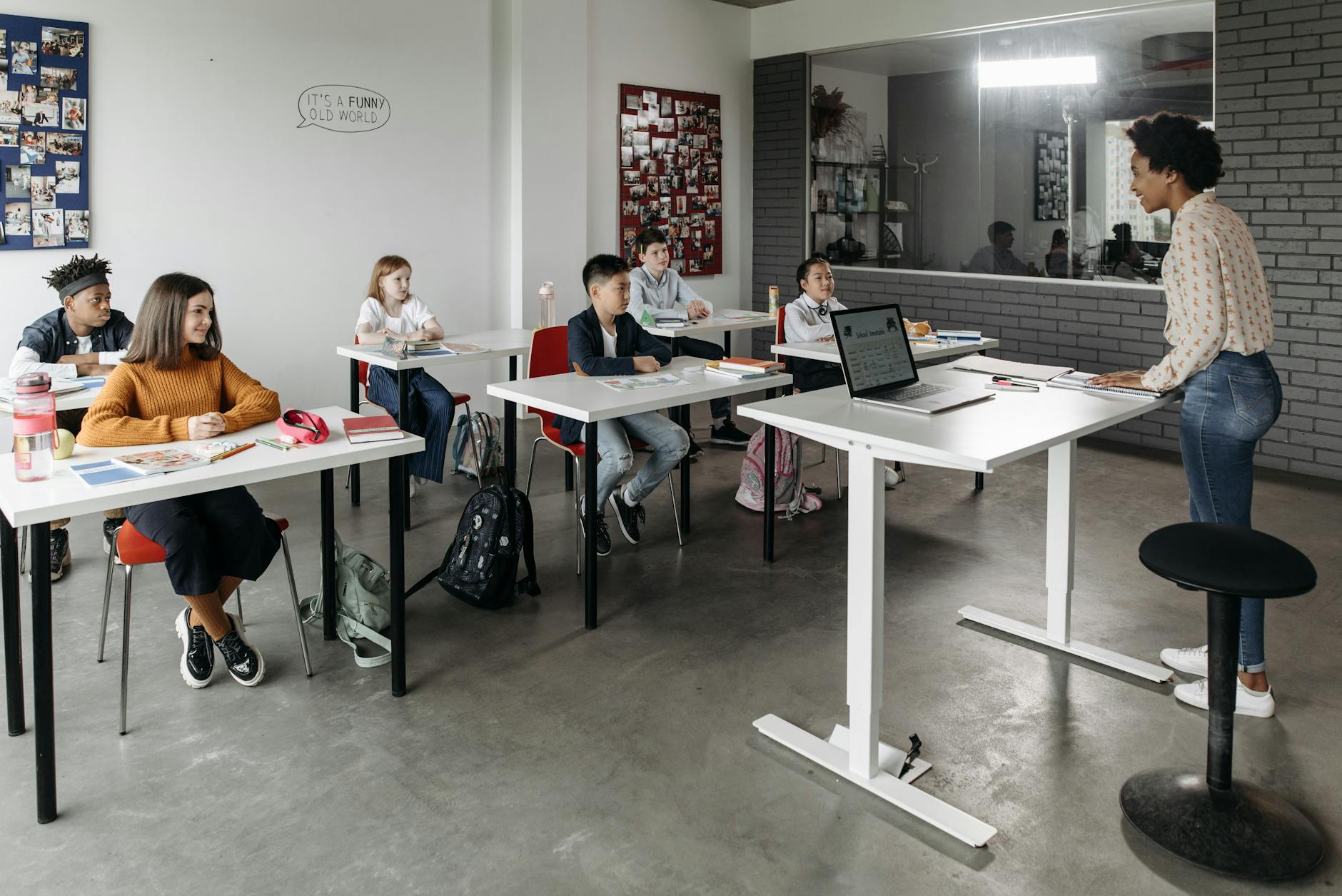
Differentiate the learning environment by offering flexible seating options such as wobble stools or standing desks, designated quiet zones for focused independent work, collaboration areas for peer discussion, and self-paced timelines with clear checkpoint deadlines to accommodate diverse sensory needs and processing speeds.
Your classroom layout sends a message before you speak. I learned this the hard way when I forced flexible seating on everyone and watched test scores drop. Now I offer choices, not mandates, because the physical space should match the learner, not the other way around.
Research on kinesthetic learning confirms what restless kids already know: movement helps some brains focus but fractures others. One student thinks better while bouncing; another loses the math problem entirely when a neighbor wobbles. This is why differentiated instruction examples in environment design require true choice rather than mandatory flexible seating implementation for all.
Know when to pull back. During standardized testing prep or the first weeks with a new class, traditional rows beat chaos. Flexible seating demands high behavioral expectations; without them, you get a playground. Costs vary: wobble cushions run $15-25, standing desk converters $50-100, or build crate seats for $10.
Flexible Seating Arrangements for Sensory Preferences
Match furniture to sensory needs. Not every body regulates the same way.
Wobble stools provide vestibular input.
Balance balls engage core muscles.
Standing desks allow movement without blocking sight lines.
Floor desks with cushions offer proprioceptive feedback.
Traditional chairs provide stable boundaries for those who need them.
Run a trial month. Students test each option for one week, then apply for preferred seating with a behavior contract. I approve based on focus demonstrated during trials.
When chaos hits, implement a Reset Day. Return to traditional rows for 48 hours, reteach expectations, then reintroduce choice.
Quiet Focus Zones vs. Collaboration Spaces
Design distinct areas for different learning modalities. My library corner uses single carrels facing walls for deep work. Seminar tables seat four for discussion, while bean bags support relaxed reading.
Standing bars accommodate pairs who think on their feet.
This effective classroom design and learning zones strategy respects diverse needs.
Manage zones visually. Red cups on desks signal focus mode—no talking. Green cups invite collaboration. I also adjust lighting: bright for work, lamps for reading.
Students use non-verbal signals to request zone changes. A specific chime signals transition, giving thirty seconds to relocate.
Self-Paced Timelines with Checkpoint Milestones
Build a playlist model using Google Slides with Must Do and May Do columns. Students progress through scaffolded instruction at their own pace within unit boundaries. Suggested timelines keep them on track without rigid lockstep.
Lock progress behind formative assessment. Every three lessons, students conference with me for five minutes to show mastery before unlocking the next module. This prevents rushing and supports product differentiation.
Clear checkpoint deadlines prevent no-pacing. Interest-based learning activities wait in the May Do column for early finishers, while I pull small groups for reteaching at required checkpoints.
How to Introduce These Examples Without Losing Control?
Introduce differentiation by starting with one content area and one strategy—such as tiered math assignments—establish clear routines and anchor activities for independent workers, use recent formative assessment data to form initial groups, and gradually layer additional complexity over 4-6 weeks rather than implementing everything simultaneously.
Differentiation fails when you try to rebuild your entire classroom in one weekend. I learned this the hard way during my third year, when I attempted tiered assignments in every subject simultaneously. Start small, or you won't start at all.
Week 1: Teach routines only.
Weeks 2-3: One strategy in one subject.
Weeks 4-5: Add a second strategy.
Week 6+: Full implementation.
Attempting to differentiate all subjects simultaneously leads to teacher burnout and chaotic classrooms. I tried this my third year and abandoned differentiation entirely by October. Pilot one subject, prove the system works, then expand.
Apply the 70-30 rule to your formative assessment data. If seventy percent or more of your students mastered yesterday's objective, proceed with tiered enrichment. If fewer than seventy percent mastered the content, stop and reteach the whole group before attempting small-group differentiation. Teaching differentiated lessons to kids who don't understand the baseline concept wastes everyone's time.
Start with One Content Area to Build Systems
Select your pilot subject based on urgency, not comfort. I chose math because my 4th graders showed a three-year readiness level spread, not because I enjoyed teaching it. Avoid piloting in your favorite subject. Begin with Tiered Assignments before Choice Boards; wait until Week 4 to introduce interest-based learning or product differentiation. Early choice without routines invites chaos.
Pilot for exactly three weeks—fifteen instructional days—to build student muscle memory. Schedule a reflection meeting on Day 15 to assess whether your scaffolded instruction layers are appropriate before expanding.
Use Data to Form Groups Efficiently
Stop guessing where kids belong. I started using data to form groups efficiently by grading exit tickets immediately and forming tomorrow's groups before leaving school. Formative.com auto-grades students, while Running Records or NWEA MAP provide benchmarks.
Use colored dot stickers on folders—red for Tier 1, yellow for Tier 2, green for Tier 3—so students sort themselves in forty seconds. Regroup every ten instructional days based on new formative assessment data. Never maintain static groups for an entire quarter; they become tracks that limit growth.
Create Anchor Activities for Independent Workers
Anchor activities keep early finishers silent while you conduct small-group reteaching. Build these into your classroom control and management strategies from Week 1.
Logic puzzles such as Sudoku or KenKen.
Extension menus with above-grade-level options.
Silent reading with written response journals.
Academic vocabulary pages for visual learning modalities.
Enforce a behavioral contract: anchor activities must be silent and solo. If students disturb others, they lose choice privileges for three days and receive traditional worksheets instead. This teaches that independent work is a privilege earned through self-regulation.

Is Differentiated Instruction Examples Right for Your Students?
Yes. But you don't need all fifteen tomorrow. Pick one differentiated instruction example that matches your next unit—maybe tiered assignments if you’re teaching fractions to mixed readiness levels, or choice boards if you want students showing mastery through different learning modalities. Start small. The goal isn't perfection; it's giving more kids access to the same standard without adding three hours to your Sunday prep.
These examples work best when you know where students stand. A quick formative assessment at the door tells you whether to send a kid to the advanced station or the scaffolded instruction group. That data makes flexible grouping actually flexible instead of just shuffling names around. You’re not creating fifteen different lessons. You’re adjusting the path to one destination based on what you learned yesterday.
Control comes from clear routines, not identical tasks. When students know the expectations at each station or tier, they work independently while you circulate. Which single example from this list could you test during next week’s lesson—without rewriting your entire plan?
Tiered Assignments for Content Differentiation
Tiered assignments adjust complexity while holding standards constant. Carol Ann Tomlinson's framework means every student tackles the same essential question with materials matched to readiness. This isn't dumbing down. My 8th graders analyzed the Civil War through texts ranging from 800 to 1200+ Lexile, all building valid historical arguments.
Tier | Student Profile | Complexity Level | Support Structure |
|---|---|---|---|
Foundational | Below grade level readiness | Prerequisite skills with scaffolding | Vocabulary glossaries, sentence frames, graphic organizers |
Grade-Level | On-track readiness | Standard curricular expectations | Standard text complexity, grade-appropriate problems |
Advanced | Above grade level readiness | Complex application and synthesis | Abstract concepts, independent research, peer teaching roles |
Research shows tiered instruction improves achievement when based on formative data, not static labels. I use three days of exit tickets before placing students. Kids move between tiers as readiness levels shift.
Never exceed three tiers. I tried four once while implementing this comprehensive guide to differentiated instruction approach. The planning load crushed me. Ten levels becomes unmanageable. Three maintains clarity and sanity.
Leveled Reading Passages with Common Themes
During our Civil War unit last October, I assigned three versions of primary source analysis targeting the same essential question: "What factors drive civil conflict?" The Lexile bands matched readiness without altering the historical thinking skill.
Tier 1 (800-900L) featured adapted primary sources with embedded vocabulary glossaries. Students read a simplified version of Lincoln's Second Inaugural with modernized syntax. Tier 2 (1000-1100L) used the original speech excerpt with academic footnotes. Tier 3 (1200L+) presented a historiographical debate between two scholars arguing about economic versus moral causes of the war.
Each tier addressed identical themes through paired texts:
Tier 1: Adapted diary entry from a Confederate soldier plus textbook summary with graphic supports.
Tier 2: Original excerpt from Frederick Douglass's speech plus period newspaper editorial.
Tier 3: Academic journal article comparing Reconstruction interpretations plus primary economic data tables.
Maintain conceptual alignment by keeping the essential question identical across all levels. Adjust only linguistic complexity and background knowledge requirements.
Math Problem Sets with Varying Complexity Tiers
I use the Depth of Knowledge framework to structure math problem sets with varying complexity in my 7th-grade classroom. The tiers correspond to cognitive demand rather than just difficulty.
Tier 1 targets DOK 1-2: procedural calculation with clear steps. Tier 2 hits DOK 2-3: multi-step application requiring strategy selection. Tier 3 demands DOK 3-4: strategic modeling and justification. When we studied ratios, Tier 1 students calculated unit prices from a restaurant menu. Tier 2 compared best buys across three stores including sales tax calculations. Tier 3 designed a budget-constrained catering plan for our actual school dance, justifying their constraints and mathematical models.
My decision rule comes from formative assessment data. If 70% or more students miss the standard problem on a warm-up, I create Tier 1 reteach focusing on prerequisite skills. If 70% demonstrate mastery, I develop Tier 3 extension tasks. That middle group gets the grade-level tier.
This approach exemplifies effective scaffolded instruction that respects student starting points.
Science Inquiry Levels from Structured to Open-Ended
Science differentiation works best along a continuum of student autonomy. I frame labs as Structured Inquiry (recipe provided), Guided Inquiry (partial procedure), or Open Inquiry (student-designed investigation).
For our Newton's Second Law unit with carts and weights, the tiers looked like this. Structured Inquiry students received a fill-in-the-blank data table and step-by-step procedure. Guided Inquiry groups chose three variables from my provided list to test independently. Open Inquiry partners designed investigations to determine optimal mass for specific acceleration targets, then justified their experimental controls and error analysis methods.
Safety protocols matter here. Before students can attempt Open Inquiry physics experiments, they must complete explicit lab safety certification. I require demonstrated proficiency with equipment handling and emergency procedures. No student designs independent experiments involving projectile motion or chemical reactions without that certification.
These differentiated instruction examples in the classroom show how product differentiation and process flexibility create authentic scientific thinking for every readiness level.
Learning Stations That Support Multiple Processes
I run my stations on the Daily 5 model. Twelve to fifteen minutes per rotation, never more than four stations total. Anything longer and 3rd graders check out; anything shorter and they spend more time transitioning than working. You need a hard count: six Chromebooks minimum for any digital station, headphones for listening work, and space for kids to spread out.
Before you launch, run this checklist:
Does every station produce something I can glance at to prove they worked?
Is one station teacher-led for scaffolded instruction? John Hattie's Visible Learning puts small-group instruction at an effect size of 0.59.
Are hardware minimums met—six devices plus headphones?
The biggest failure I see? Stations without exit tickets. Kids know when work won't be checked. They doodle. Every station needs a product.
Multiple Intelligence Rotation Stations
I build these around four of Gardner's intelligences:
Logical-Mathematical
Spatial
Interpersonal
Bodily-Kinesthetic
Last October, my 5th graders rotated through Ecosystems stations. Station 1 calculated biomass percentages using real data from our butterfly garden. Station 2 built 3D food web dioramas from shoe boxes and yarn. Station 3 negotiated predator-prey relationships through role-play. Station 4 simulated pollination by having students "fly" around the room with cotton balls on their knees to transfer pollen.
Kids carry a quarter-sheet checklist with four empty boxes. They self-rotate when done, but they cannot repeat a station until all four are visited. This prevents the "easy station" rush and forces engagement with all learning modalities.
Technology-Integrated Digital Stations
For digital work, I place six devices at Station 2. Students scan QR codes linking to teacher-curated playlists. I differentiate by readiness levels: Red group gets remediation, Blue gets grade-level, Green gets enrichment. These learning stations that work depend on specific tools:
IXL for adaptive practice
Khan Academy for video support
Nearpod for draw-it responses
Flipgrid for video reflection
IXL handles the differentiated learning activities automatically. Miss two problems, difficulty drops. This is differentiated instruction examples at work without me managing fifty assignments. Headphones are non-negotiable—one video without sound derails the room.
Teacher-Led Small Group Mini-Lessons
This is where the magic happens, but only with four to six students max. I form groups by yesterday's exit ticket—anyone below 80% mastery—or by Fountas & Pinnell levels. The structure is rigid:
Ten minutes direct reteach
Five minutes guided practice with whiteboards
Five minutes independent check (three problems)
I document on a tri-fold anecdotal notes template with three columns: Student Name, Specific Misconception, Next Step Action. While I run this station, the other three operate on autopilot. That only works because I spent September teaching the formative assessment routines and integrating technology into your digital stations so kids know exactly what "done" looks like.
Choice Boards for Student-Driven Products
Choice boards target learning preference, not readiness levels. A student who struggles with reading can still show mastery through video; scaffolded instruction happens during research, not during format selection. I use a 9-square Tic-Tac-Toe grid where kids pick three in a row. This prevents three easy crafts. Every option assesses the same objective using identical criteria—claim-evidence-reasoning works whether the output is a poster or a podcast. That's product differentiation. Boards cost nothing with paper or Google Slides, but budget $50–$100 for clay or stop-motion apps if you go multimedia.
Tic-Tac-Toe Menu for Unit Projects
The center square is your anchor—the non-negotiable complex task everyone completes. In my Cells unit, that center square is the formal lab report. The surrounding eight squares offer differentiated activities in the classroom that vary by learning modalities.
Top row options: build a 3D organelle model for spatial learners, write a children's book explaining mitosis for verbal learners, or compose a rap about cell transport for musical-rhythmic kids. Middle row flanks the lab report anchor with a comparison chart and debate prep. Bottom row: stop-motion video using the iMotion app, a cooking analogy essay comparing recipes to metabolic processes, and a microscope skills demonstration video.
Students must pick three in a row—horizontal, vertical, or diagonal. My rule: one choice must be "Create" and another "Analyze" from Bloom's Taxonomy. This guarantees they aren't just drawing pictures. Last fall, my 7th graders griped about the diagonal rule until they realized the bottom-left video project forced them to explain osmosis deeper than a worksheet ever could.
RAFT Writing Assignments with Varied Formats
RAFT stands for Role, Audience, Format, Topic. It is one of my go-to examples of differentiated activities in the classroom because it keeps the historical thinking constant while letting kids pick their voice.
For our American Revolution unit, I offer four RAFT options. Option A: Role of Merchant, Audience British Parliament, Format complaint letter, Topic taxation without representation. Option B: Role Patriot, Audience undecided colonists, Format pamphlet, Topic independence. Option C: Role modern journalist, Audience students, Format podcast script, Topic causes. Option D: Role Loyalist, Audience King George, Format diary entry, Topic colonial unrest.
Every option must use five terms—tariff, boycott, representation, liberty, treason—in context. I check this during formative assessment conferences before final submission. The kid who picked the Loyalist diary last year wrote three pages about treason; the same student had failed the previous essay on the exact same content.
Multimedia Presentation Options Beyond Essays
Not every student-driven products and projects needs to be a five-paragraph essay. I offer five formats:
Record a TED-style talk as a 3-minute Flipgrid video.
Design an infographic using Canva templates.
Build a stop-motion animation with the iMotion app.
Create an interactive timeline via TimelineJS or poster paper.
Write a traditional research paper in Google Docs.
These differentiated instruction examples vary by interest-based learning, not skill level. Every format requires the same bones: a thesis statement, three supporting evidence pieces with citations, and a conclusion. The process is scaffolded identically; only the output changes. The kid who picks stop-motion still needs to write a script that meets those criteria.
I assess with one rubric for all: Content Accuracy (40%), Argument Quality (40%), and Presentation Clarity (20%). Whether they submit a video or a paper, I measure the thinking, not the tech skills. Last semester, my weakest writer produced a timeline that showed clearer causation than any essay she'd ever drafted.
What Are the Best Flexible Grouping Strategies?
The best flexible grouping strategies combine homogeneous groups for targeted skill intervention based on recent formative assessment data with heterogeneous groups for complex collaborative tasks. Rotate students every 2-3 weeks rather than keeping static groups. This prevents the negative effects of tracking while maintaining high expectations for all learners.
Static groups kill momentum. I learned this the hard way when I kept my "red birds" together for six weeks and watched their confidence crater.
Homogeneous (Targeted Intervention) | Heterogeneous (Complex Tasks) | Interest-Based (Engagement) |
|---|---|---|
Purpose: Close specific skill gaps identified through data | Purpose: Leverage diverse perspectives for complex problems | Purpose: Increase motivation via student choice |
Duration: 20-30 minutes, 2-3 times weekly | Duration: Project-based, 3-5 days | Duration: Unit-long, 2-3 weeks |
Group Size: 3-4 students | Group Size: 4-5 mixed readiness levels | Group Size: 4-5 shared interests |
Data Source: Exit tickets, Fountas & Pinnell, MAP RIT | Data Source: Deliberate ability diversity | Data Source: Student interest surveys |
Research consistently shows that flexible grouping—changing compositions every few weeks based on formative data—produces achievement gains without the stigma of permanent tracking. Static ability grouping, by contrast, widens achievement gaps over time. The critical difference is mobility: students must see these groups as temporary pit stops, not permanent destinations.
Leave groups unchanged past three weeks and you have created tracking by another name. I mark my calendar with rotation dates before I assign the first groups. When kids stay put too long, labels stick. "Low group" becomes an identity rather than a temporary placement. Rotation signals that growth is expected and possible.
Homogeneous Skill-Based Groups for Targeted Intervention
I pull homogeneous groups when my exit ticket data shows three kids still confusing area and perimeter while the rest of the class moves forward. We meet at the kidney table for twenty minutes while others work on extension problems. These sessions happen two or three times weekly, never consuming the entire literacy or math block.
My data sources vary by urgency and subject:
Reading: Fountas & Pinnell Benchmarks or NWEA MAP Growth RIT bands
Math: Yesterday's exit ticket (80% mastery threshold)
Ongoing: Weekly running records or fact fluency probes
Exit criteria must be concrete. Students leave the group when they hit 80% on two consecutive formative assessments, typically every ten instructional days. This keeps the pipeline moving and prevents the stagnation that creates self-fulfilling prophecies. These targeted sessions serve as practical examples of differentiated instruction in the classroom that respect student time.
Heterogeneous Mixed-Ability Collaborative Teams
Complex tasks demand heterogeneous groups structured like a good sports team—mixed readiness levels working toward one goal. I use the Complex Instruction model or Jigsaw method, placing four to five students together deliberately: one high, two middle, one low, and one variable performer.
Assigned roles rotate daily to prevent dominance by the highest reader:
Facilitator: Manages discussion (not necessarily the strongest student)
Materials Manager: Distributes and collects resources
Timekeeper: Monitors pacing and deadlines
Recorder: Documents group thinking and decisions
Reporter: Shares findings with the class
The tasks must be ill-structured problems requiring multiple perspectives and different learning modalities. Last month, my fourth graders designed sustainable city blocks, combining math budgeting, science energy concepts, social studies zoning laws, and art design principles. These strategies for mixed-ability classrooms ensure high expectations for all readiness levels.
Student-Selected Interest-Based Partnerships
Sometimes I let students choose their own teams through interest-based learning surveys to boost engagement in research units. They rank Ancient Egypt, Greece, or Rome, or select mystery versus historical fiction genres via Google Form. I form groups of four to five based on these preferences, not reading levels.
I reserve veto power when social pairing overrides learning:
Friends who drift to social topics within the first ten minutes
Students who select topics far below their capability level
Groups that create exclusion or social conflict
Literature circles demonstrate this perfectly. Students rank their top three book choices; I place them in groups where all titles share similar complexity but different topics. Everyone reads at grade level while exploring personal passions. This approach represents authentic product differentiation driven by student passion rather than ability sorting.
How Can You Differentiate by Learning Environment?
Differentiate the learning environment by offering flexible seating options such as wobble stools or standing desks, designated quiet zones for focused independent work, collaboration areas for peer discussion, and self-paced timelines with clear checkpoint deadlines to accommodate diverse sensory needs and processing speeds.
Your classroom layout sends a message before you speak. I learned this the hard way when I forced flexible seating on everyone and watched test scores drop. Now I offer choices, not mandates, because the physical space should match the learner, not the other way around.
Research on kinesthetic learning confirms what restless kids already know: movement helps some brains focus but fractures others. One student thinks better while bouncing; another loses the math problem entirely when a neighbor wobbles. This is why differentiated instruction examples in environment design require true choice rather than mandatory flexible seating implementation for all.
Know when to pull back. During standardized testing prep or the first weeks with a new class, traditional rows beat chaos. Flexible seating demands high behavioral expectations; without them, you get a playground. Costs vary: wobble cushions run $15-25, standing desk converters $50-100, or build crate seats for $10.
Flexible Seating Arrangements for Sensory Preferences
Match furniture to sensory needs. Not every body regulates the same way.
Wobble stools provide vestibular input.
Balance balls engage core muscles.
Standing desks allow movement without blocking sight lines.
Floor desks with cushions offer proprioceptive feedback.
Traditional chairs provide stable boundaries for those who need them.
Run a trial month. Students test each option for one week, then apply for preferred seating with a behavior contract. I approve based on focus demonstrated during trials.
When chaos hits, implement a Reset Day. Return to traditional rows for 48 hours, reteach expectations, then reintroduce choice.
Quiet Focus Zones vs. Collaboration Spaces
Design distinct areas for different learning modalities. My library corner uses single carrels facing walls for deep work. Seminar tables seat four for discussion, while bean bags support relaxed reading.
Standing bars accommodate pairs who think on their feet.
This effective classroom design and learning zones strategy respects diverse needs.
Manage zones visually. Red cups on desks signal focus mode—no talking. Green cups invite collaboration. I also adjust lighting: bright for work, lamps for reading.
Students use non-verbal signals to request zone changes. A specific chime signals transition, giving thirty seconds to relocate.
Self-Paced Timelines with Checkpoint Milestones
Build a playlist model using Google Slides with Must Do and May Do columns. Students progress through scaffolded instruction at their own pace within unit boundaries. Suggested timelines keep them on track without rigid lockstep.
Lock progress behind formative assessment. Every three lessons, students conference with me for five minutes to show mastery before unlocking the next module. This prevents rushing and supports product differentiation.
Clear checkpoint deadlines prevent no-pacing. Interest-based learning activities wait in the May Do column for early finishers, while I pull small groups for reteaching at required checkpoints.
How to Introduce These Examples Without Losing Control?
Introduce differentiation by starting with one content area and one strategy—such as tiered math assignments—establish clear routines and anchor activities for independent workers, use recent formative assessment data to form initial groups, and gradually layer additional complexity over 4-6 weeks rather than implementing everything simultaneously.
Differentiation fails when you try to rebuild your entire classroom in one weekend. I learned this the hard way during my third year, when I attempted tiered assignments in every subject simultaneously. Start small, or you won't start at all.
Week 1: Teach routines only.
Weeks 2-3: One strategy in one subject.
Weeks 4-5: Add a second strategy.
Week 6+: Full implementation.
Attempting to differentiate all subjects simultaneously leads to teacher burnout and chaotic classrooms. I tried this my third year and abandoned differentiation entirely by October. Pilot one subject, prove the system works, then expand.
Apply the 70-30 rule to your formative assessment data. If seventy percent or more of your students mastered yesterday's objective, proceed with tiered enrichment. If fewer than seventy percent mastered the content, stop and reteach the whole group before attempting small-group differentiation. Teaching differentiated lessons to kids who don't understand the baseline concept wastes everyone's time.
Start with One Content Area to Build Systems
Select your pilot subject based on urgency, not comfort. I chose math because my 4th graders showed a three-year readiness level spread, not because I enjoyed teaching it. Avoid piloting in your favorite subject. Begin with Tiered Assignments before Choice Boards; wait until Week 4 to introduce interest-based learning or product differentiation. Early choice without routines invites chaos.
Pilot for exactly three weeks—fifteen instructional days—to build student muscle memory. Schedule a reflection meeting on Day 15 to assess whether your scaffolded instruction layers are appropriate before expanding.
Use Data to Form Groups Efficiently
Stop guessing where kids belong. I started using data to form groups efficiently by grading exit tickets immediately and forming tomorrow's groups before leaving school. Formative.com auto-grades students, while Running Records or NWEA MAP provide benchmarks.
Use colored dot stickers on folders—red for Tier 1, yellow for Tier 2, green for Tier 3—so students sort themselves in forty seconds. Regroup every ten instructional days based on new formative assessment data. Never maintain static groups for an entire quarter; they become tracks that limit growth.
Create Anchor Activities for Independent Workers
Anchor activities keep early finishers silent while you conduct small-group reteaching. Build these into your classroom control and management strategies from Week 1.
Logic puzzles such as Sudoku or KenKen.
Extension menus with above-grade-level options.
Silent reading with written response journals.
Academic vocabulary pages for visual learning modalities.
Enforce a behavioral contract: anchor activities must be silent and solo. If students disturb others, they lose choice privileges for three days and receive traditional worksheets instead. This teaches that independent work is a privilege earned through self-regulation.
Is Differentiated Instruction Examples Right for Your Students?
Yes. But you don't need all fifteen tomorrow. Pick one differentiated instruction example that matches your next unit—maybe tiered assignments if you’re teaching fractions to mixed readiness levels, or choice boards if you want students showing mastery through different learning modalities. Start small. The goal isn't perfection; it's giving more kids access to the same standard without adding three hours to your Sunday prep.
These examples work best when you know where students stand. A quick formative assessment at the door tells you whether to send a kid to the advanced station or the scaffolded instruction group. That data makes flexible grouping actually flexible instead of just shuffling names around. You’re not creating fifteen different lessons. You’re adjusting the path to one destination based on what you learned yesterday.
Control comes from clear routines, not identical tasks. When students know the expectations at each station or tier, they work independently while you circulate. Which single example from this list could you test during next week’s lesson—without rewriting your entire plan?
Still grading everything by hand?
EMStudio is a free teaching management app — manage your classes, students, lessons, and more!
Learn More
Still grading everything by hand?
EMStudio is a free teaching management app — manage your classes, students, lessons, and more!
Learn More





Notion4Teachers
Notion templates to simplify administrative tasks and enhance your teaching experience.



2026 Notion4Teachers. All Rights Reserved.
Notion4Teachers
Notion templates to simplify administrative tasks and enhance your teaching experience.
2026 Notion4Teachers. All Rights Reserved.
Notion4Teachers
Notion templates to simplify administrative tasks and enhance your teaching experience.
2026 Notion4Teachers. All Rights Reserved.