
Differentiated Instruction in Education: Complete Guide
Differentiated Instruction in Education: Complete Guide

Article by
Milo
ESL Content Coordinator & Educator
ESL Content Coordinator & Educator
All Posts
You’ve got the kid who finished the worksheet in three minutes and the one staring at question one like it’s written in code. Same lesson. Same directions. Totally different readiness levels. That gap is why you’re here. Differentiated instruction in education isn’t another buzzword your principal threw at you during PD—it’s the answer to teaching the actual humans in your room instead of teaching to the middle and hoping for the best.
Carol Ann Tomlinson figured this out decades ago. You don’t need thirty separate lesson plans. You need four levers: content, process, product, and environment. This guide cuts through the theory and shows you how flexible grouping, tiered assignments, and quick formative assessment loops can keep every student moving forward without you working until midnight.
Still grading everything by hand?
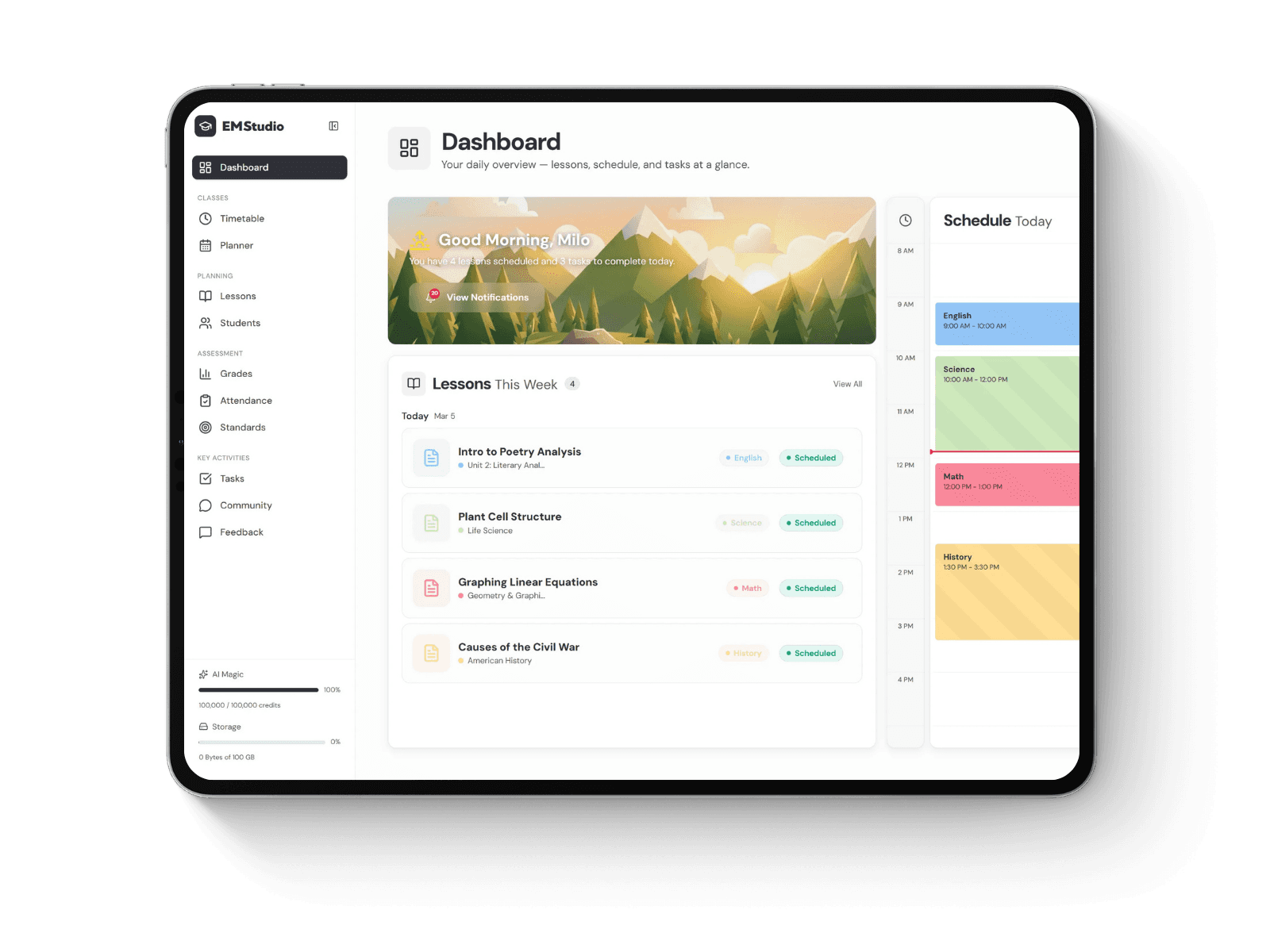
EMStudio is a free teaching management app — manage your classes, students, lessons, and more!
Learn More
Still grading everything by hand?
EMStudio is a free teaching management app — manage your classes, students, lessons, and more!
Learn More
Table of Contents
What Is Differentiated Instruction in Education?
Differentiated instruction is a proactive teaching framework where you modify content, process, products, and learning environment based on student readiness, interests, and learning profiles. Carol Ann Tomlinson developed this approach at the University of Virginia, and she's the leading differentiated instruction proponent you'll hear cited at every PD session. The differentiated instruction meaning is straightforward: you plan multiple pathways to the same learning goal instead of teaching one lesson to the middle and hoping for the best.
This isn't tracking. Tracking splits kids into permanent groups based on past performance, often sticking struggling learners in dead-end classes while advanced kids get the rich curriculum. Differentiation keeps everyone in the same heterogeneous classroom. You adjust the scaffolds and the route, not the destination or the room assignment.
The theory matters because the numbers are stubborn. About one in five students in your classroom has a learning or attention difference. That's four or five kids on a typical roster of 25 who won't respond to uniform instruction. When you ignore that 20%, you lose them.
The Four Core Elements: Content, Process, Product, and Environment
Tomlinson's differentiated instruction theory breaks down into four levers you can pull. Content is what you teach. You might offer tiered texts on the same science topic—Lexile 600 for kids reading below grade level, 900 for on-level readers, and 1200 for advanced learners. Or you use curriculum compacting for gifted students, cutting out the 40-50% of material they've already mastered so they don't spend three weeks reviewing fractions they understood in second grade.
Process is how students access the learning. I run learning stations—four rotations, fifteen minutes each—where kids move through different activities targeting the same skill. Flexible grouping shifts daily based on yesterday's exit ticket: pairs for peer tutoring, triads for discussion, whole class for mini-lessons. When I assign RAFT tasks, students choose from options like these:
Writing a letter from a mitochondria to a cell wall complaining about energy production
Drafting a newspaper article interviewing chloroplasts about photosynthesis
Composing a diary entry from the perspective of water vapor during evaporation
Product is how students demonstrate mastery. I use choice boards structured as a nine-square grid with three difficulty tiers. Students pick three tasks in a row—maybe creating a podcast, building a diorama, or writing an analytical essay. Tiered rubrics spell out what "meeting standard" looks like for different readiness levels, but everyone works toward grade-level expectations. The struggling writer uses sentence frames while the advanced student pulls evidence from multiple sources, but both prove they understand the theme. Environment matters too—quiet corners for kids who need reduced stimulation, standing desks for fidgeters, or headphones for independent work.
Differentiation Versus Tracking and Individualized Instruction
Tracking sticks kids in boxes. If you're in the "low" reading group in October, you're probably there in May. Teachers often lower expectations for these groups, assigning worksheets while the "high" group does inquiry projects. Differentiation is fluid. You shift groups based on formative assessment data from yesterday's exit ticket, not last year's state test. The expectations stay high for everyone; only the scaffolds change.
Individualized instruction is different too. That's the 1:1 IEP world—separate goals, separate lesson plans, often a separate room or pull-out setting. Differentiated instruction in education happens in general education classrooms with 25 to 30 students. You don't write 30 separate lesson plans. You design two or three strategic variants of the same lesson and let learning profiles guide who needs which version. It's sustainable. It's also tied to evidence-based learning styles and preferences, though you focus on documented student data rather than debunked theories about visual versus auditory learners.

Why Does Differentiated Instruction Matter in Modern Classrooms?
Differentiated instruction matters because modern classrooms contain students with up to 8 years of reading level variance and diverse learning needs. Research indicates that responsive instruction improves engagement and achievement for all learners, particularly the 1 in 5 students with learning differences, while meeting legal inclusion mandates.
Walk into any 7th grade ELA room. You'll find kids reading at a 4th grade level sitting next to kids ready for 10th grade material. This isn't the exception—it's the norm. Research consistently shows that same-grade classrooms typically span 5 to 8 years of reading ability. When you teach to the middle, you miss both ends. The advanced kids check out. The struggling kids drown. Carol Ann Tomlinson, who pioneered much of this work, notes that ignoring these readiness levels is essentially teaching through a bullhorn in a library—ineffective and frustrating for everyone.
John Hattie's meta-analysis gives us hard numbers on why differentiation works. He found that teacher estimates of student achievement—how well you know your kids through formative assessment—carry an effect size of 1.62. That's among the highest influences on learning he measured, nearly double the impact of most curriculum interventions. When you use a differentiated instruction approach, you're acting on that knowledge daily. You're not guessing who needs what; you're building tiered assignments based on actual data rather than hope.
Then there's the legal reality. Most students with disabilities now spend 80% or more of their day in general education settings. This isn't a trend—it's federal mandate under IDEIA. You can't send kids to the resource room for the hard stuff anymore. Differentiated instruction in education has shifted from nice-to-have to legally required accommodation. If your lesson plan shows one entry point for everyone, you're not meeting inclusion standards. I've sat in IEP meetings where administrators specifically asked how I was modifying content, process, and product. They wanted evidence of flexible grouping and varied learning profiles, not just "I help them when they raise their hand."
Yes, it takes more time upfront. Count on 2 to 3 extra hours of planning weekly when you start. That means designing three versions of an exit ticket or finding multiple texts on the same topic. But here's what surprised me: I got that time back. When lessons match learning profiles, you spend less time reteaching and managing behavior. I recovered 30 to 45 minutes daily previously lost to redirecting kids who were either bored or lost. The math works.
The payoff shows up in concrete ways:
Fewer interruptions during independent work because students have appropriately challenging tasks
Higher completion rates on assignments because you're using flexible grouping to target support
Less paperwork for interventions since you're catching gaps in real time through formative assessment
Reduced behavior issues stemming from frustration or boredom
Differentiated education isn't charity work for struggling students. It's the only practical way to teach a group of humans who happen to share a birth year but little else academically. You either design for variance, or you fight it daily. I've done both. Designing for it wins.

How Differentiated Instruction Works: The Four Classroom Elements
You don't need 30 separate lesson plans to run a differentiated classroom. Carol Ann Tomlinson's framework gives you four adjustable elements—content, process, product, and environment—to modify based on readiness levels, interest, and learning profiles. Think of it as tuning a guitar, not building a new one from scratch.
But watch out for three traps. First, don't differentiate only for struggling learners; the top 10-15% of your class will check out if you ignore them. Second, never give early finishers "busy work" like extra worksheets—extensions should push thinking deeper, not just keep them quiet. Third, grouping kids at tables isn't differentiation unless each group has a targeted task. Differentiated instruction in education fails when it becomes decoration instead of design.
Content Differentiation Based on Readiness and Interest
Start with the Curriculum Ladder method. Pinpoint the essential standard—say, cell division for 9th grade biology—then build three entry points rather than teaching to the middle. Same standard, different stairs.
Tier 1: Picture books analogizing mitosis to building construction, focusing on vocabulary acquisition and basic sequencing
Tier 2: Standard textbook with guided notes and embedded comprehension checks
Tier 3: Peer-reviewed journal articles on cancer cell mutations with academic summaries comparing research to textbook theory
You teach one mini-lesson to Tier 1 on reading strategies, another to Tier 3 on academic citation, while Tier 2 works independently.
For students who already know the material, use curriculum compacting. Give a five-item quick check on Monday morning covering the week's prerequisite skills. Anyone scoring 80% or higher skips the introduction and direct instruction for those objectives. Instead, they sign an independent study contract exploring extension topics like stem cell research or CRISPR technology. This serves your top 10-15% of the class without holding them hostage to review they've already mastered. You can track these contracts and tiered assignments using digital tools to support differentiated instruction strategies to keep the paperwork from burying you.
The key is formative assessment. You can't differentiate content if you don't know where kids start. A three-question exit ticket from yesterday tells you more than last year's standardized scores ever will.
Process Differentiation for Learning Preferences and Profiles
Flexible grouping keeps process differentiation manageable without creating chaos. Try a Station Rotation with four stops: teacher-led instruction at the front table, collaborative work at lab stations, independent practice at desks, and technology using tablets or computers. Run 12-minute rotations with groups of six or seven students formed using readiness data from yesterday's exit ticket. One group might work with you on fraction decomposition while another watches a video tutorial and a third tackles word problems at the collaborative table. The groups shift every two weeks based on new assessment data, so kids know the groupings are about learning needs, not ability labels.
Vary your discussion structures based on task complexity. Use Think-Pair-Square—pairs joining another pair to form a quad—when problems have multiple solution paths, like open-ended engineering challenges or complex text analysis. Use Silent Conversation, where students write responses on chart paper without speaking, for reflective questions about character motivation or ethical dilemmas. The writing slows down the thinkers who usually dominate verbally, and the quiet supports kids who need processing time before sharing.
Don't randomize these groups or keep them static. Grouping by learning profiles or readiness keeps the work appropriately challenging rather than just social. A kinesthetic learner doing hands-on measurement needs different partners than an analytical learner working through equations.
Product Differentiation for Varied Demonstrations of Learning
Choice boards let students show what they know without you grading 30 identical essays that make you want to retire. Design a tic-tac-toe board for 5th grade book reports with three columns representing modalities—visual, kinesthetic, and written—and three rows representing complexity levels: basic, grade-level, and advanced. Students must pick one task from each row and column, ensuring they hit their preferred modality while still stretching their skills. A student might choose to draw a graphic novel panel depicting the climax (visual/basic), build a diorama showing the setting's historical context (kinesthetic/grade-level), and write a literary analysis comparing the protagonist to a modern figure (written/advanced). The constraints force them to confront challenge while honoring preference.
Build tiered expectations into your rubrics, not just the tasks themselves. Keep identical primary traits across all tiers—ideas, organization, conventions—but write different performance descriptors for each level. Tier 1 descriptors focus on completion with teacher support and sentence starters provided. Tier 2 expects grade-level independence with standard transitions. Tier 3 requires sophisticated synthesis, original connections to other texts, and nuanced thesis statements. The traits stay constant so you're measuring the same learning goals, but the expectations shift with readiness levels rather than changing the entire assignment.
Learning Environment and Affective Climate Modifications
The physical space matters as much as the lesson plan in a differentiated instruction method of teaching. Set up distinct zones with specific purposes based on task requirements and personal preference surveys you give at the start of the year.
Collaboration Cove: Four-person tables and whiteboard walls for group work and peer editing
Focus Fortress: Individual carrels with noise-reducing headphones for independent reading and testing
Flex Space: Floor cushions and lap desks for students who think better sprawled out or need to shift positions frequently
Some kids will always choose Collaboration Cove because they're extroverts; others will camp in Focus Fortress for three weeks straight. Check out these ideas for effective classroom design and learning zones.
Adjust the affective climate with visual cues that reduce interruption and anxiety. Post a Parking Lot poster near the door for off-topic questions that come up during instruction. Hang a Help Desk sign at a side table where students can request peer tutoring without stopping your small group lesson. Give each student three Break Cards per day—physical laminated cards they place on their desk when they need to step into the hallway for water or a two-minute breather. It lets them self-regulate without raising their hand to announce to 29 peers that they're struggling.
Environment differentiation recognizes that some kids need movement to think, others need silence, and most need different things on different days depending on what they're working on.

Practical Applications Across Subject Areas and Grade Levels
Differentiated instruction in education only works when you have specific moves ready for Tuesday morning. Theory is fine for Saturday reading, but when 28 kids walk in with five different IEPs and a gifted cluster, you need strategies matched to content and age. I've organized these by subject with prep times I actually clocked. Carol Ann Tomlinson's framework for readiness levels and learning profiles underpins all of this, but these are the differentiated instruction in the classroom translations that survive first period. Whether you are differentiating instruction in the regular classroom or a specialized setting, match the strategy to your actual class composition, not your ideal one.
Literacy and Language Arts Differentiation Strategies
For K-2 with heavy phonics needs or classes where 50%+ are English learners, guided reading is your anchor. Group kids by Fountas & Pinnell reading levels (A-Z), targeting 4-5 students per group. Meet for 20 minutes daily while the rest rotate through Daily 5 stations. Select texts where students read with 90-94% accuracy; below that is frustration, above is wasted time. Prep time: 45 minutes weekly to level texts.
Read to Self: Leveled book boxes A-Z
Word Work: Phonics sorts matching current skill
Listen to Reading: Audiobooks with physical books
Work on Writing: Sentence frames for responses
If your 6-8 roster includes a gifted cluster, literature circles scale better. Assign roles—Discussion Director, Vocabulary Enricher, Literary Luminary, Connector—but differentiate the role sheets. In 7th grade, my foundational group sequenced plot while the advanced group hunted symbolism in the same novel. Use Newsela for leveled articles and Flip for video responses when writing is a barrier. Prep time: 60 minutes to create tiered sheets, then they run for three weeks. Choose circles when you have six or fewer students reading far below grade level; if above 50%, return to guided reading.
Mathematics Differentiation for Diverse Problem Solvers
In 3-5 classrooms with wide computation gaps, the Concrete-Representational-Abstract (CRA) approach builds footing without leaving anyone behind. For 4th grade fractions, offer base-ten blocks (concrete), fraction drawings (representational), and algorithms (abstract). Let students move between stages based on daily "math sprint" formative assessment results—not by fixed groups, but by demonstrated readiness that day. This works when you have students counting on fingers alongside others ready for variables. Check our specialized math teacher resources for printable manipulatives. Prep time: 30 minutes to stage materials.
For 6-8 with mixed readiness, Menu Math offers choice without chaos. Create a 15-problem menu where students complete $10 worth:
Appetizers ($1): 5 review problems targeting prior gaps
Entrees ($2): 8 grade-level problems aligned to standards
Desserts ($3): 2 extension problems requiring proof
If your class has 50%+ IEPs requiring modified assignments, use Menu Math for natural tiered assignments; if most are grade-level with few interventions, CRA keeps the whole class on the same conceptual trajectory without different worksheets. Pair Menu Math with IXL for adaptive practice filling gaps identified in their work. Prep time: 90 minutes initial setup, 15 minutes weekly adjustments.
Science and Social Studies Inquiry-Based Differentiation
In 8th grade social studies with diverse reading levels spanning three or more years, the jigsaw method distributes expertise without dumbing down content. For a Civil War unit, form expert groups researching specific aspects at different text complexities:
Economics: Textbook excerpts, primary source letters, or academic articles
Military: Simplified battle summaries vs. complex logistical analysis
Social: Photo captions vs. diary entries from multiple perspectives
Then mix groups so each student teaches their specialty. This uses flexible grouping naturally. See our tools to transform history and social studies classrooms for primary source databases. Prep time: 2 hours to curate texts. Use this when reading levels span three or more years.
For 9-12 science with strong writers mixed with reluctant learners, RAFT writing differentiates product without different assignments. Assign Role (electron, molecule), Audience (atoms, humans), Format (letter, label), Topic (bonding, matter). Provide four options per dimension—basic like "water droplet" versus advanced like "catalyst enzyme." This works for classes with IEPs requiring reduced writing volume. If your roster includes a gifted cluster, RAFT lets them run; if students struggle with reading comprehension itself, jigsaw builds background better than creative writing. Prep time: 40 minutes to build the matrix.

Common Roadblocks and How to Overcome Them
Teachers tell me differentiated instruction in education sounds great until they picture prepping three separate lessons every night. That workload is a myth. Carol Ann Tomlinson's grid method changed my planning: draw a 3x3 grid with your lesson objective in the center. Down the left, list readiness levels (below, on, above). Across the top, list learning profiles (visual, auditory, kinesthetic). Fill each cell with slight variations of the same task. Once you master this template, prep drops to fifteen minutes per lesson.
Watch for differentiation drift. I did this my first year: I made three worksheets with identical math problems, printed on different colored paper. That's not differentiation; that's decoration. Real tiered assignments vary complexity using Bloom's Taxonomy. Your struggling group identifies character traits (remember/understand). Your on-level group compares two characters (apply/analyze). Your advanced group evaluates whether the protagonist fits the hero's journey framework (evaluate/create). Same text, different cognitive load.
Know when to stop differentiating. Foundational skills requiring automaticity—multiplication tables, sight words—need identical practice until mastery. Don't invent three ways to memorize 7x8. All students need that fact automatic. Differentiate the application, not the memorization.
Managing Classroom Logistics and Instructional Time
Station rotation falls apart without tight timing. I project a Google Slides timer on my SmartBoard— fifteen minutes per station, two minutes for transition. The visual countdown keeps kids accountable without me playing traffic cop. I assign Station Captains for each table. They distribute materials at the start and check cleanup at the buzzer. That shift cut my management time by half and let me focus on my small group instead of hunting for missing scissors.
Your flexible grouping schedule needs guardrails. I meet with my struggling group daily, my on-level group three times weekly, and my advanced group twice weekly using independent contracts the other days. I track this on a clipboard checklist—simple boxes I mark with a pen. Without that visual tracker, I always over-serve the squeaky wheels and neglect the quiet advanced kids. These time management techniques for educators keep the rotation from consuming your planning period.
Addressing Administrator and Parent Concerns Effectively
Parents hear "different groups" and think "unfair." I send home a "Fair vs. Equal" one-pager at open house. It shows three kids of different heights trying to watch a baseball game over a fence. Equal treatment gives them identical boxes; only the tall kid sees the game. Fair treatment gives each kid what they need—one box, two boxes, three boxes—so everyone sees. I explain that materials might look different, but the goal is the same: grade-level mastery with appropriate support. Some request a differentiated instruction strategies pdf to study at home.
When administrators question why some kids get "easier" work, I bring formative assessment data. I show growth percentiles on pre/post assessments rather than grade-level comparisons. If a parent asks why their child is doing Tier 1 while a neighbor does Tier 3, I demonstrate how both require the same critical thinking. The Tier 1 student just has sentence starters. The complexity matches; the scaffolds differ. These conversations get easier when you focus on building strong relationships with parents early, before anyone panics about colored folders.

Your First Week Implementation Checklist
You won't rebuild your entire teaching practice in five days. Pick one subject. Pick one variable. Spend this week gathering baseline data and testing one small change with half your class while the other half serves as your control group. If you have readiness data for 100% of your students by Friday afternoon and you've executed two differentiated tasks successfully, you've won the week. That's the only success metric that matters right now. Everything else is extra.
Pre-Assessment Strategies to Identify Student Readiness
Day 1 is for data collection, not content coverage. Block 20 minutes to administer an Interest Survey with five Likert-scale questions targeting learning profiles—ask how they feel about group work, independent reading, or hands-on building activities. Follow it immediately with a Readiness Check: five questions that diagnose prior knowledge of your upcoming unit. These aren't graded. They're diagnostic. You need these readiness levels in your hands before you sleep tonight.
Score them during lunch. Project the answer key and have students self-check with colored pens, or scan bubble sheets with ZipGrade on your phone while you eat your sandwich. Don't wait until tomorrow. By Day 2 morning, you should see three distinct clusters emerging from the numbers.
Use KWL charts strategically during your lesson launch on Day 2. Hand them out and give students three silent minutes to fill the "Know" column. During your prep period, sort those responses into three piles:
Extensive knowledge: Detailed facts and specific vocabulary already mastered.
Some knowledge: Vague recognition or related concepts from previous years.
Minimal knowledge: Blank spaces or wild guesses indicating foundational gaps.
These piles become your initial flexible grouping clusters for the week. This approach beats any differentiated instruction in the classroom ppt you might download because the data comes from your actual students sitting in your actual classroom, not from generic templates designed for hypothetical learners.
Selecting Your First Differentiation Variable to Pilot
Look at your class spread on Tuesday morning. Use this decision matrix:
If diagnostic data shows more than three grade levels of variance in key skills, start with Content differentiation.
If skills are tight but engagement varies wildly—half the class doodling while half leans forward hungry for more—start with Process.
If previous assessments reveal diverse strengths—one child excelling at oral presentations while another writes brilliant analytical essays but shuts down during discussions—start with Product.
This matrix keeps you from drowning in options and spinning your wheels before you've started.
Run a tight pilot protocol on Wednesday and Thursday. Choose one 45-minute lesson and design exactly two tiered assignments, not three. Resist the urge to overcomplicate. Carol Ann Tomlinson's research consistently shows that two tiers reduce teacher cognitive load while still delivering the targeted support that differentiated instruction in education actually promises. Implement with half your class while the other half receives your standard instruction. Use formative assessment examples for immediate use to check understanding at the close of each tier. Watch who finishes early and who never gets started.
Compare engagement and accuracy rates between your pilot group and the control group. Watch for body language, question quality, and error patterns. Take notes on a clipboard during the activity, not after the fact when nostalgia distorts your memory. Run this protocol twice before Friday. Two pilots, two data sets, and one clear decision about whether to expand your approach, adjust the complexity, or pivot entirely for next week. That's your week one victory.
Final Thoughts on Differentiated Instruction In Education
Stop trying to rebuild every lesson plan tonight. The teachers who make differentiated instruction in education stick start with one small shift: they watch their students before they assign the work. Check who already knows the material while you take attendance. Watch who stalls at the word problems during math. That thirty seconds of observation tells you more about readiness levels than a diagnostic test you will grade at midnight.
Tomorrow, pick one lesson. Use flexible grouping for just that activity. Group your kids by the skill they actually need, not by their reading table assignment. Give the kids who are ready a challenge that pushes them past the basics. Support the ones who need it without making them feel like they are in the "slow group." You will not nail it perfectly. Some kids will finish early and draw on their desks. Others will still stare at page one. Adjust next period. Differentiation is not a program you buy; it is a habit you build one class period at a time.

What Is Differentiated Instruction in Education?
Differentiated instruction is a proactive teaching framework where you modify content, process, products, and learning environment based on student readiness, interests, and learning profiles. Carol Ann Tomlinson developed this approach at the University of Virginia, and she's the leading differentiated instruction proponent you'll hear cited at every PD session. The differentiated instruction meaning is straightforward: you plan multiple pathways to the same learning goal instead of teaching one lesson to the middle and hoping for the best.
This isn't tracking. Tracking splits kids into permanent groups based on past performance, often sticking struggling learners in dead-end classes while advanced kids get the rich curriculum. Differentiation keeps everyone in the same heterogeneous classroom. You adjust the scaffolds and the route, not the destination or the room assignment.
The theory matters because the numbers are stubborn. About one in five students in your classroom has a learning or attention difference. That's four or five kids on a typical roster of 25 who won't respond to uniform instruction. When you ignore that 20%, you lose them.
The Four Core Elements: Content, Process, Product, and Environment
Tomlinson's differentiated instruction theory breaks down into four levers you can pull. Content is what you teach. You might offer tiered texts on the same science topic—Lexile 600 for kids reading below grade level, 900 for on-level readers, and 1200 for advanced learners. Or you use curriculum compacting for gifted students, cutting out the 40-50% of material they've already mastered so they don't spend three weeks reviewing fractions they understood in second grade.
Process is how students access the learning. I run learning stations—four rotations, fifteen minutes each—where kids move through different activities targeting the same skill. Flexible grouping shifts daily based on yesterday's exit ticket: pairs for peer tutoring, triads for discussion, whole class for mini-lessons. When I assign RAFT tasks, students choose from options like these:
Writing a letter from a mitochondria to a cell wall complaining about energy production
Drafting a newspaper article interviewing chloroplasts about photosynthesis
Composing a diary entry from the perspective of water vapor during evaporation
Product is how students demonstrate mastery. I use choice boards structured as a nine-square grid with three difficulty tiers. Students pick three tasks in a row—maybe creating a podcast, building a diorama, or writing an analytical essay. Tiered rubrics spell out what "meeting standard" looks like for different readiness levels, but everyone works toward grade-level expectations. The struggling writer uses sentence frames while the advanced student pulls evidence from multiple sources, but both prove they understand the theme. Environment matters too—quiet corners for kids who need reduced stimulation, standing desks for fidgeters, or headphones for independent work.
Differentiation Versus Tracking and Individualized Instruction
Tracking sticks kids in boxes. If you're in the "low" reading group in October, you're probably there in May. Teachers often lower expectations for these groups, assigning worksheets while the "high" group does inquiry projects. Differentiation is fluid. You shift groups based on formative assessment data from yesterday's exit ticket, not last year's state test. The expectations stay high for everyone; only the scaffolds change.
Individualized instruction is different too. That's the 1:1 IEP world—separate goals, separate lesson plans, often a separate room or pull-out setting. Differentiated instruction in education happens in general education classrooms with 25 to 30 students. You don't write 30 separate lesson plans. You design two or three strategic variants of the same lesson and let learning profiles guide who needs which version. It's sustainable. It's also tied to evidence-based learning styles and preferences, though you focus on documented student data rather than debunked theories about visual versus auditory learners.
Why Does Differentiated Instruction Matter in Modern Classrooms?
Differentiated instruction matters because modern classrooms contain students with up to 8 years of reading level variance and diverse learning needs. Research indicates that responsive instruction improves engagement and achievement for all learners, particularly the 1 in 5 students with learning differences, while meeting legal inclusion mandates.
Walk into any 7th grade ELA room. You'll find kids reading at a 4th grade level sitting next to kids ready for 10th grade material. This isn't the exception—it's the norm. Research consistently shows that same-grade classrooms typically span 5 to 8 years of reading ability. When you teach to the middle, you miss both ends. The advanced kids check out. The struggling kids drown. Carol Ann Tomlinson, who pioneered much of this work, notes that ignoring these readiness levels is essentially teaching through a bullhorn in a library—ineffective and frustrating for everyone.
John Hattie's meta-analysis gives us hard numbers on why differentiation works. He found that teacher estimates of student achievement—how well you know your kids through formative assessment—carry an effect size of 1.62. That's among the highest influences on learning he measured, nearly double the impact of most curriculum interventions. When you use a differentiated instruction approach, you're acting on that knowledge daily. You're not guessing who needs what; you're building tiered assignments based on actual data rather than hope.
Then there's the legal reality. Most students with disabilities now spend 80% or more of their day in general education settings. This isn't a trend—it's federal mandate under IDEIA. You can't send kids to the resource room for the hard stuff anymore. Differentiated instruction in education has shifted from nice-to-have to legally required accommodation. If your lesson plan shows one entry point for everyone, you're not meeting inclusion standards. I've sat in IEP meetings where administrators specifically asked how I was modifying content, process, and product. They wanted evidence of flexible grouping and varied learning profiles, not just "I help them when they raise their hand."
Yes, it takes more time upfront. Count on 2 to 3 extra hours of planning weekly when you start. That means designing three versions of an exit ticket or finding multiple texts on the same topic. But here's what surprised me: I got that time back. When lessons match learning profiles, you spend less time reteaching and managing behavior. I recovered 30 to 45 minutes daily previously lost to redirecting kids who were either bored or lost. The math works.
The payoff shows up in concrete ways:
Fewer interruptions during independent work because students have appropriately challenging tasks
Higher completion rates on assignments because you're using flexible grouping to target support
Less paperwork for interventions since you're catching gaps in real time through formative assessment
Reduced behavior issues stemming from frustration or boredom
Differentiated education isn't charity work for struggling students. It's the only practical way to teach a group of humans who happen to share a birth year but little else academically. You either design for variance, or you fight it daily. I've done both. Designing for it wins.
How Differentiated Instruction Works: The Four Classroom Elements
You don't need 30 separate lesson plans to run a differentiated classroom. Carol Ann Tomlinson's framework gives you four adjustable elements—content, process, product, and environment—to modify based on readiness levels, interest, and learning profiles. Think of it as tuning a guitar, not building a new one from scratch.
But watch out for three traps. First, don't differentiate only for struggling learners; the top 10-15% of your class will check out if you ignore them. Second, never give early finishers "busy work" like extra worksheets—extensions should push thinking deeper, not just keep them quiet. Third, grouping kids at tables isn't differentiation unless each group has a targeted task. Differentiated instruction in education fails when it becomes decoration instead of design.
Content Differentiation Based on Readiness and Interest
Start with the Curriculum Ladder method. Pinpoint the essential standard—say, cell division for 9th grade biology—then build three entry points rather than teaching to the middle. Same standard, different stairs.
Tier 1: Picture books analogizing mitosis to building construction, focusing on vocabulary acquisition and basic sequencing
Tier 2: Standard textbook with guided notes and embedded comprehension checks
Tier 3: Peer-reviewed journal articles on cancer cell mutations with academic summaries comparing research to textbook theory
You teach one mini-lesson to Tier 1 on reading strategies, another to Tier 3 on academic citation, while Tier 2 works independently.
For students who already know the material, use curriculum compacting. Give a five-item quick check on Monday morning covering the week's prerequisite skills. Anyone scoring 80% or higher skips the introduction and direct instruction for those objectives. Instead, they sign an independent study contract exploring extension topics like stem cell research or CRISPR technology. This serves your top 10-15% of the class without holding them hostage to review they've already mastered. You can track these contracts and tiered assignments using digital tools to support differentiated instruction strategies to keep the paperwork from burying you.
The key is formative assessment. You can't differentiate content if you don't know where kids start. A three-question exit ticket from yesterday tells you more than last year's standardized scores ever will.
Process Differentiation for Learning Preferences and Profiles
Flexible grouping keeps process differentiation manageable without creating chaos. Try a Station Rotation with four stops: teacher-led instruction at the front table, collaborative work at lab stations, independent practice at desks, and technology using tablets or computers. Run 12-minute rotations with groups of six or seven students formed using readiness data from yesterday's exit ticket. One group might work with you on fraction decomposition while another watches a video tutorial and a third tackles word problems at the collaborative table. The groups shift every two weeks based on new assessment data, so kids know the groupings are about learning needs, not ability labels.
Vary your discussion structures based on task complexity. Use Think-Pair-Square—pairs joining another pair to form a quad—when problems have multiple solution paths, like open-ended engineering challenges or complex text analysis. Use Silent Conversation, where students write responses on chart paper without speaking, for reflective questions about character motivation or ethical dilemmas. The writing slows down the thinkers who usually dominate verbally, and the quiet supports kids who need processing time before sharing.
Don't randomize these groups or keep them static. Grouping by learning profiles or readiness keeps the work appropriately challenging rather than just social. A kinesthetic learner doing hands-on measurement needs different partners than an analytical learner working through equations.
Product Differentiation for Varied Demonstrations of Learning
Choice boards let students show what they know without you grading 30 identical essays that make you want to retire. Design a tic-tac-toe board for 5th grade book reports with three columns representing modalities—visual, kinesthetic, and written—and three rows representing complexity levels: basic, grade-level, and advanced. Students must pick one task from each row and column, ensuring they hit their preferred modality while still stretching their skills. A student might choose to draw a graphic novel panel depicting the climax (visual/basic), build a diorama showing the setting's historical context (kinesthetic/grade-level), and write a literary analysis comparing the protagonist to a modern figure (written/advanced). The constraints force them to confront challenge while honoring preference.
Build tiered expectations into your rubrics, not just the tasks themselves. Keep identical primary traits across all tiers—ideas, organization, conventions—but write different performance descriptors for each level. Tier 1 descriptors focus on completion with teacher support and sentence starters provided. Tier 2 expects grade-level independence with standard transitions. Tier 3 requires sophisticated synthesis, original connections to other texts, and nuanced thesis statements. The traits stay constant so you're measuring the same learning goals, but the expectations shift with readiness levels rather than changing the entire assignment.
Learning Environment and Affective Climate Modifications
The physical space matters as much as the lesson plan in a differentiated instruction method of teaching. Set up distinct zones with specific purposes based on task requirements and personal preference surveys you give at the start of the year.
Collaboration Cove: Four-person tables and whiteboard walls for group work and peer editing
Focus Fortress: Individual carrels with noise-reducing headphones for independent reading and testing
Flex Space: Floor cushions and lap desks for students who think better sprawled out or need to shift positions frequently
Some kids will always choose Collaboration Cove because they're extroverts; others will camp in Focus Fortress for three weeks straight. Check out these ideas for effective classroom design and learning zones.
Adjust the affective climate with visual cues that reduce interruption and anxiety. Post a Parking Lot poster near the door for off-topic questions that come up during instruction. Hang a Help Desk sign at a side table where students can request peer tutoring without stopping your small group lesson. Give each student three Break Cards per day—physical laminated cards they place on their desk when they need to step into the hallway for water or a two-minute breather. It lets them self-regulate without raising their hand to announce to 29 peers that they're struggling.
Environment differentiation recognizes that some kids need movement to think, others need silence, and most need different things on different days depending on what they're working on.
Practical Applications Across Subject Areas and Grade Levels
Differentiated instruction in education only works when you have specific moves ready for Tuesday morning. Theory is fine for Saturday reading, but when 28 kids walk in with five different IEPs and a gifted cluster, you need strategies matched to content and age. I've organized these by subject with prep times I actually clocked. Carol Ann Tomlinson's framework for readiness levels and learning profiles underpins all of this, but these are the differentiated instruction in the classroom translations that survive first period. Whether you are differentiating instruction in the regular classroom or a specialized setting, match the strategy to your actual class composition, not your ideal one.
Literacy and Language Arts Differentiation Strategies
For K-2 with heavy phonics needs or classes where 50%+ are English learners, guided reading is your anchor. Group kids by Fountas & Pinnell reading levels (A-Z), targeting 4-5 students per group. Meet for 20 minutes daily while the rest rotate through Daily 5 stations. Select texts where students read with 90-94% accuracy; below that is frustration, above is wasted time. Prep time: 45 minutes weekly to level texts.
Read to Self: Leveled book boxes A-Z
Word Work: Phonics sorts matching current skill
Listen to Reading: Audiobooks with physical books
Work on Writing: Sentence frames for responses
If your 6-8 roster includes a gifted cluster, literature circles scale better. Assign roles—Discussion Director, Vocabulary Enricher, Literary Luminary, Connector—but differentiate the role sheets. In 7th grade, my foundational group sequenced plot while the advanced group hunted symbolism in the same novel. Use Newsela for leveled articles and Flip for video responses when writing is a barrier. Prep time: 60 minutes to create tiered sheets, then they run for three weeks. Choose circles when you have six or fewer students reading far below grade level; if above 50%, return to guided reading.
Mathematics Differentiation for Diverse Problem Solvers
In 3-5 classrooms with wide computation gaps, the Concrete-Representational-Abstract (CRA) approach builds footing without leaving anyone behind. For 4th grade fractions, offer base-ten blocks (concrete), fraction drawings (representational), and algorithms (abstract). Let students move between stages based on daily "math sprint" formative assessment results—not by fixed groups, but by demonstrated readiness that day. This works when you have students counting on fingers alongside others ready for variables. Check our specialized math teacher resources for printable manipulatives. Prep time: 30 minutes to stage materials.
For 6-8 with mixed readiness, Menu Math offers choice without chaos. Create a 15-problem menu where students complete $10 worth:
Appetizers ($1): 5 review problems targeting prior gaps
Entrees ($2): 8 grade-level problems aligned to standards
Desserts ($3): 2 extension problems requiring proof
If your class has 50%+ IEPs requiring modified assignments, use Menu Math for natural tiered assignments; if most are grade-level with few interventions, CRA keeps the whole class on the same conceptual trajectory without different worksheets. Pair Menu Math with IXL for adaptive practice filling gaps identified in their work. Prep time: 90 minutes initial setup, 15 minutes weekly adjustments.
Science and Social Studies Inquiry-Based Differentiation
In 8th grade social studies with diverse reading levels spanning three or more years, the jigsaw method distributes expertise without dumbing down content. For a Civil War unit, form expert groups researching specific aspects at different text complexities:
Economics: Textbook excerpts, primary source letters, or academic articles
Military: Simplified battle summaries vs. complex logistical analysis
Social: Photo captions vs. diary entries from multiple perspectives
Then mix groups so each student teaches their specialty. This uses flexible grouping naturally. See our tools to transform history and social studies classrooms for primary source databases. Prep time: 2 hours to curate texts. Use this when reading levels span three or more years.
For 9-12 science with strong writers mixed with reluctant learners, RAFT writing differentiates product without different assignments. Assign Role (electron, molecule), Audience (atoms, humans), Format (letter, label), Topic (bonding, matter). Provide four options per dimension—basic like "water droplet" versus advanced like "catalyst enzyme." This works for classes with IEPs requiring reduced writing volume. If your roster includes a gifted cluster, RAFT lets them run; if students struggle with reading comprehension itself, jigsaw builds background better than creative writing. Prep time: 40 minutes to build the matrix.
Common Roadblocks and How to Overcome Them
Teachers tell me differentiated instruction in education sounds great until they picture prepping three separate lessons every night. That workload is a myth. Carol Ann Tomlinson's grid method changed my planning: draw a 3x3 grid with your lesson objective in the center. Down the left, list readiness levels (below, on, above). Across the top, list learning profiles (visual, auditory, kinesthetic). Fill each cell with slight variations of the same task. Once you master this template, prep drops to fifteen minutes per lesson.
Watch for differentiation drift. I did this my first year: I made three worksheets with identical math problems, printed on different colored paper. That's not differentiation; that's decoration. Real tiered assignments vary complexity using Bloom's Taxonomy. Your struggling group identifies character traits (remember/understand). Your on-level group compares two characters (apply/analyze). Your advanced group evaluates whether the protagonist fits the hero's journey framework (evaluate/create). Same text, different cognitive load.
Know when to stop differentiating. Foundational skills requiring automaticity—multiplication tables, sight words—need identical practice until mastery. Don't invent three ways to memorize 7x8. All students need that fact automatic. Differentiate the application, not the memorization.
Managing Classroom Logistics and Instructional Time
Station rotation falls apart without tight timing. I project a Google Slides timer on my SmartBoard— fifteen minutes per station, two minutes for transition. The visual countdown keeps kids accountable without me playing traffic cop. I assign Station Captains for each table. They distribute materials at the start and check cleanup at the buzzer. That shift cut my management time by half and let me focus on my small group instead of hunting for missing scissors.
Your flexible grouping schedule needs guardrails. I meet with my struggling group daily, my on-level group three times weekly, and my advanced group twice weekly using independent contracts the other days. I track this on a clipboard checklist—simple boxes I mark with a pen. Without that visual tracker, I always over-serve the squeaky wheels and neglect the quiet advanced kids. These time management techniques for educators keep the rotation from consuming your planning period.
Addressing Administrator and Parent Concerns Effectively
Parents hear "different groups" and think "unfair." I send home a "Fair vs. Equal" one-pager at open house. It shows three kids of different heights trying to watch a baseball game over a fence. Equal treatment gives them identical boxes; only the tall kid sees the game. Fair treatment gives each kid what they need—one box, two boxes, three boxes—so everyone sees. I explain that materials might look different, but the goal is the same: grade-level mastery with appropriate support. Some request a differentiated instruction strategies pdf to study at home.
When administrators question why some kids get "easier" work, I bring formative assessment data. I show growth percentiles on pre/post assessments rather than grade-level comparisons. If a parent asks why their child is doing Tier 1 while a neighbor does Tier 3, I demonstrate how both require the same critical thinking. The Tier 1 student just has sentence starters. The complexity matches; the scaffolds differ. These conversations get easier when you focus on building strong relationships with parents early, before anyone panics about colored folders.
Your First Week Implementation Checklist
You won't rebuild your entire teaching practice in five days. Pick one subject. Pick one variable. Spend this week gathering baseline data and testing one small change with half your class while the other half serves as your control group. If you have readiness data for 100% of your students by Friday afternoon and you've executed two differentiated tasks successfully, you've won the week. That's the only success metric that matters right now. Everything else is extra.
Pre-Assessment Strategies to Identify Student Readiness
Day 1 is for data collection, not content coverage. Block 20 minutes to administer an Interest Survey with five Likert-scale questions targeting learning profiles—ask how they feel about group work, independent reading, or hands-on building activities. Follow it immediately with a Readiness Check: five questions that diagnose prior knowledge of your upcoming unit. These aren't graded. They're diagnostic. You need these readiness levels in your hands before you sleep tonight.
Score them during lunch. Project the answer key and have students self-check with colored pens, or scan bubble sheets with ZipGrade on your phone while you eat your sandwich. Don't wait until tomorrow. By Day 2 morning, you should see three distinct clusters emerging from the numbers.
Use KWL charts strategically during your lesson launch on Day 2. Hand them out and give students three silent minutes to fill the "Know" column. During your prep period, sort those responses into three piles:
Extensive knowledge: Detailed facts and specific vocabulary already mastered.
Some knowledge: Vague recognition or related concepts from previous years.
Minimal knowledge: Blank spaces or wild guesses indicating foundational gaps.
These piles become your initial flexible grouping clusters for the week. This approach beats any differentiated instruction in the classroom ppt you might download because the data comes from your actual students sitting in your actual classroom, not from generic templates designed for hypothetical learners.
Selecting Your First Differentiation Variable to Pilot
Look at your class spread on Tuesday morning. Use this decision matrix:
If diagnostic data shows more than three grade levels of variance in key skills, start with Content differentiation.
If skills are tight but engagement varies wildly—half the class doodling while half leans forward hungry for more—start with Process.
If previous assessments reveal diverse strengths—one child excelling at oral presentations while another writes brilliant analytical essays but shuts down during discussions—start with Product.
This matrix keeps you from drowning in options and spinning your wheels before you've started.
Run a tight pilot protocol on Wednesday and Thursday. Choose one 45-minute lesson and design exactly two tiered assignments, not three. Resist the urge to overcomplicate. Carol Ann Tomlinson's research consistently shows that two tiers reduce teacher cognitive load while still delivering the targeted support that differentiated instruction in education actually promises. Implement with half your class while the other half receives your standard instruction. Use formative assessment examples for immediate use to check understanding at the close of each tier. Watch who finishes early and who never gets started.
Compare engagement and accuracy rates between your pilot group and the control group. Watch for body language, question quality, and error patterns. Take notes on a clipboard during the activity, not after the fact when nostalgia distorts your memory. Run this protocol twice before Friday. Two pilots, two data sets, and one clear decision about whether to expand your approach, adjust the complexity, or pivot entirely for next week. That's your week one victory.
Final Thoughts on Differentiated Instruction In Education
Stop trying to rebuild every lesson plan tonight. The teachers who make differentiated instruction in education stick start with one small shift: they watch their students before they assign the work. Check who already knows the material while you take attendance. Watch who stalls at the word problems during math. That thirty seconds of observation tells you more about readiness levels than a diagnostic test you will grade at midnight.
Tomorrow, pick one lesson. Use flexible grouping for just that activity. Group your kids by the skill they actually need, not by their reading table assignment. Give the kids who are ready a challenge that pushes them past the basics. Support the ones who need it without making them feel like they are in the "slow group." You will not nail it perfectly. Some kids will finish early and draw on their desks. Others will still stare at page one. Adjust next period. Differentiation is not a program you buy; it is a habit you build one class period at a time.
Still grading everything by hand?
EMStudio is a free teaching management app — manage your classes, students, lessons, and more!
Learn More
Still grading everything by hand?
EMStudio is a free teaching management app — manage your classes, students, lessons, and more!
Learn More




Notion4Teachers
Notion templates to simplify administrative tasks and enhance your teaching experience.



2026 Notion4Teachers. All Rights Reserved.
Notion4Teachers
Notion templates to simplify administrative tasks and enhance your teaching experience.
2026 Notion4Teachers. All Rights Reserved.
Notion4Teachers
Notion templates to simplify administrative tasks and enhance your teaching experience.
2026 Notion4Teachers. All Rights Reserved.