Education in Ancient Greece Explained, City by City

Picture two families in the same part of the world sending their children to school, each expecting something completely different. One wants a child who can argue, write, and reason.
The other wants a child who can endure hardship and serve the group without complaint.
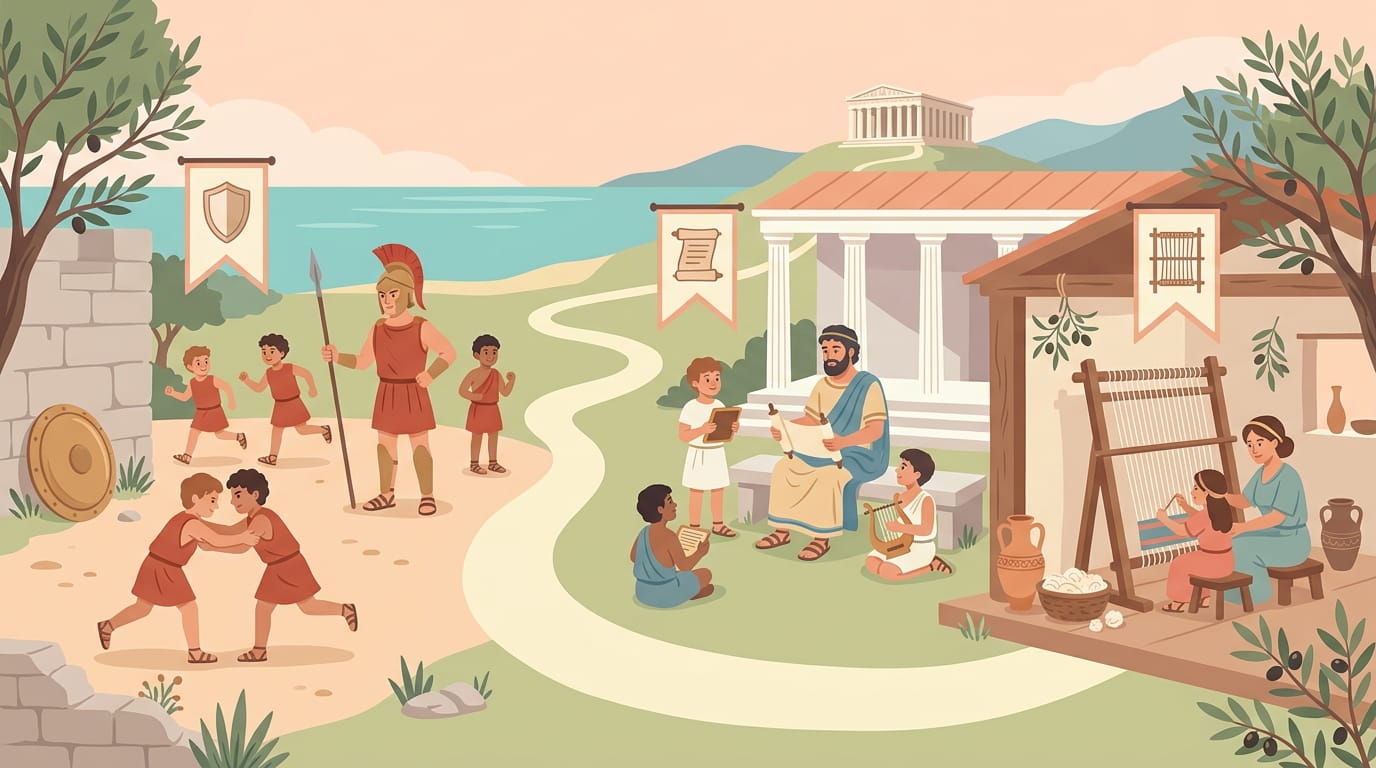
That's a fair snapshot of education in ancient Greece, where there was no single system and what you learned depended on your city and who you were.
In this post, we'll compare Athens, Sparta, and the philosophical schools side by side, and look closely at who was left out.
Ultimate Teacher Planner
The ultimate all-in-one education management system in Notion.

Overview of Education in Ancient Greece
Ancient Greek history stretches back long before the modern era, and its schooling looked nothing like today's. Here's how learning began, how formal and informal teaching compared, and which classical methods still endure.
Loose, optional schooling run by parents
The oldest form of education in Greece was less formal than modern schooling and run by parents. Parents chose whether to enroll their children, and fathers decided what was taught and for how long.
Schooling was neither mandatory nor free, so informal learning at home came first.
Formal schools and informal teaching compared
Formal learning could happen in a public school or with a hired tutor. Informal teaching, by contrast, was often unpaid. Education was also tied to identity, so who you were shaped what you learned.
For many, learning was less about where you sat and more about who taught you. In the 5th century BC (the fifth century before Christ), education became more democratized, meaning more people could access it.
That's a big change. Not everyone got that chance.
Classical teaching methods that still endure
Four methods from this period still echo in classrooms today:
Memorizing poets: students learned passages of verse by heart.
Socratic method: teachers asked questions that pushed students to examine their own answers.
Aristotelian logic: a structured way to reason step by step toward a conclusion.
Plato's skepticism: a habit of questioning what seems certain.
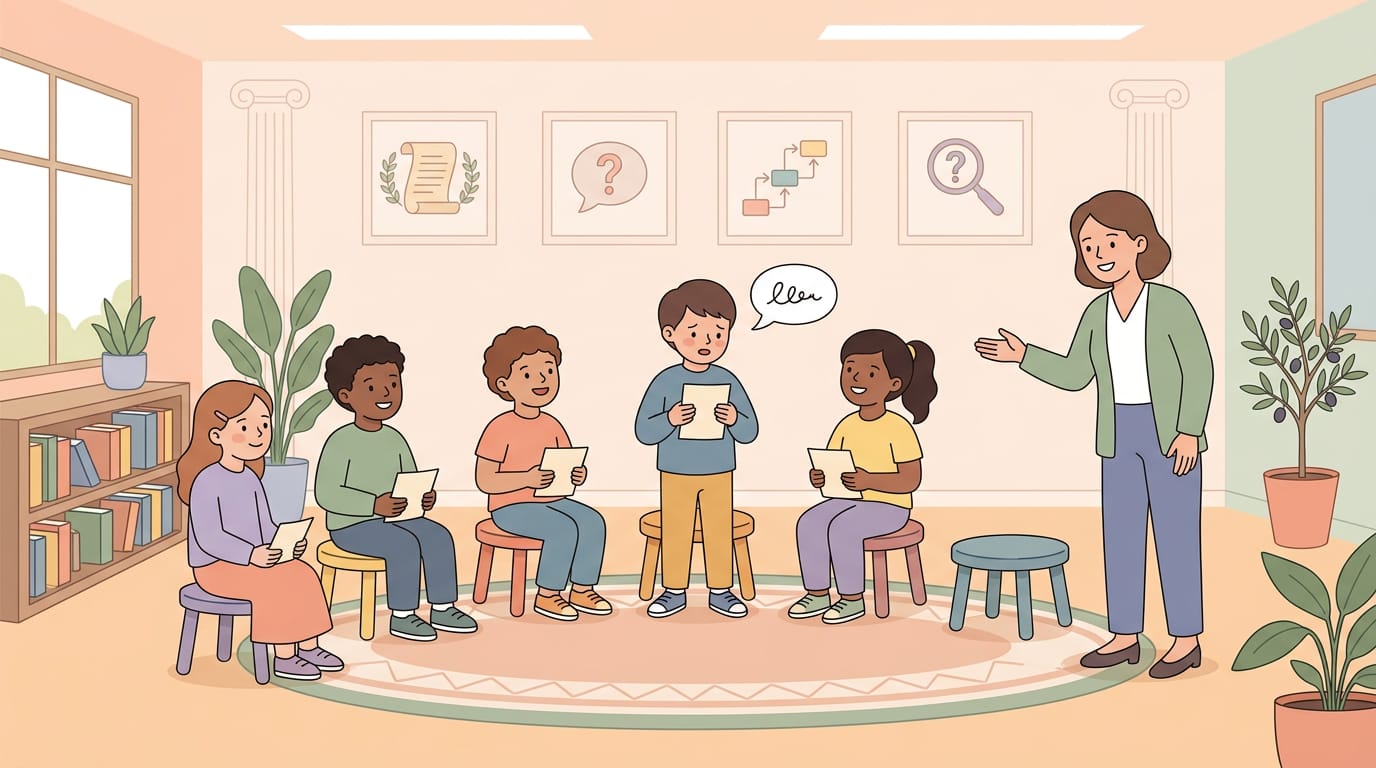
Think of a teacher who asks each student to recite one favorite line from a short poem. Quieter learners get a low-pressure way into the lesson. It's the same idea behind inclusive practice today: give everyone a way in.
How Young Children Learned in Athens
Schooling in Athens was split among several specialists, and families paid for each one. Here's how those pieces fit together for a young boy.
Three core subjects of early schooling
Early education rested on three areas:
gymnastikē (physical training)
mousikē (music and poetry)
grammata (letters)
Each subject had its own teacher, not one teacher for everything. Formal schooling generally ended around age 14 or 15. Wealthier families started earlier, giving their sons a head start on all three.
Physical training in private palaistras
Physical training took place in private palaistras, or wrestling schools. According to the Oxford Research Encyclopedia of Sport and Exercise, Athenian schoolboys regularly went to the classes of a paidotribēs, or athletics teacher. Lessons covered:
Wrestling, boxing, and pankration
Running, discus, and javelin
The aim was to prepare boys for the games and to shape the ideal body. Picture a teenager drilling his wrestling holds while his trainer corrects his footwork. Every repetition builds the strength and discipline the games would later demand.
Families paid for it too, and a private palaistra could cost a mina.
Music lessons on lyre and song
Music was taught by the kitharistēs, a lyre teacher, who covered both the instrument and song. Plato argued that music was for the soul, and the poetry students sang carried a moral function. Music was about character as much as skill.
Ignorance of it signalled lower status, so a gap in these lessons was noticeable. Music, in short, was never just for fun.
Learning to read, write, and count
Letters came from the grammatistēs, a teacher of letters who taught:
reading
writing
arithmetic
Students practiced with a stylus on a wax tablet. Lessons leaned heavily on memorizing Homer and Hesiod, and literacy was needed for trade and politics. Memorizing a line is one thing. Understanding what it means is another.
Ask yourself whether your own lessons reward recitation or real comprehension.
Paying for lessons and enforced attendance
Families footed the bill. As The March of the Muses explains, Athenian families funded their children's instruction, while some educational foundations were supported by benefactors, or donors who gave money.
Custom was also said to enforce attendance, so skipping lessons wasn't simply a family's choice.
Education and Training in Sparta
Sparta organized its whole education system around one goal: producing soldiers. Here's how that worked for boys and girls, including the harsh side you might not expect.
Boys trained by the state in the agoge
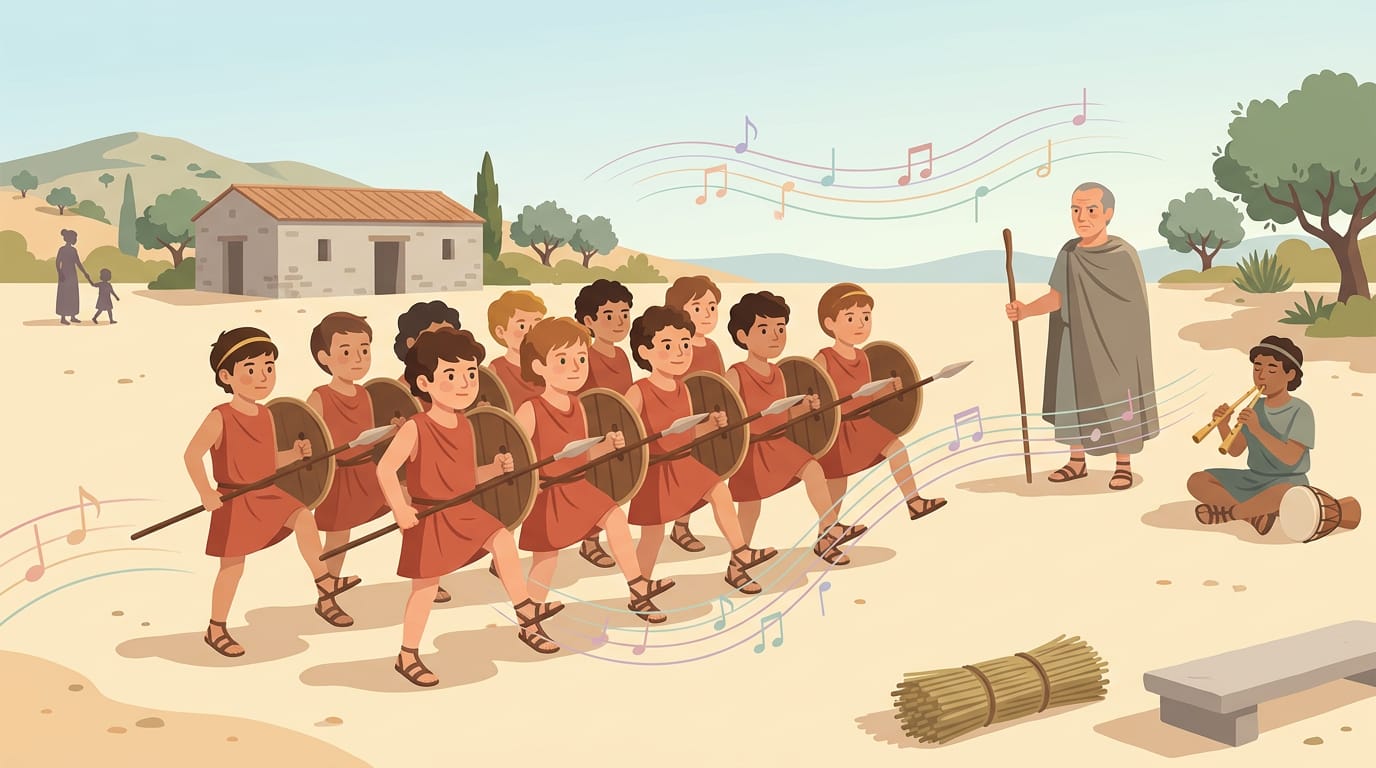
Spartan boys trained under the state's own system, the agoge. In his life of Lycurgus, Plutarch notes that boys entered it at about seven. From then on, they were taken from their families and lived in barracks, where life was hard.
Reading and writing didn't get much attention. The goal was less about letters and more about endurance.
Training also included mock battles and drills for the phalanx, a tight block of heavily armed infantry.
Music and dance were part of the drill too. Think of a music teacher who keeps a steady beat so a whole class can move together without tripping over each other. Spartan boys used music and dance in much the same way, to help them maneuver as one unit.
Coming of age through military service
Military service marked each stage of growing up. At eighteen, young men became ephebes, trainees moving into the next stage of service.
In Sparta, boys became soldiers at twenty. According to Modern Leonidas: Spartan Military Culture in a Modern American Context, a man had to be elected to a syssition, or common mess, to pass. After that, he held a lifelong post as a citizen soldier.
Young men also took a pledge of allegiance, a formal promise of loyalty.
The brutal side of Spartan training
Training was harsh from the very start. Infants judged weak were rejected, and hardship continued through childhood.
Killing a Helot. Helots were the enslaved people who worked the land for Spartan citizens, and training included killing one.
Harsh punishments. Punishments were severe and a regular part of training.
How Spartan girls were schooled
The state also supervised formal schooling for girls. Their program included:
running
wrestling
throwing the discus and javelin
music and dance
Physical training had a clear purpose: preparing girls to become the mothers of future soldiers. Everything pointed toward the same goal.
Advanced Study and the Sophists
What came after the basics? If your family could pay, a new kind of teacher offered an answer, and it raised a bigger question that we'll unpack below.
How the Sophists rose to prominence
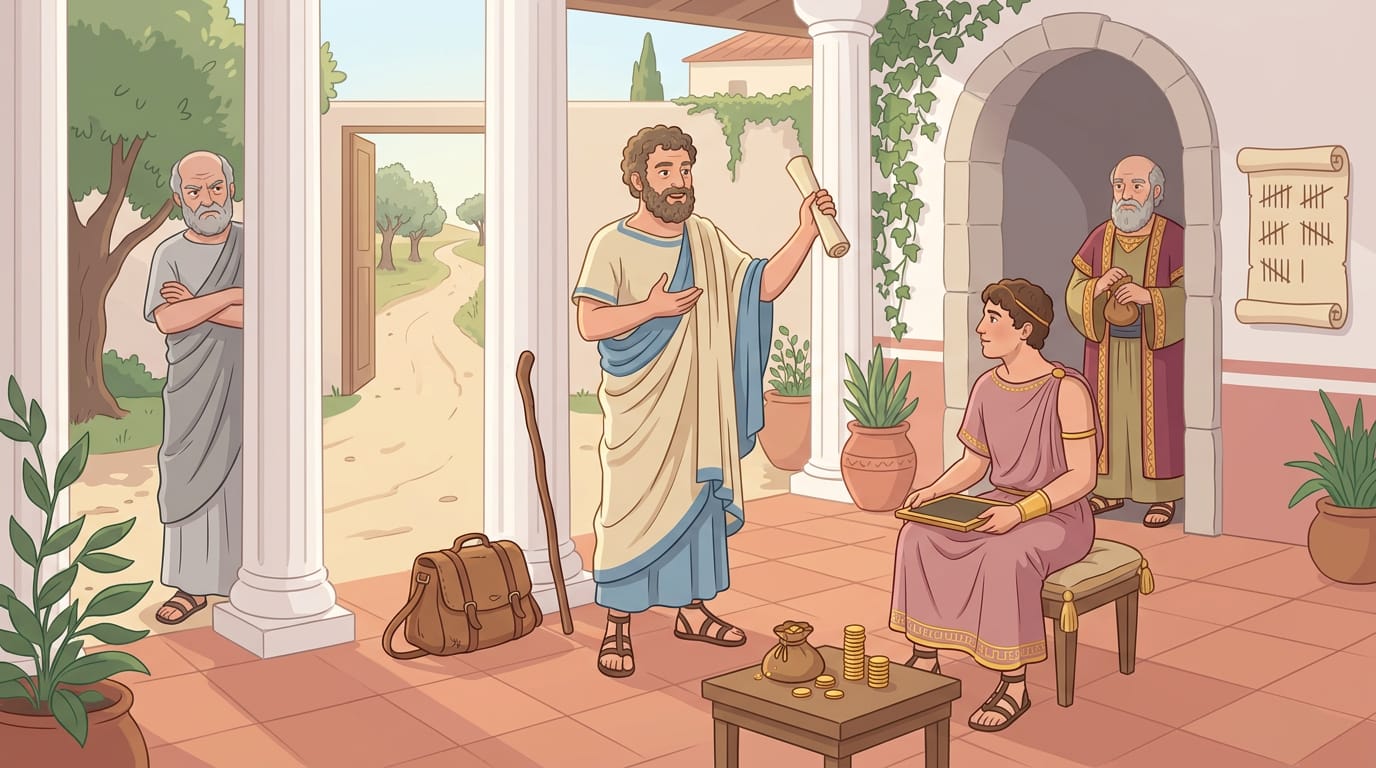
The Sophists were often foreign, professional teachers. According to the Internet Encyclopedia of Philosophy, they were itinerant teachers who charged a fee for lessons.
Their pupils were young wealthy Greek men, who paid for training in aretē (roughly, virtue or excellence).
Picture a wealthy young man whose family hires a traveling Sophist. He pays for lessons focused on the skills he wants most. For the teacher, the payoff could be wealth and fame.
Students paid for advanced skills, not basic literacy. Not everyone approved, though: other philosophers objected to charging fees for teaching. Study could last three to four years, a serious commitment for any family.
What the expanded curriculum covered
Rhetoric, the art of persuasive speaking, sat at the core. Beyond it, the curriculum stretched into:
Astronomy, mathematics, and philosophy
History and grammar
Medicine, law, geometry, and physics
Think of a student rehearsing a speech for court. Grammar keeps the sentences clear, history supplies examples, and rhetoric ties it into a persuasive case. That's a long way from reading and writing.
Where higher education first began
One claim is that the Sophists introduced the sciences into higher education. But the Pythagoreans came earlier and offer a precedent.
Secondary education builds on basic schooling, while tertiary education is the higher level. Scholars still debate which label fits the Sophists, and the answer depends on where you draw the line.
Famous Schools and the Thinkers Behind Them
Ancient Greece didn't have a single model of education. Each school answered two big questions differently: what should an educated person know, and who gets to learn it?
Isocrates and his school of rhetoric
Isocrates founded his school of rhetoric, the art of persuasive speaking, in the early 390s BCE (before the Common Era).
According to Institutions of Higher Education from the Beginnings of Civilization to 600 A.D., its School of Oratory taught oratory and ethics side by side.
For Isocrates, skilled speech was tied to virtue, and the payoff was civic: students trained for civic efficiency and political leadership. Isocrates asked students to speak well for the city.
Plato's Academy, which opened soon after, asked what they'd have to know first.
Plato's Academy and training for virtue
Plato founded his Academy around 387 BCE, though the Internet Encyclopedia of Philosophy notes that scholars date it anywhere from 387 to 383 BCE. Its core aim was education for civic virtue.
In the Republic, Plato lays out a long training program meant to produce philosopher-kings: rulers who understand what is good before they take power.
The Academy, often called the first university, asked less about what a student could do and more about who they became.
Aristotle's Lyceum and his research
Aristotle began as a student at Plato's Academy, then became tutor to Alexander.
Alexander later funded Aristotle's research at his own school, the Lyceum, which centered on empirical research: ideas were tested against observation, not just accepted because they sounded right.
Picture a biology teacher who has students test a claim with a simple experiment before anyone accepts it. Students learn to trust evidence over the loudest voice in the room, and that's a habit worth building. Evidence beats volume.

Inside the Pythagorean school in Kroton
The Pythagorean school in Kroton was a communal way of life, and much of its teaching stayed private. Instruction came at two levels:
Exoteric teaching: the outer, more public instruction.
Esoteric teaching: the inner lessons reserved for those deeper in the community.
Students studied mathematics, including the number ratios behind musical harmony. Both men and women could be admitted, and that's a detail worth remembering when we look at who was left out elsewhere in Greece.
How Socrates taught through questions
Socrates taught through question-and-answer dialogue. Rather than handing students answers, he asked questions and let them work toward their own.
Think of a middle school teacher who asks, “Why might a city need a strong navy?” instead of reading out an answer. Students argue it out, and the teacher hears misconceptions early.
That kind of questioning fosters critical thinking, the habit of testing claims instead of accepting them on authority. Inclusive classrooms can borrow the method.
It's a small shift: invite every student to answer, not just the quickest hand. Everyone gets to do the thinking.
Gender and Who Could Go to School
Access to learning in ancient Greece depended on three things:
gender
legal status
wealth
Here's how each one decided who got a lesson and who didn't.
Who received an education
Formal education went mainly to free males. Each city-state, or poleis (singular polis), made its own rules. Some Greek poleis prohibited enslaved people from receiving an education, as this source on Gytheion in Laconia reports.
Metics, the foreigners who lived in a city without citizenship, sat at the edge of the system.
Wealth also set how long a child stayed in school. A family that could spare its sons for years of learning gave them a head start. A family that couldn't gave them far less. Access was the real divide.
A few educated women, such as Sappho, Hypatia, and women linked to the Pythagorean tradition, show the rule had exceptions.
Think of a middle school teacher who keeps hearing from the same three students. She starts calling on each table in turn, and suddenly quieter kids are weighing in too. Ancient exclusion was openly written into law.
Today's gaps are quieter, hiding in habits like who gets called on and who gets the best seat. Ask yourself who's being left out of your classroom, because gaps rarely fix themselves.
What Athenian women and girls learned
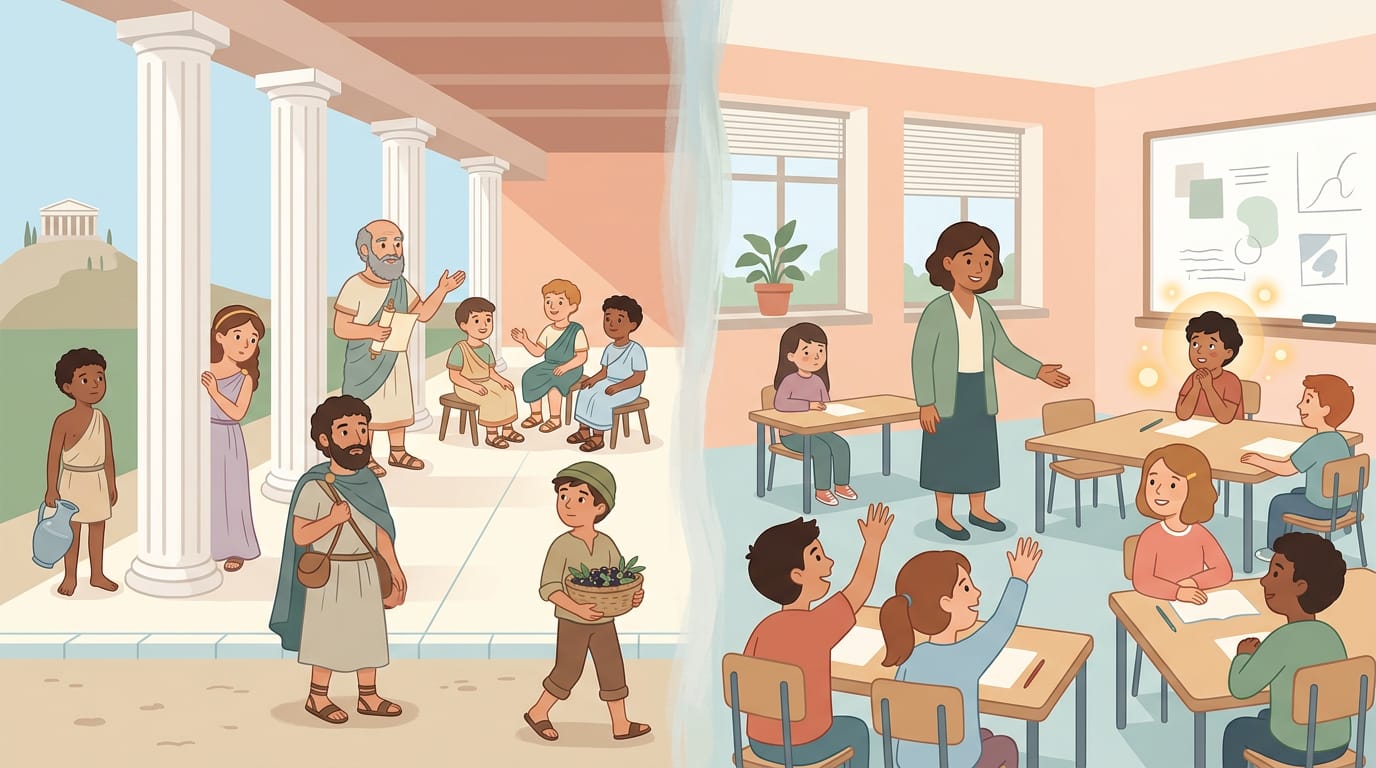
Athenian women and girls had no formal schooling. Their learning came through daily life rather than formal lessons, and it took a few main forms:
Household management. Mothers taught daughters how to run a home.
Religious rituals. These passed on shared values.
Childbearing and child-rearing. Girls received instruction in bearing and raising children.
How Greek Ideas Still Shape Schools Today
Many classroom habits are older than you'd expect. Greek thinkers argued over who should learn and how, and those debates still shape schools.
Ways modern schools resemble Athens
Athenian families mostly paid for lessons, much like private schools beside public ones today. Compulsory attendance is a modern rule, so Athens is more inspiration than blueprint.
Later schools like Plato's Academy resembled universities, where students chose a specialty, and wealthy benefactors who funded lessons foreshadowed today's scholarships.
Sparta's echoes in military academies today
Sparta's schooling put the state first, and today's military academies still prize discipline and obedience to authority. Who sets the rules for schools is a central question in education policy.
A university thesis titled Wanderer, kommst du nach Deutschland... notes that Spartan education has repeatedly been compared with the Hitler Youth. Treat that as a caution, not a verdict: a system built on obedience can go badly wrong.
Teaching methods and teacher evaluation today
The Socratic method is the clearest link to today's classrooms. Socrates taught through questions rather than lectures, so the goal is less about answers and more about reasoning. Questions do the teaching.
Aristotle's phronesis, or practical wisdom, adds that judgment matters as much as knowledge.
Those ideas give you a yardstick: if students can explain a concept in their own words, they've really learned it. The Sophists were paid teachers of persuasion, so they're a rough match for modern professors who charge for specialized skills.
Consider a science teacher who answers a student's question with 'How do you know?' The student has to explain their reasoning, and the teacher spots the gap in seconds. Try these Socratic questioning prompts:
What do you mean by that?
What would happen if we changed one thing?
Can you think of a case where that wouldn't hold?
Each model reflected what its society valued most. Athens prized debate and open inquiry, Sparta prized discipline and civic duty, and the philosophers asked what a good life truly requires.
Each also drew a circle around who counted, and that's the lesson worth carrying into your classroom.
Those questions still matter. Who gets a seat at the table, and whose voice gets heard? Ready to make your classroom more welcoming? Explore our inclusive and multilingual education posts for practical ideas.
References
Plato: The Academy — iep.utm.edu
Institutions of Higher Education from the Beginnings of Civilization to 600 A.D. — doi.org (2023)
Sport in Democratic Athens | Oxford Research Encyclopedia of Sport and Exercise — academic.oup.com
The March of the Muses: The Development of Higher Education in Athens — journals.wichita.edu
The Sophists (Ancient Greek) — iep.utm.edu
Plutarch, Lycurgus, ed. Bernadotte Perrin, 16 — beta.perseus.tufts.edu
Modern Leonidas: Spartan Military Culture in a Modern American Context — digitalcommons.uri.edu (2008)
Commerce de parfums et evérgétisme civique en Laconie (Gytheion) sous l'Empire — hdl.handle.net (2013)
"Wanderer, kommst du nach Deutschland..." — doi.org (2010)
Ultimate Teacher Planner
The ultimate all-in-one education management system in Notion.