
18 CTE Programs That Prepare Students for High-Growth Careers
18 CTE Programs That Prepare Students for High-Growth Careers

Article by
Milo
ESL Content Coordinator & Educator
ESL Content Coordinator & Educator
All Posts
Last spring, I watched one of my seniors tear apart a diesel engine in the auto shop next door while I graded papers. This was a kid who’d struggled through every essay I assigned, but now he was explaining fuel injection with total confidence—and telling me about the $22-an-hour job he’d already landed for June.
That’s the reality of modern cte programs. They’re not the vocational tracks your grandfather remembers, where “shop class” meant hiding from academics. These are rigorous career technical education pathways that pair academic standards with hands-on training. Students graduate with industry certifications and paychecks that often beat what bachelor’s degree holders earn in their first five years.
In this guide, I’m breaking down 18 specific programs worth your students’ time. We’ll look at healthcare CTE tracks that lead to immediate certification and employment. We’ll cover technology and IT pathways that skip the four-year degree debt. I’ll also show you construction and advanced manufacturing options where apprenticeship programs are desperate for young talent, plus which formats work for hybrid learning.
You don’t need complex labor market data to know your students need options beyond "college for all." You just need to know which career pathways actually deliver on their promises, and how to guide kids toward workforce development opportunities that won’t leave them broke at twenty-two.
Still grading everything by hand?
EMStudio is a free teaching management app — manage your classes, students, lessons, and more!
Learn More
Still grading everything by hand?
EMStudio is a free teaching management app — manage your classes, students, lessons, and more!
Learn More
Table of Contents
What Are the Most In-Demand CTE Programs for 2024?
Cybersecurity and network administration, renewable energy technology systems, and healthcare support specialist programs are the most in-demand CTE pathways for 2024. These vocational technology tracks offer immediate entry into careers paying $42,000-$62,000 annually with industry-recognized certifications.
Labor market data doesn't lie. When the Bureau of Labor Statistics shows growth rates ten times the national average, you pay attention.
The numbers are staggering compared to the 3% average for all occupations. Information Security Analysts are projected to grow 35% through 2032. Wind Turbine Technicians hit 45% growth. Even the steadier Medical Assistant field clocks in at 14%. These aren't four-year degree jobs. They're career technical education pathways that get students hired at 18 with credentials employers actually recognize.
Most districts gate these vocational technology pathways to students who meet baseline criteria:
Grade 11-12 standing with Algebra I completion
2.5 GPA minimum
Keyboarding 35 WPM for tech tracks
That typing speed ensures students can handle command-line interfaces and technical documentation. Counselors need to screen for this early; you don't want a senior discovering they can't touch-type in October.
Cybersecurity and Network Administration
This is where your tech-savvy seniors actually get challenged. The standard pathway runs through Cisco Networking Academy or CompTIA Security+ targeting Exam SY0-701. Students start with IT Fundamentals, move to Network+, then cap with Security+—180 contact hours per course. That's a full year of daily 90-minute blocks plus homework.
The lab reality hits your budget hard. You need Palo Alto Networks PA-220 firewalls or Cisco ASA 5506-X units running $2,500-$4,000 per lab station. We supplement with Cisco Packet Tracer simulation software so students can practice subnetting and ACL configurations at home without breaking physical hardware. In high-cost regions, entry-level cybersecurity technicians start at $48,000-$62,000.
The payoff comes at graduation. Students sit for the Security+ exam ($392 voucher) aiming for that 750/900 passing score. Pass it, and they walk with articulation credits to community college Cybersecurity AAS programs. I've watched seniors skip freshman year entirely because of this stack. If you're building this pathway, look at cybersecurity diploma programs that prepare you for fast-growth careers to see how districts structure the sequence.
Renewable Energy Technology Systems
Solar isn't coming. It's here, and your students can install it. These cte programs target NABCEP PV Associate certification, mixing solar photovoltaic theory with small wind turbine technology. The math is real—Ohm's Law, voltage drop calculations, NEC code compliance. Students who struggled in freshman algebra suddenly care about trigonometry when there's a 10kW array on the roof.
Equipment lists are specific. You need Solar PV training systems like the Lab-Volt 8006-1 ($1,800 per station), quality digital multimeters, and current NEC 2023 code books. Students wire actual circuits, not just diagrams. When my 11th graders calculated conduit fill for a residential array last spring, they understood why electricians get paid well. High-cost areas pay entry-level installers $42,000-$55,000.
The critical piece is the 120-hour apprenticeship with local solar installers. Students work residential 6kW-10kW system installs—climbing roofs, pulling wire, commissioning inverters. That's real workforce development with real paychecks. Graduates enter apprenticeship programs at year two instead of year zero.
Healthcare Support Specialist Programs
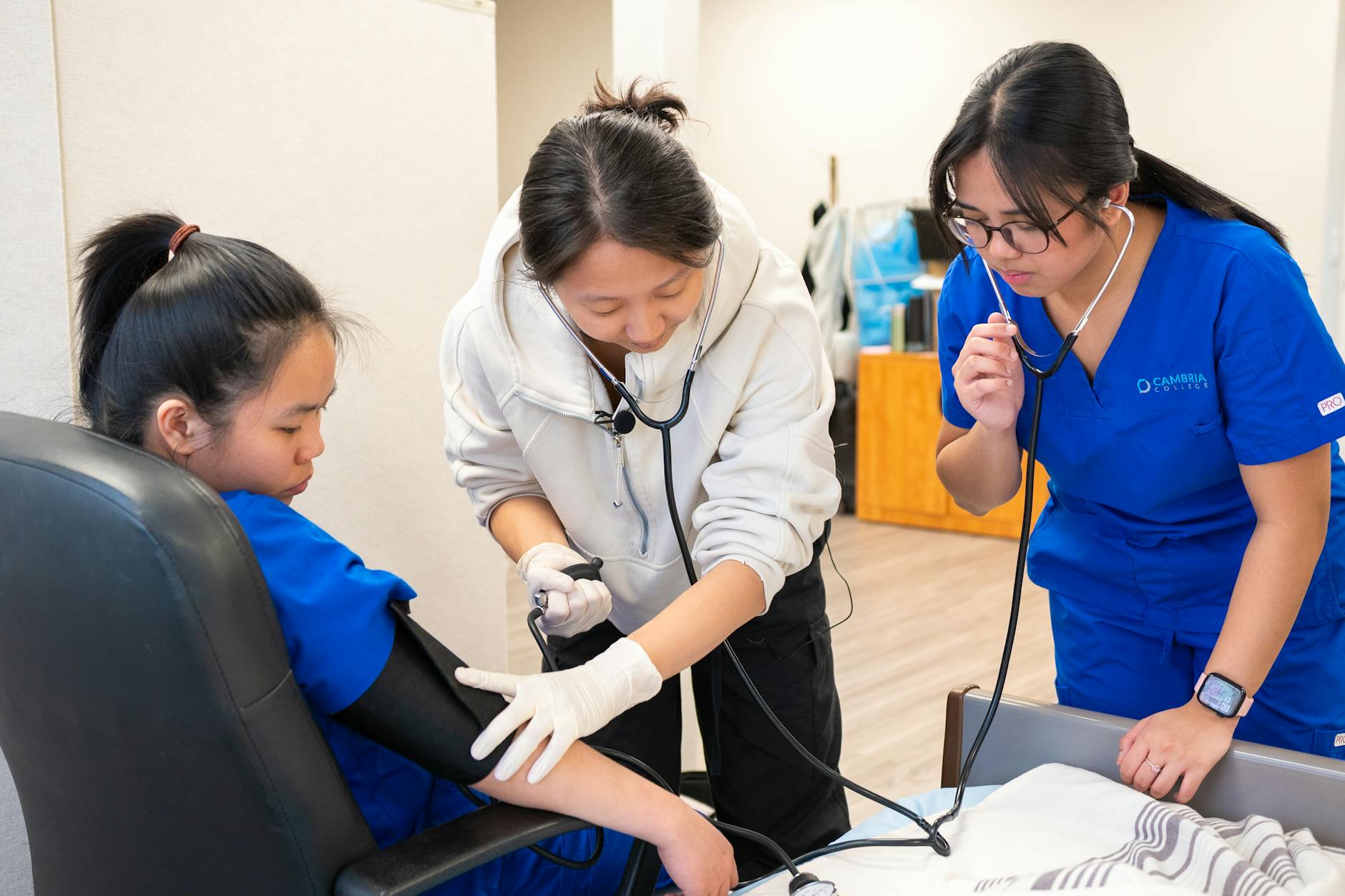
This track splits into two distinct career pathways. Clinical Medical Assistant (CMA) trains for outpatient clinics—drawing blood, scheduling, billing. Patient Care Technician (PCT) targets acute care hospitals with bed-side skills, EKGs, and dialysis prep. Choose based on your local hospital partnerships. Both require Grade 11-12 standing and that 2.5 GPA floor.
Both tracks require 160-200 clinical hours at approved sites, usually scheduled as 8-hour shifts during spring semester. Students perform competency evaluations in phlebotomy, 12-lead EKG placement, and patient vitals under RN supervision. The hours are non-negotiable for accreditation. You can't fake clinical experience.
Certification options vary by track. CMA students typically test through NHA CCMA ($155 exam) while PCT candidates use NCCT NCMA ($90 exam). Your program needs 75% pass rates or higher to maintain good standing. Entry-level wages run $35,000-$42,000 in high-cost regions, with immediate tuition reimbursement benefits at most health systems. These industry certifications beat a semester of undecided community college every time.

Which Healthcare CTE Tracks Lead to Immediate Certification?
Certified Nursing Assistant (CNA), Emergency Medical Technician (EMT), and Pharmacy Technician programs lead to immediate certification within 4-16 weeks. These tracks require 75-200 contact hours, clinical rotations of 120-200 hours, and passing national exams like the NREMT or PTCB.
These aren't college prep courses with vague promises. They're workforce development programs that put paychecks in students' hands before graduation. I've watched 12th graders walk across the stage already employed at local hospitals.
Compare the three main career technical education tracks:
Program Name | Duration | Certification Exam | Clinical Hours | Entry Wage | Background Check Required |
|---|---|---|---|---|---|
CNA | 4-8 weeks | State CNA Exam | 75-120 hours | $15-18/hr | Yes |
EMT | 12-16 weeks | NREMT | 24+ hours | $18-22/hr | Yes |
Pharmacy Technician | 12-16 weeks | PTCB | 120-160 hours | $16-20/hr | Yes |
You need to warn students about the barriers before they enroll. Felony convictions disqualify CNA and EMT candidates from licensure in 48 states. Programs require 95% attendance with no makeup options for clinical hours. Miss two days of hospital rotations and administrators remove you from the program.
Research indicates CTE programs with embedded certification prep achieve 78% first-time pass rates compared to 45% for students testing post-graduation without integrated prep. This labor market data explains why quality career pathways build exam prep into daily instruction and do not treat it as an afterthought.
Meeting evolving workforce needs in healthcare education means understanding these immediate certification tracks prepare students for industry certifications that open doors faster than traditional degree routes.
Certified Nursing Assistant (CNA) Pathways
The Red Cross CNA curriculum runs exactly 120 hours with standardized instruction across all chapters. State health department approved programs vary between 75-120 hours depending on local regulations.
Red Cross programs offer 120 hours of standardized instruction that employers trust.
State-approved programs range from 75-120 hours based on local regulations.
Students face a skills test covering five procedures selected randomly from a master list. Examiners watch hand washing, bed bath technique, vital signs measurement, transfer techniques, and mouth care. Students must perform each step in exact sequence. Forget to knock before entering the patient's room or neglect to wash hands between tasks and you fail immediately.
Job prospects differ sharply by setting:
Nursing homes maintain a 90% hire rate for new CNAs at $15-18 per hour with immediate openings.
Hospitals pay $18-22 per hour but require six months of long-term care experience first.
Unlike apprenticeship programs, these positions pay full wage immediately upon certification.
Emergency Medical Technician (EMT) Certification
The NREMT cognitive exam adapts to each student's ability level, presenting 70-120 questions over a strict two-hour limit. The psychomotor exam tests patient assessment, trauma management, and medical scenarios using live actors who scream, bleed, and resist treatment. Both components must pass for certification, and students who fail either component wait two weeks before retesting.
Physical requirements are documented strictly on official medical forms. Candidates must demonstrate ability to lift 125 pounds, possess 20/20 vision corrected, pass a hearing test, and disclose any insulin-dependent diabetes to state EMS authorities. These rules exist because EMTs perform CPR in moving ambulances, carry patients down narrow staircases, and administer drugs in chaotic environments.
Clinical rotations require minimum 24 hours combined between ER observation and ambulance ride-alongs with Advanced Life Support units. Students must document patient contacts including cardiac arrests, trauma calls, and psychiatric emergencies. This exposure separates those who belong in emergency medicine from those who freeze during airway management. Essential emergency medical certification pathways like this demand emotional resilience that textbooks cannot teach.
Pharmacy Technician Training Programs
The PTCB exam contains 90 questions over two hours with a $129 fee. Content breaks down to 40% medications, 26.25% patient safety, and 12.5% federal requirements. Students must score 1400 or higher on the scaled scoring system to earn the credential that allows them to handle controlled substances and compound medications.
Externships place students for 120-160 hours in retail pharmacies like CVS, Walgreens, and Walmart, or in hospital pharmacy settings. All sites require HIPAA compliance training before students access patient data. These rotations teach workflow speed, insurance troubleshooting, and the multitasking required to answer phones while counting pills accurately under time pressure.
Math competency gates the externship placement strictly. Students must pass pharmaceutical calculations with 90% accuracy covering dosages, conversions, and alligations. Get one calculation wrong on a patient's blood thinner dosage and you could cause a catastrophic bleed. Programs take this gate seriously because medication errors kill thousands annually. Students who cannot calculate drip rates wash out before reaching the pharmacy floor.
Technology and IT Certification Pathways
Students entering cte programs need a clear certification roadmap. Most follow this progression:
Entry-level: CompTIA A+, AWS Cloud Practitioner
Associate: CCNA, AWS Solutions Architect
Professional: CISSP, AWS Professional
But first, check prerequisites. Students need keyboarding at 35 WPM and Algebra I with a B or better. I give a logic puzzle pretest to assess computational thinking. It weeds out kids who just want to play games.
Budget realities create equity gaps. Cloud certification prep runs on $200 Chromebooks. CAD tracks need dedicated GPU workstations at $1,200 or more per seat. Districts must solve this hardware divide before enrollment opens. Review local labor market data to ensure your equipment matches regional employer needs.
Cloud Computing and AWS Certification Prep
AWS Educate membership unlocks AWS Academy Cloud Foundations (20 hours) and Cloud Architecting (40 hours). Your students build real infrastructure using actual AWS consoles, not simulations.
AWS Cloud Quest provides game-based labs at no cost for accredited institutions. Students configure S3 storage, launch EC2 instances, and build VPC networks by solving challenges. It runs in any browser, which means you can use those aging Chromebooks in the back of the lab.
Certification economics favor this track. The Cloud Practitioner exam costs $100; Solutions Architect runs $150. Many states provide free vouchers through CareerTech initiatives or AWS Educate credits. I had three students test last month without paying a dime by routing through our state's workforce development office. That kind of access changes career pathways for kids who can't afford Cisco academies.
Cloud roles don't require apprenticeship programs, which speeds up workforce development for students who need income immediately after graduation.
Full-Stack Web Development Bootcamps
The curriculum moves fast:
HTML/CSS (4 weeks)
JavaScript ES6+ (6 weeks)
React/Node.js (8 weeks)
Database (SQL/MongoDB, 4 weeks)
Students who can't keep pace usually drop by week six.
Portfolio requirements are non-negotiable. Students must ship five deployed projects: a REST API with authentication, a responsive e-commerce frontend, and a full database integration. Employers want to see GitHub commits, not certificates alone.
Setup costs nothing. Install VS Code, GitHub Desktop, Node.js LTS, and Chrome DevTools. Deploy via Netlify or Heroku free tiers. I start every year with digital tools for teaching coding and IT fundamentals to get them comfortable before we touch React.
My 11th graders last spring built an inventory tracker for the theater department using React and Firebase. They handled real data, real users, and real errors. That's when they learned debugging matters more than perfect syntax.
Computer-Aided Design (CAD) and Drafting
Software choices impact your budget dramatically:
AutoCAD: $1,775/year education pricing
SolidWorks: $4,000+ network license
Fusion 360: Free for education
Career technical education departments often standardize on Fusion 360 for budget relief, though local manufacturers may demand SolidWorks or AutoCAD specifically.
The Certified SOLIDWORKS Associate (CSWA) exam tests part modeling, assemblies, and drawings. Students need 70% on a 45-question, 3-hour test. I schedule this in late April after they've modeled at least twenty distinct parts.
Hardware specs matter here. You need dedicated NVIDIA GPUs (GTX 1660 or better), 16GB RAM minimum, 3-button mice with scroll wheels, and 1080p displays. Skip the Chromebooks. This is where that $1,200 per station cost hits.
That 3-button mouse isn't optional. SolidWorks uses the middle button for orbit commands constantly. Kids trying to use trackpads or Apple Magic Mice will fall behind within the first week.
Check with local firms before committing. Some pay for their own SolidWorks licenses and hire based on geometry knowledge, not software brand.

Construction and Advanced Manufacturing Programs
Before your students touch a bandsaw or wire stripper, they need the OSHA 10-Hour Construction or General Industry certification. Budget $25 to $75 per student. This card is non-negotiable—it's the prerequisite that keeps your insurance valid and your students employable.
Union apprenticeships through IBEW, UA, or the Carpenters pay 40% higher wages than non-union shops, but require a four-year commitment. Non-union employers hire faster with fewer barriers, though the ceiling sits lower. These cte programs require brutal honesty about physical and cognitive barriers. Color blindness bars candidates from electrical wiring per NEC safety standards. In CNC machining, students with spatial reasoning deficits face attrition rates above 30%. I saw this with an 11th grader who aced the math but couldn't mentally rotate the 3D models—we pivoted him to HVAC where he thrived.
HVAC/R Technology and Installation
Your HVAC curriculum centers on the EPA Section 608 Technician Certification. Students need Types I, II, III, and Universal credentials to handle refrigerants legally. The Universal exam is open-book with a 70% passing score, but don't let that fool you—the technical vocabulary trips up kids who skim. I require 80% on practice tests before they sit for the real thing.
Tool investment separates hobbyists from professionals. Each student needs a kit running $1,500 to $2,200:
Manifold gauge sets ($200-$400)
Electronic leak detectors ($150-$300)
Recovery machines ($500-$800)
Micron gauges ($200-$300)
I partner with local suppliers for bulk pricing, but be transparent with families upfront.
Seasonal employment patterns define this trade. Sixty percent of hiring happens March through May and September through November. Your curriculum must include income averaging and off-season budgeting. When you're launching work-based learning programs in manufacturing, align your student placements with these hiring windows or they miss the boat entirely.
CNC Machining and Precision Manufacturing
The NIMS credentials pathway follows a strict sequence. Skip the first two, and your students crash on the third:
Measurement, Materials & Safety
Job Planning, Benchwork & Layout
CNC Mill Operations
CNC Lathe Operations
I front-load the safety credential in September so they can access the shop floor by October.
Machine time splits 60/40: sixty percent hands-on production using Haas VF-1 or Tormach 770M mills, forty percent CAM programming in Mastercam or Fusion 360. Students hate the ratio until they wreck their first $80 end mill.
Precision standards demand tolerances of ±0.001 inch. Students must interpret GD&T symbols on engineering drawings and distinguish between G-code and conversational programming. This is where spatial reasoning matters. If a student can't visualize the toolpath from the top view, they'll struggle with setup sheets. Test for this early with simple block rotation exercises.
Electrical Systems and Construction Wiring
State licensing follows a rigid ladder:
4-year apprenticeship (8,000 hours documented)
Journeyman exam
Master Electrician (2 additional years + exam)
Map this timeline clearly for students who think they'll be running jobs by graduation. They won't—not legally.
NEC 2023 adoption varies by state. Check your local amendments before ordering textbooks. Budget $110 for the code book and $45 for Ugly's Electrical References. The code book updates every three years; buy the current edition or your students memorize obsolete requirements.
The math is real. Ohm's Law calculations, voltage drop formulas requiring Algebra II, and conduit fill calculations using trigonometry separate apprentices from helpers. If your students struggle with cosine functions, they'll struggle with pipe bending. I require concurrent enrollment in Algebra II or higher for this pathway.

What CTE Programs Work Best for Hybrid Learning Models?
Business administration, digital marketing, and veterinary assistant training work best for hybrid learning models. These programs combine 40% asynchronous online theory with intensive in-person labs, requiring only standard technology without specialized workshops. This accessibility makes them ideal for remote learners while maintaining rigorous certification standards.
Not all career technical education translates to a hybrid format. You need programs where theory lives online and hands-on work compresses into intensive weekends or synchronous virtual sessions. The best cte programs split the difference without splitting quality. Students get flexibility without sacrificing the rigor employers demand.
A hybrid-ready program follows strict technical and time requirements. Check these boxes before advertising your course as remote-friendly:
40% asynchronous theory delivered through your LMS
60% hands-on practice via synchronous virtual labs or condensed in-person intensives
25 Mbps internet minimum, webcam, and smartphone
That's the minimum. No $5,000 welding rigs in their garages.
Before students touch industry certifications, they need grade-level math and reading skills. I've seen too many kids struggle with accounting ratios because they never mastered fractions. Use best online math and reading programs like Khan Academy, IXL Math, or Edgenuity as prerequisites. Make completion mandatory, not optional, for students below grade level. Screen early to catch gaps.
Virtual dissections, accounting simulations, and digital marketing campaigns can replace about half your hands-on time. But they cannot replace everything. Students still need in-person capstone demonstrations to prove competency. A virtual pig dissection teaches anatomy, but it doesn't teach the physical resistance of tissue or the steady hand required. Some skills defy screens.
Online Business Administration and Accounting
I used this pathway with 11th graders who needed flexible schedules for part-time jobs. The magic happens with stackable credentials: QuickBooks Online Certification through Intuit and Microsoft Excel Expert (MOS) both work entirely through virtual instruction. Students build skills incrementally without waiting for semester breaks. These industry certifications translate directly to entry-level job qualifications.
Virtual internships connect through platforms like Nepris or Canvas Work placements. You coordinate 60 hours of remote project-based work with local businesses—real spreadsheets, real payroll problems, real client communication. It requires more setup than traditional placements, but students prove they can work from home professionally. Check your strategies for managing virtual and hybrid education models before launching these placements. Clear expectations prevent the "I didn't know what to do" emails at midnight.
We run this as competency-based progression. Students must complete the full accounting cycle—from journal entries through financial statements—with 100% accuracy before they sit for certification exams. No partial credit on bank reconciliations. Either the numbers match or they don't. This mirrors real workforce development standards where errors cost money.
Digital Marketing and E-Commerce Management
This is where you find free, legitimate credentials that employers actually recognize. Google Analytics 4 Certification takes four to six hours. Google Ads Search Certification takes three hours. Both are free, valid for one year, and update students on current industry standards. No textbook lag here.
The capstone separates tourists from professionals. Students manage a $1,000 real or simulated ad budget for a local nonprofit, tracking measurable KPIs: click-through rate, conversion rate, and ROI. They present the data, explain the failures, and defend the budget allocation. Real money or simulated, the pressure teaches budget management better than any lecture.
For content creation, you don't need Mac Studios. Canva Pro (free for education), CapCut for video editing, and a smartphone with 1080p minimum handle every assignment. Students shoot product photography, edit reels, and design email campaigns on devices they already own. Career pathways shouldn't require equipment mortgages. Labor market data shows these specific skills land entry-level marketing coordinator roles.
Remote Veterinary Assistant Training
NAVTA-approved programs structure this as 240 hours didactic instruction online plus 40 hours hands-on at a veterinary clinic within 50 miles. That ratio works. Students learn anatomy, pharmacology, and office procedures from home, then prove physical competency in person. The blend respects both the knowledge and the skill.
Clinical placement remains your biggest hurdle. Small animal clinics fill fast for physical restraint practice. Large animal exposure—equine or cattle—becomes nearly impossible if your state requires it and you're urban. Start recruiting clinic partners in August for January placements. Waiting until December means empty hands and delayed graduation. Build relationships with three clinics minimum to avoid last-minute scrambling.
Know your scope of practice. Veterinary assistants cannot induce anesthesia, take radiographs unsupervised, or give IV injections in most states—these tasks belong to Licensed Veterinary Technicians. Review your state veterinary practice act with students before placement. Apprenticeship programs work only when everyone understands the legal boundaries. One confused student performing prohibited tasks can shut down your entire partnership.

Business Management and Entrepreneurship Courses
Business Management and Entrepreneurship Courses represent the most popular cte programs in many districts. These split into two distinct paths.
The Entrepreneurship Track has students writing business plans, pitching to local investors, and meeting with SCORE mentors twice a month to refine their concepts.
The Management Track builds operations and HR skills, prepping students for CAPM certification and supervisory roles in established companies.
Your program needs competition integration to build real pressure skills.
DECA works for marketing-focused students.
FBLA fits business administration tracks.
ProStart serves hospitality specifically.
Pick one, establish a chapter, and get students to regional competitions. The travel and pressure teach more than classroom simulations ever could. Judges ask follow-up questions that force deeper thinking than rubrics do.
The SCORE partnership requires structure. Students need four documented meetings per semester with retired executives. These aren't casual chats. Students bring agendas and get honest feedback on their business plans. The mentors push back on unrealistic financial projections, which saves kids from learning those lessons with actual debt later.
Project Management and Agile Methodologies
The CAPM certification pathway needs specific prerequisites:
23 hours of project management education.
High school diploma to sit for the exam.
$225 student exam fee (vs. $300 standard rate).
Start the education hours in junior year through coursework and documented workshops. Schedule the exam for spring of senior year. The 23 hours can come from your curriculum, but document everything. PMI audits applications randomly. Keep certificates from any workshops students attend outside class.
Agile training uses the Scrum framework. Run two-week sprints with daily standups and retrospectives. Get free Atlassian education licenses for Trello or Jira. Students learn to move cards across boards and track velocity. Teach them to estimate story points and calculate team capacity. These digital tools mirror what they'll see in tech internships.
Match methodology to industry. Use Waterfall for construction and manufacturing projects with fixed scopes and regulatory requirements. Use Agile for software development and marketing campaigns where client needs evolve. My 11th graders ran an Agile sprint to redesign our school store's inventory system. It worked because requirements shifted weekly as we discovered which products actually sold.
Hospitality and Tourism Management
ServSafe Manager certification is ANSI accredited and non-negotiable in most states:
75-question exam with 70% pass rate required.
$150 exam fee.
5-year validity period.
Build this into your second-year curriculum, not first. Students need kitchen fundamentals before they can manage food safety systems for others.
The ProStart curriculum spans two years through the National Restaurant Association. Students complete 400 hours of mentored work experience in actual restaurants or hotels. This isn't job shadowing. They work the line, manage inventory, and see P&L statements in real time. The hours are documented and verified by industry managers. The 400-hour requirement sounds steep, but breaks down to roughly five hours weekly across two years. Students working weekend brunch shifts hit the mark by February of senior year.
The capstone event is planning and executing a 100+ person catered function. Students manage a $2,000+ budget, handle food safety compliance, and run profit/loss analysis after the last plate is cleared. They source ingredients, schedule labor, and troubleshoot when the heating element fails. These are the hospitality management degrees that build entrepreneurial leaders through pressure-cooker experience that textbooks cannot replicate.
Small Business Operations and Finance
Connect students to SBA resources early:
Schedule appointments with your local Small Business Development Center.
Require completion of SCORE workshops.
Assign SBA Learning Center modules.
These free resources beat textbook theory because the examples come from actual businesses in your zip code. Students see real balance sheets, not hypotheticals. Local SBDC advisors often bring real clients into the classroom. Students analyze the actual businesses' expansion plans instead of case studies from 2019.
Financial literacy requires actual math. Students build 13-week cash flow projections and calculate break-even points using real market data from Census business patterns. They draft profit/loss statements for hypothetical ventures based on actual lease rates and labor costs in our county. When they see that the coffee shop downtown pays $4,200 monthly rent, the math gets real.
The business plan pulls it together. Include an executive summary, Census-based market analysis, operations plan, and three-year financial projections with supporting assumptions. Students must defend those assumptions in front of local bankers. These leadership skills that translate to business success start with understanding that assumptions must be defended with data, not hopes.

How to Match CTE Programs With Your District's Industry Partners?
Match cte programs by analyzing BLS labor data for high-growth occupations, forming an Industry Advisory Board with 6-12 employers, and aligning equipment purchases with partner specifications. Establish articulation agreements for college credit and MOUs for 120-hour work-based learning placements to ensure curriculum remains relevant to current industry standards.
Your welding lab sits empty if local manufacturers don't hire welders. I learned this the hard way in 2019 when my 11th graders completed the program only to discover area shops needed CNC operators, not stick welders. Career technical education must mirror actual market demand or you're training students for ghost jobs.
Follow these five steps to align your curriculum with actual market needs:
Analyze labor market data from BLS O*NET for occupations projecting 15% growth with $35,000+ entry wages.
Form an Industry Advisory Board with 6-12 employers meeting quarterly to review curriculum and equipment needs.
Conduct equipment alignment audits making sure 80% of lab tools match employer specifications for CNC brands and software versions.
Establish MOUs for 120-hour workforce development placements with liability coverage and compensation structures.
Create articulation agreements for 6-12 college credits and pathways into apprenticeship programs or associate degrees.
Check your state's workforce development board website for real-time job postings. Count how many listings ask for specific industry certifications like AWS D1.1 or CompTIA A+. If employers want certified technicians and you're only teaching theory, you're creating a skills gap that hurts your graduates.
Model the boces barry tech approach of rotating business partnerships and shared equipment programs. One semester your automotive lab partners with Toyota; next semester, the local Ford dealership brings their diagnostic tablets and trains your students on proprietary software.
This rotation keeps your curriculum current without buying every brand yourself. Focus on mastering stakeholder involvement with industry partners by treating employers as co-creators, not just donors. They review your syllabi and suggest updates.
I watched one district buy $200,000 in Haas machines while local shops ran Mazak. Students graduated needing retraining on unfamiliar controls. Call three major employers and ask what sits on their shop floors.
If they use Lincoln Electric welders, don't buy Miller just because the rep offered a discount. Match the voltage, amperage, and interface exactly. Your students should walk into a job site and recognize the control panel immediately.
Hourly wages open career pathways for everyone. Draft MOUs that specify supervision ratios, safety training, and evaluation rubrics. The 120-hour minimum ensures students see a full project cycle from blueprint to completion.
Contact the dean of career technical education at your local community college. Ask which courses translate directly to their programs. Sometimes a high school CAD class counts as Engineering 101; sometimes it counts as nothing. Verify the credit transfer before you print the brochures.
Research indicates CTE programs with active industry partners achieve 40% higher completion rates. Avoid the "equipment graveyard" syndrome by securing electrical supply, ventilation, and $5,000 annual maintenance budget per lab.
Check that your building's electrical panel can handle the 220-volt draw before purchasing CNC machines or automotive lifts. A broken plasma cutter teaches nothing. Calculate three-year operating costs before you celebrate the grant award.

Where Does Cte Programs Fit in Your Practice?
Career technical education isn't the "alternative" track anymore. It's where your students build real paychecks and futures. I've watched seniors land jobs paying more than my first teaching salary because they stuck with a two-year welding sequence or passed their CompTIA A+ exam during junior year while their friends sat in study hall. These cte programs bridge the exact gap between "I'm graduating" and "I have a plan that actually pays."
Don't try to launch all 18 pathways at once, even if your admin wants the bragging rights for the brochure. Look at your local industry partners first. Which employers are desperate for talent right now? Pick one workforce development pathway that matches their immediate hiring needs. Build deep, not wide. One solid apprenticeship program with guaranteed job placement beats a dozen fancy labs sitting empty because nobody within fifty miles hires for those particular skills. Your students need actual jobs waiting for them, not just credits on a transcript.
Which single pathway could you realistically pilot next semester that would actually put your students to work within six months of graduation?

What Are the Most In-Demand CTE Programs for 2024?
Cybersecurity and network administration, renewable energy technology systems, and healthcare support specialist programs are the most in-demand CTE pathways for 2024. These vocational technology tracks offer immediate entry into careers paying $42,000-$62,000 annually with industry-recognized certifications.
Labor market data doesn't lie. When the Bureau of Labor Statistics shows growth rates ten times the national average, you pay attention.
The numbers are staggering compared to the 3% average for all occupations. Information Security Analysts are projected to grow 35% through 2032. Wind Turbine Technicians hit 45% growth. Even the steadier Medical Assistant field clocks in at 14%. These aren't four-year degree jobs. They're career technical education pathways that get students hired at 18 with credentials employers actually recognize.
Most districts gate these vocational technology pathways to students who meet baseline criteria:
Grade 11-12 standing with Algebra I completion
2.5 GPA minimum
Keyboarding 35 WPM for tech tracks
That typing speed ensures students can handle command-line interfaces and technical documentation. Counselors need to screen for this early; you don't want a senior discovering they can't touch-type in October.
Cybersecurity and Network Administration
This is where your tech-savvy seniors actually get challenged. The standard pathway runs through Cisco Networking Academy or CompTIA Security+ targeting Exam SY0-701. Students start with IT Fundamentals, move to Network+, then cap with Security+—180 contact hours per course. That's a full year of daily 90-minute blocks plus homework.
The lab reality hits your budget hard. You need Palo Alto Networks PA-220 firewalls or Cisco ASA 5506-X units running $2,500-$4,000 per lab station. We supplement with Cisco Packet Tracer simulation software so students can practice subnetting and ACL configurations at home without breaking physical hardware. In high-cost regions, entry-level cybersecurity technicians start at $48,000-$62,000.
The payoff comes at graduation. Students sit for the Security+ exam ($392 voucher) aiming for that 750/900 passing score. Pass it, and they walk with articulation credits to community college Cybersecurity AAS programs. I've watched seniors skip freshman year entirely because of this stack. If you're building this pathway, look at cybersecurity diploma programs that prepare you for fast-growth careers to see how districts structure the sequence.
Renewable Energy Technology Systems
Solar isn't coming. It's here, and your students can install it. These cte programs target NABCEP PV Associate certification, mixing solar photovoltaic theory with small wind turbine technology. The math is real—Ohm's Law, voltage drop calculations, NEC code compliance. Students who struggled in freshman algebra suddenly care about trigonometry when there's a 10kW array on the roof.
Equipment lists are specific. You need Solar PV training systems like the Lab-Volt 8006-1 ($1,800 per station), quality digital multimeters, and current NEC 2023 code books. Students wire actual circuits, not just diagrams. When my 11th graders calculated conduit fill for a residential array last spring, they understood why electricians get paid well. High-cost areas pay entry-level installers $42,000-$55,000.
The critical piece is the 120-hour apprenticeship with local solar installers. Students work residential 6kW-10kW system installs—climbing roofs, pulling wire, commissioning inverters. That's real workforce development with real paychecks. Graduates enter apprenticeship programs at year two instead of year zero.
Healthcare Support Specialist Programs
This track splits into two distinct career pathways. Clinical Medical Assistant (CMA) trains for outpatient clinics—drawing blood, scheduling, billing. Patient Care Technician (PCT) targets acute care hospitals with bed-side skills, EKGs, and dialysis prep. Choose based on your local hospital partnerships. Both require Grade 11-12 standing and that 2.5 GPA floor.
Both tracks require 160-200 clinical hours at approved sites, usually scheduled as 8-hour shifts during spring semester. Students perform competency evaluations in phlebotomy, 12-lead EKG placement, and patient vitals under RN supervision. The hours are non-negotiable for accreditation. You can't fake clinical experience.
Certification options vary by track. CMA students typically test through NHA CCMA ($155 exam) while PCT candidates use NCCT NCMA ($90 exam). Your program needs 75% pass rates or higher to maintain good standing. Entry-level wages run $35,000-$42,000 in high-cost regions, with immediate tuition reimbursement benefits at most health systems. These industry certifications beat a semester of undecided community college every time.
Which Healthcare CTE Tracks Lead to Immediate Certification?
Certified Nursing Assistant (CNA), Emergency Medical Technician (EMT), and Pharmacy Technician programs lead to immediate certification within 4-16 weeks. These tracks require 75-200 contact hours, clinical rotations of 120-200 hours, and passing national exams like the NREMT or PTCB.
These aren't college prep courses with vague promises. They're workforce development programs that put paychecks in students' hands before graduation. I've watched 12th graders walk across the stage already employed at local hospitals.
Compare the three main career technical education tracks:
Program Name | Duration | Certification Exam | Clinical Hours | Entry Wage | Background Check Required |
|---|---|---|---|---|---|
CNA | 4-8 weeks | State CNA Exam | 75-120 hours | $15-18/hr | Yes |
EMT | 12-16 weeks | NREMT | 24+ hours | $18-22/hr | Yes |
Pharmacy Technician | 12-16 weeks | PTCB | 120-160 hours | $16-20/hr | Yes |
You need to warn students about the barriers before they enroll. Felony convictions disqualify CNA and EMT candidates from licensure in 48 states. Programs require 95% attendance with no makeup options for clinical hours. Miss two days of hospital rotations and administrators remove you from the program.
Research indicates CTE programs with embedded certification prep achieve 78% first-time pass rates compared to 45% for students testing post-graduation without integrated prep. This labor market data explains why quality career pathways build exam prep into daily instruction and do not treat it as an afterthought.
Meeting evolving workforce needs in healthcare education means understanding these immediate certification tracks prepare students for industry certifications that open doors faster than traditional degree routes.
Certified Nursing Assistant (CNA) Pathways
The Red Cross CNA curriculum runs exactly 120 hours with standardized instruction across all chapters. State health department approved programs vary between 75-120 hours depending on local regulations.
Red Cross programs offer 120 hours of standardized instruction that employers trust.
State-approved programs range from 75-120 hours based on local regulations.
Students face a skills test covering five procedures selected randomly from a master list. Examiners watch hand washing, bed bath technique, vital signs measurement, transfer techniques, and mouth care. Students must perform each step in exact sequence. Forget to knock before entering the patient's room or neglect to wash hands between tasks and you fail immediately.
Job prospects differ sharply by setting:
Nursing homes maintain a 90% hire rate for new CNAs at $15-18 per hour with immediate openings.
Hospitals pay $18-22 per hour but require six months of long-term care experience first.
Unlike apprenticeship programs, these positions pay full wage immediately upon certification.
Emergency Medical Technician (EMT) Certification
The NREMT cognitive exam adapts to each student's ability level, presenting 70-120 questions over a strict two-hour limit. The psychomotor exam tests patient assessment, trauma management, and medical scenarios using live actors who scream, bleed, and resist treatment. Both components must pass for certification, and students who fail either component wait two weeks before retesting.
Physical requirements are documented strictly on official medical forms. Candidates must demonstrate ability to lift 125 pounds, possess 20/20 vision corrected, pass a hearing test, and disclose any insulin-dependent diabetes to state EMS authorities. These rules exist because EMTs perform CPR in moving ambulances, carry patients down narrow staircases, and administer drugs in chaotic environments.
Clinical rotations require minimum 24 hours combined between ER observation and ambulance ride-alongs with Advanced Life Support units. Students must document patient contacts including cardiac arrests, trauma calls, and psychiatric emergencies. This exposure separates those who belong in emergency medicine from those who freeze during airway management. Essential emergency medical certification pathways like this demand emotional resilience that textbooks cannot teach.
Pharmacy Technician Training Programs
The PTCB exam contains 90 questions over two hours with a $129 fee. Content breaks down to 40% medications, 26.25% patient safety, and 12.5% federal requirements. Students must score 1400 or higher on the scaled scoring system to earn the credential that allows them to handle controlled substances and compound medications.
Externships place students for 120-160 hours in retail pharmacies like CVS, Walgreens, and Walmart, or in hospital pharmacy settings. All sites require HIPAA compliance training before students access patient data. These rotations teach workflow speed, insurance troubleshooting, and the multitasking required to answer phones while counting pills accurately under time pressure.
Math competency gates the externship placement strictly. Students must pass pharmaceutical calculations with 90% accuracy covering dosages, conversions, and alligations. Get one calculation wrong on a patient's blood thinner dosage and you could cause a catastrophic bleed. Programs take this gate seriously because medication errors kill thousands annually. Students who cannot calculate drip rates wash out before reaching the pharmacy floor.
Technology and IT Certification Pathways
Students entering cte programs need a clear certification roadmap. Most follow this progression:
Entry-level: CompTIA A+, AWS Cloud Practitioner
Associate: CCNA, AWS Solutions Architect
Professional: CISSP, AWS Professional
But first, check prerequisites. Students need keyboarding at 35 WPM and Algebra I with a B or better. I give a logic puzzle pretest to assess computational thinking. It weeds out kids who just want to play games.
Budget realities create equity gaps. Cloud certification prep runs on $200 Chromebooks. CAD tracks need dedicated GPU workstations at $1,200 or more per seat. Districts must solve this hardware divide before enrollment opens. Review local labor market data to ensure your equipment matches regional employer needs.
Cloud Computing and AWS Certification Prep
AWS Educate membership unlocks AWS Academy Cloud Foundations (20 hours) and Cloud Architecting (40 hours). Your students build real infrastructure using actual AWS consoles, not simulations.
AWS Cloud Quest provides game-based labs at no cost for accredited institutions. Students configure S3 storage, launch EC2 instances, and build VPC networks by solving challenges. It runs in any browser, which means you can use those aging Chromebooks in the back of the lab.
Certification economics favor this track. The Cloud Practitioner exam costs $100; Solutions Architect runs $150. Many states provide free vouchers through CareerTech initiatives or AWS Educate credits. I had three students test last month without paying a dime by routing through our state's workforce development office. That kind of access changes career pathways for kids who can't afford Cisco academies.
Cloud roles don't require apprenticeship programs, which speeds up workforce development for students who need income immediately after graduation.
Full-Stack Web Development Bootcamps
The curriculum moves fast:
HTML/CSS (4 weeks)
JavaScript ES6+ (6 weeks)
React/Node.js (8 weeks)
Database (SQL/MongoDB, 4 weeks)
Students who can't keep pace usually drop by week six.
Portfolio requirements are non-negotiable. Students must ship five deployed projects: a REST API with authentication, a responsive e-commerce frontend, and a full database integration. Employers want to see GitHub commits, not certificates alone.
Setup costs nothing. Install VS Code, GitHub Desktop, Node.js LTS, and Chrome DevTools. Deploy via Netlify or Heroku free tiers. I start every year with digital tools for teaching coding and IT fundamentals to get them comfortable before we touch React.
My 11th graders last spring built an inventory tracker for the theater department using React and Firebase. They handled real data, real users, and real errors. That's when they learned debugging matters more than perfect syntax.
Computer-Aided Design (CAD) and Drafting
Software choices impact your budget dramatically:
AutoCAD: $1,775/year education pricing
SolidWorks: $4,000+ network license
Fusion 360: Free for education
Career technical education departments often standardize on Fusion 360 for budget relief, though local manufacturers may demand SolidWorks or AutoCAD specifically.
The Certified SOLIDWORKS Associate (CSWA) exam tests part modeling, assemblies, and drawings. Students need 70% on a 45-question, 3-hour test. I schedule this in late April after they've modeled at least twenty distinct parts.
Hardware specs matter here. You need dedicated NVIDIA GPUs (GTX 1660 or better), 16GB RAM minimum, 3-button mice with scroll wheels, and 1080p displays. Skip the Chromebooks. This is where that $1,200 per station cost hits.
That 3-button mouse isn't optional. SolidWorks uses the middle button for orbit commands constantly. Kids trying to use trackpads or Apple Magic Mice will fall behind within the first week.
Check with local firms before committing. Some pay for their own SolidWorks licenses and hire based on geometry knowledge, not software brand.
Construction and Advanced Manufacturing Programs
Before your students touch a bandsaw or wire stripper, they need the OSHA 10-Hour Construction or General Industry certification. Budget $25 to $75 per student. This card is non-negotiable—it's the prerequisite that keeps your insurance valid and your students employable.
Union apprenticeships through IBEW, UA, or the Carpenters pay 40% higher wages than non-union shops, but require a four-year commitment. Non-union employers hire faster with fewer barriers, though the ceiling sits lower. These cte programs require brutal honesty about physical and cognitive barriers. Color blindness bars candidates from electrical wiring per NEC safety standards. In CNC machining, students with spatial reasoning deficits face attrition rates above 30%. I saw this with an 11th grader who aced the math but couldn't mentally rotate the 3D models—we pivoted him to HVAC where he thrived.
HVAC/R Technology and Installation
Your HVAC curriculum centers on the EPA Section 608 Technician Certification. Students need Types I, II, III, and Universal credentials to handle refrigerants legally. The Universal exam is open-book with a 70% passing score, but don't let that fool you—the technical vocabulary trips up kids who skim. I require 80% on practice tests before they sit for the real thing.
Tool investment separates hobbyists from professionals. Each student needs a kit running $1,500 to $2,200:
Manifold gauge sets ($200-$400)
Electronic leak detectors ($150-$300)
Recovery machines ($500-$800)
Micron gauges ($200-$300)
I partner with local suppliers for bulk pricing, but be transparent with families upfront.
Seasonal employment patterns define this trade. Sixty percent of hiring happens March through May and September through November. Your curriculum must include income averaging and off-season budgeting. When you're launching work-based learning programs in manufacturing, align your student placements with these hiring windows or they miss the boat entirely.
CNC Machining and Precision Manufacturing
The NIMS credentials pathway follows a strict sequence. Skip the first two, and your students crash on the third:
Measurement, Materials & Safety
Job Planning, Benchwork & Layout
CNC Mill Operations
CNC Lathe Operations
I front-load the safety credential in September so they can access the shop floor by October.
Machine time splits 60/40: sixty percent hands-on production using Haas VF-1 or Tormach 770M mills, forty percent CAM programming in Mastercam or Fusion 360. Students hate the ratio until they wreck their first $80 end mill.
Precision standards demand tolerances of ±0.001 inch. Students must interpret GD&T symbols on engineering drawings and distinguish between G-code and conversational programming. This is where spatial reasoning matters. If a student can't visualize the toolpath from the top view, they'll struggle with setup sheets. Test for this early with simple block rotation exercises.
Electrical Systems and Construction Wiring
State licensing follows a rigid ladder:
4-year apprenticeship (8,000 hours documented)
Journeyman exam
Master Electrician (2 additional years + exam)
Map this timeline clearly for students who think they'll be running jobs by graduation. They won't—not legally.
NEC 2023 adoption varies by state. Check your local amendments before ordering textbooks. Budget $110 for the code book and $45 for Ugly's Electrical References. The code book updates every three years; buy the current edition or your students memorize obsolete requirements.
The math is real. Ohm's Law calculations, voltage drop formulas requiring Algebra II, and conduit fill calculations using trigonometry separate apprentices from helpers. If your students struggle with cosine functions, they'll struggle with pipe bending. I require concurrent enrollment in Algebra II or higher for this pathway.
What CTE Programs Work Best for Hybrid Learning Models?
Business administration, digital marketing, and veterinary assistant training work best for hybrid learning models. These programs combine 40% asynchronous online theory with intensive in-person labs, requiring only standard technology without specialized workshops. This accessibility makes them ideal for remote learners while maintaining rigorous certification standards.
Not all career technical education translates to a hybrid format. You need programs where theory lives online and hands-on work compresses into intensive weekends or synchronous virtual sessions. The best cte programs split the difference without splitting quality. Students get flexibility without sacrificing the rigor employers demand.
A hybrid-ready program follows strict technical and time requirements. Check these boxes before advertising your course as remote-friendly:
40% asynchronous theory delivered through your LMS
60% hands-on practice via synchronous virtual labs or condensed in-person intensives
25 Mbps internet minimum, webcam, and smartphone
That's the minimum. No $5,000 welding rigs in their garages.
Before students touch industry certifications, they need grade-level math and reading skills. I've seen too many kids struggle with accounting ratios because they never mastered fractions. Use best online math and reading programs like Khan Academy, IXL Math, or Edgenuity as prerequisites. Make completion mandatory, not optional, for students below grade level. Screen early to catch gaps.
Virtual dissections, accounting simulations, and digital marketing campaigns can replace about half your hands-on time. But they cannot replace everything. Students still need in-person capstone demonstrations to prove competency. A virtual pig dissection teaches anatomy, but it doesn't teach the physical resistance of tissue or the steady hand required. Some skills defy screens.
Online Business Administration and Accounting
I used this pathway with 11th graders who needed flexible schedules for part-time jobs. The magic happens with stackable credentials: QuickBooks Online Certification through Intuit and Microsoft Excel Expert (MOS) both work entirely through virtual instruction. Students build skills incrementally without waiting for semester breaks. These industry certifications translate directly to entry-level job qualifications.
Virtual internships connect through platforms like Nepris or Canvas Work placements. You coordinate 60 hours of remote project-based work with local businesses—real spreadsheets, real payroll problems, real client communication. It requires more setup than traditional placements, but students prove they can work from home professionally. Check your strategies for managing virtual and hybrid education models before launching these placements. Clear expectations prevent the "I didn't know what to do" emails at midnight.
We run this as competency-based progression. Students must complete the full accounting cycle—from journal entries through financial statements—with 100% accuracy before they sit for certification exams. No partial credit on bank reconciliations. Either the numbers match or they don't. This mirrors real workforce development standards where errors cost money.
Digital Marketing and E-Commerce Management
This is where you find free, legitimate credentials that employers actually recognize. Google Analytics 4 Certification takes four to six hours. Google Ads Search Certification takes three hours. Both are free, valid for one year, and update students on current industry standards. No textbook lag here.
The capstone separates tourists from professionals. Students manage a $1,000 real or simulated ad budget for a local nonprofit, tracking measurable KPIs: click-through rate, conversion rate, and ROI. They present the data, explain the failures, and defend the budget allocation. Real money or simulated, the pressure teaches budget management better than any lecture.
For content creation, you don't need Mac Studios. Canva Pro (free for education), CapCut for video editing, and a smartphone with 1080p minimum handle every assignment. Students shoot product photography, edit reels, and design email campaigns on devices they already own. Career pathways shouldn't require equipment mortgages. Labor market data shows these specific skills land entry-level marketing coordinator roles.
Remote Veterinary Assistant Training
NAVTA-approved programs structure this as 240 hours didactic instruction online plus 40 hours hands-on at a veterinary clinic within 50 miles. That ratio works. Students learn anatomy, pharmacology, and office procedures from home, then prove physical competency in person. The blend respects both the knowledge and the skill.
Clinical placement remains your biggest hurdle. Small animal clinics fill fast for physical restraint practice. Large animal exposure—equine or cattle—becomes nearly impossible if your state requires it and you're urban. Start recruiting clinic partners in August for January placements. Waiting until December means empty hands and delayed graduation. Build relationships with three clinics minimum to avoid last-minute scrambling.
Know your scope of practice. Veterinary assistants cannot induce anesthesia, take radiographs unsupervised, or give IV injections in most states—these tasks belong to Licensed Veterinary Technicians. Review your state veterinary practice act with students before placement. Apprenticeship programs work only when everyone understands the legal boundaries. One confused student performing prohibited tasks can shut down your entire partnership.
Business Management and Entrepreneurship Courses
Business Management and Entrepreneurship Courses represent the most popular cte programs in many districts. These split into two distinct paths.
The Entrepreneurship Track has students writing business plans, pitching to local investors, and meeting with SCORE mentors twice a month to refine their concepts.
The Management Track builds operations and HR skills, prepping students for CAPM certification and supervisory roles in established companies.
Your program needs competition integration to build real pressure skills.
DECA works for marketing-focused students.
FBLA fits business administration tracks.
ProStart serves hospitality specifically.
Pick one, establish a chapter, and get students to regional competitions. The travel and pressure teach more than classroom simulations ever could. Judges ask follow-up questions that force deeper thinking than rubrics do.
The SCORE partnership requires structure. Students need four documented meetings per semester with retired executives. These aren't casual chats. Students bring agendas and get honest feedback on their business plans. The mentors push back on unrealistic financial projections, which saves kids from learning those lessons with actual debt later.
Project Management and Agile Methodologies
The CAPM certification pathway needs specific prerequisites:
23 hours of project management education.
High school diploma to sit for the exam.
$225 student exam fee (vs. $300 standard rate).
Start the education hours in junior year through coursework and documented workshops. Schedule the exam for spring of senior year. The 23 hours can come from your curriculum, but document everything. PMI audits applications randomly. Keep certificates from any workshops students attend outside class.
Agile training uses the Scrum framework. Run two-week sprints with daily standups and retrospectives. Get free Atlassian education licenses for Trello or Jira. Students learn to move cards across boards and track velocity. Teach them to estimate story points and calculate team capacity. These digital tools mirror what they'll see in tech internships.
Match methodology to industry. Use Waterfall for construction and manufacturing projects with fixed scopes and regulatory requirements. Use Agile for software development and marketing campaigns where client needs evolve. My 11th graders ran an Agile sprint to redesign our school store's inventory system. It worked because requirements shifted weekly as we discovered which products actually sold.
Hospitality and Tourism Management
ServSafe Manager certification is ANSI accredited and non-negotiable in most states:
75-question exam with 70% pass rate required.
$150 exam fee.
5-year validity period.
Build this into your second-year curriculum, not first. Students need kitchen fundamentals before they can manage food safety systems for others.
The ProStart curriculum spans two years through the National Restaurant Association. Students complete 400 hours of mentored work experience in actual restaurants or hotels. This isn't job shadowing. They work the line, manage inventory, and see P&L statements in real time. The hours are documented and verified by industry managers. The 400-hour requirement sounds steep, but breaks down to roughly five hours weekly across two years. Students working weekend brunch shifts hit the mark by February of senior year.
The capstone event is planning and executing a 100+ person catered function. Students manage a $2,000+ budget, handle food safety compliance, and run profit/loss analysis after the last plate is cleared. They source ingredients, schedule labor, and troubleshoot when the heating element fails. These are the hospitality management degrees that build entrepreneurial leaders through pressure-cooker experience that textbooks cannot replicate.
Small Business Operations and Finance
Connect students to SBA resources early:
Schedule appointments with your local Small Business Development Center.
Require completion of SCORE workshops.
Assign SBA Learning Center modules.
These free resources beat textbook theory because the examples come from actual businesses in your zip code. Students see real balance sheets, not hypotheticals. Local SBDC advisors often bring real clients into the classroom. Students analyze the actual businesses' expansion plans instead of case studies from 2019.
Financial literacy requires actual math. Students build 13-week cash flow projections and calculate break-even points using real market data from Census business patterns. They draft profit/loss statements for hypothetical ventures based on actual lease rates and labor costs in our county. When they see that the coffee shop downtown pays $4,200 monthly rent, the math gets real.
The business plan pulls it together. Include an executive summary, Census-based market analysis, operations plan, and three-year financial projections with supporting assumptions. Students must defend those assumptions in front of local bankers. These leadership skills that translate to business success start with understanding that assumptions must be defended with data, not hopes.
How to Match CTE Programs With Your District's Industry Partners?
Match cte programs by analyzing BLS labor data for high-growth occupations, forming an Industry Advisory Board with 6-12 employers, and aligning equipment purchases with partner specifications. Establish articulation agreements for college credit and MOUs for 120-hour work-based learning placements to ensure curriculum remains relevant to current industry standards.
Your welding lab sits empty if local manufacturers don't hire welders. I learned this the hard way in 2019 when my 11th graders completed the program only to discover area shops needed CNC operators, not stick welders. Career technical education must mirror actual market demand or you're training students for ghost jobs.
Follow these five steps to align your curriculum with actual market needs:
Analyze labor market data from BLS O*NET for occupations projecting 15% growth with $35,000+ entry wages.
Form an Industry Advisory Board with 6-12 employers meeting quarterly to review curriculum and equipment needs.
Conduct equipment alignment audits making sure 80% of lab tools match employer specifications for CNC brands and software versions.
Establish MOUs for 120-hour workforce development placements with liability coverage and compensation structures.
Create articulation agreements for 6-12 college credits and pathways into apprenticeship programs or associate degrees.
Check your state's workforce development board website for real-time job postings. Count how many listings ask for specific industry certifications like AWS D1.1 or CompTIA A+. If employers want certified technicians and you're only teaching theory, you're creating a skills gap that hurts your graduates.
Model the boces barry tech approach of rotating business partnerships and shared equipment programs. One semester your automotive lab partners with Toyota; next semester, the local Ford dealership brings their diagnostic tablets and trains your students on proprietary software.
This rotation keeps your curriculum current without buying every brand yourself. Focus on mastering stakeholder involvement with industry partners by treating employers as co-creators, not just donors. They review your syllabi and suggest updates.
I watched one district buy $200,000 in Haas machines while local shops ran Mazak. Students graduated needing retraining on unfamiliar controls. Call three major employers and ask what sits on their shop floors.
If they use Lincoln Electric welders, don't buy Miller just because the rep offered a discount. Match the voltage, amperage, and interface exactly. Your students should walk into a job site and recognize the control panel immediately.
Hourly wages open career pathways for everyone. Draft MOUs that specify supervision ratios, safety training, and evaluation rubrics. The 120-hour minimum ensures students see a full project cycle from blueprint to completion.
Contact the dean of career technical education at your local community college. Ask which courses translate directly to their programs. Sometimes a high school CAD class counts as Engineering 101; sometimes it counts as nothing. Verify the credit transfer before you print the brochures.
Research indicates CTE programs with active industry partners achieve 40% higher completion rates. Avoid the "equipment graveyard" syndrome by securing electrical supply, ventilation, and $5,000 annual maintenance budget per lab.
Check that your building's electrical panel can handle the 220-volt draw before purchasing CNC machines or automotive lifts. A broken plasma cutter teaches nothing. Calculate three-year operating costs before you celebrate the grant award.
Where Does Cte Programs Fit in Your Practice?
Career technical education isn't the "alternative" track anymore. It's where your students build real paychecks and futures. I've watched seniors land jobs paying more than my first teaching salary because they stuck with a two-year welding sequence or passed their CompTIA A+ exam during junior year while their friends sat in study hall. These cte programs bridge the exact gap between "I'm graduating" and "I have a plan that actually pays."
Don't try to launch all 18 pathways at once, even if your admin wants the bragging rights for the brochure. Look at your local industry partners first. Which employers are desperate for talent right now? Pick one workforce development pathway that matches their immediate hiring needs. Build deep, not wide. One solid apprenticeship program with guaranteed job placement beats a dozen fancy labs sitting empty because nobody within fifty miles hires for those particular skills. Your students need actual jobs waiting for them, not just credits on a transcript.
Which single pathway could you realistically pilot next semester that would actually put your students to work within six months of graduation?
Still grading everything by hand?
EMStudio is a free teaching management app — manage your classes, students, lessons, and more!
Learn More
Still grading everything by hand?
EMStudio is a free teaching management app — manage your classes, students, lessons, and more!
Learn More




Notion4Teachers
Notion templates to simplify administrative tasks and enhance your teaching experience.



2026 Notion4Teachers. All Rights Reserved.
Notion4Teachers
Notion templates to simplify administrative tasks and enhance your teaching experience.
2026 Notion4Teachers. All Rights Reserved.
Notion4Teachers
Notion templates to simplify administrative tasks and enhance your teaching experience.
2026 Notion4Teachers. All Rights Reserved.