
15 Student Websites That Transform Learning
15 Student Websites That Transform Learning

Article by
Milo
ESL Content Coordinator & Educator
ESL Content Coordinator & Educator
All Posts
The best free reading websites include Epic! for elementary libraries with 40,000+ books and read-aloud features, CommonLit for standards-aligned text analysis with annotation tools for grades 3-12, and Newsela for differentiated current events articles adjustable to five reading levels. All offer free educator accounts and support independent reading practice.
I only recommend student websites that verify three things. Free educator accounts without credit cards. COPPA compliance for federal privacy rules. No email requirements for kids under 13—just class codes.
Epic! serves K-5 with 40,000+ ebooks. CommonLit covers grades 3-12 with annotation tools. Newsela hits grades 2-12 with five Lexile levels. Each approaches differentiation differently: read-aloud for emerging readers, guided annotation for analysis, or adjustable text complexity.
Still grading everything by hand?
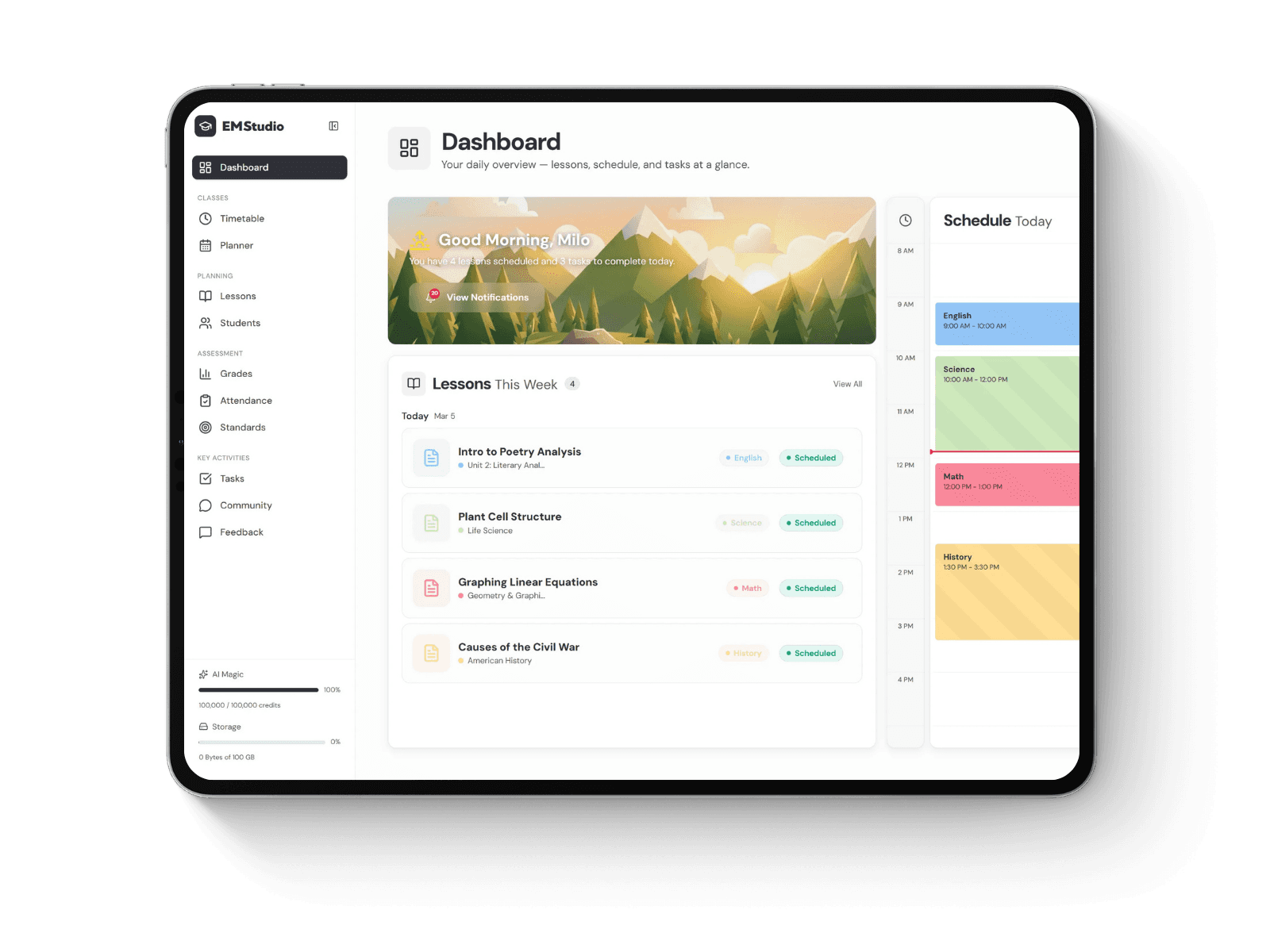
EMStudio is a free teaching management app — manage your classes, students, lessons, and more!
Learn More
Still grading everything by hand?
EMStudio is a free teaching management app — manage your classes, students, lessons, and more!
Learn More
Table of Contents
What Are the Best Free Reading Websites for Students?
Epic!'s free tier works only during school hours—7am to 4pm—and caps you at 36 profiles. Parents pay $7.99 monthly for home access. CommonLit stays fully free. Newsela limits Lite users to three articles daily.
All three support Spanish content. Newsela translates every article. Epic! stocks Spanish picture books. CommonLit includes ELL scaffolding.
Epic! for Unlimited Elementary Reading Libraries
Epic! functions like a digital learning platform and ranks among the top digital libraries with free books for kids. The library holds 40,000+ titles including audiobooks and Spanish picture books. Educational websites for 3rd graders need variety, and Epic! delivers.
The free account works only during school hours—7am to 4pm. You can roster 36 kids max. The "Read to Me" feature highlights words as narrators read, helping K-2 readers track print.
Parents pay $7.99 monthly for home access.
CommonLit for Standards-Aligned Text Analysis
CommonLit offers formative assessment platforms disguised as literature libraries. The site organizes texts by standard for grades 3-12 with built-in annotation tools and paired texts.
The Guided Reading Mode chunks text and checks for understanding after each section. You get tracking data by standard. Students highlight directly on the text, and you see every annotation in your dashboard.
The platform includes text-to-speech for ELL support. No paid tier required.
Newsela for Differentiated Current Events Articles
Newsela turns current events into differentiated instruction tools. Every article publishes at five Lexile levels—from 2nd to 12th grade. Students read the same news at their independent level.
The free "Newsela Lite" tier gives three articles daily for classes up to 40 students. Power Words highlights tier-two vocabulary with printable quizzes. Every article includes a Spanish translation, making this important for ELL virtual classroom resources.

Which Math Websites Build Real Fluency?
Khan Academy builds fluency through mastery-based practice with 80,000+ questions and instructional videos. Prodigy uses adaptive game-based learning for grades 1-8, adjusting difficulty in real-time. Desmos provides visual graphing tools for conceptual understanding in grades 6-12. All three are free and research-backed.
Math fluency combines automaticity—speed plus accuracy—with conceptual understanding and real application. It is not just drill practice. Students need 15-20 minutes of daily practice for skill retention. These student websites deliver that targeted work without the worksheet waste.
Platform | Model | Grades | Cost | Devices | Prerequisites |
Khan Academy | Mastery learning | K-12 | Free | Any browser, iOS, Android | Basic reading for word problems |
Prodigy | Adaptive game-based | 1-8 | Free (freemium) | Web, iOS, Android | Basic computer navigation |
Desmos | Visual conceptualization | 6-12 | Free | Modern browsers | Pre-algebra foundation |
Prodigy's freemium model creates equity gaps. Students see "member-only" content locked behind paywalls, which distracts from learning. Go to your Teacher Account, select Class Settings, and toggle Allow Social Features OFF. This hides member benefits visibility and keeps focus on the math.
Research on adaptive learning platforms indicates measurable gains in fact fluency when used as supplemental practice 3-4 times weekly. Consistent use beats sporadic cramming every time.
Khan Academy for Comprehensive Skill Practice
Khan Academy runs on a mastery learning system with over 80,000 practice questions spanning arithmetic through calculus. Students work until they demonstrate understanding, not until the bell rings. The platform delivers free educational websites realness—no paywalls, no trials, just rigorous educational technology that works on Chromebooks, iPads, or phones.
Instructional videos average 8-12 minutes, hitting that sweet spot for station rotations or flipped lessons. The presenters speak clearly and write every step on a digital blackboard. When students hit a wall, the Get a Hint feature provides scaffolded support without spoiling the final answer. They see the first logical step, work, then request the next. This builds problem-solving independence, not button-mashing dependence.
Your teacher dashboard tracks every skill marked Proficient versus Mastered, complete with granular time-on-task data. You can see who rushed through in three minutes and who spent twenty minutes wrestling with fractions. Mastery challenges appear automatically after students level up, mixing six-month-old problems with new content. These timed reviews force recall from long-term memory, cementing true automaticity.
For math teacher resources to transform your classroom, Khan offers assignment tools that align to Common Core or your state standards. You pick the specific skill, set the due date, and the platform handles the differentiated instruction. Struggling students get prerequisite videos; advanced kids unlock harder challenges. It remains one of the best educational websites and most reliable digital learning platforms for building fluency.
Prodigy for Adaptive Game-Based Learning
Prodigy disguises digital learning as a role-playing game for grades 1-8. Students cast spells by solving math problems, but the backend runs serious adaptive learning algorithms. The system monitors twelve diagnostic variables—including response time, error patterns, and help-seeking behavior—to adjust difficulty in real time. No two students see the same sequence of questions.
When a student struggles with place value, the questions shift to visual models. When they master multiplication, the game introduces division immediately. This responsiveness makes it one of the most fun educational websites that actually builds skills, not just entertainment. The differentiated instruction happens automatically during every play session, freeing you to work with small groups.
Free teacher tools let you create assignments aligned to Common Core, TEKS, or MAFS standards. You can force specific question types regardless of the adaptive path. Curriculum alignment reports break down mastery by standard, working as formative assessment platforms that update daily. You see exactly which standards need reteaching before the unit test.
The virtual classroom resources include battle modes where students challenge each other with math problems. Use this for Friday competitions or reward time. The game runs on any device with a browser, making it ideal for BYOD environments or computer labs. It turns practice into play without sacrificing the mathematical rigor required for true fluency.
Desmos for Visual Graphing and Problem Solving
Desmos replaces the TI-84 with a free, browser-based HTML5 graphing calculator. It works on Chromebooks, phones, and tablets without installation. Students pinch to zoom, drag to pan, and watch instantaneous changes when they modify equations. This kinesthetic connection builds deeper understanding than static textbook images.
For grades 6-12, the Activity Builder lets you create interactive learning tools where students manipulate sliders, match graphs, or draw functions. You can build a lesson in twenty minutes. Insert questions that pause the activity, forcing students to predict before they see the graph. This prediction cycle creates productive struggle.
The Classroom Conversation Toolkit includes has like anonymizing student responses to facilitate safe mathematical discussions. When you project the class overlay, students see "Student A" instead of names attached to wrong answers. They take intellectual risks. They guess boldly. They revise publicly. This builds the conceptual fluency that supports procedural speed and accuracy.
Desmos covers algebra through calculus, including statistics and geometry tools. The calculator handles regression, derivatives, and polar coordinates with ease. It integrates with Google Classroom and other virtual classroom resources. You can create custom activities or use the thousands built by the community. For secondary teachers, it is essential educational technology that makes abstract math concrete and visual.
Unlike calculation-only apps, Desmos focuses on mathematical reasoning. Students explore how changing coefficients affects parabolas. They discover slope-intercept relationships graphically. This exploration cements concepts that drill cannot touch.
What Science Websites Bring Experiments to Life?
PhET Interactive Simulations from University of Colorado provides virtual labs for physics and chemistry without equipment costs, NASA STEM Engagement offers real-world aerospace applications and career resources, and Mystery Science delivers phenomena-based video lessons with hands-on activities for elementary grades. All platforms offer free educator access.
You do not need a lab coat or a budget. These digital learning platforms let students manipulate variables, watch rocket launches, and dissect owl pellets—sometimes before breakfast.
Phenomena-based learning drives modern science instruction. Students observe the mystery first—the balloon that refuses to pop, the shadow that moves backward—then construct explanations. This mirrors NGSS practices: experience before vocabulary. These interactive learning tools create those moments without safety goggles or cleanup.
Each platform serves different lab needs. PhET offers open-ended simulations where students build circuits or manipulate gravity. NASA provides multimedia career contexts connecting classroom concepts to aerospace engineers. Mystery Science structures K-5 investigations with video hooks plus hands-on activities using pantry supplies.
Technical barriers are minimal for these virtual classroom resources:
PhET runs on HTML5—no plugins, no Java, works on aging Chromebooks.
NASA requires zero student account creation; access everything anonymously.
Mystery Science needs only a teacher email; no student PII enters the system.
Grade bands vary sharply:
PhET targets grades 3-12 with increasing mathematical complexity.
NASA spans K-12 with differentiated hubs.
Mystery Science stops at grade 5; middle schoolers will find the pacing too slow.
These education learning websites function as differentiated instruction tools and formative assessment platforms. Watch real-time as students test hypotheses. See who adjusts the friction slider ten times before recording data.
Looking for more STEM teacher resources and curriculum platforms? Start with these three student websites that prioritize exploration over memorization.
PhET Interactive Simulations for Virtual Labs
The University of Colorado Boulder hosts over 150 PhET Interactive Simulations spanning physics, chemistry, math, and biology. These work for grades 3-12, though middle and high schoolers gain the most from variables like molecule polarity or photon energy.
The Teach with PhET section saves hours. Download PDF lesson plans written by veteran teachers. Grab activity sheets that force students to predict outcomes before clicking "start." Read tips for facilitating inquiry without giving away the answer. I used the circuit construction kit last February when my physical lab's power supplies died; students built parallel circuits on Chromebooks while I ordered replacements.
These simulations shine as formative assessment tools. The "Game" tab in newer sims tracks student progress through challenge levels. You see who understands buoyancy and who randomly clicks until something floats.
NASA STEM Engagement for Real-World Applications
NASA does not just share pretty space photos. The NASA for Students portal organizes K-12 content into grade-level hubs: K-4, 5-8, and 9-12. Each section connects standards to actual missions.
The STEM Engagement career profiles feature diverse scientists—mechanical engineers who grew up in rural Texas, microbiologists working on Mars rover sterilization. Students see themselves in these roles. The Mission to Mars interactive lets teams design landing systems using drag-and-drop components, then watch 4K video of real descent footage.
High school teachers should explore the citizen science projects. Students analyze real telescope data or classify cloud formations from satellite imagery. These online educational resources turn astronomy classes into research labs. No student accounts means zero setup friction—project the interactive on your board or share links via your existing LMS.
Mystery Science for Phenomena-Based Lessons
Mystery Science structures every lesson around a question: "Why do woodpeckers peck wood?" or "Could a mountain turn into a volcano?" The video hook runs five to ten minutes. Then students investigate using paper clips, vinegar, ice cubes—materials you already own.
This is pure NGSS phenomena-based instruction. Students watch the hook, discuss predictions, test with hands-on materials, then return to the video for the explanation. The pacing forces them to grapple with the concept before receiving vocabulary.
The free trial includes one complete unit—usually eight lessons. Full free access for 2024-2025 requires school or district adoption, though individual teachers can often secure trial extensions. These educational technology tools work specifically for K-5; sixth graders will find the narration too slow. Use it while you can—this generation needs more wonder and fewer worksheets.

Where Can Students Find Free Homework Help Online?
Brainly provides peer-to-peer Q&A support with 350 million users but requires monitoring for accuracy, Khan Academy offers step-by-step video tutorials across all subjects with mastery tracking, and Quizlet enables custom flashcard creation with study games. While free tiers exist, educators should supervise Brainly use to ensure academic integrity.
Free homework help is a double-edged sword. These student websites offer instant answers, but instant doesn't mean accurate. You need guardrails before sending kids to these digital learning platforms.
Brainly and Quizlet can become copy-paste machines. Require students to show work on paper before checking answers online. Use these homework websites for review only, never for closed-book assessments. Teach lateral reading: if a solution looks suspicious, students should cross-check against their textbook or a trusted source like Khan Academy before submitting.
Never allow these study websites free during high-stakes testing or timed assessments. They're appropriate only after students have attempted problems independently. Use them for concept clarification at 8 PM when you're not available to explain fractions. Think of them as digital tutoring, not answer keys.
Safety Check for Homework Sites
Community moderation quality (who reviews the answers?)
Data privacy policies (what do they collect?)
Age verification gates (COPPA compliance for under 13)
Teacher oversight dashboards (can you monitor activity?)
Brainly runs free with ads; Brainly Plus costs $9.99 monthly for ad-free access. Khan Academy remains 100% free, funded by donations. Quizlet offers a free tier with basic flashcards, while Quizlet Plus runs $35.99 yearly for offline access and advanced interactive learning tools.
Brainly for Peer-to-Peer Academic Support
Brainly operates like a homework-focused Reddit where 350 million users trade answers in real-time. Students post photos of worksheet problems and receive responses within minutes. Contributors earn points for answering, creating a gamified economy where speed sometimes trumps accuracy.
The platform relies on community reporting for moderation. Incorrect answers can sit unchecked for hours, racking up thanks from desperate students. Last October, I watched a 10th grader copy a botched chemical equation that had 50 upvotes.
Always require students to cross-verify solutions against their textbook or Khan Academy before trusting them. Set a class rule: Brainly is for checking, not finding. If they haven't filled their paper with attempted work first, they can't open this educational technology.
Khan Academy for Video Tutorial Libraries
Khan Academy functions as your 24/7 teaching assistant with over 10,000 video tutorials. Each video breaks concepts into digestible chunks using step-by-step worked examples. The "Get a Hint" feature walks students through problems incrementally without spoiling the final answer.
Practice sets provide instant feedback, marking answers wrong immediately so kids don't cement misconceptions. These formative assessment platforms track mastery through color-coded skill maps that pinpoint exactly where a student derails.
Create assignment links that act as satellite tutoring. Send a struggling 7th grader a direct link to 4th-grade fraction prerequisites before they tackle current ratios. This differentiated instruction tool extends your reach beyond the bell.
Quizlet for Flashcard and Study Game Creation
Quizlet turns memorization into interactive learning tools with seven study modes: Flashcards, Learn, Write, Spell, Test, Match, and Gravity. The free tier allows creation of study sets and basic Flashcards and Match play. However, the adaptive Learn mode requires a paid upgrade.
For flashcard apps that use spaced repetition without paywalls, look elsewhere, but Quizlet's collaboration has remain unmatched among free websites for students.
Quizlet Live transforms review days into competitive team challenges supporting 2-4 teams per game. Students see definitions on their screens but must find who has the matching term among teammates. It turns your virtual classroom resources into actual classroom energy.

What Are the Most Engaging Creative Learning Platforms?
Scratch from MIT teaches block-based coding through animated stories and games for ages 8-16, Canva for Education builds visual design skills with 60+ million templates and stock images for grades 4-12, and Code.org offers structured computer science pathways from kindergarten through AP level. All three build creativity while teaching transferable digital skills.
Creative learning platforms work on constructionism—students learn by building, not just watching. These three student websites transform passive use of internet for students into active production. Kids produce actual artifacts: functioning games, professional posters, working apps.
Unlike passive video tutorials, these tools demand active production. A third grader spends 45 minutes coding a chase game in Scratch. A seventh grader builds an infographic in Canva in 20 minutes. High schoolers tackle 20-hour courses on Code.org or advance to AWS Educate—an aws for student pathway offering cloud computing credentials and free career training for ages 14 and up preparing for CTE certifications.
Safety considerations vary by platform. Scratch operates a moderated community where every shared project gets reviewed. Canva for Education removes advertisements entirely and carries COPPA compliance for data protection. Code.org lets students complete Hour of Code activities without creating accounts, eliminating privacy concerns for quick lessons.
Scratch for Block-Based Coding Projects
MIT Media Lab built Scratch specifically for ages 8 to 16. Students snap together color-coded blocks to build animations, games, and interactive stories without wrestling with syntax errors. The visual programming interface removes the frustration of typos while teaching real computational thinking concepts like loops, conditionals, and variables through immediate visual feedback.
The platform hosts over 100 million shared projects in its community gallery. Kids remix existing games or publish original creations, receiving feedback from peers worldwide. This social aspect motivates revision. You access the Scratch for Educators portal, which includes CS First curriculum—ready-made lesson plans with videos and activities—and classroom management tools that let you assign projects and track progress without requiring students to manage individual email accounts.
I’ve watched 4th graders spend entire 45-minute blocks perfecting maze games, debugging when their sprites get stuck in walls or adding score counters that increment when characters collect coins. The time investment matches elementary attention spans while producing substantial learning outcomes. For educators seeking virtual classroom resources that emphasize creation over consumption, Scratch remains the entry point for teaching coding skills to students that actually sticks.
Canva for Education for Visual Design Skills
Canva for Education offers free accounts to verified K-12 teachers and their students. The library contains 60 million stock images, thousands of templates for infographics, scientific posters, historical timelines, and presentation decks—far beyond the basic clip art students typically access in older educational technology tools. Real-time collaboration works like Google Docs; three students can edit the same poster simultaneously from different Chromebooks, watching cursors move and text update instantly.
You can use this with grades 4 through 12. Twenty-minute design projects fit neatly into your class periods. Your sixth graders build scientific method posters during one science block using drag-and-drop elements. Your tenth graders construct magazine covers for English literature projects. Unlike the consumer version, Canva for Education carries no advertisements, disables inappropriate image search automatically, and meets COPPA compliance standards, making sure student data never feeds targeted advertising algorithms.
These differentiated instruction tools adapt to varied skill levels within the same assignment. Struggling students modify existing templates by swapping text and images. Advanced learners start from blank canvases to manipulate layers, transparency, and custom color palettes. Both groups develop visual literacy—the ability to communicate complex ideas through layout, color theory, and typography—that transfers across every subject area from social studies to biology.
Code.org for Structured Computer Science Pathways
Code.org provides the curricular backbone for your district-wide computer science implementation. The platform structures learning across three distinct, vertically-aligned pathways: CS Fundamentals for kindergarten through fifth grade using block-based puzzles, CS Discoveries for middle school introducing web design and physical computing, and CS Principles for high school students seeking AP credit through JavaScript and Python exploration. Each pathway builds systematically, preventing the knowledge gaps that occur when digital learning platforms lack intentional scope and sequence.
The Hour of Code activities require no student accounts—perfect for trial lessons, guest teacher days, or formative assessment platforms that need quick deployment. When you establish permanent classes, your teacher dashboard tracks granular progress through 20-hour courses, showing which students mastered functions, who struggles with nested loops, and where the class needs reteaching. Unplugged activities embedded in lesson plans work for classrooms with limited devices, using paper cutouts and physical movement to teach debugging and algorithm concepts before students touch keyboards.
These digital tools for teaching coding scale from pre-readers dragging picture blocks to teenagers writing JavaScript for apps. The progression mirrors how students actually develop computational thinking, making it one of the few interactive learning tools that serves every grade band without pedagogical compromise. For teachers building comprehensive CS programs, Code.org supplies the structure that individual website resources for students often lack.

How Do You Choose the Right Website for Your Classroom?
Evaluate websites by checking COPPA/FERPA compliance for student data safety, verifying alignment with state standards using vendor alignment documents, and testing functionality on your specific student devices including older Chromebooks and tablets. Prioritize platforms with single sign-on integration to reduce login barriers and administrative overhead.
Start with safety. Then check if it actually teaches what you need. Finally, test these digital learning platforms on the crusty Chromebook that keeps overheating in row three. If it passes all three, you've got a winner.
Run every student websites candidate through this three-step filter.
Step 1: Safety/Compliance Check. COPPA compliance is mandatory. FERPA compliance is mandatory.
Step 2: Pedagogical Alignment Verification. Standards alignment documentation rated 1-5. Check Depth of Knowledge levels 1-4.
Step 3: Technical Feasibility Test. SSO integration capability: yes/no. Offline functionality: yes/no for low-bandwidth schools.
Test on your oldest devices. Epic! requires 5Mbps for video streaming, while Desmos works offline and PhET runs on less than 1Mbps. For high school CTE programs with students ages 14+, evaluate AWS Educate for cloud computing pathways; it requires email verification but offers free credits for hands-on labs.
Evaluate Age-Appropriateness and Safety Features
Check for the COPPA Safe Harbor seal first. Look for the iKeepSafe certification—it's the gold standard for privacy.
Verify FERPA compliance in the data use policy.
Confirm zero advertisements for under-13 users.
Check if teachers can disable chat or community features.
Request the Data Processing Agreement from IT.
If the platform sells data or shows targeted ads to kids under 13, delete it from your list. No lesson is worth compromising student privacy. Free educational websites for students often monetize through ads, so scrutinize the business model carefully. Read our guide on protecting student privacy in the age of edtech for deeper compliance checks.
Verify Alignment with Learning Standards and Objectives
Download the vendor's standards alignment PDF.
Verify coverage of Common Core, NGSS, or state-specific standards.
Check Depth of Knowledge levels 1 through 4.
Test data export to Google Classroom, Canvas, or Schoology.
Surface-level matching wastes time. If you must manually transfer grades, calculate that weekly time cost. Formative assessment platforms should reduce your workload, not create data entry bottlenecks. See our educational technology integration guide for alignment strategies that actually work.
Test Accessibility Across Student Devices
Test every virtual classroom resource on the oldest hardware students use.
Test on Chromebooks 3+ years old.
Check bandwidth: Epic! needs 5Mbps, Desmos works offline, PhET needs <1Mbps.
Verify WCAG 2.1 AA compliance for screen readers.
Visually impaired students need these differentiated instruction tools to work with assistive technology. Review our list of tools for inclusive classrooms and accessible learning before finalizing your choice.
Quick-Start Guide for Student Websites
You don't need to redesign your entire curriculum tonight. Pick one digital learning platform from this list that fills a gap in your current toolkit. Test it with one class period tomorrow.
Watch how students react during the first five minutes. Do they get stuck on the login screen? Do they immediately start exploring? That friction tells you everything. If the site creates more headaches than learning, drop it. Your time matters too much to wrestle with clunky educational technology.
The best interactive learning tools fade into the background. Students forget they're using a website and focus on the math problem, the science experiment, or the story. That's your signal you've found a keeper.
Pick your biggest pain point.
Choose one site from this article that solves it.
Create one assignment for next week.
Watch three students use it and note where they get stuck.

What Are the Best Free Reading Websites for Students?
Epic!'s free tier works only during school hours—7am to 4pm—and caps you at 36 profiles. Parents pay $7.99 monthly for home access. CommonLit stays fully free. Newsela limits Lite users to three articles daily.
All three support Spanish content. Newsela translates every article. Epic! stocks Spanish picture books. CommonLit includes ELL scaffolding.
Epic! for Unlimited Elementary Reading Libraries
Epic! functions like a digital learning platform and ranks among the top digital libraries with free books for kids. The library holds 40,000+ titles including audiobooks and Spanish picture books. Educational websites for 3rd graders need variety, and Epic! delivers.
The free account works only during school hours—7am to 4pm. You can roster 36 kids max. The "Read to Me" feature highlights words as narrators read, helping K-2 readers track print.
Parents pay $7.99 monthly for home access.
CommonLit for Standards-Aligned Text Analysis
CommonLit offers formative assessment platforms disguised as literature libraries. The site organizes texts by standard for grades 3-12 with built-in annotation tools and paired texts.
The Guided Reading Mode chunks text and checks for understanding after each section. You get tracking data by standard. Students highlight directly on the text, and you see every annotation in your dashboard.
The platform includes text-to-speech for ELL support. No paid tier required.
Newsela for Differentiated Current Events Articles
Newsela turns current events into differentiated instruction tools. Every article publishes at five Lexile levels—from 2nd to 12th grade. Students read the same news at their independent level.
The free "Newsela Lite" tier gives three articles daily for classes up to 40 students. Power Words highlights tier-two vocabulary with printable quizzes. Every article includes a Spanish translation, making this important for ELL virtual classroom resources.
Which Math Websites Build Real Fluency?
Khan Academy builds fluency through mastery-based practice with 80,000+ questions and instructional videos. Prodigy uses adaptive game-based learning for grades 1-8, adjusting difficulty in real-time. Desmos provides visual graphing tools for conceptual understanding in grades 6-12. All three are free and research-backed.
Math fluency combines automaticity—speed plus accuracy—with conceptual understanding and real application. It is not just drill practice. Students need 15-20 minutes of daily practice for skill retention. These student websites deliver that targeted work without the worksheet waste.
Platform | Model | Grades | Cost | Devices | Prerequisites |
Khan Academy | Mastery learning | K-12 | Free | Any browser, iOS, Android | Basic reading for word problems |
Prodigy | Adaptive game-based | 1-8 | Free (freemium) | Web, iOS, Android | Basic computer navigation |
Desmos | Visual conceptualization | 6-12 | Free | Modern browsers | Pre-algebra foundation |
Prodigy's freemium model creates equity gaps. Students see "member-only" content locked behind paywalls, which distracts from learning. Go to your Teacher Account, select Class Settings, and toggle Allow Social Features OFF. This hides member benefits visibility and keeps focus on the math.
Research on adaptive learning platforms indicates measurable gains in fact fluency when used as supplemental practice 3-4 times weekly. Consistent use beats sporadic cramming every time.
Khan Academy for Comprehensive Skill Practice
Khan Academy runs on a mastery learning system with over 80,000 practice questions spanning arithmetic through calculus. Students work until they demonstrate understanding, not until the bell rings. The platform delivers free educational websites realness—no paywalls, no trials, just rigorous educational technology that works on Chromebooks, iPads, or phones.
Instructional videos average 8-12 minutes, hitting that sweet spot for station rotations or flipped lessons. The presenters speak clearly and write every step on a digital blackboard. When students hit a wall, the Get a Hint feature provides scaffolded support without spoiling the final answer. They see the first logical step, work, then request the next. This builds problem-solving independence, not button-mashing dependence.
Your teacher dashboard tracks every skill marked Proficient versus Mastered, complete with granular time-on-task data. You can see who rushed through in three minutes and who spent twenty minutes wrestling with fractions. Mastery challenges appear automatically after students level up, mixing six-month-old problems with new content. These timed reviews force recall from long-term memory, cementing true automaticity.
For math teacher resources to transform your classroom, Khan offers assignment tools that align to Common Core or your state standards. You pick the specific skill, set the due date, and the platform handles the differentiated instruction. Struggling students get prerequisite videos; advanced kids unlock harder challenges. It remains one of the best educational websites and most reliable digital learning platforms for building fluency.
Prodigy for Adaptive Game-Based Learning
Prodigy disguises digital learning as a role-playing game for grades 1-8. Students cast spells by solving math problems, but the backend runs serious adaptive learning algorithms. The system monitors twelve diagnostic variables—including response time, error patterns, and help-seeking behavior—to adjust difficulty in real time. No two students see the same sequence of questions.
When a student struggles with place value, the questions shift to visual models. When they master multiplication, the game introduces division immediately. This responsiveness makes it one of the most fun educational websites that actually builds skills, not just entertainment. The differentiated instruction happens automatically during every play session, freeing you to work with small groups.
Free teacher tools let you create assignments aligned to Common Core, TEKS, or MAFS standards. You can force specific question types regardless of the adaptive path. Curriculum alignment reports break down mastery by standard, working as formative assessment platforms that update daily. You see exactly which standards need reteaching before the unit test.
The virtual classroom resources include battle modes where students challenge each other with math problems. Use this for Friday competitions or reward time. The game runs on any device with a browser, making it ideal for BYOD environments or computer labs. It turns practice into play without sacrificing the mathematical rigor required for true fluency.
Desmos for Visual Graphing and Problem Solving
Desmos replaces the TI-84 with a free, browser-based HTML5 graphing calculator. It works on Chromebooks, phones, and tablets without installation. Students pinch to zoom, drag to pan, and watch instantaneous changes when they modify equations. This kinesthetic connection builds deeper understanding than static textbook images.
For grades 6-12, the Activity Builder lets you create interactive learning tools where students manipulate sliders, match graphs, or draw functions. You can build a lesson in twenty minutes. Insert questions that pause the activity, forcing students to predict before they see the graph. This prediction cycle creates productive struggle.
The Classroom Conversation Toolkit includes has like anonymizing student responses to facilitate safe mathematical discussions. When you project the class overlay, students see "Student A" instead of names attached to wrong answers. They take intellectual risks. They guess boldly. They revise publicly. This builds the conceptual fluency that supports procedural speed and accuracy.
Desmos covers algebra through calculus, including statistics and geometry tools. The calculator handles regression, derivatives, and polar coordinates with ease. It integrates with Google Classroom and other virtual classroom resources. You can create custom activities or use the thousands built by the community. For secondary teachers, it is essential educational technology that makes abstract math concrete and visual.
Unlike calculation-only apps, Desmos focuses on mathematical reasoning. Students explore how changing coefficients affects parabolas. They discover slope-intercept relationships graphically. This exploration cements concepts that drill cannot touch.
What Science Websites Bring Experiments to Life?
PhET Interactive Simulations from University of Colorado provides virtual labs for physics and chemistry without equipment costs, NASA STEM Engagement offers real-world aerospace applications and career resources, and Mystery Science delivers phenomena-based video lessons with hands-on activities for elementary grades. All platforms offer free educator access.
You do not need a lab coat or a budget. These digital learning platforms let students manipulate variables, watch rocket launches, and dissect owl pellets—sometimes before breakfast.
Phenomena-based learning drives modern science instruction. Students observe the mystery first—the balloon that refuses to pop, the shadow that moves backward—then construct explanations. This mirrors NGSS practices: experience before vocabulary. These interactive learning tools create those moments without safety goggles or cleanup.
Each platform serves different lab needs. PhET offers open-ended simulations where students build circuits or manipulate gravity. NASA provides multimedia career contexts connecting classroom concepts to aerospace engineers. Mystery Science structures K-5 investigations with video hooks plus hands-on activities using pantry supplies.
Technical barriers are minimal for these virtual classroom resources:
PhET runs on HTML5—no plugins, no Java, works on aging Chromebooks.
NASA requires zero student account creation; access everything anonymously.
Mystery Science needs only a teacher email; no student PII enters the system.
Grade bands vary sharply:
PhET targets grades 3-12 with increasing mathematical complexity.
NASA spans K-12 with differentiated hubs.
Mystery Science stops at grade 5; middle schoolers will find the pacing too slow.
These education learning websites function as differentiated instruction tools and formative assessment platforms. Watch real-time as students test hypotheses. See who adjusts the friction slider ten times before recording data.
Looking for more STEM teacher resources and curriculum platforms? Start with these three student websites that prioritize exploration over memorization.
PhET Interactive Simulations for Virtual Labs
The University of Colorado Boulder hosts over 150 PhET Interactive Simulations spanning physics, chemistry, math, and biology. These work for grades 3-12, though middle and high schoolers gain the most from variables like molecule polarity or photon energy.
The Teach with PhET section saves hours. Download PDF lesson plans written by veteran teachers. Grab activity sheets that force students to predict outcomes before clicking "start." Read tips for facilitating inquiry without giving away the answer. I used the circuit construction kit last February when my physical lab's power supplies died; students built parallel circuits on Chromebooks while I ordered replacements.
These simulations shine as formative assessment tools. The "Game" tab in newer sims tracks student progress through challenge levels. You see who understands buoyancy and who randomly clicks until something floats.
NASA STEM Engagement for Real-World Applications
NASA does not just share pretty space photos. The NASA for Students portal organizes K-12 content into grade-level hubs: K-4, 5-8, and 9-12. Each section connects standards to actual missions.
The STEM Engagement career profiles feature diverse scientists—mechanical engineers who grew up in rural Texas, microbiologists working on Mars rover sterilization. Students see themselves in these roles. The Mission to Mars interactive lets teams design landing systems using drag-and-drop components, then watch 4K video of real descent footage.
High school teachers should explore the citizen science projects. Students analyze real telescope data or classify cloud formations from satellite imagery. These online educational resources turn astronomy classes into research labs. No student accounts means zero setup friction—project the interactive on your board or share links via your existing LMS.
Mystery Science for Phenomena-Based Lessons
Mystery Science structures every lesson around a question: "Why do woodpeckers peck wood?" or "Could a mountain turn into a volcano?" The video hook runs five to ten minutes. Then students investigate using paper clips, vinegar, ice cubes—materials you already own.
This is pure NGSS phenomena-based instruction. Students watch the hook, discuss predictions, test with hands-on materials, then return to the video for the explanation. The pacing forces them to grapple with the concept before receiving vocabulary.
The free trial includes one complete unit—usually eight lessons. Full free access for 2024-2025 requires school or district adoption, though individual teachers can often secure trial extensions. These educational technology tools work specifically for K-5; sixth graders will find the narration too slow. Use it while you can—this generation needs more wonder and fewer worksheets.
Where Can Students Find Free Homework Help Online?
Brainly provides peer-to-peer Q&A support with 350 million users but requires monitoring for accuracy, Khan Academy offers step-by-step video tutorials across all subjects with mastery tracking, and Quizlet enables custom flashcard creation with study games. While free tiers exist, educators should supervise Brainly use to ensure academic integrity.
Free homework help is a double-edged sword. These student websites offer instant answers, but instant doesn't mean accurate. You need guardrails before sending kids to these digital learning platforms.
Brainly and Quizlet can become copy-paste machines. Require students to show work on paper before checking answers online. Use these homework websites for review only, never for closed-book assessments. Teach lateral reading: if a solution looks suspicious, students should cross-check against their textbook or a trusted source like Khan Academy before submitting.
Never allow these study websites free during high-stakes testing or timed assessments. They're appropriate only after students have attempted problems independently. Use them for concept clarification at 8 PM when you're not available to explain fractions. Think of them as digital tutoring, not answer keys.
Safety Check for Homework Sites
Community moderation quality (who reviews the answers?)
Data privacy policies (what do they collect?)
Age verification gates (COPPA compliance for under 13)
Teacher oversight dashboards (can you monitor activity?)
Brainly runs free with ads; Brainly Plus costs $9.99 monthly for ad-free access. Khan Academy remains 100% free, funded by donations. Quizlet offers a free tier with basic flashcards, while Quizlet Plus runs $35.99 yearly for offline access and advanced interactive learning tools.
Brainly for Peer-to-Peer Academic Support
Brainly operates like a homework-focused Reddit where 350 million users trade answers in real-time. Students post photos of worksheet problems and receive responses within minutes. Contributors earn points for answering, creating a gamified economy where speed sometimes trumps accuracy.
The platform relies on community reporting for moderation. Incorrect answers can sit unchecked for hours, racking up thanks from desperate students. Last October, I watched a 10th grader copy a botched chemical equation that had 50 upvotes.
Always require students to cross-verify solutions against their textbook or Khan Academy before trusting them. Set a class rule: Brainly is for checking, not finding. If they haven't filled their paper with attempted work first, they can't open this educational technology.
Khan Academy for Video Tutorial Libraries
Khan Academy functions as your 24/7 teaching assistant with over 10,000 video tutorials. Each video breaks concepts into digestible chunks using step-by-step worked examples. The "Get a Hint" feature walks students through problems incrementally without spoiling the final answer.
Practice sets provide instant feedback, marking answers wrong immediately so kids don't cement misconceptions. These formative assessment platforms track mastery through color-coded skill maps that pinpoint exactly where a student derails.
Create assignment links that act as satellite tutoring. Send a struggling 7th grader a direct link to 4th-grade fraction prerequisites before they tackle current ratios. This differentiated instruction tool extends your reach beyond the bell.
Quizlet for Flashcard and Study Game Creation
Quizlet turns memorization into interactive learning tools with seven study modes: Flashcards, Learn, Write, Spell, Test, Match, and Gravity. The free tier allows creation of study sets and basic Flashcards and Match play. However, the adaptive Learn mode requires a paid upgrade.
For flashcard apps that use spaced repetition without paywalls, look elsewhere, but Quizlet's collaboration has remain unmatched among free websites for students.
Quizlet Live transforms review days into competitive team challenges supporting 2-4 teams per game. Students see definitions on their screens but must find who has the matching term among teammates. It turns your virtual classroom resources into actual classroom energy.
What Are the Most Engaging Creative Learning Platforms?
Scratch from MIT teaches block-based coding through animated stories and games for ages 8-16, Canva for Education builds visual design skills with 60+ million templates and stock images for grades 4-12, and Code.org offers structured computer science pathways from kindergarten through AP level. All three build creativity while teaching transferable digital skills.
Creative learning platforms work on constructionism—students learn by building, not just watching. These three student websites transform passive use of internet for students into active production. Kids produce actual artifacts: functioning games, professional posters, working apps.
Unlike passive video tutorials, these tools demand active production. A third grader spends 45 minutes coding a chase game in Scratch. A seventh grader builds an infographic in Canva in 20 minutes. High schoolers tackle 20-hour courses on Code.org or advance to AWS Educate—an aws for student pathway offering cloud computing credentials and free career training for ages 14 and up preparing for CTE certifications.
Safety considerations vary by platform. Scratch operates a moderated community where every shared project gets reviewed. Canva for Education removes advertisements entirely and carries COPPA compliance for data protection. Code.org lets students complete Hour of Code activities without creating accounts, eliminating privacy concerns for quick lessons.
Scratch for Block-Based Coding Projects
MIT Media Lab built Scratch specifically for ages 8 to 16. Students snap together color-coded blocks to build animations, games, and interactive stories without wrestling with syntax errors. The visual programming interface removes the frustration of typos while teaching real computational thinking concepts like loops, conditionals, and variables through immediate visual feedback.
The platform hosts over 100 million shared projects in its community gallery. Kids remix existing games or publish original creations, receiving feedback from peers worldwide. This social aspect motivates revision. You access the Scratch for Educators portal, which includes CS First curriculum—ready-made lesson plans with videos and activities—and classroom management tools that let you assign projects and track progress without requiring students to manage individual email accounts.
I’ve watched 4th graders spend entire 45-minute blocks perfecting maze games, debugging when their sprites get stuck in walls or adding score counters that increment when characters collect coins. The time investment matches elementary attention spans while producing substantial learning outcomes. For educators seeking virtual classroom resources that emphasize creation over consumption, Scratch remains the entry point for teaching coding skills to students that actually sticks.
Canva for Education for Visual Design Skills
Canva for Education offers free accounts to verified K-12 teachers and their students. The library contains 60 million stock images, thousands of templates for infographics, scientific posters, historical timelines, and presentation decks—far beyond the basic clip art students typically access in older educational technology tools. Real-time collaboration works like Google Docs; three students can edit the same poster simultaneously from different Chromebooks, watching cursors move and text update instantly.
You can use this with grades 4 through 12. Twenty-minute design projects fit neatly into your class periods. Your sixth graders build scientific method posters during one science block using drag-and-drop elements. Your tenth graders construct magazine covers for English literature projects. Unlike the consumer version, Canva for Education carries no advertisements, disables inappropriate image search automatically, and meets COPPA compliance standards, making sure student data never feeds targeted advertising algorithms.
These differentiated instruction tools adapt to varied skill levels within the same assignment. Struggling students modify existing templates by swapping text and images. Advanced learners start from blank canvases to manipulate layers, transparency, and custom color palettes. Both groups develop visual literacy—the ability to communicate complex ideas through layout, color theory, and typography—that transfers across every subject area from social studies to biology.
Code.org for Structured Computer Science Pathways
Code.org provides the curricular backbone for your district-wide computer science implementation. The platform structures learning across three distinct, vertically-aligned pathways: CS Fundamentals for kindergarten through fifth grade using block-based puzzles, CS Discoveries for middle school introducing web design and physical computing, and CS Principles for high school students seeking AP credit through JavaScript and Python exploration. Each pathway builds systematically, preventing the knowledge gaps that occur when digital learning platforms lack intentional scope and sequence.
The Hour of Code activities require no student accounts—perfect for trial lessons, guest teacher days, or formative assessment platforms that need quick deployment. When you establish permanent classes, your teacher dashboard tracks granular progress through 20-hour courses, showing which students mastered functions, who struggles with nested loops, and where the class needs reteaching. Unplugged activities embedded in lesson plans work for classrooms with limited devices, using paper cutouts and physical movement to teach debugging and algorithm concepts before students touch keyboards.
These digital tools for teaching coding scale from pre-readers dragging picture blocks to teenagers writing JavaScript for apps. The progression mirrors how students actually develop computational thinking, making it one of the few interactive learning tools that serves every grade band without pedagogical compromise. For teachers building comprehensive CS programs, Code.org supplies the structure that individual website resources for students often lack.
How Do You Choose the Right Website for Your Classroom?
Evaluate websites by checking COPPA/FERPA compliance for student data safety, verifying alignment with state standards using vendor alignment documents, and testing functionality on your specific student devices including older Chromebooks and tablets. Prioritize platforms with single sign-on integration to reduce login barriers and administrative overhead.
Start with safety. Then check if it actually teaches what you need. Finally, test these digital learning platforms on the crusty Chromebook that keeps overheating in row three. If it passes all three, you've got a winner.
Run every student websites candidate through this three-step filter.
Step 1: Safety/Compliance Check. COPPA compliance is mandatory. FERPA compliance is mandatory.
Step 2: Pedagogical Alignment Verification. Standards alignment documentation rated 1-5. Check Depth of Knowledge levels 1-4.
Step 3: Technical Feasibility Test. SSO integration capability: yes/no. Offline functionality: yes/no for low-bandwidth schools.
Test on your oldest devices. Epic! requires 5Mbps for video streaming, while Desmos works offline and PhET runs on less than 1Mbps. For high school CTE programs with students ages 14+, evaluate AWS Educate for cloud computing pathways; it requires email verification but offers free credits for hands-on labs.
Evaluate Age-Appropriateness and Safety Features
Check for the COPPA Safe Harbor seal first. Look for the iKeepSafe certification—it's the gold standard for privacy.
Verify FERPA compliance in the data use policy.
Confirm zero advertisements for under-13 users.
Check if teachers can disable chat or community features.
Request the Data Processing Agreement from IT.
If the platform sells data or shows targeted ads to kids under 13, delete it from your list. No lesson is worth compromising student privacy. Free educational websites for students often monetize through ads, so scrutinize the business model carefully. Read our guide on protecting student privacy in the age of edtech for deeper compliance checks.
Verify Alignment with Learning Standards and Objectives
Download the vendor's standards alignment PDF.
Verify coverage of Common Core, NGSS, or state-specific standards.
Check Depth of Knowledge levels 1 through 4.
Test data export to Google Classroom, Canvas, or Schoology.
Surface-level matching wastes time. If you must manually transfer grades, calculate that weekly time cost. Formative assessment platforms should reduce your workload, not create data entry bottlenecks. See our educational technology integration guide for alignment strategies that actually work.
Test Accessibility Across Student Devices
Test every virtual classroom resource on the oldest hardware students use.
Test on Chromebooks 3+ years old.
Check bandwidth: Epic! needs 5Mbps, Desmos works offline, PhET needs <1Mbps.
Verify WCAG 2.1 AA compliance for screen readers.
Visually impaired students need these differentiated instruction tools to work with assistive technology. Review our list of tools for inclusive classrooms and accessible learning before finalizing your choice.
Quick-Start Guide for Student Websites
You don't need to redesign your entire curriculum tonight. Pick one digital learning platform from this list that fills a gap in your current toolkit. Test it with one class period tomorrow.
Watch how students react during the first five minutes. Do they get stuck on the login screen? Do they immediately start exploring? That friction tells you everything. If the site creates more headaches than learning, drop it. Your time matters too much to wrestle with clunky educational technology.
The best interactive learning tools fade into the background. Students forget they're using a website and focus on the math problem, the science experiment, or the story. That's your signal you've found a keeper.
Pick your biggest pain point.
Choose one site from this article that solves it.
Create one assignment for next week.
Watch three students use it and note where they get stuck.
Still grading everything by hand?
EMStudio is a free teaching management app — manage your classes, students, lessons, and more!
Learn More
Still grading everything by hand?
EMStudio is a free teaching management app — manage your classes, students, lessons, and more!
Learn More



Notion4Teachers
Notion templates to simplify administrative tasks and enhance your teaching experience.



2026 Notion4Teachers. All Rights Reserved.
Notion4Teachers
Notion templates to simplify administrative tasks and enhance your teaching experience.
2026 Notion4Teachers. All Rights Reserved.
Notion4Teachers
Notion templates to simplify administrative tasks and enhance your teaching experience.
2026 Notion4Teachers. All Rights Reserved.