
STEM Teacher Resources: 12 Essential Tools and Curriculum Platforms
STEM Teacher Resources: 12 Essential Tools and Curriculum Platforms

Article by
Milo
ESL Content Coordinator & Educator
ESL Content Coordinator & Educator
All Posts
Where do you actually find lessons that work without eating your Sunday afternoon? You stop googling "fun science activities" and start using platforms built for real STEM teacher workflows. This post cuts through the noise. I've tested these 12 tools with actual 7th graders building catapults and debugging code. Some saved me hours. Others wasted my prep period. I'll tell you which is which.
You'll get free Next Generation Science Standards-aligned units and sites with ready-to-use hands-on learning activities that don't require a robotics lab budget. I'll cover PD that actually improves your inquiry-based instruction, not just theory. Plus, a realistic plan for fitting computational thinking and the engineering design process into your existing schedule without the Sunday-night dread.
Still grading everything by hand?
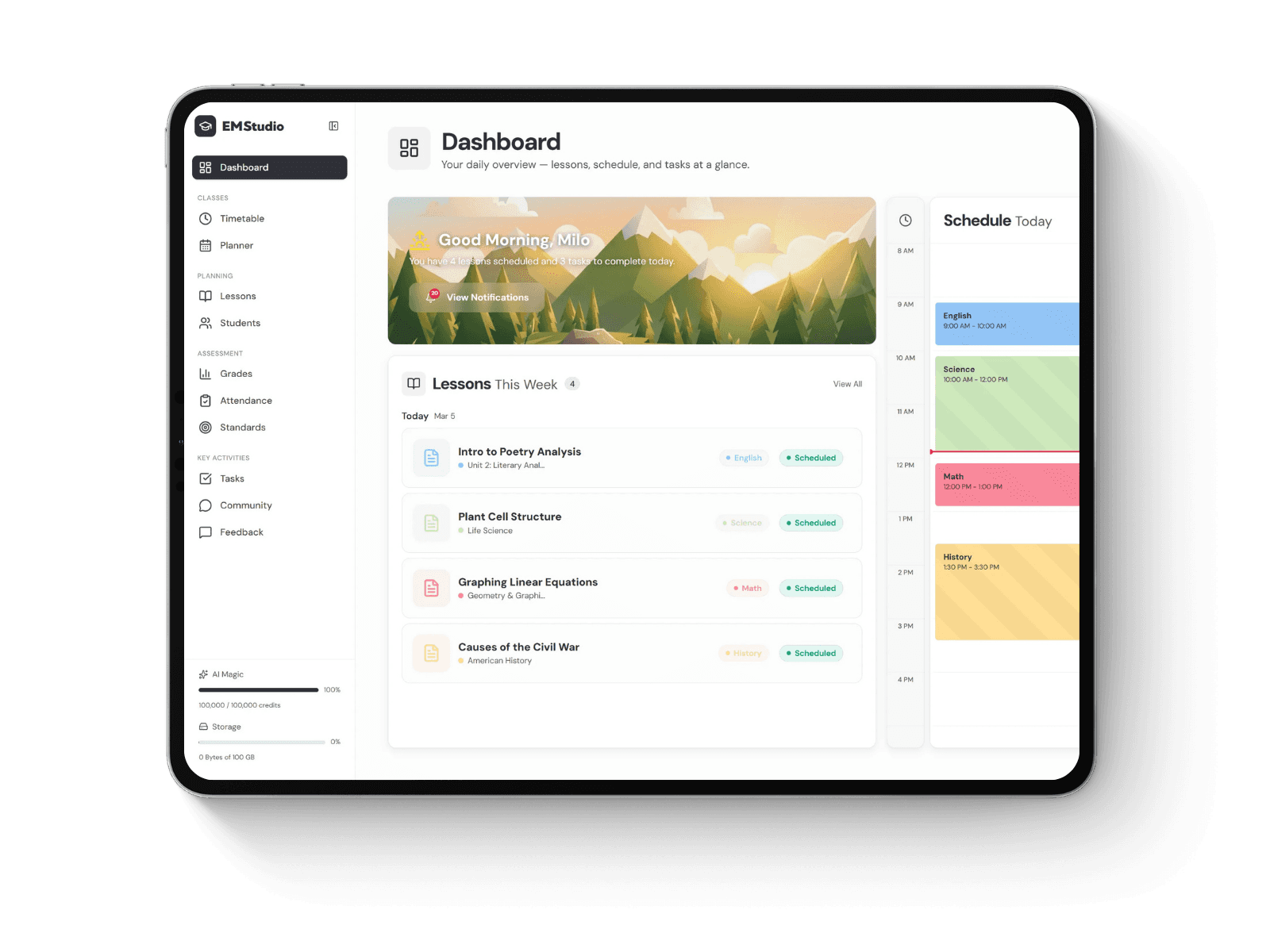
EMStudio is a free teaching management app — manage your classes, students, lessons, and more!
Learn More
Still grading everything by hand?
EMStudio is a free teaching management app — manage your classes, students, lessons, and more!
Learn More
Table of Contents
What Are the Best Free STEM Curriculum Sources?
The best free STEM curriculum sources include PhET Interactive Simulations for physics and chemistry, NASA's STEM Engagement portal for Earth and space science, Engineering is Elementary for hands-on design challenges, and Code.org for computer science pathways. These platforms offer NGSS-aligned content requiring minimal equipment.
You know the drill. Your stem teacher budget covers vinegar and baking soda for volcanoes, but not much else. That's why high-quality free STEM curriculum matters. Code.org alone has reached over 80 million students globally. That's not a pilot program. That's scale you can trust.
Platform | Grade Bands | Primary Focus | Offline Access | Standards |
|---|---|---|---|---|
PhET | K-5, 6-8, 9-12 | Physics, Chemistry, Math | Chromebook app | NGSS |
NASA STEM | 3-12 | Earth & Space Science | PDF downloads | NGSS |
Engineering is Elementary | K-5 | Engineering | Printable materials | NGSS |
Code.org | K-5, 6-8, 9-12 | Computer Science | Unplugged activities | CSTA |
Free Tier Limitations: PhET charges for teacher-contributed lessons beyond the base simulations. Code.org locks the progress dashboard for districts over 1,000 students behind a paid tier. NASA and EiE remain fully free, though EiE storybooks require library checkout or purchase.
Quick Start Recommendations: Choose PhET for high school physics and chemistry gas laws units. Pick NASA for middle school Earth science and current events connections. Use Engineering is Elementary for elementary integrative STEM education strategies. Select Code.org for K-12 computational thinking pathways and AP prep.
PhET Interactive Simulations for Math and Science
PhET runs 158+ HTML5 simulations in your browser. No installation headaches. The Circuit Construction Kit lets 9th graders build DC circuits virtually without burning out real LEDs. Fractions Intro helps 3rd graders grasp equivalence using visual pies rather than worksheets. pH Scale brings middle school chemistry to life with draggable molecules that show acid-base interactions.
Technical specs matter when your district has spotty Wi-Fi. PhET works offline through a Chromebook app. It supports 40+ languages, crucial for multilingual classrooms. Built-in accessibility features include full screen reader support and colorblind modes that replace red-green distinctions with high-contrast patterns.
Differentiation tools include slow-motion playback for analyzing collisions and built-in prediction slides that pause simulations for student hypotheses. The Teacher Tips PDFs deserve special mention. Written by practicing educators, they highlight common misconceptions about current flow and suggest specific facilitation questions. You get inquiry-based instruction without writing the lesson from scratch.
NASA STEM Engagement Digital Resources
NASA offers three goldmine collections. Space Math @ NASA delivers 400+ context-rich problems for grades 3-12. Students calculate radiation exposure for Mars missions using authentic mission parameters. GLOBE Observer turns grades 6-12 students into citizen scientists collecting cloud cover and mosquito habitat data via mobile app. MY NASA DATA provides raw satellite datasets for grades 8-12 climate analysis using Excel or Google Sheets.
Live mission integration separates NASA from static textbooks. Lessons connect directly to Artemis launches and Perseverance rover updates. Scheduled Q&A sessions let your students ask aerospace engineers questions about propulsion systems. When you build a digital resource library, these constantly updated materials remain relevant unlike printed texts.
Most resources download as PDFs for offline use. The hands-on learning happens with household materials. One practical warning: mission schedules shift due to weather. Check the launch calendar before promising your class a live viewing.
Engineering is Elementary Curriculum Units
The Museum of Science Boston offers 20 free units following the 5E instructional model. To Get to the Other Side: Designing Bridges works for grade 2 with a material cost of $12 per class using index cards and pennies. Water, Water Everywhere: Designing Water Filters challenges 5th graders to clean contaminated water using gravel, sand, and cotton balls over three 45-minute sessions.
Each unit opens with a storybook featuring diverse protagonists solving engineering problems. The characters face relatable challenges—limited materials, failed first attempts, teamwork conflicts. ISBN numbers accompany every title for easy library checkout. No need to buy class sets.
The engineering design process feels natural here. Students ask, imagine, plan, create, and improve without rigid step-by-step instructions. You don't need a makerspace budget. Most builds use recyclables and dollar-store supplies. The literacy integration supports ELA blocks, squeezing extra value from your limited instructional minutes while reinforcing that engineers read to solve problems.
Code.org Computer Science Pathways
Code.org breaks computer science into three digestible tracks. CS Fundamentals serves K-5 with 45-hour courses mixing screen time with unplugged activities that teach algorithms through dance moves and card games. CS Discoveries targets grades 6-10 for semester or full-year implementation covering web development and physical computing. CS Principles prepares 9-12 students for the AP exam with rigorous programming concepts and the Create Task.
The Hour of Code offers one-hour entry points featuring Minecraft, Star Wars, and Frozen themes. Perfect for integrative STEM education strategies during computer lab specials or Friday enrichment blocks.
The teacher dashboard tracks sections by CSTA standards. You can lock lesson progression to prevent students from clicking ahead to puzzle solutions. The Progress view shows time-on-task and puzzle completion rates for each student. Use this data for formative assessment without grading stacks of paper or managing physical worksheets.

Which STEM Websites Provide Ready-to-Use Classroom Activities?
Teachers Pay Teachers provides vetted activities from $3-$15, while PBS LearningMedia offers 30,000+ state-aligned interactives. The National Science Digital Library aggregates open educational resources, and Minecraft Education delivers immersive 3D STEM lessons for $4 per user annually.
Comprehensive curriculum maps your whole year. These sites help any stem teacher target the 20-45 minute window. You grab one activity, print or project it, and teach. No unit sequencing required.
Choose TpT for differentiated small-group work, PBS for multimedia hook/engage phases, NSDL for advanced/honors extensions, and Minecraft for kinesthetic/spatial learners.
Teachers Pay Teachers STEM Marketplace
Filter by STEM, grade level, and specific Next Generation Science Standards code like MS-PS1-2. Add a 4.0+ rating filter to weed out low-effort uploads. Single lessons run $3-$15; full month-long units cost $25-$45. Look for the "Verified" shield and video previews showing actual student work samples before you buy.
Cost per use: Low to moderate. Technology prerequisites: Minimal—just PDF access or Google Slides. Standardization quality: Crowd-sourced but review-vetted. Differentiation support: Excellent—search by "scaffolded" or "extension" tags to find tiered activities.
Districts can use TpT for Schools for purchase order integration and site-wide licensing. Instructional coaches push specific resources directly to individual teacher libraries. This streamlines PLC sharing across buildings without email attachments.
National Science Digital Library Repository
The federated search architecture queries 120+ STEM education collections simultaneously, including UCAR, AAAS, and NSF digital libraries. Use advanced search syntax: "educational level:high school" paired with "resource type:interactive simulation." The Computational Science Education Reference Desk (CSERD) offers algorithms and modeling activities for authentic computational thinking practice.
Cost per use: Free. Technology prerequisites: Variable—some older Java applets need updates. Standardization quality: Institutionally vetted by universities and research centers. Differentiation support: Best for advanced extensions and honors-level inquiry-based instruction.
Most resources use OAI-PMH protocol. Your district IT team can harvest metadata directly into local LMS repositories like Canvas or Schoology. This puts peer-reviewed materials right inside your existing lesson planning workflow without manual bookmarking.
PBS LearningMedia Interactive Collections
PBS LearningMedia hosts over 30,000 resources aligned to state-specific standards. The State Standards Alignment tool filters by Texas TEKS, Florida BEST, or California NGSS automatically. Google Classroom integration allows one-click assignment with embedded comprehension questions and automatic grade passback.
Cost per use: Free. Technology prerequisites: Reliable streaming bandwidth. Standardization quality: Professionally vetted by educators. Differentiation support: Strong visual supports benefit ELL students and struggling readers.
Key collections include NOVA Labs for grades 6-12 biotechnology, DragonflyTV for K-5 hands-on learning, and Above the Noise for high school data literacy. Every video includes downloadable teacher guides with discussion questions, student handouts, and suggested pause points for checks for understanding.
Minecraft Education Edition STEM Lessons
Pricing breaks down to $12 per user annually for standalone purchase, or $4 per user when bundled with Microsoft 365 Education A3/A5 licenses. Device requirements include Windows 10/11, macOS 10.14+, iPad iOS 10+, or Chromebooks with 4GB RAM minimum. The Chemistry Lab module lets students craft all 118 elements, build compounds, and simulate lab experiments safely without chemical spills.
Cost per use: Moderate ($4-12). Technology prerequisites: High—requires modern devices and solid graphics. Standardization quality: Microsoft-curated and aligned to standards. Differentiation support: Perfect for kinesthetic and spatial learners who struggle with 2D worksheets.
Code Builder integrates with Microsoft MakeCode (block-based) or Tynker (JavaScript/Python transition), specifically supporting CSTA 1A and 1B standards for grades 3-8. These STEM classroom games and activities pair well with other digital tools for teaching coding to reinforce the engineering design process.

Professional Development Resources for STEM Pedagogy
Most stem teacher training dies in the knowing-doing gap. You finish the module, file the certificate, and Monday looks exactly like Friday. Hattie's Visible Learning research clocks professional development at an effect size of 0.51 only when it includes collective participation and feedback. Without that peer accountability, you are just collecting digital wallpaper.
Program | Time | Cost | Credential | Renewal |
|---|---|---|---|---|
NSTA Membership | Self-paced | $39-$1,200/yr | Certificate | Annual |
ISTE Certification | 2 days + portfolio | $1,995 | Certification | 3 years |
ISTE U Micro-credential | 15-20 hours | $95 | Micro-credential | None |
Coursera Specialization | 6 months | $49/month | Certificate | None |
Local Coalition | Varies | Usually free | CEU hours | Varies |
Stop collecting credentials. Start the 30-Day Implementation Challenge the day you earn one: teach one inquiry-based instruction strategy within thirty days or the learning evaporates. Know the difference between tool training (how to click through a simulation) and stem pedagogy (how to facilitate productive failure when fourth graders' balloon cars won't roll).
NSTA Next Generation Science Standards Hub
The Next Generation Science Standards (NGSS) Hub translates three-dimensional instruction into actual lesson plans. You get phenomenon-based unit planning templates, science and engineering practice progression tools, and crosscutting concept graphic organizers that map how energy concepts thread from kindergarten through eighth grade.
Individual membership runs $39 yearly. Departments pay $1,200 for up to twenty teachers, which includes journal subscriptions and the NSTA Daily Do. These sensemaking lesson plans clock in at twenty minutes flat. Each includes student handouts, differentiation strategies for multilingual learners, and family connection activities organized by grade band: elementary, middle, and high school.
ISTE Standards for STEM Educators
The seven standards zero in on what actually changes practice. Standard 5 covers computational thinking across disciplines, not just coding. Standard 6 targets the Creative Communicator, pushing students to publish original research, not only consume it. The self-assessment rubric breaks down fourteen competencies rated one through four, with observable evidence examples like "student debugs a program without teacher intervention."
ISTE U offers micro-credentials at $95 or graduate credit through Castleton University at $295 for three credits. The full ISTE Certification runs $1,995 for a two-day intensive—face-to-face or virtual—followed by a portfolio submission requiring video evidence of standards implementation in your actual classroom. These are proven professional growth programs for teachers that demand proof of practice, not just attendance.
Coursera STEM Teaching Certificate Programs
The University of Colorado Boulder's "Learning to Teach STEM" specialization spans four courses over six months at three hours weekly. It costs $49 monthly with a seven-day free trial. You will design inclusive stem education program frameworks, build student-centered assessments, and complete peer-graded assignments that force you to examine your own hands-on learning setups.
For primary specialists, Queensland University of Technology offers "STEM Education for Teachers" focusing on integration strategies for non-specialists. It walks you through the engineering design process using cardboard and tape before you ever touch a robotics kit. These learning design certificate programs work best when you pause each video to sketch how the strategy fits your specific grade level.
Local STEM Education Coalition Workshops
The STEM Learning Ecosystems Community of Practice (SLECoP) connects over one hundred local coalitions. Typical offerings include quarterly three-hour evening convenings, summer intensive institutes packing forty contact hours into one week, and industry externships lasting one to five days at local tech or biotech firms.
Costs are typically zero. Funding flows through NSF grants, state education agencies, or corporate CSR programs from Boeing, Chevron, and Tata. Partnership perks include classroom guest speakers who actually know current industry practice, field trip transportation funding, and equipment donations like 3D printers, robotics kits, and Vernier probes that arrive calibrated and ready for inquiry-based instruction.
How Do You Implement These Resources Without Overwhelming Your Schedule?
Start with a 15-minute resource audit of your current tools, select one platform matching your biggest instructional gap, and dedicate 20 minutes weekly to integration. Avoid using multiple new platforms simultaneously; master one tool per quarter to prevent cognitive overload.
You already have eighty-seven tabs open, three new district initiatives to digest, and a parent email you need to answer before car line. Adding five fresh stem education resources this weekend will crush you. The solution isn't better time management—it's ruthless prioritization before you click "sign up" again.
Step 1: The 15-Minute Resource Audit
Start with the 15-Minute Resource Audit. Draw a 2x2 matrix on paper. Label the vertical axis "Use Frequency" and the horizontal "Instructional Value." Now sort every digital tool you touched this month into one quadrant.
High Use/High Value stays—this is your gradebook or the simulation that actually works on Chromebooks. Don't touch these.
High Use/Low Value gets replaced. These are usually compliance tools your district mandates but kids click through blindly while watching YouTube in another tab. Ditch them if you can.
Low Use/High Value reveals your hidden gold. These are the Next Generation Science Standards-aligned simulations you bookmarked last October when you had big plans but no time. This is your implementation list.
Low Use/Low Value gets deleted immediately. That free trial you forgot to cancel? Gone. Most stem teachers discover they own six versions of the same virtual lab.
Start with the Low Use/High Value pile. Pick the tool that scares you least. If you have three options, choose the one with the best NGSS alignment to your current unit, not the one with the prettiest graphics.
Block your prep time like you block bathroom breaks—non-negotiable. These time-saving classroom hacks only work if you protect the calendar from meeting creep. Treat the twenty minutes as a contract with yourself.
Step 2: The Single Platform Protocol
Now execute the Single Platform Protocol. Pick ONE platform for nine weeks—an entire quarter. Use this decision tree:
Teaching physics or chemistry concepts? Implement PhET for the gas laws unit.
Building computational thinking through coding? Use Code.org with your third graders.
Running authentic engineering design process challenges? Choose EiE for that bridge-building project.
Need general supplemental activities for inquiry-based instruction? Go with PBS LearningMedia.
Do not sign up for Code.org and PhET and EiE simultaneously. You will use none of them well. Your students will suffer from your fragmented attention, and you'll blame the tools instead of the implementation.
Step 3: Calendar Blocking
Schedule identical 20-minute prep blocks every Tuesday at 3:30 PM for four straight weeks. Use this time to build one assignment, not to browse. When you integrate EdTech seamlessly into your lesson plans, you need repetition, not inspiration.
Set a timer. Minute zero through five: log in and find one assignment. Minute six through fifteen: modify it for your class. Minute sixteen through twenty: assign it. When the timer rings, you stop. Incomplete work waits until next Tuesday.
This prevents the three-hour rabbit hole that happens when you try to "just explore" without guardrails. Twenty minutes weekly beats three hours once per semester. Your brain needs the spaced practice to remember where the assign button lives.
Failure Modes to Avoid
Watch for three specific traps that kill stem education resources adoption dead.
Platform Proliferation destroys momentum. Using more than two new tools at once dilutes your attention until everything becomes busywork. You spend twenty minutes just remembering which password you used. Students never reach the flow state where real inquiry-based instruction happens.
Resource Hoarding looks productive. You downloaded fifty PDFs from NGSS hubs and organized them in color-coded folders. But you scheduled zero hands-on learning experiences. Delete the downloads and pick one activity.
Prerequisite Skipping assigns Minecraft Education before checking if your fourth graders can right-click. Test the basics first. One platform mastered is worth twelve sampled.
After nine weeks, you'll know if the platform earns its keep. Either it becomes part of your muscle memory—like taking attendance—or you drop it without guilt. That's the real test of useful stem education resources.
To maintain a healthy teacher work-life balance, treat these implementation steps as boundaries, not suggestions. Your sanity depends on it.

Getting Started with Stem Teacher
You don't need a makerspace budget or a computer science degree to teach solid STEM. Pick one hands-on learning activity from this list and run it next week. See what breaks. See what clicks. That data matters more than any curriculum map. Next Generation Science Standards and inquiry-based instruction aren't checkboxes to hit by Friday. They're destinations you reach by starting messy. Your first attempt with a simulation or coding app will feel clunky. Do it anyway. The second time, you'll know which student needs the headphone splitter and which group finishes early.
Pick one free resource from the list above that matches your current unit.
Block 20 minutes to test the activity yourself before students see it.
Run it with one class. Note where kids get stuck.
Adjust for tomorrow's section.
What Are the Best Free STEM Curriculum Sources?
The best free STEM curriculum sources include PhET Interactive Simulations for physics and chemistry, NASA's STEM Engagement portal for Earth and space science, Engineering is Elementary for hands-on design challenges, and Code.org for computer science pathways. These platforms offer NGSS-aligned content requiring minimal equipment.
You know the drill. Your stem teacher budget covers vinegar and baking soda for volcanoes, but not much else. That's why high-quality free STEM curriculum matters. Code.org alone has reached over 80 million students globally. That's not a pilot program. That's scale you can trust.
Platform | Grade Bands | Primary Focus | Offline Access | Standards |
|---|---|---|---|---|
PhET | K-5, 6-8, 9-12 | Physics, Chemistry, Math | Chromebook app | NGSS |
NASA STEM | 3-12 | Earth & Space Science | PDF downloads | NGSS |
Engineering is Elementary | K-5 | Engineering | Printable materials | NGSS |
Code.org | K-5, 6-8, 9-12 | Computer Science | Unplugged activities | CSTA |
Free Tier Limitations: PhET charges for teacher-contributed lessons beyond the base simulations. Code.org locks the progress dashboard for districts over 1,000 students behind a paid tier. NASA and EiE remain fully free, though EiE storybooks require library checkout or purchase.
Quick Start Recommendations: Choose PhET for high school physics and chemistry gas laws units. Pick NASA for middle school Earth science and current events connections. Use Engineering is Elementary for elementary integrative STEM education strategies. Select Code.org for K-12 computational thinking pathways and AP prep.
PhET Interactive Simulations for Math and Science
PhET runs 158+ HTML5 simulations in your browser. No installation headaches. The Circuit Construction Kit lets 9th graders build DC circuits virtually without burning out real LEDs. Fractions Intro helps 3rd graders grasp equivalence using visual pies rather than worksheets. pH Scale brings middle school chemistry to life with draggable molecules that show acid-base interactions.
Technical specs matter when your district has spotty Wi-Fi. PhET works offline through a Chromebook app. It supports 40+ languages, crucial for multilingual classrooms. Built-in accessibility features include full screen reader support and colorblind modes that replace red-green distinctions with high-contrast patterns.
Differentiation tools include slow-motion playback for analyzing collisions and built-in prediction slides that pause simulations for student hypotheses. The Teacher Tips PDFs deserve special mention. Written by practicing educators, they highlight common misconceptions about current flow and suggest specific facilitation questions. You get inquiry-based instruction without writing the lesson from scratch.
NASA STEM Engagement Digital Resources
NASA offers three goldmine collections. Space Math @ NASA delivers 400+ context-rich problems for grades 3-12. Students calculate radiation exposure for Mars missions using authentic mission parameters. GLOBE Observer turns grades 6-12 students into citizen scientists collecting cloud cover and mosquito habitat data via mobile app. MY NASA DATA provides raw satellite datasets for grades 8-12 climate analysis using Excel or Google Sheets.
Live mission integration separates NASA from static textbooks. Lessons connect directly to Artemis launches and Perseverance rover updates. Scheduled Q&A sessions let your students ask aerospace engineers questions about propulsion systems. When you build a digital resource library, these constantly updated materials remain relevant unlike printed texts.
Most resources download as PDFs for offline use. The hands-on learning happens with household materials. One practical warning: mission schedules shift due to weather. Check the launch calendar before promising your class a live viewing.
Engineering is Elementary Curriculum Units
The Museum of Science Boston offers 20 free units following the 5E instructional model. To Get to the Other Side: Designing Bridges works for grade 2 with a material cost of $12 per class using index cards and pennies. Water, Water Everywhere: Designing Water Filters challenges 5th graders to clean contaminated water using gravel, sand, and cotton balls over three 45-minute sessions.
Each unit opens with a storybook featuring diverse protagonists solving engineering problems. The characters face relatable challenges—limited materials, failed first attempts, teamwork conflicts. ISBN numbers accompany every title for easy library checkout. No need to buy class sets.
The engineering design process feels natural here. Students ask, imagine, plan, create, and improve without rigid step-by-step instructions. You don't need a makerspace budget. Most builds use recyclables and dollar-store supplies. The literacy integration supports ELA blocks, squeezing extra value from your limited instructional minutes while reinforcing that engineers read to solve problems.
Code.org Computer Science Pathways
Code.org breaks computer science into three digestible tracks. CS Fundamentals serves K-5 with 45-hour courses mixing screen time with unplugged activities that teach algorithms through dance moves and card games. CS Discoveries targets grades 6-10 for semester or full-year implementation covering web development and physical computing. CS Principles prepares 9-12 students for the AP exam with rigorous programming concepts and the Create Task.
The Hour of Code offers one-hour entry points featuring Minecraft, Star Wars, and Frozen themes. Perfect for integrative STEM education strategies during computer lab specials or Friday enrichment blocks.
The teacher dashboard tracks sections by CSTA standards. You can lock lesson progression to prevent students from clicking ahead to puzzle solutions. The Progress view shows time-on-task and puzzle completion rates for each student. Use this data for formative assessment without grading stacks of paper or managing physical worksheets.
Which STEM Websites Provide Ready-to-Use Classroom Activities?
Teachers Pay Teachers provides vetted activities from $3-$15, while PBS LearningMedia offers 30,000+ state-aligned interactives. The National Science Digital Library aggregates open educational resources, and Minecraft Education delivers immersive 3D STEM lessons for $4 per user annually.
Comprehensive curriculum maps your whole year. These sites help any stem teacher target the 20-45 minute window. You grab one activity, print or project it, and teach. No unit sequencing required.
Choose TpT for differentiated small-group work, PBS for multimedia hook/engage phases, NSDL for advanced/honors extensions, and Minecraft for kinesthetic/spatial learners.
Teachers Pay Teachers STEM Marketplace
Filter by STEM, grade level, and specific Next Generation Science Standards code like MS-PS1-2. Add a 4.0+ rating filter to weed out low-effort uploads. Single lessons run $3-$15; full month-long units cost $25-$45. Look for the "Verified" shield and video previews showing actual student work samples before you buy.
Cost per use: Low to moderate. Technology prerequisites: Minimal—just PDF access or Google Slides. Standardization quality: Crowd-sourced but review-vetted. Differentiation support: Excellent—search by "scaffolded" or "extension" tags to find tiered activities.
Districts can use TpT for Schools for purchase order integration and site-wide licensing. Instructional coaches push specific resources directly to individual teacher libraries. This streamlines PLC sharing across buildings without email attachments.
National Science Digital Library Repository
The federated search architecture queries 120+ STEM education collections simultaneously, including UCAR, AAAS, and NSF digital libraries. Use advanced search syntax: "educational level:high school" paired with "resource type:interactive simulation." The Computational Science Education Reference Desk (CSERD) offers algorithms and modeling activities for authentic computational thinking practice.
Cost per use: Free. Technology prerequisites: Variable—some older Java applets need updates. Standardization quality: Institutionally vetted by universities and research centers. Differentiation support: Best for advanced extensions and honors-level inquiry-based instruction.
Most resources use OAI-PMH protocol. Your district IT team can harvest metadata directly into local LMS repositories like Canvas or Schoology. This puts peer-reviewed materials right inside your existing lesson planning workflow without manual bookmarking.
PBS LearningMedia Interactive Collections
PBS LearningMedia hosts over 30,000 resources aligned to state-specific standards. The State Standards Alignment tool filters by Texas TEKS, Florida BEST, or California NGSS automatically. Google Classroom integration allows one-click assignment with embedded comprehension questions and automatic grade passback.
Cost per use: Free. Technology prerequisites: Reliable streaming bandwidth. Standardization quality: Professionally vetted by educators. Differentiation support: Strong visual supports benefit ELL students and struggling readers.
Key collections include NOVA Labs for grades 6-12 biotechnology, DragonflyTV for K-5 hands-on learning, and Above the Noise for high school data literacy. Every video includes downloadable teacher guides with discussion questions, student handouts, and suggested pause points for checks for understanding.
Minecraft Education Edition STEM Lessons
Pricing breaks down to $12 per user annually for standalone purchase, or $4 per user when bundled with Microsoft 365 Education A3/A5 licenses. Device requirements include Windows 10/11, macOS 10.14+, iPad iOS 10+, or Chromebooks with 4GB RAM minimum. The Chemistry Lab module lets students craft all 118 elements, build compounds, and simulate lab experiments safely without chemical spills.
Cost per use: Moderate ($4-12). Technology prerequisites: High—requires modern devices and solid graphics. Standardization quality: Microsoft-curated and aligned to standards. Differentiation support: Perfect for kinesthetic and spatial learners who struggle with 2D worksheets.
Code Builder integrates with Microsoft MakeCode (block-based) or Tynker (JavaScript/Python transition), specifically supporting CSTA 1A and 1B standards for grades 3-8. These STEM classroom games and activities pair well with other digital tools for teaching coding to reinforce the engineering design process.
Professional Development Resources for STEM Pedagogy
Most stem teacher training dies in the knowing-doing gap. You finish the module, file the certificate, and Monday looks exactly like Friday. Hattie's Visible Learning research clocks professional development at an effect size of 0.51 only when it includes collective participation and feedback. Without that peer accountability, you are just collecting digital wallpaper.
Program | Time | Cost | Credential | Renewal |
|---|---|---|---|---|
NSTA Membership | Self-paced | $39-$1,200/yr | Certificate | Annual |
ISTE Certification | 2 days + portfolio | $1,995 | Certification | 3 years |
ISTE U Micro-credential | 15-20 hours | $95 | Micro-credential | None |
Coursera Specialization | 6 months | $49/month | Certificate | None |
Local Coalition | Varies | Usually free | CEU hours | Varies |
Stop collecting credentials. Start the 30-Day Implementation Challenge the day you earn one: teach one inquiry-based instruction strategy within thirty days or the learning evaporates. Know the difference between tool training (how to click through a simulation) and stem pedagogy (how to facilitate productive failure when fourth graders' balloon cars won't roll).
NSTA Next Generation Science Standards Hub
The Next Generation Science Standards (NGSS) Hub translates three-dimensional instruction into actual lesson plans. You get phenomenon-based unit planning templates, science and engineering practice progression tools, and crosscutting concept graphic organizers that map how energy concepts thread from kindergarten through eighth grade.
Individual membership runs $39 yearly. Departments pay $1,200 for up to twenty teachers, which includes journal subscriptions and the NSTA Daily Do. These sensemaking lesson plans clock in at twenty minutes flat. Each includes student handouts, differentiation strategies for multilingual learners, and family connection activities organized by grade band: elementary, middle, and high school.
ISTE Standards for STEM Educators
The seven standards zero in on what actually changes practice. Standard 5 covers computational thinking across disciplines, not just coding. Standard 6 targets the Creative Communicator, pushing students to publish original research, not only consume it. The self-assessment rubric breaks down fourteen competencies rated one through four, with observable evidence examples like "student debugs a program without teacher intervention."
ISTE U offers micro-credentials at $95 or graduate credit through Castleton University at $295 for three credits. The full ISTE Certification runs $1,995 for a two-day intensive—face-to-face or virtual—followed by a portfolio submission requiring video evidence of standards implementation in your actual classroom. These are proven professional growth programs for teachers that demand proof of practice, not just attendance.
Coursera STEM Teaching Certificate Programs
The University of Colorado Boulder's "Learning to Teach STEM" specialization spans four courses over six months at three hours weekly. It costs $49 monthly with a seven-day free trial. You will design inclusive stem education program frameworks, build student-centered assessments, and complete peer-graded assignments that force you to examine your own hands-on learning setups.
For primary specialists, Queensland University of Technology offers "STEM Education for Teachers" focusing on integration strategies for non-specialists. It walks you through the engineering design process using cardboard and tape before you ever touch a robotics kit. These learning design certificate programs work best when you pause each video to sketch how the strategy fits your specific grade level.
Local STEM Education Coalition Workshops
The STEM Learning Ecosystems Community of Practice (SLECoP) connects over one hundred local coalitions. Typical offerings include quarterly three-hour evening convenings, summer intensive institutes packing forty contact hours into one week, and industry externships lasting one to five days at local tech or biotech firms.
Costs are typically zero. Funding flows through NSF grants, state education agencies, or corporate CSR programs from Boeing, Chevron, and Tata. Partnership perks include classroom guest speakers who actually know current industry practice, field trip transportation funding, and equipment donations like 3D printers, robotics kits, and Vernier probes that arrive calibrated and ready for inquiry-based instruction.
How Do You Implement These Resources Without Overwhelming Your Schedule?
Start with a 15-minute resource audit of your current tools, select one platform matching your biggest instructional gap, and dedicate 20 minutes weekly to integration. Avoid using multiple new platforms simultaneously; master one tool per quarter to prevent cognitive overload.
You already have eighty-seven tabs open, three new district initiatives to digest, and a parent email you need to answer before car line. Adding five fresh stem education resources this weekend will crush you. The solution isn't better time management—it's ruthless prioritization before you click "sign up" again.
Step 1: The 15-Minute Resource Audit
Start with the 15-Minute Resource Audit. Draw a 2x2 matrix on paper. Label the vertical axis "Use Frequency" and the horizontal "Instructional Value." Now sort every digital tool you touched this month into one quadrant.
High Use/High Value stays—this is your gradebook or the simulation that actually works on Chromebooks. Don't touch these.
High Use/Low Value gets replaced. These are usually compliance tools your district mandates but kids click through blindly while watching YouTube in another tab. Ditch them if you can.
Low Use/High Value reveals your hidden gold. These are the Next Generation Science Standards-aligned simulations you bookmarked last October when you had big plans but no time. This is your implementation list.
Low Use/Low Value gets deleted immediately. That free trial you forgot to cancel? Gone. Most stem teachers discover they own six versions of the same virtual lab.
Start with the Low Use/High Value pile. Pick the tool that scares you least. If you have three options, choose the one with the best NGSS alignment to your current unit, not the one with the prettiest graphics.
Block your prep time like you block bathroom breaks—non-negotiable. These time-saving classroom hacks only work if you protect the calendar from meeting creep. Treat the twenty minutes as a contract with yourself.
Step 2: The Single Platform Protocol
Now execute the Single Platform Protocol. Pick ONE platform for nine weeks—an entire quarter. Use this decision tree:
Teaching physics or chemistry concepts? Implement PhET for the gas laws unit.
Building computational thinking through coding? Use Code.org with your third graders.
Running authentic engineering design process challenges? Choose EiE for that bridge-building project.
Need general supplemental activities for inquiry-based instruction? Go with PBS LearningMedia.
Do not sign up for Code.org and PhET and EiE simultaneously. You will use none of them well. Your students will suffer from your fragmented attention, and you'll blame the tools instead of the implementation.
Step 3: Calendar Blocking
Schedule identical 20-minute prep blocks every Tuesday at 3:30 PM for four straight weeks. Use this time to build one assignment, not to browse. When you integrate EdTech seamlessly into your lesson plans, you need repetition, not inspiration.
Set a timer. Minute zero through five: log in and find one assignment. Minute six through fifteen: modify it for your class. Minute sixteen through twenty: assign it. When the timer rings, you stop. Incomplete work waits until next Tuesday.
This prevents the three-hour rabbit hole that happens when you try to "just explore" without guardrails. Twenty minutes weekly beats three hours once per semester. Your brain needs the spaced practice to remember where the assign button lives.
Failure Modes to Avoid
Watch for three specific traps that kill stem education resources adoption dead.
Platform Proliferation destroys momentum. Using more than two new tools at once dilutes your attention until everything becomes busywork. You spend twenty minutes just remembering which password you used. Students never reach the flow state where real inquiry-based instruction happens.
Resource Hoarding looks productive. You downloaded fifty PDFs from NGSS hubs and organized them in color-coded folders. But you scheduled zero hands-on learning experiences. Delete the downloads and pick one activity.
Prerequisite Skipping assigns Minecraft Education before checking if your fourth graders can right-click. Test the basics first. One platform mastered is worth twelve sampled.
After nine weeks, you'll know if the platform earns its keep. Either it becomes part of your muscle memory—like taking attendance—or you drop it without guilt. That's the real test of useful stem education resources.
To maintain a healthy teacher work-life balance, treat these implementation steps as boundaries, not suggestions. Your sanity depends on it.
Getting Started with Stem Teacher
You don't need a makerspace budget or a computer science degree to teach solid STEM. Pick one hands-on learning activity from this list and run it next week. See what breaks. See what clicks. That data matters more than any curriculum map. Next Generation Science Standards and inquiry-based instruction aren't checkboxes to hit by Friday. They're destinations you reach by starting messy. Your first attempt with a simulation or coding app will feel clunky. Do it anyway. The second time, you'll know which student needs the headphone splitter and which group finishes early.
Pick one free resource from the list above that matches your current unit.
Block 20 minutes to test the activity yourself before students see it.
Run it with one class. Note where kids get stuck.
Adjust for tomorrow's section.
Still grading everything by hand?
EMStudio is a free teaching management app — manage your classes, students, lessons, and more!
Learn More
Still grading everything by hand?
EMStudio is a free teaching management app — manage your classes, students, lessons, and more!
Learn More



Notion4Teachers
Notion templates to simplify administrative tasks and enhance your teaching experience.



2026 Notion4Teachers. All Rights Reserved.
Notion4Teachers
Notion templates to simplify administrative tasks and enhance your teaching experience.
2026 Notion4Teachers. All Rights Reserved.
Notion4Teachers
Notion templates to simplify administrative tasks and enhance your teaching experience.
2026 Notion4Teachers. All Rights Reserved.