
15 Learning Strategies for K-12 Student Success
15 Learning Strategies for K-12 Student Success

Article by
Milo
ESL Content Coordinator & Educator
ESL Content Coordinator & Educator
All Posts
John Hattie's Visible Learning research ranks retrieval practice at 0.79 and spaced practice at 0.71—both sit in the top ten of 250+ influences on student achievement. Without distributed practice, students lose 50-80% of new information within 48 hours according to Ebbinghaus's forgetting curve. A simple spaced repetition schedule fixes this: review after 1 day, 3 days, 7 days, and 14 days. Total investment: 12 minutes per week per subject for these learning strategies.
Three systems dominate implementation:
Leitner Box: Five folders labeled 1-5. Cards move up when correct, back to 1 when wrong. Free, physical, works for 4th-12th grade vocabulary without devices.
Still grading everything by hand?
EMStudio is a free teaching management app — manage your classes, students, lessons, and more!
Learn More
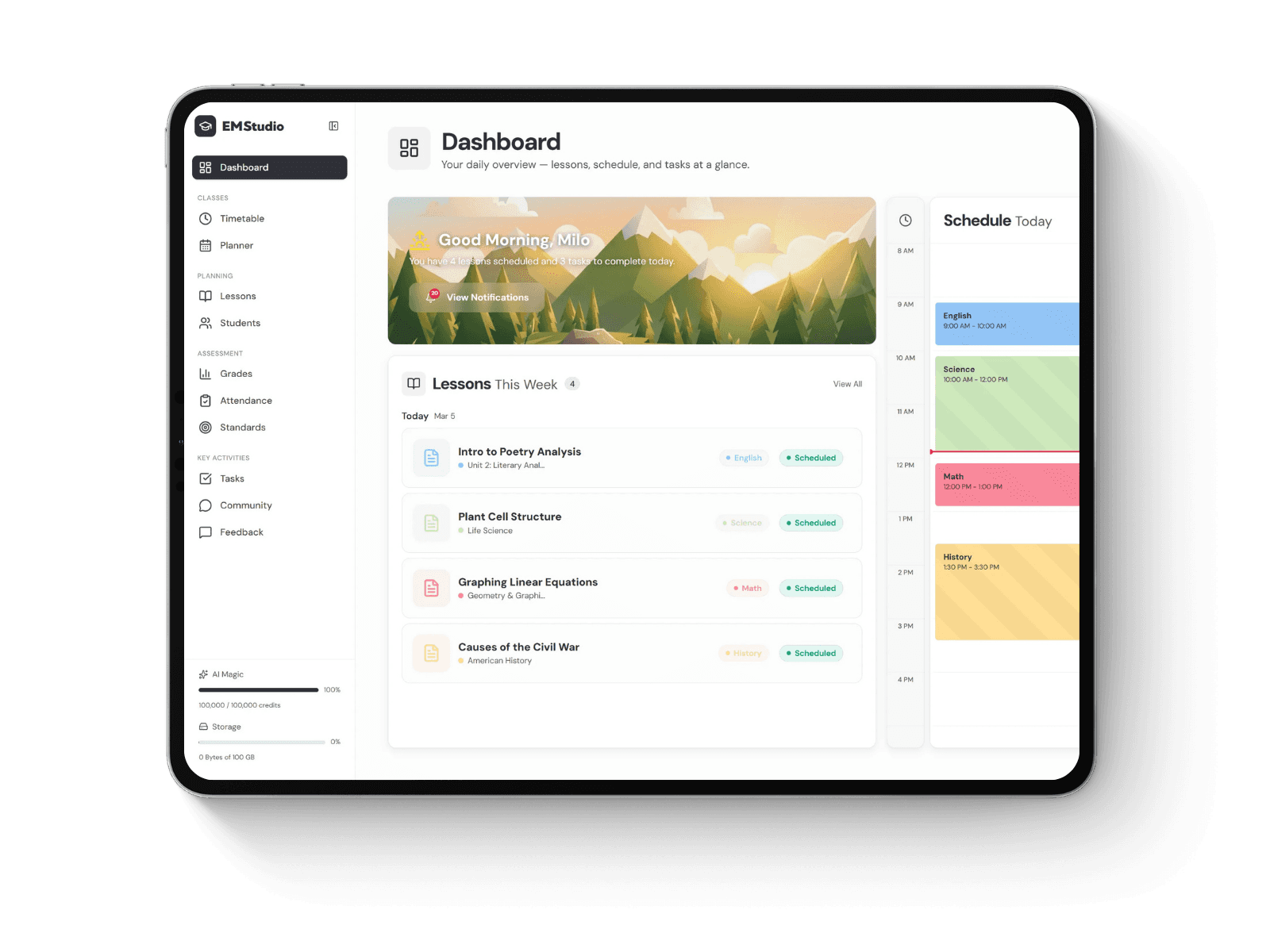
Still grading everything by hand?
EMStudio is a free teaching management app — manage your classes, students, lessons, and more!
Learn More
Table of Contents
Retrieval and Spaced Practice Strategies That Build Long-Term Memory
Spaced Repetition Scheduling Systems
Anki: Digital, free for desktop, supports images and audio. Best for 6th-12th graders with consistent device access.
Quizlet's Long-Term Learning mode: $35.99/year. Gamified, requires internet, fits 5th-12th grade. See these proven strategies to implement spaced repetition or flashcard apps that utilize spaced repetition.
Physical cards work on 15-minute bus rides without wifi. Digital tools track statistics automatically. Decision factor: your students' device access.
Interleaved Practice Session Design
Blocked practice gives students 20 fraction problems in a row. Interleaved practice mixes 5 fractions, 5 decimals, 5 percentages, then 5 fractions again. These strategies for effective learning feel harder because they load working memory, but they build better schema construction.
Never interleave until students hit 80% accuracy on isolated skills first. Novices need working memory free for initial learning, not pattern guessing. Apply cognitive load theory strictly here.
Low-Stakes Retrieval Quizzing Techniques
The Brain Dump protocol takes five minutes. Students write everything they remember from yesterday's lesson on blank paper. No grades. Afterward, they use elaborative interrogation by asking why facts connect. I used this with my 7th graders after science units; the visibility of their own growth surprised them.
Mini-whiteboards provide instant whole-class data. Every student writes an answer, holds it up on "show me," and you scan for 80% mastery before moving on. Prep time: 2 minutes to distribute boards. This formative assessment stays anonymous and immediate.
Metacognitive Strategies That Teach Students to Monitor Their Own Learning
John Flavell coined the term metacognition in the 1970s. He described it as thinking about your own thinking. John Hattie confirmed what we suspected: metacognitive strategies have an effect size of 0.60.
But here is the catch. Students need six to eight weeks of distributed practice before these learning strategies become automatic.
Metacognition has three phases. You plan before starting. You monitor during the work. You evaluate after finishing.
I saw this with my 6th graders during a research project. They predicted time needed before opening Chromebooks. They checked progress halfway through. They assessed quality at the end.
Warning: These examples of learning strategies fail when taught implicitly. Students need sentence starters and explicit modeling. Do not assume they will self-monitor naturally.
Think-Aloud Problem-Solving Protocols
When you solve problems in front of students, narrate the mess.
Model a two-step equation for 7th graders by verbalizing: "I see the variable is multiplied by 3 and then 5 is added. I need to undo addition first... wait, did I subtract 5 from both sides? Let me check." This reduces cognitive load and preserves working memory, illustrating cognitive load theory in action.
Give them stems:
"I'm confused because..."
"This reminds me of..."
"I predict that..."
"I need to check..."
"Another way to think about this is..."
Eventually, they internalize the script. That is schema construction.
Reflective Learning Journal Frameworks
Reflection cannot be vague. "How did you do?" produces blank stares.
Use the 3-2-1 framework. Three things learned, two questions remaining, one connection to prior knowledge. Four minutes at period end.
For note-taking, use Cornell Notes. Draw a line two inches from the left for cues. Take notes on the right. Leave two inches at the bottom for a summary.
In 9th grade biology, students list organelles on the right. In the left column, they write cues like "What does the mitochondria do?" In the bottom space, they summarize how parts work together. This technique exemplifies elaborative interrogation.
Self-Monitoring and Self-Assessment Checklists
Students cannot fix what they cannot see. Checklists make the invisible visible.
Try the Traffic Light system. Students place a colored card on their desk corner. Green means they got it. Yellow means they need practice. Red means they are confused. You scan the room in ten seconds and form small groups. This is formative assessment without the quiz.
A 5th grade writing checklist reads: "I have a topic sentence," "I have 3 details," "I have a conclusion." Students check boxes before submitting.
Learn how to design and use self-assessment tools for your classroom. Start with three items.

What Are the Best Collaborative Learning Strategies for Group Work?
The best learning strategies include the Jigsaw method for complex content, Think-Pair-Share for processing time, and structured peer teaching with explicit roles. Success requires individual accountability, interdependence, and clear protocols rather than simple group discussion.
Group work fails when students hide behind louder teammates. You need structures that force every kid to contribute before the group moves forward. Individual accountability prevents the free-rider problem.
Johnson and Johnson defined five elements for effective collaborative learning: positive interdependence, individual accountability, promotive interaction, social skills, and group processing. Miss one, and your lesson tanks.
Watch for social loafing. Assign roles—facilitator, recorder, timekeeper, materials—and make everyone take the individual quiz. This formative assessment exposes slackers while protecting introverts. No group grades.
Pick your approach based on prep time:
Jigsaw: 20 minutes prep, groups of 4-6, best for social studies and science content.
Think-Pair-Share: 2 minutes prep, pairs, works in every subject.
Peer Teaching: 10 minutes prep, pairs, ideal for math skill building.
Structured Peer Teaching Protocols
The Teach-Okay protocol from Whole Brain Teaching manages cognitive load theory in action. You teach in chunks, clap twice and say "Teach!" Students clap twice, respond "Okay!" and teach their partner using gestures. Cycle: 30 seconds you, 30 seconds them.
For math, use error analysis. Student A solves while Student B watches for mistakes. They switch every two problems. I use this with my 8th grade Algebra 1 students, and it catches misconceptions fast.
Jigsaw Method for Complex Content Construction
The steps for the Jigsaw learning method work best when content splits cleanly. In 8th grade U.S. History Civil War units, expert groups master one cause—economic, social, political, or geographic. They get 15 minutes to prepare.
Students return to home groups and teach for 8 minutes each. Everyone takes a 10-question quiz on all four causes. Individual scores determine group success. No hiding allowed.
Think-Pair-Share Variations for Different Subjects
Standard Think-Pair-Share gives 30 seconds to think, one minute to pair, then share. Try RoundRobin where pairs join another pair. Or use Timed-Pair-Share giving each partner 45 uninterrupted seconds. This list of learning strategies distributes cognitive load across peers.
Match prompts to your subject. Math: "Estimate before calculating." ELA: "Identify the author's tone." Science: "Predict the outcome." These cooperative learning structures for group work beat unstructured discussion.
Visual and Organizational Learning Strategies for Complex Content
Allan Paivio's Dual Coding Theory explains why your students remember more when you pair words with images. The brain stores verbal and non-verbal information in separate but connected channels. Research shows relevant visuals boost retention far beyond text alone. This is why visual learning strategies outperform lecture notes for complex material.
But clip art of smiling suns next to photosynthesis diagrams? That increases cognitive load theory effects without helping schema construction. Stick to representational visuals that mirror the concept structure.
Concept Mapping for Knowledge Construction
Construction of knowledge in learning becomes visible when students map concepts. Start with a central node like 7th grade Photosynthesis. Branch to Inputs and Outputs.
Sub-branch to Sunlight, Water, CO2. Add cross-link arrows showing relationships between ideas. This mirrors how the brain organizes information in long-term memory.
CmapTools works for digital maps with hyperlinked videos. But paper lets 3rd graders physically rearrange nodes when they spot new connections. Use 11x17 sheets for group work.
Score maps on three criteria: 10 points for hierarchical structure, 10 for cross-links, 10 for specific examples. Ninth graders mapping cell organelles finally see how mitochondria and chloroplasts connect through those cross-links. This elaborative interrogation supports distributed practice better than flashcards alone.
Dual Coding with Visuals and Text Integration
Split-page notes activate both channels. These visual learning strategies work because they engage dual coding. Left column: words and definitions. Right column: quick sketches or icons.
I watched a 6th grader draw Florida as a peninsula in the right column while the left held the definition. She never missed that question again on the summative assessment.
Set a 30-second rule for drawings. Longer creates art anxiety. If it takes longer, the image is too complex.
If a student spends a minute perfecting a mitochondria, hand them a printed icon instead. Speed keeps the focus on learning strategies, not artistry.
Check our visual learning guide for K-12 educators for ready-made templates.
Advanced Graphic Organizer Frameworks
Match the organizer to the content type:
Venn diagrams compare concepts
Flowcharts sequence steps
Fishbone diagrams track cause and effect
The Frayer Model nails vocabulary depth
Declarative knowledge fits Venns and Frayer models. Procedural knowledge needs flowcharts to show working memory processes.
But remove the training wheels for advanced students. 11th grade AP classes often build better arguments on blank paper than in pre-made graphic organizers. Too much structure limits sophisticated thinking.
Know when formative assessment shows they're ready to fly solo. Then step back.
See visual thinking strategies for classroom success for implementation steps.
How Do You Select the Right Strategy for Your Specific Learning Task?
Match learning strategies to cognitive load levels: use retrieval practice for memorization, elaborative interrogation for concepts, and concrete examples for procedures. Assess student readiness through prior knowledge checks, then sequence from low-stakes retrieval to complex application over 3-5 lesson cycles.
Think of selection as a flowchart. Start with the learning task: Is this a new topic? If yes, begin with direct instruction to build initial schema construction. Check for mastery at 80% before moving to retrieval practice. Only introduce problem-solving strategies when students show readiness for application.
Cognitive load theory guides these choices. Working memory holds roughly 7±2 items (Miller, 1956). When a strategy for learning demands more mental resources than the content itself allows, learning fails. Match the strategy's complexity to your students' developmental level, not just the subject's difficulty.
Never teach five new strategies simultaneously. I tried this with my 7th graders last fall. They experienced strategy confusion and defaulted to guessing. Introduce one per week, then master it for four weeks before adding the next. Abandoning a strategy after one difficult day wastes all prior effort.
Analyzing Cognitive Load and Student Readiness
Cognitive load has three types. Intrinsic load comes from the material's complexity—high for calculus, low for spelling. Extraneous load stems from poor instructions. Germane load fuels productive thinking. Your strategy selection must minimize extraneous demands while managing intrinsic difficulty.
Check readiness before advancing. If fewer than 70% of students scored proficient on prerequisite skills, reduce intrinsic load through chunking. Use formative assessment data from your last exit ticket to decide. Don't apply advanced elaborative interrogation techniques until foundational knowledge is automatic.
Matching Strategy to Knowledge Type and Subject
Match your approach to knowledge type. For declarative knowledge like facts, use flashcards and retrieval. Procedural knowledge such as essay writing needs worked examples and step-by-step modeling. Conditional knowledge—knowing when to apply formal versus informal tone—requires case studies and problem-based scenarios.
Consider the "i before e" spelling rule versus writing a persuasive essay. The first is declarative; use distributed practice. The second is procedural; use concrete examples. These evidence-based practices for different learning styles target specific knowledge types. Stop treating declarative and procedural memory as interchangeable.
Planning Your Implementation Sequence
Roll out strategies over three weeks. Week one, model the technique three times with think-alouds. Week two, shift to guided practice with immediate feedback. Week three, release responsibility for independent use with a self-monitoring checklist. This builds automaticity without overwhelming working memory.
Monitor effectiveness closely. If 80% of students cannot perform the strategy independently after ten repetitions, it is too complex for their current readiness. Pivot to a simpler approach immediately. Learning task 5 in your sequence should feel easier than task one because the strategy itself has become familiar.
Low-Prep Implementation Strategies for Immediate Classroom Use
Focus on sub-5-minute prep. Print three exit tickets per page, cut, and hand them out. Grab a stopwatch for one-minute papers. Draw a line down existing paper for note-taking upgrades.
Think in terms of impact versus effort. High impact and low prep means retrieval practice and exit tickets—your daily workhorses. High impact and high prep means Jigsaw—save those for essential units only. Everything else falls into the noise.
For a digital shortcut, use Google Forms for exit tickets. Set auto-grading for multiple choice. Skim short answers manually. Five minutes gets you through thirty responses. See these formative assessment examples for immediate use.
Exit Ticket Retrieval Routines
Keep three formats ready. Each takes under three minutes:
3-2-1: Three things learned, two questions, one connection to prior knowledge—three minutes.
Muddiest Point: The most confusing concept—two minutes.
Self-Assessment: Traffic light colors—thirty seconds.
These support distributed practice without eating class time. Sort responses into three bins: Got It, Partial, Reteach. If thirty percent land in Reteach, back up tomorrow. Last October, my seventh graders hit a wall with proportions. Forty percent were lost on exit tickets. I re-taught the prerequisite the next day.
This is formative assessment at its most honest. You catch gaps before they become failures. No grading required—just sorting and adjusting.
One-Minute Paper Reflection Protocols
You need a stopwatch. Pick one prompt:
"What was the muddiest point in today's class?"
"What was the most important thing you learned today and why?"
"What questions remain unanswered?"
Students write until the timer stops. This activates elaborative interrogation. Read these within twenty-four hours. Don't grade them. Instead, identify the top three misconceptions. Address them at the start of next class for three minutes.
This reduces cognitive load theory violations. You spot where working memory got overwhelmed during the lesson. The students never see a red pen—just better teaching.
Strategic Note-Taking Format Upgrades
Turn any notebook into Cornell Notes. Draw a line two inches from the left edge for cue questions. Fold the bottom two inches up for a summary. No new materials needed. This builds schema construction by forcing organization without increasing prep time.
Allow sketch notes for visual subjects. Students replace one in five notes with a drawing for subjects like history or science. Skip it for grammar rules—match modality to content. Visuals support different learning strategies for conceptual material that resists verbal description alone.
See our digital note-taking strategies for teachers for hybrid options that blend paper and screen without switching systems entirely.

One Thing to Try This Week
You do not need all fifteen strategies tomorrow. Pick one retrieval practice activity and test it with your next lesson. I started with simple exit tickets on index cards—low stakes, zero tech, and I learned immediately which students actually retained the concept versus those who just highlighted the textbook and called it studying.
Try the two-things strategy on Monday. Before you introduce new material, ask students to write down two things they remember from last week’s lesson on a scrap of paper. No notes allowed. Collect the cards, scan them during lunch, and adjust your plan for the kids who drew blanks. That single shift from reviewing notes to retrieving memories builds stronger neural pathways than re-reading ever will, and it takes less than five minutes of class time.
Start there. Watch what happens when students realize you expect them to remember, not just consume. That expectation changes how they pay attention.
Retrieval and Spaced Practice Strategies That Build Long-Term Memory
Spaced Repetition Scheduling Systems
Anki: Digital, free for desktop, supports images and audio. Best for 6th-12th graders with consistent device access.
Quizlet's Long-Term Learning mode: $35.99/year. Gamified, requires internet, fits 5th-12th grade. See these proven strategies to implement spaced repetition or flashcard apps that utilize spaced repetition.
Physical cards work on 15-minute bus rides without wifi. Digital tools track statistics automatically. Decision factor: your students' device access.
Interleaved Practice Session Design
Blocked practice gives students 20 fraction problems in a row. Interleaved practice mixes 5 fractions, 5 decimals, 5 percentages, then 5 fractions again. These strategies for effective learning feel harder because they load working memory, but they build better schema construction.
Never interleave until students hit 80% accuracy on isolated skills first. Novices need working memory free for initial learning, not pattern guessing. Apply cognitive load theory strictly here.
Low-Stakes Retrieval Quizzing Techniques
The Brain Dump protocol takes five minutes. Students write everything they remember from yesterday's lesson on blank paper. No grades. Afterward, they use elaborative interrogation by asking why facts connect. I used this with my 7th graders after science units; the visibility of their own growth surprised them.
Mini-whiteboards provide instant whole-class data. Every student writes an answer, holds it up on "show me," and you scan for 80% mastery before moving on. Prep time: 2 minutes to distribute boards. This formative assessment stays anonymous and immediate.
Metacognitive Strategies That Teach Students to Monitor Their Own Learning
John Flavell coined the term metacognition in the 1970s. He described it as thinking about your own thinking. John Hattie confirmed what we suspected: metacognitive strategies have an effect size of 0.60.
But here is the catch. Students need six to eight weeks of distributed practice before these learning strategies become automatic.
Metacognition has three phases. You plan before starting. You monitor during the work. You evaluate after finishing.
I saw this with my 6th graders during a research project. They predicted time needed before opening Chromebooks. They checked progress halfway through. They assessed quality at the end.
Warning: These examples of learning strategies fail when taught implicitly. Students need sentence starters and explicit modeling. Do not assume they will self-monitor naturally.
Think-Aloud Problem-Solving Protocols
When you solve problems in front of students, narrate the mess.
Model a two-step equation for 7th graders by verbalizing: "I see the variable is multiplied by 3 and then 5 is added. I need to undo addition first... wait, did I subtract 5 from both sides? Let me check." This reduces cognitive load and preserves working memory, illustrating cognitive load theory in action.
Give them stems:
"I'm confused because..."
"This reminds me of..."
"I predict that..."
"I need to check..."
"Another way to think about this is..."
Eventually, they internalize the script. That is schema construction.
Reflective Learning Journal Frameworks
Reflection cannot be vague. "How did you do?" produces blank stares.
Use the 3-2-1 framework. Three things learned, two questions remaining, one connection to prior knowledge. Four minutes at period end.
For note-taking, use Cornell Notes. Draw a line two inches from the left for cues. Take notes on the right. Leave two inches at the bottom for a summary.
In 9th grade biology, students list organelles on the right. In the left column, they write cues like "What does the mitochondria do?" In the bottom space, they summarize how parts work together. This technique exemplifies elaborative interrogation.
Self-Monitoring and Self-Assessment Checklists
Students cannot fix what they cannot see. Checklists make the invisible visible.
Try the Traffic Light system. Students place a colored card on their desk corner. Green means they got it. Yellow means they need practice. Red means they are confused. You scan the room in ten seconds and form small groups. This is formative assessment without the quiz.
A 5th grade writing checklist reads: "I have a topic sentence," "I have 3 details," "I have a conclusion." Students check boxes before submitting.
Learn how to design and use self-assessment tools for your classroom. Start with three items.
What Are the Best Collaborative Learning Strategies for Group Work?
The best learning strategies include the Jigsaw method for complex content, Think-Pair-Share for processing time, and structured peer teaching with explicit roles. Success requires individual accountability, interdependence, and clear protocols rather than simple group discussion.
Group work fails when students hide behind louder teammates. You need structures that force every kid to contribute before the group moves forward. Individual accountability prevents the free-rider problem.
Johnson and Johnson defined five elements for effective collaborative learning: positive interdependence, individual accountability, promotive interaction, social skills, and group processing. Miss one, and your lesson tanks.
Watch for social loafing. Assign roles—facilitator, recorder, timekeeper, materials—and make everyone take the individual quiz. This formative assessment exposes slackers while protecting introverts. No group grades.
Pick your approach based on prep time:
Jigsaw: 20 minutes prep, groups of 4-6, best for social studies and science content.
Think-Pair-Share: 2 minutes prep, pairs, works in every subject.
Peer Teaching: 10 minutes prep, pairs, ideal for math skill building.
Structured Peer Teaching Protocols
The Teach-Okay protocol from Whole Brain Teaching manages cognitive load theory in action. You teach in chunks, clap twice and say "Teach!" Students clap twice, respond "Okay!" and teach their partner using gestures. Cycle: 30 seconds you, 30 seconds them.
For math, use error analysis. Student A solves while Student B watches for mistakes. They switch every two problems. I use this with my 8th grade Algebra 1 students, and it catches misconceptions fast.
Jigsaw Method for Complex Content Construction
The steps for the Jigsaw learning method work best when content splits cleanly. In 8th grade U.S. History Civil War units, expert groups master one cause—economic, social, political, or geographic. They get 15 minutes to prepare.
Students return to home groups and teach for 8 minutes each. Everyone takes a 10-question quiz on all four causes. Individual scores determine group success. No hiding allowed.
Think-Pair-Share Variations for Different Subjects
Standard Think-Pair-Share gives 30 seconds to think, one minute to pair, then share. Try RoundRobin where pairs join another pair. Or use Timed-Pair-Share giving each partner 45 uninterrupted seconds. This list of learning strategies distributes cognitive load across peers.
Match prompts to your subject. Math: "Estimate before calculating." ELA: "Identify the author's tone." Science: "Predict the outcome." These cooperative learning structures for group work beat unstructured discussion.
Visual and Organizational Learning Strategies for Complex Content
Allan Paivio's Dual Coding Theory explains why your students remember more when you pair words with images. The brain stores verbal and non-verbal information in separate but connected channels. Research shows relevant visuals boost retention far beyond text alone. This is why visual learning strategies outperform lecture notes for complex material.
But clip art of smiling suns next to photosynthesis diagrams? That increases cognitive load theory effects without helping schema construction. Stick to representational visuals that mirror the concept structure.
Concept Mapping for Knowledge Construction
Construction of knowledge in learning becomes visible when students map concepts. Start with a central node like 7th grade Photosynthesis. Branch to Inputs and Outputs.
Sub-branch to Sunlight, Water, CO2. Add cross-link arrows showing relationships between ideas. This mirrors how the brain organizes information in long-term memory.
CmapTools works for digital maps with hyperlinked videos. But paper lets 3rd graders physically rearrange nodes when they spot new connections. Use 11x17 sheets for group work.
Score maps on three criteria: 10 points for hierarchical structure, 10 for cross-links, 10 for specific examples. Ninth graders mapping cell organelles finally see how mitochondria and chloroplasts connect through those cross-links. This elaborative interrogation supports distributed practice better than flashcards alone.
Dual Coding with Visuals and Text Integration
Split-page notes activate both channels. These visual learning strategies work because they engage dual coding. Left column: words and definitions. Right column: quick sketches or icons.
I watched a 6th grader draw Florida as a peninsula in the right column while the left held the definition. She never missed that question again on the summative assessment.
Set a 30-second rule for drawings. Longer creates art anxiety. If it takes longer, the image is too complex.
If a student spends a minute perfecting a mitochondria, hand them a printed icon instead. Speed keeps the focus on learning strategies, not artistry.
Check our visual learning guide for K-12 educators for ready-made templates.
Advanced Graphic Organizer Frameworks
Match the organizer to the content type:
Venn diagrams compare concepts
Flowcharts sequence steps
Fishbone diagrams track cause and effect
The Frayer Model nails vocabulary depth
Declarative knowledge fits Venns and Frayer models. Procedural knowledge needs flowcharts to show working memory processes.
But remove the training wheels for advanced students. 11th grade AP classes often build better arguments on blank paper than in pre-made graphic organizers. Too much structure limits sophisticated thinking.
Know when formative assessment shows they're ready to fly solo. Then step back.
See visual thinking strategies for classroom success for implementation steps.
How Do You Select the Right Strategy for Your Specific Learning Task?
Match learning strategies to cognitive load levels: use retrieval practice for memorization, elaborative interrogation for concepts, and concrete examples for procedures. Assess student readiness through prior knowledge checks, then sequence from low-stakes retrieval to complex application over 3-5 lesson cycles.
Think of selection as a flowchart. Start with the learning task: Is this a new topic? If yes, begin with direct instruction to build initial schema construction. Check for mastery at 80% before moving to retrieval practice. Only introduce problem-solving strategies when students show readiness for application.
Cognitive load theory guides these choices. Working memory holds roughly 7±2 items (Miller, 1956). When a strategy for learning demands more mental resources than the content itself allows, learning fails. Match the strategy's complexity to your students' developmental level, not just the subject's difficulty.
Never teach five new strategies simultaneously. I tried this with my 7th graders last fall. They experienced strategy confusion and defaulted to guessing. Introduce one per week, then master it for four weeks before adding the next. Abandoning a strategy after one difficult day wastes all prior effort.
Analyzing Cognitive Load and Student Readiness
Cognitive load has three types. Intrinsic load comes from the material's complexity—high for calculus, low for spelling. Extraneous load stems from poor instructions. Germane load fuels productive thinking. Your strategy selection must minimize extraneous demands while managing intrinsic difficulty.
Check readiness before advancing. If fewer than 70% of students scored proficient on prerequisite skills, reduce intrinsic load through chunking. Use formative assessment data from your last exit ticket to decide. Don't apply advanced elaborative interrogation techniques until foundational knowledge is automatic.
Matching Strategy to Knowledge Type and Subject
Match your approach to knowledge type. For declarative knowledge like facts, use flashcards and retrieval. Procedural knowledge such as essay writing needs worked examples and step-by-step modeling. Conditional knowledge—knowing when to apply formal versus informal tone—requires case studies and problem-based scenarios.
Consider the "i before e" spelling rule versus writing a persuasive essay. The first is declarative; use distributed practice. The second is procedural; use concrete examples. These evidence-based practices for different learning styles target specific knowledge types. Stop treating declarative and procedural memory as interchangeable.
Planning Your Implementation Sequence
Roll out strategies over three weeks. Week one, model the technique three times with think-alouds. Week two, shift to guided practice with immediate feedback. Week three, release responsibility for independent use with a self-monitoring checklist. This builds automaticity without overwhelming working memory.
Monitor effectiveness closely. If 80% of students cannot perform the strategy independently after ten repetitions, it is too complex for their current readiness. Pivot to a simpler approach immediately. Learning task 5 in your sequence should feel easier than task one because the strategy itself has become familiar.
Low-Prep Implementation Strategies for Immediate Classroom Use
Focus on sub-5-minute prep. Print three exit tickets per page, cut, and hand them out. Grab a stopwatch for one-minute papers. Draw a line down existing paper for note-taking upgrades.
Think in terms of impact versus effort. High impact and low prep means retrieval practice and exit tickets—your daily workhorses. High impact and high prep means Jigsaw—save those for essential units only. Everything else falls into the noise.
For a digital shortcut, use Google Forms for exit tickets. Set auto-grading for multiple choice. Skim short answers manually. Five minutes gets you through thirty responses. See these formative assessment examples for immediate use.
Exit Ticket Retrieval Routines
Keep three formats ready. Each takes under three minutes:
3-2-1: Three things learned, two questions, one connection to prior knowledge—three minutes.
Muddiest Point: The most confusing concept—two minutes.
Self-Assessment: Traffic light colors—thirty seconds.
These support distributed practice without eating class time. Sort responses into three bins: Got It, Partial, Reteach. If thirty percent land in Reteach, back up tomorrow. Last October, my seventh graders hit a wall with proportions. Forty percent were lost on exit tickets. I re-taught the prerequisite the next day.
This is formative assessment at its most honest. You catch gaps before they become failures. No grading required—just sorting and adjusting.
One-Minute Paper Reflection Protocols
You need a stopwatch. Pick one prompt:
"What was the muddiest point in today's class?"
"What was the most important thing you learned today and why?"
"What questions remain unanswered?"
Students write until the timer stops. This activates elaborative interrogation. Read these within twenty-four hours. Don't grade them. Instead, identify the top three misconceptions. Address them at the start of next class for three minutes.
This reduces cognitive load theory violations. You spot where working memory got overwhelmed during the lesson. The students never see a red pen—just better teaching.
Strategic Note-Taking Format Upgrades
Turn any notebook into Cornell Notes. Draw a line two inches from the left edge for cue questions. Fold the bottom two inches up for a summary. No new materials needed. This builds schema construction by forcing organization without increasing prep time.
Allow sketch notes for visual subjects. Students replace one in five notes with a drawing for subjects like history or science. Skip it for grammar rules—match modality to content. Visuals support different learning strategies for conceptual material that resists verbal description alone.
See our digital note-taking strategies for teachers for hybrid options that blend paper and screen without switching systems entirely.
One Thing to Try This Week
You do not need all fifteen strategies tomorrow. Pick one retrieval practice activity and test it with your next lesson. I started with simple exit tickets on index cards—low stakes, zero tech, and I learned immediately which students actually retained the concept versus those who just highlighted the textbook and called it studying.
Try the two-things strategy on Monday. Before you introduce new material, ask students to write down two things they remember from last week’s lesson on a scrap of paper. No notes allowed. Collect the cards, scan them during lunch, and adjust your plan for the kids who drew blanks. That single shift from reviewing notes to retrieving memories builds stronger neural pathways than re-reading ever will, and it takes less than five minutes of class time.
Start there. Watch what happens when students realize you expect them to remember, not just consume. That expectation changes how they pay attention.
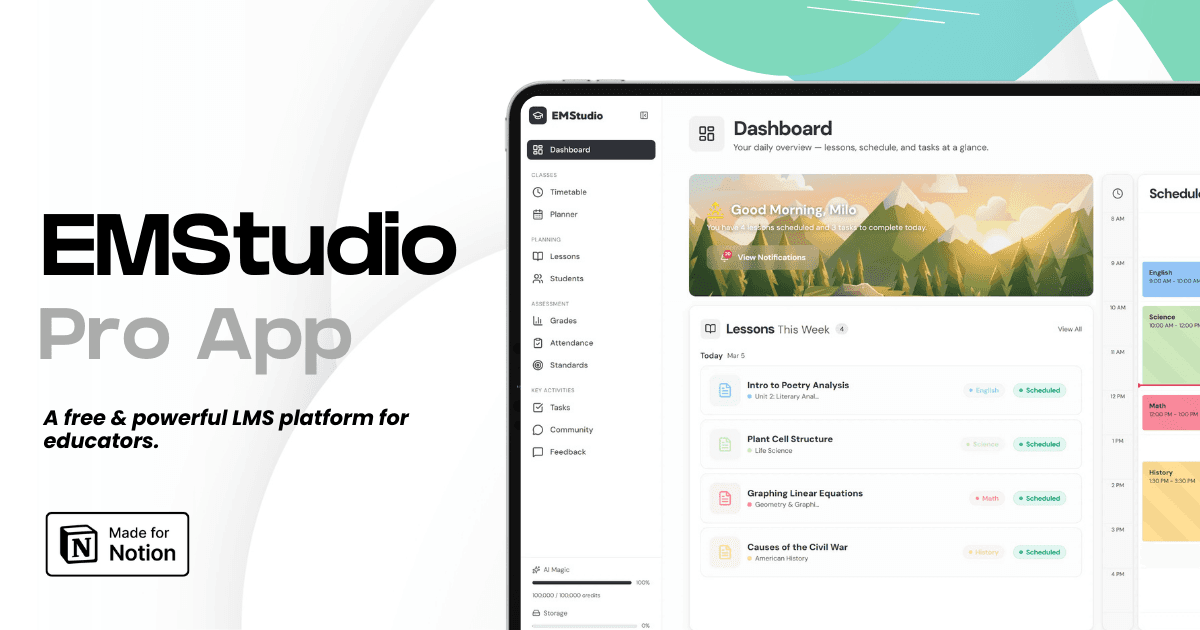
Still grading everything by hand?
EMStudio is a free teaching management app — manage your classes, students, lessons, and more!
Learn More
Still grading everything by hand?
EMStudio is a free teaching management app — manage your classes, students, lessons, and more!
Learn More



Notion4Teachers
Notion templates to simplify administrative tasks and enhance your teaching experience.



2026 Notion4Teachers. All Rights Reserved.
Notion4Teachers
Notion templates to simplify administrative tasks and enhance your teaching experience.
2026 Notion4Teachers. All Rights Reserved.
Notion4Teachers
Notion templates to simplify administrative tasks and enhance your teaching experience.
2026 Notion4Teachers. All Rights Reserved.