12 Pre K Math Games That Build Early Number Skills
12 Pre K Math Games That Build Early Number Skills

Article by
Milo
ESL Content Coordinator & Educator
ESL Content Coordinator & Educator
All Posts
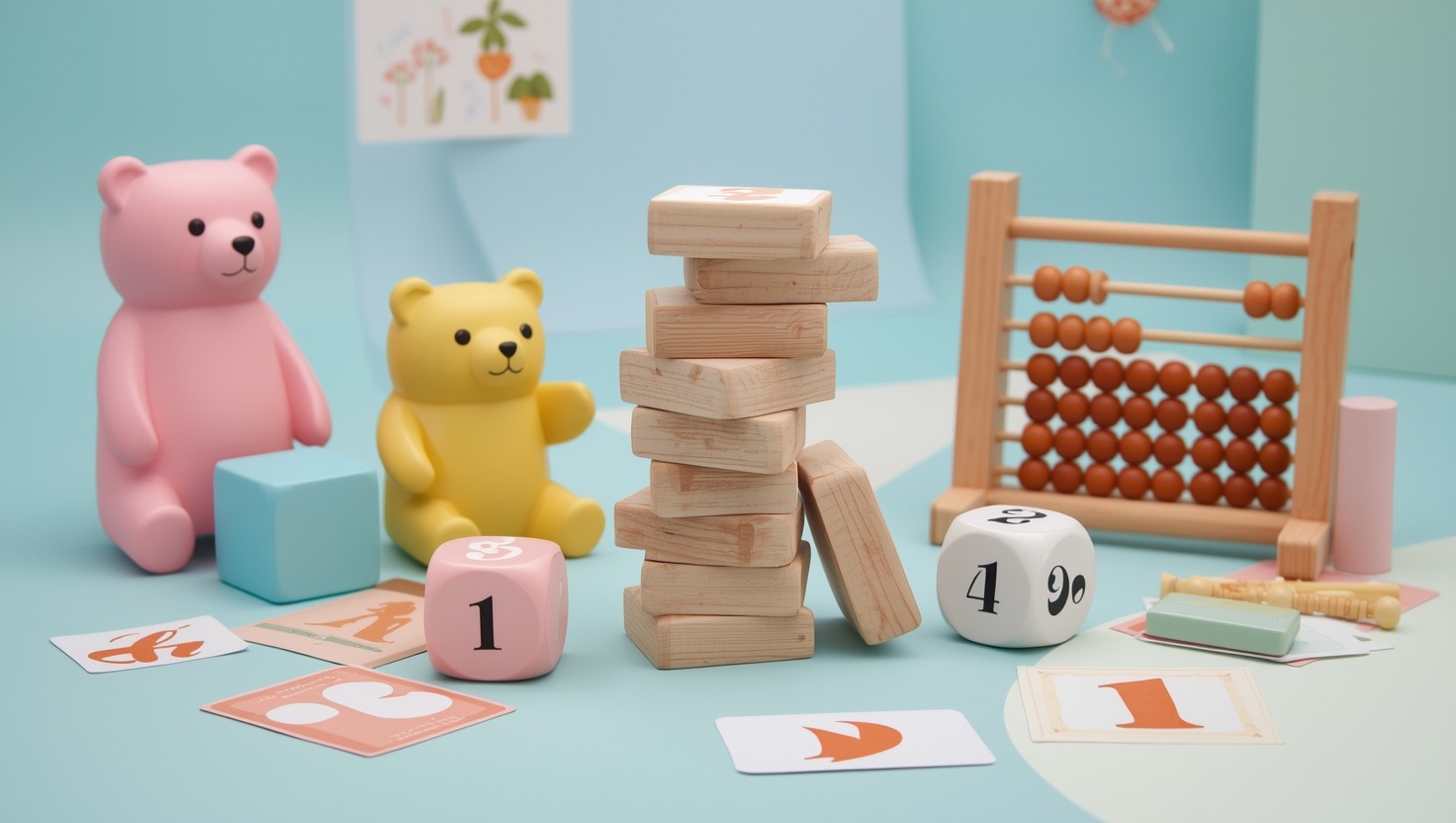
The best counting games for preschoolers include Bear Counter Mats for 1:1 correspondence, Magnetic Number Fishing for numeral recognition, Roll and Cover Dice for subitizing, and Jumping Number Lines for number magnitude. These games use concrete manipulatives and should last 10-15 minutes to match 4-year-old attention spans.
Kids learn by touching stuff. Pre k math games work best when children handle real objects, not screens.
Developmental guidelines suggest 4-5 year olds maintain attention for 8-10 minutes on concrete math tasks. You need games with quick setup and clear endpoints. If prep takes longer than playtime, scrap it.
Still grading everything by hand?
EMStudio is a free teaching management app — manage your classes, students, lessons, and more!
Learn More

Still grading everything by hand?
EMStudio is a free teaching management app — manage your classes, students, lessons, and more!
Learn More
Table of Contents
What Are the Best Counting Games for Preschoolers?
Sequence these four games as a developmental progression:
one-to-one correspondence with Bear Counters
Numeral recognition with Fishing
Subitizing with Roll and Cover
Number magnitude with Jumping Lines
Check your materials against this breakdown:
Game Name | Primary Skill | Group Size | Prep Time | Cost Range |
|---|---|---|---|---|
Bear Counter Mats | 1:1 correspondence | 1-2 | 20 min | $20 commercial |
Number Fishing | Numeral recognition | 2-4 | 5 min | $0 DIY to $20 commercial |
Roll and Cover | Subitizing | 2-4 | 5 min | $10 commercial |
Jumping Number Lines | Counting on | 4-5 | 5 min | $5 DIY |
Watch for the failure mode. If a child counts individual dots on a die rather than recognizing the pattern immediately, remain at the perceptual subitizing stage with quantities 1-3. Do not advance to conceptual subitizing until they see "3" instantly without pointing.
These hands-on counting activities for early learners build early numeracy better than any maths kg class worksheet. You need manipulatives, not paper.
Bear Counter Counting Mats
Use Learning Resources Three Bear Family Counters with 6 colors, 3 sizes, and 96 pieces for about $20. Create laminated 8.5x11 inch mats with 10 colored circles matching the bear colors. Lamination makes them last all year.
Gameplay is simple. The child draws a number card 1-10 and places one bear per circle while counting aloud. This builds 1:1 correspondence and cardinality through touch.
Differentiate by ability. Advanced learners sort bears by size—baby, mama, papa—then by color before counting. Struggling learners use only 5 bears maximum to build confidence without overwhelm.
Number Fishing Game with Magnets
Buy the Melissa & Doug Magnetic Wooden Fishing Game for $15-20, or DIY with foam fish, paper clips, and dowel rods with magnets tied to string. The magnetic wand clicks when it connects, which kids love.
Play two ways. Call a number 1-10 for recognition practice, or say "catch 3 fish, then 2 more" for early addition foundations. Both build number sense and keep hands busy.
Check safety. Ensure magnets are securely embedded to prevent choking hazards. Supervise children under 4 closely during magnetic play. If a magnet detaches, retire the game immediately.
Roll and Cover Dice Games
Gather 1.5-inch foam dice—they are quieter than hard dice when they hit the table—plus double-sided counters in red and yellow. You need laminated 5x5 grid boards with numerals 1-6 printed clearly.
Rules are simple. Roll the die, count dots or subitize, then place a counter on the matching numeral. First to place 4 adjacent counters wins. Use dot dice for beginners, numeral dice for advanced learners who have moved past counting.
Add the Bump variation for math games for 5 year olds nearing kindergarten. If an opponent rolls your number, they bump your piece off. This adds strategic thinking and keeps everyone engaged until the end.
Jumping Number Line Activity
Apply blue painter's tape to the floor in a line 15 feet long. It peels off without residue. Place large number cards 0-10 at 18-inch intervals so kids can see the spacing.
Start with magnitude understanding. The child jumps to a called number to feel that 3 is closer than 8. Then progress to "start at 3, jump forward 2 spaces" for early addition through counting on.
Manage the chaos. Establish a "waiting bench" protocol where non-jumpers sit on the tape line. Only one jumper moves at a time to prevent collisions and keep the game safe.
Which Shape Recognition Games Develop Spatial Reasoning?
Effective shape recognition games include Mystery Bag sorting for 3D attributes, Geoboard pattern challenges for spatial construction, Scavenger Hunts for real-world connection, and Play-Doh building for fine motor integration. Describe sides and corners, not just shape names, to build spatial reasoning.
Research from the University of Chicago shows spatial reasoning skills at age 4 predict mathematics achievement through middle school. These early geometry experiences build the foundation for later algebra and calculus. Don't skip them.
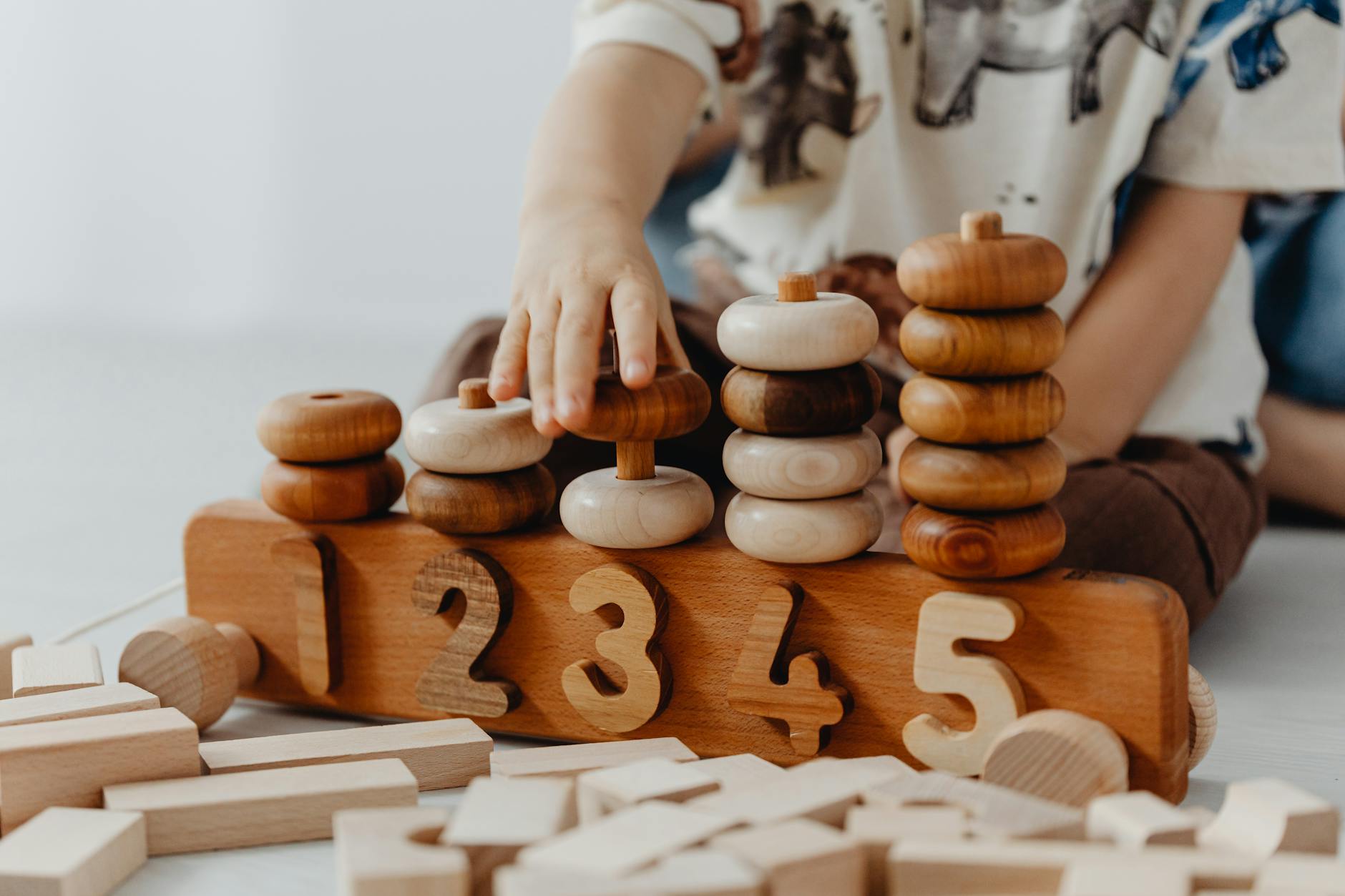
Don't just ask kids to name shapes. Strong pre k math games require them to count sides, identify vertices, and feel the difference between curves and flat faces. This attribute-based approach develops number sense and spatial reasoning that tracing worksheets miss.
2D Shapes — Circle: 0 sides, curved. Square: 4 equal sides, 4 corners. Triangle: 3 sides, 3 corners. Rectangle: 4 sides, 4 corners. Oval: 0 sides, curved.
3D Solids — Sphere: 0 faces, rolls. Cube: 6 square faces, 12 edges. Cylinder: 2 circular faces, rolls. Cone: 1 circular face, 1 vertex. Pyramid: 1 base, triangular faces.
The biggest mistake I see as a math coach? Teaching shape names without letting kids touch manipulatives. A child needs to feel why a sphere rolls off the table while a cube stacks. Tactile learning strategies aren't optional—they're how young brains map abstract concepts to physical reality, building true early numeracy.
Shape Sorting Mystery Bags
Grab the Lakeshore Learning 3D Shapes set for $29.99 or raid your pantry. Toss a tennis ball, dice, soup can, or ice cream cone into an opaque 6x6 inch drawstring bag. The child reaches in without peeking, feels the object, and describes attributes: "It rolls, has no corners, one flat face."
Then they name the shape and pull it out to verify. Later, sort by curved surfaces versus flat faces. You'll hear them use words like "vertex" and "edge" naturally because their fingers discovered these has first. This builds cardinality through physical comparison and direct touch.
Geoboard Pattern Challenges
Use 5x5 pin geoboards, not the 11x11 versions. Four-year-olds lack the fine motor control for those tiny pins. Stock assorted colored rubber bands in different sizes to allow for various tensions.
Start with AB pattern cards showing circle, square, circle, square. The child replicates the pattern with bands, then extends it two more units independently.
Advanced task: Create shape composites like "Build a house using a square and a triangle." This builds part-whole relationships and decomposing skills important for subitizing and advanced math understanding.
Shape Scavenger Hunt Cards
Laminate photo cards showing real-world shapes: stop signs as octagons, plates as circles. Give kids clipboards, checklists, and "Shape Detective" badge lanyards. The role-play element keeps them engaged longer than worksheets ever could.
Indoors, hunt for three circles, two rectangles, one square. Outdoors, find nature items matching cards—acorns for circles, triangular leaves. They document finds with stickers or tally marks, practicing one-to-one correspondence alongside geometry skills.
Play-Doh Shape Building Stations
Set out Play-Doh, plastic pizza cutters, and attribute cards showing sides and corners. Challenge kids through three distinct levels of building difficulty:
Level 1: Cut basic shapes from flattened dough.
Level 2: Build standing 3D solids that don't collapse.
Level 3: Create complex pictures like houses or cars combining multiple shapes.
Ask "How many sides does your triangle have? Are they straight or curved?" This develops mathematical language. When they explain how their square differs from their rectangle, they're analyzing attributes like a geometer, not just memorizing names.

What Addition Games Work Best for Pre-K Learners?
Pre-K addition games should use concrete objects within quantities of 5, such as Unifix Cube Tower Building, Pom-Pom Toss into numbered cups, Five Frame Fill-Up with counters, and Story-Based Mats with mini erasers. Avoid written equations; focus on 'putting together' stories and counting totals.
Four-year-olds don't need worksheets. They need stuff to touch. Pre-K addition means composing and decomposing quantities within 5—the exact precursor to Common Core K.OA.1. Use manipulatives only. No symbols. No plus signs. Just "putting together" and "taking apart" with real objects.
This concrete work builds the foundation for multiplication fluency games they'll play in second grade. A child who can't compose 5 by breaking it into 2 and 3 with their hands will struggle with 7 × 8 later. You're building number sense that actually lasts.
Stay in the first two stages of learning:
Stage 1 (Concrete): Real objects and manipulatives. Kids touch Unifix cubes, pom-poms, and counters.
Stage 2 (Representational): Child draws pictures of the objects. Circles or tally marks on paper represent the quantities.
Ages 4-5 should not use abstract symbols or written equations.
Watch for warning signs. A child might combine 3 bears with 2 bears. Then they count "1, 2, 3, 4, 5." If they can't tell you there were 3 originally, they lost track of the separate sets. Return to simpler Five Frame activities immediately.
Unifix Cube Tower Building
Unifix Cube Tower Building works because kids love the snap. You need a set of 100 cubes—about $12-15 from Didax or hand2mind. Stick with standard colors: red, blue, yellow, green. Avoid the fancy neon sets; they distract from the math.
Hand them 2 red cubes and 3 blue cubes. "Build a tower. How many cubes tall?" They snap together, then count from 1. Watch for one-to-one correspondence as they touch each cube. If they skip a cube or count one twice, stop and recount together.
Scaffold counting on. If they stop at 2, then say 3-4-5, praise that strategy. If they restart at 1 every time, model it: "We had 2... 3, 4, 5." Touch the new cubes while saying the numbers. Some kids stay in recount-everything mode until January. That's developmentally normal. Don't force the shortcut.
Pom-Pom Addition Toss
Pom-Pom Addition Toss adds fine motor work. Grab a 6-cup muffin tin, jumbo pom-poms (1.5 inch diameter), and large plastic tweezers. Label cups 1-6 with masking tape and a marker. The tweezers build hand strength for writing while slowing down the math just enough.
Kids toss two pom-poms into the tin. If one lands in cup 2 and another in cup 3, they add to make 5. They win that round. If both land in the same cup, they double it. Kids love the randomness.
Start with cups 1-3 only for beginners. For advanced five-year-olds ready to move beyond 5, use a 12-cup tin with numbers 1-12. But most Pre-K kids should stay within 5 to build subitizing and cardinality. These pre k math games work best when kids can see the whole quantity without counting every time.
Five Frame Fill-Up Challenges
Five Frame Fill-Up Challenges build automaticity with combinations. You need a laminated five-frame mat (five boxes in a 1x5 array), red/yellow counters, and a small opaque cup. The physical act of shaking builds anticipation.
Shake five counters in the cup. Spill them onto the mat. Arrange with red side up. Ask: "How many red? How many yellow? How many total?" Then ask: "How many more to fill the frame?" Kids see that 2 red and 3 yellow always makes 5. The frame provides a visual anchor.
This predicts later success. Kids who know combinations of 5—2 and 3, 4 and 1—master larger facts faster in addition games for kindergarten. The benefits of math challenges start right here with these simple combinations.
Story-Based Addition Mats
Story-Based Addition Mats connect math to language and narrative. Use laminated scenes—a farm with two pastures or an ocean with two ponds. Mini erasers or counting bears work as props. The mat creates a boundary that helps kids keep sets separate.
Tell the story: "First 3 horses were in the barn. Then 2 more horses came. How many horses now?" Kids move the props while they tell the story back to you. This builds academic vocabulary and checks for cardinality at the same time.
Let them create their own "First... Then... How many?" stories. Provide sentence frames on index cards. When four-year-olds explain their own math using "math talk," they own the concept. That's real early numeracy, not memorization.
How Do You Choose Games That Match Developmental Stages?
Choose games based on subitizing ability: ages 3-4 should work with quantities 1-3 using perceptual recognition, while ages 4-5 can handle conceptual subitizing to 5 and composing numbers. Avoid symbolic notation and competitive elimination games; select cooperative activities with manipulatives lasting 8-10 minutes.
Look at what the child can do right now, not what the box says. Three-year-olds and five-year-olds need completely different pre k math games, even when both are in the same classroom. Match the game to the child, not the calendar.
Is This Game Right for My Child?
Use this three-point check before you start.
Age 3 (Young Pre-K): Can they recognize 1-3 objects instantly without counting? That is perceptual subitizing.
Age 4-5 (Pre-K): Can they break apart 5 into smaller groups mentally? That is conceptual subitizing and composing numbers.
Stop if: They count from 1 every time, melt down in 3 minutes, or guess randomly.
At age three, stick to quantities 1-3 only. Use manipulatives for sorting by single attributes like color or shape. Build number sense through touch, not worksheets.
Avoid symbolic numerals entirely—flashcards showing "3" are useless before cardinality sinks in. Skip competitive elimination games; someone crying over a board game at age three teaches nothing about math. Check cognitive development milestones if you are unsure where your group falls.
Four-year-olds can handle conceptual subitizing to 5, seeing four dots as "two and two" without counting each one. Push one-to-one correspondence up to 10 by matching objects to numbers, and practice composing and decomposing within 5.
Avoid abstract equations like 2+3=5 and timed speed drills; they trigger math anxiety in young kids. Traditional maths kg class worksheet activities fail here because they force sitting still, not building early numeracy through movement. Try a play-based preschool curriculum approach instead.
Maths games for class 7 rely on abstract symbolic manipulation—solving for x, working with integers on paper. Your Pre-K learners need the opposite: concrete manipulatives they can hold, and cooperative structures where everyone finishes together. Middle schoolers can sit for 45 minutes; your kids need to move every ten.
Watch for three warning signs that the game is mismatched. If a child reverts to counting from 1 instead of counting on from a known number, the quantities are too big. Frustration within three minutes means the task is too hard.
Random guessing without a counting strategy tells you the game missed the mark entirely. Stop and step back.

How Can You Integrate Math Games Into Daily Routines?
Integrate math games by establishing four 12-minute learning centers with photo-labeled bins for independent play, embedding 2-minute transition activities like step estimation, and scheduling outdoor movement games such as hopscotch counting twice weekly to reinforce number sense through physical activity.
Start small. Clear a 15x15 foot area for jumping games and gross motor work. Count your manipulatives—you need enough for four stations without sharing between groups. Then build your rotation schedule. Twelve minutes of work, two minutes of transition music, repeat. This rhythm respects developmental timelines while maximizing instructional minutes. The predictability reduces anxiety for both you and the children.
You don't need a bigger classroom. You need a system. Audit your space first—measure a 15x15 foot corner for jumping games, then inventory your supplies. Build your schedule around 12-minute rotations with a 2-minute musical cue for transitions. Research confirms young children focus for roughly 2-3 minutes per year of age, so pre k math games work best in short bursts.
Skip the maths kg class worksheet drills. Physical manipulation builds stronger neural pathways than paper-pencil tasks at this age. When children move objects and their bodies, they develop one-to-one correspondence and cardinality through real experience, not just circling answers. Active learning sticks because it engages multiple senses simultaneously. Worksheets check compliance; games build understanding.
Setting Up Math Centers for Independent Play
Limit yourself to four centers for a class of 16-20. That puts four or five children at each station—enough for peer interaction without chaos. Use colored tape on the floor to mark boundaries so kids know exactly where the center ends. If you have more than 20 students, add a fifth center or run two identical centers to keep group size manageable.
Set a Time Timer for 12 minutes. When it hits zero, play your clean-up song—Raffi's "Clean Up" runs exactly two minutes, which is perfect. This audio cue trains them to reset without you micromanaging every transition. They learn to associate the music with the routine, not your voice.
Store materials in Sterilite bins with photo labels on the front and matching photos on the shelf. Laminated photo checklists showing "bin closed, pieces inside, bin on shelf" let children reset centers independently.
Teach the "Ask 3 Before Me" rule—check the card, ask yourself, ask a friend—before they interrupt your small group. This setup makes effective math learning stations actually sustainable.
Transition Time Quick Games
Don't waste the five minutes it takes to line up for lunch. These gaps are perfect for subitizing and number sense practice that requires zero setup. You don't need extra materials. You just need to change how you use the time you already have.
Children don't wait well. These bursts of math thinking keep their brains engaged during dead time. You will notice fewer pushes and complaints when they have a job to do.
Play "Estimate Steps" before leaving the room. Ask how many steps it will take to reach the door, then count together as you walk. Compare the estimate to the actual number.
Use "Finger Math" in line. Show three fingers, say "show me two more," and have them count the total. Sixty seconds, zero materials.
Try "Shape Spotting" while moving to the carpet. Challenge them to find three circles in the room before they sit down. It keeps the flow moving.
These micro-games reinforce early numeracy without stealing time from your schedule. They also eliminate the behavior problems that pop up when kids stand still too long.
Outdoor Math Movement Activities
Take pre k math games outside twice weekly. The combination of movement and fresh air cements number sense through integrating play into learning in ways indoor tables cannot replicate.
Draw a sidewalk chalk number line from 0 to 10. Call out a number and have children jump to it. The physical sensation of distance builds magnitude understanding through proprioception.
Send them on nature collection missions. Gather five pinecones and three leaves, then compare which group has more. Bring the materials indoors for tomorrow's counting games.
Bring the outdoor collections inside. Those five pinecones become manipulatives for tomorrow's one-to-one correspondence practice. This extends the learning across days without extra prep.
Safety comes first. Mark boundaries with cones at 20 feet, enforce "one jumper at a time" on the number line, and position yourself as a spotter. A skinned knee shuts down the math faster than a wrong answer.
The outdoor work also supports children who struggle with indoor constraints. They can shout out numbers, run to answers, and learn without sitting still. For some kids, this is where the math actually clicks.
The Bottom Line on Pre K Math Games
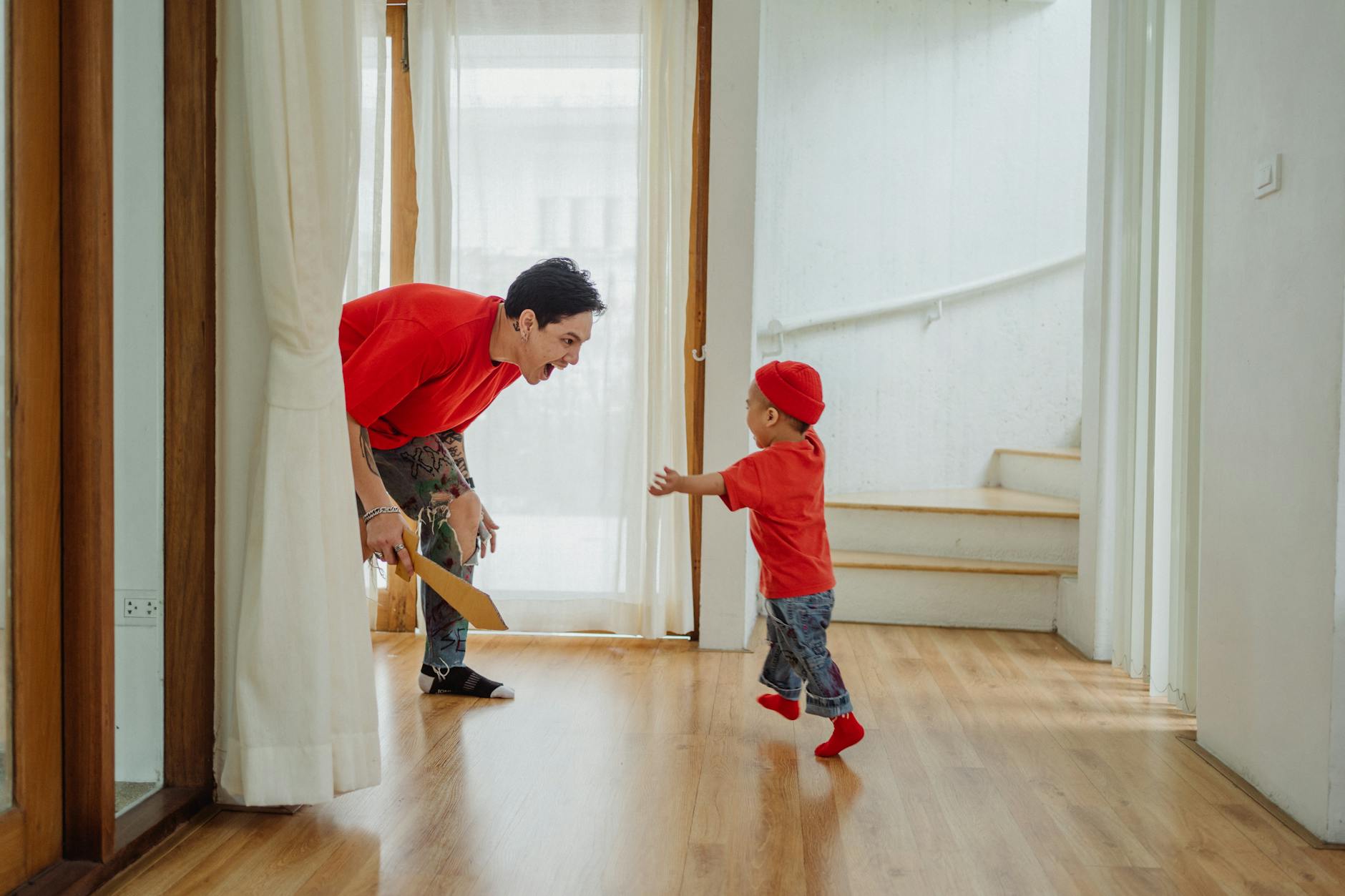
You don't need extra time for math games. You need games that fit into snack time, line-up, or cleanup. When counting bears come out while you wait for the bathroom, early numeracy stops being a lesson and starts being a habit.
Watch for cardinality. If kids count five blocks but grab eight when you ask for five, they need counting practice, not subitizing drills. Match the game to the gap you see, not the grade level on the box.
Keep it physical. If they're not touching, moving, or building, it's not a pre-k math game. Worksheets wait for kindergarten. Right now, math lives in blocks, sand, and silly songs.
What Are the Best Counting Games for Preschoolers?
Sequence these four games as a developmental progression:
one-to-one correspondence with Bear Counters
Numeral recognition with Fishing
Subitizing with Roll and Cover
Number magnitude with Jumping Lines
Check your materials against this breakdown:
Game Name | Primary Skill | Group Size | Prep Time | Cost Range |
|---|---|---|---|---|
Bear Counter Mats | 1:1 correspondence | 1-2 | 20 min | $20 commercial |
Number Fishing | Numeral recognition | 2-4 | 5 min | $0 DIY to $20 commercial |
Roll and Cover | Subitizing | 2-4 | 5 min | $10 commercial |
Jumping Number Lines | Counting on | 4-5 | 5 min | $5 DIY |
Watch for the failure mode. If a child counts individual dots on a die rather than recognizing the pattern immediately, remain at the perceptual subitizing stage with quantities 1-3. Do not advance to conceptual subitizing until they see "3" instantly without pointing.
These hands-on counting activities for early learners build early numeracy better than any maths kg class worksheet. You need manipulatives, not paper.
Bear Counter Counting Mats
Use Learning Resources Three Bear Family Counters with 6 colors, 3 sizes, and 96 pieces for about $20. Create laminated 8.5x11 inch mats with 10 colored circles matching the bear colors. Lamination makes them last all year.
Gameplay is simple. The child draws a number card 1-10 and places one bear per circle while counting aloud. This builds 1:1 correspondence and cardinality through touch.
Differentiate by ability. Advanced learners sort bears by size—baby, mama, papa—then by color before counting. Struggling learners use only 5 bears maximum to build confidence without overwhelm.
Number Fishing Game with Magnets
Buy the Melissa & Doug Magnetic Wooden Fishing Game for $15-20, or DIY with foam fish, paper clips, and dowel rods with magnets tied to string. The magnetic wand clicks when it connects, which kids love.
Play two ways. Call a number 1-10 for recognition practice, or say "catch 3 fish, then 2 more" for early addition foundations. Both build number sense and keep hands busy.
Check safety. Ensure magnets are securely embedded to prevent choking hazards. Supervise children under 4 closely during magnetic play. If a magnet detaches, retire the game immediately.
Roll and Cover Dice Games
Gather 1.5-inch foam dice—they are quieter than hard dice when they hit the table—plus double-sided counters in red and yellow. You need laminated 5x5 grid boards with numerals 1-6 printed clearly.
Rules are simple. Roll the die, count dots or subitize, then place a counter on the matching numeral. First to place 4 adjacent counters wins. Use dot dice for beginners, numeral dice for advanced learners who have moved past counting.
Add the Bump variation for math games for 5 year olds nearing kindergarten. If an opponent rolls your number, they bump your piece off. This adds strategic thinking and keeps everyone engaged until the end.
Jumping Number Line Activity
Apply blue painter's tape to the floor in a line 15 feet long. It peels off without residue. Place large number cards 0-10 at 18-inch intervals so kids can see the spacing.
Start with magnitude understanding. The child jumps to a called number to feel that 3 is closer than 8. Then progress to "start at 3, jump forward 2 spaces" for early addition through counting on.
Manage the chaos. Establish a "waiting bench" protocol where non-jumpers sit on the tape line. Only one jumper moves at a time to prevent collisions and keep the game safe.
Which Shape Recognition Games Develop Spatial Reasoning?
Effective shape recognition games include Mystery Bag sorting for 3D attributes, Geoboard pattern challenges for spatial construction, Scavenger Hunts for real-world connection, and Play-Doh building for fine motor integration. Describe sides and corners, not just shape names, to build spatial reasoning.
Research from the University of Chicago shows spatial reasoning skills at age 4 predict mathematics achievement through middle school. These early geometry experiences build the foundation for later algebra and calculus. Don't skip them.
Don't just ask kids to name shapes. Strong pre k math games require them to count sides, identify vertices, and feel the difference between curves and flat faces. This attribute-based approach develops number sense and spatial reasoning that tracing worksheets miss.
2D Shapes — Circle: 0 sides, curved. Square: 4 equal sides, 4 corners. Triangle: 3 sides, 3 corners. Rectangle: 4 sides, 4 corners. Oval: 0 sides, curved.
3D Solids — Sphere: 0 faces, rolls. Cube: 6 square faces, 12 edges. Cylinder: 2 circular faces, rolls. Cone: 1 circular face, 1 vertex. Pyramid: 1 base, triangular faces.
The biggest mistake I see as a math coach? Teaching shape names without letting kids touch manipulatives. A child needs to feel why a sphere rolls off the table while a cube stacks. Tactile learning strategies aren't optional—they're how young brains map abstract concepts to physical reality, building true early numeracy.
Shape Sorting Mystery Bags
Grab the Lakeshore Learning 3D Shapes set for $29.99 or raid your pantry. Toss a tennis ball, dice, soup can, or ice cream cone into an opaque 6x6 inch drawstring bag. The child reaches in without peeking, feels the object, and describes attributes: "It rolls, has no corners, one flat face."
Then they name the shape and pull it out to verify. Later, sort by curved surfaces versus flat faces. You'll hear them use words like "vertex" and "edge" naturally because their fingers discovered these has first. This builds cardinality through physical comparison and direct touch.
Geoboard Pattern Challenges
Use 5x5 pin geoboards, not the 11x11 versions. Four-year-olds lack the fine motor control for those tiny pins. Stock assorted colored rubber bands in different sizes to allow for various tensions.
Start with AB pattern cards showing circle, square, circle, square. The child replicates the pattern with bands, then extends it two more units independently.
Advanced task: Create shape composites like "Build a house using a square and a triangle." This builds part-whole relationships and decomposing skills important for subitizing and advanced math understanding.
Shape Scavenger Hunt Cards
Laminate photo cards showing real-world shapes: stop signs as octagons, plates as circles. Give kids clipboards, checklists, and "Shape Detective" badge lanyards. The role-play element keeps them engaged longer than worksheets ever could.
Indoors, hunt for three circles, two rectangles, one square. Outdoors, find nature items matching cards—acorns for circles, triangular leaves. They document finds with stickers or tally marks, practicing one-to-one correspondence alongside geometry skills.
Play-Doh Shape Building Stations
Set out Play-Doh, plastic pizza cutters, and attribute cards showing sides and corners. Challenge kids through three distinct levels of building difficulty:
Level 1: Cut basic shapes from flattened dough.
Level 2: Build standing 3D solids that don't collapse.
Level 3: Create complex pictures like houses or cars combining multiple shapes.
Ask "How many sides does your triangle have? Are they straight or curved?" This develops mathematical language. When they explain how their square differs from their rectangle, they're analyzing attributes like a geometer, not just memorizing names.
What Addition Games Work Best for Pre-K Learners?
Pre-K addition games should use concrete objects within quantities of 5, such as Unifix Cube Tower Building, Pom-Pom Toss into numbered cups, Five Frame Fill-Up with counters, and Story-Based Mats with mini erasers. Avoid written equations; focus on 'putting together' stories and counting totals.
Four-year-olds don't need worksheets. They need stuff to touch. Pre-K addition means composing and decomposing quantities within 5—the exact precursor to Common Core K.OA.1. Use manipulatives only. No symbols. No plus signs. Just "putting together" and "taking apart" with real objects.
This concrete work builds the foundation for multiplication fluency games they'll play in second grade. A child who can't compose 5 by breaking it into 2 and 3 with their hands will struggle with 7 × 8 later. You're building number sense that actually lasts.
Stay in the first two stages of learning:
Stage 1 (Concrete): Real objects and manipulatives. Kids touch Unifix cubes, pom-poms, and counters.
Stage 2 (Representational): Child draws pictures of the objects. Circles or tally marks on paper represent the quantities.
Ages 4-5 should not use abstract symbols or written equations.
Watch for warning signs. A child might combine 3 bears with 2 bears. Then they count "1, 2, 3, 4, 5." If they can't tell you there were 3 originally, they lost track of the separate sets. Return to simpler Five Frame activities immediately.
Unifix Cube Tower Building
Unifix Cube Tower Building works because kids love the snap. You need a set of 100 cubes—about $12-15 from Didax or hand2mind. Stick with standard colors: red, blue, yellow, green. Avoid the fancy neon sets; they distract from the math.
Hand them 2 red cubes and 3 blue cubes. "Build a tower. How many cubes tall?" They snap together, then count from 1. Watch for one-to-one correspondence as they touch each cube. If they skip a cube or count one twice, stop and recount together.
Scaffold counting on. If they stop at 2, then say 3-4-5, praise that strategy. If they restart at 1 every time, model it: "We had 2... 3, 4, 5." Touch the new cubes while saying the numbers. Some kids stay in recount-everything mode until January. That's developmentally normal. Don't force the shortcut.
Pom-Pom Addition Toss
Pom-Pom Addition Toss adds fine motor work. Grab a 6-cup muffin tin, jumbo pom-poms (1.5 inch diameter), and large plastic tweezers. Label cups 1-6 with masking tape and a marker. The tweezers build hand strength for writing while slowing down the math just enough.
Kids toss two pom-poms into the tin. If one lands in cup 2 and another in cup 3, they add to make 5. They win that round. If both land in the same cup, they double it. Kids love the randomness.
Start with cups 1-3 only for beginners. For advanced five-year-olds ready to move beyond 5, use a 12-cup tin with numbers 1-12. But most Pre-K kids should stay within 5 to build subitizing and cardinality. These pre k math games work best when kids can see the whole quantity without counting every time.
Five Frame Fill-Up Challenges
Five Frame Fill-Up Challenges build automaticity with combinations. You need a laminated five-frame mat (five boxes in a 1x5 array), red/yellow counters, and a small opaque cup. The physical act of shaking builds anticipation.
Shake five counters in the cup. Spill them onto the mat. Arrange with red side up. Ask: "How many red? How many yellow? How many total?" Then ask: "How many more to fill the frame?" Kids see that 2 red and 3 yellow always makes 5. The frame provides a visual anchor.
This predicts later success. Kids who know combinations of 5—2 and 3, 4 and 1—master larger facts faster in addition games for kindergarten. The benefits of math challenges start right here with these simple combinations.
Story-Based Addition Mats
Story-Based Addition Mats connect math to language and narrative. Use laminated scenes—a farm with two pastures or an ocean with two ponds. Mini erasers or counting bears work as props. The mat creates a boundary that helps kids keep sets separate.
Tell the story: "First 3 horses were in the barn. Then 2 more horses came. How many horses now?" Kids move the props while they tell the story back to you. This builds academic vocabulary and checks for cardinality at the same time.
Let them create their own "First... Then... How many?" stories. Provide sentence frames on index cards. When four-year-olds explain their own math using "math talk," they own the concept. That's real early numeracy, not memorization.
How Do You Choose Games That Match Developmental Stages?
Choose games based on subitizing ability: ages 3-4 should work with quantities 1-3 using perceptual recognition, while ages 4-5 can handle conceptual subitizing to 5 and composing numbers. Avoid symbolic notation and competitive elimination games; select cooperative activities with manipulatives lasting 8-10 minutes.
Look at what the child can do right now, not what the box says. Three-year-olds and five-year-olds need completely different pre k math games, even when both are in the same classroom. Match the game to the child, not the calendar.
Is This Game Right for My Child?
Use this three-point check before you start.
Age 3 (Young Pre-K): Can they recognize 1-3 objects instantly without counting? That is perceptual subitizing.
Age 4-5 (Pre-K): Can they break apart 5 into smaller groups mentally? That is conceptual subitizing and composing numbers.
Stop if: They count from 1 every time, melt down in 3 minutes, or guess randomly.
At age three, stick to quantities 1-3 only. Use manipulatives for sorting by single attributes like color or shape. Build number sense through touch, not worksheets.
Avoid symbolic numerals entirely—flashcards showing "3" are useless before cardinality sinks in. Skip competitive elimination games; someone crying over a board game at age three teaches nothing about math. Check cognitive development milestones if you are unsure where your group falls.
Four-year-olds can handle conceptual subitizing to 5, seeing four dots as "two and two" without counting each one. Push one-to-one correspondence up to 10 by matching objects to numbers, and practice composing and decomposing within 5.
Avoid abstract equations like 2+3=5 and timed speed drills; they trigger math anxiety in young kids. Traditional maths kg class worksheet activities fail here because they force sitting still, not building early numeracy through movement. Try a play-based preschool curriculum approach instead.
Maths games for class 7 rely on abstract symbolic manipulation—solving for x, working with integers on paper. Your Pre-K learners need the opposite: concrete manipulatives they can hold, and cooperative structures where everyone finishes together. Middle schoolers can sit for 45 minutes; your kids need to move every ten.
Watch for three warning signs that the game is mismatched. If a child reverts to counting from 1 instead of counting on from a known number, the quantities are too big. Frustration within three minutes means the task is too hard.
Random guessing without a counting strategy tells you the game missed the mark entirely. Stop and step back.
How Can You Integrate Math Games Into Daily Routines?
Integrate math games by establishing four 12-minute learning centers with photo-labeled bins for independent play, embedding 2-minute transition activities like step estimation, and scheduling outdoor movement games such as hopscotch counting twice weekly to reinforce number sense through physical activity.
Start small. Clear a 15x15 foot area for jumping games and gross motor work. Count your manipulatives—you need enough for four stations without sharing between groups. Then build your rotation schedule. Twelve minutes of work, two minutes of transition music, repeat. This rhythm respects developmental timelines while maximizing instructional minutes. The predictability reduces anxiety for both you and the children.
You don't need a bigger classroom. You need a system. Audit your space first—measure a 15x15 foot corner for jumping games, then inventory your supplies. Build your schedule around 12-minute rotations with a 2-minute musical cue for transitions. Research confirms young children focus for roughly 2-3 minutes per year of age, so pre k math games work best in short bursts.
Skip the maths kg class worksheet drills. Physical manipulation builds stronger neural pathways than paper-pencil tasks at this age. When children move objects and their bodies, they develop one-to-one correspondence and cardinality through real experience, not just circling answers. Active learning sticks because it engages multiple senses simultaneously. Worksheets check compliance; games build understanding.
Setting Up Math Centers for Independent Play
Limit yourself to four centers for a class of 16-20. That puts four or five children at each station—enough for peer interaction without chaos. Use colored tape on the floor to mark boundaries so kids know exactly where the center ends. If you have more than 20 students, add a fifth center or run two identical centers to keep group size manageable.
Set a Time Timer for 12 minutes. When it hits zero, play your clean-up song—Raffi's "Clean Up" runs exactly two minutes, which is perfect. This audio cue trains them to reset without you micromanaging every transition. They learn to associate the music with the routine, not your voice.
Store materials in Sterilite bins with photo labels on the front and matching photos on the shelf. Laminated photo checklists showing "bin closed, pieces inside, bin on shelf" let children reset centers independently.
Teach the "Ask 3 Before Me" rule—check the card, ask yourself, ask a friend—before they interrupt your small group. This setup makes effective math learning stations actually sustainable.
Transition Time Quick Games
Don't waste the five minutes it takes to line up for lunch. These gaps are perfect for subitizing and number sense practice that requires zero setup. You don't need extra materials. You just need to change how you use the time you already have.
Children don't wait well. These bursts of math thinking keep their brains engaged during dead time. You will notice fewer pushes and complaints when they have a job to do.
Play "Estimate Steps" before leaving the room. Ask how many steps it will take to reach the door, then count together as you walk. Compare the estimate to the actual number.
Use "Finger Math" in line. Show three fingers, say "show me two more," and have them count the total. Sixty seconds, zero materials.
Try "Shape Spotting" while moving to the carpet. Challenge them to find three circles in the room before they sit down. It keeps the flow moving.
These micro-games reinforce early numeracy without stealing time from your schedule. They also eliminate the behavior problems that pop up when kids stand still too long.
Outdoor Math Movement Activities
Take pre k math games outside twice weekly. The combination of movement and fresh air cements number sense through integrating play into learning in ways indoor tables cannot replicate.
Draw a sidewalk chalk number line from 0 to 10. Call out a number and have children jump to it. The physical sensation of distance builds magnitude understanding through proprioception.
Send them on nature collection missions. Gather five pinecones and three leaves, then compare which group has more. Bring the materials indoors for tomorrow's counting games.
Bring the outdoor collections inside. Those five pinecones become manipulatives for tomorrow's one-to-one correspondence practice. This extends the learning across days without extra prep.
Safety comes first. Mark boundaries with cones at 20 feet, enforce "one jumper at a time" on the number line, and position yourself as a spotter. A skinned knee shuts down the math faster than a wrong answer.
The outdoor work also supports children who struggle with indoor constraints. They can shout out numbers, run to answers, and learn without sitting still. For some kids, this is where the math actually clicks.
The Bottom Line on Pre K Math Games
You don't need extra time for math games. You need games that fit into snack time, line-up, or cleanup. When counting bears come out while you wait for the bathroom, early numeracy stops being a lesson and starts being a habit.
Watch for cardinality. If kids count five blocks but grab eight when you ask for five, they need counting practice, not subitizing drills. Match the game to the gap you see, not the grade level on the box.
Keep it physical. If they're not touching, moving, or building, it's not a pre-k math game. Worksheets wait for kindergarten. Right now, math lives in blocks, sand, and silly songs.
Still grading everything by hand?
EMStudio is a free teaching management app — manage your classes, students, lessons, and more!
Learn More
Still grading everything by hand?
EMStudio is a free teaching management app — manage your classes, students, lessons, and more!
Learn More






Notion4Teachers
Notion templates to simplify administrative tasks and enhance your teaching experience.



2026 Notion4Teachers. All Rights Reserved.
Notion4Teachers
Notion templates to simplify administrative tasks and enhance your teaching experience.
2026 Notion4Teachers. All Rights Reserved.
Notion4Teachers
Notion templates to simplify administrative tasks and enhance your teaching experience.
2026 Notion4Teachers. All Rights Reserved.