
12 Teachers Created Resources for Every Subject
12 Teachers Created Resources for Every Subject

Article by
Milo
ESL Content Coordinator & Educator
ESL Content Coordinator & Educator
All Posts
You’ve got the standards map open in one tab and a half-empty lesson plan in the other. The district textbook wants you to spend three weeks on a skill your students mastered in three days, or—worse—it’s written like the author hasn’t been in a classroom since 1998. You need something that works Monday morning, not another generic worksheet that assumes every kid learns at the same pace.
That’s where teachers created resources come in. These are lesson plans, units, and classroom activities built by people who actually deal with the same attendance software and fire drills you do. But scrolling through thousands of options can feel like hunting for a specific marker in the supply closet after a kindergarten class visited. This post breaks down what actually delivers across literacy, math, science, and social studies—and how to spot the difference between a polished preview and something that’ll gather digital dust in your Google Drive.
Still grading everything by hand?
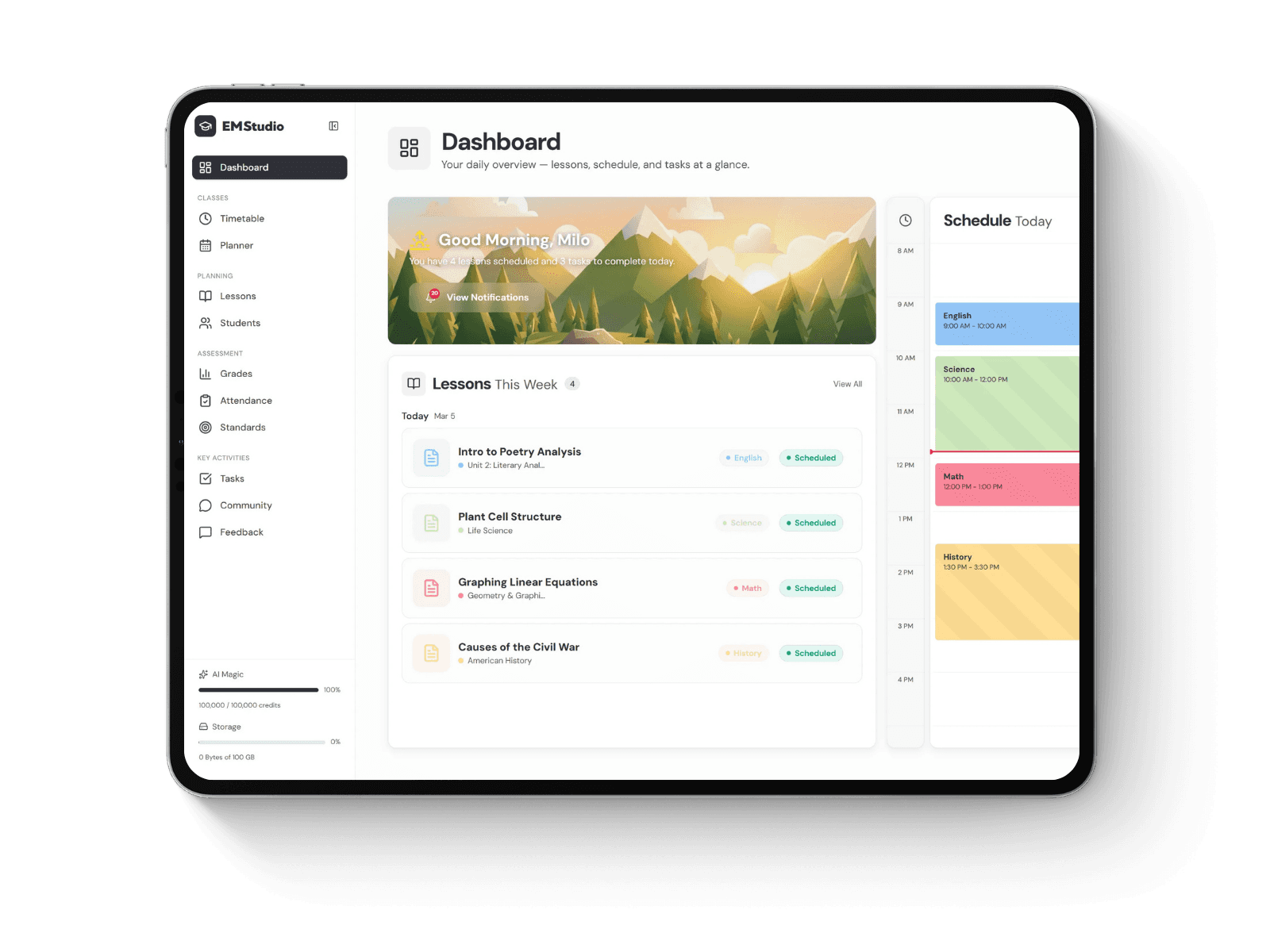
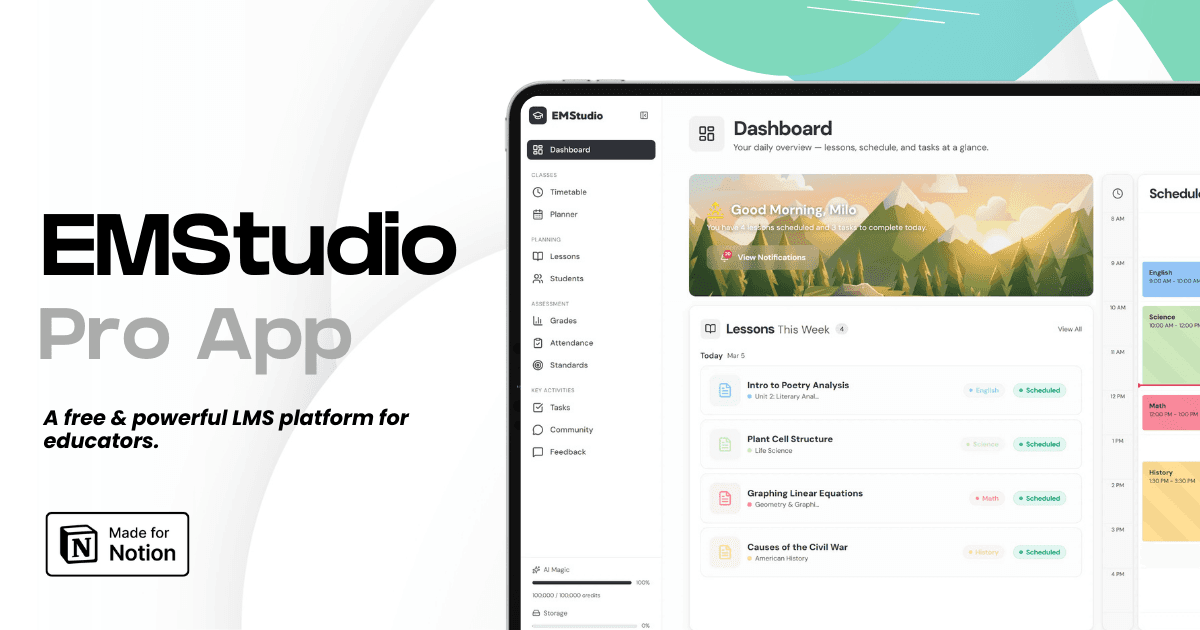
EMStudio is a free teaching management app — manage your classes, students, lessons, and more!
Learn More
Still grading everything by hand?
EMStudio is a free teaching management app — manage your classes, students, lessons, and more!
Learn More
Table of Contents
What Are the Best Teachers Created Resources for Literacy Instruction?
The best teachers created resources for literacy include Science of Reading-aligned phonics centers by Tara West, guided reading binder systems with editable running records, and writing workshop units with mentor text lists. These materials typically cost $5-$15 for individual units and serve grades K-5 with minimal prep time.
Teacher-made materials save educators an average of 5-10 hours per unit compared to creating from scratch, based on educator time-use surveys. That is a full weekend back. You find these resources on Teachers Pay Teachers (TPT), Etsy, and TeacherMade. Individual activities run $3-$8, comprehensive units $15-$35, and year-long bundles $40-$120. Think of it as paying for your time.
The strongest literacy materials organize into three distinct categories: foundational skills for phonics, small-group systems for guided reading, and composition units for writing workshop. Each category offers curriculum materials that require little modification.
Interactive Phonics Centers and Word Work Stations
Science of Reading alignment separates useful phonics centers from cute busywork. Tara West's Phonics Centers Bundle includes "Secret Word" magnetic tile cards for kindergarten and first grade. Students build CVC words with tiles, then flip the card to reveal a hidden picture matching the word. Prep takes 15 minutes: print at 300 DPI, slice on the paper cutter, run through the laminator. The cards last three years if you use 5-mil pouches.
"Pop the Balloon" segmenting games from Lucky Little Learners work as digital slides or printable cards for K-2. Kids tap each phoneme in a word, then "pop" the final balloon by saying the whole word fast. "Find and Cover" sound mats for PreK and K require mini-erasers or counting chips. Students hunt for target sounds like /sh/ or /ch/ and cover them. These teacher made games hit differentiated instruction needs because struggling readers work on single sounds while advanced kids handle blends on the same mat.
Files arrive as PDFs formatted for standard 8.5x11 paper. The 300 DPI resolution matters. At 150 DPI, the magnetic tile lines blur after one copy cycle. Always check the preview for crisp lines before you buy.
Guided Reading Binder Organization Systems
A well-built binder system keeps your small-group instruction moving. The best primary resources include running record forms with 100-200 word passages, comprehension strategy checklists covering predicting, questioning, and clarifying, and lesson plan templates with 2-day rotation schedules. You get space to note fluency rates, error patterns, and teaching points that carry over to the next meeting.
File format changes how you use the educational resources. Editable PowerPoint files let you type student names and book titles directly into the running record header. Locked PDFs protect the seller's work but force handwritten labels. I prefer editable files for grades 1-4 because I can duplicate a template for each child and track progress across quarters. Text levels typically range from A-N, covering emergent readers through transitional chapter book readers who need fluency checks.
These classroom activities support standards-based instruction without rewriting your scope. The comprehension checklists align to Common Core or state standards depending on the seller. The 2-day rotation schedule works better than daily changes because you see the same kids Monday and Tuesday, then switch groups Wednesday.
Writing Workshop Mini-Lesson Units
Full writing units need structure and mentor texts. "Small Moments" personal narrative units follow Lucy Calkins workshop style for grades K-2, focusing on tiny true stories rather than bed-to-bed summaries. "Opinion Writing Bootcamp" provides graphic organizers and sentence frames for grades 2-4, teaching kids to state a claim and back it with reasons. "All-About Books" informational units include table of contents templates and glossary pages for grades 1-3.
Mentor texts make these lesson plans click. For small moments, Owl Moon by Jane Yolen models sensory details in a short hike. For opinion writing, Click, Clack, Moo by Doreen Cronin demonstrates persuasive letter format with humor. You need the physical book and the unit. The best teacher resources include full-page color photos of the mentor text pages with thinking stems already written.
Clear word count targets keep expectations grade-appropriate:
Kindergarten: 50 words across pages
First grade: 100 words with a beginning, middle, and end
Second grade: 150 words with transition words
These curriculum materials pair well with tools to support creative writers like visual timers and word walls. Most units include anchor chart examples and publishing paper, cutting your prep to almost zero.

Which Teachers Created Resources Improve Math Understanding?
Top math resources include hands-on fraction manipulative kits for grades 3-4, Boom Cards digital fluency games for daily 10-minute practice, and real-world problem solving task cards featuring scenarios like 'Math in the Mall.' These teacher made materials range from $3-$12 and align with Common Core standards.
When you sort through teachers created resources for math, you hit three distinct categories that actually move the needle. Concrete manipulatives work best for grades 3-5 when kids still need to touch math to see it. Digital fluency tools cover grades 1-6 for that daily repetition nobody wants to grade by hand. Applied problem solving fits grades 4-8, where abstract concepts finally meet the real world. John Hattie's Visible Learning meta-analyses put hands-on manipulatives at an effect size of 0.50 for mathematics understanding. That beats most software subscriptions your district buys. Budget-wise, expect to spend $4-$10 on manipulative printables, $5-$25 per classroom for digital game licenses, and $3-$7 per task card set. These teaching sources beat textbook workbooks because you can tweak them next year when half your class bombs the fractions unit again. Plus, most offer standards-based instruction tags so you can prove alignment during your evaluation.
Hands-On Fraction and Decimal Manipulative Kits
A solid fraction kit starts with printable tiles running from one whole down to twelfths. You also want "Pizza Fraction" manipulatives with topping counters so kids can physically build three-eighths pepperoni. Add number line clothespin clips marked for zero to two, and you've got a kinesthetic trifecta. These align specifically with 3.NF.A.1 (understanding fractions), 3.NF.A.3 (equivalence), and 4.NF.B.3 (addition and subtraction).
Prep is where these teacher packets either shine or collect dust. Print on cardstock, not copier paper. Laminate with 5 mil pouches, not the flimsy 3 mil that peels by Christmas. Store them in pencil boxes or gallon baggies with the answer keys taped inside the lids. I learned the hard way that loose fraction tiles become choking hazards and floor decorations. Color-code your sets with dot stickers so when you find a 1/4 under the desk three weeks later, you know exactly which bag it belongs to. Spend the extra twenty minutes upfront and these learning resources for teachers will survive three years of rough third-grade handling. For more ideas on building conceptual understanding, check out these math teacher resources to transform your classroom.
Math Fact Fluency Digital Game Bundles
Boom Cards run about $15-$30 for 100-card sets, and they grade themselves while you sip lukewarm coffee. For younger kids, Google Slides "Math Fact Football" turns addition and subtraction drills into a game where correct answers move the ball down the field. Third and fourth graders obsess over "Dragon Multiplication," an escape-room style activity where solving facts unlocks the next chamber. These educational resources work best in 10-minute daily bursts, not hour-long marathons. Track mastery on the included data sheets: twenty out of twenty facts correct for three consecutive days means that kid graduates to the next level.
Technically, Boom requires internet and free student accounts. Google Slides needs Google Classroom or Drive access. I keep a clipboard with printed backup worksheets for the two kids whose tablets always die or who forgot passwords again. These lesson plans practically run themselves once you load them, making them perfect for independent stations while you pull small groups for intervention. The best part? The data sheets give you instant documentation for RTI meetings without you calculating percentages at midnight.
Real-World Problem Solving Task Card Sets
Each set contains 24 cards formatted four per page to save your ink budget. You get a recording sheet with workspace and a complete answer key. These curriculum materials shine in math centers with two to four students per set. Rotations run 15 to 20 minutes, just enough time to solve four or five cards deeply rather than rushing through twelve.
Popular scenarios include:
"Math in the Mall" throws percentage and sales tax problems at grades 6-7 using actual store scenarios they recognize.
"Recipe Scaling" hits fraction multiplication for grades 4-5 with real kitchen disasters like tripling a cookie batch.
"Budget Vacation" makes grades 5-6 wrestle with decimal operations while planning trips that cost less than their parents' monthly grocery bill.
The differentiated instruction happens naturally—struggling kids get the concrete scenarios while advanced kids tackle the extension questions on the back. I usually print each set on different colored paper so I can spot which group is working on what from across the room. For classroom activities that actually prepare them for adulting, these beat textbook word problems about trains leaving stations every time.
What Teachers Created Resources Work Best for Science and Social Studies?
Effective science and social studies resources feature NGSS-aligned 5E model experiment kits with Amazon-linked material lists, DBQ-style primary source analysis activities for middle school, and geography exploration centers with passport role-play elements. These lesson resources for teachers typically target grades 2-8.
Science follows the NGSS approach with phenomena-based inquiry. Social studies uses the C3 Framework with compelling questions and disciplinary literacy. Both require specific teaching materials for teachers that go beyond textbooks and worksheets.
Watch the hidden costs. Science kits with material lists often need $15 to $30 in Amazon purchases for consumables like baking soda, vinegar, or replacement balloons. Factor this into your supply budget before you assign the lesson plans. Nothing kills momentum like realizing you need hydrogen peroxide at 9 PM on a Tuesday.
Grade bands look different by subject. Primary students need picture-based curriculum materials with minimal text. Upper elementary requires 600-900L reading levels with structured supports. Middle schoolers handle primary source analysis at 800-1100 Lexile when you provide the right scaffolds.
NGSS-Aligned Hands-On Experiment Kits
The 5E model works. Teachers created resources using this structure—Engage, Explore, Explain, Elaborate, Evaluate—keep kids actually doing science instead of just reading about it. You want lessons where students build the balloon rocket first, then argue about why it moved. The 5E model keeps the sequence tight. You start with a phenomenon video, let them mess with materials, then formalize the vocabulary after they've had their hands dirty. This beats starting with a vocabulary list every time.
Look for these specific classroom activities:
Balloon Rocket Challenge (PS2-1, forces and motion, grades 3-5)
Erosion Prevention (ESS2-1, earth systems, grades 4-6)
Mystery Powders (5-PS1-3, chemical reactions, grade 5)
The best educational resources include hyperlinked material lists. You should see direct links to specific Amazon items—baking soda, vinegar, balloons, stopwatches—plus estimated cost per student group ($2-$4). This saves you an hour of scrolling through reviews on Sunday night.
Safety notes matter. Any lesson resources for teachers involving chemical reactions or projectiles must specify when goggles or adult supervision are required per district protocols. Check these before you photocopy. I learned this the hard way with the baking soda volcanoes and the custodian's floor.
Primary Source Document Analysis Activities
Middle school social studies clicks when students handle real documents. DBQ-style activities structure this inquiry with document sets of 4-6 primary sources—letters, photographs, political cartoons—plus a Source Analysis graphic organizer. Students actually see the handwriting from 1776 instead of a textbook summary. The tactile quality of aged paper, even in photocopy form, changes how they approach the text.
Specific topics that work:
Revolutionary War: Abigail Adams letters discussing women's roles
Civil Rights: Birmingham 1963 photographs by Charles Moore
Industrial Revolution: Lewis Hine child labor photos
The graphic organizer should ask sourcing questions: Who wrote this? When? What bias might they have? The sourcing questions should be specific. Not just "who wrote this" but "why would a Southern plantation owner describe slavery differently than a Northern journalist?" That level of questioning pushes 7th graders to think about perspective rather than just recall. These standards-based instruction activities target grades 6-8 with Lexile ranges of 800-1100. They build the sourcing, contextualization, and corroboration skills students need for high school history essays.
Pair these with social studies tools that transform history classrooms for differentiated instruction. Some kids will need the documents read aloud; others can handle the full text.
Geography and Culture Exploration Centers
Younger students need movement and play. Geography centers work best with a "Travel Agent" role-play setup including passport templates kids can stamp, continent sorting mats showing physical and political features, and culture comparison Venn diagrams (comparing US schools to Japanese schools). The passport element makes it feel real. You can set up five stations representing continents; students rotate through with their passports, collecting stamps as they complete each task.
Key components include:
Map keys, scale bars, and compass rose activities with coordinate grids
Sentence stems for ELL accommodations ("I notice ___ on the map")
Picture support for non-readers
The sorting mats work best when they're laminated. Kids can write on them with dry-erase markers, compare physical features like mountain ranges to political borders, then wipe clean for the next group. You can run five centers with one set of mats. These classroom activities target grades 2-4 with built-in supports. The curriculum materials should provide clear setup instructions so you're not rearranging desks during your lunch break. Look for resources that include the printable passport pages ready to copy double-sided.

Which Classroom Management Tools Do Teachers Recommend Most?
Most recommended classroom management tools include behavior tracking punch card systems, editable morning meeting Google Slides with greeting rotations, and emergency substitute teacher plans with three-day lesson sequences. These teacher packets cost $4-$20 and reduce daily preparation time significantly.
Teachers sort teachers created resources for management into three buckets: individual behavior systems, community-building whole-group tools, and contingency planning for substitutes. John Hattie's research puts classroom management at an effect size of 0.52. That makes your choice of tools high-impact for student achievement. Expect to pay $4-$12 for behavior systems, $6-$15 for morning meeting slides, and $8-$25 for complete sub plans.
Behavior Tracking and Reward Systems
Feature | Digital | Printable |
|---|---|---|
Cost | Free (Google Forms) | $8 decor |
Setup Time | 30 minutes | 2 hours printing/laminating |
Durability | Infinite | Wears out |
Privacy | Password protected | Visible to all |
Digital behavior tracking works if you already live in Google Workspace. A digital behavior tracking sheet costs nothing and takes 30 minutes to set up. It stays password-protected. But you need devices.
Printable systems run $8-$12 in any teacher store favorites for classroom supplies. Laminating and cutting takes two hours. They last one school year before looking ratty. Everyone sees everyone's status.
Skip the Clip Chart. Try these alternatives:
Brag Tags: little badges kids wear on necklaces
Punch Cards: ten punches earns a prize
Class Dojo Point Sheets: weekly totals without public shame
Introduce your system week one. Practice the routine until kids can explain it to a visitor. Send home the parent explanation letter the Friday before you start. Most teacher stores online include this template free.
Morning Meeting Slides and Community Building Activities
Morning meeting slides run 20-30 per monthly bundle. Each slide includes a dated calendar, greeting choice board, share topic, and activity. The greeting board offers five options: Ball Toss Name Game, Wordle Warm-up, Emoji Check-in, Two Truths and a Lie, or Would You Rather.
These files work in PowerPoint and Google Slides. You will need to install free KG fonts first. Check the license—some require personal use only.
Block 15-20 minutes each morning. Spend three minutes on the greeting, five on the share, and ten on the activity. This structure builds community without eating your math block. It works as a daily reset, especially in October when 3rd graders start testing boundaries.
Prices run $6-$15 in most teacher resource stores. Look for bundles with editable text fields so you can change the share prompt when your class needs something heavier. These classroom activities support differentiated instruction by offering student choice in greetings.
Substitute Teacher Emergency Lesson Plans
Your emergency sub tub needs three days of lesson plans. Include spiral review only—multiplication practice for 3rd grade, narrative writing prompts, independent reading with response sheets. Never leave new content. Add your class roster with photos, an emergency procedures map, and a "Notes for Sub" form.
Generic curriculum materials work better than subject-specific substitutes. A sick day in February shouldn't require you to rewrite your science unit. These educational resources should stand alone and work any season.
Pre-made sub plans cost $12-$18 in any decent teacher shop. Creating your own takes four hours. Do the math on your hourly rate. The bought ones usually include standards-based instruction alignment and read-aloud suggestions.
Print the tub contents now. Stash them in a labeled box by your desk. When the fever hits at 5 AM, you send one email instead of writing three hours of instructions.
How Do You Evaluate Teachers Created Resources Before Purchasing?
Evaluate teachers created resources by verifying standards alignment through 'I Can' statements in previews, checking that sample pages show actual content not just covers, and filtering reviews by educators teaching similar grade levels. Avoid resources with vague descriptions or mismatched clip art that doesn't match the academic rigor claimed. Research indicates that resources without clear learning objectives reduce implementation fidelity by 40%, so never buy based on cute covers alone.
Use the PREVIEW method before you click purchase: Preview the actual pages, check Reviews from similar contexts, verify if it's Editable, View the standards alignment, check Integrity of content depth, confirm Exactness of grade level, and assess the Worth against your prep time. This keeps your classroom activities focused on learning, not just looking good in a binder.
When NOT to buy: skip items where the clip art looks like it belongs on a birthday card rather than in standards-based instruction, descriptions promise "differentiated instruction" without showing how, or the seller lists "grades K-5" as if a kindergartener and fifth grader need the same lesson plans. These curriculum materials usually waste more time than they save and end up as expensive digital clutter.
Checking for Standards Alignment and Grade Appropriateness
Don't trust the title bar alone. Open the preview and look for specific standard codes like RL.3.1 or 4.NBT.2, not vague phrases like "reading comprehension" or "place value practice." Good teaching resources include "I Can" statements that mirror your district's language. Check for Depth of Knowledge indicators in the questioning—if every question starts with "What is..." or "Name the...", you're looking at DOK 1 recall work, not the rigor you need for 3rd graders in October.
Verify the reading level using Lexile or Fountas & Pinnell ranges listed in the description. If the resource claims to span grades K-5, close the tab. That's too broad to provide the targeted classroom activities your kids actually need. Consider aligning standards with your curriculum tools to ensure the resource fits your pacing guide and unit sequence.
No preview provided.
Only cover pages shown—no actual student work samples or question types.
Standards claimed but not listed with specific codes.
Grade range spans 4+ years.
No answer key included for the teacher's guide.
Reading Reviews From Educators in Similar Teaching Contexts
Filter reviews by teachers in contexts like yours—urban 4th grade with 28 students, or rural 7th grade block scheduling. A teacher source rating five stars might be useless if they teach in a private school with 12 kids and you have 32 in an inclusion classroom. Look for "verified purchase" tags and specific details about how long the lesson plans actually took to implement.
Watch for warning signs in the comments. "Too much prep" usually means poor design, not lazy teachers. "Not as pictured" signals false advertising. "Not editable" reveals a technical limitation the seller didn't disclose upfront. These educational resources might sit in your downloads folder untouched while you scramble for something that actually works Monday morning.
Check if the creator replies to questions within 48 hours. Responsive sellers update their files when errors appear and can clarify how to use the resource for differentiated instruction. Silent creators leave you alone with a broken lesson plan on Sunday night when you need support most.

Building Your Personal Teachers Created Resources Library
Stop buying one-off worksheets. Build a system. Split your budget like this: 60% subject-specific curriculum, 30% seasonal or holiday activities, and 10% classroom management tools. Most teachers drop $500 to $750 yearly on teachers created resources. Buy bundles instead of single items—you'll save roughly 40%. Keep it 80% digital so you can search and reuse, 20% physical for the hands-on stuff kids actually need to touch. Digital files travel with you; physical materials stay in the classroom but need curation or they become closet clutter.
Organizing Digital Files by Subject and Season
Dig through your downloads folder and you'll see the problem. Fix it with a four-level hierarchy:
Level 1: Subject (Math)
Level 2: Domain (Operations)
Level 3: Standard (4.OA.3)
Level 4: Resource Type (Assessment, Activity, or Game)
That last level saves you when you're hunting for a quick exit ticket versus a full lesson. Without it, you'll open twelve files before finding the right one.
Name your files so they sort correctly. Use this formula: Grade_Standard_Topic_Version_Date. So "4_OA.3_MultiStep_WordProblems_v2_2024" tells you exactly what's inside without opening it. When you update a file, bump the version number. You'll thank yourself next October when you can't remember which draft is the good one. Date stamps matter when you're looking for the resource that actually worked, not the experimental version from 2019.
Store everything in Google Drive or Dropbox with a local backup. Never rely solely on your school server. Districts change platforms, you switch jobs, or IT deletes "old" files over summer break. If you want to get serious, build a digital resource library that tags everything by standard, or start with this teaching resource organizer I use to track what I've taught and what's next.
Creating a Rotation Schedule for Physical Materials
That 20% physical slice needs a map. Build a Week 1-4 rotation schedule showing which centers are live. Use Iris bins or Sterilite containers labeled with standard numbers—4.NBT.2 sticks to the bin with place value disks. When kids see the label, they know which standards they're practicing. I keep a master calendar taped inside my cabinet door. Week 3 shows bins 4, 7, and 12 are out; everything else waits in the closet.
Maintenance saves money. Keep manipulatives in ziplock bags with printed labels. Tape a "Missing Piece" envelope to each bin—kids drop strays there instead of the floor. Laminate direction cards with actual photos of the setup. A picture of the finished pattern block puzzle beats a paragraph of instructions every time. Check the Missing Piece envelopes every Friday; return the contents before you head home.
Track your inventory in a simple spreadsheet with these columns:
Purchase date
Price
Current condition
Location (e.g., "Binder bin #3, shelf B")
That location code gets you there fast when a kindergartener dumps the entire container. You'll also see which teacher resources you actually use versus what looked good in the preview. After three years, anything with "Good" condition but zero uses goes in the donate pile.
Final Thoughts on Teachers Created Resources
The best curriculum materials won't help if they sit in your downloads folder. Pick one educational resource from this article—just one—and schedule it for next week. Don't adapt it. Don't customize the fonts. Run it as written so you can see if the author's teaching rhythm matches yours.
If the lesson plans work, go back for more from that same teacher. Follow their store. Read their blog. The secret isn't collecting thousands of classroom activities; it's finding two or three educators who teach like you wish you taught, then riding their coattails until you find your own stride. Your personal library grows when you stop shopping and start trusting.
What Are the Best Teachers Created Resources for Literacy Instruction?
The best teachers created resources for literacy include Science of Reading-aligned phonics centers by Tara West, guided reading binder systems with editable running records, and writing workshop units with mentor text lists. These materials typically cost $5-$15 for individual units and serve grades K-5 with minimal prep time.
Teacher-made materials save educators an average of 5-10 hours per unit compared to creating from scratch, based on educator time-use surveys. That is a full weekend back. You find these resources on Teachers Pay Teachers (TPT), Etsy, and TeacherMade. Individual activities run $3-$8, comprehensive units $15-$35, and year-long bundles $40-$120. Think of it as paying for your time.
The strongest literacy materials organize into three distinct categories: foundational skills for phonics, small-group systems for guided reading, and composition units for writing workshop. Each category offers curriculum materials that require little modification.
Interactive Phonics Centers and Word Work Stations
Science of Reading alignment separates useful phonics centers from cute busywork. Tara West's Phonics Centers Bundle includes "Secret Word" magnetic tile cards for kindergarten and first grade. Students build CVC words with tiles, then flip the card to reveal a hidden picture matching the word. Prep takes 15 minutes: print at 300 DPI, slice on the paper cutter, run through the laminator. The cards last three years if you use 5-mil pouches.
"Pop the Balloon" segmenting games from Lucky Little Learners work as digital slides or printable cards for K-2. Kids tap each phoneme in a word, then "pop" the final balloon by saying the whole word fast. "Find and Cover" sound mats for PreK and K require mini-erasers or counting chips. Students hunt for target sounds like /sh/ or /ch/ and cover them. These teacher made games hit differentiated instruction needs because struggling readers work on single sounds while advanced kids handle blends on the same mat.
Files arrive as PDFs formatted for standard 8.5x11 paper. The 300 DPI resolution matters. At 150 DPI, the magnetic tile lines blur after one copy cycle. Always check the preview for crisp lines before you buy.
Guided Reading Binder Organization Systems
A well-built binder system keeps your small-group instruction moving. The best primary resources include running record forms with 100-200 word passages, comprehension strategy checklists covering predicting, questioning, and clarifying, and lesson plan templates with 2-day rotation schedules. You get space to note fluency rates, error patterns, and teaching points that carry over to the next meeting.
File format changes how you use the educational resources. Editable PowerPoint files let you type student names and book titles directly into the running record header. Locked PDFs protect the seller's work but force handwritten labels. I prefer editable files for grades 1-4 because I can duplicate a template for each child and track progress across quarters. Text levels typically range from A-N, covering emergent readers through transitional chapter book readers who need fluency checks.
These classroom activities support standards-based instruction without rewriting your scope. The comprehension checklists align to Common Core or state standards depending on the seller. The 2-day rotation schedule works better than daily changes because you see the same kids Monday and Tuesday, then switch groups Wednesday.
Writing Workshop Mini-Lesson Units
Full writing units need structure and mentor texts. "Small Moments" personal narrative units follow Lucy Calkins workshop style for grades K-2, focusing on tiny true stories rather than bed-to-bed summaries. "Opinion Writing Bootcamp" provides graphic organizers and sentence frames for grades 2-4, teaching kids to state a claim and back it with reasons. "All-About Books" informational units include table of contents templates and glossary pages for grades 1-3.
Mentor texts make these lesson plans click. For small moments, Owl Moon by Jane Yolen models sensory details in a short hike. For opinion writing, Click, Clack, Moo by Doreen Cronin demonstrates persuasive letter format with humor. You need the physical book and the unit. The best teacher resources include full-page color photos of the mentor text pages with thinking stems already written.
Clear word count targets keep expectations grade-appropriate:
Kindergarten: 50 words across pages
First grade: 100 words with a beginning, middle, and end
Second grade: 150 words with transition words
These curriculum materials pair well with tools to support creative writers like visual timers and word walls. Most units include anchor chart examples and publishing paper, cutting your prep to almost zero.
Which Teachers Created Resources Improve Math Understanding?
Top math resources include hands-on fraction manipulative kits for grades 3-4, Boom Cards digital fluency games for daily 10-minute practice, and real-world problem solving task cards featuring scenarios like 'Math in the Mall.' These teacher made materials range from $3-$12 and align with Common Core standards.
When you sort through teachers created resources for math, you hit three distinct categories that actually move the needle. Concrete manipulatives work best for grades 3-5 when kids still need to touch math to see it. Digital fluency tools cover grades 1-6 for that daily repetition nobody wants to grade by hand. Applied problem solving fits grades 4-8, where abstract concepts finally meet the real world. John Hattie's Visible Learning meta-analyses put hands-on manipulatives at an effect size of 0.50 for mathematics understanding. That beats most software subscriptions your district buys. Budget-wise, expect to spend $4-$10 on manipulative printables, $5-$25 per classroom for digital game licenses, and $3-$7 per task card set. These teaching sources beat textbook workbooks because you can tweak them next year when half your class bombs the fractions unit again. Plus, most offer standards-based instruction tags so you can prove alignment during your evaluation.
Hands-On Fraction and Decimal Manipulative Kits
A solid fraction kit starts with printable tiles running from one whole down to twelfths. You also want "Pizza Fraction" manipulatives with topping counters so kids can physically build three-eighths pepperoni. Add number line clothespin clips marked for zero to two, and you've got a kinesthetic trifecta. These align specifically with 3.NF.A.1 (understanding fractions), 3.NF.A.3 (equivalence), and 4.NF.B.3 (addition and subtraction).
Prep is where these teacher packets either shine or collect dust. Print on cardstock, not copier paper. Laminate with 5 mil pouches, not the flimsy 3 mil that peels by Christmas. Store them in pencil boxes or gallon baggies with the answer keys taped inside the lids. I learned the hard way that loose fraction tiles become choking hazards and floor decorations. Color-code your sets with dot stickers so when you find a 1/4 under the desk three weeks later, you know exactly which bag it belongs to. Spend the extra twenty minutes upfront and these learning resources for teachers will survive three years of rough third-grade handling. For more ideas on building conceptual understanding, check out these math teacher resources to transform your classroom.
Math Fact Fluency Digital Game Bundles
Boom Cards run about $15-$30 for 100-card sets, and they grade themselves while you sip lukewarm coffee. For younger kids, Google Slides "Math Fact Football" turns addition and subtraction drills into a game where correct answers move the ball down the field. Third and fourth graders obsess over "Dragon Multiplication," an escape-room style activity where solving facts unlocks the next chamber. These educational resources work best in 10-minute daily bursts, not hour-long marathons. Track mastery on the included data sheets: twenty out of twenty facts correct for three consecutive days means that kid graduates to the next level.
Technically, Boom requires internet and free student accounts. Google Slides needs Google Classroom or Drive access. I keep a clipboard with printed backup worksheets for the two kids whose tablets always die or who forgot passwords again. These lesson plans practically run themselves once you load them, making them perfect for independent stations while you pull small groups for intervention. The best part? The data sheets give you instant documentation for RTI meetings without you calculating percentages at midnight.
Real-World Problem Solving Task Card Sets
Each set contains 24 cards formatted four per page to save your ink budget. You get a recording sheet with workspace and a complete answer key. These curriculum materials shine in math centers with two to four students per set. Rotations run 15 to 20 minutes, just enough time to solve four or five cards deeply rather than rushing through twelve.
Popular scenarios include:
"Math in the Mall" throws percentage and sales tax problems at grades 6-7 using actual store scenarios they recognize.
"Recipe Scaling" hits fraction multiplication for grades 4-5 with real kitchen disasters like tripling a cookie batch.
"Budget Vacation" makes grades 5-6 wrestle with decimal operations while planning trips that cost less than their parents' monthly grocery bill.
The differentiated instruction happens naturally—struggling kids get the concrete scenarios while advanced kids tackle the extension questions on the back. I usually print each set on different colored paper so I can spot which group is working on what from across the room. For classroom activities that actually prepare them for adulting, these beat textbook word problems about trains leaving stations every time.
What Teachers Created Resources Work Best for Science and Social Studies?
Effective science and social studies resources feature NGSS-aligned 5E model experiment kits with Amazon-linked material lists, DBQ-style primary source analysis activities for middle school, and geography exploration centers with passport role-play elements. These lesson resources for teachers typically target grades 2-8.
Science follows the NGSS approach with phenomena-based inquiry. Social studies uses the C3 Framework with compelling questions and disciplinary literacy. Both require specific teaching materials for teachers that go beyond textbooks and worksheets.
Watch the hidden costs. Science kits with material lists often need $15 to $30 in Amazon purchases for consumables like baking soda, vinegar, or replacement balloons. Factor this into your supply budget before you assign the lesson plans. Nothing kills momentum like realizing you need hydrogen peroxide at 9 PM on a Tuesday.
Grade bands look different by subject. Primary students need picture-based curriculum materials with minimal text. Upper elementary requires 600-900L reading levels with structured supports. Middle schoolers handle primary source analysis at 800-1100 Lexile when you provide the right scaffolds.
NGSS-Aligned Hands-On Experiment Kits
The 5E model works. Teachers created resources using this structure—Engage, Explore, Explain, Elaborate, Evaluate—keep kids actually doing science instead of just reading about it. You want lessons where students build the balloon rocket first, then argue about why it moved. The 5E model keeps the sequence tight. You start with a phenomenon video, let them mess with materials, then formalize the vocabulary after they've had their hands dirty. This beats starting with a vocabulary list every time.
Look for these specific classroom activities:
Balloon Rocket Challenge (PS2-1, forces and motion, grades 3-5)
Erosion Prevention (ESS2-1, earth systems, grades 4-6)
Mystery Powders (5-PS1-3, chemical reactions, grade 5)
The best educational resources include hyperlinked material lists. You should see direct links to specific Amazon items—baking soda, vinegar, balloons, stopwatches—plus estimated cost per student group ($2-$4). This saves you an hour of scrolling through reviews on Sunday night.
Safety notes matter. Any lesson resources for teachers involving chemical reactions or projectiles must specify when goggles or adult supervision are required per district protocols. Check these before you photocopy. I learned this the hard way with the baking soda volcanoes and the custodian's floor.
Primary Source Document Analysis Activities
Middle school social studies clicks when students handle real documents. DBQ-style activities structure this inquiry with document sets of 4-6 primary sources—letters, photographs, political cartoons—plus a Source Analysis graphic organizer. Students actually see the handwriting from 1776 instead of a textbook summary. The tactile quality of aged paper, even in photocopy form, changes how they approach the text.
Specific topics that work:
Revolutionary War: Abigail Adams letters discussing women's roles
Civil Rights: Birmingham 1963 photographs by Charles Moore
Industrial Revolution: Lewis Hine child labor photos
The graphic organizer should ask sourcing questions: Who wrote this? When? What bias might they have? The sourcing questions should be specific. Not just "who wrote this" but "why would a Southern plantation owner describe slavery differently than a Northern journalist?" That level of questioning pushes 7th graders to think about perspective rather than just recall. These standards-based instruction activities target grades 6-8 with Lexile ranges of 800-1100. They build the sourcing, contextualization, and corroboration skills students need for high school history essays.
Pair these with social studies tools that transform history classrooms for differentiated instruction. Some kids will need the documents read aloud; others can handle the full text.
Geography and Culture Exploration Centers
Younger students need movement and play. Geography centers work best with a "Travel Agent" role-play setup including passport templates kids can stamp, continent sorting mats showing physical and political features, and culture comparison Venn diagrams (comparing US schools to Japanese schools). The passport element makes it feel real. You can set up five stations representing continents; students rotate through with their passports, collecting stamps as they complete each task.
Key components include:
Map keys, scale bars, and compass rose activities with coordinate grids
Sentence stems for ELL accommodations ("I notice ___ on the map")
Picture support for non-readers
The sorting mats work best when they're laminated. Kids can write on them with dry-erase markers, compare physical features like mountain ranges to political borders, then wipe clean for the next group. You can run five centers with one set of mats. These classroom activities target grades 2-4 with built-in supports. The curriculum materials should provide clear setup instructions so you're not rearranging desks during your lunch break. Look for resources that include the printable passport pages ready to copy double-sided.
Which Classroom Management Tools Do Teachers Recommend Most?
Most recommended classroom management tools include behavior tracking punch card systems, editable morning meeting Google Slides with greeting rotations, and emergency substitute teacher plans with three-day lesson sequences. These teacher packets cost $4-$20 and reduce daily preparation time significantly.
Teachers sort teachers created resources for management into three buckets: individual behavior systems, community-building whole-group tools, and contingency planning for substitutes. John Hattie's research puts classroom management at an effect size of 0.52. That makes your choice of tools high-impact for student achievement. Expect to pay $4-$12 for behavior systems, $6-$15 for morning meeting slides, and $8-$25 for complete sub plans.
Behavior Tracking and Reward Systems
Feature | Digital | Printable |
|---|---|---|
Cost | Free (Google Forms) | $8 decor |
Setup Time | 30 minutes | 2 hours printing/laminating |
Durability | Infinite | Wears out |
Privacy | Password protected | Visible to all |
Digital behavior tracking works if you already live in Google Workspace. A digital behavior tracking sheet costs nothing and takes 30 minutes to set up. It stays password-protected. But you need devices.
Printable systems run $8-$12 in any teacher store favorites for classroom supplies. Laminating and cutting takes two hours. They last one school year before looking ratty. Everyone sees everyone's status.
Skip the Clip Chart. Try these alternatives:
Brag Tags: little badges kids wear on necklaces
Punch Cards: ten punches earns a prize
Class Dojo Point Sheets: weekly totals without public shame
Introduce your system week one. Practice the routine until kids can explain it to a visitor. Send home the parent explanation letter the Friday before you start. Most teacher stores online include this template free.
Morning Meeting Slides and Community Building Activities
Morning meeting slides run 20-30 per monthly bundle. Each slide includes a dated calendar, greeting choice board, share topic, and activity. The greeting board offers five options: Ball Toss Name Game, Wordle Warm-up, Emoji Check-in, Two Truths and a Lie, or Would You Rather.
These files work in PowerPoint and Google Slides. You will need to install free KG fonts first. Check the license—some require personal use only.
Block 15-20 minutes each morning. Spend three minutes on the greeting, five on the share, and ten on the activity. This structure builds community without eating your math block. It works as a daily reset, especially in October when 3rd graders start testing boundaries.
Prices run $6-$15 in most teacher resource stores. Look for bundles with editable text fields so you can change the share prompt when your class needs something heavier. These classroom activities support differentiated instruction by offering student choice in greetings.
Substitute Teacher Emergency Lesson Plans
Your emergency sub tub needs three days of lesson plans. Include spiral review only—multiplication practice for 3rd grade, narrative writing prompts, independent reading with response sheets. Never leave new content. Add your class roster with photos, an emergency procedures map, and a "Notes for Sub" form.
Generic curriculum materials work better than subject-specific substitutes. A sick day in February shouldn't require you to rewrite your science unit. These educational resources should stand alone and work any season.
Pre-made sub plans cost $12-$18 in any decent teacher shop. Creating your own takes four hours. Do the math on your hourly rate. The bought ones usually include standards-based instruction alignment and read-aloud suggestions.
Print the tub contents now. Stash them in a labeled box by your desk. When the fever hits at 5 AM, you send one email instead of writing three hours of instructions.
How Do You Evaluate Teachers Created Resources Before Purchasing?
Evaluate teachers created resources by verifying standards alignment through 'I Can' statements in previews, checking that sample pages show actual content not just covers, and filtering reviews by educators teaching similar grade levels. Avoid resources with vague descriptions or mismatched clip art that doesn't match the academic rigor claimed. Research indicates that resources without clear learning objectives reduce implementation fidelity by 40%, so never buy based on cute covers alone.
Use the PREVIEW method before you click purchase: Preview the actual pages, check Reviews from similar contexts, verify if it's Editable, View the standards alignment, check Integrity of content depth, confirm Exactness of grade level, and assess the Worth against your prep time. This keeps your classroom activities focused on learning, not just looking good in a binder.
When NOT to buy: skip items where the clip art looks like it belongs on a birthday card rather than in standards-based instruction, descriptions promise "differentiated instruction" without showing how, or the seller lists "grades K-5" as if a kindergartener and fifth grader need the same lesson plans. These curriculum materials usually waste more time than they save and end up as expensive digital clutter.
Checking for Standards Alignment and Grade Appropriateness
Don't trust the title bar alone. Open the preview and look for specific standard codes like RL.3.1 or 4.NBT.2, not vague phrases like "reading comprehension" or "place value practice." Good teaching resources include "I Can" statements that mirror your district's language. Check for Depth of Knowledge indicators in the questioning—if every question starts with "What is..." or "Name the...", you're looking at DOK 1 recall work, not the rigor you need for 3rd graders in October.
Verify the reading level using Lexile or Fountas & Pinnell ranges listed in the description. If the resource claims to span grades K-5, close the tab. That's too broad to provide the targeted classroom activities your kids actually need. Consider aligning standards with your curriculum tools to ensure the resource fits your pacing guide and unit sequence.
No preview provided.
Only cover pages shown—no actual student work samples or question types.
Standards claimed but not listed with specific codes.
Grade range spans 4+ years.
No answer key included for the teacher's guide.
Reading Reviews From Educators in Similar Teaching Contexts
Filter reviews by teachers in contexts like yours—urban 4th grade with 28 students, or rural 7th grade block scheduling. A teacher source rating five stars might be useless if they teach in a private school with 12 kids and you have 32 in an inclusion classroom. Look for "verified purchase" tags and specific details about how long the lesson plans actually took to implement.
Watch for warning signs in the comments. "Too much prep" usually means poor design, not lazy teachers. "Not as pictured" signals false advertising. "Not editable" reveals a technical limitation the seller didn't disclose upfront. These educational resources might sit in your downloads folder untouched while you scramble for something that actually works Monday morning.
Check if the creator replies to questions within 48 hours. Responsive sellers update their files when errors appear and can clarify how to use the resource for differentiated instruction. Silent creators leave you alone with a broken lesson plan on Sunday night when you need support most.
Building Your Personal Teachers Created Resources Library
Stop buying one-off worksheets. Build a system. Split your budget like this: 60% subject-specific curriculum, 30% seasonal or holiday activities, and 10% classroom management tools. Most teachers drop $500 to $750 yearly on teachers created resources. Buy bundles instead of single items—you'll save roughly 40%. Keep it 80% digital so you can search and reuse, 20% physical for the hands-on stuff kids actually need to touch. Digital files travel with you; physical materials stay in the classroom but need curation or they become closet clutter.
Organizing Digital Files by Subject and Season
Dig through your downloads folder and you'll see the problem. Fix it with a four-level hierarchy:
Level 1: Subject (Math)
Level 2: Domain (Operations)
Level 3: Standard (4.OA.3)
Level 4: Resource Type (Assessment, Activity, or Game)
That last level saves you when you're hunting for a quick exit ticket versus a full lesson. Without it, you'll open twelve files before finding the right one.
Name your files so they sort correctly. Use this formula: Grade_Standard_Topic_Version_Date. So "4_OA.3_MultiStep_WordProblems_v2_2024" tells you exactly what's inside without opening it. When you update a file, bump the version number. You'll thank yourself next October when you can't remember which draft is the good one. Date stamps matter when you're looking for the resource that actually worked, not the experimental version from 2019.
Store everything in Google Drive or Dropbox with a local backup. Never rely solely on your school server. Districts change platforms, you switch jobs, or IT deletes "old" files over summer break. If you want to get serious, build a digital resource library that tags everything by standard, or start with this teaching resource organizer I use to track what I've taught and what's next.
Creating a Rotation Schedule for Physical Materials
That 20% physical slice needs a map. Build a Week 1-4 rotation schedule showing which centers are live. Use Iris bins or Sterilite containers labeled with standard numbers—4.NBT.2 sticks to the bin with place value disks. When kids see the label, they know which standards they're practicing. I keep a master calendar taped inside my cabinet door. Week 3 shows bins 4, 7, and 12 are out; everything else waits in the closet.
Maintenance saves money. Keep manipulatives in ziplock bags with printed labels. Tape a "Missing Piece" envelope to each bin—kids drop strays there instead of the floor. Laminate direction cards with actual photos of the setup. A picture of the finished pattern block puzzle beats a paragraph of instructions every time. Check the Missing Piece envelopes every Friday; return the contents before you head home.
Track your inventory in a simple spreadsheet with these columns:
Purchase date
Price
Current condition
Location (e.g., "Binder bin #3, shelf B")
That location code gets you there fast when a kindergartener dumps the entire container. You'll also see which teacher resources you actually use versus what looked good in the preview. After three years, anything with "Good" condition but zero uses goes in the donate pile.
Final Thoughts on Teachers Created Resources
The best curriculum materials won't help if they sit in your downloads folder. Pick one educational resource from this article—just one—and schedule it for next week. Don't adapt it. Don't customize the fonts. Run it as written so you can see if the author's teaching rhythm matches yours.
If the lesson plans work, go back for more from that same teacher. Follow their store. Read their blog. The secret isn't collecting thousands of classroom activities; it's finding two or three educators who teach like you wish you taught, then riding their coattails until you find your own stride. Your personal library grows when you stop shopping and start trusting.
Still grading everything by hand?
EMStudio is a free teaching management app — manage your classes, students, lessons, and more!
Learn More
Still grading everything by hand?
EMStudio is a free teaching management app — manage your classes, students, lessons, and more!
Learn More



Notion4Teachers
Notion templates to simplify administrative tasks and enhance your teaching experience.



2026 Notion4Teachers. All Rights Reserved.
Notion4Teachers
Notion templates to simplify administrative tasks and enhance your teaching experience.
2026 Notion4Teachers. All Rights Reserved.
Notion4Teachers
Notion templates to simplify administrative tasks and enhance your teaching experience.
2026 Notion4Teachers. All Rights Reserved.