Preschool Teacher Planner: Complete Template Setup
Preschool Teacher Planner: Complete Template Setup

Article by
Milo
ESL Content Coordinator & Educator
ESL Content Coordinator & Educator
All Posts
You searched for a preschool teacher planner because the one sitting on your desk right now doesn't understand that your morning starts with circle time, not a spelling test. Generic teacher planners force early childhood educators to squeeze play-based learning into boxes built for third-grade math blocks. You need to track sensory bin rotations, document developmental milestones, and plan small group interventions—all before snack time.
I spent three years hacking together a system that worked for my pre-k classroom. I tried the pretty spiral-bound ones from the teacher store. I tried digital apps. Nothing stuck until I built a template that matches how we actually move through a day: from arrival procedures through learning centers to that final story before dismissal. This isn't about perfect handwriting or color-coded washi tape. It's about having your lesson plan template, assessment notes, and daily schedule visible in one glance.
This setup covers the specific sections that matter for early childhood education—circle time activities that hit your standards, documentation for those dreaded assessment windows, and space to note which child refused nap on Tuesday. Whether you run a Reggio-inspired studio or a traditional daycare planning routine, I'll walk you through building a system that saves your planning period for actual planning, not hunting for sticky notes.
You'll get step-by-step directions for first-time users, plus tips for adapting this to different curriculum models. No fluff. Just the planner I wish I'd had on my first day in the four-year-old room.
Still grading everything by hand?
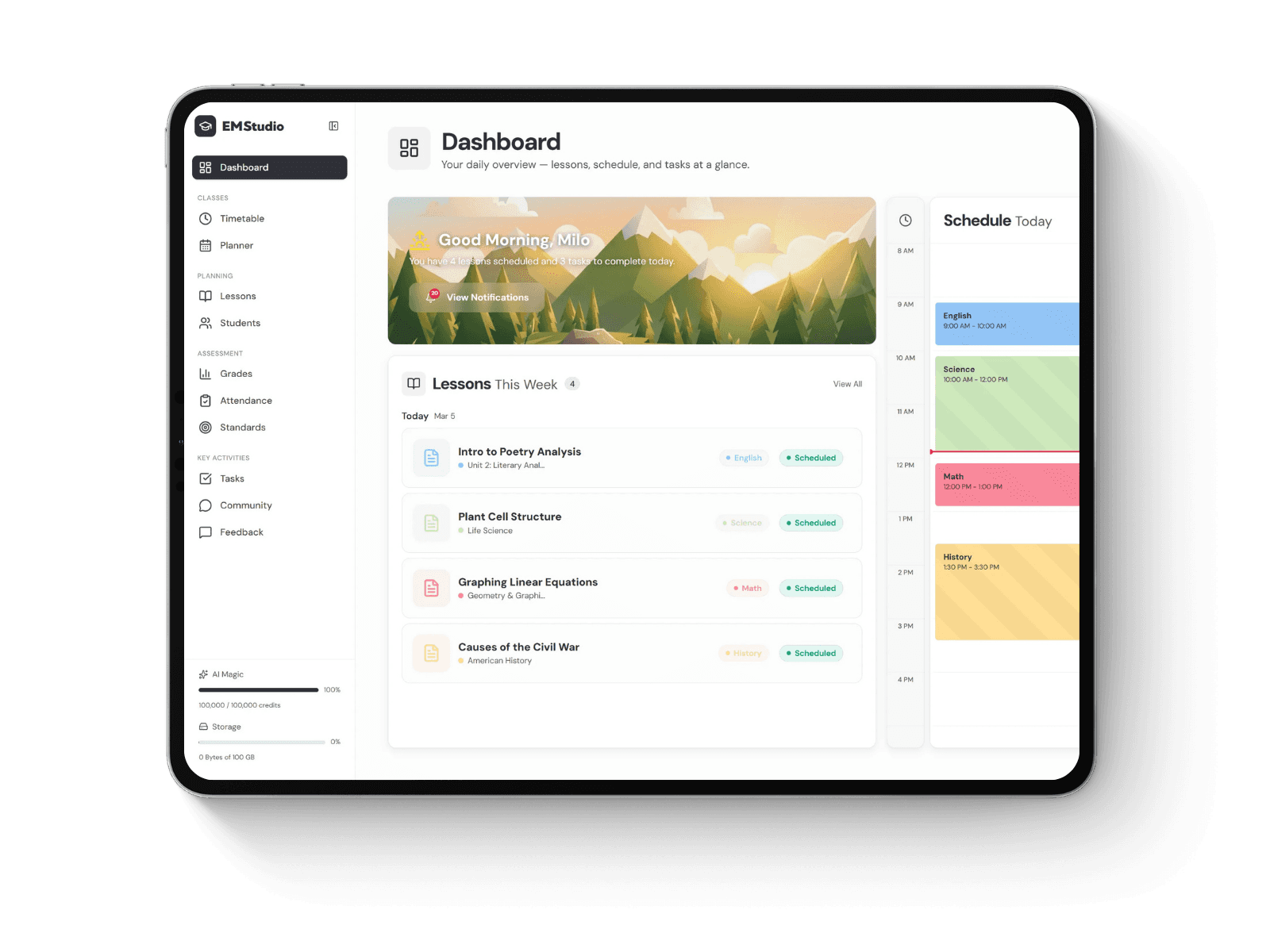
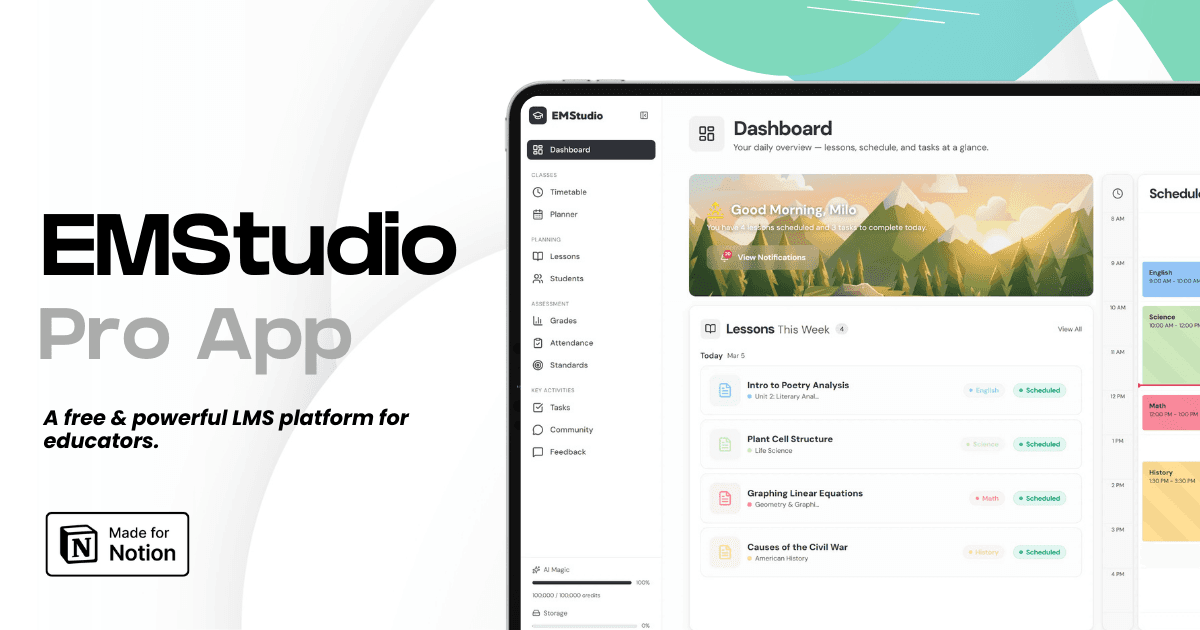
EMStudio is a free teaching management app — manage your classes, students, lessons, and more!
Learn More
Still grading everything by hand?
EMStudio is a free teaching management app — manage your classes, students, lessons, and more!
Learn More
Table of Contents
What This Template Covers
This preschool teacher planner handles mixed-age classrooms where three-year-olds nap while five-year-olds write their names. It works for ratios up to 1:10 and both half-day programs (three hours) and full-day stretches (six to eight hours). I built it because my own classroom had four-year-olds who needed scissors practice sitting next to five-year-olds ready for sight words, and I needed one system that tracked both.
You get three format options. The printable PDF binder runs $15 to $30 at Staples for the whole year—print the assessment sections on cardstock and the daily pages on regular copy paper. The Google Sheets version costs nothing beyond your existing account and auto-saves when your director walks in mid-lesson.
Or go hybrid with Happy Planner inserts—punch the pages and snap them into your existing teacher planner alongside your staff meeting notes and union calendar. I switch between the binder for observations and the digital sheet for lesson plans depending on whether I am at the sand table or my desk.
The template includes eight core components:
A 12-month academic calendar that starts in August, not January, because preschool runs on a school-year cycle.
A weekly lesson plan template with a five-day spread for Monday through Friday activities.
Individual child assessment trackers for up to 20 students with photo slots for faces you cannot yet match to names.
Daily schedule blocks mapped to 30-minute intervals for circle time activities, snack, and outdoor play.
A parent communication log with space for 100 entries to document late pickups and medication permissions.
Monthly supply inventory sheets for tracking glue sticks, tempera paint, and that one specific brand of wipes.
An emergency sub folder with rosters, allergy info, and backup lesson plans for sick days.
A developmental milestone checklist aligned with Early Learning Standards for conferences.
Skip the student grouping page and you will lose forty-five minutes every week reorganizing small groups. I learned this the hard way last October when I tried to wing it with sticky notes that fell off during clean-up. The rotating group assignment grid uses four-color coding for learning centers—blue for art, red for blocks, yellow for literacy, green for math—so you can see who goes where at 9:00 AM versus 10:00 AM without squinting at your clipboard while managing transitions.
This system plays nice with the essential preschool learning resources you already use. It maps directly to Creative Curriculum GOLD checkpoints and Teaching Strategies documentation requirements. State QRIS auditors recognize the format, which saves you from rewriting observations in their preferred layout during their three-hour visits. You can export the assessment data as a PDF for your portfolio or screenshot the grids for family conferences without reformatting anything. I export the whole thing for my CDA portfolio without retyping a word.
The planner accommodates pre-k curriculum pacing guides and daycare planning requirements without extra tabs. Whether you run a Montessori-inspired room or a play-based program with sensory bins, the grids flex to fit your early childhood education goals and state standards. I use the same template for my Tuesday-Thursday half-day class and my Monday-Wednesday-Friday full-day group by simply copying the schedule blocks and adjusting the nap time sections.

What Are the Essential Sections Every Preschool Teacher Planner Needs?
Every preschool teacher planner needs seven core sections: monthly curriculum map, weekly lesson grid with center rotations, individual student portfolios, daily schedule blocks, assessment checklists aligned to early learning standards, parent communication logs, and supply inventory trackers. These seven components handle the unique needs of 3-5 year old learners.
I learned the hard way that elementary planners don't fit early childhood education. My first year, I tried squeezing circle time activities into "Math Block" slots. The schedule fell apart by Tuesday.
Standard lesson plan templates built for third grade fail in preschool because they organize by subject rather than developmental domain. You need tools built for daycare planning and pre-k curriculum rhythms, not miniaturized elementary grids. A preschool lesson plans pdf designed for five-year-olds looks nothing like a second grade scope and sequence.
Traditional Elementary Planner | Preschool-Specific Requirements |
Subject blocks (Math, ELA, Science) | Center-based rotation grids for Dramatic Play, Blocks, Art, Literacy, and Science |
45-minute instructional periods | 15-20 minute chunks with 15-minute transition buffers |
Individual desk work focus | Small group learning centers |
Homework assignment sections | Outdoor play and sensory activity tracking |
Letter grade percentages | Developmental milestone markers |
The weekly lesson grid needs dedicated space for five learning centers plus circle time activities and outdoor play. I map out Dramatic Play, Blocks, Art, Literacy, and Science across the morning. Each block includes a 15-minute transition buffer, not just a line break. Three year olds don't pivot instantly. They need time to finish building that tower before moving to the art station.
Your assessment tracker should use a simple three-point scale: Emerging, Developing, Mastered. I track 25 students maximum per sheet, which matches most state ratios for pre-k curriculum alignment. Each checklist connects to state Early Learning Standards or Common Core Kindergarten readiness benchmarks. I tried using percentage grades once for my preschool lesson plans pdf portfolio. It made no sense for four-year-olds who are still learning to hold pencils properly.
The parent communication log needs five specific fields: date, time, method (call/text/app), concern level on a 1-3 scale, and follow-up required. Most states require this documentation for licensing. Last spring, a licensing inspector asked me to show records of a parent's worry about their child's speech development. I found it in thirty seconds because I had the template ready.
The monthly curriculum map spreads themes across the year while leaving room for emergent interests. I plan topics like "Autumn" or "Community Helpers" but keep specifics loose. Last October, my class obsessed over construction vehicles. Because my map had flexibility, I pivoted our lessons for 3 year olds to building projects without losing literacy goals.
When you're building your system, look for engaging preschool lesson plans that include these structural elements. I also recommend checking out daily templates for early learners to see how the pacing works for younger groups.

Step-by-Step Setup Guide for First-Time Users
Your preschool teacher planner should work the Monday you open it. Here is exactly how I set mine up every August before the kids arrive.
Pick your format first. Download the PDF template pack (40 pages) or copy the Google Sheets version. I have used both. The PDF feels better in staff meetings when everyone else has paper, but the Google Sheets version updates from my phone during recess. If you choose PDF, print on 28lb paper. Standard 20lb bleeds through with highlighters. Last year I paid $18 at FedEx for color printing and coil binding. Worth it. The heavier paper also survives apple juice spills better than the cheap stuff. The coil binding lets the binder lay flat on my counter.
Customize the cover and spine. Add your name, room number, and the school year (August-July). This seems small until another teacher grabs your binder by mistake during a fire drill. I add five tab dividers labeled: Calendar, Lessons, Assessments, Communication, Inventory. The Inventory tab saves me every spring when I count blocks and dramatic play dishes. I write my name on the spine with a Sharpie. Tape over it with clear packing tape. It lasts all year. I use Avery dividers with pockets so permission slips do not get lost.
Pre-fill the 12-month calendar. Block every school holiday, professional development day, and parent-teacher conference date now. I also block two hours every Friday for planning time. If I do not write it down, the principal schedules a meeting there. This protects your early childhood education prep time. I use red ink for mandatory meetings and blue for my own blocks. The visual difference helps when I am tired. I add half-days in green so I remember to pack a lunch that does not need reheating.
Set up your student roster. Use the assessment tracker page. List twenty students maximum. If you have twenty-four kids like I did in 2022, print two copies. Add IEP and 504 flags in the margin. I highlight ELL students with yellow. One glance shows me who needs visual supports during circle time activities. I also note allergy alerts here. Peanut icons in the corner remind me to check snack labels before we start daycare planning for the afternoon. Leave space for new enrollees. October always brings transfers.
Create your first week's lesson plan. Use the lessons for 3 year olds pacing guide: introduce concepts Monday through Wednesday, review Thursday, assess Friday through play-based observation. Include transition times. Five minutes between centers prevents chaos. Write it in your lesson plan template exactly how you will say it. "Clean up, line up" works better than "transition to gross motor."
I script my questions for learning centers. "What do you notice about the balance scale?" keeps me from reverting to yes-or-no questions when my brain is fried. I also note which materials I need in the margin. Nothing kills momentum like hunting for the pumpkin seeds during math.
Avoid the lamination trap. Do not laminate your weekly pages if you plan to use wet-erase markers. I tried this. The lamination creates glare under fluorescent lights, and markers stain permanently after three weeks. Use sheet protectors or write-on tabs instead.
You can wipe them clean without the shine blinding you during story time. Sheet protectors also let you slide in new pre-k curriculum supplements without re-binding. I learned this the hard way in September 2019. The glare gave me headaches by Halloween.
Stock your binder pockets. Before you finish, visit preschool websites for teachers like Pre-K Pages or Fun Learning for Kids. Download free printable supplements that fit your binder pockets. I keep alphabet tracing cards and nursery rhyme sequencing strips in my Inventory section. They pull out fast when a lesson runs short. I also stash sticky notes and a golf pencil in the back pocket. You always need a pencil. Add a small plastic bag with paper clips. They become instant pointer fingers for tracking print during circle time.
If you prefer screens, check out our digital planning setup guide. I switch between paper and digital depending on the season. October is usually paper. May is digital when everything is moving fast. Both work. The best planner is the one you will actually open at 6:45 AM when the coffee is still brewing and a three-year-old is asking why the hamster sleeps all day.

How Do You Adapt This for Different Curriculum Models?
Adapt your preschool teacher planner by modifying the lesson grid structure: Montessori programs replace subject blocks with 3-hour work cycle logs; Reggio Emilia requires project documentation pages; Creative Curriculum needs space for intentional teaching experiences; HighScope requires separate Plan-Do-Review columns. Match your planner layout to your curriculum's documentation requirements.
Your lesson plan template should match how you actually teach. A grid designed for circle time activities won't work if your pre-k curriculum runs on individual choice. I learned this the hard way when my standardized columns couldn't capture my Montessori observations. The mismatch wasted thirty minutes of planning time every Sunday night. Those thirty minutes matter when you're already working weekends.
For Montessori teaching methods, restructure your weekly grid into 3-hour work cycle blocks. Label them 8:30-11:30am. Remove whole group time blocks. Replace them with columns for practical life, sensorial, math, language, and cultural areas. Add checkboxes for material presentations. My assistant needed those checkboxes to track which 4-year-olds had received the brown stair presentation. Without them, we presented the same lesson twice. The 3-hour block visualizes the uninterrupted work period.
The Reggio Emilia curriculum model needs documentation space. Add project pages with room for photos, child dialogue quotes, and environment provocation notes. Use a web template instead of pre-planned themes. I taped sticky notes onto my planner when capturing dialogue during the dinosaur project. Those quotes became my assessment data. The provocation notes helped me set up the next day's materials.
Creative Curriculum users need grids aligned with Study Starters and Mighty Minutes. Include the Intentional Teaching Card number directly in your daily boxes. Write ITC-15 next to the activity. Track GOLD objectives in the margins. During my kindergarten prep year, I kept a running list of ITC numbers in the back cover. This saved me from flipping through the massive binder during nap time. The binder stayed on the shelf while I planned.
HighScope requires specific time-block labels. Rename your columns: 8:30-9:00 Planning, 9:00-10:30 Do, 10:30-11:00 Recall. Add checkboxes for Key Developmental Indicators. Circle the KDIs you observe during work time. My co-teacher and I split the KDIs. I tracked social-emotional while she monitored cognitive. The separate columns kept us from double-documenting. The "Do" column needed the most space since work time runs longest.
Your daycare planning setup depends on your program type. If you use a published pre-k curriculum like Creative Curriculum or HighScope, buy the specific add-on templates. They cost twelve to twenty-five dollars. For emergent programs, use the blank grid with wide margins for annotations. You need space to write when the learning centers spark an unexpected investigation. This hybrid approach works best for mixed-age classrooms.
Flexibility saves sanity in early childhood education. I leave one page per week completely blank for emergent curriculum moments. Last October, the sudden frost killed our pumpkin vines. That blank page became our science investigation for three days. No pre-printed grid could have predicted that. The children drew the frost damage while I recorded their theories.

Daily Workflow Tips to Maximize Your Planning Time
The 15-10-5 Method changed my mornings. Spend 15 minutes before students arrive reviewing your lesson plan template and setting up learning centers. Check against your printed setup checklist so you're not hunting for playdough during circle time activities.
Those 10 minutes during nap time matter more than you think. Note what actually happened versus what you planned in your preschool teacher planner. Did the pre-k curriculum activity take 20 minutes instead of 30? Write it down while it's fresh so you adjust tomorrow.
Finally, use 5 minutes after dismissal prepping materials for the next day. This small investment prevents the Sunday Night Scramble that ruins your weekend.
Batch Planning saves my sanity and my evenings. Monday afternoons are for adjusting the current week's lessons based on what flopped or soared. Wednesday afternoons get dedicated to next week's detailed daycare planning and center rotations. Friday afternoons are for copying resources from sites like Teachers Pay Teachers or free preschool websites for teachers.
Your Friday Prep Ritual is non-negotiable if you value your Monday morning sanity. Restock all 5 centers using your supply inventory checklist. Mark items running low before you forget. Print next week's parent newsletter template. File this week's completed assessment checklists in individual student portfolios.
Skip this step and pay the price. Teachers who leave Friday without Monday's materials prepped in labeled bins report 40% longer Monday morning setup times according to time-tracking studies. That extra 20 minutes means rushed prep and stressed greetings at the door.
Here's a digital shortcut I learned the hard way after losing too many details. Use voice-to-text on your phone during observations to fill the Anecdotal Notes section immediately after an interaction. Capture exactly what the child said about the block tower. Don't wait until day's end when details blur together into "they played nicely."
These time-saving classroom hacks fit the messy reality of early childhood education. They align with the planning habits of highly effective educators I observed during my years managing a busy pre-k classroom. Try the 15-10-5 tomorrow morning and watch your stress drop.

Your First 30 Days: Implementation Roadmap
Spend your first week building the container, not filling it. Set up your physical binder or digital file structure first. Input every student name, birthday, and those 12 major school dates like picture day and parent conferences. Then complete one practice week using your lesson plan template. Plan simple routines for 3 year olds—lining up, washing hands, circle time transitions. Don't worry about academic content yet. Your only goal is clicking through the template without getting lost. If you feel overwhelmed, remember these first-year teaching survival strategies.
Now fill in your first real week of plans. Conduct baseline assessments using the tracker—just observe who knows their colors and who can't hold scissors. Send home your first parent communication logs. I used to skip these until Friday, then scramble. Don't. Jot notes during nap time while the room is quiet. This week is about building the daily documentation habit, not perfecting it. The system only works if you touch it every single day.
Connect your planning to actual student data. Introduce the assessment tracker for developmental milestones—gross motor, fine motor, speech. Adjust your lesson difficulty based on what you noticed last week. If half the class couldn't sit through your 15-minute read-aloud, cut circle time activities to 8 minutes. Build your emergency sub folder with three days of stand-alone activities. Picture books with companion coloring sheets work great. Label everything clearly so a stranger could run your room without asking questions.
Optimize for sustainability. Refine your learning centers rotation timing based on real classroom flow—not what the pre-k curriculum suggested, but how long your kids actually stay engaged. Finalize your monthly supply inventory while you can still see what glue sticks are left. Schedule a 30-minute meeting with your co-teacher or director to review whether your preschool teacher planner is actually saving time or just creating busy work. Be honest about which sections you're ignoring.
By Day 30, you should be spending no more than 45 minutes daily on planning and documentation. That's down from the 90+ minutes you'll likely spend in Week 1. You should have 100% of required assessment data captured, even if the notes are messy.
These first-year teaching survival strategies work because they prioritize systems over perfection. Pair them with foundational classroom management for new teachers to protect the time you're saving. Early childhood education runs on consistency. Your daycare planning gets easier when the template becomes muscle memory and the learning centers run themselves.
The Bottom Line on Preschool Teacher Planner
A preschool teacher planner only works if it matches how early childhood education actually happens. You need space for play-based learning and developmental milestones, not just rigid lesson blocks. Get the basics right—observation logs, weekly themes, and daily schedules—and ignore the fluff that looks pretty but eats up your Sunday night.
Start with one week of full planning using your new template. Test it with real kids in a real classroom. Adjust the sections that feel clunky. By day 30, you will know which parts save time and which parts you can delete. That is the goal—a planner that fits your specific pre-k curriculum and daycare planning rhythm, not someone else's idea of organized.
Planning should make your mornings calmer, not add another task to your list. When your lesson plan template actually reflects your daily workflow, you spend less time shuffling papers and more time with the kids. That is the win.

What This Template Covers
This preschool teacher planner handles mixed-age classrooms where three-year-olds nap while five-year-olds write their names. It works for ratios up to 1:10 and both half-day programs (three hours) and full-day stretches (six to eight hours). I built it because my own classroom had four-year-olds who needed scissors practice sitting next to five-year-olds ready for sight words, and I needed one system that tracked both.
You get three format options. The printable PDF binder runs $15 to $30 at Staples for the whole year—print the assessment sections on cardstock and the daily pages on regular copy paper. The Google Sheets version costs nothing beyond your existing account and auto-saves when your director walks in mid-lesson.
Or go hybrid with Happy Planner inserts—punch the pages and snap them into your existing teacher planner alongside your staff meeting notes and union calendar. I switch between the binder for observations and the digital sheet for lesson plans depending on whether I am at the sand table or my desk.
The template includes eight core components:
A 12-month academic calendar that starts in August, not January, because preschool runs on a school-year cycle.
A weekly lesson plan template with a five-day spread for Monday through Friday activities.
Individual child assessment trackers for up to 20 students with photo slots for faces you cannot yet match to names.
Daily schedule blocks mapped to 30-minute intervals for circle time activities, snack, and outdoor play.
A parent communication log with space for 100 entries to document late pickups and medication permissions.
Monthly supply inventory sheets for tracking glue sticks, tempera paint, and that one specific brand of wipes.
An emergency sub folder with rosters, allergy info, and backup lesson plans for sick days.
A developmental milestone checklist aligned with Early Learning Standards for conferences.
Skip the student grouping page and you will lose forty-five minutes every week reorganizing small groups. I learned this the hard way last October when I tried to wing it with sticky notes that fell off during clean-up. The rotating group assignment grid uses four-color coding for learning centers—blue for art, red for blocks, yellow for literacy, green for math—so you can see who goes where at 9:00 AM versus 10:00 AM without squinting at your clipboard while managing transitions.
This system plays nice with the essential preschool learning resources you already use. It maps directly to Creative Curriculum GOLD checkpoints and Teaching Strategies documentation requirements. State QRIS auditors recognize the format, which saves you from rewriting observations in their preferred layout during their three-hour visits. You can export the assessment data as a PDF for your portfolio or screenshot the grids for family conferences without reformatting anything. I export the whole thing for my CDA portfolio without retyping a word.
The planner accommodates pre-k curriculum pacing guides and daycare planning requirements without extra tabs. Whether you run a Montessori-inspired room or a play-based program with sensory bins, the grids flex to fit your early childhood education goals and state standards. I use the same template for my Tuesday-Thursday half-day class and my Monday-Wednesday-Friday full-day group by simply copying the schedule blocks and adjusting the nap time sections.
What Are the Essential Sections Every Preschool Teacher Planner Needs?
Every preschool teacher planner needs seven core sections: monthly curriculum map, weekly lesson grid with center rotations, individual student portfolios, daily schedule blocks, assessment checklists aligned to early learning standards, parent communication logs, and supply inventory trackers. These seven components handle the unique needs of 3-5 year old learners.
I learned the hard way that elementary planners don't fit early childhood education. My first year, I tried squeezing circle time activities into "Math Block" slots. The schedule fell apart by Tuesday.
Standard lesson plan templates built for third grade fail in preschool because they organize by subject rather than developmental domain. You need tools built for daycare planning and pre-k curriculum rhythms, not miniaturized elementary grids. A preschool lesson plans pdf designed for five-year-olds looks nothing like a second grade scope and sequence.
Traditional Elementary Planner | Preschool-Specific Requirements |
Subject blocks (Math, ELA, Science) | Center-based rotation grids for Dramatic Play, Blocks, Art, Literacy, and Science |
45-minute instructional periods | 15-20 minute chunks with 15-minute transition buffers |
Individual desk work focus | Small group learning centers |
Homework assignment sections | Outdoor play and sensory activity tracking |
Letter grade percentages | Developmental milestone markers |
The weekly lesson grid needs dedicated space for five learning centers plus circle time activities and outdoor play. I map out Dramatic Play, Blocks, Art, Literacy, and Science across the morning. Each block includes a 15-minute transition buffer, not just a line break. Three year olds don't pivot instantly. They need time to finish building that tower before moving to the art station.
Your assessment tracker should use a simple three-point scale: Emerging, Developing, Mastered. I track 25 students maximum per sheet, which matches most state ratios for pre-k curriculum alignment. Each checklist connects to state Early Learning Standards or Common Core Kindergarten readiness benchmarks. I tried using percentage grades once for my preschool lesson plans pdf portfolio. It made no sense for four-year-olds who are still learning to hold pencils properly.
The parent communication log needs five specific fields: date, time, method (call/text/app), concern level on a 1-3 scale, and follow-up required. Most states require this documentation for licensing. Last spring, a licensing inspector asked me to show records of a parent's worry about their child's speech development. I found it in thirty seconds because I had the template ready.
The monthly curriculum map spreads themes across the year while leaving room for emergent interests. I plan topics like "Autumn" or "Community Helpers" but keep specifics loose. Last October, my class obsessed over construction vehicles. Because my map had flexibility, I pivoted our lessons for 3 year olds to building projects without losing literacy goals.
When you're building your system, look for engaging preschool lesson plans that include these structural elements. I also recommend checking out daily templates for early learners to see how the pacing works for younger groups.
Step-by-Step Setup Guide for First-Time Users
Your preschool teacher planner should work the Monday you open it. Here is exactly how I set mine up every August before the kids arrive.
Pick your format first. Download the PDF template pack (40 pages) or copy the Google Sheets version. I have used both. The PDF feels better in staff meetings when everyone else has paper, but the Google Sheets version updates from my phone during recess. If you choose PDF, print on 28lb paper. Standard 20lb bleeds through with highlighters. Last year I paid $18 at FedEx for color printing and coil binding. Worth it. The heavier paper also survives apple juice spills better than the cheap stuff. The coil binding lets the binder lay flat on my counter.
Customize the cover and spine. Add your name, room number, and the school year (August-July). This seems small until another teacher grabs your binder by mistake during a fire drill. I add five tab dividers labeled: Calendar, Lessons, Assessments, Communication, Inventory. The Inventory tab saves me every spring when I count blocks and dramatic play dishes. I write my name on the spine with a Sharpie. Tape over it with clear packing tape. It lasts all year. I use Avery dividers with pockets so permission slips do not get lost.
Pre-fill the 12-month calendar. Block every school holiday, professional development day, and parent-teacher conference date now. I also block two hours every Friday for planning time. If I do not write it down, the principal schedules a meeting there. This protects your early childhood education prep time. I use red ink for mandatory meetings and blue for my own blocks. The visual difference helps when I am tired. I add half-days in green so I remember to pack a lunch that does not need reheating.
Set up your student roster. Use the assessment tracker page. List twenty students maximum. If you have twenty-four kids like I did in 2022, print two copies. Add IEP and 504 flags in the margin. I highlight ELL students with yellow. One glance shows me who needs visual supports during circle time activities. I also note allergy alerts here. Peanut icons in the corner remind me to check snack labels before we start daycare planning for the afternoon. Leave space for new enrollees. October always brings transfers.
Create your first week's lesson plan. Use the lessons for 3 year olds pacing guide: introduce concepts Monday through Wednesday, review Thursday, assess Friday through play-based observation. Include transition times. Five minutes between centers prevents chaos. Write it in your lesson plan template exactly how you will say it. "Clean up, line up" works better than "transition to gross motor."
I script my questions for learning centers. "What do you notice about the balance scale?" keeps me from reverting to yes-or-no questions when my brain is fried. I also note which materials I need in the margin. Nothing kills momentum like hunting for the pumpkin seeds during math.
Avoid the lamination trap. Do not laminate your weekly pages if you plan to use wet-erase markers. I tried this. The lamination creates glare under fluorescent lights, and markers stain permanently after three weeks. Use sheet protectors or write-on tabs instead.
You can wipe them clean without the shine blinding you during story time. Sheet protectors also let you slide in new pre-k curriculum supplements without re-binding. I learned this the hard way in September 2019. The glare gave me headaches by Halloween.
Stock your binder pockets. Before you finish, visit preschool websites for teachers like Pre-K Pages or Fun Learning for Kids. Download free printable supplements that fit your binder pockets. I keep alphabet tracing cards and nursery rhyme sequencing strips in my Inventory section. They pull out fast when a lesson runs short. I also stash sticky notes and a golf pencil in the back pocket. You always need a pencil. Add a small plastic bag with paper clips. They become instant pointer fingers for tracking print during circle time.
If you prefer screens, check out our digital planning setup guide. I switch between paper and digital depending on the season. October is usually paper. May is digital when everything is moving fast. Both work. The best planner is the one you will actually open at 6:45 AM when the coffee is still brewing and a three-year-old is asking why the hamster sleeps all day.
How Do You Adapt This for Different Curriculum Models?
Adapt your preschool teacher planner by modifying the lesson grid structure: Montessori programs replace subject blocks with 3-hour work cycle logs; Reggio Emilia requires project documentation pages; Creative Curriculum needs space for intentional teaching experiences; HighScope requires separate Plan-Do-Review columns. Match your planner layout to your curriculum's documentation requirements.
Your lesson plan template should match how you actually teach. A grid designed for circle time activities won't work if your pre-k curriculum runs on individual choice. I learned this the hard way when my standardized columns couldn't capture my Montessori observations. The mismatch wasted thirty minutes of planning time every Sunday night. Those thirty minutes matter when you're already working weekends.
For Montessori teaching methods, restructure your weekly grid into 3-hour work cycle blocks. Label them 8:30-11:30am. Remove whole group time blocks. Replace them with columns for practical life, sensorial, math, language, and cultural areas. Add checkboxes for material presentations. My assistant needed those checkboxes to track which 4-year-olds had received the brown stair presentation. Without them, we presented the same lesson twice. The 3-hour block visualizes the uninterrupted work period.
The Reggio Emilia curriculum model needs documentation space. Add project pages with room for photos, child dialogue quotes, and environment provocation notes. Use a web template instead of pre-planned themes. I taped sticky notes onto my planner when capturing dialogue during the dinosaur project. Those quotes became my assessment data. The provocation notes helped me set up the next day's materials.
Creative Curriculum users need grids aligned with Study Starters and Mighty Minutes. Include the Intentional Teaching Card number directly in your daily boxes. Write ITC-15 next to the activity. Track GOLD objectives in the margins. During my kindergarten prep year, I kept a running list of ITC numbers in the back cover. This saved me from flipping through the massive binder during nap time. The binder stayed on the shelf while I planned.
HighScope requires specific time-block labels. Rename your columns: 8:30-9:00 Planning, 9:00-10:30 Do, 10:30-11:00 Recall. Add checkboxes for Key Developmental Indicators. Circle the KDIs you observe during work time. My co-teacher and I split the KDIs. I tracked social-emotional while she monitored cognitive. The separate columns kept us from double-documenting. The "Do" column needed the most space since work time runs longest.
Your daycare planning setup depends on your program type. If you use a published pre-k curriculum like Creative Curriculum or HighScope, buy the specific add-on templates. They cost twelve to twenty-five dollars. For emergent programs, use the blank grid with wide margins for annotations. You need space to write when the learning centers spark an unexpected investigation. This hybrid approach works best for mixed-age classrooms.
Flexibility saves sanity in early childhood education. I leave one page per week completely blank for emergent curriculum moments. Last October, the sudden frost killed our pumpkin vines. That blank page became our science investigation for three days. No pre-printed grid could have predicted that. The children drew the frost damage while I recorded their theories.
Daily Workflow Tips to Maximize Your Planning Time
The 15-10-5 Method changed my mornings. Spend 15 minutes before students arrive reviewing your lesson plan template and setting up learning centers. Check against your printed setup checklist so you're not hunting for playdough during circle time activities.
Those 10 minutes during nap time matter more than you think. Note what actually happened versus what you planned in your preschool teacher planner. Did the pre-k curriculum activity take 20 minutes instead of 30? Write it down while it's fresh so you adjust tomorrow.
Finally, use 5 minutes after dismissal prepping materials for the next day. This small investment prevents the Sunday Night Scramble that ruins your weekend.
Batch Planning saves my sanity and my evenings. Monday afternoons are for adjusting the current week's lessons based on what flopped or soared. Wednesday afternoons get dedicated to next week's detailed daycare planning and center rotations. Friday afternoons are for copying resources from sites like Teachers Pay Teachers or free preschool websites for teachers.
Your Friday Prep Ritual is non-negotiable if you value your Monday morning sanity. Restock all 5 centers using your supply inventory checklist. Mark items running low before you forget. Print next week's parent newsletter template. File this week's completed assessment checklists in individual student portfolios.
Skip this step and pay the price. Teachers who leave Friday without Monday's materials prepped in labeled bins report 40% longer Monday morning setup times according to time-tracking studies. That extra 20 minutes means rushed prep and stressed greetings at the door.
Here's a digital shortcut I learned the hard way after losing too many details. Use voice-to-text on your phone during observations to fill the Anecdotal Notes section immediately after an interaction. Capture exactly what the child said about the block tower. Don't wait until day's end when details blur together into "they played nicely."
These time-saving classroom hacks fit the messy reality of early childhood education. They align with the planning habits of highly effective educators I observed during my years managing a busy pre-k classroom. Try the 15-10-5 tomorrow morning and watch your stress drop.
Your First 30 Days: Implementation Roadmap
Spend your first week building the container, not filling it. Set up your physical binder or digital file structure first. Input every student name, birthday, and those 12 major school dates like picture day and parent conferences. Then complete one practice week using your lesson plan template. Plan simple routines for 3 year olds—lining up, washing hands, circle time transitions. Don't worry about academic content yet. Your only goal is clicking through the template without getting lost. If you feel overwhelmed, remember these first-year teaching survival strategies.
Now fill in your first real week of plans. Conduct baseline assessments using the tracker—just observe who knows their colors and who can't hold scissors. Send home your first parent communication logs. I used to skip these until Friday, then scramble. Don't. Jot notes during nap time while the room is quiet. This week is about building the daily documentation habit, not perfecting it. The system only works if you touch it every single day.
Connect your planning to actual student data. Introduce the assessment tracker for developmental milestones—gross motor, fine motor, speech. Adjust your lesson difficulty based on what you noticed last week. If half the class couldn't sit through your 15-minute read-aloud, cut circle time activities to 8 minutes. Build your emergency sub folder with three days of stand-alone activities. Picture books with companion coloring sheets work great. Label everything clearly so a stranger could run your room without asking questions.
Optimize for sustainability. Refine your learning centers rotation timing based on real classroom flow—not what the pre-k curriculum suggested, but how long your kids actually stay engaged. Finalize your monthly supply inventory while you can still see what glue sticks are left. Schedule a 30-minute meeting with your co-teacher or director to review whether your preschool teacher planner is actually saving time or just creating busy work. Be honest about which sections you're ignoring.
By Day 30, you should be spending no more than 45 minutes daily on planning and documentation. That's down from the 90+ minutes you'll likely spend in Week 1. You should have 100% of required assessment data captured, even if the notes are messy.
These first-year teaching survival strategies work because they prioritize systems over perfection. Pair them with foundational classroom management for new teachers to protect the time you're saving. Early childhood education runs on consistency. Your daycare planning gets easier when the template becomes muscle memory and the learning centers run themselves.
The Bottom Line on Preschool Teacher Planner
A preschool teacher planner only works if it matches how early childhood education actually happens. You need space for play-based learning and developmental milestones, not just rigid lesson blocks. Get the basics right—observation logs, weekly themes, and daily schedules—and ignore the fluff that looks pretty but eats up your Sunday night.
Start with one week of full planning using your new template. Test it with real kids in a real classroom. Adjust the sections that feel clunky. By day 30, you will know which parts save time and which parts you can delete. That is the goal—a planner that fits your specific pre-k curriculum and daycare planning rhythm, not someone else's idea of organized.
Planning should make your mornings calmer, not add another task to your list. When your lesson plan template actually reflects your daily workflow, you spend less time shuffling papers and more time with the kids. That is the win.
Still grading everything by hand?
EMStudio is a free teaching management app — manage your classes, students, lessons, and more!
Learn More
Still grading everything by hand?
EMStudio is a free teaching management app — manage your classes, students, lessons, and more!
Learn More



Notion4Teachers
Notion templates to simplify administrative tasks and enhance your teaching experience.



2026 Notion4Teachers. All Rights Reserved.
Notion4Teachers
Notion templates to simplify administrative tasks and enhance your teaching experience.
2026 Notion4Teachers. All Rights Reserved.
Notion4Teachers
Notion templates to simplify administrative tasks and enhance your teaching experience.
2026 Notion4Teachers. All Rights Reserved.