12 Movement Breaks in the Classroom That Boost Focus
12 Movement Breaks in the Classroom That Boost Focus

Article by
Milo
ESL Content Coordinator & Educator
ESL Content Coordinator & Educator
All Posts
You lose five minutes of instruction when students sit too long during transitions. They get sticky. Their attention span drops. Movement breaks in the classroom fix this without eating your schedule.
These fit into 2-minute transition windows between subjects. You prevent instructional time loss that happens when kids stay sedentary during switches.
Use a Pavlovian routine to save thirty seconds of explanation. You say "Brain break time." Your class answers with a chant. Then they start immediately. No questions. No delays.
Still grading everything by hand?
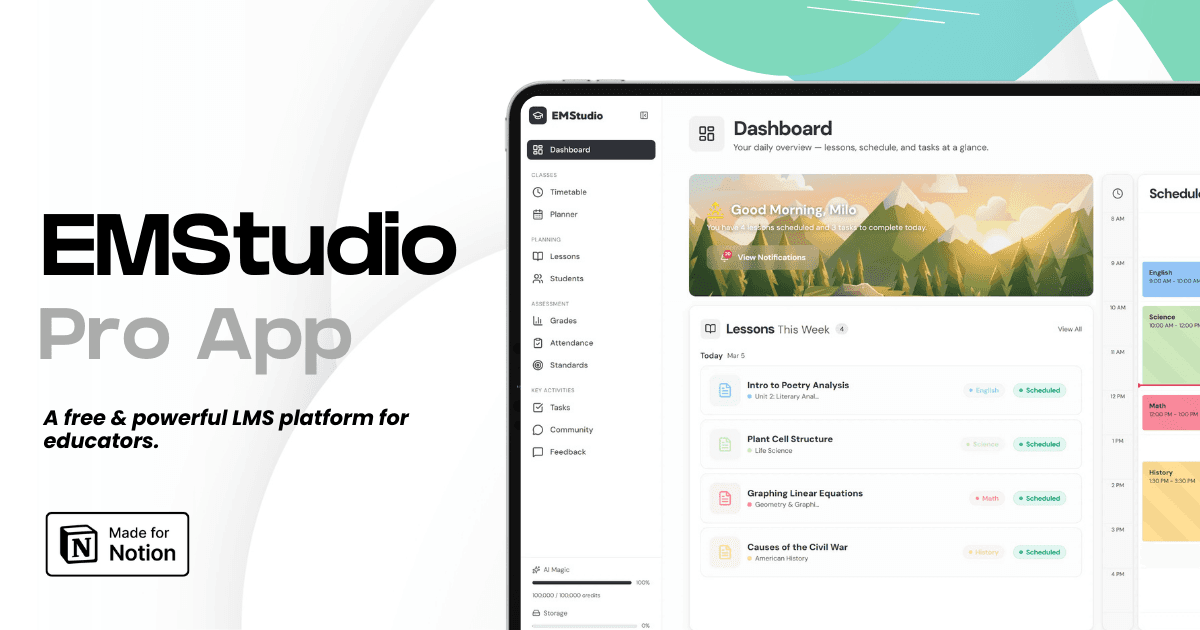
EMStudio is a free teaching management app — manage your classes, students, lessons, and more!
Learn More
Still grading everything by hand?
EMStudio is a free teaching management app — manage your classes, students, lessons, and more!
Learn More
Table of Contents
Quick No-Prep Movement Breaks for Busy Transitions
Break Name | Duration | Space Required | Primary Benefit |
|---|---|---|---|
Stand Up and Stretch | 90 seconds | At desks | Improves circulation |
Silent Ball Toss | 2 minutes | Between desks | Builds nonverbal communication |
Cross-Crawl | 2 minutes | Standing room | Bilateral brain stimulation |
Stand Up and Stretch Sequences
Third graders can handle independent stretching. Kindergarteners cannot. This break works specifically for grades three through twelve because older students self-regulate their physical activity. You give the sequence once in October. They remember it through May. You do not need to model it after the first week.
They remain seated or standing at their desks. No wandering. No line forming. No chaos near the pencil sharpener.
Run through four moves for twenty seconds each:
Desk Push-Ups: Hands on desk, ten reps.
Overhead Rainbow Reaches: Alternate sides, eight reps each.
Neck Rolls: Five each direction.
Ankle Circles: Seated, ten each foot.
Primary students need guided movement, not independent lists. Save this one for the upper grades. It gets blood moving without the noise of transition activities that require equipment or setup time. The circulation boost lasts through the next lesson block. You regain attention span without losing momentum.
Silent Ball Toss and Catch
You need one four-inch foam stress ball or koosh ball per eight students. A class set costs about twelve dollars online. This is cheap classroom management that replaces loud transition activities. The foam prevents broken windows and tears. You store them in a drawer. They take no space.
Silence matters. It keeps noise levels below forty decibels. You maintain control while they burn excess energy. The lack of talking forces eye contact.
Three rules make it work:
Zero talking. Violations mean sitting out for thirty seconds.
Make eye contact before tossing.
One bounce maximum between students.
Kids stay behind their desks. They toss diagonally across rows. This setup works optimally for classes of twenty-four to thirty-two students. The physical activity builds nonverbal communication skills while you pull up the next slide or hand out papers. It fills the two-minute window perfectly. No one leaves their spot.
Cross-Crawl Pattern Touching
This applies psychomotor learning principles to activate both brain hemispheres. It is pure kinesthetic learning for young kids. You use Brain Gym methods without the certification. The movement crosses the midline. This matters for developing brains.
Have them stand beside their desks. They touch right elbow to left knee while lifting the left leg. Then they alternate for sixty seconds. Follow immediately with thirty seconds of lazy eights. Draw infinity symbols in the air with each hand. Keep elbows loose.
Cross-lateral movement wakes up neural pathways. This neuromuscular mechanism specifically benefits students with attention difficulties. You target grades K through five, though it remains effective through middle school for burning mental fatigue. Even eighth graders feel the focus return after ninety seconds of cross-crawl.
Bilateral stimulation resets student engagement. It takes two minutes. It requires zero materials. It is the most effective brain break activity for burning mental fatigue before math or writing blocks. The pattern touching forces both sides of the brain to talk to each other. You see the difference in their posture immediately.
What Are the Best Brain Breaks for Burning Excess Energy?
The best brain breaks for burning excess energy include Tabata-style circuits (20 seconds high-knees, 10 seconds rest), desk-to-desk relay races using paper plates as skates, and dynamic yoga flows. These activities elevate heart rates within 90 seconds, release BDNF for improved cognitive function, and help students return to focused work after 2-3 minutes of vigorous movement. Schedule these after 25-30 minutes of sedentary instruction.
Match the intensity to your window. Use these movement breaks in the classroom strategically—moderate options when you have space, high intensity when time is short, and recovery flows before quiet work.
Vigorous physical activity triggers BDNF release, which supports memory consolidation and sharpens focus. Use these science-backed methods to improve student focus before complex lessons. Never run breaks within ten minutes of dismissal; the arousal makes settling impossible. Time them after twenty-five minutes of seatwork.
Desk-to-Desk Relays: Moderate intensity, needs three-foot aisles, takes two to three minutes.
High-Knees Circuits: High intensity, needs three-by-three feet per student, ninety seconds total.
Yoga Flows: Recovery intensity, works at desks, two minutes.
Choose based on your space constraints and the time available before your next transition activities.
Desk-to-Desk Relay Races
Try Paper Plate Skating. Students place one foot on a paper plate and slide across the floor to touch three designated desks, then return. Each heat lasts forty-five seconds; run three heats. You need clear aisle space of three feet minimum for safety.
Carpeted rooms prevent sliding. Use Book Balance walks instead. Students balance a textbook on their head while walking to the front board and back. Dropped books earn a five jumping jack penalty before rejoining the line. This keeps the physical activity controlled.
Group four students per team. Rotate every ninety seconds to maintain student engagement without downtime. This prevents the chaos of waiting too long and keeps your classroom management tight during these brain breaks for the classroom.
Classroom Yoga Flows
Lead a three-minute Desk Yoga sequence. Open with Chair Pose for twenty seconds. Move into Forward Fold for thirty seconds. Add Seated Spinal Twist for thirty seconds each side. Finish with Mountain Pose and deep breathing for forty seconds. No mats required.
Free resources like Cosmic Kids Yoga or Yoga build offer guidance, but you can lead these four poses yourself without training. These work for grades two through eight. High school students often prefer discreet stretching at their seats.
Yoga avoids the crash period that follows intense movement. It transitions smoothly back to academics, making it ideal before quiet independent work requiring sustained attention span.
High-Knees and Jumping Jacks Circuits
Run Tabata intervals: twenty seconds of maximum effort high-knees, ten seconds rest, twenty seconds jumping jacks, ten seconds rest. Repeat twice for two minutes total. Each student needs three-by-three feet of space to avoid collisions during these active learning games.
Establish a Freeze protocol before starting. When you clap twice, students freeze in place and take three deep breaths. This prevents the common failure mode of students continuing to move during instruction.
Adapt for age: K-1 marches in place rather than doing high-knees to prevent tripping. Grades six through twelve can add burpees for increased intensity if your ceiling height allows.
Collaborative Movement Activities That Build Community
Individual brain breaks clear mental cobwebs. Collaborative movement breaks in the classroom weave your students together. These transition activities demand four to five minutes including setup. The payoff justifies the extra sixty seconds. Students return to desks with improved trust and fewer conflict incidents than when they work alone.
Time investment: Individual breaks take ninety seconds. Collaborative breaks need four to five minutes including setup and debrief.
Noise level: Individual breaks produce minimal noise. Collaborative breaks generate controlled conversation and laughter.
Relationship outcomes: Individual breaks restore personal attention span. Collaborative breaks build the community building framework that reduces classroom conflict incidents.
Your materials budget stays under ten dollars per class. A bag of fifty twelve-inch balloons costs approximately six dollars. Hand signals and mirroring games require zero dollars and zero storage space.
Never skip the debrief. Teachers often rush back to academics and lose the social-emotional gains. You need sixty seconds for the question: "What did you notice?" Students might mention how Sarah helped the balloon stay up or how the group synced their breathing. That observation cements the community gains.
Group Mirror Mimicry Games
Groups of four to six students form standing circles. One leader initiates slow, deliberate movements at Tai Chi speed while the remaining students mirror the motions exactly. You rotate leaders every sixty seconds. The total time runs four minutes with three rotations. This protocol teaches focused attention and nonverbal communication skills without introducing competition that could exclude slower processors.
Differentiate by grade level. Kindergarten through second grade use animal movements like slithering like snakes or stomping like elephants. Grades three through eight handle complex coordinated motions such as patting heads while rubbing bellies simultaneously. High school students perform emotion-based movements, physically showing frustration through clenched fists and tight shoulders then shifting to calm with deep breaths and open posture.
Maintain two-foot personal space bubbles to prevent collisions during rapid movements. Mark the floor with tape if students struggle with spatial awareness.
Cooperative Balloon Keep-Up
You need one twelve-inch balloon per group of six students. Inflate each balloon to eleven inches to prevent popping during vigorous play. A fifty-pack costs approximately six dollars, fitting your under-ten-dollar budget constraints. Store inflated balloons in a closet for repeated use throughout the week.
The rules ban hand contact entirely. Students must use elbows, knees, and heads to keep the balloon airborne. The group counts aloud each hit, aiming for twenty consecutive touches. If the balloon drops, everyone performs ten squats together before restarting. This shared consequence eliminates blame and creates genuine shared accountability.
Add academic integration by requiring students to state a vocabulary word or solve a math fact before each hit. This extends the physical activity to five minutes but combines kinesthetic learning with student engagement and content review.
Classroom Conga Line Sorting
Students form a conga line by placing hands on shoulders of the person in front. They perform a step-touch motion while moving counterclockwise around the room. You call out sorting categories like "Arrange by birthday month" or "Line up by number of siblings." Students must communicate to arrange themselves correctly while maintaining the conga formation. This forces spatial awareness and boosts student engagement through physical constraints.
You need at least six hundred square feet of open space. Move desks to create a perimeter path, taking ninety seconds of prep time. This works best for larger classrooms or when you can push furniture to the walls.
Adapt sorts by grade. Kindergarten through second use simple visible categories like gender or hair color. Grades three through five use academic sorts like multiples of three versus four. Middle schoolers handle abstract preferences like summer versus winter sports.
How Can Teachers Use Movement to Review Academic Content?
Teachers can integrate movement with content review by using vocabulary charades where students physically act out terms, math fact stations combining hopscotch or wall push-ups with skip counting, and historical timeline human knots where students untangle themselves into chronological order. These kinesthetic strategies engage procedural memory alongside declarative knowledge, typically requiring 5-7 minutes but replacing 10 minutes of traditional seatwork review.
Movement breaks in the classroom do not have to waste instructional minutes. When you embed content into the physical activity, you turn transition activities into active learning. Students remember more because their bodies are involved in the thinking.
Physical engagement increases retention by activating procedural memory alongside declarative memory. When a 4th grader hops through a multiplication table, their brain stores the information in multiple formats. Research on multi-sensory learning confirms that students recall concepts better when they encode them through physical activity. You build memory through muscle movement.
Choose your activity based on your subject matter. Begin with the content type: Facts and dates work best with the Human Knot strategy. Vocabulary terms suit Charades. Math procedures and sequences fit Movement Stations. This simple filter saves planning time.
These content-rich brain break activities take five to seven minutes. However, they replace ten minutes of traditional seatwork review. You save three to five minutes of instructional time while boosting student engagement. The trade-off favors active review.
Vocabulary Charades and Pictionary
Divide your class into two teams. One student draws a vocabulary term from a hat of twenty current terms. They have thirty seconds to act it out without speaking or props. A correct guess earns two points.
The actor must incorporate a specific movement pattern, like spinning slowly for "photosynthesis." Last semester, my seventh graders remembered the difference between mitosis and meiosis because they crawled for one and stood tall for the other. This dual-coding improves recall.
You can use classroom gamification methods to track points. This suits grades 4-12 science and social studies.
Math Fact Movement Stations
Create three stations around the room. Station One uses a hopscotch grid for skip counting by fours or sevens. Station Two uses wall push-ups while calling out multiples of eight. Station Three uses jumping jacks while solving mental math problems you call out. Rotate every ninety seconds for five minutes total.
I use this specifically during the 10:30 energy crash when attention span plummets. This accommodates twenty-four students. Use strategies to increase engagement like providing multiplication charts for support or division facts for advanced learners.
Historical Timeline Human Knot
Assign each student a historical event on an index card. Students stand in a circle and hold hands with two non-adjacent partners, creating a physical knot. They must untangle into chronological order without releasing hands.
This takes six to seven minutes with twelve to sixteen students. Larger classes form two simultaneous knots to maintain classroom management. My juniors still reference the "knot feeling" when writing about the Revolution timeline.
The physical movement is the unraveling of historical complexity. Students remember the sequence because their bodies felt the confusion and the linear solution.
Building a Sustainable Movement Break Routine
Movement breaks in the classroom fail when you try to do everything at once. Start small and build stamina alongside your students.
Follow this four-week rollout:
Week 1: Introduce two no-prep breaks—stretching or desk push-ups. Focus entirely on procedure. Students need to know where to stand and how to freeze before you add complexity.
Week 2: Add one collaborative break like a mirror-me activity or group energizer. You're building social connection while testing your classroom management success steps.
Week 3: Integrate one academic break—a vocabulary review game with motions or math facts while jogging in place. This proves brain breaks for the classroom aren't just play time.
Week 4: Launch student choice rotation. Let them vote on activities or lead breaks themselves. Ownership creates sustainability.
Watch for three failure modes. First, overuse—more than three breaks per hour shifts from focus aid to party atmosphere. Second, poor transitions—skipping the 30-second cooldown costs you five minutes of chatter. Third, inconsistency—sporadic use prevents the routine from sticking.
Know when to pause the program. Avoid movement breaks during standardized testing windows except for discreet stretching at seats. Skip them when substitute teachers are present unless you've specifically trained that sub. Never use them during the first ten minutes of class—you need to establish academic tone before releasing energy.
Timing Breaks for Maximum Impact
Apply the Pomodoro for Kids model. For grades K-5, schedule 20-25 minutes of focused work followed by a 3-minute movement break. For grades 6-12, stretch that to 40-45 minutes of work followed by a 5-minute break. Post a visual timer like the Time Timer so students anticipate transitions rather than you announcing them repeatedly.
Target high-need windows based on your daily schedule. Use breaks immediately after lunch to combat the food coma that hits around 12:45. Deploy them before math blocks to activate numeracy centers in the brain. Insert them during writing workshops to prevent hand fatigue from gripping pencils. Never schedule breaks during the final ten minutes of class—you need that buffer for dismissal routines.
Set hard frequency limits to preserve the novelty effect. Maximum four breaks per half-day for elementary classrooms, and two per block period for secondary. Exceed these thresholds and physical activity becomes expected rather than earned. Student engagement drops because the break loses its status as a reward for focus.
Managing Transitions Back to Learning
Implement the Freeze-Breathe-Point protocol. You raise your hand as the freeze signal. Students stop moving immediately. Everyone takes three deep breaths together. Then they point to their desk materials—book open, pencil ready. This 30-second routine reduces transition time from three or four minutes of chaos to under sixty seconds of focused preparation.
Do not skip the breathing component. I learned this the hard way with a fifth-grade class that took seven minutes to settle after jumping jacks. Research on physiological arousal indicates that without parasympathetic activation through deep breathing, students remain in sympathetic "play" mode. Their bodies literally cannot shift gears from physical activity to cognitive work for 5-7 minutes.
Install a visual cue system to support these time-saving classroom hacks. Use a colored light system—green means move freely, yellow means prepare to stop, red means silent learning time. Alternatively, use a specific chime tone that signals arousal level changes without you speaking a word.
Adapting Activities for Different Grade Levels
For K-2, reduce break duration to 90 seconds maximum. Young attention spans cannot sustain longer physical activity without melting down. Use Animal Action cards with pictures rather than verbal instructions. Focus on gross motor patterns like crawling or jumping. Include a sensory path option for students with autism—texture stations they can touch while walking the perimeter rather than group activities that might overwhelm.
For grades 3-5, introduce light competition elements like team points for quietest transitions back to seats. These students crave social ranking. Allow complex movement patterns that cross the midline—touching opposite knee to elbow. Let student leaders direct breaks to build kinesthetic learning leadership and reduce your cognitive load.
For grades 6-12, shift to micro-movements that don't look childish. Use seated spinal twists, standing stretches at desks, or hallway water breaks with movement permission cards. Never use elementary games like Simon Says—teenage resistance will sabotage your classroom management instantly. Instead, use Walk and Talk protocols where students discuss a prompt while pacing the room perimeter.
Movement Breaks In The Classroom: The 3-Step Kickoff
You don't need a yoga certification or a Pinterest board full of dance routines. Pick one brain break from this list and try it tomorrow during your roughest transition. That's it. You'll see the difference in student engagement immediately.
Last month, my 7th graders were crashing after lunch every day. I started using the 5-4-3-2-1 grounding stretch during attendance. Took 90 seconds. By Friday, they were reminding me to do it. Sustainable classroom management isn't about perfection. It's about consistency with physical activity that serves your actual curriculum.
Build your kinesthetic learning routine with these steps:
Pick your worst transition time. Schedule one movement break there for the next two weeks.
Write the break on a sticky note. Put it on your computer monitor so you don't forget when you're managing chaos.
After day three, ask students which break they want to keep. Let them vote.
Stack a second break only after the first one sticks for a month.
Quick No-Prep Movement Breaks for Busy Transitions
Break Name | Duration | Space Required | Primary Benefit |
|---|---|---|---|
Stand Up and Stretch | 90 seconds | At desks | Improves circulation |
Silent Ball Toss | 2 minutes | Between desks | Builds nonverbal communication |
Cross-Crawl | 2 minutes | Standing room | Bilateral brain stimulation |
Stand Up and Stretch Sequences
Third graders can handle independent stretching. Kindergarteners cannot. This break works specifically for grades three through twelve because older students self-regulate their physical activity. You give the sequence once in October. They remember it through May. You do not need to model it after the first week.
They remain seated or standing at their desks. No wandering. No line forming. No chaos near the pencil sharpener.
Run through four moves for twenty seconds each:
Desk Push-Ups: Hands on desk, ten reps.
Overhead Rainbow Reaches: Alternate sides, eight reps each.
Neck Rolls: Five each direction.
Ankle Circles: Seated, ten each foot.
Primary students need guided movement, not independent lists. Save this one for the upper grades. It gets blood moving without the noise of transition activities that require equipment or setup time. The circulation boost lasts through the next lesson block. You regain attention span without losing momentum.
Silent Ball Toss and Catch
You need one four-inch foam stress ball or koosh ball per eight students. A class set costs about twelve dollars online. This is cheap classroom management that replaces loud transition activities. The foam prevents broken windows and tears. You store them in a drawer. They take no space.
Silence matters. It keeps noise levels below forty decibels. You maintain control while they burn excess energy. The lack of talking forces eye contact.
Three rules make it work:
Zero talking. Violations mean sitting out for thirty seconds.
Make eye contact before tossing.
One bounce maximum between students.
Kids stay behind their desks. They toss diagonally across rows. This setup works optimally for classes of twenty-four to thirty-two students. The physical activity builds nonverbal communication skills while you pull up the next slide or hand out papers. It fills the two-minute window perfectly. No one leaves their spot.
Cross-Crawl Pattern Touching
This applies psychomotor learning principles to activate both brain hemispheres. It is pure kinesthetic learning for young kids. You use Brain Gym methods without the certification. The movement crosses the midline. This matters for developing brains.
Have them stand beside their desks. They touch right elbow to left knee while lifting the left leg. Then they alternate for sixty seconds. Follow immediately with thirty seconds of lazy eights. Draw infinity symbols in the air with each hand. Keep elbows loose.
Cross-lateral movement wakes up neural pathways. This neuromuscular mechanism specifically benefits students with attention difficulties. You target grades K through five, though it remains effective through middle school for burning mental fatigue. Even eighth graders feel the focus return after ninety seconds of cross-crawl.
Bilateral stimulation resets student engagement. It takes two minutes. It requires zero materials. It is the most effective brain break activity for burning mental fatigue before math or writing blocks. The pattern touching forces both sides of the brain to talk to each other. You see the difference in their posture immediately.
What Are the Best Brain Breaks for Burning Excess Energy?
The best brain breaks for burning excess energy include Tabata-style circuits (20 seconds high-knees, 10 seconds rest), desk-to-desk relay races using paper plates as skates, and dynamic yoga flows. These activities elevate heart rates within 90 seconds, release BDNF for improved cognitive function, and help students return to focused work after 2-3 minutes of vigorous movement. Schedule these after 25-30 minutes of sedentary instruction.
Match the intensity to your window. Use these movement breaks in the classroom strategically—moderate options when you have space, high intensity when time is short, and recovery flows before quiet work.
Vigorous physical activity triggers BDNF release, which supports memory consolidation and sharpens focus. Use these science-backed methods to improve student focus before complex lessons. Never run breaks within ten minutes of dismissal; the arousal makes settling impossible. Time them after twenty-five minutes of seatwork.
Desk-to-Desk Relays: Moderate intensity, needs three-foot aisles, takes two to three minutes.
High-Knees Circuits: High intensity, needs three-by-three feet per student, ninety seconds total.
Yoga Flows: Recovery intensity, works at desks, two minutes.
Choose based on your space constraints and the time available before your next transition activities.
Desk-to-Desk Relay Races
Try Paper Plate Skating. Students place one foot on a paper plate and slide across the floor to touch three designated desks, then return. Each heat lasts forty-five seconds; run three heats. You need clear aisle space of three feet minimum for safety.
Carpeted rooms prevent sliding. Use Book Balance walks instead. Students balance a textbook on their head while walking to the front board and back. Dropped books earn a five jumping jack penalty before rejoining the line. This keeps the physical activity controlled.
Group four students per team. Rotate every ninety seconds to maintain student engagement without downtime. This prevents the chaos of waiting too long and keeps your classroom management tight during these brain breaks for the classroom.
Classroom Yoga Flows
Lead a three-minute Desk Yoga sequence. Open with Chair Pose for twenty seconds. Move into Forward Fold for thirty seconds. Add Seated Spinal Twist for thirty seconds each side. Finish with Mountain Pose and deep breathing for forty seconds. No mats required.
Free resources like Cosmic Kids Yoga or Yoga build offer guidance, but you can lead these four poses yourself without training. These work for grades two through eight. High school students often prefer discreet stretching at their seats.
Yoga avoids the crash period that follows intense movement. It transitions smoothly back to academics, making it ideal before quiet independent work requiring sustained attention span.
High-Knees and Jumping Jacks Circuits
Run Tabata intervals: twenty seconds of maximum effort high-knees, ten seconds rest, twenty seconds jumping jacks, ten seconds rest. Repeat twice for two minutes total. Each student needs three-by-three feet of space to avoid collisions during these active learning games.
Establish a Freeze protocol before starting. When you clap twice, students freeze in place and take three deep breaths. This prevents the common failure mode of students continuing to move during instruction.
Adapt for age: K-1 marches in place rather than doing high-knees to prevent tripping. Grades six through twelve can add burpees for increased intensity if your ceiling height allows.
Collaborative Movement Activities That Build Community
Individual brain breaks clear mental cobwebs. Collaborative movement breaks in the classroom weave your students together. These transition activities demand four to five minutes including setup. The payoff justifies the extra sixty seconds. Students return to desks with improved trust and fewer conflict incidents than when they work alone.
Time investment: Individual breaks take ninety seconds. Collaborative breaks need four to five minutes including setup and debrief.
Noise level: Individual breaks produce minimal noise. Collaborative breaks generate controlled conversation and laughter.
Relationship outcomes: Individual breaks restore personal attention span. Collaborative breaks build the community building framework that reduces classroom conflict incidents.
Your materials budget stays under ten dollars per class. A bag of fifty twelve-inch balloons costs approximately six dollars. Hand signals and mirroring games require zero dollars and zero storage space.
Never skip the debrief. Teachers often rush back to academics and lose the social-emotional gains. You need sixty seconds for the question: "What did you notice?" Students might mention how Sarah helped the balloon stay up or how the group synced their breathing. That observation cements the community gains.
Group Mirror Mimicry Games
Groups of four to six students form standing circles. One leader initiates slow, deliberate movements at Tai Chi speed while the remaining students mirror the motions exactly. You rotate leaders every sixty seconds. The total time runs four minutes with three rotations. This protocol teaches focused attention and nonverbal communication skills without introducing competition that could exclude slower processors.
Differentiate by grade level. Kindergarten through second grade use animal movements like slithering like snakes or stomping like elephants. Grades three through eight handle complex coordinated motions such as patting heads while rubbing bellies simultaneously. High school students perform emotion-based movements, physically showing frustration through clenched fists and tight shoulders then shifting to calm with deep breaths and open posture.
Maintain two-foot personal space bubbles to prevent collisions during rapid movements. Mark the floor with tape if students struggle with spatial awareness.
Cooperative Balloon Keep-Up
You need one twelve-inch balloon per group of six students. Inflate each balloon to eleven inches to prevent popping during vigorous play. A fifty-pack costs approximately six dollars, fitting your under-ten-dollar budget constraints. Store inflated balloons in a closet for repeated use throughout the week.
The rules ban hand contact entirely. Students must use elbows, knees, and heads to keep the balloon airborne. The group counts aloud each hit, aiming for twenty consecutive touches. If the balloon drops, everyone performs ten squats together before restarting. This shared consequence eliminates blame and creates genuine shared accountability.
Add academic integration by requiring students to state a vocabulary word or solve a math fact before each hit. This extends the physical activity to five minutes but combines kinesthetic learning with student engagement and content review.
Classroom Conga Line Sorting
Students form a conga line by placing hands on shoulders of the person in front. They perform a step-touch motion while moving counterclockwise around the room. You call out sorting categories like "Arrange by birthday month" or "Line up by number of siblings." Students must communicate to arrange themselves correctly while maintaining the conga formation. This forces spatial awareness and boosts student engagement through physical constraints.
You need at least six hundred square feet of open space. Move desks to create a perimeter path, taking ninety seconds of prep time. This works best for larger classrooms or when you can push furniture to the walls.
Adapt sorts by grade. Kindergarten through second use simple visible categories like gender or hair color. Grades three through five use academic sorts like multiples of three versus four. Middle schoolers handle abstract preferences like summer versus winter sports.
How Can Teachers Use Movement to Review Academic Content?
Teachers can integrate movement with content review by using vocabulary charades where students physically act out terms, math fact stations combining hopscotch or wall push-ups with skip counting, and historical timeline human knots where students untangle themselves into chronological order. These kinesthetic strategies engage procedural memory alongside declarative knowledge, typically requiring 5-7 minutes but replacing 10 minutes of traditional seatwork review.
Movement breaks in the classroom do not have to waste instructional minutes. When you embed content into the physical activity, you turn transition activities into active learning. Students remember more because their bodies are involved in the thinking.
Physical engagement increases retention by activating procedural memory alongside declarative memory. When a 4th grader hops through a multiplication table, their brain stores the information in multiple formats. Research on multi-sensory learning confirms that students recall concepts better when they encode them through physical activity. You build memory through muscle movement.
Choose your activity based on your subject matter. Begin with the content type: Facts and dates work best with the Human Knot strategy. Vocabulary terms suit Charades. Math procedures and sequences fit Movement Stations. This simple filter saves planning time.
These content-rich brain break activities take five to seven minutes. However, they replace ten minutes of traditional seatwork review. You save three to five minutes of instructional time while boosting student engagement. The trade-off favors active review.
Vocabulary Charades and Pictionary
Divide your class into two teams. One student draws a vocabulary term from a hat of twenty current terms. They have thirty seconds to act it out without speaking or props. A correct guess earns two points.
The actor must incorporate a specific movement pattern, like spinning slowly for "photosynthesis." Last semester, my seventh graders remembered the difference between mitosis and meiosis because they crawled for one and stood tall for the other. This dual-coding improves recall.
You can use classroom gamification methods to track points. This suits grades 4-12 science and social studies.
Math Fact Movement Stations
Create three stations around the room. Station One uses a hopscotch grid for skip counting by fours or sevens. Station Two uses wall push-ups while calling out multiples of eight. Station Three uses jumping jacks while solving mental math problems you call out. Rotate every ninety seconds for five minutes total.
I use this specifically during the 10:30 energy crash when attention span plummets. This accommodates twenty-four students. Use strategies to increase engagement like providing multiplication charts for support or division facts for advanced learners.
Historical Timeline Human Knot
Assign each student a historical event on an index card. Students stand in a circle and hold hands with two non-adjacent partners, creating a physical knot. They must untangle into chronological order without releasing hands.
This takes six to seven minutes with twelve to sixteen students. Larger classes form two simultaneous knots to maintain classroom management. My juniors still reference the "knot feeling" when writing about the Revolution timeline.
The physical movement is the unraveling of historical complexity. Students remember the sequence because their bodies felt the confusion and the linear solution.
Building a Sustainable Movement Break Routine
Movement breaks in the classroom fail when you try to do everything at once. Start small and build stamina alongside your students.
Follow this four-week rollout:
Week 1: Introduce two no-prep breaks—stretching or desk push-ups. Focus entirely on procedure. Students need to know where to stand and how to freeze before you add complexity.
Week 2: Add one collaborative break like a mirror-me activity or group energizer. You're building social connection while testing your classroom management success steps.
Week 3: Integrate one academic break—a vocabulary review game with motions or math facts while jogging in place. This proves brain breaks for the classroom aren't just play time.
Week 4: Launch student choice rotation. Let them vote on activities or lead breaks themselves. Ownership creates sustainability.
Watch for three failure modes. First, overuse—more than three breaks per hour shifts from focus aid to party atmosphere. Second, poor transitions—skipping the 30-second cooldown costs you five minutes of chatter. Third, inconsistency—sporadic use prevents the routine from sticking.
Know when to pause the program. Avoid movement breaks during standardized testing windows except for discreet stretching at seats. Skip them when substitute teachers are present unless you've specifically trained that sub. Never use them during the first ten minutes of class—you need to establish academic tone before releasing energy.
Timing Breaks for Maximum Impact
Apply the Pomodoro for Kids model. For grades K-5, schedule 20-25 minutes of focused work followed by a 3-minute movement break. For grades 6-12, stretch that to 40-45 minutes of work followed by a 5-minute break. Post a visual timer like the Time Timer so students anticipate transitions rather than you announcing them repeatedly.
Target high-need windows based on your daily schedule. Use breaks immediately after lunch to combat the food coma that hits around 12:45. Deploy them before math blocks to activate numeracy centers in the brain. Insert them during writing workshops to prevent hand fatigue from gripping pencils. Never schedule breaks during the final ten minutes of class—you need that buffer for dismissal routines.
Set hard frequency limits to preserve the novelty effect. Maximum four breaks per half-day for elementary classrooms, and two per block period for secondary. Exceed these thresholds and physical activity becomes expected rather than earned. Student engagement drops because the break loses its status as a reward for focus.
Managing Transitions Back to Learning
Implement the Freeze-Breathe-Point protocol. You raise your hand as the freeze signal. Students stop moving immediately. Everyone takes three deep breaths together. Then they point to their desk materials—book open, pencil ready. This 30-second routine reduces transition time from three or four minutes of chaos to under sixty seconds of focused preparation.
Do not skip the breathing component. I learned this the hard way with a fifth-grade class that took seven minutes to settle after jumping jacks. Research on physiological arousal indicates that without parasympathetic activation through deep breathing, students remain in sympathetic "play" mode. Their bodies literally cannot shift gears from physical activity to cognitive work for 5-7 minutes.
Install a visual cue system to support these time-saving classroom hacks. Use a colored light system—green means move freely, yellow means prepare to stop, red means silent learning time. Alternatively, use a specific chime tone that signals arousal level changes without you speaking a word.
Adapting Activities for Different Grade Levels
For K-2, reduce break duration to 90 seconds maximum. Young attention spans cannot sustain longer physical activity without melting down. Use Animal Action cards with pictures rather than verbal instructions. Focus on gross motor patterns like crawling or jumping. Include a sensory path option for students with autism—texture stations they can touch while walking the perimeter rather than group activities that might overwhelm.
For grades 3-5, introduce light competition elements like team points for quietest transitions back to seats. These students crave social ranking. Allow complex movement patterns that cross the midline—touching opposite knee to elbow. Let student leaders direct breaks to build kinesthetic learning leadership and reduce your cognitive load.
For grades 6-12, shift to micro-movements that don't look childish. Use seated spinal twists, standing stretches at desks, or hallway water breaks with movement permission cards. Never use elementary games like Simon Says—teenage resistance will sabotage your classroom management instantly. Instead, use Walk and Talk protocols where students discuss a prompt while pacing the room perimeter.
Movement Breaks In The Classroom: The 3-Step Kickoff
You don't need a yoga certification or a Pinterest board full of dance routines. Pick one brain break from this list and try it tomorrow during your roughest transition. That's it. You'll see the difference in student engagement immediately.
Last month, my 7th graders were crashing after lunch every day. I started using the 5-4-3-2-1 grounding stretch during attendance. Took 90 seconds. By Friday, they were reminding me to do it. Sustainable classroom management isn't about perfection. It's about consistency with physical activity that serves your actual curriculum.
Build your kinesthetic learning routine with these steps:
Pick your worst transition time. Schedule one movement break there for the next two weeks.
Write the break on a sticky note. Put it on your computer monitor so you don't forget when you're managing chaos.
After day three, ask students which break they want to keep. Let them vote.
Stack a second break only after the first one sticks for a month.
Still grading everything by hand?
EMStudio is a free teaching management app — manage your classes, students, lessons, and more!
Learn More
Still grading everything by hand?
EMStudio is a free teaching management app — manage your classes, students, lessons, and more!
Learn More



Notion4Teachers
Notion templates to simplify administrative tasks and enhance your teaching experience.



2026 Notion4Teachers. All Rights Reserved.
Notion4Teachers
Notion templates to simplify administrative tasks and enhance your teaching experience.
2026 Notion4Teachers. All Rights Reserved.
Notion4Teachers
Notion templates to simplify administrative tasks and enhance your teaching experience.
2026 Notion4Teachers. All Rights Reserved.