
Student Behavior Management: A 4-Step Classroom Guide
Student Behavior Management: A 4-Step Classroom Guide

Article by
Milo
ESL Content Coordinator & Educator
ESL Content Coordinator & Educator
All Posts
Before you change anything, you need to see what is actually happening. I spend three days running an ABC (Antecedent-Behavior-Consequence) recording session during high-stress periods like transitions and independent work. I focus on the times when student behavior deteriorates fastest.
Every fifteen minutes, I jot down what happened right before the disruption, the specific student behavior, and what followed immediately after. I calculate baseline percentages from these recordings to see exactly where we stand. I also run the 5 Whys on repeat: when a kid leaves his seat, I ask why until I hit the function—usually escape or attention—not just the symptom we see on the surface.
To get hard numbers, I use momentary time sampling. I set a timer to chime every five minutes during a forty-five minute block. When it beeps, I glance around and mark a plus if the student is on-task or a minus if they are off. I do this for three days to establish a stable baseline. At the end, I calculate the percentage: total plus marks divided by intervals, multiplied by one hundred. This gives me a true baseline of current on-task behavior before I waste time on interventions that miss the mark.
Still grading everything by hand?
EMStudio is a free teaching management app — manage your classes, students, lessons, and more!
Learn More
Still grading everything by hand?
EMStudio is a free teaching management app — manage your classes, students, lessons, and more!
Learn More
Table of Contents
Start With a Behavioral Classroom Audit
Mapping Current On Task Behavior Patterns
I record this data in my behavior tracking sheet. It is simple, but it stops me from guessing. Last October, my seventh graders showed a forty-percent on-task rate during morning independent reading. That number told me the problem was environmental, not motivational.
Identifying Triggers and Environmental Factors
Once I have the baseline, I map the room using the STOPP acronym: Space, Time, Objects, People, and Previous events. I create a scatterplot recording sheet and mark occurrences every five minutes to spot time-based patterns. Does the behavior spike at ten-fifteen every day? That is when the HVAC unit rattles to life, or when the class returns from a loud hallway. These patterns reveal the hidden triggers driving off-task moments.
I audit the physical space with a three-foot proximity rule. I measure distance between desks and high-traffic areas like the pencil sharpener or trash can. I document lighting types—fluorescent tubes versus natural window light—and noise levels in decibels if I can borrow the app from the science department. I also check for drafts, cold spots, or glare on whiteboards that make kids squirm.
I note seating arrangements: rows versus clusters. These antecedent strategies often reveal the fix is moving a desk away from the door or dimming a buzzing bulb, not writing a new behavior intervention plan. Fixing the environment often works faster than any PBIS reward chart I could print. Sometimes the only classroom management tool you need is a piece of tape marking a new desk boundary.

Step 1 — Define Observable Academic Behaviors and Expectations
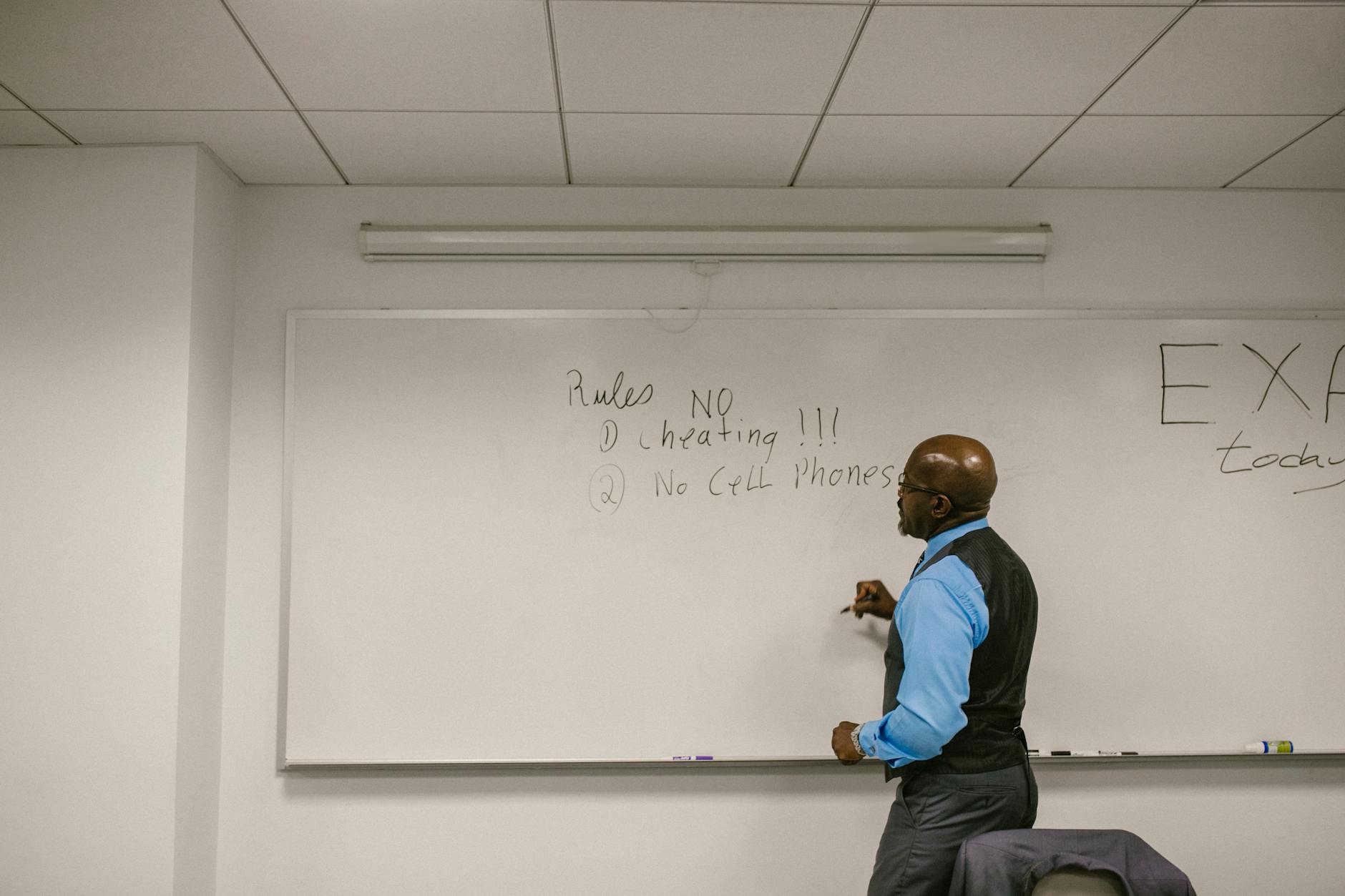
Vague rules create vague results. Posting "Be responsible" above the whiteboard asks for interpretation. One 7th grader thinks responsible means texting the teacher at midnight with questions. Another thinks it means simply showing up with a pencil. Neither matches what you actually want during behavior in the classroom discussions about collaboration.
The fix is specificity. We translate abstract expectations into actions we can see, count, and coach. This shifts your classroom management from reactive to proactive. It also gives you objective data for restorative practices when things go sideways, because you can point to the exact expectation that was missed.
Vague Language | Observable Academic Behaviors |
|---|---|
"Be respectful" | Uses kind words and keeps hands to self during group work |
"Pay attention" | Eyes on speaker and body facing forward during 15-minute lessons |
"Try your best" | Completes all assigned problems before submitting work |
"Be prepared" | Arrives with charged device, notebook, and writing tool within 3 minutes of bell |
"Work quietly" | Voice volume at Level 1 (whisper) during independent practice |
Use the ABCD model to write these targets. Audience (The student), Behavior (observable action), Condition (context), Degree (criteria). Formula template: Given [condition], the student will [observable behavior] at [criteria] accuracy. This framework removes argument. Either the behavior happened or it didn't. No more debates about "trying" versus "doing" or whether an action was respectful enough.
Creating Behavior-Specific Learning Objectives
Given a 10-minute circle time, the student will sit on designated spot for 9/10 minutes. I used this with 1st graders who treated the carpet like a trampoline. The specificity stopped the daily debates about what "sitting nicely" actually meant.
During 30-minute independent math, student completes 4/5 problems before checking answers with a peer. This stops the kid who raises his hand after 30 seconds and the perfectionist who erases until the period ends. Both academic behaviors improve when the target is clear instead of fuzzy.
Student raises hand and waits for recognition before speaking during class discussions. Observable. Countable. These objectives drive student behavior and serve as baseline data for any functional behavior assessment or behavior intervention plan you need to build later. Write them before you need them.
Translating Standards Into Student-Friendly Language
Standards sit in teacher binders. They need to live on student desks. Convert Common Core into "I can" statements using Flesch-Kincaid 4th-6th grade readability. Fourth graders can't hit a target they can't see written in language they understand.
Process: Isolate the action verb. Define the observable behavior. Add measurement criteria. CCSS.ELA-LITERACY.SL.3.1 becomes: "I can explain my thinking using complete sentences and wait for my turn to speak." No education jargon. Just the action a kid can actually perform.
This translation supports standards-based curriculum alignment. It builds antecedent strategies into your PBIS framework. When kids know exactly what success looks like, you spend less time on restorative practices and more time teaching actual content.
Step 2 — Build Systems for Positive Behavior in Classroom Routines
Systems beat willpower. When you embed positive behavior support (PBS) framework structures into daily routines, you stop managing chaos and start teaching. The goal is making appropriate behavior the path of least resistance.
Designing Tier 1 Universal Supports
Start with CHAMPS. Before every activity, define:
Conversation: Voice level 0 (silent) to 3 (presenting).
Help: Hand signal for assistance without shouting your name.
Activity: The specific task and its expected product.
Movement: Bathroom, pencil sharpener, or seated permission required.
Participation: What active engagement looks like (writing, tracking speaker).
Success: The criteria for finishing (time limit, accuracy, completion).
Watch your ratio. The 4:1 positive-to-corrective interaction ratio works only if you track it. Use a tally counter in your pocket or the paperclip transfer method: five clips in your left pocket, move one to the right for every behavior-specific praise. Every correction, move one back. Aim to end with all clips on the right.
I taught 7th grade science with CHAMPS taped to my demo table. It cut redirections by half because students knew the drill before starting.
Deploy five structures that work. Door greetings using student names take five seconds each and reduce afternoon disruptions significantly. A visual timer for transitions eliminates the "how much longer" chorus.
Pre-corrects delivered before the activity—"Remember, we use pencil for this section"—prevent errors before they happen. Choice boards offering 2-3 task order options give controlled autonomy without chaos. Finally, a token economy with immediate reinforcement: stickers for K-2, points for 3-5, privileges for 6-8. These aren't bribes; they're feedback loops that shape student behavior while you teach academics.
Teaching Transitions and Procedure Mastery
Transitions are where classroom rules and procedures live or die. Use the 3-2-1-0 countdown protocol. At "3" students freeze. At "2" materials go away. At "1" they stand quietly. At "0" they move.
Pair this with a specific auditory cue—a chime, a clap pattern, or a 30-second song snippet like the Jeopardy theme. Auditory anchors trigger automaticity faster than verbal instructions alone. The countdown gives processing time; the cue signals execution.
Never rush the protocol. If you say "3" and half the class is still talking, you wait. You don't move to "2" until you have compliance at each step. This consistency builds trust and reinforces that your signals matter more than your volume.
Practice until it hurts, then practice more. Your class hasn't mastered a transition until 80% execute it within 30 seconds for three consecutive days. Time them with your phone. Chart it on the board. When they hit the target, acknowledge it specifically: "That transition took 24 seconds and everyone had materials ready." Then move the target to 25 seconds, then 20. Mastery isn't a one-time event; it's a threshold you maintain through deliberate rehearsal.

Step 3 — How Do You Address Social Emotional Behavioral Needs?
Address social emotional behavioral needs by explicitly teaching self-regulation using Social Behavior Mapping to connect actions to consequences. Implement de-escalation strategies such as offering choice, reducing demands, and using calming spaces before crises occur, while preserving dignity through private conversations.
When student behavior escalates beyond words, drop the lesson plan. Use the EASE sequence: Escape the audience to reduce shame, Allow 3-6 feet of physical space, Simplify language to three-word phrases like "Breathe with me," and Empathize with the feeling—not the action. This works faster than punitive office referrals that escalate the crisis.
Using Social Behavior Mapping for Self-Awareness
Michelle Garcia Winner Social Behavior Mapping creates concrete connections between actions and reactions. I draw four columns on chart paper: Expected Behavior, Impact on Others, How Others Feel, and How You Feel. Students fill in the map after a conflict cools, not during the heat of the moment. The visual format makes abstract social rules tangible for kids who struggle with reading body language or tone of voice.
Last October, my 5th grader Marcus interrupted reading group four times to show off his new watch. We mapped it together during lunch. His expected behavior column read: "I talk loudly about my watch while others read." Impact on others: "Friends lose their place, teacher stops the lesson." How others feel: "Annoyed, frustrated, angry." How Marcus felt: "Embarrassed when the class sighed at me." Seeing his actions listed in his own handwriting changed something that my repeated verbal warnings never touched.
Consequences within this framework must meet the three Rs. Related means the consequence connects directly to the behavior—practicing quiet entry after a disruptive entrance. Reasonable means proportional to the developmental age and the incident severity. Respectful means delivered in a private tone without shame. This approach aligns with PBIS tier two supports and sets the stage for restorative practices that repair harm rather than inflict it.
De-escalation Techniques That Preserve Dignity
Before you write a functional behavior assessment or draft a formal behavior intervention plan, invest in the relationship. Use the 2x10 strategy: two minutes of conversation about non-school topics for ten consecutive school days. I ask about Minecraft updates, soccer tryouts, or their grandmother's cooking. Zero talk about missing homework or sitting up straight. This builds the neural pathway that you are safe before you become an authority figure issuing demands.
In the moment of crisis, offer the power of choice between two acceptable options. "Would you like to start with math or reading?" Both options move the lesson forward. This antecedent strategy prevents the power struggle before it starts. It respects the student's autonomy while maintaining clear classroom management boundaries that keep learning on track.
Neuroscience needs patience during meltdowns. A triggered amygdala needs ninety seconds of regulation before the prefrontal cortex can process language or logic. Don't lecture. Don't question why. Provide a calm space or silent companionship until the breathing slows. Integrate social and emotional learning strategies into daily instruction so students recognize their own physiological warning signs before they need emergency intervention.

Step 4 — Implement Behavior Strategies for Students Using Data
Before you layer complex classroom management systems on top of broken workflows, pick a data collection method you will actually use every day. The tool matters less than the consistency of the click or the mark. If it takes too long, you will skip days. Then your data is useless. You are flying blind.
Low-Tech (2 min/day) | High-Tech (10 min/day) |
|---|---|
Tally marks on sticky notes | ClassDojo point system |
Rubber band transfer (wrist to pocket) | Google Forms check-in |
Paper frequency count | SWIS database |
Match the measure to the pattern of student behavior. If the behavior occurs more than ten times per hour, use frequency recording. If episodes last longer than five minutes, switch to duration recording. When the issue is a delay in starting work, track latency recording. These behavior strategies for students only work when the data is accurate and collected in real time. Guesswork fails.
Simple Progress Monitoring Tools
I used a Daily Report Card with a 5th grader who avoided writing. We chose three targets: start within two minutes, write four sentences, stay seated. Each period earned 0 (did not meet), 1 (partial), or 2 (met) points. This simple rubric made expectations visible to him and to me. No surprises.
Calculate the weekly percentage by dividing total points earned by total points possible. Graph five days of baseline data against intervention phases to show trend lines. That visual proof convinces parents and administrators faster than any narrative report. Follow these progress monitoring steps to keep the intervention team aligned on what is actually changing.
Low-tech tracking takes roughly two minutes at the end of each period. High-tech options like SWIS eat ten minutes but satisfy district PBIS coordinators who need aggregate data for school-wide decisions. Choose the antecedent strategies you can maintain. Behavior strategies for students fail when the data collection stops.
Collaborative Problem-Solving With Students
Restorative practices fall flat when adults do all the talking and none of the listening. Ross Greene's Collaborative Problem Solving Plan B shifts the dynamic completely. Step one is Empathy: "I've noticed you have trouble starting the writing assignment when we come in from recess." Then stop talking. Listen to the student's concern without defending the assignment or the rules you posted on the wall.
Step two defines the problem with clarity. State your concern—safety or learning—then ask for theirs. Usually it is task difficulty or sensory overload. Step three is the Invitation: "Let's think of a way to start that works for both of us." Write the agreement on a Solution Sheet and tape it inside the desk lid for reference during future struggles.
This documentation supports your functional behavior assessment better than theories filed in a cabinet. It also anchors your data-driven teaching implementation in actual student voice, not adult assumptions. When the behavior intervention plan includes their ideas, compliance jumps because they helped write the rules. That ownership changes everything.

Avoid These Common Mistakes When Changing Student Behavior
Expect turbulence. When you start a new plan, you will hit an extinction burst around days three through seven. The student doubles down on the old behavior to test if the new boundary is real.
Stay the course. I watched a 7th grader throw three consecutive tantrums when we stopped accepting late work without a pass. By day eight, he brought the pass. The burst passes if you stay consistent.
Never just stop a behavior. You must teach a replacement using this formula: Instead of [problem behavior], do [replacement behavior] that gets [same function]. If a child shouts to escape work, teach them to request a break card. Same payoff, different method.
Write the formula on a sticky note. When a student punches the wall to escape math, your replacement is a hand-raise for a five-minute break. Both achieve escape, but one keeps the room safe. This is the heart of effective behavior intervention plan design.
Inconsistency Across Settings and Staff
Kids exploit gaps immediately. If Ms. Johnson sends them out for tardiness and you give a warning, they learn to tardy-walk to your room. You need a Same Page Protocol to fix behavior in the classroom across the grade level.
Run weekly Response Calibration meetings. Take fifteen minutes on Monday mornings. Open a shared Google Sheets matrix and list the five daily friction points: tardiness, off-task, disrespect, unprepared, and out of seat. Leave a column for each teacher's current response.
Document exactly what each teacher does now. One gives detention, another assigns a reflection sheet, a third ignores it. Map the variance. You want ninety percent consistency across all settings for the first two weeks of any new intervention.
The matrix exposes hidden inconsistencies. One teacher might count tardiness at the bell while another gives a three-minute grace period. That gap teaches kids to sprint between rooms.
Look for the outliers. If three teachers use a calm redirect and one uses sarcasm, that one teacher is feeding the problem. Alignment matters more than the specific consequence chosen.
Role-play the responses until they feel automatic. If someone usually lectures, have them practice the silent point-and-wait. Calibration prevents the game-playing that destroys student behavior gains and undermines your PBIS expectations.
Track your data weekly. If consistency drops below eighty percent, schedule another calibration. Teachers drift when stressed. The matrix keeps everyone honest and supports restorative practices by making sure fair treatment across all rooms. Consistency is an antecedent strategy that stops the behavior before it starts.
Ignoring the Function Behind the Behavior
Every behavior is a tool. The kid isn't broken; they're getting something. Learn the EATS acronym: Escape, Attention, Tangible, Sensory. These four functions drive every action in your room.
Use the look-away test. If the behavior stops when you turn your head, it is attention-seeking. If it ramps up when you place a worksheet in front of the child, it is escape. This is your quick functional behavior assessment.
Match the intervention to the cause. For attention-seeking, use planned ignoring paired with scheduled check-ins. For escape, offer break cards and chunk the assignment. Build these into your formal behavior intervention plan.
Tangible and Sensory require different tools. If the student seeks an item, teach a request protocol. If they seek sensory input, provide a fidget or allow standing. The replacement must fill the same biological tank.
Test your hypothesis. If you suspect attention-seeking, give a scheduled compliment every ten minutes. If the problem behavior drops, you were right. Adjust the replacement behavior to match the verified function, not your guess.
Skipping function analysis wastes time. Your classroom management strategies fail when they fight the biological need behind the action. Use antecedent strategies to head off the need before it escalates.
Document the function in your plan. When the team knows the behavior is escape-driven, they stop taking it personally. That shift from blame to science changes everything.

The Future of Student Behavior in the Classroom
The way we handle student behavior is shifting fast. I see fewer clip charts and more data clipboards in the classrooms I visit. Teachers are swapping punishment for problem-solving, using the four steps we walked through not as emergency fixes but as daily practice. PBIS and restorative practices aren't buzzwords anymore—they're becoming the baseline for classroom management.
What's changing? Schools are moving away from one-size-fits-all discipline. Functional behavior assessments now happen in general education classrooms, not just special ed offices. Teachers track patterns in real time, adjust systems weekly, and build social-emotional skills into every routine. The educators who stay ahead treat behavior like academic instruction: they assess, intervene, and measure growth without waiting for crises to escalate.
Stay current by auditing your systems each quarter. Keep the strategies that reduce your stress and increase student ownership. Ditch the rest. The future belongs to teachers who treat behavior as teachable moments, not obstacles to covering content, and who build systems that last beyond any single school year.

Start With a Behavioral Classroom Audit
Mapping Current On Task Behavior Patterns
I record this data in my behavior tracking sheet. It is simple, but it stops me from guessing. Last October, my seventh graders showed a forty-percent on-task rate during morning independent reading. That number told me the problem was environmental, not motivational.
Identifying Triggers and Environmental Factors
Once I have the baseline, I map the room using the STOPP acronym: Space, Time, Objects, People, and Previous events. I create a scatterplot recording sheet and mark occurrences every five minutes to spot time-based patterns. Does the behavior spike at ten-fifteen every day? That is when the HVAC unit rattles to life, or when the class returns from a loud hallway. These patterns reveal the hidden triggers driving off-task moments.
I audit the physical space with a three-foot proximity rule. I measure distance between desks and high-traffic areas like the pencil sharpener or trash can. I document lighting types—fluorescent tubes versus natural window light—and noise levels in decibels if I can borrow the app from the science department. I also check for drafts, cold spots, or glare on whiteboards that make kids squirm.
I note seating arrangements: rows versus clusters. These antecedent strategies often reveal the fix is moving a desk away from the door or dimming a buzzing bulb, not writing a new behavior intervention plan. Fixing the environment often works faster than any PBIS reward chart I could print. Sometimes the only classroom management tool you need is a piece of tape marking a new desk boundary.
Step 1 — Define Observable Academic Behaviors and Expectations
Vague rules create vague results. Posting "Be responsible" above the whiteboard asks for interpretation. One 7th grader thinks responsible means texting the teacher at midnight with questions. Another thinks it means simply showing up with a pencil. Neither matches what you actually want during behavior in the classroom discussions about collaboration.
The fix is specificity. We translate abstract expectations into actions we can see, count, and coach. This shifts your classroom management from reactive to proactive. It also gives you objective data for restorative practices when things go sideways, because you can point to the exact expectation that was missed.
Vague Language | Observable Academic Behaviors |
|---|---|
"Be respectful" | Uses kind words and keeps hands to self during group work |
"Pay attention" | Eyes on speaker and body facing forward during 15-minute lessons |
"Try your best" | Completes all assigned problems before submitting work |
"Be prepared" | Arrives with charged device, notebook, and writing tool within 3 minutes of bell |
"Work quietly" | Voice volume at Level 1 (whisper) during independent practice |
Use the ABCD model to write these targets. Audience (The student), Behavior (observable action), Condition (context), Degree (criteria). Formula template: Given [condition], the student will [observable behavior] at [criteria] accuracy. This framework removes argument. Either the behavior happened or it didn't. No more debates about "trying" versus "doing" or whether an action was respectful enough.
Creating Behavior-Specific Learning Objectives
Given a 10-minute circle time, the student will sit on designated spot for 9/10 minutes. I used this with 1st graders who treated the carpet like a trampoline. The specificity stopped the daily debates about what "sitting nicely" actually meant.
During 30-minute independent math, student completes 4/5 problems before checking answers with a peer. This stops the kid who raises his hand after 30 seconds and the perfectionist who erases until the period ends. Both academic behaviors improve when the target is clear instead of fuzzy.
Student raises hand and waits for recognition before speaking during class discussions. Observable. Countable. These objectives drive student behavior and serve as baseline data for any functional behavior assessment or behavior intervention plan you need to build later. Write them before you need them.
Translating Standards Into Student-Friendly Language
Standards sit in teacher binders. They need to live on student desks. Convert Common Core into "I can" statements using Flesch-Kincaid 4th-6th grade readability. Fourth graders can't hit a target they can't see written in language they understand.
Process: Isolate the action verb. Define the observable behavior. Add measurement criteria. CCSS.ELA-LITERACY.SL.3.1 becomes: "I can explain my thinking using complete sentences and wait for my turn to speak." No education jargon. Just the action a kid can actually perform.
This translation supports standards-based curriculum alignment. It builds antecedent strategies into your PBIS framework. When kids know exactly what success looks like, you spend less time on restorative practices and more time teaching actual content.
Step 2 — Build Systems for Positive Behavior in Classroom Routines
Systems beat willpower. When you embed positive behavior support (PBS) framework structures into daily routines, you stop managing chaos and start teaching. The goal is making appropriate behavior the path of least resistance.
Designing Tier 1 Universal Supports
Start with CHAMPS. Before every activity, define:
Conversation: Voice level 0 (silent) to 3 (presenting).
Help: Hand signal for assistance without shouting your name.
Activity: The specific task and its expected product.
Movement: Bathroom, pencil sharpener, or seated permission required.
Participation: What active engagement looks like (writing, tracking speaker).
Success: The criteria for finishing (time limit, accuracy, completion).
Watch your ratio. The 4:1 positive-to-corrective interaction ratio works only if you track it. Use a tally counter in your pocket or the paperclip transfer method: five clips in your left pocket, move one to the right for every behavior-specific praise. Every correction, move one back. Aim to end with all clips on the right.
I taught 7th grade science with CHAMPS taped to my demo table. It cut redirections by half because students knew the drill before starting.
Deploy five structures that work. Door greetings using student names take five seconds each and reduce afternoon disruptions significantly. A visual timer for transitions eliminates the "how much longer" chorus.
Pre-corrects delivered before the activity—"Remember, we use pencil for this section"—prevent errors before they happen. Choice boards offering 2-3 task order options give controlled autonomy without chaos. Finally, a token economy with immediate reinforcement: stickers for K-2, points for 3-5, privileges for 6-8. These aren't bribes; they're feedback loops that shape student behavior while you teach academics.
Teaching Transitions and Procedure Mastery
Transitions are where classroom rules and procedures live or die. Use the 3-2-1-0 countdown protocol. At "3" students freeze. At "2" materials go away. At "1" they stand quietly. At "0" they move.
Pair this with a specific auditory cue—a chime, a clap pattern, or a 30-second song snippet like the Jeopardy theme. Auditory anchors trigger automaticity faster than verbal instructions alone. The countdown gives processing time; the cue signals execution.
Never rush the protocol. If you say "3" and half the class is still talking, you wait. You don't move to "2" until you have compliance at each step. This consistency builds trust and reinforces that your signals matter more than your volume.
Practice until it hurts, then practice more. Your class hasn't mastered a transition until 80% execute it within 30 seconds for three consecutive days. Time them with your phone. Chart it on the board. When they hit the target, acknowledge it specifically: "That transition took 24 seconds and everyone had materials ready." Then move the target to 25 seconds, then 20. Mastery isn't a one-time event; it's a threshold you maintain through deliberate rehearsal.
Step 3 — How Do You Address Social Emotional Behavioral Needs?
Address social emotional behavioral needs by explicitly teaching self-regulation using Social Behavior Mapping to connect actions to consequences. Implement de-escalation strategies such as offering choice, reducing demands, and using calming spaces before crises occur, while preserving dignity through private conversations.
When student behavior escalates beyond words, drop the lesson plan. Use the EASE sequence: Escape the audience to reduce shame, Allow 3-6 feet of physical space, Simplify language to three-word phrases like "Breathe with me," and Empathize with the feeling—not the action. This works faster than punitive office referrals that escalate the crisis.
Using Social Behavior Mapping for Self-Awareness
Michelle Garcia Winner Social Behavior Mapping creates concrete connections between actions and reactions. I draw four columns on chart paper: Expected Behavior, Impact on Others, How Others Feel, and How You Feel. Students fill in the map after a conflict cools, not during the heat of the moment. The visual format makes abstract social rules tangible for kids who struggle with reading body language or tone of voice.
Last October, my 5th grader Marcus interrupted reading group four times to show off his new watch. We mapped it together during lunch. His expected behavior column read: "I talk loudly about my watch while others read." Impact on others: "Friends lose their place, teacher stops the lesson." How others feel: "Annoyed, frustrated, angry." How Marcus felt: "Embarrassed when the class sighed at me." Seeing his actions listed in his own handwriting changed something that my repeated verbal warnings never touched.
Consequences within this framework must meet the three Rs. Related means the consequence connects directly to the behavior—practicing quiet entry after a disruptive entrance. Reasonable means proportional to the developmental age and the incident severity. Respectful means delivered in a private tone without shame. This approach aligns with PBIS tier two supports and sets the stage for restorative practices that repair harm rather than inflict it.
De-escalation Techniques That Preserve Dignity
Before you write a functional behavior assessment or draft a formal behavior intervention plan, invest in the relationship. Use the 2x10 strategy: two minutes of conversation about non-school topics for ten consecutive school days. I ask about Minecraft updates, soccer tryouts, or their grandmother's cooking. Zero talk about missing homework or sitting up straight. This builds the neural pathway that you are safe before you become an authority figure issuing demands.
In the moment of crisis, offer the power of choice between two acceptable options. "Would you like to start with math or reading?" Both options move the lesson forward. This antecedent strategy prevents the power struggle before it starts. It respects the student's autonomy while maintaining clear classroom management boundaries that keep learning on track.
Neuroscience needs patience during meltdowns. A triggered amygdala needs ninety seconds of regulation before the prefrontal cortex can process language or logic. Don't lecture. Don't question why. Provide a calm space or silent companionship until the breathing slows. Integrate social and emotional learning strategies into daily instruction so students recognize their own physiological warning signs before they need emergency intervention.
Step 4 — Implement Behavior Strategies for Students Using Data
Before you layer complex classroom management systems on top of broken workflows, pick a data collection method you will actually use every day. The tool matters less than the consistency of the click or the mark. If it takes too long, you will skip days. Then your data is useless. You are flying blind.
Low-Tech (2 min/day) | High-Tech (10 min/day) |
|---|---|
Tally marks on sticky notes | ClassDojo point system |
Rubber band transfer (wrist to pocket) | Google Forms check-in |
Paper frequency count | SWIS database |
Match the measure to the pattern of student behavior. If the behavior occurs more than ten times per hour, use frequency recording. If episodes last longer than five minutes, switch to duration recording. When the issue is a delay in starting work, track latency recording. These behavior strategies for students only work when the data is accurate and collected in real time. Guesswork fails.
Simple Progress Monitoring Tools
I used a Daily Report Card with a 5th grader who avoided writing. We chose three targets: start within two minutes, write four sentences, stay seated. Each period earned 0 (did not meet), 1 (partial), or 2 (met) points. This simple rubric made expectations visible to him and to me. No surprises.
Calculate the weekly percentage by dividing total points earned by total points possible. Graph five days of baseline data against intervention phases to show trend lines. That visual proof convinces parents and administrators faster than any narrative report. Follow these progress monitoring steps to keep the intervention team aligned on what is actually changing.
Low-tech tracking takes roughly two minutes at the end of each period. High-tech options like SWIS eat ten minutes but satisfy district PBIS coordinators who need aggregate data for school-wide decisions. Choose the antecedent strategies you can maintain. Behavior strategies for students fail when the data collection stops.
Collaborative Problem-Solving With Students
Restorative practices fall flat when adults do all the talking and none of the listening. Ross Greene's Collaborative Problem Solving Plan B shifts the dynamic completely. Step one is Empathy: "I've noticed you have trouble starting the writing assignment when we come in from recess." Then stop talking. Listen to the student's concern without defending the assignment or the rules you posted on the wall.
Step two defines the problem with clarity. State your concern—safety or learning—then ask for theirs. Usually it is task difficulty or sensory overload. Step three is the Invitation: "Let's think of a way to start that works for both of us." Write the agreement on a Solution Sheet and tape it inside the desk lid for reference during future struggles.
This documentation supports your functional behavior assessment better than theories filed in a cabinet. It also anchors your data-driven teaching implementation in actual student voice, not adult assumptions. When the behavior intervention plan includes their ideas, compliance jumps because they helped write the rules. That ownership changes everything.
Avoid These Common Mistakes When Changing Student Behavior
Expect turbulence. When you start a new plan, you will hit an extinction burst around days three through seven. The student doubles down on the old behavior to test if the new boundary is real.
Stay the course. I watched a 7th grader throw three consecutive tantrums when we stopped accepting late work without a pass. By day eight, he brought the pass. The burst passes if you stay consistent.
Never just stop a behavior. You must teach a replacement using this formula: Instead of [problem behavior], do [replacement behavior] that gets [same function]. If a child shouts to escape work, teach them to request a break card. Same payoff, different method.
Write the formula on a sticky note. When a student punches the wall to escape math, your replacement is a hand-raise for a five-minute break. Both achieve escape, but one keeps the room safe. This is the heart of effective behavior intervention plan design.
Inconsistency Across Settings and Staff
Kids exploit gaps immediately. If Ms. Johnson sends them out for tardiness and you give a warning, they learn to tardy-walk to your room. You need a Same Page Protocol to fix behavior in the classroom across the grade level.
Run weekly Response Calibration meetings. Take fifteen minutes on Monday mornings. Open a shared Google Sheets matrix and list the five daily friction points: tardiness, off-task, disrespect, unprepared, and out of seat. Leave a column for each teacher's current response.
Document exactly what each teacher does now. One gives detention, another assigns a reflection sheet, a third ignores it. Map the variance. You want ninety percent consistency across all settings for the first two weeks of any new intervention.
The matrix exposes hidden inconsistencies. One teacher might count tardiness at the bell while another gives a three-minute grace period. That gap teaches kids to sprint between rooms.
Look for the outliers. If three teachers use a calm redirect and one uses sarcasm, that one teacher is feeding the problem. Alignment matters more than the specific consequence chosen.
Role-play the responses until they feel automatic. If someone usually lectures, have them practice the silent point-and-wait. Calibration prevents the game-playing that destroys student behavior gains and undermines your PBIS expectations.
Track your data weekly. If consistency drops below eighty percent, schedule another calibration. Teachers drift when stressed. The matrix keeps everyone honest and supports restorative practices by making sure fair treatment across all rooms. Consistency is an antecedent strategy that stops the behavior before it starts.
Ignoring the Function Behind the Behavior
Every behavior is a tool. The kid isn't broken; they're getting something. Learn the EATS acronym: Escape, Attention, Tangible, Sensory. These four functions drive every action in your room.
Use the look-away test. If the behavior stops when you turn your head, it is attention-seeking. If it ramps up when you place a worksheet in front of the child, it is escape. This is your quick functional behavior assessment.
Match the intervention to the cause. For attention-seeking, use planned ignoring paired with scheduled check-ins. For escape, offer break cards and chunk the assignment. Build these into your formal behavior intervention plan.
Tangible and Sensory require different tools. If the student seeks an item, teach a request protocol. If they seek sensory input, provide a fidget or allow standing. The replacement must fill the same biological tank.
Test your hypothesis. If you suspect attention-seeking, give a scheduled compliment every ten minutes. If the problem behavior drops, you were right. Adjust the replacement behavior to match the verified function, not your guess.
Skipping function analysis wastes time. Your classroom management strategies fail when they fight the biological need behind the action. Use antecedent strategies to head off the need before it escalates.
Document the function in your plan. When the team knows the behavior is escape-driven, they stop taking it personally. That shift from blame to science changes everything.
The Future of Student Behavior in the Classroom
The way we handle student behavior is shifting fast. I see fewer clip charts and more data clipboards in the classrooms I visit. Teachers are swapping punishment for problem-solving, using the four steps we walked through not as emergency fixes but as daily practice. PBIS and restorative practices aren't buzzwords anymore—they're becoming the baseline for classroom management.
What's changing? Schools are moving away from one-size-fits-all discipline. Functional behavior assessments now happen in general education classrooms, not just special ed offices. Teachers track patterns in real time, adjust systems weekly, and build social-emotional skills into every routine. The educators who stay ahead treat behavior like academic instruction: they assess, intervene, and measure growth without waiting for crises to escalate.
Stay current by auditing your systems each quarter. Keep the strategies that reduce your stress and increase student ownership. Ditch the rest. The future belongs to teachers who treat behavior as teachable moments, not obstacles to covering content, and who build systems that last beyond any single school year.
Still grading everything by hand?
EMStudio is a free teaching management app — manage your classes, students, lessons, and more!
Learn More
Still grading everything by hand?
EMStudio is a free teaching management app — manage your classes, students, lessons, and more!
Learn More




Notion4Teachers
Notion templates to simplify administrative tasks and enhance your teaching experience.



2026 Notion4Teachers. All Rights Reserved.
Notion4Teachers
Notion templates to simplify administrative tasks and enhance your teaching experience.
2026 Notion4Teachers. All Rights Reserved.
Notion4Teachers
Notion templates to simplify administrative tasks and enhance your teaching experience.
2026 Notion4Teachers. All Rights Reserved.