
Elementary Education Major: Complete Guide for Future Teachers
Elementary Education Major: Complete Guide for Future Teachers

Article by
Milo
ESL Content Coordinator & Educator
ESL Content Coordinator & Educator
All Posts
An elementary education major is a bachelor's degree program (BS or BA) requiring 120-130 credit hours that prepares teachers for K-6 certification. It combines child psychology coursework with subject-specific methods classes in math, science, and literacy, plus 60-100 practicum hours and a semester of student teaching in partnered school districts.
This track differs from early childhood certification, which covers birth through grade three. It also stops short of secondary education for grades six through twelve. You train specifically for the messy middle years of learning to read and reading to learn.
You will complete 40-45 general education credits first. Then come 30-35 professional education credits covering foundations and methods. Add 15-20 subject-content credits and 12-15 student teaching credits. That totals 120-130 hours for your degree and teacher licensure preparation.
Still grading everything by hand?
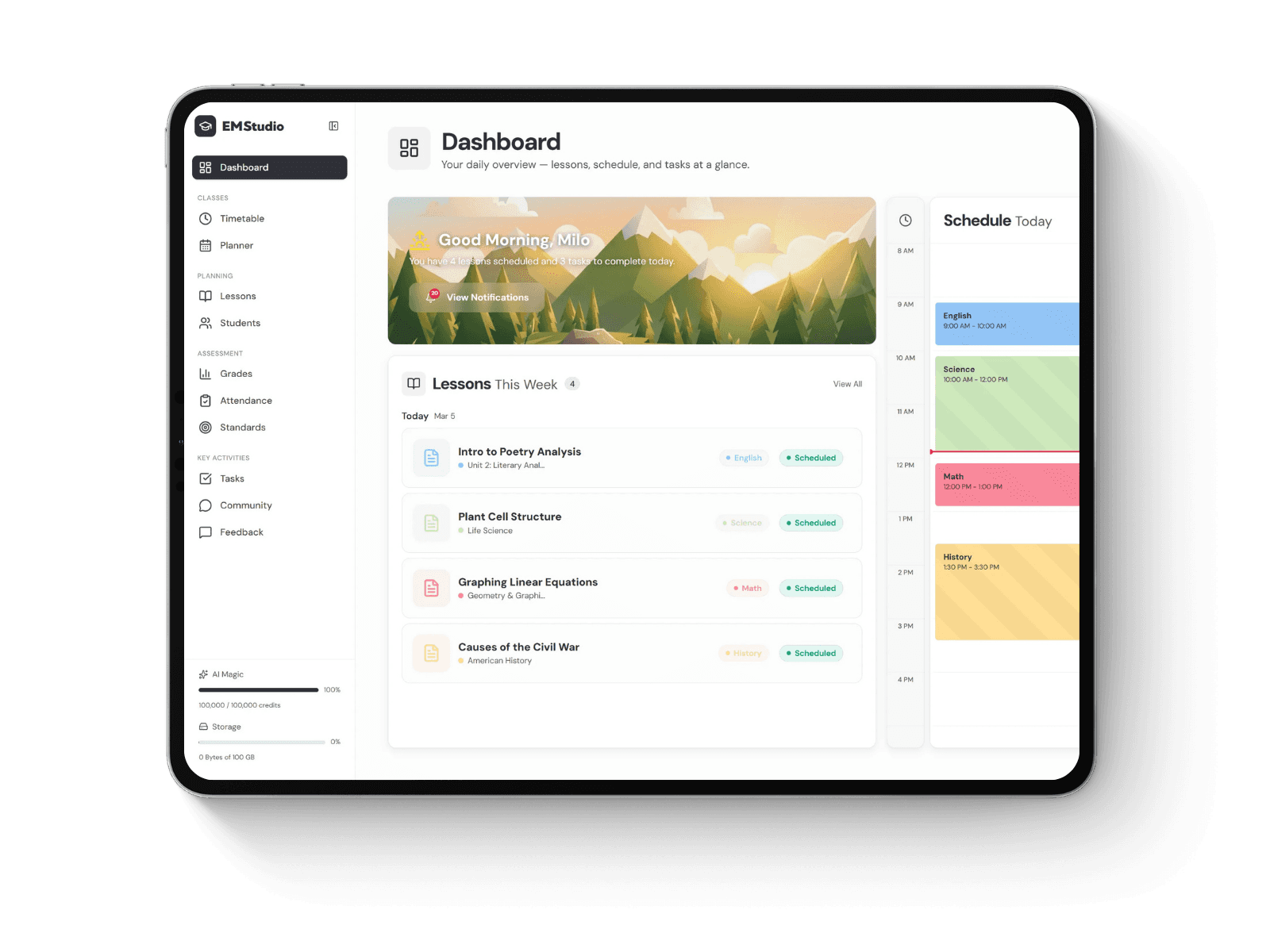
EMStudio is a free teaching management app — manage your classes, students, lessons, and more!
Learn More
Still grading everything by hand?
EMStudio is a free teaching management app — manage your classes, students, lessons, and more!
Learn More
Table of Contents
What Is an Elementary Education Major?
Before you begin your semester of full-time teaching, you complete 60-100 hours of student teaching practicum. You rotate through K-2, 3-4, and 5-6 settings. This builds your pedagogical content knowledge and exposes you to differentiated instruction across elementary levels.
Then you spend one semester teaching full-time in a partnered district. This caps your clinical experience. You move from observer to teacher.
I remember watching my mentor teacher handle a math meltdown in third grade during my practicum. She used classroom management strategies I had only read about in textbooks. That moment taught me more than any lecture on developmental psychology.
Traditional majors for teaching elementary take four years. Some universities offer five-year integrated bachelor's-master's programs. These combine initial licensure with special education or ESL endorsements. You graduate with more credentials but spend an extra year in school.
For a deeper look at coursework and clinical hours, see our comprehensive guide for K-5 educators. It breaks down exactly what to expect from your field experiences.

Why Does an Elementary Education Major Matter for Your Career?
Completing an elementary education major provides state licensure eligibility required by 94% of public school districts, significantly higher job security than emergency certification routes. Graduates access starting salaries averaging $45-65K depending on state, with pathways to instructional coaching or curriculum development that bypass the classroom while maintaining education sector benefits.
The Bureau of Labor Statistics counts 1.5 million elementary teaching positions nationwide as of 2023. Your paycheck depends heavily on geography. Mississippi teachers start around $45,400 while California districts offer median salaries near $87,000. These figures represent genuine middle-class stability backed by union protections and pension systems. Unlike volatile startup equity, this salary arrives predictably every month.
Most districts offer step-and-lane salary schedules that reward longevity and additional credits. Your degree qualifies you for these structured raises. Emergency hires often remain on provisional contracts without access to career ladders or leadership stipends. The degree pays dividends across decades, not just the first year.
Ninety-four percent of public school districts require state licensure obtainable only through accredited elementary teaching degrees. Emergency certification routes might get you hired fast, but they show 40-50% attrition within the first three years. That instability affects real children who lose their teacher mid-year. Kids do not recover the instructional time lost to constant turnover.
I watched a colleague struggle through emergency certification in my second year teaching 3rd grade. She lacked pedagogical content knowledge and classroom management strategies. By October, she was drowning in IEP compliance paperwork and differentiated instruction planning for a boy who needed visual supports. She quit before winter break. That 40-50% attrition rate is not abstract when you are the one floundering without foundation.
Your student teaching practicum provides sixteen weeks of supervised failure and recovery. You learn to adjust pacing when a lesson flops. Emergency certification throws you into solo classrooms without this safety net. That supervised practice prevents the burnout driving uncertified teachers from the profession.
Your elementary education major unlocks teacher career advancement opportunities beyond the classroom walls. Instructional coaches earn $65,000 to $85,000 supporting new teachers without the daily grading load. Curriculum specialists pull $70,000 to $90,000 designing district scope and sequences. These positions demand the credibility that comes from surviving your practicum and mastering pedagogical content knowledge.
Reading interventionists and educational technology coordinators typically land between $55,000 and $75,000. These roles require the teacher licensure preparation and early childhood certification you earn during your training. Districts rarely promote uncertified staff into these positions. They need professionals who have actually managed a classroom full of six-year-olds and lived to implement data-driven improvements.
The differentiated instruction techniques and formative assessment design you master translate outside school walls. Educational publishers hire former teachers to align textbooks to state standards. Child-centered nonprofits need staff who understand IEP compliance and developmental psychology. Your ability to break complex standards into manageable steps serves any organization serving children.
Your classroom management strategies become program management skills when you shift into nonprofit administration or educational consulting. The degree builds a portable foundation. Whether you stay for thirty years or pivot after five, you carry verified pedagogical expertise. Emergency certification cannot provide that professional flexibility or depth.

How Elementary Teacher Education Programs Build Classroom Readiness
Good programs sequence your fieldwork deliberately. You start with 30 hours observing how a veteran manages transitions and small groups. Next comes 60 hours co-teaching alongside your mentor, taking over one center at a time while she watches your questioning technique. Finally, you face 12 to 16 weeks of solo student teaching practicum. Your instructional time scales from 20 percent to full ownership of the classroom schedule.
Research tracks exactly what breaks new teachers. Candidates who skip comprehensive coursework in classroom management strategies show 40 to 50 percent higher attrition in year one. Smart elementary teacher education programs now use TeachLivE virtual simulations where you practice redirecting disruptive avatars before real kids arrive. They also run micro-teaching labs where peers give immediate feedback on your wait time and pacing under pressure.
I remember watching a student teacher in my 3rd grade classroom freeze during a fire drill her first week. She had read the emergency plans but never practiced the actual voice command to get 28 kids to the door silently. That gap between theory and performance is exactly what the clinical progression fixes.
By completion, you handle 25 to 30 students simultaneously. You implement differentiated instruction for IEP and 504 accommodations without losing the thread of your lesson. You adjust instruction on the fly using running records from that morning’s reading group. You execute parent communication protocols with confidence and run emergency drills without checking the binder. These concrete markers separate ready candidates from those who desperately need essential survival strategies for your first year.
Shulman’s framework explains why subject expertise matters. Targeted methods courses like Teaching Elementary Mathematics build pedagogical content knowledge. This cuts beginning teacher attrition far better than generic education theory ever could. An elementary education major worth your tuition prioritizes these clinical experiences. It favors content-specific methods over broad survey classes that never mention the reality of a crowded 2nd grade carpet.
Programs investing in structured clinical models, virtual practice, and data-driven feedback loops are modernizing teacher preparation for the 21st century. You leave knowing how to actually teach.

Types of Elementary Teaching Degrees and Program Formats
You have three main paths to the classroom. Each route gets you to teacher licensure preparation, but the timeline, cost, and daily grind look completely different.
Traditional four-year BA/BS programs require 120 credit hours. You pay between $15K and $80K total depending on the school. Public in-state tuition typically lands at $15K-$25K for the full degree. Private institutions charge $50K-$70K. These programs include a university-placed student teaching practicum. You do not hunt for your own placement. The school partners with local districts. You simply show up and learn classroom management strategies under a mentor teacher.
Alternative certification suits career changers who already hold a bachelor's degree. These programs last 18 to 24 months and cost $8K-$25K. You earn a provisional license first. You teach full-time while finishing coursework. Then you upgrade to standard licensure.
I mentored a student teacher in my 3rd grade classroom who entered through this route. She brought real-world patience from her previous nursing career. However, she struggled with pedagogical content knowledge because her training was condensed into weekend seminars.
Online and hybrid formats like ASU Online or Western Governors University offer flexible online university formats that let you accelerate. WGU charges roughly $3K per six-month term. Most students finish for around $15K total. These competency-based programs work well if you have bills to pay and cannot quit your day job. You move at your own speed.
However, many require you to find your own student teaching placement. That means cold-calling principals and begging for a spot while balancing coursework. You become your own placement coordinator.
Cost breakdowns vary wildly by sector. Public in-state universities offer the best value for an elementary education major at $15K-$25K total. Private colleges run $50K-$70K but sometimes offer extensive scholarship support. Competency-based models like WGU cost approximately $3K per term. Most candidates finish in five terms or fewer, totaling around $15K. You pay for time, not credits.
If you have strong study habits, you save thousands.
Grade-level authorization differs by program. A standard K-6 generalist license covers kindergarten through sixth grade. You can teach self-contained classrooms. If you want K-8 with middle school endorsement, you need an extra 12 to 18 credits in a specific content area. You might add mathematics or English. That endorsement lets you teach 7th grade algebra or 8th grade literature.
It adds a semester or two to your timeline. You walk away with deeper content knowledge for early adolescent learners.
Some programs waste your money. Accelerated online elementary teaching degrees without embedded practicum support often leave candidates scrambling for placements three weeks before student teaching starts. I have seen teachers delay graduation because they could not secure a cooperating teacher in time. Avoid any program lacking CAEP accreditation. Non-accredited degrees create headaches when you transfer states or pursue early childhood certification add-ons later. You might have to retake courses.
Your choice affects your first year survival. Teachers who complete robust student teaching practicums handle classroom chaos better. They have already tripped over their words in front of 28 kids. They have modified a lesson on the fly when the fire alarm interrupted. Alternative and online paths can work. They demand more self-advocacy. You must seek out observation hours and volunteer opportunities to build your pedagogical content knowledge.
Differentiated instruction starts with your own training. If your program rushes through assessment strategies or skips the 12-week full-time practicum, you will struggle to meet diverse learners later. Pick the format that gives you time to practice actual teaching. You need repetition with real children before you fly solo.

Core Components of Education for Elementary Teacher Development
Your coursework in education for elementary teacher preparation begins with two years of foundational theory. You will study Educational Psychology and Child Development to understand how 8-year-olds process fractions differently than 10-year-olds. You will also complete Introduction to Exceptional Learners, which demystifies the IEP process before you sit in your first actual meeting. These foundational teaching principles courses seem theoretical until you are trying to calm a dysregulated 1st grader.
Junior year shifts from theory to pedagogical content knowledge. You take Teaching Mathematics K-6, Science Methods, Diagnosis and Remediation of Reading Difficulties, and ESL Strategies. These courses teach you the specific mechanics of explaining cause and effect to 5th graders who are still learning English. You will practice actual lesson segments in front of peers before unleashing them on real children.
Senior year is your student teaching practicum. You attend a Student Teaching Seminar while working full-time in a host classroom for 12 to 16 weeks. This is where you transition from observing to actually running the literacy block while your mentor watches from the back. You will write full unit plans and attend parent conferences as the lead teacher.
Before you earn your early childhood certification, you must conquer the Praxis Elementary Education: Multiple Subjects (5001). This exam splits into four subtests: Reading and Language Arts (5002), Mathematics (5003), Social Studies (5004), and Science (5005). Most states require passing scores between 150 and 157 on each section. You usually cannot student teach until you pass at least the Reading and Math subtests.
Your program will require 60 to 100 pre-student teaching practicum hours across diverse settings. You will log time in urban Title I schools, suburban districts, and rural classrooms, often starting with observation and moving to small-group instruction. Then comes the culminating 12 to 16 week clinical experience with documented mastery of the edTPA or state-specific performance assessment. You need at least 42 points on the national edTPA version to pass. This portfolio requires video evidence of your teaching and written commentary on your instructional choices.
Every solid elementary education major completes three non-negotiable courses. Multicultural Education prepares you for diverse classrooms. Classroom Management and Behavior Support gives you the systems to prevent chaos. Assessment and Data Literacy teaches you to read exit tickets and actually adjust tomorrow's lesson. These build your teacher licensure preparation beyond content knowledge into actual classroom management strategies.
Data literacy means more than calculating class averages. You will learn to disaggregate reading fluency scores by subgroup and pinpoint exactly which phonics skill your 3rd graders missed. This drives your differentiated instruction and proves to administrators that you respond to evidence.
I learned the value of that management coursework during my 2nd grade placement in East Nashville. I had the math manipulatives ready and the exit ticket planned. But I lost twelve minutes of instruction time because I had not yet mastered transition signals. That semester I dove deep into classroom management techniques for new teachers and finally understood that differentiated instruction fails without solid procedures first. Your training is not complete until you can teach a lesson while simultaneously scanning for the kid who needs a sensory break.

What Are the Admission and Graduation Requirements?
Admission requires a 2.75-3.0 GPA, passing Praxis Core scores (Reading 156, Writing 162, Math 150), and background clearance. Graduation needs completion of 120 credits, 12-16 weeks of full-time student teaching, and passing edTPA portfolio scores (42+ nationally) or state-specific performance assessments to qualify for initial licensure.
Most programs set the bar at a 2.75 cumulative GPA. Competitive universities demand 3.0 or higher in your prerequisite coursework. You must clear a background check and fingerprinting through state DOE channels before entering any school building.
The Praxis Core Academic Skills for Educators test surprises candidates. You need a 156 in Reading, 162 in Writing, and 150 in Mathematics. Some states accept SAT or ACT exemptions if you tested high enough within the last ten years.
Background clearance moves slowly. Submit fingerprints through state DOE channels the moment you apply. Processing takes four to eight weeks, and you cannot observe in a classroom without the clearance card in hand.
Once you hit 45 to 60 credits, you apply for upper-division status. This gatekeeps your methods courses and field experiences. Every education course requires a C or better; one C-minus stalls your progression until you retake the class.
The negative TB test proves you can work safely with children. Most clinics charge $20 to $40 for the skin test. Liability insurance runs $30 to $50 annually and covers you through the student teaching practicum.
I remember standing in my 3rd grade classroom during my student teaching practicum, realizing my liability insurance card was in my binder right next to my negative TB clearance. That paperwork felt like bureaucracy until a student tripped during a relay race. Then that $40 policy was the only thing standing between me and a lawsuit.
Majors for teaching elementary vary by state. Some programs offer unified early childhood certification covering birth through grade 3. Others split into elementary education focusing on grades K-6. Check your state’s grade band requirements before selecting your path.
Early childhood certification candidates complete additional coursework in developmental psychology and play-based learning. These classes focus on pre-literacy skills and social-emotional growth. The requirements add 6 to 9 credits beyond the standard elementary pathway.
Those 120 to 130 credits split into three buckets. General education consumes 40 to 50 credits. Your professional education sequence takes another 40 to 50. The remainder covers your concentration or minor coursework.
Your methods courses drill specific classroom management strategies and differentiated instruction. You will learn to modify content for English learners and students with IEPs. These skills appear in your edTPA commentary and in daily student teaching evaluations.
This sequence forms your teacher licensure preparation. You bridge theory into practice while building pedagogical content knowledge. Each assignment connects directly to the evaluation rubrics used during your student teaching practicum.
As an elementary education major, you will complete 120 to 130 credits total. The edTPA portfolio requires a 42 or higher out of 75 to satisfy most elementary teacher certification requirements. You also need 12 to 16 weeks of documented student teaching evaluated through the Danielson Framework.
The Danielson Framework evaluates your teaching across four domains. Administrators score your planning and preparation, classroom environment, instruction, and professional responsibilities. Each domain includes rubrics ranging from unsatisfactory to distinguished.
The edTPA portfolio consumes your final semester. You film yourself teaching and write commentaries analyzing your decisions. That 42-point threshold separates candidates who proceed from those who enter remediation.
Your student teaching practicum spans 12 to 16 weeks of full-time work. You arrive when the cooperating teacher arrives and leave when they leave. You are essentially a full-time teacher without the paycheck.
Many candidates cruise through freshman year then hit the methods sequence hard. Suddenly you are writing lesson plans while taking 18 credits. That is when GPAs slip below 2.75 and trigger automatic program suspension.
Failing the edTPA by three or more points is devastating. You must enroll in a remediation course and resubmit during the next testing window. This pushes your graduation back by one semester minimum.

Getting Started: Selecting the Right Elementary Education Program
Choosing where to earn your elementary education major shapes every year that follows. You need a program that fits your geography, finances, and teaching style. Follow these steps to choosing a teacher preparation program to avoid expensive missteps.
Begin with accreditation reality. Visit the CAEP website and run their program search tool. Verify both CAEP accreditation and your specific state's program approval status.
Unaccredited programs promise flexibility but trap you in one state. Your license won't transfer across state lines. You could end up re-taking courses for reciprocity.
CAEP standards ensure your teacher licensure preparation meets national benchmarks. Without this seal, you risk completing a degree that neighboring states reject outright.
Check the fine print on state approval. Some online programs hold national accreditation but lack specific state endorsements. You need both.
Next, map your student teaching practicum placement model. Universities offer three distinct paths with wildly different logistics.
University-placed models guarantee a spot but might place you thirty miles from home. Self-placement lets you use local networks, yet offers zero guarantee of finding a cooperating teacher. Paid residencies provide one-year apprenticeships with twenty to thirty thousand dollar stipends, though competition remains fierce.
Residency models embed you in one classroom for twelve months. You learn classroom management strategies gradually. You avoid being thrown in for twelve weeks.
If you need early childhood certification specifically, confirm the program places candidates in K-2 classrooms. Some programs default to upper elementary placements.
Calculate your return on investment before signing loan papers. Research starting teacher salaries in your target state, typically forty-five to sixty-five thousand dollars.
Subtract total program cost from that salary figure. Aim for a debt-to-income ratio below twelve percent.
A thirty-thousand-dollar loan on a forty-five-thousand-dollar salary can strain your budget for years. If your projected debt feels unmanageable, consider consulting a debt reduction service provider to explore repayment strategies or restructuring options before committing to a program. Keep your debt under twelve percent of your starting income.
Prioritize programs with strong district partnerships in your preferred geographic area. These connections often lead directly to job offers. Local principals trust graduates they have already watched teach.
Test your readiness through free elementary education courses online before committing financially. Try Coursera's "Foundations of Teaching for Learning" from the University of London or edX's "Introduction to Family Engagement in Education" from the University of Chicago.
These courses reveal whether you actually enjoy building pedagogical content knowledge or dread reading about differentiated instruction theories.
I sat through a Saturday morning module on classroom management strategies while my third graders were at soccer practice last fall. That single experience confirmed I could handle the academic workload while teaching full time.
Audit these courses to test your time management. If you cannot complete a free six-week module, reconsider jumping into a full course load.
Draw your own flowchart on paper. Begin with the question of whether you can afford to work unpaid for a semester. If no, pursue only paid residency models.
Finally, conduct informational interviews with current students. Ask specifically about practicum support quality.
Ask how quickly the university responds when a cooperating teacher cancels. Find out if you get a backup placement or are left scrambling.
Schedule an observation day in partner schools. Watch how the program's graduates actually teach. Look for evidence of differentiated instruction in action.
Notice whether students work in groups or sit in rows. Check if technology integration looks seamless or forced.
Verify that the program maintains eighty-five percent or higher first-time pass rates on state licensure exams. This metric indicates robust preparation.
Solid preparation in early childhood pathways matters too if you plan to teach the primary grades. Ask to see data broken down by endorsement area.
Your program selection determines your first job offer and your debt burden. Choose with your eyes open to the financial and geographic realities.
The right program feels like a professional home, not just a credential factory. Trust your gut when you visit the campus or attend a virtual info session.

Should You Try Elementary Education Major?
Only if you like noise. Only if you can handle twenty-five kids asking why the butterfly died while you’re trying to teach regrouping. I’ve watched bright college students ace their pedagogical content knowledge exams and still freeze when a first grader throws up on the rug. This major isn’t about loving children in theory. It’s about surviving the bad days so you can shape the good ones.
Before you send that application, spend three full days in a real classroom. Not the gifted cluster. Not the shiny lab school downtown. Sit in the back of a Title I third grade room during February. If you leave exhausted but already planning how you’d rearrange the reading corner, you’ve got your answer.
So here’s the real question: when you picture your Monday morning ten years from now, do you see spreadsheets or small hands raised high?

What Is an Elementary Education Major?
Before you begin your semester of full-time teaching, you complete 60-100 hours of student teaching practicum. You rotate through K-2, 3-4, and 5-6 settings. This builds your pedagogical content knowledge and exposes you to differentiated instruction across elementary levels.
Then you spend one semester teaching full-time in a partnered district. This caps your clinical experience. You move from observer to teacher.
I remember watching my mentor teacher handle a math meltdown in third grade during my practicum. She used classroom management strategies I had only read about in textbooks. That moment taught me more than any lecture on developmental psychology.
Traditional majors for teaching elementary take four years. Some universities offer five-year integrated bachelor's-master's programs. These combine initial licensure with special education or ESL endorsements. You graduate with more credentials but spend an extra year in school.
For a deeper look at coursework and clinical hours, see our comprehensive guide for K-5 educators. It breaks down exactly what to expect from your field experiences.
Why Does an Elementary Education Major Matter for Your Career?
Completing an elementary education major provides state licensure eligibility required by 94% of public school districts, significantly higher job security than emergency certification routes. Graduates access starting salaries averaging $45-65K depending on state, with pathways to instructional coaching or curriculum development that bypass the classroom while maintaining education sector benefits.
The Bureau of Labor Statistics counts 1.5 million elementary teaching positions nationwide as of 2023. Your paycheck depends heavily on geography. Mississippi teachers start around $45,400 while California districts offer median salaries near $87,000. These figures represent genuine middle-class stability backed by union protections and pension systems. Unlike volatile startup equity, this salary arrives predictably every month.
Most districts offer step-and-lane salary schedules that reward longevity and additional credits. Your degree qualifies you for these structured raises. Emergency hires often remain on provisional contracts without access to career ladders or leadership stipends. The degree pays dividends across decades, not just the first year.
Ninety-four percent of public school districts require state licensure obtainable only through accredited elementary teaching degrees. Emergency certification routes might get you hired fast, but they show 40-50% attrition within the first three years. That instability affects real children who lose their teacher mid-year. Kids do not recover the instructional time lost to constant turnover.
I watched a colleague struggle through emergency certification in my second year teaching 3rd grade. She lacked pedagogical content knowledge and classroom management strategies. By October, she was drowning in IEP compliance paperwork and differentiated instruction planning for a boy who needed visual supports. She quit before winter break. That 40-50% attrition rate is not abstract when you are the one floundering without foundation.
Your student teaching practicum provides sixteen weeks of supervised failure and recovery. You learn to adjust pacing when a lesson flops. Emergency certification throws you into solo classrooms without this safety net. That supervised practice prevents the burnout driving uncertified teachers from the profession.
Your elementary education major unlocks teacher career advancement opportunities beyond the classroom walls. Instructional coaches earn $65,000 to $85,000 supporting new teachers without the daily grading load. Curriculum specialists pull $70,000 to $90,000 designing district scope and sequences. These positions demand the credibility that comes from surviving your practicum and mastering pedagogical content knowledge.
Reading interventionists and educational technology coordinators typically land between $55,000 and $75,000. These roles require the teacher licensure preparation and early childhood certification you earn during your training. Districts rarely promote uncertified staff into these positions. They need professionals who have actually managed a classroom full of six-year-olds and lived to implement data-driven improvements.
The differentiated instruction techniques and formative assessment design you master translate outside school walls. Educational publishers hire former teachers to align textbooks to state standards. Child-centered nonprofits need staff who understand IEP compliance and developmental psychology. Your ability to break complex standards into manageable steps serves any organization serving children.
Your classroom management strategies become program management skills when you shift into nonprofit administration or educational consulting. The degree builds a portable foundation. Whether you stay for thirty years or pivot after five, you carry verified pedagogical expertise. Emergency certification cannot provide that professional flexibility or depth.
How Elementary Teacher Education Programs Build Classroom Readiness
Good programs sequence your fieldwork deliberately. You start with 30 hours observing how a veteran manages transitions and small groups. Next comes 60 hours co-teaching alongside your mentor, taking over one center at a time while she watches your questioning technique. Finally, you face 12 to 16 weeks of solo student teaching practicum. Your instructional time scales from 20 percent to full ownership of the classroom schedule.
Research tracks exactly what breaks new teachers. Candidates who skip comprehensive coursework in classroom management strategies show 40 to 50 percent higher attrition in year one. Smart elementary teacher education programs now use TeachLivE virtual simulations where you practice redirecting disruptive avatars before real kids arrive. They also run micro-teaching labs where peers give immediate feedback on your wait time and pacing under pressure.
I remember watching a student teacher in my 3rd grade classroom freeze during a fire drill her first week. She had read the emergency plans but never practiced the actual voice command to get 28 kids to the door silently. That gap between theory and performance is exactly what the clinical progression fixes.
By completion, you handle 25 to 30 students simultaneously. You implement differentiated instruction for IEP and 504 accommodations without losing the thread of your lesson. You adjust instruction on the fly using running records from that morning’s reading group. You execute parent communication protocols with confidence and run emergency drills without checking the binder. These concrete markers separate ready candidates from those who desperately need essential survival strategies for your first year.
Shulman’s framework explains why subject expertise matters. Targeted methods courses like Teaching Elementary Mathematics build pedagogical content knowledge. This cuts beginning teacher attrition far better than generic education theory ever could. An elementary education major worth your tuition prioritizes these clinical experiences. It favors content-specific methods over broad survey classes that never mention the reality of a crowded 2nd grade carpet.
Programs investing in structured clinical models, virtual practice, and data-driven feedback loops are modernizing teacher preparation for the 21st century. You leave knowing how to actually teach.
Types of Elementary Teaching Degrees and Program Formats
You have three main paths to the classroom. Each route gets you to teacher licensure preparation, but the timeline, cost, and daily grind look completely different.
Traditional four-year BA/BS programs require 120 credit hours. You pay between $15K and $80K total depending on the school. Public in-state tuition typically lands at $15K-$25K for the full degree. Private institutions charge $50K-$70K. These programs include a university-placed student teaching practicum. You do not hunt for your own placement. The school partners with local districts. You simply show up and learn classroom management strategies under a mentor teacher.
Alternative certification suits career changers who already hold a bachelor's degree. These programs last 18 to 24 months and cost $8K-$25K. You earn a provisional license first. You teach full-time while finishing coursework. Then you upgrade to standard licensure.
I mentored a student teacher in my 3rd grade classroom who entered through this route. She brought real-world patience from her previous nursing career. However, she struggled with pedagogical content knowledge because her training was condensed into weekend seminars.
Online and hybrid formats like ASU Online or Western Governors University offer flexible online university formats that let you accelerate. WGU charges roughly $3K per six-month term. Most students finish for around $15K total. These competency-based programs work well if you have bills to pay and cannot quit your day job. You move at your own speed.
However, many require you to find your own student teaching placement. That means cold-calling principals and begging for a spot while balancing coursework. You become your own placement coordinator.
Cost breakdowns vary wildly by sector. Public in-state universities offer the best value for an elementary education major at $15K-$25K total. Private colleges run $50K-$70K but sometimes offer extensive scholarship support. Competency-based models like WGU cost approximately $3K per term. Most candidates finish in five terms or fewer, totaling around $15K. You pay for time, not credits.
If you have strong study habits, you save thousands.
Grade-level authorization differs by program. A standard K-6 generalist license covers kindergarten through sixth grade. You can teach self-contained classrooms. If you want K-8 with middle school endorsement, you need an extra 12 to 18 credits in a specific content area. You might add mathematics or English. That endorsement lets you teach 7th grade algebra or 8th grade literature.
It adds a semester or two to your timeline. You walk away with deeper content knowledge for early adolescent learners.
Some programs waste your money. Accelerated online elementary teaching degrees without embedded practicum support often leave candidates scrambling for placements three weeks before student teaching starts. I have seen teachers delay graduation because they could not secure a cooperating teacher in time. Avoid any program lacking CAEP accreditation. Non-accredited degrees create headaches when you transfer states or pursue early childhood certification add-ons later. You might have to retake courses.
Your choice affects your first year survival. Teachers who complete robust student teaching practicums handle classroom chaos better. They have already tripped over their words in front of 28 kids. They have modified a lesson on the fly when the fire alarm interrupted. Alternative and online paths can work. They demand more self-advocacy. You must seek out observation hours and volunteer opportunities to build your pedagogical content knowledge.
Differentiated instruction starts with your own training. If your program rushes through assessment strategies or skips the 12-week full-time practicum, you will struggle to meet diverse learners later. Pick the format that gives you time to practice actual teaching. You need repetition with real children before you fly solo.
Core Components of Education for Elementary Teacher Development
Your coursework in education for elementary teacher preparation begins with two years of foundational theory. You will study Educational Psychology and Child Development to understand how 8-year-olds process fractions differently than 10-year-olds. You will also complete Introduction to Exceptional Learners, which demystifies the IEP process before you sit in your first actual meeting. These foundational teaching principles courses seem theoretical until you are trying to calm a dysregulated 1st grader.
Junior year shifts from theory to pedagogical content knowledge. You take Teaching Mathematics K-6, Science Methods, Diagnosis and Remediation of Reading Difficulties, and ESL Strategies. These courses teach you the specific mechanics of explaining cause and effect to 5th graders who are still learning English. You will practice actual lesson segments in front of peers before unleashing them on real children.
Senior year is your student teaching practicum. You attend a Student Teaching Seminar while working full-time in a host classroom for 12 to 16 weeks. This is where you transition from observing to actually running the literacy block while your mentor watches from the back. You will write full unit plans and attend parent conferences as the lead teacher.
Before you earn your early childhood certification, you must conquer the Praxis Elementary Education: Multiple Subjects (5001). This exam splits into four subtests: Reading and Language Arts (5002), Mathematics (5003), Social Studies (5004), and Science (5005). Most states require passing scores between 150 and 157 on each section. You usually cannot student teach until you pass at least the Reading and Math subtests.
Your program will require 60 to 100 pre-student teaching practicum hours across diverse settings. You will log time in urban Title I schools, suburban districts, and rural classrooms, often starting with observation and moving to small-group instruction. Then comes the culminating 12 to 16 week clinical experience with documented mastery of the edTPA or state-specific performance assessment. You need at least 42 points on the national edTPA version to pass. This portfolio requires video evidence of your teaching and written commentary on your instructional choices.
Every solid elementary education major completes three non-negotiable courses. Multicultural Education prepares you for diverse classrooms. Classroom Management and Behavior Support gives you the systems to prevent chaos. Assessment and Data Literacy teaches you to read exit tickets and actually adjust tomorrow's lesson. These build your teacher licensure preparation beyond content knowledge into actual classroom management strategies.
Data literacy means more than calculating class averages. You will learn to disaggregate reading fluency scores by subgroup and pinpoint exactly which phonics skill your 3rd graders missed. This drives your differentiated instruction and proves to administrators that you respond to evidence.
I learned the value of that management coursework during my 2nd grade placement in East Nashville. I had the math manipulatives ready and the exit ticket planned. But I lost twelve minutes of instruction time because I had not yet mastered transition signals. That semester I dove deep into classroom management techniques for new teachers and finally understood that differentiated instruction fails without solid procedures first. Your training is not complete until you can teach a lesson while simultaneously scanning for the kid who needs a sensory break.
What Are the Admission and Graduation Requirements?
Admission requires a 2.75-3.0 GPA, passing Praxis Core scores (Reading 156, Writing 162, Math 150), and background clearance. Graduation needs completion of 120 credits, 12-16 weeks of full-time student teaching, and passing edTPA portfolio scores (42+ nationally) or state-specific performance assessments to qualify for initial licensure.
Most programs set the bar at a 2.75 cumulative GPA. Competitive universities demand 3.0 or higher in your prerequisite coursework. You must clear a background check and fingerprinting through state DOE channels before entering any school building.
The Praxis Core Academic Skills for Educators test surprises candidates. You need a 156 in Reading, 162 in Writing, and 150 in Mathematics. Some states accept SAT or ACT exemptions if you tested high enough within the last ten years.
Background clearance moves slowly. Submit fingerprints through state DOE channels the moment you apply. Processing takes four to eight weeks, and you cannot observe in a classroom without the clearance card in hand.
Once you hit 45 to 60 credits, you apply for upper-division status. This gatekeeps your methods courses and field experiences. Every education course requires a C or better; one C-minus stalls your progression until you retake the class.
The negative TB test proves you can work safely with children. Most clinics charge $20 to $40 for the skin test. Liability insurance runs $30 to $50 annually and covers you through the student teaching practicum.
I remember standing in my 3rd grade classroom during my student teaching practicum, realizing my liability insurance card was in my binder right next to my negative TB clearance. That paperwork felt like bureaucracy until a student tripped during a relay race. Then that $40 policy was the only thing standing between me and a lawsuit.
Majors for teaching elementary vary by state. Some programs offer unified early childhood certification covering birth through grade 3. Others split into elementary education focusing on grades K-6. Check your state’s grade band requirements before selecting your path.
Early childhood certification candidates complete additional coursework in developmental psychology and play-based learning. These classes focus on pre-literacy skills and social-emotional growth. The requirements add 6 to 9 credits beyond the standard elementary pathway.
Those 120 to 130 credits split into three buckets. General education consumes 40 to 50 credits. Your professional education sequence takes another 40 to 50. The remainder covers your concentration or minor coursework.
Your methods courses drill specific classroom management strategies and differentiated instruction. You will learn to modify content for English learners and students with IEPs. These skills appear in your edTPA commentary and in daily student teaching evaluations.
This sequence forms your teacher licensure preparation. You bridge theory into practice while building pedagogical content knowledge. Each assignment connects directly to the evaluation rubrics used during your student teaching practicum.
As an elementary education major, you will complete 120 to 130 credits total. The edTPA portfolio requires a 42 or higher out of 75 to satisfy most elementary teacher certification requirements. You also need 12 to 16 weeks of documented student teaching evaluated through the Danielson Framework.
The Danielson Framework evaluates your teaching across four domains. Administrators score your planning and preparation, classroom environment, instruction, and professional responsibilities. Each domain includes rubrics ranging from unsatisfactory to distinguished.
The edTPA portfolio consumes your final semester. You film yourself teaching and write commentaries analyzing your decisions. That 42-point threshold separates candidates who proceed from those who enter remediation.
Your student teaching practicum spans 12 to 16 weeks of full-time work. You arrive when the cooperating teacher arrives and leave when they leave. You are essentially a full-time teacher without the paycheck.
Many candidates cruise through freshman year then hit the methods sequence hard. Suddenly you are writing lesson plans while taking 18 credits. That is when GPAs slip below 2.75 and trigger automatic program suspension.
Failing the edTPA by three or more points is devastating. You must enroll in a remediation course and resubmit during the next testing window. This pushes your graduation back by one semester minimum.
Getting Started: Selecting the Right Elementary Education Program
Choosing where to earn your elementary education major shapes every year that follows. You need a program that fits your geography, finances, and teaching style. Follow these steps to choosing a teacher preparation program to avoid expensive missteps.
Begin with accreditation reality. Visit the CAEP website and run their program search tool. Verify both CAEP accreditation and your specific state's program approval status.
Unaccredited programs promise flexibility but trap you in one state. Your license won't transfer across state lines. You could end up re-taking courses for reciprocity.
CAEP standards ensure your teacher licensure preparation meets national benchmarks. Without this seal, you risk completing a degree that neighboring states reject outright.
Check the fine print on state approval. Some online programs hold national accreditation but lack specific state endorsements. You need both.
Next, map your student teaching practicum placement model. Universities offer three distinct paths with wildly different logistics.
University-placed models guarantee a spot but might place you thirty miles from home. Self-placement lets you use local networks, yet offers zero guarantee of finding a cooperating teacher. Paid residencies provide one-year apprenticeships with twenty to thirty thousand dollar stipends, though competition remains fierce.
Residency models embed you in one classroom for twelve months. You learn classroom management strategies gradually. You avoid being thrown in for twelve weeks.
If you need early childhood certification specifically, confirm the program places candidates in K-2 classrooms. Some programs default to upper elementary placements.
Calculate your return on investment before signing loan papers. Research starting teacher salaries in your target state, typically forty-five to sixty-five thousand dollars.
Subtract total program cost from that salary figure. Aim for a debt-to-income ratio below twelve percent.
A thirty-thousand-dollar loan on a forty-five-thousand-dollar salary can strain your budget for years. If your projected debt feels unmanageable, consider consulting a debt reduction service provider to explore repayment strategies or restructuring options before committing to a program. Keep your debt under twelve percent of your starting income.
Prioritize programs with strong district partnerships in your preferred geographic area. These connections often lead directly to job offers. Local principals trust graduates they have already watched teach.
Test your readiness through free elementary education courses online before committing financially. Try Coursera's "Foundations of Teaching for Learning" from the University of London or edX's "Introduction to Family Engagement in Education" from the University of Chicago.
These courses reveal whether you actually enjoy building pedagogical content knowledge or dread reading about differentiated instruction theories.
I sat through a Saturday morning module on classroom management strategies while my third graders were at soccer practice last fall. That single experience confirmed I could handle the academic workload while teaching full time.
Audit these courses to test your time management. If you cannot complete a free six-week module, reconsider jumping into a full course load.
Draw your own flowchart on paper. Begin with the question of whether you can afford to work unpaid for a semester. If no, pursue only paid residency models.
Finally, conduct informational interviews with current students. Ask specifically about practicum support quality.
Ask how quickly the university responds when a cooperating teacher cancels. Find out if you get a backup placement or are left scrambling.
Schedule an observation day in partner schools. Watch how the program's graduates actually teach. Look for evidence of differentiated instruction in action.
Notice whether students work in groups or sit in rows. Check if technology integration looks seamless or forced.
Verify that the program maintains eighty-five percent or higher first-time pass rates on state licensure exams. This metric indicates robust preparation.
Solid preparation in early childhood pathways matters too if you plan to teach the primary grades. Ask to see data broken down by endorsement area.
Your program selection determines your first job offer and your debt burden. Choose with your eyes open to the financial and geographic realities.
The right program feels like a professional home, not just a credential factory. Trust your gut when you visit the campus or attend a virtual info session.
Should You Try Elementary Education Major?
Only if you like noise. Only if you can handle twenty-five kids asking why the butterfly died while you’re trying to teach regrouping. I’ve watched bright college students ace their pedagogical content knowledge exams and still freeze when a first grader throws up on the rug. This major isn’t about loving children in theory. It’s about surviving the bad days so you can shape the good ones.
Before you send that application, spend three full days in a real classroom. Not the gifted cluster. Not the shiny lab school downtown. Sit in the back of a Title I third grade room during February. If you leave exhausted but already planning how you’d rearrange the reading corner, you’ve got your answer.
So here’s the real question: when you picture your Monday morning ten years from now, do you see spreadsheets or small hands raised high?
Still grading everything by hand?
EMStudio is a free teaching management app — manage your classes, students, lessons, and more!
Learn More
Still grading everything by hand?
EMStudio is a free teaching management app — manage your classes, students, lessons, and more!
Learn More





Notion4Teachers
Notion templates to simplify administrative tasks and enhance your teaching experience.



2026 Notion4Teachers. All Rights Reserved.
Notion4Teachers
Notion templates to simplify administrative tasks and enhance your teaching experience.
2026 Notion4Teachers. All Rights Reserved.
Notion4Teachers
Notion templates to simplify administrative tasks and enhance your teaching experience.
2026 Notion4Teachers. All Rights Reserved.